CLAUSEN’S COMMENTARIES
on
MORALS and DOGMA
TABLE OF CONTENTS
Preface ...............................................................xvii
What Is the Scottish Rite? ...................................... 1
Our Historical Roots ............................................. 9
Secret Master-Fourth Degree ............................... 19
Perfect Master-Fifth Degree ................................. 25
Intimate Secretary-Sixth Degree ........................... 31
Provost and Judge-Seventh Degree....................... 39
Intendant of the Building-Eighth Degree ............... 45
Elu of the Nine-Ninth Degree .............................. 51
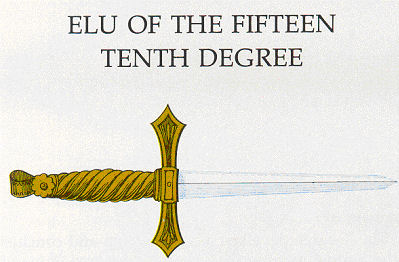
Elu of the Fifteen-Tenth Degree ........................... 57
Elu of the Twelve-Eleventh Degree....................... 63
Master Architect-Twelfth Degree .......................... 69
Royal Arch of Solomon-Thirteenth Degree............. 75
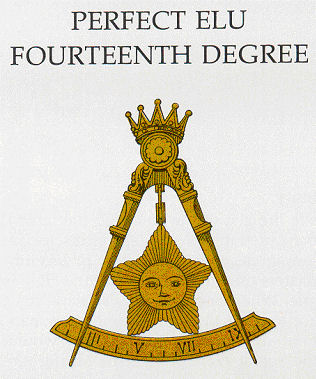
Perfect Elu-Fourteenth Degree ............................. 81
Knight of the East, of the Sword or
of the Eagle-Fifteenth Degree............................ 89
Prince of Jerusalem-Sixteenth Degree .................... 95
Knight of the East and West-Seventeenth Degree ...101
Knight Rose Croix-Eighteenth Degree ...................107
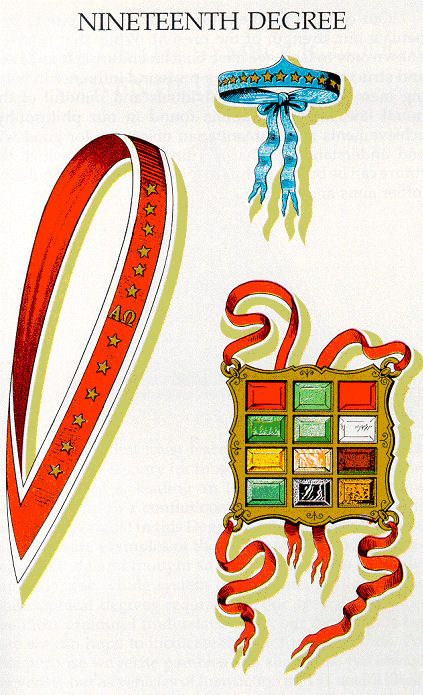
Pontiff-Nineteenth Degree ................................... 115
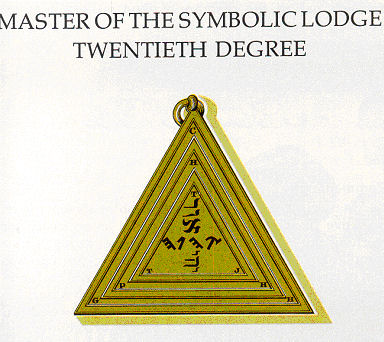
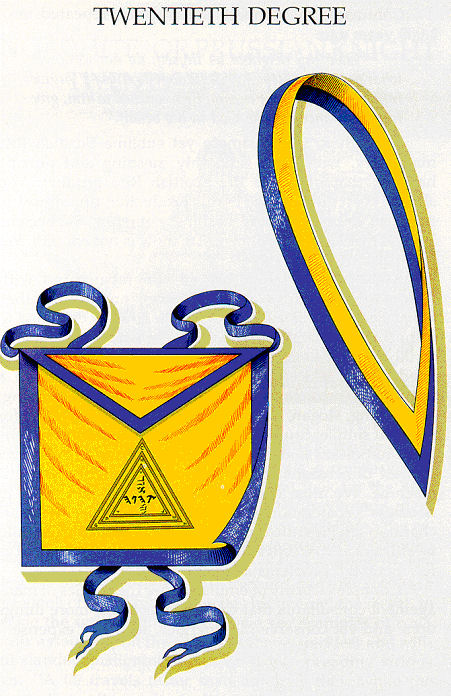
Master of the Symbolic Lodge-Twentieth Degree ....121
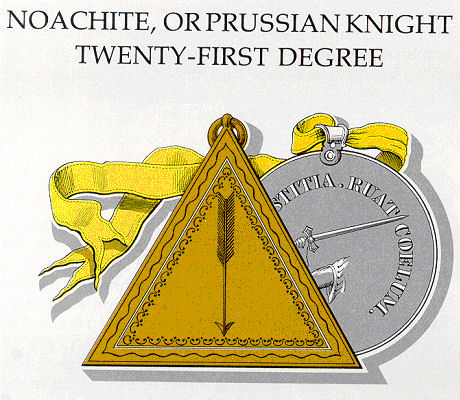
Noachite, or Prussian Knight-Twenty-first Degree ..127
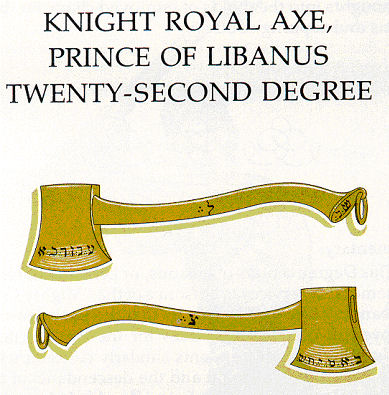
Knight Royal Axe, Prince of Libanus
Twenty-second Degree ....................................... 133
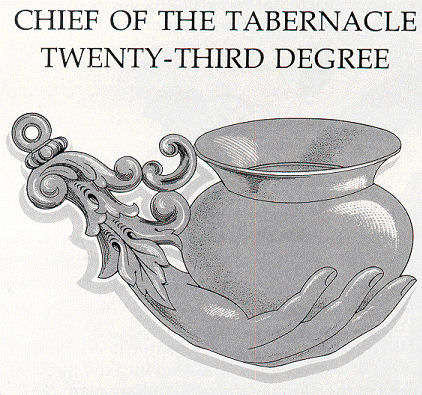
Chief of the Tabernacle-Twenty-third Degree .........139
Prince of the Tabernacle-Twenty-fourth Degree ......145
Knight of the Brazen Serpent-Twenty-fifth Degree..151
Prince of Mercy-Twenty-sixth Degree .................... 159
Knight Commander of the Temple
Twenty-seventh Degree .....................................165
Knight of the Sun, Adept-Twenty-eighth Degree ....171
Scottish Knight of Saint Andrew
Twenty-ninth Degree ......................................... 177
Knight Kadosh or Knight of the White and
Black Eagle-Thirtieth Degree .............................183
Inspector Inquisitor-Thirty-first Degree .................. 195
Master of the Royal Secret-Thirty-second Degree .... 203
Index......... ... . ... . ........ . ... . ... ... ... ..... . . . ........ .... ..... ..251
Xlll
ILLUSTRATIONS
House of the Temple ............................................................. v
Henry C. Clausen, 33°
Sovereign Grand Commander ..............................................ix
Map of Early Days................................................................. 6
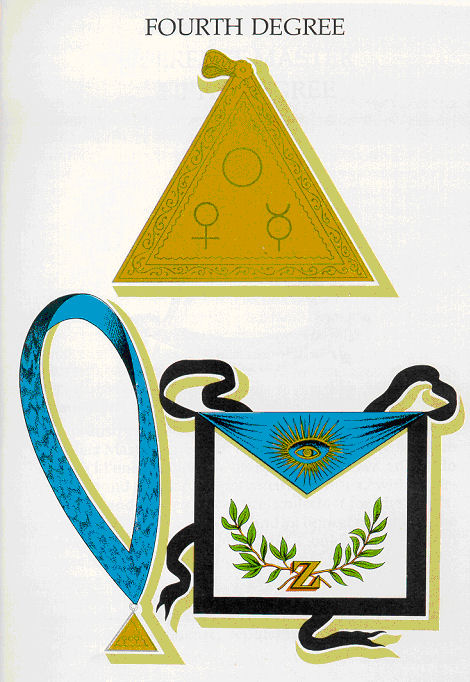
Fourth Degree Symbol, Collar, Apron ............. ..... 19, 23
Plate ......................................... .... 21
Fifth Degree Symbol, Collar, Apron ........ 25, 29
Plate........... 27
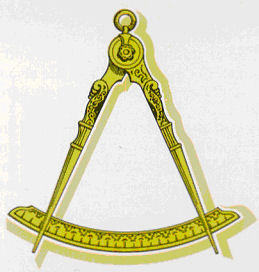
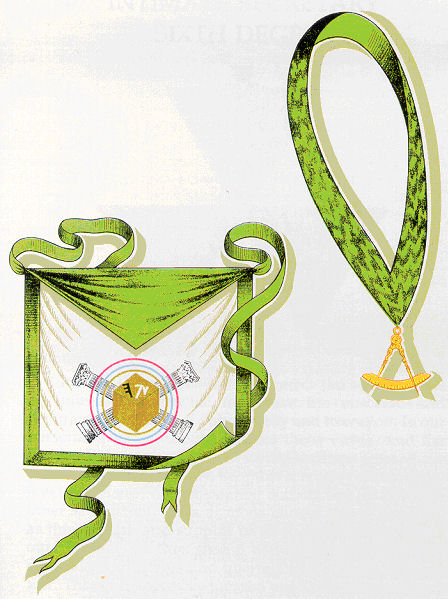
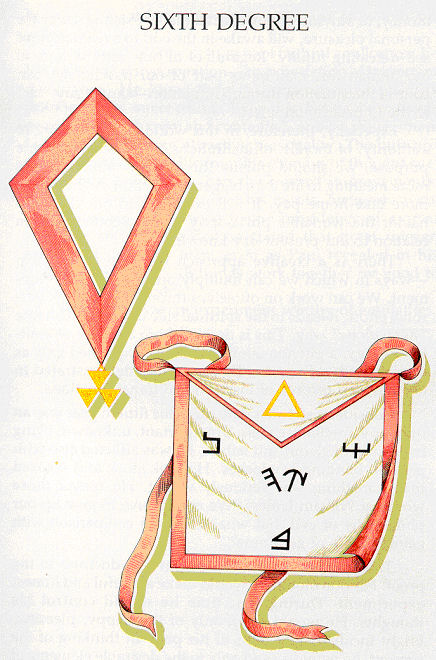
Sixth Degree Symbol, Cordon, Apron ................ 31, 35
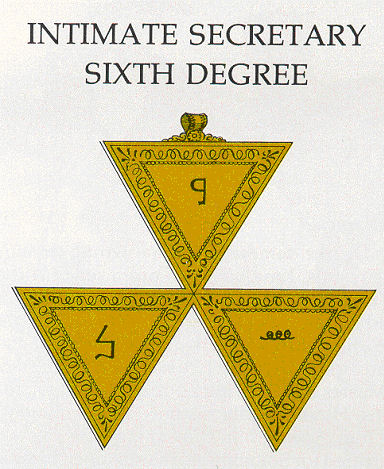
Plate .............................................. 33
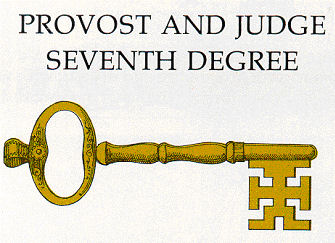
Seventh Degree Symbol, Collar, Apron ..................39, 43
Plate .............................................. 41
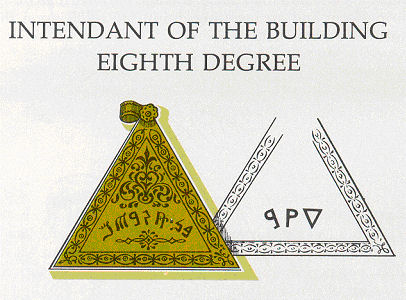
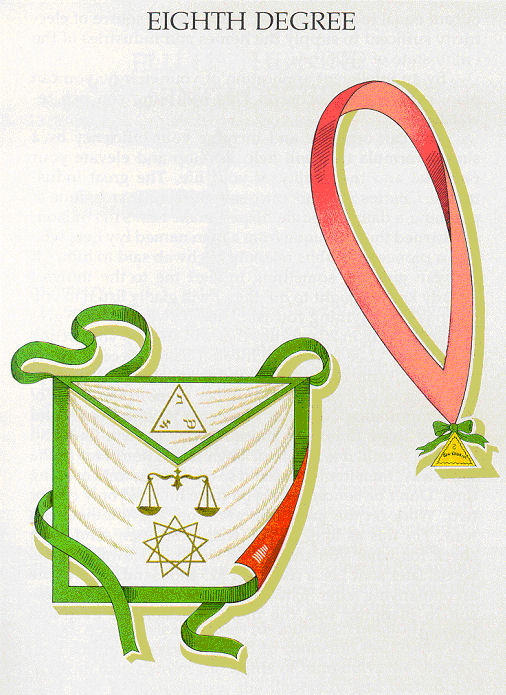
Eighth Degree Symbol, Collar, Apron ..................45, 49
Plate .............................................. 47
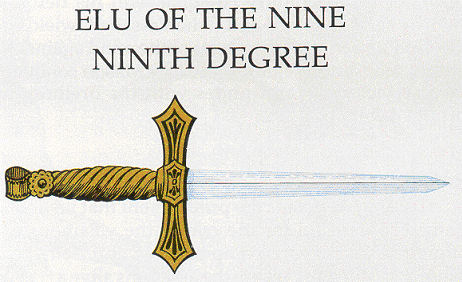
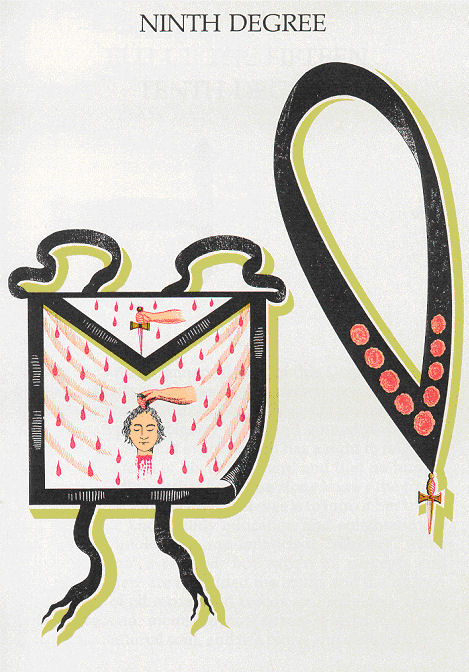
Ninth Degree Symbol, Cordon, Apron ................ 51, 55
Plate .............................................. 53
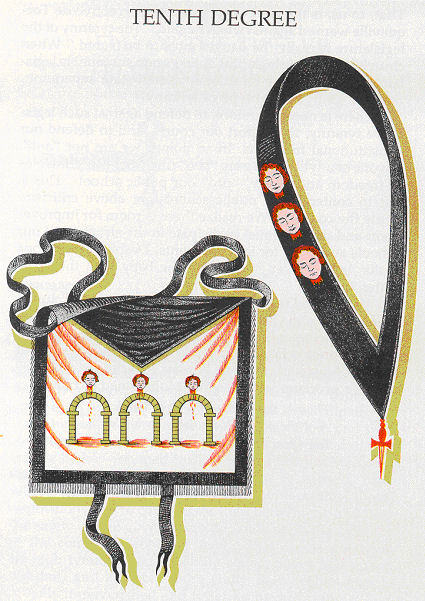
Tenth Degree Symbol, Cordon, Apron ................57, 61
Plate .............................................. 59
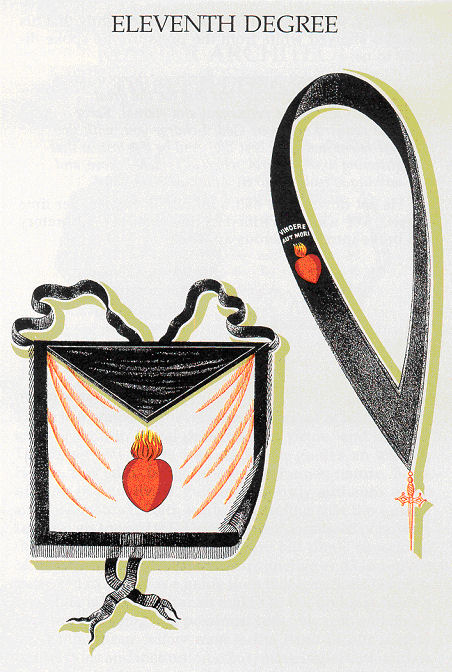
Eleventh Degree Symbol, Cordon, Apron ................ 63, 67
Plate .............................................. 65
Twelfth Degree Symbol, Cordon, Apron ................ 69, 73
Plate .............................................. 71
Thirteenth Degree Symbol, Collar, Apron .................. 75, 79
Plate ........................................... ... 77
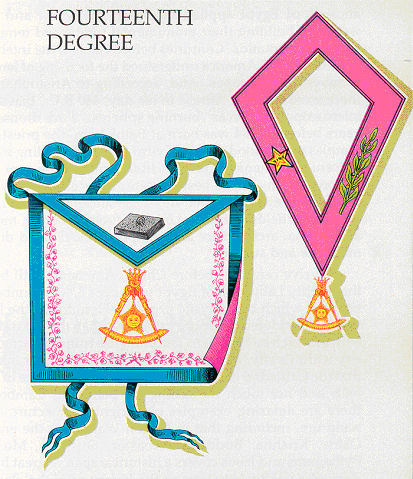
Fourteenth Degree Symbol, Collar, Apron ..................81, 85
Plate .............................................. 83
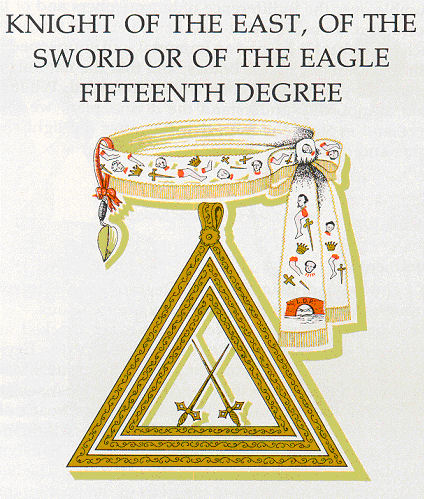
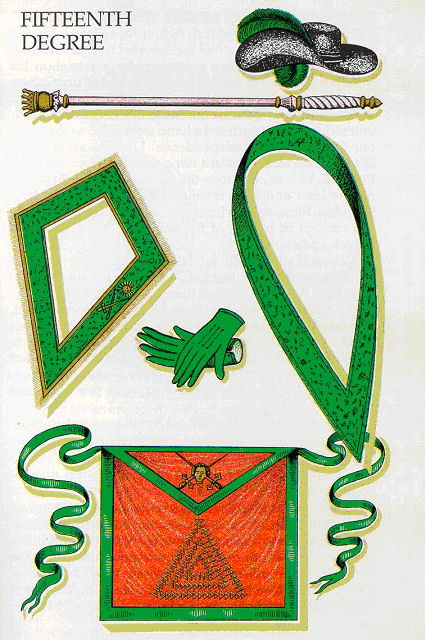
Fifteenth Degree Symbol, Collar, Apron, Girdle .......89, 93
Plate .............................................. 91
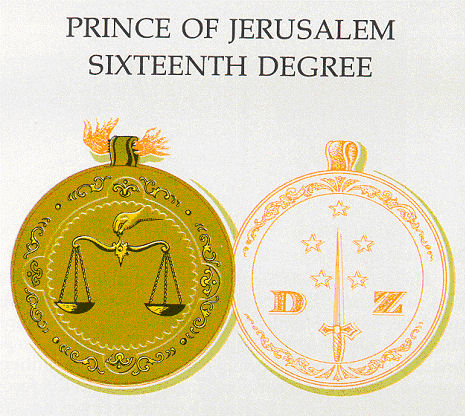
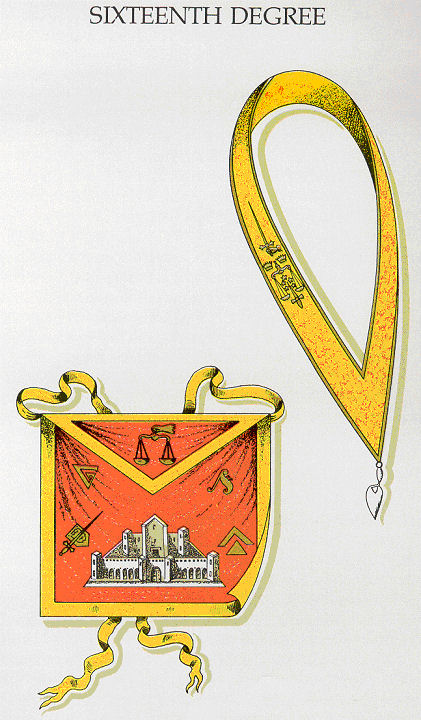
Sixteenth Degree Symbol, Cordon, Apron ................95, 99
Plate .............................................. 97
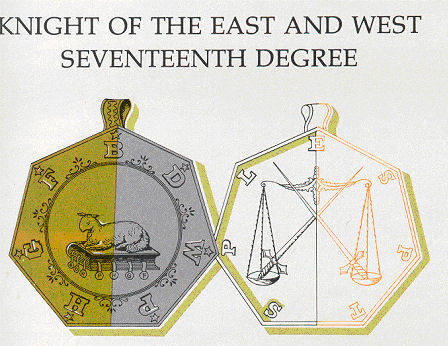
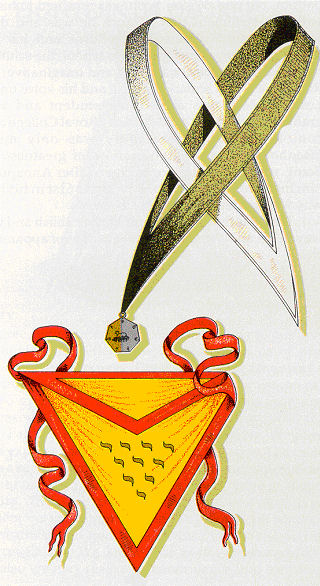
Seventeenth Degree Symbol, Cordons, Apron ...........101, 105
Plate ..............................................103
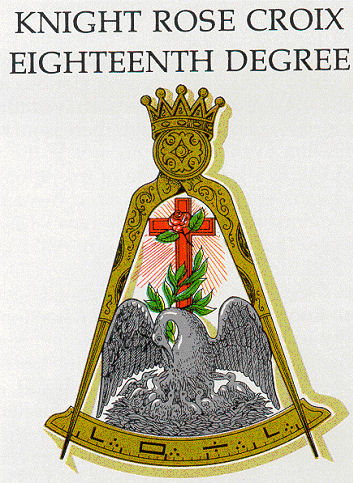
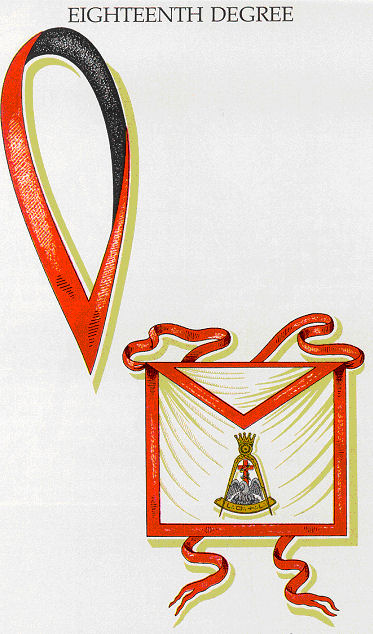
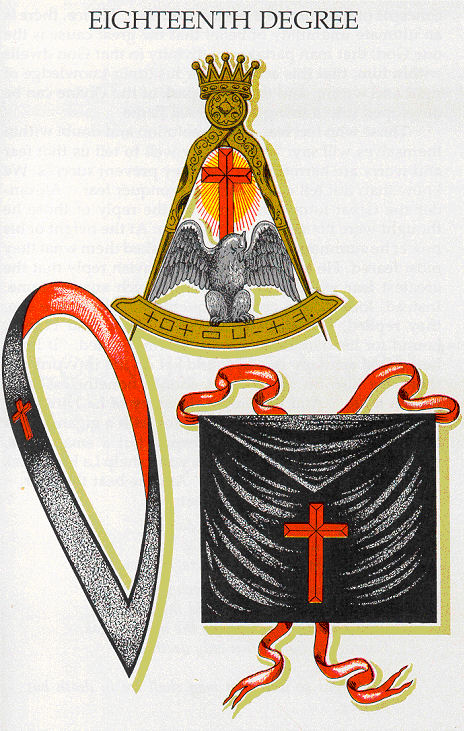
Eighteenth Degree Svmbol, Collars, Apron s......107, 110, 111
Plate ............ .. . ...................... .....109
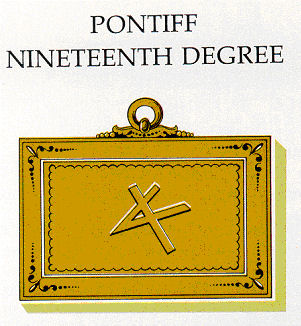
Nineteenth Degree Svmbol, Cordon, Apron, etc. ......115, 119
Plate . ........... .... .... ... ........... .....117
Twentieth Degree Symbol, Cordon, Apron. .... ........ 121, 125
Plate ..............................................123
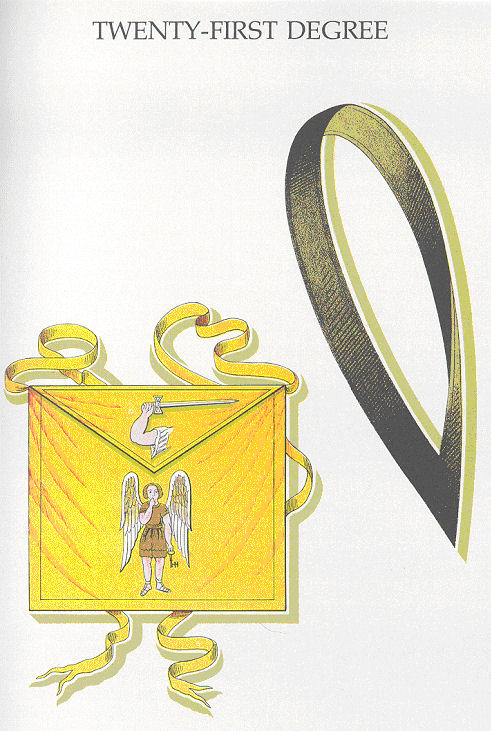
Twenty-first Degree Symbol, Collar, Apron ...............127, 131
Plate ........ .....................................129
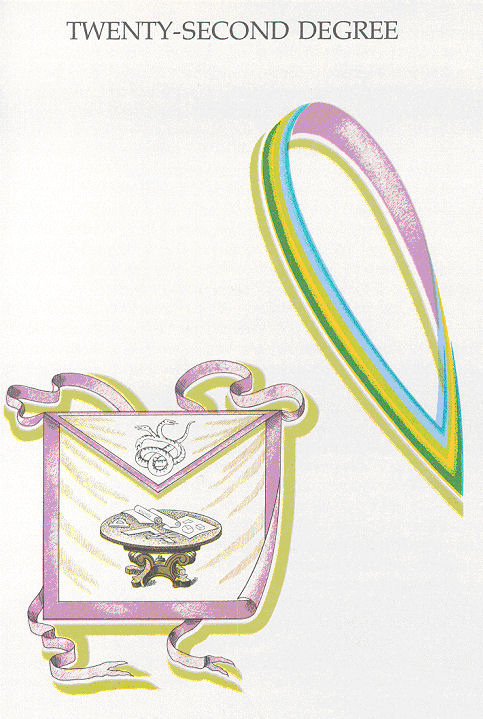
Twenty-second Degree Symbol, Collar, Apron ...............133, 137
Plate ..............................................135
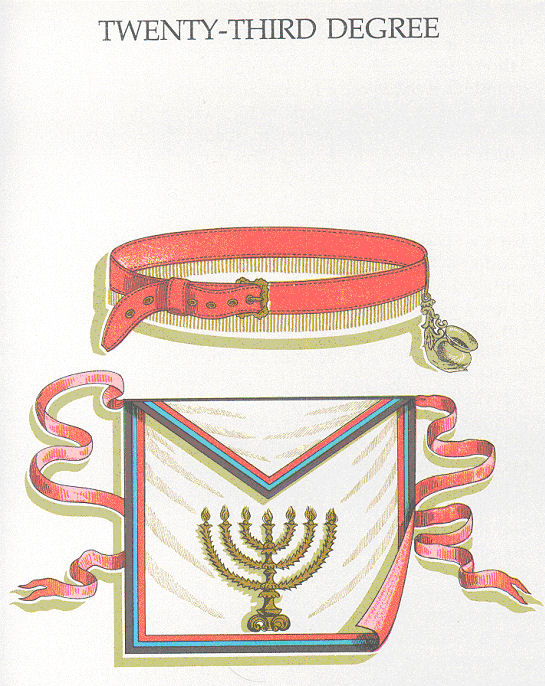
Twenty-third Degree Symbol, Belt, Apron ..................139, 143
Plate ..............................................141
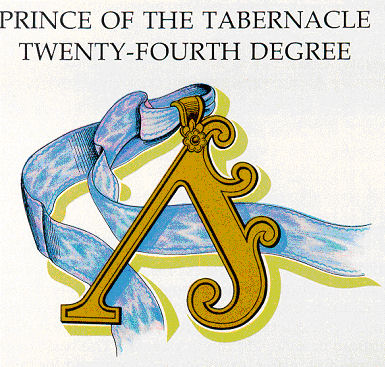
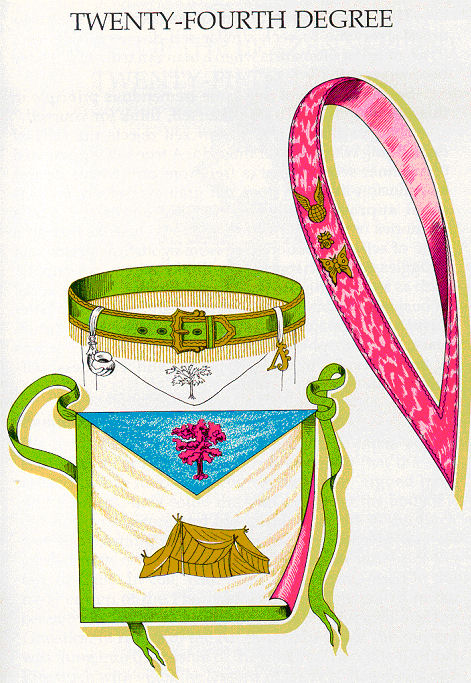
Twenty-fourth Degree Symbol, Cordon, Apron, etc....... 145, 149
Plate ..............................................147
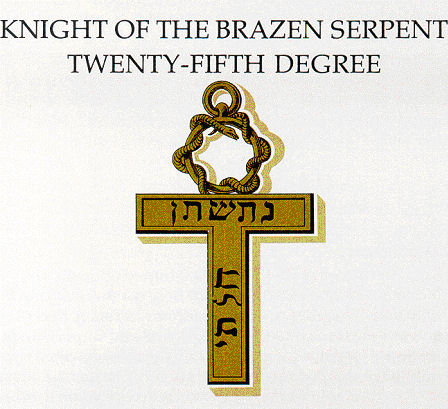
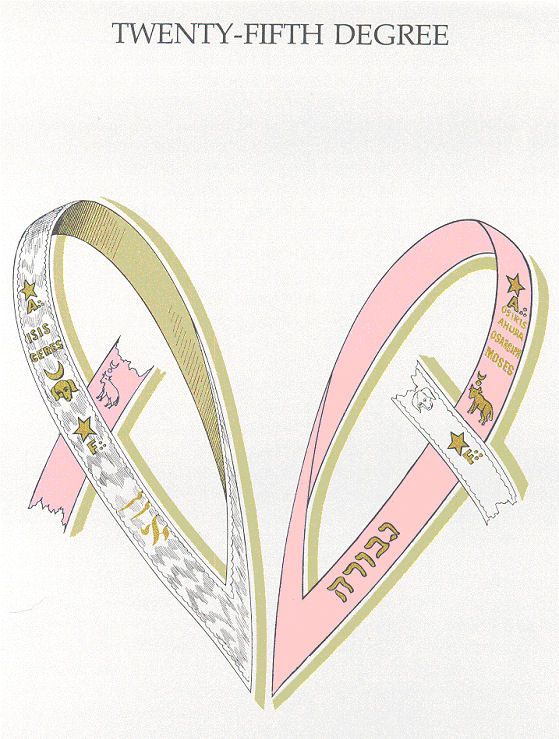
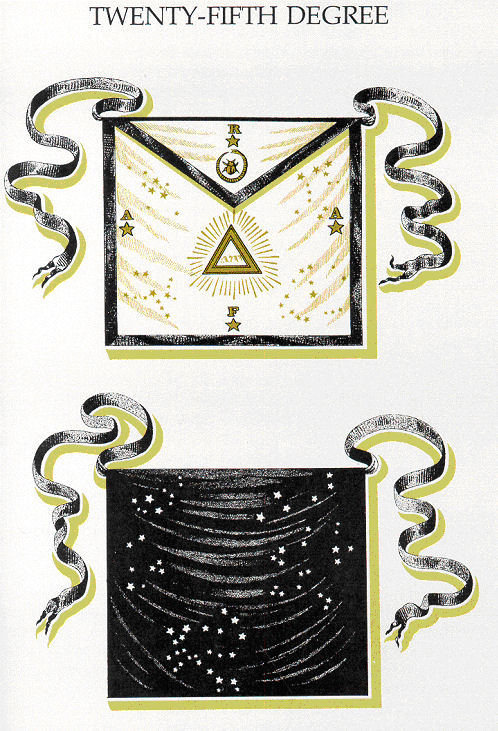
Twenty-fifth Degree Symbol, Cordon, Apron ......151, 154, 155
Plate ..............................................153
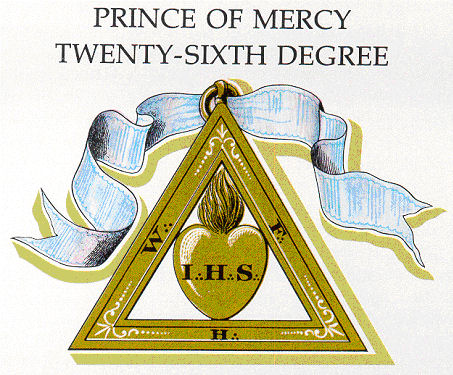
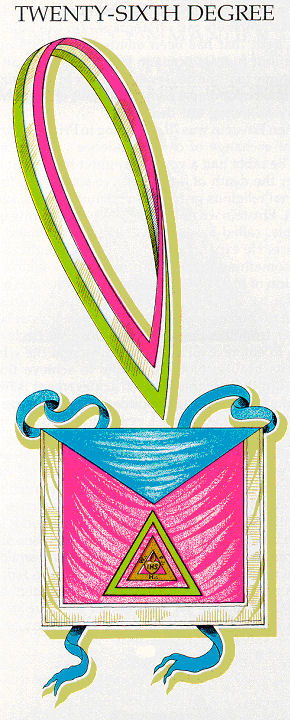
Twenty-sixth Degree Symbol, Order, Apron ...............159, 163
Plate ..............................................161
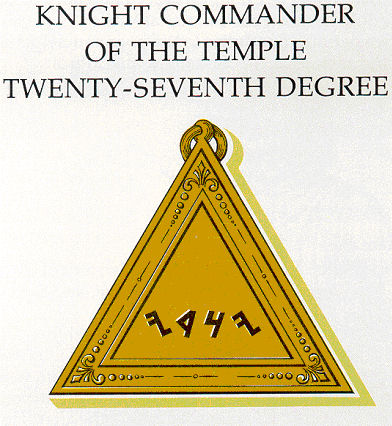
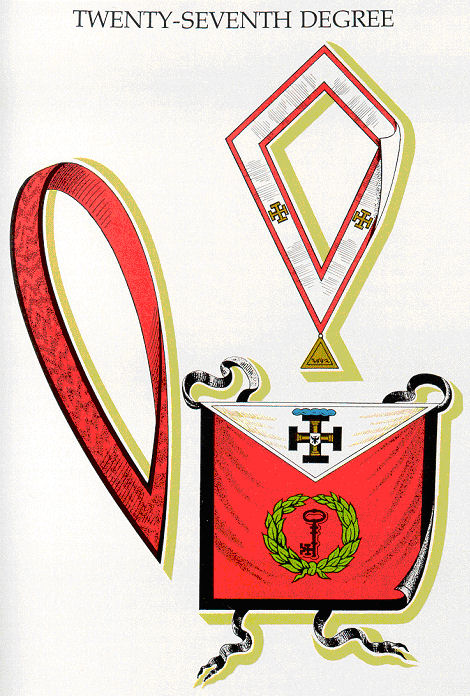
Twenty-seventh Degree Symbol, Collar, Apron, etc. ........165, 169
Pla to .............................................. 167
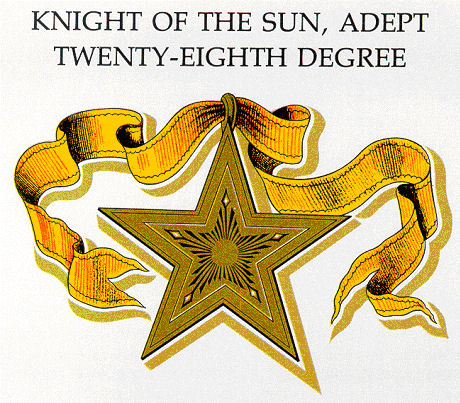
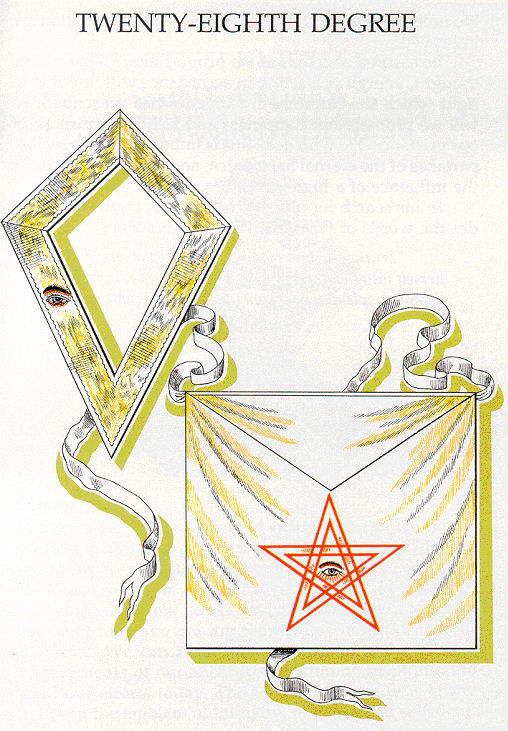
Twenty-eighth Degree Symbol, Collar, Apron ...............171, 175
Plate ..............................................173
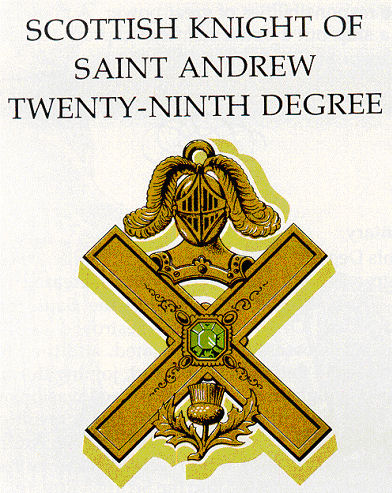
Twenty-ninth Degree Symbol, Collar, Apron ...............177, 181
Plate ..............................................179
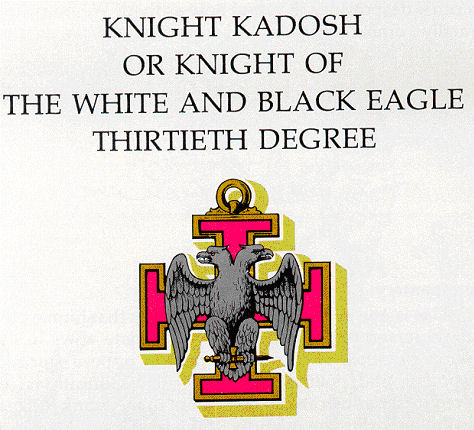
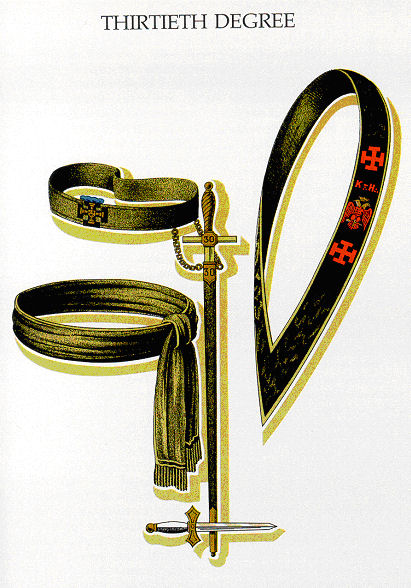
Thirtieth Degree Symbol, Collar, Apron, etc. ........183, 187
Plate ..............................................185
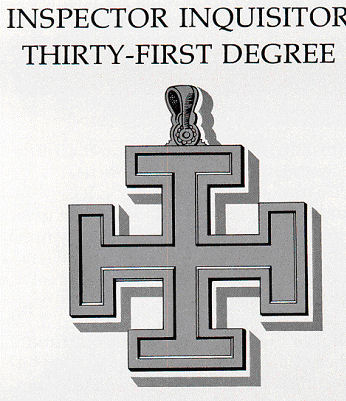
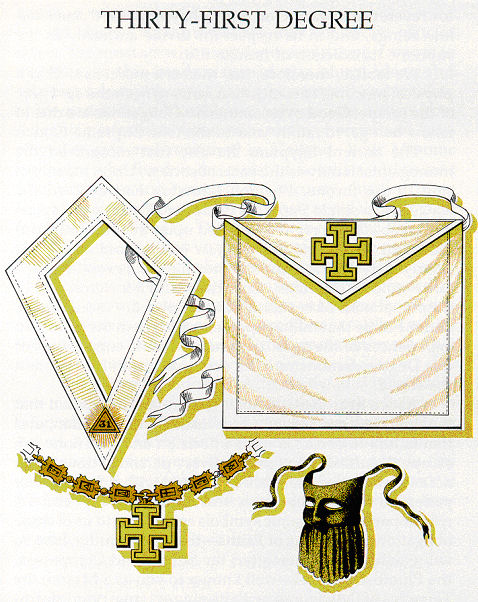
Thirty-first Degree Symbol, Collar, Apron, etc. ........195, 199
Plate ..............................................197
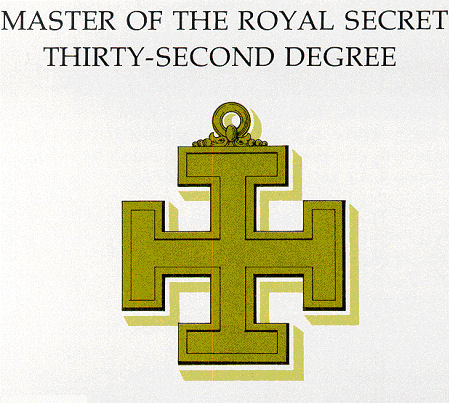
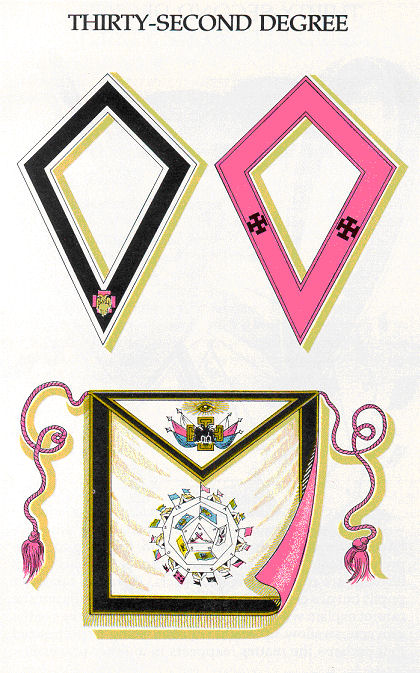
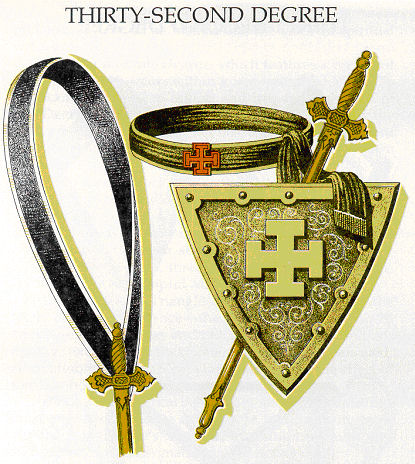
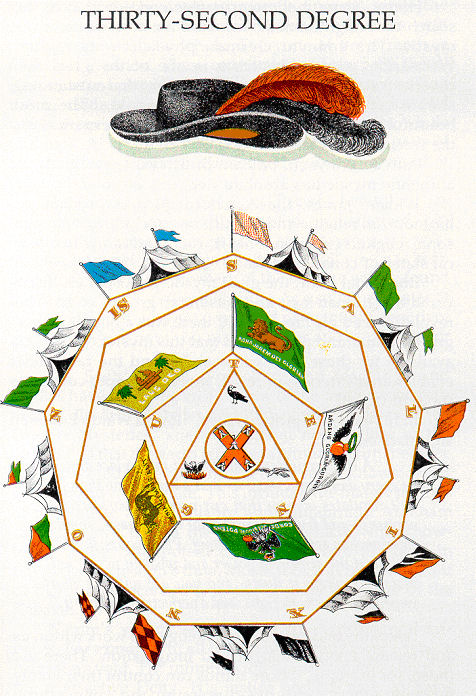
Thirty-second Degree Symbol, Cordon, Apron, Girdle,
etc. .........................203, 207, 208, 209
Plate ..............................................205
Illustrations for the Commentaries were conceived and designed by Brother Robert E. Bartlett, 33°.
Xv
PREFACE
There is need for a more modern discussion of the actions and thoughts of Sovereign Grand Commander Albert Pike's Morals and Dogma and for a concise interpretation of its significance. The monumental work was published in 1871, over 100 years ago. It was an inspired and classical compilation of Pike's own research and the writings of others, but that now should be related to our language and style and setting in time. The changes since 1871 have been prodigious. Heraclitus was ever so correct when he wrote some 500 years before Christ that nothing is permanent except change.
Mankind has progressed or retrogressed to our current and critical problems. These involve the things with which the Scottish Rite deals-human behavior. For example, how can we contain our population explosion, end the threats of war and nuclear holocausts, forefend against world famine, control the misery of physical disease and mental sickness, stop pollution of our bodies and environment, improve the lot of our poor in home and purse?
There is also the problem of whether civilization, even with knowledge, will act to save itself. Walter Lipmann wrote perceptively that not only is "the supreme question before mankind how our culture can save itself from catas
Xvii
trophe but also that we must do more than find the answers." We must discover also how men can "make themselves willing to save themselves."
Truly, ways must be found to motivate men to be not only able, but willing. We must activate the knowledge. Even if there are at hand the physical, biological and behavioral technologies adequate for the purpose, people still must be persuaded to use them. In other words, how do we induce members of our culture to work for survival?
Physical and biological technology has not supplied the answers. The problems with which we are now confronted so demonstrate. Religions have moved from threats of hellfire to an emphasis on God's love. Governments have turned away from compulsions to inducements. Where, then, shall we look?
The answer to this question will be found, I think, in the remarkable discovery of William James, father of modern American psychological science. He was at one time professor of anatomy, psychology and philosophy at Harvard University- combining body, mind and soul-one of this country's most profound thinkers. He gave us a great guide in these words: "The greatest discovery of my generation is that we have learned we can alter our lives by altering our attitudes of mind."
The answer, therefore, is not more miracles of science and technology but an inspired application of Masonic teachings that will alter our lives for the better. This is the world-of-tomorrow potential breakthrough. We must return to a faith in man himself-to the concept that he has within himself the requisite corrective capacities.
Russell Conwell (1843-1925), founder of Temple University, gave the most popular lecture ever delivered in the United States, "Acres of Diamonds," over 5,000 times. It produced over $6 million for charitable purposes. The simple lesson overflows with human interest and inspires people to practice the principle of self-reliance. It tells how our weary search through the highways and byways of the
Xvlll
world for fame and fortune brings us back finally to a surprising discovery in our own backyards.
How, then, can Masonry release man's inner capacities? This volume attempts to give a glimpse of where the answers can be found. It is designed as a valuable teaching tool that will heighten perception and awareness toward living in Socrates' famous phrase, "the examined life." Morals and Dogma, combined with our rituals, provides Initiates, members and students with spiritual lessons of tremendous value, philosophies of the ages and down-to-earth basic truths that can enrich and activate human behavior.
Therefore, I have summarized into short, capsule forms the successive chapters of Morals and Dogma and then I have authored my own commentary thereon. These summaries and commentaries are designed to increase the participation and input of our members-not to supplant Morals and Dogma-but to stimulate its research as a source of knowledge and inspiration. They are intended as a supplementary aid in a completely new approach and, like concept teaching, present in numerical sequence the basics of each degree structured for self-study, group discussion and lectures. Participants may relate the information to their own personalized experiences. The commentary program thereby lends itself to persons and groups of all ages and backgrounds. It is not intended as a substitute for the degrees nor as a revelation of cabalistic or esoteric hints and allusions, but it does make more explicit the fundamentals. Only serious study and participation in a portrayal of our degrees can reveal how we reshape human behavior.
Moreover, in the classic phrase, Masonry cannot teach; it can only help us learn. This is done in the course of several developmental stages. But if the Initiates become locked or lost in the progress, Masonry can help them break loose and start forward again on the correct path. The earnest and perceptive Scottish Rite seeker of truth can learn from our degrees, for example, the futility of dependence either upon persons or things, or upon approval or disapproval. Independence leads to self-reliance. The truly self-reliant is not subject to adverse manipulation or undue influence. He is in control of himself and enjoys freedom and dignity. This induces, in turn, more effective moral and modern behavior.
In keeping with our view that man has inner capacities that can supply answers to our problems, we use a self-help approach founded upon an intuitive feeling that we can reach the inner self. We will find there a refuge from external evils, just as peace and quiet are found at the eye of a hurricane. There the sun shines and birds fly. Put your trust in your own inherent capacities.
Emerson, in his "Essay on Self-Reliance," points the way:
"A man should learn to watch that gleam of light which flashes across his mind from within, more than the lustre of the firmament of bards and sages."
After Buddha attained his own enlightenment, he said to his followers:
"Be a lamp unto your own feet; do not seek outside yourself."
Jesus expressed the same opinion and said: "Neither shall they say, Lo here! or, to there! for, behold, the kingdom of God is within you."
What is needed first, therefore, is an increase of self-understanding-a discovery of your inner selves and of your own essential natures. Where better can this be learned than through your Scottish Rite? You learn there is no need to lean upon others. You are first-rate, front rank-in the forefront, not second-string. The Scottish Rite Degrees develop full trust in your own innate capacities so that you are never overwhelmed, nor overcome by helplessness, nor the desperate victim of despair. When man has faith in himself he learns to reject unreality. Like Alice in Through the Looking Glass, the mirror reflects competitive unreality in front; but behind is found reality-the folly of competitive success and failure, approval and disapproval. You can learn to be self-reliant, to stand upon your own feet-not dependent leaners upon persons or things outside yourselves. Then, in essence, you shall be free and possess initiative and confidence and live in the present.
Sir William Osler (1849-1919), the great philosopher-physician, when a young man in medical school in Montreal, became sadly discouraged about his future career. Then one day he accidentally read a few words by Carlyle that transformed his life. They struck home like a revelation turning point. Numerous times he repeated them to himself, wrote them down in notebooks and quoted them to his friends. He felt they changed his attitude toward life and were responsible for what turned out to be a most successful and happy career. He became devoted to science and professed a profound religious faith. His tangible achievements included diagnostic wizardry and brilliant research, writing and teaching. When he died in 1919 the Journal of the American Medical Association said: "The years have added to his glory. No one has in any way taken his place as the World's best doctor."
The words of Carlyle that had such great influence in Osler's life were these:
"Our main business in life is not to see what lies dimly at a distance, but to do what lies clearly at hand."
Later, those words were the inspiration for Osler's encouraging talks to students when he taught that we should "live in day-tight compartments," not worrying about yesterday's nor tomorrow's happenings.
Our degrees drive home with dramatic impact the teaching of great truths. There you will find your own directive approach and the satisfactions and benefits and
enrichments you will enjoy as a self-reliant human being. As such, your life also will show to the world the behavioral solutions that can cure the ills of our day.
Hence, you are asked to use your mind to the fullest. Think through the meanings of each degree as suggested in these summaries and commentaries. Apply them to yourself. Supplement your studies with further research. Let your actions then bespeak that you are in fact as well as in name a Scottish Rite Mason. Thus, you will discover the true secrets.
And now, "To work, my brethren, yonder sounds the gong!"
. GJC4v
Sovereign Grand Commander
What Is the Scottish Rite?
You may ask at the outset, what is the Scottish Rite of Freemasonry? I am constrained to reply, like the wit, that it is impossible to think about when you come to think about it! I can tell you first what it is not. It is not the formal organization. Nor is it our magnificent temples. Nor is it a severely secret society. Nor is it merely ritual. Perhaps we should content ourselves with the standard definition of Masonry that it is "a peculiar system of morality, veiled in allegory, and illustrated by symbols."
Our overall mission can be summarized thus;
To seek that which is the most worth in the world; To exalt the dignity of every person, the human side of our daily activities and the maximum service to humanity;
To aid mankind's search in God's Universe for identity, for development, and for destiny; And thereby achieve better men in a better world, happier men in a happier world, and wiser men in a wiser world.
Our ultimate goal, simply stated, is mankind's moral and spiritual and intellectual development.
Historically, the Scottish Rite of Freemasonry as we know it evolved as the Rite of Perfection over 200 years ago on the Continent of Europe under the Constitutions of 1762. Later, the Grand Constitutions of 1786 were enacted and became the creative and derivative laws for us and all our descendant Supreme Councils of the Ancient and Accepted Scottish Rite. Our Supreme Council was organized at Charleston, South Carolina, in 1801 as the Mother Supreme Council of the World, and hence all regular and recognized Supreme Councils throughout the world must trace their pedigree to us.
But the actual roots of the Scottish Rite go far deeper. Tracing them is a romantic and exciting quest for adventure in the realm of the mind and the spirit. It is a superb story of success-more intriguing than the storied search for the Holy Grail and more rewarding than a successful probe for the philosopher's stone.
Our teachings and symbols preceded our formal organization by thousands of years. They go deep into ancient ages. The signs, symbols and inscriptions come to us from across long, drifting centuries and will be found in the tombs and temples of India to those of Nubia, through the Valley of the Nile in Egypt down to its Delta, as well as in what was then known as Chaldea, Assyria, Persia, Greece, Rome and even in Mexico and Yucatan. The Scottish Rite, therefore, is a treasure house in which there is stored the ageless essence of immutable laws, the accumulation of thousands of years of Masonic experience.
We learn our mission in a system of progressive degrees of instruction. We teach our members the highest ethics, the wise expositions of philosophy and religion, the
blessings of charity. Our code of personal conduct stems from the precepts of chivalry, the Ten Commandments and the Golden Rule. We reveal truly the wisdom of the Lesser and the Greater Mysteries and their symbols of words and phrases long considered lost. These were the truths that Plato, Pythagoras, Socrates, Homer and other
2
intellects of the ages held in high esteem, that have reappeared in later religions, and that never were disclosed until after timely preparation and purification of selected and trusted Initiates.
Our degrees represent the study and reflection of many men during many years and at heavy cost, the culling of hundreds of volumes for effective portrayals and illustrations, and more labor than the accumulated endeavors of a lifetime engaged in efforts to attain eminence or riches. Our members therefore receive a gift of the greatest value. They gain a comprehensive knowledge of our heritage of history, philosophy, religion, morality, freedom and toleration, and of their relationship to their Creator, their country, their family and themselves. These well may lead also to that understanding of identity, clarity of mind and energy of will that propel toward personal success in life.
We carry out our mission in a series of spiritual, charitable and moral programs. We make living, breathing, vital parts of our activities the recovery and maintenance of moral standards and spiritual values, the pride of patriotism and love of flag and country, the dispensing of charity without regard to race, color or creed. Our Scottish Rite Hospital for Crippled Children at Atlanta was the forerunner of the vast chain of Shrine hospitals across the Nation.
We stand for positive programs but fight with moral courage and enthusiasm every force or power that would seek to destroy freedom, including spiritual despotism and political tyranny. We believe and teach that sovereignty of the state resides in control by the people themselves and not in some self-appointed dictator or despotic totalitarian. We therefore advocate complete separation of church and state, absolute freedom and protection of religion, press and assembly, and the dignity of every individual. Those we consider vital for the ultimate liberties and independence of our people.
Ours, therefore, has been a strong voice for human dignity, political justice, moral values and civic responsibility. Through our teachings millions of men and women have discovered an opportunity to lead more rewarding lives. The example of our actions has been as stirring and inspiring as that of our collective commitment to true human progress.
Today our Mother jurisdiction, of which I am Sovereign Grand Commander, includes 35 of our United States and all our Territories and Possessions abroad.
Of the four million Masons in the United States, there are over a million Scottish Rite members. Our Mother jurisdiction comprises more than 660,000 members who belong to so-called Valleys in 218 cities. We have clubs in many more. They meet frequently for executive, administrative and evangelistic purposes as provided by our Statutes. Their control and management is under elected officers who, in turn, are supervised by our Inspectors General or Deputies. The Inspectors General of our Mother Jurisdiction, now numbering 30, meet as our Supreme Council every two years in a Session over which I preside. When it is not in session I discharge the functions of our Supreme Council, in pursuance of our Statutes.
Our House of the Temple in Washington, an awe inspiring, monumental structure, is the nerve center of our organization. We also have at our Headquarters the Department Heads, administrative branches and staff. These include our world-famed Grand Secretary, Director of Education, and Managing Editor of The New, Age, our monthly magazine.
I should say a word also as to membership in our Order. We welcome and initiate inquiries from Master Masons of regular and recognized Lodges. Thereby we grow and expand the light. Our Officers and committees devote long hours in evaluating and deciding upon those we feel should progress beyond the screening process and become entitled to pass through the mystic gate of Scottish
4
Rite Masonry. All who seek entry are commended for their interest and vision.
Sponsorship and standards of character, morality and training are required, of course, but every candidate will receive serious consideration. Thus we assure compliance with our time-tested standards and selection process.
A new member is made welcome and invited to participate in our activities.
And so, to end as we started when we sought a definition:
To me, the Scottish Rite can be likened to a tree of sparkling symbolic jewels, surmounted with the Blazing Star of Truth that displays the dazzling splendor of the Mystic Doctrine of the Universe, and the reflected glory of the Deity.
Hence, inspired by our accomplishments of the past and encouraged by our endeavors of the present, we go on to even more monumental achievements in the great tomorrow- toward our greater Scottish Rite destiny.
Our Historical Roots
While winging my way to Puerto Rico with our Grand Secretary General for an official workshop and visitation in February 1973, I felt the spur of my own admonition that history is the heritage and patrimony of mankind in its lessons of the past that give us priceless inspiration for the future. As we search for such inspiration there is need for Scottish Rite historical explorations and, as new discoveries are made, for corrections and additions to our literature. So, after Puerto Rico we flew to Jamaica and researched in those fertile cradle sources of American Scottish Rite origins. These are my findings on the early days of the Rite.
Ecossais (Scottish) Masonry bubbled to the surface in some form at various times and places in Scotland, England and France. It seems impossible to trace the original wellspring but we know now that a confluence of tributary streams flowed into a reservoir at Bordeaux, France. This developed into regular units there known as the Rite of Perfection that Stephen (Etienne) Morin was empowered in 1761 to bring into the Western Hemisphere. The label of "Ecossais" or "Scottish" put upon these developments did not refer to Scotland but gave them the status of an established brand. Through Morin's first appointment about 1765 in the West Indies of Henry Andrew Francken as Deputy Grand Inspector General, and the successive descendant appointments, there finally was established at Charleston, South Carolina, in 1801 the first Thirty-third Degree Supreme Council of the Ancient and Accepted Scottish Rite of Freemasonry. Today all the regular and recognized Supreme Councils that exist in the world stem from this source.
Bordeaux apparently was the oldest provincial Masonic center in Europe and it was the home of Morin. He was made a Mason there in Loge Francaise, which had been created December 13, 1740 and later was named La Francaise Elue Ecossaise. This was the eldest of more than fifty daughter Lodges of Loge L'Anglaise, a Lodge that British Masons founded at Bordeaux in 1732. These daughter Lodges gave birth to a proliferation of degrees that resulted in the progenitors of our Scottish Rite.
The original reason for the organization of separate Lodges to confer these "higher" degrees may have been a desire to limit the membership to those of the Christian faith. Anderson's Constitutions of 1723 had widened the field of Masonry to men of all denominations that believed in the Deity and in the hope of immortality. In this connection it should be observed the ultimate Scottish Rite Constitutions of 1786 similarly opened the doors to men of all religions and provide that only four of the governing nine need profess the prevailing religion.
These Lodges also may have been set up as a refuge and bypass from cruel operations under the famous Papal Bull "In Eminenti" of 1738 that decreed a ban and punish ment on Masons and Masonry and any who helped them. Morin was a Roman Catholic, as were most of these early French Masons.
Later, these Lodges flourished and blossomed in the fertile fields of Masonry for more important reasons. They became repositories for revelations through sequential de grees of great truths derived from the arcane wisdom of the
10
ages, including discoveries original Freemasonry concealed in the secret knowledge, symbology and Lesser and Greater Mysteries that came down across drifting centuries, even long before the riddle of the Mystic Sphinx first puzzled men's minds.
Ancient French manuscripts contemporary to the period prove that since about 1740 Bordeaux was the mother and controller of these Scottish Degrees and had warranted daughter organizations under various regulations. These descendants included the following: Paris 1747; Cap, San Domingo 1748; St. Pierre, San Domingo 1750; Port La Paix, San Domingo 1752; St. Marc, San Domingo 1753; Les Caye de Fond L'Isle a Vaches, San Domingo 1757; Perigueux, France 1759; New Orleans, U.S.A. 1763 (pursuant to request of 1756).
Morin presided over Loge Parfaite Harmonie, which was an offshoot of Loge Francaise and believed to be the first to confer degrees as high as Perfection. This actually was a Lodge of Perfection working the additional degrees only. It was not related to the Grand Lodge of France since at that time none of the Bordeaux Lodges was a constituent of that Grand Body. In natural sequence, Morin became active in a Sovereign Grand Consistory of Princes of the Royal Secret (Twenty-fifth Degree).
As a traveling representative for the Sevres porcelain factories and the distributor of a religious publication, Morin had made several trips to the French West Indies. Being poised for departure again in 1761, the Grand and Sovereign Lodge of St. John of Jerusalem, in conjunction with the Council of the Emperors of the East and West, founded at Bordeaux, issued to Morin a now celebrated Patent with broad discretionary powers. This created him a Grand Inspector General and conferred upon him the powers of propagation of Bodies and Lodges and the appointment of Deputies, with the right to confer the degrees of the Rite of Perfection.
Morin left Bordeaux as planned, but the voyage was interrupted when the British captured his ship. Taken to London, as a private citizen he was allowed freedom. He attended Lodges in England and Scotland and met Earl Ferrest (Ferres), England's Grand Master, who endorsed Morin's Patent. Finally, he sailed again and this time arrived safely at Jacmel, San Domingo, in 1763.
From his fertile Patent, Morin commenced planting the seeds of the Scottish Rite in the West Indies like a veritable "Johnny Appleseed." This he did with inspirational zeal and venture. About 1765 and in virtue of his powers he created as his first Deputy Henry Andrew Francken, who held a number of public offices in Kingston, Jamaica. The title Morin gave him was Deputy Grand Inspector General. As such, Francken went to North America in 1766 or 1767 and promoted Scottish Rite activities at New York and Albany. He communicated the degrees to Moses M. Hayes. The Minutes of the Albany Lodge which Francken founded in 1767 show him to have visited it also in 1768. Significantly, in proof of an alliance with Berlin and Frederick the Great, the Albany Lodge Minutes of a September 3, 1770 meeting read, in part: "Br. Stringer Depy. Inspr. acquainted the body that he had received an order from the Founder to transmit the Minutes of the Lodge and the state thereof, to be forwarded to Berlin . . ."
In his later days, Stephen Morin's fortunes changed for the worse. He experienced some difficult times before he died. John Gillieron, his foremost creditor, was granted Letters of Administration on January 23, 1772, two months after Morin's death. Morin was buried on November 17, 1771 at Kingston, Jamaica, in the Anglican Parish Church or burial yard.
By special dispensation of Francken, on January 2, 1768, Lieutenant Augustin Prevost of the 60th Royal American Regiment was Initiated into the Rite of Perfection at Albany. In February 1774, at Kingston, Francken appointed the same Augustin Prevost, now Colonel of the
12
Regiment, a Deputy Grand Inspector General. It was Prevost who appointed new Deputies and made the organized Rite available to Scotland and England.
Later, in 1781 at Charleston, South Carolina, Francken communicated degrees to Barend M. Spitzer of Georgia. These Deputy Grand Inspectors General met in 1794 for a Sublime Council at Philadelphia and in 1795 conferred the degrees on Moses Cohen. He, in turn, communicated them to Hyman L. Long in 1795. It was Long who, as Deputy Grand Inspector General, granted Letters Patent to the Comte Auguste de Grasse-Tilly and on the same date, acting for the Princes of Masonry at Kingston, granted a Patent to de Grasse's father-in-law, Jean Delahogue, authorizing the establishment of a Body at Charleston. This was organized on January 3, 1797. Comte Auguste de Grasse-Tilly was the son of the French Admiral, Comte Francois de Grasse, Marquis de Tilly, Comte de Provence, Prince d'Antibes, who commanded the French fleet, defeated by the English Admiral, Lord Rodney, at the "Battle of the Saints," but who contributed to the final and decisive American victory at Yorktown. Young de Grasse went to Saint Domingue to claim and supervise a sugar plantation he had inherited from his father.
Fleeing native uprisings in San Domingo and finding refuge in Charleston, South Carolina, de Grasse and Delahogue helped to found a Council of Princes of the Royal Secret there in 1797. Returning to Saint Domingue in 1798 or 1799, de Grasse served as a soldier under General Hedouville. After being taken prisoner and then released because he had become an American citizen, de Grasse returned to Charleston.
While at Charleston, de Grasse and Delahogue in all probability helped organize our Supreme Council as the Mother Supreme Council of the World. We have in our Archives a manuscript that Delahogue wrote in 1798 and 1799, authenticated by de Grasse, setting forth a copy of
13
the Constitutions of 1762. This document is supposed to be a copy of that which Morin delivered to Francken in 1768. Morin either took a draft copy with him when he left for America in 1761 or he received a copy of the Constitutions after his arrival in 1763. The Commissioners who compiled the 1762 Constitutions also drafted and promised to send Morin a copy of the Secret Constitutions of August 27, 1761, which was the date of Morin's Patent. These Secret Constitutions were expanded into the Constitutions of 1762.
On April 2, 1795 Barend M. Spitzer, as Deputy Grand Inspector General, granted to John Mitchell a Patent as Deputy Grand Inspector General. Mitchell was justice of the Quorum and a Notary Public in South Carolina and late Colonel and Deputy Quartermaster General of the United States Army. On May 25, 1801 Mitchell, as Deputy Grand Inspector General, granted to Frederick Dalcho a Patent as Deputy Grand Inspector General.
Mitchell and Dalcho then organized and opened at Charleston, South Carolina, on May 31, 1801, the first and Mother Supreme Council of the Ancient and Accepted Scottish Rite. On December 4, 1802 this Supreme Council issued a circular that announced its completed organization and gave the Grand Constitutions of 1786 as the law of its existence and the source of its powers. From this there are derived all regular and recognized Supreme Councils in the World.
The development and expansion of degrees into those of our Ancient and Accepted Scottish Rite thus evolved out of Bordeaux's Rite of Perfection, out of Paris' aristocratic Chapter of Clermont that the Chevalier de Bonneville founded at the College of the Jesuits in 1754, out of the Council of Emperors of the East and West, and out of several other tributary systems. Later, my predecessor, the renowned Sovereign Grand Commander and classical scholar, Albert Pike, brought order out of chaos and edited or rewrote the rituals for these degrees.
On February 21, 1802 the Charleston Supreme Council
14
granted to de Grasse a Patent as Sovereign Grand Inspector General and declared that he was Grand Commander for life of the Supreme Council of the French West Indian Islands with power to establish other Scottish Rite organizations under the Grand Constitutions.
In 1802 de Grasse returned to Saint Domingue -serving as a Captain of Cavalry under General Leclerc, Napoleon's brother-in-law, and later under the Comte de Rochambeau- and it was from there that a year later a British blockader took him as a prisoner to Jamaica. After spending about seven months at Kingston, Jamaica, he established a Supreme Council of the Windward and Leeward Islands at Port-au-Prince in 1803. Returning to France in 1804, he went to Bordeaux and established the Supreme Council of France in the same year, of Italy in 1805, of Spain in 1809, and of Belgium in 1817.
From the foregoing it follows that the activities and energies of Francken during some fifteen years as the Senior Deputy Grand Inspector General primarily were responsible for planting the Scottish Rite firmly upon North American shores. He carefully selected his descendant Deputy Grand Inspectors General. Earlier in Jamaica he had been appraiser, marshal and Sergeant-at-Mace in the Admiralty Court. After he returned to Kingston from North America in 1769, personal losses, sickness and the subsequent hurricanes of 1784 and 1785 caused him some ups and downs, but later he was appointed Customs Inspector, Master of Revels, Assistant Judge of the Court of the Common Pleas for Port Royal, and Supreme Court Commissioner. He died at Kingston on May 20, 1795. In view of the labors, leadership and promotional successes of Morin and Francken, I felt they deserved lasting tribute and recognition and hence caused a plaque to be erected to their memory in the Anglican Parish Church, Kingston, Jamaica. For, their zealous endeavors over so many years furnished a springboard that truly launched the Scottish Rite into a creative and developing orbit, first
15
in the United States and then around the world. With prophetic vision they aroused in key men a dynamic impulse for an expanding Scottish Rite. They carried into the darkness and passed into other hands a living flame that continues to illuminate Scottish Rite Freemasonry with ever-increasing brilliance. This led to the outstanding achievements we enjoy and for which we are so grateful today, just as though we were inheritors of great wealth under a will. Our Scottish Rite of the Mother jurisdiction is now the fastest-growing and most dynamic Masonic system encircling the globe.
LODGE OF PERFECTION
100
SECRET MASTER
FOURTH DEGREE
Summary:
You now take your first step into our sanctuary in search of truth and knowledge, the most genuine and real of human treasures. You are reminded that your progress depends upon your secrecy, obedience and fidelity; secrecy for the security of obligations, duties, oaths, communications; obedience for the laws that reflect the will and judgment and benefit of the people, not the edicts of the tyrant or those that are contrary to God and nature; fidelity for the faith and to promises plighted family, friends, country and Masonry. Thereby you will avoid the diverting allurements of pleasure and indolence and permit the mandates of your obligations to be fulfilled. You must seek, read, study, reflect, digest and discriminate. The light of knowledge develops the soul of man and
19
assures the reward of his aspirations for continuance after death. In the faithful pursuit of these ideals you will serve yourself, your fellow members, country and mankind.
Commentary:
The first division of our Degrees, from the Fourth to the Fourteenth, includes those known as the Ineffable Degrees.
The appointments and furniture of the Lodge in the Fourth Degree form a setting of deep mourning, symbolizing grief and tears for the loss of the Grand Master. The story is retold of the criminal interruption in the labors of building the Temple of Solomon. The one gigantic mind was murdered and the word was lost. King Solomon, confronted with suspension of the work, starts in Masonic progressive fashion toward the burial of his brother, then to completion of the Temple, and finally to mete out justice to the assassins.
The presiding officers are a Master representing King Solomon and an Inspector representing Adoniram, Inspector of the workmen and the first Secret Master. The candidate, finally shown the Holy of Holies behind closed gates, is told the mystic meaning of its sacred elements. He may infer that while at this time he is barred from entry, there may come a time when the gates will be opened unto him.
This Degree presents a powerful lesson in teaching fidelity to dWy even at the risk of death, and the sudden cessation of life when death arrives without warning. While able to do so, we should review our personal philosophy and define our lifetime obligations to ourselves, our families, our country and our God. We should
20
Plate-Secret Master, Fourth Degree:
The Bible describes the room called "the Most Holy Place." In the oracle "he made two cherubims each ten cubits (fifteen feet) high. . . . And he set the cherubims (winged sphinxes) within the inner house: ... the wing of the one touched the one wall and the wing of the other ... touched the other wall; and their wings touched one another in the midst of the house. And he overlaid the cherubims with gold." (1 Kings 6: 23, 27, 28.)
"And the priests brought the ark of the covenant of the Lord. . . to the most holy place ... under the wings of the cherubims." (1 Kings 8: 6.)
travel with assurance toward a form of immortality and a submission to Divine judgment for acts and omissions of our lives.
Sir William Osler, to whom reference already has been made, possessed such a personal philosophy and deep religious faith. His son had been killed in action during World War I. When Osler himself was hospitalized in 1919 for a severe, final illness, he knew better than the attending physicians how it would end. Yet, he faced death serenely. After he died there was found among his effects a slip of paper upon which he had written these words:
"The Harbor almost reached after a splendid voyage, and with such companions all the way, and my boy awaiting me."
Ask yourselves, do you agree that you exist? If you do, must there not have been a Creator called God? Is not your creation itself the best proof? Or are you the mere vestige of an accident, or a machine, or a beast, or greater than a Creator? Or are you the poor victim of a cruel, blind, evolutionary process, coming from nowhere, a nothing, doomed to eternal extinction?
No! You are a towering example of man's ability to burst out of an animalistic state. You are an ensouled immortal, imprisoned for a time within an ensouled body, but rejoicing in a God-given dignity, traveling bravely upon an ever-ascending, happier, spiritual plane.
23
PERFECT MASTER
FIFTH DEGREE
Summary:
Industry and honesty are homely virtues that become a Perfect Master. Life is far too short and fleeting to waste time in idleness, follies or dissipation. To learn and to do combine and develop the potential human soul with inherent force and power. Satan finds mischief for idle hands. Honesty still is the best policy and an honest man still is the noblest work of God.-This virtue should be reflected in contracts, business dealings, payment for services and acceptance of an honest day's pay only for an honest day's work. So live and deal and act that when you go before God no man was poorer because you were richer; no man had less rank, influence, reputation or affection because you had more.
25
Commentary:
In this Degree we witness solemn preparations for a more decent interment of the Grand Master. King Solomon ordered the remains brought to the Temple and a suitable tomb erected as befitted the eminent virtues of the Grand Master. Funeral orations of King Solomon and King Hiram of Tyre expressed grateful tributes to the departed as a man of great abilities in many fields and the central character of the Hiramic Legend. His life also symbolized the virtues of industry, honesty, charity, freedom and spiritual power.
Examples of the Lost Symbol abound in unselfish, vital contributions to humanity. Consider the mother who became lost in a blizzard while carrying her baby over the
hills of South Wales. A search party found her frozen to death beneath the snow. Surprisingly, she had on no outer garments. They soon discovered why. She had wrapped these around her baby. When they unwrapped the child he was alive and well. He grew up to become Prime Minister of Great Britain during World War I, one of England's great statesmen. His mother had given her life to save David Lloyd George.
Another woman also had the key to the Master's Word. Dressed in rags, she was passing along the streets of a French town, holding by the hand her barefoot little boy. Suddenly she stooped to pick up an object from the ground, tucking it quickly within the folds of her ragged garments. In so doing shy, aroused the suspicions of a nearby policeman. He rudely demanded that she show him what she had concealed. The poor, frightened woman cast down her eyes and revealed a jagged fragment of a broken bottle. She said, "I was thinking only of the barefoot children."
The setting and symbolic color for this Degree remind us that while we die in sin we may revive in virtue. We therefore always should act with regard to justice, equity,
honesty and integrity and reaffirm our abiding belief in the
26
P F/gaq;e~33°
Plate-Perfect Master, Fifth Degree:
The two kings lead the procession of workers from the vicinity of the Temple to the new tomb. "Solomon (had) ... 1,400 chariots." (2 Chron. 1, 14.) Models for this painting were an ancient chariot and harness unearthed in Egypt.
Hiram cast the pillars Jachin and Boaz [341/2 feet high ] and ten bases of brass with wheels. (1 Kings 7:15,16, 21, 27, 30.) He sculptured and cast in brass an altar and 12 oxen upholding an immense brass basin [which held 10,000 gallons of water. 1 (2 Chron. 4: 3, 4.)
immortality of the soul. Thus, we symbolically raise the departed from the coffin and place him at the holy altar as a Perfect Master.
A glance upward at the stars in the heavens may strengthen our faith. As Longfellow tells us in "Evangeline":
"Silently, one by one,
In the infinite meadows of heaven, Blossomed the lovely stars,
The forget-me-nots of the angels."
The universe is creating continually. As we participate in the process we partak of the Creator-the Divine of God. This participation as co-Creator is itself a form of man's immortality regardless of whether, as we believe, his spirit survives the body. We exist and create. Being greater than self is man's true destiny, dignity and grandeur.
Mans will to believe in something greater than self is the springboard from which we can touch the Divine. Talk with men of faith. Read the books that tell of spiritual achievements. Meditate as you gaze at the stars of the first magnitude. Then you, too, may attain that conclusive spiritual revelation which is the highest human development.
So, also, should we conduct ourselves on the assumption of life after death. The folly of not preparing is told in the tale of a king who sent his beloved jester, Wamba, on a journey. "Go abroad," he said, "and see all that there is to be seen. Take with you this golden wand, and if you meet a greater fool than yourself, present it to him." On his return, Wamba found the king in his last illness. "I, too, am going on a long journey," said the king, "an even longer one than yours." "Are all your preparations made?" asked Wamba. "No," answered the king, "I have made no preparations." "Then, surely," said Wamba, "it is to you I must give the golden wand."
28
INTIMATE SECRETARY
SIXTH DEGREE
Summary:
In this Degree we learn to reject the worldly, the covetous and the sensual, the severe, the censorious and the injurious in favor of duty, charity and toleration. In our personal lives we should practice those virtues and the Golden Rule, with peace and loving kindness toward our parents, children, friends, neighbors, employees and business associates, not for popular acclaim but for our own inner satisfaction. Organizations should reflect harmony as the strength and support of all societies, especially of ours. Ideally, we thus should witness the elimination of dissensions, disputes and quarrels and a world without war. Thoughts should be focused upon that which is good and healthy. In short, we are told how we can reshape our thinking into joyful channels of charity, self-control and success.
31
Commentary:
This Degree demonstrates that wrong thinking leads to wrong results. King Solomon promised to Hiram, King of Tyre, certain towns in Galilee. The latter, on inspecting them and not knowing that it was Solomon's intention to improve them first, was displeased with their barren characteristics. Coming to Jerusalem for the funeral of the Grand Master and viewing en route the desolate state of the towns, Hiram angrily assumed that Solomon had defrauded him. Seeing him thus enraged, a Captain of the Guards feared for Solomon and so stationed himself that in secret he could observe the Audience Chamber. Hiram discovered this and, in a rage, remonstrated to Solomon, who denied the surveillance. But Hiram revealed the spying Captain and, about to kill him, was prevented from doing so when Solomon promised a fair trial for the offender and also related his plans for rehabilitating the substandard towns. Hiram then begged Solomon's forgiveness and asked that the Captain be forgiven, since actually he deserved commendation for his loyalty. Whereupon the Captain was appointed Confidential Secretary to the two kings in replacement of that office which the murdered Grand Master had held.
The quintessence of our Scottish Rite teachings is healthy thinking. These words are used in a sense of signifying a state of mind that is harmonious with a philosophic belief from which there flows a confident approach to life.
32
We can attain that condition of confident living through application in our daily affairs of those secure patterns of behavior that are disclosed in our degrees.
Application means more than merely wishing. Any success-starved person can do that. Instead, it requires an active response to the urge for something beyond the self. From this foundation there are specific steps that can be taken. For example, we can talk with those people who may suggest out of their experience and wisdom the paths best suited to us. We can use the powerful tools given us in our Scottish Rite rituals, lessons that impart the highest levels of thought. We can commune in silent meditation and seek reserves of psychic strength. Through conscious effort we can strengthen our positive approaches toward life's instinctive fears and doubts. In short, we can think our way to success.
The opposite is also true. You can assume such a critical role that destructive ill health results. Amid a thousand pleasant scents such a person singles out one solitary smell for complaint. Once Churchill was building a wall and put a critic in his place. When told that the wall was crooked, Churchill gave this stinging reply: "Any fool can see what's wrong. But can you see what's right?"
Lack of giving is another unhealthy attribute. It violates the great secret of life that to get we must give, and give without the slightest expectation of receiving. The ungiving person so often denies articulation to the most basic of all human needs: a craving for love.
Closely allied is the person who is stingy with praise or compliments. They forget that while actions speak louder than words, a lack of both can be devastating. Approval and appreciation should be verbalized.
Then, too, he who merely eats and breathes and sleeps, and who strives always to satisfy only his own needs, is afflicted with an unhealthy greed. He is in a ruthless quest for gratification. The selfish man seeking public office, or climbing over unfortunate victims for
34
money, or striving unfairly for status, or existing solely for personal pleasure, will awake in the end to a realization of self-defeating futility. Regardless of how natural and all too human this may be as part of our psyche, we can control the situation through inhibition-simply say "no" to the unhealthy impulse.
Especially, therefore, in this world of questioning of authority, of morals, of institutions, of values and of life purpose, we should pursue the healthy mind. It gives more meaning to life than bigger production, higher sales, more take-home pay. It will exemplify in our daily behavior the workable philosophy of the Scottish Rite in relation to our present-day knowledge.
There is a creative approach to Masonic self-help -ways in which we can multiply our personal development. We can work on ourselves through systematic per sonal effort. It leads to the spiritual side of the Scottish Rite "miraculous" way. This is derived from a source of limitless energy, a phenomenon that can be explained only as coming from a Supreme Power, amply demonstrated in documented records of inspirational transformations.
Consider a scientist who up to his fiftieth year was an unhappy, ineffective man. Unimportant, unknown, living in a world of gloom and failure, he was afflicted also with painful, blinding headaches. He took stock and realized that something was seriously wrong. He reread those words of William James: "We might have to give up our philosophy of evil, but what is that in comparison with gaining a life of goodness?"
The scientist determined to put this doctrine to the proof. For one month he would make a careful and honest experiment. During that time he would control his thoughts. He would think only of the happy, pleasing, bright incidents and days of his past. In thinking of the present, he would attend only to the desirable elements of his home, his work and his opportunities. For the future,
36
he would regard every worthy ambition as within his grasp.
At the end of only eight days of faithful application, he felt a tingling transformation-an expectation of important discoveries. He knew then the experiment of healthy thinking was succeeding. Even his headaches disappeared. He felt happy and contented, and he made others happy with his more attractive personality. The outward transformation of his life from his changes of thought surprised him even more than the inward improvements. Eminent scientists recognized his merits; his works were published. He was elected to the presidency of a great scientific society. He demonstrated that great unseen forces can work for man, even as Paul revealed in his perceptive saying: "All things work together for good to them that love God."
Truly, this was an experiment worthy of emulation.
PROVOST AND JUDGE
SEVENTH DEGREE
Summary:
From this Degree we learn that impartial justice protects persons, property, happiness and reputation. It involves punishment and the possibility also of retribution and repentance for wrong done and evil perpetrated. Every criminal, every teller of idle words, and every doer of evil deeds stands revealed in his naked guilt before God. There is divine as well as man-made justice. What has been done or omitted never can be obliterated. It is a momentous truth that wrong and injustice once done or omitted cannot be undone. The consequences are eternal. Wrong contains its own retributive penalty. Reparation or remorse may result in forgiveness, but the deed or omission is never erased. Masonry endeavors to restrain men from injustice, wrong and outrage, and when this restraint fails, seeks for the fallen the type of justice that is tempered with mercy and pity. We should not look with scorn upon the disgraced offender; rather, there should be concern as to how he may be reclaimed. Remember that you, too, someday may appear before the bar of justice if you have not already done so; or perhaps you have escaped apprehension! Those invested with the power of judging, whether as judge or
39
jury, should act patiently, uprightly and impartially, devoid of prejudice, preconception and personal considerations, and carefully weigh the facts and arguments before proceeding to decision. Our great goal is finding the most effectual means of preventing and dealing with wrong and injustice, and of enforcing the laws of God and man.
Commentary:
The murdered Grand Master had been supervising a vast number of craftsmen engaged in construction of King Solomon's Temple and, in so doing, had settled their quar rels and disputes and had administered justice. Following his death, King Solomon appointed Provosts and Judges to perform these functions. Meetings were held in the Middle Chamber of the Temple. They, in effect, held court and applied to Phoenician and Hebrew alike the same law and endeavored to do equal justice to all. They kept their records in a box of ebony, the key to which the Chief Provost and Judge held.
As we all act as judges from time to time, we should endeavor to do justice in decisions, in judgments, and in our intercourse and dealings with other people. Since what is done or omitted in assessing and determining justice can never be undone, we must always act with deliberation and impartiality, and decide with a single eye on equity. The consequences of what we say and do here are eternal in character. Punishment is not the execution of a sentence; rather, it is the culmination of a cause the offenders themselves have set in motion.
Our moral and mental character as formed in life determines what our fate will be in the domain of eternal
40
justice. A man's thought, word or deed will return according to the law of cause and effect. He has made his own record for good or evil. This is beyond recall. We sow the seed and this inexorably brings to harvest our own crop. Therefore, he who hurts another only harms himself. Retribution is a self-inflicted penalty. As Schoepenhauer put it in his figure, man is a wild beast who fastens his fangs into his own flesh.
There is, however, the inspiring assurance that we can control the remedy for evil and the increase for good through the curative powers of purity and love and reason, and striving for spiritual realization. In that sense, we of the Scottish Rite believe that "Man is the master of his own destiny."
We are singularly fortunate in that we can fight for justice in this life and achieve memorable victories, drawing lessons from our Scottish Rite teachings as guideposts. The perceptive student will see that behind the clash of armies and ideologies there lies a struggle against injustice. We in this life can pursue the never-ending and exhilarating quest for human justice. Its meaning may involve many ingredients when we behold the traditional symbolic figure with familiar scales that are in balance. There is a deeper meaning in this than the mere symbolic, as you will learn later. The concept is crucial for there must be harmony and balance, and equilibrium of equality and peace.
What we call justice cannot be defined with any simply stated ideals. It is far from static. Our present standards have been developed over the ages and through the agonies of experience. The Roman praetor transformed crude customs into a consistent legal system. Merchants even in ancient times made far-reaching contributions through their customs and binding contracts. St. Paul, bound with thongs, on being brought into the castle for examination by scourging, asked the Centurion, "Is it lawful for you to scourge a man that is a Roman, and uncondemned?" Thus, he gained the benefit of laws that were
42
similar for all Roman citizens everywhere. When Justinian took the throne in A.D. 527, he commissioned a work which became the bible of Western law, it being his hope thereby to restore the grandeur of Rome and of Roman law. After the fall of the Roman Empire, and the passage of centuries, the private citizens themselves, like the vigilantes of a later day, administered law.
The Lords of England similarly aroused themselves in defense of their rights, and on June 15, 1215 went upon the rolling meadows of Runnymede and forced King John unwillingly to affix his seal to the Magna Carta. Four hundred years later the courts, like the Lords of England, spoke courageously to James I, the King, in defense of the English common law. Summoned to his presence, he accused them of impertinence and demanded that in the future they obey his orders rather than the edicts of the courts. All but one fell to their knees and so promised. Standing alone, the fearless Sir Edward Coke, towering over his prostrate colleagues, replied, "When the case happens, I shall do that which shall be fit for a judge to do."
Our American Colonies initiated legal reforms in the course of which John Peter Zenger fought for freedom of the press, although attacks were aimed at despised British officials. Andrew Hamilton's ringing eloquence won the day. On the same spot where Zenger had stood trial 54 years earlier, James Madison on May 4, 1789 proposed the Bill of Rights to our Constitution. This Bill had its forerunner, England's Magna Carta, but ours is unique in that it is written as the first ten amendments into the Constitution of the United States.
More important than the list of rights themselves is the concept of man's inalienable, God-given rights that the fundamental laws of a nation must protect.
Thus, we also can put into practice in our daily lives our devotion to justice, which has for its heart a reverence for the brotherhood of the individual man, a Masonic teaching for the conditions of human life.
INTENDANT OF THE BUILDING
EIGHTH DEGREE
Summary:
Masonry reduces to practice the great principles of God's inherent love, charity, morality and kindness. But many times the symbols and the ceremonies deliberately have multiple meanings. The truth then is concealed in hints and allusions that are designed for discovery only in stages and through organized and systematic reflection and study. It is futile to advance unless we learn the lessons already given in work and ceremonies and communications and the related jurisprudence. Thus, we proceed toward our ultimate goal of Perfection, the name of our first fourteen degrees. But the Scottish Rite is practical. The world itself is God's handiwork and hence essentially good. In truth, it is the beginning of heaven and part of immortality. We should weigh the world's evil against the good; the misanthropy, the melancholy and the despair as opposed to the contentment, the blessings and the happiness. Compare our afflictions with those of they who are less fortunate. Our faults are more truly reflected in the
45
mirror of enemies than that of friends. We have high duties to perform and an inspiring destiny to fulfill upon this earth as a noble field of action.
Commentary:
This Degree portrays, as do others, the problem of resuming the duties which the murdered Grand Master had been performing. Among these were those of superin tendent of construction, or Intendant of the Building. In searching for a replacement, King Solomon interviewed the five favorite craftsmen among the workmen of the Grand Master. The selection fell to Adoniram, who had taken advantage of opportunities presented to gain knowledge, wisdom, experience and fairness to employees. Thus he was ready to assume further and higher responsibilities for completion of the great work of the dead Grand Master.
We learn that work must be organized and systematized, and that progression must proceed by stages. This is but a truism that has been reflected in man's prog ress upon the earth. It is now said that man has lived here many, many millions of years. During that time, he has progressed as a nomad, a food collector, a hunter and then a builder. He first fashioned crude tools and utensils of stone, bone and wood; next he molded clay and loam; then he discovered the casting of bronze and copper and, finally, iron. Along the line, he learned to till the soil and reap the harvest, to capture and domesticate wild animals, to build dwellings and villages and cities. He has survived
46
four ice ages and three warmer interglacial periods. The last ice age ended about 8000 B.C.
All the splendor and all the mystery of this miraculous story of man is deeply imbedded in you-lives on in you-as in a seedbed. We all have experienced unexpect edly, unexplainably, rooted deep in the past, a feeling of kinship with places and persons. There is within you -destined to endure forever-the wisdom of the Delphic Oracle, the truth of Atlantis, the thousands upon thousands of legacies that you have inherited from your ancestors during their existence upon this earth. Within the span of your own lifetime, thus extended, you may have followed in the footsteps of your primeval ancestors as they walked the walls of Jericho, so ancient that even the patriarchs Abraham, Isaac and Jacob knew not its origins. You may have stood on top of its tower, four thousand years older than the first pyramid. You may have worked with your ancestors in an intense desert heat as they stoked the fires in the smelting ovens of King Solomon, or built the towers of Sardis in the bronze age of 800 B. C. Today you can view in southern France the mysterious and fascinating caverns where your ancestors over 25,000 years ago painted, colored and carved upon walls of their cave homes the pictures and designs of buffalo, deer, horses and symbols. This creative artistry, motivated by a religio-magical impulse, holds excitement for us since, aside from antiquity, it marks the end of the Cro-Magnon man's period as a mere toolmaker. It is mute evidence of his entry into the era of true humanity.
And so we plan and progress. Your brain is a greater computer than could ever be built. A group of experts in the field of computer design were asked what science would have to devise as equivalent equipment to compete with one human brain. They figured that, in a lifetime, if parts were as miniaturized as those used in a rocket to the moon, the machine would be as big as the United Nations building in New York, with a cooling system that had an
48
output equal to Niagara Falls, and a power source of electricity sufficient to supply the homes and industries of the entire state of California.
By an intelligent application of your energy, you can plan, progress and achieve. This will bring you rich rewards.
You can organize and increase your efficiency by a simple formula that will help develop and elevate your potential and the quality of your life. The great industrialist, Charles Schwab, once said the simple technique of planning a daily schedule helped make him $100 million. He learned the technique from a man named Ivy Lee, who was a pioneer in public relations. Schwab said to him, "If you can give me something to alert me to the things I already know I ought to do, then I will gladly listen to you and pay you anything you ask." Lee answered, "I can give you something in 20 minutes that will step up your action 50 percent." Lee handed Schwab a blank piece of paper and said, "Write on this paper the six most important tasks you have to do tomorrow. Number them in the order of their importance. Now put this paper in your pocket and the first thing tomorrow morning look at Item One and work on it until it is finished. Then tackle Item Two in the same way, then Item Three and so on. Do this until quitting time. Don't be concerned if you have finished only one or two. Work on the more important ones. The others can wait. Try this as long as you wish, and then send me a check for what you think it is worth." Schwab several weeks later sent Lee a check for $25 thousand. And in the accompanying letter Schwab told Lee that this simple lesson in planning was the most profitable he ever had learned.
50
ELU OF THE NINE
NINTH DEGREE
Summary:
The Scottish Rite reaches into the heart of Freemasonry for its homely virtues and principles of truth, candor and generosity. We learn we should follow these practical and active rules that shape and control our conduct. Yet, far too often, men are guilty of the very faults they find in others, talking like hypocrites of virtue, charity and honor but living a life of wickedness, vice or indulgence. Certainly there is little opportunity inside a Lodge itself to practice Freemasonry. Masonry belongs more importantly in the world of competition and disputes, of temptations and of unlawful pleasures. True Masonry is active, not inert, especially when our country, our Brethren or mankind call on us for help. It is the apostle of Liberty, Equality and Fraternity but engages in no plots or conspiracies against civil government. It retains the same calm and simple dignity under every government and apart from any sect or creed. A Mason learns to set his foot upon political tyranny and spiritual despotism and to condemn the cruelty and wanton disregard of the rights of humanity, the disgrace and ruin of his country, the depravity and barbarity of mankind. He therefore resists the usurpation of perversion of power that belongs to the people. He exerts himself in defense of his love of liberty and equal justice under the
51
law, and in supporting education of the people, making the honor of his country co-equal with his heroic own. There he seizes a sword and, when assailed, wields it aloft with God's strength. In contests of the mind against superstitions, fears and prejudice, the true Mason conquers and emerges victorious and unites with his Brethren in the patriotic labors of peace.
Commentary:
This Degree details the punishment that justice is constrained to demand for the crimes the villainous traitors committed just before completion of the Temple. King Solomon desired to capture the assassins alive and selected from among the craftsmen nine to make the attempt. One of the criminals, however, was killed in a cave where he had been hiding. On seeing the evidence of this, King Solomon angrily assumed that his order had been disobeyed. But on learning the circumstances, he conceded his judgment was overly hasty and based upon inadequate evidence.
The criminals, of course, had been motivated by ambitious greed. That type of ambition should be denounced. There is another ambition which is laudable. The late Brother J. C. Penney, one of our Thirty-third Degree members, said on one occasion, rapping his desk for emphasis, "Any young man can be a success in business today if he has ambition; it's the same as it was in my day." Brother Penney climbed the ladder of success the hard way, reaching a crest with many stores throughout our land and a worldwide organization. He struggled through some 70 years in the highly competitive world of American business, insisting that "a man needs three things to succeed in business: he must be patient, he must like people and he must be able to make a good impression. The Golden Rule has been more than a trademark for me; it has been a principle to live up to. You must give good value
52
and good service. I can't conceive of a man succeeding who hasn't been honest. I've profited from my experience by learning not to make the same mistake twice." These homely virtues, of course, are what we are taught in our Scottish Rite to practice.
We also know that there are times when the demands of justice require corrective action. Then we must be equally firm. Our colonial Masons were. They molded and riveted down Masonic concepts and a Masonic organizational pattern into our Declaration of Independence, the Constitution of the United States and the Bill of Rights. Actually, therefore, they created what I call "Masonic-minded Americanism." The very term "Americanism" was coined by one of these patriots, John Witherspoon, who signed the Declaration of Independence.
Fundamentally, Masonic-minded Americanism is simply man's burning desire for freedom of which the poet sang:
"Let man be free!
The mighty words they spoke were not their own. The spirit of the highest moved their mortal lips alone.
You can understand, therefore, why our Supreme Council of the Scottish Rite has been a strong exponent of patriotism and freedom. We know that Masonry can exist only in that kind of climate. Surely, where there is no law, there is no freedom. That is why Masons in the main -Masonic minds directing Masonic hands-wrote into basic documents those which add up our concept of a free America, a moral America, a law-abiding America. Masons have an inherent stake in the security, the survival and the perpetuity of what we call the American Way of Life. We say with our Brother, Theodore Roosevelt, "We here in America hold in our hands the future of the world, the faith of the coming years, and shame and disgrace will be ours if in our eyes the light of high resolve be dimmed or if we trail in the dust the golden hopes of men."
54
ELU OF THE FIFTEEN
TENTH DEGREE
Summary:
Toleration is the dominant theme of this Degree. History records a bloody trail of persecution when men arrogate to themselves the right to punish others for contrary opinions. This type of bigotry is behind condemnations of Masonry. We feel that every person has a right to religious and political views of his or her own, and that no human being can validly say that he or she alone knows the truth. Whatever a person sincerely believes is to him or her truth, and he or she knows only education and enlightenment can conquer intolerance and fanaticism. Masonry, while religious, is not a religion, but within its precepts and professions there are contained the truths and the universal morality of all recognized creeds and religions. These include those our members must share-a belief in the one God, in an immortal soul, and in a moral and virtuous life.
57
Commentary:
This Degree develops a continuation and conclusion of the punishment inflicted upon the two remaining traitors for their atrocious crimes. King Solomon added six more craftsmen to the nine already elected and these fifteen then set forth in a search which succeeded in capturing the remaining two murderers, who were found working in a quarry. They were taken to Jerusalem for trial, where they pleaded guilty and were hanged and beheaded. Symbolically, they represent the enemies of freedom, namely, unbridled emotion-out of which tyranny and despotism is born-and fanaticism, from which emerges intolerance and persecution. The third and most guilty criminal signified the ignorance of the masses, which permits ambition and fanaticism. "An enlightened people cannot be enslaved and an ignorant people cannot be set free."
We of the Scottish Rite are tolerant of all creeds and religions. We do not fasten any dogma upon our members, nor do we seek to purge any dogma that confounds science or confutes history. Myth and story may be a phase of man's eternal search for God. So, we say:
"Let pridish priests do battle with creeds,
That church is mine that does most godlike deeds." Yet we are not so "soft" as to confuse tolerance with
58
license when it comes to our Masonic and national survival. Remember the old refrain:
"Those who cry 'Appease! Appease! Appease!' Are hanged by those they sought to please."
Let there be no mistake. There are today vindictive and relentless foes of Freemasonry. They are motivated by ignorance, bigotry and intolerance, mental and spiritual slavery. Hence, they collide with Masonic concepts of constitutional freedoms, enlightened living and inherent rights of the people. The principle of freedom rejects the rule of the priesthood over those held in ignorance. Therefore, some of the priesthood are bitter foes of those who would enlighten and educate the citizenry of a nation through free, tax-supported public schools, a free press, freedom of thought and religion.
Freemasonry neither fears nor hates any sect or society, but stands on guard to protect humanity from intolerance, tyranny, fanaticism and ignorant brutality. Some times the more timorous among us, in a "head in the sands" attitude, claim that our Supreme Council policies, programs and practices may offend the sensibilities of those who are not members of our organization. It is contended on occasions, for example, that our warnings of church-state violations are "anti" in nature. The hope is even expressed that we should refrain from any activity that may impede the ecumenical professions of the priesthood.
But if we were to succumb to these blandishments of misguided, albeit well-meaning men or Brethren, we would fall into the abyss of oblivion. It would be Masonic suicide.
Recall that our basic reaction against attacks upon the wall of separation between church and state has been strictly defensive. We are defending against aggressions. The leaders of some churches have initiated the demands and the campaigns for illegal state violations and subsidies.
60
That, to us, is the kind of tyranny the perceptive de Tocqueville warned against when he said, "The tyranny of the legislature is really the danger most to be feared." When church leaders apply clerical duress upon susceptible legislators to violate our traditional church-state separation, they are guilty of that type of tyranny.
There is need, therefore, to defend against such legislative tyranny, to support our courts, and to defend our constitutional freedoms. In so doing, we are not "anti" anyone or anything. We are "pro" the American principles of freedom and justice, "pro" our public schools. This is not to contend that public schools are above criticism. Quite the contrary. We realize there is room for improvement and that we must participate in the structure of our schools and work for improvements. Despite the obvious faults, let us never "throw out the baby with the wash water."
If improved relations with ecumenical-minded church leaders are going to result in the loss of our American freedoms or imperil the welfare and safety of Freemasonry, then the price is far too high! We take our stand with our patriotic Masonic Founders! We say, let's defend our liberties! We proclaim with Prophet Mohammed of old:
"Though the sun on my right hand And the moon on my left
Say silence,
Still will 1 speak!"
62
ELU OF THE TWELVE
ELEVENTH DEGREE
Summary:
A distinguishing characteristic of every true Mason is the key word of this Degree-sympathy. He should manifest this not only toward his Brethren, but toward all mankind. For, he sees the human race as one great family to which God has connected and forged him with invisible links through a mighty network of circumstance. Especially upon entry into our Fraternity does he feel sympathy to serve his fellow man, cease any prior isolation, and welcome opportunities to put into practice unselfish duties of service he has assumed toward his Brethren in Masonry. He knows then how essential it is to be earnest, true, reliable and sincere; to protect the people against illegal impositions and to contend for their betterment; and how the safety of free government depends upon the integrity of the common people. A nation that claims greatness through tyranny over prostrate states, heavy and unjust taxation, and alliances more crafty than wholesome, is actually impoverished and tottering toward ruin.
63
Commentary:
Complaints had been made to King Solomon of abuses in the Oriental custom of "farming out" the collections of taxes. Turning for advice to King Hiram of Tyre, Solomon changed the system so that his representatives would personally superintend collections. He desired to reward those of the Twelve Tribes of Israel who had exhibited zeal and fidelity in the capture and punishment of the criminals, so he chose twelve from among the Elu of the Fifteen to constitute a new order and gave them command of the Twelve Tribes. Those tribes that were at work on the Temple thereafter reported daily through the twelve to King Solomon and received their wages.
The deadly analogies of excesses in taxation run throughout civilization. For example, Edward Gibbon in his classic, The Decline and Fall of the Roman Empire, pointed out that similar abuses and the decay of religion and morals among the people of Rome were the fundamental causes of its weakness and eventual ruin.
Gibbon had in mind, of course, the rise of Rome that began about 500 B. C. when the Romans drove out the Tarquin tyrant invaders from Etruria. The victors then formed a republic which became the hard rock foundation for a mighty empire that would stretch over the civilized world and last some four and one-half centuries. Their government included a system of checks and balances
64
similar to those we find today in our Constitution, and thus avoided a concentration of personal authority. Small wonder that a Bishop of Lyons wrote in the second century of Rome's glory: "The world is at peace, and we walk on the highways without fear, and sail where we will."
But this security and magnificence began to fade and there was heard a death rattle when the Gracchus Brothers disguised themselves as heroic champions of the people's rights. Actually they were malignant political demagogues. They manipulated the masses, overrode the Senate and subverted the constitutional safeguards. They did this through land distribution, free grain for the urban population, and make-work programs. Thereby they won votes and enriched their henchmen. As always, this corruption was not a sudden circumstance, but came about gradually. First, a little corn and oil for the wretched poor, then corn and oil for the voters not so poor, and later corn and oil for everyone who had a vote to sell.
Julius Caesar saw in this caretaker softening of the Roman character a situation that was ripe for his political chicanery-more bribery of the masses, and misuse of military power. So he exploited the corruption for his sinister scheme of a dictatorship which led to complete disintegration of the republic.
Some years ago we had in California a distinguished Grand Chaplain of the Grand Lodge, Rabbi Jacob Nieto. One evening he was supposed to share the program with a lady, each being allowed a half hour. The lady spoke first and at great length and used up most of the Rabbi's time. When he arose to speak he had barely ten minutes left. He began, with intense earnestness, commenting first on the dangerous tendency of our people to commercialize every phase of our national life. Then he quoted from Goldsmith's "Deserted Village":
"Ill fares the land, to hast'ning ills a prey,
Where wealth accumulates and men decay."
66
Finally, with uplifted fist, clenched so tightly that his knuckles showed white from the pressure, he spoke directly to us:
"Be strong, young men, be strong! Be not deceived by outward appearances, but look for the great realities, which are permanent and eternal. Serve your country and your God, I charge you, with the best talent and your best life. And be not lost in that glittering tinseled world, where all is make believe, and nothing is real. Go to it! And God bless you."
He sat down with half a minute of his meager time unused. We were electrified by his inspirational oratory and broke into thunderous applause.
MASTER ARCHITECT
TWELFTH DEGREE
Summary:
There is instinctive in every human breast at least a modicum of faith in moral principles, in virtue, and in God. This is as real as the instinct which guides an animal. Hence, this faith, being inherent in human nature, has a mission in our divine guidance as truly authentic as an animal's instinct. Faith leads to a feeling that the human soul travels toward this Deity. We are possessed of powers that include those of which we are but dimly conscious. Masonry strives to develop the instinctive and God-given traits and to accept as a guide their half conscious promptings. Life is what each man makes it; the optimist turns a trial into a blessing, the pessimist sees only ruin and disaster. Faith in our fellow men is the basis of our earthly transactions and institutions, but, more important, faith is belief in the spiritual powers of a just, wise and beneficent Supreme Being.
69
Commentary:
This is a scientific degree that unfolds the principles of architecture and the connection of liberal arts with Masonry. The action shows admission to the office of Chief Architect following a proficiency examination. The instruments and working tools of masonry are used to exemplify the moral and ethical analogies. An application of these to what we do in our daily lives inevitably will result in making us better, wiser and more useful.
We adapt the Square to plain surfaces and also for geometry or measurement of the earth. The ancients supposed this to be flat. The Compass relates to spheres or spherical trigonometry. This also deals with the heavenly bodies. In his Materia Prima, printed in 1613, Valentinus set forth a representation of a triangle upon a Square, both inscribed within a circle. Above this there was a human body with a male and female head, but with only two arms. The male arm next to the sun held the Compass and the female arm next to the moon held the Square. The earth was then regarded as female or the bountiful mother, while the sun was regarded as male or the generator of the earth. Combined, they symbolized the double nature of Deity.
The Compass represents the spiritual, the intellectual and the moral part of humanity, and the Square the material, the sensual and the base portion. Masonry uses these for teaching purposes. As a Knight you have been taught that the swords symbolize honor and duty.
Few men in any field of endeavor ever reach the pinnade of success without an inbred and strong sense and
70
display of morality. A dishonest character eventually is uncovered. In business a man cannot be just a little bit dishonest any more than a woman can be just a little bit pregnant! He is either honest or not. He either has integrity or he does not. Obviously, he must not adopt a hypocritical pose merely for the sake of appearance.
A reputation for honesty pays off in dramatic ways. Donald Douglas sought to build and preserve such a reputation for his aircraft company. At one time he was competing against Boeing to sell Eastern Airlines its first big jets. Eastern was then headed by Brother Eddie Rickenbacker, 33°. It is said that he told Mr. Douglas that his specifications and offers for the DC-8 were close to Boeing's on everything but noise suppression. He then gave Mr. Douglas one last chance to outpromise Boeing on this feature. Mr. Douglas consulted with his engineers and reported that he did not feel he could make the promise. Brother Rickenbacker is said to have answered. "I knew you could not. I merely wanted to see if you were still honest. You just now got yourself an order for $165 million!"
Today, we need activation of those moral values that are the bedrock of business dealings and good citizenship. In so doing, we make Masonry come alive and find an outlet for our soul.
Astronomers now tell us that they have seen the outer reaches of matter speeding away in a great rush of far distant galaxies, so that the light from the most distant takes 16 billion years to reach our earth! The Scottish Rite, in effect, is a giant telescope that reveals spiritual studies as we proceed step by step through our degrees. We are not concerned with building merely a splendid and lofty ceremonial; nor do we construct an arcanum in which amazing secrets should be hidden. It takes a searching eye to observe and understand our lessons just as we need gigantic telescopes to penetrate the far distant reaches of the universe.
The secrets of philosophy and mysticism, like those of
72
chemistry or mathematics, are reserved for the few who will seek for them within their capacity and understanding. The formulae of a chemist and the axioms of Euclid are proclaimed everywhere as conspicuously as the room in which you are seated, but only the knowing eye understands them.
We seek to instill into the hearts of our members a love of knowledge and thereby inflame their souls with a passion for mental and spiritual growth. They then may de vote themselves to a search for the truth that should dominate their lives. The marks of a true Scottish Rite Mason are not glib phrases, nor ready answers or shining jewelry, but an insatiable curiosity, a love of learning, and a desire to know and to find the radiant truth.
ROYAL ARCH OF SOLOMON
THIRTEENTH DEGREE
Summary:
The Royal Arch of Solomon forms a part of Ineffable Scottish Rite Masonry. For centuries the Hebrews were forbidden to pronounce the sacred name of God, considered it magic and sacred and, where it occurred, they read instead the name "Adonai." A knowledge of the true pronunciation was withheld from the common people, and was supposed to give the favored few supernatural powers. The conception of the Deity varied according to intellectual capacities; among the ignorant He was invested with the lower attributes of humanity, among the intellectual spiritual, He was a Being, Pure and Holy. Our Scottish Rite dispels the dark clouds and mists that theretofore veiled the sacred mysteries. The allegory of the Lost Word and other esoteric truths are explained. The true knowledge of the One Supreme Deity is given. A glorious dawn illuminates the East and the light enters into dark and hidden places. So the Royal Arch of the sacred Temple of Liberty is revealed as a fundamental expression of the people, embodied in a written instrument that cannot easily be
75
changed or violated with impunity. It is not enough that the people gain liberty. They must keep it, and not entrust it to the keeping or pleasure of one man.
Commentary:
We review in this Degree the legend that Enoch was so filled with the love of God that the Deity appeared before him in a dream and revealed His true name. Enoch then set out in search for the scene of this dream. Growing weary, he stopped in the land of Canaan and employed workmen to excavate nine apartments in the earth, one below the other, and each with a supporting arch. The lowest, or ninth, was hewn out of solid rock and in this Enoch placed upon a pedestal of light alabaster a triangular plate of gold upon which he had engraved the ineffable name of the Deity. Over the topmost vault he built a modest temple that concealed the opening to those underneath.
King Solomon, proposing to erect an edifice for the administration of public justice, unknowingly selected the site of Enoch's ancient temple. The Grand Master Architect and two Intendants of the Building surveyed the ground for foundations and accidentally uncovered the opening to the vaults. An Intendant of the Building entered each vault and finally discovered the cube of agate and plate of gold, engraved with mysterious characters. None being able to decipher this, they took it to King Solomon who was conferring with King Hiram of Tyre. On beholding the inscription, King Solomon saw that this was indeed the true name of the Deity. Rejoicing in the good fortune of the three discoverers, King Solomon conferred upon them the titles and order of nobility of Masons of the Ninth or Royal Arch.
Since the Grand Master is to us a symbol, we remind ourselves that a people must not only gain, but also must
76
secure freedom. This should not be at the mercy of one man. In the great Temple of Liberty, the keystone of the Royal Arch is fundamental law, in writing, never hastily amended or excusably violated, but held sacred as the Arch of the covenant.
Someone once asked, "What makes a nation great?" Is it a vast number of people? No, otherwise China would be the superior nation. Is it great riches? No, in our early American days we were puny and poor. Is it military prowess? No, else Rome would have continued as the mightiest nation on earth. Is it intellectual genius? No, otherwise Greece would have remained the outstanding nation.
America rose to the heights because the men who formed and fashioned her government possessed the greatest thing that moves humanity-the spirit that sets men free. Plato put into words what that freedom is. He said, "Freedom is no mere matter of laws and constitutions. Only he is free who realizes the divine order within himself, the true standard by which a man can steer himself."
Finally, we realize that the mere possession of a word cannot confer supernatural powers. King Canute, the onetime Danish ruler of England, taught this lesson to his followers who thought he possessed such powers. He visited the seashore and ordered a chair set in the sand in front of the incoming tide and asked, "Do you think the tide will obey me if I command it to stop?" They did. So he repeatedly commanded, "Tide, halt!" But it crept closer and closer, until huge splashes broke against the entire royal party. Everyone retreated in the reality of wet dismay.
Today, in Southampton a bronze tablet is a silent witness to the event, reading, "On this spot, in the year 1032, King Canute rebuked his courtiers."
Thus, he dramatized that men should not worship fellow humans; instead, we should ourselves seek true power beyond the human.
78
PERFECT ELU
FOURTEENTH DEGREE
Summary:
We now reach the point of reflection, of consideration, and of analysis. Each must discover for himself the Secrets contained in our symbols and in what has been said and done in the work. We press on toward the unattainable, yet more nearly approaching perfect truth. God has given each of us work to do and duties to perform in the progress of the great plan for enlightenment and growth. In this plan there are sorrows and trials that are designed to purify and strengthen our souls. It cannot be true that these are visited upon us for sadistic or cruel purposes. Ultimate good in accordance with merciful and wise divine guidance must result. Our future well-being depends upon how we perform in this life. Hence, we should so live that death will hold no terror for us. Instead, there will be a release from our earthly trials into spiritual realms above.
81
Commentary:
This is the last of the so-called Ineffable Degrees. It relates to the Ineffable Word we have discussed in some of the preceding degrees. According to legend, the three Grand Masters met in a vault under the Holy of Holies of the Temple. When one of them was slain, the two others agreed not to meet there again until they had selected a replacement and, until such time, they would not make known the Secret Word. When the Master Architect and the two Intendants of the Building discovered and delivered to Solomon the Cube of Agate, the two Kings deposited this in the secret vault and permitted the three craftsmen to be present and made known to them the pronunciation of the Ineffable Word. Thus, they created a new Order, styled Grand Elect, Perfect and Sublime Mason or, as we call it, Perfect Elu. The two Kings and three craftsmen were the first members.
The esoteric meaning of our Scottish Rite Degrees is not definitively interpreted. You may do this for yourself. Secrets are hidden from all but the discerning few and are revealed only through fuller and deeper study. For example, in ancient mythology a square is the symbol of the material and principle; a cube, the symbol of the material man. A triangle is the symbol of Deity and, by association, of all things divine and of the spiritual. Hence, a triangle within a square, or upon the face of a cube which appears similar, symbolizes the divine within the material.
82
The pattern of the ancient mysteries called for reception in three steps: purification, initiation and illumination; hence, perfection.
Baptism does not belong exclusively to Christianity. Instead, as a symbol of purification it was a rite of religious initiation thousands of years before Christ. The vows of a Perfect Elu are assumed after baptism and symbolic purification. Then there is a partaking of bread, the ancient Hebrew pledge of brotherhood, and of the wine, symbol of wisdom and of knowledge. This also is a reminder that hospitality is a true Masonic virtue and that each of us owes to his Brother kind services, graceful courtesies, and prompt and cheerful assistance and relief. Thereafter, there is Investiture with the Ring of the Fourteenth Degree, and with the Apron, Collar and Jewel. Then the Sacred Word is explained, communicated and demonstrated.
The history of this Degree concludes the reference to the First Temple. When this was finished, the builders acquired immortal honor and their Order became estab lished and regulated. New members were admitted solely on merit. But sad to say, King Solomon in his advancing years grew deaf to the voice of the Lord and became irregular in his conduct to the point of profaning the three purposes of the Temple, offering to Moloch the incense which should be offered only to the living God. The people, copying the vices and follies of their King, became proud and idolatrous.
Sorely grieved at this result, the Perfect Elus grew afraid that this apostasy would end in dreadful consequences. As punishment for the defection, God caused Nebuchadnezzar, King of Babylon, to take vengeance on the King of Israel. A Babylonian army entered Judah with fire and sword, sacked the city of Jerusalem, destroyed the Temple and carried the people captive to Babylon. In later years the attempt to free the Holy Land from oppression led to assistance from virtuous progenitors of Masons who displayed valor and fortitude in so pious an undertaking.
84
FOURTEENTH DEGREE
This inspired others, the great and the good men of virtue and religion, to seek initiation into the mysteries.
The symbolism and teachings of our Scottish Rite come to us from across the centuries. They go deep into ancient ages, thousands of years before the medieval cathedral builders. Some detractors doubt this and would mark our origins no farther back than the 18th century. But, we learn from Ecclesiastes "there is no new thing under the sun." Long before Archimedes was born, the
85
ancients of Egypt applied the lever, the screw and the wedge in building their monumental tombs and temples and great pyramids. Centuries before Galileo, the intellectuals of Central America understood the focusing of lenses in tubes for telescopes. And, according to Aristophanes, there were stores at Athens in his day, 440 B.C., that sold microscopes known as "burning spheres." Four thousand years before Christ was born at Bethlehem, the priests of temples understood the art of vitrifying and molding magnificent specimens of glass, including marvelous gem imitations worthy of the best we can produce today. As far back as the eye can penetrate, these ancients were proficient in the fields of iron and bronze, tools, weaving, music and drama, architecture and sculpture, clocks and dials, medicine and surgery.
Twelve centuries before Christ, Amenemhat III built the mighty Labyrinth of Egypt with over 3,000 chambers, many of which bore mystic symbols. Herodotus, the historian, considered this more marvelous than the Pyramids, both of which he had seen. The immense ruins of Karnak, a city within a city, part of the site of ancient Thebes, show that the Cathedral of Notre Dame might stand in one of the halls and not touch the ceiling. In Siam and Cambodia there are amazing examples of ancient architecture and sculpture, including that in Nagon-Wat. Thus the era of Osiris, Krishna, Buddha, Zoroaster, Orpheus, Moses, Pythagoras and Jesus covers a historical span of great builders who used symbology as the language of the elect.
Today in Central Park, New York City, there is an obelisk from Alexandria, Egypt. In its foundation, dated 22 B. C., there were found the following: trowel, lead plum met, rough rectangular stone, pure white cubical stone, stone trying square, stone with a serpent border, stone showing the ancient Egyptian cubical gauge, and some hieroglyphics similar to triangles drawn upon our trestleboards.
CHAPTER OF ROSE CROIX
KNIGHT OF THE EAST, OF THE SWORD OR OF THE EAGLE
FIFTEENTH DEGREE
Summary:
We learn fidelity to obligation and perseverance of purpose under difficulties and discouragement. He who endeavors to serve, to benefit and to improve the world is like a swimmer battling against a rapid river which the winds lash into angry waves. Often they roar over his head; often they beat him down and back. Most men yield to the stress of the raging stream and are swept to the shore or over the rapids. Only here and there do we find the stout heart and the strong arms that will struggle on toward ultimate success. Masonry carries on a crusade against ignorance, into
89
lerance and error. Sometimes, on the way to success, we stumble over the indifference of our members and of the world. But we believe that God has a personal interest in each of us; that He gave us an immortal soul imprisoned for a time within our mortal bodies, and that the natural and instinctive yearning for good will be rewarded. While we now cannot fully understand the divine plan, we must have and express the faith that hereafter the light shall shine and disclose all details.
Commentary:
The next division of our Degrees, the Fifteenth through the Eighteenth, is historical and religious. When the armies of Nebuchadnezzar attacked and destroyed Jerusalem, some of the Jews escaped to Egypt. Later they returned to Jerusalem and held a Council Meeting amidst the ruins of their beloved Temple. A sentinel interrupted the meeting and reported the approach of a stranger. He claimed to be an Adept and offered to prove this by giving and receiving the Sacred Word. Satisfying the council, he identified himself as Zerubbabel. The head of the council related to him the trials of the people, their longing to rebuild the Temple and asked his advice. He volunteered to journey to Babylon and intercede with King Cyrus for liberation of the Jews and permission to rebuild the Temple.
Entering upon this assignment, Zerubbabel arrived at the Court of Cyrus and made known to him his wishes. Cyrus agreed to grant the request if Zerubbabel would impart to him the secret knowledge of King Solomon's Order. Zerubbabel refused. Cyrus then tempted him with many offers-gold, freedom for the Jews, permission to rebuild the Temple and personal honors. Zerubbabel re
90
fused again, whereupon Cyrus led him to the treasure chamber and showed there the Sacred Vessels of the Temple. Zerubbabel still refused. Cyrus asked what would save him from passing through the fire as punishment. Zerubbabel replied the oath and honor of Cyrus as a king. Impressed with this reply and fidelity, Cyrus decreed freedom for the Jews, permission for them to return to Jerusalem and to rebuild the Temple and that the Holy Vessels should be delivered to Zerubbabel, who was made a Prince of Persia and Ruler of Judah. In further evidence of his esteem, Cyrus presented Zerubbabel with the golden collar of the Median Order and gave him his own signet ring as a token of the authority with which he was invested.
We thus have an example of fidelity to duty in the steadfast refusal of Zerubbabel to reveal the secrets. There was reason then and now for such secrecy. Philosophic mysteries should be imparted only to those who have first purified their minds so as to be receptive to the teachings. Otherwise, it is like pouring clean water into a dirty well. The teacher himself might get sprayed with the dirt.
The tattered pages of history down through the ages tell many a miserable story of appeasement and compromise. The bitter truth is that you cannot do business on conciliatory terms with bandits, braggarts or bullies. Those who appeased Genghis Khan were trampled under his forces as they swept out of the Orient. Alexander the Great and Attila, King of the Huns, broke promises as they broke nations. We have seen Mussolini and Hitler apply the patterns of diabolical pressure and power and of deathly poison to peace-loving nations.
History also records that mankind has produced hundreds of heroes whose deeds have stirred the nations: For example, our own Jacques DeMolay and the central character in our Hiramic Legend. Socrates, as he puts to his lips the hemlock. Jesus, as He suffers on the Cross. Luther, as he nails to the wall his 95 theses with the exclamation,
92
"Here I stand, I can do no other. God help me. Amen." Thomas Hawkes of England, fighter for religious liberty, sentenced to a fiery death at the stake for refusal to recant, as he holds his hands in a prearranged signal to show his friends that a martyr's death is bearable and to urge others to similar action. Edmund Burke, as he champions before a hostile British Parliament the cause of the American Colonies. Brave men, with not a hand trembling, as they sign our Declaration of Independence. Lincoln, as he proclaims, "With malice toward none and charity toward all." Robert E. Lee, as he exhorts the people of the South to stay on the land and help rebuild and reunite the country. Theodore Roosevelt, as he affirms to the world the American concept of justice, of freedom, and of separation of church and state.
There is an old Arab folktale about a caravan that once met Pestilence as Pestilence was going on the desert way to Baghdad. The Arab chief of the caravan asked Pestilence. "Why must you hasten to Baghdad?" Pestilence replied, "To take five thousand lives." On the way back they met again. The Arab chief this time was angry and said to Pestilence. "You deceived me. Instead of five thousand lives you took fifty thousand." "Nay," said Pestilence, "five thousand I took and no more. It was fear that killed the rest."
There was a Sunday School hymn we used to sing:
"Dare to be a Daniel, Dare to stand alone, Dare to have a purpose firm, And dare to make it known."
The world today badly needs more Daniels. Thrown into a lions' den, the Almighty saved him and his fellow captives and they became a power for righteousness in the land. We do well to remember as a guide the great men who served so selflessly and of whom it can be said, as Owen Meredith wrote: "That man is great, and he alone, who serves a greatness not his own."
94
PRINCE OF JERUSALEM
SIXTEENTH DEGREE
Summary:
Jerusalem's efforts to rebuild the Temple is a saga of fortitude that is of special interest to us as Masons. While we no longer are so engaged, the inspiring story does impress upon us that the world and all that inhabit the globe as it speeds through space are part of God's Temple, and that we may build and rebuild within ourselves a spiritual temple with lasting love and peace and fill it with priceless treasures. In so doing, we use the emblem of this Degree the trowel-to remind us of the ennobling effects of honest labor. As we work to earn our daily bread, so we can work on our spiritual temple and develop the virtues of patience and gentleness, the beauty of love, the heroism of patience, the nobility of self-sacrifice, the exercise of compassionate judgment and the dispensing of helpful charity, all as part of the grandeur and power and glory of humanity.
95
Commentary:
The action of this Degree is a continuation of the efforts mentioned in preceding degrees when Zerubbabel and other Jews sought to complete the Second Temple. The story is derived from opposition of the warlike Samaritans and other neighboring nations. They repetitively launched attacks that seriously interfered with the reconstruction progress and therefore each worker was required to arm himself with a sword for protection and a trowel for construction. The opposition also caused a steady stream of propaganda letters to be sent Darius, King of Persia at Babylon, to alarm and anger him and cause him to stop the Temple restoration.
An incognito embassy of three, with four Knights of the East, therefore called upon Darius to counter the opposition campaign and to end the attacks. They beseeched his favor and protection. The King, sitting in the splendor of his court, caused the Hebrew emissaries to be received in chains. Hearing the presentation of Zerubbabel as Ruler of Judah, they were released from their chains. Darius then issued a new Decree that any further interference with the rebuilding would be punished by crucifixion. This effectively ended the attacks. Zerubbabel thereupon established five judges to administer justice and granted them the titles of Princes of Jerusalem and the restoration work
96
moved swiftly forward. On completion, there was a great gathering in Israel and the law of Moses was fully expounded.
As lessons from these events, we learn that any great undertaking requires steady labor and a willingness to wield the sword in an active personal defense against slan
derous opposition. We can meet life's challenges with courage. Today, man's main concern is the conflict between the material and the spiritual, requiring a rediscovery of those spiritual forces that animated our ancient Brethren.
The progress of man, more durable than brass or bronze, has been his heroism, his aspirations and his ideas, all of which are spiritual in nature. These have been de veloped over millions of years, slowly taking shape. Our primitive ancestors faced a desperately hard life. They lived in caves, in forests, in wild hiding places among the hills. They had to fight day after day for their very lives. Their enemies were wild animals, hostile fellow men, and the furious forces of nature. In that struggle the individuals who lacked a will to win or a capacity to conquer were annihilated. Only those men and women with spiritual characteristics survived. From this selected group the next generation sprang. Thus, through a process of successive selective survival, human beings gained the qualities of conquest and the rewards of spiritual realization.
There is told an illustrative tradition of Michelangelo. Seeing a misshapen piece of marble that other sculptors had cast aside as having no artistic value, he exclaimed, "But it has within it an imprisoned angel and I must set it free!" And he proceeded successfully to the task, producing a masterpiece.
The Danish philosopher, Soren Kierkegaard, once commented, "In reading the Bible, one senses that God thinks of man in terms of giant expectations!" Neither God nor Kierkegaard minimized our great potential, the giant expectations of which we are capable.
98
KNIGHT OF THE EAST AND WEST
SEVENTEENTH DEGREE
Summary:
In this Degree we pass from the individual to the general, and draw the name from the combined thought of the Orient and the Occident. The Sect of Essenes, which parallels Christianity, believed that truth was scattered among different sects throughout the world. They taught that mans duty was to gather and mold into a harmonious whole these fragments of divine revelation. At the time of John the Baptist, all the ancient philosophical and religious doctrines became intermingled through the invading conquests of nation upon nation. Ever since recorded history, baffled man has tried to penetrate the fact of creation in the related creeds and faiths that arose during his progress. Thus we have the teachings of Philo, a Jewish Greek, the Zend-Avesta stemming from provinces of Persia and India, and the Holy Kabalah with a mysterious system of Judaic beliefs. Each sought to explain creation, how man arose and how he acquired a divinity called a soul. We know the reasoning process is augmented with a superior instinctive intelligence, and that emanating from inferior sources there are inclinations and passions that produce disorder but from which captivity man is ultimately able to free himself.
Commentary:
This Degree portrays the story that upon the return of the crusading Knights from the Holy Land, they organized the Order of Knights Templar. In the year 1118 the first eleven Knights made their vows before the Patriarch Garinus. The Knights of the East were those who remained in the East after the building of the First Temple.
The apocalyptic character of the Degree is described in the first chapter of the Revelation of St. John. Some 4,000 Hebrews called Essenes lived in monastic communes near the Dead Sea in the Palestine of John the Baptist before the time of Christ. They were the ones who wrote and secreted the famous Dead Sea Scrolls, were studious and hard workers, refused to make or use weapons, and were skillec in the healing arts. Deeply conscious of the Deity, practicing benevolence, they organized their communities intc four degrees, each with secret rituals.
Ceremonies of baptism, initiation and prayer wer( conducted in the approaching dawn. Then, as described ii the book of Revelation, the seven seals were broken, loos ing upon the world all the forces of evil. Yet, even so, we
102
are reassured that some day these forces shall be overcome in a glorious victory that will bring everlasting peace to those who believe in God.
The conditions thus portrayed just before the appearance of Jesus included a confluence of these remarkable events: Alexander had conquered the world. The Greek language became a universal one by which thoughts could be exchanged throughout the world. Barriers between nations were taken down and travel was free and open. Ideas could be swiftly and easily transmitted. The Hebrew dispersion had established organized groups all through the Roman Empire and these were available as centers of growth for new doctrines. A new spirit of religious toleration had emerged, breaking the rigid walls of the past.
How true it is that freedom in a land leads to a release of human potential as it moves forward, free from fear. Man then shows what man can do. Recall that it was job of biblical fame who said, "For the thing which I greatly feared is come upon me." Thoughts of fear act as magnets that may attract the very troubles we are anxious to avoid.
Dr. Walter Dill Scott, eminent psychologist and longtime president of Northwestern University, pointed out this truth when he wrote: "Success or failure in life is caused more by mental attitudes than mental capabilities." If you have confidence in yourself and in your potential abilities, you are armed with a golden cloak of courage. For instance, a retail store owner did not think F. W. Woolworth, who later founded the five and dime chain, had enough business sense to wait on customers. He once hired Woolworth as a janitor for fifty cents a day. Zane Grey, who gave us marvelous stories, tried to sell his book manuscripts when he was still unknown. A publisher told him he had no ability for writing fiction. Louisa May Alcott of Little Women fame was a tomboy. Her fellow townspeople said she would never amount to anything. A publisher once told her to give up the idea of writing. The first time George Gershwin played the piano on the stage, he was
104
Seventeenth Degree
laughed out of the theater by both audience and fellow actors. Albert Einstein's teachers and parents thought him backward. When Isaac Newton was in school he was at the bottom, but one. Walter Scott was returned to his mother with the statement that "Dunce he was and dunce he would remain." When Robert Burns and his younger brother, Gilbert, were first sent to school, the schoolmaster reported that Gilbert was witty and imaginative, but that Robert's ear was remarkably dull and his voice untunable. Louis Pasteur was a plodding student and when he graduated at the age of 20 from the Royal College of Becancon, his rating in chemistry was only mediocre. Eisenhower showed little promise of greatness at West Point, which was his second choice after Annapolis ruled him ineligible. Scholastically he stood 61st in his class and was 95th in deportment.
Thus it is that a free people may establish and win their way in life and overcome the challenges of apparent obstacles.
106
KNIGHT ROSE CROIX
EIGHTEENTH DEGREE
Summary:
This Degree, interpreted as we wish according to our own credal convictions, reflects the descent upon us of profound sorrow and darkness. The world is under the sway of tyranny and evil. Yet, at times of such despair, we can call upon two great motivating forces for relief-reason and faith. Reason deals with that which is demonstrable, the tangible. Faith comes from within, the intangible. We combine and express these in the cross and the rose. The cross has been a sacred symbol from earliest antiquity and among many nations. The rose signifies the dawn of the resurrection of life. Thus, we dispel the darkness of evil with its fearful demons and tempting fallen angels and are restored to the greatness and goodness of the Deity in the divine light of revelation. We know that as life emanated from God so also we may realize its continuance into eternity.
107
Commentary:
This mandatory Degree reveals the light of fulfillment promised in prayers. The pain, sorrow and evil loosed upon the world are overcome. Through the goodness and supremacy of the Deity, we receive a glorious answer of hope, of faith and of power. This is portrayed through the story of Jesus of Nazareth, although there is no restriction on its application to those who are not of the Christian faith. Instead, it is a great Degree of toleration, inviting men of all creeds to find spiritual enrichment within its portrayal. It points up the new Law-Love of God and of one's neighbor. The ideals and the spirit of Jesus with his wonderful works inspire a love of the Deity, a love of "thy neighbor as thyself." Certainly through His demonstrations we can know God and experience freedom.
The story of Jesus with which we have been familiar since childhood is simple. Born in the little town of Bethlehem, He spent his early years at Nazareth and, at the age of 12, disputed doctors in the Temple at Jerusalem, showing a precocious mind. Returning to Nazareth, He "increased in wisdom and stature." He went from Nazareth of Galilee and John the Baptist baptized Him. Then, after fasting in the desert, He commenced His own ministry, preaching in the synagogues and about Galilee. He cured people of diseases, selected His disciples and delivered upon a mountain the world's greatest oration, the Sermon that is celebrated for its high moral and ethical content. This taught the plain lesson of personal redemption through individual virtue, not group adventures into starry-eyed economics. His arrest, farcical trial and crucifixion from fears of the chief priests, scribes and elders, occurred as He foretold.
There is in Christ's gospel a rapport with many religions: Christianity, Buddhism, Mohammedanism, Confucianism, Judaism, Brahmanism and others. They origi nally arose from man's early fears of nature's forces. Gradual progress was made to higher and more mature
108
concepts of freedom, of a release from fear. Hence, there is an ultimate unanimity of belief that the great cause is the one God; that man partakes of divinity in that God dwells within him; that this accounts for his inner knowledge of right and wrong, and that this spark of the Divine can be developed into a living and eternal flame.
Those who feel fear and irresolution and doubt within themselves will say: "It is all very well to tell us that fear and worry are harmful and that they prevent success. We know that. But tell us how we can conquer fear." Alexander the Great found an answer in the reply of those he thought were his victims, the Vikings. At the height of his power he summoned the Chiefs and asked them what they most feared. He expected the usual slavish reply that the greatest fear was his power. But no such answer came. Instead, looking the great conqueror straight in the eye, they replied. "Of no man are we afraid." And Luther, bound for his dangerous trial in Worms, stated, "If I had heard that as many devils would set on me in Worms as there are tiles on the roofs, I should nonetheless have ridden there." And remember the story of La Hire who, suddenly finding himself face to face with a gigantic bear taller than himself, with no weapon but a small knife, prayed aloud: "Lord, I do not ask you to help La Hire, I ask you only not to help this bear." And he beat the bear.
So, we can say with the poet:
"Lord, if I had the choice to don one Virtue as a cloak of gold,
It would be the cloak of courage I would wear.
"Courage to speak when speech can help, The strength to leave unsaid the words That passing anger tempts the lips to speak; Courage to fight when only death can
Be the end,
And fight so well that men shall see in death but victory. "
COUNCIL OF KADOSH
PONTIFF
NINETEENTH DEGREE
Summary:
We here concern ourselves with the influence of the past upon the present and future. Consider how there live in our day the deeds of heroism, the thoughts and the laws, the monuments of art, architecture and literature of ages gone by. They uplift, govern and benefit us. Those responsible were not content with a role and dim ambition as characters that would fade away in one lifetime. Instead, they left a mark which would survive men's memories. This is an instinctive, God-given impulse, found deep in the roughest of human hearts, a sign of the soul's immortality, and it indicates the chasm between the most elemental man and the wisest brute. A true Mason seeks ways in which he may labor now so he will enlighten those of the future years. Posterity is uppermost in his mind as he daily performs acts that will produce and endure, advance and improve, for those yet unborn.
Commentary:
The third division of our Degrees, from the Nineteenth through the Thirtieth, is philosophical and chivalric.
The Nineteenth Degree is the first of the Council of Kadosh Degrees and is concerned with an examination of the apocalyptic mysteries of the new Jerusalem. The stage setting represents twelve columns for the Twelve Tribes of Judah, representative of all mankind. In the center, Jerusalem is in ruins, beneath which is a three-headed serpent. This signifies the final destruction of evil on earth and the forces of truth, honesty and charity crushing those of error. In the background, descending from Heaven, is a beautiful city with a wall of gold and in its midst a sparkling stream and the Tree of Life. This is the new empire that requires no adornment or temple since within there is God.
A true Mason labors for the advancement and improvement of tomorrow's humanity. He looks with instinctive impulse beyond his life to those who will succeed him and yearns to outlast his own day and generation. He seeks survival in the good done mankind, rather than the fading characters in men's memories.
Thus, the deeds of heroism, the monuments of art and literature, the labors of a lifetime in the ministry, will uplift and influence future ages. Examples of this abound in the towering monuments of Moses, Mohammed, Confucius, the Barons of Runnymede, the Patriot Founders of our Nation. Men thereby set themselves apart from mere ani116
mals and articulated the sureness of their belief in immortality.
The great historian, Arnold Toynbee, has emphasized the importance to civilization of the individual, of his spiritual characteristics, and of the dangers when they are absent. He assured us that there is within each of us the divine spark of creative power which can be enflamed toward the highest goals of human endeavor. He ends with a little couplet from "Faust":
"At the whirring loom
Of time, unawed
I work the living
Mantle of God."
And just as we can witness the dead leaves of winter turn into recurring rapture of nature's renewal and rebirth of spring foliage, so we live again in the beauty and festival of new lives adorned with the values and goals toward which we have aspired for the betterment of mankind. Thereby, we can achieve effective immortality.
How unfortunate is he who wanders in pursuit of vain ends, who fails to nourish his inner life, and who succumbs to gloom and despair and fear as he refuses to leave the darkness and walk into the mystical light of the Supreme Being. He becomes a traitor to his faith, cheating himself and posterity of happiness and serenity.
Every Mason who has received the Degree of the Pontiff knows that we are planting in our lives today for future harvesting. There will unfold and mature an inheritance of faith, of betterment and of brotherhood, like building a mighty cathedral for those who follow. We transmit to others the focus of Masonry's wisdom and its moral integrity and mission. We pass these to men who will believe in a faith for the future and in the Brotherhood of Man under the Fatherhood of God. How wonderful that man can venture beyond his sunset and thus shape the destiny of millions yet unborn.
118
Our concern for the future leads us to aspire to perpetuate our strength of the present. While that future is known only to God, we have built an enduring foundation and structure that can have a profound influence in helping men become better individuals and mindful of the moral law, with aspirations found in our philosophy, achievements and humanitarian objectives for good will and understanding. That is a firm base upon which the future can be built and thus inspire men to greater nobility, loftier aims and enriched living.
120
MASTER OF THE SYMBOLIC LODGE
TWENTIETH DEGREE
Summary:
To teach, man first must learn. This truism is of special importance in Masonry for those who act as Masters of the Symbolic Lodges, leading an Initiate along the sublime paths that end in a confluence of the ultimate truth. The lessons uppermost in this Degree-Liberty, Fraternity and Equality-are examples of those that require sufficient research, study and thought so as to impart them properly. Similarly, the whole system of our moral, religious and philosophical degrees requires for our special audiences the most profound understanding in our own minds before we can hope to inculcate them into other minds. For this purpose we recite parables and allegories, not always for verity, but as vehicles of instruction and as useful illustrations. These include those that indicate the struggles of the human mind in seeking answers to insoluble problems, an infinite variety of efforts to comprehend the Deity, the forces of nature, the existence of good and evil in an expanding universe.
Commentary:
In this Degree you are asked to restore Masonry to its primitive purity. This should be done as an instructor teaching the beauty of a simple machine, rather than a complicated jumble. The original Masonic concept was that of an organization with emblems, allegories and ceremonies that were easily understood, and with a purpose and objective easily perceived. Confined to a few degrees, it was religious and philosophical, worthy of a good citizen and of an enlightened philanthropist. But innovators overturned this simplicity into tired platitudes, lofty titles, pretended mysteries and an absurd increase and mutilation of degrees. Over 1,000 were invented!
We retain some of these titles, but to us they have meanings entirely consistent with our Masonic teachings of equality. The Knight devotes his hand and heart to Masonry and is the sworn soldier of truth. The prince is first among equals in virtue and good deeds. The Sovereign is one of those who are all sovereigns and he is supreme and first among equals only because of the law and constitution he administers and by which he is himself governed. Titles such as Wise and Venerable indicate the powers that those placed in high office seek to attain. Other titles have esoteric meanings that the recipients understand.
122
Your duty is to instruct your Brethren in the many important lessons, teaching the qualifications of first among coequals, consistent with modesty.
Our Mother jurisdiction undertook the task of revising and reforming the work and ritual of its degrees. The leading idea of each was retained and the absurdities were rejected, thus making a connected system of moral, religious and philosophical instruction. Dipping into the Hebrew and Christian books and drawing from the ancient mysteries of Egypt, Persia, Greece, India, the Druids and the Essenes, the legends of the Crusades and the ceremonies of knighthood, all were used as vehicles to impress upon our candidates the great Masonic truths. These embody the ageless essence of the ages, the immutable laws of an expanding universe.
That was what Masonry was meant to be. It was not an organization to inculcate criminal or wicked vengeance as punishment for the deaths of Hiram, Charles I or Jacques DeMolay, but to teach great truths. We advocate Liberty, Fraternity and Equality and we inculcate honor for the Deity, regard for all men as Brethren, and labor for ourselves and society. Hence, our degrees may be conferred in a truly universal fashion and throughout the world.
We avoid plots and conspiracies against unfriendly governments, but recognize that fitness for freedom must precede freedom itself as an axiom precedes a corollary. So, we prepare men for freedom.
In doing so, the Scottish Rite inspires men with enlightened reason, constant wisdom and liberal philanthropy. That is what the Scottish Rite machine is supposed to produce.
Zoroaster, the Persian philosopher, more than 3,000 years ago stated:
"Be good, be kind, be humane, and charitable; love your fellows; console the afflicted; pardon those who have done you wrong."
124
Confucius, the Chinese philosopher, repeated over 2,000 years ago:
"Love thy neighbor as thyself; do not to others what thou wouldst not wish be done to thyself: forgive injuries, forgive your enemy, Be reconciled to him, give him assistance, invoke God in his behalf."
This, then, is the simple yet sublime Scottish Rite machinery, with gears smoothly meshing and purring happily, that produces the Scottish Rite product. You should keep the purpose of this production uppermost in mind, so you are not mere machinery minders, but become instead machinery producers. To know is not enough. We must also do.
Some organizations are so superstructured with committees, meetings, papers, reports and studies they fail to achieve that which the whole array is designed to bring forth. Parkinson pointed out that work expands so as to fill the time available for its completion, regardless of need. There is some merit in what a company with a spectacular record of success has adopted as a guiding, albeit slang, slogan, namely, the letters KISS, standing for "Keep it simple, Stupid!" That admonition becomes all the more important and pertinent to us, having grown from modest dimensions to the stature of a mighty fraternal machine. We must watch that growth does not result in needless proliferation of activities or papers. We must channel activities into our original purposes. There should be efficient and effective use of available manpower, and as few potential problems as possible.
Examples worthy of emulation are the studies of management consultants that challenge us to get more things done and yet conserve our energies, time and expense.
126
NOACHITE, OR PRUSSIAN KNIGHT
TWENTY-FIRST DEGREE
Summary:
Arrogance is a crime and humility is a virtue. Modesty with our superiors is a duty; with our equals, a courtesy; and with our subordinates, nobility. If you look for the high and mighty you will find them mostly in common men. Examples of arrogance are in publicly proclaiming the errors and faults of other men, in smearing and debunking those who deserve lasting fame and admiration. Public reproof, like shooting a deer in the herd, not only results in the smell of blood but also incites his enemy, the jackal, to tackle the wounded. Similarly, we see examples of cowardly assaults upon the rights of others-reckless and willful slander, maligning men's motives, spreading vicious lies. "A he travels faster than an eagle flies; while the contradiction limps after it at a snail's pace." So, also, there are those theorists who spawn pseudo philosophies that
127
seek to degrade into accidental occurrences the Deity's examples of omnipotence. The true Freemason rejects man's arrogance, defamation and cowardice as unworthy of a loyal Knight.
Commentary:
This Degree derives from the Prussian Knights in France and presents a singular history and character. We depart from the Temple of Solomon and trace our story to the Tower of Babel. The Prussian Knights called themselves Noachites, or Disciples of Noah, and designated other Knights as Hiramites, or Disciples of Hiram. The destruction of the Tower of Babel is the story and a regulation required that the Degree be portrayed each month in the night of the full moon, with no artificial light in the Lodge room.
We abandoned the original ritual and now represent the Vehmgericht or Westphalian Frank Judges, who wrestled with crime problems and enforced inquiries with an cient trial practices. These assumed that if any ordeal was forced upon the accused, God would intervene and protect the innocent, thus settling the issue. For example, guilt would be established by touching a murdered victim's body and causing it to bleed; by eating a slice of blessed bread and cheese and choking; by failure to carry red hot iron weights; by engaging unsuccessfully in mortal combat. The latter was not repealed in England until 1818.
The action of the Degree involves a knight, recently returned from the Crusades, who found his lands and heritage stolen under a forged deed. He appealed to the Frank Judges for justice and a secret midnight trial was
held. Successive ordeals were applied between the complaining knight and the accused, all sustaining the charge. Hence, the deadly verdict of Vehm was proclaimed against the wrongdoer and the rightful lands and possessions were restored to the knight.
The story thus supports man's belief in a Supreme Being and in His willingness to sustain truth and right a wrong.
We know there is evident order in the universe. We can understand this since our mind can express mathematical abstractions of the way in which the world about us will behave. Consequently, there must be some resemblance between our powers of reason and the Powers of Creation, namely, God. Distant as God may be from us, He has touched the great geniuses.
Arthur H. Compton wrote that the hypothesis of God gives a more reasonable interpretation of the universe than any other theory. It is as legitimate to hypothesize God as it is to do much of physics. Newton, one of the world's greatest geniuses, joined by Millikan, Eddington and Jeans, believed that the cosmos was the product of a creative intelligence.
Science may seem at times to scoff at orthodox religion. But if it cuts out the errors and superstitions of the past, it also carries us forward into the future. For example, astronomy may belittle our world as a mere speck revolving around a third-rate star in one of the tinier galaxies, of which there are millions. But mathematics and the law of probabilities restore the perspective scale. For it is highly probable there exist many planets that are alive with persons, cultures and technologies similar or superior to ours. This outlook expands the horizon for religion. We are part of a vast coordination of life throughout the universal cosmos that is an integrated plan for creatures "formed in the image of God."
We grant that we need a God who loves, hears and helps us. Such was the God of Jesus. We can speak to Him
130
TWENTY FIRST DEGREE
and He will answer us. This need is expressed in prayer, which gives us strength to bear our burdens and to long for hope. The results are more clear to those who will shut out from their minds the worship of profit and of science, and the tumult and confusion of modern life. Then it is that prayer can act, not only on the logical, but also on non-logical activities and on our physiological processes. It can cure organic diseases in an instant. We do not know how this works, but we are constrained to admit the reality. Medical testimony furnishes ample proof of supernatural healing.
The search, therefore, should be for a God of love, not of reason. The mysticism of our degrees contains guidelines for the search and furnishes the essence of the difference between philosophical knowledge and that possessed by great mystics. Our insistence upon the purgative, a purification of our senses and the practicing of virtues, is the beginning of the journey-a journey toward the indescribable and unknowable. Yet, the eventual discovery is a feeling that is so strong and certain as to be real. The experience confirms the supreme thoughts of theology and goes beyond Aristotle's teaching that God cannot be seen, heard, smelled, tasted or touched. For today we must concede the science of extrasensorial perception. Can it be said that God is beyond man's reach if man can communicate with a human being remote in space or time? It must follow that man is capable of religious experiences of profound significance.
The value of our Scottish Rite Degrees lies in a discovery of spiritual elements that are of far more importance than the material environment in which man has imprisoned himself. We know there is a world of spirit as well as a world of matter. Even Napoleon conceded as a maxim: "In the long run, the spirit will always conquer the sword."
132
KNIGHT ROYAL AXE,
PRINCE OF LIBANUS
TWENTY-SECOND DEGREE
Summary:
In Masonry, the working man and his associates are heroes in its legends and are companions of kings. From first to last, Masonry is a great workshop of industry that seeks to make good products for our day and future generations, and where we venerate the Great Architect of the Universe. We commemorate the building of a Temple. We use the well-known working tools of Masons and artisans; we preserve the name of a worker in bronze and iron. When we meet in official sessions we are at labor. The Master is our overseer who sets the Craft at work and gives it proper instruction. All this is as sublime as it is simple. Actually, we are building within ourselves, with creative mental processes, a spiritual structure greater and more monu
133
mental than any work of marble, bronze or genius, pouring our thoughts into the molds of improved character, better citizens and aspiring souls.
Commentary:
This Degree centers in Libanus, or Lebanon. It records the memorable services to Masonry of the "Mighty Cedars of Lebanon." The legend tells us that the Sidonians were employed in cutting these trees for the construction of Noah's Ark. Their descendants similarly cut cedars there for the Ark of the Covenant and the descendants of these for King Solomon's Temple. Later, Zerubbabel employed them for use in the Second Temple. They formed colleges on Mount Lebanon and in their labors adored the Grand Architect of the Universe. A secret sect of Druses, or Theists, still resides there and conducts mystic ceremonies.
The action is set in a carpenter's shop on the slopes of Mount Lebanon. A highborn Prussian Knight entered and sought the title of Prince Libanus. He supported his peti tion with a tale of noble birth and of high rank. But the claim on these grounds was rejected. He was told that first he must forego his title and rank and personally earn the reward he sought through work symbolized by the saw, the plane and the axe.
The concept of labor is central in all Masonic instruction and emblems. We are a Craft of work, we wear aprons of workers, and we are supervised by a Master who draws upon the trestle-board the designs for work. Our basic
134
legend involves workmen of manual labor and also those skilled in the arts and sciences and in allied fields of learning. It is a most profound truth of the Scottish Rite that this umbrella of "work" covers all Masonic activity, mental and physical, spiritual and material.
Energy can be physical or mental. The manifest plan of the Deity calls for man to use his faculties and abilities in every endeavor and to win rewards and true happiness through lifelong activity and self-improvement. Such activity arises out of energy, intelligence and character. Energy means activity. As has been said, "A doer always comes to the front." John Burroughs once characterized our Theodore Roosevelt as "doubtless the most vital man on the continent, if not on the planet, today."
Work is a prerequisite stepping stone to success: Andrew Carnegie chose to earn his own living at the age of 13, and "fairly panted to work." John Wanamaker, when Postmaster General, amazed Washington, D.C., by going to work at 7:30 a.m., and at the age of 82 he was in his Philadelphia office from 8 a.m. to 6 p.m. Madame Curie recorded experiments "that were tedious, day after day." Horace Mann, when asked how he succeeded, replied that it required constant, hard, conscientious work and that in his opinion this, combined with praiseworthy aims, was essential for permanent success. Beethoven would rise at daybreak, seat himself at his writing table and continue unbroken labors, except for dinner or brief excursions into the open air. Houdini is an example of one who performed seemingly easy miracles, but that actually were preceded by everlasting practice and arduous application. Brother Charles H. Mayo, 33°, surgeon of Rochester, Minnesota, together with his brother, William, started the famous clinic in a Masonic building and expended every ounce of energy and effort for a perfect result. Mustafa Kemal Ataturk, a protector of Masonry in Turkey, in developing the organizational base for a new Turkey, worked at one time for 48 hours at a stretch, exhausting one secretary after
136
another. John Wesley, the Methodist circuit rider who traveled on horseback more than 250,000 miles-which equals ten times around the world-preached as often as 15 times a week throughout 50 years. When over 80, he complained that he could not read and work more than 15 hours a day!
We are exceedingly fortunate that within the orbit of our Scottish Rite there are available to every member avenues galore for participatory action and help in our humanitarian fields of charity; elevating men to a higher consciousness; instructing toward a law-abiding, moral and enlightened citizenry; supporting the great fundamentals of freedom, civil and religious liberty, free enterprise and a government responsive to the people.
That type of work turns inward worries, self-pity and idleness into avenues of dynamic action with noble and God-blessed rewards.
CHIEF OF THE TABERNACLE
TWENTY-THIRD DEGREE
Summary:
Ancient religious ceremonies consisted mainly of worship and private rites called Mysteries. Only the Initiated could attend the latter. They, in turn, were divided into the Lesser Mysteries dealing with basic virtues appropriate for the masses, and the Greater Mysteries that were reserved for the more enlightened or for royalty and that revealed the truths of the universe and the omnipotence of the Deity. Years of practice of the most rigid virtue and proof of the development of spiritual insight were required as conditions for entry into the Greater Mysteries. The ceremonies were often held at night in some secret place and portrayed a legend with sacred dramas as instruction. The candidates usually were told to interpret the truths for themselves. These included the great minds of the day, such as Moses, Plato and Pythagoras who, in turn, taught others the essential doctrines. The same practice is followed in Masonry. We teach with allegories and symbols,
139
permitting an Initiate to grasp as much as his mental capacity can acquire; each Mason becoming adept to the extent that he studies for himself and understands.
Commentary:
This Degree commemorates the start of the Priesthood Order in Aaron and his son. In dealing with the ancient Mysteries, it introduces the Lesser Mysteries. The setting is the wilderness of Sinai at an encampment of the Twelve Tribes of Israel. Tented in a great circle, the center is the tent of the Tabernacle. Moses and Aaron head the action in which one of the Levites is Initiated into the ranks of the guardians of the Temple. This symbolizes man's first step into the knowledge of holy things and his entry into the Lesser Mysteries.
The Mysteries never were revealed to anyone not considered worthy and well-qualified. He must have been just, upright and true, possessed of a good moral character and under the tongue of good report. To attain these rights and ceremonies, the aspirant had to undergo a prerequisite test of worthiness and qualification. Historical records tell us that when our learned and ancient Brother Pythagoras presented himself for Initiation, he underwent the most searching investigation during which he displayed great fortitude and patience. He realized the sublimity and the grandeur of the profound philosophies.
Once inside the mystic portals, a candidate had to pass through the most penetrating and majestic ceremonies before being entrusted with a key to the symbology. Then the veil was lifted and there were revealed to him the
140
ineffable glories. But first the effulgent light of the sanctuary blinded him and he realized there is no instant revelation; instead, an understanding of the sublimity and grandeur is achieved only in earnest meditation and study. Such an approach finally filled him with marvelous admiration for the majestic beauty and esoteric teachings of our illustrious Fraternity through the means of symbols.
These included the Level, signifying equality and the universal Brotherhood of Man; the Square, for justice, hcnesty of purpose and fair dealing toward all; the Plumb, for conquest of our lower animal nature and unerring rectitude; the Mosaic Pavement, for human life, checkered with good and evil-the bright square of hope and the black square of adversity-joy and happiness, sorrow and tribulation.
The esoteric teachings of the ancient Mysteries originated in prehistoric ages. Indian, Ahura-Mazdean and Egyptian Hierophants taught a knowledge of science, arts and philosophy derived from this wisdom. Linked to a common origin, they also had an identical purpose of upbuilding humanity by means of the profound truths. Those truths still run through all religions and philosophies. The principle is imbedded in the secret doctrine of the Adepts and Sages of India that there is an omnipresent, eternal, boundless and immutable creator's principle back of all manifestations. We call this creator the Deity, the Great Architect of the Universe. Further, the universal Brotherhood of Man as part of the divine whole is basic to all ethics, and the great study of man is man since then he comes to understand himself and his great potentials. Hence, he comes to enlightenment with a clear comprehension of God and nature.
Our Scottish Rite is a lineal descendant of these teachings and has preserved and maintained the knowledge and the wisdom of these ancient fraternities. They gave to Greece her culture and refinement, and to Rome her civilization.
142
Our progress in the Scottish Rite teachings will depend upon the reality of our vision. Goethe, the great German poet and ardent Mason, saw this with keen in sight when he wrote, "Man seeks his inward unity, but his real progress on the path depends upon his capacity to restrain from distorting reality in accordance with his desires." He might have added, "and his fears."
This brings to mind the famous prisoners-in-the-cave allegory of Socrates. Plato said this explains man's condition. Some men are chained in a dark cave. A blazing fire throws fearful shadows upon the wall. Thinking they are real, they cringe in terror. But one man takes courage and decides to escape. He fights his way through the darkness, enters the sunlight of the real world, and is a free man. Then he goes back to share the discovery with his former fellow prisoners. But they cling to their false assumptions, call him a deluded fool and remain locked in their own little world of dread unreality.
Man today many times fails to emerge from his self-imposed prison of despair and hostility. Our Scottish Rite teaches a way out toward the enlightened sunlight of true identity and to a realization that the Kingdom of Heaven is within us.
144
PRINCE OF THE TABERNACLE
TWENTY-FOURTH DEGREE
Summary:
To be considered worthy enough for receipt of the torch of the Mysteries, an aspirant must have given evidence of compassion, piety and justice. After Initiation he was required to manifest faithfully the social virtues in order to receive the rewards, such as participation in the ceremonies. The use of symbols, the universal language of ancient theology, was an essential vehicle of Mysterious Communication. A progressive series sought to recall to man his divine origin and how ultimately he might return. He was made aware of his identity, the nobleness of his creation, the grandeur of his destiny, and his superiority over the animals. Indeed, as we speculate today upon the enigmas of nature, we find the ancients anticipated our ideas. The most profound of their thoughts were imbed
145
ded secretly and deep within symbols which they used more eloquently than words to express the sublime ideas that struggled for release as they contemplated the great circle of phenomena-Birth, Life, Death, Resurrection, Eternity, God.
Commentary:
The setting and scene of the preceding Degree are continued in this one. Moses presides over a Lodge, called a Court, in the desert encampment. The Greater Mysteries are about to be conferred upon a candidate who will become a priest among the Tribes of Judah. First, there is purification as taught in our degrees. The basic forces of nature-fire, water, earth and air- are used for this purpose. Then there follow symbolic death and resurrection amid recitals from many legends of Osiris, Brahma, Dionysus and others. Finally, the substance of the Greater Mysteries is imparted.
Originally, these ceremonies, unlike those of the Lesser Mysteries, were surrounded with the greatest secrecy and were conferred in places such as underground vaults or caverns, within pyramids, or in deep groves, and usually were presented and conducted at midnight. Terrors and dangers of a very real character beset the candidates at every turn. Symbolic death was followed by blinding lights in magnificent surroundings. The candidates became acquainted with what was then known of the sciences, astronomy and the arts; were given keys to the secret system of hieroglyphics; were taught the double and sometimes triple meanings of symbols; were made aware of the exis
146
tence of one Supreme Deity, and given a basic belief in the immortality of the soul.
Just as the possession of this knowledge gave to leaders, kings and priests a commanding position over the uninformed masses, so to a lesser but nonetheless real extent today the knowledge of these spiritual truths we impart to a Scottish Rite Mason invests him with possibilities of leadership over his fellow men. He bears also for this reason a personal responsibility for the moral and spiritual uplift of his country and for leadership toward true liberty, dignity and brotherhood among all mankind.
It must be apparent that the Blue Lodge or Symbolic Degrees cannot explain the whole of Masonry. They are the foundation, just as the first three rules of arithmetic precede the science of numbers or mathematics, and as the few basic notes in our musical scale are the source for combinations that produce compositions of the masters. An Initiate may imagine he understands the ethics, symbols and enigmas, whereas a true explanation of these is reserved for the more adept. That is why the first Three Degrees of Masonry have been described as "broken columns of a ruthless Druids' Temple in their rude and mutilated greatness."
Every earnest Mason and student knows that in the Scottish Rite he can glimpse the symbolism, the parables and allegories, the grand achievements, the knowledge of the sublime and profound truths and philosophies that have descended from the most wise of the past through the Greater Mysteries. These traditions return us to remote ages of antiquity, far before the dawn of prehistoric civilization, long beyond the time that hieroglyphic inscriptions were written and veiled from the profane upon tombs and temples in the Valley of the Nile. This ancient wisdom, as taught in the Scottish Rite, was the well-spring of Masonry that has flowed down to us in a great confluence from many areas of the world.
148
The Danish mystic, Soren Kierkegaard, in his day also urged everyone to seek similar self-discovery. He said, "The amazing ultimate is when a man can truly say, 'I have become myself!' "
Socrates spoke of this same tremendous principle in this simple guide, "To find yourself, think for yourself." This practice of reliance on self rejects the folly of demanding what another must do. A true self is possessed of an inner security that is free from compulsive desires and illusion-living. It does not grab excessively for personal approval nor wallow in regrets of the past's memories or the future's anticipations. It seeks instead a state of self-observation, free from egotistical strains and struggles for the happiness it thinks others can supply, such as artificial stimulations, busy activities, wealth, social or business climbing. Then, surprisingly, rather than bitter despair, disappointing pursuits, past regrets or future fears, the atmosphere of true independence and freedom of mind results in real happiness and effortless self-fulfillment.
KNIGHT OF THE BRAZEN SERPENT
TWENTY-FIFTH DEGREE
Summary:
We tackle here the concept of the pure, celestial, eternal soul of man. It is a belief of great antiquity that the soul existed before union with our bodies; else, argued most philosophers, how could the soul exist after the body if it did not exist before and independent of the body. Such was the teaching in the Mysteries. The serpent was regarded with reverence in olden days as the author of the fate of souls. In coil, with head erect, it was used in the royal ensign of the Pharoahs and was consecrated in the ceremonies and the Mysteries and by the Hebrews and the Gnostics. In rituals of the Bacchus Saba-Zeus, the serpent was flung into the bosom of the Initiate. We of the Scottish Rite teach with vigor the lessons of many philosophies and religions, recognizing the unanimity of aims, ideals and moral lessons, especially a similar mystical death which
symbolized the descent of the soul into the infernal regions and then its resurrection to the grandeur of light, truth and perfection.
Commentary:
The history of this Degree is founded upon the story in Numbers XXI:6-9. The Lord sent fiery serpents among the rebellious Israelites and caused them to repent their sins and ask Moses to intercede. He prayed and was told to put a fiery serpent upon a pole and that those who looked upon it, when bitten, would live. So he made a serpent of brass, set it upon a pole and every person who looked on it, when bitten, was saved from death.
The action is in a desert camp of the Israelites among the neighboring Ishmaelites, who were Arabs and descendents from Abraham through his son, Ishmael, and his handmaiden, Hagar. The candidate passed through the houses of the earth, planets, sun, moon and light. In the course of so doing, he succeeded in achieving personal betterment. Then there was revealed the Old Testament symbol of a "brass serpent" upon a tall column.
We are again reminded that the Mysteries taught the doctrine of our divine nature, the nobility of the immortal soul and the grandeur of its destiny. The serpent was used among the symbols. In some quarters the reptile was considered the author of the fate of souls. In the Mysteries of Bacchus and Eleusis, it was consecrated. It is found in Mithraic monuments and was used in the royal ensign of
152
the Pharoahs. It was as often a symbol of malevolence and evil, according to Hebrew writers and in the Indian and Persian mythologies. Every devout follower of Zoroaster was obliged to exterminate serpents.
We know that repentance for sins committed possibly may prevent a repetition, but it never will redeem what has been done. The relentless hand that smites us is our own. The offense and the punishment are the same in the domain of eternal justice. He who wrongs another only, in fact, injures himself. He sinks the dagger into his own heart. But we still have under our control the remedy of evil, and the increase of good. We can implement the powers of love, purity and spirituality. This Degree is therefore philosophical and moral, teaching not only repentance, but also reformation. It is devoted also to an explanation of symbols of Masonry, especially those connected with the ancient and universal legend of death and restoration of life. A deeper meaning is that the rule of darkness and evil is only temporary and that light and good shall be eternal.
We must sow carefully, therefore, if we would reap a harvest of happiness. Our Philosophical Degrees impart-and each of our degrees from the First to the Thirty-second teach by ceremonial and instruction-that the noblest purposes and duties of man in life are to struggle and overcome and win mastery over the material and sensual, to reach the spiritual and divine within himself. There is in him, as in the universe, God's harmony and beauty and equilibrium. This laudable aim requires a knowledge that man is possessed of a spiritual nature-an eternal soul advancing ever nearer and nearer to perfection and the light of the Divine Presence-He of omnipotence and omniscience-infinite in power and wisdom and mercy, with love and infinite pity for the frail and imperfect creatures of His creation.
While we have dealt with the Lesser and Greater Mysteries that have come down to us over the long centuries
156
from ancient times, the truths they impart are as pristine pure and as timely to us as our modern civilization. We can look at the creative purpose behind the universe in many ways, rejecting idolatry, superstition and infantile fantasies. We can refuse to believe in a capricious Deity that metes out favors and punishments according to rules and regulations. The Scottish Rite does not insist upon following man-made dogmas as a necessary step toward eternal salvation. Our teachings are relevant to contemporary problems and to our social and moral obligations.
We stress that it is God who gives us good, freedom, love, reason, moral choice and identity. Those are things for which we can ask and pray. They are synonymous with God if we condemn evil and strip from all religions their orthodox tenets, legends, allegories and dogmas. And, since religions proclaim the Omnipotence of God, so also are the basic characteristics omnipotent that are synonymous with God. A definition of omnipotence may be "the infinite, unlimited source of all power."
It follows then that if we have faith in those basic characteristics of God, if we reflect them in our lives, and if we think those thoughts and exclude from our conscious ness the opposite, we have within us an infinite, unlimited source of power. This requires conscious rejection of the opposites, a blotting-out from the mind of despair, forebodings, self-pity, fear and anxiety, and filling the vacuum with thoughts of harmony, health, perfection, faith and courage.
What a world this would be if all nations would practice that philosophy. We would have achieved a true New Age. No more wars, no more crime; Brotherly Love and life would be lived in all God's glory. That age was foreseen when Henry James told us in his autobiography:
"Were half the power that fills the earth with terror,
Were half the wealth bestowed on camps and courts,
157
Given to redeem the human mind from error, There were no need of arsenals or forts."
Perhaps the stars in transition have a message for us, as the world plunges through space into the Age of Aquarius. The astronomers point out that the celestial motion of our galaxy completes an orbit every 26,000 years. This can be divided into twelve divisions, or some 2,100 years of space. These events are related to Masonry. We celebrate the feasts of the equinox and of the solstice. Our altar is in the East. Lights, furniture and symbols refer to the heavens.
Having in mind, as Einstein demonstrated, that matter and energy are interchangeable, so that actually everything is material or vice versa, we know that the new division we are entering will bring new energies. These may have tremendous effects upon us, our civilization and our earth, just as sunspot cycles are related to weather changes and economic cycles.
H. G. Wells, in his novel, "In the Days of the Comet," told of a world beset with warfare, treachery and intrigue over which a mysterious comet discharged a gigantic green cloud. It put everyone on earth into a strange sleep. Then they awoke to an encouraging change. Anger and mistrust were gone. In the calm of genuine human understanding, soldiers threw down their weapons and, in the fullness of peace, greeted as friends the former objects of hatred. So, also, an eventually awakened mankind will reject material ambition for a conquest of self in the new age of happiness.
Diogenes and Thoreau, each in his day, were exponents of the contented life. Diogenes declared "you lose the elusive object of your search when you scramble for the luxurious life." One day Alexander the Great went to where huge crowds were waiting to hear him speak. But Diogenes stayed home. Noting the absence, Alexander asked, "What can I do for you?" Diogenes replied, "Just one thing. Stand aside; you are blocking my sunlight."
158
PRINCE OF MERCY
TWENTY-SIXTH DEGREE
Summary:
Some things are beyond our jurisdiction. For example, we do not say to a Moslem that whether he believes in the divinity of Mohammed is subordinate to his belief in but One God. We do not call a Hebrew a heretic because he refuses to believe the Messiah was born in Bethlehem 2,000 years ago. We do not say to Christians that Christ was a mere man, whose life story is only a revival of similar older stories. To do any of these things would be irreverent. We utter no such words. We respect all credal beliefs that do not desecrate the Deity. Masonry belongs to no one sect, no one religion, no one age, no one man. It encompasses and reverences the truth of all. That is why it blossoms into beauty and greatness when tended with an understanding and tolerant touch. Masonry is an exciting treasure chest that can be opened by those who seek the perceptive wisdom, the artistry of divine fire, the pleasure of compass
159
sionate companionship. The human structure is brought into the Temple of the Infinite Spirit while conceding that finite man cannot fully fathom the infinite structure. But zest for the search is coequal with the rewards of the trinity of God's attributes-wisdom or intelligence, force or strength, harmony or beauty.
Commentary:
This Degree treats of God's Tripled Covenant of mercy- with Abraham by circumcision, with the Israelites in the wilderness by the intervention of Moses, and with all mankind by the death and suffering of Christ. We primarily are taught the importance of truth and we focus attention again on the Greater Mysteries as practiced during earliest Christianity.
The scene of action is set late at night in a meeting of Christians deep within catacombs under Rome, for the Emperors were cruel and persecuted them. There is in progress a conferral of the final degree of Faithful.
The early church was divided into three degrees. The Novices, known as auditors, were prepared to receive instruction. Next were those that were called Catechumens, who had received part of the learning, or had received instruction and training and were awaiting baptism. Then there were the Faithful, who had been given the full knowledge, had been baptized and who participated in the communion service of bread and wine. It is obvious that this progression parallels the phases of Revelation in the Ancient Mysteries.
The lesson deals with man's groping for understanding of himself and of the universe in which he dwells and by which he is surrounded, and of his relation to the Deity.
160
Man's actual knowledge is minute, but he knows there are forces other than material. Hence, he aspires toward an understanding of the spiritual and of his true destiny.
In his search for truth, all too often man becomes embroiled in disputes about dogma instead of centering upon the substance of the One Supreme Being, His superior permanence, the immortal aspects of man's soul and his inherent impulse toward a revelation of the great truths.
Masonry disbelieves no truth and instead reverences all the great teachers of morality. It is beyond our purpose to decide among conflicting claims that beset the followers of Moses, Confucius, Zoroaster, Jesus, Buddha, Mohammed and others. We do reject any attempt to lower or degrade the Deity, or to deny man's glorious destiny or to countenance immorality or to evade the duties our Fraternity enjoins upon its members.
The Masonic workshop is one in which all men may explore the mystery of the first cause, God; may express through our feeble human comprehension a wonder in the forces of the universe such as love, goodness, wisdom, mercy, justice and benevolence; may pierce the firmament with our most powerful telescopes and see spheres in motion, spinning through infinite space with inconceivable rapidity-millions of suns, each with its own retinue of worlds and so distant that their light travels for centuries upon centuries before it reaches us. We simply say that God speaks in the soul of every man that lives and in all creation, in the stars, the trees, the wind, the earth, the whisper of the pines and the murmuring of the brook, in the light of love and in the song of birds and in the laughter of man. Perhaps thousands or millions of years will go by before we truly find the secret between our spirit and our body. Survival of the spirit after death always has intrigued man. If we consider our spirit as an emanation of our brain, analogous to light produced in an electric bulb, then it is separate and separable. When the bulb is extinguished the
162
light continues onward in an unending travel through space. Astronomers can photograph, for example, the arrival of light that has been emitted by stars long dead, perhaps four hundred million light years. We can, therefore, assume that spiritual energy of our brain radiates into regions far beyond space and time and also continues in existence following our death.
When Einstein was 70 and living in Princeton, he had a poignant exchange of correspondence with an ordained rabbi. The rabbi had a young daughter he sought to com fort over the death of her sister. No solace was found on traditional religious grounds so recourse was made to the scientist. Einstein wrote in reply, "A human being is part of the whole, called by us 'universe,' a part limited in time and space. He experiences himself, his thoughts and feelings as something separated from the rest-a kind of optical illusion of his consciousness. This delusion is a kind of prison for us, restricting us to our personal desires and to affection for persons nearest to us. Our task must be to free ourselves from this prison by widening our circle of compassion to embrace all living creatures and the whole nature in its beauty. Nobody is able to achieve this completely. But the striving for such achievement is in itself a part of the liberation and a foundation for inner security."
KNIGHT COMMANDER OF THE TEMPLE
TWENTY-SEVENTH DEGREE
Summary:
This Degree revives the old knightly spirit of duty and worship of truth. There was a time when a knight would die rather than utter an untruth or profess an opinion for the sake of mere expediency, profit, or fear of worldly disfavor. He would not color or pervert the sayings or acts of other men; would not speak or argue insincerely nor soil his fair escutcheon under any pretext. All this he would observe whether in or out of his Chapter. Despite all our idealistic endeavors, philosophies of wisdom and restraint and sublime and exalted meditations, there are times and events that call for aggressive action, displays of strength and indomitable will to victory in battles which must be waged to support the virtues we proclaim. Our lives should scorn the base and selfish, and make manifest the
165
knightly attributes of character and charity, truth and honor, rather than be examples of accumulations of wealth and worldly power. This is practical Masonry in action, as when we perform our duties to the poor and helpless, the weak and unhappy, the distraught and infirm.
Commentary:
This Degree revives the old knightly spirit of chivalry, regard for the virtues in which we believe, and the steadfast defense of duty.
The action concerns an applicant for knighthood in the Order of Teutonic Knights of the House of Saint Mary of Jerusalem, founded about 1191. The applicant underwent tests and ceremonies and, in accordance with ancient requirements, was posted on guard before the altar. He was given strict warning that desertion would disqualify him. There then occurred successive temptations for him to abandon his post. He rejected love, defense of his castle, and dire danger to his church. Unexpectedly, a real and furious enemy assault was launched against the city. The outcome was perilously close and apparently only the knight's fighting leadership could rally the defense. The knight applicant realized the terrible danger to the inhabitants, so he unselfishly abandoned his ambitions, seized his arms, and led the defenders to victory. This was recognized, however, as a sacrifice of self for others and, as a reward, he was knighted and received the deserved title of "Commander of the Temple."
Our Scottish Rite-the strong right arm of Masonry that wields aloft the flaming sword of truth-has labored to
166
give humanity its birthright of freedom of thought, freedom of speech and a free government, to overcome tyranny, injustice and usurpation, and to smite the despotism of a despot. The betterment and upbuilding of the human race are the duties of every Mason in the spirit of a knight's selflessness. This does not mean we should lose our lives when the loss would effect no good result. Rather, we should help our fellow man, sacrifice our personal comfort and desires and help him ascend onto a higher plane of spiritual enfoldment so he may understand himself. As Epictetus wisely said: "Be not diverted from your duty by any idle reflections the world may make upon you, for its censures are not in your power and consequently should not be any part of your concern."
Do good to all men. Try to remember that the human race is one great family of which you are a part. Every true Knight of our Scottish Rite labors for the good of his Brother so as to benefit him mentally and morally, teaching that he should practice humility, patience, charity and self-denial, but never submit to oppression, injustice or usurpation, to spiritual tyranny or political despotism.
Throughout its inspirational history, the Scottish Rite of the Mother Jurisdiction has been a champion of the rights of the people, teaching, practicing and inculcating among all men a knowledge of truth, striving to free them from animalistic passions and from ignorance, bigotry, intolerance and spiritual slavery. There the true knight sounds the bugle and draws his sword.
We are reminded also that life is not a meadow for meditation. Instead, as Horace said: "All virtue is a struggle; life is not a scene of repose but of energetic action."
Life requires energetic action. Similarly, Masonic responsibilities require Masonic action, the kind that I have called "Shirt-sleeve Masonry." By this I mean the practical application in our daily lives of those principles which we are taught in our Lodges.
Charles Dickens said: "Possibly we might even im
168
prove the world a little, if we got up early in the morning and took our coats off to the work."
That is "Shirt-sleeve Masonry." Taking off our coats to the work, instead of indulging solely in vague or mystical contemplations. Let's take off our coats to the work. Let's do some real live, day-by-day, down-to-earth, practical "Shirt-sleeve Masonry."
In considering that we of the Scottish Rite are doers as well as thinkers, bear in mind what Professor William James of Harvard University said:
"Action seems to follow feeling, but really action and feeling go together; and by regulating the action, which is under the more direct control of the will, we can indirectly regulate the feeling, which is not."
KNIGHT OF THE SUN, ADEPT
TWENTY-EIGHTH DEGREE
Summary:
Our love for God can be made manifest in our love of Truth, Justice and Nobility of Soul. These forms can comprise a mighty confluence of the universal act of total piety. We are continually and forever in and out of great forces of God's vast universe. We also come face to face with the Infinite Deity when we confront God's thought as we attain a truth; when we discover God's rule of conduct as we learn the right; or when we partake of God's feeling as we experience disinterested love. These were taught in ancient religions but we could not hope to complete a study of these even if we devoted an entire lifetime to the task. Long before the pyramids of Egypt or the Sacred Tower of Babylon, ancient man worshiped the sun and its planets, as well as fire, light and heat as symbols and outward signs of the Supreme Being or Intellect.
Commentary:
This is a Kabalistic and Hermetic Degree of the greatest antiquity, dealing with the primal matter of all things. The allegory is man in search of truth. It teaches a philosophic design for a doctrine of natural religion as part of the mystery.
In accordance with the philosophic approach, there are seven stations representing planets that anciently explained the passage of souls between heaven and earth. We learn that creation brings opposing forces of equilibrium and harmony. Thus, the hammering blows of adversity are useful for the development of character. Another presentation is the belief of the old sages that what we see in this life are reflections of things that exist in the invisible spiritual world. Hence, similar life after death was assured. Nature also was commended for study and for finding there the characteristics of the Deity. Then, as we learned previously, faith is taught as the miraculous lever that can move humanity. Once you have grasped and believe this concept of faith in an All Powerful Creator, you have a shield which forever will deflect fear.
We combine in a belief of the Great Architect of the Universe, the Infinite, Incognizable, One Eternal God. Our teachings, however, are not sacramental. We say that crea tion is the manifestation of God. Everyone is entirely free to inquire for himself into the methods. Space symbolizes this idea of divinity. It is boundless, infinite, unfathom
172
able, unknowable. But it is. So, also, man is. God is not deduced from nature but nature is derived from God. The stability of nature is coequal with His unchanging presence therein.
A man can conceive an imperfect concept of the Deity according to his own conscience, insight, mental calculation and powers. One man's intellect can grasp a higher image than can that of another. The Indian of the American plains made his devotions to the Great Spirit. The Chinese will know the law of love that Lo Lao-tze taught centuries before Christ was born, and will believe in our similarity of truths. Some civilized men formulate special gods to speak to suit their spiritual needs and to endow them with personal attributes. But as the mind rises above social traits, so there is experienced something grand, sublime and ennobling that senses an underlying divinity in all things. While contending creeds assert claims to the exclusive possession of truth, Masonry inculcates its belief that there is One God, Creator and Preserver of the Universe under eternal laws; that He breathed into man the breath of life and immortality; that man can do evil or choose good and is responsible for his acts and subject to punishment for his sins; that all wrong and suffering are temporary discords of the great harmony that will ring out in a final great harmonic chord of truth, love, peace and happiness.
It is simply impossible for the finite to understand fully the spiritual infinite. Man searches and struggles for spiritual realization, like Sisyphus, the cruel king of mythology who was condemned to roll the rock forever almost to the top of the mountain in Hades, only to see it roll back again. Whether a positive truth of the spiritual is attained by reason or revelation, it impinges upon the human mind only to the extent that the finite human intelligence is capable of receiving. We do believe in and know the greater truths, the infinity of space, and the spiritual nature of the soul from the One God. But the full idea and details of that infinity and spirituality must elude us in this
174
life unless our finite conditions or powers of revelation are improved.
Be assured also that as we proportionately contribute thought, energy and action in accordance with the rule of right which the Supreme Intelligence has prescribed, so will we promote our happiness and fulfill the purpose of our existence. He who does this is imbued with a new life, partakes of the eternal harmonies, and is more truly under the influence of a higher wisdom.
In his search for ultimate truth, man might well ponder the words of Polybius, the ancient scribe:
"Truth, by her own unadorned charms, forces herself into the heart of man; she at last bursts forth in dawning splendor and conquers by her innate force."
SCOTTISH KNIGHT OF SAINT ANDREW
TWENTY-NINTH DEGREE
Summary:
In days of old, the knights held virtue, truth and honor the greatest qualities of personal character. Love of God, loyalty to superiors, faithful adherence to promise, and active resistance to unfair judgment were steadfastly observed. Traditions and folk songs and tales of knightly performance of long ago are the foundation stones of national character. We can form into beacon lights the glorious achievements of our ancestors for shining inspiration toward our efforts today. The Cross of St. Andrew always has been the emblem of humility, patience and self-denial and, even more than these, that of charity and forbearance for the weak, the poor and the helpless. Duty includes that of superiors. With assumption of power there come oblige
177
tions and duties. To maintain supreme power one must learn the responsibilities of great power. A good man can captain a ship but a better man can capture respect.
Commentary:
In this Degree we examine what originally was a Scottish Degree which King Robert Bruce created for the Knights Templars in 1314 following the Battle of Ban nockburn. Their Order had been destroyed in 1307, its properties and possessions confiscated, and their leaders killed. Some had fled to Scotland and, joining the army of King Robert, fought and helped defeat an invasion of Scotland by King Edward II of England. As a result of this bravery King Robert created the Order of St. Andrew of Scotland into which they were received. The Scottish Degree was later incorporated into the Scottish Rite, following its organization.
The action of the Degree illustrates that extreme secrecy is necessary when ruthless opponents throughout the world seek to destroy Masonry. The candidate presented himself for admission as a Knight of St. Andrew, but was met by officials who declared they represented the Holy Inquisition. They charged him with being a Mason. This he admitted. Then they demanded that he renounce Masonry and name his associates and superiors. This he refused to do, even when he was sent to the rack for torture. Finally he was released and his challengers revealed they actually were Knights in disguise, testing the applicant's loyalty. Left to guard a banner during the night, armed only with a sword and forbidden to seek aid unless three or more attacked him, he was set upon by three, fought them and defended the banner. His Brother Knights relieved him and accepted him as a member. The qualities of knighthood were expounded to him, including the virtues of high-mindedness in adversity, openheartedness in connections, generosity in honor, superiority in courtesy and firmness in manly honesty.
It is understandable why this Degree sometimes is called the Patriarch of the Crusades. Chevalier Ramsay first promulgated the mythical legend in his famous oration wherein he described the experiences of Masons in a society of knights building Christian churches in Palestine. The Saracens sought to prevent the execution of this purpose, which caused the knights to institute secrecy and security measures. When the Saracens finally became too strong to be resisted, the knights moved to England where they cultivated architecture and the fine arts.
Toleration of religion is a central lesson of this Degree. Masonry tolerates all religions that observe its basic principles and asserts that no mere man may dictate what another shall believe. Freedom of thought is essential for mans exercise of free will. We say that all men have a right to judge the claims and evidence of so-called truths that religious creeds put forth. Then, if investigations satisfy the tests of veracity and of proof, it is truth for them. A man's faith belongs to himself alone, as part of the world he makes for himself. He is free to think and reason for himself without opposition from any source. This includes lifting himself onto a higher plane of spiritual unfoldment and thus dominating any animalistic propensities. He has conquered himself when he subdues the animal within himself and has learned to control his passions and improve himself in Masonry.
As we trace our historical journey from remote periods, we should bear in mind there are four ways in which we can look -backward, inward, upward and for ward. Looking backward is retrospective. It is extremely
180
valuable for the virtues we have been taught and the inspiration we gained for the future, but if it is too dominant a stance we tend to immobilize ourselves for appropriate action in the present. As one wit observed, "Some people have been looking back to the 'good old days' ever since Adam's fifty-first birthday!"
The inward look is introspective. This also has value, if not excessively indulged. Saroyan wrote a parable of a modern viola player who, day after day, played his instrument, sounding only the same, single note and none other. Finally his long-suffering wife gently suggested that other players had a broader range of notes and melodies. But the indignant reply was: "Of course, other viola players sound many notes. They are looking for the right one and I have found it!" We obviously must sound more than one note.
In Freemasonry we are concerned mainly with the upward and forward looks. The ruling cynic at one point of the French Revolution asked a peasant, "What will you do when we tear down your churches?" The reply deserves immortality: "We still have the stars!" And so we of the Scottish Rite live primarily in the present, but press forward and upward, instructed and inspired by the past.
182
KNIGHT KADOSH OR KNIGHT OF
THE WHITE AND BLACK EAGLE
THIRTIETH DEGREE
Summary:
One of the most important of the great Degrees, this one reminds us that there is life in the death of martyrs of history, since they live in the hearts and minds of their followers. Every Mason who has attained the Thirtieth Degree should reread the inspirational stories of the Order of Templars. Similarly, the esoteric teachings of Masonry must be studied diligently and continually to be appreciated. Formed in 1118 after the First Crusade, the purpose of the Order of Templars was to guard pilgrims to the Holy Land. Kings and Popes supported the military Order of noble fighting men, and it became so vastly wealthy and powerful that Philip IV (the Fair) of France coveted its riches. He conspired and entered into devious plots with ambitious priests in high places, destroyed the Order, confiscated its properties and burned at the stake its Grand Master, Jacques DeMolay, for refusal to violate his vow and
183
reveal the secrets of the Order. Political tyranny and spiritual despotism are as real now as then. We must continually combat arbitrary and unscrupulous power that keeps the people in the chains of ignorance.
Commentary:
This is one of the mandatory Degrees that humanizes the old lesson of vengeance. The candidate vows in the solemn presence of death that he will oppose spiritual despotism and political tyranny. The qualifications required for a Kadosh are made evident to the Frank Judges. Finally, honoring the memory of the last Grand Master of the Knights Templars, Jacques DeMolay, symbolic action is taken to spurn all attempts of any church or state to crush man's liberty, lessen his freedom, or degrade and detract from his worship of the supreme spiritual power of his choice.
Masonry long has used the great inspirational story of Jacques DeMolay to illustrate its truths. It brings to dramatic emphasis the greed of Philip the Fair of France and his jealousy of the Templars' rising powers. Philip secretly conspired in a scheme to elect Pope Clement, who consented to a then undisclosed condition. After Clement's election, and to his reported horror, the condition was revealed as the destruction of the Templars. But Clement nonetheless acquiesced in this cruel demand. DeMolay, as the Grand Master and leader, was arrested and steadfastly refused to reveal the identities of his fellow Templars or
184
other secrets of the Order. The heroic DeMolay, imprisoned for years, finally was burned at the stake without betraying his vows.
We uphold, defend and safeguard the ringing declarations of American freedoms so we may transmit to posterity its great constitutional guarantees of justice, liberty and a democracy clothed in the protective robes of a republic. But the Roman Catholic Pope Innocentius III (1198-1216) condemned the Magna Carta, the English charter of human liberty and justice and great progenitor of our own Bill of Rights, in these words:
"we . . . do utterly reprobate and condemn this agreement; and under ban of anathema we command that neither the King shall presume to observe it nor the Barons and their accomplices to require its observation; utterly cancelling and making void both the charter itself and any pledges or obligations so ever that have been made in any way concerning it, so that neither now nor hereafter shall they be of any validity."
This Vatican thinking reflects its demands for church dominance over the people.
Popes Pius IX (1846-1878), Leo XIII (1878-1903), Pius XI (1922-1939) and others similarly condemned popular government, the public schools, the separation of church and state, freedom of speech and conscience and, at the same time, placed the Canon Law of their hierarchy above the civil law.
The Vatican has fulminated against Freemasonry since 1738 in some 17 major encyclicals and allocutions. Leo XIII ratified and confirmed the bitter Bull of Clement XII. This, according to Joseph Cardinal Firrao, condemned every Freemason to death and to confiscation of his property, and damned him to die without salvation!
These papal pronouncements never have been officially revised or rejected. Indeed, the official thinking of the Vatican hierarchy on these subjects apparently has not changed despite the ecumenical attempts of Pope John.
186
Time and Newsweek magazines of July 16, 1973 told of an order from the Vatican to all its members, expressed through the Sacred Congregation for Doctrine of the Faith, that they must reject any overtures toward reconciling Roman Catholic and Protestant theology, and declared that it alone was the true church, and reaffirmed the theory of papal infallibility. This department of the Vatican formerly was the infamous Inquisition that inflicted reprisals, tortures, mutilations and horrors which must rank among the most grisly of man's inhumanity to man. It burned Giordano Bruno at the stake, banned and threw into fires thousands of books of learned authors, and condemned Galileo to perpetual imprisonment and silence because he taught the deductions of science on the movement of the earth.
So, in view of that July 1973 order of the Vatican, we fairly may ask, do the flames still crackle around Joan of Arc as she burns in agony at the stake in Rouen? Do the streets of France still echo to the shrieks of 30,000 Huguenots, the French Protestants who were massacred in the week-long blood bath of St. Bartholomew? In response to this outrage, does Pope Gregory XIII still express to the perpetrators his pleasure, command bonfires to be lit, and order a congratulatory medal to be struck? Does Tomas de Torquemada still throw innocent victims into dungeons and subject them to barbaric practices and cruel tortures in his heresy-hunting as the Inquisition Chief?
Many good American Roman Catholics oppose these papal condemnations as un-American and contrary to the principles of justice and freedom. We recall with patriotic pride that Roman Catholics served with great honor and distinction in our Armed Forces, fighting to uphold American principles. Many died in defense of their country. We profoundly admire and honor them. They fought against the bloodiest and most monstrous horrors ever to curse this 20th century, led by Hitler and Mussolini, both of whom pretended to embrace that faith. The barbaric acts of
188
these two gangsters, the concentration camp tortures and killings of Jews and Poles, and rapes of other lands, will live long in our memories. Neither Hitler nor Mussolini, however, was excommunicated. If they had been Masons, this fact alone under the encyclicals may have made excommunication from Roman Catholicism automatic!
The ideas of Masonry collide with despotic and oppressive rule. Hence, the ruthless and irresponsible dictators, Mussolini and Hitler, persecuted, imprisoned and murdered Masons and confiscated their properties just because they were Masons. Criticism has been levelled at the Vatican's clergy for alleged commissions and omissions during World War II including: neutrality toward the diabolical dictators; blessing Mussolini's military forces as they sallied forth to slaughters in Abyssinia; failing to condemn Nazi invasions of neutral nations; silence on exterminations of Jews.
It is neither bigotry nor intolerance to protest against those who display enmity toward Freemasonry or toward principles such as those set forth in our Bill of Rights; nor to protest attempts to unite church and state in this country and compel the American taxpayers to support church schools that indoctrinate religious dogma. It is not a violation of the ecumenical spirit so to protest; rather, not to do so would be craven servility.
You might ask what has this to do with the Scottish Rite of Freemasonry? I would answer: Everything! For, Masonry is the oldest bulwark of liberty and justice and champion of constitutional freedoms. The real issue is American and Masonic survival. Witness the situation in many countries where the Roman Catholic Church dominates the state. Masonry there has been blotted out or exists only by sufferance. Hence, the law of sheer selfdefense justifies counteraction. This does not come within the prohibition of being "political" or "religious." Masonry has an inherent right of self-defense. We protest ecclesiastical tyranny and spiritual despotism. Were it not so,
189
Masonry would contain within its too pacific self the seeds of its own destruction.
We applaud the efforts of our Roman Catholic friends who joined with a candidate for President, later President, when he dealt with the subject frankly and fairly. He stated his opposition toward clerical intrusion into politics. He committed himself to the principle of church-state separation and to a denial of public funds for church schools. He thus affirmed his belief in religious coexistence for America.
Just prior to his election, President John F. Kennedy, a Roman Catholic, said, September 12, 1960 in Houston, Texas:
"I believe in an America where the separation of church and state is absolute-where no Catholic prelate would tell the President, should he be a Catholic, how to act, and no Protestant minister would tell his parishioners for whom to vote where no church or church school is granted any public funds or political preference."
That statement of this position is compatible with the best Judeo-Christian thought. It is an accomplishment of courageous magnitude. Many of our friends who are members of that sect reject as foreign to America the medieval fulminations against our Fraternity, realize how very much we have in common, accept the standards of American democracy, recognize we have a pluralistic system in a new and permanent form of relationship between religion and government, and call upon their church leaders to stop attacks upon Masonry and upon Masonic ceremonies. They hope for winds of freedom that may create in America a friendly, tolerant atmosphere and climate which Masons seek as men of good will.
For example, the Rev. John A. O'Brien, Ph.D., speaking in 1973 at a luncheon sponsored by the Chicago Lawyers Shrine Club, said:
190
"As a Roman Catholic, a research professor of theology at the University of Notre Dame, and a priest for more than half a century, I want to pay a long overdue tribute to the Freemasons for the distinguished contribution which they have made to the civic, commercial, scientific, cultural and spiritual life of our nation. They have given us some of our greatest presidents, generals, legislators, statesmen, citizens and patriots. If that rich and many-faceted contribution were withdrawn, our nation would be impoverished indeed.
"During a priestly ministry of more than fifty years, many of my closest and dearest friends have been Masons, and I count their friendship as a pearl beyond all price."
Actually, a start, at least, has been made right in the Vatican. There have been discussions for liberalization of the restrictive provisions of canonical laws. It has been said that since the codification of the canonic laws in the Codex Juris Canonici the papal Bulls and Briefs are only the expressions of personal opinions. And John Cardinal Willebrands, Secretariat for Christian Unity, addressed DeMolay representatives during their 50th Anniversary and said this:
"It is a pleasure and an honor for me to welcome you-at the request of the Secretariat of State-in the house of the Holy Father. The Holy Father is taking a short and necessary vacation in his residence at Castel Gandolfo, preparing at the same time his journey to Africa. Therefore he can now receive only on Wednesdays. . . .
"So we fulfill the commandments given in the book of Deuteronomy (6,5), and quoted by Christ in the gospel of Mark (12,29): 'Hear, O Israel: the Lordour God, the Lord is one; and you shall love the Lord your God with all your heart and with all your soul and with
all your mind and with all your strength,' and Christ adds to this first command the second, which we find also in the book Leviticus (19,18): 'You shall love your neighbor as yourself,' and he concludes: 'there is no other commandment greater than these.'
"This inspiration animates the Order of DeMolay and therefore you as its members, in your service of humanity, especially of the sick, the abandoned, the invalids, etc.
"May I, as the President of the Secretariat for Promoting Christian Unity, express my gratitude and joy that the membership of the Order includes Catholics and Protestants and Jews in a great cooperation for the benefit of humanity.
"I congratulate you particularly on the occasion of the 50th anniversay of the Order and I pray that the Lord of Hosts may bless you in all your noble work."
CONSISTORY
INSPECTOR INQUISITOR
THIRTY-FIRST DEGREE
Summary:
Examination is the key word of this Degree. Every person-and more especially, every Mason-must ponder self-examination of the day's activities prayerfully and soberly. Wrongs committed today should be avoided and corrected tomorrow. Each day should shed some light for our future guidance. Then, as time goes on, our character shall be so formed and strengthened that the world will pronounce judgment and instinctively say: "There is a good man for he is a Mason." Examination leads to judgment in the act of dispensing justice. This maintains relations among men. It holds the balance in equipoise between nation and nation, man and his family, man and man and the interests of the individual that are sometimes antagonistic so conflicting rights may be resolved fairly. Justice must be done and demanded of all. It is a universal human claim. The administration of justice between con
195
tenders in controversies is not an exact science and may err, for secret motives and events are retained within the human breast. But if we continually try to practice justice in our daily lives we may leave the world a better place. In so doing, we know that a just act has God's support.
Commentary:
The final division of our Degrees, the Thirty-first and Thirty-second, is ceremonial and official.
This Degree opens the Consistory. It is not historical in nature but talks of judicial power and is of great spiritual and religious significance. It is based partly upon the Book of the Dead, the earliest codification of moral tenets basic to an outstanding world religion and prior, of course, to Christendom's decalogue.
Moses, despite his Hebraic mind and loyalty to the tribal religion, was a thoroughly cultured Egyptian philosopher.
Interesting confirmation of the antiquity and character of the Book of the Dead will be found in that literary and moral code of great merit contained in the teachings of Ptah-hotep. He lived in the 15th century B.C. and held high office in the Egyptian world of that day, serving at even the advanced age of 110 years as Vizier to the Pharaoh Amenhotep 111. Witness these admonitions:
"If thou desirest that thy conduct be worthy, withhold thee from all evil, and beware of avarice. It is an ill and incurable disease ... It makes bitter the sweet friend, it alienates the intimate friend. . . , it estranges fathers and mothers and the mother's brothers, it sunders wife and husband ... Great is righteousness ... Hold fast the truth and transgress it not ... Attain character ... Precious to a man is the virtue of his son and good character is a thing remembered. A wise man is recognized by that which he knows. His heart is the balance for his tongue, his lips are correct when he speaks, and his eyes in seeing. His ears together hear
196
what is profitable for his son who does righteousness and is free from lying."
The Legend of the Egyptian god, Osiris, told of the trial and final judgment in a supreme tribunal of every soul after death. The final judges were Osiris, his wife, Isis, Nebtei, Atum and Anufu. The Master of Ceremonies was the jackal-headed Horus, who conducted the soul during and after the trial. The advisors and judges searched and evaluated the soul with penetrating questions. Sometimes they developed a "negative confession"; that is, the failure in life to do more than merely adhere to the strict letter of the law. Personal answers were required for acts and for failure to act.
The Knight Kadosh seeks to enlarge his experience and advance opportunities for service by learning the meaning of the "judgment" that is upon himself and others. He listens as the Soul of Cheres, son of Suphis, the symbol of our mortality, is brought before the chamber of the dead. He learns the measure of justice and the chief duties of a judge.
We, of course, epitomize only from the vast store of our present knowledge of Egyptian history, religion, ethics and cultural development. The dramatic scenes portrayed in the Degree are truly remarkable and contain many guides for everyday living. What could be of more importance than the eternal destiny of the soul?
The story presented comes as a segment of ancient Egyptian life, verified on the ablest archaeological research. Actually, the cross-section in this Degree comes from the 17th century B. C. The basic documents are papyri in the British Museum. As you view these, you feel a surge of wonder and admiration. You behold the progress of the trial and the historic, dramatic and artistic accuracy with which the philosophy of the ancient but mature civilization has been revealed to us. We experience a symbolic lesson of the imperishable processes of the human mind in its age-long quest for truth, in its belief in the immortality of the soul, in its concept of conscience as a moral control of human motives and actions, in its sense of justice as a basis
198
for reverence toward God and behavior toward one's fellow beings, and in its respect for divine authority as the supreme jurisdiction of human life.
We realize, therefore, that man is a moral as well as a physical outcome of civilization, arising from the savagery of the jungle. Good overcomes evil. Obligations are due to fellow beings, to family and to the One Supreme God.
The ancient Egyptian life also first recognized the monogamist family as the basis of society. Upon his ascension to the throne, Pharaoh Ikhnaton had evolved the concept of a single Supreme Being for all men and nations and established a regime founded upon this religious fundamental. While the priests grew jealous and overthrew this dynasty, the doctrine still prevailed and grew in acceptance among Israelites, Christians and Moslems. Then, despite attacks of bestial dictators upon the moral order, and the hope that military power could crush these human experiences of the ages, the unanswerable conclusions of this Degree demonstrate the eventual triumph of good in the world.
As we hear those lessons, we are also reminded that the time now has arrived for decisions and for action, and that failure to decide is itself a decision and that none can escape the ultimate judgment. Every person at times must act as a judge and therefore is charged with a duty to hear patiently, weigh deliberately and dispassionately, and decide impartially. Masonic symbols again remind us of these obligations: the Books of Faiths-that as you judge here so will you be judged hereafter; the Square and Compasses, the Plumb and Level-well known to you as a Mason; the Tetractys of Pythagoras, with its nine external points forming a Triangle- the Deity.
You are reminded also that in your life and conversation you should give evidence of the excellence of our Masonic Doctrines and of the institution itself. For if you go astray, or succumb to intolerance and bigotry, or express displeasure unfairly, it is time for you to take corrective
200
action in your own life.
As Masons we learn that we must not always play for safety. We must act with confidence and daring if we are to mobilize in this modern world our moral ideas and spiritual values. We must help give strength and stability to life and society. The Pilgrims who sought refuge from religious persecution upon our eastern shores could have played it safe and remained in Holland. Your Masonic Brethren, who lived in the midst of Loyalists and valued colonial ties, could have sought security. Instead, they fought for independence and freedom, as did their English forebears in the 1600's. The group of men in the Philadelphia Congress could have played it safe and have avoided the criticism of being called violent men. But they said, "We will not play it safe. We declare our independence. We shall create a better world even though thereby we risk our lives, our fortunes and our sacred honor." What would they say now, looking toward the great tomorrow, in a message to us?
I think they would say, "Activate the idea of freedom and individual liberty as a way of life that works. Believe in religious freedom. Know that we must keep that climate in America so Masonry can live and grow and flourish. As civilization in its rise is studded with stars, so you can generate and preserve the patrimony of your Masonic forebears. Thereby you will have done a deed for freedom."
And,
"When a deed is done for Freedom, through the broad earth's aching breast
Runs a thrill of joy prophetic, trembling on from east to west,
And the slave, where'er he cowers, feels the soul within him climb
To the awful verge of manhood, as the energy sublime Of a century bursts full-blossomed on the thorny stem of Time."
201
MASTER OF THE ROYAL SECRET
THIRTY-SECOND DEGREE
Summary:
This Degree presents the crowning power of designs we have drawn upon the Scottish Rite trestle-board. Those of the Lodge of Perfection traced for us how our spiritual nature is enabled to assert itself. In the Philosophical, the values of the virtues encourage us to subdue our animal passions and appetites. In the Chivalric, we learn how the spiritual and divine in man are superior. Life, we learn, is a battle. To fight that battle heroically and well is the overriding purpose of man's existence. Genuine Brotherhood requires mutual regard, opinion, esteem and charity. Brethren in the true sense of the word look for the good in others and expect and allow for evil, making generous allowance for the human faults and failings of God's imperfect children. As we progress toward the end of this Degree and seek seriously the Royal Secret which is concealed like the occult science of the ancients, we remember, "Faith begins
203
where reason sinks exhausted." Magic, after all, is but the absolute science of nature and its laws. So the Star of Hope shines for us as truly as when, like a magnet, it drew the wise men to Bethlehem. Today, as at the time of the initial creation of the entire universe, the Balance of Equilibrium is the ultra activating force in the eternal plan of the Omnipotent. Thus, vacuum and matter, matter and antimatter, positive and negative, light and darkness, male and female, attraction and repulsion, evil and good, justice and mercy, are examples of what the Magic of Balance can create under the law of Universal Equilibrium. You will seek the Holy Doctrine-the Blazing Star of Truth, the Royal Secret-of creation. So do we slowly climb toward the final goal, the state of perfection.
Commentary:
The Thirty-second Degree formerly was the Twentyfifth Degree of the Rite of Perfection.
There is depicted the ceremony at which a chosen aspirant for knighthood is elevated during the Medieval Ages. Carefully chosen, he undergoes a vigorous catech ism and advances humbly for admission. Warned of its rigors, he is clothed in white to symbolize the purity he must maintain. Austere fasts, penance and a clean life are required. He passes a vigil in a church with no arms, except those of his sponsors, and is allowed only meager food. These are trials against solitude, fatigue and worldly temptations. All this culminates with final acceptance into the Rite.
The Degree now summarizes the Degrees that have been given. We learn, for example, in the Degrees of the Lodge of Perfection that we must generate and develop our spiritual attributes. Those of the Philosophical and Histori
204
cal Degrees gave us an insight into the value of spiritual virtues.
The action of this Degree, which features a review of those preceding, occurs within a campground, technically "the camp." The deep import and true interpretation of this Degree leads to the "Royal Secret." Located in the center of the camp is a tracing board, the most important part of which includes the three oldest symbols known to man:
First, we have a Circle representing the Fourteenth Degree Ring, the single Deity without beginning or end. Second, we have an Equilateral Triangle showing, as do the pyramids, the concept of the Deity. Similar concepts come to mind as wisdom, strength and beauty; three senior officers; three degrees; three ruffians; as well as the sun, the moon and Worshipful Master.
The Equilateral Triangle enables us to discover the truth of perfect balance-the secret law of universal equilibrium-attraction and radiation, sympathy and antipathy, fixedness and movement. If this law is canceled, all creation would evaporate into nothing, for the effect of this law holds the opposing forces together.
This law of reciprocal balance operates throughout the universe-divine justice with divine mercy, divine omnipotence with man's free will, constitutional authority and individual rights, material with the spiritual.
The third ancient symbol is a representation of the Cross, reflecting the positive and negative powers of the world out of which come creation and procreation.
The tremendous truth of balance lets us understand the tensions within us as they struggle for good and evil. With this knowledge, we realize that our characteristic for good should be enhanced while those characteristics that propel toward evil should be overcome. Just as a counterweight can raise a mighty elevator, so can we accomplish the desired result with little effort if we will move in the direction we should desire.
206
THIRTY-SECOND DEGREE
Science now confirms these ancient truths and the wisdom of the Ancient Mysteries. Outstanding scientists have confessed their confusion and inability to com prehend basic inquiries through a rational approach. Faith healings are confirmed medical facts. A teacher takes her pupils out of a classroom just before the ceiling falls but she cannot explain why. Black holes in the outer reaches of the universe swallow up matter, it even being hypothesized that perhaps the matter reappears in another universe!
208
Hence, some modern scientists concede that in the search for enlightenment, recourse must be made to the mystic. The eminent German physicist-philosopher, Weizsacker, said, "Mysticism is one of the great discoveries of mankind." Albert Einstein, the outstanding scientist of our generation, once remarked, "The most beautiful and most profound emotion we can experience is the sensation of the mysterious."
Alfred Tennyson, brilliant British poet, said that "an authentic mystic has absolute clearness of mind." William James, the American giant of psychology, harmonized religion and mysticism, concluding that "personal religious experience has its roots and center in mystical states of consciousness."
Immanuel Kant, the great mystic-philosopher, discovered that human logic and reason can go only so far. This revolutionized his life. He said there was a higher power, greater than mind power, and that this mysterious force is available for those who will seek beyond the rational. It enables an awareness of reality more than does conscious thought of will.
In his essay, "Spiritual Laws," Ralph Waldo Emerson summarized:
"A little consideration of what takes place around us every day would show us that a higher law than our will regulates events; that our painful labors are un necessary and fruitless; that only in our easy, simple, spontaneous action are we strong. Place yourself in the middle of the stream of power and wisdom which animates all whom it floats, and you are without effort impelled to truth, to right, and a perfect contentment."
Telepathy and esoteric psychology can work within us and release energy, insight and imagination. There are those, for example, whose minds can control their bodily functions, their heart, blood pressure and temperature. Modern knowledge of the brain shows there are two different kinds of mathematical intelligence, the analytic and
210
the geometric. The analyst proceeds linearly, while the geometer views a problem from above and works with intuitive grasp of the whole. Everyone at times receives flashes of intuition. These contracting counterparts themselves are in balance, the left side of the brain controlling the right side of the body and being the locus of logical and verbal processes, while the right side grasps for the whole of things. Aberrations may occur when these two parts of the mind have contrary reactions, they being then out of balance.
The Holy Doctrine-the Royal Secret-heretofore has been concealed, imperfectly revealed or disfigured, obscured under arrogant pretensions and enveloped in mys terious, impenetrable enigmas. But the veil now has been lifted for you. For the mystery of the balance will be found in the law of universal equilibrium. As a sublime Master of the Royal Secret, you are possessed of an inner strength of great value and now you may discover and apply this for yourself.
The Scottish Rite symbology and teachings and studies have made the creative law of the universe susceptible of discovery. Thales and Pythagoras, Initiates in the Greater Mysteries, knew but dared not disclose to the uninitiated that the earth revolves around the sun, because to do so would have compromised the secret knowledge of creation and cause of life. This included the manifestations of the double law of balance and equilibrium. Abraham carried from Chaldea the traditions which, with knowledge of the Omnipotent One Deity, were practiced in Egypt during 3oseph's time. Moses took this orthodoxy out of Egypt and recorded it in the obscure language of the Kabalah.
Nature's secrets are those of the supernatural sciences. For example, in all the apparent emptiness of space there is no void. The infinite is filled with manifestations of the ever-active Deity. His justice prevails and, as Saint Thomas Aquinas said, "A thing is not just because God wills it; but God wills it because it is just." Masonry confirms this. Man has an immortal soul, imprisoned for a time within a mortal body, which is capable of improvement and of spiritual development. It is released when death occurs, thus mingling the divine with the human.
Divine wisdom and power, justice and mercy, necessity and liberty, omnipotence and free will, good and evil, light and darkness are examples of the ultimate law. Man attains the true word when these contrary natures of the spiritual and of the sensual, the moral instincts and the carnal passions, are in equipoise. He feels then the impact of the Royal Secret. Yet, never explicitly explained, you must learn and find it for yourself like Dorothy of The Wizard of Oz wearing magic slippers that she finally knew could transport her back to Kansas. So, if you will seek and discover, you can travel beyond the material, you can grasp the supersensual, you can touch the Divine. You will be carried toward total truth and to that rare and ultimate mystic understanding of self and the universe. You then will know why we are here, what we are doing, and where we are going.
Thus may end the quest for answers to these heroic questions:
Is there a grandeur of destiny for some or all human passengers on this relatively insignificant globe as it plunges through space toward its inevitable evaporation?
What is the end product the earth-machine is intended to produce?
What must you do to assure the possibility there is a creative, eternal continuance of your life?
In short, will your life serve a cosmic purpose?
212
Visit Amazon.com to buy this book and others related to Freemasonry.