General History of the
Order of the Eastern Star
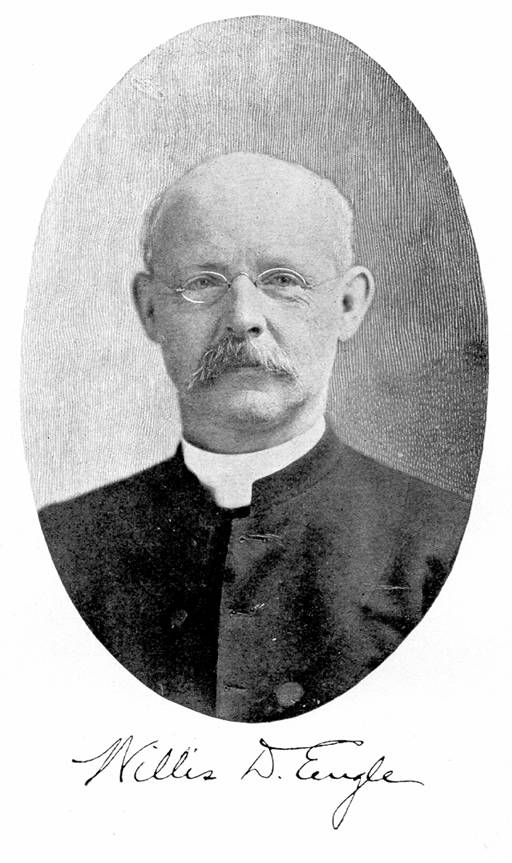
BY WILLIS D. ENGLE
A GENERAL HISTORY
OF THE
ORDER OF THE EASTERN
BY
REV. WILLIS D. ENGLE
Past Grand Patron of Indiana, and first Right Worthy Grand Secretary
of the General Grand Chapter of the Order
ILLUSTRATED
INDIANAPOLIS, IND.
Willis D. Engle, Publisher
1901
This History of the Order of the Eastern Star is
FRATERNALLY DEDICATED
By the author to his co‑laborers in the early days of the Order, whose
eyes have seen the crowning of their labors; and to the memory
of those faithful ones among them who have passed on
to the larger life, and entered upon rest nobly won.
PREFACE.
TO BE the first to enter an unexplored field, and attempt to map out before the understanding of one's readers its various characteristics; to delve below the soil and thus endeavor to discover the hidden sources from which has sprung that which appears upon the surface; and thus to add to the store of knowledge, is no easy task, and requires patient, persevering labor. Although the writer of this book has been an active worker in the Order of the Eastern Star for twenty‑eight years, and during all that time has been a diligent gatherer of material and facts concerning it, and has, by the favor of his fellow‑members been placed in positions of trust and responsibility, which have given him rare opportunities to learn much of the workings of the order, yet he had no idea, when he undertook the production of this history, how great the task would prove, for he has undertaken to be doubly sure of the facts stated and has spent days in running down some particular item that, perhaps, when secured, would not add a dozen lines to the work. That it is perfect, and that every essential fact that it is possible to ascertain in regard to the order is contained in it, he would not pretend to say; but he does say that he has made an honest effort in that direction flow far he has succeeded perhaps time only can demonstrate. Although there have been brief historical sketches of the order written, they have been produced generally for a purpose other than a simple development of the truth, and
4 PREFACE.
the writer knows of none, however brief, that has not contained more or less inaccurate statements, even as his may be found to do, but none have been knowingly made, and he has tried to present every fact in an unbiased manner. That his book will meet with favorable criticism, he hopes; that it will also receive some unfavorable comment, he expects. If he succeeds in adding something to the common stock of knowledge and understanding, and in rescuing some facts from being lost, and is privileged to be an instrument in adding a little to the glory and luster of the order, he will be satisfied. In the history it will be found that while he has made no direct quotations from the present authorized ritual, with one or two minor exceptions, he has quoted, sometimes quite copiously, from rituals that are now obsolete, but in doing so he has carefully avoided incorporating therein anything that might throw any light upon what is the real secret work of the order, and in this respect he believes his work will be found to compare favorably with the Masonic encyclopedias. He has endeavored, at the same time, to convey to the enlightened reader as full knowledge of the subject in hand as was possible with these limitations. Many months of continuous labor have been bestowed upon it, and as he indites these words as his task is drawing to a close, it is with the desire that his readers will consider how hard it is for one to write unbiasedly of his own times, and of events in which lie has been an active participant, so that if the fiat person singular is sometimes singularly prominent, it is simply because a full recital of essential facts rendered it necessary, as he, has no desire to use both ends of the trumpet of fame. He would be singularly remiss if he did not express his deep sense of obligation to the many brothers and
PREFACE. 5
sisters who have given him material assistance in se‑curing information that has helped to make the work both valuable and interesting; and he would also give expression to his sense of obligation to those more numerous sisters and brothers who have so generously confided in his ability to create a work worthy of their encouragement, and have manifested that confidence by subscribing in advance of its production, and thus rendered its publication possible. He trusts that none of them will be disappointed in its perusal, and that they will by kindly words, en‑courage, others to purchase it, that he may receive at least some return for his months of labor. He will be grateful, also, to any one who may be able to add any facts concerning the order that will be of interest, that can be used in a second edition of the work. He will always be glad to know of any copies of old rituals that can be purchased, and he will also be pleased to supply to his fellow Eastern Star bibliomaniacs copies of any rituals of which he may have duplicates.
It will be noticed that in this work the Eastern Star degrees are sometimes spoken of in the singular, and sometimes in the plural. This will be understood when it is stated that when the secrets were given by communication the singular number was used in the early days, but when given in constellations or Chapters, they were spoken of in the plural, and I have followed this custom.
WILLIS D. ENGLE.
Indianapolis, Ind., February 9, 1901.
This material originally scanned by Ralph Omholt, Kirkland Chapter 176, Washington.
BON VOYAGE.
Go, " History of the Eastern Star,"
Where e'er its wandering children are;
Recall to those who hailed its birth
Their toilsome struggle 'mid the dearth
Of cheering words, or sunny ways;
And tell to those of later days
How great the triumph it has met
Lest they forget - lest they forget.
Go gladly forth, and may thy pages
Suffice to keep for future ages
The record of the care and strength
Which nursed and fostered, till at length
The Order of the Eastern Star
Is known and loved the world afar.
With naught set down in malice vile,
E'en unkind facts wear friendship's smile,
For, though our order had its battle,
It's grown above war's din and rattle,
And charity's broad mantle red
Is cast about those days, instead.
To those who labored, loved, and - fought,
The guerdon was not dearly bought,
For our great order moves to‑day
Untrammelled in its upward way.
To those who helped with heart and hand
To make this true; that knightly band;
Those women brave; we ask the fame
Too often grudged each early name.
No easy task for woman lone
To stand as target; many a stone
Was hurled 'gainst such whose word and deed
Helped in our order's hour of need.
They're now forgotten, yet that hour
Gave birth to all its present power.
Now, in these days of proud progress,
Forget not those of storm and stress,
Encourage the same zeal and truth
Which marked our order in its youth,
And let the future years reveal
The same desire for its best weal;
Then shall its record grow and blaze
With the refulgence of its rays,
Till earth, illumined, near and far
Reflects the light of Bethlehem's star!
- ADDIE C. STRONG ENGLE.
PART ONE.
____
EMBRACING A FULL ACCOUNT OF ALL RITUALS
PRINTED FOR THE USE OF THE ORDER SINCE.
ITS INCEPTION, WITH A SYSTEMATIC
PRESENTATION AND COMPARISON OF ITS
SYMBOLIC AND EMBLEMATIC TEACHINGS;
A HISTORY OF ITS GOVERNING BODIES,
TOGETHER \WITH ITS LAWS AND CUSTOMS.
CONTAINING, ALSO, FULL NOTICES OF ALL
SIDE DEGREES AND OTHER CEREMONIES
PUBLISHED FOR THE USE OF THE ORDER,
AND OF OTHER PERTINENT PUBLICATIONS.
CHAPTER I.
____
THE ORIGIN OF THE ORDER.
AN organization would hardly be entitled to the designation Masonic whose origin was not shrouded in mystery, and in this respect the Order of the Eastern Star is the peer of any of the branches of Masonry. We know that androgynous Masonry (so named from two Greek words signifying "man" and "woman,") was established in France in 1730, under the name of Adoptive Masonry, and that its Lodges were called adoptive Lodges. These flourished and gained steadily in both numbers and influence until, in 1774 the Grand Orient of France established the Rite of Adoption, and set forth rules and regulations for its government. Among other requirements was one that each Lodge should be placed under the charge and held under the sanction and warrant of some regularly constituted Masonic Lodge, whose master, or his deputy should be the presiding officer, assisted by a woman president or mistress. We are unable to learn whether the ritual used from 1730 was continued in use, or a new one adopted. It is probable that the earlier ritual at least furnished the basis for the later work, which consisted of four degrees, viz.: The first, or apprentice degree was introductory in its character, in which the candidate was pre‑pared to appreciate the emblematic lessons inculcated in the degrees that were to follow.
The second, or companion degree represented emblematically, in its ceremony of initiation, the
10 THE ORIGIN OF THE ORDER.
temptation in Eden, and, in the lecture, or catechism (of which there was one to each degree), the candidate was reminded of the unhappy results of woman's first sin, culminating in the universal deluge.
The third, or mistress degree was based upon the legend of the building of Babel's tower, the confusion of tongues, and the dispersion of the human race. This was made to symbolize a badly regulated Lodge, in which disorder and confusion reigned, while the ladder of Jacob was introduced to represent the various virtues which a Mason should possess, and the concord and obedience that should exist in a well regulated Lodge.
The fourth, or perfect mistress degree was founded upon the passage of the children of Israel through the wilderness, which was made to symbolize the passage of men and women through this to another and better world, and the officers represented Moses, Aaron, and other characters in that history.
There is no evidence, so far as, known, that the French rite ever obtained in this country. A French edition of its ritual, under the title: "La Vraire Maconnerie D'Adoption," (144 pp.) was printed in Philadelphia in 1768; a Spanish translation was printed in Havana in 1822, and, about 1874, Albert Pike published an English translation of it, revised and amplified, but efforts to establish Lodges proved entire failures, the ritual being altogether too lengthy and sombrous to command success.
But side degrees to be conferred upon women in an informal manner, in the form of lectures, seemed to be in demand, and the demand was supplied. Under the title of "Ladies' Masonry," William Leigh, Past Grand Master of Alabama, in 1851 set forth the degree of the "Holy Virgin," and the de‑
THE ORIGIN OF THE ORDER. 11
gree of the "Heroine of Jericho." In 1866, under the title of the "Ladies' Friend," G. W. Brown, of Michigan, published the "Eastern Star," "Mason's Daughter," "Kindred Degree," "Good Samaritan," and "Heroines of Jericho." Other degrees bore the titles of "Ark and Dove." "Maids of Jerusalem," "Sweet Brier," "Daughter of Zion," "Daughters of Zelophadad," "Daughters of Bethlehem," "Cross and Crown," and "Lady of the Cross." Of the origin of these degrees little is known. The Heroines of Jericho is said to be the oldest of them all, and to have been the production of David Vinton, of Rhode Island. While these other degrees are somewhat analogous to the Eastern Star, it is not the design of the writer to attempt to set forth their various peculiarities, but to confine his history to the Eastern Star.
If confidence could be placed in certain statements of Rob Morris, whose labors in bringing the order into prominence exceed those of any other person, we could easily ascertain the truth as to its origin. But these statements are made without corroborative proof, and have been contradicted by the brother himself. In A Monument of Gratitude (1884), brother Morris said:
“Some writers have fallen into the error of placing the introduction of the Eastern Star as far back as 1775, and this they gather from my work, "Lights and Shadows of FreeMasonry," published in 1852. What I intended to say in that book was, that the French officers introduced adoptive Masonry into the colonies in 1775, but nothing like the degree called the Eastern Star, which is strictly my own origination. By the aid of my papers, and the memory of Mrs. Morris, I recall even the trivial occurrences connected with the work, how I hesitated for a theme, how I dallied over a name, how I wrought face to face with the clock that I might keep may drama within due limits of time, etc. The name was first settled upon,
This material originally scanned by Ralph Omholt, Kirkland Chapter 176, Washington.
12 THE ORIGIN OF THE ORDER.
the Eastern Star. Next the number of points, five, to correspond with the emblem on the masters' carpet. This is the pentagon, "the signet of King Solomon," and eminently proper to adoptive Masonry.”
What brother Morris did say in "Lights and Shadows," was in part as follows:
“The five androgynous degrees, combined under the above title (The Eastern Star Degrees), are supposed to have been introduced into this country by the French officers who assisted our government during the struggle for liberty. The titles, Jephthah's Daughter, Ruth, Esther, Martha, and Electa, sufficiently denote the histories comprehended in the degrees.
* * * The following extracts from the published ritual, translated into English, are in point: "The Sisterhood of the Eastern Star is manifest, to the world by its adoring virtues - five. Honor in bright loneliness is the sanctity and moral guarantee of all the obligations of the Eastern Star. This is read by the enlightened in the cabalistic motto of the order. Upon that foundation (honor) stands the following pillars: - to be true; to be aiding; to be counseling; to be loving; to be secret; to be the servant of Jesus Christ. Sweet in its fragrance is the memory of the worthy dead. It comes up from the recollection of happy hours passed in their companionship; it comes down in faith's joyful anticipations of reunion in the home of the Savior. The members of the Eastern Star will follow to the grave's brink the forms of those who have preceded them to a world of glory. * * *
The following verses are offered by the writer as an humble testimonial of gratitude to those who kindly instructed him in the mysteries of these beautiful degrees.”
Whether this can be explained as meaning what brother Morris said he intended to say I leave to my readers to judge. It will be noted that he makes an extract, translated into English, from a ritual, which was, presumably from his previous statement,
THE ORIGIN OF THE ORDER. 13
in the French language, and it is certain that the quotation is not embodied in any ritual now known to exist, except that in the Thesauros there appears to be a reference to, and amplification of a portion of it.
In an open letter, dated Lagrange, Ky., October 2, 1877, brother Morris said:
“I am justified in speaking on this subject. I wrote every word of the original lectures, and composed the songs. For twenty‑eight years I have been communicating it as my own origination. I am the founder of the system, and no one can show any proofs of its existence prior to 1849.”
And yet brother Morris, in the Voice of Masonry, May, 1862, said:
“My first regular course of lectures was given in November, 1850, at Colliersville, Tennessee. * *
At Colliersville, likewise, I conferred the degrees of the Eastern Star and Good Samaritan. Both of these I had received some years before, the latter by brother Stevens, the same who presided at my passing and raising. The restrictions under which the Eastern Star was communicated to me were "that it should only be given to master Masons, their wives, widows, sisters and daughters, and only when five or more ladies of the classes named were present;" these rules I have always adhered to.”
In the first ritual published under the auspices of brother Morris, The Mosaic Book, 1855, it is stated:
“In selecting some androgynous degree, extensively known, ancient in date, and ample in scope, for the basis of this rite, the choice falls, without controversy, upon the Eastern Star. For this is a degree, familiar to thousands of the most enlightened York Masons and their female relatives; established in this country at least before 1778; and one which popularly bears the palm in point of doctrine and elegance over all others. Its scope, by the addition of a ceremonial and a few links in the chain of recognition, was broad enough to constitute a graceful and consistent system,
14 THE ORIGIN OF THE ORDER.
worthy, it is believed, of the best intellect of either sex.”
In the Macoy Manual, 1866, it is stated that
"the Order of the Eastern Star was established in this country during the year 1778,"
and this statement is repeated in Adoptive Rite, 1868, but in the Macoy Ritual, 1876, it is changed to read:
"during the year 1850."
In Adoptive Rite appears the following note:
"A. O., Anno Ordinis - Year of the Order. To find this date subtract 1778 from the present year." In "The Adopted Mason, the organ of the American Adoptive Rite," (August, 1855,) of which brother Morris was M. E. Grand Luminary, it is stated:
“We seek to effect our purpose by adapting an ancient system to a modern use. The degree upon which the American Adoptive Rite is built is very ancient, more so by far than any other, save the York Rite, and one that carries on its very face indubitable marks of antiquity. It exhibits all the furrows of age. Its voice, solemn and impressive, comes up like the deep tones of the veteran, who, from the treasures of four score, enriches the lap of youth.”
In the Adopted Mason of January, 1856, it is stated:
“The Heroine of Jericho, which is so strangely made a standard of adoption, is in itself the offspring of the present century, and one of the youngest of the androgynous degrees; while the five degrees of the Eastern Star, the basis of the American Adoptive Rite, exhibit internal evidences of great age, and they were always considered the property of master masons, their wives, sisters and daughters.”
The fact is that brother Morris received the Eastern Star degree at the hands of Giles M. Hillyer, of Vicksburg, Mississippi, about 1849.
While recognizing the abilities and labors of
THE ORIGIN OF THE ORDER. 15
brother Morris in the various branches of Masonry and more particularly in the Eastern Star, and his many noble qualities, it must be acknowledged that, as to the history of the order his evidence is too conflicting to be accepted as conclusive, and we must turn to other sources of information, although they may prove equally unsatisfactory.
If we could accept it for what, it at first appears to be, "The Thesauros of the Ancient and Honorable Order of the Eastern Star as collected and arranged by the committee, and adopted by the Supreme Council in convocation, assembled May, 1793," an octavo pamphlet of eighteen pages, the property of brother Alonzo J. Burton, Past Grand Lecturer of New York, and the author of the Floral Work, which purports to have been "Printed for the use of the fourth division U. S. By order of the G. L. 1850," we would have conclusive evidence of the existence of the order in this country in the eighteenth century. The writer regrets that he has been unable to obtain a sight of this pamphlet, although he has offered to make the trip from Indianapolis to New York for the purpose of doing so, as, having seen it, he would be enabled to give affirmative testimony. A reprint, no matter how carefully made, does not enable even an expert to judge of its age or authenticity. The style of type; quality and finish of the paper; the manner of binding; the arrangement of matter on the pages; the spelling of words; and many other things would reveal, to one experienced in that line, many points that another, not up in such matters, might overlook. However, brother Burton has kindly furnished him a carefully edited reprint of it. Of it, he says: "I copied the work myself, not omitting a single word, nor even a punctuation mark." It purports to be the fifth edition of the work, the first
16 THE, ORIGIN OF THE ORDER.
printed in 1793, the third in 1819, the fourth in 1845, and the fifth in 1817. This pamphlet was purchased at a sale by Barker, 63 Bleeker street, New York, November 15, 1896, and the writer freely admits that he knows of no motive that would induce its publication for the purpose of deception merely, and there are some internal evidences that would indicate that it may be will be noted that on the Constellation and on the Book of Instructions, gloves, and collar are mentioned as proper regalia to be worn by each lady.
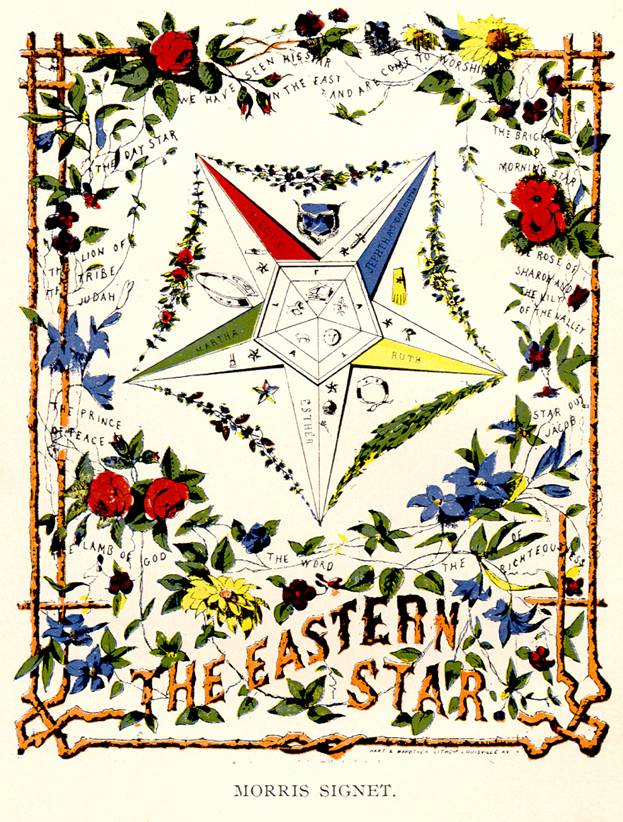
Each point of the star in the seal and signet referred to also contains a five pointed star to which no reference is made in any other ritual, while in the Thesauros the stars are each referred to as representing something, and each of the five classes of regalia has a significance. In the signet the name in the first point is given as Jephthah's laughter, as in the Thesauros, although in all the Morris rituals it is given as Adah. These variations between the seal and signet and his rituals would seem to indicate that brother Morris, in revising the authentic, e. g.: It seal of the Supreme Morris signet (vide illustration, facing title), there are emblems between the points of the star, but these emblems are not in any way referred to in any other ritual of the order extant, except that in 1861, the apron,
THE ORIGIN OF THE ORDER. 17
older ritual omitted some of the emblematical teachings, but did not omit the emblems from the seal and signet.
On the other hand there are several things that would throw doubt upon the authenticity of the Thesauros, e. g.: In it, extracts from the prefaces to the first and third editions are inserted in the fifth. The first is dated Boston, Mass., May 17, 1793, and is signed by John Mayhew, L. R. C. Jones, and Robert Lennox, and attested by James S. Morton, S. C., as "Unanimously adopted by the Supreme Council in session, at Boston, May 18, 1793." A thorough examination of the Boston newspapers of the time fails to disclose any reference to such a meeting; the city directory of the city of Boston of that year does not show any of the persons whose names are given; and the records of the Grand Lodge of Massachusetts do not contain any of the names among the list of members of the Lodges in that jurisdiction.
The legal money in the United States in 1793 was the present decimal system, but the "money of accounts" was in a transition state, the papers of the day giving quotations sometimes in decimal, and sometimes in sterling, money. In the Thesauros it is provided "The membership fee shall not exceed ten nor be less than two shillings sterling." Is it supposable that a national body, meeting at a time when, to say the least, sterling money was passing into disuse, would have established the fee in that money, rather than in the decimal, which was the legal money, and which its members must have known, would come into exclusive use very soon? In the Thesauros it is also stated:
The Districts according to the distribution of 1845 was as follows: District 1, New England and New York; District 2, New Jersey, Pennsylvania, Dela‑
2
This material originally scanned by Ralph Omholt, Kirkland Chapter 176, Washington.
18 THE ORIGIN OF THE ORDER.
ware, Maryland, Virginia; District 3, Ohio, Iowa, Michigan, Illinois, Kentucky, Mississippi; District 4, Tennessee, Arkansas, Louisiana, Missouri, Alabama, Georgia, North Carolina, South Carolina. The several Territories to accompany the States to which they are contiguous.
Whatever excuse there may have been for such a provision in 1793, it could certainly not have existed when the fifth edition was endorsed in 1847, "for the use of the fourth division U. S." in a large proportion of which territory sterling money had never been used.
The preface to the fifth edition is dated New York, Dec. 12, 1847, and is signed "H. H. Sandifer, Secretary." December 12, 1847 was Sunday, and neither the city directories of New York from 1840 to 1850, nor the records of the Grand Lodge of New York for the same period display the name of H. H. Sandifer. The genealogical records in the libraries of Indianapolis and Chicago have been searched, but, although members of the Jones, Lennox, Morton, and other families named, have been discovered, no trace has been found of those whose names appear. The city directories of the forty principal cities in the country have been searched, but in only two of them, Indianapolis and Denver, does the name of Sandifer appear, and investigation has discovered that they are either colored people or Carolinians, with no knowledge of an Eastern branch of the family.
As to the orthography of such words as honor, honorable, Savior, and labor, in the reprint they are all spelled without a "u". I regret that inquiry of brother Burton upon this point has elicited no information other than that the reprint is an accurate reproduction of the original, for, if the "u" is omitted it would be strong evidence that the pamphlet was not printed as early as it purports to have been.
THE ORIGIN OF THE ORDER. 19
The adoption of the Thesauros in 1793 is attested by James S. Dorton, S. C., while the regulations provided for no such officer, the chief being Grand Luminary, and the letters S. C. are specifically interpreted therein as standing for Supreme Council.
According to the Thesauros the Supreme Council consisted of "a great luminary and four deputy luminaries," while the committee that reported the Thesauros was composed of three members, who reported to themselves and two others! The title page says "Copyright secured," without giving date of same, or stating by whom copyrighted, although the law of congress required that both should be given, and the universal form found in all copyrighted books before the revision of the law, about 1870, was "Entered according to the act of Congress, in the district court for the ____ district of ____ , by ____, 18___." I am assured by Thorvald Solberg, Register of Copyrights: "The record of copyrights in the district of Massachusetts for 1793 does not contain any entry of Thesauros of the ancient honorable Order of the Eastern Star," and that "The indices of the copyright records of the Southern district of New York do not show any entry of the book either in 1847 or 1850." All the facts obtainable that would throw any light upon the Thesauros have been set forth, and the reader will have to judge for himself as to what weight is to be given to it. Authentic or not, it is an interesting document, and in this history it will be further referred to.
After reviewing all the facts it must be concluded that brother Morris did not originate the ritual of the order, but that, receiving the degrees by communication, as above stated, and taking the ritual as used before he took up the occupation of a Masonic lecturer,
20 THE ORIGIN OF THE ORDER.
he embellished and adorned it, and started the order toward systematic organization. Certainly, as it at present exists in this country, brother Morris was the master builder.
S. Baring Gould has written a very interesting volume on the myths of the middle ages, but the myths of Masonry are still awaiting the touch of a master hand. The paper, "The Eastern Star," in its issue for December, 1900, had a communication signed "A Sister," wherein it was stated:
“Order of the Eastern Star, the English name given to adoptive Masonry in England and this country, was introduced into this country in 1780. George Washington and Lafayette constituted the first Chapter. The ritual was, however, so dramatic, and required such gorgeous robes, that it gradually lost its hold upon the people until our late brother, Robert Morris, revised the ritual, reinstituting the order, bringing it to a point of perfection unknown in the past.”
While the writer could hardly credit the statement that Washington and Lafayette had found time and opportunity, in 1780, even if they had the disposition, to introduce the English rite of adoption, he could not let such a positive statement go without investigation, in consequence of which the publication of his history had been delayed a month. Through the courtesy of sister Ransford, the editor of The Eastern Star, he was furnished the address of "A Sister," who kindly responded to his inquiries, and referred him to a "Dictionary of Masonic Lore," in the Masonic library at Colorado Springs, Colorado, for confirmation of her assertions; but investigation failed to discover a Masonic library in that city, or any one there who had knowledge of such a book; nor could any trace of it be found by inquiry of the most noted Masonic librarians in the country. His inquiries of the brother
THE ORIGIN OF THE ORDER. 21
who loaned the sister the publication brought the information that it was loaned to an unknown party, and could not be found, and it has not been thought best to delay the publication of this history for further chasing of this Iguis fatuus. Should it prove anything more substantial, the writer will be glad and surprised.
Lafayette, the bearer of information of the most momentous character to Washington, from France, arrived at Washington's headquarters, May 10, 1780, and remained four days, going from thence to Philadelphia, to communicate with congress, returning to Morristown, May 31, where he remained until July 22. During this time, we are told that the Continental army was in a most terrible; condition, and suffering every privation, going often five or six days without bread, and two or three days without either bread or meat, Washington saying that the men had eaten every kind of horse feed except hay. August 7, Lafayette returned to the army, and occupied himself in organizing and equipping a battalion of light infantry with which he led the advance guard of the army. September 6, he participated in a council of general officers, and on the 18th went with Washington to Hartford for a conference of war; on the 25th, the knowledge of Arnold's treason burst upon them, and on the 29th Lafayette sat as a member of the court martial that condemned Andre. He was busy with military plans and operations until the army went into winter quarters in November, when he obtained leave of absence, went to Philadelphia, and remained away the balance of the year. During all this time Washington was carrying a burden of responsibility such as few men have ever borne, and was sleeplessly vigilant in his efforts to continue Clinton cooped up in New York. Can we believe that in the
22 THE ORIGIN OF THE ORDER.
busy weeks when Lafayette was with the army these two men organized an Eastern Star Chapter "with gorgeous robes," when the army was going half‑clad in rags? The investigation thus far made only confirms me in the assertion made when penning the first paragraph of this Chapter, months ago, that the Eastern Star is the peer of any Masonic organization in the mystery surrounding its origin.
CHAPTER II.
SUPREME BODIES.
SUPREME COUNCIL No. 1.
ACCORDING to the Thesauros, the entire government of the order was vested in the Supreme Council, which consisted of five persons "holding their stations during good behavior." It was to meet "quintennially at such times and places as may be previously designated." Through its deputy luminary it granted authority to confer the degrees, and provided that five or more worthy sisters might petition for a charter in the manner following:
To the D. L. of District:
We the undersigned members of the Ancient and Honorable Order of the Eastern Star, have seen the rays five, and are enlightened by the glory thereof. They have advocated the claims of the Order in public and in private; yielded their first fruits to charity, according to the commandment; and now that they may gain increased ability for the good work of the Order, do offer this petition, that a charter may be is‑sued, enabling them to unite their rays into a Constellation, to be entitled the_____ Constellation, No.
State of _____ . They promise obedience to the Constitutional requirements of the Order and to frame their By‑Laws in accordance with the Ancient Constitution. The following officers to hold their stations until others are elected according to the Constitution and By‑Laws, to‑wit : S. P.; V. P.; R. B.; R. O.; R. W.
Dated at ____ the ____ day ____ A. D.
A, B,
C, D, &c.
Vouched for by N. R., A. D. L.
(23)
24 SUPREME BODIES.
It was further provided that upon the receipt of the above petition "a charter will be issued under the great seal of the Supreme Council, countersigned by the deputy luminary in the form and style following, to‑wit:
"Light is sorrow for the righteous, and gladness for the upright in heart."
To all to whom these presents shall come, the Supreme Council of the Ancient and Honorable Order of the Eastern Star sendeth light, peace and love. Know ye, that on the petition of the worthy Sisters A, B, C, D, &c., resident at F, and on the avouching of Brother G. H., acting D. L. of _____ District, who guarantees the illumination and the worthiness of the petitioners, the S. C. has granted and by these presents doth grant to the sisters aforesaid this Charter, authorizing them to form a Constellation of the Eastern Star at or near the town of F, to be opened by any A. D. L., duly authorized and to be governed by the following officers until others are regularly elected, to‑wit: S. P.; V. P.; P. B.; It. O.; R. W.; R. G.; R. R.; T.; S. And we further ordain and declare that this Constellation shall be known and held as _____ Constellation No. ___ of the State of _____ Hereby authorizing the Sisters aforesaid, in the capacity of a Constellation, to elect members; enact By‑Laws subordinate to the Ancient Constitution of the Order; to suspend or expel unworthy members; and do such other acts and things as tend to the good of Order and the interests of the religion of Christ. They to be obedient to rule; attached, the one to the other; pure in heart and life; faithful to Him whose Star in the East they have beheld; and hospitable to all who love the truth; and so conducting, this Charter to them and their successors is perpetual.
Signed at the seat of light and authority, to‑wit: the ___ day of A. D.
____ _____ G.L.
[Locus Semillon.] _____ D. L.
_____ District U. S.
SUPREME BODIES. 25
SUPREME CONSTELLATION.
In 1855, Rob Morris inaugurated a Supreme Constellation, claiming that "no such attempt upon a national basis has heretofore been made in America." The Mosaic Book stated that
The Supreme Constellation was, at the organization of the rite, a self‑assumed body, and will so continue during a period sufficiently protracted to test the merits of the American Adoptive rite, and afford experience as a basis of its improvement. The constitution and edicts of this body constitute the supreme law of the order, both to individual members and to constellations; and its acts will establish precedents for the parliamentary usages, &c., of the order.
Of this body Rob Morris was Most Enlightened Grand Luminary; Joel M. Spiller, Delphi, Indiana, Right Enlightened Deputy Grand Luminary and Grand Lecturer, Jonathan R. Neill, New York, Very Enlightened Grand Treasurer; John AV. Leonard, New York, Very Enlightened Grand Secretary; and Very Enlightened Deputy Grand Luminaries were appointed as follows:
New Jersey, and pro tem for New England - James B. Taylor, Newark.
New York - Thomas C. Edwards, Elmira.
Indiana - Joel M. Spiller, Delphi.
Iowa - L. D. Farmer, Muscatine.
Kentucky - John Scott, Flemingsburg.
Georgia - M. B. Franklin, Atlanta.
Missouri - M. J. F. Leonard, at large.
Right Eminent Deputy Grand Luminaries were also named:
Illinois, Fourth district - Harmon G. Reynolds, Knoxville.
Kentucky - James G. Gorsuch, Portland; W. C. Munger, Covington.
26 SUPREME BODIES.
The form of petition for a charter, to be signed by at least five master Masons, was as follows:
To the M. E. Grand Luminary of the Supreme Constellation of the American Adoptive Rite: We, the undersigned, affiliated master Masons, members in good standing of the Lodge whose title is affixed to our names, being desirous of associating ourselves with a constellation of the American Adoptive Rite, do pray your Most Eminent body to grant us a charter for that purpose, under the title of _____ Constellation No. _____ to be holden at _____. We pledge our Masonic faith, if the prayer of our petition is granted, to submit to the requirements of the Supreme Constellation in all things relative to this rite; and should the constellation herein prayed for fail to be organized, or at any time hereafter be dissolved, we will return the charter and hue books to the V. E. Grand Secretary.
The charter, which, together with five hue books, cost ten dollars, was lithographed in colors in the highest style of the art then known, by Sarony & Co., of New York, and is herein reproduced in facsimile. The significance of the emblems in the border will be found explained under the head: "The Mosaic Book."
The body of it reads as follows:
"We have seen His Star in the East and are come to worship."
In the name and by the authority of the Supreme Constellation of the American Adoptive Rite.
To all to whom these presents may come and especially to our well beloved and enlightened Stellae and Protectors everywhere.
Greeting.
Whereas a petition has been presented to our M. E. Grand Luminary of the American Adoptive Rite by ____ affiliated Master Masons and Members in good standing in their respective Lodges residing at or near the town of ____ , praying that they may be authorized to
SUPREME BODIES. 27
organize and work as a Constellation of the American Adoptive Rite, under the title of _____ Constellation No. ____ and it appearing for the interest of Adoptive Masonry that their petition should be granted now
Know Ye that We the Supreme Constellation of the American Adoptive Rite invested with full power and authority over all Stellć and Protectors and the Supreme Court of Appeal in all cases relative to adoption, do hereby authorize and empower our well beloved and enlightened Pillars _____ Heleon; _____ Philomath; _____ Verger; _____ Herald; and _____ Warder; to open and hold a Constellation by the name of _____ Constellation No. _____ the said Constellation to be holden at _____ or within five miles of the same. And we do likewise authorize our said Pillars to associate with them in the work and discipline of Adoption in said Constellation the following Correspondents to‑wit: _____ Luna _____ Flora _____ Hebe _____ Thetis and _____ Areme. And we do further authorize and empower our said Pillars to confer the five degrees of the American Adoptive Rite, according to the ceremonial and lectures approved by the Supreme Constellation, upon all worthy applicants possessing the constitutional qualifications for the same. And we do further authorize and empower our said Pillars, and their legal successors in office, to hear all and singular matters and things relative to the American Adoptive Rite, within the jurisdiction of said Constellation.
And lastly we do further authorize, empower, and direct our said well beloved and enlightened Pillars, to elect and reject applicants at their discretion; to elect and instruct their successors in office subject to our approval and confirmation; and to perform all matters and things pertaining to and provided in the American Adoptive Rite.
Provided always that the above named Pillars and their successors: do pay and cause to be paid, due respect and obedience to the M. F. Supreme ConsteI‑
28 SUPREME BODIES.
lation of the American Adoptive Rite, and to the by‑laws, rules, regulations and edicts, thereof, otherwise this Charter to be of no force or virtue.
Given under the hands of our Grand
Officers and the seal of our Supreme
Constellation at the City of _____ this
_____ day of _____ Anne Domini 18__
_____ Grand Luminary
_____ Grand Secretary
A constellation was composed of five or more of each sex, but no more than twenty‑five of each sex, in addition to the Pillars and Correspondents, could be members of the same constellation at the same time, but two or more constellations could be connected with the same Lodge. Vigorous work was done in disposing of charters, so that by December 25, 1855, seventy‑five had been granted, as follows:
Alabama - Venus No. 11, New Market.
Arkansas - livening Star No. 16, Morristown.
California - Morning Star No. 44, Grass Valley; Orion No. 57, Mariposa.
Connecticut - Morning Star No. 48, Fair Haven.
Florida - Electa No. 11, Tallahassee; Flora No. 21, Uchee Anna.
Georgia - Virgo No. 4, Woodstock; Magnolia No. 5, Hillsboro; Rose No. 39, Whitesville; Electa No. 58, Cedartown.
Indiana - White Rose No. 3, Crown Point; Jessamine No. 8, Moore's Hill; Cassiopeia No. 28, Cam‑bridge City; North Salem No. 36, North Salem; New Albany No. 160, New Albany; Newman No. 161, Milton.
Illinois - Griggsville No. 10, Griggsville; Orion No. 15, Sycamore; Flora No. 18, Pecatonica; Pittsfield No. 56, Pittsfield; Friendship No. 65, Knoxville; Rose of Sharon No. 67, Tipton.
SUPREME BODIES. 29
Iowa - Electa Morris No. 66, Muscatine; Violet No. 68, Iowa City.
Kentucky - Purity No. 1, Lodge; Vesta No. 7, Burlington; Covington No. 60, Covington.
Louisiana - Cassiopeia No. 32, Lisbon.
Maine - Moriah No. 19, Denmark; Corona No. 22, Waterville.
Michigan - Buchanan No. 20, Buchanan; Western Star No. 61, Litchfield.
Missouri - Flora No. 13, New Madrid; Hesperus No. 17, Charlestown; Lyra No. 24, Arcadia; Morning Star No. 25, Caledonia; Cassiopeia No. 26, Potosi; Eastern Star No. 30, Frederickstown; Evening Star No. 31, Franklin; Western Star No. 33, Pauldingville; Prudence No. 34, Marthasville; Pleiades No. 37, Mexico; Mary Washington No. 38, Florida; Martha No. 40, Madison; Robert Bums No. 42, Fulton; Astrea No. 43, Fayette; Rob Morris No. 45, Spring Hill; Esther No. 46, Pattonburg; Ruth No. 47, Gallatin; Nannie No. 49, Windsor City; Mary Anna No. 50, Roanoke; Mary Washington No. 52, Haynesville; Martha Washington No. 54, Richmond; Rose No. 59, Clinton; Louisa No. 162, Dekalb; Lucinda No. 164, Ridgeley; Hobe No. 167, Rochester; Lafayette No. 168, Palmyra; Hannah No. 169, Trenton.
Mississippi - Concordia No. 6, Tallaloosa; Ripley No. 41, Ripley; Hebron No. 55, Hebron.
New York - Orion No. 9, Evans; Purity No. 27, Spencer; Speedsville No. 29, Speedsville.
North Carolina - Hookerton No. 63, Hookerton.
Pennsylvania - Towanda No. 166, Towanda.
Texas - Lavacia No. 23, Hallettsville; Lily No. 35, Sabine Pass; Pleiades No. 51, Texana; Mount Horeb No. 165, Gabriel Mills.
Vermont - Irene No. 53, Swanton Falls.
30 SUPREME BODIES.
Wisconsin - Lake Mills No. 171, Lake Mills.
Some time in 1857, James B. Taylor succeeded to the office of V. E. Grand Secretary; and, in all, nearly three hundred constellations were organized, the records of which are not at hand, but they included in addition to those named above: Mendias No. 1, Wyandotte, Kansas, July 28, 1856; Alpha No. 1, New London, Connecticut, chartered January 15, 1857, organized March 9; Acacia, Clifton, Tennessee; Decatur, Indiana, 1866; Stevenson, Alabama.
SUPREME COUNCIL No. 2.
It was claimed by the members of the Supreme Constellation that brother Morris pledged himself to desist conferring the Eastern Star degree, except in constellations, but that within two weeks after making this pledge he issued a circular, which he sent over the country, offering to forward to any master Mason in good standing, the necessary information to enable him to confer the degree, upon his remitting to him a fee of three dollars, and that the Supreme Constellation, on discovering what it deemed to be a lack of good faith on the part of the M. E. Grand Luminary, repudiated him, and attempted a reorganization under the name of Supreme Council of the Ancient Rite of Adoptive Masonry for North America, and adopted rituals adapted from an European system, in which there were two branches, consisting of constellations and temples of enlightenment. In justice to brother Morris it should be mentioned that the Mosaic Book, which was the ritual of the Supreme Constellation, specifically stated that "the inherent right which master Masons possessed, to communicate the degree remains forever unchanged, nor does the Supreme Constellation presume to interfere with it." Of the Supreme Council, James B. Taylor be‑
SUPREME BODIES. 31
came Grand Secretary. If the Supreme Constellation was a self‑perpetuating body, the Supreme Council was more. Not only was it self‑perpetuating, but its membership was unknown to any but the chosen few, and all communication with it had to be through the Grand Secretary, who would not even disclose the number and location of its subordinate bodies. Although it attempted to maintain an existence as late as 1876, it is not believed that it really had any substantial being.
EASTERN STAR FAMILIES.
Upon the disruption of the Supreme Constellation the records and seal remained in the hands of the former V. E. Grand Secretary, but the supply of very elaborately lithographed charters was in the possession of brother Morris, who, in 1860, set about organizing families of the Eastern Star, issuing to them charters of the old form, the reason for which he gave as follows:
The use of the old form of charter is continued although the association governed by the Supreme Constellation has ceased to exist. This is done to show that the two systems of "constellations" and "families" are identical in spirit, the latter having taken the place of the former. It serves further to show that the thousands of ladies who were introduced to the advantage of adoptive Masonry under the former system retain their privileges under the latter.
In the family, under this charter, Helion was Patron; Philomath, Conductor; Verger, Treasurer; Herald, Recorder; Warder, Watchman; Luna, Patroness; Flora, Conductress. Under this system, if it can be called a system, the charter was signed by Rob Morris as M. E. Grand Luminary, and, concerning the signature of the V. E. Grand Secretary it was stated:
The Recorder of the family is authorized to sign
32 SUPREME BODIES.
his name as Grand Secretary at the bottom of the charter, adding "p. t." (pro tempore) to his signature.
And it was required that the names of all ladies and gentlemen receiving the degree in the family * * must be entered on the records by the Recorder, and certified lists promptly forwarded to the Grand Patron.
From the above it will be seen that there was really no organization; that the only head was brother Morris; and that there was little or no cohesiveness to the order. Something over one hundred families were organized between 1860 and 1867, but no complete record of them has been preserved, if one was ever made.
I know of only the following: Rose of Sharon No. 4, "held at T. B. Dunigan's House," Annapolis, Indiana, organized January 15, 1861; Plymouth, No. 41, Plymouth, Indiana, organized June 25, 1864; Friendship No. 103, Brooklyn, New York, organized January 25, 1866; Sunbeam No. 83, Mt. Vernon, Indiana, organized April 19, 1866; Miriam No. 111, Chicago, Illinois, organized October 6, 1866; Orion No. 102, Rensselaer, Indiana, organized February 27, 1867; and families of Davenport, Iowa, and Hazleton, Indiana, the numbers and dates of organization of which are unknown. The numbers, it will be seen, are no guide as to order of organization.
SUPREME GRAND CHAPTER.
In 1868, brother Morris resolved to devote the balance of his life to Masonic explorations in the holy land, and, as was claimed by Robert Macoy of New York, turned over to him the prerogatives he had assumed in the order. Previous to this, in 1866, brother Macoy had arranged a Manual of the Order of the Eastern Star, which was published by the Masonic Publishing and Manufacturing Company, and was
SUPREME BODIES. 33
not copyrighted; in this he styled himself "National Grand Secretary." Brother Macoy attempted to keep up the semblance of a supreme body, calling the same a Supreme Grand Chapter, of which he styled himself, in the Adoptive Rite, copyrighted and published by the Masonic Publishing and Manufacturing Company of New York, in which he was a partner, the "Grand Secretary." This title he retained in published rituals emanating from that company up to 1876, when he assumed the title of "Supreme Grand Patron." Petitions for charters, as prescribed in Adoptive Rite, were addressed to the M. E. Grand Patron of the Supreme Grand Chapter of the Adoptive Rite of the Order of the Eastern Star, and the charters issued were in the following form:
ORDER OF THE EASTERN STAR.
"We have seen His Star in the East and are come to worship Him."
To all to whom these presents may come Greeting:
In the Name and by the Authority of the Supreme Grand Chapter of the Adoptive Rite, known by the distinctive title of the Order of the Eastern Star. Whereas, a petition has been presented to us by Sisters _____ who having received, in a legal manner, all the degrees of the Order, and being the ____ of master Masons in good standing in their respective Lodges, praying for a Warrant authorizing them to establish a Chapter of the Order of the Eastern Star, under the title of ____ Chapter No. ____ to be held in County of ____ State of ____ and it appearing for the interest of the Adoptive Rite that their petition should be granted; Know ye, that we, the M. E. Grand Patron and Grand Secretary, by authority of the Constitution of the Supreme Grand Chapter, do hereby grant the prayer of said petitioners, and that the organization may be complete, do appoint brother ____ a master Mason, Worthy Patron; sister ____ Worthy
3
34 SUPREME BODIES.
Matron, and sister ____ Associate Matron of said Chapter.
And we do further authorize and empower our said Patron and sisters to confer the five degrees of the Adoptive Rite, according to the ceremonial and lectures approved by the Supreme Grand Chapter, upon all worthy applicants possessing the constitutional qualifications for the same. And we do further authorize and empower our said sisters, and their legal successors, to do and perform all and singular matters and things relative to the Adoptive Rite within the jurisdiction of said Chapter. And they are further authorized to elect and reject applicants at their discretion; by and with the consent and assistance of a majority of the members: of the said Chapter present upon such occasions, duly summoned, to elect and install the officers of the said Chapter, as vacancies may happen, in manner and form as is or may be prescribed by the constitution of the Supreme Grand Chapter.
Given under our hands and the seal of the Supreme Grand Chapter, this ____ day of _____ in the year of our Lord one thousand eight hundred and ____.
_____
M. E. Grand Patron.
______
Grand Secretary.
[Research Comment: Note the “1778” date in the seal]
These charters were issued for some seven hundred Chapters, located in part as follows:
Alabama 1 Minnesota, 11
Arkansas 5 Nevada 1
California 11 Nebraska 12
Colorado 2 New Hampshire 4
Connecticut 12 New Jersey 5
Dakotah 2 New York 20
District of Columbia 1 North Carolina 12
SUPREME BODIES. 35
Florida 1 Oregon 4
Illinois 181 Ohio 1
Indiana 25 Pennsylvania 3
Iowa 54 South Carolina 9
Kansas 82 Texas 8
Kentucky 2 Tennessee 3
Massachusetts 5 Virginia 2
Michigan 2 Vermont 6
Mississippi 7 Wisconsin 1
Missouri 144 Washington Territ'y 1
Maine 1 __________
Total 641
The foreign market was also cultivated, as will appear from the following:
In 1868, Bro. Andres Cassard, with authenticated powers as Deputy Grand Patron for the South American countries, made an extended tour through Ratiana, Cuba, New Grenada, Venezuela, Chili, Uruguay, Brazil, portions of Mexico, and other parts of South America, where he successfully established many Chapters. * * Through the active exertions of Bro. Henry J. Shields, Deputy Grand Patron for England, Ireland and Scotland, three Chapters have been organized.
- Robert Macoy's Report on Correspondence, Grand Chapter of New York, 1876.
On the 8th of March last (1877), Bro. Andres Cassard appointed, with our concurrence, Pr. David E. Dudley , a Deputy Grand Patron, with ample authority to confer the degrees upon worthy and qualified persons, and establish Chapters in Egypt, China, Japan, Philippine Islands, Singapore, Calcutta, Bombay, and several of the chief towns on the island of Java.
- Robert Macoy's Correspondence Report, Grand Chapter of New York, 1877.
In Macoy's Standard it is asserted:
More than fifty Chapters were organized by brother Andres Cassard, Associate Grand Patron, in Cuba, Mexico, Central and South America, in 1871.
While Edward O. Jenkins was Grand Patron of New York (1871), as well as before and subsequent
36 SUPREME BODIES.
to that time, he signed charters in blank, as M. E. Grand Patron, which were countersigned by brother Macoy as Grand Secretary, and he disposed of them, sometimes through his agents, who were styled Deputy Grand Patrons, and whom he appointed for different States, and supplied with blank charters, rituals, and other supplies, and who, in some instances, traveled constantly, and did a flourishing business. At other times he sold them directly to petitioners, at from ten to thirty dollars each. The charters signed by brother Jenkins were, sold as late as 1873. Not desiring to do injustice to any one, even by implication, I quote from a letter of brother Jenkins: All business matters were attended to by the Grand Secretary, Robert Macoy. I never received one penny in any shape or form for charters, or anything else, nor desired to.
Subsequently, as early as 1876, and as late as 1880, the charters were signed by brother Macoy as M. E. Grand Patron, and Rob Morris as Grand Secretary, but on most of them the name of Rob Morris was in the disguised handwriting of brother Macoy.
In 1879 and 1880 the Grand Chapter of New York issued three charters, on the blank forms of the Supreme Grand Chapter, to Alpha Chapter No. 1, located at Baltimore, Maryland, Arcadia Chapter No. 3, Bowling Green, Kentucky, and Alpha Chapter. No. 1, located at Laramie, Wyoming, which are believed to be the only instances in which a State Grand Chapter has issued a charter for the organization of a Chapter outside its territorial jurisdiction, with the exception of Mississippi, which chartered a Chapter in Florida, 1876, previous to the organization of the General Grand Chapter, and California, which has chartered Chapters in Nevada, the General Grand Chapter having turned the three Chapters chartered by it in that State over to the care of the Grand
SUPREME BODIES. 37
Chapter of California. This was three years subsequent to the organization of the General Grand Chapter, which has jurisdiction over all territory not within the immediate jurisdiction of some Grand Chapter. These charters were filled up in the handwriting of brother Macoy.
According to brother Macoy the constitution of the Supreme Grand Chapter was never printed, and the only indication we have that such a document existed is found in the proceedings of the Grand Chapter of Indiana at its meeting for organization, in which appear some "Extracts from the constitution of the Supreme Grand Chapter, United States, Order of the Eastern Star." It will be noticed that this publication was in 1874, a year after the alleged organization of the Supreme Council No. 3, in provisional form, and the extracts were undoubtedly furnished to brother Leach, who was the deputy of brother Macoy, and who was chosen the first Grand Patron of Indiana, by brother Macoy himself. The efforts made by the officers of Grand Chapters to obtain copies of the entire document met with failure; and it is evident that the existence of the Supreme Grand Chapter was purely imaginary, the whole work, authority, and emoluments being done and enjoyed by brother Macoy. These extracts were as follows:
PREAMBLE.
To give cosmopolitan extension and practical uniformity to that branch of the adoptive rite which is embodied under time title of the Eastern Star; to redeem it from the hands of empirics and irresponsible persons; and that its scriptural and traditional landmarks may be rendered more attractive and better understood; the Chapter Order of the Eastern Star is hereby established under the following constitution:
CONSTITUTION.
Article I. - Primary Source of Government.
Section 1. The primary source of government of
38 SUPREME BODIES.
the Chapter Order of the Eastern Star rests in the Supreme Grand Chapter of the United States, whose times and place of meeting are regulated at the Grand Assemblages.
MEETINGS.
Sec. 2. The meetings of the Supreme Grand Chapter shall occur triennially, on the first Monday in September, at such place as may be designated at a previous meeting. At such meeting all the affairs of the adoptive rite shall be regulated, its rituals revised whenever experience renders it expedient, its officers elected and installed, and measures taken suitable to the dignity and importance of the order, for its dissemination into all parts of the country.
Article II. - State Grand Chapters.
Sec. 5. In each State jurisdiction, when not less than five Chapters are regularly at work, a Grand Chapter may be organized by the concurrence of the representatives of five such Chapters of the order.
* * * * * * * * * *
Sec. 10. The rituals to be used under authority of the Supreme Grand Chapter shall be those now in use, prepared under the supervision of the Supreme Grand Secretary, and no changes, additions or emandations shall be made, except by the direct authority of the Supreme Grand Chapter, in regular convention assembled.
CHARTERS, RITUALS, ETC.
Sec. 11. Charters shall be issued, rituals distributed, and the general direction of the order exercised during the recess of the assemblages of the Supreme Grand Chapter, by order of the M. E. Grand Patron, through the Grand Secretary.
At the time of the publication of these extracts brother Macoy was acting as chairman of a committee of the Grand Chapter of New York to revise the ritual, in violation of the tenth section. Evidently he did not deem it of any force.
SUPREME COUNCIL No. 3.
June 14, 1873, there was a meeting in New York for the purpose of forming the General
SUPREME BODIES. 39
Grand Council of Royal and Select Masters, at which there were in attendance several brethren interested in the Eastern Star, and, at a conference held by them, preliminary steps were taken looking to the organization of a Supreme Grand Council of the order for the World, and a provisional organization was had, with Robert Macoy as Supreme Grand Patron; Frances E. Johnson, of New York, Supreme Grand Matron; Andres Cassard, Associate Supreme Grand Patron; John I. Power, of Mississippi, Deputy Supreme Grand Patron; Laura L. Burton, of Mississippi, Deputy Supreme Grand Matron; W. A. Frail, of Missouri, Supreme Treasurer; Rob Morris, Supreme Recorder; P. M. Savery, of Mississippi, Supreme Inspector. Other officers included E. E. Edminston, of Tennessee, and Julian K. Larke, of New York. Concerning this provisional organization brother Savery said, in 1875:
The committee on constitution and regulations were to report at an adjourned meeting to be held in New York in September, in 1873. * * As the committee failed to report, the provisional Grand Council was, at New Orleans, December, 1871 (the time and place at which the organization was to have been completed), pronounced dead.
Brother Power, Grand Patron of Mississippi, March 13, 1875, said: I have the honor to be Deputy Supreme Patron for all this continent, and as I see no prospect of ever having a meeting of the Supreme Council * * I consider myself functus officio. Indeed the matter of dissolving the Supreme Grand Council was discussed and agreed upon in New Orleans in December last by several whose names figure in the organization of 1873.
That no attempt was made to give brother Macoy even the semblance of authority, until after the question of organizing a legitimate governing body for the
40 SUPREME BODIES.
order was raised, is evident from the fact that, in an article emanating from him in 1878 it is stated: The appointment of Supreme Patron was conferred at a convention of delegates from several states, held in the city of New York, June 14, 1873, by unanimous election, letters patent, and subsequent installation.
The "subsequent installation," as appears by the same article, was not because he had been elected at a convention of delegates," but by authority of a letter from Rob Morris, dated Lagrange, Kentucky, April 29, 1575, addressed to Prof. Andres Cassard, New York, authorizing him to install "Very Illustrious Robert Macoy as my successor in the position of Supreme Patron of the World, Adoptive Rite," which it was claimed was done May 3, 1575, nine months after the beginning of the movement to organize a legitimate governing body.
During this period, the laws and jurisprudence of the order were in a chaotic condition. 'here was no written law, outside the little contained in the ritual then in use, and this lack had given rise to various modes of action on the same subject. It was almost the universal rule that "males" should pay at least double the fees and dues that "females" did. Notwithstanding this, there was, with many, a disposition to deprive them of any rights in a Chapter. A considerable number of sisters insisted that they shout not vote, either on petitions, or for officers, and the exercise of what he deemed his right to the ballot by the writer, in December, 1873, created some discussion, and when the Grand Chapter of Indiana was organized, in May, 1874, sixteen so‑called landmarks were incorporated into its constitution, fifteen of which were reproduced, with slight verbal changes, from the ritual then in use (Adoptive Rite), while a sixteenth was added, as follows:
Master Masons, when admitted to membership,
SUPREME BODIES. 41
shall have all the rights and privileges of the Chapter when convened, except that of balloting for candidates, for membership, and voting for officers.
This was adopted by a vote of twenty‑three to five. This was the fuse that started the fire that resulted in the total destruction of the Supreme Grand Chapter and brother Macoy's control of the order. Through the Masonic Advocate and other journals I made direct assault upon the alleged landmark. In another section of the constitution it was required that "Every member present must vote" on petitions. The, inconsistency of the two provisions was pointed out. With no laws accessible I obtained the addresses of those active in the work in other States and opened correspondence with some twenty of them, asking if they knew of any landmark or law depriving the brethren of the right to vote on any subject, and answers from Massachusetts to Oregon, from New Hampshire to Alabama, were that no such law was known.
GENERAL GRAND CHAPTER.
The first definite proposition to strike at the root of the matter, and put everything upon a reasonable basis by forming a legitimate supreme body, was made by me in the New York Courier of August 30, 1874, as follows:
Two things, it seems to me, are needed immediately: first, a Supreme Grand Chapter composed of representatives from the several Grand Chapters; second, revision and general boiling down and finishing up of the ritual, which is now defective both in style and language. Let us all buckle on our armor, and enter in earnest on the work of improving and extending the order, and a very few years will place it in a very enviable position. But as long as it is made merchandise of by any one, to gain a livelihood, and persons are put in positions of honor and trust, not because they are qualified for them, but simply because they are not able to make a living otherwise, they will, like Othello, soon find their occupation
42 SUPREME BODIES.
gone; it will drag out a miserable existence for a time, and finally fall to the ground of its own weight.
Beginning in October, 1874, the writer contributed regularly to the Masonic Advocate of Indianapolis, communications relative to the order, and, filled with the zeal and fire of youth, he wrote some very pointed articles relative to its needs and management. It was a time when the future of the order could be made or marred very easily, and although the judgment of his matures years cannot fully approve the strong language employed in clothing his thoughts, he recognizes the fact that had he not pursued the course lie did the subsequent history of the order might have been far different from the brilliant record of the last quarter of a century.
His contributions were not appreciated by all, among those by whom they were not, was the Grand Patron of Indiana, who, in his address to the Grand Chapter in 1875, said:
It has been suggested that the ritual should be revised for the reason that it is a botch and disconnected and ungrammatical. It is a little singular that all the intelligent men who love received and worked the ritual have failed to make the discovery, and it has been left to Indiana in the seventy‑fifth year of the nineteenth century to furnish the man who though "Young and of small experience," young and of small experience makes the remarkable discovery, and suggests the remedy.
SUPREME BODIES. 43
At its meeting in 1875 the Grand Chapter of Indiana, its members being ignorant of the true status of the Supreme Grand Chapter, adopted the following:
Resolved, that this Grand Chapter will not declare her independence of the Supreme Grand Chapter, but we hereby empower the Worthy Grand Patron, so soon as fraternal relations have been established with four or more State Grand Chapters, to join with them in a request to the officers of the Supreme Grand Chapter to convene the same immediately and perfect its organization, and on failure or neglect to do so, to call a general convention for the good of the order, to form a General Grand Chapter of the Eastern Star.
At its organization, October 13, 1875, the Grand Chapter of Missouri adopted this resolution verbatim, but no action was taken under it by either Grand body. The Grand Patron of Missouri wrote me concerning it: I cannot, and with present purpose, will not join in any such request, thereby recognizing the existence of what does not exist. * * The thing called a S. G. C. is a myth.
The writer of this history, from 1874 to 1876 carried on an extensive correspondence with sisters and brothers prominent in the work of the order in the several States, agitating the question of organizing a legitimate supreme body. P. M. Savery, Grand Lecturer of Mississippi, under date of June 26, 1875, said: Dear Brother Engle: Yours of 24th to hand and its contents noted. There has never been a Supreme Grand Chapter or Council of the Order of Adoptive Rite, or of the Eastern Star, de facto. * * The Grand Chapter of Mississippi will meet at Tupelo on 14th of July next. I do not desire to bring up the subject (of forming a representative Supreme Grand Chapter) before them, but presume brother
44 SUPREME BODIES.
Power, Grand Patron, will do so, if you request it - which you write you have done.
J. L. Power, Grand Patron, in a letter dated July 7, 1875, said:
Dear Brother Engle: Your favors of the 9th and 24th ult. duly received. have been absent, hence delay in answering. * * * Our Eastern Star Grand Chapter meets on the 14th inst. It is my purpose to recommend action looking to the formation of a Supreme Grand Chapter - a legitimate Grand body - that shall meet triennially, or as may be agreed upon. Your letter on the subject is most opportune.
In harmony with these letters, the recommendation was made by the Grand Patron, and the matter being referred to a special committee of which brother Savery was chairman, the Grand Chapter adopted the following:
WHEREAS, we deem uniformity of ritual and lectures essential to the present and f Lure prosperity of the order; therefore, we respectfully recommend that a committee, consisting of seven members of this Grand Chapter, of which committee the Grand Patron and Grand Matron shall be members, shall be appointed to confer with like committees that may hereafter be appointed by other Grand Chapters of the order in the United States, or elsewhere, whose duty it shall be to take under advisement., and present, if practicable, some feasible and judicious plan for the organization of a Supreme Grand Chapter; which said supreme body shall, when organized and recognized by two‑thirds of the Grand Chapters in the United States, have absolute and supreme control over the ritual and lectures of the Adoptive Rite. We also recommend that said committee shall be the accredited delegates from this Grand jurisdiction to a convention of the order wheresoever and whensoever convened, and they shall have all power and authority to do any and all acts necessary and lawful to be done in the premises; and they shall report their doings to this Grand Chapter at each annual Grand convocation.
SUPREME BODIES. 45
My correspondence with John M. Mayhew, Grand Patron of New Jersey, commenced in February, 1875, and in his fourth letter, dated August 21, following, he said: I look forward with considerable anxiety to the time when a supreme body shall be organized, under whose authority alone a ritual and other ceremonies and form of documents of the order shall be published, and from whom alone all such documents shall be procured. * * I am in hopes of receiving communications from Mississippi and Indiana on the subject before our Grand Chapter meets on October 13th.
And in his next letter, August 29th, he said:
Brother Engle: * * Your letter conveys some glad information, viz.: That the subject of a Supreme Grand Chapter is to come before the Grand Chapter of California in October. I shall also embody the subject in my address to our Grand Chapter. I am, however, in hopes that I shall receive something official from Mississippi in season. Can you assist me in the matter by writing them? Subsequent letters discussed details of plans, and, in accordance with his letters, he presented the matter to the Grand Chapter at its meeting, October 13, 1875, and the following was adopted: Resolved, that five delegates be selected to represent this Grand Chapter at any meeting or convention that may he called for the purpose of organizing a Supreme Grand Chapter of the Order of the Eastern Star.
My correspondence with George J. Hobe, Grand Patron of California, began in February, 1875, and in his ninth letter, dated August 18, 1875, he wrote: I am in receipt of yours of the 10th and 12th of July, as also the August number of the Masonic Advocate, for which many thanks. I see by the Advocate that Mississippi has taken the initiatory step
46 SUPREME BODIES.
toward forming the so‑called Supreme Grand Chapter of the United States. If we should receive a communication from them before the session of our Grand Chapter, October 18th, it will, of course, come up in its regular order; if not, I think I shall bring it before them myself.
Which he did, and at its meeting at Vallejo, October 19, 1875, the following was adopted:
Resolved, that the Grand Chapter constitute a committee of seven, of which the Worthy Grand Patron and Worthy Grand Matron shall be members, to confer with like committees that may hereafter be appointed by the other Grand Chapters of the order of the United States. It shall be their duty to take under advisement, and present, if practicable, some feasible and judicious plan for the organization of a Supreme Grand Chapter, which supreme body shall, when organized and recognized by two‑thirds of the Grand Chapters of the order in the United States, have absolute and supreme control over the ritual and lectures of the order.
Resolved, that said committee be the accredited delegates from this Grand jurisdiction to a convention of the order wheresoever and whenever convened, have power to do any and all acts necessary and lawful to be done in the premises, and report their doings to this Grand Chapter at each annual communication.
Resolved, that the Grand Patron be requested to submit, or cause to be submitted, the action of this Grand Chapter to each and all sister Grand Chapters in the United States, and respectfully solicit their zealous cooperation.
At a meeting of the Grand Chapter of Indiana, in April, 1876, the Grand Patron said, in his address: Several of the State Grand Chapters have passed similar resolutions to the one adopted by our Grand Chapter upon the subject of a Supreme Grand Chapter. As no definite action, however, has been taken upon this subject, I would recommend the. repeal of the aforesaid resolution, and that you, by suitable
SUPREME BODIES. 47
action, fix a time, select a place, declare who shall be entitled to seats in the proposed Supreme Grand Chapter, and invite all other State Grand Chapters to unite with you in the work. The first Wednesday in November, and Indianapolis, would be a suitable time and place, in my judgment.
In pursuance of this recommendation the following was adopted:
WHEREAS, uniformity of work, modes of recognition, and regulations governing eligibility to member‑ship are not only desirable, but absolutely necessary to the permanent growth and prosperity of our order, now so rapidly increasing in numbers, and advancing in the estimation of the Masonic fraternity; and
WHEREAS, several Grand Chapters recognizing this necessity, have appointed committees to represent and act for theme in a convention to. be thereafter called to organize such a body, but have failed to take ally steps which will lead to the calling of such a convention, and this Grand Chapter, realizing the importance of speedy and definite action which will lead to so desirable an end; therefore, be it Resolved, that all Grand Chapters of the order be invited and requested to appoint seven delegates of which the Grand Patron and Grand Matron shall be, ex‑officio, two, with full power to do any and all acts necessary to be (lone in the premises, for and in behalf of their respective Grand Chapters, to meet in convention, for the purpose of organizing a Supreme Chapter, at Indianapolis, at 10 o'clock on Wednesday, the 8th day of November next.
Resolved, that the Grand Patron appoint a committee of three brothers and two sisters to act in conjunction with the Grand Patron and Grand Matron, as delegates from this Grand Chapter to such convention.
Resolved, that the said delegates be appointed the committee of this Grand Chapter to submit a copy of the foregoing preambles and resolutions to all sister Grand Chapters, and request their prompt and zealous cooperation.
48 SUPREME BODIES.
Resolved, that said committee be instructed to make all preliminary arrangements necessary for the accommodation of said convention.
Resolved, that the necessary expenses of the said committee, not to exceed one hundred dollars, be paid out of the Grand treasury: provided, no part thereof shall be expended for mileage.
The Grand Chapter of Nebraska, on June 19, 1876, elected delegates to the convention, with full power to act for it.
At its meeting in Chicago, October 4, 1876, the Grand Chapter of Illinois accepted the invitation of the Grand Chapter of Indiana and elected four delegates to represent it.
The Grand Chapter of Missouri, at its meeting in St. Louis, October 9, 1876, resolved to accept the invitation, and appointed seven delegates to represent it.
New Jersey supplemented her former action, on October 11, 1876, by accepting the invitation, and elected seven delegates to represent the Grand Chapter.
And on October 17, 1876, the Grand Chapter of California took additional action, as follows:
Resolved, that this Grand body cordially accepts the invitation of the Grand Chapter of Indiana to send seven delegates to a Supreme Grand Chapter to be holden in the city of Indianapolis in November next.
Resolved, that the delegates present at such Grand council cast the votes of absentees.
As the original date fixed for the assembling of the convention was very near the date of the presidential election, it was concluded to postpone it one week, and notice to that effect was issued by the delegates from Indiana. On November 15th the convention met and on the following day completed the organization
SUPREME BODIES. 49
of the General Grand Chapter. The Grand Chapters then in existence were those of New Jersey, New York, Mississippi, California, Vermont, Indiana, Connecticut, Nebraska, Illinois, Missouri, Kansas and Arkansas; five of which were represented, and two others were committed to the movement.
The position of Rob Morris relative to this matter is indicated by the following extracts from a letter dated Nevada, California, June 26, 1876:
Dear Brother Engle: * * I am free to say that I think your plans are entirely practical, and that by judicious and prudent establishment of correct principle, a Supreme Chapter of the world may be formed at your November meeting, which will command universal respect. Your personal exertions to this end are, in all respects, meritorious, and will se‑cure to you the permanent honor and respect you have so well earned. I have accepted the general invitation to be present as "Father of the Order," and shall be glad to correspond with you fully and confidentially upon all questions that lie at the root of this subject. Under no circumstances will I permit my name to be used for any office in the supreme organization. I have read most of your articles in the Advocate, and generally can endorse your views.
In answer to this I called brother Morris's attention to the fact that while all members of the order would be heartily welcomed at the convention, it was to be composed of delegates from Grand Chapters only, and on July 15, 1876, he wrote: I will, ere long, advance my opinions upon the subjects named. At present can only say your opinions coincide with mine.
He then made inquiries as to the cost of organizing Chapters, his idea being to organize enough Chapters in Kentucky to establish a Grand Chapter. On July 22d, following, he wrote: I will aid you all I can. I can get up four or five
4
50 SUPREME BODIES
subordinate Chapters very readily, but would not like to pay fees for charters. If your Grand Patron could see his way clear to reduce the terms, and so have the eclat of introducing the Chapter system into this State, it might be mutually advantageous.
The design of brother Morris to organize the order in Kentucky was not pushed to success, and he did not attend the convention as proposed, and, evidently forgetful of our correspondence, he wrote, in an open letter dated Lagrange, Kentucky, October 2, 1877: When the project of a General Grand Chapter originated I was not consulted, and although the organizing meeting was held within four hours' travel of this place, I was not invited, but learned that, not having joined any Chapter in the Eastern Star, I was not entitled to enter.
To this I responded in the Masonic Advocate for November following: Whatever omission was made that should not have been was probably owing to an oversight on the part of the committee which made the original call. Certainly it was not in the province of any individual to extend the call beyond the original limits. Certainly no member of the order would have been excluded, and, in fact, the convention passed an order "that all members of the order be entitled to seats and to speak in the convention." In 1880 the Most Worthy Grand Patron said, in his address to the General Grand Chapter: I have informally invited to be present upon this occasion, one whom the order will ever remember as the founder of the Order of the Eastern Star - brother Robert Morris, LL. D., of Lagrange, Ky. Our brother is not a Chapter member, nor is he in the ordinary sense a member of the order; but as its founder he alone may occupy the exceptional position of membership in the order universal. I am assured by the brother that the has watched with deep interest the progress of the order through the several stages
SUPREME BODIES. 51
of its growth, and regards the organization and success of the General Grand Chapter as evidence of the Eastern Star's ultimate complete triumph. He bids us Godspeed, and assures me that he will be only too glad to aid us in any way in his power. Such being the case, I am sure that time, will only increase the honor with which a grateful order will remember its founder.
Brother Morris was at that meeting elected an honorary member of the body, and his natal day, August 31st, was made the festal day of the order. In an address acknowledging these honors, he said: I am satisfied with what has been done by the officers of this body in the last three years, and that the basis on which the order now rests is a permanent one. Second - I have always felt the warmest friendship for brother Macoy, and friendship is a thing not to be broken for slight cause. This friendship has existed for thirty years, and it would take a great deal to break it. I disapprove the course he has taken, and have labored unavailingly to restrain him. I would never suffer a hard word to sever true friendship, which is of inestimable value, but would bear many things from friends. Others have borne with my faults, and I will bear with theirs. Brother Macoy's course I have disapproved from the first, although I do not think he was properly treated at first; yet, that does not justify him in they course he has since pursued. '' * * If any Grand Chapter has any idea of withdrawing from your body, as Grand commanderies did from the General Grand Encampment, I would say to them, don't do it; I beg of you. Wait fifteen or twenty years and let the General Grand Chapter have a chance to demonstrate the good that I am sure is in it, and which will result in such a Grand success that the Masonic fraternity will accept it as a helpmeet for it, and be surprised that it did not take it up sooner; for, properly worked out, it will form a Grand attachment to free Masonry. This I felt years ago, and I trust the day will come when every Lodge will have in connection with it a
52 SUPREME BODIES.
Chapter of this order. The more there are the cheaper they can be run, and the more good can they accomplish. I am sorry today that I have not given my own personal attention for thirty years to this matter, and it is with sincere regret that I realize it is too late for me to do the good in it that I could have accomplished if I had begun years ago, but I am glad to know that younger men and women have taken hold of the work with a zeal and wisdom which will assure success; and I say to you: Preserve the order in unity; frown down all secession; keep the Grand Chapters in rank, for in union there is strength.
Brother Morris was in attendance at the meeting of the general body in St. Louis, in 1886, and was loyal to the interests of it up to the time of his death, July 31, 1888.
The position assumed by brother Macoy was one of most bitter opposition to the movement, the motive of which may not be far to seek when it is remembered that from the sale of charters at from ten to thirty dollars each, from the sale of rituals at from one to five dollars per copy, and from the sale of jewels at fifty‑six dollars for a set of fourteen, similar to those that can now be bought for sixteen dollars, he had enjoyed an income of several thousand dollars a year. One of the principal causes of dissatisfaction was the numerous changes made in the ritual. That in use in 1874 was revised and materially altered in 1875, so that previous editions were useless when the later was used, and, in 1876, he issued another differing still more from previous ones; even the different editions of the syllabus gave radically different directions as to the manner of giving the signs, so that it was found that, if Chapters were to keep up with the order, annual expenditures must be made for the purchase of new editions of the ritual. When Grand Chapters which were using the 1875 ritual applied to the Masonic Publishing Company for additional
SUPREME BODIES. 53
copies of it, they were informed that it was out of print, and that copies of it could not be purchased.
The following is from the address of the Most Worthy Grand Patron in 1880:
Soon after the publication of the ritual in November, 1878, each member of your committee, and the printers, received a letter from a legal gentleman in New York, saying that he had been retained by Mr. Robert Macoy to prosecute us individually for forfeiture and damages, for violation of his copyright upon the ritual published by him in 1876. The letter stated that, "Failing to hear from you within ten days, I shall proceed against you in the United States Court." * * * Our counsel's reply in our behalf was such that nothing further has been heard from the threatened suit. Thwarted in his effort for your injury in this direction, Mr. Macoy soon after published a work, containing less than one‑half of our ritual, and falsely advertised it as an edition of the ritual published by the General Grand Chapter, copies of which were for sale at one‑half the price of the authorized work. * * *
The opposition of brother Macoy was not only manifested in a legitimate way, but assumed the shape of virulent personal attacks upon individuals and committees of the General Grand Chapter. It is not deemed necessary to incorporate herein the worst of these, as they would soil the pages too greatly.
Many of his expressions were in letters and postal cards sent to members of the order, but I will present only a few extracts of the least obnoxious nature from his printed articles. The following is from a postal card sent generally to members of the order in January, 1879: The new ritual, sent forth by the committee of the G. G. C. (Gen. Gulling Catchpenny), consisting of a blessed tom lamb (Mary's pet, whose fleece was white as snow), and two others of equal obscurity, being a thorough failure, except for mischief, is now appropri‑
54 SUPREME BODIES.
ately known as The Lamb's Fry. This unskillful parody and unjust plagiarism on the recognized standard ritual can be had, postage prepaid, at 10 to 50 cents a copy, on application to the G. S. of the above body. Address D. W. Jengles, Indianapolis, Ind.
Only once did brother Macoy approach to wit in his enamations in the matter, which was in a two‑page circular issued in 1881, headed with the accompanying cut, which he labeled "A starry caudal appendage." The following extracts are taken from it: The hybrid concern known as the G. G. Circus, will pitch its tent, erect the ring, and spread the saw dust for special exhibition, for a few days only, at San Francisco, Cal., in August, 1883. The company will be fresh and unique, consisting of aesthetics, acrobats, gymnasts, champion bareback riders, strong minders, &c. Signor Funnieman, captain of the gang, who writes ridiculous reports for G. C. of Mo., will handle the whip as ring master. Mr. Jengles, G. S., the nice young man, whom all the women want to marry, will appear in his original character as clown. "Our Willis" will be on hand, as heretofore, to collect the revenue and appropriate the funds. "Our noble order," as some of the F. F. F. (Fair, Fat and Forty), fraternity proclaim it, is passing, with notable rapidity, into "Our school for scandal," and will, under the auspices of the circus managers, soon pass into the region of oblivion.
* * * * * * * * *
In the year 1876, a few persons, having in view their own pecuniary interests, organized the concern known as G. G. C. (Grand Gossiping Circus) of the O. E. S. They saw "millions in it." Having no ritual they plagiarized one already made and claimed it as their own, and are now reveling in the fruits of their dishonesty.
* * * * * * * * *
Hops and Hoppers. - An item is going the rounds
SUPREME BODIES. 55
of the press that the Chapter at Indianapolis has inaugurated a series of social hops for the season. The order was not organized for the purpose of dispensing hops, gratifying hoppers, or any sort of indecent gyratory and gymnastic displays. For what base purpose is the order being used. Shame! It was this and similar kinds of immoral exhibitions that brought upon the order in Chicago and other places an opprobious title.
* * * * * * * * * * * * * * * * * *
SYMPATHETIC ADVICE.
Dear friends,
If you wish to keep your title clear
For a mansion in the skies.
And of Boss Female Stars have no fear
Avoid Fast ones - and be wise.
The columns of the New York Dispatch teemed with productions of brother Macoy's pen, of which this is a sample: Three years ago a few nervous and inconsiderate individuals met in a Western city and without lawful authority conglomerated a body which they termed G. G. C., which, being translated into good English, signifies General Grand Circus. This spurious organization is now led and presided over by a very feeble Lamb, assisted by a few unknown stray sheep.
The advocates of the concern admit that it possesses no authority, and is a non-entity, therefore its qualities are so flat, stale and puerile that it does not rise to the dignity of an ordinary fraud, and it should be treated accordingly. The result is that either we should recognize this fraud as having a claim upon our fealty, or that we should at once and unanimously denounce it as what it really is - a fraud. If we love the order as it is, let us stand by it and ever be its friends: if we do not, let us help to forward the ideas of this fraudulent imitation.
Immediately after the issuance of the ritual authorized by the General Grand Chapter brother Macoy issued extracts from it, containing the opening, closing, and initiatory ceremonies, which lie not only
56 SUPREME BODIES.
offered to sell, as he always had sold his rituals, to all that would buy, whether Masons or not, but he sent copies of it gratuitously to leading Masons, who were not members of the order, in all parts of the country. In addition to these extracts he appended what he called "Critical and Explanatory Notes," in which he ridiculed some of the changes made in the ritual, and reiterated his claim to ownership of the same. If brother Macoy had any legitimate grievance, it was in the infringement of his copyright, and for that there was no basis. Concerning this, Thomas M. Lamb said in his address to the General Grand Chapter in 1880:
If Mr. Macoy's preposterous claims of ownership of the ritual work of our order should be sustained, the Eastern Star would be thrown powerless into the hands of one man. A copyright is of no value unless the party claiming its benefits is wholly or substantially the author of the work copyrighted. The ritual and its several revisions, published and copyrighted by Robert Macoy, are almost entirely the work of other brains than his own. The revisions were mostly the work of committees regularly appointed by the Grand Chapter of New York. The latest revision by that body was made by a committee appointed in 1875. * * * The ritual published by the General Grand Chapter has more original matter than has appeared in all the rituals published by Mr. Macoy, and it is well known that we had access to all the original sources used by him in the compilation of the books he claims to own. * * * The various rituals published, and all the facts known to us, were submitted to able counsel, and it appeared, as the result of his examination, that Mr. Macoy's claim is as void in law as in moral right.
As will be seen by readers of this history, the first manual issued by brother Macoy was in 1866, and it was not copyrighted, but, on issuing a subsequent edition in 1867, that was copyrighted, but any one at
SUPREME BODIES. 57
all familiar with the copyright laws knows that, in order to have it protected, a work must be copyrighted before it is issued; that it must bear the imprint of copyright; and that the copyright only protects original matter never before published. But brother Macoy did not own the copyright of any ritual issued before 1876, so that he had no right to raise his voice in objection to the action of t1: General Grand Chapter in publishing its ritual, so far as his individual rights were concerned, for it contained nothing that was original in the ritual of which he was the owner of the copyright. The Mosaic Book, the Ladies' Friend, the Tatem Monitor, the Adoptive Rite, and other works, containing in one form or another the work of the order, were the sources from which brother Macoy and the General Grand Chapter alike drew the substance of their rituals. After brother Macoy failed in his attempt to intimidate the committee of the General Grand Chapter which had charge of the publication of its ritual, he took refuge under the assertion that, "1. I am not fond of a law‑suit, and the parties do not reside in the judicial district with me; 2. They are pecuniarily worthless." To this response was made in "A review of the critical and explanatory notes," by the writer, as follows: The strong arm of the law, with all the force of the United States government will protect Mr. Macoy in the possession of all the property to which he can prove a legal title. Though he may insinuate publicly as he has already done privately, that the reason for his not putting his threat of legal proceedings into execution was on account of the financial irresponsibility of the members of the committee, it lacks the elements of credibility, as, no matter how irresponsible financially the members of the committee may be, if Mr. Macoy has any title to the "property" he so generously claims, the courts will grant a perpetual injunction prohibiting them from publishing the rit‑
58 SUPREME BODIES.
ual of the General Grand Chapter, and Mr. Macoy can live off of the profits from future sales of the ritual as long as the life of the order can be maintained under his dictatorship.
Even as late as 1892 brother Macoy kept up the claim of the existence of a governing body, the title and authority of which he stated in Macoy's Standard: The Supreme Chapter by the inherent authority of possession and right of eminent domain, has exclusive authority to establish Chapters in jurisdictions domestic and foreign, where no Grand Chapter of the rite exists; to establish a uniform system of work and lectures; has jurisdiction over all subjects of legislation, and appellate powers to hear and decide all questions of law and equity that may be brought before it; and to do each and everything appertaining to the good and perpetuity of the rite, in accordance with its constitution.
And of this body he claimed to be Supreme Patron. And yet in his critical and explanatory notes he had said: I opposed the proposition of a General Grand Chapter because I had seen for thirty years the uselessness of the two national Masonic organizations, and the waste of immense sums of money obtained substantially under they guise of charity, for their maintenance. * * * I feared that such an organization in the Adoptive Rite would meddle with the rights of State Grand Chapters, deprive them of their sovereignty, independence, and absolute authority in their respective jurisdictions.
A comparison of the very limited authority of the General Grand Chapter, composed of the representatives of the various Grand Chapters, with that claimed for the Supreme Chapter, which consisted solely of brother Macoy, will demonstrate, at least, his lack of sincerity. It was further claimed that Grand Chap‑
SUPREME BODIES. 59
ters could only be formed by "the sanction of the Supreme Chapter or the Supreme Patron." This brief reference to the violent and bitter persecution which those prominent in the movement for the upbuilding of the General Grand Chapter, and the establishment of the order upon a substantial foundation underwent, is set down in no spirit of malice. It only serves as an index to point to the great mass of such material emanating from the same source, aimed principally at the then Most Worthy Grand Patron, Thomas M. Lamb, and myself, as Right Worthy Grand Secretary, but some of the bitterest shafts were directed at sisters who were also Past Grand Matrons. I have an abundance of such material, which was sent through the mails in utter violation of the postal laws against the transmission of obscene matter, which I could not be induced to put in type. In his milder moments he wrote of the members of the General Grand Chapter as thieves, and its ritual as a bawdy one, and if he ever alluded to either the General Grand Chapter or its active promoters, save in terms of opprobrium, I am ignorant of it. Were it possible to set down the history of the order, and to convey even a faint idea of the trials through which it has passed to its present high estate without reference to this disagreeable feature, it would have been passed by. Brother Macoy's mind was naturally warped by personal interests, and his nature was such that he could not view, unbiased, a subject in which he was so deeply concerned. The order owes much to his efforts toward systematizing and arranging it, and if he could have disabused his mind of the conviction that both the order and its ritual were his personal property, and have welcomed the movement that was designed to more thoroughly systematize and organize it, and induced the Grand
60 SUPREME BODIES.
Chapter of New York, which was thoroughly under his influence, to accept the invitation to participate in the convention which organized the General Grand Chapter, and attended the same, as a representative of his Grand Chapter, he would have been received with the highest honor, and might have handed down a name unsullied by the mistakes of his later years. He has passed beyond the reach of censure, or reproach, into a region, let us hope, where, with clear vision he can see the unselfishness of the labors of those he opposed, and can realize that the welfare of the order, which was really near his heart, was also dear to them.
The General Grand Chapter in 1895 adopted the following, reported by a committee of which the writer was chairman: Robert Macoy, Past Grand Patron of New York, although never connected with this body, but rather opposed to it, rendered most valuable service to the order by his talent and great executive ability, giving it the Chapter form of organization which has resulted in its present highly prosperous condition. We gladly then cover what we deem his failings, believing that be honestly held and battled for his views, with the broad mantle of charity, and express the sense of loss we must feel as an order, and inscribe his name upon the General Grand Chapter memorial scroll.
Many Masons who held positions of prominence had a very intolerant spirit toward the order, which found expression in many ways; sometimes, as in Ohio, in excluding Chapters from Lodge rooms, under all circumstances; and sometimes by severe attacks in the columns of the Masonic press. Numerous as these were, we will mention only one.
One of the most reputable of Masonic journals, the Philadelphia Keystone, in a three‑column article
SUPREME BODIES. 61
upon the address of Mattie A. Yost, Grand Matron of Missouri, had this to say: We are pronouncedly opposed to "hair pin" Masonry. We do not think that a tyled Lodge or Chapter is the place for males and females to congregate, and we know that freeMasonry, in its institution, its inherent character, and its present purpose, has no affiliating elements that render it homogenous with a female secret society. Masonry was not made for all men, and certainly it was made for no women.
And shall it ever he that ancient craft Masonry will officially recognize "hair pin" Masonry, and take it to its arms? Shade of King Solomon, forbid the banns! * * * Let those individuals who created this order alone recognize and take care of their illegitimate offspring.
Sister Yost was denied the columns of this Masonic journal by its valiant editor, to make reply to his ungentlemanly assault, but she found an equally reputable Masonic journal, the Masonic Advocate, that gave her the opportunity to castigate the gentleman in such a way that he had nothing more to say.
CHAPTER III.
RITUALS.
THE following is a complete list of rituals of the Eastern Star extant, arranged alphabetically by the names by which, for the sake of brevity and convenience, they are designated in this history.
Adoptive Rite. - Adoptive Rite. A Book of Instructions in the Organization, Government, and Ceremonies of Chapters of the Order of the Eastern Star. Arranged by Robert Macoy, Grand Secretary of the Supreme Grand Chapter. New York, Masonic Publishing Company, 626 Broadway. 1868. Copyrighted, 1868, by the Masonic Publishing and Manufacturing Company.
Adoptive Rite Revised. - Same as above. (1874.) Adoptive Rite Ritual. - Adoptive Rite Ritual. A Book of Instruction in the Organization, Government and Ceremonies of Chapters of the Order of the Eastern Star, arranged by Robert Macoy, Past Grand Secretary of the Supreme Grand Chapter. Revised Edition. New York: Macoy Publishing and Masonic Supply Co., 34 Park Row, N. Y. 1897. Copyrighted, 1868, by the Masonic Publishing and Manufacturing Company, and in 1897, by J. G. Barker.
Book of Instructions. - F. A. T. A. L. Book of Instructions. 1861. No imprint. Not copyrighted.
California Ritual. - Ceremonies for opening the Chapter, Conducting Business, the Form of Initiation, Closing the Chapter, and Installation of Officers, for the use of Subordinate Chapters under the Jurisdiction of the Grand Chapter of California, of the Order of the Eastern Star. Printed by Authority. (1873.) Not copyrighted.
(62)
RITUALS. 63
California Revised. - Same as above. San Francisco. Spalding & Barto, Book and Job Printers, 414 Clay street. 1877. Not copyrighted.
Critical and Explanatory Notes. - Ritual of the Order of the Eastern Star, as "set forth and established" by the General Grand Chapter. With Critical and Explanatory Notes. By Robert Macoy, 33d Degree, Past National Grand Secretary and Past Grand Patron of New York, and Grand Patron of the Order. "Uniformity of Ritual is Desirable." New York: Macoy, Publisher, 4 Barclay Street. 1878. Copyrighted, 1878, by Robert Macoy.
Crombie's Ritual. - Ritual of the Order of the Eastern Star. Revised by Brother John Cronibie, 33d Degree, 90th Degree, 96th Degree, Past Grand Warden, Grand Lodge of Scotland; Past Provincial Superintendent of Aberdeenshire; Past Provincial Grand Master for Aberdeenshire, &c., Royal Order of Scotland; Sovereign Grand Master General for Scotland, Royal Masonic Rite, &c., &c., &e. Aberdeen: Gibson & Thompson, 8 Gaelic Lane. 1889. Not copyrighted.
General Grand Chapter Ritual. - Ritual of the Order of the Eastern Star, Published by Authority of the General Grand Chapter. Printed for the General Grand Chapter. (1878.) Not copyrighted.
General Grand Chapter Revised. - Ritual of the Order of the Eastern Star. Published by Authority of the General Grand Chapter. First Revised Edition. Copyrighted, 1890.
Ladies' Friend. - The Ladies' Friend, Containing all the Lectures and Exoteric Ceremonials, made use of in Conferring the Adoptive Degrees of Masonry, Consisting of the Eastern Star, Mason's Daughter, Mildred Degree, Good Samaritan, and Heroines of Jericho, by G. W. Brown, M. A. Ann Arbor. Press of Dr. A. W. Chase, Main Street, 1866. Copyrighted by G. W. Brown, 1866.
Lowe's Exposé. - Adoptive Masonry Illustrated. A full and complete Illustrated Ritual of the five degrees of Female Masonry, comprising the degrees of Jehpthah's Daughter, Ruth, Esther, Martha
64 RITUALS.
and Electa, and known as the Daughter's degree, Widow's degree, Wife's degree, Sister's degree, and the Benevolent degree. By Thomas Lowe. Ezra A. Cook, Publisher, 1881. Copyrighted by Ezra A. Cook, 1881.
Macoy's Manual. - Manual of the Order of the Eastern Star, containing the Symbols, Scriptural Illustrations, Lectures, etc., adapted to the System of Adoptive Masonry. Arranged by Robert Macoy, National Grand Secretary. "I have seen His Star in the East and have come to Worship Him." Beautifully Illustrated. New York, Masonic Publishing and Manufacturing Company, 430 Broome Street. Chicago, J. C. W. Bailey. 1866. Not copyrighted. Subsequent editions copyrighted.
Macoy's Ritual. Ritual of the Order of the Eastern Star. A Book of Instruction for the Organization, Government and Ceremonies of Chapters of the Order in every department, by Robert Macoy, Supreme Grand Patron, and Past Grand Patron, Grand Chapter of New York. Illustrated. New York, Robert Macoy, Publisher, 4 Barclay Street, 1876. Copyrighted by Robert Macoy, 1876.
Macoy's Standard. - The Rite of Adoption. The Standard Rituals of the Degrees of the Eastern Star, the Queen of the South, and the Amaranth. To which is added that of the Matron's Administrative Degree. A complete Book of Instruction for the Organization, Government and Ceremonies of the Rite of Adoption, in every Department. By Robert Macoy, 33d degree, Supreme Patron of the Eastern Star, and Vicar‑General of the A. and A. Scottish Rite of Adoption, Southern Jurisdiction. New York: Robert Macoy, Publisher, 1887. Copyrighted by Robert Macoy, 1876, 1887. Later edition copyrighted by Robert Macoy, 1891.
Michigan Ritual. - Without title. 1875. Not copy‑righted.
Morris's Manual. - Manual of the Eastern Star Degree+ as arranged by competent authority. 1860. No imprint. Not copyrighted.
RITUALS. 65
Mosaic. Book. - The Mosaic Book of the American Adoptive Rite, in three parts. Part I. General Instructions. Part II. The Ritual. Part III. Constitution, By‑Laws, etc. First Edition. Published under the authority of the Supreme Constellation of the American Adoptive Rite. New York, John W. Leonard & Co., 383 Broadway. 1855. Copyrighted by John W. Leonard, 1855.
Mosaic Second. - The Mosaic Book of the American Adoptive Rite. In two parts. Part I. General Instructions. Part. II. The Ritual. Second Edition. Published under the Authority of the Supreme Constellation of the American Adoptive Rite. New York: J. B. Taylor, V. E. Gr'd Sec'y, 335 Broadway. 1857. Not copyrighted.
New York German. - Ritual des Ordens vom Ost Stern. Lehrbuch zur Leitung von Kapiteln, geordnet and zusammengestellt von Robert Macoy, Gross‑Patron des Gross‑Kapitels im Staate New York. L`nberseszt fuer den Gebrauch in Deutschen Kapiteln fuer Concordia Kapitel von Simon Lambert. New‑York, Druck von "Der Fuehrer." 1898. Not copyrighted.
New York Ritual. - The Authorized Standard Ritual of the Order of the Eastern Star in the State of New York. A system of forms and ceremonies, with necessary instructions for Chapters. As revised by a committee at the annual session of the Grand Chapter, held in June, 1897. New York: Published by the Grand Chapter, 1900. Copyrighted by Robert Macoy, 1876, 1887, 1891; by Clara Clark, 1895; by Grand Chapter, Order of the Eastern Star, State of New York, 1896, 1899, 1900.
Rosary. - The Rosary of the Eastern Star, comprising the Lectures, Odes, Emblems, Scriptural Readings, and General Directions appertaining to the popular and elegant system of Adoptive Masonry, by Rob Morris, LL. D., Masonic Writer. Chicago, John C. W. Bailey, Printer and Publisher, P. O. Box 1439, 1865. Copyrighted by Rob Morris, 1865.
66 RITUALS.
Scotch Ritual. - Ritual of the Order of the Eastern Star. Aberdeen: Printed by W. Milne Gibson, S Gaelic Lane. 1900. Not copyrighted. Same as Crombie's ritual except title page.
Tatem's Monitor. - The Monitor of the Eastern Star, containing the Ritual of Adoptive Masonry embraced in the Eastern Star Degree, consisting of the Initiation, Degree Work, Ceremony for Opening, and Closing a Lodge, Installation Services, etc., Together with forms and rules for the government of Lodges, compiled and arranged by John H. Them, Adrian, Michigan. Holmes, Cook & Bruner, Printers, Adrian, Mich. Copyrighted by J. IL Tatem. 1867.
Thesauros. - Thesauros of the Ancient and Honorable Order of the Eastern Star as collected and arranged by the Committee and adopted by the Supreme Council in Convocation, assembled May, 1793. Copyright Secured. Printed for the use of the fourth Division, U. S. By order of the G. L. 1550.
The following account of the various rituals published takes them in the order of their publication, so that the reader can trace the development of the work of the order, and note its various changes. It has been deemed best to give in this Chapter only a general outline of them, reserving to a subsequent Chapter the explanations of the various emblems, and grouping the different explanations of each emblem or class of emblems together, so that the changes may be more easily noted without critical study.
I am aware that criticism may be made that too copious extracts have been inserted herein from rituals which are now obsolete, but it must be remembered that Macoy's Manual and Adoptive Rite Ritual can be purchased in the open market by any that will buy, and that only the initiated can know what changes have been made, and wherein the former work is similar to that now in use. Those who have
RITUALS. 67
no idea of the loose manner in which former rituals have been kept, or of their complete accessibility by any one caring to read them, may criticise the author for thus quoting from them, but, secure in his belief that he has divulged no new facts he has chosen thus to present the evolution of the ritual. The various efforts, largely unavailing, on the part of the various Grand Chapters, to restrict the circulation of the ritual, emphasizes strongly the necessity of that which was prayed for in the memorial of the Grand Chapter of Texas to the General Grand Chapter in 1898, on which a committee will report in 1901, viz: the publication of a manual to contain the lectures and other non‑secret portions of the ritual for general sale, re‑serving the secret work for communication in another way. In this history will be found nothing that, even if it had been quoted from the present ritual, would not properly find a place in such a manual. Reference is made in the Preface to this subject, to which the reader's attention is called.
THE THESAUROS.
In Chapter 1, the authenticity of this ritual is discussed. In the preface of 1819 it is said of the order: During the revolutionary war, and the last war with England, it tended greatly to soften barbarous strife by bringing to the aid of the wounded, the gentle charity of enlightened sisterhood.
In the. ritual it was stated that "no officer of the Supreme Constellation receives any fee or reward for services rendered in that capacity, nor can the council itself establish any treasury or permanent fund whatever in connection with the order." or was any officer of a constellation to be allowed any fee or emolument for services. Meetings were to be held quarterly. The officers of a constellation were
68 RITUALS.
Principal; Vice Principal; five sisters of the rays, viz: Ray Blue, Ray Orange, Ray White, Ray Green, and Ray Red; Treasurer, and Secretary.
In the charges accompanying the several degrees the candidate was thus addressed:
At initiation. - May your obedience be as exemplary as that of Jephthah's daughter. May your honor be in your hands a weapon of might to cut asunder all unholy ties, and prove the sword of the Spirit, which is the Word of God. May your apron caution you to keep your garments unspotted from the world, and your emblematical color, blue, advise; you constantly of that cerulean hue which appears in the clear heavens, to win us upwards to those still higher mansions, not made with hands, eternal in the heavens. So mote it be * *
At passing. - May your attachment be like that of Ruth, both to the service and the people of God. May your sheaf of wheat move you to produce an hundred fold of the peaceable fruits of righteousness. May your glove warn you of those thorns and asperities which will everywhere be found until "He that cometh shall come." May your emblematical color, orange, continually suggest to your mind amidst the Spring and Summer of life, that when its Autumn cometh on and the Winter of death draweth nigh, your ripened sheaves shall be: acceptable, and the Lord of the harvest giveth you an eternal rest among those pronounced worthy, good and faithful servants. So mote it be * *
At raising. - May the spotless purity of your hearts be like that of virtuous Esther. May your golden crown entice your thoughts to that brilliant company that encircles the throne of God. May your band serve to connect you in spirit with the pure of all ages who have gone up to their kindred heaven; and your emblematical color, white, awaken devout aspirations, that after death shall have released you from the soiled raiments of the flesh, your souls washed white in the blood of the Lamb, may you be presented for acceptance of your Redeemer, without fault before the throne of God. So mote it be.
RITUALS. 69
At exalting. - A solemn union, while we contemplate the scene described by a faithful John. An open sepulcher, and a triumphant God! Weeping to joy and tears to smiles! The Redeemer, touched by human grief, and the dead, that died in the Lord called again to life. And can a member of the Eastern Star ever banish such thoughts from the heart? May your faith in God's promises be like that of Martha, the sister of Lazarus, whom Jesus loved. May your opened sepulcher admonish you of the end of life, and the resurrection of those that follow the Conqueror through the valley of the shadow. May your brooch be as the urim and thummim of the old dispensation whose mysterious lights called to enquire the will of God, and your emblematical color, green, speak aloud to him that said: "Whosoever liveth and believeth in me shall never die." Where the spirit of the Lord is, there is liberty. Greenness springs never from the barren sand, but warmed by the sunshine of his favor, and counseled by his whisperings of love, you shall be planted as trees in the garden of the Lord, and dwell in the house of the Lord forever.
So mote. it be * *
At perfecting. - The circle is complete. The colors five have met your eyes and you have been enlightened by the glory thereof. The Star in the East is before you in all its rays. Signals and symbols, traditions and ancient tokens have yielded their treasures to your perseverance and I hail you members and brothers, protectors of the Eastern Star, worthy and true. Let the labors through which I have cheerfully led you, yield blessings of consolation in the hour of need. As daughters, widows, wives, sisters and sister‑in‑laws, who obey faithfully the precepts of this order, you will ever be under the protection of one who will spread the mantle of his love around you when the storm beats furiously. As brother protectors you will be a wall to these defenseless ones and shed your blood, if need be, that no evil approach them. So let your light shine before men, that they may see your good works, and glorify your Father which is in heaven. You have seen His Star in the East! Come ye then and worship him! May the
70 RITUALS.
obedience of Jephthah's daughter, and the attachment of Ruth, and the purity of Esther, and the faith of Martha, and the hospitality (truth) of Electa. adorn the circle of your virtues, and stand forth, of all the brightest. May your grasping hands warn you that in life we are but the stewards of a master who has commissioned us to dispense His bounties without grudging. May your collar with its array of symbols tell to the suffering and the needy, that you are of those whose first fruits were an oblation to the Lord; and your emblematical color, red, recall you to those drops of blood that fell to the ground for your sake. In that blood, as the Alpha and Omega of the Eastern Star, our labors gain their sanction, as Christian works.
To those red drops falling as heavy rain from a pierced side of Messiah, may you ever turn with perfect hope, and so may you live, sisters and brethren, that your obedience, attachment, purity, faith, and hospitality (truth), may survive your enduring monuments on earth, long after you shall have gone to your glorified and eternal rest.
So mote it be * *
No portion of the lectures or secret work was given.
THE MOSAIC BOOK.
In the Mosaic Book the officers of a constellation were designated by symbols as noted, the symbols being found also in the border of the charter (see illustration), and were as follows: Brothers: Heleon the first and chief Pillar; president of council; personator of Jephthah. - Lion. Philomath, the second Pillar; lieutenant to Heleon; personator of Boaz. - Coiled snake.
Verger, the third Pillar; personator of Ahasuerus; Treasurer. - Raven.
Herald, the fourth Pillar; personator of St. John; Secretary. - Eagle.
Warder, the fifth Pillar; keeper of portals. - Dove. Sisters: - Luna, the first or chief Correspondent; personator of Adah. - Violets.
RITUALS. 71
Flora, the second Correspondent; personator of Ruth. - Sunflower.
Hebe, the third Correspondent; personator of Esther. - Lilies.
Thetis, the fourth Correspondent; personator of Martha. - Pine branch with cones.
Areme, the fifth Correspondent; personator of Electa. - Poses.
The other emblems found in the border of the charter were used in the Mosaic Book as follows: Five stars in a blue circle represented the constellation.
The gavel represented the five Pillars.
The heart, the five Correspondents.
The perfect ashlar, the landmarks.
The ring, the memorial, "the semi‑annual passport communicated by the V. F. Grand Secretary to the subordinate constellation for traveling purposes only."
The sun, the Luminaries, "the governing officers of the Supreme Constellation."
The Pillars alone had power to appoint the Correspondents, elect candidates, nominate their own successors, and appoint times and places of meetings. Stated meetings were to be held weekly, semi‑monthly, monthly, bi‑monthly, or quarterly as the bylaws should specify. Three Pillars were necessary for the opening of a constellation, and five of each sex were essential for work. Before opening, the membership board was purged by the Pillars and Correspondents, and the names of any not entitled to attend were erased therefrom. Then, only the Pillars and Correspondents being present:
Heleon addresses Warder: - Sir and Pillar. The constellation is about to be opened for the purposes contemplated in this charter. Your duties will require you to remain without, guarding with all diligence, the entrance to this place and suffering neither
72 RITUALS.
fear nor favor to influence you in admitting improper visitors. Will you perform this trust in truth and vigilance ?
Warder - What guarantee have I that, in my absence, the work of the constellation will be performed agreeably to the constitution of the Supreme Constellation and the usages of the American Adoptive Rite?
Heleon - The honor of a Mason.
Warder - It is well, - I accept it - and, if you will furnish me with the means of security, I will guard you in truth and vigilance while here assembled.
Heleon - Receive the key. - He presents him with the key of the room whereupon the Warder retires to the anteroom, locks the door on the outside, and thenceforth, until the close of the meeting, the security of the constellation is under his sole and peculiar care.
Heleon - Ladies and Sirs. The hour of meeting has arrived. The precautionary measures of security, both within and without, have been duly taken, and it is now my will that the Christian star be formed for the purpose of improvement and social pleasure.
The officers then assumed their stations, (See illustration of labyrinth, Chapter IV,) and members were admitted two at a time. "When convenient they should be one of each sex, the lady walking on the right." They then passed the labyrinth. "The lady should take the left of the gentleman when they pass Philomath. As each chair is passed (except 5), they make the initiation sign and receive from its occupant the responsive sign. Arriving before Heleon, each presents a Tessera to that officer, who examines it and, if found correct, invites them to proper seats." After Scripture readings (Isa. lxiii, 1‑6; I Peter, ii, 21‑25,) and prayer, Philomath said: Let us attend to the instructive lessons of our order. We have five degrees, named respectively, Jephthah's Daughter, Ruth, Esther, Martha, and Electa. In these we contemplate certain exalted virtues in their relationship to the history of our Lord Jesus Christ, that
Rob Morris
RITUALS. 73
perfect exemplar of all virtues. In His eventful and blessed life we view Him resigning his blessed life to fulfill His Father's oath that the soul that sinneth shall die; forsaking his princely mansion in heaven to dwell in a humble place on earth; offering Himself a victim to rescue His people from impending and eternal death; relying, with unswerving faith, upon the promises of God; and, finally, sacrificing all things, fame, power, friends, and life, in testimony of the religion He came to establish. Was there ever love like His?
Which was followed by a rehearsal, by the Correspondents, of the signs, meaning of emblems, etc., each followed by a response by Philomath, of which the following is a specimen:
It is well. And when a sister in distress hails us with that sign, we will recall the merits of Electa and of you, my sister, her representative; be reminded of our covenant of adoption, and, responding with the pass of this degree, afford her prompt relief. Brothers, shall it be so? All reply, Even so.
The closing ceremony was very brief, but embraced the prayer, "Holy and merciful God."
At the time of initiation, the Herald thus addressed the candidate in the anteroom:
The objects for which we are banded together, are to comfort, protect and aid each other through the labyrinth of human life, and make its hardships light by means of cheerful companionship, and social pleasures. * * We are tongue tied against slandering any member of this order; and bound with chains and fetters against doing one of them any manner of wrong. You will in like manner be placed under restraint. We are all of us, in faith, Christians; and it is a large part of the business of this society to rehearse the life and doctrines of Christ, and endeavor to imitate and practice upon his example. In this faith and in these works you, too, will be expected to participate.
This material originally scanned by Ralph Omholt, Kirkland Chapter 176, Washington.
74 RITUALS.
After her entrance, Thetis, acting as Conductress came forward, took the candidate by both hands, and thus addressed her:
Welcome, my dear friend, to our constellation. The recommendations you bring us have convinced us that you are a proper subject for the light of adoptive Masonry. We trust the lessons that we shall teach you here, will both please and instruct you. Human life is a labyrinth through which we wander, too often, alas! blindly and in ignorance. It is good for us to have a friendly form by our side who has trod this way before us, and a friendly hand that can guide us with infallible certainty and safety through its most intricate mazes. Such a companion may be found in Jesus Christ; who lived as we are living, (lied as we must die, and went before us to heaven to prepare a place for us. Permit me, however, on the present occasion to act as your guide through a labyrinth, which otherwise you could not pass, and to lead you to the presence of our enlightened chief officer. But receive first of all this copy of the divine guide of life.
A small bible was then presented to the candidate and the labyrinth passed, a halt being made before each officer, when a dialogue took place of which this will give an idea: Herald - What bringest thou?
Thetis - I know not.
Herald - You know not?
Thetis - But I have a hope.
Herald - What hopest thou, then?
Thetis - Affection.
Herald - It is well. Pass, Affection.
The several "hopes" were Amiability, Charity, Constancy, Delicacy, Discretion, and Faith.
Arriving at her station Thetis said:
This is the seat that I have vacated for a tune, that I may assist your wandering steps through our labyrinth. We are taught in the lessons of adoptive
RITUALS. 75
Masonry to resign at times, our comforts and ease, that by so doing, we can benefit our fellow‑creatures. Be seated. Soon may you be enlightened, my dear friend, to fill this or some other station in our order. Whenever wearied on the journey of human life, may you always find, as now you do, a friend who has a place and a heart to refresh you. Rise now, and let us be going.
Arriving at Heleon, he repeated the covenant of adoption, which consisted of five ties, covering 1, secrecy; 2, obedience to laws; 3, advice, sympathy, and aid; 4, avoiding unkindness; 5, to model life upon example of Jesus Christ. It being assented to, he said: It is well. We readily accept the pledge you make us. We share with you in this covenant and do now accept you into our band. Herald, make record that sister ____ , the ____ of brother ____ , an affiliated master Mason, is now initiated into the American Adoptive Rite.
After an intermission, the signs were repeated, and Heleon further addressed the candidate:
My sister, we hail with true pleasure your coming amongst us. The work of adoptive Masonry is amply sufficient for us all, and we shall rejoice to find you excelling in your zeal that of the most devoted members of our society. We are laboring to increase our own happiness and to promote that of others. Our experience and the wisdom we gain from the scriptures alike teach us that this world is a harsh, unfriendly scene, poorly adapted to impart felicity; and that it is chiefly by combining the efforts of the good and true, in the work of morality and religion, that happiness is to be acquired and extended. The greater our ability to do good, the more pleasure we shall enjoy. We meet in private, that we may arrange our plans for the good work in which we are engaged, without interruption from those who can riot understand or sympathize with in. In our meetings, we strive to learn our duty as beings who possess an immortal part, and
76 RITUALS.
when we return home it is our care to perform them. We cultivate a spirit of harmony that the enemy of souls may acquire no advantage over us. And as a large portion of our work as adopted Masons lies in acquiring the doctrines and temper of Jesus Christ, whom truly to know is everlasting life, we often unite to address the heavenly throne and to plead with God that the very spirit of faith and wisdom may descend upon us and make our meeting place a place like heaven. In such a prayer let us now with cheerful faith combine.
Then followed the prayer, "Source of all Wisdom."
Both stellć and protectors might pass through the initiatory ceremonies, but the five degrees were only conferred upon stellć, and in conferring them one of the Correspondents represented the candidate. The degrees, with the exception of that of Martha, were given in dramatic form, and, it will be seen, required considerable talent.
ADAH.
In the degree of Jephthah's daughter, the candidate being announced as in readiness, the five Correspondents retired to receive her, when she was addressed:
Luna - My dear sister! you are about to represent Adah, the devoted woman, the daughter of Jephthah, the Gileadtie, who resigned her life to fulfill the oath of her father. Carefully observe whatever passes under your notice, my dear sister, and let the impressive lessons of this degree sink deeply into your heart.
The covenant of adoption was rehearsed and assented to, after which the ladies entered and remained by the door. Behind a curtain which divided the hall, a sound as of trampling feet and music was heard.
Luna - Hosanna! they come they come! The prayer of my father has prevailed with God. He has
RITUALS. 77
given him the victory. Hosanna! they come! they come! Oh the raptures of this hour! For this have I waited; for this my prayers have ascended day and night to heaven. Hosanna! they come! they come! Soon I shall meet my father, no more to be separated. Soon I shall crown him with this wreath of triumph and my nation will hail him as their deliverer. Hosanna! they come! they come! On the brow of yonder hill I already see their banners and the glitter of their spears. I hear their music echoing from the mountain side. Oh God of Israel! thou alone art God, and there is none other! The curtain is now drawn aside, and Heleon, who represents Jephthah, enters with a sword in his hand, accompanied by the other Pillars.
Heleon - Once more I see my native village and the dwelling place of my child. Soon I shall greet her, and, in the history of my exploits and the joys of victory, forget all the dangers to which I have been exposed. Beloved Adah! how must your gentle heart now bound with joy. But, here I pause to recall the solemn vow I made when last I stood upon this spot. As I went forth, in the might of Israel's God, to repel the hosts of Ammon, I swore with uplifted hand, when I returned home in peace, whatsoever should come forth from the doors of my house to meet me, it should be the Lord's and I would offer it up for a burnt offering. Now I pause to learn what shall be the victim. The pet lamb of my beloved Adah was wont to run and meet me when I returned from the mountain chase. It were a harsh welcome to my daughter to slay her gentle favorite; yet my oath is registered in heaven. I am becoming anxious. Trumpets, sound again! that Adah may know of my approach and send out some messenger to meet me.
The trampling of feet and music are renewed. The ladies who have remained near the door now move slowly toward Heleon. As his eye falls upon them, he starts in anguish, cries aloud: Alas! my daughter! and then, falling upon his knees, buries his face in his hands. The ladies approach him, and
Luna - My father, why this distress?
Heleon - Alas! my daughter!
78 RITUALS.
Luna - What has thy daughter done to distress thee?
Heleon - Thou hast brought me very low!
Luna - Father, father, what cruel words are these?
Heleon - Thou art one of them that trouble me; for I have opened my mouth to the Lord, and I can not turn back.
Heleon arises, and after a short pause continues slowly and solemnly:
Daughter! beloved and only child! when I went forth at the head of the army of Israel, I felt that in God alone could I hope for victory. Therefore I consecrated myself in solemn prayer to Him. And I vowed a vow that should I return victorious and in peace, whatsoever should come forth to meet me should be the Lord's - a victim - a burnt offering! Oh my daughter! how little did I anticipate this result! How much better had I perished by the sword of Ammon! Alas, my daughter! my vow is registered in heaven. My soul is perjured. I shall be miserable both in this world and in the next; for I can not, can not take thy life.
Luna - My father, if thou hast opened thy mouth unto the Lord, do to me according to that which hath proceeded out of thy mouth. Better that I should die, dear father, than that thou lose thy soul. Yea, rather a thousand deaths. I will die, and our people shall see that Adah was worthy to be the daughter of Jephthah, the deliverer of his people.
She takes the sword from her father's hand and examines the blade. Then, with a pathetic impulse, she adds: But oh, my father, in this first hour of your return, while the nation is exulting in your victory, it is hard to die, today! I can not submit my neck to this sword today. Give me a little time to contemplate this awful change and prepare for it. I ask for two months to fit my mind for death. Let me go in the mountains in the company of these maidens, for two months, and I will surely return.
Heleon - Go, my daughter, and the God of truth go with thee.
The ladies return to the door, while Heleon
RITUALS. 79
remains in Misplace. After a few minutes' separation, they return, Jephthah's daughter being crowned with a wreath:
Luna - Father, I am come again, agreeably to my pledge. In the caves of the mountains, in answer to my earnest prayers, I have found resignation and peace. I am come, willingly, I trust, to fulfill your vow, and give myself a victim. For this purpose, with this wreath that I prepared to celebrate your victory, I am crowned. My father, do not afflict your heart too much at my sacrifice. Be resigned to the will of God. And when you think of me, and remember how willingly I suffered this, to save you from dishonor, do not forget, in your anguish at my loss, the splendid triumph God granted you in answer to your vow. Father - friends - life - farewell. A long, a last farewell.
She folds her hands resignedly, and casts her eyes upward:
Do not delay the fatal blow.
Heleon - My daughter! there is another world, where the errors of this life shall be forgiven, and sorrow lost in universal joy. I will meet you there.
Casts the veil over her face. All present cover their faces with their veils. She instantly throws her veil back upon the floor, they imitating her, and speaks with great resolution:
Luna - Nay, father, I did not consent to this. I can not permit my eyes to be covered. I will die in the light.
She again folds her arms, and looks upward. He picks up the veil, and, while again casting it over her face, says:
Heleon - My daughter, I can not strike you while your eyes are fixed upon mine.
She throws it off as before, but with more determination, and says:
Luna - Then I will turn them away from you; I will fix them upon yonder mountain tops, where I found peace. But you shall not put me to death in the dark.
Turns from him and folds her arms as before. He
80 RITUALS.
regains the veil, and going behind her says, while he covers her face the third time: Heleon - Do not disobey me thus, my daughter! It is necessary you should consent to this.
She throws it from her face, but retains the end of it in her hands, grasping it with much force. Turning toward him, with a firm and steady look and voice, she says:
Luna - I declare to you, my father, I will never consent to this. To die with my face covered, like a criminal, would be a mark of perpetual infamy and disgrace - a stain upon my memory. This multitude, who have come to witness my death, would be persuaded that I am suffering the penalty of my own crime. I will not thus be debased, and my name go down to the future dishonored. I die innocent. I die not for myself, but for another, even for you. I die to maintain your integrity - and if you will not suffer me to preserve my good name, upon your head be the penalty, for I will not submit to death at all.
She casts her eyes upward.
Heleon - Let it be so then. Have your desire. Here ends the ceremony. Heleon invites the candidate to be seated.
RUTH.
After an introduction similar to the preceding, and the repetition of the covenant of adoption, Areme, who represents Naomi, addresses Flora, who represents Ruth:
Areme - My daughter, we have nothing left us now, but to trust in God. Our money is expended; - our last morsel of food is consumed; - I have called at every house where a friend or relative once resided, and have sought relief, but in vain. My friends do not recognize my claim. My relatives are dead, or the few who survive have forgotten me. All my humiliation has been in vain. The Almighty bath dealt very bitterly with me. I pray you, then, my daughter, no longer attempt to share my cheerless lot, but rather return to your own princely home and friends, and be happy there. You have already sac‑
RITUALS. 81
rificed too much for me. Go, dear Ruth, and leave me to my fate.
Flora - Intreat me not to leave thee or to return from following after thee; for whither thou goest I will go, and where thou Lodgest I will Lodge; thy people shall be my people, and thy God my God; where thou diest will I (lie, and there will I be buried; the Lord do so to me and more also, if aught but death part thee and me! I will go, my mother, into the barley fields and glean. It can not be, but that some liberal man among this people may yet take compassion upon our distress, and afford me the means of maintaining you; while I have the strength to toil for your subsistence, you shall not suffer want. Give me your blessing then, my mother, and let me go.
Areme - Nay, my daughter, I will go. Such hardships are not for you. Our long journey from Moab has already exhausted your strength, and you could not endure it. So delicately nurtured as you have been, the hot sun in the barley fields would overpower you; I am more accustomed to toil, and I will go.
Flora - The strength of a good resolution will support me. Give me your blessing and let me go.
Areme - The Lord recompense thy work, and a full reward be given thee of the Lord God of Israel, under whose wings thou art come to trust.
The ladies now move toward the curtain, which is thrown aside, and they behold a representation of a barley field, in which workmen and gleaners are engaged. Upon the floor appear sheaves and loose straw. The Pillars are observed to be arranging the sheaves - one of them, the overseer, having a sickle in his hand. Flora picks up a few bits of straw with apparent fatigue, and then rising, speaks, as if to herself:
Flora - I feel that Naomi spake truly. The sun glares upon my head like a sheet of flame. The stubble scorches my feet like coals of fire. My heart begins to sink within me. I feel that I must faint. I will return to Naomi. Oh, God of Israel, for whom I have forsaken all things, witness my distress, and hear the widow's cry! Give me help! Goes near the door and reclines against the wall as
82 RITUALS.
if exhausted. Philomath, who represents Boaz, and who has been thus far in the background, out of view, now comes among the reapers with a basket in his hand, and speaks to the overseer:
Philomath - It is well. The workmen have done a good task today. Call them around me now, and let them partake of the refreshments I have provided, - Observes Ruth; - But what - who - whose damsel is this?
Herald - It is the Moabitish damsel who came back with Naomi, out of the country of Moab - and she said to me, I pray you let me glean and gather after the reapers, among the sheaves. So she came, and bath continued here, even from the morning until now.
Philomath - She appears to be fatigued. She is quite exhausted.
Herald - Sir, it is plain she has not been accustomed to hardships like these. I observed early this morning, how painfully the stubble scorched her feet, and with what difficulty she gathered up the gleanings. And as the sun came over us, she has drooped more and more, ‑until, like a stricken lily, she bows her head, and can do no more. Sir, observe her with those two handfuls of barley; it is all she has gathered today.
Philomath - God has sent her to us that she may find relief. I will invite her to partake of these refreshments.
He advances towards her. As she observes him approaching, she raises her head, and looking towards heaven, speaks as if to herself:
Flora - It is the owner of the field. What should he want of me but to insult and reproach me? O cruel people! shall I not find one friendly soul among you? He takes me to be an intruder - peradventure a thief - and he will drive me from the field. Oh, God of Israel, for whom I have forsaken all things, witness now my distress, and hear the widow's cry! Give me help!
Holds up her two handfuls of barley to show him that she is but a poor gleaner, and gazes intently
RITUALS. 83
towards heaven. Philomath comes before her and speaks: Philomath - Ruth, it has been fully showed me all that thou hast done unto thy mother‑in‑law since the death of thine husband, and how thou hast left thy father and thy mother, and the land of thy nativity, and art come unto a people that thou knewest not heretofore. The Lord recompense thy work, and a full reward be given thee of the Lord God of Israel, under whose wings thou (lost trust. Come with me, and partake of the refreshments which I have provided for my reapers.
They all gather around the basket and partake, accosting one another with cheerful words. After a minute or two Philomath addresses Herald:
Philomath - Let her glean, even among the sheaves, and reproach her not; and let fall also some of the handfuls of purpose for her; and leave them, that she may glean them and rebuke her not.
ESTHER.
After introduction and rehearsal of the covenant of adoption:
Hebe (who represents Esther) - All is now in readiness for the effort. I have done all I could to prepare for this trial, and nothing remains but to make the attempt. By prayer and fasting, for three days and nights I have endeavored to secure the favor of God. For is it not for his dear sake that I am thus imperiling all that I hold dear? In this cruel edict my life is not attempted; nor should I personally suffer this dreadful penalty. But, oh my people! the hunted exiles of Judah! doomed nation of God! to what a fate are you exposed? How can I live and see you destroyed? Better that we all perish together, and the faithfulness of death seal the friendship cemented in life. This is the last day that remains for me to accomplish my purpose, and even now it is full late. I will go in unto the king, which is not according to the law, and if I perish, I perish. Maidens, robe me for the sacrifice. Give me a garb of purest white, and the golden crown upon my head. Peradventure,
84 RITUALS.
when the king beholds me thus arrayed, he will be reminded of the solemn vow which, in years gone by, he made me, and I shall accomplish my purpose.
The attendants tie the white scarf over her left shoulder, so that it crosses her breast to the right side, and place the crown upon her head.
Hebe - Now, my maidens, let us move forward, and while we approach the gate of the palace in which life or death awaits us, let your hearts, with mine, be directed to that throne whence cometh all our help.
They move slowly forward.
Hebe - Be pleased, oh Lord, to deliver me: oh Lord make haste to help me. Withhold not thou thy tender mercy from me, oh Lord; let thy loving kindness and thy truth continually preserve me. Why art thou cast down oh my soul? and why art thou disquieted within me? hope thou in God: for I will yet praise him who is the help of my countenance and my God.
Marching two and two they approach the guards, who are seated in front of the curtain. The guards rise, cross their swords before her, and:
Philomath - Back! you can not pass here! Back! I say. Do you not know that this is the king's palace and that we are his guards?
Hebe - Stand aside! I command you. I am your queen, and will enter! Guards, stand aside!
Philomath - Madam, I recognize you, and respect you, both for your station and your character. Your kindness and affability to all your subjects have endeared your memory throughout the nation. I know that your word here is law. Yet it is at your peril if you enter this place. Today is the Grand council of the nation. With the king are assembled the princes and rulers of the land, and his majesty will on this occasion, more than all others, he offended at your intrusion. I pray you, royal madam, do not pass.
Hebe - Stand aside, I have estimated the peril and I will undertake it. Let me pass!
Herald - Royal madam! it is an inviolable law of the palace, that no person shall enter unless summoned by the king, under penalty of death. I entreat
RITUALS. 85
you to be warned before your blood stains those walls. If you enter, it is to certain death.
Hebe - Let me pass, and no longer delay my enterprise. The responsibility be upon my own head.
Herald - Pass then, and may God protect you! The curtain is here drawn aside and exhibits the Grand council. The king is seated; the other officers are standing on his right and left; he wears a crown upon his head, and bears in his right hand a scepter; as the ladies enter, he is speaking to those around him:
Verger - As to this accursed nation, let their destruction be sharp and sure. See that no lingering slaughter or protracted death makes their fate uncertain; but in one day, yea, if it be possible, in one hour, let the sword reach them, old and young, until not one be left. Then shall my kingdom ___
At this instant his eye falls upon Hebe, and he abruptly pauses. He rises to his feet, his countenance expressing the greatest surprise and anger.
Verger - What means this intrusion? Guards, upon your lives be this act. Are my strictest orders thus to be disregarded? Were it my mother, she should die. Take her at once to the courtyard and put her to death.
The guards rush upon her and seize her by each hand to lead her away. She accompanies them a few paces, then snatches her hands from theirs, turns towards the king, and * * * The king speaks quickly, and in a softened tone:
Verger - Stop guards, release her. Return to your posts. Esther, my queen, approach hither and receive my pardon.
She advances to him Verger - What wilt thou, Queen Esther? and what is thy request? it shall even be granted thee to the half of the kingdom.
MARTHA.
This degree is communicated without ceremonial; and to all the candidates simultaneously. This was found necessary, as the principal male character in the dialogue would necessarily have represented the Lord
86 RITUALS.
Jesus Christ, whom to attempt thus to personate would be blasphemous.
ELECTA.
In this Heleon represented St. John, and Areme, Electa.
Herald, who is on the inner side of the veil, is heard as if reading from a letter he has just received:
That the new religion be crushed out of every nation where the Roman rule prevails; that its votaries, one and all, be required to renounce it or be mercilessly sacrificed; that the Roman soldiers - ah, cruel band - visit the dwelling of every suspected Christian, and see that he acquit himself of the suspicion by trampling upon the cross. Take notice, Most Worshipful Grand Master, and govern yourself accordingly.
Ah, cruel Emperor! Ah, hapless people! Alas, the persecuted church of Christ, what will avail you now? people of the living Savior, whither now will you flee? Is there no rest but the grave for the friends of Jesus? And you, pious Electa, true‑hearted sister of Christ, delight of all who love the Lord, what will be your fate now? How will you sustain this dreadful trial? Many will deny in these latter days of persecution, and purchase a miserable life by denying Him who gave his life as a ransom for many. Will your name be added to that traitorous band? I tremble to consider it. Yet, how many, who have been devoted to him, in the day of ease and quiet, afterward, when affliction or persecution ariseth for the Word's sake, are offended. I am oppressed with anxiety concerning this woman. If Electa is found to shrink under this calamity, who, then, will be faithful? Aged and infirm as I am, under the yoke of five score years, I will arise and go to her dwelling, to satisfy my mind that she is faithful. And that she may not easily recognize me until I have communicated this message, I will disguise myself in the garb of a Roman soldier, the bitterest enemy of the cross, and thus present myself at her door.
The curtain is now drawn aside and exhibits Herald
RITUALS. 87
armed with a sword. He walks slowly, as if with weariness and pain, towards the door of entrance. Arrived there, he halts and soliloquizes:
The task is more than I reckoned it. Had the distance been a little greater I could not have accomplished it. Five score years have done their work too faithfully for such journeys as these. I will apply for admission. - He knocks. - Dusty and disguised as I am in this garb, Electa will surely be unable to recognize me. I am quite exhausted.
He leans upon the sword in his left hand, by the side of the door. The ladies approach him. Areme, who represents Electa, observes him narrowly and halts. She soliloquizes:
A soldier! A Roman soldier! The butchers of Christ, and the insatiable ravagers of his flock - what does he here? Why has he chosen to call upon me? But my duty is plain, whatever may be his motives, and I will dispense to him Christian hospitality. I perceive he is very aged and infirm. He appears overcome with heat and fatigue. I will hesitate no longer. Perhaps God has sent him here for his sours good. - She goes to him and takes him kindly by the hand. - My aged brother, in the name of the Lord Jesus Christ, welcome to my dwelling. Let it be your home while you tarry here. Enter. The liberal hand of Providence has endowed me richly with the means of hospitality. Enter, and, as if sent by Him, partake freely of his benefits. - She leads him a little way and seats him. - Let me refresh you with water. - She brings him water, of which he drinks. - The day is hot, the roads are hard and dusty, your journey has been too great for you. It was often so with our blessed Savior, who, in his ministry, used to pass this way when I was but a child. Hungry and thirsty and weary as you are, he has often realized in this very dwelling how hitter is the lot of man. Now, my brother, you seem refreshed; the color mounts to your cheek and light comes again to your eye. Does the name of Christ bring such animation to your soul? ah, I have experienced its benefits. Cheer up, then, cheer up, aged friend. There shall be nothing wanting for your comfort here. The love of Christ con‑
88 RITUALS.
straineth me, and whatever I have is your own. Speak, brother, and command me what I shall do for You.
Herald - I am hungry. Since the morning watch I have not broken bread. Yet a few crusts will suffice me, and I will be thankful.
Areme - No crusts from me. While Electa has an abounding Providence for her own support, the wayfarer whom Christ may direct hither shall not have crusts. ‑ She presents him a dish covered with food. - Take of the best my house affords and welcome. - After a few minutes she brings him a cup of wine. - Accept this cup of the richest wine my house affords. May its generous flavor give you new strength and prove, at least, the earnest of your welcome. ‑ After he has drank she continues. - But what further token of hospitality can I offer you? Speak, brother, and command me, what I shall do for you.
Herald draws forth an empty purse and hands to her. - My purse is empty. My home far away. I have but little strength to labor for money. Give me a few farthings to enable me to reach the next village and I will be thankful.
Areme - Nay, not a few farthings. - She fills the purse as if with gold. - But rather let me furnish you the means for your entire journey. And when you shall once again reach that distant home, may you find its loved ones all in health and prepared to greet you. - She returns the purse. - But all your wants are not yet supplied. Speak again, brother, and command me, what shall I do for you?
Herald - My raiment is old and worn. Yet I shall not much longer need a covering, therefore, if your husband or servants have any cast‑off garments you would bestow upon me, I would be thankful.
Areme - Not so, my brother, I will deal more bountifully with you than you ask. - She presents him with a bundle, as if filled with clothing. - Here is the best in our wardrobe, and may they give you comfort and warmth until you reach your distant home and friends. But is there not something further I can do for you? Think: I should feel loth to know
RITUALS. 89
that any left me in distress while: I have the means for their relief.
Herald - No, kind lady, nothing further. All that I was in want of has been supplied me, and for your generous bounty believe me I am thankful. But now, that I am refreshed and able to deliver my message, I will inform you what is my business in this part of the country. The Emperor of Rome has been pleased to issue an edict to the effect "that the new religion be crushed out from every nation where the Roman rule prevails; that its votaries, one and all, be required to renounce it or be mercilessly sacrificed; that the Roman soldiers visit the dwelling of every suspected Christian, and see that he acquit himself of the suspicion by trampling upon the cross." I have, therefore, come to enquire of you,, as of one who is best acquainted throughout this region, are there any Christians among your neighbors, and, if so, to demand their names. - He looks her steadily in the face. She returns his look with a surprised air, but makes no reply. After a brief pause he continues: - Madam, there is something suspicious in your silence. Why should you hesitate to reply? Are there any Christians in your family? Your manner would seem to indicate it. Give me their names, or you will suffer the penalty as though you were one in person. - He again pauses and looks in her face as before; but she makes no reply. He rises and continues: - Madam, can it be that you are a Christian? one so wealthy, so accomplished, so hospitable. Can it be possible that you have subjected yourself to such a horrid doom? But no, there is a means of escape; there is a method, easy and sure, by which this terrible punishment may be avoided. Madam, you have been kind to me in my hour of distress, and I will show you that I am grateful. - He draws from his pocket a small black cross. - According to the terms of the law, whoever is suspected of being a Christian, may acquit himself of the suspicion by trampling on the cross. You will preserve your life, your property, and the lives of your husband and children by casting this upon the floor and putting your foot upon it. Then
90 RITUALS.
I will go forth and declare that you have submitted to the law and renounced the Christian religion. Take it.
All this time site has not ceased to look him sternly and indignantly in the face. But now she takes the cross from his hand, her countenance changes to tenderness, she presses the cross ardently to her lips and bosom; then she speaks: - Sir, are you a demon in the form of humanity, that you strive to imperil my soul with these allurements? and think you I am terrified with your threats? why, what is there in all you have said to move me? have I not lived fifteen years daily expecting, waiting, desiring this message, and shall it shake me now? You ask me, too, if I am a Christian, and you profess to be astonished to discover that I am a Christian; did I not meet you at my threshold and welcome you in the name of Jesus Christ? Have I not fed you and tended upon your wants for the sake of Jesus Christ? What was there in you or me independent of my faith in the Crucified One, which should prompt me to such actions? Cease, then your allurements, and spare me the further recital of my perils. I am a Christian. This family, one and all, are Christians. One and all we have long been prepared to render up all things for the sake of Him who gave all things to us; go on then, and do your duty. Spare no part of it for the remembrance of my hospitality, and God, for Christ's sake, will enable me to do mine. - She places herself in the position * * *.
Herald lays aside his sword and speaks kindly to her: - Electa, my sister, tried and true, look upon me again. Do you not know me? I am John.
Areme ‑ John ! It is indeed! Oh sir, how could you try my feelings in this cruel manner?
Herald - That I might learn the strength of your religions character. I confess, my dear sister, that I feared this alarming and most unexpected intelligence might shake your faith, and I disguised myself in this manner to try you unobserved; but all is clear now, your gold is altogether pure; you are the fairest among ten thousand and altogether lovely. Electa, in a few days you may expect this scene, which has tried you so, will he realized. The soldiers will come, and the rest will follow. I see in store for you a ter‑
RITUALS. 91
rible sacrifice and a cruel death. But you need no pity. Your reward is in heaven, and soon shall I meet you there to rehearse the events which are now nigh at hand. Electa, we will Masonically embalm your religious fortitude and your triumphant death. As Grand Master of Masons I will institute a degree to be entitled after your name, which shall perpetuate your history among us while there is a woman's eve to weep or a man's heart to feel for the sorrows of suffering virtue.
Accompanying the degrees were lectures much longer than those contained in the present ritual, which were all given by Heleon. Jephthah was described as "a pious man, a devoted father, and exemplary Mason;" Mahlon, "a devoted freeMason," and in the same category came Boaz, Ahasuerus, and Lazarus; while the husband of Electa was said to be the successor of St. John in the Grand mastership.
MOSAIC SECOND.
This was substantially a reprint of the Mosaic Book, words being substituted for symbols, and allusion to Part Three omitted, as were, also the Tuilleur, and the illustrations of the manner of giving the signs.
MORRIS'S MANUAL.
This was prepared solely for communicating the degrees, and opened with an explanation of freeMasonry and its benefits to woman; the obligation administered being one of secrecy only. The signet was explained, together with the signs, followed by the lectures, which were adapted from those contained in the Mosaic Book. Each was followed by an explanation of the appropriate signs, emblems, and colors, which were fully described in the manuscript accompanying it.
BOOK OF INSTRUCTIONS, 1861.
This was to be used in connection with Morris's Manual, and provided for the communicating of the
92 RITUALS.
degrees in families, concerning which see Chapter II. The opening ode was:
O, that in this world of weeping,
Widow's tear and orphan's cry,
Hearts their term of trial keeping,
Would but melt in sympathy.
O, that we, each sister, brother,
Traveling on the self-same road,
In our love for one another,
Would but love the love of God.
For that love would surely teach us
Ne'er to crush a burdened heart,
By the tender thoughts that reach us
When we see a tear-drop start;
And the lonely, poor and saddened,
In their almost cheerless grief,
By our liberal bounty gladdened,
Would acknowledge the relief.
Here, then, met in social pleasure,
Here before the Word divine,
While our life contains the treasure,
Let us in this covenant join—
Tears to dry, to comfort sighing,
Gentle words and smiles to strew—
By the sick, and by the dying,
Patient, Godlike love to show.
Then, though we must part like others,
And the dead be joined among,
In the hearts of sisters, brothers,
We shall be remembered long.
Those that speak of us shall name us
As the dead to memory dear,
And the page of friendship claim us
Worthy of a grateful tear.
This was followed by Scripture reading, it being recommended that passages be selected which refer to the histories of Jephthah's daughter, Ruth, Esther and Martha; also the more pathetic passages from tie gospels, such as the raising of the son of the widow of Nain, Christ's agony in the garden, Christ blessing little children, the crucifixion, etc.
RITUALS. 93
In this work a social grip and family hail were used, but I have been unable to find that any one now living has a knowledge as to what they were. The membership board (see illustration), was filled up by writing on the under side, about half way from the center to the circumference, thus: "Mary A. Carneal," in plain round hand, taking great pains to spell each name correctly. Directly over each lady's name, upon the upper side of the ray write the name of the gentleman through whom she is adopted as a sister in adopted Masonry, thus: "John A. Carneal." This being done, write in the broad part of the ray near the center of the picture, the class of ladies to which each lady belongs, viz.: "Wife, widow, sister, or daughter."
The Patron and Patroness were the sole judges as to the candidates, both for the Eastern Star degree and for membership in the family, although they were compelled to recognize an objection from a member. The Eastern Star degree was first communicated as per Morris's Manual. The conferring of the Family degree commenced by the introduction of the candidate by the Conductress, as follows:
Enlightened Patron: It becomes my pleasant duty to introduce to you our sister in adoptive Masonry, Mrs. A ___ B ____ . This lady has received the degree of the Eastern Star, having first made an inviolable pledge of secrecy according to our rules. She has heard with emotion the painful yet glorious history of Jephtha's daughter; she has contemplated the noble self-devotion of Ruth and Esther; she has witnessed the tears of the faithful Martha, and has paid the tribute of her own generous sympathy to the martyrdom of the Christian Electa; she desires now to make one of this family of the Eastern Star, where such histories are studied and such virtues emulated, and she has entered amongst us, determined to bear her part in this good work.
94 RITUALS.
To this the Patron responded in much the same style as Heleon addressed the candidate in the Mosaic Book: "We hail with true pleasure," etc.
Every female member of the family was requested to select an emblem, and the Recorder was required to keep a book in which the emblems were recorded.
The ceremony of selection was as follows:
Esteemed sister, the language of flowers has been studied and applied in all ages. The earth is vocal with the praises of God from the tongues of unnumbered blossoms in vale and meadow, by the brookside and upon the mountains; and these voices are heard and echoed in the hearts of all who in every nation have learned to adore him. In our society the graces of Jephthah's daughter, Ruth, Esther, Martha and Electa, are inculcated by means of emblems selected from the fields of nature.
The character of Jephthah's daughter is illustrated by the blue violet. This beautiful modest flower, in its bashful timidity, conceals itself amidst foliage from the face of the sun. Of the blue violet the poet has happily said:
I know thou art oft
Passed carelessly by,
And the hue so soft
Of thine azure eye
Gleams unseen, unsought, in its leafy bower,
While the heartless prefer some statelier flower,
That they eagerly cull, and when faded fling
Away with rude hand, as a worthless thing.
Not such is thy fate; not thy beauty's gift
Alone, bids thee from thy bower he reft; -
Not thy half‑closing dewy and deep blue eye,
But the charm that doth not with beauty die;
'Tis thy mild, soft fragrance makes thee so dear,
Thou loveliest gem of the floral year!
Such was the character of the Israelitish maiden, Jephthah's daughter. Modest and bashful, shrinking from the gaze of men, her life had been passed in the retirement of her father's dwelling until the sublime occasion called her forth which is so beautifully
RITUALS. 95
explained in our tradition. The blue violet therefore is sacred to the memory of Jephthah's daughter.
The character of Ruth is illustrated by the sunflower. This broad and stately blossom, which steadily faces the sun from his oriental to his occidental course, is an emblem of lofty and pure thoughts.
As the poet expresses it:
Herein will I imitate the sun;
Who cloth permit the base contagious clouds
To smother up his beauty from the world,
That when he please again to be himself,
Being wanted, he may be more wondered at
By breaking through the foul and ugly mists
Of vapors that seem to strangle him.
Such was the character of the Moabitish damsel, who came "from Moab's hills to Bethlehem's gates." In her days of prosperity her wealth and rank had but gilded the bright purity of her soul; and in her poverty and desertion, when toiling, a poor gleaner in the fields of Boaz, the unalloyed graces of Ruth shone out with the halo of lofty and pure thoughts. The sunflower, therefore, is sacred to the memory of Ruth.
The character of Esther is illustrated by the white lily. All nations agree in making this flower the emblem of purity, and its beauty and delicacy have ever been the theme of admiration from the time of Solomon to the present day. Even the divine Savior points to it with admiration, saying, "Behold the lilies of the field; I say unto you that Solomon in all his glory was not arrayed like one of these." The poet has happily declared:
Fair white lilies having birth
In their native genial earth:
These in sweet and queenly grace,
Match the maiden's form and face.
Such was the character of Esther, the matchless queen of Persia, fairest among the women of the land, pre‑eminent in intellectual gifts, the pride of the down‑trodden people of God, exposed to all the temptations of pride, rank and a corrupt court, she still
96 RITUALS.
retained that purity of character which had elevated her at the first, and when the time of trial came, her heroism and self‑devotion gained the favor of the king and saved her people from destruction. The white lily, therefore, is sacred to the memory of Esther.
The character of Martha is illustrated by the pine sprig. This, in Masonry, reminds us of the immortality of the soul and the resurrection of the, body, the two sublimest lessons the mind of man can con‑template. The history of Martha, as given in our traditions, is that of a young woman whose faith in Christ enabled her to resist the despondency that death had thrown around her, and to believe that her brother would rise again under the Almighty voice. Her faith was duly rewarded and her heart was made happy in the reunion. The pine sprig, therefore, is sacred to the memory of Martha.
The character of Electa is illustrated by the red rose. In producing the rose, nature appears to have exhausted herself by her prodigality in attempting to create so fine a specimen of freshness, of beauty in form, of exquisite perfume, of brilliance of color and of grace. The rose adorns the whole earth as the commonest of flowers. It is the emblem of all ages, the interpreter of all our sentiments, it illustrates alike our happiness and our sorrows. Its lessons are sung by the poet when he says:
'Tis not alone in the flush of morn,
In the cowslip‑bell or the blossom‑thorn,
In noon's high hour or twilight hush,
In the shadowy stream of the floweret's blush,
Or in aught that beautiful nature gives,
That the delicate spirit of beauty lives.
Oh, no, it lives and breathes and lies
In a home more pure than the morning skies;
In the innocent heart it loves to dwell,
When it comes with a sigh or a tear to tell,
Sweet visions that flow from the fount of love,
To mingle with all that is pure above.
Such was the character of Electa, combining all the meek domestic virtues with the highest and noblest heroism that is recorded in the books of history. In
RITUALS. 97
the pursuit of what she deemed her Christian duty, she cheerfully surrendered all things, sealing the covenant she had made with her heart's blood. The red rose, therefore, is sacred to the memory of Electa.
Choose then, my esteemed sister, which of these emblems, the blue violet, the sunflower, the white lily, the pine sprig, or the red rose you will adopt as yours.
The choice seemed to be deemed a weighty one, as the lady was allowed three months in which to make her selection. This ceremony does not seem to have any points of union with the rest of the work and was rather meaningless.
For an additional ceremony of the family see the heading, Banquets.
ROSARY.
This was a revised form for communicating the degrees, a pledge of secrecy only being required. The welcoming ode was as follows:
A welcome and a greeting now,
To gentle friends and sisters true,
Around the place where Mason's bow,
And pay their homage due;
On checkered floor, 'neath starry sky,
Welcome sweet friends of Masonry.
To her who finds a father here;
Or brother's strong and trusty hand;
To her who mourns the lost and dear,
Once cherished in our band;
To her who husband's love doth own,
Greeting and welcome, every one.
Welcome the light our emblems shed;
Welcome the hope yon volume gives
Welcome the love our covenants spread,
The wages each receives;
And when is past life's toilsome week,
Welcome the home that Masons seek.
The several lectures as in the manual were revised and somewhat shortened, and the subjects of the degrees were given as "The Tradition of the Veil;"
7
98 RITUALS.
"The Tradition of the Barley Field;" "The Tradition of the Crown, Robe and Sceptre;" "The Tradition of the Uplift Hands," and "The Tradition of the Martyr's Cross." Each degree had a Christian application which was fully explained. The evening was closed with the following valedictory:
Good night! the spirits of the blest and good
From these dear halls go with you and abide:
In hours of sorrow, hours of solitude,
Or when the hosts of melancholy brood
And cloud your minds, may angel spirits glide
From the white throne and give you great delight
Dear friends, good night'
Good night, good night! and joy be with you all!
May sickness never blight, nor poverty:
May slander's breath your spirits ne'er appall,
May no untoward accident befall,
But all things prosperous and joyful be:
May morning suns rise on you fresh and bright -
Dear friends, good night!
Good night! in dreams, may faithful Martha come
To tell of her Beloved, high in heaven:
And Ruth, the gleaner, from the harvest home,
And Adah, maid immortal, from her tomb,
Esther and true Electa, spirits bright,
And say, Good night!
Good night! and when the shadows of the grave
Close in around you - when the parting breath
Draws heavily, and unto Him who gave
You yield the spirit, be He strong to save
Who is our Guide and Savior unto death:
Then may dear friends and heavenly hopes unite,
To say, Good night!
THE LADIES' FRIEND.
This was almost an exact reprint of the Morris Manual, the secret work being given by initial letters, each of which was numbered, and a Vocabulary which accompanied it, being referred to by letter and number, indicated the word.
RITUALS. 99
TATEM'S MONITOR.
This was compiled largely from the Mosaic and Morris Manual, much new matter, in the shape of opening, closing, and installation ceremonies being formulated; and, in this was first inaugurated the manner of communicating the cabalistic word and motto substantially as at present. Much of the work, both original and reprint, was given by initial letters only, without any other key as to what it was. The vacant chairs, as in the Mosaic Book, were retained, and also the dialogue as there introduced, although in an abbreviated form. In this was first included the instruction that a Mason seeing one of the signs given, should write his name on a card, or slip of paper, together with the pass belonging to the sign given.
The officers were styled Worthy President (Matron), Vice President (Patron), First Patron (Adah), Second Patron (Ruth), etc., Secretary, Treasurer, Conductor, Guard, and Sentinel. In 1872 the ritual was amended so that all of the five signs were used in the opening and closing ceremonies of the Lodge.
MACOY'S MANUAL.
This was for the communicating of the degrees under a pledge of secrecy only, and was illustrated with a rather too suggestive picture for each degree, and the motto: "‑We have seen his Star," etc., was changed to the first person singular. A grip was introduced for the first time. Concerning the origin of this grip the Masonic department of a New York weekly newspaper in 1877, gave the following: After diligent inquiry we learn that the grip was invented by accident at a meeting held in Concord, New Hampshire, when brother W. S. Wolf, now of New York city, was conferring the degree as a lecture, in 1862, prior to which time there had been no grip. A lady, whose husband was a Mason, "rose in meetin'," and said aloud, "Brother Wolf, you have
100 RITUALS.
forgotten to give us the grip." It was a dilemma, but brother Wolf was equal to the emergency, and gave the grip which is now so generally used; a council of Eastern Star lecturers having adopted it in 1863.
This material originally scanned by Ralph Omholt, Kirkland Chapter 176, Washington.
ADOPTIVE RITE.
This was the first ritual providing for the Chapter form of organization. Jewels were prescribed for the officers, that for the Patron being a duplicate of the Matron's. Provision was also first made for a floor star. Sisters only were to be initiated; brothers, if elected, being only required to pledge their honor as master Masons, in open Chapter, to conform to the rules and regulations of the order. Concerning the initiation of brethren, provided for in the General Grand Chapter ritual, brother Macoy subsequently said, in Critical and Explanatory Notes:
The ceremonies originally "set forth" in the Eastern Star Order were intended for ladies only. The attempted innovation of requiring gentlemen to pass through these ceremonies will have the effect of illustrating that there is "but a step from the sublime to the ridiculous." We hope no Chapter will enforce the suggestion of the committee, and no gentleman will allow himself to be the subject of mirth by being so used. The ceremony might be appropriate for the committee, but not proper for a gentleman.
In declaring the Chapter open, the Matron said:
In the name of the departed heroines whose virtues we emulate; in the name of our great sisterhood, knit together in bonds of charity and sincere friendship; and in the name of our heavenly Master, who has declared that He "Loved' a cheerful giver," I declare _____ Chapter No. ___ , of the Eastern Star, open and in due order for the dispatch of business.
The covenant of adoption, which was printed in full, contained but four ties: 1. Secrecy; 2. Obedience to law; 3. Advice, sympathy and aid; 4. Avoid-
Robert Macoy
RITUALS. 101
ing acts of injustice and unkindness. The point; lectures bore the same characteristics as those of the Manuals, the candidate being seated in the point chairs during their delivery. Some infelicitous expressions marred this work, e. g.: the Conductress stated that "first impressions made upon a candidate are permanent * * and it depends greatly upon the manner of conducting her * * to make those impressions lasting," and this is found in all the Macoy rituals and the New York ritual.
Forms for installation, for a Chapter of sorrow and funeral services were also included, most of which were performed by the Patron. These were undoubtedly original with brother Macoy.
The Chapter of sorrow was a most harrowing service; the room, altar, and official stations were to be draped in black; on the altar was an urn covered with a black pall fringed with silver, or white silk, on which were painted or embroidered the names of the departed; at each point of the star was a lighted white wax candle; a floral star was also introduced, from which the various colored flowers were withdrawn by the proper officers, and deposited in the urn of 'remembrance. Much of the language of the Macoy funeral service; was incorporated into it, and like that, it was entirely under the direction of the Patron, the Matron's part consisting of six lines; while in the funeral service she had no part whatever.
CRUMBIE'S RITUAL.
This was an arrangement of the work for the use of the order in Scotland and was made up from the Morris Manual, and Adoptive Rite, and was not well adapted to the work in an organized body, as it included much of the address of the Patron that was contained in the Manual, which was written solely for the communicating of the degree in lecture form.
102 RITUALS.
Nor was it adapted to the communicating of the degree, as the other portions of the work were arranged to be rendered by the star officers. The only original matter worthy of note was the lecture of Martha, which followed more nearly and completely the scripture account. We make the following excerpts:
The family, composed of Martha and Mary, with their brother Lazarus, seemed to have possessed all things needful for a happy life. Bound up in the love of each other, and blessed with the friendship of Him whom to know is everlasting life, the little group were distinguished from their neighbors by a name that proved how thoroughly their hearts were occupied with divine things. They were "the beloved of the Master, the happy household of Bethany." * * Amazing faith! heroic spirit of confidence in her friend! though her brother had been four days in the embrace of death, and the subject of its corrupting influences - though the weight of watchfulness and sorrow rested heavily upon her spirit as she knelt, her hands wildly raised to heaven - there was a spirit of prophecy in her words which gave them a. value altogether their own.
CALIFORNIA RITUAL.
In this Adoptive Rite was closely followed, there being introduced a five‑sided altar, the sides of glass in colors, the proper emblems being painted on them, which were illuminated by a lamp or candle placed inside the altar; around which was a five‑sided cushion in the five colors; in the East was an illuminated five‑pointed star. In this was first introduced the square and compass as the Patron's official emblem. Provision was made for collars of the five colors to be worn by eight officers; the star officers were to wear sashes and aprons of the appropriate colors, while all other sisters were to wear five‑sided white aprons, each side measuring twelve inches, with a bib, the point of which was to reach the center of the apron; these
RITUALS. 103
were trimmed around the edges with the five colors. The complete Chapter was made, for the first time, to require fourteen officers, and the Patron was mentioned first. Many other additions and verbal changes were made in the initiation ceremony, to make it more complete, and the candidate for the first time was caused to kneel at the altar and to repeat they vow of adoption. A special form was provided for the initiation of gentlemen, which included the vow of adoption, and the explanation of the signs, passes, grip, and cabalistic motto, but did not include any lectures. Some additions were made to the initiation ceremony, but the lectures were as in Adoptive Rite, the candidate, however, not being seated. An installation ceremony, differing somewhat from Adoptive Rite, completed the volume.
ADOPTIVE RITE REVISED.
In this brother Macoy availed himself largely of the matter embraced in the California ritual, e. g.: the number of officers for a complete Chapter was made fourteen, but the Patron was mentioned last. Provision was made, for the first time, for the officers to march in before the opening, and responses from the star officers were incorporated in the opening ceremony, in Adoptive Rite the meaning of the point emblems being incorporated in the Matron's work. Otherwise the book was unchanged.
MACOY'S RITUAL.
In this the jewel of the Patron was made the square and compasses, as in California, and many of the minor additions and verbal changes in that ritual, including the ceremony for initiating gentlemen, were incorporated. It was provided that the Conductress was to ascertain if all sisters present were members of the order, and The Patron will assure himself that the gentlemen present are entitled to seats in the Chapter. * * If
104 RITUALS.
there should be any master Masons present who have not been obligated, that ceremony should be performed immediately after the Chapter shall be declared open.
The golden chain was introduced, and for the first time in a Macoy ritual, the initiation ceremony was concluded by a lecture by the Patron, in which the signs, passes, etc., were explained. This was the work of B. T. Burnham, Grand Lecturer of New York, and was published in pamphlet form by the Grand Chapter of New York, in 1875, without being copyrighted. Forms were also provided for constituting Chapters and dedicating halls, and it also contained a revised burial service, which was largely performed by the Patron; although the Matron was given a small part.
CALIFORNIA REVISED.
A committee was appointed by the General Grand Chapter, in 1870, to prepare a ritual, of which Jeremiah F. Whitcher, of California, was a member. A committee of the Grand Chapter of Massachusetts, of which Thomas M. Lamb, afterward Most Worthy Grand Patron, was chairman, presented for the consideration of the committee, a new set of lectures, and the committee of the Grand Chapter of California, which prepared this ritual, availed itself of many of the suggestions of the Massachusetts committee. The special form for the initiation of gentlemen was dropped. With these exceptions the ritual was much like the first California ritual.
MICHIGAN RITUAL.
This was a revision of the Tatem Monitor, in which much of the secret work, especially in the opening ceremonies, was represented by asterisks, while the point lectures were an exact reproduction of those in the Tatem Monitor. It was printed by the Grand
RITUALS. 105
Lodge for the use of its subordinates, the original work being out of print.
GENERAL GRAND CHAPTER.
This ritual was prepared by a committee appointed in 1876, consisting of John M. Mayhew, of New Jersey; Willis D. Engle, of Indiana; Thomas C. Heady, of Missouri; Jeremiah E. Whitcher, of California; Elizabeth Butler, of Illinois; Mary A. Comstock, of Indiana; and Mattie A. Yost, of Missouri; which submitted its report in 1878, when it was amended, adopted, and placed in the hands of a committee consisting of brothers Lamb, Mayhew and Engle, for arrangement and printing, and the proclamation of the Most Worthy Grand Patron, authorizing its use, was issued November 16, 1878, the second anniversary of the organization of the General Grand Chapter, and it was immediately accepted by all the Grand Chapters except New York and Vermont. By it the Patron was made the second officer of a Chapter, and provision was made for a Chaplain, if desired. Jewels were prey gibed for the officers, and it was provided:
Collars, and other regalia in addition, may be worn by Chapters that desire them the General Grand Chapter only prescribing the minimum. All the members of the order shall, during Chapter session, wear upon the left breast a five‑pointed star, three inches across, and having the five colors of the order.
This, however, never attained general acceptance in practice.
The alarm as now in use was herein first introduced, as were also the Grand honors, and the giving of the signs and the responses in the opening ceremony, similar to the Mosaic Book. A new opening prayer was inserted, and a closing prayer, for which no provision had been made in the preceding Chapter rituals,
106 RITUALS.
was adapted from the Mosaic Book. The use of scripture recitations (luring the weaving of the labyrinth was authorized, and the Patron's address was greatly changed, and entirely new lectures were furnished for Ruth, Esther, and Electa, while Martha's was materially lengthened, and greatly beautified. The Patron's lecture, including the explanation of the floral emblems, was entirely recast, and forms for installation of officers and Grand officers, the latter entirely new, and a new funeral ceremony completed the volume.
CRITICAL AND EXPLANATORY NOTES.
This was a publication made by brother Macoy, and embraced portions of the General Grand Chapter ritual, with the brother's comments and criticisms thereon. In it was reiterated the claims that brother Morris was the originator of the order, and the transfer of his assumed authority to brother Macoy; and it was stated that "when the Chapters had sufficiently increased in each State, Grand Chapters were formed, first in New York, then in other States;" that he had "openly and candidly" opposed the organization of the General Grand Chapter "because I dreaded that the spirit of innovation would destroy all that to which so much labor had been devoted to build up;" that the General Grand Chapter ritual was "tautological and farcical, monotonous and puerile. It may possibly be used by a few, and by reason of its innovations, will produce confusion and discord in the order."
LOWE'S EXPOSÉ
This work, which was written by a man who claims that
As I received these "Adoptive Degrees" from their inventor and "Grand Patron," Rob Morris himself, the public may rest assured I here give them correctly. Certain it is that I give them not only as
RITUALS. 107
I received them, but as, under a commission from the "Grand Patron," Morris, I conferred them upon several hundred men and women in different parts of the State of Michigan. For the sketch of the origin and character of the order and the analysis of the different degrees the public are indebted to the publisher instead of the author.
Any one perusing the aforesaid sketch and analysis will not be surprised that even a man who claimed to be thus violating his most solemn pledge of secrecy, desired to escape the responsibility for such diatribe. With a sanctimoniousness characteristic of all such self‑accusing perjurers, he says:
That this little volume may be blessed of God in opening the eyes of many to the real character, not only of this order, but of freeMasonry and kindred orders is the prayer of the author.
When it is remembered that at the time of the publication of this book the work of the order, correctly given, with the exception of the secret work, could be had at any bookseller's by purchasing Macoy's Manual, it is evident that the object of its publication was either to make mono y; to mislead those who had no knowledge of the real character and work of the order; or simply to carry the vile misrepresentations of the order, and of Masonry. We will give some extracts from the sketch and analysis; those of a milder nature only, and will also reproduce some of the illustrations of the manner of giving the signs, which will certainly be amusing if not profitable to members of the order. They are inserted here so that should a person ask admission to a Chapter, and give the signs after this manner, the source from which they attained their knowledge might be known.
A careful investigation of the subject must convince every candid person that secret societies play a very important part in the devil's economy.
108 RITUALS.
It certainly is not that I have any personal quarrel with any of the managers of the order or that I seek pecuniary profit or notoriety thereby, but that the Christian women of America may see for themselves what a sham and cheat is provided to close the mouths of the female relatives of freeMasons from protesting against an order which is a standing insult to every true woman, in that it not only classes all women with minors, madmen and fools, but would repeal the law of God which pronounces husband and wife one, by swearing the husband to perpetually conceal from his wife matters concerning his relations with five hundred thousand other men, to each of whom he may confide what he dare not mention to his wife.
The first degree is evidently a shrewd, yet desperate attempt to justify Masonic oaths, even when such oaths lead to murder. The second aims to prove that freeMasonry inculcates piety, though Masonic authors sneer at the Decalogue as narrow and declare that the Masonic moral law is the law of nature only. The object of the third degree is somewhat similar to that of the first degree, and though professedly a tribute to true friendship is plainly designed to teach that freeMasons are justified in aiding and defending each other in both right and wrong conduct. What the object of the fourth degree is, unless it be by wholesale lying to deceive the uninformed as to the charac-
RITUALS. 109
ter of the order, seems difficult to imagine. The fifth degree is a lame attempt to convey the impression that freeMasonry teaches "patience and submission under wrongs" and that freeMasons are a noble band of martyrs for the truth; and further, that benevolence is a prime characteristic of the order.
We call attention to the fact that all master Masons in good standing in the Masonic order, however immoral their character, may demand admission to the women's Lodge.
The lightning changes of costumes between the first and second positions in the widow's and wife's signs must have been of a sleight of hand nature and we are certain that the correctness, with which the sins are delineated is only exceeded by the artistic execution of the engravings. The decided change in Esther's countenance will also fix attention.
GENERAL GRAND CHAPTER REVISED.
This was substantially a reprint of the original General Grand Chapter ritual, although it contained many minor changes. It was provided that any Chapter could have a Marshal and an Organist if it so desired. The greatest change was in the lecture of Electa, which was entirely recast, and somewhat shortened. Another change was in the rearranging and shortening of the Patron's lecture.
MACOY’S STANDARD.
In this, following the arrangement of the General Grand Chapter ritual, the Patron was made the
110 RITUALS.
second officer of the Chapter, and other regulations were adopted from the same source. The opening, closing and initiation ceremonies were an exact reprint of the Macoy ritual. One of the purposes of this publication was to engraft upon the order the "higher degrees" of the Amaranth and Queen of the South, but so far as the latter is concerned it was a complete failure. I do not know that it has been used by any one. These remarks are not applicable to our colored friends, who delight in its royal titles. As the ritual was sold in the open market, they largely availed themselves of it. The book closed with an historical sketch from the pen of W. J. Duncan, now a Past Grand Patron of New York, which contains many facts of a valuable nature, but he could not but let his friendship for brother Macoy bias him so that some things are only partially stated, as e. g.: "The order was introduced into * * * Michigan, at Rockland, March, 1870 (during 1867, '68, and '69 there was a system called `Lodges of adoptive Masonry');" the reader being left to infer that that system had died out, and that there was no Grand Chapter in that State, as, in every other instance, he gave the date of the organization of the Grand Chapter. Rob Morris's writings in 1877 are copiously quoted as in opposition to the General Grand Chapter, and the impression conveyed that he was unalterably opposed to it, the fact that lie gave it his endorsement during the last eight years of his life, being entirely ignored.
NEW YORK RITUAL.
This is a revision of the Macoy ritual, containing opening, closing, and initiation ceremonies for both women and master Masons. To it are also appended the floral work as composed by brother Burton, and a form for organizing Chapters. The following changes are noted: The Associate Matron is provided with
RITUALS. 111
a gavel, but no use is specified for it; the point lectures are slightly changed, and in some places abbreviated; the duties and badge of the Patron are introduced into the opening ceremony, and are given by that officer; the prayer in the opening is changed, and a form for prayer in closing is supplied where, in the Macoy ritual, provision was made for an extemporaneous prayer; the question: "Do you believe in the existence of a Supreme Being?" is introduced into the work; and certain portions of the secret work which were in the Macoy ritual, are omitted.
NEW YORK GERMAN.
This was a translation of the New York ritual into German for the use of Concordia Chapter, New York city.
ADOPTIVE RITE RITUAL.
In 1896 the Grand Chapter of New York purchased from the heirs of Robert Macoy his copyright of the Macoy Standard, but as brother Macoy was never the owner of the copyright of any previous ritual, Adoptive Rite having been copyrighted by the Masonic Publishing and Manufacturing Company, the owners of that copyright did not pass to the Grand Chapter, but is now claimed by J. G. Barker, as the successor to that company, and this ritual, which includes not only the Eastern Star, but also the Queen of the South, Matron's Administrative degree, forms for installation of officers and Grand officers, constituting and inaugurating Chapters, dedicating halls, Chapter of sorrow, and funeral service, is upon the market, for sale to whomsoever will buy. This ritual is a combination of Adoptive Rite revised and Macoy's Ritual, such alterations as were introduced into the work by brother Macoy before he sold his interest in the Masonic Publishing and Manufacturing Company in 1875 being included in it, as is also the form of the initiation of master Masons.
CHAPTER IV.
OBJECTS, LANDMARKS, ETC.
OBJECTS OF THE ORDER.
THESAUROS set forth the objects of the order as follows: The objects of this organization are to relieve the distressed, cultivate the social virtues; guard the good fame and character of the membership; and promote the interests of the Christian religion.
In the Mosaic Book:
1, To associate in one common band, the worthy wives, widows, daughters, and sisters of freeMasons, so as to make their adoptive privileges available for all purposes contemplated in Masonry;
2, to secure to them the advantages of their adoptive claims in a moral, social, and charitable point of view; and
3, to gain from them the performance of corresponding duties. The benefits of this rite are mainly for the female sex. For them this temple has been reared, these walls set up. They are its glory and crown. For a wider diffusion of the Masonic scheme of teaching morality and religion by significant emblems; for inclining the influence of females toward the York rite; for increasing social enjoyment by the Masonic tie, for ameliorating the condition of widows and orphans; and for affording increased facilities in relieving distressed travelers, the American Adoptive Rite has been framed. To secure successful results it is necessary that its votaries should apply its rules in a rigid sense; maintain its landmarks valiantly; affiliate into its bonds only those calculated, by temperament and principle, to understand and appreciate it, and work out patiently and untiringly its Grand designs.
(112)
OBJECTS, LANDMARKS, ETC. 113
Adoptive Rite added:
The wives, mothers, widows, sisters and daughters of Masons cannot, from the immutable laws of the order, be permitted to share in the Grand mysteries of freeMasonry; but there is no reason why there should not be a society for them, which may not merely en‑able them to make themselves known to Masons, and so to obtain assistance and protection, but by means of which, acting in concert through the tie of association and united obligation, they may co‑operate in the great labors of Masonry, by assisting in, and, in some respects directing, the charities, and toiling in the cause of human progress.
In his address to the General Grand Chapter in 1880, Thomas M. Lamb, Most Worthy Grand Patron, said:
What Masonry does for the Masonic brother, the Eastern Star shall do for the Mason's wife, daughter, widow, mother and sister. They also shall become companions in the pilgrimage of life, and walk with the brother by the light of the blending rays of their own and the brother's order. Together they shall enter the temples of the Eastern Star, and consecrating themselves to a pure and useful life, become bound in the bonds of charity and loving kindness. The brother, kneeling at such an altar, will feel stronger the obligation resting upon him to walk uprightly, worthy of such companionship. The light that emanates from our central star, shall lead them to virtues that blossom into true manhood and woman‑hood. Electa shall teach them loyalty to the truth, and though suffering the wrongs of persecution in its behalf, to despair not of its final triumph - the eternal years of God are hers. They shall learn fidelity to convictions of right from Adah, who in the morning of life surrendered to the grave the brightest of earthly hopes, that she might prove faithful to her convictions of right, and preserve her father's honor. The constancy of the humble gleaner Ruth shall teach them that there is loveliness among the lowly, and
8
114 OBJECTS, LANDMARKS, ETC.
that in every station of life we should be faithful to the demands of honor and justice. They shall learn of that burning love for kindred and friends, that led Esther to risk the loss of crown and life, that she might give life and joy to a despised and captive race. When sore bereavement shall cast them into the valley of sorrow, they shall see Martha beside the grave of her brother, inspired with trustful faith and hope of immortal life. The broken column shall be entwined with evergreen, an emblem that leads the sorrowing heart through the shadow of the tomb to the open portals of eternal day, where faith is lost in sight, and hope crowned with celestial fruition.
A later writer has said: Its purposes are to enlarge the acquaintance, increase the friendships, and cultivate sociability among the brotherhood and their families. The brotherhood have many and frequent opportunities of sociability at the meetings of the Lodge, Chapter, council and commandery, from which their families are excluded. The Eastern Star supplies this long felt want to those who should of right share with the brotherhood its labors and its enjoyments. It is a worthy helpmeet, and has proved a most helpful auxiliary to the venerable order of freeMasonry. Its purposes are high and ennobling, and its lessons teach the purest morality and a consistent Christianity. While it seeks to encourage and cultivate the social element among its members, it aims to practice that charity which suffereth long and is kind. From the time of its conception, it has not only been a social institution, but one of charity and benevolence as well. All along, its past has been marked by deeds of charity, and kindness, and mutual goodwill to man, giving aid to the unfortunate, advice to the troubled, and sympathy to the sorrowing. With these noble deeds, making the pathway of many a life brighter and purer, the cause of the Eastern Star has ever been onward and upward, rising higher and still higher toward the zenith of perfection, whence its beneficent rays will permeate every Masonic home in the land.
OBJECTS, LANDMARKS, ETC. 115
LANDMARKS.
In Mosaic Book they were nine in number:
I. The Star of Christ, or Eastern Star, is the basis of the five degrees of the American Adoptive Rite.
II. This rite contains nothing in its ceremonies and lectures of any other rite.
III. Its lessons are eminently scriptural and Christian.
IV. Its obligations are based on the honor of the female sex; and framed upon the principle that what‑ever benefits are due by the Masonic fraternity to the wives, widows, daughters, and sisters of Masons, corresponding benefits are due from them to the Masonic fraternity.
V. The control of the rite lies in a central head, styled the Supreme Constellation.
VI. The Supreme Constellation delegates its authority to form subordinate constellations respectively, to five affiliated master Masons of the York Rite, associated together for that purpose, and responsible to the Supreme Constellation alone.
VII. An intimate periodical relationship is maintained between each subordinate constellation and the central b sad.
VIII The ceremonial and lectures of this rite are communicated by the joint instrumentality of both sexes.
IX. The entire ritual of this rite, both esoteric and exoteric, is reduced to writing and intrusted, under due precautions, to the heads of constellations.
Adoptive Rite increased the number to fifteen, embracing, practically I, III, IV, V, and VI of the above, substituting Supreme Grand Chapter for Supreme Constellation, and adding
4. A belief in the existence of a Supreme Being, who will, sooner or later, punish the willful violation of a solemn pledge.
5. The modes of recognition, which are the peculiar secrets of the rite, cannot, without destroying the foundation of the system, be changed.
116 OBJECTS, LANDMARKS, ETC.
6. That a covenant of secrecy voluntarily assumed is perpetual; from the force of such obligation there is no possibility of release.
8. That the ballot for candidates for membership must be unanimous, and is to be kept inviolably secret.
9. The right of every Chapter to be the judge of who shall be admitted to its membership, and to select its own officers; but in no case can the ceremonies of they order be conferred unless a master Mason in good standing in the Masonic fraternity presides.
10. Every sister is amenable to the laws and regulations of the order, and may be tried for offenses, though she may permanently or temporarily reside within the jurisdiction of another Chapter.
11. The right of every sister to appeal from the decision of her associates in Chapter convened, to the Supreme Grand Chapter, or to the M. E. Grand Patron.
12. The prerogative of the M. E. Grand Patron to preside over every assembly of the rite wherever he may visit, and to grant charters for the formation of new Chapters.
13. That every Chapter has the right to dispense the light of the adoptive rite and to administer its own private affairs.
14. Every Chapter should elect and install its officers annually.
15. The right of every sister to visit and sit in every regular Chapter, except when such visitor is likely to disturb the harmony or interrupt the progress of the Chapter she proposes to visit.
They were the same in Macoy's ritual except that the word "Supreme," and the letters "M. E." were omitted from 7, 11, and 12, and the words "and to grant dispensations for the formation of new Chapters within the territorial jurisdiction," were added to 12. Although there were two or three incidental allusions to a Supreme Grand Chapter and a Supreme Grand Patron, in this ritual, this change in the landmarks was a practical abandonment of the pretense
OBJECTS, LANDMARKS, ETC. 117
of the existence of such a body, and, as this ritual was first issued in 1876, just at the time when the movement for the organization of the General Grand Chapter was taking definite shape, and brother Macoy was preparing to attack it on the ground of the uselessness of such bodies, the reason of the change is apparent. Failing in his purposes, when he issued Macoy's Standard, in 1887, he, inserted the words "Supreme Council," and "Supreme Patron, or executive officer," in 7, and changed 11 and 12 to correspond.
The General Grand Chapter reduced the number to twelve, embracing practically all of Macoy's except those referring to the control of the rite, and 12, 13, and 14, and changing the word "sister," to "member." This latter change was also embodied in the New York ritual, and "Matron" was substituted for "Patron" in number twelve.
PUBLIC DISPLAYS.
The Thesauros provided that "at least one annual, public procession of this body shall occur, that the light of the order may prove a city upon a hill, not to be hid." The universal practice in the order in later days has been to forbid public displays, outside of funerals, Chapters of sorrow, and public installations, thus being in harmony with the spirit and practice of Masonry. In most jurisdictions any display beyond those mentioned, is prohibited.
AUTHORITY TO CONFER DEGREES.
Thesauros provided that the degrees could only be conferred by the officers of the Supreme Council, or their authorized deputies. The Deputy Luminaries were authorized to appoint "as many Assistant Deputy Luminaries as the good of the order may require," each of whom was empowered "to receive petitions, decide upon merits, and confer the five degrees in the
118 OBJECTS, LANDMARKS, ETC.
original mode wherever within the State of _____ his journeyings may bring him," and they were to serve until the next convocation of the Supreme Council, which was to meet quintennially. "The Supreme Council at Philadelphia, 1845, directs each Deputy Luminary to offer an Assistant Deputyship to each Master and Past Master of a Lodge throughout his division." Under the Morris regime every master Mason who, had the right to receive the degree, had an equal right to communicate it, provided there were not less than five ladies present, together with as many gentlemen as might be convenient. Master Masons could not communicate the degree to one another, save in the presence of five ladies.
Under the present system the degrees can only be conferred in regularly organized Chapters, save that, in most jurisdictions, the Grand Patron, or his deputy, duly authorized so to do, has power to communicate them at sight upon petitioners for the organization of a Chapter in a town or city where no Chapter exists, but, in one or two jurisdictions, the Grand Matron is clothed with this power.
MEMBERSHIP.
At the present time all affiliated master Masons, their wives, widows, mothers, sisters, and daughters, over eighteen years of age, are eligible to membership, and in many jurisdictions, including that of the General Grand Chapter, the term daughters is interpreted to include legally adopted daughters; but during the development of the order, other regulations have obtained.
In Thesauros, dimitted master Masons, and the wives, widows, sisters, daughters, and the sisters of the wives of such, were admitted of "fifteen years of
OBJECTS, LANDMARKS, ETC. 119
age and upwards, of matured intellect and good understanding." In constellations, applicants for membership were required to be affiliated master Masons, or the relatives of such, and were to be recommended by five members, and "a unanimous vote (save two) shall be required to elect. They must also be of sound mind, and capable of acquiring a knowledge of the rite." Under the Morris regime (1860‑1868), all master Masons, whether affiliated or not, and the wives, widows, sisters, and daughters of such were admitted, "provided the unmarried ladies were eighteen years of age or upward," but step‑sisters, step‑daughters, and divorced widows, were specifically excluded. It was further provided that Daughters and sisters who have married persons not Masons can receive the degree at the discretion of the lecturer; but, in general it is advised that they should not.
The same rule was laid down in the Macoy Manual, without the exceptions. Under the Tatem Monitor only affiliated master Masons, and their wives, widows, daughters, and sisters were eligible. The first recognition of the mothers of master Masons was in Adoptive Rite, and since that, the present rule has generally prevailed.
In the states of New York and New Jersey it has always been the practice to admit all master Masons to the meetings of Chapters, as visitors, upon their assuming an obligation of secrecy, but this is not believed to have been done in any other jurisdiction.
Thesauros declared: The Order of the Eastern Star is impregnable to the profane, the vicious, and the skeptics of Christian faith. The Order of the Eastern Star is a Christian association of females in aid of ancient freeMasonry.
120 OBJECTS, LANDMARKS, ETC.
The Mosaic Book:
It will be observed that this order, like the encampment order of Masonry, is a Christian system; and that none can consistently become its members, whether male or female, save those who at least believe in Jesus Christ.
Morris's Manual:
The Eastern Star degree is not adapted to the Jewish brethren or their female relatives, though they may receive it if they choose. If any offer to attend they ought to be informed that it is purely Christian.
According to Adoptive Rite and Macoy's rituals, including the Standard, and Adoptive Rite Ritual, "A belief in the existence of a supreme being, who will, sooner or later, punish the willful violation of a solemn pledge," was one of the landmarks. By the General Grand Chapter and New York rituals the candidate was required to declare a belief in the existence of a Supreme Being. All other rituals are silent as to religious belief.
The Mosaic Book provided:
Whatever physical deformities or deficiencies, that would render a person incapable of giving and responding to any of the means of recognition, are a bar to initiation.
No other ritual alludes to physical qualifications, that matter being usually dealt with by decisions of the several Grand Chapters, which are generally in accord with the above, although the blind, and the deaf and dumb have been initiated in some jurisdictions. For particulars of these decisions reference should be made to the index.
In Thesauros sisters were called members, and brothers protectors; in the Mosaic Book, sisters were stellć, and brothers protectors. Under the family regime they were called simply sisters and brothers,
OBJECTS, LANDMARKS, ETC. 121
and this custom has prevailed ever since, although, by decisions in some jurisdictions, the use of the terms have been confined to the precincts of the Chapter room.
FORFEITURE OF MEMBERSHIP.
Under Thesauros membership was forfeited by great dereliction of duty, violation of the obligation, or transgression of the laws of the land, and the excinded member should be held as such until full reformation is evident.
By the Mosaic Book a protector forfeited his membership:
1, by absence, from the sessions of the constellation for twelve consecutive months (except on account of protracted journeying, or ill‑health,);
2, by demitting from the Masonic Lodge in which he is affiliated;
3, by suspension or expulsion from said Lodge;
4, by suspension or expulsion from the constellation.
The membership of a stella is forfeited 1, by absence from the sessions of the constellation for twelve consecutive months (except on account of protracted journeying, or ill‑health,); 2, by suspension or expulsion from the constellation; 3, by the dimital, suspension or expulsion of the individual through whom she was adopted, upon her original petition, provided that, if she can prove adoption through another master Mason, affiliated, and in good standing, the Pillars of a constellation are at liberty to substitute his name on the membership board for the one originally entered there.
In Book of Instructions provision was made for the forfeiture of membership only after "a fair trial, conducted on a patient and equitable basis," except that
Any master Mason, a member of the family, suspended or expelled by his Lodge, shall receive the same penalty from the family, without trial; nor can he be reinstated in the family until he has been reinstated by his Lodge, or the Grand Lodge.
122 OBJECTS, LANDMARKS, ETC.
Under Adoptive Rite and Adoptive Rite Ritual a brother's membership was forfeited "by suspension, expulsion, or dismission from the Masonic Lodge of which he was a member; or from the Chapter;" while the membership of a sister was forfeited: 1, by absence from the sessions of the Chapter for two years; 2, by suspension, expulsion, or dismission from the Chapter; 3, by the suspension, expulsion, or dismission of the brother through whom she was adopted upon her original petition; provided that, if she can prove adoption through another master ma‑son, affiliated, and in good standing, the members of the Chapter are at liberty to substitute his name on the original petition.
In Macoy's ritual and Macoy's Standard the same rule obtained, except that the third specification in regard to a sister was omitted, and this is the rule that now universally exists, although the exempting of a sister from dependence upon the good standing of the brother through whom she obtained membership was strenuously opposed by brother Morris. In 1877 he said: In my judgment nothing so effectually destroys the very aim and purpose of the order as the legislation adopted in some of the Grand Chapters, which changes the relationship of woman to the order. It has been decided in California, New York, and possibly else‑where, that if a master Mason is ever expelled from Masonry this will not affect the standing of his wife, daughter, or sister in the order. What object can a Chapter have in retaining ladies in membership whose husbands are expelled? Will a modest lady come to the Chapter at all under such circumstances? Are they not exposed at every meeting to he wounded by the lectures, and remarks made upon the subject of immorality and unworthiness? Can a master Mason conscientiously sit in a Chapter with ladies whose husbands and fathers he has helped to expel for gross crimes? What principle in the Eastern Star is un‑
OBJECTS, LANDMARKS, ETC. 123
changeable if this one is not, which enters into the very origin and philosophy of the order I do not wonder so many intelligent master Masons look with suspicion upon the operations of Grand Chapters of the Eastern Star, when, by a single vote, they can thus remove the foundation stone of the whole order.
Time and experience seem to have vindicated the views that brother Morris deemed so dangerous to the very existence of the order.
Under the present system no penalty attaches to absence from Chapter meetings in any jurisdiction, except that in Wisconsin an officer forfeits office by unnecessary absence from four consecutive meetings.
The General Grand Chapter ritual provided:
Membership can only be forfeited by dismission, suspension, or expulsion from a Chapter, excepting that the suspension or expulsion of a brother from a Masonic Lodge for any other cause than nonpayment of dues, deprives him of all the rights of membership in the order until reinstated by the Masonic body.
In most jurisdictions the laws do not make the exception in regard to nonpayment of dues, while the Grand Chapter of California has decided that the suspension of a brother from his Lodge for any cause does not affect his standing in the Chapter.
ADDENDAS TO THE WORK.
The Most Worthy Grand Patron in 1880 decided that
The floral work, and other rhetorical exercises, are useful when the Chapter seeks diversion, or means of culture, but they should in no case be introduced as a part of the initiatory ceremony.
This was supplemented, in 1889, by the adoption of the following:
Resolved, that it is the sense of this General Grand Chapter that the rendition of what is known as the floral work, or floral addenda is not prohibited, if the candidate is fully instructed that it does not constitute any part of the initiatory ceremony.
124 OBJECTS, LANDMARKS, ETC.
In 1879 the Grand Chapter of New York declared that So long as our ritual and landmarks of our order are not interfered with, we shall hail with joy any work that will add to the solemnity and interest of our ceremonies.
CHAPTER OF SORROW.
In his address to the General Grand Chapter in 1889, the Most Worthy Grand Patron said:
I call your attention to a recently published memorial service, entitled Chapter of Sorrow of the Order of the Eastern Star, composed and arranged by sister Addie C. S. Engle. As indicated by its name, it is intended as a service, "supplemental to the prescribed funeral ceremonies, in commemoration of those who, year by year, are taken by the stern reaper, death," and is designed for use in the Chapter room. It is a very beautiful form of service, and is worthy of being used in every Chapter, when it is desired to do honor to the memory of our deceased members. I most heartily commend it to you, and recommend its use in every Chapter of the order.
The committee on revision of ritual reported as follows, and it was adopted:
We have reviewed the memorial service, Chapter of sorrow of the Order of the Eastern Star, as arranged by Mrs. Addie C. S. Engles. We do most heartily indorse it as being all we could desire, both in beauty and expression, and take pleasure in recommending its use to the order.
For particulars as to these, and other similar ceremonies, see Chapter V.
CHAPTER V.
DEGREES, EMBLEMS, ETC.
IN ALL rituals the first four degrees are uniformly called Daughter's; Widow's; Wife's; and Sister's. The fifth is called in Thesauros, the Mason's Wife's Sister's; and in subsequent rituals, until Adoptive Rite, in which they are not named, the Christian. In Macoy's Ritual, and subsequent ones, it is called the Mother's. In Thesauros they are further called Initiatory; Passing; Raising; Exalting; and Perfecting.
NAMES OF HEROINES.
The names of the five heroines are the same in all rituals except Thesauros, in which Jephthah's daughter is the only designation for the first.
COLORS.
The colors are the same in all rituals except Thesauros, in which the second is given as orange. In the esoteric work presumably accompanying Thesauros, which is not known now to exist, those things which the various colors represented, and the different emblems, were explained.
In Mosaic Book the colors were thus explained:
Blue, which is the hue of distant mountains under Judah's fair sky, reminds me of they two months' stay made by Adah in the mountains, while fortifying her mind against the terrors of a violent death.
Yellow, which is the hue of the barley fields on the plains of Judah, reminds me that, in that place of harvest, all her prayers were answered, her faith re‑warded, and her trust in God vindicated.
White, which is the hue of the silken robes of Esther, reminds men that, in the spotless purity of Christ alone I can expect to find favor at the throne of God.
(125)
126 DEGREES, EMBLEMS, ETC.
Green, which is the hue of Spring, and covers every grave as with a mantle, reminds me that as Lazarus came forth at the breath of the Lord Jesus Christ, so shall I, in the spring time of the resurrection, be summoned from my grave by the same commanding voice.
Red, which is the hue of blood and wine, reminds me to dispense with my temporal means to the poor, even as the Redeemer gave his heart's best blood to save me from eternal death.
In Morris's Manual:
Blue alludes to the blue appearance of the mountains in whose caves she abode for two months while preparing for death.
Yellow alludes to the color of the ripened barley in the harvest fields of Boaz.
White alludes to her silken apparel as a queen.
Green alludes to the resurrection of Lazarus.
Red alludes to her liberal and boundless hospitality.
In Rosary:
Blue alludes to the mountains of Gilead, among which was her romantic home in Mizpeh. Seen under the clear sky of Palestine, the ranges and peaks of the mountains are intensely blue, and this suggests the application to Jephthah's daughter.
Yellow alludes to the golden late of the barley fields in which Ruth was gleaning when she met with favor at the hands of Boaz.
White alludes to the royal robe of whitest silk worn by Esther when she entered the audience chamber to make known to the king her petition.
Green alludes to the resurrection of her brother Lazarus from the sepulcher where he had lain four days dead.
Red is an emblem of fervency in the exercise of the moral virtues, and alludes to the admirable generosity of Electa displayed particularly toward the poor and persecuted of her faith.
In Macoy's Manual:
Blue alludes to the cerulean hue of the mountains in whose solitude Jephthah's daughter passed two months while preparing herself for death.
DEGREES, EMBLEMS, ETC. 127
Yellow alludes to the ripened grain that composed the barley sheaves of Boaz among which Ruth was gleaning.
White alludes to the silken robes of Esther, emblematic of the spotless purity of her character.
Green alludes to the resurrection of Lazarus, and by direct inference, that final and Grander resurrection at the last day. Never does freeMason cast the evergreen sprig into the open grave of his brother but the coming event is thus beautifully foreshadowed.
Red symbolizes fervency, and alludes to the noble generosity of Electa displayed toward the poor and persecuted of her faith.
Adoptive Rite and Macoy's Ritual:
Blue, which we symbolize (sic) by the azure and hazy atmosphere that enveloped the mountains of Judea, in whose caves and solitude Jephthah's daughter dwelt, with her companions, two months while preparing for death. It also symbolized fidelity, and should teach us to be faithful to all our obligations.
Yellow, which symbolizes the ripened grain in the field of Boaz, in which Ruth was an humble gleaner.
White alludes to the white silken robes in which Esther was dressed when she appeared before the Ling in the court of Persia. It is emblematic of the spotless purity of her character, and teaches us to be ever mindful of our rectitude of conduct in the affairs of life so as to be above the tongue of reproach.
Green, emblematical of the immutable nature of truth and its victory. The evergreen is the symbol of our faith in the immortality of the soul, and the realization of an everlasting happiness beyond the grave.
Red symbolizes fervency, and alludes to the noble generosity of Electa displayed toward the poor and persecuted of her faith.
In the opening ceremonies other explanations were given, some of which seem somewhat strained and inconsistent: The blue ray represents the clearness of the sky,
128 DEGREES; EMBLEMS, ETC.
when all clouds have vanished, and symbolizes chastity, loyalty, fidelity, and a spotless reputation.
The yellow ray symbolizes constancy, purity (!), and the lustre of great brightness.
The white ray symbolizes light, purity, and joy.
The green ray, the purity and freshness of which are emblems of delight, and the beauty of nature, and symbolizes hope and immortality.
The red ray, symbolically representing ardor and zeal, which should actuate all who are engaged in the holy cause of benevolence.
California Ritual:
Blue is the color to which popular usage has assigned the representation of that which is true and faithful. When the blue ray is made to fall for some time on the needle it acquires polarity and points time to its mysterious attraction in the chambers of the north. It teaches us to be true and faithful to all our obligations as members of the Eastern Star.
Yellow or gold, one of the primitive colors, and reflecting the most light, after white, is used to signify something pleasing or valuable, as a "heart of gold," or "the golden chain of friendship." To us it is symbolical of the ripened grain in the field of Boaz, in which Ruth was an humble gleaner.
White is the color which has ever been regarded as an emblem of purity and innocence. It is the result of a union and reaction of all the primary rays of light, hence it is metaphorically used to signify a collection and reflection of those graces and virtues which adorn and dignify the character. To us it is emblematical of the spotless purity of the character of Esther.
Green is the most widely diffused of all the tints which adorn the material world, and is the symbol of memory and eternity. The evergreen which lifts it‑self over the grave of some loved one, seems to respond to our sighs with an instructive language: "He is not dead, but sleepeth - thy brother shall rise again." To us it is a symbol of the immortality of the soul.
DEGREES, EMBLEMS, ETC. 129
Red, one of the primary colors, is the one by which fervency and love has ever been represented. In the prismatic spectrum the red ray is the most calorific, and the least refragable of all. It teaches us that our covenant of love should be ardent, and never turn from its purpose, and is symbolical of the fervency of Electa in her noble generosity toward the poor and persecuted of her race.
POINT EMBLEMS.
First point. The sword only, is given in the Thesauros, Mosaic Book, Ladies' Friend, and Tatem, while in Morris's Manual the veil is added, but without any explanation. In all other rituals the sword and veil.
Second point. The sheaf is all except Rosary, in which "two barley parcels" were prescribed.
Third point. "The crown" only, in Thesauros, Ladies' Friend, and Ta tem. In Rosary, "the crown, robe and sceptre." In Morris's Manual, the crown and scepter are specified, but the crown only explained. All others, "the crown and scepter."
Fourth point. In Thesauros, "the open sepulchre;" Mosaic Book, "pillar rent;" Rosary, "shattered shaft and green sprig." All others, "broken column."
Fifth point. Thesauros, "grasped hands;" Mosaic Book, "clasped hands;" Morris's Manual, Ladies' Friend and Tatem, "joined hands;" Rosary, "clasped hands, cup and cross;" Macoy's Manual, "cup and clasped hands," but cup only explained. All others, the "cup."
9
130 DEGREES, EMBLEMS, ETC.
The explanations were:
In Mosaic Book:
The sword which in the hands of her own father, became the instrument of her death.
The sheaf, which in the field of Boaz became the means of preserving her life, and exhibiting the benevolence of a faithful bother.
The crown which, denoting royalty, is the measure of that vast sacrifice so cheerfully made by Esther for the preservation of her people.
The pillar rent, which denotes the sudden death of Lazarus.
The joined hands, which, denoting ardent hospitality, teaches that, though the Christian saint could not render to God the benefits received from Him, she neglected no opportunity to dispense charity to His people.
Morris's Manual:
The sword alludes to that by which she was slain.
The sheaf alludes to the sheaves of barley amongst which she was gleaning.
The crown alludes to her royal state as a queen.
The broken column alludes to the death of Lazarus.
The joined hands allude to the rich generosity of her character.
Macoy's Manual:
The sword reminds us of the instrument of her death.
The sheaf reminds us of the liberality of Boaz, who, from his sheaves, commanded that portions be taken and cast in Ruth's way, that she might gather an abundance.
The crown reminds us of the queenly state of Esther, and of the manner in which she hailed the notice of the king.
The broken column is an emblem of the death of a young man in the vigor of life.
The cup reminds us of the ardent hospitality of Electa, excited by the view of poverty and distress.
DEGREES, EMBLEMS, ETC. 131
Adoptive Rite:
By the sword in the hands of the father was the daughter slain. The veil alludes to the firmness with which Adah adhered to her determination to die in the light, suffering no stain to rest upon her memory after death.
The sheaf is an emblem of plenty, which, from its distinct and minute parts, teaches us that by patient industry, gleaning here a little and there a little, we may accumulate a competency to support us when the infirmities of age unfit us for the fatigues of labor.
The crown and scepter united is an emblem of royalty and power. It reminds us of the dignity of the king and the meek submission of the queenly petitioner.
The broken column is an expressive emblem of the uncertainty of human existence, and the outward evidence of the decease of a young man cut down in the vigor of life.
The cup reminds us of the generous hospitality of Electa excited by the view of poverty and distress.
In the opening ceremonies of Adoptive Rite and Macoy's Ritual, two of these explanations were varied: The sword and veil, emblematic of the heroic con‑duct of Jephthah's daughter.
The cup is the emblem of the bitter draught, of which we are constantly partaking through life; but, however distasteful, will, in the end, overflow with blessings, rich, abounding and eternal.
In the opening ceremonies there were different lessons:
By the sword and veil we are reminded of the filial piety of the heroic daughter of Jephthah; by the sheaf, that to please God is worthy of our greatest sacrifices; by the crown and scepter, that true friendship refuses no pain or cross for the object of its affection; by the broken column, that times of the deepest sorrow and loneliness are often enlightened by the brightest graces of God; by the cup, that the cup
132 DEGREES, EMBLEMS, ETC.
which our heavenly Father gives us to drink, though bitter and distasteful, will, in the end, prove to overflow with blessings, rich, abounding and eternal.
It will be noticed that the Macoy rituals had a superabundance of symbolic teachings.
VEILS.
In Adoptive Rite, Macoy, California and New York rituals the candidate was made to wear a thin white veil over her face, which was removed by the Conductress after the obligation. The writer was initiated thus veiled, but in the New York ritual only women candidates were to be thus veiled. In the latter ritual, which is the only one that gives any explanation of this ceremony, the candidate is thus addressed: In removing the veil from your eyes, my sister, we bring you into the full light of the beauty of our Chapter room. In the ancient ceremonies of initiation the veil was used as a symbol to teach the candidate that as he advanced in knowledge, he was enlightened by the spirit of education. That he was led from the darkness of ignorance into the marvelous light of truth, and we desire that the glory of the bright Eastern Star shall be clearly seen by you with no veil to dim its lustre.
The veil used by Adah is variously designated: Mosaic Book, "heavy black;" California Ritual, "blue;'" in all others except the General Grand Chapter Ritual, "a thick mourning veil." In General Grand Chapter Ritual, "a veil."
The Grand Chapter of Vermont, in 1896, decided that a black veil should be used, while the Grand Chapter of Maine, in 1897, decided on blue, which is the color usually employed, although, with the above exceptions, there has been no legislation on the subject. It would seem that, considering the harmonies, black would be preferable to blue.
DEGREES, EMBLEMS, ETC. 133
FLORAL EMBLEMS.
The first mention of them was in Morris's Manual, where they were specified, as also in Rosary : "1. Violet; 2. Sunflower (heliotropes)," - helianthus was probably meant - "3. White lily; 4. Sprig of Pine; 5. Red rose." With this agrees Macoy's Manual, save 4 is "a pine leaf."
In the Chapter of sorrow in Adoptive Rite the blue flower was said to teach the lesson of undying love; the yellow, unending possession; the white, heart purity; the green, undeviating sincerity; and the red, unfading beauty.
In the funeral service in the same, the blue flower was to symbolize universal friendship; the yellow, disinterested kindness; white, truth and innocence; the green, immortality; and the red, fervency.
Macoy's Ritual had no explanation of the floral emblems.
In General Grand Chapter Ritual they were: "1.Violet; 2. Yellow jasmine; 3. White lily; 4. Fern; 5. Red rose."
The Rosary explanations were that the flowers were severally selected on account of their colors, but brother Morris had evidently associated the thought of these flowers with the several points before he incorporated them in the Rosary, as in 1855, he had written in a poem entitled "The Flowers of the Order:"
Gleaned from plain and hill and valley,
Grouped in mystic tie,
Maidens read me, - gladness, sadness,
Ev'ry tongue have I; -
Violet, sunleaf, lily white,
Pine eternal, - rose, delight.
Macoy's Manual:
Violet. Its retired, shrinking nature is emblematical of Jephthah's daughter, the devoted maid of Mispeh.
134 DEGREES, EMBLEMS, ETC.
Sunflower. Emblematical of the ripened grain gleaned by Ruth, the pious widow of Moab.
White lily. Emblematical of the white robes of Esther, the noble hearted queen of Persia.
Pine leaf. Emblematical of Martha, the faithful sister of Bethany.
Red rose. Emblematical of the unbounded charity and hospitality practiced by Electa.
EMBLEMS IN CENTER OF STAR.
These emblems are explained in Mosaic Book, Morris's Manual, Rosary, Ladies' Friend and General Grand Chapter Ritual, but are not mentioned in Thesauros, Tatem, or either of Macoy's. In the first four mentioned the explanations were elaborate, and connected each with one of the mottoes found in the border of the signet, of which the following brief summary embraces the salient points:
They all allude to Christ, Who is the light and key to the Eastern Star, and Who is the Word of God; the Lily of the Valley; The Sun of Righteousness; the Lamb of God; and the Lion of the Tribe of Judah. Brother Morris put their objects in poetic phrase as follows:
By that form of innocence,
By that Bud of Peace,
By that Word unbroken, spoken
By the Son of Grace,
Judah's Terror, - emblems five,
Read we Him, and reading, live!
THE LABYRINTH.
The labyrinth as in Mosaic Book, together with the stations of the officers and members, is represented in the accompanying illustration. It will be noticed that the single point of the star is up, or toward the east. In adapting the Mosaic Book for use in Lodges of adoptive Masonry Tatem dispensed with the Pillars, who occupied the outer points of the star (1, 2, 3, 4,
DEGREES, EMBLEMS, ETC. 135
and 5), and left the sisters, who formed the inner angles of the star in the same stations, thus changing the position of the star, so that, practically, two points were toward the east. Some discussion has been had
as to the origin and propriety of the latter position, as mythological teaching is that the star with one point up is an emblem of good, while with two points up it is an emblem of evil. Brother Morris was, per‑
136 DEGREES. EMBLEMS, ETC.
haps, not lacking in mythological lore when he penned the directions for forming the star with one point toward the east, but it will be easily seen that by the later development, in doing away with the outer points, the mythological significance of the star was altered without design, and probably by persons that were ignorant of the fact, and that it stood for the goat of Mendes.
But in this particular, as in many others, brother Morris was not consistent, as in the tessera he placed the star with two points up. The changes in the work made by Tatem left the stations in order the reverse of the present usage. In the Tatem labyrinth the candidate entered at the southwest door, passed north in front of the Vice President's station in the west, was seated in the chair of the Conductor in the north, then passed the stations of the five patrons (Adah, Ruth, Esther, Martha, and Electa), from east to west, then south and east, then was seated in the banner chair southeast of Electa, and then east and north to the President's chair, from which place she was instructed and welcomed.
Adoptive Rite was the first to delineate the star with two points toward the east. In that and Macoy's Ritual the candidate, after entrance, was stationed in the west, facing east, in which position the covenant of adoption was assumed; she then made a circuit around the altar to the first point; then to the second point by passing to the left of the altar; then round the altar to the third point, and so to the fourth and fifth points; then directly to the east.
The General Grand Chapter Ritual was the first that provided a labyrinth of any particular significance, weaving out, as it does, a complete double star.
MACOY’ SIGNET.
DEGREES, EMBLEMS, ETC. 137
The Mosaic Book had this lecture:
The pathway of human life meanders like this labyrinth, and the most prudent pilgrim upon the journey fails to accomplish the plans with which he set out. He may go swiftly and prosperously forward a little ways, but suddenly his course is checked by obstacles he does not understand, and powers that he can not overcome. Again he attempts to move in the right line, to some new goal of his desires; again all for awhile may seem to conspire to accomplish his ends, when, unexpectedly as before, his way is stopped - and so all through his life, he drives from point to point, baffled and astonished at every turn, until wearied and disgusted with repeated disappointments and failures, and craving something that is not subject to change and disaster, he stands, at last, before the Great Light of all, and is accosted by the judge of quick and dead.
MOTTOES.
The cabalistic word is referred to in all rituals, and appears on all signets, as well as upon the seal of the Supreme Constellation. See illustration, Chapter I.
"We have seen His Star in the East and are come to worship Him," is on all signets except Macoy's.
The Morris signet (see frontispiece), had the additional mottoes: "The Bright and Morning Star;" "The Rose of Sharon, and the Lily of the Valley;" "The Star out of Jacob;" "The Sun of Righteousness;" "The Word;" "The Lamb of God;" "The Prince of Peace;" "The Lion of the Tribe of Judah;" and "The Day Star."
OTHER SIGNET EMBLEMS.
Thesauros designated the regalia for the several degrees as follows: 1. apron; 2. glove; 3. band; 4. brooch; 5. collar; and the virtues: 1. obedience; 2. attachment; 3. purity; 4. faith; 5. truth; were each represented by a five‑pointed star on each point of the larger star, all of which are found on the Morris signet, and the seal of the Supreme Constellation.
138 DEGREES, EMBLEMS, ETC.
SIGNETS.
The various signets that have been used by the order are reproduced in facsimile, in reduced size. The Morris Signet was used under the family organization and was inserted in the Rosary. The Macoy Signet was used by Chapters working under the Supreme Grand Chapter. The Engle Signet was designed by the author in 1879 and is used by all Chapters working under the General Grand Chapter.
BANNERS.
In the Mosaic Book, the banner exhibiting "the head of the lion" was set up at one point of the star. (See diagram of labyrinth.) This was also used in the Addenda published by the Grand Chapter of Connecticut.
TESSERA.
The Mosaic Book said:
The tessera is a metallic object in the form of a five‑pointed star, the points being so disposed that one is directed downwards, in the front of which appears the lion, the symbol of this order, - on the back the name of the stella (or protector) who presents it, and the name and number of which she (or he) is or was last a member. The theory of the American Adoptive Rite is that every stella and protector is provided with a tessera, to answer as a visible token of membership, in traveling, and to present to Warder at the door of the constellation, as a testimonial of qualification. In such cases, however, as the loss of the tessera, or its being absent, or the party not having provided herself (or himself) with one, Warder will provide in its stead a slip of card, or paper containing the name, locality, &c., of the party, and this may be exhibited to Heleon on entering, as a substitute. No person, member or visitor, can, under any circumstances, enter a constellation without exhibiting the tessera or its substitute to Warder and Heleon.
VOTING SIGN.
The Mosaic Book provided that "Votes in a constellation may best be taken by raised hands; this is
DEGREES, EMBLEMS, ETC. 139
where the ballot is not required." The General Grand Chapter adopted the same method for the government of itself only, in 1878.
POSITIONS OF STAR OFFICERS.
In Mosaic Book the Pillars and Correspondents sat facing the bible. In California the star officers faced the east. In General Grand Chapter Revised the chairs were to be placed facing the east, or inclined toward the altar. The other rituals did not specify how these officers should face.
FIRST FRUITS.
In Thesauros, at her initiation, the candidate was admonished:
The first lesson taught you in this order was obedience to the word of God. He has bade us remember the poor and afflicted. You should exhibit your faith by your works, and I now request you to select some object of charity, and bestow upon it at your first opportunity such an amount as your heart and means dictate. This will be reckoned the first fruits of your obedience, according to the word of God. "As for the oblation of the first fruits, you shall offer them unto the Lord."
In the Mosaic Book, after having received the initiatory degree
No preparation of the candidate, save a willing and obedient spirit, is demanded for this (Jephthah's Daughter), or subsequent degrees. But, as a means of ascertaining the feelings which prompt the applicant to advance, it is recommended that she be solicited to devote a sum, small or great, according to her ability and disposition, to the widow's fund of the constellation, as the first fruits of her adoption. Moneys so received must be set apart in strict accordance with the wishes of the donor.
SPONSORS.
In Mosaic Book and Adoptive Rite, at the time of initiation, some one was required to be responsible for the good faith of the candidate.
140 DEGREES, EMBLEMS, ETC.
EXAMINATION.
The Mosaic Book provided that at an examination of a visitor a declaration should be made which answered the purpose of a test oath, and the examination consisted of thirty‑five questions, covering colors, signs, and all the emblems and their allusions.
CHRONOLOGY.
In the Book of Instructions, the directions as to dating documents of the order were as follows: "1861, 97th day; implied, April 17, 1861; 1863, 310th day; October 11, 1863;" etc.
In Adoptive Rite, the year A. D., was supplemented by "A. O. - Anno ordinis, - year of the order. To find this date subtract 1778 from the present year."
ODES.
The Mosaic Book contained an ode appropriate to each degree, the production of brother Morris: "Father! father, the joyful minstrel sang;" "From Moab's hills;" "Queen of Persia's broad domain;" "Low in the dust;" and, "Her gentle hand." In the second edition "The Dirge of the freeMason's daughter;" and "Love and light," were added. The first five were also in Morris's Manual.
The family bylaws contained the five first above mentioned, and three others, including:
Alas! my daughter, why these tears?
Who is this so sad appears?
What wilt thou of thy sorrowing friend?
Believest thou this grief will end?
Love one another and thou'lt prove
From all these tears an angel's love.
Macoy's Manual introduced, "Here around the altar meeting," to the tune of "Just before the battle, mother;" and his subsequent publications contained substantially the same odes, with the addition of several familiar hymns.
DEGREES, EMBLEMS, ETC. 141
When the General Grand Chapter ritual was first published, at the request of the chairman of the committee on publication, Addie C. S. Bario (Engle), Past Grand Matron of Connecticut, wrote three odes, which were published in the collection issued by that body under the name of "Odes with music," viz.: "With earnest hearts and willing hands;" "Of Thee, Supreme Grand Power above;" and "Called from labor to repose." In 1882 Lorraine J. Pitkin, and Jennie E. Mathews, now Past Most Worthy Grand Matrons, issued a collection of odes entitled "Gems of Song for Eastern Star Chapters;" and in 1899, Carrie F. Bradford, Past Matron, of Indianapolis, published, under the title of "The Musical Star," a collection of odes, and a complete arrangement of musical marches, etc., for the entire ceremonies of the Chapter.
PASS‑WORDS.
The Mosaic Book provided for "a memorial, communicated semi‑annually by the Supreme Constellation to Heleon, and by him to all Pillars and Correspondents, and such stellć and protectors as may contemplate traveling."
The Book of Instructions:
The Patron, immediately after his installation, selects one of the twenty‑five words engraved around the border of the membership board, according to his own judgment, and communicates it to the members. This remains as the peculiar countersign of the family for twelve months.
In California ritual an annual password was taken up at the opening of the Chapter.
The practice now prevails in at least half a dozen jurisdictions of taking up a password at the opening of both Grand and subordinate Chapters, but there is no authority in the ritual for such a custom, and the
142 DEGREES, EMBLEMS, ETC.
General Grand Chapter in 1895, decided that a password was not necessary.
Formerly, in Connecticut, and possibly in other states, it was the practice for the Matron to announce, before the opening of the Chapter: We will open with the pass of Adah; - or one other of the five points, and the pass designated was taken up by the Conductress and Associate Conductress; and the Grand Chapter of Michigan, at its meeting in 1900, passed a resolution allowing this to be done, as does also the Grand Chapter of Wisconsin.
SIGNS, ETC.
The tuilleur which was printed in the Mosaic Book gave specific directions as to the manner of giving all the secret work, and the signs were illustrated by artistic engravings of each movement, which agree substantially with those prescribed in Morris's Manual, the Macoy syllabus, and with those now in use save that the fourth sign was given kneeling; and the third movement of the third sign was as here illustrated.
The directions for a responsive sign were:
Place the right hand upon the center of the breast, then move it slowly upward and forward to the full length of the arm. This was said to point out the source from whence adoptive Masonry receives its illumination.
The passes remain unchanged from the beginning. The words "ten" and "and," were dropped from the motto by the General Grand Chapter.
In Mosaic Book the bible was to be opened at Isaiah lxiii.
Thesauros prescribed white and green as "the mourning colors of the order from time immemorial."
DEGREES, EMBLEMS, ETC. 143
Masons' sisters were given the precedence in a funeral procession, followed in order by daughters; widows; wives; and sister‑in‑laws; "brought up in the rear by the brother protectors."
BANQUETS.
The Mosaic Book recommended that "Every meeting, whether stated or called, should be concluded, when practicable, with a social repast."
In the Book of Instructions a ceremony was provided for the opening of a banquet, behind tyled doors, beginning with an invocation:
Source of every earthly pleasure,
Bounteous Author of all good,
To Thy mercy's largest measure,
Bless this meeting and this food.
Grateful hearts will then adore Thee,
Grateful lives Thy mercy own,
Till in heaven we stand before Thee,
Till we worship by Thy throne.
Then each of five officers held up a pasteboard letter, about an inch in height, representing the cabalistic word, and alternately repeated a word of the motto.
Then five other officers and members (not visitors), commencing with the Recorder and going around on his left, hold up the stars (biscuits baked very hard and dry, cut in the form of a five‑pointed star, about the size of a silver dollar), and as each breaks off one point, he or she repeats the explanation as follows:
Recorder - Remember the birth of Christ! Remember the life of Christ! Remember the death of Christ! Remember the resurrection of Christ! Remember the ascension of Christ!
Then all present, officers, members, and visitors, hold up their bouquets (of flowers of the five colors) and repeat the following invocations, the Patron leading the way, and the rest responding in unison:
Break off a blue flower and repeat:
Blessed are the poor in spirit; for theirs is the kingdom of heaven.
Then followed four other beatitudes in a similar manner. Toward the close of the banquet five regular
144 DEGREES, EMBLEMS, ETC.
toasts were given, with another ceremonial breaking and eating of a star biscuit. They were of a stereo‑typed character of which the following will serve as a specimen: Lasting honor to her - and whosoever resembles her who cheerfully resigned her life to vindicate the honor of her father.
ADDITIONAL DEGREES.
Thesauros declared "The Order of the Eastern Star embraces five degrees and no more, nor can further degrees ever be legally accumulated upon it." Macoy's Standard: The rite of adoption was never designed to be wholly embodied within the limits of one degree, but like that great institution into whose fraternal organization it was intended to be adopted, it should teach its lessons step by step, each advancing ceremony to be higher, and more instructive in principle and design.
The Grand Chapter of New York adopted the Worthy Matron's degree in 1873, the Floral Work in 1882 and the Sisterhood degree in 1895.
In 1877 the Grand Chapter of Mississippi authorized its subordinates to confer the Mason's Daughter; Heroine of Jericho; Queen of the South; and Cross and Crown.
The General Grand Chapter in 1595 approved the action of the Most Worthy Grand Matron in refusing to recognize any so‑called higher degrees; and in 1898 it
Resolved, that there are no degrees connected in any way or manner with our order other than those provided for and taught in the ritual.
Resolved, that any member willfully representing to any one that there are side degrees, higher degrees, or any degrees other than those taught and provided for by our ritual, shall be guilty of conduct unbecoming a member of the order, and, upon conviction thereof, shall be suspended or expelled from the order.
CHAPTER VI.
MINOR RITUALS, CEREMONIES, ETC.
THERE have been issued in limited numbers works containing arrangements of ceremonies to he used in lieu of portions of the work, or as additions thereto, the oldest being two issued by the Grand Chapter of Connecticut, viz.: "Short Specimen Dramas, founded on Scripture subjects." This embraced the four degrees of the Mosaic Book, revised, which Chapters were allowed to use in plate of the regular ritual, and they are still so used, occasionally, by at least one Chapter in Connecticut.
"Addenda." This supplied many things that were needful to round out the work under Adoptive Rite.. It was largely adapted from the Mosaic Book, and included explanations of the colors, emblems, etc.
"Monitor of the Exemplified Work," was printed by Minneapolis Chapter No. 9, Minneapolis, Minnesota, the use of which was made the groundwork for the beginning of what was popularly known as the Minnesota muddle. It was an attempt to inject into the degrees, as in the General Grand Chapter ritual, certain dramatic effects, substituting for portions of the lectures, dramatic action. It was much briefer than the Mosaic Book, and lacked the Grandeur that that contained. There was nothing in common between the two, and it is evident that the authors of the latter work had never seen the former.
THE MEMORIAL SERVICE.
Chapter of Sorrow, by Addie C. S. Engle. This service, written in 1888, and approved by the General
10 (145)
146 MINOR RITUALS, CEREMONIES. ETC.
Grand Chapter, has found wide acceptance with the order, and has been officially adopted by many Grand Chapters, both for their own use and that of their subordinates. It embraces opening and closing ceremonies with parts for all the officers, and provides for the forming of a floral star surrounded by a wreath, which, with other emblems, are deposited upon a memorial shrine. There are also original hymns, and the dedication is to, Rob Morris, who passed beyond this life a few months before it was written, in these lines:
The harp which late so sweetly rang
Hangs stringless now and still;
The master wakes its chords no more
Obedient to his will.
O, who shall wake again that lyre
And sing our order's weal?
Who follow in his steps, and to
Our vows be ever leal?
The cause he loved he honored well,
Its light he followed far;
Death's gloomy vale was all illumed
By Bethlehem's holy Star.
To chant with joy redemption's song
May voice to him be given,
The song of Moses and the Lamb,
The melody of heaven.
It is designed for public use, and is calculated to make the very best impression upon non‑members.
CHAPTER OF SORROW.
In 1886, Charles. C. Dike, Past Grand Patron of Massachusetts, published an edition of the Macoy Chapter of sorrow, with very slight changes, the principal one being the giving of certain portions of the ceremony that in the Macoy were performed by the Patron, to the Matron.
MINOR RITUALS, CEREMONIES, ETC. 147
FUNERAL CEREMONIES.
About 1876, Golden Gate Chapter No. 1, of San Francisco, published a funeral ceremony, which was an adaptation of that contained in Adoptive Rite. Provision was made for the rendering of the first portion of it in the Chapter room, instead of at the grave; all of it was rendered by the Matron instead of the Patron; and the star parts were entirely left out, the floral star being deposited in the grave with these words: This floral emblem of the Eastern Star, framed from Nature's loveliest materials, is emblematical of that pure life to which our sister has been called, and reminds us that as these children of an hour will drop and fade away, so we too shall soot follow those who have gone before its. I now deposit this emblem of our order in the grave of our departed sister. Mere may she sleep in peace, where the murmurs of the winds and trees will chant their eternal requiem, and the fairest flowers affection's hand can plant will cover her grave with perpetual bloom.
THE QUEEN OF THE SOUTH.
This was an adaptation by brother Macoy of a degree arranged by brother Morris, probably from some form in which he had received it orally, and it is one of the crudest productions that was ever published as a degree from the pens of these brethren. Al‑though it was incorporated in some editions of Macoy's rituals, it never was rendered with any regularity, that I can learn of, in any Chapter. In fact I do not know that it was ever worked more than once or twice. It enlisted all the fourteen officers of a Chapter, and was rendered in the royal palace of King Solomon, on mount Zion who is seated upon his great throne of ivory, overlaid with pure gold, surrounded with his officers and courtiers, and the kings of foreign nations, ambassadors, philosophers, and others who had come to gather wisdom from his lips.
148 MINOR RITUALS, CEREMONIES, ETC.
The purpose of the degree was well set forth in an address to the court: In this beautiful allegory we have considered the objections urged against the admission of ladies into the knowledge of Masonic principles. Those objections advanced by king Solomon were so easily answered and refuted by the queen of the South, that it was impossible even for the wisest of men to maintain them.
The argument referred to was carried on between King Solomon and the officers of the Chapter as proxies for the candidate, who represented the queen of Sheba.
THE CROSS AND CROWN.
Brother Macoy's original plan, which he worked out, on paper, in 1875, was to make the Queen of the South the second, and the Cross and Crown the third degree in the Adoptive Rite, but the latter was no more suited to enlist the interest of intelligent persons than was the former, and if anything it was cruder and more lacking in unity. It was to be worked by Chapter officers in a body called a court, the point officers forming a cross instead of a star. The degree consisted of the brief mention of five American women who had been foreign missionaries; the presentation of five objections to Masonry on be‑half of the women, and their refutation by the Patron; the mention of four great crosses in human life: ingratitude, poverty, sickness and death, which may culminate in the crown of life; and the application of five religions graces: piety, friendship, resignation, truth and constancy. The ritual was illustrated with banners for the five divisions of the degree which covered the baptism, temptation, agony, crucifixion and ascension of the Savior. It would require a wise ritualist to take this abundance of incongruous material and work it all into one harmonious degree. It is no wonder that the attempt was a failure.
MINOR RITUALS, CEREMONIES, ETC. 149
MATRON'S ADMINISTRATIVE DECREE.
This was a production of brother Macoy, and was to be conferred upon Matrons before their installation, or as soon thereafter as possible in an administrative council, made up of Past Matrons and Past Patrons, and was founded upon the scripture narrative of Deborah and Barak, and was intended "to explain and dignify the powers, duties, and responsibilities of the presiding officer of a warranted Chapter." The object was to show "what strong faith in a single woman may do for a whole nation."
STAR AND CROSS, OR PREPARATORY WORK.
This was by S. Clark, Past Patron of Radiant Chapter No. 35, of New York, who dedicated it to John J. Sproull, Past Grand Secretary of New York, and was published in 1876. It consisted solely of scripture recitations, and marches. To it was appended a lesson of purity, with a suitable introduction. Its purpose was stated in the preface.
"With the restoration of the adoptive rite under the names of the Eastern Star the figure of the Savior. was presented in the symbol of the Star of Bethlehem, but the teachings of the Great Master were omitted. It resembled the clay image ere immortal breath had quickened it. This little work which is added, are the words and teachings of him of whom the star is the symbol, and is calculated and intended to prepare the mind of the initiate for a proper reception of the ritual. * * * It not only, by due solemnity, prepares the mind for a proper reception of the main work, but is also calculated to impress it with the beauty and truth of the sacred scriptures, by planting the germ which will only require culture to ultimate in purity of life, by leading the votary the true path to heaven and a blessed immortality."
THE AMARANTH.
This was intended by brother Macoy as the third and highest degree in his revised system of adoptive
150 MINOR RITUALS, CEREMONIES, ETC.
Masonry, and the "Court" consisted of the same number of officers as a Chapter, but they were given more exalted titles. The Matron and Patron were "Royal," while all the others had "Honored" prefixed to their titles. After assuming the obligation, the candidate was caused to partake of salt and bread with the officers, "'To share bread and salt with another is to exchange confidence and pledge hospitality." "By this act we, in behalf of this Chapter, seal and make perpetual our mutual bond of friendship." The lessons at the points were Truth, Faith, Wisdom, and Charity. One of the most beautiful passages was at the fourth point, Charity: There is a beautiful thought conveyed in the legend, that on the shores of the Adriatic sea the wives of the fishermen, whose husbands have gone far off upon the deep, are in the habit, at eventide, of going down to the sea‑shore and singing the first verse of a favorite hymn. After they have sung it, they listen till they hear, borne by the winds across the desert sea, the second verse, sung by their husbands as they are tossed by the gale upon the waves, thus rendering happiness to all. Perhaps, if we listen, we too may hear, in the desert world, some whisper borne from afar, to remind us that there is a heavenly home; and when we sing a hymn upon earth, it may be we shall hear its echo breaking in sweet melody upon the sands of time, cheering the hearts of those who, perchance, are pilgrims and strangers, looking for a city that hath sure foundations. (When possible to do so, a choir of ladies and gentlemen will sing two verses of a familiar hymn; the ladies, being in a distant part of the Chapter room, will sing the first verse, and the gentlemen, in an adjoining room, with the door ajar, will sing the second verse.) The candidate arriving in the East the Royal Matron said
The ceremony by which Knighthood is conferred is called the accolade. Conforming to this custom,
MINOR RITUALS, CEREMONIES, ETC. 151
and by the authority vested in me, I receive you (places a sword on the left and right shoulders, and on the head of the candidate), and confer upon you the dignity of a Lady of the Royal and Exalted degree of the Amaranth; and as the Amaranthine flower is typical of undying friendship and eternal truth, so with this right Band accept our pledge of an abiding trust, and 'a cordial reception into our fellowship.
Conducted to the West she was crowned with a wreath: This is no diadem of gold; no cinture of pearls; no regal tiara; no frame‑work of gems, velvet lined, like that which so often presses upon the aching brows of royalty. That is a badge of power; frequently empty, unsubstantial, and delusive. But our crown and our act of coronation have a higher and a nobler meaning. We crown you as being eminent for virtue, zeal, and well‑doing; showing charity to the destitute, and faithful in every walk of life. May all your footsteps fall upon flowers. May all your good intentions he fraught with success. May your last days be your best. We crown you in the hope of immortality. There is no death to the pure and loving. May your admission to the land celestial and everlasting be sure, and your entrance full of delight. And as the years rill along and bring about the great consummation for which we all hopefully wait, may your ransomed spirit he crowned with the never‑ceasing favor of Almighty God.
The candidate was then made to bear the banner of the order which embraced the Eastern Star within which was a circle bearing the letters H. E. B. A. S. while in the center was an Amaranthine wreath.
THE FLORAL WORK.
This was the work of brother Alonzo J. Burton, of New York, in which the candidate is presented with appropriate flowers by each of the point officers, and
152 MINOR RITUALS, CEREMONIES, ETC.
the Associate Conductress. A full programme of vocal music usually accompanies it, as well as the rendering of the floral march, in which figures and letters are formed by the officers participating. This work has been officially adopted and published by the Grand Chapter of New York, and the work as arranged by John N. Bunnell, Past Grand Patron of New Jersey, has been adopted by some other Grand Chapters, and is widely used; few of those who have enjoyed witnessing it probably know who its modest author is.
It includes some of the secret work, and should only be given in private, but several jurisdictions allow its public use, the secret parts being, of course, omitted. Ten officers participate in its rendering.
SISTERHOOD DEGREE.
This was the invention of brother Alonzo J. Burton, and was adopted by the Grand Chapter of New York, but we believe was never printed. It was intended to follow the degrees of the Eastern Star, and the officers were entitled Honored Matron, Associate, Deaconness, Preceptress, Treasurer, Secretary, Warder, Sentinel, Faith, Hope and Charity. The life of Mary, the mother of Jesus, formed the foundation of the degree, although the ladder of Jacob was brought in to support the lessons of faith, hope and charity. The lessons of the degree were beautiful, as witness the following:
Through the darkness of doubt and gloom we advance toward the light and truth; through the clouds and shadows of the night of death we pass into the realms of immortality. The afflictions and calamities of life which are its darkness, and the gloom which broods over the precincts of the grave, not the light of health and the enjoyment of prosperity, chasten us and fit us for eternal life.
MINOR RITUALS, CEREMONIES, ETC. 153
The birth of the Savior is rehearsed, but there is a confounding of the Shepherds with the Wise Men which is so common and so strange In many ways the degree is of superior merit, and is worthy of wider use than it has attained, as an addenda to the work.
THE VOCAL STAR.
This is by Addie C. S. Engle, and was written for, and first rendered by the Past Grand Matrons of Michigan before that body in 1890. It is not, as many infer from its title, a musical production, although music, both vocal and instrumental, can be very profitably introduced into it, but it is an attempt to give the star of our Chapter a voice as well by types and symbols, by emblems and flowers, as by words. Its object is briefly summarized in its introductory:
In the inception of the Order of the Eastern Star some imagery was used in its ritualistic work which has not been retained in the present initiatory ceremony. Those who remember the well‑loved symbolism, and regret its omission, will welcome this attempt to preserve some of it from oblivion, and the author cheerfully acknowledges her indebtedness to the old Mosaic work; to the ritual of Adoptive Masonry as formerly used in Michigan; to the Connecticut addenda, and to the first ritual of the General Grand Chapter, whose explanation of the resemblance between the language of the emblematic flowers and the heroines they represent, had been too carefully made to be entirely lost. The balance is original with her who, being earnestly engaged in the work when these various figures were used, has treasured them in her heart through many changes, and with a simple arrangement of her own, now offers them for the enjoyment of others.
154 MINOR RITUALS, CEREMONIES, ETC.
The work is usually accompanied by the vocal star march, in which various letters and figures are formed, the voice of the star closing with these words:
Accept now, dear friends, as we part here to‑night,
Our wish that the bright Vocal Star
May cheer you through life with its radiance bright;
And pierce every gloom from afar.
The Star in the East with its lesson fraught ray,
If taken at once for our guide;
Shall lighten each lab'rinth we meet on life's way,
And comfort, whatever betide;
Its five radiant beams earth's dim pathway shall gild,
Its blue shall combine with its gold,
Its red and its green with rich treasures be filled,
All teaching the same gospel old;
And when their rich lessons, our spirits shall con,
We then learn this truth (strangely odd);
That all of the colors our souls must put on,
To make up the white light of God!
Accept then our wishes for happiness blest,
As "forth in the world," we all go;
"Not knowing what trials," but leaving the rest
With Him who "upholds" as we go.
God grant that we meet, where our Star shall await,
When earth robe and staff are laid down,
And pass through the entrance of that pearly gate,
Where cross is exchanged for the crown.
THE MYSTIC TIE.
This is a ceremony for the reception of Grand officers, and other distinguished visitors, by Acidic C. S. Engle, and enlists sixteen officers. It includes the formation of marches, of the star, cross, and square, and brings out the teachings of the jewels of the order. After the presentation of flowers for the guests the mystic chain is formed, and the ceremony closes with :
Dear members of the mystic tie,
Walk as beneath the All‑seeing Eye.
Live true the vows we've uttered here,
And prove we hold them sacred, dear.
Our jeweled links should each proclaim
Our truth in deed as well as name.
MINOR RITUALS, CEREMONIES, ETC. 155
Thus, from our earthly life‑work fair,
The outside world can vision there
All of the love, relief and truth
Which we now hold as highest ruth.
Then, when our links, quick broken, fall
And each one hears the angel‑call,
May no far scattered tie be lost,
From out the Grand celestial host,
But our fraternal chain of love
Still brighter glow in realms above.
God grant we form this severed chain
And meet these broken links again
Within the golden sunrise land
Where Love divine shall clasp the band.
THE PILGRIMS.
This, by Ella A. Bigelow, of Massachusetts, is largely in verse and musical, and requires five officers and seven pilgrims, the latter entering, clothed in black and presenting offerings to the Matron, who crowns each, and communicates to her a password. It can be rendered publicly.
THE GUIDING LIGHT.
This is a poetical production with parts for the various officers, by Julia C. Tenney, of Orange, Massachusetts, and is a very pleasing ceremony, reiterating in new form the lessons of the order.
DECORATION CEREMONY.
The proper title of this is "A ceremonial for observance at the resting places of our beloved dead," by Julia C. Tenney. The title gives a good idea of its purpose. Provision is made for forming several evolutions, and the text breathes the poetic spirit of the author, as
We cone not in sable garb, we bear no cypress wreaths to place above the sleeping dust beneath us; but the fresh, fragrant flowers of love and trust we scatter here: and unto the freed ones who now walk in wider fields, gathering richer bloom, and who may, even now, be listening unto us, with tender voice we cry, "Mizpah," Beloved.
156 MINOR RITUALS. CEREMONIES, ETC.
THE STAR‑CROWNED CROSS.
This is an addenda by Julia C. Tenney, principally in verse, and into it are woven several marches, and considerable music, both vocal and instrumental. The formation of a floral, star‑crowned cross is impressively done. The following will give an idea of the style:
We bind them in chaplets snowy,
And their crimson petals strew
O'er the hearts who fondly loved us
In the days of long ago.
And often a tender memory
Is born of their rare perfume,
And a sweet‑voiced mother whispers,
Our pathway to illume.
'Twas there, by the dear old cottage,
From the porch above the door,
We gathered the old‑time beauties,
In the days that are no more!
'Twas there, in the dusky twilight,
When the night dropped softly down,
She told us the old, old story,
Of the Star - the Cross - the Crown!
MAGIC LANTERN MONITOR.
This was an arrangement by Kimball Sedgwiek, of Sunbury, Ohio, by which the lantern slides illustrating the work of the order, were explained by a beautiful lecture made up largely of excerpts from the poems of brother Morris, sister Engle, Susanna C. Russell, and selected hymns. In the publication of his work brother Sedgwick included the portraits of many of the leading members of the order in the country, and particularly in his own state.
CONSTITUTING AND OTHER CEREMONIES.
Most of the Grand Chapters have at different times set forth forms for instituting and constituting Chapters, and some of them ceremonies for opening and closing Grand Chapter, but they are drawn upon par‑
MINOR RITUALS, CEREMONIES, ETC. 157
allel lines, and do not demand separate or special mention.
A REVIEW.
This was a review of the critical and explanatory votes of Robert Macoy, of the ritual of the Order of the Eastern Star as published by authority of the General Grand Chapter, by Willis D. Engle, and was published in 1879, soon after the publication of "Critical and Explanatory Notes," and contained all of said notes, with a specific answer to each of them. It was intended to set before the members of the order its true status at that time, and was gratuitously circulated by the General Grand Chapter. It was a book of forty pages. All the essential facts are covered by this history, and yet the little book must ever prove of interest to Eastern Star antiquarians as presenting nearer view of the matters in controversy than it would have been advisable to incorporate herein.
"A MONUMENT OF GRATITUDE,
To illustratrious sisters and brothers, officers and past officers, of all Eastern Star Chapters; to Grand and past Grand officers of all governing bodies of the rite; finally, to all members of the Order of the Eastern Star, and all who respect long and faithful service, this appeal for a thank offering to Robert Morris, founder and Patriarch of the Eastern Star order, is lovingly and hopefully presented by the committee."
Such was the title of a thirty‑two page pamphlet issued by brother Morris in 1884, the object of which was to raise a fund, in shares of five dollars each, to be permanently invested in interest‑paying securities for the sole benefit of brother Morris and his wife.
An elegant, engraved certificate, and an elegant medal in bronze, were to be presented to each shareholder. The money was to be sent to the Grand Pa‑
158 MINOR RITUALS, CEREMONIES, ETC.
tron having jurisdiction, or direct to brother Morris, and a full list of contributors, with the amounts, etc., was to be published, and a copy sent to each subscriber, but it is believed that this effort was not successful, and that neither the certificates nor medals were ever issued. In the pamphlet was contained a seven‑page history of the origin of the order, by brother Morris, which embraced many erroneous statements, a few of which have already been noticed. Some which have not been were the statements that the Mosaic Book was prepared in 1856; and the Morris Manual in 1859, while the correct dates were 1855 and 1860 respectively.
IN RE MINNESOTA MATTER ‑ SPECIAL REPORT.
In 1886 the Most Worthy Grand Patron made a special report to the General Grand Chapter on matters connected with the order in Minnesota, which was published before the meeting of that body, that its members might have a full statement of the case in type, but the body did not deem it advisable that it should he incorporated in the proceedings. The Most Worthy Grand Matron had not been in accord with the Most Worthy Grand Patron in his actions in the premises, and presented her views in her address, but after the body had passed upon them, the following request was granted:
The M. W. Grand Matron requests the privilege of eliminating from her address such portions as refer to the personal differences between herself and the M. W. Grand Patron in relation to the Minnesota case, as she has no desire, neither does she deem it proper, that such matters should be brought to the attention of the outside world, yet she felt it to be justice to herself that she he permitted to call the attention of this Grand body to the facts alluded to in that portion of her address.
MINOR RITUALS, CEREMONIES, ETC. 159
As the address of the Most Worthy Grand Matron had not been previously printed, it was lost to the order, but copies of the special report of the Most Worthy Grand Patron are preserved as valuable mementoes.
FACTS CONCERNING O. E. S. MATTERS IN MINNESOTA.
This was a pamphlet of twenty‑nine pages set forth by Grand Chapter No. 2, March 25, 1890, and intended to show the ease as seen from its standpoint, and contained much information not embraced in the printed proceedings of either Grand Chapter.
A PLAIN STATEMENT.
This was a document of eighteen pages issued by the principal officers of Grand Chapter No. 1, July 15, 1890, in response to the document named above, and was incorporated in the proceedings of the body for that year.
NAMES OF CHAPTERS.
In a "Monument of Gratitude," brother Morris had quite an extended article on the names given to Chapters, which he classified. Any one giving attention to the subject will be struck with the contrast that exists between the nomenclature of the order and that of the Masonic. The divided the names of the Chapters as they then existed, into classes, as follows: 1, Heroines of the order and other ladies; 2, Solar, stellar and celestial terms; 3, Terms from field, forest and garden; 4, Names of sacred and memorial localities; 5, Names of gems and objects of ornament; 6, Names derived from freeMasonry; 7, Miscellaneous. The best rule, under ordinary circumstances, is to name the Chapter after its location, thus identifying it at once and avoiding confusion. Thus Minnesota has Jasper Chapter at Rush City, and Taylor Chapter at Jasper; Oregon, Elgin at Myrtle Point, and Blue
160 MINOR RITUALS, CEREMONIES, ETC.
Mountain at Elgin; Washington, Fern at Tacoma, and Ivy at Fern Hill; Indiana, Clinton at Frankfort, and Jerusalem at Clinton; Liberty at Sylvania, and Violet at Liberty; Illinois, Victoria at Patoka, and Vera at Victoria; Virginia at Ashmore, and Ada Robinson at Virginia; Eureka at Louisville, and Doric at Eureka; Normal at DeNalb, and Felicity at Normal. Some good opportunities it would seem have been missed: e. g., the Chapter at Morris, Minnesota, is named Corinthian; that at Hope, North Dakota, is named Fidelity; that at Eldorado, Kansas, Andrina, and at St. Johns, Henry Rohr. The Chapter at Lakeview, Arkansas, is called Carden's Bottom; that at Morris, Illinois, is Laurel. Some felicitous departures are: Celestial City, at Pekin, Illinois; Merry Meeting, at Fairfield, Maine; and Happy Home, at Holdenville, Indian Territory. Vermont is the only jurisdiction, we believe, in which none of the Chapters is named after the place in which it is located.
PERIODICALS.
There have been a number of exclusively Eastern Star monthlies published in different parts of the country, but we believe only three survive. Most of the Masonic journals devote space to the news and interests of the order. The oldest exclusively Eastern Star journal is The Eastern Star, now in its thirteenth year, published by Nettie Ransford, Past Most Worthy Grand Matron, at Indianapolis, at one dollar per year. The next is The Signet, now in its eighth volume, published by Inez Jamison Bender, at Decatur, Illinois, at fifty cents per annum; and the third Mizpah, in its seventh volume, published by Ella A. Bigelow, at Marlborough, Massachusetts, at one dollar per year. They are each monthlies of sixteen pages, and should command larger support than they receive. Nothing more tends to promote inter‑
MINOR RITUALS, CEREMONIES, ETC. 161
est in the order than the regular perusal of such periodicals, as they tend to keep the members in touch with the order generally, and to give them a better idea of its growth and work.
POEMS.
Brother Morris, "the poet Laureate of FreeMasonry," wielded a graceful pen, and his poems in connection with the Eastern Star were valuable additions to its literature, and were, perhaps, the most numerous of any writer. The widest used poem is that of H. T. Stanton, "In Mason's hall," as it was also among the first, after the productions of brother Morris. Addie C. S. Engle, has written some twenty poems in the interest of the order, while Hattie E. Parmelee, of Iowa, has written one for each point of the star, and one entitled, "Our Altar." Other writers who have made valuable contributions in this line, include Bessie R. Hastings, Past Grand Matron of Ohio, L. Timmerman of Michigan, Susannah C. Russell of Indiana, Clarissa B. Curtiss, Past Grand Matron of Connecticut, Charles McCutcheon, Past Grand Secretary of Washington, Mary L. Paine, Past Grand Matron of Vermont, Giles P. Brown of Michigan, and J. E. H. Boardman. Many of these poems are familiar to the members of the order, as they are frequently used to promote the interest of the Chapter meetings, under the head of "The good of the order."
11
PART TWO.
CONTAINING A CONCISE BUT COPIOUS HISTORY OF
THE GENERAL GRAND CHAPTER, AND OF ALL
GRAND CHAPTERS, FROM THEIR ORGANIZATION
TO THE CLOSE OF TILE NINETEENTH CENTURY.
GRAND CHAPTER HISTORIES.
THIS part is first presented a list of the various Grand bodies of the order in the order of their organization; which is followed, first by a history of the General Grand Chapter, and then by histories of the different Grand Chapters in alphabetical order. In these sketches the aim has been to give the essential facts, and to record such things of note as are of general interest, or out of the ordinary. In most of them, under the general head of decisions, are noted, in brief form, the actions had on various legal points. These actions may have been in the form of decisions of the presiding officer, approved by the Grand Chapter; by resolution of a Grand Chapter; or by a law adopted by it. There is a general trend toward uniformity; the jurisprudence of the order is fast crystallizing, and the General Grand Chapter has done much toward securing uniformity in this direction, as it has secured absolute uniformity, so far as the same can be hoped for, in the ritualistic work. It is not possible, if indeed it were desirable, that the work should be rendered in absolutely the same manner in every Chapter. Some Chapters have greater means and ability than others, and will employ them toward the embellishing of the ritualistic work, and will find material profit in the use of robes, marches, and addendas, that other Chapters, of more limited opportunities, can not employ. In that branch of the Catholic Church in which the writer has the privilege to minister, the motto of the undivided church has practical illustration: "In essentials, unity; in nonessentials, liberty; in
166 GRAND CHAPTER HISTORIES.
all things charity;" and the order can find no better lines on which to regulate its rendition of ritualistic work. Whatever will add to the impressiveness of the work, without involving a departure from the forms laid down in the established ritual, should be hailed with pleasure by all who love the order, but nothing should find acceptance that is a departure in a serious way from the wording and spirit of the ritual. We do not believe that our ritual has attained that degree of perfection that it can not be improved, but frequent changes should be avoided, and should not find place until they have been seriously and maturely considered, and, indeed they must be under the law of the General Grand Chapter governing the subject. The ritual today is exactly as adopted in 1889; some alterations have been approved by the General Grand Chapter, but none of them have had final action in that body, so that those Grand officers who have announced to their Grand Chapters that it has been changed in any particular have labored under a wrong impression.
While the decisions and actions of the General Grand Chapter, on subjects other than the ritual, are binding only on the subordinate Chapters under its immediate jurisdiction, they have had their influence upon most of the Grand Chapters, as e. g. the adoption of a test oath by it in 1895 has been generally followed, although but two or three Grand Chapters used one before that time; the ruling that the brother on an investigating committee must report before a petition can be balloted upon, has been generally followed, as has also the acceptance of the raised right hand as a voting sign.
As to the eligibility of step‑daughters to the degrees the General Grand Chapter and most of the Grand Chapters have decided against it, although Counecti‑
GRAND CHAPTER HISTORIES. 167
cut, Massachusetts, Montana, and Texas admit them. The general practice is to admit half‑sisters and adopted daughters, although New Jersey, New York, and some other Grand Chapters do not. Iowa admits a deaf and dumb person, and Illinois and Wisconsin admit the blind. The General Grand Chapter and several Grand Chapters draw the line on one‑armed persons, while Illinois and some others admit them. Nebraska admits an adopted mother, and Massachusetts an adopted sister. Michigan admits the daughter of a dimitted Mason, if he belongs to the Royal Arch Chapter and commandery. In the early days, married women were admitted under eighteen years of age, such decisions being made in Illinois, Kansas, and Texas in the later eighties, and in Indiana in 1895 and New York in 1896. In Mississippi it was decided that such an one was eligible "provided her husband is willing, and is not unfriendly to Masonry," and a lady lacking a few months of sixteen but "about grown," was admitted by dispensation. Though not a law, the practice is almost universal for the sisters to remove their hats and wraps during meetings of the Chapters.
The taking up of a password is practiced some five or six jurisdictions. The question of the age at which children should be excluded from the Chapter has been ruled on many times, the rulings varying from the exclusion of them at any age, up to three years. The general law of a quorum is seven members, including one of the three principal officers, although in some jurisdictions the total is as low as four, and in others a Past Matron or Past Patron can act in the absence of the three principal officers, as in Minnesota and Michigan.
In many jurisdictions auxiliary societies, being organizations composed of sisters of the order, whose
168 GRAND CHAPTER HISTORIES.
objects are, generally, to add to the social features, and by entertainments, sewing, and other means to procure funds for charitable and other needs, flourish. They are sometimes called by the name of the Chapter, e. g. "Queen Esther Auxiliary," and sometimes by other names, as "Areme Society," "Electa Social," or "Emera Club." They have often proved of great assistance in the field of work they have chosen, but like every effort toward the accomplishment of any object worth attaining, care and common sense are necessary in their formation and government, so, that there may be no conflict or jealousies engendered by them.
In recent years there has grown up in many Chapters the practice of advancement in office, beginning with the Associate Conductress, and following up the line to Worthy Matron. In the earlier days of the order this did not obtain, and it would now seem that the order would be better served if it was abandoned, where it is the practice. It is very often the case that a sister may have the ability to fill the office, say, of Conductress, with honor to herself, and to. the benefit of the Chapter, who may be entirely lacking in those qualities that are needful for an efficient Matron. If this practice were not in vogue the members would feel at liberty to act solely as the best interests of the Chapter seemed to require, and to select from any of the officers, or from the floor, the particular sister that is best fitted to discharge the duties of Matron or Associate Matron. It is not wise to spoil a good Conductress to make a poor Matron.
It would have pleased the author to have presented the portraits of the many distinguished sisters and brothers that have by their zeal and labors, made names for themselves in the order, but their number is legion, and if he had undertaken to incorporate them
This material originally scanned by Ralph Omholt, Kirkland Chapter 176, Washington.
GRAND CHAPTER HISTORIES. 169
all herein it would have swelled the book and the cost of its production far beyond what could have been afforded at the modest price at which he has undertaken to sell it, and he did not see how he could venture to make distinctions without running the serious risk of a charge of favoritism, so that he concluded to insert only those of the three eminent brethren, Morris, Macoy, and Lamb, who have passed from this life, together with the portrait of sister Pendleton, by many years, the oldest surviving Grand Matron, and that of the author.
The following is a list of the Grand Chapters in the order of their seniority:
Michigan, as Grand Lodge of Adoptive Masonry, October 30, 1867.
New Jersey, July 18, 1870.
New York, November 3, 1870.
Mississippi, December 15, 1870. Ceased in 1877.
California, May 9, 1873.
Vermont, November 12, 1873.
Indiana, May 6, 1871.
Connecticut, August 11, 1874.
Nebraska, June 22, 1875.
Illinois, October 6, 1875.
Missouri, October 13, 1575.
Arkansas, October 2, 1876.
Kansas, October 18, 1876.
General Grand Chapter, November 16, 1876.
Massachusetts, December 11, 1876.
Minnesota, June 28, 1878.
Iowa, July 30, 1878.
Ontario, May 3, 1882. Ceased in 1883.
Texas, May 5, 1884.
Minnesota No. 2, May 12, 1884. Merged, 1894.
Washington, June 11. 1888.
South Dakota, July 11, 1889.
170 GENERAL GRAND CHAPTER.
Indian Territory, July 11, 1889.
Ohio, July 24, 1589.
Oregon, October 3, 1889.
Montana, September 25, 1890.
Wisconsin, February 19, 1891.
New Hampshire, May 12, 1891.
Colorado, June 7, 1892.
Maine, August 24, 1892.
North Dakota, June 14, 1894.
Pennsylvania, November 22, 1894.
Rhode Island, August 22, 1895.
District of Columbia, April 30, 1896.
Wyoming, September 14, 1895.
Maryland, December 23, 1898.
Louisiana, October 4, 1900.
Tennessee, October 18, 1900.
Arizona, November 15, 1900.
GENERAL GRAND CHAPTER.
The preliminary steps leading to the organization of this body have been fully given in Chapter II. The convention for its organization was held in the Masonic temple, Indianapolis, Indiana, November 15, 1376, when the Grand Chapters of California, Illinois, Indiana, Missouri, and New Jersey were represented. James S. Nutt, Grand Patron of Indiana called the convention to order, and John M. Mayhew, of New Jersey, the senior Grand Patron present, was chosen President, and John II. Parson, of Missouri, Secretary. A committee of one from each jurisdiction, of which Willis P. Engle, of Indiana, was chairman, reported a form of constitution, which was adopted, and the General Grand Chapter organized. A committee to prepare a ritual was appointed, and the Most Worthy Grand Patron was authorized to issue dispensations to all subordinate Chapters holding charters purporting to emanate from a Supreme Grand Chap‑
GENERAL GRAND CHAPTER. 171
ter, upon their surrendering the same, without expense. The meeting closed with a public installation of officers. The Most Worthy Grand Patron was made the executive head, and the powers and authority of the body were thus prescribed:
ARTICLE III.
Section 1. The General Grand Chapter shall possess no other power than is expressly delegated to it. It can exercise no doubtful authority or power, by implication merely. All Eastern Star authority not hereby granted to it, is reserved to the Grand Chapters, subordinate Chapters, and their members individually.
Sec. 2. It shall have and maintain jurisdiction over all Chapters established by itself in any section of any country where there is no Grand Chapter established, and have disciplinary power over such Chapters until a Grand Chapter shall be legally organized and recognized by this General Grand Chapter, and no longer.
Sec. 3. It shall have power to decide all questions of Eastern Star law, usage and custom which may arise between any two or more Grand Chapters, or in any subordinate Chapter under its own immediate jurisdiction; and all that may be referred to it for its decision by any Grand Chapter, and its decision so made shall be regarded as the supreme tribunal of the Eastern Star in the last resort.
Sec. 4. It shall be the judge of the qualifications of its own members.
Sec. 5. It shall adopt and prescribe a uniform ritual of work, and formula for installation of its own officers, as well as the officers of Grand and subordinate Chapters.
Sec. 6. All amendments, alterations or additions to the ritual that shall be promulgated by this General Grand Chapter, must be submitted in writing at a stated meeting, when, if approved by a majority of the members present, shall lie over until the next stated meeting, when, if adopted by a two‑thirds vote, shall become a part of the same.
172 GENERAL GRAND CHAPTER.
ARTICLE VII.
Sec. 2. The General Grand Chapter may levy such contributions as in its judgment shall be required, which shall always be uniform in proportion to membership, and which shall not exceed five cents per annum for each paying member.
No tax has ever been levied by the General Grand Chapter upon any Grand Chapters, except that the five Grand Chapters, which were represented at its organization were requested to advance to it two and one‑half cents for each member of its subordinates, the same to be applied on their dues, which they cheerfully did, the same aggregating $148.43.
At the second meeting, held in Chicago, Illinois, May 8‑10, 1878, seven Grand Chapters were represented, and Past Grand Matrons of Connecticut and New York were present as visitors. Five Chapters had been organized, and five Macoy Chapters had exchanged their charters.
The third meeting was also held in Chicago, August 20‑21, 1880, eleven Grand Chapters were represented, and visitors were present from fourteen states. Rob Morris, who was present was made an honorary member, and his birthday, August 31, was made the festal day of the order. Eleven Chapters had been organized, and one Macoy charter and two issued by the Grand Chapter of New York to Chapters in Maryland and Wyoming, exchanged. Fourteen Chapters had been released to form two Grand Chapters.
The fourth meeting, was held in San Francisco,
GENERAL GRAND CHAPTER. 173
August 17‑23, 1883, when twelve Grand Chapters were represented. Twenty‑seven Chapters had been organized, and two Macoy charters exchanged. Five Chapters had been released to form a Grand Chapter. The withdrawal of the Grand Chapter of New Jersey from the General Grand Chapter in October, 1880, and its return in October, 1881, were reported. A committee was appointed on revision of ritual.
The fifth meeting was held in St. Louis, Missouri, September 23-25, 1886, ten Grand Chapters being represented. Twenty‑nine Chapters had been organized, and one Macoy Chapter reorganized. Thirteen Chapters had been released to form a Grand Chapter. The Most Worthy Grand Patron reported that he had, in behalf of the General Grand Chapter, assumed jurisdiction over Mississippi, the Grand Chapter of that state having ceased to exist; and that recognition had been withdrawn from the Grand Chapter of Minnesota, on account of gross violations of law, and that a new Grand Chapter bad been organized and recognized. This was a matter that provoked much controversy, extending over ten years, and occupied the attention of the General Grand Chapter at three of its meetings. The salient points of it are epitomized as follows:
The address of the Most Worthy Grand Patron, in 1886, was largely taken up with a statement of the troubles and his action in the premises, which attempted the abolition of the old Grand Chapter, and assumption of jurisdiction over the order in that state, and the subsequent organization of another Grand Chapter. The trouble doubtless had its origin in undue ambition for office and power, but its first official manifestation was in a criticism by the Grand Patron, in his address to the Grand Chapter in 1883, of the work as exemplified in Minneapolis Chapter
174 GENERAL GRAND CHAPTER.
No. 9, which resulted in a declaration by the Grand Chapter that the work was not an infraction of the ritual, which was the only action in the matter ever taken by the Grand Chapter. The following year the matter was presented by the Grand Matron, in her address, but before action was taken, and before the election and other routine business had been disposed of, the Grand Chapter adjourned sine die. Then came an edict from the Grand Matron, dated March 30, 1885, suspending all the officers and members of Minneapolis Chapter from all the rights and privileges of the order until the next meeting of the Grand Chapter. The Grand Secretary being a member of No. 9, on April 7, the Grand Matron issued a notice relieving her of the duties of that office, and appointing another sister to fill the vacancy. Following this came a call for a special meeting of the Grand Chapter, which was held May 13, and at which all the acts of the Grand Matron were approved, and a new corps of officers elected. At this stage, the Most Worthy Grand Patron issued his edict, and, when the matter was presented to the General Grand Chapter, it took action as follows:
Resolved, that in his edict of withdrawal of recognition of the Grand Chapter of Minnesota, the Most Worthy Grand Patron was justified by the exigencies of the case, and this General Grand Chapter confirms his action.
Resolved, that the Most Worthy Grand Patron he authorized to call a convention of all the Chapters in Minnesota, claiming to work under the authority of both the so‑called Grand Chapters of the state, and that he, in person or by deputy, proceed to that convention and organize a new Grand Chapter, consisting of all the Chapters willing to become members of this new Grand Chapter, and that no other body but the one thus organized be recognized by this General Grand Chapter.
The newly elected Most Worthy Grand Patron is‑
GENERAL GRAND CHAPTER. 175
sued a call as directed, but, before the time fixed for the meeting, he cancelled the same, and subsequently issued an edict requiring all Chapters to recognize the original Grand Chapter, and restoring recognition to the same as a constituent part of the General Grand Chapter. At the meeting of the General Grand Chapter in 1859, this action was confirmed, and all Chapters in the state were ordered to make report and pay dues to said Grand Chapter under penalty of forfeiture of all rights, and the Grand Chapter was ordered to receive such Chapters as made reports and paid dues, into full membership, under penalty of a withdrawal of recognition of the Grand Chapter. The Grand Chapter failing to comply with the conditions, recognition was withdrawn, April 14, 1891, and at the meeting of the General Grand Chapter in 1892, what was known as Grand Chapter No. 2, was recognized as the "own and only" Grand Chapter of Minnesota, and by the subsequent conservative action of the leading members of the order in both divisions, a consolidation of all the bodies under one head, and the recognition thereby of all Chapters and past Grand officers, was effected May 10, 1894, since which time peace and harmony have prevailed.
Among those present at the St. Louis meeting was brother Morris, who read a poem as follows.
ANGELIC VISITORS.
[Composed for the triennial assembly of the General Grand Chapter, Order of the Eastern Star, St. Louis, Mo., September, 1880, and fraternally inscribed to Mrs. A. C. S. Engle, by Rob Morris, Poet Laureate.]
If to our world dear lost ones would descend
If Ruth and Martha would in kindness bend.
With Esther and Electa from the sky
And sanctify our harmony and joy,
I think while in these roseate bonds we meet,
Our happiness this morning were complete.
176 GENERAL GRAND CHAPTER.
So hard is life, so anxious and unsure,
So much there is to combat and endure,
We need a greater than an earthly hope,
To buoy our dull, despondent spirits up;
Oh God, Thou fountain of all‑perfect love,
Send messengers of comfort from above.
So shall this conclave of the Eastern Star,
Be like the gatherings where the angels are;
So shall one purpose occupy each heart
And give full consolation ere we part;
While every evil thought shall fade away
And naught remain but one perpetual day.
It was ordered that
The jewels of a Grand Chapter be the emblems within a star or a triangle, within a pentagon; and that the jewels of the General Grand Chapter be the emblems within a star or a triangle, within a circle.
By the adoption of the revised ritual, in 1889, the jewels of the General Grand Chapter were made the jewels of a Grand Chapter within a circle.
The sixth meeting was at Indianapolis, September 25‑27, 1889. Twelve Grand Chapters were represented, including two delegations from Minnesota; and one subordinate Chapter. Twenty‑eight Chapters had been organized, and twenty‑seven had been released to organize four Grand Chapters. The Grand Chapter of Ontario having become dormant, the General Grand Chapter assumed jurisdiction over its territory, August 8, 1889. New Jersey was reported as having again withdrawn from the General Grand Chapter, in which condition it still remains. The death of Rob Morris having occurred July 31, 1888, and that of William M. Hack, who had been Worthy Grand Sentinel from the organization of the General Grand Chapter, August 9, 1887, suitable action was taken relative thereto. The Most Worthy Grand Matron was made the executive head of the body, the business of granting charters and organizing Chapters
ENGLE SIGNET.
GENERAL GRAND CHAPTER. 177
still remaining in the hands of the Most Worthy Grand Patron. The committee on revision of ritual reported, .and its report was adopted, giving the order the ritual as it now is.
The seventh meeting was held in Columbus, Ohio, September 15‑17, 1892, sixteen Grand Chapters and two subordinate Chapters being represented. Fifty‑seven Chapters had been organized, while fifty‑four Chapters under its jurisdiction had been released to. organize six Grand Chapters.
The eighth meeting was in Boston, Massachusetts, August 29‑30, 1895, when twenty‑four Grand Chapters and nine subordinate Chapters were represented. Fifty‑eight Chapters had been organized, while eighteen had been released to organize. two Grand Chapters. The Right Worthy Grand Secretary reported shaving maintained a very successful Eastern Star corner at the World's. Fair, which did much to bring the order to the attention of Masons and their relatives. The Worthy Grand Conductress and Worthy Grand Associate Conductress were made elective officers, they having theretofore been appointive.
The ninth meeting was in Washington, District of Columbia, September 27‑30, 1895, when twenty‑six Grand Chapters were represented, besides representatives of the Grand Chapters of Connecticut, New Jersey, and New York, not members of the body, and a committee was appointed to confer with them, and subsequently it submitted a report opening up the way for their affiliation with the General Grand Chapter. Sixty‑five Chapters had been organized, and eleven Chapters released to form two Grand Chapters. A memorial was presented front the. Grand Chapter of Texas asking for the publication of the esoteric work in a separate volume, and that a monitor, containing the balance of the work, be published and sold
12
178 GENERAL GRAND CHAPTER.
to members generally, and a committee was appointed to report details for carrying out the suggestion.
Being the only person that has been a member of the General Grand Chapter from its organization who has attended all of its meetings, and having had an intimate knowledge of its workings, I am, perhaps, as well able as one to speak of its great success, from many points of view. Consisting, as the order did at the time of its organization, of but thirteen Grand Chapters (two of which had been organized the previous month), with a membership of possibly thirteen thousand, in two hundred and seventy‑five Chapters, how great is the contrast with its present flourishing condition, with its thirty‑six Grand bodies, nearly thirty‑two hundred Chapters, and upwards of two hundred thousand members; and increasing at the rate of two hundred and sixty Chapters, and over twenty thousand members per annum. Truly, the General Grand Chapter has, by the test of its fruits, proven the wisdom of its projectors, and has placed the order en a basis of permanency, harmony, and prosperity that could not otherwise have been attained. But any sketch would he incomplete that did not mention the social reunions that its meetings afford, when sisters and brothers from one end of the land to the other clasp the cordial hand of friendship. The gatherings leave been made most pleasant by the hospitalities that have been extended to its members by the Chapters here its meetings have been held, whether they have been in the beautiful summer land of California, under the eaves of Faneuil hall, or within the shadow of the nations capitol.
Financially the General Grand Chapter has been a success, never having levied any tax upon the Grand Chapters other than the small contributions made by the Grand Chapters that organized it, to pay its initial
GENERAL GRAND CHAPTER. 179
expenses. Tip to 1898, the date of the last printed report, the receipts had been approximately: For charters, $4,977; dues, $8,050; merchandise, $37,200. Total, $50,227. Disbursements, expenses, $27,512 merchandise, $17,200. Balance, cash and credits, $5,500.
Decisions. - A person who has lost an arm can not be received into our order. 1886.
The rituals of the Queen of the South and Amaranth degree cannot be used in any Chapter in a jurisdiction under the General Grand Chapter. 1895.
All printed matter between the covers of the ritual shall be considered as law, and binding upon all Grand Chapters. 1898.
The prayers in the ritual are as much a part of the regular work as the lectures, and they may not be changed in the opening or closing ceremonies, any more than in the initiation or installation ceremonies. 1895.
M. W. G. Matron. - 1876, Elizabeth Butler, Illinois; 1878, Elmira Foley, Missouri; 1880, L. J. Pitkin, Illinois; 1883, Jennie E. Mathews, Iowa; 1886, Mary A. Flint, California; 1889, Nettie Ransford, Indiana; 1892, Mary C. Snedden, Kansas; 1895, Mary E. Partridge, California; 1898, Hattie E. Ewing, Massachusetts.
M. W. G. Patron. 1876, John D. Vincil, Missouri; 1878, *Thos. M. Lamb, Massachusetts; 1880, Willis Brown, Kansas; 1883, *R. C. Gaskill, California; 1886, J. S. Conover, Michigan; 1889, Benj. Lends, Missouri; 1892, Jas. R. Donnell, Arkansas; 1895, H. H. Hinds, Michigan; 1898, N. A. Gearhart, Minnesota.
R. W. G. Secretary. - 1876‑1889, Willis D. Engle, Indiana; 1889‑1900, Lorraine J. Pitkin, Illinois.
*Deceased.
180 ARIZONA‑ARKANSAS.
ARIZONA.
The first Chapter chartered by the General Grand Chapter was Golden Rule, at Prescott, February 6. 1882, and subsequently eleven other Chapters were organized, there being eight live Chapters at the time of the organization of the Grand Chapter, November 15, 1900, the convention held at Phoenix, assembling in the reception room of the Commercial hotel, five Chapters being represented. The members indulged in a banquet, in connection with the other Masonic Grand bodies, in the evening, and completed the organization by the installation of officers on the following day.
Grand Matron, Annie L. Tilton; Grand Patron, George E. Kohler; Grand Secretary, Lizzie D. Armstrong.
ARKANSAS.
The first Chapter in this state was Enola No. 1, organized at Mt. Vernon, in July, 1870. The Grand Chapter was organized October 2, 1876, the convention assembling on the call of W. B. Massey; and held its first annual meeting at Searcy, November 8, following, six Chapters being represented. As the proceedings of this body for its earlier meetings have not been printed, particulars that would be of interest and valuable, are not accessible, while its earlier printed proceedings are lacking in statistics. At the second meeting, in 1877, but four Chapters were represented; Past Matrons, Past Patrons, and Past Associate Matrons, were made members of the: Grand Chapter for one year after their term of office had expired; the Grand Matron was made the executive head of the Grand Chapter; dues were fixed at 10 cents per capita, but were raised to twenty cents in 1882, and to twenty‑five cents in 1886. "A scarf of five colors, three inches wide, with a rosette on.
ARKANSAS. 181
the shoulder, the breast, and at the crossing, to be worn from the right shoulder to the left side," was adopted as the distinctive regalia of the order. At the third meeting there were but four Chapters represented.
In 1879 a Grand Orator was elected whose duty it was to deliver an address at the installation of the Grand officers at each annual communication, on the objects of the order.
In 1880 allegiance was acknowledged to the General Grand Chapter, and its ritual adopted; a committee was appointed to visit the Grand Lodge and lay the claims of the order before it, and ask it to recognize the order; and an edict was issued forbidding any member of the order conferring the degrees in any other way than in the manner prescribed by the constitution.
In 1886 the state was divided into eighteen districts, and a Deputy Grand Matron and a Deputy Grand Patron appointed for each, and in 1891, district schools of instruction were inaugurated. The number of districts was reduced to ten, in 1899.
In 1889 a brother was suspended by the Grand Chapter for conferring the degrees in an illegal manner.
In 1893, the Grand Chapter, by special invitation, attended the dedication of the Masonic temple, in Little Rock.
In 1898 the use of the Grand Lodge hall was, by resolution of the Grand Lodge, tendered to the Grand Chapter at such times as the Grand Lodge does not require it.
There have been two hundred and fifty‑six Chapters organized in this state, ninety‑one of which made returns in 1900.
Decision. - The voting sign of the order is raising the right hand.
182 CALIFORNIA.
Grand Matron. - 1876, Kiddy A. Neal; 1877, Ann F. Beavers; 1878, Kiddy A. Neal; 1879, Mary F. McCain; 1880, N. M. Maddox (Nelson); 1881‑1882, Leila B. McBride; 1883‑1886, S. Alice Cox; 1887, Hettie E. Penn; 1885‑1890, Sallie E. Reynolds (Conner); 1891‑1892, Ida M. Beloate; 1893‑1894, Mattie C. DeVaughan; 1895‑1896, Jennie B. Hopkins; 1897, Alma C. Strong; 1898, Frances M. Stark; 1899, Jane A. Dixon; 1900, Julia M. Gill.
Grand Patron. - 1876, J. M. Mallett; 1877, N. K. Dobbins; 1875, Rev. G. A. Dannelly; 1879, ‑*W. B. Massey; 1880, N. J. Chance; 1881‑1885, Rev. G. A. Dannelly; 1886‑1887, *James Al. Harkey; 1888‑1889, J. R. Donnell; 1890, J. F. Hopkins; 1891, John G. Holland; 1892‑1893, Rev. E. L. Massey; 1894, J. F. Hopkins; 1895‑1896, *R. R. Lewis; 1897, George Thornburg; 1898, George W. DeVaughan; 1899, Dr. J. B. Ellis; 1900, M. T. Brisco.
Grand Secretary. - 1876‑1880, B. B. Bradley; 1881‑1885, W. B. Massey; 1886‑1890, J. C. Higgs; 1591‑1896, Hettie E. Penn; 1897‑1900, Jennie B. Hopkins.
CALIFORNIA.
The degree of the Eastern Star was first conferred in this State, in San Francisco, in April, 1860. The first Chapter organized was Golden Gate No. 1, San Francisco, May 10, 1869. The Grand Chapter was organized in San Francisco, April 9, 1873, by representatives of seven of the ten Chapters then organized in the state. Of these ten Chapters, six still survive. A constitution was adopted which did not provide for Grand officers at the points of the star, but these were added in October, 1873. In addition to the three principal officers, and Past Matrons and Past Patrons, each Chapter was given an additional representative for each twenty‑five members, and one
*Deceased.
CALIFORNIA. 183
for each fraction of twenty‑five, more than seven‑teen, but the additional representation was abolished in 1875. The Grand Patron was made the presiding officer, and executive head of the Grand Chapter, and so continues, this being the only Grand Chapter in which the Grand Patron is the executive. On this subject, a committee in 1886 said: The labor of presiding over the deliberations of the Grand Chapter for several days in succession is very onerous, and can better be endured by a brother than a sister, as a general proposition, admitting the qualification of each, mentally, are alike. Notwithstanding the Grand Matron may preside in most, or even in all other Grand jurisdictions. The Grand Chapter of California has not indulged very largely in the practice of going to other jurisdictions to learn how to conduct her own affairs.
At the meeting for organization a committee was appointed to prepare a ritual, which was adopted and published.
(California Ritual.) In 1875 a committee was appointed "to revise the ritual, and abbreviate the ceremonies of initiation so far as it can be done without impairing the sense or value of the same, and that the responses for the points found in the New York ritual (Adoptive Rite Revised) be adopted by subordinate Chapters." This committee reported in 1877, the report being adopted, and the ritual published. (California Revised.)
184 CALIFORNIA.
The Grand Chapter was represented at the organization of the General Grand Chapter, but in 1877 it was
Resolved, that the Grand Chapter of California will not recognize any authority in the General Grand Chapter until it puts forth the form of ritual that it may adopt, and the Grand Chapter of California have time for the examination thereof, and that the members of the General Grand Chapter who are members of this Grand Chapter are not to feel themselves at liberty to pledge this Grand Chapter in any respect.
It was also ruled
That it would be in order for our Grand Chapter to grant a dispensation for the formation of a Chapter in any adjacent state, or territory where there is no Grand Chapter.
In 1878 "All resolutions, motions, and orders passed by this Grand Chapter relating to the adoption of ritual, and the form thereof to be used in this jurisdiction," were rescinded, and the General Grand Chapter ritual adopted.
In 1873 "a password system" was adopted, and continued in force until 1878.
In 1882 the state was divided into districts with a Deputy Grand Matron for each, and this was continued until 1898. The printed proceedings for all these years contain specific and interesting reports from the district deputies, giving information in regard to the condition of each Chapter. In 1898 the operation of the law was suspended for a year, and a system of schools of instruction under the direction of the Grand Matron was substituted, and was so successful that it was continued in 1899. Concerning them the Grand Patron said:
I hold that the visits of our Worthy Grand Matron to the centers of population of each district and the schools of instruction held there by her have been
CALIFORNIA. 185
a Grand success, and that at no time in the history of our existence has the interpretation of our work has been so uniform and so much unity of purpose exhibited throughout the jurisdiction.
A Grand Chapter of Sorrow was held in 1880, when Abbie E. Wood (Krebs) delivered a memorial address; and in 1888 a like service was held by the Chapters of San Francisco in memory of Rob Morris, the Grand Chapter attending the same, and the program being included in the printed proceedings.
The Grand Chapter most royally entertained the General Grand Chapter in 1883, at an expense of $1,465.68.
At the request of some of the Chapters in Nevada working under charters from the General Grand Chapter, they were transferred to the jurisdiction of California, the population of Nevada being so sparse that there seemed no probability of a Grand Chapter being organized in that State.
The following was adopted in 1888:
Resolved, that while we recognize the lamented Rob Morris as the author and founder of the order, we recognize brother Robert Macoy as the master builder, who systematized the work of the order, and through whose instrumentality the order has assumed its present Grand proportions; and that we are proud to hail brother Macoy as the Patriarch of the order, and hope that his useful life may be spared many years to adorn and dignify the Order of the Eastern Star.
In the matter of other degrees the Grand Chapter Resolved, that it is the sense of this Grand Chapter that it is not conducive to, the upbuilding of our order, and opposed to the well established rules, regulations, and edicts of this fraternity, that any of the so‑called side degrees not prescribed by the ritual of our order, be conferred by our Chapters as such, at any time, or in the Chapter room during the evenings of our meet‑
186 CALIFORNIA.
ings, or under the auspices or countenance of our fraternity, but that it is the sense of this Chapter that all entertainments of an exclusively social nature be reserved for a time subsequent to the close of the Chapters, to the end that maters of a fraternal nature be not rendered secondary to social festivities.
In 1898 the Grand Patron issued a warning to members of the order against recognizing the Amaranth degree, as connected with the order, in which he said:
Robert Macoy wrote the degree of the Queen of the South, and the Amaranth, and conferred the same on many persons during his lifetime, but said Macoy was not a member of an Eastern Star Chapter for several years before his death, nor was he a member when he wrote this degree. * * The Macoy ritual can be purchased by any one desiring it at any of the large book stores; and is used exclusively by the colored Chapters, they working all the degrees as written by Macoy.
The Grand Patron was in error; brother Macoy was, at the time of his death, a member of Wyona Chapter No. 77, of Brooklyn, and the funeral ceremonies of the order were conducted by that Chapter at his burial. The Queen of the South was, like the Eastern Star, adapted by brother Morris from a form that had been in use before his day, and, as with the Eastern Star, brother Macoy revised the Morris form of conferring it, but his ritual was first published in 1876, when he was certainly an active member of the order.
In reporting upon this, the committee to which was referred that portion of the Grand Patron's address said: The Court of the Amaranth may be, and no doubt is, a good thing of itself, and worthy of countenance when permitted to stand alone on its merits; and we see no harm in making a prerequisite to joining it,
CALIFORNIA. 187
that the applicant be a member in good standing in the Order of the Eastern Star. * * Any order of a social nature requires advertising and holstering up by building on the foundation and strength of another order of known beauty and merit, should be viewed with suspicion, and held at arm's length. Let it flourish or decline upon its own merits alone, unaided by borrowing from, or preying upon kindred orders, and then only, will it free itself from unkind remarks or well deserved censure.
A committee on Masonic home was appointed to cooperate with the Grand Lodge, and the Grand Chapter pledged $500 toward the object. Owing to financial depression, and the suspension of the bank in which some $1,100 of the fund were deposited, the movement languished, but recently the home has been acquired, and the interest of the order in it revived, about $2,500 being contributed toward it, by the order in 1898, and in 1899 the committee reported that a total of $6,388.45 had been received, and that no less than $6,000 was added to the building fund by the efforts of members of the Eastern Star, the amounts contributed through the Grand Chapter being toward the furnishing of the building.
The bills presented for the expenses of the trial of a Matron aggregating $886.95, the Grand Chapter ordered that Hereafter, when the members of a Chapter desire to prefer charges against the Worthy Patron or Worthy Matron, they shall deposit with the Grand Patron or Grand Matron a sufficient sum to cover the expenses of a trial, before the commission is appointed.
In 1899 a proposition to amend the constitution so as to make the Grand Matron the executive head of the Grand Chapter, failing to receive five‑sixths of the votes cast, was laid over for a year. By a unanimous vote the following proviso was added to the section of
188 CALIFORNIA.
the constitution relative to the membership of the Grand Chapter: There is hereby created the title of Venerable Past Grand Patron, with all the rights and privileges of membership, to be conferred upon our beloved brother William S. Moses, of Golden Gate Chapter No. 1, in view of the fact that he was the first Deputy Grand Patron, and as such organized the first Chapters in this state.
The following memorial prepared by H. Augusta Hobe is of such general interest as to justify its insertion here: Sister Maria Anderson was born February 3, 1821. She received the degrees of the order of the Eastern Star by communication April 23, 1869. At that time she was the wife of brother James Everard, an actor by profession. As an actress sister Everard had acquired an education in early life which qualified her to become an efficient instructor in the new order, and on account of her public experience she was considered to be the better fitted than any other sister to make the enterprise a success, and yet she had no easy task. "Separated by thousands of miles from any other Chapter of the order, without the advice or assistance of any one capable of instructing the members in the work or ceremonies of a Chapter; surrounded by influences which, if not positively antagonistic, were nevertheless injurious to the prosperity of the order, it required a hard struggle against difficulties and opposition" to manipulate the crude material into proper form; but sister Everard proved to be an able assistant to the devoted little band of zealous workers, who had raised our standard colors on this far off western shore, and their united labor of love reached its fruition on the 23rd day of August, 1869, when the first Eastern Star Chapter was opened in regular form for the transaction of legitimate business, with sister Everard in the chair. Previous to this date fifty‑eight had received the degree by communication. In less than four months afterward thirty‑five members were regularly initiated.
CALIFORNIA. 189
December 27, 1869, sister Everard had the honor of being first elected and installed Worthy Matron in this state. At the close of her year's service, in December, 1870, she had received one hundred and twenty petitions, and initiated one hundred and three members; ten others came into the Chapter later on, making a record unsurpassed in the annals of the order in California. When she retired from office she received the collar and jewel of a Past Worthy Matron and also a handsome case of silver, but she cherished most, as a precious memento of the past, the practical proof that she was loved and honored by the members of her beloved Chapter, for when death invaded her happy home in June, 1871, and she was left without kindred, alone in her widowhood, the Chapter members were called together to show their sympathy for her bereavement. The Worthy Patron escorted the sisters in a body from their Chapter hall on Post Street to the Masonic temple, where seats had been reserved for them, which was at that time a great innovation. At the Masonic cemetery, when Mount Moriah Lodge No. 44, F. & A. M., had finished the sad funeral rites for their Master, brother James Everard, they stepped aside, and the sisters of the Order of the Eastern Star gathered around the weeping widow with kind words of love and tenderness, and while quietly covering the mound which contained the mortal remains of her loved one with their floral offerings, "instilled hope into her heart until site looked beyond the river and saw the glory of the farther shore." March 10, 1872, sister Everard was duly installed Worthy Matron of Alameda Chapter No. 7, and from her saddened home she continued to work for the interests of the order. Some time after she married L. C. Andersen, a brother actor and an old‑time friend of her late husband. April 7, 1873, when the delegates from the several Chapters in this state met to organize a Grand Chapter, sister Anderson received her reward as the pioneer sister worker in the order by being elected and installed the' first Worthy Grand Matron of California. She occupied her seat of honor at the first annual communication. The body then represented nine subordinate Chapters, and
190 CALIFORNIA.
a membership of over five hundred, as a result of the nucleus formed by fourteen members April 8, 1869.
The Grand Secretary is paid annually $900, the Assistant Secretary $3300, and $250 is paid for office rent. The retiring, and oftentimes the incoming Grand officers are presented tokens of regard and affection by their friends.
The Grand Chapter in 1899 was attended by sixteen Grand officers, fifty‑one past Grand officers, one hundred and eighty‑five representatives of Chapters, and two hundred and fourteen Past Matrons and Past Patrons, a total of four hundred and sixty‑six. The receipts, general fund, including balance were $9,037.05, and the total balance of cash on hand was $3,939.95. Home fund, receipts $2,635.55; balance $826.55.
Decisions. - The floral work may be given in public. 1891.
Being neither business nor work of the order the floral work should not be given in open Chapter. 1896.
A brother's suspension or expulsion from his Lodge does not affect his membership in a Chapter. 1875 and 1881.
A Past Matron from another state affiliating with a Chapter of this state, is entitled to her rank as past officer, and to membership in the Grand Chapter. 1889.
It is not in keeping with the dignity of this Grand Chapter to pass upon the merits or demerits of any work or production, nor to approve or disapprove the same. 1896.
A bylaw providing that "no applicant for charity shall be relieved out of the funds of the Chapter except females, and orphan children in some way connected with freeMasonry," is void, because it is in direct conflict with the foundation principles of the order. 1898.
A Chapter cannot appear in public processions, celebrations, festivities, or fairs of any kind, without a
CALIFORNIA. 191
special dispensation from the Grand Matron, except to attend the funeral of a member of the order. 1898.
The Chapter shall determine who among the qualified sisters and brothers shall act as installing officer. 1899.
Grand Matron. -1871. Maria Anderson; 1873, Mary E. Gillespie; 1874, 1enrietta Whitcher; 1875, Emily Rolfe: 1876, Ada A. Libber: 1577, *Annie E. Douglas; 1878, Fena W. Ford; 1879, Nellie N. Owens; 1880, S. Jennie Mann; 1881, Frances E. Ryder; 1582‑1883, Mary A. Flint; 1884, Mary J. Young; 1885, A. E. Wood (Krebs); 1886, Mary B. Moore; 1857, G. S. Freeman; 1888, Mary E. Partridge; 1889, Annie E. Briggs; 1890, Mary J. Parker; 1891, Mattie A. Farnum; 1892, "Georgia A. Matfield; 1893, Emma Hapgood; 1894, Augusta D. Wilson; 1895, Carrie A. Peaslee; 1896, Ella T. Hall; 1897, Eva M. Porter; 1898, Maria A. Pierce; 1899, Fannie T. McCowen; 1900, hand E. Bowes.
Grand Patron. - 1373‑1574, George J. Hobe; 1875, *J. E. Whitcher; 1876, Jerome Spalding; 1877, *R. C. Gaskill: 1578, I. J. Rolfe; 1579, *Charles L. Thomas; 1s80, *Jerome Banks; 1881, Edward S. West; 1582, Rev. A. F. Hitchcock; 1883, A. C. Hartley; 1884. F. W. G. Moebus; 1885, *E. W. Roberts; 1886, John N. Young; 1887, John H. Gray; 1888, Thomas Flint; 1889, Jesse B. Fuller; 1890, Fred L. Button; 1891, C. C. Bush; 1892, J. F. Boller; 1893, A. B. Lemmon; 1894, Thomas Flint, Jr.; 1895, Joseph B. Merritt; 1896, James R. Tapscott; 1897, Harrison D. Rowe; 1898, J. M. Lawrence, M. D.; 1899, George L. Darling; 1900, Ernest W. Conant.
Grand Secretary. - 1873. *Henrietta Whitcher; 1874, Anna M. Elliott; 1875‑1881, Abbie E. brood (Krebs); 1882‑1900, Kate J. Willats.
*Deceased.
192 COLORADO.
COLORADO.
Chapters were chartered by brother Macoy, at Black Hawk and Silver Cliff, about 1877, but neither of them survived. The first Chapter chartered by the General Grand Chapter was Trinidad No. 1, at Trinidad, January 7, 1881. The convention to organize the Grand Chapter was called by Romona No. 11, of Colorado Springs, and met at Colorado Springs, June 6, 189, when ten of the thirteen Chapters in the state were represented by thirty‑four representatives and past officers. Instead of completing the work of organization in one day, as most of such conventions have done, it continued in session three (lays, but those who have visited Colorado Springs, and know of the sights that may be seen there, need not be told the reason. The Chapter at Leadville presented the Grand Chapter fifty dollars toward paying the expenses of organization; Past Matrons and Past Patrons were made permanent members of the Grand Chapter, and the Grand Matron its executive head; per capita dues were fixed at twenty‑five cents per annum.
The floral work was rendered before the Grand Chapter for the first time in 1893. The printed secret work was recalled in 1895, audit was ordered that it be communicated orally. The retiring Grand Matron in 1894 was presented a diamond ring, and it was ordered that from thenceforward, the retiring Grand Matron should be presented a Past Grand Matron's jewel by the Grand Chapter, at an expense of twenty‑five dollars. The word "session"
COLORADO. 193
was adopted to designate the meetings of both Grand and subordinate Chapters.
In 1897, Union Lodge No. 7 extended greetings to the two Chapters in Denver, as follows:
Resolved, that these relatives of our Masonic brothers are deserving of the fraternal regard, endorsement, and sympathy of this Lodge, and that the same is hereby extended to them, with our good will and earnest desire for their welfare and prosperity.
In 1900 the Grand Matron in her address said:
Whereas the order of the Eastern Star has become well established in Colorado, and as one of they principal objects of the order is charity, I would suggest that a special committee be appointed by the incoming Grand Matron, looking to the formation of some plan whereby this Grand Chapter or the subordinate Chapters in connection with the Masonic brotherhood, might accumulate a fund for the organization of a Masonic home for indigent master Masons, their widows, orphans, and Eastern Star members. And as our ritual teaches, "the order exists for the purpose of giving practical effect to one of the beneficent purposes of freeMasonry, which is to provide for the welfare of the wives, daughters, and widows of master Masons," now let us show "that woman's heart beats responsive to the same inspiration that prompts man to noble deeds!" During the past year I have seen the need of a home or some temporary shelter for those who were worthy and who had a right to look to us for assistance, and it seems to me quite appropriate that this Grand Chapter should at this time take some action in the matter.
This recommendation was approved by the Grand Chapter, but proceedings do not show the appointment of the committee.
The total number of Chapters chartered in the state is forty‑eight, of which four have surrendered their charters, while the forty‑four others are actively at work.
13
194 CONNECTICUT.
Decisions. - The Worthy Patron of a Chapter must be an affiliated master Mason. 1894.
The word ritual can only be construed to mean the opening, closing, initiation, and funeral ceremonies. 1896.
The floral work contains no secret work, but is in the nature of an entertainment. 1897.
A member of a defunct Chapter can not visit a Chapter. 1899.
Grand Matron. - 1892‑1893, Carrie Reef; 1894, Eva J. Aldrich; 1895, Mary N. Potter; 1896, Mary E. Peirce; 1897, Mary L. Carr; 1898, Lizzie B. Shreyer; 1899, Mary Barry; 1900, Sarah E. Calvert.
Grand Patron. - 1892‑1893, *Henry D. Hathaway; 1894, Calvin E. Reed; 1895, Jethro C. Sanford; 1896, George D. Greenfield; 1897, D. R. Callaway; 1898, Newton D. Owens; 1899, L. D. Crain; 1900, James B. Sherman.
Grand Secretary. - 1892‑1900, Eliza S. Cohen.
CONNECTICUT.
The first Chapter organized was Orient, Bridgeport, April 22, 1869. The convention to organize the Grand Chapter was called by Chauncey M. Hatch, who had served as deputy for brother Macoy, and who had been the active agent in the organization of all the Chapters in the state, and met in New Haven, August 11, 1874, when eleven of the twelve Chapters were represented. The Grand Patron was made the executive head of the Grand Chapter, but this was changed in 1876, by placing the authority in the hands of the Grand Matron. Grand Chapter dues were fixed at fifty cents for each member admitted during the year, with no per capita dues, but in 1878 dues were levied of two and one‑half cents per capita, which was increased in 1880 to five cents, and to ten cents in 1899.
In 1878 Rob Morris's birthday was "set apart as
*Deceased.
CONNECTICUT. 195
a day of recreation, and social greetings by the members of the order in this state," and, commencing in 1886, an annual picnic of all the Chapters has been held, usually at some convenient seaside resort.
In 1889 the Chapter of sorrow by Addie C. S. Engle was adopted, the committee reporting that "after careful examination we found nothing we would wish erased, and could think of nothing we could add to improve it." In 1897 the Grand Matron made an appeal for the erection of a monument to the first Grand Patron, Chauncey M. Hatch, in response to which the Chapters contributed $238.10, and the monument was erected at a cost of $223.30, the balance being turned into the Masonic home fund. The monument was unveiled with appropriate ceremonies, under the direction of the Grand Matron, September 1, 1898.
In 1876 the Grand Chapter decided that "the present condition of our finances is such that we should be unable to bear our proportion of the legitimate expense attendant upon the formation of a supreme Grand Chapter," and there the matter rested until 1897, when a committee was appointed to visit the General Grand Chapter, in 1898, which made its report in 1899, recommending affiliation therewith, but the matter was at that time indefinitely postponed, but was taken up in 1900, and the recommendation of the committee concurred in.
In the matter of ritual, in October, 1874, "A committee on uniformity of work was appointed to pre‑pare a system of work and ritual," which reported at a special session, held February 1, 1875, the ritual as ordinarily practiced (Adoptive Rite), with some additions taken from the ancient ritual (Mosaic), which was adopted, and is known as the Connecticut Addenda. Excelsior Chapter, of New Haven also
196 CONNECTICUT.
exemplified portions of the dramatized work (Mosaic), and it was ordered that "Chapters in this jurisdiction are permitted to dramatize such portions of the work as they may choose, provided the same be in accordance with the text and ceremonies as exemplified at this time," and Short Specimen Dramas were printed by the Grand Chapter for the use of Chapters desiring to avail themselves of the permission.
In her address in 1876 the Grand Matron said: In the brief time that the Chapter at Meriden has been in existence it has used three varieties of rituals, and I have just seen a fourth, the revised work recently adopted by the Grand Chapter of New York (Macoy's Ritual). * * * This Grand body adopted a ritual - sending for more copies, we are informed they are not in print, thus forcing us to adopt the new one for any new Chapters we may form.
In 1877 it was
Resolved, that uniformity of ritual in the various jurisdictions is desirable, and we will place no obstacle in the way of securing that end by the General Grand Chapter.
In 1878 the General Grand Chapter ritual was adopted, and the Grand Chapter recognized "the General Grand Chapter as a sister body, and will cooperate with it in such matters as in our judgment will advance the interests of the whole order." In 1890 it was Resolved], that the ritual of the General Grand Chapter (General Grand Chapter Revised) be adopted as the ritual of this Grand jurisdiction.
In the Masonic home matter the Grand Chapter in 1592 appropriated one hundred dollars and received contributions amounting to twelve dollars for that purpose; and in 1894 it appropriated two hundred dollars, while the subordinate Chapters contributed $564.12, besides many gifts of articles, which went
CONNECTICUT. 197
to the complete furnishing of the assembly room in the home at Wallingford, and in 1896 a board of visitors composed of sisters was appointed.
Connecticut has performed two feats unexampled elsewhere in the order; transacted all its business in a one day's meeting each year; and sustained itself on a per capita tax of five cents or less, and a fifty‑cent tax on initiations. Perhaps no Grand Chapter can show a better record for permanency of Chapters. Of the fifty‑three organized in the state, including the Macoy Chapters, forty‑six survived in 1900. How much of this is due to the fact that almost from the beginning, the communicating the degrees "at sight" for the purpose of organizing a Chapter, which has largely prevailed in other jurisdictions, was discontinued, it would be impossible to say.
Grand Matron. - 1871, *A. C. Thorpe; 1875‑1877, A. C. S. Bario (Engle); 1878‑1879, Sarah A. Cullum; 1550, Eliza A. Landon; 1881, Lizzie S. Hotchkiss; 1882, Marian R. Drake; 1883, C. E. Billings; 1884, H. C. Holaday; 1885, Julietta Walker; 1886, Helen E. Battey; 1887, '`Carrie‑ B. Konold; 1888, Frances E. Holroyd; 1889, Sarah U. Wright; 1890, Clarissa B. Curtiss; 1891, *Hannah S. Harvey; 1892, Julia A. Granniss; 1.893, A. E. Leeds (Stebbins); 1894, Mary C. A. Perkins; 1895, Annie C. L. Wolcott; 1896, Ida A. Fisk; 1897, Minnie E. Willis; 1898, Clara M. Georgia; 1899, Ruth Huntoon; 1900, Harriet I. Burwell.
Grand Patron. - 1874, C. M. Hatch; 1875, *W. H. Ford; 1876‑1877, Wm. W. Lee; 1878, C. J. Buckbee; 1879, T. H. L. Tallcott; 1880, Charles H. Fowler; 1881, *Chester Tilden; 1882, "John N. Ensign; 1883, George B. Whitney; 1884, Clark Buckingham; 1885, James M. Dow; 1886, J. M. Page; 1887‑1889, Frank G. Bassett; 1890, Elizur B. Parsons; 1891, *Deceased.
198 DISTRICT OF COLUMBIA.
James B. Pellett; 1892, Jay C. Holden; 1893, Dr. F. M. Ripley; 1894, Wm. M. Gage; 1895, Merle C. Cowles; 1896, Wm. B. Hall; 1897, S. G. Redshaw; 1898, Wm. H. Pierpont; 1899, Edward M. Platt; 1900, Henry W. Atwood.
Grand Secretary. - 1874‑1884, Kate L. Tuttle; 1885‑1892, *Frances R. Martin; 1893‑1894, Sarah U. Wright; 1895‑1900, Amelia E. Leeds (Stebbins).
DISTRICT OF COLUMBIA.
The first Chapter chartered by the General Grand Chapter was Ruth No. 1, at Brightwood, July 16, 1892. The call for the convention that organized the Grand Chapter was issued by the Most Worthy Grand Patron, and it met in the Scottish Rite Cathedral, Washington, April 30, 1896, and was presided over by Elmira Foley, Past Most Worthy Grand Matron, this being the third Grand Chapter which she has assisted in organizing. All the six Chapters were represented. The constitution adopted provided for two stated sessions each year, the annual session in January, and the second in June; Past Matrons and Past Patrons were made permanent members of the Grand Chapter; the Grand Matron was made the executive head; and all the Grand officers were made elective by ballot. At a special session, held December 26, 1896, a committee was appointed to prepare resolutions regarding Grand Chapters not working under the General Grand Chapter, which reported at the annual session in 1897, and resolutions were adopted reciting that the Grand Chapter of New York persists in refusing to acknowledge allegiance to the General Grand Chapter, and is endeavoring to extend its territory by granting charters in states other than New York, and declaring it clandestine, and all members made in its subordinates, clandestine. In September 1898, the Grand officers were authorized to suspend
*Deceased.
DISTRICT OF COLUMBIA. 199
the effect of these resolutions "so far as the same shall relate to the proper reception and treatment of the representatives of the Grand Chapter of New York who shall attend the General Grand Chapter in 1898," and, at the session in June, 1899, all previous action in the matter was rescinded.
During 1896‑7 the Matrons of the Chapters held Monthly meetings to devise means for aiding the destitute. A committee appointed to assist in the National Masonic Fair, in 1897 succeeded in raising $1,435.96.
The Matrons, Patrons, and past officers of the Chapters formed a Soldiers' and Sailors' Relief Association, for the purpose of securing from each member ten cents per month to be distributed through the Red Cross Society for the benefit of sick and wounded United States soldiers and sailors in the Spanish‑American war.
In 1898 the secret work was called in, and a form was also adopted for an annual official visit by the Grand officers, and the inspection of the records and work of each Chapter in the jurisdiction.
The entertainment of the General Grand Chapter, in 1898, was most successfully accomplished at a cost of $1,105.95. The Grand Chapter has a committee on work, which reports as to the proper manner of rendering the work, even to the minutest details, as,
e. g. as to which arm of the Marshal the different officers shall take at installation.
In 1899, a committee was appointed to investigate the advisability and practicability of establishing a home for aged and dependent Masons, their widows and orphans, which reported favorably, and a permanent committee was named, which reported in detail a plan for the establishment of the Masonic and Eastern Star Home of the District of Columbia, levying
This material originally scanned by Ralph Omholt, Kirkland Chapter 176, Washington.
200 DISTRICT OF COLUMBIA.
a special per capita tax of twenty‑five cents per annum on all members, and inviting the cooperation of the Grand Lodge.
In 1900 the charter of Adah Chapter No. 6, was arrested, the trouble arising from the expulsion of a member, the Grand Chapter reversing the action of the Chapter. A committee was appointed to inaugurate an Eastern Star fair. In his address the Grand Patron said: Many of those who have been initiated during the year are men high in Masonic circles, showing that the Eastern Star is growing more popular with the great fraternity.
The Grand Lecturer is an active officer, visiting all the Chapters four times each year. The Grand Lecturer in 1897 and 1900 very appropriately bore the name of M. E. Teachum. This Grand Chapter is a live and energetic body, and has made more history than any other Grand Chapter of its age. The total receipts have been $2,776.92; disbursements, $2,136.28; balance, $640.64.
Decisions. - The custom of calling the Conductress and Associate Conductress to the West previous to ascertaining if all present are members of the order, is confirmed. 1897.
Officers of a Chapter are forbidden to assemble in any place other than the regular meeting place, to re‑hearse work. 1898.
The Worthy Matron of each Chapter must prohibit any rituals being open, except in the hands of officers exemplifying the work. 1898.
It is mandatory that all newly initiated members be thoroughly instructed in the obligation. 1898.
The Worthy Patron kneels at the altar with the candidate, during the chanting of the Lord's prayer, just after the obligation. 1899.
Only a Worthy Matron, Associate Matron, or Past Matron can open a Chapter. 1899.
ILLINOIS. 201
Grand Matron. - 1896, Alcena Lamond; 1897, M. Ella Espey; 1898, Carolyn A. Handy; 1899, Willey E. Messinger; 1900, Carrie B. Allen.
Grand Patron. - 1896, L. Cabell Williamson; 1897, Cornelius W. Okey; 1898, W. E. Nalley; 1899, Mil‑lard F. Dixon; 1900, John F. O'Neill.
Grand Secretary. - 1896, W. E. Nalley; 1897‑1899, C. L. Patten; 1900, Rose A. Yost.
ILLINOIS.
The first Chapter in the State was Miriam No. 1, Chicago, which was organized March 4, 1869. It had previously existed as a family, having been organized as such October 6, 1866, but subsequently it adopted the Tatem ritual. The convention to organize the Grand Chapter was called by Frank Hudson, Jr., "Deputy Grand Patron," and met in the Commercial Hotel, Chicago, October 6, 1875, the ninth anniversary of the organization of Miriam Family. Twenty‑two of the one hundred and eighty‑one Chapters that had been organized in the state, principally by Harmon G. Reynolds, Macoy's deputy, were represented. Of these one hundred and eighty‑one Chapters, only twenty have maintained an uninterrupted existence; twenty have been reorganized, some of which have died; and twenty‑eight others have had an intermittent existence; making sixty‑eight that have had a place on the Grand Chapter roll, thirty‑nine of which are still there. Rob Morris presided at the convention, which met at half‑past seven in the evening, and closed the same night, having adopted a constitution, organized the Grand Chapter, and elected officers. The Grand Patron was made the presiding officer, but the law was changed in 1877, so that the Grand Matron was made the executive head.
The Grand Chapter was represented at the organiza‑
202 ILLINOIS.
tion of the General Grand Chapter, and that body was recognized in 1877.
In 1879 the Grand Matron reported:
Memory Earnest Leake, born September 20, 1874, the orphan boy whose mother and father died of that fearful disease, yellow fever, now resides with an aunt, at Tupelo, Mississippi. One hundred dollars given him from the relief fluid sent by the Eastern Star Chapters of Chicago, is invested and will be kept as a legacy for him until his educational requirements become a necessity, and he is old enough to understand the circumstances relative to its donation.
We took the trouble to ascertain what this donation helped to do for Memory Earnest, who is now brother, Leake. He obtained a good English education, and also a legal one, and is now a practicing attorney at Tupelo, Mississippi, a deacon in the Baptist church and a useful and honorable citizen. Of the many acts of true charity performed by the subordinate Chapters, few find record in the permanent annals of the order, and fewer still can be traced, in their results, as this one can be, yet the Memory of many such Earnest labors is cherished in loving hearts, although the facts may not Leake out to the knowledge of the world, or to that of the members of the order generally.
In 1879 the proceedings were printed by the acting Grand Secretary, and in 1880 the Grand Chapter "refused to recognize these so‑called proceedings as the authorized record of the Grand Chapter," and a committee was appointed "to rewrite the transactions of 1879 from memory, and such other reliable sources as were at command," the acting Grand Secretary reporting that the original minutes had been destroyed. The committee subsequently reported, and the minutes were ordered recorded as usual, but not printed,
ILLINOIS. 203
but in 1882 the printed minutes of 1879 were unanimously adopted. The following was also adopted:
WHEREAS, our Grand Patron, H. R. Rent, has exceeded his powers, in appointing a sister to the position of Deputy Grand Patron, be it
Resolved, that this Grand Chapter do hereby declare such acts unconstitutional, and all acts performed by such deputy null and void.
In 1883 Rob Morris was present by invitation, and installed the officers. He was again present in 1881, and delivered an address. A committee was appointed.
To take action in the establishment of a home for the widows and orphans of master Mason; the most desirable location for its establishment; the probable cost; the desired plans and conduct of such a home; with full power to solicit aid for such purpose.
During the following year the Masons organized to build a Masonic home, and the Grand Matron asked that the Eastern Star might be recognized by having a member on the board of trustees, which was refused, but it was granted the following year, and Chapters contributed one hundred dollars toward it, and the Grand Chapter attended the dedication of the home in a body. The matter of the home was in abeyance, so far as the Grand Chapter was concerned until 1891, when the Grand Chapter appointed a committee to induce the association to amend its rules so that widows and orphans of the order would stand on the same footing as Masons' widows and orphans, but it was not successful in doing so. In 1895 it was determined that the order would maintain a Masonic and Eastern Star home, and a house of twelve rooms, surrounded by twenty‑eight acres, was purchased at a cost of $5,000, and the home was dedicated July 7, 1897, there being at that time three inmates; the receipts for the year were $2,632.66, and the ex‑
204 ILLINOIS.
penses $606.60. The Grand Chapter appropriated from its funds $1,000. A picnic given by Chicago Chapters in 1898 netted $650; the receipts that year were $3,647.68, and there were four inmates. In 1899 the receipts were $5,405.90, the expenses $4,508.47; there being four inmates. The Grand Lodge of Masons made the home a donation of $1,000. In 1900 the home was reported as free from debt by the payment of the balance of $2,532.50 of the purchase money, which event was celebrated by a jubilee at the home on the evening of January 2nd. The sale of the present property was proposed, as it is not fully suited to the needs of the work, but the matter was referred to a special committee to report in 1901. The receipts were $5,903.49, including $2,444.20 per capita tax, and $650 from the picnic association. The inmates numbered ten.
In 1888 the State was divided into districts, and a Deputy Grand Matron appointed for each, and the system was continued until 1893, when schools of instruction under the direction of the Grand Matron, and with the co‑operation of the Grand Lecturer, were substituted, and they seem to have been very successful.
Services in memory of Rob Morris were held by the Chicago Chapters in the First Methodist Episcopal church, October 2d, 1888, which were attended by the Grand Chapter. Sopha C. Scott, during whose three years as Grand Matron the number of active Chapters increased from sixty‑three to one hundred and twenty‑eight, was presented, by friends, a diamond studded Past Grand Matron's jewel. In 1895 the retiring Grand Matron was presented a diamond ring, and each of her successors has been similarly remembered. On two occasions the floral work has been exemplified before the Grand Chapter, the
ILLINOIS. 205
doors being open for the admission of non‑members; and the Amaranth degree was exemplified in 1893.
An appropriation of $250 was made toward maintaining Eastern Star headquarters at the World's Fair, which resulted in a very successful Eastern Star corner under the management of Lorraine J. Pitkin, Right Worthy Grand Secretary.
In 1893 all copies of the secret work were called in, and it has since been communicated orally. The same year Associate Matrons were deprived of membership in Grand Chapter. In 1895 the Chapters at Champaign and ‑Urbana furnished a room in the hospital at the former place.
The silver anniversary of the Grand Chapter was celebrated October 4, 1899, with appropriate ceremonies, addresses being delivered by several distinguished speakers, and Lorraine J. Pitkin prepared an historical sketch.
Twenty‑five Chapters were organized in 1900.
All meetings of the Grand Chapter have been held in Chicago, except that of 1896, which was held in Peoria, when the local Chapters exemplified the vocal star and floral work.
There have been 468 Chapters on the roll of this Grand Chapter, 400 of which made reports in 1900.
An idea of the transactions of this, the largest Grand Chapter, may be gained from the record for 1900. The attendance included eighteen Grand officers, twenty‑six past Grand officers, 261 Worthy Matrons, 76 Worthy Patrons, 192 proxies, 117 Past Matrons and 36 Past Patrons, a total of 726. The receipts were $9,666.91, and the disbursements $4,579.93, not including those on account of the home. The mileage aggregated $2,752.38.
Decisions. - Unaffiliated master Masons and their female relatives are eligible to the degrees. 1887. Repealed in 1899.
206 ILLINOIS.
Expulsion involves an absolute deprivation of all the rights, privileges and benefits of the order to the delinquent, and his family. 1887. The last three words were stricken out in 1893.
The titles brother and sister should be used only in the precincts of the Chapter room. 1896.
Electioneering in any way for one's self for office in the Grand Chapter is prohibited, and any member found guilty of the offense shall be ineligible to office, and if already in office, shall forfeit the office held by him or her. 1899.
Grand Matron. 1875, Elizabeth Butler; 1876‑1877, "Laura N. Young; 1878, E. J. Pitkin; 1879, M. Lemon; 1880‑1881, Jeannette W. Ashley; 1882‑1883, Jane F. Cozine; 1884‑1885, Jennie A. Walker; 1886‑1888, Sopha C. Scott; 1889‑1890, Sue M. Simpson; 1891‑1892, Jane Ricketts; 1893, Nettie C. Kenner; 1894, Mate L. Chester; 1895, May Brown; 1896, Jennie W. Freeman; 1897, Sarah B. Haggard; 1898, May Chapman; 1899, Sadie B. Morrison; 1900, Lottie J. Wiley.
Grand Patron. - 1875, Daniel G. Burr; 1876‑1877, Henry R. Kent; 1878, Joseph W. Watson; 1879, Henry R. Kent; 1880, James M. Biree; 1881, Alonzo Eaton; 1882, "John F. Dickinson; 1883‑1885, A. B. Ashley; 1886, John E. Pettibone; 1887, W. O. Butler; 1888‑1889, E. L. Palmer; 1890, George F. Howard; 1891, A. H Wright; 1892, W. H. Bartels; 1893, D. H. Zepp; 1894, G. A. Edwards; 1895, C. L. Hovey; 1896, *N. D. Ricks; 1897, W. B. Carlock; 1898, J. J. Crowder; 1899, F. M. Hocker; 1900, D. W. Whittenberg.
Grand Secretary. - 1875‑1878, Frank Hudson, Jr.; 1879‑1880, *Laura N. Young; 1881, Lizzie Mulford; 1882‑1891, Mary A. Beale; 1892‑1897, Sopha C: Scott; 1898‑1900, Mate L. Chester.
*Deceased.
INDIANA. 207
INDIANA.
Rob Morris first communicated the degree in this state of New Jersey, in 1852, and subsequently he communicated it on upwards of two hundred occasions. A Grand Lodge of adoptive Masonry was organized at Elkhart, January 27, 1869, by representatives of five Lodges working the Tatem ritual, the organization being patterned closely after that of Michigan. A second meeting was held in October, 1869, which closed to meet the following October, but it failed to ever meet again, and the Lodges composing it soon ceased to exist. The principal officers were Sarah Eldridge, Grand Worthy President (who died at Junction City, Kansas, February 4, 1899, and to whose memory the Grand Chapter of Kansas inscribed a memorial page); G. W. Neihardt, Grand Vice President, at organization; Frank Salisbury, Grand Vice President in October, 1869; and Josephine Heath, Grand Secretary.
Brother Macoy chartered the first Chapter at State Line City in January, 1870, and subsequently twenty‑five other Chapters, but fifteen Chapters, however, survived at the time of the organization of the Grand Chapter, at Anderson, May 6, 1874, when Rev. John Leach, "Deputy Supreme Patron," presided, ten Chapters being represented. The constitution adopted made the Grand Patron the executive head, and fixed the per capita dues at twenty‑five cents per annum. It did not make Past Matrons or Past Patrons members of the Grand Chapter, nor provide for Grand officers at the points of the star. Sisters only were al‑
208 INDIANA.
lowed to vote in subordinate Chapters, although brethren enjoyed the franchise in the Grand Chapter, (See page 40,) but they were given the right to vote in Chapters in 1877, when, also, the Grand Matron was made the executive head of the Grand Chapter, this being the first Grand Chapter to make such a change. Grand officers were also added at the points of the star. In 1879 the Grand Chapter voted not to publish in its proceedings so much of the Grand Matron's ad‑dress as referred "to brother Robert Macoy and his ritual," as it was "not proper matter to be spread upon the records," after which the Grand Matron refused to furnish any part of it for publication, but she subsequently published it in pamphlet form, with explanatory remarks. As the writer was at the time Grand Patron, and the object of some of the shafts of the Grand Matron, he will not discuss the matter, but will quote the opinion of brother Thomas M. Lamb, the correspondent of Massachusetts: We think it would have been better had the Grand Chapter published the whole address, accompanied by exposition of the fallacies contained in the objectionable part. Its fallacies were quite obvious to the Grand Chapter, and would be no less so to the order, when made familiar with the facts. The sister is a good writer, * * * yet we find in the address nothing new bearing upon the controversy which Mr. Macoy has very unwisely provoked between himself and the order. * The fact is Mr. Macoy did not write the ritual he so presumptuously copyrighted. He has plucked the fruit others have grown, and demands that the order make no effort to get better, but protect him in its sale at an exorbitant price. The Eastern Star and its ritual are inseparable, and Mr. Macoy has no more legal or moral right to claim ownership in one than the other. * * * We take no issue with the sister on the value of Mr. Macoy's services as one of the founders of the order; we are chiefly concerned with his present attitude of bitter hostility
INDIANA. 209
to its inherent and inalienable right to control its ritualistic work. Remembrance of past services can make no atonement for present hostility. * * * He has spoken of the ritual published by the General Grand Chapter, and its officers, in language which self‑respect, and a regard for the decencies of life will not permit us to quote. We are amazed that the sister should so much respect one who so, little respects himself, and that she should merit the fulsome praise of one whose censure would bear to her more honor.
The Grand Chapter located at Indianapolis in 1879, and has held all its subsequent meetings in that city, except the one in 1899, which was held in Fort Wayne, at which was celebrated the twenty‑fifth anniversary, in a suitable manner. In 1887 Jennie B. Phelps was elected Grand Matron, but declined the honor. In 1884 Chapters contributed $67.50, through the Grand Lodge officers, for the relief of sufferers from floods on the Ohio river. In her address the Grand Matron spoke of a labor of love undertaken by her home Chapter: We have now in hand a work which I am sure will meet the approbation of every mother - that of caring for a little boy, the son of a master Mason. The little fellow is receiving treatment for paralysis at the Surgical Institute. He was brought here nearly a year ago by his father, who, after keeping him here six months, felt that he must take him home, for sickness and death in the family had made such calls that the finances would not admit of the extra expense of keeping him here. Upon learning this fact, the members of Queen Esther Chapter determined to assume the responsibility of meeting his expenses, and have so far succeeded by giving socials, and gathering here a little and there a little.
In 1885 Jacob J. Todd was re‑elected Grand Patron, but declined.
In 1887 the Grand Chapter unanimously adopted
210 INDIANA
the closing paragraph of the correspondence report, written by Martin H. Rice, as follows:
We had completed and signed the foregoing review before this morning's session of the Grand Chapter, expecting to submit it at the proper time, without comment; but when we entered the hall this morning, and saw so many earnest working Masons present, taking such an active interest in the welfare of the order, and willing to fit) all in their power to promote its interests, we could not refrain front adding a few words in conclusion, and declaring in the most emphatic terms, that this is not a "woman's order," in the sense that many would have it to be, but a Grand organization of master Masons, their wives, mothers, sisters, and daughters, united together so that all may more fully enjoy the benefits towing so freely from the Grand old institution of freeMasonry. We want to put ourselves on record as opposing all efforts to divorce this order from Masonry, or to establish it in any way independent of that honored institution. We feel confident that there is no disposition on the part of our sisters in Indian, to weaken this order by alienating from it the hearty support of the Masonic brotherhood, and we want to afford those in this Grand Chapter an opportunity to say to all whom it may concern whether they endorse the sentiments that we have expressed. This they can do by adopting or rejecting this conclusion to our report.
In 1889 the Grand Matron divided the state into districts and appointed a Deputy for each, but the custom was not incorporated into the law, and has not been followed since. Fine hundred dollars were appropriated for the entertainment of the General Grand Chapter at its second meeting in Indianapolis. In 1892 it was
Resolved, that it is the sense of this Grand body that the time has arrived when some definite action should be taken relative to establishing a home for the widows, orphans as aged members of the Masonic fraternity, and while we disclaim any intention
INDIANA. 211
of either dictating or instructing the great body of Masons in the state of Indiana as to their duty, we do desire to place on record the fact that we will be found working in the vineyard of charity, when the home, which we have an abiding faith to believe will eventually be built, shall have become a reality.
The chairman of the committee appointed to further the movement died in the year following, and nothing further has been done. The floral work was rendered before the Grand Chapter for the fiat time and the Grand Chapter presented Wm. H. Smythe an outfit of solid silver tableware on his retiring from the office of Grand Secretary after seventeen years' service, in 1893; and a resolution of sympathy with Nettie Ransford, Past Grand Matron, who was unable to attend the meeting on account of an accident, was adopted, and the following year she was presented $118.50, the amount of subscriptions made by subordinate Chapters as a testimonial of love and respect, and Miriam Chapter, Greenfield, presented Addie C. S. Engle a token of the love of its members. Olive E. McGrew, Grand Matron, being unable, on account of illness, to attend the Grand Chapter in 1896, resolutions of loving regret were sent her. The vocal star was exemplified before the Grand Chapter for the first time in 1897.
Addie C. S. Engle was elected an honorary member of the Grand Chapter in 1883; Jeannette W. Ashley and Albert B. Ashley in 1891; and William H. Smythe in 1900.
212 INDIANA.
The twenty‑fifth anniversary celebration was a notable event, Willis D. Engle writing up the history of the order in the state making a book of 104 pages, besides the portraits of all the Past Grand Matrons and Past Grand Patrons. Addresses were made by the Grand Matron and a number of the older past officers, and a glass paper weight containing the star of the order and suitable inscription, was issued to commemorate the event.
In 1900 the Mystic Tie was presented for the first time before the Grand Chapter.
The total number of Chapters on the roll, including those chartered in 1900, is 272, of which 227 survive. The total receipts have been $33,180.44; and the disbursements $29,867.81; the balance being $3,312.63.
Decisions. - A master Mason’s widow loses her membership in the order by marriage with one who is not a Mason. 1875. Repealed in 1877.
This Grand Chapter prohibits any of its members from publishing their objections to any of the acts of any of the officers of the order. 1875.
The ballot is a finality, and when a candidate is elected the Chapter is in duty bound to initiate. 1876.
Canvassing for votes for any office in this Grand Chapter by announcement cards, either printed or written, is not in accord with the spirit of the order, and the same is forbidden 1898.
A deaf mute is not eligible to the degrees. 1891.
Officers of a Chapter may be elected either by voice or ballot. 1893. Law changed to require ballot, in 1895.
The wife of a master Mason who has not attained the age of eighteen years is eligible to the degrees. 1895. Members have a right to urge people, to join a Chapter, but it should be clone with moderation. 1898. A blind person is not eligible to the degrees. 1900. The floral work can not be given in public. 1900.
Grand Patron. - 1874, M. A. Taylor (Tarleton); 1875‑1877, Mary A. Comstock; 1878, Mary E. M.
INDIAN TERRITORY. 213
Price; 1579‑1880, Nettie Ransford; 1881‑1882, `Mary B. High; 1883, Nettie Ransford; 1884, Mary E. Spitler; 1885, Clara B. Kendall; 1886‑1887, Carrie M. Fanning; 1888, "Alma V. Lakin; 1889, Mary E. Mason; 1890‑1891, Augusta V. Hunter; 1892, Eva M. Hollinger; 1893, Helen E. Macomber; 1894, Jennie Myerhoff; 1895, Olive E. McGrew; 1896, Jennie T. Nye; 1897, Mamie Conrad; 1898, Lizzie J. Smythe; 1899, Sarah E. Gardiner; 1900, Alice E. Stewart.
Grand Patron. - 1874, Rev. John Leach; 1875, James A. Thompson; 1876, *James S. Nutt; 1877‑1878, Rev. Willis D. Engle; 1879, Henry G. Thayer; 1880, Wm. G. Burnett; 1881, Martin H. Rice; 1882, *Robert VanValzah; 1883, *Albert H. Kaiser; 1884, "Jacob J. Todd; 1885, James W. Morrison; 1886, "George C. Borland; 1887, Edwin D. Palmer; 1888, David J. Thompson; 1889, Edward J. Church; 1890, Fred W. Fanning; 1891, Irvin B. Webber, M. D.; 1892, E. N. Wilkinson; 1893, Oliver B. Sargent; 1894, "Joseph A. Manning; 1895, A. W. Hempleman; 1896, Peter E. Floss; 1897, Christopher B. Stemen, M. D.; 1898, Wm. H. Glascock; 1899, Ed‑ward W. Barrows; 1900, Daniel McDonald.
Grand Secretary. - 1874‑1875, *James S. Nutt; 1876‑1892, Wm. H. Smythe; 1893, Lizzie J. Smythe; 1894‑1900, Nettie Ransford.
INDIAN TERRITORY.
The first Chapter organized was O‑ho‑yo‑ham‑ma (Red Woman's) No. 1, Atoka, chartered by the General Grand Chapter February 25, 1879, through the efforts of Joseph S. Murrow, Grand Master of Masons. Two years later, An‑tek Hom‑ma Chapter was organized at McAlester. The call for the convention to organize the Grand Chapter was issued by Chapter
*Deceased.
214 INDIAN TERRITORY.
No. 1, and it met at Atoka, July 11, 1889, when six of the eight Chapters in the territory were represented. The Grand Matron was made the executive head of the Grand Chapter, the per capita dues were fixed at twenty‑five cents per annum, and allegiance was declared to the General Grand Chapter.
Upon the setting off of Oklahoma Territory the question of jurisdiction arose between the Grand Chapter and the officers of the General Grand Chapter, but in 1892 the General Grand Chapter decided that the Grand Chapter had jurisdiction.
In 1892 the territories were divided into five districts with a Deputy Grand Matron in each, and a committee was appointed to work up an interest for the orphans' fund," which reported the following year that twenty‑five dollars had been contributed, and small annual additions have been made to it, which made an aggregate in 1899 of one hundred and sixty‑eight dollars and twenty cents.
Beginning in 1893 Past Grand Matron's jewels have been presented to Grand Matrons on retiring from office.
The floral work was first exemplified before the Grand Chapter in 1891.
In 1896 the Grand Secretary noted that the thermometer stood at 108, on August 13th, when the Grand Chapter proceeded to confer the degrees upon five candidates, residents of four different places where no Chapters existed, with the view of organizing Chapters therein, but the subsequent history shows that Chapters were organized in only two of them. One of the candidates was Grand Master of Masons and the last chief of the Wyandotte Indians. Every brother that is a Past Grand Master in the Indian Territory is a member of the order. Another of the candidates was the Grand Commander of the Knights Templar.
INDIAN TERRITORY. 215
The Grand Chapter of New York was declared clandestine, and all Eastern Star intercourse with it was prohibited, but the declaration was suspended during the meeting of the General Grand Chapter in 1898, but was again put in force in 1899. A bonus of five dollars was voted to any one "who will organize a Chapter." Carrie M. Perkins, Past Grand Matron, who served as Grand Secretary for six years, died in 1900. The committee on addresses in 1398 well said that "probably to sister Perkins more than to any other one person, is due the success of the order in these two territories." In 1900 memorial services were held by the Grand Chapter, While the soft throbbing tones of the organ filled the room the Grand Chapter was called up as the Grand Conductress, sister Madeline B. Conkling, and the Associate Grand Conductress, sister Emma Cotton, entered bearing between them an appropriately draped easel on which rested the pictured, sunny face of our beloved Grand Secretary. Slowly, tenderly they bore it past Esther whose lesson of fidelity to kindred and friends our sister had so fully exemplified in life as a bereaved husband and many others present could testify; past Martha, whose sublime lessons she was, even now, experiencing: on past Electa, whose teachings of charity and hospitality had ever been most generously heeded, finally placing it in the Grand east which she had once so graciously filled. In faltering tones the Grand Matron gave the command and once again Carrie M. Perkins received the Grand honors from the companions who loved her so well.
The Grand Patron issued a special dispensation by telephone, and the same appears in the proceedings as under seal. The Grand Matron endorsed an appeal of the trustees of the Masonic home for which the Grand Lodges of the two territories are raising funds, and the following was adopted
WHEREAS, the Grand ledge, A. F. and A. M., of
216 INDIAN TERRITORY.
Indian Territory, and the Grand Lodge, A. F. and A. M., of Oklahoma Territory, have each endorsed the Order of the Eastern Star as being a valuable adjunct to Masonry; and,
WHEREAS, brother H. M. Furman is financial agent of the Masonic orphan home of Indian Territory and William H. Mead is trustee of the Masonic orphan home fund of Oklahoma Territory; be it
Resolved, that this Grand Chapter requests each local Chapter under its jurisdiction to appoint a special committee of two to cooperate with the aforewarned brethren and solicit funds and plan methods for raising money in their locality. The Chapters in Indian Territory to turn over all funds so collected to the Grand Secretary of the Grand Chapter O. E. S., and the Chapters in Oklahoma territory to forward funds so collected to Wm. H. Mead, Kingfisher, Oklahoma Territory.
A petition was presented by eleven Chapters in Oklahoma asking that the Chapters in that territory be allowed to withdraw and organize a Grand Chapter, but a resolution to allow them to do so was laid upon the table. The Grand Chapter finds itself in rather awkward position as the order is, by the law of the Grand Chapter, governed in many things by the laws of the Masonic Grand Lodge, and as it exercises jurisdiction over the territory of two Grand Lodges the result is that what is good Eastern Star law in one part of the territory is not in another part.
Total number of Chapters chartered, 71 still on the roll, 64; reporting in 1900, 40.
Decisions. - A Past Matron can open a Chapter for a stated meeting in the absence of the three principal officers. 1896.
A dimit should be issued when called for, if all dues are paid, and no charges preferred, and not wait for regular meeting of Chapter. 1900.
It would require six months in Oklahoma and twelve months' residence in Indian Territory before a petition can be received. 1900.
IOWA. 217
Grand Matron. - 1889‑1890, Mary E. McClure; 1891‑1892, Clara A. McBride; 1893, Carrie M. Perkins; 1894, Mary D. Walrond; 1895, Mary M. Rogers; 1896, Rebecca M. Swain; 1897, Sallie M. Scott; 1898, Malda N. Charles; 1899‑1900, M. Alice Miller.
Grand Patron. - 1889, John Rennie; 1890, Rev. Jos. S. Murrow; 1891‑1892, Zachary T. Walrond; 1893, Rev. Louis S. Byrd; 1894, Rev. A. Frank Ross; 1895‑1896, Leo E. Bennett; 1897, Henry Rucker; 1898, W. L. Eagleton; 1899, George W. Cotton; 1900, Hugo Haas.
Grand Secretary. - 1889‑1892, Edmond II. Doyle; 1893, Leo E. Bennett; 1894‑1899, *Carrie M. Perkins; 1900, Clara A. McBride.
IOWA.
The first Chapter was organized in Clermont, in April, 1870, and fifty‑nine charters were sold in the state by brother Macoy. Of these fifty‑nine Chapters, twelve survive today, but only six of them have maintained an uninterrupted existence. Of the two‑hundred and ninety‑six Chapters that have obtained a place on the Grand Chapter roll, two hundred and sixty‑one reported in 1900, ten of the thirty‑five Chapters lost from the roll being old Macoy Chapters, which is certainly a good record as to the stability of the order in the state.
The first Chapter reorganized in the state by the General Grand Chapter was Ruth No. 6, Iowa City, May 9, 1877, and it was the first subordinate Chapter organized anywhere by authority of that body; four other Macoy Chapters surrendered their charters in exchange for General Grand Chapter charters, and four new Chapters were organized before the convention to organize the Grand Chapter met in Cedar Rapids, July 30, 1878, upon the call of Jennie E. Mathews, deputy of the Most Worthy Grand Patron,
*Deceased.
218 IOWA.
who had been the active agent in the work, when seven Chapters were represented. At that time a constitution was adopted, and allegiance to the General Grand Chapter declared. The Grand Patron was made the executive head of the Grand Chapter, but in 1881 the Grand Matron succeeded to that authority. The annual dues were fixed at twenty‑five cents per capita but were increased to thirty‑five cents in 1887.
At the second meeting regalia was adopted as follows: For sisters, a scarf with white ground, six inches wide, the five colors to be worked around the edge. For brothers, a master Mason's apron, with stars worked in at the two points, and borders of the five colors.
Subsequently the officers' scarves and aprons were ordered made of different colors, while the members' scarves and aprons were white, bordered with the five colors. The veteran Grand Secretary, T. S. Parvin, and Grand Master C. T. Granger, were elected honorary members of the Grand Chapter. In 1890 the constitution was amended so as to give subordinate Chapters additional representation in the Grand Chapter in proportion to membership.
Upon her retiring from office after five years' service as Grand Matron, in 1891, during which time she had made two hundred official visits to Chapters, Harriette A. Ercanbrack was presented a Past Grand Matron's jewel. It will be noticed that sister Ercanbrack was first elected Grand Matron the same year that her husband retired after four years' service as Grand Patron, making nine succeeding years in which the Grand Chapter was under the efficient guiding hand of one or the other of the two.
In 1892 a Past Grand Matron's jewel was presented to sister Mathews which cost one hundred dollars.
IOWA. 219
In 1893 the state was divided into districts, with a Deputy Grand Matron in each.
In 1893 it was ordered that the secret work be printed in cypher, and in 1900 that the secret work printed in full should be placed in the hands of the Patron for twenty days, when it must be returned to the Grand Secretary, and exchanged for the work in cypher, and that the Grand Chapter shall, as soon as possible, call in all the printed secret and replace it in cypher.
By order of the Grand Chapter the memorial service of sister Engle is held at each annual meeting. In 1897 the floral star was sent to the widow of Theodore Schreiner, who had been the Grand Sentinel of the Grand Chapter from its organization, and who was the first Grand officer to die in office. In 1898 the star was sent to the widow of Past Grand Patron Dyke, and in 1899 to the mother of brother Underwood who was killed in the Spanish war. In 1900 the Grand Matron made a special address in memory of Past Grand Patron Winslow.
In the address of the Grand Matron in 1898, the following extract from the address of the Grand Master of Masons was incorporated: My observation is that where Chapters of the Order of the Eastern Star have been established it has added a new zest to Masonry, stimulating its social features, and indeed, proving itself an active auxiliary to our order. If this is true, it would follow that it is little for us to do to so far extend our good wishes and fraternal sympathy as shall afford encouragement. That we may do so, I suggest the adoption of the following, or some like enactment as a standing regulation:
That the organization known and designated as the Order of the Eastern Star, when composed of Masons, their wives, widows, mothers, sisters and daughters, may occupy Masonic halls for festal and ceremonial purposes.
220 IOWA.
This was approved and adopted. In a resolution of acknowledgment adopted by the Grand Chapter it is erroneously stated that "Brother Dewey was the first Grand Master to recommend the courtesy from the Grand Masonic brotherhood." Daniel McDonald, when Grand Master of Indiana, in 1876, ruled that Chapters were entitled to the use of Masonic halls, and the Grand Lodge, the same year, declared the Order of the Eastern Star to be a Masonic body, within the intent of the law that prohibits the use of Masonic halls by other than Masonic bodies.
In 1893 a Grand Chapter charity fund was created, and five hundred dollars of the money in the treasury appropriated thereto, and it was ordered that the proceeds of property sold, which may be forfeited to the Grand Chapter by Chapters ceasing to exist, shalt be added hereto. The aggregate of this fund amounted to seven hundred and seventy‑four dollars and seventy‑four cents, in 1900. For several years a number of Chapters maintained mite boxes for the benefit of this fund, which added to it something over one hundred dollars.
In response to an appeal in behalf of the sufferers from the Galveston flood made October 3, 1900, 128 Chapters contributed before November 12th, eight hundred and thirty‑two dollars and three cents, which was both prompt and generous.
In 1900 there were nine hundred and thirty‑two votes in Grand Chapter. The receipts were $7,465.36; and the disbursements $1,375.38; balance $6,089.95, beside the charity fund.
Of the forty‑one persons who have held elective offices in the Grand Chapter, but three have died, and of the thirteen who were present at the organization of the Grand Chapter, Jennie E. Mathews, O. N. Williams, Maria Jackson, and George II. Jackson are still leading workers in the body.
KANSAS. 221
Decisions. - Eligibility to membership is not dependent upon a perfect physical organization. 1892.
Chapters have a right to use the square and compasses on the bible. 1895.
The floral work may be given publicly. 1895. Petitioners for affiliation may be elected by a two‑thirds vote.
A sister under charges cannot act as her own counsel, as the law says counsel must be a Mason in possession of the degrees. 1898. Reversed in 1899.
The candidates should be requested to give the sign and pass after the lecture in each degree. 1899.
A Chapter has no right to appear in public on other than Eastern Star or Masonic occasions. 1899.
If petitions come after Chapter has been closed, but none have left the room, they can be received. 1900.
As a rule one who is not present can not be elected to office: exceptions by consent. 1900.
Grand Matron. - 1878‑1879, O. N. Williams; 1850‑1583, delude E. Mathews; 1584‑1885, Mary C. Agnew; 1886‑1890, H. A. Ercanbrack; 1591‑1892, Maria Jackson; 1893‑1894, Sarah E. Woods; 1895, Jennie A. Rule; 1896‑1897, Delia Meredith; 1898‑1899, Mary B. Rathbun; 1900, Freda Oppenheimer.
Grand Patron. - 1578‑1879, George H. Jackson; 1580, J. Norwood Clark; 1881, S. A. Calvert; 1882‑1885; T. R. Ercanbrack; 1886‑1889, Sabert M. Casey; 1890, George M. Barrette; 1891, Frank M. Howard; 1892‑1893, *H. S. Winslow; 1894‑1895, *Eugene B. Dyke; 1896, John Westley Geiger; 1897‑1898, William II. Norris; 1899‑1900, A. J. Small.
Grand Secretary. - 1878‑1879, E. E. Savage; 1880‑1581, D. H. Moore; 1882‑1892, *Eugene B. Dyke; 1893‑1900, Maria Jackson.
KANSAS.
The first Chapter was Esther No. 1, at Burlington, organized in December, 1875, and eighty‑two were organized, principally through the labors of Harmon G.
*Deceased.
222 KANSAS.
Reynolds, who called the convention to organize the Grand Chapter, at Emporia, October 18, 1876, when forty‑two Chapters were represented, thirty‑one of them by proxies, many of the proxies not being members of the Chapters they represented. The Grand Patron was made the executive head of the Grand Chapter, but this was changed in 1877, since which time the Grand Matron has held the authority. The constitution also provided for a Deputy Grand Patron, and a Deputy Grand Matron, but these offices were abolished in 1575. The annual per capita dues were fixed at ten cents, but were raised in 1877 to twenty cents, and in 1896 to thirty cents.
In 1877 delegates were elected to the General Grand Chapter, with discretionary powers, who, for the Grand Chapter, formally gave its allegiance to the General Grand Chapter at its meeting in 1878.
In 1878, the junior Past Grand Matron and the Grand Matron and Grand Patron were made custodians of the work, and have been so continued ever since.
By the provisions of the constitution the annual meetings were held at the same time and place as the meetings of the Grand Chapter of Royal Arch Masons, and owing to the postponement of its meeting from October, 1879, to February, 1880, no meeting of the Grand Chapter was held in 1879. The annual meeting was changed in 1882 to such time and place as the Grand Chapter shall designate.
In 1880 it was
Resolved, that it is the sense of this Grand Chapter that all master Masons within the jurisdiction of the Grand Lodge of the State of Kansas should unite in active membership with the Order of the Eastern Star.
An Eastern Star Association, whose object is to properly celebrate the festal day of the order, was or‑
KANSAS. 223
ganized by members in Kansas and western Missouri in 1884, which, we believe, has since annually held most enjoyable picnics, which have been participated in by goodly numbers.
A Past Grand Matron's jewel was presented to the retiring Grand Matron in 1886, and, with few exceptions all Grand Matrons have been similarly remembered with valuable gifts. In 1891 it was
Resolved, that, in token of the high appreciation of her services, the Grand Chapter extends to its first Grand Matron, Mary A. Kepler, a heartfelt welcome, and authorizes the Grand Secretary to draw an order on the Grand Treasurer refunding to her the amount of her expenses incurred in attending this meeting, and this be done annually so long as she remains in this Grand jurisdiction.
In 1893 the Grand Chapter presented sister Kepler a gold watch, suitably inscribed, and, in 1895, appropriated ten dollars per month to her during the remainder of her life. Sister Kepler's services to flit order in Kansas and generally, have been invaluable, and she well deserves all the kindnesses that the order can bestow upon her.
The Grand Chapter in 1891 also voted to appropriate fifty‑dollars annually to aid Electa Chapter in caring for the orphan, Emnia Avery, so long as the Chapter has her in charge.
At the funeral of Lizzie E. Gabriel, Associate Grand Matron, in February, 1891, the Knight Templar Commandery, by permission of the Grand Commander, acted as escort to the Chapter, which performed the funeral rites of the order, and, in 1892, a Chapter of sorrow was held in her memory, and that of Georgiana SeCoy, Past Grand Matron, by the Grand Chapter. Ivy Chapter held a Chapter of sorrow during the meeting of the Grand Chapter in 1895, in memory of George A. Colton, Past Grand Patron, and
224 KANSAS.
in 1898 a Grand Chapter of sorrow was held in memory of J. Ira Brown, Past Grand Patron, and William Julien, Grand Sentinel.
By invitation of the Grand Commandery, the meeting of the Grand Chapter was held at Topeka, in 1893. The many courtesies extended to the order by the different branches of Masonry in Kansas and elsewhere are noted in. this history to show the growing recognition of the order, and of its good works. No one who has come into the order in recent years can so fully appreciate the contrast between the condition of matters in this regard and what formerly prevailed, as can those who were early laborers in its upbuilding. In an historical address delivered by Mary H. Buck, Past Grand Matron, at the twenty‑first annual meeting, she said: In those days it was deemed expedient to meet at the same time and place as the Masonic Grand Lodge. I well remember the cold stare we received, and the elevated noses of some of the brethren, as we were compelled at times to pass through their committee rooms and ante‑rooms, going to and from our place of meeting. * * * There was much prejudice to overcome on behalf of our order in the minds of even the truest and best of Masons; the idea having become fossilized with many, that woman never had been and never could be made a Mason - never had and never could keep a secret. But I can safely say we have learned to do even that better than many of them, for if by chance any terrible mystery is revealed "to the profane," it is usually traceable to the brethren.
A painting designed by sister Hepler giving a pictorial history of the order in Kansas was paid for by contributions from the subordinate Chapters, amounting to three hundred dollars, and was displayed in the Kansas building at the World's Fair, and it now adorn,. the walls of the Kansas Masonic Home.
KANSAS. 225
In 1894 the Grand Chapter, in token of its appreciation of his noble work for the order and in consideration of his great zeal in the cause of the Kansas Masonic Home, authorized the local Chapter at its place of meeting to confer the degrees upon Matthew M. Miller, Grand Correspondent of the Grand Lodge, in the presence of the Grand Chapter, and gave him a certificate which would enable him to affiliate with any Chapter, and also took similar action relative to the wife of the Grand Recorder of Knights Templar.
In 1895 the Grand Chapter was invited to attend a reception and ball given by Mt. Olivet Commandery, Knights Templar, and in 1898 the Grand Commandery unanimously adopted the following:
Resolved, that the Grand Commandery of Knights Templar in annual conclave assembled hereby extends to the Order of the Eastern Star our knightly and courteous greetings, and our sincere wish that their session may be pleasant and harmonious, and their legislation wise and judicious.
In the matter of a Masonic Home the Grand Chapter took the initiative in 1885 when a committee was appointed to confer with the Grand Lodge, and join it in the establishment of such a home, and in 1886 it was
Resolved, that the Grand Chapter of the Order of the Eastern Star of Kansas establish within its jurisdiction a Masonic home for master Masons, their widows and orphans.
A committee was appointed to carry the resolution into execution, but little advance was made until 1890, when a committee was appointed to confer with the Grand Lodge, which reported in 1891 having done so, and that the Grand Lodge by a unanimous vote appointed a committee to co‑operate in the movement, and in 1892 it so amended its constitution that it
226 KANSAS.
might do so, and appointed a committee "to cooperate with similar committees from the other regular and recognized Masonic bodies, and the Order of the Eastern Star, to furnish plans for arranging and carrying into effect the action of the Grand Lodge." At its organization, and continuously since, a sister was made a member of the board of directors, the first time that a woman has served in such a capacity. The regulations were made to provide for the admission of the children of members of the order.
In 1895, the Grand Lodge having decided to abandon the project on account of the prevailing hard times, the Grand Chapter asked the Grand Lodge to reconsider its action, and to take steps toward founding a home, pledging the hearty assistance of the order. To this request the Grand Lodge acceded, and in 1896 an annual per capita tax of ten cents was made by the Grand Chapter for the object; a standing committee on the home was provided for; the twenty‑fourth of June was made Masonic Home day, which each subordinate Chapter was requested to devote to raising money for the home. Eight hundred dollars were appropriated from the Grand treasury and a like sum pledged annually for the future in addition to the per capita tax. The contributions of the order toward the home have aggregated more than tell thousand dollars, in addition to special contributions for particular objects. Emma W. Port, Past Grand Matron, contributed one thousand dollars as the foundation for an endowment, to which the Grand Chapter added five hundred dollars in 1900.
In 1896 the board of directors adopted the following: We appreciatingly and gratefully acknowledge the encouragement, aid and support, moral as well as material given by the Order of the Eastern Star, and record our conviction that an order so distinguished and
KANSAS. 227
noted for its efforts in behalf of distressed, destitute, and helpless humanity, is entitled to the active support as well as the commendation of all good Masons.
The home was dedicated by the Grand Lodge September 10, 1896, and in his address on the occasion the Grand Master said: We do not forget the powerful aid and influence of the Eastern Star and its Chapters. Without their aid, and the support of the women of Masonry we could boast neither of past success nor future hope.
Rinda E. Chesney, Past Grand Matron, was the first matron of the home, and sister Port is the vice‑president of the board of directors.
We are pleased to present herewith an illustration of the home, and to quote the following description of it by a recent visitor: It was erected for Hon. R. E. Lawrence in 1888, when Wichita was in the zenith of her glory and money was no object, and cost $97,000.
It is built of stone, three stories high with basement tinder the entire building, double walls and slate roof render it fire proof. The building is 90 by 90 feet. The reception room is 20 by 25, finished in oak with massive French plate mirrors, and parquet floor. Opening from this room, with folding doors, are the library, parlors, sitting room and Matron's room.
It is one of the many places in this land that cost a fortune and sold for a song. The Masons bought the place for only $21,000. Since buying it they have built an addition connecting the stable (which was as fine as the house) with the house. The addition contains the dining room and kitchen, the original dining room being used as the Matron's room and the original
228 KANSAS.
kitchen as the children's play room. The stable has been fitted up for the old men, the former carriage room with its beautiful mantel and grate being their reading room.
The only drawback to this home is the lack of land as there is but fifteen acres. What they have is utilized to the best advantage. They have about 500 fruit trees, all bearing and supplying plenty of fruit for the home and some to sell.
The Masons bought this home and Eastern Star sisters furnished it. The Chapter that raised the largest amount of money was given the first choice of rooms, and the honor fell to Queen City Chapter, of Winfield, who raised $1,000 with which they furnished the parlor in handsome style.
Alfred Whitman, Past Grand Patron, is known as the father of the home, and to him, more than to any other one brother, belongs the credit of its successful inauguration.
In 1900 there were forty‑one inmates, nineteen of whom were Masons, three women, and nineteen children, and it was maintained at a cost of about one hundred and forty‑five dollars per capita. James Snedden is Superintendent and Mary C. Snedden Past Most Worthy Grand Matron is Matron of the home.
Of the eighty Chapters organized in this state before the organization of the Grand Chapter but eleven survive. Since that time a total of two hundred and thirty-one Chapters has been enrolled, one hundred and ninety‑four of which are still on the list, although only one hundred and eighty‑four reported in 1900, leaving forty‑seven dead or dormant Chapters.
Decisions. - The petitions of a master Mason and his wife, when presented at the same time, shall be balloted upon at one and the same ballot. 1876. Reversed in 1886. The ballot may be spread upon any number of petitions at one time, and if clear, all shall be declared elected; if not clear, separate ballot shall be taken on each. 1899.
KANSAS. 229
The Grand Chapter recommends to its subordinates that only one person be initiated at the same time except it be a man and wife, and restricts and prohibits the initiation of more than four persons at the same time. 1880.
Officers of subordinate Chapters are required to commit their charges to memory within sixty days after their installation. 1880.
A Past Matron of another jurisdiction who becomes a member of a subordinate Chapter in Kansas, is not thereby made a member of the Grand Chapter. 1886.
No person is entitled to admission as a member or visitor in any Chapter in Kansas, except those who have been regularly initiated in some Chapter working under the jurisdiction of the General Grand Chapter. 1886. Rescinded in 1887.
The square and compasses should be placed on the bible the same as on the Patron's jewel. 1886.
According to ancient history it was due as much to the heroic conduct of Queen Esther, as to the great wisdom of King Solomon, that the light of freeMasonry is to‑day shining broadcast on land and sea. 1889.
It is improper to pass between the star and dais during Chapter sessions. This symbolizes that nothing should come between the executive officer and the law. 1889.
When robes are used the officers robed are the five points, each in the color they represent; the Conductress and Associate Conductress in black, and the candidate in white. Robes are used only during initiation. 1890.
The Queen of the South and the Amaranth can not be adopted by a Chapter. 1893.
The female relatives of a deceased master Mason unaffiliated at the time of his death are eligible to the degrees. 1894.
A Chapter has a right to make an assessment on its members to pay necessary expenses. 1898.
Grand Matron.‑1876‑1877, Mary A. Hepler; 1878, Mary H. Buck; 1879, Livonia J. Becker; 1881, Myra Mottram; 1882, Mari C. Snedden; 1883,
230 LOUISIANA.
Amelia C. Peters; 1884, Celestia A. Stevenson; 1885, Phebe B. Colton; 1886, Emma W. Port; 1887, Rinda E. Chesney; 1888, *Georgiana. SeCoy; 1889, Lottie E. Young; 1890, L. A. Wiggs (Gatch); 1891, Eudora E. Hall; 1892, Carrie O. Getty; 1893, Elizabeth Magie; 1894, Lettie E. Trouslot; 1895, H. B. Farnsworth; 1896, Ellen A. Kenner; 1897, Della Bennett; 1898, Libbie B. Towner; 1899, Eva Wheeler; 1900, Etta S. Main.
Grand Patron. - 1876, *Harmon G. Reynolds; 1877, *E. D. Hillyer; 1878, Rev. Daniel W. Coxe; 1879, Willis Brown; 1881, J. Jay Buck; 1882, *George A. Colton; 1883, *D. C. Young; 1884, Henry Parker; 1885, Julius R. Trouslot; 1886, J. Ira Brown; 1887, R. E. Stevenson; 1.888, Z. T. Walrond; 1889, George W. Clark; 1890, William Julien; 1891, Thos. K. McFarland; 1892, David C. Beatty; 1893, Alfred Whitman; 1894, J. C. Postlethwaite; 1895, *J. A. Regnell; 1896, August Anderson; 1897, Edd Hayes; 1895, Albert Sarbach; 1899, E. W. Poindexter; 1900, David Smyth.
Grand Secretary. - 1876, *Laura Reynolds; 1877‑1879, S. P. Tresslar; 1881, Rev. Thomas Burrows; 1882‑1886, Myra Mottram; 1887, Mary C. Snedden; 1888, Myra Mottram; 1889‑1890, Rinda E. Chesney; 1891‑1899, Myra Mottram; 1900, Della Bennett.
LOUISIANA.
Rob Morris Chapter No. 1, New Orleans, was chartered by the General Grand Chapter April 1, 1884, but became dormant. Rebecca No. 2, Welsh, was chartered June 3, 1890, and subsequently twelve other Chapters were chartered, and No. 1 was reorganized. At the convention to organize the Grand Chapter eight of the ten Chapters that survived, were represented, the meeting being held in Alexandria, October 4,
*Deceased.
MAINE. 231
1900. The per capita dues were fixed at twenty‑five cents per annum.
Grand Matron.‑ Mary S. Herring.
Grand Patron. - Jelin S. Alfred.
Grand Secretary. - Riehard Lambert.
MAINE.
Brother Macoy sold a charter for a Chapter in South Berwick, in May, 1810. The first Chapter organized by the General Grand Chapter was Adah No. 1, at Biddeford, April 3, 1888. The convention to organize the Grand Chapter was called by Golden Rod Chapter No. 8, Rockland, and met in Rockland, August 24, 1892, when seven of the eleven Chapters in the state were represented, and a constitution was adopted which made the Grand Matron the executive head of the Grand Chapter, and all Past Matrons and Past Patrons permanent members of the Grand Chapter, and provided that in addition to the three principal officers a Chapter of over fifty members should be entitled to one additional representative, and to one additional representative for each additional fifty members, but the additional representation was abolished in 1894, and in 1896 the past officers were deprived of individual votes and given one collective vote. The per capita dues were fixed at twenty‑five cents per annum.
In 1894 all Past Grand Matrons and Past Grand Patrons were voted past officer's jewels to cost six dollars each, and in 1896 all retiring Grand Matrons and Grand Patrons were voted jewels to cost fifteen dollars each. Provision was early made for the Grand Matron to officially visit each subordinate Chapter annually, and in 1896 the state was divided into districts with a Deputy Grand Matron in each. Schools of instruction have been held in these districts in the
232 MAINE.
last two years, concerning which the Grand Matron said in 1900: I shall be unable to express the benefit that I feel assured was given and received by those present. They were not only brought into closer touch with each other socially, but exchanged ideas, received new inspirations and an increase of interest in the work.
The receipts in 1900 were $1,575.31; disbursements $1,426.76; balance $1,299.34. Of the seventy‑three Chapters chartered in this state, all but two survive, and reported in 1900.
Decisions. - It is the duty of a Worthy Matron to install her successor. She may, however, delegate the authority to any one qualified. 1898.
The jurisdiction of a Chapter, which extends half way to the next Chapter, is determined by the usual traveled route, and not by an air line. 1897. [?? Man didn’t fly until 1903!]
The only persons entitled to the Grand honors are the Grand Matron, Grand Patron, and Past Grand Matrons and Past Grand Patrons in their own state. 1898.
Petitions may be balloted on collectively. 1898.
A person without sight or otherwise bodily disabled is not eligible to receive the degrees. 1900.
No children of any age should be allowed in open Chapter. 1900.
Grand Matron. - 1892, Ella H. Day; 1893, Annie L. Cobb; 1894‑1895, Jennie M. Stewart; 1896, Annie M. Eaton; 1897, Nina V. A. Talbot; 1898, Eliza B. Douglas; 1899, Sarah F. Morse; 1900, Belle P. Smiley.
Grand Patron. - 1892, Dr. A. H. Burroughs; 1893, Hadley O. Hawes; 1894‑1895, R. H. Burnham; 1896, Algeron M. Rock; 1897, Wilmot S. Ames; 1898, J. Putnam Stevens; 1899, Samuel L. Miller; 1900, Benjamin I. Hadley.
Grand Secretary. - 1592‑1900, Annette H. Hooper.
MARYLAND. 233
MARYLAND.
The Grand Chapter of New York chartered Alpha Chapter No. 1, at Baltimore, September 15, 1879, but the charter was surrendered and one taken from the General Grand Chapter, April 26, 1880. The convention to organize the Grand Chapter was called by the deputy of the Most Worthy Grand Patron, L. Cabell Williamson, and met in Baltimore, December 23, 1898, when seven of the nine Chapters in the state were represented. Upon the question of organizing a Grand Chapter six Chapters voted for and one against, and upon the announcement of the vote the representatives of the dissenting Chapter withdrew. The Grand Matron and Grand Patron elect each volunteered to advance the Grand Chapter $100 to pay its necessary expenses, which offers were accepted. The constitution adopted made Past Matrons and Past Patrons permanent members of the Grand Chapter; the Grand Matron, the executive head; and fixed the per capita dues at twenty‑five cents per annum. It also provided for two stated meetings each year after the pattern of the Grand Chapter of the District of Columbia, the annual in January and the second in June. A majority of the Chapters in the state was made to constitute a quorum. At the first annual meeting, January 25 1899, the record shows five Chapters represented and five not represented, but, notwithstanding, the Grand Chapter proceeded with its business. The sisters appointed to office from the unrepresented Chapters sew declinations. At the June meeting in 1899 two of the dissenting Chapters were represented. In 1899 a proclamation was issued declaring one Chapter that had not come into the fold, Concordia No. 5, Baltimore, clandestine; but in January, 1900, the Chapter having reconsidered its action, and submitted to the, authority of the Grand Chapter, it was reinstated, and now peace and harmony prevail in "Maryland, my Maryland."
234 MASSACHUSETTS.
Decisions. - A Past Matron or Past Patron of another jurisdiction who affiliates with a Chapter in this jurisdiction is entitled to a seat and vote in this Grand Chapter. 1899.
Grand Matron. - 1899‑1900, Margaret Mergenhardt.
Grand Patron. - 1899, Wm. Lechlider; 1900, Harry B. Major.
Grand Secretary. - 1899‑1900, Robert M. Coombs.
MASSACHUSETTS.
The first Chapter, Harmony No. 1, was organized at Shelburne Falls, in March, 1869. A council to consider the expediency of forming a Grand Chapter was called by Stella Chapter No. 3, of Worcester, to meet in Worcester, October 23, 1876, at which six Chapters were represented, and a call was issued for a convention to organize a Grand Chapter, at Worcester, December 11, 1876, when the Grand Chapter was organized by delegates from five of the eight Chapters organized in the state. By the constitution adopted the Grand Patron was made the executive head of the body and he appointed all the appointive officers, including a Deputy Grand Patron, who was the second officer, there being no Associate Grand Patron, and the Grand Chapter consisted "of all present and past Matrons, Patrons, and Associate Matrons, and such other persons as the Grand Chapter shall elect,” but this latter clause was stricken out in 1882. Dues were fixed at twenty‑five cents per capita, but were reduced to fifteen cents in 1879. At the meeting for organization Brother Lamb called attention to the imperfections of the ritual; its histories are too lengthy and untrue, its symbols double‑tongued. and their teachings inconsistent: as a specimen of English composition it is unworthy of the order.
MASSACHUSETTS. 235
On his motion it was ordered that a committee of five be appointed to make a thorough revision of the ritual. The chairman of this committee, brother Lamb, reported in 1877 that he had made suggestions to the ritual committee of the General Grand Chapter as to the changes desired, and recommended that the Grand Chapter await the action of the general body. The Grand Chapter declared its sympathy with the General Grand Chapter, and elected brother Lamb as a representative to it. Respecting brother Lamb's efforts in co‑operating with the ritual committee of the General Grand Chapter, the Grand Patron said in 1877: I have been witness to the labor and ability he has given to the work, and the order is in no small degree indebted to him for what he has achieved. His version of the five histories, which have been used during the past six months in Stella Chapter has been substantially accepted by the General Grand Chapter; also the funeral ceremonies which he had prepared.
The Grand Chapter voted unanimously to acknowledge allegiance to the General Grand Chapter, and a special meeting of the Grand Chapter was held in Springfield, January 27, 1879, for the purpose of exemplifying the work according to the new ritual.
Fifteen persons, not past officers, were elected members of the Grand Chapter in 1878. In 1880 the duties of the Grand Matron were greatly enlarged, and in 1894 she was made the executive head of the Grand Chapter.
The Grand Chapter gave a reception breakfast to the Most Worthy Grand Matron and Right Worthy Grand Secretary, at the Tremont house, Boston, August 21, 1890, which was largely attended by members of the order in the state.
In 1892 regalia was adopted as follows: Worthy Matron, Worthy Patron, and Associate Ma
236 MASSACHUSETTS.
tron, purple velvet collar with star in five colors on each side, gold bullion fringe on outside and gold braid on inside; Chaplain, white collar with silver fringe; point officers, sashes of appropriate colors trimmed with silver fringe; other officers, collars of five colors trimmed with gold or silver fringe.
The charter of Beulah Chapter, Stoneham, having been arrested by the Grand Chapter in May, 1892, on account of internal dissensions, and the members of the same unanimously voting to surrender all its property to the Grand Chapter, a special meeting of the Grand Chapter was called in August to consider the matter of the revival of the Chapter, hut the Grand Chapter deferred action until its annual meeting, thus practically refusing to restore said property to a revived or new Chapter, to be organized in Stoneham, as recommended by the Grand Patron, but subsequently a new Chapter was organized there and was given the property of the defunct Chapter.
In 1892 the state was divided into districts and a Deputy Grand Matron appointed in each. The Chapters contributed liberally toward the maintaining of the Eastern Star corner at the World's Fair. In 1891 the Grand Treasurer not having sufficient funds to pay the indebtedness of the Grand Chapter, the members present contributed a sufficient amount to make good the deficiency. This year sister Ewing was unanimously reelected Grand Matron, but declined to accept the office.
Concerning the rendition of the vocal star for the first time in the state by Athenia Chapter, the Grand Patron said in 1896:
No one's expectations met with disappointment. While no lovelier than the floral addenda perhaps, this work certainly is more impressive in its teachings, and it was most beautifully rendered. I commend both these ceremonies, and am in favor of the exemplification of one or both at least once a year.
Thos. M. Lamb
MASSACHUSETTS. 237
Relative to the meeting of the General Grand Chapter in Boston, the committee reported that the Chapters in the state contributed $1,664.13. Headquarters were established; a bureau of information maintained; a banquet given in Faneuil hall; a theatre party given at Castle Square Theatre; souvenir badges were given to members of the: order registering at headquarters; and a souvenir jewel presented to each member of the General Grand Chapter. Twenty‑three hundred members, representing four hundred and eight Chapters, located in thirty‑seven states, registered during the week, and a balance of $84.90 was turned into the Grand Chapter treasury.
In recent years it has been the practice to present past officer's jewels to the retiring Grand Matron and Grand Patron.
Brother Seagrave is the oldest Grand Secretary in point of service as well as age, and his reports are models of completeness, containing full particulars concerning each Chapter, and a resumed of the year's work, and are invaluable in the way of historical data. Bona L. Goodenough is one of the oldest Grand Treasurers in point of service, having served twenty‑three years.
In 1900 the Grand Chapter consisted of 21 Grand officers, 17 past Grand officers; 126 past officers; and a total membership of 293.
Decisions. - The Grand Matron, Grand Patron, Associate Grand Matron, and Associate Grand Patron constitute the council of the Grand Chapter. 1892.
The Chaplain should always be called upon to say grace before a Chapter banquet. 1894.
Chapters are prohibited from presenting the floral addenda in the presence of persons not members of the order. 1895.
Any Chapter conferring the degrees upon a person from another jurisdiction without the consent of Chapter in proper form must pay the sum of twenty‑five
238 MASSACHUSETTS.
dollars to the Chapter in whose jurisdiction such person belongs. 1895. (One Chapter has paid such a penalty.) Any Chapter shall be fined five dollars for each ritual, and twenty‑five dollars for each copy of the secret work reported as lost. 1895. The latter fine was reduced to ten dollars in 1896. (Several Chapters have paid the fine for loss of rituals.) Persons residing in a town where there is no Chapter can apply for the degrees at any Chapter in the state. 1896.
As the courts of Massachusetts do not recognize a western divorce, a lady whose husband has procured a divorce in Chicago, and has married again, is still his legal wife, and eligible to our degrees if the husband is in good standing in a Masonic Lodge. 1897.
It is the prerogative of the Matron to select the installing officer. 1900.
Grand Matron. - 1876‑1879, M. E. Cook; 1879‑1880, *Sarah M. Sisson; 1881‑1882, *S. Ellen Whitcomb; 1883, Mary O. Davis; 1884, Lucinda M. Farrar; 1885, Mary L. Gleason; 1886, *Eva J. Perry; 1887, Annie B. Huntress; 1888,Josie A. Crane; 1889; Anna E. Bullard; 1890, Anna M. Harrington; 1891‑1892, Louise J. Provin; 1893, Hattie E. Ewing; 1894, Mary A. Stebbins; 1895, Carrie S. Fairbairn; 1896, Effie M. Carson; 1897, Isadore Forbes; 1898, Lena W. Lamb; 1899, Isa R. Gallup; 1900, Carrie A. Cushing.
Grand Patron. - 1876‑1879, Daniel Seagrave; 1879‑1880, *Thomas M. Lamb; 1881‑1882, D. H. L. Gleason; 1883, Wm. A. Farnsworth; 1884‑1885, Charles C. Dyke; 1886, Joseph W. Hill; 1887, Granville C. Fiske; 1888, N. W. Farrar; 1889, Robert C. Huntress; 1890, Frank E. Shaw; 1891, Henry C. Savage; 1892, John P. Loring; 1893, Adams F. Brown; 1894, William A. Blossom; 1895, Warren M. King; 1896, Amos M. Parker; 1597, Frank A. Noyes;
*Deceased.
MICHIGAN. 239
1898, William W. Wallace; 1899, Henry Spavin; 1900, Walter A. Atwood.
Grand Secretary. - 1876‑1879, *Thomas M. Lamb; 1879, Horace A. Richardson; 1880, H. A. Rawson; 1881‑1900, Daniel Seagrave.
MICHIGAN.
The Grand Lodge of Adoptive Masonry was organized at Adrian, October 30, 1867, by sixty delegates from fifteen Lodges, and different works of adoptive Masonry were exemplified after which that of J. H. Tatem, with some changes, was adopted. The Grand Worthy President (equivalent to Grand Matron) was made the executive head of the Grand body, with power to grant dispensations for the organization of new Lodges. A committee was appointed to procure regalia for the Grand officers, which it did at an expense of $146.25. In 1868 a committee was appointed on revision of ritual. Short opening and closing prayers were adopted, and a badge for funeral occasions consisting of "a rosette made of black and white crepe, box plated and in alternate rows, the inside one being white; to be worn on the left breast," but in 1869 "a bow and streamers of crepe attached to the star," was substituted, the star referred to being one which was adopted at this meeting as the regalia to be worn by members, it being a "star of the five colors, with tinsel star in the center." In 1569 a revised ritual was adopted, including a form for funeral ceremonies, which was a revision of that found in Adoptive Rite; provision was made for dividing the state into nine districts and to appoint a District Lecturer in each. In 1870 complaint was received from Robert Macoy that the Grand Lodge had "appropriated his ritual and burial service, in whole
*'Deceased.
240 MICHIGAN.
or in part, without his permission," and the committee in the matter reported that they had Reviewed all the correspondence within our control, and from the knowledge obtained from this and other sources, together with a careful examination of the late work of brother Macoy, date of copyright, publication, etc., your committee consider that he has no cause for complaint, with the exception, perhaps of the adoption, or use of the funeral service; while we have not the means of knowing that it is his property, yet, inasmuch as our worthy brother objects to its use at the grave of a deceased sister in Michigan we would recommend that it be stricken from our report, and that we rely, in the future, on our own talents for the adoption of a funeral service. Your committee conclude that the committee last year who adopted said service, and submitted it for your approval, not only wronged brother Macoy, but have thereby induced this Grand body to take action upon a matter entirely beyond its control.
In 1571 another funeral service, prepared by Past President H. E. Reidclaw, was adopted. In 1876 a committee was appointed to publish the ritual as revised, which discharged the duty, giving what is known in this history as the Michigan Ritual.
In 1877 "brother Willis D. Engle, Grand Patron of the Order of the Eastern Star in the state of Indiana, was invited to attend the sessions of this Grand body," he being the first visitor ever admitted to its meetings who, was not a member of a Lodge in Michigan. He was subsequently invited to address the Grand Lodge in regard to the General Grand Chapter. A communication from the officers of that body was received, and three delegates were elected to attend its next meeting, which they did, and in 1678 the Grand Lodge "resolved that we acknowledge the jurisdiction of the General Grand Chapter of the Order of the Eastern Star, and conform our work to its ritual," and
MICHIGAN. 241
a committee was appointed to make the necessary revision of the constitution and laws, which reported the following year, and the transformation was completed.
The order in Michigan, by cheerfully giving up its old work, which had many points of beauty and appropriateness not embodied in the General Grand Chapter ritual, and relinquishing its form of organization which antedated that of the Chapter form by at least a year, and its Grand Lodge organization being nearly three years older than the oldest Grand Chapter, for the sake of union and uniformity, certainly demonstrated its title to the prosperity that has crowned its later years.
There had been fifty Lodges formed in the state up to this time, but twenty‑seven of them had forfeited their charters.
In 1881 the following was adopted:
WHEREAS, the time has come in the temperance work when every person and society ought to take right grounds, and show their true colors everywhere; therefore
Resolved, that we believe in and will practice total abstinence from all that will intoxicate, and will use our most earnest endeavors to totally abolish all drinking customs, and suppress the liquor traffic by the use of all moral and legal measures practicable.
The provision that "no person shall be eligible for the office of Matron or Associate Matron who has not served at least one term upon one of the five points of the star," was repealed in 1882. “Brother Conover having presented all the subordinate Chapters represented in 1882 and 1883 with a beautiful cabinet photograph of his daughter `the adopted daughter of the Grand Chapter of the state of Michigan,' sister Louise Olin moved that each Chapter receiving the photograph have the same framed and hung in the
16
242 MICHIGAN.
Chapter room. Motion prevailed." And the "daughter" was presented a silver cup by members of the Grand Chapter.
In 1886 Rob Morris sent the following sentiment, which was adopted:
The Eastern Star: The Star of Bethlehem once guided three wise men to the place where the infant Jesus lay. But the Eastern Star is this hour guiding fifty thousand wise women, to the highest plane of earthly merit and usefulness. May the rays of light we cherish continue to guide us through middle life, through old age, and even through the darkness of the tomb to those green meadows by the crystal river, where the tree of life grows, and where faith is lost in sight, and hope ends in fruition.
In 1890 Rosana Rose, Past Grand Matron, delivered a brief historical address which was printed in the proceedings. At this meeting the Vocal Star was rendered for the first time, by the Past Grand Matrons, at whose request it was written. A committee of three brothers was appointed to confer with the Grand Lodge as to "the matter of adopting a uniform sign known to all Masons and Eastern Star members," but the following year it reported that the General Grand Chapter only should take the matter under consideration. The same year it was ordered that "the mileage of all Past Grand Matrons and Past Grand Patrons cease at the end of one year after the expiration of their term of office," but this was subsequently repealed. All Past Matrons and Past Patrons were made members of the Grand Chapter in 1889, but they were dropped out in 1892.
In the printed proceedings of 1891 the poem "In Mason's Hall with earnest eyes upon the chart before me," was published and credited to Rev. Willis D. Engle, which was, of course an error of the Grand Secretary, as the poem was written long years before
MICHIGAN. 243
I saw the rays of the Eastern Star, by H. T. Stanton. The error arose from the fact that I had had it printed, and had given it wide free circulation, even before knowing the name of its author.
In 1894 the Grand Chapter purchased a set of Grand officers' jewels at a cost of two hundred dollars, made of sterling silver, triple gold plated, upper bar with state coat of arms in center, and the words Grand Chapter in gold, in field of dark blue enamel; the lower bar with Michigan in letters of gold in field of white enamel; the stars all enameled in the five colors; emblems of office and point emblems in gold." They were pronounced to be the most elegant jewels used by any society in this country.
The Masons of Michigan established a Masonic home, and, in 1890, in response to an appeal of the Grand Matron, many of the Chapters assisted in promoting a state Masonic fair for its benefit which netted seven thousand dollars, and from that time forward the Chapters have been active promoters of the work, contributing, in 1895 nearly four hundred dollars, and the Grand Chapter now shares in its government, being represented on the board of control by three members, and in 1899 it was ordered that "one day of the year be designated and known as Masonic Home Day, and that the various Chapters use their best endeavors on that day to raise funds by entertainments, socials, or otherwise, to aid in the support of that Grand institution." As a result of this $382 were contributed in 1900, and the Grand Chapter appropriated $150.
The Grand Chapter in 1897 instructed all Chapters to provide their delegates with badges containing the name, number, and location of the Chapter; and in 1898 it was ordered "that, as the Grand seal of our state was designed by the first Grand Master of Masons of Michigan, Governor Lewis Cass, it shall here‑
244 MICHIGAN.
after embellish the cover of the proceedings of this Grand Chapter."
A reference to the statistical tables will show what a wonderful development there has been in this Grand Chapter, beginning soon after it changed its form of organization, it having increased over ten fold in membership in the ten years following 1885, and about doubled its numbers from 1895 to 1900. Perhaps no Grand Chapter is composed of better material, has had less friction, or is in better condition than this; and certainly no Grand Chapter has its proceedings more creditably printed than those issued by sister Matteson. In 1899 the committee on charters said "Nearly ten per cent of our present membership, and more than ten per cent of the Chapters now in existence in this state, have been brought into light of the new Masonry the past year."
In 1900 $500 were appropriated toward the entertainment of the General Grand Chapter in 1901. There were in attendance at the Grand Chapter 17 Grand officers; 24 past Grand officers and 717 representatives of 239 Chapters. The financial statement showed receipts, including balance $10,191.S7; disbursements, $5,555.89; balance $4,632.89.
It has not been possible to present in this work, as we would have liked to have done, the portraits of all the distinguished sisters and brothers who have, by their labors, laid the order under indebtedness, but it is with pleasure that the portrait of the oldest living Past Grand Matron is inserted, that of Mrs. E. L. Pendleton, who served the Grand Lodge of Adoptive Masonry as Worthy Grand President in 1869 and 1870, and who, during all the years since, has been an active worker in the order, rarely missing a meeting of the Grand Chapter.
Decisions. - A member who becomes an infidel should not retain membership in a Chapter. 1886.
E. L. PENDLETON,
MICHIGAN. 245
Each Chapter annually elects three proxies to represent it in the Grand Chapter, should any or all of the three principal officers be unable to attend.
Members of a Chapter can not form themselves legally into another society in the name of the Chapter for any purpose whatever, without the Chapter concurring in their aims, and receiving report of such work, the same as from a standing committee. 1897.
A person who can neither read nor write is eligible to membership. 1900.
Grand Matron. - 1867‑1868, *Martha G. Lindsly; 1869‑1870, E. L. Pendleton; 1871-1872, D. C. Purinton; 1873-1874, Mary Snyder; 1875‑1876, Eliza J. Barber; 1877‑1878, Sarah L. Marsh; 1879, Nellie S. Corey; 1880, *Rosana Rose; 1881, H. L. Anthony; 1882, D. L. Merrill; 1883, Mary A. Watrous; 1884‑1885, M. C. Griswold; 1886, M. M. Parsons; 1887‑1888, A. A. Matteson; 1889‑1890, O. L. Davidson; 1891, Mary D. Stone; 1892, Ida J. Martin; 1893‑1894, Louese A. Turck; 1895‑1896, Lida A. Pratt; 1897‑1898, Ida E. Joslin; 1899‑1900, Helen E. C. Balmer.
Grand Patron. - 1867, *David Bovee; 1868, C. Jacobs; 1869, J. H. Tatem; 1870, *D. B. Puxinton; 1871‑1872, A. P. Secord; 1873, Allen Church; 1874, Travers Phillips; 1875, Micajah Douglass; 1876, *Wm. S. Burrows; 1877, *J. S. Cross; 1878, Benjamin R. Rose; 1879, Wm. H. Severance; 1880, Allen C. Manley; 1881, George W. Matteson; 1882, Travers Phillips; 1883, *Loren Day; 1884‑1885, Jeff. S. Conover; 1886‑1888, *Chauncey Waterbury; 1889‑1890, John J. Decker; 1891, H. H. Hinds; 1892, Charles A. Cornell; 1893‑1894, Allen S. Wright; 1895, Charles A. Conover; 1896, Fred H. Hosford; 1897‑1898, William F. King; 1899‑1900, A. C. Northrup.
Grams Secretary. - 1867, Ira C. Haight; 1868, O. M. Eddy ; 1869‑1870, E. H. Crofut; 1871, J. D. Van‑.
*Deceased.
246 MINNESOTA.
Duyn; 1872, W. H. Rice; 1873‑1881, *D. B. Purinton; 1882‑1885, Dan. W. Sawyer; 1886‑1892, Travers Phillips; 1893‑1900, A. A. Matteson.
MINNESOTA.
The first Chapter was Crystal Lake No. 1, organized at Hokak, in October, 1869. The convention to organize the Grand Chapter was called by Leonard Lewis, deputy of the Most Worthy Grand Patron, and met in Minneapolis, June 27, 1878, when five of the eleven Chapters that had been organized in the state were represented by seventeen delegates. Of these Chapters but three now survive. The constitution adopted made Past Matrons and Past Patrons members of the Grand Chapter, clothed the Grand Matron with executive powers, and fixed the per capita dues at fifteen cents. Allegiance to the General Grand Chapter was acknowledged.
The Grand Chapter failed to meet in 1880. In 1882 the state was divided into three districts, with a Deputy Grand Patron in each.
In 1883 the Grand Patron in his address criticised the work as exemplified in Minneapolis Chapter No. 9, which was an attempt to dramatize the work, falling far below the Mosaic, and the jurisprudence committee reported recommending
That so much of the Grand Patron's address as refers to the peculiar exemplification of the work in Minneapolis Chapter No. 9 be not entered on the Grand Chapter records, from our knowledge, we deem it not as an ignoring, nor any infraction of the recognized ritual of the order, but simply as an enlargement, or, perhaps, an enriching of the work; rendering it more attractive and impressive. While we do not recommend its adoption by other Chapters, we see nothing inappropriate in this practice, if any Chapter desires to adopt it.
This report was adopted. In 1884, at Hastings,
*Deceased.
MINNESOTA. 247
while a report of a special committee disapproving the work of Minneapolis Chapter No. 9 was under consideration, and before officers had been elected, or other business disposed of "without a thought as to the seriousness of the result," a motion to adjourn was adopted, and the Grand Chapter meeting ended. The constitution provided that the Grand Chapter should designate the place for its next meeting, which was not done. A special meeting was called by the Grand Matron for May 13, 1885, at Farmington. Although the constitution provided "No new Chapter shall be formed in any town or city where one or more Chapters exist, except upon the recommendation of the Chapters already organized in said town or city," the Grand Matron decided that one could be organized in Minneapolis without the recommendation of No. 9, and the same day that the decision was rendered a Chapter was organized therein. Four days after rendering this decision she suspended No. 9 on account of the manner in which it rendered the work, and forbade all intercourse with its members as such. The Grand Secretary being a member of No. 9, the Grand Matron decided that she "could not perform the duties of any office," and she was directed to turn over the property of the Grand Chapter in her possession, which she refused to do. At the called meeting at Farmington a corps of officers was elected.
On August 11, 1895, the Most Worthy Grand Patron issued an edict that The Grand Chapter, Order of the Eastern Star of the state of Minnesota is no longer a legally qualified body to administer the affairs of the order in that jurisdiction, and that its existence as a part of the General Grand Chapter is hereby terminated, and I do, in behalf of the General Grand Chapter assume jurisdiction over all lawful Chapters and members of the order in that state, and it is hereby ordered that all such
248 MINNESOTA.
Chapters shall report to the Right Worthy Grand Secretary of the General Grand Chapter, and in all things conform to and obey the constitution.
At the meeting of the Grand Chapter in October, 1885, the charter of No. 9 was arrested. The Grand Matron and Grand Patron ably defended their actions in the matter, and the Grand Chapter approved the same. A second Grand Chapter was organized May 12, 1886. For an account of the actions of the General Grand Chapter in this matter refer to the sketch of that body, and for the history of the second Grand Chapter see subsequent pages.
The Grand Chapter continued its work, five Chapters being represented in 1886; six in 1887; eight in 1888 and 1889; ten in 1890; eight in 1891 and 1892; and seven in 1893. Various efforts were made to harmonize the conflicting elements, but without success. In 1889 representatives of Chapters working under Grand Chapter No. 2 applied for admission, but, the Grand Chapter refusing to admit those from three Chapters, all declined to enter, but later the Grand Chapter declared it would admit the excepted Chapters "provided our Grand Patron shall be fully satisfied of their sincerity." In its last report, 1893, eight subordinates reported two hundred and eighty members. The loyalty and devotion to their organization of the members of this Grand Chapter during the long years of trial are worthy of commendation.
At a special meeting held May 9, 1894, at which nine Chapters were represented the following was unanimously adopted on May 10th:
Resolved, that for the purpose of promoting the interests of the Order of the Eastern Star in this state and uniting the two organizations in one harmonious Grand Chapter, we, the Grand Chapter of the Order of the Eastern Star of the state of Minnesota known as No. 1, in convention assembled, do agree and declare
MINNESOTA. 249
that if the organization known as the Grand Chapter of the Order of the Eastern Star No. 2 of the state of Minnesota will join in the organization of a new Grand Chapter to be known as the Grand Chapter of the Order of the Eastern Star of the state of Minnesota, and such Grand Chapter shall be organized; then, and in that ease, the said Grand Chapters known as No. 1 and No. 2 respectively, aforesaid, shall cease to exist.
Resolved, further, that for the purpose of expediting the organization of said new Grand Chapter, the said Grand Chapter No. 2 shall adopt resolutions the same in principle, and for the objects aforesaid, and present the same forthwith to the said Grand Chapter No. 1 now in session in Cataract Lodge room, upon the interchange of this and the resolutions aforesaid by the respective Grand Chapters, they shall each appoint a committee consisting of three members to select a time and place of meeting for the purpose of organizing said new Grand Chapter, which place shall be either the city of St. Paul, or the city of Minneapolis, and the time not later than May 10, 1894, at two o'clock in the afternoon.
Resolved, that the delegates in attendance upon the said Grand Chapters, and all present and past Grand officers entitled to vote therein, shall be admitted as delegates and representatives in the organization and business of the said new Grand Chapter, and shall have all the rights, privileges, and immunities possessed by them in their respective Grand Chapters.
After conferring with the committee from No. 2 this action was rescinded, and the following adopted:
WHEREAS, it is desirable that the two Grand Chapters Order of the Eastern Star existing in the state of Minnesota be united.
Resolved, that the Grand Chapter now in session in St. Paul is invited to meet this Grand Chapter at the Masonic temple in St. Paul at three o'clock this day to perfect such union, to be known as the Grand Chapter, Order of the Eastern Star of the state of Minnesota, which organization shall be upon this basis: The preservation of the Eastern Star status of all officers
250 MINNESOTA.
and members of subordinate Chapters. Also that all charters of all subordinate Chapters be preserved, subject to revisal where in conflict in names or numbers.
Resolved, that the seal of the Grand Chapter shall contain the inscription; Grand Chapter of the Order of the Eastern Star, Minnesota. 1878‑1886. United May 10, 1894. Also the signet.
Thus was union at last consummated.
MINNESOTA No. 2.
Of the seventeen Chapters organized before the disruption of the Grand Chapter, six had died, six remained loyal to No. 1, five joined No. 2, and one divided into two Chapters, one of them remaining with No. 1, and the other joining No. 2. The convention to organize Grand Chapter No. 2 was called by S. I. Wing, deputy of the Most Worthy Grand Patron, and met May 12, 1886, when six Chapters were represented, the organization completed, and the state divided into five districts with a Deputy Grand Patron in each.
The Grand Chapter adopted the Chapter of sorrow, by Addie C. S. Engle, in 1889, and set apart July 31st, the day of Rob Morris's death, "as the day for holding such Chapter of sorrow throughout this jurisdiction." A special meeting was held January 14, 1890, when a committee was appointed to issue a statement relative to the controversy in the order in the state, which was prepared by J. R. Walker. At the annual meeting the dramatized work was exemplified before the Grand Chapter by Minneapolis Chapter No. 9.
During 1891 five Chapters were organized, and one came over from No. 1. An effort was made to unite the two Grand Chapters, and came near being successful, and paved the way for the final consummation of the union, the vote of the subordinate Chapters on the acceptance of the plan proposed being unanimous
MINNESOTA. 251
as to the subordinates of No. 2, but in No. 1's subordinates the vote stood four for and six against.
In 1892 ten Chapters were organized and two came over from No. 1; while in 1893 thirteen Chapters were organized. By the report of 1893 there were forty‑nine Chapters with a membership of 2,065, to which were added fifteen Chapters in 1894, making the totals sixty‑four Chapters, and, approximately 3,215 members under No. 2 at time of the union.
A committee was appointed in 1891 to confer with the Grand Lodge in relation to the establishment of a Masonic home, and the Grand Lodge declared its sympathy with the object, but nothing further was done in the matter until 1900.
Past Grand officer's jewels were presented to the retiring Grand Matron and Grand Patron in 1894.
MINNESOTA ‑ UNITED.
May 10, 1894, upon the arrival of the members of No. 1, a joint meeting was held over which Mary C. Snedden, Most Worthy Grand Matron, presided, supported by two corps of officers, sixty Chapters being represented, and it was
Resolved, by the two Grand Chapters now jointly assembled, that the proposed union is hereby declared to be effected, and the Grand Chapter resulting from said union is declared to be the Grand Chapter Order of the Eastern Star of the state of Minnesota.
The Grand Matron stated that she had imposed upon the retiring Grand Patron, brother Gearhart, the duty of acting as Worthy Grand Marshal, for the reason that to him, more than to any one else, the credit of restoring peace to the order in Minnesota was due, and she felt that he should have the satisfaction of proclaiming the installation of the officers of the united Grand Chapter.
J. D. Markham was re‑elected Grand Patron in
252 MINNESOTA.
1895, but declined for business reasons. Sophia M. Hodges, being about to remove to California, the Grand Chapter voted unanimously to present her a Past Grand Matron's jewel, and past officers' jewels were subsequently presented Louise Lyon Johnson, Charles D. Boyce, and J. D. Markham, and in 1897 and 1898, the Grand Chapter voted to present such jewels to all retiring Grand Matrons and Grand Patrons in future, and one hundred dollars were presented to Isaac W. Blake, the second Grand Patron, in lieu of a jewel.
In 1897 the Grand Matron divided the state into fifteen districts, and held conventions in each, which were quite successful, and the Grand Chapter voted to continue the system. A code of etiquette, customs, and rules for the guidance of officers and subordinate Chapters was also adopted.
The Grand Matron in 1898 incorporated in her address a statement of the Grand Lecturer regarding the manner of exemplifying the work in Minneapolis Chapter No. 9, and the Grand Chapter.
Resolved, that any subordinate Chapter within the jurisdiction of the Grand Chapter which may have heretofore adopted or used in the conferring of the degrees any so called "dramatic work," or work different from, or not in conformity with the work promulgated by the General Grand Chapter, or adopted by this Grand Chapter, be, and such subordinate Chapter is hereby ordered and directed to make its work conform to said ritual.
During 1899 the Grand‑Matron suspended the charter of Minneapolis Chapter No. 9 for gross infraction of the laws of the order, and her action was approved, and she was elected for the third time, but declined, and the Grand Chapter, "in the interest of harmony and with the earnest hope that the experience of the past may prove a salutary lesson in the future," re‑
MINNESOTA. 253
stored the charter. The Grand Matron was presented a beautiful slumber robe, the center of which was a square of white satin with a silk flag in each corner, on which was painted the signet; also her monogram, and the name of Ruth Chapter, which presented it. A Grand Chapter of sorrow was held "which made an impression on the listeners that will not soon be for gotten." In 1900 twenty‑one schools for instruction were inaugurated in as many districts, most of which the Grand Matron attended in person. The vocal star was exemplified before the Grand Chapter. The matter of cooperating in the erection of a Masonic home, toward which the Grand Lodge had accumulated some thirty thousand dollars, was decided upon, and a ten cent per capita tax was levied, and a committee appointed to raise and manage funds for that object.
Decisions. - In the absence of the first three officers a subordinate Chapter may be opened by a Past Matron or Past Patron. No. 1, 1887.
Printed ballots should be rejected by tellers. 1895.
No member has the right to appeal from the decision of the presiding officer of the Grand Chapter. 1896.
Honorary membership in a Chapter carries with it no rights or privileges in the Chapter where conferred, and imposes no duties. 1897.
The degrees can not be conferred on a blind, deaf, or otherwise physically disabled person. 1897. A brother Mason in good standing, whatever may be his physical condition, is eligible to the degrees. 1898.
It is the privilege of the officers to select their installing officer. 1897.
No person is allowed to remain in Chapter room during session with hat or bonnet on. 1897.
No Chapter shall suspend or expel a member for nonpayment of dues, but members two years in arrears for dues may be stricken from the roll. 1895.
Charges must be preferred against a sister who has taken out a saloon license. 1898.
254 MINNESOTA.
The bible should be opened at the second Chapter of St. Matthew while the Chapter is in session. 1899.
Every Chapter shall have a committee of three members of known ability to communicate to members the secret work, and it is made mandatory that all newly initiated members be thoroughly instructed in the obligation, and be impressed with the necessity of faithful conformity to its requirements. 1899.
MINNESOTA No. 1.
Grand Matron. - 1878, ‑Sarah B. Armstrong; 1879‑1881, M. Louise Lewis; 1882, A. A. Palmer; 1883‑1885, Helen A. Valentine; 1886, *Charlotte A. Wescott; 1587, Emma S. Peck; 1888, Mary A. Cooper; 1889‑1S90, *Victoria C. Little; 1891‑1893, Flora E. Moore.
Grand Patron - 1878, Charles Griswold; 1879‑1880, 'Isaac W. Blake; 1881, *John H. Noble; 1882, Leonard Lewis; 1853, Charles J. Stauff; 1884‑1885, Jonathan Smith; 18S56‑1887. A. Chapman; 1885, Leonard D. Valentine: 1889‑1891, Charles L. Davis; 1892‑1893, D. B. Schofield.
Grand Secretary. - 1878‑1880, *Olive C. Davis; 1851, John A. Davis; 1882, M. Louise Lewis; 1883, L. A. Pratt; 1884‑1893, M. Louise Lewis.
MINNESOTA. No. 2.
Grand Matron. - 1889, Roseneth Mayham; 1887‑1888, Sophia M. Hodges; 1889‑1891, Louise E. Jacoby; 1892‑1893, Mary C. Taylor.
Grand Patron. - 1886, Charles H. Strobeck; 1887‑1888, *Solomon I. Wing; 1889. Charles I. Mayham: 1890‑1891, Andrew P. Swanstrom; 1892‑1893, Nathaniel A. Gearhart.
Grand Secretary. - 1856, George Cotton; 1887, A. Plomteaux; 1888. Rozeneth Mayham; 1889‑1893, Ida M. Wing (Brown).
*Deceased
255 MISSISSIPPI
MINNESOTA UNITED.
Grand Matron. - 1894, Mary C. Taylor; 1895, Louise L Johnson; 1896, Mary L. McGindley; 1897‑1898, Flora A. Pattee; 1899‑1900, Adelaide F. Bissell.
Grand Patron. - 1894, James D. Markham; 1895, Charles D. Boyce; 1896, Thomas H. Warren; 1897, Wm. D. Patton; 1898, P. II. White; 1899‑1900, Rev. A. G. Pinkham.
Grand Secretary. - 1894‑1895, Ida M. Wing (Brown); 1896‑1898, Eleanor I. Young; 1899‑1900, Mary C. Taylor.
MISSISSIPPI.
The first Chapter was organized at Starkville in April, 1870. The Grand Chapter was organized at Rienzi, December 15, 1370, by representatives of five of the seven Chapters that had been organized in the state. It was the practice to hold a public Grand Chapter of sorrow at each meeting, which was the chief event of the session, and on one of these occasions the local commandery of Knights Templar acted as an escort to the Grand Chapter. That of 1875 may be mentioned as a sample of all. After the Grand Chapter of sorrow was opened, obituaries were read, and floral emblems presented, including a beautiful white cross from Sir John Curtis, of Philadelphia, and a crown and scepter from Queen Esther Chapter, Indianapolis. Concerning the first, P. M. Savery, in presenting it said: In thrilling language, yet unuttered, it reminds us that though our loved ones sleep in death, yet the Son of God has on the cross made atonement for sin, triumphed over death, and sits at the right hand of the Father as a mediator and intercessor for all those who have faith in him. It speaks of hope in the eternal hereafter, and lights up the valley and shadow of death with a glorious effulgence.
256 MISSISSIPPI.
The crown and scepter was accompanied by the following:
This floral tribute, a testimonial of love and sympathy, is sent to the Grand Chapter of Mississippi in manifestation of our desire to heartily co‑operate with all true members of our order wheresoever dispersed, and with the hope that those who have gone from their earthly ranks to join the company of them who wait for the reappearance of him at whose first coming the bright and glorious star of Bethlehem guided the wise men to the place of his nativity. It is our hope that all may so follow that glory beaming star, that at last they may reach the heavenly Jerusalem, and lay their hands upon his scepter, and he crowned by him with a crown more enduring than flowers.
John L. Power was Grand Patron during the en‑tire existence of the Grand Chapter. In his address in 1873 he said: It is well known to us, and it may as well be known to others, that the first idea of a state Grand Chapter originated in this state. Chapters of the order have for many years existed in the Eastern and Western states, deriving their authority and charters from a sort of self‑constituted Supreme Grand Council located in the East, that place of all light Masonically. It was from this supreme authority your Grand Patron received his commission on May 26, 1870. On the fifteenth of December following Chapters numbered 2, 4, 5, 6, and 7, held a convocation at Rienzi, and organized the second (he was in error, he should have said the third,) Grand Chapter on this continent. On the third of the previous mouth a Grand Chapter of the order was formed in New York, but the correspondence of this office for 1870 attests that the brethren and sisters of the Empire state acted upon suggestions from this jurisdiction in organizing their Grand Chapter.
In 1874, after the Grand Chapter had been closed, the local Chapter was opened and "Kosciusko Commandery, K. T., (all of whom were members of the
MISSISSIPPI. 257
Adoptive Rite) entered in full dress uniform, when the Grand Matron presented the commandery a large and elegant bible; after which the Sir Knights escorted the Chapter members to their banquet hall, where all enjoyed the festivities."
Ten of the forty‑one Chapters on the roll were represented at the seventh and last meeting in 1877. Eighteen Chapters reported 510 members. The Grand Patron said:
I regret that I cannot report prosperity in the order. A few Chapters report great zeal and harmony, regular meetings, and general attendance, but fully one‑half of the Chapters are virtually dead.
The Grand Patron granted a dispensation for the admission of a young lady lacking a few months of being sixteen but "about grown."
In 1875 it was
Resolved, that all Grand Masters and Past Grand Masters of the Grand Lodge of Masons, Most Excellent Grand High Priest and Past Most Excellent Grand high Priests of the Grand Royal Arch Chapter, Most Illustrious Grand Master and Past Most Excellent Grand Masters of Grand Council of Royal and Select Masters, and Eight Eminent Grand Commander and Past Right Eminent Grand Commanders of Grand Commandery Knights Templar of Mississippi, resident within the jurisdiction of this Grand Chapter, and who obtained possession of the light of the adoptive rite within the body of a regular chartered Chapter of the order, working under authority of this Grand Chapter, are hereby declared to be ex‑officio honorary members of this Grand Chapter.
The Supreme Council was pledged the hearty cooperation of the Grand Chapter in 1873. In 1875 recognition was withdrawn from the Supreme Grand Chapter and resolutions adopted looking to, the formation of a legitimate general Grand body. In 1877 the Grand Patron being somewhat intimidated by the onslaught
258 MISSISSIPPI.
made by the Grand Patron of New York on the General Grand Chapter, raised the question of repudiating that body, but the Grand Chapter declared "that it would be highly inexpedient in the present languishing condition of the order in this state, that any additional burdens be imposed. This Grand Chapter recognizes the regular formation of the General Grand Chapter, and cheerfully surrenders to same the jurisdiction of all territory beyond the limits of our own state, over which this Grand body has assumed control." The latter clause referring to the two Chapters in Florida, one of which had been chartered by brother Macoy, and the other being chartered by the Grand Chapter of Mississippi, April 22, 1876. (See Florida.) In all there were forty‑one Chapters organized in this state under the authority of the Grand Chapter, seventeen of which reported to the Grand Chapter in 1877, when ten Chapters were represented.
In 1881 the Grand Patron wrote to the Right Worthy Grand Secretary:
GRAND CHAPTER OF THE EASTERN STAR,
OFFICE OF THE GRAND WORTHY PATRON,
JACKSON, Miss., June 11, 1881.
DEAR BRO. ENGLE - The Grand Chapter Eastern Star of this state has had no meeting since 1877. The yellow fever in 1878 prevented a meeting that year; and the apprehension of fever prevented a meeting in 1879. Other causes prevented a meeting last year and I have called no meeting this year. Our Grand Worthy Matron is in a low state of health, and has been for more than a year, so that if I had the time to work up a meeting, I could not have her cooperation. Notwithstanding all this a few Chapters continue to meet, and occasional inquiries are made as to an annual meeting. But so many duties are demanding my time, I can not give to the Eastern Star the attention it deserves and should have to prosper. I have
MISSOURI. 259
repeatedly tried to retire from the office of Grand Patron, but each time unanimously re‑elected. Under all the circumstances I have thought it best to take the responsibility of transferring the order in this state to the fostering care of the General Grand Chapter. You have our last proceedings, and can correspond with the Chapters. All I ask is to be relieved of the honors and labors incident to the office of Grand Patron.
Fraternally,
J. L. POWER.
This was followed by earnest efforts on the part of the Right Worthy Grand Secretary to secure a meeting of the Grand Chapter, but without success, and on April 23, 1885, the General Grand Chapter assumed jurisdiction over Mississippi, all the Chapters having at that time ceased to exist, and on April 30, 1895, a charter was issued to Winnie Davis Chapter No. 1, Brookhaven, and since that time five other Chapters have been organized, none of them being located in a town where a Chapter formerly existed. Of these Chapters three reported in 1900 a membership of one hundred and forty‑five.
Grand Matron. - 1870, M. I. Hunter; 1871, Laura L. Burton; 1872, C. M. Barton; 1873‑1877, Annie T. Clark.
Grand Patron. - 1870‑1877, John L. Power.
Grand Secretary. - 1870‑1872, Sue H. Brevard; 1873‑1876, Mattie Cromwell; 1877, Sallie Lewis.
MISSOURI.
The first Chapter organized was said by brother Macoy to have been at Graham, in October, 1869, but Queen Esther at Hannibal, organized in December, 1871, bore the number one, while the one at Graham was numbered two. The convention to 'organize' the Grand Chapter was called by Thomas C. Ready, Provisional Grand Patron, and met in Masonic hall, St. Louis, October 13, 1875, the credential report show‑
260 MISSOURI.
ing sixty‑five representatives present from forty‑five of the one hundred and forty‑four Chapters which had been organized, principally by brother Harmon G. Reynolds, and one Provisional Grand Patron, and two Deputy Grand Patrons. The constitution adopted was unique, providing that
The first triennial meeting shall be held on the Wednesday after the second Tuesday in October, 1878, commencing at seven o'clock in the evening, and triennial meetings shall be held every three years thereafter, on the same day, and at the same hour, in the city of St. Louis.
The Grand Chapter shall consist of a Grand Patron, Deputy Grand Patron, Grand Matron, Deputy Grand Matron, Associate Grand Matron, Deputy Associate Grand Matron, Grand Treasurer, Grand Secretary, Grand Conductress, Deputy Grand Conductress, Associate Grand Conductress, Deputy Associate Grand Conductress, five Grand Chaplains, Grand Marshal, five Assistant Grand Marshals, Grand Lecturer, Grand Adah, three Assistant Grand Adahs, Grand Ruth, three Assistant Grand Rut's, Grand Esther, three Assistant Grand Esthers, Grand Martha, three Assistant Grand Marthas, Grand Electa, three Assistant Grand Electas, Grand Warder, Assistant Grand Warder, Grand Sentinel, and thirty District Deputy Grand Patrons.
A total of seventy‑seven Grand officers, seven of whom were elective, and seventy appointive, and the usual representatives of Chapters, and all Past Patrons and Past Matrons. A board of commissioners, consisting of seven officers, was clothed with the authority of the Grand Chapter, except legislative, during the recess of the Grand Chapter, and was to meet annually in the intervening years. Reports had been secured from sixty‑two Chapters, fifty‑five of which had advanced three dollars each as dues. In 1876 the Grand Patron said: On examining the published proceeding's he found
MISSOURI. 261
many things that needed alteration and amendment. Under the circumstances he thought best not to try to do much until the Grand Chapter had taken further action, and thinking the necessities of the case demanded it, he had taken the responsibility of ordering a session of the Grand Chapter.
Twenty‑two Chapters were represented by thirty‑six members. The communication from the Grand Chapter of Indiana in regard to the convention to organize a general Grand body was read and "brother Willis D. Engle, of Indiana, was introduced and explained what was desired by the Grand Chapter of Indiana," after which delegates were elected to the convention, and subsequently allegiance was acknowledged to the General Grand Chapter. The constitution was thoroughly revised, and made to conform more nearly to those of other Grand Chapters. The state was divided into districts, and a Deputy Grand Patron or Deputy Grand Matron appointed for each.
In the correspondence report of 1877, in answering brother Macoy's attacks on the General Grand Chapter in his report on correspondence to the Grand Chapter of New York, John R. Parson said: Perhaps we ought to be thankful that he did not declare our Grand Chapter illegal as he did New Jersey, but as our Missouri Chapters paid the representatives of the so‑called Supreme Chapter over three thousand dollars for their charters, we presume we are legal.
Andrew G. Mackey was a visitor to the Grand Chapter in 1879, and delivered an interesting address. In 1880 the Grand Matron arrested the charters of one hundred Chapters for failure to report, ninety‑eight of them holding Macoy charters.
Up to 1881 the Grand Chapter met uniformly in St. Louis, but since that time it has been migratory. From 1881 to 1891 the number of Chapters represented varied from eight to twenty‑three, but in later years the number has reached seventy‑six.
262 MISSOURI.
In his address in 1889 the Grand Patron said: I wrote Past Patron S. L. C. Rhodes that unless he sent me a petition for a Chapter he had better send a synopsis of his good deeds (if he had been guilty of any) to the Grand Chapter committee on necrology, that they might prepare suitable resolutions on his sudden death and his untimely taking off. He at once notified me where I could get a petition, and he still lives.
I sent word to Captain Tygard (who is president of a National bank), that unless he sent me an application for a charter, I would get the Comptroller to send an inspector to examine his bank every thirty days. He immediately sent me a draft for $25.00 and seventy names.
I notified Judge Givan that if he did not take steps to organize a Chapter, I would come to, Harrisonville and board a couple of months with him while I worked the matter up. He telegraphed me that the matter would be ready on my arrival, and I would not have to stay.
The law having been that a lady need be but sixteen years of age to be eligible to the degrees, the Grand Patron said : While we believe Missouri girls are smarter at sixteen than girls in other parts of the country are at eighteen, and know that our young ladies at sixteen have more good sense than our young men at twenty‑one, still as all other states require ladies to be eighteen years of age to be eligible to the degrees, I recommend that, as a matter of courtesy to other jurisdictions, we make our law conform to, theirs.
And the law was amended in accordance with his recommendation.
In all recent years the Grand Patron has addressed letters to Masonic Lodges located where no Chapter is working, setting forth the advantages of the order, which have resulted in the organization of many Chapters.
In 1894 a Past Grand Matron's jewel was presented
MISSOURI. 263
to the efficient Grand Secretary; in 1897 it was ordered that each Grand Matron should be presented one on her retiring from office; and in 1899 the Grand Chapter ordered a similar token of remembrance for all Past Grand Matrons, which tokens were presented to them at the meeting in 1900.
The Grand Chapter has been favored with two unique honorary members, Jean Loraine Flanders, who is named as the Grand daughter of the Grand Chapter, and Eliza Edgar, who was denominated the great Grandmother of the Grand Chapter, and who died December 18, 1899.
In 1897 the Grand Matron inaugurated a system of district schools of instruction. In 1900 fifty dollars were appropriated by the Grand Chapter for the benefit of members of the order suffering from the Galveston flood.
In 1878 a committee was appointed "to mature and report a plan for the gradual accumulation of a fund ii
264 MISSOURI.
for the purpose of establishing a widow's and orphan's asylum." The matter was in abeyance until 1888, when the Masons having started a movement to establish a home, the Chapters began contributing sums annually, varying from $17.50 to $390, aggregating in eight years some two thousand dollars, and the Grand Chapter appropriating six hundred dollars. In 1894 it was proposed to build at the home an Eastern Star chapel, and the same was completed in 1897 at a cost of $3,533, and the chapel was dedicated by the Grand Master, October 21, 1897, in the presence of the Grand Chapter, the members of it taking prominent parts in the program. In the eastern end of the chapel is a large Eastern. Star window donated by the children of the home. Besides, they contributed $339.95, the money being earned by their voices. On the right of this window is a picture of Christ blessing little children, donated by Ascalon Commandery, K. T.; on the left one of the Repose in Egypt from Molah Temple, Mystic Shrine. Other windows show Martha, Ruth, Esther, the Ascension, the Guardian Angel, the open Bible, and the Burning Bush. The members in Missouri are justly proud of their chapel, and have held their annual meeting in it.
In 1900 the following was adopted: The Grand Chapter does hereby agree to give $3,000 toward building the old people's building. It further agrees to contribute annually an amount equal to fifteen cents per member toward the maintenance of the Masonic home; provided that the board of directors of the home, or whoever has the authority, will admit the members and children of such members of the order, who are not now entitled to equal privileges of the home with those of the Masonic fraternity of Missouri. Provided, further, that the board of directors of the Masonic home of Missouri will so amend their laws as to admit two lady directors from the Grand Chapter, Order of the Eastern Star of Missouri.
MISSOURI. 265
When the charity fund shall be deemed sufficient, and the necessity arises, the fund or such portion of it as may be necessary, shall be used to organize and maintain an old ladies' home.
Each subordinate Chapter was requested to raise funds for the object. At this juncture sister N. M. Botkin, of Joplin, said she would start the fund with a nest‑egg of twenty‑five dollars, and in less than an hour contributions were made by Chapters and individuals aggregating $1,465.54, and a committee was appointed to confer with the directors of the home in regard to the matter. It has been the practice of the Grand Chapter to appropriate annually fifty or seventy‑ five dollars for Christmas presents for the aged members of the home, who now number twenty‑one old ladies and twenty old gentlemen; there are also fifty‑one girls and twenty‑seven boys in the home.
Of the 144 Macoy Chapters organized in this state but ten survive. There has been a total of 382 Chapters organized, 198 of which are still on the roll of 1900, only 160 of which made reports, making 134 Macoy Chapters dead, and 88 others dead or not reporting.
Decisions. - Chapters can not unite in procession with any other than Masonic bodies. 1889.
Past Grand Matrons and Past Grand Patrons, Past Matrons and Past Patrons of other jurisdictions who have properly authenticated dimits stating their past honors, and have affiliated with some subordinate Chapter in this Grand jurisdiction shall be entitled to vote and take part in the proceedings of this Grand Chapter. 1888.
Electioneering for officers, either by personal solicitation, printed ballots or otherwise, is prohibited in this Grand Chapter, and in all subordinate Chapters in this Grand jurisdiction. 1890.
A lady who can not write her name is not eligible to the degrees, as by our law, every applicant for the degrees is required to sign his or her name. 1892.
266 MONTANA.
Culms of barley should not be used in giving the sign of Ruth. 1897.
Grand Matron. - 1875‑1876, Mattie A. Yost; 1877, Elmira Foley; 1878, Louisa J. Moore; 1879, Mary J. Wash; 1880, Sallie E. Dillon; 1881, Elizabeth A. Rhea; 1852, Amanda M. Wyatt; 1883, Sarah M. Snyder; 1884, Mary E. Lynds; 1885, *Sarah C. Hibbard; 1886, Annie F. Goodrich; 1887, Cora B. McPherson; 1888, Flora M. Clarkson; 1889, Hettie M. Warner; 1890, Jane Miller; 1891, Mary E. Wakefield; 1892, Sarah E. McCully; 1893, M. Sue Black; 1894, Sue M. Tuttle; 1895, Genevieve F. Wyatt; 1896, Rosa L. Harris; 1897, Hattie Barney; 1898, Mary S. Russell; 1899, Kate Murphy; 1900, Ella J. Flanders.
Grand Patron. - 1875‑1876, John D. Vincil; 1877, *James E. Cadle; 1878, Wm. R. Stubblefield; 1879, R. F. Dumi; 1880, *Milton H. Wash; 1881, *John L. Deatherage; 1882, J. H. Frame; 1883, Wm. Mc‑Cully; 1884, Jack P. Richardson; 1885, Benjamin Lynds; 1886, II. M. Pettit, M. D.; 1887, S. L. C. Rhodes; 1888‑1889, John R. Parson; 1890, Noah M. Givan; 1891, J. J. ,McElwee, M. D.; 1892, Dr. Reuben Barney; 1893, C. Hanson; 1894, W. H. Wake‑field; 1895, Thomas P. Kelly; 1896, Joseph S. Browne; 1897, E. II. Phelps; 1898, Charles L. Mc‑Donald; 1899, John Broder; 1900, W. F. Kuhn, M. D.
Grand Seeretary.‑1875‑1887, John R. Parson; 1888‑1900, Sallie E. Dillon.
MONTANA.
The first Chapter, Miriam No. 1, was chartered by the General Grand Chapter, December 29, 1880, and was organized January 10, 1881. Four other Chapters had been organized before the assembling of the convention to organize the Grand Chapter, in Livingston, September 24, 1890, at which all were repre‑
*Deceased.
MONTANA. 267
sented, and the organization was completed on September 25. The constitution of the Grand Chapter of Michigan was adopted with necessary changes; the Grand Matron was made the executive head of the body; Past Matrons and Past Patrons were made members; and the per capita dues fixed at fifty cents per annum. In 1892 the Grand Matron was given exclusive authority to grant dispensations for and organize new Chapters. In 1897 the Chapters were authorized to elect proxies to serve if the three principal officers could not attend the meetings of the Grand Chapter. The Chapters were requested to donate a sum equal to ten cents per capita toward a fund to pay the expenses of the Grand Matron in making official visits, in 1898.
Of the twenty‑eight Chapters organized in this state twenty‑seven are still active.
Miriam Chapter No. 1, of Helena, took the initiative, so far as the order is concerned, in 1898, toward the establishment of a Masonic home in Montana, issuing an appeal to the several Chapters, which resulted in the raising of $325.05, which was turned over to the Grand Lodge charity fund, and in 1900 the committee on the project reported that $959.80 had been contributed, which was ordered turned over to the Grand Lodge fund, and a custodian was appointed to receive, turn over, and report all amounts that may be raised in the future.
Decisions. - This Grand Chapter does not recognize as the law of the order and binding upon it, the declaration of the General Grand Chapter at its ninth triennial session, "That all printed matter between the covers of the ritual shall be considered as law, and binding upon all Grand Chapters." Grand Matron. - 1890, Edna L. Hedges; 1891, Lizzie O. Marsh; 1892, Sue G. Anderson; 1893, Marian L. Wood; 1894, Alice A. Stedman; 1895, Sarah J.
268 NEBRASKA.
Tracy; 1896, Ada M. Aiken; 1897, Lucy Railsback; 1898, Amelia Hindson; 1899, Emily Frizzell; 1900, Jennie Bishop.
Grand Patron. - 1890, C. E. Lancaster; 1891, Jacob M. Powers; 1892, Cornelius Hedges; 1893, C. W. Pomeroy; 1894, Isaac W. Baker; 1895, George T. Slack; 1896, William Wood; 1897, Robert M. Vickers; 1898, S. C. Kenyon; 1899, Samuel M. Nye; 1.100, H. S. Hepner.
Grand Secretary. - 1890‑1893, *Emma D. Fretz; 1594‑1900, Elva Boardman.
NEBRASKA.
Brother Macoy said that the first Chapter organized was at Brownsville, in January, 1872, but Queen Esther, at Nebraska City, bore the number, one, while Adah, at Brownsville, was numbered two. The convention to organize the Grand Chapter met in the parlors of the Commercial Hotel, Lincoln, at eight o'clock on the evening of June 22, 1875, nine of the twelve Chapters in the state being represented by nine‑teen delegates. Of these twelve Chapters only two have had a continued existence since, Vesta, No. 6, Omaha, and Electa, No. 8, Lincoln. Past Matrons and Past Patrons were made members of the Grand Chapter without the right to vote, but they were given that right in 1892. The Grand Chapter was to meet at the same time and place as the Grand Lodge, but this regulation was repealed in 1888. The Grand Patron was made the executive head of the Grand body, and continued as such until 1888, when the Grand Matron was clothed with the executive powers.
In 1876 delegates were elected to the convention that organized the General Grand Chapter, but none of them attended. That organization was recognized in 1877, and dues paid to it.
*Deceased.
NEBRASKA. 269
The Grand Chapter held no meetings in 1882 and 1883, and the proceedings for 1879, 1880, 1881 and 1884 have not been published. Concerning these times the Grand Patron said in 1885: The history of our order in this jurisdiction does not clamor even for synoptical recapitulation. There is in it little that is calculated to fill the heart with satisfaction or encouragement. Though a brief, it has proven a checkered history. The past year did not differ widely from the years preceding it. A few willing and faithful hearts and hands there are, and have been, or our beautiful star would have long since, so far as Nebraska is concerned, have been lost in the dark, dense night clouds.
In 1889 provision was made for dividing the state into districts, and a sister was appointed to bear greetings to the Grand Lodge then in session. In 1892 a Grand Chapter of sorrow was held, and this has been the practice annually since 1894. The Chapters in the state contributed to the relief of cyclone sufferers at Nelson, to the extent of eighty‑four dollars, in 1892. The Grand Chapter contributed as an ornament to the state building at the World's Fair a design six feet in diameter, the center being an immense star made entirely of glass, representing the Grand Chapter; the center pentagon in crimson, lettered in gold leaf, and about the inscription was wrought a golden chain; each point of the star was of the appropriate color, with proper emblems painted thereon; surrounding this were the stars furnished by the subordinate Chapters.
In 1894 Mt. Hebron Commandery, Knights Templar, acted as an escort to Dawson Chapter at the funeral of a sister. In 1895 the Grand Chapter adopted a public service prepared by Helen H. Stires, for the celebration of Christmas. District conventions were inaugurated in 1896. In 1897 a brother addressed
270 NEBRASKA.
the Grand Chapter upon Masonry, and "quoted extensively from Masonic authorities to show that women were, a few centuries ago, eligible to all the degrees of ancient Masonry." A testimonial was given Rev. A. G. Pinkham, Past Grand Patron, upon his removing to Minnesota, where he became the Grand Patron of that state. Also one to Edwin Davis, who served thirteen years as Grand Treasurer.
A creditable display for the order was made at the Trans‑Mississippi Exposition, the order in Nebraska contributing for that purpose $345.25, and the order in other states $190.
A committee was appointed in 1887 to confer with the Grand Lodge in relation to establishing a Masonic home, and the next year the following was adopted:
WHEREAS, we understand that. a, proposition is to be made to the most worshipful Grand Lodge of Masons of Nebraska at its present session looking to the establishment of a widows' and orphans' home within the jurisdiction of said Grand Lodge, therefore Resolved, that this Grand Chapter highly approves of this project, and pledge ourselves to render all the assistance in our power to further the purpose, and maintain the noble objects sought for in this Grand achievement of the true mission of Masonry.
The Grand Chapter subscribed for $100 stock in the proposed home in 1889, and requested the Chapters to contribute toward the same object, which they did to the extent of $44, but the effort seems to have failed.
In 1898 the subject of such a charity was again brought up, and twenty‑five dollars were set aside toward a fund for a home for the widows and orphans of members of the order in Nebraska, and since then subordinate Chapters have contributed some eighty dollars for the same purpose.
Decisions. - If a Chapter expects the public to as‑
NEBRASKA. 271
sist in paying for its regalia, it would be proper to wear it at a public festival. 1889.
The Grand Matron and Grand Patron are ineligible to the offices of Matron and Patron of a subordinate Chapter. 1892.
Funds of a Chapter can not be alienated for a purpose in no way connected with the order or with Masonry. 1893.
A petition can not be acted upon unless the brother on the committee signs the report. 1893.
Saloon keepers are not eligible to the degrees, but their female relatives may be. 1894.
The Queen of the South and the Amaranth degrees can not be given in a Chapter in this. jurisdiction. 1897.
The cabalistic word can not properly be considered a pass. 1900.
A Chapter can not unite in funeral or memorial services with other than Masonic bodies, unless it takes charge of the services. 1900.
Grand Matron. - 1875, Mary E. Imhoff; 1876, Jennie L. Jackson; 1877‑1878, Phebe Fales; 1879, Maggie Meagher; 1880, IL C. Smith; 1881, Sarah M. Clark; 1884, Mary E. Mount; 1885, "Elizabeth Davis; 1886; C. Thompson; 1887, Macy A. Webster; 1888, A. J. Snider; 1889‑1900, *Emilie J. Scott: 1891‑1892, Acidic M. Billings; 1893‑1894, A. E. Mussel‑man; 1895, A. Whitmarsh (Whitney); 1896‑1897, Helen Il. Stires; 1898, Eva M. Baldwin; 1899, Maude M. Greene; 1900, Louise Mathews.
Grand Patron. - 1875‑1876, J. N. Wise; 1877, Robert W. Furnas; 1878‑1879, David E. Hume; 1880, Edwin Davis; 1881, Marshall Smith; 1884‑1885, *Rev. Henry A. Guild; 1886, F. E. Winning; 1887, James B. Bruner; 1888‑1889, Wm. N. Nason; 1890, Thomas Batterton; 1891, Wm. N. Kasen; 1892, G. W. Kern; 1893‑1894, H. A. Turton; 1895‑1896, Rev. A. G. Pinkham; 1897‑1898, David B.
*Deceased.
272 NEW HAMPSHIRE.
Howard; 1899, Lorenzo D. Woodruff; 1900, Robert E. Evans.
Grand Secretary. - 1875‑1876, W. I. Baker; 1877‑1883, Sarah C. Baker; 1884‑1885, Louise M. Merrill; 1886‑1895, *Rev. Henry A. Guild; 1896‑1898, Eleanor Dailey, M. D.; 1899, Elfleda E. Wright; 1900, Anna C. Peterson.
NEW HAMPSHIRE.
Brother Macoy chartered four Chapters in this state of which Olive Branch, at Lancaster, surrendered its charter in exchange for one from the General Grand Chapter, May 28, 1888, Adah, Candia, pursuing the same course in 1892. The convention to organize the Grand Chapter met at Lancaster, May 12, 1891, all of the six Chapters being represented. The constitution adopted made Past Matrons and Past Patrons members of the Grand Chapter, and the Grand Matron its executive head, and fixed the per capita dues at twenty‑five cents per annum.
Chapters were given one representative each in addition to the three principal officers, in 1895, and the Grand Matron was instructed to visit annually every Chapter, either personally or by deputy, at the expense of the Grand Chapter. The work has been exemplified at almost every meeting of the Grand Chapter, and the floral work was rendered in 1899. All except one of the Chapters that have had a place on the Grand Chapter roll are still active. The gross receipts to 1900 inclusive have been $1,635.91, and the disbursements $3,402.96.
Decisions. - A Chapter can not hold a public instal‑
*Deceased.
NEW JERSEY. 273
lation without a special dispensation from the Grand Matron. 1900.
Grand Matron. - 1891, Mary D. M. Quimby; 1892, M. Josephine Horne; 1893, Lucy Spooner; 1894, Jane D. Davis; 1895, Sadie A. Pike; 1896, Nancy J. Moody; 1897, Ella K. Patten; 1898, Almer A. Piper; 1899, E. C. Whittemore; 1900, Ella M. Stone.
Grand Patron. - 1891, Dr. Frank Spooner; 1892, James H. Conner; 1893, George H. Everett; 1894, Fred P. Knox; 1895, Wm. R. Bartlett; 1896, Lewis P. Wilson; 1897, Charles M. Freeman; 1898, Charles K. Kimball; 1899, Win. P. Prescott; 1900, George E. Bates.
Grand Secretary. - 1891‑1897, J. Sullivan Chase; 1898‑1900, Bessie P. Norris.
NEW JERSEY.
The first Chapter organized was at Keyport, March 25, 1869. The Grand Chapter was organized at Newark, July 18, 1870, by representatives of three Chapters, all there were in the state, and the Grand Secretary was instructed to notify brothers Robert Macoy and Edward O. Jenkins of the fact. Of these three Chapters but one, Eureka No. 2, Elizabethport, survives. At an adjourned meeting, October 20, a constitution, etc., was adopted which made the Grand Matron the presiding officer, and all Past Matrons and Past Patrons members of the Grand Chapter. Subsequent to the organization of the Grand Chapter brother Macoy issued charters for the organization of two additional Chapters. At the meeting in June, 1871, a communication was received from brother Macoy stating
From what has transpired among the members of the order in New Jersey toward me, I must decline
274 NEW JERSEY.
further participation in the affairs of the order in that state.
The same year a committee was appointed to prepare a ritual which reported the striking out of the word "Supreme" in the obligation. Brother Macoy offered to supply ten blank charters for twenty‑five dollars, and rituals at two dollars and two dollars and a half each. In 1873 brother Macoy was present as a visitor as Grand Patron of New York, and congratulated the Grand Chapter on its success, and the manner in which its business was transacted. The Grand Matron made mention of the organization of a supreme Grand body in June, 1873.
In 1874 a communication was received from the Grand Chapter of New York recognizing the, Grand Chapter of New Jersey. Until 1875 the Grand Chapter had no star officers, but they were then added. The Patron's lecture, as established by the Grand Chapter of New York was adopted in 1875, and in 1876 the new (Macoy) ritual was adopted, and the Grand Patron defended the legality of the organization of the Grand Chapter which had been assailed by brother Macoy, as chairman of the committee on correspondence of the Grand Chapter of New York.
The Grand Chapter was represented at the organization of the General Grand Chapter, and at its meeting in 1878, and adopted its ritual. In 1880 it withdrew its acknowledgment of and allegiance to the general body, but, a year later this action was rescinded, and the Grand Chapter retained its connection with the General Grand Chapter until 1887, when it again "permanently" withdrew its allegiance, and appointed a committee to revise and prepare a ritual; at the next annual meeting the movor of the resolution, who was then Grand Patron, said the withdrawal was an illegal act, committed inadvertently, and asked that the
NEW JERSEY. 275
Grand Matron declare the same null and void, but upon this recommendation the Grand Chapter indefinitely postponed action. The next year the same brother took diametrically opposite grounds, quoting from letters twelve years old to show that Rob Morris never gave his sanction to the General Grand Chapter, utterly oblivious of his acts during the last eight years of his life, and the Grand Chapter affirmed its act of withdrawal, and appointed a new committee on ritual. In 1890 the committee on ritual reported in favor of adopting the Macoy ritual, but the report was not concurred in, and it was ordered that the General Grand Chapter ritual be continued in use, and a committee was appointed to translate it into the German language.
In 1893 the ritual question again coining up, action thereon was postponed for two years, but one year later this action was rescinded, and the revised General Grand Chapter ritual adopted. In 1897 a committee was appointed to visit the General Grand Chapter at its Washington meeting in 1898, which reported in 1899, and action on the question was laid over for one year, and in 1900 it was postponed for another year.
276 NEW JERSEY.
In 1883 the office of Associate Grand Matron was created, but it was abolished in 1890. In 1891 it was ordered that members hailing from Minnesota belonging to Chapters, other than those subordinate to Grand Chapter No. 1, must not be received. The twenty‑fifth anniversary was celebrated by a banquet at noon, September 19, 1894. At that meeting the charter fee was reduced from twenty dollars to ten dollars.
In 1896 a special tax of five cents per capita was levied to be continued annually until jewels should he obtained for all Past Grand Matrons, but this action was rescinded the following year. In 189 the Grand Chapter ordered "that black balls instead of cubes he used in balloting for candidates," and reaffirmed it in 1896, but in 1897 it was ordered "that black cubes shall be the proper negative ballot, and that Black balls shall no longer be used." In 1900 fifty dollars were appropriated for the relief of the sufferers from the flood at Galveston. At an evening reception given by the Chapters of Pantie county an address was delivered by Past Grand Master of Masons, Joseph W. Congdon, which was published in the proceedings.
This Grand Chapter has perhaps had more cases of "grievances" in proportion to the number of Chapters and members than that of any other jurisdiction. This, together with her vacillating course on many subjects, and the fact that Chapters are not allowed to meet in Masonic halls, will account for the slow growth of the order in the state, but we are glad to note that in the last six years a greater increase has been made in both Chapters and membership, than in all the previous years of its existence. Twenty‑three Chapters have been organized, twenty of which still survive. Susie A. Stewart, Past Grand Matron, is the
NEW JERSEY. 277
oldest Grand Treasurer in point of service in the order, she having served for twenty‑five consecutive years. Mary Martin, Past Grand Matron, has been Grand Secretary sixteen years.
Grand Matron. - 1870, *Janet B. Maynard; 1871, Sarah Wentworth; 1872, *Anna M. Mayhew; 1873‑1874, Susie A. Stewart; 1875, *Eliza D. Tilden; 1876, Mary C. Dobbs; 1877, *Helen Van Blarcom; 1878, *Mary J. Bunnell; 1879, *Selina Kennard; 1880, *Ann E. Graul; 1881, Mary Martin; 1882‑1883 *Lucinda Smith; 1884, Amanda M. Morgan; 1885‑1886, Augusta M. Ladd; 1887, *Caroline Karlsberg; 1888, Ann Garrabrantt; 1889, Ellen W. Cole; 1890, Ida L. Stagg; 1891, Minnie A. Pugh; 1892, Catherine Beyea; 1893‑1894, Minnie Heller; 1895, Kate M. Esch; 1896, Frances L. Boone; 1897, Jennie Winkler; 1898, Emma Selnow; 1899, Carrie Rosenstein; 1900, Georgia Roe.
Grand Patron. - 1870, *George N. Potter; 1871, *Joseph E. Haynes; 1872, *E. Maynard; 1873‑1876, John M. Mayhew; 1877, *Wm. C. Hammond; 1878, *George W. Knight; 1879, *W. V. W. Vreeland; 1880, *John N. Bunnell; 1881, H. B. Goodridge; 1882‑1883, W. C. Brown; 1884, C. J. Van‑Horn; 1885‑1886, Wm. E. Boone; 1887‑1888, *Lewis F. Lyne; 1889, James Martin; 1890, Wm. A. Bembridge; 1891, Albert W. Stagg; 1892‑1893, John W. Reid; 1894, Albert Sault; 1895‑1896, Frederick Selnow; 1897‑1898, Robert J. Aljoe; 1899, Edwin B. Young; 1900, Benjamin F. Davis.
Grand Secretary. - 1870‑1871, Martha E. Johnson; 1872, John M. Mayhew; 1873‑1877, *Anna M. Mayhew; 1878, *Ann E. Graul; 1879‑1880, Mary Martin; 1881, *Anna M. Mayhew; 1882‑1883, *Mary J. Bunnell; 1884, *Ann E. Graul; 1885, Mary Martin; 1886, Ellen W. Cole; 1887‑i 900, Mary Martin.
*Deceased.
278 NEW YORK.
NEW YORK.
The first Chapter organized in this state was Alpha No. 1, New York City, December 28, 1868. The Grand Chapter was organized in New York city, November 30, 1870, by representatives of fourteen of the twenty Chapters, five of them being by proxies who were not members of the Chapters they represented; a constitution was adopted which made the Grand Patron the executive head, and all Past Matrons and Past Patrons members of the Grand Chapter; and required that proxies must be members of the Chapters they represented; and that "sisters and daughters, if unmarried, must have attained the age of eighteen years" to be eligible to the degrees. No provision was made for an address or report from the Grand Matron.
In 1873 the Grand Patron reported the organization of the Eastern Star mutual benefit association, which seems to have survived for a number of years, and then dropped out of sight. The Grand Patron also reported that At the Masonic fair held in this city in March and April last for the benefit of the hall and asylum fund, the Eastern Star was particularly prominent. At, almost every table were to be found members of the order actively employed. At the great Masonic fair held in this city in 1866 for the same noble purpose, the ladies of the Eastern Star were also numerous and active. Through their exertions much of the material aid that swelled the receipts of that enterprise to the very respectable sum of $50,000, may be attributed to them. Immediately after the close of that fair, Alpha Chapter, then just organized, added from the proceeds of an entertainment and personal contributions the sum of $1,000.
The amounts realized in 1873, by the Chapters, aggregated $1,617.
NEW YORK. 279
Rob Morris was present as a visitor in 1873, and delivered an address. Star officers were added to the roll of Grand officers. In 1871 provision was made that in no ease shall both the Grand Matron and Grand Patron be chosen from this city, or the country, but one from each. This rule shall govern in the choice of other Grand officers." Sisters were also exempted from dependence upon the standing of the Masons through whom they obtained membership. The Grand Patron reported having assisted in "the ceremonies of adoption and lustration according to the rites of the order, upon two lovely female children," and concerning it he said: The persons selected, or voluntarily acting as guardians, solemnly promise in behalf of the Chapter, to watch over and protect them until they have attained mature age, or so long as they live, and do require it, and it is in their power to do so; to guard them against danger and temptation; to forgive, if they repent; to instruct their inexperience; to reprove their faults, and admonish them with a view to improvement; and by precept and example, teach them to be good and virtuous.
This is all that is known of this "rite of the order (?)." It is possible that brother Macoy had an idea that it might be, at some future time developed for the mutual benefit of the order and himself. Concerning the burial service he said:
I have * * * prepared a service * * * and would respectfully recommend that it be printed by the Grand Chapter for the use of the order in this state to be supplied to Chapters with of without charge, as you may deem advisable.
This was a revision of the service incorporated in Adoptive Rite, and was subsequently ordered incorporated into the ritual. (Macoy's Ritual.) It had, however, been previously published, without being copyrighted, in pamphlet form.
280 NEW YORK.
The Grand Chapters of California, Indiana, Massachusetts, New Jersey, and Vermont were formally recognized in 1874, and brother Macoy was presented "several pieces of silver" by Eleanor Burton, in behalf of members of the order, to which he pleasantly responded.
In 1877 brother Macoy, in the report on correspondence, vigorously attacked the General Grand Chapter, and its "so‑called Secretary;" labored to show, what was not a fact, that the Grand Chapter of New York was "the parent Grand Chapter of the world," and gave all who differed with him, especially the Grand Matron of Connecticut, most severe criticism. He pronounced concerning her address "Much of its sentiment, pathos, and flowery exordiums are better adapted to the annual fourth of July celebrations than the peaceful and conservative session of a Grand Chapter," and after quoting some "pathos," said: Angels and ministers of grace defend us! What has this to do with the transactions of the Eastern Star? A few more such profuse exhilarations from this or any other Grand east, and our order will be the subject of ridicule, and, finally, disaster. She expresses a desire that the work should be uniform, and the landmarks perfectly similar. Upon these points we say, most heartily, Amen! And to bring about a result so desirable, we would respectfully suggest that our enthusiastic sister confine her labors to the state of Connecticut, where she can, as she fervently expresses, "Make New England's sterile rocks blossom as the rose." This sentiment is not in harmony with the parable of the sower, as uttered by our Savior: "And some (seed) fell upon a rock, and soon as it sprung up it withered away, because it lacked moisture." By the way, in a country where the soil is so fertile that "sterile rocks blossom," would not that be a first‑class place to raise Cain? The report was referred to a committee "to revise,
NEW YORK. 281
and remove all objectionable matter." In reviewing this report as committee on correspondence for the Grand Chapter of Indiana, Nettie Ransford said: "Angels and ministers of grace defend us," if this be the revised report, what must the original have been? * * The report is so full of abuse of all who happen to entertain views which differ from those of the chairman of the committee, that we can not conceive how it could have been received.
In 1879 a committee was appointed to obtain from brother Macoy a copy of the degree of the Good Samaritan, "which, if after due examination, shall be approved by the committee, or a majority thereof, said committee shall be, and they are hereby empowered to present the said degree to the several Chapters in this jurisdiction as a second, or advanced degree in the system of the Adoptive Rite;" but the following year the committee submitted an adverse re‑port, which was adopted. A revised constitution was adopted which described the jurisdiction of the Grand Chapter as "co‑extensive with the geographical limits of the state," but, by a resolution offered by brother Macoy, the executive officers were "authorized and empowered to grant charters, on proper application, in all places where no Grand Chapter exists," and in pursuance of this resolution, the Grand Patron, in 1880, reported that he had granted charters to Chapters at Bowling Green, Kentucky; Baltimore, Maryland; and Laramie City, Wyoming; and he also reported the appointment of Deputy Grand Patrons for the states of Maryland and Tennessee.
In 1884 the degree of the Amaranth was exemplified before the Grand Chapter; the Grand Patron re‑ported that he had "received a communication from Farmersville Chapter No. 13, of Texas, accompanied with the sum of $24.30 for dues, as they were working under a charter granted from New York, some
282 NEW YORK.
time ago." The matter was referred to the committee on credentials and returns, which recommended that the money be received, which was concurred in, but the committee did not state on what grounds it based its recommendation. This Chapter bought its charter from brother Macoy, and if anybody collected dues from it, it should have been the Supreme Grand Chapter. It might be contended that, by his proposing the resolution to grant charters for Chapters outside of the state of New York, he had voluntarily transferred to the Grand Chapter his self‑assumed powers. It would be interesting to know, were the data at hand, how many other Chapters "working under a charter granted from New York," remitted money for their dues, which was not turned over to the Grand Chapter. At this meeting the Grand Matron was made the executive head of the Grand Chapter.
An entertainment netting $500 was given under the auspices of the Grand Matron, April 15, 1886, for the benefit of the hall and asylum fund, and, in 1889 a fair was conducted by the Eastern Star Masonic fair association, under the management of Past Grand Matron Demarest, for the benefit of the ma‑sonic home, which netted $2,278.01.
In 1888 the Grand Chapter by resolution, and without formal charges or trial, suspended from the Grand Chapter a Past Matron "until such time as she returns the books and property of" a defunct Chapter, but the following year she was reinstated without having complied with the conditions. Twenty‑five dollars were appropriated for the relief of sufferers from the Johnstown flood.
In 1890 the Grand Matron reported that the Grand Lecturer having used his office "to advance the Queen of the South in the interest of Robert Macoy,
NEW YORK. 283
and to the injury of the order," the office had been declared vacant. The committee on addresses reported "the act not justifiable, and without precedent," which report was adopted. The Grand Chapter ordered that "no member be permitted to hold commission as Grand representative from more than one sister Grand Chapter," and divided the state into four districts, with a Deputy Grand Matron in Each. It also ordered that "all private or personal matters that have transpired in the metropolitan district that would have an injurious influence, or criticism upon the good name of our order in this state," be omitted from the address of the Grand Matron, but subsequently the address was published under the auspices of the (rand Matron, and, from a perusal of it, we think the Grand Chapter fully justified in its action, but we cannot fail to note that when the Grand Chapter of Indiana previously took similar action regarding the address of its Grand Matron, it was severely criticised by some of those who were instrumental in "suppressing" a portion of this address.
In 1891 a "commission of appeals" was appointed, to "hear all grievances before presented to this Grand Chapter;" a committee of one from each Chapter was appointed "to give an entertainment in New York and Brooklyn to raise a nucleus for the purpose of providing a home for the deserving members of the order," and the Grand Matron reported that "she had directed the Grand Secretary to write to the Most Worshipful Grand Master, and offer the services of the order to furnish one room in the Masonic home at Utica, when completed, which might, perhaps, be set apart for the use of the deserving of the order," and subsequently $200 were appropriated for the object. A committee was appointed "to draft resolutions giving expression to the grateful sense of this
284 NEW YORK.
Grand Chapter for the valuable services rendered the order by brother Robert Macoy," which reported a set of resolutions from which we quote: he has seen the labors of his hands abundantly blessed, and as the shades of evening gather about our brother, and the sunset glow sheds a halo upon his pathway, it is with pleasure that we place upon record this testimony of our love for him, and our appreciation of the services he has rendered to the Order of the Eastern Star.
The Grand Chapter recommended "that the obligation be repeated by the candidate, and the room darkened from the time of entrance until the taking of the obligation," and that the candidate kneel. This had not been allowed before this, as the Macoy Ritual prescribed that the candidate should stand in front of the associate Matron's station, and should simply assent to the obligation after it had been repeated to her. Concerning the candidate's kneeling, as first prescribed in the General Grand Chapter Ritual, brother Macoy said in Critical and Explanatory Notes:
She is also required to kneel, which was not the original practice. The act in this place is indecorous and unbecoming a lady. The correct position is that the candidate shall stand in front of the Altar, near the station of Esther.
The number of candidates to be initiated at one time was limited to five. An Eastern Star Home Association was organized, and receipts were reported in 1892 as $1,178.25, and in 1900 the fund showed a balance of $4,089.33i. In 1892 M. Libbie Putnam was appointed "permanent chairman" of the correspondence committee, in which capacity she served three years, and then resigned, the work being done by different committees for three years, since which the duties have been ably discharged by Frederick
NEW YORK. 285
W. Putnam. This Grand Chapter has learned, what many Grand Chapters are slow to do, that in order to get the highest good from such reports, they must be written by an experienced hand, and that a good correspondent, once secured, should be retained for years, if not for life. The standing and reputation of a Grand Chapter in the Eastern Star world depends more upon its reports on correspondence than any other one thing. To change every year, and to appoint the retiring Grand Matron, as is sometimes the practice, is as absurd as was the practice, now happily going out of style, of appointing the Grand Matron of a jurisdiction the Grand representative of other Grand Chapters near her own. A sister may make a very efficient Grand Matron and a very poor correspondent.
In 1894 May 30 was set apart for the annual "decorating with flowers, and performing suitable memorial exercises over the graves of deceased members." The "twenty‑fifth anniversary of the establishment of the order," was celebrated in June, 1894, by an elaborate banquet, and addresses by brother Macoy, and others.
In 1897 a sister after due trial was found guilty and sentenced to be suspended for two years, and to pay the cost of the trial.
In 1900 a committee was appointed "to ascertain or devise some way to procure a monument for our late brother Robert Macoy;" and words of loving sympathy were sent to Eleanor Burton who has been for many years a leader in the affairs of the Grand Chapter, who was prevented by sickness from being present.
The matter of ritual has been a subject frequently before the Grand body, and we give a summary of its actions.
286 NEW YORK.
In 1873 Robert Macoy, as Grand Patron, recommended the appointment of a committee. "looking to certain improvements in the ritual," and the committee appointed in pursuance of this resolution reported the following year, and "the ritual as amended and published in 1874," was adopted as the standard work, and five hundred copies were ordered "printed and paid for front the funds of the Grand Chapter."
In 1875 the Grand Patron said in his address:
In the Month of November our Grand Lecturer, brother B. T. Burnham, at my request, handed me a manuscript for the completion of our work of initiation. * * * This I caused to he printed, and directed the Grand Lecturer to forward copies to each Chapter for their use. * * * Our ritual being thus complete, I now recommend that a committee of five be appointed by this Grand body, whose duty it shall be to carefully revise it, and that the said committee be directed to publish the same under the sanction of this Grand Chapter.
The work referred to included the Patron's lecture as in Macoy's Ritual, and, on motion of brother Macoy, it was "adopted by this Grand Chapter as the standard work of the order in this state," and a committee consisting of brothers Macoy and Greenwood was appointed to "revise the ritual of the order." In relation to its report the Grand Patron said in 1876: The committee have * * given great dare and incessant labor to their work, and received suggestions from many members long in the order.
The committee reported a revised ritual and it was adopted. Brother Burnham made an ineffectual motion to correct the ritual as reported in one particular, "to read as originally written," saying "I am unwilling to allow such an answer to go out before the intelligent members of the order as the work
NEW YORK. 287
recommended by B. T. Burnham, Grand Lecturer of 1875.” In 1879 the ritual was amended by adding some portions of the General Grand Chapter ritual, and in 1880 further amendments were made. In 1881 it was
Resolved, that a committee be appointed to consider the propriety of enlarging the ritual by the addition of new degrees, with power to make such additions, if the best interests of the order seem to require such action, and to take into consideration such matters connected with the ritual, and harmonize any inaccuracies therein as may be found.
The committee in 1882 reported quite extended alterations, but the report was recommitted to the committee to report the following year, which it did, and after an exemplification of the revised work, the report was laid on the table for fifty years, and the committee was discharged with thanks. It. was also "Resolved, that the floral addenda (of which brother A. J. Burton is author), be added to and become a part of the ritual of this Grand Chapter." In 1885 further amendments were made to the ritual, and it was declared that the floral addenda might be conferred in public, but this was reversed the following year.
In 1888 a committee was appointed to revise the ritual, which reported the following year, and its report was laid on the table. In 1895 the sisterhood degree, written by brother Burton, was adopted as an auxiliary to the ritual. It was described as "founded on the ladder of Jacob, or as it is generally known as the theological ladder. A lucid explanation of the star in the east is also given." During 1895 the Grand Matron and Grand Lecturer set forth some additions to the ritual in a circular to the Chapters,
288 NEW YORK.
and ordered that they take immediate effect. A sign of distress and motto accompanying it were adopted.
In 1895 a committee was appointed to arrange with the owners of the copyright of the ritual, whereby the Grand Chapter could control its sale, and also revise it, which reported in 1891; in favor of the purchase at $300, and an assessment of five dollars was levied on each Chapter to pay the same, which was promptly responded to. In 1597 it was reported that
Since the close of the matter of purchase * * * a new ritual * * has teen issued containing the whole work of the Eastern Star, and placed on sale.
It was resolved that proper measures should be taken at once to protect the interests of the Grand Chapter, and that suitable papers to legally drawn up and served upon the previous owner of the ritual, and the publisher of the new work referred to, so as to restrain the further publishing and sale of the book.
But in 1598 the committee in the matter reported that it
Found the expense attending any legal measures would be greater than the Grand Chapter would be justified in incurring, and that the publication of the ritual by other parties was not of sufficient injury to the Grand Chapter to cause any uneasiness.
Chapters were forbidden to use rituals not purchased of the Grand Secretary. In 1897 a committee was appointed to revise the ritual, which reported progress in 1898, and the Grand Lecturer was empowered to eliminate from the ritual grammatical and historical errors. The committee made final report in 1899, and the ritual was ordered published. (New York Ritual.) Concerning the General Grand Chapter the record is as follows:
In 1876 the communication front the Grand Chap‑
NEW YORK. 289
ter of Indiana, inviting the Grand Chapter to send delegates to the convention which organized the General Grand Chapter, was read and ordered placed on file.
In 1881 the Grand Patron in his address haying advocated joining the General Grand Chapter, it was Resolved, that this Grand Chapter deprecates and disapproves of any effort on the part of its members to establish relations of membership between this Grand Chapter and the organization styling itself the General Grand Chapter.
In 1881 the Grand Matron, evidently not being awed by the foregoing resolution, said, in her address: We need but look at the reports of the various states connected with the General Grand Chapter to satisfy ourselves that while our own state is diminishing in numbers every state enrolled with the General Grand Chapter is alive in interest, and increasing in members. * * In my judgment the time is at hand when all Grand Chapters should acknowledge allegiance to the General Grand Chapter, and in doing so this Grand Chapter would surrender no right that it is important that she should exercise.
A resolution bearing on the matter was laid upon the table for one year, when it was unanimously re‑solved that the Grand Chapter do not join the General Grand Chapter.
In 1897 a committee was appointed "to take into consideration the advisability of joining the General Grand Chapter, or using the ritual of the same," which reported in 1898, when a committee was appointed to attend the meeting of the General Grand Chapter in Washington and "make due and careful inquiry into all matters concerning membership in the General Grand Chapter and as to rituals, etc., and report."
19
290 NEW YORK.
In 1899 the committee reported at length the basis that had been agreed upon by the committee and the General Grand Chapter for the consideration of the matter, action on which was deferred until the following year, when the Grand Chapter took no notice of it.
There have been 203 Chapters organized in this state, 160 of which survive.
Decisions. - Kneeling at the altar and darkening the room during the initiation of a candidate is hereby ordered to be discontinued. 1874. Reversed in 1891.
The Matron finding one rejecting ballot, may, without remark, order one or more ballots, not exceeding three, provided no announcement of the ballot has been made. 1896.
The Worthy Patron, or a master Mason in good standing, must preside during the ceremonies of initiation; also at the annual election and installation of the officers. 1896.
Grand Matron. - 1870‑1872, *Frances E. Johnson; 1873, Prudence B. Lyons; 1874, Eleanor Bur ton; 1875, Jeannie S. Ramsdell; 1876, *Eliza A. Macoy; 1877, Jennie E. Barnes; 1878, *Christiana Buttrick; 1879, Marietta E. Faulkner; 1880, *Sarah A. Greenwood; 1881, Sophia E. Brisco; 1882, Kate E. Hopper; 1883, Martha J. Brett; 1884, Jennie S. Molesworth; 1885, Mary E. Blanding; 1886, Eliza H. Demarest; 1887, Sadie E. McKelvey; 1888, Martha W. Travis; 1889, Helen A. Robbins; 1890, Rachel L. Stiefel; 1891, M. Libbie Putnam; 1892, Hannah L. Quinn; 1893, Elizabeth Raymond; 1891, Elizabeth Paterson; 1895, Jessie M. Ray; 1896, Annie L. Brooks; 1897, Ida E. Harrigan; 1898, D. M. Buttrick (Clark); 1899, M. Eva Williams; 1900, Rebecca Niner.
Grand Patron. - 1870, *Edward O. Jenkins; 1871,
*Deceased.
NORTH DAKOTA. 291
Fred D. Ramsdell; 1872‑1873, *Robert Macoy; 1874, Robert J. Greenwood; 1875, Herman G. Carter; 1876, Myers T. Webb; 1877, *Jacob M. Hopper: 1878, Dayton Ball; 1879, *Joseph W. Beatley; 1880, Robert J. Greenwood; 1881, *Calvin D. Hayward; 1882, Charles H. Green; 1883, Benjamin F. Ferris; 1884, *Joseph A. Faulkner; 1885, N. J. Hebbard; 1886, Benjamin T. Robbins; 1887, George W. Decker; 1888, Henry L. Fowler; 1889, Edwin Selvage; 1890, John W. Merriman; 1891, George S. Barber; 1892, Frederick Wurtz; 1893, John C. Heineman; 1894, James E. Batsford; 1895, *J. V. B. Green; 1896, Otto H. Fasoldt; 1897, Edward F. Barnes; 1898, Frank Raymond; 1899, Wm. J. Dun‑can; 1900, Delevan G. Ross.
Grand Secretary. - 1870‑71, *Robert Macoy; 1872‑73, *George Ackerman; 1874‑75, *Wm. H. Lefferts; 1876, *John J. Sproull; 1877‑78, *Calvin D. Hayward; 1879‑99, *Christiana Buttrick; 1900, Eliza M. Demarest.
NORTH DAKOTA.
The first Chapter was Lady Washington No. 1, Jamestown, chartered by the General Grand Chapter September 7, 1887; the second being chartered in 1892. There were thirteen Chapters in the state when the Most Worthy Grand Patron called the convention to meet at Valley City on June 14, 1894, to organize the Grand Chapter. There was a social, preliminary to the convention, which is thus recorded in the proceedings: On Wednesday afternoon, June 13, 1894, the Grand Lodge of A. F. and A. M., then in session at Valley City, extended an invitation to the representatives of the several Chapters of the Order of the Eastern Star, who had assembled for the purpose of organizing a Grand Chapter to attend the instal‑
*Deceased.
292 NORTH DAKOTA.
lation of the Grand Lodge officers. Mrs. Lorraine J. Pitkin, Right Worthy Grand Secretary of the General Grand Chapter being present, accepted an invitation to sit in the Grand east during the installation; this being the first time a lady ever received such distinguished honors at the hands of Masons. Mrs. Pitkin in a very impressive speech thanked the Grand Lodge for the courtesy extended to her.
A reception and banquet was given in the evening in honor of the officers and delegates of the Grand Lodge of A. F. and A. M., Royal Arch Masons, Knights Templar and Order of the Eastern Star. The banquet was one worthy of the occasion.
The convention met on the fourteenth, and was presided over by sister Pitkin, deputy of the Most Worthy Grand Matron and Most Worthy Grand Patron, all the thirteen Chapters being represented by forty‑one delegates. A constitution was adopted making the Grand Matron the executive head, and fixing the per capita dues at twenty‑five cents per annum. The officers elected were, on invitation of the Grand Chapter of Royal Arch Masons, installed at a joint installation, in the evening. Before the close of the Grand Chapter it was
Resolved, that we beg the Grand Lodge A. F. and A. M., the Grand Chapter R. A. M., and the Grand commandery K. T. to receive our humble expressions of thankfulness for the encouragement given to, and the courtesies bestowed upon us at the beginning of our career.
The floral work was first given before the Grand Chapter in 1895. In 1896 a floral offering was sent to the Grand Royal Arch Chapter in session in a room adjoining the Grand Chapter. In the year 1899‑1900 the Grand Matron successfully introduced the district school of instruction system, under the supervision of district deputies. In 1900 the secret work was ordered printed in cypher and the old
NORTH DAKOTA. 293
copies destroyed; twenty‑four persons who were members of the convention that organized the Grand Chapter, not otherwise members of the Grand Chapter were, by resolution, made permanent members; and it was Resolved, that the second Sunday in September be observed as memorial day, on which day each Chapter in this Grand jurisdiction hold a Chapter of sorrow in memory of the deceased members of the order.
The record of this Grand Chapter in regard to the permanency of Chapters is unexcelled, none of the Chapters failing to report at any meeting of the Grand Chapter.
Decisions. - Sisters are not eligible to act as deputies of the Grand Patron in instituting new Chapters. 1896.
In case of the suspension or expulsion of a brother by the blue Lodge, upon official notice being received by a Chapter to which the suspended or expelled brother belonged, under the seal of the Lodge, he shall then be declared suspended or expelled from the Chapter, but in case such official notice is refused by the Lodge, then it will be necessary to prefer charges against the brother, and try him. 1896.
A Chapter should not be named after a living person. 1897.
Petitions for the degrees should contain the questions: "Are you eighteen years of age or over?" and "Do you believe in a supreme Deity?" and petitions and committee's report blanks should be printed separately. 1898.
The floral work can be given only in the presence of members of the order. 1898.
The bible on the altar should be opened at the second Chapter of St. Matthew. 1900.
No more than four candidates should be obligated at the same time. 1900.
294 OHIO.
Grand Matron. - 1594, Elizabeth White; 1895, Sarah E. Topping; 1896, Sarah C. Gannon; 1897, Elizabeth Porter; 1898, Ida M. Lacey; 1899, Helen M. Stockwell; 1900, Josephine Folsom.
Grand Patron. - 1894, Thomas N. Ritchie; 1895, Leonard A. Rose; 1896, David E. Morgan; 1897, A. C. Plumley; 1895, David M. Holmes; 1899, Francis Ingalls; 1900, John McDonald.
Grand Secretary. - 1894‑96, Nannie R. Briggs; 1897‑1900, Florence M. Hoskins.
OHIO.
Brother Macoy chartered a Chapter at Vermillion, in March, 1869, but it did not survive. Previous to this, in 1868, the Grand Lodge
Resolved, that the said degrees, otherwise called adoptive or androgynous Masonry, are not legitimate Masonic degrees, and do not entitle the recipients thereof to any of the rights or benefits of Masonry; that the conferring of said degree on women is calculated to deceive and mislead them, and is, therefore, improper.
Resolved, that the Lodges of this jurisdiction are forbidden, under any pretense whatever, to permit their halls to be used for the purpose of conferring said degree.
By authority of the Most Worthy Grand Patron, Willis D. Engle communicated the degrees to Dr. C. S. Chorlton, in April, 1883, and he was made deputy for the state, and on November 13, 1883, Lorraine Chapter No. 1, at Columbus, was chartered. Pearl No. 2, Cleveland, \vas organized in December, 1886, and others rapidly followed, but Dr. Chorlton did not live to see the consummation of his desires, as he died May 1, 1589, while the Grand Chapter was not organized until July 24 following, in a Knights of Pythias hall in Cleveland, the Most Worthy Grand
*Deceased.
OHIO. 295
Patron presiding, and all of the five Chapters in the state being represented by thirteen delegates. The Grand Matron was made the executive officer, and the per capita dues fixed at twenty‑five cents per annum.
In 1890 Past Matrons and Past Patrons were, by resolution, allowed to appoint proxies to represent them, but the law was changed so as to specifically forbid such representation, in 1891. In the latter year a committee was appointed to memorialize the Grand Lodge asking permission for Chapters to hold meetings in Masonic Lodge rooms, and in 1892 it was made a standing committee, and the Grand Chapter made an appropriation covering the expenses of the chairman of the committee, who handed the amount over the ladies' aid society of Pearl Chapter, to be used in assisting to furnish a cottage at the Masonic home. In 1892 the Grand Lodge decreed that "with the consent of the Grand Master, and the unanimous consent of members of all Masonic bodies occupying Masonic halls," their use might be granted to Chapters of the order for festival and ceremonial purposes. In 1896 the Grand Matron said in her address to the Grand Chapter: At the very beginning of the official year, Grand Master Mellish plainly signified his intention not to allow any Chapters of the Order of the Eastern Star to meet in a Masonic hall. He also declared that those Chapters already meeting in Lodge rooms had no legal right there, and many of our Chapters were ordered by him to seek quarters elsewhere.
But in 1897 the Grand Lodge ordered that Chapters might meet in Masonic halls by obtaining the consent of the Masonic bodies using the same. This opened up the way for a more rapid extension of the order, which was well improved, as the statistics for 1900 show.
296 OHIO.
In 1892 the floral work was exemplified before the Grand Chapter for the first time, and the Grand Chapter was banqueted by the members of the local Masonic Lodge who were not members of the order. In 1894 Belle Schmuck was elected Grand Matron in her absence, but the honor was declined in her behalf, by her husband. The General Grand Chapter was most hospitably entertained at Columbus in 1892, but the records of the Grand Chapter show no details.
In 1890 a committee was appointed to devise ways and means to secure a home for the indigent Masons and their children. In 1895 the Grand Matron was authorized to issue an appeal to Chapters for contributions for the Masonic home at Springfield, but owing to the action of the Grand Master in relation to Chapters meeting in Masonic halls, she did not do so. In 1897 the Grand Chapter appropriated one hundred dollars to the home which had been completed by the Masons at a cost of $17,500. In 1898 twenty‑eight Chapters contributed to the Christmas cheer of the occupants of the home, and the Grand Chapter appropriated one hundred dollars to the home, and did likewise in 1899 while forty‑one subordinate Chapters gave $470.44. In 1900 seventy‑two Chapters gave $797.70 in Christmas offerings for the home.
In 1895 the state was divided into districts with a Deputy Grand Matron in each, and detailed reports are submitted annually as to the condition of the various Chapters. In 1896 the seventeen Chapters organized during the administration of Ada C. Gaskell as Grand Matron presented her a Past Grand Matron's jewel, and the Grand Chapter voted to present all Past Grand Matrons such jewels, at an expense of twenty‑five dollars each. In 1898 Sedgwick's monitor for use in connection with stereopticon views was
OHIO. 297
endorsed; the secret work as printed, was recalled and the same issued in cypher. In 1599 the Grand Chapter by a rising vote elected the superintendent of the Masonic home and his wife to receive the degrees, and proceeded to confer the same, the Sedgwick monitor lectures being given by brother Sedgwick. In 1900 the three months' old baby of the Grand Secretary, "O. E. S" hearer, was adopted by the Grand Chapter, but it is presumed that the Grand Secretary is the official custodian.
Decisions. - A member dimitted from a Chapter in New York can not affiliate in Ohio. 1895. Re‑versed in 1896.
Chapters can not admit as visitors members belonging to Chapters which do not owe allegiance to the General Grand Chapter. 1895. Reversed in 1896.
Chapters should be closed before the floral work is given. 1896.
A veil can be used for the candidate during initiation. 1896.
Card parties can not be given in a Chapter room. 1896.
The titles brother and sister should only be used in the sacred precincts of the Chapter room; never in public, or in presence of those not members of the order. 1896.
When there are a number of applicants to be voted on, if no objection is made, a collective ballot may be taken. 1897.
It is highly improper to exhibit the floral work or floral march to the public. 1898.
Members from New York affiliating must be re‑obligated. 1899.
All stated meetings must be opened and closed the same day. 1899.
A quorum is necessary to close a Chapter. 1900.
The ballot box should never be placed upon the bible. 1900.
Past Matrons and Past Patrons only are eligible to office in the Grand Chapter. 1900.
298 OHIO.
The office should seek the person and not the person the office. It is unwise and undignified to solicit votes for an office or a member, and the practice has a tendency to create ill feelings and dissensions among the membership of the Grand Chapter. It is therefore an offense against the order, and members guilty thereof shall be subject to discipline. 1900.
The Grand Matron shall not issue a dispensation to ballot upon a petition for initiation or membership upon the same evening it is presented. 1900.
The Worthy Matron, Worthy Patron and Associate Matron shall not be elected to the same office for more than two consecutive years. 1900.
The Worthy Patron must be a master Mason and a contributing member of an Eastern Star Chapter and a regular Masonic Lodge. 1900.
A member who is indebted for two years' dues shall be notified, and if the dues are not paid in one month, it shall be the duty of the Worthy Matron to declare such member suspended. 1900.
Upon the trial of a sister, at the request of the majority of the sisters present, the brethren shall retire; and upon the trial of a brother, at the request of a majority of the brethren present, the sisters shall retire. 1900.
At its meeting in 1900 an entirely new constitution and code of laws were adopted, drawn upon original lines, in many respects admirable, and far in advance of the average. This will account for the large number of decisions noted above. The last rule, which is also that of Indiana, might give rise to some embarrassment if, on the night set for the trial of a brother there should be, as we have sometimes seen, but one or two brethren present.
Grand Matron.‑1889, *Hattie E. Felton; 1890, Mary C. Mitchell; 1891,‑*R. J. McClintock; 1892, Ada E. Gaskell; 189, *Y. J. McClintock; 1894, Linda J. Lowery; 1895, Gertrude B. Williams; 1896, Mary J. Stephens; 1897, Mary C. Gladding; 1898,
*Deceased.
ONTARIO‑OREGON. 299
Elizabeth M. Walton; 1899, Bessie R. Hastings; 1900, Kate E. Jackman.
Grand Patron. - 1889, Hobert T. King; 1890,*I. N. Hathaway; 1891, S. H. Schmuck; 1892, W. H. Osborne; 1893, John M. Erodriek; 1894, W. W. Hathaway; 1895, O. B. Clark; 1896, Charles A. Eckart; 1897, John Blyth; 1898, John M. Stull; 1899, Clare Smith, M. D.; 1900, William J. Semple.
Grand Secretary. - 1889, M. C. Mitchell; 1890, J. Ellen Doten; 1891‑1900, Ella B. Shearer.
ONTARIO.
The General Grand Chapter chartered Queen Esther Chapter No 1, Toronto, March 13, 1882, and subsequently four ether Chapters in the Province, and a Grand Chapter was organized in Toronto, May 3, 1882, but neither the subordinate Chapters nor the Grand Chapter long survived, and it was officially declared dead, and the General Grand Chapter resumed jurisdiction of the Province, August 8, 1889.
Grand Matron. - A. Robertson.
Grand Patron. - Alexander Gardner.
Grand Secretary. - W. T. I. Haywood.
OREGON.
Brother Macoy issued a charter for a Chapter at Oregon City, in January, 1870, and later for three others, but none of them survived at the time of the organization of the Grand Chapter. The first Chapter chartered by the General Grand Chapter was Alpha No. 1, at Ashland, February 24, 1880, William S. Moses, who was the organizer of the first Chapter on the Pacific coast, being the organizing officer. Nine Chapters had been organized when Roseburg Chapter No. 8 issued the call for the convention to organize the Grand Chapter, which met at Roseburg, October 3, 1889, at which six Chapters were represented. Of the
300 OREGON.
ten Chapters then in existence seven survive. The constitution of the Grand Chapter of California was adopted with some emendations. It made all Past Matrons and Past Patrons members of the Grand Chapter, and provided that Chapters should elect representatives to act when any of the three principal officers of a Chapter could not attend the meeting of the Grand Chapter. The Grand Patron was made the executive head, and he so continued until 1892, when the Grand Matron succeeded to the executive powers; the per capita dues were fixed at fifty cents per annum; the state was districted, and a Deputy Grand Matron provided for each district, which continued until 1897, when the districts were abolished. The minimum fee for the degrees was fixed at two dollars and a half for ladies and five dollars for gentlemen, but it was equalized in 1892.
In 1892 a memorial to the Grand Lodge was adopted in which it was stated: We come to you as your mothers, wives, daughters, widows, sisters, sons and brothers would come to you, and ask that we be allowed to assist you in carrying forward the Grand work.
To which the Grand Lodge responded:
The Grand Lodge will be glad of your cooperation in the fraternal and charitable work of the Masonic order, and when the members of this Grand Lodge go back to their several homes, they will endeavor to do all in their power towards furthering the interests of the Order of the Eastern Star among Masons and their families.
Similar greetings were also exchanged in 1896. In 1894 the Grand Chapter, by invitation, attended in a body a Lodge of sorrow held by the Grand Lodge, In 1895 the Grand Chapter exemplified the work, the candidate being a master Mason, who was thereupon
OREGON. 301
declared "a member of the Grand Chapter of Oregon." The printed copies of the secret work were recalled and destroyed. The practice of veiling the candidate evidently prevailed until 1896, when, on recommendation of the Grand Patron, it was discontinued. A Grand Chapter of sorrow was held in Portland, November 7, 1897, in memory of Julia Abraham, Past Grand Matron.
At the opening of the Grand Chapter in 1898 The several Worthy Matrons of the Portland Chapters, dressed in the emblematic colors of the order, approached the east ladened with appropriate flowers, and in turn, welcomed the Grand Chapter appropriately, and presented the flowers to the Grand Matron.
The Grand Matron made a strong plea for the establishment of a Masonic home, and the Grand Chapter elected five trustees to promote the work, and appropriated $300 to the object, and communicated its desire to the Grand Lodge, which declared itself ready by counsel and moral support to sustain it. The Chapters contributed $133 and the Grand Chapter appropriated $100 in 1899, but owing to the fact that the Grand Lodge considered the movement premature, nothing more definite has been done than to invest the $533 at interest. During the meeting
The memorial service was rendered, each Chapter which had been called to mourn the loss of a sister or brother responded to the roll call with flowers and brief remarks in memory of the deceased.
And annually since, the Grand Chapter has held the same ceremony.
Julia Chapter, Canyon City, having sustained a heavy loss by fire, many of the members being left homeless, and several destitute, in response to an appeal by the Grand Matron, forty Chapters contrib‑
302 OREGON.
uted $357. A Past Grand Matron's jewel was presented the retiring Grand Matron in 1899, and in 1900 the Grand Chapter resolved to present each Past Grand Matron a jewel. The memorial service of Addie C. S. Engle, which had been used by the Grand Chapter several years, was formally adopted as the form to he used by the members of the order when assembled as a Chapter of sorrow, and the uniform code of by‑laws adopted provided that it may be used after the death of any member.
Of the sixty‑six Chapters organized in the state sixty survive.
Decisions. - All elective Grand officers should be saluted with Grand honors when visiting a Chapter. 1893.
No person is eligible to membership by deposit of certificate or dimit, except such certificate or dimit emanates from a Grand Chapter which is legally recognized as working under the jurisdiction of the General Grand Chapter. 1894.
A Past Matron or Past Patron who has acquired the honors in a sister jurisdiction, retains them when joining a Chapter in this jurisdiction by deposit of dimit. 1894.
It is not allowable for a Chapter to take part in a celebration or public gathering of any other than a Masonic nature. 1894.
It is inconsistent with the spirit and interest of Masonry, and consequently of our order, to entertain any propositions to provide or arrange, by appointment of committee or otherwise, for balls. 1895.
We adopt the custom of rising and standing when our national air, the Star Spangled Banner, is played or sung on public occasions, and the national flag shall be displayed in the Grand Chapter room at each annual communication of this Grand body. 1896.
It is not permissible for any member to give instructions in any of the work of tine order, except the Worthy Grand Matron, Worthy Grand Patron, Grand Lecturer, or District Grand Matron in her own jurisdiction. 1896.
PENNSYLVANIA. 303
A Chapter can not hold an election at a stated meeting that occurs on a legal holiday. 1896.
A Chapter can not be formed in any town unless some regular Masonic body holds stated communications therein. 1896.
If a Chapter can not complete its business, it can call off until the next day, and continue in session until the work is completed. 1897.
No person shall be relieved from the funds of a Chapter except females and children in some way connected with the order of freeMasonry. 1900.
Grand Matron. - 1889, J. M. McCall; 1890, *Julia Abraham; 1891, B. A. Miller; 1892, Rose J. Wilson; 1893, Josephine D. Crocker; 1894, M. A. Weatherford; 1895, Margaret E. Kellogg; 1896, Frances A. Helm; 1897‑1898, M. B. Conkling; 1899, Margaret L. Lutke; 1900, Jessie S. Vert.
Grand Patron. - 1859, Robert A. Miller; 1890, *A. C. Jones; 1891, M. F. Rapp; 1592, W. Knowles; 1893, N. B. Crane; 1894‑1895, J. H. Bridgeford; 1896, John Vert; 1897, Rev. C. C. Poling; 1S93, Dr. L. M. Davis; 1899, Thomas F. Ryan; 1900, E .W. Haines.
Grand Secretary. - 1889‑1892, Josephine D. Crocker; 1893‑1894, Frances A. Helm; 1895‑1896, Madeleine B. Conkling; 1897. Jessie L. Cavana; 189S, Josephine D. Crocker; 1899, Mabel Settlemier; 1900, Mary Scott Myers.
PENNSYLVANIA.
Brother Macoy chartered three Chapters in this state, the first being at Northumberland, in January, 1869, but none of them survived. The first Chapter chartered by the General Grand Chapter was Wyoming No. 1, Pittston, on November 11, 1887, it being instituted by the Rev. D. W. Coxe, Past Grand Patron of Kansas. The convention to organize the Grand Chapter was called by the Most Worthy Grand
304 RHODE ISLAND.
Patron, and met in Scranton, November 21, 1891, all of the five Chapters being represented, and Mary C. Snedden, Most Worthy Grand Matron, presided. The constitution adopted made fast Matrons and Past Patrons members of the Grand Chapter; the Grand Matron its executive head; and fixed the per capita dues at twenty‑five cents per annum. In 1898 the Grand Matron decided, in accordance with the constitution, that a member of the order in good standing could act as proxy in Grand Chapter, for any Chapter in the state, which decision the Grand Chapter overruled, but a year later it acknowledged its error, adopted a resolution of apology, and changed the law so as to require a proxy to be a member of the Chapter represented. In 1599 the animal meeting was changed from November, 1900, to January, 1901, so that there was no meeting in 1900.
Decisions. - A candidate residing in a town or city where a Chapter is established may be elected to membership in a Chapter located in another town or city, without obtaining the consent of the home Chapter. 1899.
Grand Matron. - 1594, Annette Gorman; 1895, Hata A. Villa; 1596, Frances Montanye; 1897, Mary A. Strachen; 1598, B. E. Luckenbach; 1899, Mary E. Oliver; 1901, Bertha Fordice.
Grand Patron. - 1894, Philip C. Shaffer; 1895, Andrew B. Holmes; 1896, Wm. H. Saunders; 1897, Charles Schumaker; 1898, Sylvester N. Bayley; 1899, Wm. T. Smith; 1901, Frank L. Taylor.
Grand Secretary. - 1891‑1897, Dr. George W. Gleason; 1898‑1901, Rata A. Mills.
RHODE ISLAND.
Providence Chapter No. 1 was chartered by the General Grand Chapter, December 3, 1890, and on the call of the General Grand Chapter officers the convention to organize the Grand Chapter met in
RHODE ISLAND. 305
Providence, August. 2, 1893, all the five Chapters in the state being represented, Mary C. Snedden, Most Worthy Grand Matron presiding, and a number of other distinguished visitors, who were on their way to Boston, to attend the meeting of the General Grand Chapter, were present. Past Matrons and Past Patrons were made members of the Grand Chapter, and the Grand Matron its presiding officer; and the per capita dues were fixed at twenty‑five cents per annum. This is one of two Grand Chapters that do not require representatives of five Chapters to constitute a quorum, the law reading "Representatives of a majority of the Chapters, or a majority of the members of the Grand Chapter shall constitute a quorum." Under this law the Grand Chapter assembled in 1896 with fifteen Grand officers, five past officers from two Chapters, and representatives of two Chapters. The Grand Chapter has presented jewels to all its Past Grand Matrons.
This material originally scanned by Ralph Omholt, Kirkland Chapter 176, Washington.
The coat of arms of this Grand Chapter which is herewith illustrated, and which is incorporated in its seal, embraces the arms of ancient craft Masonry;
29
306 SOUTH DAKOTA.
arms of the state of Rhode Island; thus indicating by what authority it exists - through the fraternity and the state. The star of the order also appears while the shield is supported by figures representing Ruth and Electa, Esther's crown and scepter appearing above it. The motto may be translated: "What brighter stars?''
Decisions. - A collective ballot may be taken when there are two or more petitions to be acted on. 1899.
It is permissible for a Chapter to possess a duplicate charter, and use the same in lieu of the original, which may be placed in some place secure from fire. 1899.
It strikes us that this decision might seriously complicate matters under certain conditions that might arise, and have arisen in other jurisdictions, where dissentions exist, and the Chapter officers were not harmony.
Grand Matron. - 1895, Emogene Williams: 1890, Mary F. Phillips; 1897, Hattie E. Davis; 1898, Sarah E. Ballou; 1899, Hannah F. Aldrich; 1900, Lizzie F. Chase.
Grand Patron. - 1895, S. Penrose Williams; 1896, Elisha P. Clark, M. D.; 1897, Frederick F. Phillips; 1898, Fred W. Arnold; 1899, John M. Nye; 19011, Frank N. Cook.
Grand Secretary. - 189.1, Hattie E. Davis: 1896-1900, S. Penrose Williams.
SOUTH DAKOTA.
Brother Macoy granted a charter for a Chapter at Vermillion in July, 1871, but it did not survive. The first Chapter chartered by the General Grand Chapter was Queen Esther No. 1, at Mitchell, February 4, 1882, but before the convention met to organize the Grand Chapter, this Chapter and Black Hills No. 2. Rapid City, had become dormant, and Evergreen No. 3, Madison, surrendered its charter in February,
SOUTH DAKOTA. 307
1889. The call for the convention was issued by Vesta Chapter No. 4, Watertown, and it met at Watertown, July 10, 1889, the six active Chapters being represented, all of which still survive. By the constitution adopted the Grand Matron was made the executive head of the Grand Chapter, the per capita dues were fixed at twenty‑five cents per annum, and a special assessment of fifty cents per capita was levied. Mattie C. Crane was elected Grand Matron, but declined the honor.
The constitution as amended in 1891 made the first six elective officers of any Grand Chapter under the jurisdiction of the General Grand Chapter who affiliate with any Chapter in South Dakota, permanent members of the Grand Chapter. In 1895 the Grand Matron issued an appeal for the relief of the widow of a master Mason of one of the South Dakota Lodges, and the Chapters responded to the extent of $77.50, and the Grand Chapter appropriated fifty dollars for the same object.
The floral work was recommended for the use of subordinate Chapters in 1896, and district conventions were inaugurated in 1898. The same year the Grand Chapter appropriated one hundred dollars as a nucleus for the founding of a Masonic home, and the Chapters contributed $62.50, the proceeds of entertainments given for that object. The vocal star was rendered "in a manner beyond criticism," at the annual meting in 1898, and all copies of the secret work were ordered returned to the Grand Secretary.
308 SOUTH DAKOTA.
The Grand Chapter by invitation attended the banquet given the Grand Lodge by St. John's Lodge No. 1, of Yorkton, at the celebration of its quarto‑centennial, June 13, 1899. The memorial service was rendered at the annual meetings in 1899 and 1900. In 1900 the Grand Lodge sent greetings to the Grand Chapter; and a code of etiquette, etc., similar to that of Minnesota, was adopted.
Of the sixty‑three Chapters in this state since the organization of the Grand Chapter, sixty survive, all of which reported in 1900. The Grand Chapter has had the services of but one Grand Secretary. Total receipts, $7,087.94; disbursements, $5,927.40; balance, $1,160.54.
Decisions. - Candidates should repeat the signs while taking degrees. 1892.
A member cannot dimit from a Chapter, and join one in another town, without a change of residence. 1894.
There is hereby appropriated not exceeding two cents for each member borne upon the rolls of the Chapters in this jurisdiction, whenever the General Grand Chapter shall levy such contributions as in its judgment shall be required to assist in defraying its expenses. 1895.
A motion that certain members be a committee is out of order. The Worthy Matron appoints all committees. 1897.
It is the sense of this Grand Chapter that banquets and gratuitous entertainments during its annual sessions be dispensed with. 1898.
It is customary to open the bible on the altar at Matthew ii. 1900.
Grand Matron. - 1889, May H. Monks; 1890, Florence M. Mudgett; 1891, L. Leslie McBride; 1892, Lurancy W. Norton; 1893, Mary Brown; 1894, Sarah J. Clark; 1895, Hattie Downey; 1896, Fannie R. Roddle; 1897, J. E. Herried; 1898, Jennie E.
TENNESSEE - TEXAS. 309
Bradley; 1899, *Jennie A. Shirk; 1900, Margaret V. Hitchcock.
Grand Patron. - 1889, J. H. Baldwin; 1890‑1892, George A. Pettigrew; 1893, Alfred J. Poznansky; 1894, Frank A. Brown; 1895, John Banks; 1896, Martin G. Carlisle; 1897, Arthur C. Phillips; 1898, Geo. W. Snow; 1899, Robert F. Kerr; 1900, Philip Lawrence.
Grand Secretary. - 1889‑1900, A. M. McCallister.
TENNESSEE.
Brother Macoy chartered a Chapter at Nashville in 1874, and subsequently two others in the state but none of them survived. The first Chapter chartered by the General Grand Chapter was Esther No. 1 at Gladdice, April 30, 1880, and Chapters were chartered at Galliher's Mills, and Fayetteville in 1880 and 1881, but all of them became dormant, so that when a Chapter was organized in March, 1893, at East Nashville, it was given the number 1, and since that eleven others have been chartered, one of which has become dormant. The convention to organize the Grand Chapter met in Nashville, October 18, 1900, having eleven subordinates.
Grand Matron, Amanda F. Williams; Grand Patron, W. F. Foster; Grand Secretary, Mary R. Forbes.
TEXAS.
The order is said to have been introduced into this state in 1870, and five charters were sold therein by brother Macoy. The first Chapter chartered by the General Grand Chapter was friendship No. 1, Dallas, June 22, 1877, which was organized July 24. Twelve other Chapters were chartered up to May 22, 1884. The call for the convention to organize the Grand Chapter was issued by members of Fort Worth Chap‑
*Deceased.
310 TEXAS.
ter No. 8, and it met in Fort Worth, May 5, 1884, when four Chapters were represented, and the organization of a Grand Chapter was proceeded with, but it was not recognized by the General Grand Chapter until July 20, when the action of the convention had been endorsed by an additional Chapter. Elmira Foley, Past Most Worthy Grand Matron, was present and rendered valuable assistance. The Grand Chapter membership was made to include not only Past Matrons and Past Patrons, but Past Associate Matrons also.
Concerning the condition of the Grand Chapter in 1889, the incoming Grand Secretary said:
The committee on foreign correspondence of the Grand Chapter of Indiana in its review of the printed proceedings of the sixth annual meeting of the Grand Chapter for 1888, says "No money appears to have been paid to the Grand Treasurer; no statistics given; and proceedings indicate that the affairs of the Grand Chapter are in a chaotic condition." If this appeared to be the condition of our Grand Chapter in 1888, it was certainly in a much worse condition in 1889, when but six Chapters were represented, and but two of the Grand officers were present; even the Grand Secretary being absent, and only a skeleton report was submitted by him, with no statistics whatever. * * * The late Grand Secretary did not furnish even the addresses of Secretaries of live Chapters. We had to find out what we could, and stumble along as best we could in the dark, until by main strength we forced our way to the light.
The finance committee found $140.5 due from the Grand Secretary, and that
With sixty out of ninety odd Chapters, there is no entry whatever, not a debit nor a credit, nothing to say if chartered or not, or if demised or not; nothing but blank pages. * * Your committee find it utterly impossible to report upon the standing of the several Chapters, and as to their indebtedness.
TEXAS. 311
But the condition was bravely faced, and effective steps taken to put the order on a firmer foundation. The floral work, and the Chapter of sorrow by Addie C. S. Engle were adopted for the use of subordinate Chapters. In 1891 Grand Chapter No. 1 of Minnesota was recognized "as the only legal Grand Chapter and all communication forbidden with the pretended Grand Chapter No. 2, or with any subordinate Chapter, or individuals working under the pretended jurisdiction of that illegal body."
In 1892 the thirty‑first of July, the day of Rob Morris's death, was designated as memorial day; the state was divided into fifty‑five districts, but the number was reduced to ten in 1896. The Grand Chapter made the experiment of allowing thirteen dollars to any deputy organizing a Chapter, the result of which was stated by the Grand Matron in 1893:
Careful investigation shows that in many cases undue influence has been brought to bear upon a community of Masons to organize a Chapter. Often a charter and a few rituals had been sold them, an exorbitant fee charged for organizing, and the so‑called Grand officer had gone on his way rejoicing. There was no exemplification of the work, and no careful, conscientious explanation of the beauties of its teachings which appeal so strongly to the sympathetic soul of woman. Small wonder is it not, that grim death followed in the footsteps of such official (officious) work?
312 TEXAS.
In 1894 all copies of the secret work were ordered called in, the delegates to the Grand Chapter to be instructed in same by the "committee of the work." In 1899 the committee reported that seventy‑five persons had been instructed in the secret work during the meeting. The Grand Matron was made the executive head in 1895 and a test oath was adopted; the General Grand Chapter was memorialized to publish a monitor of the work and the secret work separately. In 1896 seventy‑five dollars were appropriated for the relief of a Past Grand Patron, one hundred dollars in 1897, one hundred and twenty‑five dollars in 1898, and ninety‑five dollars were contributed by personal subscriptions for the same purpose. In 1897 the Grand Secretary was ordered to issue a circular to ill Chapters and Lodges warning then against "Masonic pirates," who were communicating the degrees with‑out authority.
In 1898 it was
Resolved, that in future this Grand Chapter will not accept or attend any banquet given by the subordinate Chapter in the city where the annual convocation is held.
Notwithstanding this the Grand Chapter attended and partook of "an elegant lunch" served by the local Chapter at its convocation in 1899.
In 1900 a Past Grand Matron's jewel was presented the retiring Grand Matron, and a diamond scarf pin to the Grand Patron.
The Galveston flood of September 8, while it took but three members of the order, brought distress upon many others, and the need of assistance was promptly recognized by members of the order generally. The Grand officers were prompt and efficient in meeting the emergency, issuing appeals both to the Chapters of Texas, and to the various Grand chap‑
TEXAS. 313
ters, which were responded to up to the first of January, 1901, as follows:
Arkansas $45.25
California, 72 Chapters 1,351.10
District of Columbia 185.00
Illinois, Grand Chapter 100.00
Illinois, L. J. Pitkin 5.00
Indiana 580.00
Iowa 842.23
Kansas, 1 Chapter 10.00
Maryland 39.85
Massachusetts, II. E. Ewing 15.00
Minnesota, 1 Chapter 2.00
Missouri, Grand Chapter 50.00
Missouri, 1 Chapter 10.00
Nebraska 259.00
Nevada, 6 Chapters 75.00
New Jersey, Grand Chapter 50.00
New York 548.35
North Dakota, Grand Chapter 50.00
Ohio, Grand Chapter 50.00
Oregon 335.00
Pennsylvania, 1 Chapter 10.00
Rhode Island 78.25
South Dakota 203.8
Texas, Grand Chapter 500.00
Texas 370.55
Vermont, Grand Chapter 100.00
Washington, 1 Chapter 10.00
Wisconsin 316.50
Wyoming, Grand Chapter 30.00
Total $6,221.96
In 1891 a committee was appointed to ask the Grand Lodge to appoint a similar committee to co‑operate with it, "the duty of the joint committee being to arrange a plan whereby the Order of the Eastern Star may assist the Masons in building and managing a Masonic home," in response to which the Grand Lodge accepted "with gratitude the proffered
314 TEXAS.
cooperation of the Grand Chapter in providing a fund for the establishment of our Masonic widows' and orphans' home, and pledge to our good women the hearty good will and assistance of the Masons of Texas in this Grand work." Some two hundred and forty dollars were contributed in 1892 and 1893, where the matter seems to have rested until 1898, when ten per cent. of the gross receipts of the, Grand Chapter, amounting to $185.65, were appropriated to the support of the home, and the same per cent was promised for future years, "provided that a lady member of this Grand Chapter be appointed a member of the board of trustees." In 1900 it was Resolved, that $500 is hereby appropriated toward building a home for aged Masons, and that hereafter twenty‑five per cent of the gross receipts of this Grand Chapter be appropriated annually for said purpose.
It was also noted that
The Grand commandery Knights Templar of Texas has appropriated to this Grand Chapter the sum of one hundred dollars as a nucleus for this purpose.
There have been 268 Chapters on the roll of the Grand Chapter, 85 of which reported in 1900.
Decisions. - All master Masons in good standing, members of some Lodge, and their wives, daughters, mothers, widows and sisters, who have attained the age of eighteen years are eligible to membership in this order. Amended in 1884 by adding: provided that daughters and sisters be unmarried; and provided that those who have availed themselves of the degrees shall not be deprived of their privileges as members. Provisos repealed in 1889.
A lady whose son is a master Mason, but whose husband is yet living, and not a Mason, is not entitled to the degrees, because of the fact that a "wife is sub‑
TEXAS. 315
ject to her husband so long as they both live," is no more the teaching of tie holy word than of our order. 1887.
A brother is not entitled to aid from a Chapter. 1886.
Should an applicant for membership accompanied by a dimit be rejected, the applicant may apply to the same or any other Chapter, provided such rejected applicant shall not be elected to membership without the consent of the Chapter rejecting the application. 1890.
The floral work may be given publicly. 1893.
Any one of the degree passes may be used as a password in opening a Chapter, in place of the cabalistic word. 1899.
The suspension of a brother from the blue Lodge for non‑payment of dues does not suspend him from the order. 1899.
A petition can not be balloted on until the brother on the investigating committee reports. 1899, The Worthy Matron can administer the obligation if necessary. 1899.
None but Past Matrons and Past Patrons are eligible to office in the Grand Chapter. 1899.
Objection after ballot applies to petition for affiliation. 1900.
Grand Matron. - 1884, E. J. Talbot; 1885‑1887, Virginia Tucker (Essex); 1888‑1890, Lizzie M. Hadley; 1891, *Belle de P. Moon: 1892, Laura B. Hart; 1893, Panlino C. Harris; 1891, Rachel M. Swaim; 1895, Sadie A. Hoskins; 1596, Kate Y. Birch; 1897, Jennie S. Randolph; 1898, Ree T. Alvord; 1899, Amelia A. Garrison; 1900, Agnes V. Young.
Grand Patron. - 1882, W. L. Holt; 1885, Perry Hawkins; 1880, P. if. Stephens; 1887‑1888, *J. J. Kendrick; 1889, J. W. I:f1 ender; 1890, Stephen Gould; 1801, A. F. Hicks ; 1892, J. L. Miller; 1893, Tom Murrah; 1894, P. Ludlow; 1895, L. S. Garrison; 1896, J. K. Bowman; 1897, Jesse T. Atchison;
*Deceased.
316 VERMONT.
1898, Nelson M. Barney; 1899, W. S. Hoskins; 1900, W. S. Hellyer.
Grand Secretary. - 1884, R. C. McPhail; 1885‑1888, J. B. Ashby; 1889, Stephen Gould; 1890, Jennie Cassil; 1891‑1893, J. P. Slawson; 1594‑1900, Laura B. Hart.
VERMONT.
The first Chapter was Mt. Anthony No. 1, Bennington, organized in July, 1869. The call for the convention to organize the Grand Chapter was issued by Electa Chapter No. 6, Brandon, and the convention was held at Brandon, November 12, 1873, five of the six Chapters in the state being represented, one by a proxy not a member of the Chapter represented. The constitution of the Grand Chapter of New York was adopted, with necessary changes.
In 1875 a committee was appointed "to prepare a uniform work and lectures to be used in this state," which reported in 1876 "recommending that used in the state of New York" (Adoptive Rite), and the recommendation was concurred in, and one hundred copies ordered to be procured, but in 1877 the Grand Patron reported that the committee, on going to New York, "came back with a copy of a new ritual (Macoy's Ritual), published by authority of the Grand Chapter of New York," and the same was adopted.
In 1879 it was
Resolved, that a committee of three be appointed to take into consideration the propriety of revising our ritual, and to recommend such work as, in their judgment, is best calculated to promote the good of the order.
This committee reported in 1880 that
Both the Macoy ritual and that of the General Grand Chapter possess merit, and we deem the mat‑
VERMONT. 317
ter of too much importance to decide upon a recommendation.
And it was
Resolved, that the matter be postponed until the next convocation, and that subordinate Chapters instruct their representatives as to their wishes.
In 1881 a motion to adopt the General Grand Chapter ritual was not concurred in. In 1888 it being found that the Queen of the South ritual was contained in the only Macoy rituals that could be obtained, the use of any ritual or decree not formally adopted by this Grand Chapter was interdicted, and
The Grand Secretary was instructed to request brother Macoy, the publisher of our ritual, not to sell rituals in this Grand jurisdiction unless the requisition has the impression seal of this Grand Chapter, or one of its subordinates.
In 1899 the Grand Secretary was instructed to "furnish all subordinate Chapters with a copy of an authorized syllabus," but later the Grand Lecturer was directed to "furnish all Worthy Patrons of subordinate Chapters one manuscript copy of the syllabus of the work upon application of the Worthy Patrons under the seal of the Chapter, the same to be kept by them, and transmitted to their successors in office."
In 1891 the Grand Patron said:
I feel that the time has come for this Grand body to have a ritual of its own, and I would therefore recommend that a committee be appointed to prepare and present a ritual for use in this jurisdiction,
318 VERMONT.
But the matter was "dropped until the financial condition of the Grand Chapter will warrant further action." In 1892 the Grand Secretary called attention to the fact that the only (Macoy) rituals obtainable contained the Amaranth degree, and were "publicly sold in book stores, as the original and only Eastern Star manual," and a committee was appointed
With full power to make an arrangement for the printing of a ritual for this jurisdiction, separate and distinct from the spurious orders or degrees, and if unable to make such arrangement, that they have authority to prepare and print e ritual for the use of this jurisdiction.
In 1893 this committee's report was adopted as follows:
We recommend that if suitable and satisfactory arrangements can be made with the General Grand Chapter, that purchases of rituals for all new Chapters be made from the (general Grand Chapter; that permission be granted to any Chapter to substitute the General Grand Chapter ritual for the Macoy, and that until some definite action as to the adoption of a ritual by this Grand Chapter other than the one heretofore adopted, any of the Chapters within this jurisdiction may use either the Macoy or General Grand Chapter ritual as they may determine, or may use the ritual of the General Grand Chapter, except as to the history of the five degrees, and, as to that, may, if they desire, substitute our present ritual.
In 1895 the Grand Secretary reverted that nine‑teen Chapters were using the General Grand Chapter ritual, and five the Macoy. At the present time every Chapter is using the General Grand Chapter ritual, although some still adhere to the old customs in the secret work.
In 1876 sisters were exempted from dependence upon the continued good standing of the brothers
VERMONT. 319
through whom they acquired membership. In 1879 it was ordered
That members seeking admission to the convocations of this Grand Chapter shall be required to give at the door one of the passes of the order, which shall be such pass as may he designated annually by the Grand Patron, and the same shall be considered sufficient evidence that they are entitled to be present.
A Grand Chapter of sorrow was held in June, 1880, in memory of Josie S. W. Stillson, Grand Secretary, and Mary A. Amsden, Grand Conductress. In 1887 it was ordered that "all members of this Grand Chapter shall wear appropriate jewels, and that subordinate Chapter officers shall wear their proper jewels." The state was divided into seven districts, and Deputy Grand Patrons appointed in them. At the opening of the Grand Chapter in 1890 this original welcome was sung:
We welcome you from far and near
To Lakeside Chapter's hall;
To Memphremagog's rural shore,
We welcome one and all,
Where steamers ply the waters deep
And sportsmen spread their sail,
Where lilies white bedeck the waves
And healthful winds prevail.
Chorus - Sisters of the star we welcome you,
Brothers of the star we welcome you,
To Memphremagog's rural shore.
The red‑man roamed these regions wild
One hundred years ago,
Where twinkles now the Eastern Star,
And where we welcome you;
And where the snow‑white gull flies o'er
The fisherman's canoe,
We greet you, members of the star,
And warmly welcome you.
From mountain slopes of old Vermont,
In verdure clad always,
From nestling hamlets in the vales,
Or cottage by the way,
We welcome you from far and near
To Lakeside Chapter's hall,
To Memphremagog's rural shore
We welcome one and all.
320 VERMONT.
Star officers were first appointed in the Grand Chapter in 1891; and in 1895 it was "made compulsory on the deputies in the several districts to appoint a district convention to be held with some Chapter in the district once a year." In 1900 the Mystic Tie was given before the Grand Chapter by Coral Chapter, concerning which the Grand Chapter proceedings say
The Mystic Tie is drawn upon lines Masonic and, in this characteristic, is quite different from the other addenda common to the order. The literary and symbolic values of the exercise are exceptionally perfect, as one might suppose who was acquainted with the author, but it appeals more to the Masonic sense than to Eastern Star sentiment, and therefore, has not been as well received in Vermont as was the Pilgrims. It is, however, a very difficult degree to present, and on this occasion, was given in a most creditable manner.
Helen M. Whitney has served the Grand Chapter as Grand Treasurer continuously since 1875, and Olive J. Stowell served as correspondent fifteen years. In 1900 the attendance at Grand Chapter was fifteen Grand officers, sixteen past officers, eleven district deputies, and sixty‑nine representatives of thirty‑one Chapters. Cash in the treasury after paying expenses of convocation, $1,438.90. There have been forty‑three Chapters chartered, thirty‑five of which survive.
Decisions. - None but a past officer, or one who has been elected to the office of Associate Matron, is eligible to the office of Worthy Matron.
A dimitted member residing in another state can not affiliate with a Chapter in Vermont. 1900.
Grand Matron. - 1873‑1874, Lizzie D. Rose; 1875‑1876, Mary L. Scranton; 1877‑1878, 'Mary C. Deming; 1879‑1880, Eliza G. Cole; 1881, E. G. F. Whitcomb; 1882‑1883, Susa S. Bass; 1884, Flora E. Haviland; 1885, Susa S. Bass; 1884‑1887 , Flora E. Haviland; 1888, J. H. Loring; 1889‑1890, Sarah J. Fair‑
*Deceased.
WASHINGTON. 321
man; 1891‑1892, Janet P. Blackmer; 1893‑1894, Minnie A. Parsons; 1895‑1896, Eugenia M. Peace; 1897, Ida I. Wing; 1898, glary L. Paine; 1899, Olive J. Stowell; 1900, Etna M. Miller.
Grand Patron. - 1873‑1874, Will F. Lewis; 1875‑1876, A. L. Robinson; 1877, *E. J. Whitcomb; 1878‑1879, W. W. Culver; 1880‑1882, Henry L. Stinson; 1883‑1884, E. J. McWaine; 1885, "F. N. Harris; 1886‑1887, Wm. G. McClintock; 1888, D. K. Simonds; 1889‑1891, James E. Curran; 1892‑1893, J. T. Gleason; 1894‑1895, George W. Wing; 1896‑1897, F. W. Baldwin; 1898‑1899, J. H. McLoud; 1900, J. S. Weeks.
Grand Secretary. - 1873‑1874, S. A. Giffin; 1875, S. J. Young; 1876, Helen J. Hatch; 1877, F. R. Cobb; 1878‑1879, "Josie S. W. Stinson; 1880, Olive J. Stowell; 1881, Mary S. Scranton; 1882, Hattie Bradford; 1883‑1900, Henry L. Stinson.
WASHINGTON.
Brother Macoy chartered a Chapter at Vancouver, in December, 1869, but the first Chapter under the authority of the General Grand Chapter was organized at Goldendale as Evergreen No. 1, November 12, 1881. The call for the convention to organize the Grand Chapter was issued by Fern Chapter No. 7, Tacoma, and the convention met at Port Townsend, June 11, 1888, with all the eight Chapters represented, of which six still survive; the constitution and laws of the Grand Chapter of Iowa were adopted with necessary changes. It made Past Patrons and Past Matrons members of the Grand Chapter, and the Grand Patron its executive head, but the Grand Matron was given the executive powers in 1890.
The Grand Chapter by invitation of the Grand Lodge attended the ceremonies of laying the corner‑stone of
*Deceased. 21
322 WASHINGTON.
the Masonic hall at Ellensburg, June 10, 1890. In 1897 the Grand Chapter provided for a permanent committee of three "who shall exhibit and explain the signs at this and each succeeding communication of this Grand Chapter, and that the signs as exhibited by said committee shall be the adopted signs in this jurisdiction."
A special communication of the Grand Chapter was held at Seattle, May 8, 1898, to attend the funeral of Mary C. Fenton, Past Grand Matron, the funeral services being conducted ender the direction of the Grand Matron. The Grand Matrons have generally been very diligent and thorough in their official visitation, and the Grand Chapter has always exercised independence and dignity in dealing with all questions of import. Its reports on correspondence are among the best that have been presented to any Grand Chapter.
In 1898 the Grand Matron reported having granted it dispensation to a Chapter to confer the degrees outside the Chapter room, and at Steptoe Butte, and to remove the charter for that purpose, but the Grand Chapter decided that the Grand Matron had no authority to grant a dispensation to a Chapter to hold a meeting outside the town or city specified in its charter, or to authorize a Chapter to hold its meeting within the territorial jurisdiction of another Chapter. The Grand Chapter also declared
We do not see the necessity for making any change in the ritual. We believe the ritual should remain forever unchanged. * * * The secret work of the order should never be printed by the General Grand Chapter except in cypher.
The Grand Chapter has abolished the Grand representative system. It would be difficult for any one to demonstrate that the order has been in any way benefited by it, and the Grand Chapter of Washington will not materially suffer by doing without it. Con‑
WASHINGTON. 323
cerning the exemplification of the work before the Grand Chapter in 1899, by Electa Chapter No. 20, of Spokane, the record says:
Truly this is a wonderful country of magnificent distances easily overcome, when a full corps of officers were willing to travel over four hundred miles to exemplify the work before the Grand Chapter.
Jewels were purchased for all Past Grand Matrons at an expense of twenty dollars each. The Grand Chapter also declared:
The Grand Chapter of Washington has never authorized any one to represent it in the General Grand Chapter, and under its constitution could not consistently do so, and any person from this state who is admitted to a seat in the General Grand Chapter must act in his or her individual capacity, and not as a representative of this Grand Chapter.
And in 1900 the independence of the Grand Chapter was set forth in a declaration which was laid over one year for final action. The two Chapters in Seattle reported that they had $122, and other subscriptions were made to the amount of $150, toward a Masonic home fund, and the Grand Chapter appointed a committee to provide ways and means, and to co‑operate with a like committee of the Grand Lodge. Of the sixty‑three Chapters that have been chartered by the Grand Chapter fifty‑eight are still active.
Decisions. - The chairs of star officers should face the east. 1890.
The wife of a dimitted Mason is eligible to the degrees. 1892.
When used, the floral work is a part of the initiation ceremony. Master Masons not members of the order can not be admitted to witness it. 1893.
A member of a Chapter suspended for one year by his blue Lodge for un-Masonic conduct is in good standing in the Chapter if no charges have been preferred against him therein. 1895.
324 WASHINGTON.
The Grand Chapter of Washington does not recognize the right or authority of the General Grand Chapter to assess or collect dues from a sovereign Grand Chapter. 1895.
Suspension for non‑payment of dues does not bar an applicant from receiving the degrees. 1896. This was modified in. 1897, by the statement that
In the state of Washington a master Mason can not be suspended from all the rights and privileges of Masonry for non‑payment of dues, but is suspended from Lodge privileges only. * * But if the sentence for non‑payment of dues under the laws of a Grand Lodge in another state is suspension from all the rights and privileges of Masonry, one so suspended is not in good standing in that state nor in the state of Washington, and hence is not an eligible petitioner for the degrees of the order.
The Grand Matron shall not issue dispensations for any purpose except those specifically provided for in the constitution or by‑laws of the Grand Chapter. 1899.
Grand Matron. - 1888, *Hannah Bellinger; 1889‑1890, Helen E. Edmiston; 1891, Helen E. Shannon; 1892, R. A. Palmer; 1893, Winnifred B. Hare; 1894, Mary A. Amos; 1895, Alice M. Taylor; 1896, *Mary C. Fenton; 1897, Lou Jordan; 1898, Florence G. McLean; 1899, Emma P. Chadwick; 1900, Emma Colwell Ennis.
Grand Patron. - 1888, J. M. Taylor; 1889‑1890, Edd R. Hare; 1891, *J. E. Edmiston; 1892, E. H. Van Patten; 1893, H. W. Tyler; 1894, Walter L. Darby; 1895, *G. D. Shaver; 1896, M. E. Reed; 1897, Yancey C. Blalock; 1898, H. L. Kennan; 1899, Fred J. Elsensohn; 1 900, Archibald W. Frater.
Grand Secretary. - 1888, D. H. Shaw; 1889.
W. Coiner; 1890‑1891, Charles McCutcheon; 1892‑ 1900, Libbie J. Demorest.
*Deceased.
WISCONSIN.
325 WISCONSIN.
The following is from the annual address of J. P. C. Cottrill, Grand Master of Masons in Wisconsin to the Grand Lodge in 1875, the recommendations of which were unanimously adopted by that body: In July, 1874, the masters of several of the subordinates applied to me by letter for advice and directions, stating that they had received printed circulars addressed to their Lodges from a person, whose name I omit here as he has since died, notifying them that he would visit their Lodges on certain days designated, in order to organize what he termed Chapters of the Eastern Star. I gave the matter immediate attention and thorough investigation. I found that an organization under a somewhat different name and like the proposed concern in some respects had existed and had been tolerated by the Grand Orient of France during the last century; but that it had decayed and died there. In somewhat different shape it appeared to have been revived in this country, and the effort was to import it into this jurisdiction, in order that its projector might put money in his purse. A personal interview with him brought from him the open - and, as it seemed to me, the dishonest - avowal that his object in disseminating it was to enable him the better and more conveniently to sell books, etc., that he was engaged in retailing. He stated that he cared nothing for it, but that meeting the brethren assembled together in one place and at their Lodge rooms to hear him lecture and receive this new order, he was enabled thereby to sell his wares more conveniently, and that he was thus saved the time and trouble of calling on each one separately. In short his object at the bottom was to sell his goods, to spend his evenings pleasantly at the profit to himself of $30 for each charter granted, which charter signed in blank he carried with him; and this he proposed to do in the name of and as an attachment or appendage of freeMasonry. I at once stated to him that his project could have from me only disapproval and discountenance; that I believe the sentiment of the Grand Lodge was against any such concern, and that our constitution and
326 WISCONSIN.
standing regulations positively prohibited it. He assured me that he would abandon the business in this jurisdiction, but, feeling no especial confidence in any promises made by any man so unworthy as I was satisfied he was, I caused a circular to be issued to all subordinates calling their attention to the fact that by the constitution the conferring of honorary or side degrees in any Lodge is entirely forbidden.
The above shows from contemporary records the manner and purpose of propagating the order under the auspices of the Supreme Grand Chapter, by at least some of its deputies. At the time of this action the writer took occasion in his communications to the Masonic press to endorse the action of the Grand Master of Wisconsin, as he then believed and still believes that such a mode of extending the order was more hurtful than helpful. This action of the Grand Lodge effectually barred the order from the state until it had conquered many of the ill effects of the professional charter peddler, so that when, in 1890, the Grand Lodge adopted the report of its committee which follows, the order had virgin soil in which to be planted, and the history of the Grand Chapter, which is more brilliant than that of any other Grand Chapter in an equal period from its organization, fully demonstrates that the order owes a debt of gratitude to brother Cottrill.
Your committee to whom was referred such of the Grand Master's address as related to the Order of the Eastern Star, beg leave to report:
Your committee recommends that in all cases when the Grand Master shall deem it expedient to grant dispensations to enable the Order of the Eastern Star to hold its Chapter in a Masonic Lodge room, that such dispensation be granted without charge.
And without exception, when a Chapter has asked the privilege of meeting in a Masonic Lodge room, the
WISCONSIN. 327
dispensation has been granted. I think I make no mistake in saying that much of the credit for this favorable action, and the subsequent prosperity of the order in the state are due to the late John W. Laflin, Grand Secretary of the Grand Lodge.
The first Chapter chartered was Honor No. 1, Sturgeon Bay, July 10, 1890, and nine others were organized in the next seven months. The call for the convention to meet in Milwaukee, February 19, 1891, was issued by the three principal officers of Milwaukee Chapter No. 2. The ten Chapters then organized had a membership of 605, and eight of them were represented in the convention by twenty‑two delegates. The constitution adopted made Past Matrons and Past Patrons members of the Grand Chapter, and the Grand Matron its executive head, and fixed the per capita dues at twenty‑five cents per annum. The Grand officers were installed by Nettie Ransford, Most Worthy Grand Matron, and Lorraine J. Pitkin, Right Worthy Grand Secretary, was present, as she has been at every meeting of this Grand Chapter, of which she is an honorary member. In the first year the number of Chapters increased to twenty‑nine. In 1892, June 24 was designated as Eastern Star recreation day. In 1894 the state was divided into districts, and district Chapters held in each. The floral work was first rendered before the Grand Chapter in 1895. In 1897 the constitution was changed so that no Past Matron nor Past Patron, except those already members, acquired membership in the Grand Chapter by reason of their past honors; and the printed secret work was recalled and the same was issued in cypher.
An incident of more than ordinary interest was the presentation to the Grand Chapter of a beautiful silk national flag by some of the Past Grand Matrons and Past Grand Patrons at the meeting in 1898. In response to an appeal issued by the Grand Matron in
328 WISCONSIN.
1895 the Chapters contributed $234.60 to provide a home for an aged widow of a master Mason, and when she died in 1899 the balance of her funeral expenses was paid by the Grand Chapter. Subordinate Chapters were directed to provide their delegates with badges containing name, number and location of the Chapter. In 1899 the vocal star was rendered before the Grand Chapter in a most impressive manner by Bloomington Chapter. A special per capita assessment of five cents was levied in 1900. In 1899 the town of New Richmond being almost entirely destroyed by a tornado, the Grand Matron issued an appeal for the relief of members of the order suffering therefrom, to which the Chapters responded to the amount of $1,192.76 in cash, besides other contributions.
In 1893 a committee was appointed to consider the subject of establishing a Masonic widows' and orphans' home. In 1894 the committee reported that it had heard from fifty‑five Chapters, and that only one orphan had been found to whom such an institution would be a place of refuge, but the Grand Chapter declared its readiness to give the movement substantial aid when the Masonic brothers should inaugurate it. The matter made no further progress until 1900, when generous individual contributions were made toward starting a home fund, through the efforts of Nellie M. Towner, Past Grand Matron.
This is the only Grand Chapter of any age that has had but one Grand Secretary and one Grand Treasurer from its start. They have received $15,645; and the Grand treasurer, Lucille W. Parker, has paid out $13,944, and holds a balance of $1,701.24. There were in attendance upon the Grand Chapter in 1900, eighteen Grand officers, nine past Grand officers, forty‑four past officers, and two hundred and forty representatives, a total of 311. There have been 119 Chapters organized, 117 of which are still active.
WISCONSIN. 329
Decisions. - Twenty candidates may be initiated at once. Proceed in the usual manner until the star work, which may be exemplified by one or two of the candidates, the remainder being seated, after which the ceremony may be completed with all of the candidates. 1892.
Should any officer fail to fill his or her position for four consecutive meetings without satisfactory excuse, said office shall be declared vacant. 1592.
The Grand Patron is fully authorized to deputize the Grand Matron to organize subordinate Chapters. 1892.
A petitioner, although unable to read or write, is eligible to the degrees. 1893.
The cabalistic word should be taken at the opening of a Chapter. 1893.
A Chapter can appropriate its funds for any purpose it may deem desirable. 1896.
An applicant for membership through affiliation may be elected by a four‑fifths vote of the members present. 1897.
The floral work may be given in public, omitting anything that refers to our secret work. 1898.
The vocal star should not be given in public. 1900.
It is proper to use any of the degree passes as a password - this is preferable to the cabalistic word. 1900.
Grand Matron. - 1891, Adency Irons; 1892, Mary H. Martin; 1893, Emma R. Herrick; 1894, Emma R. Friend; 1895, Martha D. Ross; 1896, Annie Phillips; 1897, Nellie M. Towner; 1898, Ella S. Washburn; 1899, Elizabeth Little; 1900, Helen M. Budd.
Grand Patron. - 1891, Wm. A. Lawrence; 1892, Albert A. Hinman; 1893, Daniel Webster; 1894, Wm. W. Perry; 1895, Jonathan H. Evans; 1896, C. M. Hutchinson; 1897, Fred Ring; 1898, Wm. A. Wyse; 1899, C. S. Stockwell; 1900, David H. Wright.
Grand Secretary. - 1891‑1900, Helen M. Laflin.
330 WYOMING‑UNORGANIZED STATES.
WYOMING.
The Grand Chapter of New York chartered Alpha Chapter No. 1, at Laramie, December 24, 1879, but it surrendered its charter and took one from the General Grand Chapter, August 5, 1880. The convention to organize the Grand Chapter was called by the Most Worthy Grand Patron, and met in Casper, September 14, 1898; six of the eight Chapters being represented. The constitution adopted made the Grand Matron the executive head and fixed the per capita dues at twenty‑five cents per annum, and made the then Past Matrons and Past Patrons permanent members of the Grand Chapter. A public installation of the Grand officers was held in connection with the installation of the officers of the Masonic Grand Lodge.
All the ten Chapters that have had a place on the Grand Chapter roll are still borne thereon.
Grand Matron. - 1898, Sarah A. Bristol; 1899, E. J. Rohrbaugh; 1900, Ada Miller.
Grand Patron. - 1898, D. C. Abrams; 1899, J. F. Hoop; 1900, Henry Bunger.
Grand Secretary. - 1898‑1899, Laura E. McGrath 1900, Inez M. Robinson.
UNORGANIZED STATES AND TERRITORIES.
Alabama. - The constellation at Stevenson had its charter endorsed by brother Macoy in May, 1869, but the Chapter did not survive. The first Chapter chartered by the General Grand Chapter was Charity No. 1, at Burleson, March 31, 1891, but the Chapter is not active. Corona No. 2, at Corona, chartered June 30, 1895, is the oldest active Chapter. There have been fifteen Chapters chartered by the General Grand Chapter, twelve of which are active, with a membership of 400.
UNORGANIZED STATES. 331
A Grand Chapter is to be organized in Alabama March 6, 1901.
Florida. - Brother Macoy chartered a Chapter at Jacksonville, in January, 1873, and it was active for a few years. On March 12, 1875, the Grand Patron of Mississippi issued an official document in which he said:
I assume the responsibility of withdrawing any further recognition of the Supreme Grand Chapter, and in the name and behalf of the Grand Chapter of Mississippi assume jurisdiction of all unoccupied territory equidistant to other state Grand Chapters. We will take care of the Chapter at Jacksonville until Florida shall have a state Grand Chapter of its own.
On April 22, 1876, a charter was issued by the Grand Chapter of Mississippi for Esther Chapter No. 37, at Cedar Creek.
The General Grand Chapter chartered Evergreen Chapter No. 2, at Tampa, June 18, 1880, and later Magnolia No. 3, at Palatka, but neither of them survived, so that when a petition was received from Green Cove Springs, a charter was issued, December 24, 1889, to Electa Chapter, and it was given the number 1. Magnolia, at Palatka, was re‑chartered as No. 2, October 23, 1893, and reported sixty‑one members in 1896. Under the present series of numbers ten Chapters have been chartered, six of which reported a membership of 203 in 1900.
Georgia. - Brother Macoy chartered a Chapter at Covington, in December, 1875. The first Chapter chartered by the General Grand Chapter was Lithonia, No. 1, at Lithonia, September 21, 1891. In all fifteen Chapters have teen chartered by it, nine of which reported 375 members in 1900. A Grand Chapter was organized February 4, 1901.
Hawaiian Islands. - Hawaii Chapter N o. 1, at
332 UNORGANIZED STATES.
Hilo, was chartered March 15, 1899, with a member‑ship of thirty‑four.
Idaho. - The first Chapter was Mt. Idaho, at Mt. Idaho, chartered May 21, 1880, which soon became dormant; but Hugh Duncan Chapter No. 2, at Salmon City, chartered March 18, 1886, is an active and prosperous Chapter, as indeed are most of the eighteen Chapters that have been organized, sixteen of them re‑porting 671 members in 1900.
Kentucky. Brother Macoy's; first Chapter was at Lancaster, in August, 1870. Subsequently he chartered Queen Esther Chapter at Louisville, which exchanged its charter for one from the General Grand Chapter, March 25, 1882, but after maintaining a struggling existence for some time, it succumbed. The oldest active Chapter is Union No. 2, Dehoven, chartered June 11, 1589. Of the twenty‑three Chapters chartered only nine reported is 1900, with a membership of 331.
Mississippi. - After the assumption of jurisdiction over the state by the General Grand Chapter, Natchez Chapter No. 1 was chartered, May 3, 1886, but it never became active. Winnie Davis Chapter No. 1, at Brookhaven, was chartered April 30, 1895, but fared no better than the first No. 1. There have been under the present series of numbers six Chapters, of which three reported 145 members in 1900, the oldest being Long Branch No. 2, chartered February 2, 1897.
New Mexico. - Queen Esther Chapter No.1, Raton, was chartered November 15, 1838, and has always been a successful Chapter, as, indeed have been all the six Chapters organized in the territory: all of them making reports in 1900, their membership being 316.
North Carolina. - Brother Macoy issued a charter for a Chapter at Kingston, in February, 1869. The first chartered by the General Grand Chapter was
UNORGANIZED STATES. 333
Hope No. 1 at Boone, April 15, 1882; but the hope was not realized, and it never made a report. The second No. 1 was at Center Grove, chartered July 30, 1890, and followed in the footsteps of its predecessor. The only active Chapter in the state is Stonewall No. 2, located at Robersonville, which has twenty‑four members.
South Carolina. - Brother Macoy chartered a Chapter at Charleston, in April, 187 3. Gate City No. 1, at Florence, chartered by the General Grand Chapter March 31, 1893, surrendered its charter February 25, 1898. Vance No. 2, chartered October 8, 1895, is the oldest active Chapter. In all eight Chapters have been chartered, five of which reported 221 members in 1900.
Utah. - Lynds No. 1, Salt Lake City, chartered June 6, 1892, was the first organized in this domain of Mormonism. The order seems to be built upon substantial foundations, as all the four Chapters are active and reported 239 members in 1900.
Virginia. - Brother Macoy issued a charter for a Chapter at Portsmouth, in January, 1872. The first chartered by the General Grand Chapter was Alpha No. 1 at Woodstock, March 13, 1896, since which eight other Chapters have been chartered, six of the nine reporting 196 members in 1900.
West Virginia. - Miriam No. 1, Wheeling, was chartered April 20, 1892, since which three other Chapters have been chartered, three of the four reporting 101 members in 1900.
It is expected that Grand Chapters will be organized in Idaho, North Carolina, New Mexico and South Carolina before the meeting of the General Grand Chapter, in Detroit in September, 1901.
334 FOREIGN COUNTRIES.
THE ORDER IN FOREIGN COUNTRIES.
British Columbia. Alpha Chapter No.1,Rossland, was chartered by the General Grand Chapter May 3, 1899, with a membership of forty‑two.
India. Pioneer Chapter No. 1, Benares, was chartered by the General Grand Chapter October 30, 1899, with a membership of eight.
Scotland. - Brother Macoy chartered Victoria Chapter No. 1, Glasgow, September 30, 1874, and subsequently three others, located at Holytown, Motherwell, and Edinburgh, all of which still maintain an existence, are fairly prosperous, and still use the Macoy ritual.
John Crombie, at one time an active Mason and Grand Warden of the Grand Lodge, published a blue Lodge ritual, which he was ordered to recall, and not doing so, he was suspended from the fraternity. Subsequently he issued rituals of the other rites, including the Eastern Star (Crombie's Ritual), and, under the title of the Supreme Council of Rites, he chartered Chapters, first in Aberdeen, and subsequently in Inverness, Ayr, Newmilne, Dundee and other points, but it is believed that they are all dormant, except those at Aberdeen and Dundee.
The matter of organizing a Grand Chapter is being agitated, and it is hoped that the order in Scotland may become united, not only in itself, but with the order in this country.
R. S. Brown, G. S. E., Supreme Grand Royal Arch Chapter of Scotland, is a member of Victoria Chapter, and is actively interested in the building up of the order.
ORDER OF THE AMARANTH. 335
ORDER OF THE AMARANTH.
In the published constitution it is claimed that the Supreme Council (No. 3) was perpetuated of which brother Macoy was the first Supreme Royal Patron, and Frances E. Johnson, the first Supreme Royal Matron.
This body never issued any charters or other official documents before 1896, when a constitution was adopted and printed, which gave it the name of the Supreme Council of the Rite of Adoption of the World, Order of the Amaranth. It is both a social and a beneficial order. By the revised ritual, the officers Truth, Faith, Wisdom and Charity are stationed at the four corners of the altar, and the letters on the banner are changed to AMARANTH.
It has a small number of courts in various parts of the country, under its immediate jurisdiction. Any master Mason, whether a member of the Order of the Eastern Star or not, is eligible to membership therein, but women must be members of that order before they can petition for the degree of the Amaranth. The Supreme Royal Matrons have been, after the first: Anna West; Eliza M. Demarest, and Ella A. Reed; and the Supreme Royal Patrons: F. W. Rancock; Frank G. Bassett; Wm. J. Duncan, and James T. Walker.
The Grand Court of New York was organized in June, 1898, and it now has ten subordinate courts which are said to be flourishing.
Grand Royal Matron. - 1898, Sarah A. E. Bennett; 1899, Marie Strandberg; 1900, Lucie A. Buddington.
Grand Royal Patron. - 1898, Wm. J. Duncan; 1899, Joseph Tripp; 1900, James T. Walker.
336 STATISTICS.
STATISTICS OF THE ORDER.
Table No. 1 shows the number of Chapters and members in the different jurisdictions at quintennial periods, and the percentage of increase in number of Chapters and members during the same.
Table No. 2 shows the year of the order's introduction and the total number of Chapters organized in the different states and territories; the present number of active Chapters; the number of Chapters that in any way have become dormant, either by forfeiting charter or failing to report; the percentage that the dormant Chapters bear to the total number organized: the total membership; and the average number to each Chapter. I have grouped the several states and territories according to their geographical locations. It will be seen that, for some reason, in that portion of the country lying south of the historic Mason's and Dixon's line the order does not prosper as it does north of it, the only exceptions being in Maryland and the District of Columbia, which lie immediately south of the original line. The largest average membership is in the District of Columbia, Rhode Island and Maryland following in the order named. North Dakota, Pennsylvania, New Mexico, Rhode Island, West Virginia, and Utah have no dormant Chapters, the order being longest established in North Dakota, and in the other jurisdictions in the order named.
Table No. 3 shows the number of Masonic Lodges and master Masons in the several states and territories, taken from "Drummond's Table" for 1900, but corrected with later figures where they were obtainable; the number of Chapters of the Eastern Star in the same, with the percentage that number bears to the number of Lodges; and the number of members in each state and territory, with the percentage that number bears to the number of master Masons. It will be
STATISTICS. 337
noticed that Michigan bears the palm in percentage of Chapters to Lodges, while Oregon leads in the percentage of members to master Masons, followed by South Dakota and Nevada. The difference in totals of Chapters and members between table No. 3 and the two others is caused by the omission of the three foreign Chapters with a membership of 84.
338 STATISTICS.
STATISTICS. 339
340 STATISTICS.
STATISTICS. 341
340 STATISTICS.
POSTSCRIPT. 343
POSTSCRIPT.
It is said that a woman's letter is never complete without a postscript, and perhaps a history of an order that partakes so much of the feminine nature as does the Eastern Star would naturally require such an appendage. It is believed that no attempt has ever been made to write a history of any order, certainly not of a Masonic order, covering the ground so completely in all particular's, as is attempted in this, and it is not to be wondered at that, in the multitude of subjects, some have been inadvertently overlooked, even though of greater importance than some that were not. Chapter should have contained three matters that follow here:
THE STAR OF BETHLEHEM.
This is a service arranged by Helen H. Stires, Past Grand Matron of Nebraska, to he held by Chapters on the first Sunday after Christmas, which was adopted by that Grand Chapter in 1895, and published by it. It is a service for public worship largely adapted from the prayer book.
THE FIVE JEWELS OF THE ORIENT.
This is a volume of 241 pages by Juliette T. Burton, published by the Masonic Publishing Company, in 1871, and is the largest book relative to the order that has been heretofore published. It was an effort to recount the lives of the five heroines in a romantic way, throwing an air of naturalness around them. The first four followed closely the outline of the scripture accounts, additional scenes being thrown in to fill out the story. Adah was the Turquoise before Jephthah; Ruth the Topaz in the field of Boaz; Esther the Diamond before Ahasuerus, and Martha the Emerald before Christ. But the story of Electa, who was represented by the Ruby, differs widely from that por‑
344 POSTSCRIPT.
trayed in the rituals of the order, but as the character is purely a fictitious one, the "Lives of the Saints" not having Electa's name recorded, of course sister Burton had the right to picture her as she pleased. The Mosaic Book made Recta the wife of Gaius, while sister Burton gives her in marriage to Adrian, and makes her the mother of Gains. Contrary to generally received tradition, Mary the mother of Jesus is pictured as the head of a large family. Electa is transported from Judea to Athens, and from thence to Rome, where she suffers martyrdom.
THE STAR OF LIGHT.
A book of 78 pages, by Lizzie J. Boller, published it 1598. The titles are The blue veil; Ruth, the gleaner; The Signet of Solomon; If a man die shall he live again?; and The Red Rose, each illustrating the lesson of one of the points of the star. All but the fourth are in poetry‑.
And this in Chapter III:
MACOY'S MANUAL.
In "Esoteric of Eastern Star," published by Rob Morris in 1867, which was intended for use in connection with Macoy's Manual, he said concerning the latter: "All the matter in that volume, except a part of the preface, was written by myself,” and "The passage relative to a grip on page 65, is altogether an innovation. There is no grip ever used in conferring the Eastern Star degree. Explain this to purchasers of the Manual, and say that the only grip used in adoptive Masonry is employed in the ceremonies of the `Eastern Star family.' " As the manual contains no preface, and brother Morris thus contradicts the statement he says he penned, it is difficult to know where to draw the line, as to the authorship of it.
LIST OF ILLUSTRATIONS.
PAGE
Broken Column 29
Charter Supreme Constellation, facing 28
Crown aodScepter 129
Cop 12V
Diagram YorConstellation 115
Family Membership Board, facing 93
Goat of Mendeo 138
Labyrinth of 0ooatolbatioo 185
Portraits—Willis D.Engle, facing 8
Willis D.Engle, bul878 42
Thomas M.Lamb, facing 200
Robert Macoy,facing 1lV0
ItobMorris, facing — 72
E. L. Pendleton, facing 244
Seals—California 188
Colorado 1o2
General Grand Chapter 178
Indiana Grand Chapter — xzz
Indiana Grand Lodge Adopted Masons 207
Missouri 208
NervHampshire 272
New Jersey , uTu
Rhode Island 305
South Dakota 307
Supreme Constellation 10
Supreme Grand 0byptor 34
Texas 81
Vermont 81
Sheaf 1 I2o
Signets—Engle, facing 170
Maooy,fuoiug zx7
Morris, facing '...'.".--".----"—"—"." Title.
Gbguo--Lon'o`eExpose, Mother's zoo
Sister's 100
Widow's 100
Wife's 100
Mosaic 148
Starry Ouu8ulAppendage, A 54
INDEX.
The following index contains over five hundred titles, and some sixteen hundred references, and, it is believed, will enable the reader to readily obtain information upon any desired point relative to the order.
PAGE.
Absence of officers from meetings 329, 345
Adah, Degree of 76
Addendas to work 123, 145, 195
Additional degrees 144
Addresses, Suppression of 208, 283
Adopted children of Grand Chapter 241, 297
Adopted daughters 118, 167
Adopted Mason, The, periodical 14
Adopted mothers 167
Adopted sisters 167
....................................
Adoption, French rite of 9
Adoptive Masonry, Grand Lodges of 207, 239
Adoptive Rite (Ritual) 33, 52, 62, 100, 113, et seq. to 140, 195, 316
Adoptive Rite Revised 62, 103, 183
Adoptive Rite Ritual 62, 111, 120, 122, 28S
Advancement in office 168
Affiliation 308, 320, 329
Age of petitioners 118, 119, 257, 262, 278, 293, 314
Age of married women 167, 212
Alabama 28, 30, 34, 330, 341, 342
Alarm 105
Altar, Five sided 102
Amaranth degree 64, 110, 149, 179, 186, 229, 271, 318
Amaranth, Order of the 335
Anderson, Maria 188
Angelic Visitors 175
Appeal 116, 253
Appeals, Commission of 28a
Aprons. (See Regalia.)
Arizona 180, 338, 340, 342
Arkansas 28, 34, 180-182, 338, 341, 342
Ark and Dove degree 11
Arm, Loss of. (See Physical qualifications.)
Arrest of Charters ::.x 236, 248, 261
Assessments 229
Associate Matrons 180, 205, 234
Auxiliary Societies 167, 245
Badges 105, 243, 328
Ballot box 297
Ballot, Collective 228, 232, 297, 306
Ballots 253, 276
Ballot, The 116, 119, 212, 221, 290, 298, 329
Balls 802
Banner chair 135, 138
Banners 138-
(349)
350 `"~°
INDEX.
PAGE.
Banquets 1l48.308 812
Belie1 ll1,115,120 293
Beller,LizoioJ 344
Bender, Inez J 160
Bible 74, 142, 293, 297, 308
Bigelow, Ella A 155,l00
Black, William M 170
Blind. ( See Physical qualifications.)
Boardman, J.lO.H l01
]Koul/oyage 0
Book of Ioatruobouy 16, 62, 91`121.I43
Bradford, Carrie F 141
British Columbia 334
Brown, Giles I! l0l
Buck, Mary l{ 224
Burnham, 8.9 28V
Burton, Alonzo J 15'll0 151, 287
Burton, Juliette T 843
Cabalistic motto — N\lVT 142
Cabalistic word 99, 187
California Z8,84,V0,45' 48,182-191`8:8.8*1, 342
California Revised 04,104, 183
California Ritual 64lVO 128, 132, 141, 183
Candidates, Number of 229,284 293,820
Card parties 29J
Ceremouiea 145-157
Chapter of 8orron-Diko'* I40
Chapter of Sorrow-'Engle"* 12f, 145, 105, 250, 203, 302, 311
Chapter of 8o `* l0l,1D,l3V,l45
Chapters of Sorrow, Grand 185 219, 253, 255, 209301. 308, 319
Chapter organization I00,308,V11
Chapter room, Deen 207, 302
Chapters. (See Statistics.)
Chapters, Names oL I69,2V8
Chapters, Permanency of. (See Statistics and Grand Chapter Histories.)
Chapters, Suspension of 174, 200, 247, 252
Chaplain l05,207
Charity, ,Works of 19V,202 205,209'214,220,228.260, 265, 209
276, 282, 301, 307, 812, 313, 327
Charters outside of jurisdiction 36, 198, 281, 331
Charters, DoDlioute 8VO
Children in Chapters 167 232
Christian order ll0 120
Christmas service 200, 343
Chronology — 14, 140
Clandestine Chapters 1V82lJ,228 283
Clark, SL ~.l48
Collars. (See Regalia.)
Colorado 84,192-l84,;88'840 342
Colors l%5 142
Committees, Appointment of 808
8onueotburt 28, 80,@4,I45, 177, 194-108,3*,340.842345
0ooetellationo 28, 110
Constituting noreozouioe 104, Ill, 156
Continuance of membership 12D'278814 318
Copyrigbt l9'50,200 288
Corraotiono u4u
PAGE.
Cottrill, J. P. C 325
Council, Grand Chapter 237, 260
Counsel 221
330 314 308
Courtesies from Royal Arch Masons 292
Covenant of adoption. (See Obligation.)
Critical and Explanatory Notes 53, 55. 63, 106, 284
Crombie, John 334
Crombie's Ritual 63, 101
Cross and Crown degree 11, 144, 148
Curtiss, Clarissa B 161
Dakotah 34
Daughter of Zion degree 11
Daughters of Bethlehem degree 11
Daughters of Zelophadad degree 11
Deaf and dumb. (See Physical qualifications.)
Decisions, Following history of each Grand body and 165, 166
Decoration Ceremony 155
Decoration day 285
Dedication 2
Dedicating halls 104, 111
Defunct Chapters, Members of 194
Degrees, Authority to confer 116, 117, 118, 181
DEGREES, EMBLEMS, ETC 125-144
Degrees, Names of 97, 125
Delaware 342
Dependence of sister on Mason's standing 122, 279, 318
Deputies 117, 118, 203, 293, 311, 329
Dike, Charles C 146
Dimits 216
Diinitted Masons 118, 119
Dimitted Masons, relatives of 118, 119, 167, 229, 323
Dispensations 298, 322, 324
Districts. See Grand Chapter Histories and 17
District conventions. (See Schools of Instruction.)
District of Columbia 34, 198-201, 336, 338, 341, 342
Divorce 238
Drummond's table 336
Duncan, W. J 110
Eastern Star, The, periodical 160
Eastern Star families 31, 201, 344
Eastern Star homes 203, 282, 284
Electa, Degree of 86, 109
Elections 212, 221
Election of proxies 245, 267, 300
Electioneering 206, 212, 265, 298
Eligibility to membership 118, 122, 166, 245, 257, 265, 271, 278, 314, 329
Eligibility to office 194, 221, 241, 247, 271, 279, 297, 298, 315, 320
Emblems on pentagon 134
Emblems on points 129
Engle, Addie C. S 124, 141, 145, 153, 161, 280
Engle, Willis D 157
Engle signet 138
Esther, Degree of 83
Etiquette, Code of 252, 308
Examination 140, 166, 311
Courtesies from Grand Lodges 181, 204, 219, 291, 295, 300, 308, 321, 326,
Courtesies from Knights Templar 224, 225, 256, 269, 292,
Courtesies from Lodges: 189, 193, 296,
Executive head. (See Grand Chapter Histories.)
Exemplified work 145, 246 252
Extinction of Grand Chapters 173, 176, 247, 258, 299
Expulsion of master Masons. (See Suspension from Masonry.)
Facts—Minnesota 159
Fairs 199, 200, 278, 282
Families of the Eastern Star 31, 201, 344
Families of the Eastern Star, Charter of 31
Family degree 93
Family hail 93
Fees 17 , 40, 300
Festal day 51, 172, 194, 222, 327
Fines 2:38
First Fruits 139
Five Jewels of the Orient 343
Flag, United States 302, 327
Floral Work 110, 123, 144, 151, 190, 194, 204, 212, 221, 237, 287
293, 297, 307, 311, 315, 323, 329
Floral emblems 133
Floral emblem, Selection of 94
Florida 28, 35, 36, 258, 331, 341, 342
Foley, Elmira 198, 310
Foreign Lands, Order in 35, 334, 841
Forfeiture of membership 121, 122
French Rite of Adoption 9
Funeral ceremonies 101, 104. 106, 111, 133, 147, 235, 239, 279
Funerals 143
Funds 271, 303, 329
Gaskill, Rollin C 158, 173
General Grand Chapter 41-60, 124, 165, 166, 170-179, 184, 195
196, 258, 261, 268, 274, 275, 288, 297, 302, 308, 323, 324, 339 (See also Macoy and General Grand Chapter.)
General Grand Chapter Ritual 63, 105, 117 et seq. to 144
181, 184, 196, 275, 284, 316
General Grand Chapter Revised 63, 109, 177, 196, 275, 318
Gems of Song__ 141
Georgia 25, 28, 331, 341, 342
Goat of Mendes 136
Golden chain 104
Golden Gate Chapter No. 1 147
Good Samaritan degree 11, 13, 63, 281
Grace before meats 237
Grand Chapter, Council of 237, 260
Grand Chapters, Extinction of 173, 176, 247, 258, 299
GRAND CHAPTER HISTORIES 165-330
Grand Chapters, List of 3.69
Grand Chapter, Election to membership in 234, 293, 297, 301
Grand Chapter, Representatives in 182, 218, 231, 272
Grand Chapters of sorrow. (See Chapters of Sorrow, Grand.) Grand commanderies, courtesies from. (See Courtesies from Knights
Templar.)
Grand honors 105, 232, 302
Grand Lodges, Courtesies from. (See Courtesies from Grand Lodges.)
Grand representatives 283, 285, 322
Grip 99, 344
Growth of the order 178, 200, 244, 276, 338
Guiding Light, The 155
` Hair Pin Masonry " 61
PAGE.
Hailing sign 242
Half sisters 167
Hastings, Bessie R 161
Hatch, Chauncey M 194, 195
Hats 167, 253
Hawaiian Islands 331
Hepler, Mary A 223, 224
Heroine of Jericho degree 11, 14, 63, 144
Heroines, Names of 125
Hillyer, Giles M 14
History, Duncan .' s 110
Hobe, George J 45
Hobe, H. Augusta ! 188
Holy Virgin degree 10
Homes, Easter Star 203, 282, 284
243, 251 323, 328 263, 327
" Hopes " 74
Idaho 332, 333, 340, 342
Illinois 25, 28, 32, 85, 48, 201-206, 338, 340, 342
Illustrations, List of 345
India 334
Indiana 25, 28, 30, 32, 35, 37, 40, 42, 46, 207-213, 298, 338, 340, 342
Indian Territory 213-217, 338, 340, 342
Initiated, Number, at once 229, 284, 293, 32g
Initiation of master Masons 100, 103, 104, 110
Infidelity 244
Installing officer 191, 232, 238, 253, 290
Installation ceremony 101, 103, 106, 111
Instruction in work, Who may give 302
Investigating committees 166, 271, 315
Iowa 25, 29, 32, 35, 217-221, 338, 340, 342
Jenkins, Edward 0 35, 273
Jewels, Officer's 176, 243, 319
Jews 120
Jurisdiction 232, 237, 238, 247, 304, 308, 315, 322
Jurisdiction of General Grand Chapter 171
Jurisdiction, Grand Chapter 184, 258, 281, 331
Jurisprudence. (See Decisions.)
Kansas 30, 35, 221-230, 338, 340, 342, 345
Kentucky 25, 29, 35, 36, 49, 281, 332, 341, 342
Keystone, periodical 60
Kindred degree 11, 63
Kneeling 103, 200, 284, 290
Labyrinth 72, 134
Ladies' Friend 11, 63, 98, 129
Ladies' Masonry 10
Lady of the Cross degree 11
Lafayette 20
Laflin, John W 327
Lamb, Thomas M 50, 53, 56, 104, 113, 169, 208, 234
Landmarks 40, 115
Leake, Memory Earnest__ 202
Legal holiday 303
Lights and Shadows of FreeMasonry 12
Lodges, Courtesies from. (See Courtesies from Lodges.)
Lodges, Letters to 28
Homes, Masonic 187, 193, 196, 199, 203, 210, 215, 225,
253, 263, 267, 270, 283, 295, 296, 301, 307, 313,
Honorary members 211, 253, 257,
----
Lodges ioUnited States, Number mY 842
Louisiana 29, 230, 338, 341, 342
I,opro`oExpose 08,I00
Ixetrutinn 270
Macoy,Robert 32 etseq. to41, 147 mtaeq. to 15110&,l85, 186
239, 261, 273, 280, 282, 283, 285, 317, 335 Macoy aodGeneral Grand Chapter 52-60,106, 15J,208 580
Macoy signet ---'.–...-.--'– I88
Macoy's Manual 14, 82, 64, 99, 126 et seq. to 140, 344
Macoy's Ritual 14,6&,1V3, 111,110et seq. to 136, 100,274,270, 285, 316
Mu*oy`sStandard 64, 109, 117, 120,128,288
Magic lantern monitor 1D8,2UO
Maids of Jerusalem degree 11
Mmioo 29, 35, 182231,338^340,842
Marches l03,15i^1G3, 154
Marriage affecting membership 212
Marriage affecting eligibility to membership 119
Married women, Age of eligibility 167, 212
Marshal l08
Martha, Degree ot 8S,102
Maryland 38,2&8,281836,@@8341 342
Masonic Publishing and Manufacturing Company 32, 111
Mason's Daughter degree 1l,08,144
Masons, Obligating ^ 103,118
Masonic Advocate, periodical 42,50, 61
Masonic halls, TJeeof 210 204+28b 326
Masonic homes. (See Homes, Masonic.)
Massachusetts 35`2U&-20,388340,842
Master Masons, Initiation of 100, 103, 104, 110
Master Masons in United States, Number nt 842
Master Masons, Suspension or expulsion of. (See Suspension from Masonry.)
Master Masons visiting 108,110
Mathews, Jennie ]8 141,1D8,217
Matron's Administrative degree 64, 111, 144, 149
Mayhew, John M 45
D{*Cutmhmoo,Charles I81
McDonald, Daniel 220
Meetings, Continuance ot 207, 803
Membership. (See Statistics.)
Membership board _^__.__,~_,__,__ 93
Membership, Eligibility to. (See Eligibility to Membership).
Membership, Forfeiture of ~ 121,122
Membership, Continuance of 182,278,314,318
Memorial service. See Chapter of anr and 204
Memorial day 250 293,@l1
Memorizing work 228
Michigan 29, 35, 239-246, 337, 338, 340, 342
Michigan Ritual 0d,10& 240
Minneapolis Chapter No.0 145.l7J2402D0 252
Minnesota 34, 145, 158, 1Y3,240-2O5, 270,311,338340, 342
MINOR RITUALS, CEREMONIES, ETC 145-161
Mississippi 29, 35, 43, 173, 255-259, 331, 332, 338, 341, 342
Missouri 25,20,35,4@,48,259-206, 388,840,%42, 345
Mizpah, periodical I5n
Monitor of Exemplified work 145,546
Montana 208-208,888,840, 342
Monument oYGratitude 11,1GJ, 159
Monuments-C. M. Hatch 195
Robert Macoy 285
Morris, Rob 11, 15, 30, 31, 49, 1'2'2, 157, 159, 161, 189, 172, 175
176, 185, 194, 201, 203, 204, 207, 242, 344
Morris signet 16, 1:38
Morris's Manual 64, 91, 120, 126, et seq. to 134
Moses, William S 188, 299
Mosaic Book 13, 25, 30, 65, 70-91, 112 et seq. to 143
Mosaic Second 65, 91
Mothers of master Masons 119, 314
Mottoes 137, 142
Musical Star, The 141
Mystic Tie, The 154, 320
Names of Chapters 159, 293
Names of Heroines 125
342 342 342 842 342
342
New York Amaranth 335
New York Dispatch, periodical 55
New York German 65, 111
288 298 324 342 342
315
Objects of the order 112
OBJECTS, LANDMARKS, ETC 112-124
Obligation 75, 100, 116, 281, 315
Obligating Master Masons 103, 119
Odes 92, 07, 98, 140, 319
Odes with music 141
Office, Eligibility to. (See Eligibility to office.)
Ohio 35, 294-299, 339, 340, 342
Oklahoma. (See Indian Territory.)
Ontario 176, 299
Opposition to order 224, 294, 295, 325
Orator, Grand 181
Oregon 335, '299-303, 337, 339, 341, 342
Organizing officer. (See Deputies.)
ORIGIN OF THE ORDER 9-22
Organist 109
PART ONE 7-161
PART Two 1634344
Paine, Mary L 161
253 327 221 329
Patron an affiliated master Mason 194, 298
Patron's lecture 104, 106, 109, 274, 286
Penalties 206, 329, 345
Pendleton, E. L 169, 244
Pennsylvania 29, 35, 303-304, 836, 339, 340, 342
Nebraska 34, 48, 268-272, 3338, 340,
Nevada 34, 36, 185, 337, 341,
New Hampshire 334, 272, 338, 340,
New Jersey 25, 334, 45, 48, 119, 173, 176, 177, 273-277, 339, 340,
New Mexico 332, 333, 3336, 340,
New York 25, 29, 32, 34, 36, 119, 124, 177, 198, '215, 278-291, 297, 339, 340,
New York Ritual 65, 110, 120, 132,
Nonpayment of dues 253,
Nonpayment of dues, Suspension from Lodge for 123, 323,
North Carolina 29, 34, 332, 333, 341,
North Dakota 291-294, 336, 339, 340,
Objection after ballot 93, 212,
Past officers, Powers of : 167, 216,
Past officers, Rights of 190, 229, 234, 242, 265, 302, 307,
Passes 115, 142,
Pass-word 99, 141, 167, 184, 271, 315, 319,
Periodicals 161
Perkins, Carrie M 215
Petitions 221, 293
Physical qualifications 120, 167, 179, 212, 221, 232, 253
Picnics 195, 204, 222
Pilgrims, The 155
Pitkin, Lorraine J 141, 177, 202, 205, 235, 292, 327
Plain Statement, A—Minnesota 159
Poems 161, 175
Point Emblems 129
Portraits, See List of Illustrations and 168, 244
Postscript 343
Power, John L 39, 44, 256
Prayers in ritual 179
PREFACE 3-5
Preparatory work 149
Presiding officer 116, 167, 183, 194, 200, 216, 253, 290
Price, Mary E. AI 208
Proxies 278, 295, 304, 316
Proxies, Election of 245, 267, 300
Publication prohibited 212
Public displays 117, 190, 221, 255, 265, 270, 271, 272 302
Queen of the South degree 64, 110, 111, 144, 147, 179, 186, 229
271, 282, 317
Quorum 167, 297, 305
Quorum in Grand Chapter 233, 305
Ransford, Nettie 20, 160, 209, 211, 235, 281, 327
Reception of visitors. (See Mystic Tie.)
Re-election of officers 298
Regalia 16, 100, 102, 105,180, 218, 235, 239, 270
Rehearsals 200
Relief of brethren : 115, 190, 303, 315
Reports of committees 166, 271, 315
Representatives in Grand Chapters 182, 218, 231, 272
Representatives, Grand 283, 285, 322
Residence 216, 238, 304
Review, A 157
Reynolds, Harmon G 25, 201, 221, 260
Rhode Island 304-306, 336, 339, 340, 342
Rice, Martin H 210
Ritual, Changes in 166, 171, 177, 234, 274, 286, 312, 316, 318, 322
Ritual, Ownership of q6, 111
Ritual, Preparation of 170
Ritual, What it includes ...179, 1 4, 267
RITUALS 62-111
Rituals, List of 62- 66
Robes 229
Rosary, The 65, 97, 126, 129, 133
Russell, Susanna C 161
Ruth, Degree of 80
Saloon Keepers 253, 271
Sashes. (See Regalia.)
Savery, P. M 39, 43, 44, 255
Schools of Instruction 181, 184, 204, 231, 253, 263, 269, 292, 307, 320, 327
Scotch Ritual 66
Scotland 35, 334
Scripture recitations 106
Seals, See List of Illustrations and 16, 250, 305
Secret Work 115, 192, 199, 205, 219, 254, 292, 297, 301, 307, 312, 317, 322, 327
Sedgwick, Kimball 156
Sedgwick's Monitor 156, 296
Short Specimen Dramas 145, 196
Side degrees 10, 185
Signet emblems 129 et seq. to 138
Signet, The, periodical 160
Signets 16, 138
Signs 99, 105, 108, 115, 142, 221, 266, 308, 322
Silver anniversaries 205, 212, 276, 285
Sisterhood degree 144, 152, 287
Sisters-in-law _118, 143
Social functions 291
Social grip 93
Soliciting membership 212
South Carolina 35, 833, 341, 342
South Dakota 306-309, 337 339, 340, 342
Special report—Minnesota 158
Sponsors 139
Square and compasses 221, 229
Stanton, H. T 161 242
Star and Cross degree 149
Star Crowned Cross, The 156
Star officers, Position of 135, 139, 323
Star of Bethlehem, The 269, 343
Star of Light, The 344
Star, Position of 134
Star Spangled Banner 302
Statistics, Tables of 336-342
Step-daughters 119, 166
Step-sisters 119
Stires, Helen H 269, 343
Supreme Being, Belief in 111, 115, 120, 293
SUPREME BODIES 23-61
Supreme Constellation 25-30, 115
Supreme Constellation, Charter of 26
Supreme Council, No. 1 15-19, 23, 117
Supreme Council, No. 1, Charter of 24
Supreme Council, No. 2 30
Supreme Council, No. 3 38-41, 117, 257, 335
Supreme Grand Chapter 32-40, 115, 256, 257, 281, 325, 331, 335
Supreme Grand Chapter, Charter of 33
Supreme Grand Chapter, Constitution of 37
Supreme Grand Chapter, Chapters chartered by 34, 170
Suppression of addresses 208, 283
Suspended Chapters, Members of 174
Suspension of Chapters 174, 200, 247, 252
Suspension from Masonry 121, 123, 190, 206, 293, 315, 323, 324
Sweet Briar degree 11
Tatem's Monitor 66, 99, 119, 129, 134, 136, 207, 239
Taxation by General Grand Chapter 172, 268, 308, 324
Tennessee 30, 35, 281, 309, 539, 341, 342
Tenney, Julia C : 155
Tessera 138
Test oath 140, 166, 312
Texas 29, 85, 17T, 281, 309-316, 339, 341, 842
Thesauros 13, 15-19, 66, 67, 112, 117 et seq. to 144
Thompson, James A 46
Timmerman, I 161
Titles of members 120, 206, 297
Trials 116, 121, 187, 221, 282, 285, 298
Trans-Mississippi Exposition 270
Total abstinence 241
Unaffiliated Masons and relatives 205
Uniformity of work 165, 1535
Unorganized states and territories 330-33.3
Utah 333, 336, 340, 342
Valedictory 98
Veils 132, 297, 301
Vermont 29, 35, 132, 316-321, 339, 340, 342
Vincil, John D 43
Virginia 35, 333, 341, 342
Visit, Right to 116, 194, 229, 297
Visiting, Master Masons 103 119
Visitors, Reception of. (See Mystic Tie).
Vocal Star, The 153, 236, 329
Voice of Masonry, periodical 13
Vote, Right to 40, 208
Voting sign 138, 166, 181
Washington 35, 321-324, 339, 341, 342
Washington, George 20
Welcome ode 97, 319
West Virginia 333, 336, 341, 342
Wisconsin 30, 35, 325-329, 339, 340, 342, 345
Wife's sister 118, 143
Work, Committees on 199, 222, 312 322
Work, Details of 200, 229, 266
World's fair 177, 205, 224, 269
Wraps 167, 253
Wyoming 36, 281, 330, 339, 340, 342
Yost, Mattie A 61
Visit Amazon.com to buy this book and others related to Freemasonry.