LIGHTFOOT'S MANUAL OF THE LODGE
or
Monitorial Instructions in the Three Degrees of
Symbolic Masonry,
Revised and Amended, so as to restore much that had been changed or lost through lapse of time, and to harmonize the language of the Manual with that employed in the Monitorial work of many of the oldest and leading grand jurisdictions of the world, to which is also added, Commentaries on some of the important rites, symbols and allegories of Ancient Craft Masonry.
By
JEWEL P. LIGHTFOOT, Past Grand Master
INTRODUCTORY
"FREE MASONRY," "CRAFT MASONRY," "ANCIENT CRAFT MASONRY," "MASONRY" and "LODGE" are terms indiscriminately employed in designating the institution comprising the Masonic Fraternity as it exists today. These terms, while indicating, in a general way, the same Institution, may be said to possess individual significations.
The word "Masonry" cannot be adequately defined within the limits of a necessarily brief introduction to the work of the Manual of the Lodge. Like the words city, church, democracy, craft and the like, it embraces many elements, divisions, and subjects, each of which is separable, yet all combining to create a coordinated whole.
The word Masonry has been applied to the art of building in stone; also to the whole body of the society of Masons, including the entire complex of their organizations, grand and subordinate, throughout the world. At times, the word is used to signify the peculiar rites and ceremonies used in what we term the Lodge. Again, it may be said to signify, not these, but a certain body of principles and rules of morals, duties and conduct, advocated or taught in the Lodges.
It has also been suggested that the word "Masonry," in addition to the significations already named, and others which cannot be properly specified here, signifies a vast and comprehensive body of Knowledge, teachings, traditions, and principles, concerning the visible universe; the government thereof; order; Providence; nature; man; and their necessities. Also, the relations between natural physical causes, as well as the operations and sublime moral principles and processes of the human mind.
These, with other related and connected subjects, are claimed to constitute a veritable system of science, philosophy and moral enlightenment, taught by a system of symbols and allegories, as well as by precepts and examples inculcated and practiced from remote ages, in the ancient temples of many nations. Such ceremonies and their correlated teachings have sometimes been referred to as the Mysteries of Masonry, with the same signification employed when one speaks of the "Mysteries of the Magi;" the "Mysteries of Osiris;" the "Grecian Mysteries of Eleusis," and other kindred rites, practiced in the temples of initiation through‑out the ancient world.
The meaning of the word Mysteries, as so used, must not be confounded with the idea signified by the word mysterious. The word has an entirely different meaning, and constitutes a system of some kind, designed to be communicated in a particular manner, for the purpose of inculcating the truths of life, of nature, of art, of science, of philosophy, and other subjects.
It has been described by Bromwell, (Restorations of Masonic Geometry and Symbolry," Chap. 11, 23), as "A system of sublime truths, including those of the Natural Universe, as well as of Moral and intellectual science and philosophy, based on the accepted fact of one Almighty, infinite and perfect Deity, called by Masons `The Grand Architect of the Universe' - the perfection and completeness of the order of the Universe - its correspondence with itself throughout; that is, in all its parts and Degrees - the coordination of these last by correspondence, from first to last - xtheir correspondence with the Degrees found in man, in the same order - physical, intellectual and moral - the immortality of the human spirit - a righteous system of Divine Government - the enjoining of the practice of all moral and social virtues and duties by means of lessons embodied in symbolic representations of deep significance, together with apt and wisely ordered discourse, all contained in certain ancient and simple, but sublime, ceremonies, coordinated in Degrees according to the order of the Universe, which is the Divine order." The presence in the modern Masonic system, of many of the emblems, symbols and allegories of the ancient Temples of Initiation, as well as certain rites performed therein, has persuaded the most learned among Masonic scholars to conclude that Masonry is of very ancient origin, and is, in some aspects, the modern successor of, and heir to, the sublime Mysteries of the Temple of Solomon, and of the Temples of India, Chaldea, Egypt, Greece, and Rome, as well as the basic doctrine of the Essenes, Gnostics and other mystic Orders.
The work of Freemasonry is conducted in what is called the Lodge. The word Lodge as used in Masonry has several different significations, as when we speak of "A Lodge," meaning any Lodge; another when we speak of a Lodge being opened or closed when we mean the symbolic Lodge; again when we speak of a particular society of Masons, as when we say "Frank Sexton Lodge, No. 206." There are also three different Lodges, the Entered Apprentice's Lodge; the Fellow‑Craft's Lodge, and the Master‑Mason's Lodge. Yet all three of the Lodges, though separate in their opening and closing, as well as in their respective work, are one. The one contains the three as will be well understood by the skillful craftsman.
In this respect the Lodge is said to conform to the Divine Order in nature and in man. There is an external Lodge and an internal Lodge. The external Lodge refers to the physical Lodge, its building, furnishings and members composing it; corresponding to the physical universe of which it is said to be a symbol, and symbolizes also the First Degree in man represented by his physical body. The Internal Lodge is said to be divided into two parts, the secondary and the primary.
The secondary Degree in Masonry has been compared with the second Degree in man and in nature. In man, it refers to xi his intellectual faculties, and powers; while in nature it alludes to the harmony of laws that regulate and govern the Universe. The primary or third Degree of the Lodge refers to the Moral Degree in man, and to the Divine attributes of the Supreme Divine Intelligence.
Thus the three Degrees in man, physical, intellectual and moral, correspond to the same Divine order in the Universe and are thought to be reflected in the three Degrees of the Lodge, which are yet one, in the sense that the Universe is a unit, though composed of three Grand Divisions, and man is an entity, though possessing three distinct divisions in his being. This correspondence will become more manifest to the initiate as he penetrates the veils of our Mysteries.
The work of the Degrees is imparted through the medium of certain rites, forms and ceremonies, which are designated by the terms, Initiation, Passing, and Raising.
Every candidate for the Mysteries of Masonry, at the proper time and in an appropriate manner, should be taught the truth that the rite of Initiation means much more than a formal ceremonial progress through the Degrees. In fact one may receive the entire work, conferred under the most favorable circumstances, and by competent officers, and yet not perceive the true Masonic light, which the symbols and allegories are designed to conceal, as well as to reveal. Initiation is to be attained only after real labor, deep study, profound meditation, extensive research and a constant practice of those virtues which will open a true path to moral, intellectual, and spiritual illumination.
Masonry does not expound the truths concealed in her emblems. It displays the symbol and may give a hint here and there concerning some characteristic of its several meanings, but it must remain for the Neophite to search out for himself its more hidden significations.
It has always been the essential process by which man rises from a state of nature, to that of civilization, from darkness to light, from slavery to freedom, that he advances as by the steps of a ladder. This is the method provided by the laws of nature, at times retarded and slow in its operation, but certain to lead to glorious heights if persistently pursued, and devoutly followed.
Manual of the Lodge
OPENING AND CLOSING THE LODGE
THE necessity of some preparatory ceremonies, of a more or less formal character, before proceeding to the dispatch of the ordinary business of any association, has always been recognized. The decorum and dignity of the meeting suggest, even in popular assemblies called only for a temporary purpose, that a presiding officer shall, with some formality be inducted into the chair, and then, to use the ordinary phrase, "opens" the meeting with the appointment of his necessary assistants, and with an announcement, in an address to the audience, explanatory of the objects that have called them together.
If secular associations have found it expedient, by the adoption of some preparatory forms, to avoid the appearance of an unseeming abruptness in proceeding to business, it may well be supposed that religious societies have been still more observant of the custom, and that, as their pursuits are more elevated, the ceremonies of their preparation for the object of their meeting should be still more impressive.
In the Ancient Mysteries (those sacred rites which have furnished so many models for Masonic symbolism), the opening ceremonies were of the most solemn character. The sacred herald, in the Ancient Mysteries, commenced the ceremonies of opening the greater initiations by the solemn formula of "Depart hence, ye profane!" to which was added a proclamation which forbade the use of any language which might be deemed of unfavorable augury to the approaching rites.
In like manner a Lodge of Masons is opened with the employment of certain ceremonies in which, that attention may be given to their symbolic as well as practical import, every member present is expected to take part.
These ceremonies, which slightly differ in each of the degrees - but differ so slightly as not to affect their general character - may be considered, in reference to the several purposes which they are designed to effect, to be divided into eight successive steps or parts.
1. The Master having signified his intention to proceed to the labor of the Lodge, every brother is expected to assume the necessary Masonic clothing, and, if an officer, the insignia of his office, and silently and decorously to repair to his appropriate station.
2. The next step in the ceremony is, with the usual precautions, to ascertain the. right of each one to be present. It is scarcely necessary to say that, in the performance of this duty, the officers who are charged with it should allow no one to remain who is not either well known to themselves or properly vouched for by some discreet and experienced brother.
3. Attention is next directed to guarding the external avenues of the Lodge, and the officers, within and without, who are entrusted with the performance of this important duty, are expected to execute it with care and fidelity.
4. By a wise provision, it is no sooner intimated to the Master that he may safely proceed, than he directs his attention to an inquiry into the knowledge possessed by his officers of the duties that they will, respectively, be called upon to perform.
5. Satisfied upon this point, the Master then announces, by formal proclamation, his intention to proceed to business; and, mindful of the peaceful character of our Institution, he strictly forbids all unceremonious conduct whereby the harmony of the Lodge may be impeded, and after this no brother is permitted to leave the Lodge during Lodge hours (that is, from the time of opening to that of closing), without having first obtained the Worshipful Master's permission.
6. Certain mystic rites, which can here only be alluded to, are then employed, by which each brother present signifies his concurrence in the ceremonies which have been celebrated, and his knowledge of the degree in which the Lodge is about to be opened.
7. It is a lesson, which every Mason is taught at one of the earliest points of his initiation, that he should commence no important undertaking without first invoking the blessing of Deity - hence the next step in the progress of the opening ceremonies is to address a prayer to the Supreme Architect of the Universe. This prayer, although offered by the Master, is to be participated in by every brother, and, at its conclusion, the audible response of "So mote it be" should be made by all present.
8. The Lodge is then declared, in the name of God and the Holy Saints John, duly opened.
A Lodge is said to be opened in the name of God and the Holy Saints John as a declaration of the sacred purpose of our meeting; of our profound reverence for that Divine Being whose name and attributes should be the constant theme of our contemplation, and of our respect for those ancient patrons whom the traditions of Masonry have so intimately connected with the history of the Institution.
It is said to be duly opened, to intimate that all that is necessary, appropriate and usual in the ceremonies, and all that the law requires, or that ancient usage renders indispensable, has been observed.
It is said to be opened on, and not in, a certain degree (which latter expression is often incorrectly used), in reference rather to the speculative, than to the legal character, of the meeting; to indicate, not that the members are to be circumscribed in the limits of a particular degree, but that they are met together to unite in contemplation on the symbolic teachings and divine lessons, to inculcate which is the peculiar object of that degree.
It is improper to open either the Entered Apprentice or the Fellow Craft Degree until a Master's Lodge has first been opened and then called off for such purpose.
The ceremony of closing varies but very slightly from that of opening. Of course the first and second steps, which have already been enumerated as proper to be observed when the brethren first assemble, are to be dispensed with when they are about to part, as being under those circumstances entirely unnecessary, and the proclamations and prayers which refer to opening must be varied when they are to be applied to closing, but in other respects the ceremonies are much the same.
* * * * * * * *
PRAYER AT OPENING
Most holy and glorious Lord God, the Great Architect of the Universe; the Giver of all good gifts and graces: Thou hast promised that where two or three or more are gathered together in Thy name, Thou wilt be in `the midst of them. In Thy name, we assemble, most humbly beseeching Thee to bless us in all our undertakings, that we may know and serve Thee aright, and that all our actions may tend to Thy glory and to our advancement in knowledge and virtue; and we beseech Thee, 0 'Lord God, to bless this our present assembling, and to illuminate our minds by the divine precepts of Thy Holy Word, and teach us to walk in the light of Thy countenance; and when the trials of our probationary state are over be admitted into THE TEMPLE "not made with hands, eternal, in the heavens." Amen.
Response: So mote it be.
4 MANUAL OF THE LODGE
ANOTHER PRAYER
Great Architect of the Universe: In Thy name we have assembled, and in Thy name we desire to proceed in all our doings. Grant that the sublime principles of Freemasonry may so subdue every discordant passion within us, so harmonize and enrich our own hearts with Thine own love and goodness, that the Lodge, at this time, may humbly reflect that order and beauty which reign forever before Thy throne. Amen.
Response: So mote it be. ANOTHER Supreme Grand Master of the Universe: We would reverently invoke Thy blessings at this time: Wilt Thou be pleased to grant that this meeting, thus begun in order, may be conducted in peace, and closed in harmony. Amen.
Response : So mote it be.
ORDER OF BUSINESS
1. Reading the Minutes of the Preceding Communication.
2. Receiving and Referring Petitions
3. Reports of Standing Committees
4. Reports of Special Committees
5. Balloting for Candidates and Members
6. Unfinished Business
7. New Business, Resolutions, Etc.
CLOSING PRAYERS 5
AT CLOSING THE FIRST DEGREE
Master: Brethren - Before I declare the Lodge closed, let us, with all reverence and humility, express our gratitude to the Great Architect of the Universe, for the blessings already received.
May He continue to preserve the Order, by cementing and adorning it with every social and moral virtue. Amen.
Response: So mote it be.
AT CLOSING THE SECOND DEGREE
Master: Brethren - Before I declare the Lodge closed, let us humbly invoke the continued blessing of the Grand Geometrician of the Universe on our Fraternity.
Let us remember that wherever we are, and whatever we do, He is with us, that His "All‑Seeing Eye" observes us. While, then, we continue to act in conformity with the principles of the Craft, let us not fail to discharge our duties toward Him with fervency and zeal. Amen.
Response: So mote it be.
AT CLOSING THE THIRD DEGREE
Master: Brethren - Before I declare the Lodge closed, let us unite in humbly acknowledging our dependence on the Most High. May His right hand be as a shield and buckler to us against the assaults of our enemies; and, at the final day, may each and every one of us be raised, through the merits of the Lion of the tribe of Judah, to the celestial Lodge above, where the Supreme Grand Master forever presides - forever reigns. Amen.
Response: So mote it be.
6 MANUAL OF THE LODGE
CHARGE AT CLOSING
Brethren: We are now about to quit this sacred retreat of friendship and virtue, to mix again with the world. Amidst its concerns and employments, forget not the duties you have heard so frequently inculcated and forcibly recommended in this Lodge. Be diligent, prudent, temperate, discreet. Remember that around this altar you have promised to befriend and relieve every brother who shall need your assistance. Remember that you have promised to remind him, in the most tender manner, of his errors, and aid in his reformation. Vindicate his character when wrongfully traduced.
These generous principles are to extend further; every human being has a claim upon your kind offices. "Do good unto all." Remember it more "especially to the household of the FAITHFUL." Finally, brethren, be ye all of one mind; live in peace, and may the God of love and peace delight, to dwell with and bless you. Amen.
Response: So mote it be.
BENEDICTION
May the blessings of heaven rest upon us and all regular Masons. May brotherly love prevail, and every moral and social virtue cement us. Amen.
Response: So mote it be.
Entered Apprentice
PREPARATION OF THE CANDIDATE
When the candidate for initiation shall have entered the preparation room, the Secretary of the Lodge, or some other Officer or member, shall, by direction of the W.'.M.'. repair thither, and may address him as follows:
Mr. _____, somewhat of your motives, in applying for admission into our Ancient and honorable fraternity, we have learned from the declarations contained in your petition, over your signature. It now becomes my duty to recall to your memory some of the more important promises and declarations you have made therein, and each of which, we find, you have answered in the affirmative:
1. You have promised upon your honor, to strictly adhere to and be governed by the Constitution and Laws of the Grand Lodge of _____, and the By‑Laws of this Lodge.
2. You have sincerely declared, upon your honor, that, unbiased by friends and uninfluenced by mercenary motives, you freely and voluntarily offer yourself as a candidate for the Mysteries of Masonry.
3. You have seriously declared, upon your honor, that you are prompted to solicit the privileges of Masonry by a favorable opinion conceived of the institution, a desire for knowledge, and a sincere desire to be of greater service to your fellowmen.
4. You have seriously declared, upon your honor, that you will cheerfully conform to all the ancient established usages and customs of Masonry.
5. You have seriously declared, upon your honor, that you firmly believe in the existence of God; the immortality of the soul; and in the Divine authenticity of the Holy Scriptures.
You are again reminded of these solemn declarations, because they constitute important considerations upon which the Lodge acted, in looking with favor, upon your request to be admitted a member among us.
8 MANUAL OF THE LODGE
In order that you may not be misled as to the character or the purpose of the ceremonies in which you are about to engage, the Lodge addresses to you these preliminary words of advice.
Freemasonry is far removed from all that is trivial, selfish and ungodly. Its ceremonies are by no means of a light or trifling character, but are of profound significance and deep solemnity. They have existed without material changes from remote antiquity. Its structure rests upon the indestructible foundation of the Father‑hood of God, the Brotherhood of Man, and the Immortality of the Soul.
Our ancient and honorable fraternity welcomes to its doors, and admits to its privileges, worthy men of all faiths and creeds who possess the indispensable qualifications. Freemasonry is, in one of its major aspects, a beautiful and profound system of morality, veiled in allegories and illustrated by symbols. Its grand purposes are, to diffuse light; to banish ignorance; to promote peace and happiness among mankind; to relieve distress; to protect the widows and orphans of our brethren; to inculcate a wider knowledge concerning the existence of the Grand Architect of the Universe, and of the arts and sciences connected with His Divine laws. In fine, the design is to make its members wiser, freer, better and consequently happier men.
These purposes are accomplished by means of a series of moral instructions taught, according to ancient usage, by allegories, symbols, types, figures and lectures.
With this brief and general explanation is it still your desire to proceed?
If the candidate answers in the affirmative, then continue:
As a preparation for the mystic rites into which you are about to enter, you will now be asked to divest your
ENTERED APPRENTICE 9
mind and conscience of all mental prejudices and superfluities incident to a material or worldly life; and to re‑member that selfish aims and vanities, if present, are not in keeping with the reverential spirit which a true seeker of Divine Light and Wisdom must manifest when he enters upon the path of true initiation. I will now leave you in the hands of true and trusty brethren, who will attend to your further preparation and see that you proceed as all others have done who have gone this way before.
SECTION 1
The ceremonies as taught in this section not only serve as marks of distinction, but communicate useful and interesting knowledge, when they are thoroughly investigated and understood. It is, of course, impracticable, and inexpedient, in a monitorial work, to give a full explanation of the various symbols and ceremonies of our important rites; but an allusion, even in the most general terms, to the most important ones, in the order in which they occur, will be sufficient to lead the observant and contemplative Mason to make further examination into their more concealed and important import.
10
MANUAL OF THE LODGE11
THE PRAYER USED AT THE INITIATION OF A CANDIDATE
Vouchsafe Thine aid, Almighty Father of the Universe, to this our present convention; and grant that this candidate for Masonry may dedicate and devote his life to Thy service, and become a true and faithful brother among us. Endue him with a competency of Thy divine wisdom that by the secrets of our art he may better be enabled to display the beauties of godliness* to the honor of Thy Holy Name. Amen.
Response: So mote it be.
* * * * * *
The word "godliness" has been reinstated in this prayer for the word "holiness' which was substituted for it by Cross, and was therefore a modern innovation. Preston uses the word as restored. It is said that the prayer at initiation is one of very ancient usage and in its corrected form was used by the "Ancient" or "York Masons," but omitted by the Moderns.
ENTERED APPRENTICE 11
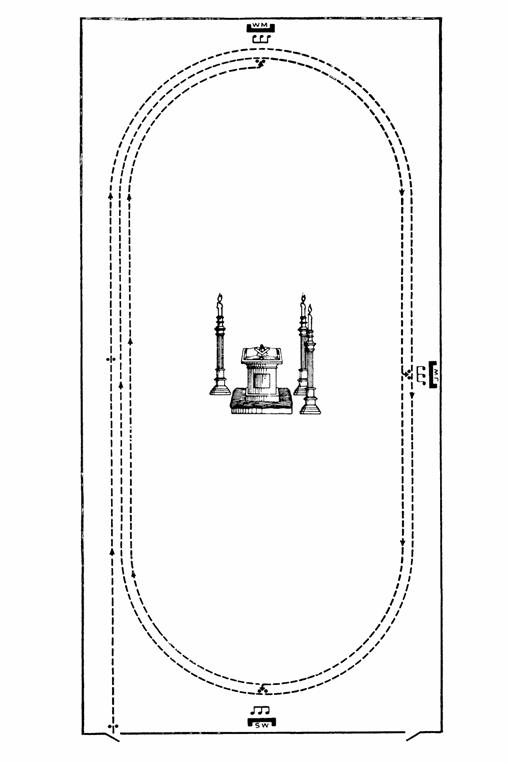
CIRCUMAMBULATION:
The following passage of Scripture will be read during the ceremony, beginning immediately after passing the South on first circuit:
12 MANUAL OF THE LODGE
♪
"Behold, how good and how pleasant it is for brethren to dwell together in unity:
♪
"It is like the precious ointment upon the head, that ran down upon the beard, even Aaron's beard, that went down to the skirts of his garment:
♪
"As the dew of Hermon, and as the dew that descended upon the mountains of Zion; for there the Lord commanded the blessing, even life for evermore."
* * * * * *
"In the beginning God created the heavens and the earth, and the earth was without form, and void; and darkness was upon the face of the deep, and the Spirit of God moved upon the face of the waters and God said: `Let there be light,' and there was light."
ENTERED APPRENTICE 13
* * * * *
* * * * *
In the course of this section the badge of a Mason is introduced and explained.
* * * * *
* * * 14 MANUAL OF THE LODGE
* * * * *
The Lambskin, or white leather apron, is an emblem of innocence and the badge of a Mason; more ancient than the Golden Fleece or Roman Eagle; more honorable than the Star and Garter, or any other order that could be conferred, at this, or any future period, by king, prince or potentate, or any person, except he be a Mason; and which, I trust, you will wear with equal pleasure to yourself and honor to the Fraternity.
* * * * *
NORTH‑EAST
* * * * *
* * * * * ENTERED APPRENTICE 15
DEMAND
* * * *
* * * *
CHARITY
THE WORKING TOOLS OF AN ENTERED APPRENTICE
* * * *
* * * * * * * * *
This section closes with the moral explanation of the Twenty‑four Inch Gauge and Common Gavel.
THE TWENTY‑FOUR INCH GAUGE Is an instrument made use of by operative Masons to measure and lay out their work. But we, as Free and Accepted Masons, are taught to make use of it for the more noble and glorious purpose of dividing our time. It being divided into twenty‑four equal parts, is emblematical of the twenty‑four hours of the day; which we are taught to divide into three parts, whereby we find a portion for the service of God and a distressed worthy brother; a portion for our usual vocations, and a portion for refreshment and sleep.
16 MANUAL OF THE LODGE
THE COMMON GAVEL
Is an instrument made use of by operative Masons, to break off the rough and superfluous parts of stones, the better to fit them for the builder’s use; but we, as Free and Accepted Masons, are taught to make use of it for the more noble and glorious purpose of divesting our minds and consciences of all the vices and superfluities of life, thereby fitting ourselves as living stones, for that spiritual building, that house not made with hands, eternal in the heavens.
* * * * *
_____
SECTION II
SECTION II
This section rationally accounts for the ceremony of initiating a candidate into our ancient institution, and fully explains the first section. No portion of it can be written, but the following emblems will greatly aid the memory in explaining said section.
The superstructure of the Temple, from a drawing more than 200 years old, by a distinguished Divine and Scientist of England, Arthur Bed ford, M. A. Copied from his "Scripture Chronology."
* * * * *
ENTERED APPRENTICE 19
ENTERED APPRENTICE
SECTION III
This section sets out with the definition of the Lodge, and contains instructions relative to the form, supports, covering, furniture, ornaments, lights and jewels of the Lodge, and how it should be situated and to whom dedicated.
Every lawful assemblage of Masons, duly congregated for work, is "A just and legally constituted Lodge." It is just, that is, regular and orderly, when it contains the requisite number to form a quorum and when the Bible, Square, and Compasses are present. It is legally constituted when it is acting under the authority of a Warrant or Charter, emanating from the Grand Lodge in whose jurisdiction the Lodge is situated, and signed by the grand officers, which authorizes the persons therein named, and their successors to meet as Masons and perform Masonic labor. As no assemblage of Masons is legal without such an instrument, it is not only the privilege, but the duty, of every Mason on his first visit to a strange Lodge, to demand a sight of its Warrant or Charter; nor should any brother sit in a Lodge whose members are unwilling to exhibit the authority on which they act.
Nearly the whole of the third section has been made monitorial. The symbols and allegories of Freemasonry are susceptible of more than one interpretation. An Illustrious Masonic Savant has well said, "He who would become an accomplished Mason must not be content merely to hear, or even to understand, the lectures; he must, aided by them, and they having as it were, marked out the way for him, study, interpret, and develop these symbols for himself."
* * * * *
20
HIGHEST HILLS
LOWEST VALES
21
22
And * * * *
The Lodge has three principal supports, which are Wisdom, Strength, and Beauty; because it is necessary that there should be wisdom to contrive, strength to support, and beauty to adorn, all great and important under‑takings. Of these, the column Wisdom, situated in the East part of the Lodge, is represented by the Worshipful Master, because it is presumed that he has wisdom to devise labor for the craft, and superintend them during the hours thereof. The column of Strength, in the West part of the Lodge, is represented by the Senior Warden, be‑cause it is his duty to strengthen and support the authority of the Master. The column of Beauty is situated in the South part of the Lodge, and is represented by the Junior Warden, because from his position in the South he is the first to observe the meridian sun, which is the beauty and glory of the day; to call the craft from labor to refreshment and to superintend them during the hours thereof; to see that none convert the purposes of refreshment into those of intemperance or excess; and to call them to labor again in due season, that the Worshipful Master may have honor, and they pleasure and profit, 'thereby.
Jacob's Vision
23
THE COVERING OF THE SYMBOLIC LODGE
The covering of the Symbolic Lodge is no less than a clouded canopy, or starry‑decked heavens, where all good Masons hope at last to arrive, by the aid of the theological ladder which Jacob, in his vision, saw ascending from earth to heaven; the three principal rungs of which are denominated Faith, Hope, and Charity; and which admonish us to have faith in God, hope of immortality, and charity to all mankind.
Of these, Charity is the greatest; for Faith may be lost in sight; Hope end in fruition; but Charity extends beyond the grave, through the boundless realms of eternity.
THE FURNITURE OF THE LODGE
is the Holy Bible, Square and Compasses.
* * * * *
* * * * * *
The Holy Bible is dedicated to God, because it is the inestimable gift of God to man:
* * * * *
the Square to the Master, because it is the proper Masonic emblem of his office; and the Compasses to the Craft, because, by due attention to their use, they are taught to circumscribe their desires and keep their passions within due bounds.
24 MANUAL OF THE LODGE
THE ORNAMENTS OF THE LODGE
Are the Mosaic Pavement, the Indented Tessel, and the Blazing Star.
The Mosaic Pavement is a representation of the ground‑floor of King Solomon's Temple; and the Indented Tessel, of that beautiful tessellated border or skirting which surrounded it. The Mosaic Pavement is emblematical of human life checkered with good and evil; the beautiful border which surrounds it is emblematical of those manifold blessings and comforts which surround us, and which we hope to obtain by a faithful reliance on Divine Providence, which is hieroglyphically represented by the Blazing Star in the center.
25
The Lodge has three symbolic lights; one of these is in the East, one in the West, and one in the South. There is no light in the North, because
* * * * * * *
THE JEWELS OF THE LODGE
There are six Jewels belonging to the Lodge, three immovable and three movable. The Immovable Jewels are the Square, Level, and Plumb; the Square teaches morality, the Level equality, and the Plumb rectitude of conduct. They are termed immovable, because they be‑long at fixed stations in the Lodge - the Square in the East, the Level in the West, and the Plumb in the South, and are the jewels of the officers filling those respective stations.
26 MANUAL OF THE LODGE
IMMOVABLE JEWELS
MOVABLE JEWELS
ENTERED APPRENTICE 27
MOVABLE JEWELS
The movable Jewels are the Rough Ashlar, Perfect Ashlar, and the Trestle‑Board.
The Rough Ashlar is a stone as taken from the quarry, in its rude and natural state. The Perfect Ashlar is a stone made ready by the hands of the workmen, to be adjusted by the working‑tools of the Fellow‑Craft. The Trestle‑Board is for the Master workman to draw his designs upon.
By the Rough Ashlar we are reminded of our rude and imperfect state by nature; by the Perfect Ashlar, of that state of perfection at which we hope to arrive by a virtuous education, our own endeavors, and the blessing of God; and, by the Trestle‑Board, we are also reminded that, as the operative workman erects his temporal building agreeably to the rules and designs laid down by the Master on his Trestle‑Board, so should we, as Speculative Masons, endeavor to erect our spiritual building agreeably to the rules and designs laid down by the Supreme Architect of the Universe, in the great books of nature and revelation, which are our spiritual, moral, and Masonic Trestle‑Board.
28 MANUAL OF THE LODGE
THE SITUATION OF THE LODGE
* * * * * * *
The Tabernacle established by Moses in the wilderness which became the model for Solomon's Temple and which together with the Temple, furnished much of the symbolic foundation for Ancient Craft Masonry.
ENTERED APPRENTICE 29
DEDICATION
Our ancient brethren dedicated their Lodges to King Solomon, because he was our first Most Excellent Grand Master; but modern Masons dedicate theirs to St. John the Baptist, and St. John the Evangelist, who were two eminent patrons of Masonry; and since their time, there is represented, in every regular and well‑governed Lodge, a certain Point within a Circle, embordered by two perpendicular parallel lines, representing St. John the Baptist, and St. John the Evangelist; and upon the top rests the Holy Scriptures. The point represents an individual
30 MANUAL OF THE LODGE
brother; the circle is the boundary line, beyond which he is never to suffer his prejudices or passions to betray him.
In going round this circle, we necessarily touch upon these two lines, as well as the Holy Scriptures; and while a Mason keeps himself circumscribed within these due bounds, it is impossible that he should materially err.
The principal tenets of our profession are three: Brotherly Love, Relief and Truth, and are thus explained:
BROTHERLY LOVE
1. By the exercise of brotherly love, we are taught to regard the whole human species as one family - the high and low, the rich and poor; who, as created by one Almighty Parent, and inhabitants of the same planet, are to aid, support and protect each other. On this principle, Masonry unites men of every country, sect, and opinion, and conciliates true friendship among those who might otherwise, have remained at a perpetual distance.
RELIEF
2. To relieve the distressed is a duty incumbent upon all men; but particularly on Masons, who, are linked together by an indissoluble chain of sincere affection. To soothe the un‑ happy, to sympathize with their Wi misfortunes, to compassionate their miseries, and to restore peace to their troubled minds, is the grand aim we have in view. On this basis we form our friendshh' c and establish our connections.
ENTERED APPRENTICE 31
TRUTH
3. Truth is a divine attribute, and the foundation of every virtue. To be good and true, is the first lesson we are taught in Masonry. On this theme we contemplate, and by its dictates endeavor to regulate our conduct.
Hence, while influenced by this principle, hypocrisy and deceit are unknown among us, sincerity and plain dealing distinguish us, and the heart and tongue join in promoting each other's welfare, and rejoicing in each other's prosperity.
THE MANNER OF SERVICE
Our Ancient Brethren served their Masters * * *
THE FOUR CARDINAL VIRTUES,
Temperance, Fortitude, Prudence, and Justice are
* * * * *
in this manner:
Temperance is that due restraint upon our affections and passions which renders the body tame and governable, and frees the mind from the allurements of vice. This virtue should be the constant practice of every Mason, as he is thereby taught to avoid excess, or the contracting of any licentious or vicious habit, the indulgence of which might lead him to disclose
32
some of those valuable secrets which he has promised to conceal and never reveal, and which would consequently subject him to the contempt and detestation of all good Masons.
* * * * *
Fortitude is that noble and steady purpose of the mind, whereby we are enabled to undergo any pain, peril, or danger, when prudentially deemed expedient. This virtue is equally distant from rashness and cowardice; and, like the former, should be deeply impressed upon the mind of every Mason, as a safeguard against any illegal attack that may be made, by force or otherwise, to extort from him any of those valuable secrets with which he has been so solemnly entrusted, and which were emblematically rep‑resented upon his first admission into the Lodge.
* * * * *
Prudence teaches us to regulate our lives and actions agreeably to the dictate of reason, and is that habit by which we wisely judge, and prudentially determine, on all things relative to our present, as well as our future happiness. This virtue should be the peculiar characteristic of every Mason, not only for the government of his conduct while in the Lodge, but also when abroad in the world. It should be particularly attended to in all strange and mixed companies, never to let fall the least sign, token, or word, whereby the secrets of Masonry might be unlawfully obtained.
ENTERED APPRENTICE 33
* * * * *
Justice is that standard, or boundary of right, which enables us to render to every man his just due, without distinction. This virtue is not only consistent with Divine and human laws, but is the very cement and support of civil society; and as justice in a great measure, constitutes the real good man, so should it be the invariable practice of every Mason never to deviate from the minutest principles thereof.
* * * * *
This closes the third section, and finishes the Degree, with the exception of the charge, to which I now invite your attention. Please rise.
CHARGE
My Brother: - As you are now introduced into the first principles of Masonry, I congratulate you on your admission into this ancient and honorable Order; ancient, as having existed from time immemorial; honorable, as tending to make all men so, who are strictly obedient to its teachings and precepts. No institution was ever raised on a better principle or more solid foundation; nor were ever more excellent rules and useful maxims laid down, than are inculcated in every Masonic degree.
There are three great duties which, as a Mason, you are charged to inculcate - to God, your neighbor, and yourself. To God, in never mentioning his name but with that reverential awe, which is due from a creature to his Creator; to implore His aid in all your laudable under‑takings, and to esteem Him as the chief good. To your neighbor, in acting upon the square, doing unto him as you wish he should do unto you; and to yourself, in avoiding
34 MANUAL OF THE LODGE
all irregularity and intemperance, which may impair your faculties, or debase the dignity of your profession. A zealous attachment to these duties will insure public and private esteem.
As a citizen, you are to be a quiet and peaceable subject, true to your government, and just to your country; you are not to countenance disloyalty or rebellion, but patiently submit to legal authority, and conform with cheerfulness to the government of the country in which you live.
In your outward demeanor, be particularly careful to avoid censure or reproach. Let no interest, favor or prejudice, bias your integrity, or influence you to be guilty of a dishonorable action.
Your prompt attendance at our meetings, when at labor in the Entered Apprentice Degree, is earnestly solicited; yet it is not meant that Masonry should interfere with your necessary vocations, for these are, on no account, to be neglected; neither are you to suffer your zeal for the institution to lead you into argument with those who, through ignorance, may ridicule it. At your leisure hours, that you may improve in Masonic knowledge, you are to converse with well informed brethren, who will always be as ready to give, as you will be to receive instruction.
Finally, keep sacred and inviolable the mysteries of the Order, as these are to distinguish you from the rest of the community, and mark your consequence among Masons. If, in the circle of your acquaintance, you find a person desirous of being initiated into Masonry, be particularly attentive not to recommend him unless you are convinced he will conform to the laws, customs and usages of the Order; to the end, that the honor, glory, and reputation of the Institution may be firmly established, and the world at large convinced of its good effects.
FELLOW CRAFT 35
Fellow‑Craft's Degree
Masonry, like all other sciences, is progressive, and can only be acquired by degrees and at intervals. When an Entered Apprentice has served the proper time, and learned properly the Ritual of the first degree, he can, and it is his duty (if he is a good and true Apprentice), to apply through a member of the Lodge for the second, or Fellow‑Craft's Degree.
This application can be made orally, at a stated meeting, but before the applicant can be balloted for, he must be examined in an Entered Apprentice Lodge as to his proficiency in the first degree, and if (after closing the E. A. Lodge, and calling to labor in the Master's Degree), said examination is declared satisfactory, by the vote of the brethren present, the Lodge will proceed to ballot upon said application.
This degree is divided into two sections, the first of which is entirely ceremonial, and the Lecture pertaining to the same is a recapitulation of the ceremonies used on the occasion, and should be well understood by every member of the Lodge, and more especially, by the officers. While it extends the plan of knowledge commenced in the first degree, it comprehends a more extensive system of learning, and inculcates, in our peculiar method, the most important truths of science.
36 MANUAL OF THE LODGE
SECTION I
The first Section accurately elucidates the mode of initiation into this degree.
The Fellow Craft's degree, is particularly devoted to science. The mind of the recipient is fixed, by the nature of its ritual, upon the wonders of nature and of art.
The attention is particularly directed to the liberal arts and sciences, with whose principles the candidate is charged to be‑come familiar, that he may be enabled to occupy with honor to himself, and with profit to his fellow‑creatures, his allotted place in the great structure of human society.
* * * * *
______
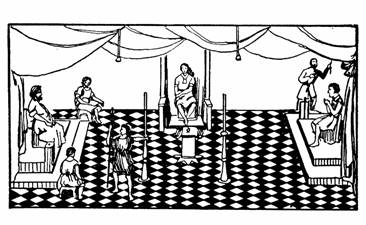
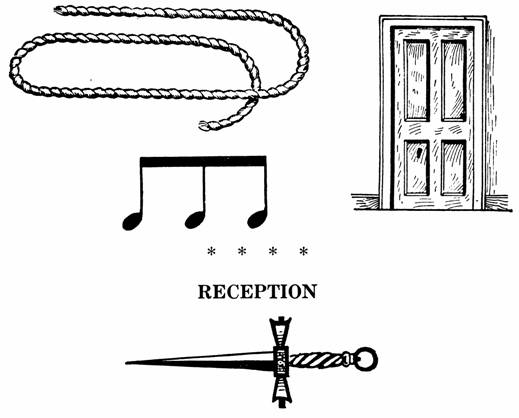
RECEPTION
* * * * *
FELLOW CRAFT 37
CIRCUMAMBULATION
The following passages of scripture will be read during the ceremony, beginning immediately after passing the South on second circuit:
38 MANUAL OF THE LODGE
"Thus he shewed me; and behold the Lord stood upon a wall made by a plumb line, with a plumb line in His hand.
"And the Lord said unto me, Amos, what seest thou? And I said, a plumb line. Thus saith the Lord, Behold, I will set a plumb line in the midst of my people Israel.
"I will not again pass by them any more."
* * * * *
* * * * *
FELLOW CRAFT 39
* * * * *
* * * * *
THE WORKING TOOLS OF A FELLOW‑CRAFT
* * * * *
This section closes with the moral explanation of the Plumb, Square and Level.
The Plumb is an instrument made use of by operative Masons to raise perpendiculars, the Square to square their work, and the Level to lay horizontals; but we as Free and Accepted Masons, are taught to make use of them for more noble and glorious purposes; the Plumb admonishes us to walk uprightly in our several stations before God and man, squaring our actions by the Square of Virtue, and remembering that we are traveling upon the Level of Time, to "that undiscovered country, from whose bourne no traveler returns."
40 MANUAL OF THE LODGE
SECTION II
The Terrestrial and Celestial Globes, the Orders of Architecture, the Human Senses, and the Liberal Arts and Sciences are here introduced and explained, and the learned and accomplished Mason may display his talents and skill in their elucidation.
The Second Section * * * * and treats of Masonry under two denominations, Operative and Speculative. It also details some interesting features relative to the Temple of Solomon, and the usages of our Ancient Brethren, in the course of which the mind is drawn to the contemplation of themes of science and philosophy.
OPERATIVE MASONRY
We work in Speculative Masonry, but our ancient brethren wrought in both Operative and Speculative. They worked at the building of King Solomon's Temple, and many other sacred and important edifices.
By Operative Masonry we allude to a proper application of the useful rules of architecture, whence a structure will derive figure, strength and beauty, and whence will result a due proportion, and a just correspondence in all its parts. It furnishes us with dwellings and with convenient shelter from the vicissitudes and inclemencies of the seasons; and while it displays the effects of human wisdom, as well in the choice as in the arrangement of the sundry materials of which an edifice is composed, it demonstrates that a fund of science and industry is implanted in man, for the best, most salutary and beneficent purposes.
FELLOW CRAFT 41
SPECULATIVE MASONRY
By Speculative Masonry we learn to subdue the passions, act upon the square, keep a tongue of good report, maintain secrecy, and practice charity. It is so far inter‑woven with religion as to lay us under obligations to pay that rational homage to the Deity, which at once constitutes our duty and our happiness.
It leads the contemplative to view, with reverence and admiration, the glorious works of creation, and in‑spires him with the most exalted ideas of the perfection of his Divine Creator. In six days God created the heavens and the earth, and rested upon the seventh day; the seventh, therefore, our ancient brethren consecrated as a day of rest from their labors; thereby enjoying frequent opportunities to contemplate the glorious works of the creation, and to adore the Great Creator.
* * * * *
_________
* * * * *
42 MANUAL OF THE LODGE
The symbols of Unity, Peace and Plenty are explained in connection with these pillars.
THE PILLARS OF THE PORCH
The Winding Stairs
FELLOW CRAFT 43
THE GLOBES
* * * * two artificial spherical bodies * * * *, upon the convex surfaces of which were delineated the countries, seas, and various portions of the earth's surface; the face of the heavens, the planetary revolutions, fixed stars, and other particulars.
* * * * *
THE USE OF THE GLOBES
Their principal use, besides serving as maps to distinguish the outward parts of the earth, and the situation of the fixed stars, was to illustrate and explain the phenomena arising from the annual revolution and the diurnal rotation of the earth around its own axis. They are the noblest instruments for improving the mind, and giving it the most distinct idea of any problem or proposition, as well as enabling it to solve the same. Contemplating these bodies, we are inspired with a due reverence for the Deity and his works, and are induced to encourage the studies of Geometry, Astronomy, Geography, and Navigation, and the arts and sciences dependent upon them, through which a more extensive knowledge of the mysteries of nature, and of the laws which govern the universe may be obtained; and by which, throughout many ages, the initiated have been so greatly benefited.
The five orders of Architecture next require attention.
By order in Architecture is meant a system of all the members, proportions and ornaments of columns and pilasters; or, it is a regular arrangement of the projecting parts of a building, which, united with those of a column, form a beautiful, perfect and complete whole.
From the first formation of society, order in architecture may be traced. When the rigor of the seasons first obliged man to contrive shelter from the inclemency of the weather, we learn that they planted trees on end, and
44 MANUAL OF THE LODGE
then laid others across to support a covering. The bands which connected those trees at the top and bottom are said to have given rise to the idea of the base and capital of pillars; and from this simple hint, originally proceeded the more improved art of architecture.
* * * * *
THE FIVE ORDERS OF ARCHITECTURE Are the Tuscan, Doric, Ionic, Corinthian, and Composite.
THE TUSCAN
Is the most simple and solid of the five orders. It was invented in Tuscany, whence it derives its name. Its column is seven diameters high, and its capital, base and entablature have but few mouldings. The simplicity of the construction of this column renders it eligible where ornament would be superfluous.
THE DORIC
Which is plain and natural, is the most ancient, and was invented by the Greeks. Its column is eight diameters high, and has seldom any ornaments on base ors capital, except mouldings; though the frieze is distinguished by triglyphs and metopes, and triglyphs compose the ornaments of the frieze. The solid composition of this order gives it preference in structures where strength and noble simplicity are chiefly required.
The Doric is the best proportioned of all the orders. The several parts of which it is composed are founded on the natural position of solid bodies. In its first invention it was more simple than in its present state.
FELLOW CRAFT 45
In after times, when it began to be adorned, it gained the name of Doric; for when it was constructed in its primitive and simple form, the name of Tuscan was conferred on it. Hence the Tuscan precedes the Doric in rank, on account of its resemblance to that pillar in its original state.
THE IONIC
Bears a kind of mean proportion between the more solid and delicate orders.
Its column is nine diameters high; its capital is adorned with volutes, and its cornices have dentils. There are both delicacy and ingenuity displayed in this pillar, the invention of which is attributed to the Ionians, as the famous temple of Diana, at Ephesus, was of this order. It is said to have been formed after the model of an agreeable young woman of elegant shape, dressed in her hair, in contrast to the Doric order, which was formed after that of a strong, robust man.
THE CORINTHIAN
The richest of the five orders, is deemed a masterpiece of art. Its column is ten diameters high, and its capital is adorned with two rows of leaves and eight volutes, which sustain the abacus. The frieze is ornamented with curious devices, the cornice with dentils and modillions. This order is used in stately and superb structures. It was invented at Corinth by Callimachus, who is said to have taken the hint of the capital of this pillar from the following
46 MANUAL OF THE LODGE
remarkable circumstances: Accidentally passing by the tomb of a young child of Patrician blood, he perceived a basket of toys, covered with a tile, placed over an acanthus root, it having been left there by its nurse. As the branches grew up, they compassed the basket, till, arriving at the tile, they met with an obstruction and bent downward. Callimachus, struck with the object, set about imitating the figure; the base of the capital he made to represent the basket; the abacus the tile; and the volutes the bending leaves.
THE COMPOSITE
Is compounded of the other orders, and was contrived by the Romans. Its capital has the two rows of leaves of the Corinthian and the volutes of the Ionic. Its column has the quarter-round, as the Tuscan and Doric order; is ten diameters high, and its cornice has denticles, or simple modillions. This pillar is generally found in buildings where strength, elegance, and beauty are displayed.
OF THE INVENTION OF ORDER IN ARCHITECTURE
The ancient and original orders of Architecture, revered by Masons, are no more than three, the Doric, Ionic, and Corinthian, which were invented by the Greeks. To these the Romans have added two; the Tuscan, which they made plainer than the Doric; and the Composite, which was more ornamental, if not more beautiful, than the Corinthian. The first three orders alone, however, show invention and particular character, and essentially differ from each other: the two others have nothing but what is borrowed, and differ only accidentally: the Tuscan
FELLOW CRAFT 47
is the Doric in its earliest state; and the Composite is the Corinthian enriched with the Ionic. To the Greeks, therefore, and not to the Romans, we are indebted for what is great, judicious and distinct in architecture.
* * * * *
THE FIVE HUMAN SENSES
Are Hearing, Seeing, Feeling, Smelling, and Tasting (and are next in order for explanation):
HEARING
Is that sense by which we distinguish sounds, and are capable of enjoying all the agreeable charms of music. By it, we are enabled to en‑joy the pleasures of society, and reciprocally to communicate to each other our thoughts and intentions, our purposes and desires; and thus our reason is capable of exerting its
48 MANUAL OF THE LODGE
utmost power and energy. The wise and beneficent Author of Nature intended, by the formation of this sense, that we should be social creatures, and receive the greatest and most important part of our knowledge by inter‑course with each other. For these purposes we are endowed with hearing, that, by a proper exertion of our rational powers, our happiness may be complete.
SEEING
Is that sense by which we distinguish objects, and in an instant of time, without change of place or situation, view armies in battle array, figures of the most stately structures and all the agreeable variety displayed in the landscape of Nature. By this sense, we find our way on the pathless ocean, traverse the globe of earth, determine its figure and dimensions, and delineate any region or quarter of it. By it we measure the planetary orbs, and make new discoveries in the sphere of the fixed stars. Nay, more; by it we perceive the tempers and dispositions, the passions and affections of our fellow creatures, when they wish most to conceal them; so that, though the tongue may be taught to lie and dissemble, the countenance would display the hypocrisy to the discerning eye. In fine, the rays of light which minister to this sense are the most astonishing part of the animated creation, and render the eye a peculiar object of admiration. Of all the faculties, sight is the noblest. The structure of the eye, and its appurtenances, evince the admirable contrivance of Nature for performing all its various external and internal motions; while the variety displayed in the eyes of different animals, suited to their several ways of life, clearly demonstrates this organ to be the master‑piece of Nature's work.
FELLOW CRAFT 49
FEELING
Is that sense by which we distinguish the different qualities of bodies, such as heat and cold, hardness and soft‑ ness, roughness and smoothness, figure, solidity, motion and extension; all of which, by means of certain corresponding sensations of touch, are presented to the mind as real external qualities, and the conception or belief of them invariably connected with these corresponding sensations by an original principle of human nature, which far transcends our inquiry. All our knowledge beyond our original perception is obtained by experience. The constancy of nature's laws connects the sign with the signified, and we rely on the continuance of that connection which experience hath discovered.
SMELLING
Is that sense by which we distinguish odors, the various kinds of which convey different im‑ pressions to the mind. Animal and vegetable t,.i _ bodies, and indeed most other bodies, while ex‑ posed to air, continually send forth effluvia of vast subtlety, as well in the state of life and growth, as in the state of fermentation and putrefaction. These effluvia, being drawn into the nostrils along with the air, are the means by which all bodies are smelled. Hence it is evident that there is a manifest appearance of design in the great Creator's having planted the organ of smell in the inside of that canal, through which the air continually passes in respiration.
TASTING
Enables us to make a proper distinction in the choice of our food. The organ of this sense guards the entrance of
50 MANUAL OF THE LODGE
the alimentary canal, as that of smell guards the entrance of the canal for respiration. From the situation of both these organs, it is plain that they are intended by Nature to distinguish wholesome food from that which is nauseous. Everything that enters into the stomach must undergo the scrutiny of tasting; and by it we are capable of discerning the changes which the same body undergoes in the different compositions of art, cookery, chemistry, pharmacy, etc.
Smelling and Tasting are inseparably connected, and it is by the unnatural kind of life men commonly lead in society that these senses are rendered less fit to perform their natural offices. Each of the senses of the body is directly connected with the human mind, and they are the essential instrumentalities through which the immortal spirit contacts the outer world. By anatomical dissection and observation, we become acquainted with the body and its functions; but it is by the anatomy of the mind alone, we discover its powers and principles. To sum up the whole of this transcendent measure of God's bounty to man, we shall add, that memory, imagination, reasoning, moral perception, and all the active powers of the soul, including its senses, present a vast and boundless field for study and investigation, and are peculiar mysteries, known only to nature and nature's God, to Whom we are all indebted for creation, preservation and every blessing we enjoy.
Of the five senses, three are principally revered by Masons, namely: Hearing, Seeing, and Feeling.
* * * * * *
FELLOW CRAFT 51
THE SEVEN LIBERAL ARTS AND SCIENCES
Are Grammar, Rhetoric, Logic, Arithmetic, Geometry, Music and Astronomy. The fifth of these sciences, Geometry, is deemed principally essential in Masonry. (The seven liberal arts and sciences are illustrated in this section as follows):
GRAMMAR
Teaches the proper arrangement of words, according to the idiom or dialect of any particular people, and that excellency of pronunciation which enables us to speak or write a language with accuracy, agreeably to reason and correct usage.
RHETORIC
Teaches us to speak copiously and fluently on any subject, not merely with propriety alone, but with all the advantages of force and elegance, wisely contriving to captivate the hearer by strength of argument and beauty of expression, whether it be to entreat, exhort, admonish or applaud.
LOGIC
Teaches us to guide our reason discretionally in the general knowledge of things, and directs our inquiries after truth. It consists of a regular train of argument, whence we infer, deduce, and conclude, according to certain premises laid down, admitted or granted; and in it are employed the faculties of conceiving, judging, reasoning, and disposing; all of which are naturally led on from one gradation to another, until the point in question is finally determined.
ARITHMETIC
Teaches the powers and properties of numbers, which are variously effected, by letters, tables, figures and instruments. By this art, reasons and demonstrations are
52 MANUAL OF THE LODGE
given for finding out any certain number whose relation or affinity to another is already known or discovered.
GEOMETRY
This science treats of the powers and properties of magnitudes in general, where length, breadth, and thickness are considered, from a point to a line, from a line to a superfices, and from a superfices to a solid.
A point is a dimensionless figure; or an indivisible part of space.
A line is a point continued, and a figure of one capacity, namely, length.
A superfices is a figure of two dimensions, namely, length and breadth.
A solid is a figure of three dimensions, namely, length, breadth and thickness.
THE MORAL ADVANTAGES OF GEOMETRY
By this science, the architect is enabled to construct his plans, and execute his designs; the general to arrange his soldiers; the engineer to mark out ground for encampments; the geographer to give us the dimensions of the world, and all things therein contained; to delineate the extent of the seas, and specify the divisions of empires, kingdoms and provinces; by it, also, the astronomer is enabled to make his observations, and to fix the duration of times and seasons, years and cycles. In fine, geometry is the foundation of architecture, and the root of mathematics.
MUSIC
Teaches us the art of forming concords, so as to compose delightful harmony, by a mathematical and proportional arrangement of acute, grave and mixed sounds. This
FELLOW CRAFT 53
art by a series of experiments, is reduced to a demonstrative science, with respect to tones, and intervals of sound. It inquires into the nature of concords, discords, and enables us to find out the proportion between them by numbers.
ASTRONOMY
Is that divine art, by which we are taught to read the wisdom, strength and beauty of the Almighty Creator in those sacred pages, the celestial hemisphere. Assisted by astronomy, we can observe the motions, measure the distances, comprehend the magnitudes, and calculate the periods and eclipses of the heavenly bodies. By it we learn the use of the globes, the system of the world, and the preliminary laws of nature. While we are employed in the study of this science, we must perceive unparalleled instances of wisdom and goodness, and through the whole creation, trace the glorious Author by His works.
54 MANUAL OF THE LODGE
EMBLEM OF PLENTY
* * * * * * *
* * * * * * *
55
* * * * * * *
56 MANUAL OF THE LODGE
THE MORAL ADVANTAGES OF GEOMETRY
From this theme we proceed to illustrate the moral ad‑vantages of Geometry, a subject on which the following observations may not be unacceptable.
Geometry, the first and noblest of sciences, is the basis on which the superstructure of Freemasonry is erected. By Geometry we may curiously trace nature, through her various windings, to her most concealed recesses. By it we discover the power, wisdom and goodness of the Grand Artificer of the Universe, and view with delight the proportions which connect this vast machine. By it we discover how the planets move in their different orbits, and demonstrate their various revolutions.
By it we account for the return of seasons, and the variety of scenes which each season displays to the discerning eye.
Numberless worlds are around us (all framed by the same Divine Artist), which roll through the vast expanse, and all are conducted by the same unerring laws of nature.
A survey of nature, and the observation of her beautiful proportions, first determined man to imitate the divine plan, and study symmetry and order. This gave rise to Societies, and birth to every useful art. The architect began to design, and the plans which he laid down, being improved by experience and time, have produced works which are the admiration of every age.
The lapse of time, the ruthless hand of ignorance, and the devastations of war, have laid waste and destroyed many valuable monuments of antiquity, on which the utmost exertions of human genius have been employed. Even the Temple of Solomon, so spacious and magnificent, and. constructed by so many celebrated artists, escaped not the unsparing ravages of barbarous force.
FELLOW CRAFT 57
Freemasonry, notwithstanding, has still survived. The attentive ear receives the sound from the instructive tongue, and the sacred mysteries are safely lodged in the repository of faithful breasts.
Tools and implements of architecture, symbols the most expressive! are selected by the Fraternity, to imprint on the memory wise and serious truths; and thus, through a succession of ages, are transmitted, unimpaired, the excellent tenets of our institution.
* * * * * *
* * * * *
______________
* * * * * * *
CORN, WINE AND OIL
* * * * * *
This closes the second section, and finishes the Degree, with the exception of the charge, to which I now invite your attention. Please rise.
CHARGE TO THE CANDIDATE
My Brother:
Being passed to the degree of Fellow‑Craft, permit me, in the name of the brethren, to congratulate you on your preferment. The internal and not the external qualifications of a man are what Masonry regards. As you increase in knowledge you will improve in social intercourse
58 MANUAL OF THE LODGE
It is unnecessary to recapitulate the duties which, as a Fellow‑Craft, you are bound to perform, or to enlarge on the importance of strict adherence to them, as your own experience and examination will convince you of their value.
Our laws and regulations you are strenuously to sup‑port, and be always ready to assist in seeing them duly executed. You are not to palliate or aggravate the offenses of your brethren; but, in the decision of every trespass against our rules you are to judge with candor, admonish with friendship and reprehend with justice.
The study of the liberal arts and sciences, that valuable branch of education which tends so effectually to polish and adorn the mind, is earnestly recommended to your careful consideration; especially the science of Geometry, which is established as the basis of our art.
Geometry, or Masonry (originally synonymous terms), being of a divine and moral nature, is enriched with the most useful knowledge; while it proves the wonderful properties of nature, it demonstrates the more important truths of morality.
Your past behavior, and regular deportment, have merited the honor which we have conferred; and in your present character it is expected that you will conform to the principles of the order, by steadily persevering in the study and practice of every commendable virtue. Such is the nature of your engagement as a Fellow‑Craft, and to these duties you are bound by the most sacred and solemn ties.
MASTER MASON 59
Master Mason
Freemasonry, as before stated, is progressive, and a knowledge of its philosophy and teachings can only be acquired by time, patience, perseverance and close application.
In the first degree, we are taught the duties we owe to God, our neighbor and ourselves.
In the second, we are more thoroughly inducted into the mysteries of moral science and learn to trace the goodness and majesty of the Creator, by minutely analyzing His works.
But the third degree cements the whole, and is calculated to bind men together by mystic ties of fellowship, as in a bond of fraternal affection and brotherly love.
It is among brethren of this degree that the Ancient Land‑marks of the Order are preserved, and it is from them the rulers of the Craft are selected. It is in a Master's Lodge that all business of a legislative character is transacted and all balloting takes place.
The candidate, after serving his proper time as a Fellow‑Craft, orally applies for the Master's degree; and, after being examined in a Fellow‑Craft's Lodge, as to his proficiency, a Master's Lodge is then called to labor (it being a stated meeting), and if the Lodge approves his examination, a ballot is taken upon his application for the third degree; and if elected, and there be no objection, he is prepared for his introduction into the first section of the Master's Degree. The conferring of the degree may be postponed to a subsequent called meeting, if desired.
This Degree is divided into three sections.
SECTION I
* * * * *
60 MANUAL OF THE LODGE
RECEPTION
* * * *
MASTER MASON 61
CIRCUMAMBULATION
The following passages of Scripture will be read during the ceremony beginning immediately after passing the South on first circuit:
"Remember now thy Creator in the days of thy youth, while the evil days come not,
"Nor the years draw nigh, when thou shalt say I have no pleasure in them; while the sun or the light, or the moon, or the stars, be not darkened, nor the clouds return after the rain;
"In the day when the keepers of the house shall tremble, and the strong men shall bow themselves,
"And the grinders cease, because they are few; and those that look out of the windows be darkened, and the doors shall be shut in the streets,
"When the sound of the grinding is low; and he shall rise up at the voice of the bird, and all the daughters of music shall be brought low.
"Also, when they shall be afraid of that which is high, and fears shall be in the way,
II 62 MANUAL OF THE LODGE
"And the almond tree shall flourish, and the grass‑hopper shall be a burden, and desire shall fail;
"Because man goeth to his long home, and the mourners go about the streets; or ever the silver cord be loosed, or the golden bowl be broken, or the pitcher be broken at the fountain, or the wheel broken at the cistern.
"Then shall the dust return to the earth as it was and the spirit shall return unto God who gave it" - Ecclesiastes 12:1‑7.
* * * * *
MASTER MASON 63
* * * * *
THE WORKING TOOLS OF A MASTER MASON
* * * * * *
* * * * *
This section closes with the moral explanation of the Trowel.
The trowel is an instrument made use of by operative Masons to spread the cement which unites a building in one common mass; but we, as Free and Accepted Masons, are taught to make use of it for the more noble and glorious purpose of spreading the cement of brotherly love and affection; that cement which unites us into one sacred band, or society of friends and brothers, among whom no contention should ever exist, but that noble contention, or rather emulation, of who can best work and best agree.
64 MANUAL OF THE LODGE
SECTION II
This section, like the first, is altogether ceremonial and recites a legend of the utmost importance to the Order; and should be well understood by all, and forcibly and impressively illustrated at the raising of every Candidate. The legend of the Third Degree has been considered of so much importance that it has been preserved in the symbolism of every Masonic rite. It embodies the symbolic lesson of life, death and immortality.
No matter what modifications or alterations the general system may have suffered - no matter how much the ingenuity or the imagination of the founders of rites may have perverted or corrupted other symbols, abolishing the old, and substituting new ones - the legend of the Temple Builder has ever been left untouched, to present itself in all the integrity of its ancient mythical form.
* * * * * *
* * * * * *
MASTER MASON 65
* * * * * *
66
67
68 MANUAL OF THE LODGE
MASTER MASON 69
* * * * * *
The following prayer is offered just before the candidate is raised:
PRAYER
Thou, 0 God, knowest our downsitting and our up‑rising, and understandest our thoughts afar off. Shield and defend us from the evil intentions of our enemies, and support us under the trials and afflictions we are des‑tined to endure while traveling through this vale of tears. Man that is born of a woman is of few days and full of trouble. He cometh forth as a flower and is cut down; he fleeth also as a shadow, and continueth not. Seeing his days are determined, the number of his months are with Thee; Thou hast appointed his bounds that he cannot
70 MANUAL OF THE LODGE
pass; turn from him that he may rest till he shall accomplish his day.
For there is hope of a tree, if it be cut down, that it will sprout again, and that the tender branch thereof will not cease. But man dieth and wasteth away; yea, man giveth up the ghost, and where is he? As the waters fail from the sea, and the flood decayeth and drieth up, so man lieth down and riseth not up till the heavens shall be no more. Yet, 0 Lord! have compassion on the children of Thy creation; administer them comfort in time of trouble, and save them with an everlasting salvation! Amen.
Response: So mote it be.
* * * * * *
* * * * * *
MASTER MASON 71
SECTION III
The Third Section furnishes many details in relation to the building of the Temple, and concludes with an explanation of the hieroglyphical emblems of the Degree. Nearly all of this Section is monitorial.
The third section sets out -
* * * * * *
72
* * * * * *
* * * * * *
* * * * * *
(MASTER’S CARPET)
* * * * * *
74 MANUAL OF THE LODGE
75
The three steps usually delineated upon the Master's carpet are emblematical of the three principal stages of human life, namely: Youth, Manhood, and Age.
In Youth, as Entered Apprentices, we ought to occupy our minds in the attainment of useful knowledge; in man‑hood, as Fellow‑Crafts, we should apply our knowledge to the discharge of our duties to God, our neighbor, and ourselves so that, in Age, as Master Masons, we may enjoy the happy reflection consequent upon a well‑spent life, and die in the hope of a glorious immortality.
MASTER MASON 75
THE POT OF INCENSE
Is an emblem of a pure heart, which is always an accept‑able sacrifice to the Deity; and, as this glows with fervent heat, so should our hearts continually glow with gratitude to the great beneficent Author of our existence for the manifold blessings and comforts we enjoy.
THE BEE HIVE
76 MANUAL OF THE LODGE
Is an emblem of industry, and recommends the practice of that virtue to all created beings, from the highest seraph in the heavens to the lowest reptile of the dust. It teaches us that, as we came into the world endowed as rational and intelligent beings, so we should ever be industrious ones; never sitting down contented while our fellow creatures around us are in want, when it is in our power to relieve them, without inconvenience to ourselves.
When we take a survey of nature, we view man in his infancy more helpless and indigent than the brute creation; he lies languishing for days, months and years, totally incapable of providing sustenance for himself, or guarding against the attack of the wild beasts of the field, or sheltering himself from the inclemencies of the weather.
It might have pleased the great Creator of heaven and earth to have made man independent of all other beings; but, as dependence is one of the strongest bonds of society, mankind were made dependent upon each other for protection and security, as they thereby enjoy better opportunities of fulfilling the duties of reciprocal love and friendship. Thus was man formed for social and active life; the noblest part of the work of God; and he that will so demean himself as not to be endeavoring to add to the common stock of knowledge and understanding, may be deemed a drone in the hive of nature, a useless member of society, and unworthy of our protection as Masons
MASTER MASON 77
THE BOOK OF CONSTITUTIONS, GUARDED BY
THE TILER'S SWORD
Reminds us that we should be ever watchful and guarded in our thoughts, words and actions, particularly when be‑fore the enemies of Masonry; ever bearing in remembrance those truly Masonic virtues, silence and circumspection.
THE SWORD POINTING TO A NAKED HEART
Demonstrates that justice will sooner or later overtake us; and although our thoughts, words and actions may be hidden from the eyes of man, yet that
78 MANUAL OF THE LODGE
ALL‑SEEING EYE
Whom the sun, moon and stars obey, and under whose watchful care even comets perform their stupendous revolutions, pervades the inmost recesses of the human heart, and will reward us according to our merits.
MASTER MASON 79
THE ANCHOR AND ARK
Are emblems of a well‑grounded hope, and a well‑spent life. They are emblematical of that divine ark which safely wafts us over this tempestuous sea of troubles, and that anchor which shall safely moor us in a peaceful harbor, where the wicked cease from troubling and the weary shall find rest.
THE FORTY‑SEVENTH PROBLEM OF EUCLID
This was an invention of the ancient philosopher, the Great Pythagoras, who, in his travels through Asia, Africa, and Europe, was initiated in several orders of Priest‑hood, and is said to have been raised to the sublime de‑
80 MANUAL OF THE LODGE
gree of Master Mason. This wise philosopher enriched his mind abundantly in a general knowledge of things, and more especially in Geometry or Masonry. On this subject he drew out many problems and theorems and among the most distinguished he erected this, when, in the joy of his heart, he exclaimed, "Eureka," in the Grecian language, signifying "I have found it:" and upon the discovery of which he is said to have sacrificed a hecatomb. It teaches Masons to be general lovers of the arts and sciences.
THE HOUR GLASS
Is an emblem of human life. Behold! how swiftly and rapidly our lives are drawing to a close. We cannot, without astonishment, behold the little particles, which are contained in this machine, how they pass away almost imperceptibly, and yet, to our surprise, in the short space of an hour, they are all exhausted. Thus wastes man! today he puts forth the tender leaves of hope; tomorrow, blossoms and bears his blushing honors thick upon him; the next day comes a frost, which nips the shoot, and when he thinks his greatness is still aspiring, he falls, like autumn leaves, to enrich our mother earth.
THE SCYTHE
Is an emblem of time, which cuts the brittle thread of life and launches us into eternity. Behold! what havoc the scythe of Time makes among the human race; if, by chance, we should escape the numerous evils incident to childhood and youth, and with health and vigor arrive to the years of manhood ; yet, withal, we must soon be cut down by the all‑devouring scythe of Time, and be gathered into the land where our fathers have gone before us.
MASTER MASON 81
The last class of emblems are not monitorial, and therefore their true interpretation can only be obtained within the tiled recesses of the Lodge. They consist of the Setting Maul, the Spade, the Coffin, and the Sprig of Evergreen. They afford subjects of serious and solemn reflection to the rational and contemplative mind, and thus the lecture closes with cheering promises of a blessed immortality beyond the grave.
THE NINTH, OR LAST CLASS OF EMBLEMS
* * * * * *
* * * * * *
This closes the Third Section, and finishes the Degree, with the exception of the charge, to which I now invite your attention. Please rise.
CHARGE
My Brother: Your zeal for the institution of Masonry, the progress you have made in the knowledge of its mysteries and your conformity to our regulations, have pointed you out as a proper object of our favor and esteem.
You are bound by duty, honor and gratitude, to be faithful to your trust; to support the dignity of your character on every occasion; and to enforce by precept and example, obedience to the tenets of the Order. In the character of a Master Mason, you are authorized to correct the irregularities of your less informed brethren,
82 MANUAL OF THE LODGE
and guard them against a breach of fidelity. To preserve unsullied the reputation of the fraternity must be your constant care.
Universal benevolence, you are always to inculcate; and by the regularity of your own behavior, afford the best example for the conduct of others less informed.
The ancient landmarks of the order, entrusted to your care, you are carefully to preserve; and never suffer them to be infringed, or countenance a deviation from the established usages and customs of the fraternity.
Your virtue, honor and reputation, are concerned in supporting, with dignity, the character you now bear. Let no motive, therefore, make you swerve from your duty, violate your vows, or betray your trust; but be true and faithful, and imitate the example of that celebrated artist you have this evening represented. Thus you will render yourself deserving of the honor which we have conferred, and merit the confidence we have reposed.
ADDRESS TO A BROTHER UPON THE PRESENTATION
OF A LAMBSKIN APRON BY THE LODGE*
My brother, in behalf of this Lodge, I now present to you this white Lambskin Apron. It may be, that in the coming years, upon your brow shall rest the laurel leaves of victory; it may be that, pendant from your breast, may *The proper time to present the apron to the initiate as a gift from the Lodge is at the end of the Master's Degree, after the lecture has been delivered.
MANUAL OF THE LODGE 83
hang jewels fit to grace the diadem of some Eastern potentate.
Aye! more than these, for light, added to coming light, may enable your ambitious feet to tread round after round of the ladder that leads to fame, in our Mystic Order; and even the purple of our fraternity may rest upon your honored shoulders; but never again, from mortal hands; never again, until your enfranchised spirit shall have passed upward and inward, through the pearly gates, can a greater honor be bestowed, or one more emblematical of purity and innocence, than that which has been conferred upon you tonight.
This Apron, the special gift of this Lodge, is yours to wear upon all proper occasions throughout an honorable life, and at your death, is to be placed upon the coffin that contains your lifeless remains and with them shall be laid beneath the silent clods of the valley.
May the pure and spotless surface of this Apron be an ever‑present reminder of that "purity of heart and uprightness of conduct so essentially necessary," thus keeping pure your thoughts, and inspiring nobler deeds and greater achievements! Then, when at last, your weary feet shall have come to the end of life's toilsome journey, and from your nerve‑less grasp, shall drop, forever, the working tools of life, may the record of your life and actions be as pure and spotless as this Apron now is; and when your soul, freed fr^m earth, shall stand naked and alone before the Great White Throne, may it be your portion to hear from Him who sits thereon, the welcome plaudit: "Well done, thou good and faithful servant! Enter thou into the joy of thv Lord!"
84 MASONIC CALENDAR
MASONIC CALENDAR
ANCIENT CRAFT MASONS commence their era with the creation of the world, calling it Anno Lucis (A\L\) "in the year of light."
A\A\S\RITE, same as Ancient Craft, except the Jewish Chronology is used, Anno Mundi (A\M\) "in the year of the world."
ROYAL ARCH MASONS date from the year the second temple was commenced by Zerubbabel, Anno Inventionis (A\L\) "in the year of the discovery."
ROYAL AND SELECT MASTERS date from the year in which the Temple of Solomon was completed, Anno Depositionis (A\Dep\) "in the year of the deposit."
KNIGHTS TEMPLAR commence their era with the organization of their Order, Anno Ordinis (A\O\) "in the year of the Order."
ORDER OF HIGH PRIESTHOOD dates from the year of the Blessing of Abraham by the High Priest Melchizedek, Anno Benefacto (A\Beo\) "in the year of the Blessing."
_____________
RULES FOR COMPUTING CURRENT MASONIC DATES
1. ANCIENT CRAFT - Add 4000 years to the common era. Thus, 1935 and 4000=A\L\5935.
2. A\A\S\RITE - Add 3760 to the common era. Thus, 1935 and 3760=A\M\.5695. After September add another year.
3. ROYAL ARCH - Add 530 to the common era. Thus, 1935 and 530=A\I\2465.
4. ROYAL AND SELECT MASTERS - Add 1000 to the common era. Thus, 1935 and 1000=A\Dep\2935.
5. KNIGHTS TEMPLAR - From the Christian era take 1118. Thus, 1118 from 1935=A\O\817.
6. ORDER OF HIGH PRIESTHOOD - To the Christian era add 1913, the year of the Blessing, B. C. Thus, 1935 and 1913 = A\ Beo\.3848.
CONSTITUTING A LODGE 85
Ancient Ceremonies
CONSTITUTING A NEW LODGE
With the Ceremonies of
Consecration and Dedication
_________
When a new Lodge, created by dispensation, is set to work, the officers shall not be installed, but shall be placed in charge of the Lodge, in accordance with the regulations provided in Articles 253 and 254 of the Constitution and Laws of this Grand Lodge.
When a Lodge is constituted, and set to work under a charter for the first time, the preliminary steps shall be as follows: A special meeting shall be called by the designated Master, on the date fixed by the Grand Master, or his duly authorized representative, and a Master's Lodge is opened by the Grand Master or his proxy. He will ascertain if the Past Master's degree has been conferred upon the master‑designate; as provided, in Article 256 of the Laws of this Grand Lodge, and Edicts thereunder.
The Master's Lodge shall be called from labor to refreshment; and the Grand Master, or his duly authorized representative, shall open a representation of the Most Worshipful Grand Lodge.
When the representation of the Grand Lodge has been opened, the Master‑designate will rise and address the Grand Master as follows:
Most Worshipful Grand Master: A number of brethren duly instructed in the mysteries of Masonry, having assembled together at stated periods, for some‑time past, by virtue of a dispensation granted them for that purpose, do now desire to be constituted into a regular Lodge, agreeably to the ancient usages and customs of the fraternity.
Grand Master: Brethren, the Grand Lodge has granted the brethren of this new Lodge a charter, con‑
86 MANUAL OF THE LODGE
firming them in the rights and privileges of a regularly constituted Lodge. I request the Grand Secretary to read it.
After the charter is read, the Grand Master then says: Grand Master: We shall now proceed according to ancient custom and usage, to consecrate and dedicate this Lodge, and constitute the brethren into a regular Lodge.
As a preparation for the ceremony of Consecration and Dedication, a small model of the building, or Lodge room, shall be prepared in advance by a skillful carpenter, and shall be placed on a small table, or pedestal, near the altar, and covered with a white linen cloth, and the proper vessels containing corn (wheat), wine and oil, shall be provided.
The Grand Master, attended by the Grand Officers and the Grand Chaplain, (after calling up the Grand Lodge) form them‑selves in order around the altar and the model of the Lodge, which is then uncovered by the Grand Deacons. The officers of the Grand Lodge all devoutly kneel, when the Grand Master says: Grand Master: Right Worshipful Grand Chaplain, you will lead us in the prayer of Consecration.
Grand Chaplain: Great Architect of the Universe, Maker and Ruler of the world, deign from Thy Celestial Temple, from realms of light and glory, to bless us in all the purposes of our present assembly.
We humbly invoke Thee to give us, at this and all times, wisdom in all our doings, strength of mind in all our difficulties, and beauty of harmony in ale our communications.
Permit us, O Thou Author of light and life, great source of love and happiness, to erect this Lodge, and now solemnly to consecrate it to the honor of Thy glory.
"Glory be to God on high." Response by the Brethren : "As it was in the beginning, is now, and ever shall be! - Amen! So mote it be."
CONSECRATION OF A LODGE 87
The officers will then rise, and the Grand Master will lead three complete circuits, from left to right, around the altar and the representation of the Lodge; upon the completion of which, the public grand honors will be given (without words), by all present. The Grand Master will then stretch forth his hands over the representation of the Lodge, and says: Grand Master: "I now solemnly consecrate this Lodge, to the honor and glory of Jehovah, the Grand Architect of the Universe." The Deputy Grand Master then hands the vessel containing corn, to the Grand Master, who sprinkles the corn upon the representation of the Lodge. The Grand Wardens, in turn, present the vessels containing wine and oil to the Grand Master, who sprinkles the elements of consecration, likewise, upon the Lodge. The Grand Master then causes the officers to again kneel, and says: Grand Master: Right Worshipful Grand Chaplain, you will now lead us in the prayer 1)f Dedication.
Grand Chaplain : Grant, O Lord, our God, that those who are now about to be invested with the government of this Lodge, may be endowed with wisdom to instruct their brethren in all their duties. May brotherly love, relief and truth always prevail among the members of this Lodge; and may this bond of union continue to strengthen the Lodges throughout the world.
Bless all our brethren, wherever dispersed, and grant speedy relief to all who are either oppressed or distressed.
We affectionately commend to Thee all the members of Thy whole family. May they increase in the knowledge of Thee, and the love of each other.
Finally, may we finish all our work here below with Thy approbation, then have our transition from this earthly abode to Thy Heavenly Temple above, there to enjoy light, glory and bliss, ineffable and eternal.
"Glory be to God on High." Response by the Brethren: "As it was in the beginning, is now, and ever shall be! - Amen! So mote it be."
88 MANUAL OF THE LODGE
The brethren rise, and under the leadership of the Grand Master, make three circuits around the altar and the representation of the Lodge; after which, the Grand Master again stretches forth his hands toward the altar and the representation of the Lodge, and says: Grand Master: "To the memory of the Holy Saints John, I solemnly dedicate this Lodge. May every brother revere their characters, and imitate the virtues of these two eminent patrons of Ancient Craft Masonry." "Glory be to God on high." Response by the Brethren : "As it was in the beginning, is now and ever shall be, world without end! - Amen! So mote it be." The public grand honors are again given. An appropriate ode may be sung at this time, if available.
The representation of the Lodge is then recovered, and under the leadership of the Grand Master, one circuit of the altar is made; the Grand Master then strikes the representation of the Lodge one time with his gavel, and says: Grand Master: "In the name of Jehovah, the Grand Architect of the Universe, to Whom be all honor and glory, I do solemnly devote the Hall of this Lodge to Freemasonry." The private Grand Honors are then given once.
Two more circuits are made, when the Grand Master strikes the Lodge twice with his gavel, and says: Grand Master: "In the name of the Holy Saints John, I do solemnly devote this Hall and the members of this Lodge, to the cause of Virtue." The private Grand Honors are then twice given.
The procession then passes around the altar three times, upon the completion of which, the Grand Master strikes the Lodge three times with his gavel, and says:
CONSECRATION OF A LODGE 89
Grand Master : "In the name of the whole Fraternity, I do solemnly devote this Hall, and the members of this Lodge, to the cause of Universal Benevolence." The private Grand Honors are then thrice given.
The Grand Master then seats the Lodge, and the officers resume their stations.
Grand Master: Worshipful Grand Marshal, you will present the officers of the Lodge, for the purpose of installation.
Whereupon, the several officers of the Lodge will be presented, and installed, in accordance with the ceremony set forth on page 120 of the Manual. After the installation of the Master, the other officers will be seated in a row to his right, until the ceremony is completed, and the proclamation of their installation is duly made. If music is provided, an appropriate ode or anthem may be sung, and if desired, an oration may be heard at this time. When concluded, the Grand Master rises and constitutes the Lodge, as follows: Grand Master: "In the name of the Most Worshipful Grand Lodge of _____, I now constitute and form you, my good brethren, into a Lodge of Ancient, Free and Accepted Masons, to be known as Lodge, No. - , A. F. & A. M.
"From henceforth, by virtue of the power and authority in me vested, I empower you to act as a regular Lodge, constituted in conformity to the rites of our Order, and the Charges of our ancient and honorable Fraternity; and may the Grand Architect of the Universe prosper, direct and counsel you in all your doings." The representation of the Grand Lodge shall then be closed, and the new Lodge shall resume labor, after which, the by‑laws of the Lodge may be adopted, if prepared, and any other business authorized by Article 257 of the laws of the Grand Lodge, may be transacted.
The meeting for the purpose of constituting a new Lodge, is a called meeting and no business should be transacted which the laws require to be done at a stated meeting. At the conclusion of the business before the Lodge, it will then be duly closed.
90 MANUAL OF THE LODGE
CEREMONY AT LAYING CORNER‑STONES
Two Tilers with drawn swords; rx Tiler of the oldest Lodge, with a drawn sword; Two Stewards of the oldest Lodge; Master Masons; Stewards; Junior Deacons; Senior Deacons; Secretaries; Treasurers; Past Wardens; Junior Wardens; Senior Wardens; Mark Masters; Past Masters; Royal Arch Masons; Knights Templars; Masters of Lodges; Music; Grand Tiler with drawn sword; Grand Stewards, with white rods; Grand Pursuivant; Members and Delegates of the Grand Lodge in double file; Grand Treasurer and Secretary; District Deputy Grand Masters; A Brother with a golden vessel containing Corn; Two Brethren, with silver vessels, one containing Wine and the other Oil; Principal Architect, with Square, Level, and Plumb; Bible, Square, and Compasses, carried by a Master of a Lodge, supported by two Stewards; Grand Chaplain; The Five Orders; Past Grand Wardens; Past Deputy Grand Masters; Past Grand Masters; Grand Orator; Grand Wardens; At the time appointed, the Grand Lodge is convened at some suitable place, approved by the Grand Master, the brethren appearing in the insignia of the Order, with white gloves and aprons.
The Lodge is then opened in ample form, and the rules for regulating the procession are read by the Grand Secretary. The Lodge is then called from labor in the Lodge room, and placed in charge of the Grand Marshal, and sets out to perform the ceremony of laying the corner‑stone in the following order, viz.: Entered Apprentices; Fellow‑Crafts; LAYING CORNER‑STONES 91 Deputy Grand Master; Master of the oldest Lodge, bearing the Book of Constitutions on a Velvet Cushion; Grand Deacons, with black rods, on a line 7 feet apart;
GRAND MASTER.
The procession having arrived at the proper place, it will halt and open to the right and left, facing inward, and the Grand Master and his officers pass through and take their proper places on the platform prepared for the occasion. An ode is then sung. The Grand Master commands silence, and the ceremonies proceed as follows, viz.: The Grand Master says: "Right Worshipful Grand Senior Warden: The Grand Lodge of _____ having been invited to lay the corner‑stone of this edifice, and having assembled for that purpose, I now order that this, the representation of the Grand Lodge of _____, do now assist me in the performance of this work. This my will and pleasure you will, therefore, proclaim to the Grand Junior Warden, that the brethren and others present may have due notice thereof." The Grand Senior Warden says: "Right Worshipful Grand Junior Warden: It is the order of the Most Worshipful Grand Master that the corner‑stone be now laid with Masonic honors; this you will proclaim to all present, that the occasion may be observed with due order and solemnity." The Grand Junior Warden then says: "The Brethren and all persons present will take notice that the Most Worshipful Grand Master will now proceed to lay this corner‑stone in due Masonic form. You will, therefore, observe the order and decorum be‑coming the important and solemn ceremonies in which we are about to engage."
92 MANUAL OF THE LODGE
The Grand Master then says: "Right Worshipful Grand Treasurer: I now order you to deposit the corn, medals and papers in the place prepared for their reception." The principal Architect then presents the working tools to the Grand Master, who directs the G. Marshal to present them to the Deputy G. Master and Grand Senior and Grand Junior Wardens.
The G. M., D. G. M., and G. Wardens then descend from the platform; the Grand Master with the Trowel, the D. G. Master with the Square, the G. S. Warden with the Level, and the G. J. Warden with the Plumb - the G. M. standing at the East of the stone, his Deputy on his right, the G. S. Warden at the West, and the G. J. Warden at the South side of the stone. The Grand Master spreads the cement, and then directs the Grand Marshal to order the craftsmen to lower the stone by three motions.
The Public Grand Honors are then given (without words).
The Square, Level and Plumb are then applied to the stone by the proper officers.
G. M. - Right Worshipful Deputy Grand Master: What is the proper jewel of your office? A. - The Square.
G. M. - Have you applied the Square to those parts of the stone that should be squared? A. - I have, Most Worshipful Grand Master, and the Craftsmen have done their duty.
G. M. - Right Worshipful Grand Senior Warden: What is the proper jewel of your office? A. - The Level.
G. M. - Have you applied the Level to the stone? A. - I have, Most Worshipful Grand Master, and the Craftsmen have done their duty‑.
LAYING CORNER‑STONES 93
G. M. - Right Worshipful Grand Junior Warden: What is the proper Jewel of your office? A. - The Plumb.
G. M. - Have you applied the Plumb to the several edges of the stone? A. - I have, Most Worshipful Grand Master, and the Craftsmen have done their duty.
G. M. - Having full confidence in your skill in the Royal Art, it remains with me to finish the work.
The Grand Master then gives three knocks upon the stone and says: "I find this foundation‑stone well formed, true and trusty, and may this undertaking be conducted and completed by the Craftsmen, according to the Grand Plan, in Peace, Love, and Harmony." The D. G. M. then receives from the Grand Marshal the vessel containing Corn, and, spreads the corn upon the stone, saying: "May the health of the workmen employed in this undertaking be preserved to them, and the Supreme Grand Architect bless and prosper their labors." Response : So mote it be.
The G. S. Warden then receives from the Grand Marshal the vessel containing wine, and, pours the wine upon the stone, saying: "May plenty be showered down upon the people of this State, and may the blessing of the bounteous Giver of all things attend their philanthropic undertakings." Response: So mote it be.
94 MANUAL OF THE LODGE
The G. J. Warden then receives the vessel containing Oil, and pours the oil upon the stone, saying: "May the Supreme Ruler of the World preserve the people in peace, and vouchsafe to them the enjoyment of every blessing." G. M. - "May the Corn of nourishment, the Wine of refreshment, the Oil of joy, and all the necessaries of life abound among men throughout the world, and may the blessing of Almighty God be upon this undertaking, and may this structure here to be erected be preserved to the latest ages, in order that it may promote the useful purpose for which it is designed." Response : So mote it be.
The Grand Master then presents the implements to the Architect, saying: "To you, Brother Architect, are confided the implements of operative Masonry, with the fullest confidence that, by your skill and taste, a fabric shall arise which shall add new luster to your fame as a Master Builder; may it endure for many ages, a monument of the liberality and benevolence of its founders." Response: So mote it be.
An oration suitable to the occasion is then delivered. An ode is sung and a prayer concludes the ceremonies. Then the Lodge returns, in the same order as above set out, to the place from whence it came, and is closed in due form.
BURIAL SERVICE 95
MASONIC BURIAL SERVICE
The custom of interring the dead with some solemnity is general among all nations - whether savage and ignorant, or civilized and enlightened. The proper discharge of this duty insures respect to the mortal remains of a deceased brother, whatever may have been his failings, and affords an opportunity for the happy recollection of his virtues, giving testimony of the estimation in which they were held. It also serves to remind those who participate in it of their own mortality, and of the importance of being prepared for Death, which must come upon all. The ceremonies observed on such occasions vary in different nations and societies. Those observed by Masons have an ancient origin, and refer to one of the most important traditions of the Order. They are uniform throughout the Masonic World, in some general and essential matters; and, though they differ in details, being subject to regulation by the legislative authority of the Order, they should be uniform in each Grand Lodge jurisdiction, and to that end The Grand Lodge of _____ has approved the two ceremonies set out in this section, either of which may be used by Subordinate Lodges in _____:
RULES
1. No Mason can be interred with the formalities of the Order, or is entitled to join the procession on such occasions, unless he has been advanced to the third degree of Masonry.
2. The Brethren should observe uniformity in dress: black coats, hats and pants are most appropriate. The proper Masonic clothing is white gloves and aprons. Each brother should also wear a sprig of evergreen on the left lapel of his coat, and black crepe around the left arm.
3. The Holy Bible, Square and Compasses should be covered with crepe.
4. The Deacons' and Stewards' Rods should be trimmed, with a black silk knot, or with black ribbon, at the upper end.
5. The Officers of the Lodge wear their jewels trimmed with black crepe or black ribbon.
6. Under no circumstances should dress aprons or sashes be worn.
96 MANUAL OF THE LODGE
7. If the Grand Master, Deputy Grand Master, or either of the Grand Wardens attends any funeral procession, he will preside over and conduct the ceremonies, unless he desires otherwise. His place in the procession is always after the Master of the Lodge officiating. If more than one Grand Officer attends, their place is in the order of their rank, 8. If two or more Lodges attend, the ceremonies will be con‑ducted by the Lodge of which the deceased was a member. In case the deceased is a stranger or sojourner, the Master of the senior Lodge present will preside.
9. The Brethren having assembled at the Lodge Room, a Master Mason's Lodge is opened, and the Worshipful Master states the object of the meeting. The Ante‑Burial Service is then read (the brethren standing) ; if the Master should deem it more appropriate, he may have it read at the church or residence of the deceased, in which event the Lodge should at once be called from labor and placed in charge of the Marshal, and the burial pro‑cession formed.
10. When the Ante‑Burial Service is read at the house of the deceased, the Master will take his station at the head of the coffin (which may be uncovered), the Wardens at the foot, and the brethren around it. If the service be held in a church, the Master, Wardens and brethren will place themselves as above directed, and the service will begin immediately after the close of the religious services.
11. When a religious ceremony is conducted over the remains, either at the house or church, the Lodge shall not take charge, or participate in the ceremonies, until after the duties of the minister have been concluded. After the Lodge takes charge of the remains of the deceased brother, it shall have entire control of the funeral ceremonies and procession until the rites are completed and the body is laid to rest. The active pall‑bearers shall be Master Masons. None but Master Masons must have any part in performing the funeral rites. This includes songs as well as prayers and the Benediction. It is highly improper to ask a minister not a Mason to perform any of these duties, the rites are exclusively Masonic, and no profane shall participate in them.
12. The Lodge or Lodges must march ahead of the hearse. The Lodge in charge of the funeral will march immediately in front of the hearse. Societies composed solely of Masons invited to take part in the procession shall precede the Lodge and act as an escort. Societies and civic organizations not composed entirely of Masons shall follow the family and relatives in the line. The family and relatives shall follow immediately behind the hearse.
13. The Lodge, after being called from labor, should proceed to the place where it is to take charge of the remains, whether at the house, church, funeral home, or cemetery, and there it will wait until the conclusion of any other ceremonies before taking charge of the remains.
BURIAL SERVICE 97
THE ANTE‑BURIAL SERVICE
Master: What man is he that liveth, and shall not see death? Shall he deliver his soul from the hand of the grave? Response: Man walketh in a vain shadow; he heapeth up riches, and cannot tell who shall gather them.
Master: When he dieth he shall carry nothing away; his glory shall not descend after him.
Response: Naked he came into the world, and naked must he return.
The Master here takes in his hand a copy of the roll, which should be carefully prepared by the Secretary before the service begins, and says: Master : Let us live and die like the righteous, that our end may be like His! Response: God is our God forever and ever; He will be our guide even unto death! The Master then deposits the roll in the archives of the Lodge, or hands it to the Secretary, to deposit, and says: Master: Almighty Father! in Thy hands we leave with humble submission the soul of our deceased brother.
The brethren then give the Public Grand Honors three times with the following words:* "The will of God is accomplished ! Amen. So mote it be." *(The brethren give the public grand honors at funerals three times, as follows:) 1. Cross the arms over the breast by a graceful, easy movement, the right arm over the left, and all repeat in unison: "The will of God is accomplished." 2. Then strike the palms of the hands gently together over the head, looking upward, and say: "Amen." 3. Then strike the palms of the hands gently over the thighs, bending forward and looking down, as if into the grave, and all repeat: "So mote it be."
98 MANUAL OF THE LODGE
When this service is read at the house of the deceased, the coffin being closed, the following, or some other suitable psalm or hymn, may be sung: FUNERAL DIRGE 90 PSALM, L. M.
Vtamp,'L.111 .. 1 Thro' ev' ‑ ry age, e ‑ ter ‑ nal God, ‑merlon room ..7..^m^ ‑Qrs. n owl s'L.^.Im lime arm ^ 1 /1\I^.=1L~MM. _WNW./ ~~ - r II WI/OW ~.tiAlIlIEJ ~_, im^g Thou art our rest, our safe a ‑bode; =4^.ňr‑ ‑I ~~~i1Aňis ‑ate Aril~1 4___‑‑_‑ / High was thy throne ere heav'n was made, ' , fit/IIIII.^/l/l.1 4 Or earth thy hum‑ble foot‑stool laid.
i╗/^N^~~‑IMPME71111‑1 I^ l:.ar‑‑..taw.no arms Long hadst Thou reigned ere time began, Or dust was fashioned into man; And long Thy kingdom shall endure, When earth and time shall be no more.
BURIAL SERVICE 99
But man, weak man, is born to die, Made up of guilt and vanity; Thy dreadful sentence, Lord, was just, "Return, ye sinners, to your dust." Death, like an overflowing stream, Sweeps us away; our life's a dream; An empty tale; a morning flower, Cut down and wither'd in an hour.
The Master or Chaplain will then offer one of the following prayers:
PRAYER
"O Almighty and Eternal God! There is no number of Thy days or of Thy mercies. Thou hast sent us into this world to serve Thee, but we wander far from Thee in the path of error. Our life is but a span in length, and yet tedious, because of the calamities that enclose us on every side. The days of our pilgrimage are few and evil, our bodies frail, our passions violent and distempered, our understandings weak, and our wills perverse. Look Thou upon us, our Father, in mercy and pity. We adore Thy majesty, and trust like little children to Thine infinite mercies. Give us patience to live well, and firmness to resist evil. Give us, O Merciful Father, faith and confidence in Thee, and enable us so to live, that, when we come to die, we may lie down in the grave like one who composes himself to sleep, and that we may be worthy hereafter to be remembered in the memories of man. Bless us, 0 God! Bless our beloved Fraternity throughout the world; may we live and emulate the example of our beloved brother; and, finally, may we in this world attain a knowledge of Thy truth, and in the world to come, life everlasting. Amen." Response. So mote it be.
100 MANUAL OF THE LODGE
Or this:
PRAYER
"Most glorious God! author of all good and giver of all mercy! pour down Thy blessings upon us, and strengthen our solemn engagements with the ties of sincere affection! May the present instance of mortality remind us of our approaching fate, and draw our attention toward Thee, the only refuge in time of need! that, when the awful moment shall arrive, that we are about to quit this transitory scene, the enlivening prospect of Thy mercy may dispel the gloom of death; and after our departure hence in peace, and in Thy favor, may we be received into Thine everlasting kingdom, to enjoy, in union with the souls of our departed friends, the just reward of a pious and virtuous life. Amen." Response: So mote it be.
Should this service have been conducted in the Lodge Room, the Lodge is now called from labor, and placed in charge of the Marshal, to repair in procession to the house of the deceased, or wherever his body may be, to accompany it to the place of interment. If the service has been held at the house or church, the proces on will be reformed for this purpose. During the marching of tin procession the strictest silence should be observed. While the procession is moving it is under the control of the Marshal (subject to the direction of the Worshipful Master), and he should be promptly obeyed. The General Rules in regard to processions prescribed by the Grand Lodge, so far as they are applicable to burials, must be observed.
The following is the order for burial processions of a subordinate Lodge. The procession immediately precedes the hearse:
ORDER OF PROCESSION AT A BURIAL
Tiler with drawn sword; Stewards with white rods; Musicians, if they are Masons (otherwise they precede the Tiler); ,.a Master Masons; Senior and Junior Deacons; Secretary and Treasurer; Senior and Junior Wardens; Past Masters of Chartered Lodges; The Holy Writings, on a cushion covered with black cloth, carried by the oldest member of the Lodge; Two Deacons with black rods, supporting the Master, slightly in advance and on each side of him; The Master; The body, with the insignia placed upon the coffin.
BURIAL SERVICE 101
After the procession is formed, the brethren should not leave the ranks, but keep their proper places. When it arrives at the place of interment, the members of the Lodge form a circle around the grave, the officers of the Lodge taking their stations at the head, and the family and other mourners at the foot, and the burial service proceeds as follows: BURIAL SERVICE To be conducted by the Worshipful Master, or officer officiating as Master: "Brethren : Here we view another instance of the uncertainty of life, and the vanity of all human pursuits. The last offices paid to the dead are useful as lectures to the living. From them we are to derive instruction, and we should consider every solemnity of this kind as a summons to prepare for our approaching dissolution.
"Notwithstanding the various mementos of mortality with which we daily meet; notwithstanding death has established its empire over all the works of nature; yet through some unaccountable infatuation we forget that we are born to die; we go on from one design to another, add hope to hope, and lay out plans for the employment of many years, till we are suddenly alarmed at the approach of Death when we least expect it, and at an hour which we probably conclude to be the meridian of our existence.
"What are all the externals of majesty, the pride of wealth, or charms of beauty, when nature has paid her last, just debt? Fix your eyes on the last scene, and view life stripped of its ornaments, and exposed in its natural poverty; you will then be convinced of the futility of these empty delusions. In the grave, all fallacies are detected, all ranks are leveled, and all distinctions are done away.
"While we drop the sympathetic tear over the grave of our deceased Brother, let charity incline us to throw a veil over his foibles, whatever they may have been, and not withhold from his memory the praise that his virtues
102 MANUAL OF THE LODGE
may have claimed. Suffer the infirmities of human nature to plead in his behalf. Perfection on earth has never been attained; the wisest, as well as the best of men, have erred.
"Let the present example excite our most serious thoughts, and strengthen our resolutions of amendment. As life is uncertain, and all earthly pursuits are vain, let us no longer postpone the all‑important concern of pre‑paring for Eternity, but embrace the happy moment, while time and opportunity offer, to provide against the great change, when all the pleasures of this world shall cease to delight, and the reflections of a virtuous and holy life yield the only comfort and consolation. Thus our expectations will not be frustrated, nor we hurried, unprepared, into the presence of an allwise and powerful Judge, to Whom the secrets of all hearts are known.
"Let us, then, while in this state of existence, sup‑port with propriety the character of our profession as Masons, advert to the nature of our solemn ties, and pursue with assiduity the sacred tenets of our Order. Then, with becoming reverence, let us supplicate the Divine Grace, to insure the favor of that Eternal Being, Whose goodness and power know no bounds; that, when the awful moment shall arrive, be it soon or late, we may be enabled to prosecute our journey without dread or apprehension, to that distant country, from whose bourne no traveler returns." The following invocations are then made: Master: May we be true and faithful; and may we live and die in love! Response: So mote it be.
Master: May we profess what is good, and always act agreeably to our profession! Response: So mote it be!
BURIAL SERVICE 103
Master: May the Lord bless and prosper us; and may all our good intentions be crowned with success! Response: So mote it be! Master: May all the influences of our brother for good, that do survive him, be continually expanded and increased, to bless his fellowmen; and may our Father Who is in heaven, in His wisdom, counteract all those that tend to evil! Response: So mote it be! Master: Glory be to God in the highest! on earth, peace! and good will toward men! Response: So mote it be, now, from henceforth and forever more! The coffin is then lowered into the grave: The apron is taken from the coffin and handed to the Master. The MASTER, holding it in his hand, says: "This white apron (or lambskin) is an emblem of innocence and the badge of a Mason; more ancient than the Golden Fleece or Roman Eagle; more honorable than the Star and Garter, when worthily worn." The Master drops the apron into the grave, and continues: "This emblem I now deposit in the grave of our deceased brother. By it we are reminded of the universal dominion of death. The arm of friendship cannot oppose the King of Terrors, nor the charms of innocence elude his grasp. This grave, that coffin, this circle of mourning friends, remind us that we, too, are mortal; soon shall our bodies moulder into dust. Then how important for us that we should know that our `Redeemer liveth, and that He shall stand at the latter day upon the earth'." The Master, holding the sprig of evergreen in his hand, continues: "This evergreen, that once marked the temporary resting‑place of the illustrious dead, is an emblem of our
4 MANUAL OF THE LODGE
.ith in the immortality of the soul! By it we are reinded that we have an immortal part within us which call survive the grave, and which shall never, never, !ver die. Though like our brother whose remains now before us, we shall soon be clothed in the habiliments Death, and deposited in the silent tomb, yet, through Le mercy of God, we may confidently hope that our souls ill bloom in eternal Spring." The Brethren then move in procession around the grave. The ňocession moves in reverse to the usual order, the lift hand is arest to the grave. The Master, and each of the Brethren ccessively, as he reaches the head, will throw in a sprig of 'ergreen.
The evergreen should be thrown in at the head of the grave only.
The procession should pass three times around, but if the tmber of Brethren present be very large, or the situation of the ňave render it inconvenient, it will suffice to pass once around. bile the procession is formed around the grave, one of the folwing hymns may be sung, or some other appropriate hymn, with atich the Brethren are familiar:
FUNERAL DIRGE HYMN, C. M.
. L.zoomms ~~ - ~‑‑U Hark! from the tombs a dole ‑ ful sound, - .Q I I ~ ~ =AIM I .
wz..^= __ 1 tII\~i~a ň11E ~OE ň11111111^1U Mine ears at ‑ tend the cry pm 1m wa.‑.rimmarm. '‑ i - a LňV.C;rf IL‑AM BURIAL SERVICE 105 ň1 'AC wr‑‑‑ ./Jl^ rimi. ma= J Ye Iiv ‑ ing men, come view the ground, $ ‑ ‑‑ t1_ =Al= WA. 1 ^.~ r ~~ii ~=A= I wi:^n^ Where you must short ‑ ly lie.
JJ tl~‑‑ Princes, this clay must be your bed, In spite of all your towers; The tall, the wise, the reverend head, Must lie as low as ours.
Great God, is this our certain doom? And are we still secure? Still walking downward to the tomb, And yet prepare no more? Grant us the power of quick'ning grace To fit our souls to fly, That when we drop this dying flesh, We'll rise above the sky.
HYMN 8's and 7's Brethren of the Mystic Order, Bound together by a tie, Old, and sacred, and enduring, Come and see a Craftsman die.
Breathe no formal sigh of sorrow, O'er the ashes of the dead! Only plant the priceless symbol, Freshly blooming at his head.
When death's gavel blow shall call us Off from Labor unto Rest: May each Brother find refreshment In the Mansions of the Blest,
106 MANUAL OF THE LODGE
After this the Public Grand Honors are given. (Masters should be very careful to instruct the brethren as to giving these before they leave the Lodge. They should be given together, and with much solemnity, for correct method of executing the movements see page 97.) The Master then takes a spade, and, throwing a small quantity of earth into the grave, says: "The dust shall return to the earth as it was, and the spirit shall return unto God Who gave it." He then hands the spade to the Brother next to him on his left, who throws earth into the grave in a similar manner, repeating the same words. This should be done by every Brother present, unless the number should be great, when it may be done only by the Officers of the Lodge and those Brethren nearest the grave.
The Master then continues, as follows: "From time immemorial, it has been the custom among the Fraternity of Free and Accepted Masons, at the request of a brother, to accompany his corpse to the place of interment, and there to deposit his remains with the usual formalities.
"In conformity to this usage, and in the performance of a duty we owe to our deceased brother, whose memory we revere, and whose loss we now deplore, we have assembled in the character of Masons, and to offer up to his memory, before the world, this parting tribute of our affection; thereby demonstrating the sincerity of our past esteem, and our steady attachment to the principles of the Order.
"The great Creator having been pleased, out of His mercy, to remove our brother from the cares and troubles of a transitory existence, to a state of eternal duration, and thereby to weaken the chain by which we are united man to man; may we, who survive him, anticipate our approaching fate, and be more strongly cemented in the ties of union and friendship; that, during the short space allotted to our present existence, we may wisely and usefully employ our time; and, in the reciprocal inter‑course of kind and friendly acts, mutually promote the welfare and happiness of each other.
BURIAL SERVICE 107
"For as much as it has pleased Almighty God, in His wise providence, to take out of this world the soul of our deceased brother, we therefore commit his body to the ground, earth to earth, ashes to ashes, dust to dust, looking for the general resurrection at the last day and the life of the world to come, when the earth and the sea shall give up their dead." The Master, or other Brother will then say: "Let us pray:" when the following prayer may be offered: PRAYER "Almighty and most merciful God, in Whom we live, and move, and have our being, and before Whom all men must appear to render an account for the deeds done in the body, we do most earnestly beseech Thee, as we now surround the grave of our fallen brother, to impress deeply upon our minds the solemnities of this day. May we ever remember that `in the midst of life we are in death,' and so live and act our several parts as we will desire to have done when the hour of our departure is at hand.
"And oh! Gracious Father, vouchsafe us, we pray Thee, Thy Divine assistance, to redeem our misspent time; and in the discharge of the duties Thou hast assigned us, in the erection of our moral edifice, may we have wisdom from on high to direct us; strength commensurate with our task to support us; and the beauty of holiness to adorn and render our performances acceptable to Thy sight. And, at last, when our work on earth is done, when the mallet of Death shall call us from our labors, may we obtain a blessing and everlasting rest in that Spiritual House not made with hands, eternal in the Heavens." Amen.
Response: So mote it be!
108 MANUAL OF THE LODGE
The Lord's prayer shall always be said by all the Brethren as follows:
THE LORD'S PRAYER
Our Father, which art in Heaven, Hallowed be Thy name. Thy kingdom come. Thy will be done in earth, as it is in Heaven. Give us this day our daily bread. And forgive us our trespasses, as we forgive those who trespass against us. And lead us not into temptation; but deliver us from evil: For Thine is the kingdom, and the power, and the glory, for ever and ever. Amen.
Response: So mote it be! The Master will pronounce the following:
BENEDICTION
May the blessings of Heaven rest upon us and all regular Masons. May brotherly love prevail, and every moral and social virtue cement us. Amen.
Response: So mote it be! The Grave will be closed, and the procession is then re‑formed and moves to the Lodge Room, where the Lodge is closed in due form.
Masonic Burial Service by NAT M. WASHER, P, G. M.
ADOPTED BY THE M\W\GRAND LODGE OF _____ DECEMBER 3d, 1930 DEDICATION
To the memory of those faithful Craftsmen, whose earthly pilg?image ended, have joined the ranks of the silent majority and now answer the roll call in that everlasting Temple, that house not made with hands, eternal in the Heavens, this Burial Service is fraternally dedicated.
NAT M. WASHER
BURIAL SERVICE 109
The Brethren having assembled at the Lodge Room, a Master Mason's Lodge is opened and the object of the meeting is announced. The Ante‑Burial Service is then read or, if deemed more appropriate, it may be read at the Church or at the residence of the deceased. The Craft is then called from labor and placed in charge of the Marshal to be formed in funeral procession in the following order: Tiler, with drawn sword; Stewards, with white Rods; Master Masons; Senior and Junior Deacons; Secretary and Treasurer; a) Senior and Junior Wardens; Past Masters; The Holy Writings; The Master; (This procession immediately precedes the hearse.)
ANTE‑BURIAL SERVICE
Master: 0 Lord! what is man, that Thou takest knowledge of him; or the son of man, that Thou makest account of him? Man is like unto vanity; his days are as a shadow that passeth away. In the morning he flourisheth and groweth up; in the evening he is cut down and withereth. Thou turnest man to contrition and sayest: Return, ye children of men! 0 that they were wise, that they would consider their latter end ! For when man dieth he shall carry nothing away; his glory shall not descend after him. Mark the perfect man, and behold the upright; for the end of that man is peace. The Lord redeemeth the souls of his servants; and none of them that take refuge in Him shall be desolate.
Master : What man is he that liveth and shall, not see death, that shall deliver his soul from the power of the grave? Response: Seeing his days ale determined; the number of his months is with Thee.
Master: Lord, make me to know mine end, and the measure of my days, what it is; let me know how short‑lived I am.
110 MANUAL OF THE LODGE
Response: So teach us to number our days that we may get us a heart of wisdom.
Master: How precious is thy loving kindness, 0 God; the children of men take refuge in the shadow of Thy wings.
Response: For with Thee is the fountain of life; in Thy light do we see light.
Master and Brethren together: The Lord is my Shepherd; I shall not want. He maketh me to lie down in green pastures; He leadeth me beside the still, waters; He restoreth my soul; He guideth me in straight paths for His Name's sake. Yea, though I walk through the valley of the shadow of death, I will fear no evil, for Thou art with me; Thy rod and Thy staff, they comfort me. Thou preparest a table before me in the presence of mine enemies; Thou hast anointed my head with oil; my cup runneth over. Surely goodness and mercy shall follow me all the days of my life; and I shall dwell in the house of the Lord forever.
BURIAL SERVICE
When the funeral procession arrives at the place of interment, the Brethren assemble around the grave, the Master at the head, and the Service proceeds as follows:
Brethren : Once again we are standing in the presence of the great Mystery we call Death. In awe and wonderment we submit to its inexorable decree, impotent as we are to solve its purpose or to measure its dominion. Try as we may to pierce it, the impenetrable veil that conceals the future refuses a glimpse of the promised paradise, while to the plaintive cry ;or knowledge of the hidden mysteries that lie across and beyond the fabled river, there comes no answer save the faint echo of our own weak voices as the winds of time waft them back across the abyss that separates us from Eternity.
BURIAL SERVICE 111
The mute lips of the dead are alike unresponsive to our appeals, and thus, though in sadness and sorrow we bow our heads in meek submission to the inevitable decree, yet are we strengthened by faith, buoyed by hope in the firm belief that death liberates but does not annihilate the spirit, that those "we loved long since but lost awhile" have only gone before and that, in the fullness of time as we ourselves pay nature's last just debt, we shall be reunited with them in that Elysium of Peace, that haven of rest in the great beyond, where there is neither pain nor parting. Imbued with these sublime thoughts, we assemble around the grave of our deceased brother today, come as we have in response to the call of fraternal affection, to commit his mortal body to the earth, while to the Great Creator we commend the beautiful spirit that once dwelt therein, but which is now gathered with the faithful in glory everlasting.
In a common sorrow we weep with those of his own beloved household because of the personal loss that has come to them and to us in his passing.
The link is broken alike in home circle as in our own fraternal chain, and though we weld anew the shattered ends that remain, though we tie them securely the one to the other, there be visible signs of a separation, tangible scars that can never be effaced save as Time, the Great Healer, may bring a measure of forgetfulness which, while not eradicating entirely, will serve to dim the mark, to make lighter the burden of a sorr *hat is deep, sincere and abiding.
Contemplating these visitations and perf, solemn ceremonies at their places of inter by one death calls another Craftsman to of the silent majority, it becomes us to7 vanity of human pursuits - to consider anon
112 MANUAL OF THE LODGE
the illusions that beckon us to personal achievements. No mortal was ever satisfied with his accumulation of material wealth, his acquirement of worldly wisdom or his rise to distinguished honor in civic life, though their possession be only temporal and their enjoyment but vanity. Day after day, incessantly, relentlessly, we reach out to grasp the shadow whilst the substance of real human achievement passes us by unsolicited and there‑fore unattained. The passion for power and for pleasure leads us into the pathway of selfishness, in the indulgence of which we forget that we are born to die - that delight ends with the enjoyment - that duties and obligations beckon us to unselfish service in the cause of humanity, and almost unconsciously in the pursuit of personal desire, we stray from the narrow lane of rectitude and wander into the broad and beaten pathway of sin.
It is such moments as these, under the spell of a tragic touch of nature, that we pause for serious reflection, in which and through which there comes a realization of our own unworthiness, a desire for a closer walk with God, a truer sense of fraternity with our brethren and with all mankind, as with upturned faces we supplicate the Divine Throne: "So teach us to number our days, That we may apply our hearts unto wisdom." Master: 0 Lord, our strength, be attentive to our supplication.
Response : So mote it be.
Master: May we ever walk humbly before Thee and revere Thy holy name.
Response: So mote it be.
Master: May love for our fellow man always abide in our hearts.
Response : So mote it be.
BURIAL SERVICE 113
Master:
May wisdom guide, strength support and beauty adorn our existence.
Response : So mote it be.
Master : May we remain true and faithful to our every obligation.
Response : So mote it be.
Master: May the good deeds of our departed brother inspire us to emulation.
Response: So mote it be.
Master: May the faults he possessed be no more remembered.
Response: So mote it be.
Master: May the Lord redeem the soul of His servant, for none of them that trust in Him shall be condemned.
Response: So mote it be, now, henceforth and forever.
The coffin is then lowered into the grave. The apron is then taken from the coffin and the Master holding it in his hand, says: The white apron is an emblem of innocence and the badge of a Mason. It is more ancient in point of usage than the later symbols of Knighthood or the decorations conferred by royal decree upon those who may have won the favor of Sovereigns: and when worthily worn it is, too, more honorable than any other that has been or can be bestowed as a mark of peculiar favor or distinction by anyone, be he himself of exalted rank or great power in his own dominion.
The Master here drops the apron into the grave and continues: This apron we deposit in the grave of our brother as a reminder of our unity in service, of the common
114 MANUAL OF THE LODGE
destiny that beckons us hence, of the Masonic spirit of universality that linked us as brothers, and, although barriers of wealth, political power or social prestige may have kept us temporarily apart, Death, the great leveller, brings us at last to one distinction, reduces us to a common grade, makes us to know that, born as we are into one great brotherhood, no circumstance of chance or achievement shall serve to separate us in Eternity.
The Master and Brethren here deposit the sprig of evergreen in the grave after which the Master says: We drop this sprig of evergreen into the grave, not alone because we remember that it once marked the temporary resting place of one illustrious in the annals of Masonry, even as it now recalls to our minds his loyal service to our beloved Order, but because of our belief that within us there is an immortal spirit which shall survive the tomb and which, blooming in everlasting beauty in the garden of our Father and our God, shall never, never. never die.
Thus we may hope that when our earthly tabernacle is vacated and our bodies, clothed in the habiliments of death, are deposited in the tomb, our souls, rising in majesty, like those of our departed brethren, shall blossom in Eternal Spring.
The Public Grand Honors are then given, after which the following or some other appropriate hymn may be sung.
HYMN b 11/i\y ňV/rliIlsI. ‑ä - - ‑‑ ~I - 'I 1I 1 h n the a r toil i done, Ime BURIAL SERVICE 115 ~~11^ 1(WWI, M11riI ~ W en the race o lif a run, am, ^rn ,m ň,_fit/.~/~~~/~~ 1/ V/ a ‑ i r grant Thy `.;ta ‑ ry oi1 1,eJ;1fl:Amm so air/l , 1I mamma min.‑ , i ,+9,+ Rest fort ‑ er ‑ more! A ‑ men.
d iJ eJ rJ IIGI ‑Q‑
2. When the heart by sorrow tried Feels at length its throbs subside, Bring us where all tears are dried, Joy for evermore! 3. When for vanished days we yearn, Days that never can return, Teach us in Thy love to learn Love for evermore! 4. When the breath of life is flown, When the grave must claim its own, Lord of Life! Be ours Thy Crown, Life for evermore! At the conclusion of the hymn the Master and several Brethren near him, in turn, taking a spade in hand will throw a small quantity of earth into the grave and say: "The dust shall return to the earth as it was and the spirit shall return unto God Who gave it."
r/MvM=ININW./As./w.f. - . I 1.01711IňW..N^.IP‑ =lr/:M^11c w 1 J:71l'^I r~7I^I 116 MANUAL OF THE LODGE
The Master continues: We have come together today to publicly pay this tribute of respect to the memory of one whose life was inseparably linked with ours by ties of affection and esteem made potent through solemn and binding promises spoken at the altar.
Our brother's death does not release us nor would we be absolved from the duties imposed upon us by those obligations and which considerately extend to the exercise of fraternal and helpful attention to the widow and orphan of our beloved dead.
In closer bonds too are drawn together those who surň vive, for the vacant place needs must narrow the circle as the ends are again united the one with the other.
Let these thoughts exert us to greater efforts in the doing of kind and friendly acts and in the endeavor to promote the welfare and happiness of each other. Thus will the lessons of the dead be useful, as they have always been, as lectures to the living.
"Forasmuch as it has pleased Almighty God, in His wise providence, to take out of this world the soul of our deceased brother, we therefore commit his body to the ground, earth to earth, ashes to ashes, dust to dust, looking for the general resurrection at the last day and the life of the world to come, when the earth and the sea shall give up their dead." Master: Let us pray.
This prayer to be recited by the Master or the Chaplain.
Almighty and most merciful God, Thou Who givest life and takest it away, Thou Who markest the fall of the sparrow even as Thou gleanest the brightest sheaf from
BURIAL SERVICE 117
the garden of mankind, humbly do we approach Thy foot‑stool, as bowed in sorrow we come to bless even as it smites us the chastening rod of Thy visitation. We know how wondrous are Thy works even though Thou take mysterious ways in which to perform them.
As we gather here today around the open grave of him who yesterday walked with us in paths of human brotherhood, but who today is gathered into the restful abode of eternal life, we ask Thee to direct our footsteps in the way of righteousness, that we, by sanctifying our own lives on earth, may be prepared, when our summons shall come, to enter, unafraid, into that more exalted realm of life where in blissful peace we may from ever‑lasting to everlasting dwell with Thee in that blessed home, that house not made with hands, eternal in the heavens.
We pray Thee, O God, for strength to meet and to vanquish the forces that make for evil. May we consecrate our lives and our energies to the upbuilding of Thy earthly kingdom through a devoted adherence to the sublime commands as they have come to us in Thy holy word. Draw closer the ties of brotherhood that bind us together and through which Thy greater Fatherhood shall be known and accepted on earth.
As the balm of Gilead soothed and sustained the wounded wayfarer, so we pray that Thy divine love may dwell amongst the dear ones of our brother's household to cheer, to console, and to strengthen them in their hour of sorrow and despair.
"Let the light of Thy countenance shine upon them and be gracious unto them." Teach us Thy ways, 0 Lord. Make us to know the measure of Thy wondrous love, that we may seek Thee
118 MANUAL OF THE LODGE
in truth, and, forsaking our evil ways, cleave in righteous and constant devotion to Thee, 0 God, Who art our Rock and our Redeemer both now and evermore. Amen.
Response: So mote it be.
THE LORD'S PRAYER
Our Father, Which art in heaven, Hallowed be Thy name; Thy kingdom come; Thy will be done in earth, as it is in heaven. Give us this day our daily bread, And forgive our trespasses as we forgive those who trespass against us, And lead us not into temptation; but deliver us from evil, For Thine is the kingdom, and the power, and the glory, forever and ever. Amen.
Response : So mote it be.
BENEDICTION
May God's blessings rest upon our Fraternity. Max He imbue each one of us with a sense of affection for each other and for the great human family. May every moral and social virtue unite and cement us, so that, anticipating the coming of the kingdom of heaven on earth, we may become sharers in its fulfillment by bringing all mankind into an universal acknowledgment of, and a sincere belief in "The Fatherhood of God and the Brotherhood of Man." Amen.
Response : So mote it be.
RULES FOR MASONIC PROCESSIONS 119
RULES FOR MASONIC PROCESSIONS
The order of Masonic processions has heretofore been given. (For Laying Corner Stones, pages 90‑91; For Burial, pages 100, 109; For Public Installation, page 129), but it is deemed advisable to give some general rules for public appearances of the Order.
Any public appearance of a Masonic Lodge is an occasion of great solemnity, and should be observed as such. The brethren, where possible, should be clothed in black - however, Masonry regards not the external, but the internal qualifications of man - hence, no brother should remain out of procession simply because of the kind, color, or quality of the clothing that he wears.
Only Master Masons may appear in public processions or ceremonies. All should wear white gloves and aprons. If Knights Templar form an escort, they should be clothed as Knights Templar, and precede the Lodge. If a Knight Templar is clothed as a Master Mason, he should march with the Master Masons. All officers should wear their jewels.
The cushion on which the Holy Writings are carried is covered with black cloth, preferably velvet. At funerals, the Holy Writings, Square and Compasses should be covered with black crepe, and a black crepe knot should be placed at the end of each Steward's rod.
In the procession of a subordinate Lodge, the place of the Grand Master, a Past Grand Master, Deputy Grand Master, or Grand Warden is after the Master of the Lodge. Two deacons should attend the Grand Master, or, in his absence, the Deputy Grand Master, the one on his right, and the other on his left, at a distance of seven feet apart. The Book of Constitutions is borne before the Grand Master, or Deputy Grand Master; and on entering public buildings, the Holy Writings, and Book of Constitutions are placed before him; and the Grand Marshal and Grand Deacons keep near him.
The Grand Master, Deputy Grand Master, and Master each walks alone in procession. All brethren walk in pairs, with elbows nearly touching, and there should be a distance of six feet between pairs.
If the procession consists of more than one Lodge, the Lodges may form separately, or in one body; and, if separately, the youngest Lodge precedes.
If a band, composed of Masons, accompanies the procession, it is placed immediately following the tiler; if composed of other than Masons, it precedes the tiler, and walks on the right and left of the line of the procession.
In funeral processions, the Lodge precedes the hearse. The family and relatives follow the hearse.
The procession should move in straight lines, all brethren keeping step, and all turns should be made at right angles. At each turn, the Lodge should pass under an arch, made by the Stewards' rods, and the members should raise their hats as they pass under.
The Marshal walks on the left of the procession‑
120 MANUAL OF THE LODGE
INSTALLATION CEREMONY FOR A SUBORDINATE LODGE
The Marshal presents the Master‑elect to the Installing Officer, and says: Worshipful Master: I present you Bro. A. B., who has been duly and constitutionally elected W. Master of Lodge No Ancient Free and Accepted Masons, for the ensuing Masonic year. I believe him to be well qualified to discharge the duties of that office. He has also signified his willingness to accept the same. I therefore ask that he be duly and constitutionally in‑stalled therein.
Wor. Sir and Bro. - I take pleasure in installing you into this honorable office, with the usual ceremonies; but, previous to being invested with the insignia of your office, it is necessary that you should signify your assent to those ancient charges and regulations which point out the duty of a Master of a Lodge, viz.:
"I. You agree to be a good man and true, and strictly to obey the moral law.
"II. You agree to be a peaceable citizen, and cheer‑fully to conform to the laws of the country in which you reside.
"III. You promise not to be concerned in plots and conspiracies against government, but patiently to submit to the decisions of the supreme legislature.
"IV. You agree to pay a proper respect to the civil magistrate, to work diligently, live creditably, and act honorably by all men.
"V. You agree to hold in veneration the original rulers and patrons of the Order of Masonry, and their regular successors, supreme and subordinate, according
INSTALLATION CEREMONY 121
to their stations; and to submit to the awards and resolutions of your brethren, when convened, in every case consistent with the Constitutions of the Order.
"VI. You agree to avoid private piques and quarrels, and to guard against intemperance and excess.
"VII. You agree to be cautious in carriage and behavior, courteous to your brethren and faithful to your Lodge.
"VIII. You promise to respect genuine brethren and to discountenance impostors, and all dissenters from the original plan of Masonry.
"IX. You agree to promote the general good of society, to cultivate the social virtues, and to propagate the knowledge of the Art.
"X. You promise to pay homage to the Grand Master for the time being, and to his officers when duly in‑stalled; and strictly to conform to every edict of the Grand Lodge, or General Assembly of Masons, that is not subversive of the principles and groundwork of Masonry.
"XI. You admit that it is not in the power of any man, or body of men, to make innovations in the body of Masonry.
"XII. You promise a regular attendance on the committees and communications of the Grand Lodge, on receiving proper notice; and to pay attention to all the duties of Masonry, on convenient occasions.
"XIII. You admit that no new Lodge shall be formed without permission of the Grand Lodge; and that no countenance be given to any irregular Lodge, or to any person clandestinely initiated therein, being contrary to the ancient charges of the Order.
"XIV. You admit that no person can be regularly made a Mason in, or admitted a member of, any regular
122 MANUAL OF THE LODGE
Lodge, without previous notice, and due inquiry into his character.
"XV. You agree that no visitors shall be received into your Lodge without due examination, and producing proper vouchers of their having been initiated in a regular Lodge." These are the regulations of Free and Accepted Masons.
The Installing Officer then addresses the Master‑elect in the following manner: "Do you submit to these charges, and promise to sup‑port these regulations, as Masters have done in all ages before you?" The new Master having signified his cordial submission as before, the Installing Officer thus addresses him: "Brother A. B., in consequence of your cheerful conformity to the charges and regulations of the Order, you are now to be installed Master of this (new) Lodge, in full confidence of your care, skill and capacity to govern the same." The new Master is then regularly invested with the insignia of his office, and the furniture and implements of his Lodge.
The various implements of the profession are emblematical of our conduct in life, and upon this occasion are carefully enumerated.
The Holy Writings, that great light in Masonry, will guide you to all truth; it will direct your path to the temple of happiness, and point out to you the whole duty of man.
The Square teaches us to regulate our actions by rule and line, and to harmonize our conduct by the principles of morality and virtue.
INSTALLATION CEREMONY 123
The Compasses teach us to limit our desires in A every station, that, rising to eminence by merit, we may live respected, and die regretted.
The Rule directs that we shall punctually observe our duty; press forward in the path of virtue, and, neither inclining to the right nor to the left, in all our actions have eternity in view.
The Line teaches us the criterion of moral rectitude, to avoid dissimulation in conversation and action, and to direct our steps to the path which leads to immortality.
The Book of Constitutions you are to search at all times. Cause it to be read in your Lodge, that none may pretend to ignorance of the excellent precepts it enjoins.
You now receive in charge the Charter, by the t)p authority of which this Lodge is held. You are carefully to preserve and duly transmit it to your successor in office.
Lastly, you receive in charge the By‑Laws of lu,ws your Lodge, which you are to see carefully and punctually executed.
The Master is then seated with his officers on his right, if the ceremony is in a public place. If in the Lodge, the officers will be seated in their respective stations.
SENIOR WARDEN
Presented by the Marshal to the Installing Officer, with the same ceremony, only changing the name of the W. Master to Senior Warden, and the same with all the other officers. After the Warden is properly presented, the Installing Officer invests him with his Jewel and Gavel, and says:
124 MANUAL OF THE LODGE
A The Level demonstrates that we are descended from the same stock, partake of the same nature, and share the same hope; and though distinctions among men are necessary to preserve subordination, yet no eminence of station should make us forget that we are brethren; for he who is placed on the lowest spoke of fortune's wheel, may be entitled to our regard; because a time will come, and the wisest knows not how soon, when all distinction, but that of goodness, shall cease; and Death, the grand leveler of human greatness, reduce us to the same state.
Your regular attendance on our stated meetings is essentially necessary. In the absence of the Master, you are to govern this Lodge; in his presence, you are to assist him in the government of it. I firmly rely on your knowledge of Masonry, and attachment to the Lodge, for the faithful discharge of the duties of this important trust. "Look well to the West." He is then seated to the right of the W. Master, or in his usual station.
THE JUNIOR WARDEN
Brother E. F.: You have been elected Junior Warden of Lodge No and are now invested with the badge of your office. ii 000 0/ The Plumb admonishes us to walk uprightly in %ä our several stations, to hold the scale of justice in equal poise, to observe the just medium between intemperance and pleasure, and to make our passions and prejudices coincide with the line of our duty.
To you is committed the superintendence of the Craft during the hours of refreshment; it is, therefore, indispensably necessary that you should not only be temperate and discreet, in the indulgence of your own inclinations, but carefully observe that none of the Craft be suffered
INSTALLATION CEREMONY 125
to convert the means of refreshment into intemperance and excess.
THE TREASURER
Brother G. H.: You have been elected Treasurer of Lodge No It is your duty to receive all moneys from the Secretary, make due entries thereof and pay them out by order of the Worshipful Master and consent of the Lodge.
I trust your regard for the welfare of the Order will prompt you to a faithful discharge of your duties.
THE SECRETARY
Brother E. F.: You have been elected Secretary of Lodge No It is your duty to carefully observe all the proceed‑ ings of the Lodge; make a correct record of all things proper to be written, receive all moneys due the Lodge, and pay them over to the Treasurer, taking his receipt for the same.
I trust your good wishes for the welfare of this Lodge will prompt you to discharge the duties of your office with fidelity, and by so doing, you will merit the esteem and applause of your brethren.
THE CHAPLAIN
Rev. Sir and Brother: You have been appointed Chap‑lain of this Lodge. It is your duty to perform those solemn services which we should constantly render to our Creator; and which, when offered by one whose profession is "to point to heaven and lead the way," may, by refining our souls, strengthening our virtues, and purifying our minds, prepare us for admission into the society of those above, where happiness will be as endless as it is perfect.
126 MANUAL OF THE LODGE
SENIOR AND JUNIOR DEACONS
Brothers A. B. and C. D.: You have been appointed Deacons of Lodge '4..
No and I invest you with the badges of your office. It is your province to attend on the Master and Wardens, and to act as their proxies in the active duties of the Lodge; such as the reception of candidates into the different degrees of Masonry; the introduction and accommodation of visitors, and the immediate practice of our rites.
The Square and Compasses, as badges of your office, I entrust to your care, not doubting your vigilance and attention.
STEWARDS
Brothers O. P. and R. S.: You are appointed Stewards of this Lodge or Masters of the Ceremonies. It is your duty to assist the Deacons and other officers in performing their respective duties, to see that the tables are properly furnished at refreshment, and the brethren suitably provided for. Your regular and early attendance will afford the best proof of your zeal and attachment to the Lodge.
TILER
Brother S. A.: You are elected Tiler of Lodge No and I invest you with this implement of your office. As the sword is placed in the hands of the Tiler, to enable him effectually to guard against the approach of cowans and eaves‑droppers, and permit none to pass except those who are duly qualified, so it should admonish us to set a guard over our thoughts, a watch at our lips, post a sentinel over our "' actions;
INSTALLA rION CEREMONY 127
thereby preventing the approach of every unworthy thought and deed, thus preserving consciences void of offense toward God and man.
CHARGE TO THE WORSHIPFUL MASTER
Worshipful Sir and Brother: To your care is committed the Charter of this Lodge and the government of the brethren who compose the same and are within the jurisdiction of said Lodge. You cannot be insensible of the obligations which devolve on you as their head nor of your responsibility for the faithful discharge of the important duties annexed to said station.
The honor, reputation and usefulness of your Lodge will materially depend on the skill and assiduity with which you manage its concerns; whilst the happiness of its members will be generally promoted, in proportion to the zeal and ability with which you propagate the genuine principles of our Institution.
For a pattern of imitation, consider the great luminary of nature, which, rising in the East, regularly diffuses light and lustre to all within its circle. In like manner it is your province to spread and communicate light and instruction to the brethren of your Lodge. Forcibly impress upon them the dignity and high importance of Masonry; and seriously admonish them never to disgrace it. Charge them to practice out of the Lodge, those duties which they have been taught in it; and by amiable, discreet and virtuous conduct, to convince mankind of the goodness of the Institution; so that when a person is said to be a member of it, the world may know that he is one to whom the burdened heart may pour out its sorrows; to whom distress may prefer its suit; whose hand is guided by justice, and whose heart is expanded by benevolence. In short, by a diligent observance of the By‑Laws of your Lodge, the Constitution of Masonry, 128 MANUAL OF THE LODGE
and, above all, the Holy Scriptures, which are given as a rule and guide to your faith, you will be enabled to acquit yourself with honor and reputation, and lay up a crown of rejoicing, which shall continue when time shall be no more.
SENIOR AND JUNIOR WARDENS
You are too well acquainted with the principles of Masonry to warrant any distrust that you will be found wanting in the discharge of your respective duties. Suffice it to say, that what you have seen praiseworthy in others, you should carefully imitate; and what in them may have appeared defective, you should in yourselves amend. You should be examples of good order and regularity; for it is only by a due regard to the laws, in your own conduct, that you can expect obedience to them from others. You are assiduously to assist the Master in the discharge of his trust; diffusing light and imparting knowledge to all whom he shall place under your care. In the absence of the Master, you will succeed to higher duties; your acquirements must, therefore, be such as that the Craft may never suffer for the want of proper instruction. From the spirit which you have hitherto evinced, I entertain no doubt that your future conduct will be such as to merit the applause of your brethren, and the testimony of a good conscience.
TO THE MEMBERS OF THE LODGE
Brethren, such is the nature of our Constitution that some must, of necessity, rule and teach, while others must, of course, learn to submit and obey. Humility in both is an essential duty. The officers who are elected and appointed to govern your Lodge are sufficiently conversant with the rules of propriety and the laws of Masonic order, to avoid exceeding the powers with which
INSTALLATION CEREMONY 129
they are entrusted; and you are of too generous dispositions to envy their preferment.
I, therefore, trust that you will have but one aim, and that will be, to try to please each other and unite in the grand design of being happy and communicating happiness.
Finally, my brethren, as the business of this Lodge has been conducted in peace and harmony, so may it long continue. May you and your associates long enjoy every satisfaction and delight which disinterested friendship can afford. May kindness and brotherly affection distinguish your conduct as men and as Masons.
Within your peaceful walls may your children's children celebrate, with joy and gratitude, the annual recurrence of this auspicious solemnity. And may the tenets of our profession be transmitted through your Lodge, pure and unimpaired, from generation to generation.
The Marshal then proclaims the officers of Lodge No duly and constitutionally installed.
The following is the order of a procession for installing the officers of a subordinate Lodge publicly, viz.:
PROCESSION OF A SUBORDINATE LODGE
ON OCCASIONS OF PUBLIC INSTALLATION
Tiler with drawn sword; Musicians (if Masons - if not, they precede the Tiler); Stewards, with white rods; 1‑4 Master Masons; Senior and Junior Deacons with black rods; t/i Secretary and Treasurer; Senior and Junior Wardens; Past Masters; Royal Arch Masons; Knights Templar; Orator and Chaplain; Holy Writings; W. Master, supported by two Deacons with black rods, walking on each side and slightly in advance of the Master.
130 MANUAL OF THE LODGE
INSTALLATION CEREMONY OF THE GRAND LODGE
The following Installation Ceremony was prepared by Past Grand Master John Sayles, in 1879, was approved, and has been since then used by the M. W. Grand Lodge in installing its officers. By special permission of his widow, Mrs. Mary E. Sayles, and son, Henry Sayles, of ____,_____, this form is incorporated in this edition, with the Official Titles as prescribed in the Constitution and some necessary preliminary instructions by the compiler.
The Grand Master‑elect may be installed by a present, or a Past Grand Master, and if the latter, he does so by request of the retiring Grand Master.
It is the prerogative of the newly installed Grand Master to install the other Grand Officers; but this right is usually waived, and the officer who installed him, proceeds to install the remaining Grand Officers.
The hour for installation having arrived, the Installing Officer takes the chair, calls the Grand Lodge to order, and states the order of business. He directs the Grand Marshal to have the jewels and other insignia of office collected and arranged in proper order, and instructs the Grand Secretary to call the roll of the Grand Officers elected and appointed. As the name of each is called, he should come forward and take his seat according to rank.
The installation then proceeds as follows:
INSTALLATION CEREMONY
The Grand Marshal presents the Grand Master‑elect, and says: Most Worshipful Grand Master: - I present you Brother A. B., who has been duly and constitutionally elected Grand Master of the Grand Lodge of _____ for the ensuing Masonic year. He has signified his willingness to accept the office. I therefore ask that he be duly and constitutionally installed therein.
The Grand Master‑elect is then placed at the Altar, facing the East; the Grand Chaplain is conducted to the Altar, facing the West; the Grand Lodge is then called up; and the Grand Chaplain says: Brethren, let us pray:
INSTALLATION CEREMONY, G. L. 131
PRAYER
Eternal source of life and light, we ask Thy blessing upon Thy servant now before Thee, as he is to enter upon new and responsible duties, and assume new and important relations to his brethren. Invest him with Thy choicest gifts; may heavenly wisdom illuminate his mind; may heavenly power give strength to his exertions; may heavenly goodness fill and enlarge his breast; may his feet rest upon the rock of justice, and from his hands may streams of beneficence continually flow; may his administration of the affairs of the Fraternity redound to Thy glory, to the good of the Craft, and to the welfare of mankind.
Add Thy blessing upon the Officers associated with him. May they be faithful and zealous in upholding the hands of their chief in all good deeds, and with a just sense of their accountability to Thee, and to the Craft, may they labor for the advancement of the Institution.
Bless the Grand Lodge and its subordinates, and all the Brotherhood, wherever dispersed! Make them more helpful and beneficial to each other and to all Thy children; and inspire them with an ardent love to Thee, to their brethren, and to the whole human family! In Thee we place our trust! Guide us, we pray Thee, through all the vicissitudes of life, and at last bring us to dwell in Thy presence forever! Amen.
Response: So mote it be.
The Grand Chaplain is conducted to his station, but the Grand Master‑elect remains kneeling at the Altar, and the Installing Officer addressing him, says: You will repeat after me your official obligation: "I, A. B., do promise, upon the honor of a Mason, that I will serve as Grand Master of the Grand Lodge of _____
132 MANUAL OF THE LODGE
for the term for which I have been elected and until my successor is duly and constitutionally installed, and will perform all the duties of that office to the best of my ability." The Brethren are seated.
Installing Officer: Brother Grand Marshal, you will conduct the Grand Master‑elect from the Altar to the East.
Installing Officer: Brother A. B., you having been duly elected Grand Master of Masons, and having taken an obligation to discharge the duties of that office, it is with much pleasure that I now invest you with this Jewel as the badge of your office. It will silently admonish you always to do justice to the cause of Masonry; and to consult, as the exalted rank you now hold demands of you, the real interests of the Institution. It will instruct you to infuse into the many Lodges of which you are now the head, the true spirit of our Order; to make wise decisions for the good of the Fraternity; to give due commendation to the worthy; and to rebuke those who act contrary to our laws.
By immemorial usage and the irrevocable landmarks of Masonry, you are invested, as Grand Master of Masons, with powers and prerogatives which are well‑nigh absolute. The interests of the Craft, for weal or woe, are placed in your hands during your term of office. The good resolutions which, I doubt not, you have formed in your mind, that these powers shall not be abused or perverted by you, I would gladly strengthen by a word of admonition which it will not become me henceforth to utter. The very consciousness of the possession of a great power will ever make a generous mind cautious and gentle in its exercise.
INSTALLATION CEREMONY, G. L. 133
To rule has been the lot of many, and it requires neither strength of intellect nor soundness of judgment. To rule WELL has been the fortune of but few, and may well be the object of an honorable ambition. It is not by the strong arm, or the iron will, that obedience and order, the chief requisites of good government, are secured; but by holding the key to the hearts of men.
The office of Grand Master is of great antiquity and respect, and is one of the highest dignities to which we may aspire. Its incumbent, to rule well, should possess and practice several important requisites.
As a man, he should be of approved integrity and irreproachable morals, freed from the dominion of hasty temper and ill‑governed passions; of good repute in the world, and practicing, as an example to the Craft, the cardinal virtues of Temperance, Fortitude, Prudence and Justice.
As a citizen, he should be loyal to his government; obedient to its laws; prompt in the duties he owes to society; and a pattern of fidelity in all social and domestic relations.
As a Mason, he should cling to the old landmarks and be sternly opposed to their infringement; be a proficient in the laws, languages and literature of the Fraternity; be desirous to learn, and apt to teach; though not, for the time, a workman, yet the master of the work, and qualified to earn his wages; be prompt to give aid, and slow to demand it; be ever mindful, that though elevated for a time above his fellows, yet he is elevated by them, and that he is still a Craftsman, more sacredly bound by a Craftsman's obligation; and that he should cultivate everywhere, and at all times, the golden tenets of Brotherly Love, Relief and Truth.
As an officer, he should remember, first of all, that he is an individual Mason, sharing, in that respect, a
134 MANUAL OF THE LODGE
common lot with his brethren, and therefore interested in the welfare of each and all. He should be devoid of undue ostentation and haughty overbearing; accessible to all; cultivating the closest friendship and the most unlimited confidence with his associate officers; eager to take counsel with his brethren and ready to give it; patient in investigation and hearing; deliberate in judgment, prompt in execution; forbearing long and much with evil‑doers; ready to reward good; devoid of favoritism and wholly impartial; watchful over the treasury; having an eagle eye upon every portion of his jurisdiction, and breasting ever the restless spirit of innovation.
Such are some of the more important qualifications which a Grand Master should possess, and the leading errors which he should avoid.
While the tools of operative Masonry (to us the most expressive symbols), the Book of Constitutions, and the Holy Writings, are all placed in your charge, I would call your attention especially to the latter. In this you find the principles upon which Masonry is founded; from this it derives its Wisdom, Strength, and Beauty; this will confirm your faith, strengthen your hope, encourage your charity, and direct you to that Temple where all is harmony, love and peace.
I also deliver to you the emblem of that power with which you are now invested. In your hands it must never be sounded in vain. Use it only for the gook' of the Craft.
I now seat you, Most Worshipful, in the .)rand East, at the head of an Order which is calculated to unite men by true friendship, to extend benevolence, and to promote virtue. And allow me to say that the honor with which you are invested is not unworthy of a man of the highest position or most distinguished abilities. May you do honor to your exalted station, and late, very late, in life, may you be transmitted from the fading honors of an
INSTALLATION CEREMONY, G. L. 135
earthly Lodge, to the mansions prepared for the faithful in a better world ! The Grand Lodge is called up, and the Installing Officer says: Brethren, salute your Grand Master! The Grand Honors are given, after which the following Installation Ode should be sung:
MASTER'S INSTALLATION ODE Music - DUNDEE
Behold, 0 Master, in the East, What glories greet thee there! What floods of radiance eastward stream! The sun is rising fair.
Behold, 0 Master, glorious arts, Were cradled in the East; Behold, what sciences came forth Man's waking mind to feast.
O Master, in thy symboll'd East Seek wisdom from above, And spread the light which heaven shall send Within thy Lodge in love.
The Grand Marshal is directed to conduct the Grand Officers‑elect to the East, where, standing with the right hand on the left breast, they take the official obligation as follows: "I, A. B., do promise, upon the honor of a Mason, that I will serve the Grand Lodge of _____ in my office for the term for which I have been elected and until my successor is duly elected and installed, and that I will faithfully observe the laws and Constitution of the Grand Lodge of _____, all ancient Masonic usages, and perform all the duties of my office to the best of my skill and ability." The Installing Officer proceeds as follows:
136 MANUAL OF THE LODGE
DEPUTY GRAND MASTER
R. W. Sir: You are invested with this Jewel as the badge of the office of R. W. Deputy Grand Master.
The office to which you have been elected by your brethren is one of great dignity and importance. In many cases your powers and prerogatives are co‑extensive with those of your chief. At all times, if he be present, you are to assist him with your counsel and co‑operation; and in his absence, death, incapacity or inability to act, the whole duties of his office devolve upon you. In case of the Grand Master's absence from the State, or his disability to act, you are empowered by the Constitution of this Grand Lodge to preside, when present, in any Lodge under her jurisdiction; to grant dispensations for new Lodges; install and constitute Lodges to whom Charters are ordered to issue; to suspend Lodges for un‑Masonic conduct, and to instruct in the Ritual of Masonry. But while your powers and privileges are thus extensive, re‑member that they will bring with them a heavy share of responsibility.
The honor thus conferred, and the trust reposed in you, demand a corresponding fidelity and attachment to the interests of those to whose kindness and confidence you are indebted for your official elevation. Let, there‑fore, no effort of yours be wanting in the faithful discharge of the duties of your office, so that you may have honor, and the Craft profit thereby.
The Deputy Grand Master is then conducted to his seat, to the left of the Grand Master.
GRAND SENIOR WARDEN
R. W. Sir: You are invested with the Jewel of Grand Senior Warden. The position which you occupy in the Grand Lodge and among the Fraternity is one of no little
INSTALLATION CEREMONY, G. L. 137
importance. In the Grand Lodge, to control, practically, under the direction of the Grand Master, the admission of all visitors; to announce specially those who are of rank or eminence; to aid in the preservation of order; and at all times to render counsel and advice to the Grand Master, are high and responsible duties, requiring circumspection, vigilance and reflection; but when to these is super‑added the more onerous labor, in conjunction with the Grand Junior Warden, of diligently preserving the ancient land‑marks throughout the jurisdiction, it then becomes a trust of deep moment to the welfare of the Craft.
Your fitness for the discharge of such a trust undoubtedly led to your selection for the office by your brethren, and it will be your duty and pleasure to so act as to justify their confidence. Look well to the West.
The Grand Senior Warden is conducted to the West by the Grand Marshal, and the following words may be sung:
GRAND SENIOR WARDEN'S INSTALLING ODE Music - DUNDEE
O Warden, with thy Level poised, What lesson dost thou give? Are all men equal? Shall the worm On king and peasant live? 0 Warden, where King Hiram stood, Like him, seek strength above; Sustain the East, pay all their dues, Protect the weak in love.
GRAND JUNIOR WARDEN
R. W. Sir: As the duties of your office and the qualifications for it are almost identical with those of the Grand Senior Warden, except as it respects the introduction of visitors, I will only add to the charge given to that officer, that you he equally vigilant and circumspect, not
138 MANUAL OF THE LODGE
only at your station in the Grand Lodge, but in the broader field of action without, dividing with him his labors, and taking due care that the great object of your united solicitude shall remain inviolate.
Accept the Jewel of your office, and repair to the South, being ever watchful, whether in labor, or at refreshment, that the high twelve of observation do not find you with your work, and that of the Craft you super‑intend, unperformed.
The Grand Junior Warden is conducted to the South by the Grand Marshal, and the following words may be sung:
GRAND JUNIOR WARDEN'S INSTALLING ODE Music - DUNDEE O Warden, with the plumb upraised, What doth thy emblem teach? Do all the Craft uprightly walk, And practice what they preach? 0 Warden, where the Faithful One Observed the glorious sun, Like him, adorn with beauty still The work by him begun.
GRAND TREASURER
R. W. Sir: You are invested with this Jewel as the badge of the office of Grand Treasurer.
It is your duty to receive all moneys due the Grand Lodge from the Grand Secretary and other officers, giving your receipt for the same; to enter all moneys in regular accounts, with the purposes for which they are intended; to keep regular accounts with all officers, charging them with all fees, dues or other moneys received by them and known to you; to make disbursements only on legal orders from the Grand Lodge, or of the Grand Junior Warden on Grand Steward's accounts, or to Lodges entitled to
INSTALLATION CEREMONY, G. L. 139
distribution from the grand charity fund; and to keep accurate accounts thereof; to make regular reports to the close of each Annual Communication, and whenever required by the Grand Lodge.
The keys forming the Jewel of your office have a two‑fold significance; they are instruments to bind as well as to loose; to make fast as well as to open; they will never, I am confident, be used by you in any other manner than the Constitution, laws, rules and regulations of the Grand Lodge shall direct.
The Grand Treasurer is then conducted to his proper place in. the Grand Lodge.
GRAND SECRETARY
R. W. Sir: Usage as well as positive enactments from time to time have rendered the duties of Grand Secretary more onerous and varied than those of any other officer.
Brought by his official position more immediately into communication with the whole body of the Fraternity, it is requisite that he should possess ability, skill and industry, to meet the various demands upon him. Placed in a position where he holds almost constant correspondence with our Masonic brethren of every State and country, upon him devolves, in a large degree, the good name and credit of the Masonic family of this State.
The Fraternity should enable him to maintain it; he should strive that it be maintained. Courtesy and patience are to be elements in his manners and character. Vigilance and fidelity must also be necessary qualities.
Our Constitutions, my brother, point out to you fully the duties of your office, and I will not recapitulate them. Your capability for their prompt and faithful execution has induced your brethren to confide this trust to you, and I feel assured that it is well placed.
140 MANUAL OF THE LODGE
In investing you with your official Jewel, the pens, I am persuaded that they will make an enduring record, not only to your praise, but to the welfare of a Craft so largely dependent upon your experience and integrity.
He is then conducted to his seat at the Grand Secretary's desk.
DISTRICT DEPUTY GRAND MASTERS R. W. Sirs: You have been appointed District Deputy Grand Masters of the Grand Lodge of _____.
It is your duty to assist the Most Worshipful Grand Master in the discharge of his duties during the recess of the Grand Lodge; to visit all the Lodges in your respective districts; to examine their records and see that they are properly kept; to correct any errors you may observe, and to make a full report of all your acts and doings to the Grand Master before the next Annual Communication of this Grand Lodge.
In the discharge of your respective duties you will have many serious and important questions propounded to you, the solving of which will require each of you to be well skilled in Masonic jurisprudence. The office to which you have been appointed embraces an important trust, and the choice of you by the Grand Master is an evidence of the high opinion he entertains of your fidelity and discretion. Labor, therefore, to discharge the duties of your respective offices in such a manner as not to bring censure or dishonor upon the head of your illustrious chief.
They are then seated, and the Grand Marshal presents the Grand Chaplain, and the Installing Officer proceeds as follows: GRAND CHAPLAIN R. W. and Rev. Sir and Brother: The sacred position of Grand Chaplain of the Grand Lodge of _____ has been INSTALLATION CEREMONY, G. L. 141 intrusted to your care by our Grand Master, and you are now invested with the Jewel of your office.
It will be your duty to conduct the devotional exercises of our Grand Communications, and to perform the sacred functions of your holy calling at our public ceremonies. In faithfully performing these duties, it may be the means of refining the souls, strengthening the virtues, and purifying the minds of our Masonic brethren and thereby preparing them for admission into the society of those above, whose happiness will be as endless as it is perfect. The profession which you have chosen for your lot in life is the best guarantee that you will discharge the duties of your present appointment with steadfastness and perseverance in well‑doing.
He is then conducted to the Grand Chaplain's desk, to the right of the Grand Master.
GRAND ORATOR R. W. Sir and Brother: You have been appointed Grand Orator of the Grand Lodge of _____, and you are now invested with the badge of your office.
It is your duty to attend the Annual Communications of this Grand Lodge, and at public installations, dedications, or other public occasions, to deliver a suitable address.
To do this, it is necessary that you should be familiar with the operations of Masonry, both at home and abroad, and well versed in Masonic lore. And from your known zeal and attachment to the Order, I have no doubt but that you will perform your duties with credit to yourself and pleasure to the Fraternity.
He is then seated.
142 MANUAL OF THE LODGE
GRAND MARSHAL R. W. Sir and Brother: You have been appointed Grand Marshal of the Grand Lodge of _____. The office with which you are intrusted is one of great importance, and requires much skill and attention in the discharge of its duties.
You are to superintend all processions of the Grand Lodge, when moving as a distinct body, either in public or private; and as the world can only judge of our private discipline by our public deportment, you will be careful that the utmost order and decorum be observed on all such occasions.
You will ever be attentive to the commands of the Grand Master and always near at hand to see them duly executed. You are now invested with the badge of your office, and I presume that you will give to your duties all that study and attention which their importance demands. I now present you this sword as the appropriate implement of your office.
GRAND SENIOR AND JUNIOR DEACONS W. Sirs and Brothers: You have been appointed Grand Deacons of this Grand Lodge. It is your province to attend upon the Grand Master and Grand Wardens, and to act as their proxies in the active duties of the Grand Lodge; to see to the introduction and accommodation of visitors, and such other duties as may be assigned you by these officers.
The badges of your office are intrusted to your care, without doubt of your vigilance and attention.
GRAND STEWARDS W. Sirs and Brothers: You have been appointed Grand Stewards of this Grand Lodge. The duties of your INSTALLATION CEREMONY, G. L. 143 office are to assist the Deacons and other officers in performing their respective duties, and to see that none are admitted into the refreshment rooms but such as are justly entitled to be there by the regulations of the Grand Lodge.
Your regular and early attendance will afford the best proof of your zeal and attachment to our Grand Lodge.
GRAND PURSUIVANT W. Sir and Brother: You have been appointed Grand Pursuivant of the Grand Lodge of _____, and you are now invested with the badge of your office.
It is your duty to announce all applicants for admission into the Grand Lodge by their names and Masonic titles; to take charge of the Jewels and regalia of the Grand Lodge; to attend all communications of the Grand Lodge, and to perform such other duties as may be required of you by the Grand Master or presiding officer. I presume that your respect and attachment to the Grand Lodge, and your earnest solicitude for the good of the Order, will prompt you to the faithful discharge of the duties of your office.
GRAND TILER W. Sir and Brother: You have been appointed Grand Tiler of the Grand Lodge of _____, and are now invested with the implement of your office. As the Sword is placed in the hands of the Grand Tiler to enable him to effectually guard against the approach of cowans and eaves‑droppers, and permit none to pass except those who are duly qualified, so it should admonish us to set a guard over our thoughts, a watch at our lips, post a sentinel over our actions, thereby preventing the approach of every
144 MANUAL OF THE LODGE
unworthy thought or deed, and preserving consciences void of offense towards God and towards man.
The Installing Officer then calls up the members of the Grand Lodge (and only the members should rise, as the address is exclusively for them), and delivers the following:
ADDRESS TO THE MEMBERS OF THE GRAND LODGE Brethren, Members of the Grand Lodge of _____: Behold the officers of this Grand Lodge for the ensuing Masonic year.
Such is the nature of our Constitution, that as some must of necessity rule and teach, so others must, of course, learn to submit and obey. Humility in both is an essential duty.
The officers who have been elected and appointed to govern this Grand Lodge are sufficiently conversant with the rules of propriety and the laws of this institution to avoid exceeding the powers with which they are in‑trusted, and you are of too generous dispositions to envy their preferment.
I therefore trust that you will have but one aim, to please each other and to unite in the grand design of being happy and communicating happiness.
Finally, my brethren, as this Grand Annual Communication has been conducted thus far with so much unanimity and concord, in which we greatly rejoice, so may it continue to the end. May you long enjoy every satisfaction and delight which disinterested friendship can afford. May kindness and brotherly affection distinguish your conduct as men and as Masons. May your children's children celebrate, with joy and gratitude, the annual recurrence of this auspicious solemnity. And may the tenets of our profession be transmitted, through this
MANUAL OF THE LODGE 145
Grand Lodge, pure and unimpaired, from generation to generation.
The Installing Officer then calls up the entire Grand Lodge, and the Grand Marshal, by his direction, makes the following: Grand Marshal: I hereby proclaim that the Most Worshipful Grand Master and other Grand Officers, elected and appointed, of this Grand Lodge, have been regularly installed into their respective stations.
This proclamation is made from the East J from the West J from the South J once, twice, thrice. All interested will take due notice, and govern themselves accordingly.
The Installing Officer then surrenders the East and the gavel to the Grand Master, who seats the Grand Lodge.
If the installation is public, a program with music and an address, may be readily arranged. If the time allows, the ceremonies should always be interspersed with appropriate music.
W ACV> Gar*
144 MANUAL OF THE LODGE
unworthy thought or deed, and preserving consciences void of offense towards God and towards man.
The Installing Officer then calls up the members of the Grand Lodge (and only the members should rise, as the address is exclusively for them), and delivers the following:
ADDRESS TO THE MEMBERS OF THE GRAND LODGE Brethren, Members of the Grand Lodge of _____: Behold the officers of this Grand Lodge for the ensuing Masonic year.
Such is the nature of our Constitution, that as some must of necessity rule and teach, so others must, of course, learn to submit and obey. Humility in both is an essential duty.
The officers who have been elected and appointed to govern this Grand Lodge are sufficiently conversant with the rules of propriety and the laws of this institution to avoid exceeding the powers with which they are in‑trusted, and you are of too generous dispositions to envy their preferment.
I therefore trust that you will have but one aim, to please each other and to unite in the grand design of being happy and communicating happiness.
Finally, my brethren, as this Grand Annual Communication has been conducted thus far with so much unanimity and concord, in which we greatly rejoice, so may it continue to the end. May you long enjoy every satisfaction and delight which disinterested friendship can afford. May kindness and brotherly affection distinguish your conduct as men and as Masons. May your children's children celebrate, with joy and gratitude, the annual recurrence of this auspicious solemnity. And may the tenets of our profession be transmitted, through this
MANUAL OF THE LODGE 145
Grand Lodge, pure and unimpaired, from generation to generation.
The Installing Officer then calls up the entire Grand Lodge, and the Grand Marshal, by his direction, makes the following: Grand Marshal: I hereby proclaim that the Most Worshipful Grand Master and other Grand Officers, elected and appointed, of this Grand Lodge, have been regularly installed into their respective stations.
This proclamation is made
from the East J
from the West J
from the South J
once, twice, thrice. All interested will take due notice, and govern themselves accordingly.
The Installing Officer then surrenders the East and the gavel to the Grand Master, who seats the Grand Lodge.
If the installation is public, a program with music and an address, may be readily arranged. If the time allows, the ceremonies should always be interspersed with appropriate music.
P. 147
LIGHTFOOT'S MANUAL OF THE LODGE
or
Monitorial Instructions in the Three Degrees of Symbolic Masonry,
COMMENTARIES
_____________
On some of the Rites, Ceremonies, Symbols and Allegories, practiced in the Ancient Temples of Antiquity, as well as the Contemplation of similar ones, preserved in Ancient Craft Masonry.
_____________
"The Ancient Mysteries were practised as a means of perfecting the soul, of making it know its own dignity, of reminding it of its noble origin and immortality, and consequently of its relations with the Universe and the Deity."
148 MANUAL OF THE LODGE COMMENTARIES 149
The Commentaries presented here are offered as an aid to the new initiates and to students of Masonry seeking more light on the Ancient ceremonies.
It must be understood, however, that they are not to be considered as an official interpretation of the rites, ceremonies, signs, emblems, symbols and allegories of Freemasonry. Masonry does not attempt to expound the concealed or complex meaning of its symbols. It merely displays them, and leaves each member free to study, interpret and develop them for himself, without attempting to restrict his freedom of thought in relation thereto, so long as the ancient customs, usages and landmarks are preserved.
The comments set forth represent some of the ideas and opinions of eminent Masonic scholars on the subjects discussed.
A large part of the Commentaries are excerpts from the writings of such illustrious savants as Mackey, Pike, Bromwell, Oliver, Higgins, Preston, Webb, Tannehill and many others. The major part of the work is drawn from Mackey's "Encyclopedia of Free Masonry," interspersed with liberal contributions from Bromwell's "Restoration of Masonic Geometry and Symbolism," Oliver's "Symbol of Glory," and excerpts from the works of many other recognized authorities.
The lectures and monitorial explanations in the Manual and the esoteric work sufficiently expound the moral significations of the symbols and ceremonies, hence, the Commentaries are designed to present the historical and more recondite meanings which may be reflected in them.
CHAPTER ONE
THE PREPARATION OF THE CANDIDATE
The preparation of the Candidate for initiation in Masonry is entirely symbolic. It varies in the different degrees, and therefore the symbolism varies with it. Not being arbitrary and unmeaning, but on the contrary conventional and full of signification, it cannot be altered, abridged or added to in any of its details without fore‑going its esoteric design. To it, in its fullest extent, every candidate must without exception, submit.
Great care was taken of the personal condition of every Israelite who entered the temple for divine worship. The Talmudic treatise entitled Baracoth, which contains instructions as to the ritual worship among the Jews, lays down the following rules for the preparation of all who visit the Temple: "No man shall go into the Temple with his staff, nor with shoes on his feet, nor with his outer garment, nor with money tied up in his purse." There are certain ceremonial usages in Freemasonry which furnish what may be called at least very remarkable coincidences with this old Jewish custom.
THE RITE OF DISCALCEATION
Is the ceremony of taking off the shoes as a token of respect whenever we are on, or about to approach, holy ground: It is referred to in Exodus III, 5. where the Angel of the Lord in the burning bush exclaims to Moses: "Draw not nigh hither; put off thy shoes from off thy feet; for the place whereon thou standest is holy ground." It is again mentioned in Joshua V, 15, in the following words: "And, the captain of the Lord's host said unto Joshua, `Loose thy shoe from off thy foot; for the place whereon thou standest is holy'." And lastly, it is alluded to in the injunction given in Ecclesiastes V, 1, "Keep thy foot when thou goest to the house of God." This rite, in fact, always was, and still is, used among the Jews and other Oriental nations when entering their temples and sacred edifices. It does not seem to have been derived from the command given to Moses, but rather to have existed as a religious custom from time immemorial, and to have been borne, as Mede supposed, by the Gentiles, through tradition from the Patriarchs.
The direction of Pythagoras to his disciples was in these words: "Offer sacrifice and worship with thy shoes off." Justin Martyr says that those who came to worship in the sanctuaries and temples of the Gentiles were commanded by their priests to put off their shoes.
Drusus, in his notes on the Book of Joshna, says that among most of the Eastern nations it was a pious duty to tread the pavement with unshod feet.
Maimonides, the great expounder of Jewish law, asserts (Beth. Habbechirah CVII) that "It was not lawful for a man to come into the mountain of God's house with his shoes on his feet, or wig' a staff, or in his working garments, or with dust on his feet."
150 MANUAL OF THE LODGE COMMENTARIES 151
Rabbi Solomon, commenting on the command in Leviticus, XIX, 30, "Ye shall reverence my sanctuary," made the same remark in relation to this custom.
On this subject, Oliver (Hist. Landm., 77, 481), observes: "Now, the act of going with naked feet was always considered a token of humility and reverence, and the priests, in temple worship, always officiated with feet uncovered, although it was frequently injurious to their health." Mede, quotes Zaga Zaba, an Ethiopian bishop, who was ambassador from David, King of Abyssinia, to John III, of Portugal, as saying, "We are not permitted to enter the church except barefooted." The Mohammedans when about to perform their devotions always left their slippers at the door of the Mosque. The Druids practiced the same custom whenever they celebrated their sacred rites, and the ancient Peruvians are said always to have left their shoes at the porch when they entered the magnificent temple consecrated to the worship of the sun.
Adam Clark (Comm. on Exod.), thinks that the custom of worshipping the Deity barefooted was so general among all nations of antiquity, that he assigns it as one of his thirteen proofs that the whole human race has been derived from one family.
Finally, Bishop Patrick, speaking of the origin of this rite, says in his commentaries, "Moses did not give the first beginning to this rite, but it was derived from the Patriarchs before him, and transmitted to future times from that ancient, general tradition; for we find no command in the law of Moses for the priests' per‑forming the services of the temple without shoes, but it is certain they did so from immemorial custom; and so do the Mohammedans and other nations at this day." Among the ancient Israelites the shoe was made use of in several significant ways. To put off the shoes imported reverence, and was done in the presence of God, or on entering the dwelling of a superior. To unloose one's shoe and give it to another was the way of confirming a contract. Thus we read in the Book of Ruth that it having been proposed by Boaz to the nearest kinsman of Ruth that he exercise his legal right by redeeming the land of Naomi, which was offered for sale, and marry her daughter‑in‑law, the kinsman, being unable to do so, resigned his right of purchase to Boaz, and the narrative goes on to say (Ruth IV, 7 and 8), "Now this was the manner in former time in Israel, concerning redeeming and concerning changing, for to confirm all things, a man plucked off his shoe and gave it to his neighbor; and this was a testimony in Israel." "Therefore the kinsman said unto Boaz, `Buy it for thee,' so he drew off his shoe." The reference to the shoe in the first degree is therefore really as a symbol of a covenant to be entered into. In the Third Degree the symbolism is altogether different.
THE BLINDFOLD
Physical blindness in Masonry, as in the language of the scriptures, is symbolic of the deprivation of moral and intellectual light. It is equivalent to the darkness of the ancient mysteries in which the Neophytes were enshrouded for periods varying from a few hours to many days. The Masonic candidate, therefore, represents one immersed in intellectual darkness, groping in the search for that divine light and truth which are the objects of a Mason's labor. Darkness has, in all the systems of initiation, been deemed a symbol of ignorance, and so opposed to light, which is the symbol of knowledge, hence, the rule that the eye should not see until the heart had conceived the true nature of those beauties which constitute the mysteries of the Order. In the ancient mysteries the aspirant was always shrouded in darkness as a preparatory step to the reception of the full light of knowledge. The time of this confinement in darkness and solitude varied in the different mysteries. Among the Druids of Britain the period was nine days and nights. In the Grecian mysteries it was three times nine days; while among the Persians, according to Porphyry, it was extended to the almost incredible period of fifty days of darkness, solitude and fasting.
Because, according to all the Cosmogonies, darkness existed before light was created, darkness was originally worshiped as the firstborn, as the progenitor of day, and the state of existence before creation. The apostrophe of Young to night, embodies the feeling which gave origin to this worship of darkness:
“O majestic night!
Nature’s great ancestor!
Day elder born!
And fated to survive the transient sun!
But mortals and immortals see with awe!
152 MANUAL OF THE LODGE COMMENTARIES 153
Freemasonry has restored darkness to its proper place, as a state of preparation. It is the symbol of that ante‑mundane chaos, from which light issued by Divine command; of the state of nonentity before birth, and of ignorance before the reception of knowledge.
Hence, in the ancient mysteries, the release of the aspirant from solitude and darkness was called the act of regeneration, and he was said to be born again, or to be raised from the dead.
And, in Masonry, the darkness, which envelops the mind of the uninitiated, is removed by the effulgence of Masonic light. Masons are appropriately called the "Sons of light." In Dr. Oliver's Signs and Symbols, there is a lecture "On the mysterious darkness of the third degree." This refers to the ceremony of enveloping the room in darkness when that degree is conferred, a ceremony once always observed, but now, in this country at least, frequently, but improperly, omitted. The darkness here is a symbol of death, the lesson taught in the degree; while the subsequent renewal of light refers to that other and subsequent lesson of eternal life."
THE CABLE TOW
According to the ancient laws of Freemasonry, every brother must attend his lodge if he is within the length of his cable‑tow. The old writers define the length of a cable‑tow, which they some‑times called "cable's length," to be three miles for an entered apprentice, but the expression is really symbolic, and, as it was defined in the Baltimore Convention in 1842, means the scope of a man's reasonable ability.
CHAPTER TWO
PRAYER
Freemasonry is an institution having reverence for religion, and hence its regulation inculcates the use of prayer, "as a proper tribute of gratitude," to borrow the language of Preston, "to the author of life." Hence, it is an indispensable obligation that a lodge, a chapter, or any other Masonic body should be both opened and closed with prayer; and, in the lodges working under the English and American systems, the obligation is strictly observed. The prayers, used in opening and closing the Lodge in this country, differ in language from the early formulas found in the Second Edition of Preston, and for the alterations we are probably indebted to Webb. The prayers used in the middle, and perhaps the beginning of the eighteenth century, are to be found in Preston. (Ed. 1775.) There is also a prayer at the initiation of the candidate which has, at the present day, been very slightly varied from the original form. This prayer, but in a very different form, is much older than Preston, who changed and altered the much longer formula which had been used previous to his day.
The custom of commencing and ending labor with prayer was adopted at an early period by the operative Freemasons of England. Findel (Hist. P. 78) says, "Their lodges were opened at sunrise, the Master taking his station in the East and the brethren forming a half circle around him. After prayer, each craftsman had his daily work pointed out to him and received his instructions. At sunset they again assembled; after labor, prayer was offered and their wages paid to them." We cannot doubt that the German stone masons, who were even more religiously demonstrative then and since, must have observed the same custom.
As to the posture to be observed in Masonic prayer, it may be remarked that, in the lower degrees, the usual posture is standing. At an initiation, the candidate kneels, but the brethren stand. In the higher degrees, the usual posture is to kneel on the right knee. These, at least, are the usages which are generally practiced in this country.
Every candidate, on his initiation, is required to declare that his trust is in God; and he who denies the existence of a Supreme Being is debarred the privilege of initiation, for atheism is a disqualification for Masonry. This pious principle has distinguished the fraternity from the earliest period, and it is a happy coincidence that the company of operative Freemasons, noted in 1477, adopted as their motto the truly Masonic sentiment, "The Lord is all our trust." Masonry neither usurps the place of, nor imitates, religion. Prayer is an essential part of our ceremonies. It is the aspiration of the soul toward the absolute and infinite intelligence, which is the One Supreme Deity. Certain faculties of man are directed toward the unknown, - thought - meditation - prayer. Thought,
154 MANUAL OF THE LODGE COMMENTARIES 155
meditation, and prayer are great mysterious pointings of the needle. It is a spiritual magnetism that thus connects the human soul with Deity. These majestic irradiations of the soul cast through the shadow toward the light. It is but a shallow scoff to say that prayer is absurd because it is not for us, by means of it, to persuade God to change His plans. Prayer is a force. Why should it not be the law of God that prayer, like faith and love, should have its effeet? To deny the effect of prayer is to deny that of faith, love, and effort.
CHAPTER THREE
THE RITE OF CIRCUMAMBULATION
Circumambulation is the name given by sacred archaeologists to that religious rite, in the ancient initiations, which consisted in a formal procession around the altar, or other holy and consecrated object.
In ancient Greece, when the priests were engaged in the rite of sacrifice, they and the people always walked three times around the altar, singing a sacred hymn. In making this procession, great care was taken to move in imitation of the course of the sun. For this purpose, they commenced at the east, and passing on by the way of the south to the west, and thence by the north, arrived at the east again. By this means, as it will be observed, the right‑hand was always toward the altar.
This ceremony, the Greeks called moving from the right to the right, which was the direction of the motion; and the Romans applied to it the term "Dextrovorsum," or "Dextrorsum," which signifies the same thing.
Thus, Plautus (Curcul. I, 70), makes Polinurus, a character in his comedy of Curcobio, say: "If you would do reverence to the Gods, you must turn to the right‑hand." Gronovius, in commenting on this passage of Plautus, says: "In worshipping and praying to the Gods, they were accustomed to turn to the right‑hand." A hymn of Callimachus has been preserved which is said to have been chanted by the priests of Apollo at Delos, while performing this ceremony of circumambulation, the substance of which is: "We imitate the example of the sun, and follow his benevolent course." Among the Romans, the ceremony of circumambulation was always used in the rites of sacrifice and expiation, or purification. Thus Virgil describes Chorinaeus as purifying his companions at the funeral of Misenus, by passing three times around them, while aspersing them with the lustral waters, and, to do so conveniently, it was necessary that he should have moved with his right hand toward them.
"Idem ter socios pura circum to lit unda, spairgens Rore levi et ramo felicis olivae." That is: "Thrice with pure water compassed he the crew, sprinkling with olive branch the gentle dew." In fact, so common was it to unite the ceremony of circumambulation with that of expiation or purification, that the term lustrare, whose primitive meaning is "to purify," came at last to be synonymous with circuire, "to walk round anything"; hence purification and circumambulation were often expressed by the same word.
Among the Hindus, the same rite of circumambulation has always been practiced. As an instance, we may cite the ceremonies which are at present performed by a Brahman, upon first arising from bed in the morning, an accurate account of which has been given by Mr. Colebrooke, in the 6th volume of Asiatic Researches. The priest, having first adored the sun, while directing his face to the east, walks toward the west by the way of the south, saying: "I follow the course of the sun," which he thus explains: "As the sun in his course moves around the world by way of the south, so do I follow that luminary to obtain the benefit arising from a journey around the earth by the way of the south." Lastly, we may refer to the preservation of this rite among the Druids, whose "Mystical Dance" among the Cairn, or sacred stones, was nothing more nor less than the rite of circumambulation. On these occasions the priests always made three circuits from east to west by the right hand, around the altar of Cairn, accompanied by all of the worshippers. And so sacred was the rite once considered that we learn from Toland (Celt. Rel. and Learn., II, ?VII.), that in the Scottish Isles, once a principal seat of the Druidical religion, the people "never came to the ancient sacrifices and far hallowed cairns but they walked three times around them, from east to west, according to the course of the sun."
156 MANUAL OF THE LODGE COMMENTARIES 157
CHAPTER FOUR
LIGHT
Light is an important word in the Masonic system. It conveys a far more recondite meaning than it is believed to possess by the generality of readers. It is, in fact, the first of all symbols presented to the Neophyte, and continues to be presented to him, in various modifications, throughout all his future progress in his Masonic career. It does not mean, as might be supposed, simply truth or wisdom, but contains within itself a far more abstruse allegation to the very essence of speculative Masonry, and embraces, within its capacious signification, all the other symbols of the Order.
Freemasons are emphatically called the Sons of Light, because they are, or at least are entitled to be, in possession of the true meaning of the symbol; while the profane or uninitiated who have not received this knowledge, by a parity of expression, are said to be in darkness.
The connection of material light with mental illumination was prominently exhibited in all the ancient systems of religion and esoteric mysteries.
Among the Egyptians, the hare was the hieroglyphic of eyes that are open, because that animal was supposed to have his eyes always open. The priests afterwards adopted the hare as the symbol of the moral illumination revealed to the Neophytes in the contemplation of the Divine Truth, and hence, according to Champollion, it was also the symbol of Osiris and principal divinity, and the chief object of their mystic rites; thus showing the intimate connection that they maintained, in their symbolic language, between the process of initiation and the contemplation of Divinity. On this subject a remarkable coincidence has been pointed out by M. Portal (Symb. Des. Egypt., 69) ; in the Hebrew language, the word for "hare" is "arnebet," which seems to be a compound of Aur - "light" - and "Nabat" - "to see." So that the word which, among the Egyptians, was used to designate Initiates, among the Hebrews, meant to see the light.
If we proceed to an examination of the other systems of religion, which were practiced by the nations of antiquity, we shall find that light always constituted a principal object of adoration as the primordial source of knowledge and goodness; and that darkness was synonymous with ignorance and evil. Dr. Beard (Encyc. Bib. Lit.) attributes this fact of the divine origin of light among the eastern nations, to the fact that light in the east has a clearness and brilliancy, which is accompanied by an intensity of heat, and is followed in its influence by a largeness of good, of which the inhabitants of less genial climates have no conception. Light easily and naturally became, in consequence, with the Orientals, a representative of the Highest Good. All the more joyous emotions of the mind, all the pleasing sensations of the frame, all the happy hours of domestic intercourse, were described as being derived from light. The transition was natural from earthly to heavenly - from corporeal to spiritual things - so light came to typify true religion and the feelings which it embodies. As light not only comes from God, but also makes man's way clear before him, it was employed to signify moral truth, and preeminently that divine system of truth which is set forth in the Bible, from its earliest gleamings onward to the perfect day of the great sun of righteousness.
As light was thus adored as the source of goodness, darkness, which is the negation of light, was abhorred as the cause of evil, and hence arose that doctrine, which prevailed among the ancients, that there were two antagonistic principles continually contending for the government of the world.
"Light," says Duncan (Relig. Prof. Ant. 187), "is a source of positive happiness; without it man can barely exist, and since all religious hope is based on ideas of pleasures and pain, and th corresponding sensations of hope and fear, it is not to be wondered that the heathen reverenced light. Darkness, on the contrary, by replunging nature, as it were, into a state of nothingness, and depriving man of the pleasant emotions conveyed through the organ of sight, was ever held in abhorrence as a source of misery and fear. The two opposite conditions in which man thus found himself induced him to imagine the existence of two antagonistic principles to whose dominions he was alternately subjected.
Such was the dogma of Zoroaster, the great Persian philosopher who, under the name of Ormuzd and Ahriman, symbolized these two principles of light and darkness. Such was also the doctrine, though somewhat modified, of Manes, the founder of the sect of Manichees, who describes God, the Father, as ruling over the kingdom of light, and contending with the powers of darkness.
158 MANUAL OF THE LODGE
Pythagoras also maintained this doctrine of two antagonistic principles. He called the one "unity, light, the right‑hand, equality, stability, and a straight line; the other binary, darkness, the left‑hand, inequality, instability, and a curved line. Of the colors, he attributed white to the good principle, and black to the evil one." Among the Brahmans it is said, "light and darkness are esteemed the world's eternal ways; he who walketh in the former path returneth not, that is, he goeth immediately to bliss; whilst he who walketh in the latter cometh back again upon the earth." In fact, in all the ancient systems, this reverence for light is a symbolic representation of the eternal principle of good, predominant in the mysteries; and the candidate passed, during his initiation, through scenes of utter darkness and at length terminated his trials by an admission to the brilliantly illuminated sacellum, where he was said to have attained pure and perfect light, and to have received the necessary instructions which were to invest him with that knowledge of Divine Truth, which had been the object of all his labors.
In all time, truth has been hidden under symbols, and often under a succession of allegories, where veil after veil had to be penetrated before the true light was reached, and the essential truth stood revealed. The human light is but an imperfect reflection of a ray of the infinite and divine light. According to the doctrines of Philo, the Supreme Being is a sun of light, whose rays, or emanations, pervade the universe, and that is the light for which all Masonic journeys are in search, and of which the sun and moon in their lodges are only emblems, that light and darkness, chief enemies from the beginning of time, dispute with each other the empire of the world, and is symbolized by the candidate wandering in darkness and being brought to light. The visible world is said to be the image of the invisible world.
Light was the first divinity worshipped by man. To it he owed the brilliant spectacle of nature. Its emanations make known to our senses the universe which darkness hides from our eyes and, as it were, give it existence. Darkness, as it were, reduces all nature to nothingness, and almost entirely annihilates man. Naturally, therefore, two substances of opposite natures were imagined, to each of which the world was in turn subjected, one contributing to its felicity, and the other to its misfortune; light contributed to its enjoyments, darkness despoiled it of them; the
COMMENTARIES 159
former was its friend, the latter its enemy; to one all good was attributed, to the other all evil, and thus the words "light" and "good" became synonymous, and the words "darkness" and "evil," it seeming that good and evil could not flow from one and the same source, no more than could light and darkness. Men naturally imagined two principles of different natures, and opposite in their effects, one of which shed light and good, and the other darkness and evil, on the universe.
CHAPTER FIVE
APRON
There is no one of the symbols of speculative Masonry more important in its teachings, or more interesting in its history than the lamb‑skin, or white leather apron. Commencing its lessons at an early period in the Mason's progress, it is impressed upon his memory as the first gift which he receives, and the first symbol which is explained to him, in his admission into the fraternity. Whatever may be his future advancement in the "Royal Art"; into whatsoever deep an arcana his devotion to the mystic institution, or his thirst for knowledge may subsequently lead him, with the lamb‑skin apron - his first investiture - he never parts, although changing, perhaps, its form and its decorations and conveying at each step some new but still beautiful illumination, its substance is still there, and continues to claim the honor title by which it was first made known to him on the night of his initiation as the badge of a Mason.
As, in less important portions of our ritual, there are abundant allusions to the manner and customs of the ancient world, it is not to be supposed that the Masonic rite of investiture - the ceremony of clothing the newly initiated candidate with this distinctive badge of his profession - is without its archetype in the times and practices long passed away. It would indeed be strange, while all else in Masonry is covered with the veil of antiquity, that the apron alone, its most significant symbol, should be indebted for its existence to the invention of a modern mind.
160 MANUAL OF THE LODGE COMMENTARIES 161
On the contrary, we shall find the most satisfactory evidence that the use of the apron, or some equivalent mode of investiture as a mystic symbol, was common to all the nations of the earth from the earliest periods. Among the Israelites, the girdle formed a part of the investiture of priesthood. In the Mysteries of Mithras, in Persia, the candidate was invested with a white apron. In the initiation practiced in Hindustan, the ceremony of investiture was preserved by a cord, called the Sacred Zenna, which was substituted for the apron. The Jewish sect of the Essenes clothed their novices with a white robe. The celebrated traveler, Kempfer, informs us that the Japanese, who practiced certain rites of initiation, invested their candidate with a white apron, bound around the loins with a girdle. In the Scandinavian rites, the military genius of the people caused them to substitute a white shield, but its presentation was accompanied by an emblematic instruction, not unlike that which is connected with the Mason's apron. "The apron," says Dr. Oliver, "appears to have been in ancient times an honorary badge of distinction." In the Jewish economy, none but the superior orders of the priesthood were permitted to adorn themselves with ornamented girdles, which were made of blue, purple and crimson, decorated with gold upon a ground of fine white linen, while the inferior priests wore only plain white. The Indian, the Persian, the Jewish, the Ethiopian, and the Egyptian aprons, though equally superb, bore a character distinct from each other. Some were plain white ones, others striped with blue, purple and crimson; some were of wrought gold, and others superbly adorned and decorated. In a word, although the principal honor of the apron may consist in innocence and purity of heart, yet it certainly appears, through all the ages, to have been a most exalted badge of distinction. In primitive times it was rather an ecclesiastical than a civil decoration; although in some cases the apron was elevated to great superiority, as a national trophy. The royal standard of Persia was originally an apron in form and dimensions. At this day the apron is connected with ecclesiastical honors for the chief dignitaries of the Christian Church. Wherever necessary degrees of rank and subordination are found, they are invested with aprons as a peculiar badge of distinction, which is collateral proof of the fact that Masonry was, perhaps, originally incorporated with the various systems of divine worship, used by every people in the ancient world. In the Masonic apron two things are necessary to the due preservation of its symbolic character, its color, and its material. The color of a Mason's apron should be pure unspotted white. This color is esteemed as an emblem of innocence and purity. It was with this belief that a portion of the vestments of the Jewish priesthood was directed to be white. In the ancient mysteries the candidate was always clothed in white. "The priests of the Romans," says Vestus, "were accustomed to wearing white garments when they sacrificed." In the Scandinavian rites, it has been seen that the shield presented to the candidate was white. From these instances, and others that may be cited, we learn that white apparel was anciently used as an emblem of purity, and, for this reason, it has been preserved in the apron of the Freemason.
A Mason's apron must be made of lamb‑skin. No other sub‑stance, such as linen, silk, or satin, could be substituted without entirely destroying the emblematic character of the apron; for the material of the Mason's apron constitutes one of the most important symbols of his profession. The Lamb has always been considered as an appropriate emblem of innocence, and hence we are taught by the ritual, in the first degree, that "by the Lamb‑skin the Mason is reminded of that purity of heart and uprightness of con‑duct, so essentially necessary to his gaining admission into the Celestial Lodge above, where the Supreme Architect of the Universe forever presides." In addition to being an emblem of innocence, and the distinguished badge of a Mason, it may be readily shown that the apron symbolizes other important factors connected with the Divine Science embodied in the structure of its manifold mysteries.
It is not expected that, in the scope of these commentaries, all of the significations of the symbols can be fully discussed. We can only give hints which will lead the inquiring mind to pursue his researches into the more hidden meanings. The apron is shown, by countless numbers of remains of antiquity, to have been the special badge of priests and initiates in the history of ancient religions. From the elaborate "serpent" apron of the Egyptian Priest of Ammon Ra to the simple triangular flap of the Mayan, of Yucatan; and the marvelous representation of the great and sacred name of Jehovah, worn as an apron by the pre‑historic Guatemalans, there
162 MANUAL OF THE LODGE COMMENTARIES 163
is an imposing array of varieties, all of which tell us one and the same story of the association of geometric principles in connection with its symbolism.
In the foregoing symbol you will observe that the apron, in one of its aspects, contains the outlines of the 47th problem of Euclid when properly displayed as such.
, , , The Masoniic apron displaying a vertical section of the Great Pyramid of Gizeh, in proper degrees. "More ancient than the Golden Fleece or Roman Eagle." It must be that the Apron, as a Masonic symbol, embodies some Important significance, other than the reflection of the moral virtue of Innocency. No other Masonic symbol has inspired such eulogies. It is the first gift of the Lodge to the Neophite. No member can legally sit in the Lodge without it, and it accompanies the faithful member into the shadows of his tomb. It therefore behooves the earnest Mason to search out its concealed significations.
In some of the Grand Jurisdictions the presentation of the Apron is made in the following words: "My brother, in behalf of this Lodge, I now present to you this white Lambskin Apron. It may be that, in the coming years, upon your brow shall rest the laurel leaves of victory; it may be that, pendant from your breast, may hang jewels fit to grace the diadem of some eastern potentate.
"Aye! more than these, for light, added to coming light, may enable your ambitious feet to tread round after round of the ladder that leads to fame, in our Mystic Order; and even the purple of our fraternity may rest upon your honored shoulders; but never again, from mortal hands, never again, until your enfranchised spirit shall have passed upward and inward, through the pearly gates, t The apron in the center of a geometrical theorem, revealing its relation to the ancient problem of "squaring a circle." It is also the key solving the relation of the diameter to the circumference of a circle.
164 MANUAL OF THE LODGE COMMENTARIES 165 can a greater honor be bestowed, or one more emblematical of purity and innocence, than that which has been conferred upon you tonight.
"This Apron, the special gift of this Lodge, is yours to wear upon all proper occasions throughout an honorable life, and at your death, is to be placed upon the coffin that contains your lifeless remains, and with them shall be laid beneath the silent clods of the valley.
"May the pure and spotless surface of this Apron be an ever‑present reminder of that `purity of heart and uprightness of con‑duct so essentially necessary,' thus keeping pure your thoughts, and inspiring nobler deeds and greater achievements! "Then, when at last, your weary feet shall have come to the end of life's toilsome journey, and from your nerveless grasp, shall drop, forever, the working tools of life, may the record of your life and actions be as pure and spotless as this Apron now is; and when your soul, freed from earth, shall stand naked and alone before the Great White Throne, may it be your portion to hear from Him Who sits thereon, the welcome plaudit: `Well done, thou good and faithful servant! Enter thou into the Joy of thy Lord!' " CHAPTER SIX SIGNS AND TOKENS It is evident that every secret association must have some conventional mode of distinguishing strangers from those who are its members, and Masonry in this respect, must have followed the universal custom of adopting such modes of recognition. The Abbe Granddier (Essais Historiqus et Topgrophiqus, page 422) says that when Josse Dotzinger, as architect of the Cathedral of Strasburg, founded in 1452, organized all the Master Masons in Germany into one body, "He gave them a word and a particular sign by which they might recognize those who were of their confraternity." Martene, who wrote a treatise on the ancient rites of the Monds, says that in the mystery of Herschau, where many Masons were incorporated as lay brethren, one of the officers was called the master of the works, and the Masons under him had a sign. He also says, and other writers confirm the statement, that in the middle ages, the Monks had a system of signs by whichthey were enabled to recognize the members of their different orders. So does Apuleius describe the action of one of the devotees of the mystery of Isis, and says, "He walked faintly, with a hesitating step, the ankle of the left foot being slightly bent, in order, no doubt, that he might afford some sign by which he might recognize him." And in another work, "Apologia," he says, "If anyone happens to be present who has been initiated into the same rites as myself, if he will give me the sign, he will then be at liberty to hear what it is, that I keep with so much care." Plautus thus alludes to this custom in one of his plays (Miles Gloniosus IV, 42), when he says, "Give me the sign if you are one of the Bacchantes." Signs, in fact, belong to all secret associations, and are no more peculiar to Masonry than is a system of initiation. The forms differ, but the principle has always existed.
The word Token is derived from the Anglo‑Saxon tacen which means a sign, presage, type or representation; that which points out something; and this is traced to Toecan, to teach, show and instruct, because, by a token, we show or instruct others as to what we are. Bailey, whose dictionary was published soon after the revival of Masonry, defines it as a sign or mark; but it is singular that the word is not found in either of the dictionaries of Phillips or Blount, which were the most prominent glossaries in the beginning of the 15th century. The word was, however, known to the fraternity, and was in use at the time of the revival, with precisely the same meaning that is now given to it, as a mode of recognition.
The Hebrew word 0th is frequently used in scripture to signify a sign of something passed, some covenant made or promise given. Thus God said to Noah of the rainbow, "It shall be for a token of a covenant between me and the earth," and to Abraham He says of circumcision, "It shall be a token of the covenant betwixt me and you." In Masonry, the grip of recognition is called a token, because it is an outward sign of the covenant of friendship and fellowship, entered into between the members of the fraternity, and is to be considered as a memorial of that covenant which was made, when it was first received by the candidate, between him and the Order into which he was then initiated.
166 MANUAL OF THE LODGE
CHAPTER SEVEN THE NORTHEAST CORNER In the notes of Menu, the sacred book of the Brahmans, it is said, "If anyone has an incurable disease, let him advance in a straight path toward the invincible `northeast point,' feeding on water and air 'til his mortal frame totally decays and his soul becomes united with the supreme." It is at the same northeast point, that those first instructions are given in Masonry, which enable the true Mason to commence the erection of the spiritual temple, in which, after the decay of his mortal frame, "his soul becomes united with the Supreme." In the important ceremony which refers to the northeast corner of the Lodge, the candidate becomes as one who is, to all outward appearance, a perfect and upright man in Masonry, the representative of a spiritual cornerstone, on which he is to erect his future moral and Masonic edifice.
This symbolic reference to the corner stone of a material edifice, when, at his initiation, the Mason commences the moral and intellectual task of erecting a spiritual temple in his heart, is designed to impress the idea of acquiring all the qualities that are necessary to constitute a "well formed, true and trusty" corner stone. The squareness of its surface is emblematic of moral force. Its cubic form is emblematic of firmness and stability of character - and the peculiar fineness and finish of the material is emblematical of virtue and holiness; showing that the ceremony, in the northeast corner in the lodge, was undoubtedly intended to portray, in the consecrated language of symbolism, the necessity of integrity and stability of conduct; of truthfulness and uprightness of character, and of purity and holiness of life; which, just at that time, and in that place, the candidate was most impressively charged to maintain.
In Masonic symbolism the cornerstone signifies a true Mason, and is the first character which the apprentice is made to represent after his initiation has been completed. As every Mason fully understands, the corner stone is the stone which lays at the corner of two walls, and forms the corner of the foundation of an edifice. It is the foundation on which the entire structure is supposed to rest. It is considered by operative Masons as the most important COMMENTARIES 167 stone in the edifice. It is laid with impressive ceremonies and, for this purpose, Freemasonry has provided a special ritual, which aids in the proper performance of that duty.
Among the ancients, the cornerstone of important edifices was laid with impressive ceremonies, and these are well described by Tacitus, in the history of the rebuilding of the capitol, after telling of the preliminary ceremonies, which consisted in a procession of vestals, who, with chaplets of flowers, encompassed the ground and consecrated it by libations of living water. He adds that, after solemn prayer, Helvidius, to whom the care of rebuilding the capitol had been committed, laid his hand upon the fillets that adorned the foundation stone and also the cords by which it was to be drawn to its place. At that instant, the magistrates, the priests, the Romans, knights and a number of citizens, all acting with one effort and general demonstration of joy, laid hold of the ropes and dragged the ponderous load to its destined spot. They then threw in ingots of gold and silver and other metals which had never been melted in the furnace, and still untouched by human art, and in their first form as they came from the bowels of the earth. The symbolism of the corner‑stone, when duly laid with Masonic rites, is full of significance, which refers to its form, its seat, its permanence, and its consecration.
As to its form, it should be perfectly square on its surface, and in its solid contents, a cube. Now, the square is the symbol of morality, and the cube, of truth. In its situation, it lies between the north, the place of darkness, and the east, the place of light, and hence, this position symbolizes the Masonic progress from darkness to light, and from ignorance to knowledge. The permanence and durability of the corner‑stone, which lasts long after the building, in whose foundation it was placed, has fallen into decay, is intended to remind the Mason that when this earthly house of his tabernacle shall have passed away, he has within, a full foundation of eternal life, a corner stone of immortality, an emanation from that divine spirit which pervades all nature, and which therefore must survive the two and rise, triumphant and eternal, above the decaying dust of death and the grave. The stone, when deposited in its appropriate place, is carefully examined with the necessary implements of operative masonry, the square, the level Ind the plumb, - all symbolic in meaning, - and is then declared to he "well formed, true and trusty." Thus the Mason 168 MANUAL OF THE LODGE COMMENTARIES 169 is taught that his virtues are to be tested by temptation and trial, by suffering and adversity, before they can be pronounced, by the Master Builder of souls, to be materials worthy of the spiritual building of eternal life, fitted, "as like a stone," for that house not made with hands, eternal in the Heavens. And, lastly, in the ceremony of depositing the corner‑stone, the elements of Masonic consecration are produced, and the stone is solemnly set apart by pouring corn, wine and oil upon its surface, emblematic of the nourishment and refreshment and joy, which are to be the rewards of the faithful performance of duty.
CHAPTER EIGHT THE 24‑INCH GAUGE AND GAVEL In England the chisel is also given as one of the working tools of a Mason. It is explained as being "to further smooth and prepare the stone and render it fit for the hands of the more expert workmen." But to the French and American Masons the chisel points out to us the advantages of education, by which means alone we are rendered fit members for regularly organized society.
Emulation Working (pages 26‑7), gives the same tools and the following beautiful explanation: "From the 24‑inch gauge we derive a maximum of daily admonition and instruction; for, as it is divided into 24 parts, it recalls to our mind the division of the day into 24 parts, and directs us to appropriate them to their proper objects, namely, prayer, labor, refreshment, and sleep." "From the common gavel we learn that skill, without exertion, is of little avail - that labor is the lot of man, for the heart may conceive and the head devise in vain, if the hand be not prompt to execute the design." "From the chisel we learn that perseverance is necessary to establish perfection; that the rude material receives its fine polish but from repeated efforts alone; that nothing short of indefatigable exertion can induce the habit of virtue; enlighten the mind and render the soul pure." From the whole we deduce this moral: "That knowledge, grounded on accuracy, aided by labor, and prompted by perseverance, will finally overcome all difficulties, raise ignorance from despair, and establish happiness in the paths of science." The presentation of the working tools of a stone mason to the candidate necessarily attracts his attention to the fact that there was a common connection between the Operative Art and the Speculative Science. The connection simply consists in this, that Speculative Masonry, in one of its aspects, is the application of the working tools and implements, and the rules and principals of Operative Masonry, to the veneration of God, and to the purification of the heart.
The Operative Masons at Jerusalem, from whom, tradition in‑forms us, we date our origin, were occupied in the construction of an earthly and material temple to be dedicated to the service and worship of God - a house in which the mighty Jehovah was to dwell visibly by his Shekinah, and whence, he was, by Urim and Thummin, to send forth his oracles for the government and direction of his chosen people. The Speculative Mason is engaged in the construction of a spiritual temple in his heart, pure and spotless, fit for the dwelling place of Him, Who is the author of purity; where God is to be worshipped in spirit and in truth; and whence every evil thought and unruly passion are to be banished. In the symbolic language of Masonry, therefore, the 24‑inch gauge is a symbol of time well employed; the common gavel, of the purification of the heart.
In the Ancient Mysteries the first step taken by the candidate was a lustration, or purification. The candidate was not permitted to enter the sacred vestibule, or to take any part in the secret formula of initiation, until by water or fire he was emblematically purified from the corruptions of the world, which he was about to leave behind. A similar plan exists in Freemasonry, where the first symbols presented to the Apprentice are those which inculcate a purification of the heart, of which the purification of the body in the Ancient Mysteries, was symbolic. We no longer make use of the ceremonial bath or the fountain, because in our philosophical system the symbolism is more abstract; but we present the candidate with the apron, the gauge, and the gavel, as symbols of a spiritual purification. The design is the same, but the mode in which it is accomplished is different. The true form of the gavel is that of the stone masons' hammer. It is to be made with a cutting edge, as in the illustration shown in the Manual, that it may be used "to break off the corner of rough stones," an operation which could never be effected by the common hammer or 170 MANUAL OF THE LODGE COMMENTARIES 171 mallet. The gavel, thus shaped, will give, when looking at it in front, the exact representation of the gavel or gable end of a house, whence the name seems to have been derived, and this word comes from the German gipfel, - a summit, top or peak, - the idea of a pointed extremity being common to all. The gavel of the master is also called a Hiram, because, like that architect, it governs the craft, and keeps order in the Lodge, as he did in the Temple.
CHAPTER NINE THE TEMPLE Whoever might be able to ascertain the particulars, all and each, of King Solomon's Temple, would doubtless gain a deeper insight into the mystic or symbolic science cultivated by the learned among the ancients, in many different forms, than could be gathered from a knowledge of any other ancient structure. Should we compare the sacred writings of the Hebrews, at, and prior to the time of Solomon, with those of any other people of the ancient world - their more elevated ideas, in many respects, concerning the Supreme Being - the character and extent of the Divine order of the universe - the responsibility of man to the supreme power, and the nature of his duties toward God and his fellows, and particularly the conception of righteousness, and holiness - which the best of their teachers ascribed to the Deity, we might reasonably believe that among them, notwithstanding the barbarity, which in some particulars appears in their acts and utterances, could be found a deeper understanding and more adequate conception of the correspondences of corporeal and spiritual order, than among any, if not all, of the other nations of the world.
These conceptions would naturally lead them to the cultivation of some system of symbology, such as those which gave form to the national or race worships, which had been evolved in all countries during unknown ages, and which gave both solemnity and importance to religious rites, and enhanced their effect on the minds of the people.
It is not to be wondered, therefore, that King David, or King Solomon, should have ardently desired to construct at Jerusalem, a Temple, in which the people of Israel might be gathered together for the worship of Jehovah, according to the solemn and imposing ritual which the priesthood had wrought up to its highest perfection, nor yet, that such a structure should have been intended to exhibit in all its parts, a complete embodiment of that symbolic science and art which was an object of the greatest interest to the priestly orders of all civilized nations, and which the architects and skilled builders of all countries esteemed as the most excellent accomplishment to which they might attain.
It is not difficult to understand why that Temple, so constructed, and under such circumstances, should have become the theme of tradition and given rise to countless allegories and fables in many lands, and why the fraternities of builders of all countries should come to locate within its courts and chambers, the scenes of the most interesting legends concerning their craft.
As to the main features of the Temple, it may be deemed sufficiently established that it was built in the form of a grand outer court, not less in extent, each way, than 500 cubits; that within this was another grand court, and within this a third, near the center of which stood the "House of the Lord," containing the Holy place and Holy of Holies, with the large building enclosing them. Each exterior court rises above the next outer, until the inmost and highest was on a level with the summit of the hill; further, that each court was formed by magnificent buildings facing outward and inward on all four sides of the court, and that there was an ascent from each lower to the next higher and inner court in the form of a grand ramp.
The Temple stood on Mount Moriah, one of the eminences of the ridge which was known as Mount Zion, and was originally the property of Ornan the Jebusite, who used it as a threshing floor, and from whom it was purchased by David for the purpose of erecting an altar. The Temple retained its original splendor for only 33 years. In the year of the world 3033, Shishak, King of Egypt, having made war upon Rehoboam, King of Judah, took Jerusalem and carried away the choicest treasures. From that time to the period of its final destruction, the history of the Temple is but a history of alternate spoilations and repairs, of profanations to idolatry and subsequent restorations to the purity of worship.
One hundred and thirteen years after the conquest of Shishak, Joash, King of Judah, collected silver for the repairs of the COMMENTARIES 173 Temple and restored it to its former condition in the year of the world 3148. In the year 3264, Ahaz, King of Judah, robbed the Temple of its riches, and gave them to Tiglath‑Pileser, King of Assyria, who had united with him in a war against the Kings of Israel and Damascus. Ahaz also profaned the Temple by the worship of idols. In 3276 Hezekiah, the son and successor of Ahaz, repaired the portions of the Temple which his father had destroyed, and restored the pure worship. But fifteen years after, he was compelled to give the treasures of the Temple, as a ransom, to Sennacherib, King of Assyria, who had invaded the land of Judah: but Hezekiah is supposed to have restored the Temple after his enemies had retired. Manasseh, the son and successor of Hezekiah, fell away to the worship of Sabianism, and desecrated the Temple, in 3306, by setting up altars to the Host of Heaven. Manasseh was then conquered by the King of Babylon, who in 3328 carried him beyond the Euphrates; but subsequently, repenting of his sins, he was released from captivity, and having returned to Jerusalem, destroyed the idols, and restored the altar of burnt offerings. In 3380, Josiah, who was then King of Judah, devoted his efforts to the repairs of the Temple, portions of which had been demolished or neglected by his predecessors, and replaced the Ark in the sanctuary. In 3398, in the reign of Jehoiakim, Nebuchadnezzar, King of Chaldea, carried a part of the sacred vessels to Babylon. Seven years afterwards, in the reign of Jechoniah, he took away another portion; and finally, in 3416, in the eleventh year of the reign of Zedekiah, he took the city of Jerusalem, and entirely destroyed the Temple, and carried many of the inhabitants captive to Babylon. The Temple was originally built on .a very hard rock, encompassed with frightful precipices. The foundations were laid very deep, with immense labor and expense. It was surrounded with a wall of great height, exceeding in the lowest part 450 feet, constructed entirely of white marble.
The Temple was small in size, for its length was but 90 feet, or, including the porch, 120 feet, and its width but 30 feet. It was its outer courts, its numerous terraces, and the magnificence of its external and internal decorations, together with its elevated position above the surrounding structures, which produced that splendor of appearance that attracted the admiration of all who beheld it, and gives color, or probability, to the legend that tells us how the Queen of Sheba, when it first broke upon her view, exclaimed in admira‑ 174 MANUAL OF THE LODGE COMMENTARIES 175 tion, "A most excellent Master must have done this." The Temple itself, consisting of the porch, the sanctuary, and the Holy of Holies, was but a small part of the edifice on Mount Moriah. It was surrounded with spacious courts, and the whole structure occupied at least half of a mile in circumference. Upon passing through the outer wall one came to the first court, called the Court of the Gentiles, because the Gentiles were admitted into it, but were prohibited from passing farther. It was surrounded by a range of porticos or cloisters, about which were galleries or apartments, supported by pillars of white marble.
Passing through the court of the Gentiles, one entered the Court of the Children of Israel, which was separated by a low stone wall, and an ascent of fifteen steps, where the Jews were in the habit of resorting daily, for the purpose of prayer.
Within the court of the Israelites, being separated from it by a low wall, was the court of the priests. In the center of this court was the altar of burnt‑offerings, to which the people brought their oblations and sacrifices, but none but the priests were permitted to enter it.
From this court twelve steps ascended to the Temple, strictly so‑called, which, as already pointed out, was divided into three parts, the Porch, the Sanctuary and the Holy of Holies.
The Porch of the Temple was twenty cubits in length, and the same in breadth. At its entrance was a gate made entirely of Corinthian brass, the most precious metal known to the ancients. Beside this gate there were two pillars, Jachin and Boaz, which had been constructed by Hiram Abif, the architect whom the King of Tyre had sent to Solomon. From the Porch one entered the Sanctuary by a portal, which, instead of folding doors, was furnished with a magnificent veil of many colors, which represented the universe. The breadth of the sanctuary was twenty cubits, and its length forty, or just twice that of either the Porch or the Holy of Holies. The Holy of Holies, or inner‑most chamber, was separated from the sanctuary with veils of blue, purple and scarlet, spun from the finest linen. The size of the Holy of Holies was the same as that of the Porch, namely twenty cubits square. It contained the Ark of the Covenant which had been transferred into it from the Tabernacle, with its overshadowing Cherubim and its Mercy Seat. Into the most sacred place, the High Priest alone could enter, and then only once a year, on the day of Atonement. The Temple,thus constructed, must have been one of the most magnificent structures of the ancient world. For its erection, David had collected more than 4,000 millions of dollars, 183,300 men were for seven years engaged in building it, and after its completion, it was dedicated by Solomon with solemn prayer, and seven days of feasting, during which, a peace offering of 20,000 oxen and six times that number of sheep was made, to consume which, the Holy fire came down from Heaven; according to details recorded in the Bible.
In Masonry, the Temple of Solomon has played a most important part. A large portion of the symbolism of Freemasonry rests upon, or is derived from, the "House of the Lord" at Jerusalem. To the Masons of this day, the Temple, and the manner of its construction, and its furnishings, constitute a magnificent allegory, concealing the profound philosophy connected with the rites of Initiation.
The Temple of Solomon presented a symbolic image of the Universe, and resembled, in its arrangements and furniture, all the Temples of the ancient nations that practiced the Mysteries. The Holy of Holies of the Temple formed a cube, in which, drawn on a plain surface, there are four, plus three, plus two, which equal nine lines, visible; and three sides or faces. It corresponded with the number four, upon which the ancients presented nature, it being the number of substances of corporeal forms; and of the elements, earth, water, air and fire; the four cardinal points and seasons; and the four secondary colors. The number three everywhere represented the Supreme Being. Hence the name of the Deity, engraven upon the triangular plate and that sunken into the cube of agate, taught the ancient Masons, and teaches us, that the true knowledge of God, His nature and His attributes, are written by Him upon the leaves of the great book of Universal Nature, and may be read there by all who are endowed with the requisite amount of insight and intelligence. Within the Temple, all the elements were mystically and symbolically connected with the same system. The vault or ceiling, starred like the firmament, was supported by twelve columns, representing the twelve months of the year. The border that ran around the columns represented the zodiac, and one of the twelve celestial signs was appropriated to each column. The Brazen Sea was supported by twelve oxen, three looking to each cardinal point of the compass. The arrangement of the Temple of Solomon, the symbolic ornaments which formed its chief decorations, and the dress of the High Priest - all, as St. Clement of 176 MANUAL OF THE LODGE COMMENTARIES 177 Alexandria, Josephus, and Philo state, had reference to the Order of the world. Clement informs us that the Temple contained many emblems of the seasons: the sun; the moon; the planets; the constellations Ursa Major, and Minor; the Zodiac; the Elements and other parts of the world. Josephus, in his description of the High Priests' vestments, declares that in the construction of the Tabernacle, (of which the Temple was an elaborated model), in the vestments of the sacrificers, and in the sacred vessels, the whole world was in some sort represented. The twelve loaves of Shew‑bread signify the twelve months of the year. The candle stick represented the twelve signs, through which the seven planets run their courses; and the seven lights, those planets; the veils of four colors, represented the four elements; the tunic of the High Priest, the earth; the hyacinth, nearly blue, the heavens; the Ephod of four colors, the hall of nature; the gold, light; the twelve precious stones of the Breastplate represented the twelve months of the year and the twelve signs of the zodiac. Even the loaves of Shew‑bread on the Table were arranged in two groups of six, like the zodiacal signs above and below the Equator. St. Clement of Alexandria says the candle stick with seven branches represented the seven planets, like which the seven branches were arranged and regulated, preserving that proportion and system of harmony of which the sun was the center and connection. They were so arranged, says Philo, by three's, like the planets above and those below the sun. The old Temple was an abridged image of the Universe. There were candle sticks with four branches, symbol of the elements, and the seasons; with twelve, symbol of the twelve signs of the zodiac; and even with 360, the number of days in the year, without the supplementary days. The hemispherical Brazen Sea supported by four groups of bulls, of threes each, looking to the four cardinal points of the compass, represented that sign of the zodiac named Taurus, in which the sun rose at the vernal equinox, at that period of time in the world's history. How completely the Temple of Solomon was symbolic is manifested not only by the continual reproduction in it of the sacred numbers and other significant symbols, but also, and yet more, from the details of the heavenly Temple described by Ezekiel in his vision. The description of the Temple in the Apocalypse of St. John completes the demonstration, and shows the Kabalistic meaning of them all.
But there is still a loftier symbolism connected with the Templeof Solomon. It was constructed without the sound of "hammer, axe, or any tool of iron heard in the house, while it was in building." In this respect it is an apt symbol of the processes of the growth and unfoldment of the soul, in the building of which there is no sound of working tools of metal.
This idea was exemplified by the Author, in an address entitled the "Lost Word," delivered before the Grand Lodge of _____ twenty‑three years ago, while serving as Grand Orator. The full text of the address is published in the Proceedings of 1911, p. 97. As a fitting close to the symbolism of the Temple, I take the liberty of quoting the closing portion of that address: "Our ancient Grand Masters have given us a fitting symbol of this great work. They constructed a Temple which shall forever be associated with the worship of the one true and living God.
"From the brow of Mount Moriah on which the structure arose, they have touched for good all succeeding time. The sound of the axes in the forest of Lebanon, and of the chisels and mallets in the quarries of Baradotha, have been transmuted into the music of humanity, and the polished stones of white marble which they builded into the walls, but typify the living stones of that mighty, invisible, spiritual Temple, which is slowly rising in the earth, and shall stand at last eternal in the Heavens.
"The Temple of Solomon was but a visible symbol of a loftier Temple, a grander Temple which time can never bronze over with years and on which destruction's besom shall beat in vain - the Temple of the Soul - the shrine of an Infinite Deity, the Temple of an Indwelling God.
"The Temple erected by Solomon was the wonder of its time. In order to provide space enough on which to erect it, the huge mass of Mount Moriah was enclosed in a wall springing from the valley below, and rising higher than our loftiest spires. The crest was then cut down and the space filled in, and on that mighty' pedestal the structure arose. Within were three paved courts, one rising above another, and each separated from the other by marble walls or balustrades and approached only by great gates, famous throughout the world for their magnificence. Over all, in the central space, stood the sanctuary built of blocks of white unblemished marble, rising from a level higher than the highest court, and surmounted by a roof overlaid with burnished gold, and flashing with golden spikes, the glory and crown of the whole terraced structure. There it stood, flashing, regal in the sunlight, dazzling 178 MANUAL OF THE LODGE COMMENTARIES 179 the eyes of all who looked upon it - the greatest and most material achievement in the history of Israel.
"But stately and magnificent as it was, it but symbolized a grander and more wondrous Temi'le - the Temple of the Human Soul - a sublimer creation than ever arose on earth - a higher expression of creative skill, not only than the Temple of Solomon, but also than the temple of the material universe.
"The soul possesses more resources of design; more intricate and wonderful harmonies are displayed in it, than in the inter‑play of suns and systems. Orion, sculptured in light on the black walls of space, fades into a mere firefly pageant when compared to this matchless Temple which sprung from the Soul of the In‑finite, is robed with His Own Beauty and Majesty, and endowed with His Own Immortality.
"Not only is this Temple grander in structure and sublimer in outline than the Temple built by Solomon, but it transcends it in its nature. The Temple of Solomon had to stand as he built it. It could not enlarge itself; it could not enhance the stately ornamentation with which he had beautified it; it could not lift its mighty roof to the sky, and when its massive walls and polished pillars began to yield to the touch of time, it could not repair its wastes, or fill in its losses; but the living Temple of the soul does all this. It enlarges its sweep and sway, and even builds the imperfect work of the past into statelier achievements of the future.
"But do you think we have yet seen its highest achievements and its qualities robed in their brightest glory? "Why, we have just begun to mount the steps of the portico of this Temple and to catch dim visions of the transcendent glories within.
"Language is of far too small a compass to voice its divinest harmonies, and only when transported from the imperfections of earth, we shall stand amid the circumstance and scenery, potent to awaken its latent susceptibilities, shall we ever know the slumbering, yet wondrous powers and capacities of the human soul.
"The Temple of King Solomon, however stately, imposing and magnificent, was a temple built with hands, and, therefore, built only for time. Though built of cedar and stone, silver and gold: though the shrine was glorified with rich and costly elaborations, though it flashed like a constellation of precious stones in the Oriental sunlight, though it was the center of a nation's unity and the symbol of a nation's power - where is it now? Not onestone is left standing upon another. There was something sad and mournful in the successive revelations uncovered by the engineers of the `Palestine Exploration Fund,' when sinking shafts and opening galleries along the walls of the ancient Temple of Jerusalem. As they went down they came upon the remains of masonry, indicating the successive epochs of rebuilding, and just as clearly the successive epochs of destruction, which had overtaken it.
"They came, first, upon the ruins of the work which was done three or four centuries ago by the Sultan Suleiman. Lower down they came upon the ruins of the constructive work which was ordered by Justinian. Deeper down and upon a lower historic strata they came upon, the ruins of the work of the age of Herod the Great. Still deeper down they came upon the original foundations of King Solomon's Temple, full seventy feet below the surface and resting upon the rocky slopes of Mount Moriah, and in the lowest angle of the Temple area they found the original cornerstone untarnished by time, unstained by mould, the same stone that Isaiah the Prophet was probably looking upon, or at least had in mind, when he uttered the great words, `Behold, I lay in Zion for a foundation, a stone, a tried stone, a precious cornerstone.' "Thus from the bottom upward may be traced the footprints of destruction as, age after age, it leveled those successive temples to the dust.
"But the Temple which that ancient and gorgeous structure but symbolizes, shall never be overtaken by destruction, but shall advance on in widening power, and increasing beauty and glory forever.
"The soul is immortal and therefore can never die. The longer it lives the intenser it lives. It is an ever‑growing, ever‑expanding temple - a living temple which, when at last it shall thrust aside this mortal scaffolding, shall mount upward forever.
"Think of a year of spiritual building in Paradise, what grace and beauty will it bring to the temple of character. But think of a thousand years! Think of ten thousand years! Think of the difference between a spiritual temple garnished and beautified by ten milleniums of celestial construction as compared to a temple just laying its foundations and beginning to uprear its walls in this brief scene of temple building which we call human life.
"Contemplate the human soul mounting up amid the circumstance and scenery of Eternal Being! The intellect forever expanding with richer, and yet richer, ingathering of knowledge; wiser 180 MANUAL OF THE LODGE COMMENTARIES 181 yet wiser, happier, and yet happier, holier, and yet holier; now towering beyond the reach of the Archangel! now mounting into those supernal atmospheres that burn with the footsteps of the seraphim! Onward and upward and Godward forever! Oh, glorious Temple, worthy of the conception and handiwork of God! For‑ever shalt thou stand; thy windows flooded with the glory of an uncreated day; thy altars fragrant with the incense of fraternal love and joy; while, beneath thy translucent dome, shall roll and reverberate forever, the transcendent anthems and harmonies, which, flashing with living light, shall ever and still ever uncover and reveal the hitherto unsuspected glories that lie hidden in the mighty name and nature of God." top of Baikal and other mountains, to sacrifice to the gods and curse Israel from thence. The same custom is attested in almost innumerable places in the sacred scriptures. Abraham was commanded by God to offer up Isaac, his son, for burnt offering upon one of the mountains in the land of Moriah. On the same mountain, and presumably the same spot, Solomon, by God's appointment, erected a Temple according to the model of the Tabernacle, which Moses, for divine instruction, built in the wilderness. In succeeding ages the temples were often built on the summits of mountains, thus it is observed of the Trojan temples, in which Hector is sup‑posed to have sacrificed; and both at Athens and Rome the most sacred temples stood on the most eminent parts of the city.
CHAPTER TEN HIGHEST HILLS AND LOWEST VALLEYS CHAPTER ELEVEN Dr. Oliver (Landm. 319) says: "Among other observances which were common in the early history of Masonry, we find the practices of performing commemorative rites on the highest of hills and in the lowest of valleys. This practice was in high esteem amongst all the inhabitants of the ancient world, from a fixed per‑suasion that the summit of mountains made a nearer approach to the celestial Deities; and the valley, or holy cavern, to the infernal and submarine gods than the level country; and that, therefore, the prayers of mortals, were more likely to be heard in such situations." Hutchinson also says, "The highest hills and the lowest valleys were, from the earliest times, esteemed sacred, and it was supposed that the spirit of God was peculiarly diffusive in those places." There is, however, a more important symbolism connected with worship, or the performance of sacred mystical rites, on the highest of hills or mountain peaks. In practically every instance, all the visions experienced by notable characters in the sacred writings occurred on lofty places, which, by some, is thought to symbolize the elevation of consciousness, above the physical plane to higher realms of vision, in which all supernal visions are said to take place.
The Greeks and most other nations worshipped their gods on the tops of high mountains. Strabo observes that the Persians had neither images nor altars, but only sacrificed to the gods on some high place. The nations which lived near Judah also sacrificed on the tops of mountains. Balak, King of Moab, directed Balaam to the THE FORM OF THE SYMBOLIC LODGE The form of the Lodge should be that of a parallelogram, or oblong square, at least double in length from east to west, than the width between north and south. There should be two entrances to the room, which should be situated in the west and on each side of the Senior Warden's Station. The one on his right hand is for the introduction of visitors and members, and leads from the Tiler's room. The one on his left hand, from the preparation room, is known as the inner door and is sometimes called the "northwest door." The Lodge should always, if possible, be situated due east and west. This position is not absolutely necessary; and yet it is necessary, so far as to demand that some sacrifice should be made to obtain so desirable a position, if possible. It should also be isolated, when practicable, from all surrounding buildings, and should always be placed in an upper story. No lodge should ever be held on the ground floor. All of the major temples of the world were situated with the front towards the east, as appears from the Temples of the Assyrian Goddess Lucian; the Temple of Memphis, built by the King of Egypt; that of Vulcan, also erected by an Egyptian king; the great Grecian temples; the Temples of the Incas in Peru; as well as King Solomon's Temple.
The conformity of the Symbolic Lodge to the surface of the earth is not to the round or globular form thereof, as it exists in fact, for that is impracticable, but to the form and situation of 182 MANUAL OF THE LODGE COMMENTARIES 183 parts, and the lines of the great and less circles, and the poles which belong to the globe, all reduced to a level or flat surface, through the center of the earth, by a certain projection of the sphere on a plane. The projection is accomplished by taking the dimension from east to west, on the equator as a complete circle of 360 degrees, while the dimension between the north and south is a half circle or 180 degrees, therefore the form of the ground floor must be two in length to one in breadth. (For further discussion see pages 196, 197, 201, and 209.
CHAPTER TWELVE WISDOM, STRENGTH AND BEAUTY In Ancient Craft Masonry, Wisdom is symbolized by the East, the place of Light, it being represented by the pillar that there sup‑ports the Lodge, and by the Worshipful Master. It also refers to King Solomon, the symbolical founder of the order. In Masonic architecture, the Ionic column, distinguished for the skill in its construction - as it combines the beauty of the Corinthian and the strength of the Doric - is adopted, as the representative of Wisdom. King Solomon has been adopted in Speculative Masonry, as the type or representative of wisdom, in accordance with the character which has been given to him in the first Book of Kings (IV, 30‑32), "And Solomon's wisdom exceeded the wisdom of all the children of the East country, and all the wisdom of Egypt; for he was wiser than all men; than Ethan the Ezrahite, and Heman, and Chalcol, and Darda, the sons of Mahol; and his fame was in all nations round about." In all the Oriental philosophies, a conspicuous place has been given to Wisdom. In the book called the Wisdom of Solomon (VII 7 and 8), it is said: "I called upon God and the spirit of wisdom came to me. I preferred her before scepters and thrones, and esteemed riches nothing in comparison of her." The Oriental doctrine of wisdom was that it is a divine power, standing between the Creator and the creation, and acting as his agent.
"Jehovah," said Solomon, (Proverbs III, 19), "by wisdom hath formed the earth." Hence wisdom, in this philosophy, answers to the idea of a vivifying spirit, brooding over and impregnating the elements of the chaotic world, in which the world is but the outwardmanifestation of the spirit of wisdom. This idea is universally diffused throughout the East, and is said to have been adopted into the sacred doctrine of the Templars, who are supposed to have borrowed much from the Basilideans, the Manicheans and the Gnostics. From them it easily passed over to the so‑called higher degrees of Masonry, which are said to be founded on the Templar theory. Hence in the great decoration of the 33rd degree of the Scottish Rite, the points of the triple triangle are inscribed with the letters "S. A. P. I. E. N. T. I. A." - or wisdom. The Column of Wisdom is always, symbolically, placed in the east of the Lodge, because thence emanate all light, knowledge and truth - the Column of Strength is placed in the West; and of Beauty in the South. The triangle formed by the symbolical position of the three columns represents, on its three sides, the three principal attributes of the Deity, which created, and shall ever support, uphold and guide the universe in its eternal movement. The three supports of the symbolical Temple are Wisdom, the Infinite Divine Intelligence; Strength or Power, the Infinite Divine Will; and Beauty, the Infinite Divine Harmony. The eternal law, by virtue of which the myriads of suns and worlds flash ever onward in their ceaseless revolutions, without clashing or conflicting, is the law of created existence. From the equilibrium of Infinite Wisdom and Infinite Force results perfect Harmony in the physical as well as in the moral Universe. Wisdom, Strength and Beauty constitute one Masonic triad. They have other and profounder meanings, which may be unveiled to the earnest searcher for light.
CHAPTER THIRTEEN JACOB'S LADDER The introduction of Jacob's ladder into the symbolism of Speculative Masonry should be traced to the vision of Jacob, which is thus substantially recorded in the 28th Chapter of the Book of Genesis: "When Jacob, by the command of his father Isaac, was journeying towards Padan‑Aram, while sleeping one night with the bare earth for his pillow he beheld the vision of a ladder whose foot rested on the earth and whose top reached the heavens. Angels were continually ascending and descending upon it, and the Lord stood above it, and promised him the blessing of a numerous and 184 MANUAL OF THE LODGE COMMENTARIES 185 happy posterity. When Jacob awoke he was filled with pious gratitude, and declared the spot to be the house of God and the gate of heaven." This ladder, so remarkable in the history of the Jewish people, finds its analogies in all the ancient Mysteries. Thus, in the Persian Mysteries of Mithras, there was a ladder of seven rungs, the passage through them, being symbolical of the soul's approach to perfection. These rungs were called gates, and in allusion to them the candidate was made to pass through seven dark and winding caverns, which process was called the ascent of the ladder of perfection. Each of these caverns was the representation of a world, or state of existence, through which the soul was supposed to pass in its progress from the first world to the last. Each rung of the ladder was said to be of metal, of increasing purity, and was dignified also with the name of its protecting planet. Thus the order, according to Mithras, was: First, lead; second, quicksilree; third, copper; fourth, tin; fifth, iron; sixth, silver; and seventh, gold. The Mysteries of Mithras, were celebrated in Persia long before Jacob experienced his vision. In even much older Mysteries, as that of Brahma in Ancient India, we find the same reference to the ladder of seven steps. The names of these were not different, and there was the same allusion to the symbol of the universe. 'Hie seven steps were said to be emblematical of the seven worlds wh'c h constituted the Indian Universe. The lowest was the earth; the second, the world of pre‑existence; the third, heaven, the fourth, the middle world, or intermediate region between the lower and upper world; the fifth, the world of birth, in which souls are again born; the sixth, the mansion of the priesthood; and the seventh, or top‑most rung, the sphere of Truth, and the abode of Brahma. As a symbol of progress, Jacob's ladder was early recognized. Pious of Mirandola, who wrote in the sixteenth century, in the oration "De Hominis Dignitate," says "Jacob's ladder is a symbol of the progress, skill and intellectual communication betwixt the earth and heaven, and upon the ladder, as it were, step by step, man is permitted, with the angels, to ascend and descend until the mind finds blissful and complete repose in the bosom of Divinity." Fludd, the Hermetic, in his Philosophia Mosaica (1638), calls the ladder the symbol of the triple world, moral, physical, and intellectual. The Persians represented the soul in its progress to the perfection of a better state of existence, as passing up a tall and steep ladder, consisting of innumerable steps, and opened by seven gates into so many stages of happiness. Celsus, as cited by Origen, says on this subject: "The first gate is of lead, the second of tin, the third of brass, the fourth of iron, the fifth of copper, the sixth of silver and the seventh of gold. The first they attributed to Saturn, because lead denotes the slowness of that planet's course, which appeared to move slowly to the ancients, being the farthest re‑moved from the sun, of any of the anciently known planets; the second, to Venus, which resembles the softness and splendor of tin; the third, for its solidity and firmness, to Jupiter; the fourth, to Mercury, because iron and mercury are applicable to all sorts of work; the fifth, which by reason of its mixture, is of an unequal nature, to Mars; the sixth, to the moon, and the seventh, to the sun; because silver and gold correspond in color with these two luminaries. Thus the ascent of the ladder was graduated and adopted to the faith of the people and terminated in a blaze of glory, for the sun represented the Supreme Deity of the Persians, and next to him the moon. The addition of the three theological virtues to the ladder of Freemasonry was perhaps made in modern times, as they are distinctly the three graces of the religious life of the Christian faith. However, they are essential elements to the attainment of true initiation in whatever rite the novice may have sought the light. It may be said that, even in the ordinary affairs of life, we are governed more by what we believe than what we know - by faith and analogy, than by reason. Faith is a necessity to man; faith that has from the beginning illuminated human souls, and constituted their consciousness of their own dignity; their divine origin; and their immortality; that faith, which is the light by which the human soul is enabled, as it were, to see itself. The three greatest moral forces are Faith, which is the only true wisdom, and the very foundation of all government; Hope, which is strength and insures success; and Charity, which is beauty, and alone makes animated united effort possible. Charity is the "great channel" it has been well said, "through which God passes all His mercy upon mankind," for we receive absolution of our sins in proportion to our forgiving our brother. God Himself is love and every degree of charity that dwells in us is the participation of the Divine Nature. The immutable law of God requires, that besides respecting the absolute rights of others, and being just, we should do good, be charitable, and obey the dictates of the generous and noble senti‑ 186 MANUAL OF THE LODGE COMMENTARIES 187 ments of the soul. Charity is the law, because our consciousness where, however, it inculcates the same lesson of morality, of truth‑ is not satisfied, nor at ease, if we do not relieve the suffering, the fulness and of honesty. So universally accepted is this symbolism distressed, and the destitute. Charity knows neither rule nor limit. that it has great uses in the Order, and has been found in colloquial It goes beyond all obligation. Its beauty consists in its liberty - i language, communicating the same idea. "Square," says Halowell "He that loveth not knoweth not God, for God is love. If we love (Pict. Archaisms) "means honesty, equitably, as in `square dealing'." another, God dwelleth in us, and His love is perfected in us. To To play upon the square is proverbial for to play honestly, in which he kindly affectioned, one to another, with brotherly love; to relieve sense the word is found in the old writers. The modern Specu‑ the necessities of the needy; and be generous, liberal and hos‑ lative Mason will recognize the idea of living on the level and by pitable; to return to no man evil for evil; to rejoice at the good the square. The square and compasses have long been universally fortune of others and sympathize with them in their sorrows and combined to teach us, as says an early ritual, "to square our actions reverses; to live peaceably with all men, and repay injuries with and keep them within due bounds." They are seldom seen apart, benefits and kindness; these are the sublime dictates of the moral but are so kept together, either as two great lights, or as a jewel lain taught from the infancy of the world by the Mysteries, and once worn by the Master of the Lodge, but now by the Past Master, by Masonry." that they have come at last to be recognized as the proper emblem of a Master Mason, just as the Keystone is of a Royal Arch Mason; or the Passion Cross is of a Knight Templar. The Holy Bible, CHAPTER FOURTEEN Square and Compasses are not only styled the Great Lights in Ma‑ THE FURNITURE OF THE LODGE sonry, but they are also technically called the furniture of the Lodge, and no Lodge can be held without them. The Square is a right The Holy Bible, Square and Compasses are said to consti‑ angle formed by two lines. It is adapted only to a plane surface, and belongs only to geometry, earth measurement, and that trig‑ tute the furniture of the lodge. They are, respectively, dedicated to onometry which deals only with planes and with the earth. The God; to the Master of the Lodge; and to the Craft. The Holy Bible is Compasses is an instrument that has relation to spheres and properly called a greater light of Masonry, for from the center of the Lodge it pours forth from east to west and north to south its spherical surfaces, and is adapted to spherical trigonometry or effulgent rays and divine truth. The Bible is used, among Masons that branch of mathematics which deals with the heavens and the in this country, as the symbol of the Will of God, however it may orbits of the planetary system. In another aspect the square is the be expressed; and, therefore, whatever expresses that Will may be symbol of the earth, its material, sensual and baser portion, while used as a substitute for the Bible in other countries; otherwise, the compasses, as the symbol of the heavens, represents the Masonry would be a sectarian institution, incapable of universality.
spiritual, intellectual and moral nature of humanity.
Thus, in a lodge consisting entirely of Jews, the Old Testament alone may be placed upon the altar. Turkish Masons may make CHAPTER FIFTEEN use of the Koran. Whether it be the Gospel to the Christian, the Pentateuch to the Israelite, the Koran to the Mussulman, or the THE ORNAMENTS OF THE LODGE
Vedas to the Brahman, it everywhere Masonically conveys the same idea - that of the symbolism of the Divine Will revealed to man. The ornaments of the Lodge are said to he the Mosaic Pavement, In Freemasonry, the Square, in one of its aspects, is a symbol of the Indented Tessel and the Blazing Star. Pike, (Morals and Dog‑ Morality. This is the general signification and is applied in various ma, 14), says, "The Mosaic Pavement, checkered in squares or ways. It presents itself to the Apprentice, as one of the three great lozenges, is said to represent the ground floor of King Solomon's lights; to the Fellow‑craft, as one of his working tools; to the Mas‑ Temple, and the Indented Tessel that beautiful tesselated border ter Mason, as the official emblem of the Master of the Lodge. Every‑ which surrounded it." 188 MANUAL OF THE LODGE COMMENTARIES 189 "In England, anciently, the tracing board was surrounded with Justice. It was termed the `Indented Trassel' but this is a misuse an indented border, and it is only in America that a tesselated of the words‑‑it is a tesselated pavement with an indented border border is put around the Mosaic Pavement. Tessera, indeed are around it. The pavement, alternately black and white, symbolizes, squares or lozenges of the pavement. In England also the indented whether so intended or not, among other things, the good and evil or denticulated border is called tesselated, because it has four principles of the Egyptian and Persian creed. It is the warfare of tessels, said to represent Temperance, Fortitude, Prudence and Michael and Satan; of the gods and Titans; of Baldar and Lak; of light and shadow, which is darkness. The edges of this pavement, if in lozenges, will necessarily be indented or denticulated, toothed like a saw; and to complete and finish it a border is neces‑ 0lW~~?T nary" A careful examination of the forms of the lozenges and of d~~ the triangles shown in the border will clearly show a geometric 0m*, ,' pattern, which completes the checkered pavement, and ends in the completion of the border. Each of these lines can be followed *ň~ ; diagonally through the pattern to its termination in the border, ,ňň ,/ to infinity. The diagram on the opposite page shows the geometric '*,~~ basis for the checkered pavement shown in the Manual, page 24.
~~The diagram also records the 47th., Problem of Euclid, projected 0*~r*wrw4keast and west, proving the geometrical accuracy of the form of the ,+***44*4040400 ' f loor. Each exterior point of the 47th., Problem centers on a square, '~..**"~" and likewise the center the square of the course.
The diagram also demonstrates the cause of the e indented border.
~~~*~ň~~~ň' A number of rituals show a five‑pointed star as the repre‑ '.~..p~‑.pňň~, sentative of the blazing star. It is believed that the blazing star /ň..v~‑ ~ ;'*.' should be aten‑pointed star, as shown in the illustration, page 24 orasor the H Manual. It was gone of reat the geometrical the symbols of into ten 'ň~ .ň ~ň, . He divided the great circle of the solar system into ten ~sections of 36 degrees each, by employing ten figures of the 47th., totit.,ňć44k ~Prob lem of Euclid, and the keystone, as illustrated on the following ~~ page.
.ň~~ Students of Masonic geometry will find much of interest in further investigation of this interesting subject. The ten‑pointed ft4t‑,.At.44.,40 v".40/40*10 star can be seen in the central portion of the diagram, together with some of our other symbols. In some of the jurisdictions the Blazing Star is said to be in allusion to the star in the East, commemorative of the star that is said to have guided the Magi, which is to gi ve it a meaning comparatively modern. *ammo Pike suggests that originally it represented Sirius, or the hog etwtv,wevi ' ~~ Star the forerunner of the inundation of the Nile; also called the God Anubis, companion of Isis, in her search for the body of /. Osiris, after he had been slain by Python, the God of darkness. In 190 MANUAL OF THE LODGE COMMENTARIES 191 lodge are the Mosaic Pavement, the Indented Tessel, and the Blazing Star.
"The Mosaic Pavement is a representation of the ground‑floor of King Solomon's Temple, and is emblematical of human life, checkered with good and evil. The Blazing Star represents the Sun, which enlightens the earth, and by its benign influence dispenses its blessings to all mankind. The Indented, or Tesselated border, refers to the Planets which, in their revolution, form a beautiful border around that grand luminary, and are emblematic of the blessings and comforts which surround us." The form of the Mosaic Pavement, the Blazing Star, and the indented border set forth in the present Manual are deemed to be geometrically accurate, and as nearly symbolically correct as the symbol can be made. The Manual interpretation seems to be in harmony with the best authorities on the subject.
A pavement of black and white squares was commonly used in ancient Egypt, in conjunction with a column or obelisque, to keep track of the course of the sun in its apparent semi‑annual movement between the two tropics of Cancer and Capricorn, which was indicated by the shadows on certain of the squares, as the sun, apparently, moves in its daily progress of ascent or descent between the two tropics.
If the explanations of our geometrical symbols seem to be lacking in that clarity which will make them easily understood by brethren who are unfamiliar with the science, permit me to say, that the object of the Commentaries is to point out the way toward the light, rather than to set forth a complete exposition of their deep significance.
CHAPTER SIXTEEN THE THREE SYMBOLIC LIGHTS There are three principal officers of the lodge. There are three lights at the altar, sometimes called the Lesser Lights, signifying the Sun, Moon and Worshipful Master. Anciently, the lights were said to represent the Sun, Moon and Mercury. In Egyptian Temples, they represented Osiris, Isis, and Horus, - the father, the mother and the child; Wisdom, Strength and Beauty; Hakmah, Binah and Daath; also Gedulah, Geburah and Teparath, which were divisions of Ten figures of the 47th., problem, completely fill any circle, great or small, and the usual lines em‑ ployed by geometricians in proving the problem, when extended, form the ten‑pointed sun in the central area of the figure.
other and older jurisdictions, the Blazing Star is said to represent the Divine Providence, radiating from the center of the universe, and surrounding us with manifold blessings. In the old English lectures, our brethren said, "The blazing star or glow in the center, refers us to that grand luminary, the sun, which enlightens the earth and, by its genial influence, dispenses blessings to mankind." They also call it an emblem of prudence. The word prudencia means, in its original and full significance, foresight, and accordingly the Blazing Star has sometimes been regarded as an emblem of omniscience, or the all‑seeing eye, which to the Egyptian initiates, was the emblem of Osiris, the Creator.
With the yod in the center, it has the kabalistic meaning of the Divine Energy, manifested as Light, creating the universe.
The previous monitors of the Grand Lodge of _____ gave a different interpretation from the standard definition generally used. It is set out in full for the purpose cf preserving it, and also for the ideas embodied in it. It is as follows: "The ornaments of a 192 MANUAL OF THE LODGE kiUMMENTARIES 193 the divine Sephiroth of the Hebrew Kabala. The meaning of these references is too transcendental to exhibit here, and must be searched out by the seeker after light and truth. The sun is the ancient symbol and the life‑giving and generative power of the Deity. To the ancients, light was the cause of life, and God was the source from which all light flowed. The essence of Light, the invisible Fire, when developed as flame, manifested as light and splendor. The sun was His manifestation and visible image, and the Sabians, in worshipping the Light God, seemed to worship the sun, in which they saw the manifestation of the Deity. As the Masters of material light and life, the sun and the moon are symbolized in every Lodge by the Master and Wardens; and this, it is said, makes it the duty of the Master to dispense light to the brethren by himself and through the Wardens, who are his ministers. The sun, it has been said, represents the two grand principles of all generation, the active and passive forces, observable throughout all nature. Three lights, placed in a triangular form in the Temples of the Ancient Mysteries, in one of their aspects, alluded to the triune aspect of the Deity. The principal triune names of the Deities of the ancient nations were as follows: In India, Brahma, Vishnu, and Siva; in Egypt, Osiris, Isis and Horus; in Ancient Greece, Phanes, Uranus and Kronos; in ancient Chaldea, Ormuzd, Mithras and Ahriman; in Phoenicia, Ashtaroth, Milcom and Chemosh; in ancient Tyre, Belus, Venus and Thammuz. Also in later Grecian history, Zeus, Poseidon and Hades; the Roman names were Jupiter, Neptune and Pluto; in the Eleusinian Mysteries, they were Bacchus, Persephone and Demeter; among the Druids, they were Hu, Ceridwen and Creirwy; among the Goths, Woden, Friga and Thor; among the Scandinavians, Odin, Vile and Ve. Even the ancient Mexicans had their triad, which were Vitzliputzli, Kaloc, and Tescalipuca. The system of triads existing in all of the Ancient Mysteries, symbolized by three lights, was so predominant that it seemed to be invested with a mystical idea. The same idea is thought to be preserved in Masonry by the triad of three officers in the different bodies, as well as by the three symbolic lights. They also allude to the three positions and functions of the sun; the rising sun, or creator of light: the meridian sun, or its preserver; and the setting sun, or its destroyer.
CHAPTER SEVENTEEN THE JEWELS OF THE LODGE
Every lodge is furnished with six jewels, three of which are movable, and three immovable. "They are termed Jewels," says Oliver, "because they have a moral tendency which renders them jewels of inestimable value. The movable jewels, so called because they are not confined to any particular part of the lodge, are the rough ashlar, the perfect ashlar and the tresselboard. The immovable jewels are the square, the level and the plumb. They are termed immovable because they are appropriated to particular parts of the lodge, where alone they should be found, namely, the Square to the east, the Level to the west and the Plumb to the south. The signification of the Square has been treated under Chapter Fourteen of these commentaries. In Freemasonry the Level, in at least one of its aspects, is the symbol of equality, which, recognizing the Fatherhood of God, admits, as a necessary corollary, the Brotherhood of Man, and treats all the brethren of a common spiritual faith, as occupying a status of equality. It, therefore, teaches us that in the sight of the Grand Architect of the Universe, His creatures, who are at an immeasurable distance from Him, move upon the same plane as the far moving stars, which, though millions of miles apart, yet seem to shine upon the same canopy of the sky. In this view, the Level teaches us that all men are equal, subject to the same infirmities, hastening to the same goal, and preparing to be judged by the same immutable law.
The Level is deemed, like the Square and the Plumb, of so much importance as a symbol that it is repeated in many different relations. First, it is one of the jewels of the lodge, and the proper official ensign of the Senior Warden, because the craft, when at labor, at which time he presides over them, are on a common level of subordination; and then it is one of the working tools of a Fellow‑craft, still retaining its symbolism of equality. Another suggestion as to the proper signification of classifying the Square, Level and Plumb as immovable jewels will be found in the relation existing between certain geometric lines radiating from the sun as the center of our solar system.
194 COMMENTARIES 195 raä16uw \ The universe as understood by the ancient philosophers and initiates of the Ancient Mysteries, showing the seven planets known to them; the Belt of the Zodiac with the sun in the center of the solar system. Showing also the astronomical lines radiating from the sun, forming right angles, horizontals and perpendiculars, also representing the square, Level and Plumb - which are considered immovable because ever present and unchanging.
Inasmuch as light passes from the sun in every direction, the four cardinal points thereof is indicated by four central rays toward the east, south, west and north, forming right‑angles, horizontals and perpendicular lines, permanent and immovable in their relations, and forming, in their individual capacities, and mutual con‑ nections, the square, level and plumb. Another example: there is an invisible line extending through the center of the earth from the north to the south, called the Polar Axis of the earth; another invisible line extending from the zenith through the equator to the center of the earth, representing the plumb line; while its juncture at the center of the earth with the polar axis, forms the geometrical level, and also two right‑angled triangles. The continuation of the line through the earth to the Nadir below forms the four cardinal points, and the three immovable jewels of the lodge. This becomes clearer when the Lodge is regarded geometrically as a symbol of the universe. The plumb line, in another aspect, teaches the criterion of rectitude; to avoid dissimulation in conversation and action, and to direct our steps in the path which leads to a blessed immortality. The Ashlar, in its ordinary meaning, refers to free stone as it comes out of the quarry. In Speculative Masonry, we adopt the ashlar, in two different states, as symbols in the first degree. The rough ashlar or stone in its rude and unpolished condition, is said to be emblematic of man in his natural state - ignorant, uncultivated and vicious - but when education has exerted its wholesome influence in expanding his intellect, restraining his passions, and purifying his life, he then is represented by the Perfect Ashlar, which, under the skillful hands of the workman, has been smothed and squared, and fitted for its place in the building.
In Operative Masonry, the tressel‑board is of vast importance. It was on such an implement that the genius of the ancient masters worked out those problems of architecture that have reflected an unfading luster on their skill. The tressel‑board was the cradle that nursed the infancy of such mighty monuments as the ancient temples of India, Egypt, Greece, and Jerusalem, and as the structures advanced in stature, the tressel‑board became the guardian spirit that directed their growth. One can imagine those old builders, pondering by the midnight light upon their tressel‑board, working out designs with consummate taste and knowledge, whereby the edifice grew and finally stood forth, in all the wisdom, strength and beauty of the masters' art.
The tressel‑board, as a Masonic symbol, may be applied to the individaul Mason in his labors to construct his earthly Temple, following the precepts and designs laid down in the Book of the Sacred Law. This Temple is sometimes referred to as a spiritual Temple, of which the material Temples of the past are but a type. The rules and designs laid down by the Grand Architect of the Universe, in the great book of nature and revelation, constitute the 196 MANUAL OF THE LODGE COMMENTARIES 197 Spiritual Tressel‑board of every Freemason. The Tressel‑board, in this aspect, becomes the symbol of the Natural and Moral Law. Like every other symbol of the Order, it is universal and tolerant in its application. The Christian Mason may cling with unfaltering fidelity to the explanations which make the scriptures of both Dispensations his tressel‑board. On the other hand, he grants to our Jewish and Mohammedan brethren the right to use the Sacred Books of their own faiths, as their Spiritual Tressel‑boards. Masonry does not interfere with the path, form or development of anyone's religious faith. All that it asks is that the interpretation of the symbol shall be according to what each one believes to be the revealed Will of his Creator; but so rigidly exacting is it, that the symbol shall be preserved, and in some rational way interpreted; that it peremptorily exclude the atheist from its communion, because believing in no Supreme Being - no Divine Architect - he must necessarily be without a spiritual tressel‑board, on which the designs of that Being may be inscribed for his direction.
CHAPTER EIGHTEEN THE SITUATION OF THE LODGE
The orientation, of the Lodge is its situation due East and West. The principal Temples of the world were universally erected facing the East, which symbolically represents the place of light. The great Pyramid of Gizeh, in Egypt, was oriented with the four cardinal points. It has been a custom from time immemorial, wherever practicable, to construct cathedrals and churches with the same orientation. It was a custom, and principle of ecclesiastical architecture, very generally observed by builders, in accordance with ecclesiastic law, from the earliest times, in the Apostolic Age. Thus in the Apostolic Constitution, attributed to St. Clement of Alexandria, we find the express direction "Let the church be of an oblong form directed to the East" - a direction which would be strictly applicable in the building of a Lodge room. St. Charles Borromeo, in his Instructiones Fabricate Eecle.siastieae, is still more precise and directs the rear or altar part of the church "shall look directly to the East - not to the solstitial, which varies by the deflection of the sun's rising, but to the Equinoctial East, where the sun rises at the Equinox, that is to say, due East." Whatever maybe the external situation of a Lodge with reference to the points of the compass, it is always considered, internally, that the Master's seat is in the East, and therefore that the Lodge is, at least symbolically, situated "due east and west." The Tabernacle of Moses and the Temple of Solomon were, said to have been situated due east and west, and no doubt the situation of a Masonic Lodge with reference to the east is derived from the universal custom prevailing in all countries throughout all ages of the world. The East has always been considered peculiarly sacred. This was without exception the case in all the Ancient Mysteries. In the Egyptian rites especially, and those of Adonis, which were among the earliest, and from which the others derived their existence, the sun was the object of adoration. His revolutions throughout the various seasons were symbolically represented. The spot, there‑fore, where this Luminary made his appearance at the commencement of day and where the worshippers in the Temple were wont anxiously to look for the first darting of his prolific rays, was esteemed as the figurative birthplace of the sun, and honored with an appropriate degree of awe. The camp of Judah was placed by Moses on the East of the Tabernacle, as a mark of distinction. The Tabernacle in the wilderness was invariably situated due East and West, and the practice has continued in the erection of the Christian churches. St. Augustine declared that the custom was followed because "the east is the most honorable part of the world, being the region of light, whence the glorious sun arises." The East, being the place where the Master sits, is considered' the most honorable part of the Lodge, and is distinguished from the rest of the room by a dais or raised platform, which is occupied only by those who have passed the chair. Bazot (Manual page 154) says, "The veneration which Masons have for the East confirms the theory that it is from the East that the Masonic cult proceeded." It is customary in speaking of the Lodge, to think of a hall or room in an ordinary building. It is true that in a certain sense, it may be termed the Lodge. It is, what may be deemed the external, or physical Lodge. The symbolic Lodge or the internal Lodge, is much more than that. It is said to represent the universe. It extends from east to west, and in width between the north and south and in height from the center of the earth to the highest heavens. That is the Ledge which is opened for work. There is only one such Lodge. and it is the one which is opened, regardless 198 MANUAL OF THE LODGE COMMENTARIES 199 of the location of the society of Masons which meets and opens it. The work of the Symbolic Lodge takes place on the mental plane. While the external Lodge has its rites, forms, ceremonies, symbols and allegories, they deal with intellectual, moral and spiritual truths belonging to the internal or Symbolic Lodge.
Since the Symbolic Lodge is said to represent the universe, it is to be expected that the laws which govern it, must necessarily have an important part in its system of symbolism. Hence we are taught that Geometry is the base upon which the superstructure of Masonry is erected.
CHAPTER NINETEEN THE DEDICATION OF THE LODGE
Among the ancients every temple, altar, statue, or sacred place was dedicated to some Divinity. The ceremony usually consisted in surrounding the Temple, or object of dedication, with gar‑lands of flowers, while the vestal virgins poured on the exterior of the temple the lustral water. The dedication of a temple was always a festival for the people, and was annually commemorated. The Jews dedicated their religious edifices to the one Supreme Jehovah. Thus David dedicated, with solemn ceremonies, the altars which were erected on the threshing floor of Ornan the Jebusite, after the cessation of the plague which had afflicted his people; and Calmet conjectures that he composed the 30th., Psalm on this occasion. The Jews extended this ceremony of dedication even to their private houses, and Clark tells us, in reference to a passage on this subject in the Book of Deuteronomy, that, "It was a custom of the Israelites to dedicate a new house to God with prayer, praise and thanksgiving, and this was done in order to secure the Divine presence and blessing, for no pious or sensible man can imagine he could dwell safely in a house that was not under the immediate protection of God." According to the learned Selden, there was a distinction among the Jews between consecration and dedication, for sacred things were both consecrated and dedicated, while profane things such as private dwelling houses were only dedicated. Dedication was, therefore, a less sacred ceremony than consecration. The distinction has also been preserved among Christians, many of whom have, in the early ages, consecrated their churches to theworship of God, but dedicated them to, or placed them under, the express patronage of some particular Saint. Similar practice prevails in the Masonic institution, and therefore, while we consecrate our lodges "to the honor of God's glory," we dedicate them to the patron Saints of our Order. Tradition informs us that Masonic Lodges were originally dedicated to King Solomon, because he was our first Most Excellent Grand Master. That from the building of the first Temple at Jerusalem to the Babylonish captivity, Free‑masons' Lodges were dedicated to him. From thence to the coming of the Messiah they were dedicated to Zerubbabel, the builder of the second temple; and from that time to the final destruction of the Temple by Titus in the reign of Vespasian, they were dedicated to St. John the Baptist. But owing to the many massacres and disorders which attended that memorable event, Freemasonry sank very much into decay. Many Lodges were entirely broken up, and but few could meet in sufficient numbers to constitute their legality; and, at a meeting of the Craft held in the city of Benjamin, it was observed that the principal reason for the decline of Masonry was the want of a Grand Master to patronize it. They therefore deputed seven of their most eminent members to wait upon St. John the Evangelist, who was at that time Bishop of Ephesus, requesting him to take the office of Grand Master. He returned for answer that, though well stricken in years (being upwards of ninety), yet, having been initiated into Masonry in the early part of his life, he would take upon himself that office. He thereby completed by his learning what the other St. John effected by his zeal, and thus drew what Freemasons term a "line parallel," ever since which time Freemasons' Lodges in all Christian countries have been dedicated both to St. John the Baptist and St. John the Evangelist. The foregoing is a tradition only and there is no authentic source by which the facts stated can be verified. There is another version of the reason for the adoption, after the Christian era, of the two Saints John as patron Saints of the Order which grew out of the persecutions directed against the Masons in the early centuries, and it is suggested that the Dedication of Lodges to the two Saints John was made in order not to arouse the suspicions of the powers theretofore engaged in directing such persecutions.
In addition to the Dedication of Lodges to the two Holy Saints John, these eminent characters are referred to in our ceremonies in 200 MANUAL OF THE LODGE COMMENTARIES 201 connection with "a certain point within a circle embordered by two perpendicular parallel lines, representing St. John the Baptist, and St. John the Evangelist, and upon the top of the circle rests the Holy Scriptures." There can be little doubt but that the circle and the point and the two parallel lines have an astronomical signification, when placed in proper relation to the floor of the symbolic lodge. The point within the circle is an ancient symbol of the sun, and as such it appears among the hieroglyphics of ancient Egypt, and may be found among the symbols of all the ancient Temples of Initiation. Mackey says, commenting upon the symbol, that the point indicates the sun, and the circle the universe of nature, warmed into life by his prolific rays. "The two parallel lines," says Mackey, "which in the modern lectures are said to represent St. John the Baptist and St. John the Evangelist, really allude to particular periods in the sun's annual course. At two particular points in this course, the sun is found on the Zodiacal signs, Cancer and Capricorn, which are distinguished as the summer and winter solstices. When the sun is at these points it has reached, respectively, its greatest north‑ern and southern limits. These points, if we suppose the circle to represent the sun's annual course, will be indicated by the points where the parallel lines touch the circle; but the days when the sun reaches these points are the 21st of June and 22nd of December, and this will account for their subsequent application to the two Saints John, whose anniversaries the church has placed near those days." The birthday of St. John the Baptist is the beginning of a new Masonic year.
The point within a circle is an interesting and important symbol in Freemasonry, and brings us into close connection with the early symbolism of the solar orb and the universe, which was a predominant study in the Ancient Mysteries.
The lectures of Freemasonry, given in the modern monitors, have made an exoteric explanation of the symbol, in telling us that the point represents an individual brother, the circle the boundary line of his duty to God and man, and the two perpendicular parallel lines, the Patron Saints of the Order, St. John the Baptist and St. John the Evangelist. This explanation, however, was not always its symbolic signification, and does not include other meanings that have been attached to it as a symbol. In the Temples of Egypt and ancient Chaldea, the point within a circle represented the sun. In India stones, or rather their ruins, are everywherefound, among the oldest of which, according to Moore (Pant/a. 242), is that of Dipaldiana, whose splendid remains will compete with those of the Temples of the Greeks. In the oldest monuments of the Druids we find, as at Stonehenge and Abury, the circle of stones. In fact, all the temples of the Druids were circular, with a single stone erected in the center. A Druidical monument in Pembrokeshire called Y Cromlech, is described as composed of several rude stones pitched on end in a circular order and in the midst of the circle a vast stone placed on several pillars. Near Keswick in Cumberland, says Oliver (Signs and Symbols 174), is another specimen of this Druidical symbol; on a hill stands a circle of forty stones, placed perpendicularly, of about five feet and a half in height, with one stone of greater altitude in the center. Among the Scandinavians, the hall of Odin contained twelve seats, disposed in the form of a circle, with an elevated seat in the center for Odin. Some writers have construed the symbol to mean the sun in the center of the solar system connected with it. In this respect, it may be said that the sun and the surrounding circle of the universe, together with the two parallel lines really point, not exclusively to the two Saints John, but to the two northern and southern limits of the sun's apparent annual course around the earth.
In the Manual, in connection with the section devoted to the Form of the Lodge, will be found a drawing representing the floor of the Symbolic Lodge, projected through the center of the earth, and representing the two hemispheres, together with the astronomical lines showing the situation of the poles as well as the tropical lines and the equator. The drawing also shows the correct relation of the point within the circle and the lines represented by the two Holy Saints John. It also indicates the Ecliptic of the sun between those lines during its apparent annual course around the earth, between the tropics. A careful study of the drawing will reveal to the Initiate the signification of several important Masonic Rites and Ceremonies, as well as astronomical facts concealed in some of the symbols.
The floor of the Lodge, technically speaking, outlines the form of the Symbolic Lodge, the correct shape of which is a rectangle having a length double its breadth.
The ground floor, or checkered pavement of King Solomon's Temple, as well as the Sanctuary of the Tabernacle of Moses, were said to be of such dimensions. They were wholly symbolic.' The 202 MANUAL OF THE LODGE COMMENTARIES 203 symbolism of the Mosaic pavement, one of the Ornaments of the Lodge, is the point of beginning of a vast store of science and knowledge possessed by the seers and adepts of the Ancient Temples.
CHAPTER TWENTY OPERATIVE AND SPECULATIVE MASONRY The origin and source whence first sprang the institution of Freemasonry, such as we now have it, has given rise to more differences of opinion and discussion among Masonic scholars than any other topic in the literature of the Institution. Writers of the history of Freemasonry, have at different times, attributed its origin to the following sources: (1) The Patriarchal religions; (2) The Ancient Mysteries; (3) The Temple of King Solomon; (4) The Crusaders; (5) The Knights Templar; (6) The Roman Colleges of Artificers; (7) The Operative Masons of the Middle Ages; (8) The Rosicrucians of the sixteenth century; (9) Dr. Desaguliers and his associates in the year 1717. Each of these theories has been, from time to time, sustained with much zeal. A few of them, however, have long since been abandoned, but the others still attract attention, and find defenders. There can be little question but that the Guilds of Operative Masons, for several centuries, were in possession of the rites and ceremonies of the Order. It was undoubtedly one of the vehicles through which the ancient ceremonies were transmitted to modern times. It is equally as certain, however, that the rites, forms, ceremonies, and symbols are of much more ancient origin. Those Building Corporations must have had an origin and an archetype from which they derived their peculiar character; and one may well look to the Roman Colleges of Artificers, which were spread all over Europe by the invading forces of the Roman Empire. But these have also been traced to Numa, who gave to them that mixed practical and religious character, which they are known to have possessed, and in which they were imitated by the medieval Architects. We must therefore look at Freemasonry from two distinct points of view: First, as it is - a source of Speculative Architects, engaged in the construction of spiritual Temples, and in this respect a development from the Operative Architects of the tenth and succeeding centuries, who were themselves offshoots from the traveling Freemasons of Como, who traced their origin to the Roman Colleges of builders. But Freemasonry must also he looked at from another standpoint; not only does it present the appearance of a Speculative Science, based on an Operative Art, but it also very significantly exhibits itself as the symbolic expression of moral and spiritual ideas. In other and plainer words, we see in it the important lesson of Eternal Life, taught by a legend, which is used in Masonry as a symbol and as an allegory. This legend, as we now have it and! as we have had it for a certain period of 250 years, is intended, by a symbolic representation, to teach resurrection from death, and the Divine Dogma of Eternal Life. The presence of this Legend in the Ma‑sonic system is one of its internal evidences pointing to greater antiquity. We find in practically all of the Temples of Initiation, connected with the Ancient Mysteries in every land, regardless of their faith, a similar legend, varying only in immaterial particulars - a legend with the same spirit and design, a legend funereal in character, celebrating death and resurrection, solemnized in lamentation, and terminating in joy. Thus in the Egyptian mystery of Osiris, the image of a dead man was borne in an Argha, ark or coffin by a procession of Initiates, and this enclosure in the coffin or interment of the body was called the Aphanism or disappearance, and the lamentation for him, formed the first part of the Mystery. On the third day after the interment the Priests and Initiates carried the coffin, in which was also a golden vessel, down the River Nile, and with the vessel they poured water from the river, and with the cry, "We have found him, let us rejoice," they declared that the dead Osiris, who had descended into Hades, had returned from thence and was restored again to life, and the rejoicings which ensued constituted the second part of the Mystery. Sometimes the legend was applied to death of Nature in the winter, and its rebirth in the spring: sometimes to the setting and the subsequent rising of the sun, but always indicating a loss and a, recovery. Especially do we find this Legend, and in a purer form, in the Ancient Mysteries. At Samothrace, at Eleusis, at Byblosin all places where these ancient religions and mystical rites were celebrated - we find the same teachings of Eternal Life inculcated by the representation of an imaginary death and apotheosis. And it is this Legend, in particular, and its Astronomical Symbolism, that connects Speculative Freemasonry with the Ancient Mysteries of Greece, of Syria, of Chaldea, and of Egypt. There can be little 204 MANUAL OF THE LODGE COMMENTARIES 205 question that all the Mysteries had one common source, and there is still less doubt that Freemasonry has derived its Legend, its symbolic mode of instruction, and the lesson for which that instruction was intended, either directly or indirectly, from the same source. The Hebrews' celebrations in the Temple of Solomon were patterned, in many respects, after the ceremonies of the Egyptian Temples, a knowledge of which was brought out of Egypt by Moses. He was undoubtedly an Initiate and a Priest of the Temple at Heliopolis, and according to the Sacred Book of the Law, was well skilled in all the Mysteries of the Egyptians. The lectures of the Symbolic Degrees instruct a neophyte concerning the differences between the Operative and Speculative division of Masonry. The term that "We work in Speculative Masonry, but our ancient brethren wrought in both Operative and Speculative," and the distinction between an Operative Art and a Speculative Science, is therefore familiar to all Masons from their early instructions. Speculative Masonry may be briefly defined as the scientific application and the moral consecration of the rules and principles, the language, the implements and materials, of Operative Masonry to the veneration of God and purification of the heart; and the inculcation of the Dogmas of a religious philosophy. Speculative Masonry, or Freemasonry, is then a system of ethics and must, therefore, rest on other ethical systems for its distinctive doctrines. These may be divided into three classes, namely the moral, the religious and the philosophical. First, the moral doctrines, are dependent on and spring out of its character as a social institution. Hence, among its numerous definitions is one that declares it to be "A science of morality," and morality is said to be symbolically one of the precious jewels of a Master Mason.
Freemasonry is, in its most patent and prominent sense, that which most readily and forceably attracts the attention of the uninitiated, a fraternity, an association of men bound together by a peculiar tie; and therefore it is essential to its successful existence that it should, as it does, inculcate, at the very threshold of its teachings, obligation of kindness, man's duty to his neighbor. "There are three great duties," says the charge given to an Entered Apprentice, "which as a Mason you are charged to inculcate - to God, your neighbor, and yourself," and the duty to our neighbor is said to be that we should act upon the square, and do unto him as we wish that he should do unto ourselves.
The object, then, of Freemasonry, in this moral point of view, is to carry out, to their fullest practical extent, those lessons of mutual love and mutual aid that are essential to the very idea of brotherhood. Thus the moral design of Freemasonry, based upon its social character, is to make men better toward each other; to cultivate brotherly love, and to inculcate the practice of all those virtues, which are essential to the perpetuation of a brotherhood. A Mason is bound, says the Old Charges, to obey the moral law, and, the very keystone of this law is the Divine precept, the "Golden Rule." To relieve the distressed, to give counsel to the erring, to observe temperance in the indulgence of appetite, to bear evil with fortitude, to be prudent in life and conversation, and to dispense justice to all men, are duties that are inculcated on every Mason by the moral doctrines of his Order.
The Religious Doctrines of Masonry are very simple and self‑evident; they are designated by no perplexities of sectarian theology, but stand out in the broad light, intelligible and acceptable by all minds having a belief in God, and in the Immortality of the Soul. He who denies these tenets can be no Mason, for the religious doctrines of the Institution significantly embrace them in every part of its ritual. The Neophyte no sooner crosses the threshold of the Lodge than he is called upon to recognize, as a first duty, an entire trust in the superintending care and love of the Supreme Being, and the Ceremonies of Initiation into Symbolic Masonry terminate by revealing the symbol of a life after death, and an entrance upon Immortality. Now this and the former class of doctrines are intimately connected and mutually dependent, for we must first know and feel the universal Fatherhood of God, before we can rightly appreciate the universal Brotherhood of Man. The Old Charges prescribe that a Mason, while left to his particular opinions, must be of that "religion in which all men agree; that is to say, the religion which teaches the existence of God and an eternal life." The Philosophical Doctrines of Freemasonry are scarcely less important, although they are less generally understood than either of the preceding classes. The object of these philosophical doctrines is very different from that of either the moral or religious, for the moral and religious doctrines of the Order are intended to make men virtuous, while its philosophical doctrines are designed 206 MANUAL OF THE LODGE COMMENTARIES 207 to make them zealous Masons. He who knows nothing of the "in strength shall it be established"; and thus were the Jews, in philosophy of Freemasonry will be apt to become lukewarm and passing through the porch into the Temple, daily reminded of the indifferent, but he who devotes himself to its contemplation will abundant promises of God, and inspired with confidence in His feel an ever increasing ardor in its study. These philosophical protection, and gratitude for His many acts of kindness to His doctrines are developed in that symbolism which is the express chosen people. Each of the pillars was surmounted by a chapiter, characteristic of Masonic teachings; and relate almost altogether to which was five cubits in height. The shape and construction of and lost and recovered word, the search after Divine Truth, the the chapiter requires some consideration. The Hebrew word which manner and time of its discovery, and the reward that awaits the is used in this place is Coteret; its root is to be found in the word faithful and successful searcher. Such a philosophy far surpasses ä the abstract quiddities of metaphysicians. It brings us into close Keta, which signifies a crown, and is so used in Esther VI, 8, relation to the profound thought of the ancient world, and makes us to designate the royal diadem of the King of Persia. The Chaldaic familiar with every subject of mental science that lies within the expressly calls the chapiter a "crown," but Rabbi Solomon, in his grasp of the human intellect. So that, in conclusion, we find that commentary, uses the word (Pomel), signifying a globe or spherical the moral, religious and philosophical doctrines of Freemasonry, body. In the first Book of Kings (chapter VII, verses 17, 20, 22), respectively, relate to the social, the eternal, and the intellectual the ornaments of the chapiters are thus described, "And nets of progress of man. checkerwork and wreathes of chain work, for the chapiters which were upon the top of the pillars; seven for the one chapiter and seven for the other chapiter. And he made the pillars, and two CHAPTER TWENTY‑ONE rows round about upon the one net‑work, to cover the chapiters that THE PILLARS OF THE PORCH were upon the top, with pomegranates; and so did he for the other chapiter. And the chapiters that were upon the top of the pillars The pillars most remarkable in scriptural history were the two were of lily‑work, * * * so was the work of the pillars finished." As erected by Solomon on the porch of the Temple, which Josephus symbols, these two pillars have been universally diffused, and are to (Antic!. Lib. I, Cap. II) thus describes: "Moreover, this Hiram be found in all rites. Since the symbolism of Freemasonry is founded made two hollow pillars, whose outsides were of brass and the on the Temple of Solomon, it is to be expected that these two im‑ thickness of the brass was four fingers breadth, and the height portant parts of the Temple should be naturally included in the sys‑ of the pillars was eighteen cubits, and the circumference twelve tem. Hiram, the Tyrean artist who was the Architect of the Temple, cubits, but there was cast with each of their chapiters lily‑work constructed the two pillars in imitation of the two columns found that stood upon the pillar, and it was elevated five cubits, round at the entrance to the famous Temple of Malcarth, in the City about which there was net‑work, interwoven with small palms of Tyre, which were consecrated to the Winds and Fire. Practically made of brass and covered with lily‑work; to those also were hung all of the most famous Temples of ancient times had similar pillars 200 pomegranates in two rows. One of these pillars he set at situated in front of the building. These two pillars undoubtedly the entrance of the porch on the right hand, and called it Jachin, and also have astronomical significance. If the form and situation of the other at the left hand and called it Boaz." Solomon did not the lodge represents the world, the width of the lodge represents the simply erect these pillars as ornaments to the Temple, but as distance between the two poles. The position of the two pillars memorials of God's repeated promises of support to his people, for on the porch on either side of the entrance would occupy the relative the pillar Jachin, derived from the words Jah, abbreviation of position of the astronomical lines of the tropics of Cancer and "Jehovah," and Achin "to establish," signifies that God will establish Capricorn. Pike (in Morals and Dogma, Page 50G) says "The his house of Israel. While the pillar Boaz, composed of "B," solstices Cancer and Capricorn, the two gates of Heaven, are the 11 11~ meaning in the Hebrew "in," and OAZ, "Strength," signifies that two pillars of Hercules, beyond which he, the sun, never journeyed; 208 MANUAL OF THE LODGE COMMENTARIES 209 and they still appear in our lodges as the two great columns Jachin and Boaz, and also as the two parallel lines that bound the circle, with a point in the center, emblems of the sun between the two tropics of Cancer and Capricorn." The idea here presented is reflected in the symbol to be found in the Manual in connection with the section devoted to the Form of the Lodge.
CHAPTER TWENTY‑TWO GLOBES In the Second Degree, the Celestial and Terrestrial globes have been adopted as a symbol of the universal extension of the Order, and as suggestive of the universal claims of brotherly love. The symbol is a very ancient one, and is to be found in the religious systems of many countries. Among the Mexicans, the globe was the symbol of universal power, but the Mexican symbol appears to have been derived from, or at least to have, an allusion to the Egyptian symbol of the winged globe. There is nothing more common among the Egyptian monuments than the symbol of a globe supported on edges by a serpent and accompanied with wings ex tended wide upon them, occupying nearly the whole of the entablature above the entrance of many of their Temples. We are thus reminded of the globes on the pillars at the entrance of the Temple of Solomon. The winged globe, as the symbol of Cneph, the Creator, soon was adopted by the Egyptians as their national device, as the Lion is that of England, or the Eagle of the United States. The presence of globes on the columns in front of the Temple of Solomon signifies that the Initiates of the Temple had a knowledge of the correct form of the earth. The common mass of the profane were permitted to think differently, and believed the earth flat, until the discovery of Columbus. Dudley, in his Naolo,gg, page 18, says that the knowledge of the spherical figure of the earth was familiar to the Egyptians in the early ages, in which some of their Temples were constructed. The Terrestrial and Celestial globes symbolized not only the fact that the earth is round, but that stellar space apparently maintains the same form. A glance at the skies will convey to the mind the circular form of the solar universe.
When we consider that the earth and all other planets and sans are globes, and circular in form; that the orbits in which theyaccomplish their movements are likewise, to a certain degree, circular, we begin to view with astonishment the extent of the scientific knowledge possessed by our ancient brethren, as preserved and reflected in the symbols they displayed.
The foregoing, though not worthy to be termed even so much as a sketch of the general condition or characteristic features of the globes, much less their connection with and relations to the sun, and other members of the solar system, may be of some service in calling the attention of Masons, who may have neglected such studies, to the investigation of the countless wonders of nature involved in the physical world we inhabit, and the sublime system of worlds, among which it is a co‑member of the family of the sun.
Considering the form and surroundings of the earth - its relation to the stupendous planetary and cosmic bodies, and especially to the sun, the grand, central, ever flaming lamp of light and life, as well as king bolt of connection and order of the entire system of the solar universe - the lines or boundaries of its zones, fixed as if drawn on the surface of the earth by the complex facts of its own motions, and the visible aspects of the heavens thereby produced, together with the prime laws which govern every manifestation throughout, and which are set forth in the Lodge in ocular demonstration by the three principal jewels, the Plumb, Level and Square, we cannot be surprised at the evident correspondence between the forms of the several Lodges and the surface of the earth, in connection with its astronomic lines. And we may well believe the traditional teaching of Masons, that the Lodge in its forms and lines and symbolry represents the earth as its own ground floor, and the cloudy canopy and star decked heavens as its own coverings, and, in a higher sense, the course and vicissitudes of human progress, and especially of the individual man, as he advances from the darkness and restraint of ignorance and depravity toward the freedom and light of righteousness and truth; and, in a highest sense, things greater than all these.
And we may, also, well believe that it is not without good reason that the terrestrial and celestial globes occupy such conspicuous positions on the two great pillars of the Lodge; and, further, that the idea of the figure of the earth as a globe was familiar to the minds of those who instituted the Lodge in such significant forms as it presents.
210 MANUAL OF THE LODGE COMMENTARIES 211 There are two classes of persons disinclined to believe that the founders of the Lodge had the true form of the earth in mind when they adopted the system of representation put in practice in the Degrees.
One class consists of those who claim that all the principal forms, ceremonies and symbols of the Lodge have been introduced in recent times, because they think that they have discovered that. prior to the period called "the revival," in the early part of the 17th century, the Masonic society was nothing more than a guild or association of operative mechanics, which had nothing to do with Degrees of any sort, that is, having only one simple ceremony for the initiation of members, as in the societies of coppersmiths, carpenters, tailors and others. And they suggest that, if anything appears to the contrary in the direct teachings or work of the Lodge, or in its ceremonies or equipments, the same has been introduced of late years by lecturers, and imposed upon the Craft, that is, since the "revival." As to whether they are right or wrong, in whole or in part. it is not within the plan of these Commentaries to offer any argument - what may appear bearing on that question must be found in the several matters set forth, and the general effect of what is shown throughout.
The other class of persons, who hesitate to attribute such knowledge of the form of the earth to "the original founders and patrons of Masonry," consists of those who hold the Lodge to be an ancient institution, and at the same time believe that the earth is the symbolical ground floor, and that the visible universe is some‑how represented to some extent in the Lodge. But they think that any such representation is altogether based upon the apparent form of the earth as a plane or flat expanse, with the heavenly bodies revolving about it daily. They believe this because they believe that the ancients had no knowledge whatever of the spherical form of the earth, but that the discovery of its globular figure is one of the achievements of modern intellectual progress; and, like other persons who have a preconceived opinion, they do not readily admit the truth of any other opinion which might come in conflict with, or tend to discredit, their own.
Indeed, it is a common opinion that the true form of the earth is a modern discovery. Some believe that Christopher Columbus is the man who first taught the truth in this matter - others thinkthat it came in with the invention of the steam engine. spinning jenny and the like, while many others suppose that Galileo was the very man who discovered it; and a yet t;raeter number suppose that the globular form of the earth is part of the Copernican system, never heard of until Copernicus, Kepler or Sir Isaac Newton brought it forth.
Now, the truth is that, whether or not the framers of the Degrees of Masonry had a correct understanding of the form of the earn., has nothing to do with the antiquity of Masonry or of the Masonic Lodge because the Initiates of the Temples of a'l historic times well understood that the earth is a globe and this fact is abrurdo tly verified.
We cannot, I suppose, trace the history of this doctrine by means of direct assertions or declarations contained in the writings which have come down to us, further hack than to the sixth century before Christ. Anaximander of Miletus, a celebrated Greek astronomer and initiate, about the year B. C. 560, taught, according to some of the Greek writers, that the earth is a globe.
Aristotle, a great initiate of the Grecian Temples (horn 384 years B. C.), insisted on the truth of the doctrine that the earth is a globe, by the same arguments drawn from the phenomena of the heavenly bodies which are put forth by astronomers today; for instance, from the eclipses of the moon, in which the spherical form of the earth is shown by its shadow on the moon, which shadow causes the moon's eclipse; also from the appearances of the stars in their courses, as seen from different places on the earth. Thus, he says: "Again, from the appearances of the stars it is clear, not only that the earth is round, but that its size is not very large; for when we remove to the sonde or to the north the circle of the to zoo becomes perceptibly different, so that the stars overhead undergo a great change, and are not the same to those who travel to the north and to the south. For some stars are seen in Egypt or Cyprus which are not seen in the countries north of these, and the stars which in the north are visible while they make a complete circuit, in Egypt they undergo a setting," etc.
He also says: "The mathematicians who try to calculate the measure of the circumference make it about 400,000 stadia (a stadium is 606 2/3 English feet), whence we conclude that the earth is not only sph irnl, but is not large compared x itia the magnitudes of the other sta, s" Il_ re Aristotle calls the earth small, though 212 MANUAL OF THE LODGE COMMENTARIES 213 400,000 stadia make its circumference over 45,959 miles, nearly double the true figures. From this it can be seen that ancient ideas were not so contracted as many persons might believe.
The Greeks also understood the cause of the phases of the moon, and Aristarchus of Samos endeavored by means of them to estimate the distance of the sun from the earth.
When we consider that there were among ancient astronomers such men as Hipparchus (about 150 B. C.), who discovered (or at least verified) the precession of the equinoxes. and determined the eccentricity and apogee of the moon's orbit, by conclusions drawn from six eclipses of the moon, and established the doctrine of the sun's eccentric by calculations from the number of days in two seasons of the year, viz., from the vernal equinox to the summer solstice, and from that to the autumnal equinox, we may be sure that they would not be ignorant of a matter so much more easy to determine as is the sphericity of the earth.
Eratosthenes, superintendent of the great Alexandrian library, about 250 years before Christ, made measurements to ascertain the circumference of the globe. This was by measuring the distance from Alexandria south to a point at Syene (a city on the river Nile), where the sun is at the zenith (perpendicular) at "Irish meridian" (noon) on the day of the summer solstice (St. John Baptist's day), while at the same time at Alexandria the sun s'ood south of the perpendicular by one‑fiftieth part of the circumference; from which facts it was calculated that the circumference of the globe was 250,000 stadia (about 28,693 miles). Calculations were made at Rhodes, based on the difference in the altitude of the star Canopus, as seen from that city and from Alexandria. by which it was calculated that the distance from Rhodes to Alexandra was one forty‑eighth part of the circumference of the earth, aad this made the circumference 218,000 stadia (about 28,194 miles). The previous calculations mentioned by Aristotle were probably based on some different mode of taking measurements, or more probably on some erroneous measurements of the part of the surface of the earth chosen.
According to Strabo, in his Geography, Pos‑domus (born 135 B. C.), divided the earth into five zones, and gave credit to Parmenides (born B. C. 519) for being the first to make this division, but Plutarch says that both Thales (born B. C. 64;7) and Pythagoras (born B. C. 582) divided the earth in the some way░. (see Strabo, Chapter XI, section 2, Bohn's edition, 1854.) Strabo cites the following from the poet Aratus: - "Where the extremities of the West and East blend together." Aratus was the poet quoted by St. Paul in his discourse on Mars' Hill (Areopagos), at Athens.
Strabo and the others cited by him knew as well as Galileo that the earth is a globe.
The calculations of astronomers now make the circumference of the globe at the equator 24,899, in round numbers 25,000 miles. These computations are based on much more accurate measurements of the sin face than any made by the ancients.
That the Romans, as well as the Greeks, understood that the earth is a sphere, and that it has five zones, one torrid, two temperate and two frigid, and that it has inhabitants who stand obliquely, and at right angles, and also exactly opposed to each other, can be abundantly seen in the work of Cicero, entitled "Somnium Scipionis" (the dream of Scipio), written between the years 60 and 50 B. C., being part of his greater work, "De Repuhl'ca." The story represents the younger Scipio relating his dream about the year 129 B. C. In the dream or vision the first Scipio (Africanus) appears to his adopted grandson, standing in the "Milldt Way," where the younger Scipio seemed to himself to be present; and the elder, in a wise and forcible discourse to the younger, urges upon him the vanity of expecting any great renown throughout the world, pointing out the condition of the globe, with its fire zones. Of these, he considered the torrid and the two frigid as uninhabitable, and in those in which men lived great deserts and seas and regions of mountains separated them from each other. Some were living under the same meridian, but in opposite latitudes, and standing obliq uelr/ to each other, and others living in the same latitude, but under opposite meridians, standing at right angles to each other; and yet others, under opposite meridians and in opposite latitudes, standing "adversos" (as antipodes) to one another.
He speaks of the globe suspended among myriads in the "Great Temple of the Universe," and of the Moon as shining by means of borrowed light, with divers other expressions such as a Masonic or philosophic teacher of the present time might well employ. These utterances show not only what was understood concerning 214 MANUAL G THE LODGE COMMENTARIES 215 the earth in the days of Cicero, but what was deemed proper by such a scholar as he, to be put in the mouths of wise men of to, me,‑ geeerution.s.
We may well say that, from the days of the early Greeks until now the globular form of the earth has never been in dispute among astronomers or learned men of the Temples - though at times during the dark and middle ages men in high places in both the church or state, partaking of the general ignorance of the times, have believed the earth to be flat. Further, we may very well believe that in tat non, mould times the whole subject was better understood than by either Romans or Greeks.
It was not the doctrine that the earth is a globe which was disputed by the churchmen of the time of Galileo, who feared that the lible would be contradicted. but the theory that the earth rote tee dodo o,e its a is; and, what was still more repugnant to the minds of the clergy, as well as of some scienji,ts? who urged them on, deeming it especially pious and meritorious to aid in humbling a more illu.strio,is rirul - the theory that the earth revolves uunnualli o lee ,el the s'rrn. This was supposed, by them, to be distinctly contrary to holy writ, and therefore necessarily false, and much more, a presumptuous profanation.
Although direct evidence may not be accessible to show that the ancient Egyptians, Chaldeans, Phoenicians, and some others, under‑stood the spherical form of the earth, yet from what we well know they did understand, we may confidently believe that the men who designed the pyramids. temples and other notable works of those nations, as well as the llindoos, long centuries before the appearance of either Greeks or Romans among civilized nations, knew enough to understand the form of the earth.
It has been by means of observation of the movements of the heavenly bodies that men in all countries have been incited to a study of the form of the earth. Such observations soon reveal to thoughtful minds that it is impossible that the earth should be a plane, especially when they have knowledge of the countries north and south at any considerable distance.
Such knowledge was within the reach of the astronomers who carried on the observation and study of the heavens in the most ancient times in all countries above spoken of, for the dynasties which ruled at Memphis, Akkad, Nineveh, Thebes, Babylon, Susa, and in India and Ethiopia, extended their enterprises over vastregions north and south. The officers of the Chaldee and Assyrian monarchs, to say nothing of their ancient predecessors in the same regions, were constantly traversing the countries from the southern shore of Arabia to the mountains and steppes of the regions about the Caspian and Black Seas, and beyond. As to the Egyptians, their empire was ancient when Abraham left the old city of Cr to "go west" and dwell as a "cattle king" in the plains of Sodom. The river Nile, which was the center thread of the long and narrow land of the Pharaohs, ran almost due north from the land of Ethiopia, in the south, to the Mediterranean Sea; and thence the empire extended northwardly, around the eastern coast of that sea, to the farthest land of the Khetas (Hittites), far north of Palestine. There is preserved in the British museum a letter or report written by an officer of Rhamses II, who was sent on official business to Phoenicia - before the exodus of the Israelites under Moses - in which he describes the condition of the cities tributary to Egypt, through which he passed: "Gebal," or Byblos, "the city of Mysteries," Berytes, Sidon, Sarepta and Tyre, then only a fishing station. This was towards the close of the grand career of Sidon, the city which preceded Tyre as chief commercial center of the Phoenician people.
As the priests of the ancient Temples were the principal scholars and astronomers in Egypt, and also had great control in the government, it is plain that they could have ample means of informing themselves of the appearances of the heavens in all those countries ages before the time of Hipparchus or Pythagoras or Moses. And they doubtless could apply such knowledge to the same use that Anaximander and Aristotle, with other Greek philosophers, did in the days of the first and second Temple of Jerusalem, especially considering that these last derived their sciences principally from those same Egyptian priests and the world‑exploring Phoenicians.
One of the most remarkable natural manifestations to be observed in traveling from the mouth to the north, which is repeated year by year, and is impossible to explain on any other supposition than that the form of the earth is globular, is this: that in our own hemisphere the long days (and nights) grow longer as we go north. This could not be the case if the earth were flat, however much the sun might appear lower in the south (even sup‑posing it close to the earth, as perhaps many of the ancients 216 MANUAL OF THE LODGE COMMENTARIES 217 believed). All such men as Aristarchus and Hipparchus, and the Egyptian and Chaldean astronomers, could discern this as well as we can today. The facts must have been well known to the people of the northern countries, whether any of them had ever crossed the equator or not; and they could thus learn that their part of the earth was globular in form, if nothing further.
Whether or not the two globes placed by the Tyrian artist on the two pillars of Solomon's Temple were intended for terrestrial and celestial globes, as Masonic tradition asserts, there is one opinion which we can surely hold with confidence. That is, that when Tyre was at the height of her glory, as the successor of ancient Sidon, and the Phoenician ships had, during a thousand years and more, traversed the seas in regular voyages from all the Mediterranean shores to the extremities of the Black Sea, and around through the Atlantic to Britain and Ireland, besides their adventures through the Red Sea and on both shores of Africa, and to the land of Ophir, their philosophers and scholars, who carried letters and science first to Greece, had the means of knowing and well knew that the earth is a sphere.
The truth is that such is the advance during late years in under‑standing the true character of ancient civilization, laws and knowledge, that it can not be long that any one claiming to be a scholar will question the knowledge of the ancients on this subject. Indeed, there are enough representations of the globe in the hands of the figures of their gods, or embellishing their headgear or thrones, and the like - signifying them to be rulers of the world - to be found among the most ancient sculptures and paintings of the Hindoos, Chaldeans and Egyptians, to show that the idea of the earth as a globe, is coeval with the most ancient things of the human race which have come down to us.
The same investigation of the restored fragments of ancient history, and of the sciences of remote ages, which has thrown such light on the intellectual and moral condition of the ancient world, has also given a new aspect and importance to the traditions of all the races - and they are now the subjects of earnest and active research by many of the leading scholars of the world.
CHAPTER TWENTY‑THREE THE WINDING STAIRS Although the legend of the Winding Stairs forms an important tradition of Ancient Craft Masonry, the only allusion to it in Scripture is to be found in a single verse in the sixth chapter of the First Book of Kings, in these words: "The door for the middle chamber was in the right side of the house; and they went up with winding stairs into the middle chamber, and out of the middle into the third." Out of this limited material has been constructed an allegory, which, if properly considered in its symbolical relations, will be found to be of surpassing beauty. But it is only as a symbol that we can regard the whole tradition, for the historical facts and the architectural details forbid us to suppose for a moment that the legend, as it is rehearsed in the Second Degree of Masonry, is anything more than a magnificent philosophical allegory. In the investigation of the true meaning of every Masonic symbol and allegory we must be governed by the principle that the whole design of Freemasonry, as a speculative science, is the investigation of divine truth. To this great object everything is subsidiary. The Mason is, from the moment of his initiation as an Entered Apprentice, to the time at which he receives the full fruition of Masonic Light, an investigator - a laborer in the quarry of the Temple - whose reward is to be Truth, and the ceremonies and traditions of the Order tend to this ultimate design. Hence, there is in Speculative Masonry always a progress, symbolized by its peculiar ceremonies of Initiation; there is an advancement from a low to a higher state; from darkness to light; from death to life; from error to truth. The candidate is always ascending; he is never stationary; he never goes back, but each step he takes brings to him some new mental illumination - a knowledge of some more elevated doctrine. The Winding Stairs is one of the most impressive and significant of all Masonic symbols. A critical examination of it will reveal the fact that it veils more different .subjects than any other symbol. It exemplifies allegories, as well as symbolical truths; it errbodies science as well as moral and spiritual significations. The splendor of its conception is one of the most illuminating examples of symbolical concealment of divine truths practiced by 218 MANUAL OF THE LODGE COMMENTARIES 219 our ancient brethren, from remotest time. The allusion to the Winding Stairs, as leading to the middle chamber of the Temple, is apparently but a veil to divert the mind and thus conceal many interesting truths. In the verse in First Kings, referring to the winding stairs, nothing is said concerning two columns at the beginning of the ascent of the stairs; no reference whatever concerning the globes upon the columns; nothing to show the number of steps contained in the stairway; or that they are divided into three series, numbering three, five and seven steps. There is nothing in the reference to signify the three grades or degrees of initiation. Not the slightest hint in the Book of Kings that the five steps bore any relation to a knowledge of the five Orders of Architecture; or the five senses of the human anatomy; not the slightest indication therein that the seven steps led through all the liberal arts and sciences known to the ancient world, and that at the top of the winding stairway would be found a sacred glyph, surrounded by brilliant, circular rays of effulgent and refulgent light and glory, reflecting the ineffable and unpronounceable name of the Lord of the Universe. A critical examination of this symbol will reveal that it is not to be associated at all, in its symbolic interpretation, with the Winding Stairs of the Temple, described in the 8th verse of First Kings. The fact is that the beautiful symbol is a compound symbol. It was manifestly constructed by bringing into a single picture several separate symbols to be found in the several degrees. Each separate part carries with it a peculiar significance of its own. Yet, when brought together into a single symbol, it conceals effectively a Divine Science, as well as one of the most sublime allegories to be found in the Masonic rites. It will be noticed that the two columns and the globes thereon, are symbols belonging to the Entered Apprentice Degree; the first three steps are symbols belonging to the Master's Degree; while the five and seven steps alluding to the five Orders of Architecture, the five human senses, and the seven liberal arts and sciences, are essential parts of the Fellow‑craft's Degree. The symbol as a whole may be interpreted as depicting the Neophyte emerging from the profane world. He is about to begin his journey from darkness in search of moral, mental and spiritual light. If he succeeds in completing the journey, and in acquiring all the lessons inculcated, as he ascends to the heights, he has every encourage‑men, to hope that he will attain a knowledge of divine truths. The Apprentice begins his symbolic journey of initiation in search of Masonic light and knowledge at a point between replicas of the two columns. Those columns are undoubtedly intended to rep‑resent, with all their symbolic meaning, the columns of Jachin and Boaz, of King Solomon's Temple. The First Degree in Masonry, like the Lesser Mysteries of the ancient systems of Initiation, is designed to be only a preparation and purification for something higher. The lessons received in that Degree are primarily intended to cleanse the heart and prepare the recipient for the mental, moral and spiritual illumination which is to be achieved in the succeeding Degrees. It is therefore in the Second Degree that the real intellectual work begins. A candidate finds stretching out before him winding stairs, which seen to invite him, as it were, to ascend, and which, as the symbol of discipline and instruction, teach him that he must commence his real Masonic labor. Here he must enter upon those glorious, though difficult, researches, the end of which is to be the possession of divine truths. The laborious task of self‑improvement is the duty now placed before him. He cannot stand still, if he be worthy of his vocation. His destiny as an immortal soul requires him to ascend, step by step, until he has reached the summit, where the treasures of knowledge, as well as the ancient secrets of the Royal Art and sacred Science, await him. For the faithful performance of this task a reward is promised. The reward of the improvement of all his intellectual faculties; the moral and spiritual elevation of his character, and the acquisition of knowledge and wisdom.
Thence, he proceeds onward and upward through the liberal arts and sciences, where he will find divine Iaws and supernal harmonies, by which the Great Architect creates, preserves and rules the wondrous universe in which we are fortunate enough to live. All this is finally and gloriously reflected at the very top of the stairs, "in that hieroglyphic bright, which none but true craftsmen can ever see and fully comprehend." So then, at least on the surface, it appears that a rational explanation of the symbol of the w:riding; stairs, is that it represents the progress of an inquiring mind and consecrated heart, through toils and labors of the intellect, in the acquisition of an understanding of the sciences displayed on the steps. Such is undoubtedly one of the preliminary steps toward the attainment of divine truths. If this symbol did nothing more than to point out the pathway for the attainment of true Masonic 220 MANUAL OF THE LODGE
light and knowledge, it should be one of the most treasured of all. However, it contains much more than a mere superficial inspection discloses. The seeker after true Masonic light will miss much if he remains satisfied with the Monitorial explanation of the symbols displayed therein. In some instances such explanations are of a superficial nature. While they invariably proclaim important moral truths, and sometimes embody significant hints, in many cases, the explanations are designed to lead the thoughts entirely away from profounder truths, concealed in the symbol, because they are so openly displayed. Reference has been made in other Chapters to some of the symbolical significations of portions of the winding stairs, and need not be repeated here. Reference was made in the chapter on the "Two Pillars of the Porch" to the possibility that the two columns Jachin and Boaz may indicate astronomical significations, and thus represent the relative position of the two Tropical lines between which the sun apparently moves from north to south in its journey between the summer and winter solstices. It is at the southern tropic on the 21st to the 24th days of December, and at the northern tropic from the 21st to the 24th of June, as indicated, also, by the birthdays of the two Holy Saints John. If the two columns correctly represent the position of the two tropical lines, then it would follow logically that the winding stairs would be a splendid symbolical representation of the path the sun would follow in its annual course, between the Tropics of Cancer and Capricorn. Reflection upon this subject will prove most interesting to such as may be interested in the astronomical science believed to be concealed in our symbols.
CHAPTER TWENTY‑FOUR THE THREE STEPS OF THE WINDING STAIRS In the monitorial explanation, the three steps delineated upon the Master's carpet, which are similar to the three steps upon the winding stairs, are said to be emblematical of the three principal stages of human life, viz: Youth, manhood, and age. But the number three also has other significant symbolical meanings.
Everywhere among the ancients the number three was deemed the most sacred of the numbers. A reverence for its mystical virtues is to be found even among the Chinese, who say that num‑ COMMENTARIES 221 hers begin at one and are made perfect at three, and hence they denote the multiplicity of any object by repeating the character which stands for it three times. In the philosophy of Plato, it was the image of the Supreme Being, because it includes in itself the properties of the two first numbers, and because, as Aristotle says, it contains within itself a beginning, a middle, and an end. The Pythagoreans called it perfect harmony. So sacred was this number deemed by the ancients that we find it designating some of the attributes of almost all of the gods. The thunderbolt of Jove was three‑forked; the scepter of Neptune was a trident; Cerberus, the dog of Pluto, was three‑headed; there were three Fates and three Furies; the sun had three names, Apollo, Sol, and Liber, and the moon three, Diana, Luna, and Hecate. The Druids paid no less regard to this sacred number, throughout their whole system, and reference is constantly made to its influence, and so far d_d their veneration for it extend, that even their sacred poetry was composed in triads.
In all the Mysteries, from Egypt to Scandinavia, we find a sacred regard for the number three. In the Rites of Mithras, the Empyrean was said to be supported by three intelligences, Ormuzd, Mithra and Mithras. In the Rites of Hindustan, there was the trinity of Brahma, Vishnu and Siva. It was, in short, the general character of the Mysteries to have three principal officers and three grades of initiation.
In Freemasonry the ternary is the most sacred of all the mystical numbers, beginning with the old axiom of the Roman Artificers, that tres faciunt collegium, or, "it requires three to make a college," and in it is established the rule that not less than three shall congregate to form a Lodge. There lie at the base of all the rites, whatever may be the number of superimposed grades, the three Symbolic Degrees. There are, in the Lodge, three principal officers, seated in triangular form ; three supports; three greater and three lesser lights; three movable and three immovable jewels; three principal tenets; three working tools of a Fellow‑craft; three principal orders of architecture; three chief human senses; three ancient Grand Masters; three ornaments of the Lodge, and other triads too numerous to enumerate here. In fact, everywhere in the system, the number three is presented as a prominent symbol, and so much is this the case, that the other mystical numbers depend upon it, for each is a multiple of three, its square or its cube, or de‑ 222 MANUAL OF THE LOi,vE COMMENTARIES 223 rived from it. But in nothing is the Masonic signification of the ternary made more interesting than in its connection with the sacred Delta, or Equilateral Triangle, regarded as the symbol of Deity. The equilateral triangle appears to have been adopted by nearly all the nations of antiquity as a symbol of the Deity in some of His forms or emanations, and hence, probably, the prevailing influence of this symbol was carried into the .Jewish system where the letter YOD, within the triangle, was made to represent the Tetragrammaton, or four‑lettered sacred name of God. Viewed in the light of the doctrines of those who gave it currency as a divine symbol, the equilateral triangle represents Deity, the Creator and Container of all things as one and indivisible, manifesting himself in an infinity of forms and attributes in this visible universe. The equilateral triangle was considered by the Egyptians as the most perfect of figures, and a representative of the great principle of animated enietence, each of its sides referring to one of the three departments of creation, the mineral, the animal, and the vegetable kingdoms, which may be said to be the Divine Order in Nature. All nature is divisible into three Degrees. It has three states - gaseous, liquid, and solid; it is said to have three regions - the celestial, terrestrial, and infernal. There are three zones - the frigid, temperate, and torrid. The mineral kingdom may be divided into three major Degrees - stones, clays and soils. The waters of the earth are of three major divisions, salt, fresh, and mineral. The vegetable kingdom is susceptible of division into three major degrees - trees, shrubbery and grasses. The animal kingdom, likewise of animals, fowls, and insects. On the human plane, the same triad operates, in the physical, intellectual and spiritual nature of man. Thus, it will be seen, the three degrees in nature constitute a divine order, and are constant, from the grossest form of the mineral division, to the highest form of the intellectual and spiritual forces. In all of the ancient temples, and in all of the faiths of mankind, the Deity is characterized as a Trinity, and all of the ancient nations had three names to personify their triune Gods.
Time itself can be divided into only three grand degrees: past present and future. In music, three is said to be the mistress, be‑cause a harmony contains three symphonies. Ezekiel XIV, 14, mentions three men who saw creation, destruction and restoration: Noah of the Old World; Daniel of the Jewish World, Jerusalem; and Job of his private world. There were three cities of refugeon each side of the Jordan. The first division of the winding stairs consists of three steps, which taken in connection with the five and seven steps, forms the number fifteen, which represented in the Jewish Kabala a part of the Ineffable Name, still preserved as a part of the Grand Granitic word of the Royal Arch, and they also correspond to the fifteen steps of the Temple which led from the Court of the Gentiles to that of the Israelites. The student of Masonic Symbolism will find it profitable to search out the symbolical meanings of the presence and persistence of these triads in the Masonic rites and ceremonies.
CHAPTER TWENTY‑FIVE THE FIVE SENSES The five senses of hearing, seeing, feeling, smelling and tasting are introduced into the lecture of the Fellow‑craft, as a part of the instructions of that Degree. As these senses are the avenues by which the mind receives its perception of things exterior to it, and thus becomes the storehouse of ideas, they are most appropriately referred to that Degree in Masonry whose professed object is the pursuit and acquisition of knowledge. The explanation given of these senses in the Manual is sufficiently clear without requiring further elucidation in the Commentaries. However, the number of the senses, and the steps of the winding stairs associated with them, conceal another signification. Among the Pythagoreans Tice was a mystical number, because it was formed by the union of the first even number, and the first odd, rejecting unity; and hence it symbolized for them the mixed conditions of order and disorder, happiness and misfortune, life and death. The same union of the c ld and even, or male and female numbers, made it the symbol cf marriage. Among the Greeks it was a symbol of the world, because, says Diodorus, "it represented ether and the four elements." It was a sacred round number among the Hebrews. In Egypt, India and other Oriental Nations, says Gesenius, the five minor planets, and the five elements, and elementary powers were accounted sacred. It was the Pentas of the Gnostics and of the Hermetic philosophers. It was the symbol of their quintessence - the fifth or highest essence of power in a natural body.
In Masonry, five is said to he a sacred number, inferior in importance to only three and seven. It is especially significant in 224 MANUAL OF THE LODGE COMMENTARIES 22:; the Fellow‑craft degree, where five are required to hold a Lodge, and in the Winding Stairs, the five steps refer to the orders of architecture and the human senses. In the Third Degree, we find the reference to the five points of fellowship, and their symbol, the five‑pointed star. Geometry, too, which is deemed synonymous with Masonry, is called the fifth science, and in fact, throughout nearly all the degrees of Masonry we find abundant allusions to five as a sacred or mystical number.
The early Christians reverenced the number five, because it represented to then the number of wounds inflicted upon the body of Christ. In Roman marriage ceremonies it was customary to light five tapers ansl to admit the guests by fives. The Jews classed a bride's attendants by fives, five wise and five foolish virgins. The Jewish references to five are many - five gifts to the priests; five things which might only be eaten in the camp; not to eat fruit from a tree until it was five years old. The trespass offerings imposed on the Philistines were five golden emerods and five golden mice; Joseph gave Benjamin five suits of raiment; Joseph present( d only five of his brethren to Pharaoh; David took five pebbles when he went to fight Goliath; there are five articles of belief in the Mohammedan faith‑‑‑in Ali; in angels; in the Prophet; in the day of judgment; and in predestination. The five duties of a member of the Christian church are to keep Holy the festivals; to observe the fasts; to attend public worship; to receive the sacraments, and to adhere to the worship of the church. St. Paul said he preferred to speak fire voids in a language understood by his hearer, than 10,000 in an unknown tongue. The pentalpha, or five‑pointed star, is an endless complex set of angles; it forms five copies of the capital letter "A"; it is also called pentacle, and was said to be a device on the signet of the ancient Grand Master of the Mysteries. These references to the signification of the number five are set forth in order to direct the students interested to the number philosophy of Pythagoras, and of the Hebrew Kabala, the ancient sources of light on the subject. Five is the number value of the Hebrew letter H, which appears twice in the sacred Tetragrammaton, or ineffable name of Deity.
CHAPTER TWENTY‑SIX THE SEVEN LIBERAL ARTS AND SCIENCES We are indebted to the scholastic philosophers of the middle ages for the nomenclature by which they distinguished the seven sciences then best known to them. Out of the metaphorical age in which they lived, they called the two classes into which they divided them the Trivium, or the meeting of three roads, and the Quadrivium, or meeting of four roads, calling grammar, logic, and rhetoric the Trivium, and arithmetic, geometry, music, and astronomy the Quadrivium. These they styled the seven liberal arts and sciences, to distinguish them from the mechanical arts, which were practiced by the handicraftsmen. Mosheim, speaking of the state of literature in the eleventh century, uses the following language: "The seven liberal arts, as they were now styled, were taught in the greatest part of the schools that were erected in this century for the education of youth. The first stage of these sciences was grammar, which was followed successively by rhetoric and logic. When the disciple, having learned these branches, which were generally known by the name of Tririee, extended his ambition further, and was desirous of new improvement in the sciences, he was con‑ducted slowly through the Qxadiii';irin, arithmetic, music, geometry and astronomy, to the very summit of literary fame." In ancient times, one who had mastered the seven liberal arts and sciences had reached the rank of a philosopher. As a part of the symbolism of Masonry, the number of seven liberal arts and sciences, like the number of the steps of the winding stairs, representing the five senses and the five orders of architecture, is significant. Seven of the steps on the winding stairs are devoted to the seven liberal arts and sciences. The word seven, say the followers of Pythagoras, was so called from the Greek verb "sebo," to venerate, (and from the Hebrew "Shho," seven; or satisfied, abundance), being Septos, "Holy," or "Divine." The number seven was peculiarly sacred in the school of Pythagoras, and was likewise a sacred number in all the ancient Temples of Initiation. Among the coincidences, relating to the number, may be mentioned the seven planets known to the ancients, and the Lyre, with seven strings, corresponding to the planets. Among the Hebrews, oaths were con‑firmed by seven witnesses or by seven victims offered in sacrifice 226 MANUAL OF THE LODGE COMMENTARIES 227 or, as the covenant between Abraham and Abimelech, by seven lambs. (Genesis 21, v. 28.) Clean beasts were admitted into the Ark by sevens, and the unclean only in pairs. The Ark touched ground in the seventh month, and the dove was sent out on the seventh day, and again on the seventh day thereafter. Joseph interpreted Pharaoh's dream to mean seven years of plenty, and seven years of famine, indicated by seven fat and seven lean kine, and seven full and seven blasted ears of corn.
Nebuchadnezzar was a beast seven years. By the old law man was commanded to forgive his offending brother seven times; but under the new dispensation, seventy times seven. In the destruction of Jericho, seven priests bore seven trumpets seven days; on the seventh day they compassed the walls seven times. after which the walls fell.
Miriam was cleansed of leprosy after being shut out of the camp seven days; Solomon was seven years in building the Temple, at the dedication of which he feasted seven days; in the Temple were seven lamps; seven days were appointed for an atonement upon the altar; the children of Israel ate unleavened bread seven days; Abraham paid Abimelech seven ewe lambs for a well; Jacob served seven years for Rachel; and repeated the service after his marriage; Joseph mourned seven days for Jacob; under the Mosaic law, a man defiled was unclean seven days; Job's friends sat seven days and seven nights, and offered seven bullocks and seven rams as an atonement for their wickedness; St. John describes, in the Apocalypse, the Son of Man standing in the midst of seven candle sticks, holding seven stars in his right hand, and out of his mouth went a sharp two‑edged sword, and his countenance was as the sun shining in his strength. The Goths had seven deities, from whom come the names of the days of our week: Sun, Moon, Tuisco, Woden, Thor, Friga, Saetur; corresponding, of course, to the planets. There were seven wise men of Greece, and seven wonders of the world. The moon passes through stages of seven days in increase, full, decrease and renewal. Naaman was ordered by Elisha to dip seven times in Jordan, to cleanse himself from leprosy; also note the seven years for repentance; seven churches of Asia; seven angels with trumpets; seven candle‑sticks of the Holy Places; seven trumpets; seven kings; seven thousand slain; seven vials of wrath to be poured out, referred to in the Apocalypse; seven members form an Entered Apprentice Lodge; there are seven vowels in the Englishlanguage. Our physical senses, known as five, are an incomplete set. There are, indeed seven forms or modes of perception, as appear in the highest developments, and as described in the oldest sanskrit occult science of the Upanishads; - smell, taste, sight, touch, hearing, and the sixth, mental perception, the seventh spiritual understanding. The two latter were not dwarfed and materialized into noticeable organs, but nevertheless seem to function. The constant use of the number seven in all the religious systems of mankind vests it with symbolic significations of more than passing interest. It is composed of the numbers three and four, the first perfect odd and even numbers, symbolized in Masonry by the compasses forming a triangle, and the square representing the number four. The triangle, in one of its meanings, signifies spirit, and the square, matter, and since all living things must possess both in some form or proportion, it can be seen that the question is an important one. It is difficult for the modern mind to understand the complex system employed by the ancients in concealing their science and doctrines under a system of numbers. Their languages did not possess figures as we have them, but their numbers were composed of certain letters of their alphabets, so that words also meant numbers, and numbers could be translated into words. To understand the symbolism more perfectly, one must search out the signification of the number seven in the philosophy of numbers as taught by Pythagoras, and also by the Hebrew Kabala. It would be a mistake to regard the use of numbers for symbolic purposes, as practised by the ancients, as a mere superstition. Many of the wonderful and mysterious laws of nature are governed by the science of numbers. For example, in the realm of sound, or music, there can be but seven full tones or notes in the chromatic scale, the eighth note is invariably a reproduction of a lower note in a higher octave. Light contains only seven primal colors, three of which are primary, and four are secondary, as shown by the prism, and as reflected by the rainbow. Time was originally divided into weeks of seven days to correspond with the four phases of the moon, monthly. There are seven orifices in the human head through which the four senses of hearing, smelling, tasting and seeing function, while the fifth sense of feeling functions through a system of nerves containing seven major ganglia, or centers, three of which are located in the head, and four in the body. It would seem, therefore, that we should fully investigate 228 MANUAL OF THE LODGE I COMMENTARIES 229 the hidden significance of the number philosophy of the ancients LOGIC before we scoff at it as a mere superstition. The seven steps on "Is that science which directs us how to form clear and distinct the Winding Stairs undoubtedly conceal a mystery and when taken ideas of things, and thereby prevents us from being misled by their into combination with the three and five steps, total the num‑ similitude, or resemblance. Of all the human sciences, that con‑ ber fifteen. Fifteen is the number value of a word in the cerning man is certainly most worthy of man. The precise business Hebrew language forming the first syllable of the grand Omnific of Logic is to explain the nature of the human mind, and the word of the Royal Arch Degree, and is a contraction of the Ineffable proper manner of conducting its several powers in the attainment name of Deity, which could never be spoken aloud except by the of truth and knowledge. This science ought to be cultivated as High Priest, once a year, at the feast of atonement, and then only the foundation, or groundwork of our inquiries; particularly in the in the inner‑most sanctuary.
pursuit of those sublime principles which claim our attention as Of the seven liberal arts and sciences depicted upon the wind‑ Masons." ing stairs, the subjects, Grammar, Rhetoric, Logic, and Arithmetic MUSIC are sufficiently explained in the Manual so as not to require special "Is that elevated science which affects the passions by sound.
treatment in the Commentaries. Since the revision restores the ex‑ There are few who have not felt its charms and acknowledged its planations given in the principal jurisdictions of the world, the expressions to be intelligible to the heart. It is a language of language of the older _____ monitors on these subjects is set forth delightful sensation, far more eloquent than words; it breathes below in order to preserve it in the literature of the Grand Lodge. It to the ear the clearest intimations; it touches, and gently agitates seems to have been original, appearing in 1858 in Taylor's Mon‑ the agreeable and sublime passions; it wraps us in melancholy, and itor. Few jurisdictions carry the wording, and those that do so elevates us in joy; it dissolves and inflames; it melts us in tender‑ seem to have copied it from the _____ Monitors. While in many ness and excites to war. This science is truly congenial to the respects the language excels, in beauty of diction, the older language nature of man, for, by its powerful charms, the most discordant universally employed, it has been removed in the interest of uni‑ passions may be harmonized and brought into perfect unison, but formity and to conform to ancient usage. it never sounds with such seraphic harmony as when employed in GRAMMAR singing hymns of gratitude to the Creator of the Universe." "Is the key by which alone a door can be opened to the under‑ ASTRONOMY standing of speech. It is Grammar which reveals the admirable "Is that sublime science which inspires the contemplative mind art of language and unfolds its various constituent parts, its names, to soar aloft and read the wisdom, strength, and beauty of the definitions and respective offices; it unravels, as it were, the thread great Creator in the heavens. How nobly eloquent of the Deity is of which the web of speech is composed. These reflections seldom the celestial hemisphere! - spangled with the most magnificent occur to any one before their acquaintance with the art; yet it is heralds of His infinite glory! They speak to the whole universe; most certain that, without a knowledge of Grammar, it is very for there is neither speech so barbarous but their language is under‑ difficult to speak with propriety, precision and purity." stood, nor nations so distant but their voices are heard among them.
RHETORIC "'The heavens proclaim the glory of God; "It is by Rhetoric that the art of speaking eloquently is The firmament declareth the works of His hands.' acquired. To be an eloquent speaker, in the proper sense of the "Assisted by astronomy, we ascertain the laws which govern word, is far from being either a common or an easy attainment; the heavenly bodies, and by which their motions are directed; in‑ it is the art of being persuasive and commanding; the art not only vestigate the power by which they circulate in their orbs, discover of pleasing the fancy, but of speaking both to the understanding their size, determine their distance, explain their various phenomena, and to the heart." and correct the fallacy of the senses by the light of truth." 230 MANUAL OF THE LODGE J COMMENTARIES 231 CHAPTER TWENTY‑SEVEN ASTRONOMY Astronomy is the science which instructs us in the laws that govern the heavenly bodies. Its origin is lost in the mist of antiquity; for the earliest inhabitants of the earth must have been attracted by the splendor of the glorious firmament above them, Our solar system, surrounded by the twelve signs forming the belt of the Zodiac, with the appropriate constellations, signs and symbols thereof. Showing also the planets and orbits thereof.
The diagram also shows the correct position of the sun in the center. A point within a circle, is therefore a fitting symbol of the sun in the center of our solar universe.
and have sought, in the motions of its luminaries, for the readiest and most certain method of measuring time.
The earliest notions of the majesty and power of Almighty God were derived from contemplation of the glories of the starry universe. The sacred writings of all times and regions are replete with astronomical allusions, and Masonry abounds with them. When we grasp the idea that our universe as a whole was considered the temple or habitation of its Creator, then we can understand why men sought to construct symbolic representations of the stupendous whole, and thereby preserve for the Initiates of future generations, their discoveries of sublime processes, which they saw going on in the mysterious depths of the Cosmos, and thus testify, in the strongest manner possible, to their realization of their own share in the eternal plan and scheme of things.
With Astronomy, the system of Freemasonry is intimately connected. From that science many of our most significant emblems are borrowed. The Lodge itself is a representation of the world; it is adorned with images of the sun and moon, whose regularity and precision furnish a lesson of wisdom and prudence. Its pillars of Strength and Establishment have been compared to the two columns which the ancients placed at the equinoctial points, as sup‑porters of the arch of Heaven. The Blazing Star (which was, among the Egyptians, a symbol of Anubis or the Dog star, the most majestic and brilliant star in the heavens, the astronomical name of which is Sirius, and in rising foretold the overflowing of the Nile), shone in the east of the ancient Lodges, while the clouded canopy was decorated with the beautiful Pleiades. The sciences of astronomy and geometry are intimately connected, and we are dependent upon them for the knowledge we possess of the divine order in the universe, and the mighty forces which regulate its movements, and maintain its equilibrium. The earnest Masonic student will learn much of the true signification of Masonic symbolism by thoroughly investigating these sciences.
CHAPTER TWENTY‑EIGHT TWELVE SIGNS OF THE ZODIAC The Zodiac is said to be a series of constellations completely encircling our own solar system. There are twelve constellations in the series, each occupying about 30 degrees of the arc of their 232 MANUAL OF THE LODGE COMMENTARIES 233 circle. In width, the belt extends about eight degrees on each side of the eclipbic, or the apparent path of the sun. The sun, and all the planets connected with our solar system, seem to rise in the east, ascend to the zenith, and finally set in the west. In so doing they appear to travel along much the same path through the sky, which path is clearly outlined by the belt of constellations forming the twelve Signs of the Zodiac.
The number twelve was a sacred number in all of the ancient mysteries. Likewise it has a significant part in the second section of the Master's Degree. Among the notable instances in which the number twelve plays an important part, may be mentioned the twelve sons of Jacob, who founded the twelve tribes; the group of twelve apostles; the twelve stones of the breastplate of the Jewish High Priest; twelve months in the year. Groups of twelve gods are to be noticed in the religions of many of the ancient nations, as the Chaldeans, Etruscans, and Romans. In Scandinavia, the Great Odin had twelve names; and there are twelve signs in the zodiac, which form the belt of constellations completely surrounding our solar system, and through which the paths of the sun and the planets of our solar system continually pass, without wandering therefrom, in their apparent courses from east to west. The twelve labors of Hercules, in one meaning, symbolize the course of the sun, and its labors in the twelve houses represented by the twelve signs of the zodiac. Likewise, Josephus informs us that the twelve jewels in the breastplate of the High Priest symbolize, in one aspect, the twelve signs. The twelve signs of the zodiac, together with the planets of our solar system, bear an intimate relation to the symbolism, rites and ceremonies of Ancient Craft Masonry.
CHAPTER TWENTY‑NINE GEOMETRY In the modern rituals, geometry is said to be the basis on which the superstructure of Masonry is erected; and in the old Constitutions of Mediaeval Freemasons of England, the most prominent place of all the sciences is given to geometry, which is made synonymous with Masonry. Thus in the Halliwell MS., which dates not later than the latter part of the fourteenth century, the Constitutions of Masonry are called "the Constitutions of the art of geom‑etry according to Euclid," the words geometry and masonry being used indifferently throughout the document; and in the Harleian MS., it is said "thus the Craft Geometry was governed there, and that Worthy Master (Euclid) gave it the name of Geometry, and it is called Masonrie in this land long after." In another part of the same MS. it is thus defined: "The fifth science is called Geometry, and it teaches a man to mete and measure the earth and other things, which science is Masonrie." The Egyptians were undoubtedly one of the first nations who cultivated Geometry as a science, "It was not less useful and necessary to them," as Goguet observes, (Orig. des Lois, I, iv. 4)" in the affairs of life, than agreeable to their speculative philosophical genius." Hence it is not strange that Euclid, the most famous of geometricians, should be spoken of in all the old records as the founder of Masonry in Egypt.
Geometry and astronomy had reached a high degree of development in Chaldea before the day of Abraham. The 47th., Problem, accredited to Euclid, is said to have been the discovery of Pythagoras, 550 years before the Christian era. He was instructed in the science by Thales, as well as by the Priest Initiates of the Temples of Egypt.
The question may be justly asked, in what manner is Masonry said to be associated with the science of Geometry, and of what importance is it to us in this modern age? Geometry, called by Masons "the noblest of sciences," is the very one by which the astounding secrets of the heavens have been disclosed by the Masters of Astronomy. It can be seen, on further examination by any careful student, that no other science could take its place for this purpose.
In the first place it is an exact science. It is also a science of quantity, and when applied to surfaces of any form, by means of proper figures, the actual truths concerning areas, parts and pro‑portions, if not in all cases perceived by the eye, can, by knowledge of geometric principles, and proficiency in their application, be made conclusively apparent to the mind, leaving no doubt at all.
It, therefore, begins to appear why Masonry is said to be founded on Geometry. The symbolic Lodge must necessarily be founded upon an exact science, and one whose principles are the same in every country, language and age.
234 MANUAL OF THE LODGE COMMENTARIES 235 There is and can be only one equilateral triangle - let their The very difficult nature of the science renders it a safe ,, several sizes or areas be what they may. It may be regarded depository for truths which the ancient Initiates deemed unwis t eo as an appropriate symbol i theref in one of its aspectsn ore,, communicate to the ignorant vicious and unworthy profane ,.
Who i in the greatest as well as Geometry of the Divine Creators It is noticeable that some of the important implements used,,, in connection with the science of Geometry occupy the most exalted in the least things, the same. It represents the creative force and positions in the symbolic work of the Lodge. Among such imple‑ power, the all producing cause, as distinguished from His works or pmanifestations, symbolized by the square. The Hebrews always sym‑ ments highest held by those familiar bolize the Deity by an equilateral triangle, enclosing the glyph or common the use, the Cplacesompasses are and Square. For two these most are two of the in "Great Lights" and are also distinguished as being a part initial of the Ineffable Name. The right angled triangle is capable three of the "Furniture of the Lodge." of forming an infinite variety of triangles, dependent upon the length of either or both of the arms forming the angle of ninety The square is not only one of the Great Lights, but also one of degrees.
the Jewels of the Lodge, and the principal one of those called In its multiple forms, it may be regarded as a fitting symbol of immovable, and is worn by the Worshipful Master in the East, nature, the Divine existence, the work or manifestation of the he being the highest symbolical character in the Lodge. Divine, in form and material operation, to wit, the universe.
The wonderful discrimination in the order of Masonic Symbolry The triangle is the first and simplest form possible in geometry, is strikingly shown in this, that the compasses are not reckoned of which all other forms are composed, so it must be said that the among the jewels, either of the Lodge or the three principal of. circle is the most comprehensive form possible in geometry, in ficers, while the Square, Level and Plumb constitute both sets. which all other forms are contained. For these reasons these three The compasses have no fixed lines or angles, while the right angle figures (the two triangles and the circle) have been used from time outlined by the square is fixed and definite. It is not practical to immemorial to represent the Deity and His works; that is, the give a full explanation of the deeper signification of these imple‑ whole - all in all - possible to mention from primary to ultimate.
ments and their angles in this brief outline. Those who may desire And, indeed in their proper connections and coordinations, these further light on the subject will greatly profit by an examination figures in Masonry symbolically represent, in a certain sense, of Bromwell's "Restoration of Masonic Geometry and Symbolry." the entire complex of God, Spirit, mind, man, beast, world and mat‑ Suffice it to say that if the symbolic Lodge is a figure of the ter in all their forms whatsoever - the two triangles representing Universe, with the earth representing its floor, and the highest the Divine Being and the Divine Order (existence), and the circle, heavens its covering, no other science than that of Geometry can the completion, completeness and unity of the whole.
define the proportion and relation of all its parts with each other, The compasses being the implements used in forming and and reveal the laws by which it functions. The right angle con‑ proving circles, and when open, containing between its extended tained in the Master's Square, and not the metal of the implement, points the triangle, which two are the "Alpha and Omega" of is the real jewel of the Symbolic Lodge. The Geometric figure, the geometric figures, this instrument is the one and only one, when Master's jewel, is the right angle of ninety degrees, exhibited by rightly opened and applied to the square or right angled triangle, the square, and is the essentialfigure in the 47th., problem of Euclid. to form the second Great Light.
It should not be very difficult here to understand why the There are two important triangles in Masonic Geometry: First, ancients regarded the triangle as the proper symbol of the "All the equilateral triangle represented by the compasses when opened ,,"d a little examination and reflection should Producing Cause an , on the proper degree or angle, and represented by the three columns and three lesser lights in the symbolic Master' show why they made the square "the emblem of matter, whereof all s Lodge; and second, the right‑angled triangle formed by the Master's Square, and rep‑ things are composed"; that is, all things cognizable by means of the bodily senses. For these two triangles, the equilateral represented resented by innumerable triads found in Masonic Symbolism.
236 MANUAL OF THE LODGE I COMMENTARIES 237 by the compasses and the right angled by the square, are "Great Lights" for the reason that one represents the Divine Being in His essence and the other the Divine Being in His e cistenee, or Manifestations. Further the equilateral triangle represents, in a lesser degree, the same principle in man, as it is from that source that he has his being, and this is why the double interlaced triangle, "the Seal of David" represents the Duque Humanity, the image of God in mao, while the square with its two sides is said to represent the other two sides of man, his physical and intellectual nature, that is to say, the points of the compasses conjoined with the two arms of the square.
For these, and many more cogent reasons, the two implements of Geometry and the Operative craft, called the Compasses and the Square, are the proper and only material forms to be placed in a certain order - according to Degree - to form, when combined, two Great symbolic Lights of Masonry. They signify the first principles of the philosophy, the science and the art of the crap, which may be said to be the unification of all its sciences, geometry, astronomy, numbers and the others, together with all such as serve to explore, develop and explain, the mysteries of life; of existence; and of the universe about us.
The importance of geometry in the realms of nature is beautifully exemplified in an inspiring Masonic allocution, said to be from the pen of the venerable Albert Pike. It is called, from one of its allusions, the Dew‑Drop Lecture, and may be quoted with effect as reflective of the working of the ancient mind in the presence of the manifold wonders of nature: "If we consider the symmetry and order which govern all the works of creation we must admit that geometry pervades the universe. The ancient philosophers placed such a high estimate upon this science that all who frequented the groves of the sacred academy were compelled to explore its heavenly paths, and no one whose mind was unexpanded by its precepts was entrusted with the instruction of the young.
"If by the aid of the telescope we bring the planets within the range of our observation and by the microscope view particles too minute for the eye unaided to behold, we find them all pursuing the several objects of their creation in accordance with the fixed plan of the Almighty.
"By geometry we may curiously trace nature through her various windings to her most concealed recesses; by it we discover hew the planets move in their respective orbits, and demonstrate their various revolutions; by it we account for the return of the seasons, and the variety of scenes which each season displays to the discerning eye; by it we discover the power, wisdom and goodness of the Grand Artificer of the Universe, and view with delight the proportions which connect this vast machine. Numberless worlds are around us, all framed by the same Divine Artist, which roll through the vast expanse, and are all governed by the same unerring law of nature.
A DIVINE GEOMETRY "By geometry He rounds the dew‑drop, points the pyramidical icicle which hangs from thatch bound roof, bends into a graceful curve the foaming cataract, paints His bow of beauty upon the canvas of a summer shower, assimilates the sugar to the diamond, and in the fissures of the earth‑bound rocks forms gorgeous caverns, thick set with starry gems. By it He taught the bee to store its honey in prismatic cells, the wild goose to range her flight and the noble eagle to wheel and dart upon its prey and the wake‑some lark, God's earliest worshipper, to hymn its matin song in spiral flight.
`By it He forms the tender lens of the delicate eye, rounds the blushing cheek of beauty, curves the ruby lip and fashions the swelling breast that throbs in unison with a gushing heart. By it He paints the cheek of autumn's mellow fruit, forms in moulds of graceful symmetry the gentle dove, marks the myriad circles on the peacock's gaudy train, and decks the plumage of ten thousand warblers of His praise that animate the woody shade.
"By it He fashions the golden carp, decks the silvery perch, forms all fish of every fin and tribe that course the majestic ocean, cut the placid lake or swim in gentle brook. Nay, more, even the glassy element in which they dwell, when by gentle zephyrs stirred, sends its chasing waves in graceful curves by God's own finger traced in parallel. Above, beneath, around us all the work of His hands, animate and inanimate, but prove as Plato, the first of the philosophers justly deemed, that God geometrizes continually.
"But if man would witness the highest evidence of geometrical perfection, let him step out of the rude construction of his own hands and view the wide o'er‑spreading canopy of the stars, whether 238 MANUAL. OF THE LODGE I COMMENTARIES 239 fixed as centres of vast systems, or all noiselessly pursuing their ernment of that people and the king, but also because their Kings geometrical paths in accordance with the never changing laws of were initiates and governed by sacred inspiration, for they were nature. Nay, more, the vast fields of illimitable space are all also the Priests. Hence, one of the significations of the presence formed of an infinitude of circles, traced by the compasses of the of the beehive among the symbols of Masonry may be construed Almighty Architect, Whose every work is set by the Level, adjusted as a symbol of leadership of itsj Master, and the storing up of wis‑ by the Plumb, and perfected by the Square; for He Who stretcheth dom, knowledge and light, represented by the honey of initiation.
the earth upon emptiness and fixeth the foundation thereof upon nothing. so that it cannot be moved, can bind the sweet influence CHAPTER THIRTY‑ONE of the Pleiades or loose the bands of Orion." In conclusion of this great subject, barely touched, permit me to THE FORTY‑SEVENTH PROBLEM OF EUCLID say that the 47th., Problem of Euclid is one of the major keys to an The forty‑seventh problem of Euclid, which has been adopted understanding of Masonic Geometry, and the Arcana of the Ancient as a symbol in the Master's Degree, is one of the most important Mysteries. and perhaps least understood of all the symbols presented to the The zealous seeker for light will search it out for himself. Neophyte. For the demonstration of this problem the world is indebted to Pythagoras. The explanation usually given of the CHAPTER THIRTY I problem is as follows: "In any right angle triangle, the square which is described by the side subtending the right angle, is BEEHIVE equal to the squares described by the sides which contain the right angle." Thus, in a right angled triangle whose perpendicular is In addition to the explanation given in the Manual concerning three feet, the square of which is nine; and whose base is four feet, the Beehive, it has perhaps another signification. The bee was, the square of which is sixteen; the hypothenuse or subtending side, amongst the Egyptians, the symbol of an obedient people, because will be five feet, the square of which will be twenty‑five; which of all animals, the Bee alone, had a monarch for a ruler, in the form is the sum of nine and sixteen.
of a queen. Hence, in looking at the regulated labor of these .
insects, when congregated in their hive, it is not surprising that a beehive should have been deemed an appropriate emblem of organ‑ .
ized and systematized industry. Champollion, the Egyptologist, +ň+ gives the bee the signification, "King of an obedient people." The ..~ ň.ň Abydos tablet shows numerous examples of the use of this sign, and confirms the meaning attributed to it. The Hebrew name of ^A^ň the bee, DBURE, or DBRE, DRB, signifies "to administer, to gov‑ . ^ ern, to put in order, to act like a swarm of bees." The same root DBR in the Hebrew, has the further meaning of discourse, words, ~II sentences, precepts of wisdom; it is also the verb to speak. Finally the name of the bee in the plural feminine, DBRUTH, signifies words, precepts. The bee was therefore the symbol of royalty, II II II and of sacred inspiration, and honey represented initiation and wise discourse. The bee was consecrated to the Kings of Egypt, and they were hieroglyphically designated by it on the monuments; not I This interesting problem, on account of its great utility in only on account of the relation that might exist between the gov‑ making calculations and drawing plans for buildings, is sometimes 45" 240 MANUAL OF THE LODGE
called the Carpenter's Theorem. The triangle whose base is four parts, whose perpendicular is three and whose hypothenuse is five, and which would exactly serve for a demonstration of this problem, was, according to Plutarch, a symbol frequently employed by the Egyptian priests, and hence it is sometimes called the Egyptian Triangle. With the Egyptians, it was the symbol of universal nature, the base composed of four units, representing Isis, or the female principle; the perpendicular composed of three units, Osiris, or the male principle; and the hypothenuse, composed of five units, Horus, their son, or the product of the two principles. They added also that three was the first perfect odd number; that four was the square of two, the first even number, and that five was the result of three and two. But the Egyptians made a still more important use of this triangle. It was the standard of all their measures of extent, and was applied by them to the building of the pyramids. There are two figures of the problem in common use, one being found in a triangle, the two shorter sides of which are of equal length, and the other in a triangle having one of the shorter sides longer than the other. The problems worked out with these two forms cannnot be explained in the brief space allotted to these Commentaries. It may be said, however, that the figure of this problem is the key to Masonic geometry, and astronomy. It is also the key to the dimensions of the floor and superstructure of the Symbolic Lodge, which extends from east to west and between north and the south, and from the center of the earth to the highest heavens. It is so important to the whole symbology of Masonry that the apron, when properly displayed, is a symbol of the problem. The illustration shown in this chapter in colors shows the floor of the symbolic Fellow‑craft Lodge, the dimensions of which are established and proven by the forty‑seventh problem, in conjunction with the Keystone and the Egyptian Cross, the Crux Ansata.
It will also be seen from the same diagram, that the forty‑seventh problem of Euclid generates by its form the keystone, the outer lines of which perfectly enclose the forty‑seventh problem. The development of the keystone from the forty‑seventh problem of Euclid had a most profound influence upon the development of architecture; because, until the keystone was developed, no arches were constructed. The diagram also displays the geometrical origin of the two circular parallel lines upon the keystone of a Royal Arch Mason; because, of these two parallel circular lines, one circum‑ The Form of the Floor of the Symbolic Lodge Proved Geometrically by the Forty‑seventh Problem of Euclid, the K1ystone and the Crux Ansata, or the Egyptian Handled Cross.
COMMENTARIES 241 scribes the right angled triangle, at the apex of the triangle, and the other circle is inscribed within the triangle (in each instance one point of the Compasses is placed at the middle of the line forming the hypothenuse of the triangle), thus forming the two circular parallel lines on the face of the keystone, the outer lines of which keystone, precisely enclose the figure of the forty‑seventh problem.
This geometrical design furnishes significant evidence of the truth of the tradition that the Royal Arch Degrees, at one time, were a part of the three degrees of Ancient Craft Masonry.
The intimate relation of the keystone to the forty‑seventh problem, as shown in the diagram, lends force to the claim. It also exhibits a significant relationship to the symbols of the ancient temples of Egypt, where geometry reached the highest state of development in ancient times. The drawing shows how the 47th., Problem also generates the Crux Ansata, or Egyptian handled Cross, by combining the two parallel circular lines of the keystone with the tau cross shown in the illustration. The handled cross was the chief emblem displayed at the Egyptian Initiations, and was said to be the symbol of Regeneration or of Eternal Life. In all A drawing depicting a rite older than Abraham. Thoth, receiving the word of life fona Pharaoh Note, Pharaoh holding in his right hand the Crux Ansata or handled cross, symbol of Regeneration and Eternal Life, among the Ancient Egyptians.
242 MANUAL OF THE LODGE COMMENTARIES 243 Egyptian scenes depicting the ceremonies of Initiation, the Hierophant is always shown holding the Crux Ansata in one of his hands.
The diagram will also serve to demonstrate the perfection of the forty‑seventh problem as a key to the proportions of the floor of the Symbolic Lodge.
If it is an efficient geometrical key to the correct dimensions of our globe, as the floor of the Symbolic Lodge, the forty‑seventh problem must likewise be a key to the astronomy and geometry of all the spheres of the entire universe.
No wonder that Pythagoras exclaimed, upon the discovery of its signification, "Eureka," and sacrificed a hundred bullocks.
CHAPTER THIRTY‑TWO THE MORAL LAW "A Mason," say the old charges, "is obliged by his tenure to obey the Moral law." Since it is, by ancient custom and usage, the duty and obligation of every Mason to obey the Moral law, these Commentaries would be deficient without a brief consideration of that important subject.
Morality seems to be the first outward manifestation of Masonic philosophy. It is a prime prerequisite for admission into the rites of initiation. Masonry is described as a "beautiful system of Morality veiled in allegories and illustrated by symbols." A careful investigation of this important subject will reveal the fact that Moral preparation is an essential necessity before the Neophite can actually enter upon the path of true initiation.
The Moral law is the gateway through which one enters the straight and narrow pathway that leads to spiritual awakening and unfoldment, which may be said to be the ultimate object to be accomplished by the rites of initiation.
No one who reads our ancient charges can fail to see that Freemasonry is a strictly moral Institution, and that the principles it inculcates inevitably tend to make a brother who obeys its precepts a more honorable and virtuous man. Hence our lectures very properly define Freemasonry to be "a science of Morality." Morality is, indeed, a very comprehensive term. It has been defined to be the doctrine of right and wrong in human conduct; conduct or practice which accords with moral principle, or virtuous conduct; ot, or pertaining to the practices, conduct, and spirit of men toward God, their fellow men and themselves, with reference to right and wrong, and obligation to duty. It may be said to cover the entire sphere of human conduct coming under the distinctions of right and wrong.
Moral laws are not man made edicts or decrees: they spring from the eternal justice and wisdom of God. They are as absolute and immutable as the physical laws He has ordained for the government of Nature and the universe about us. Violation of Moral laws bring evil consequences, in like manner, as a violation of physical laws.
The distinguishing difference between man, and all the varities of animal life and intelligence below him, is in the fact that man is morally accountable, and individually responsible; while the animal is not. That is to say, man is bound by a higher law of life than is the animal. He is a distinct factor in the "Moral Order" of the Universe, and is bound by the Moral Law. The animal is not.
There is a definite and scientific reason why man is a creature of the Moral Order, while the animal is not. It is because man is vested by nature with those higher distinguishing attributes of the Soul (Self‑consciousness, Reason, Independent choice; and Independent, Self‑Conscious and Rational Volition), which alone enable him to understand and respond to Moral Law, and discharge the Moral Obligation of Personal Responsibility. The animal is not so vested.
Man, therefore, is a "Moral Being," in the sense that he is charged with Moral Accountability, and Personal Responsibility. The animal is an Un‑moral being (not 1m‑moral), in the sense that it is not charged with Moral Accountability nor Personal Responsibility.
Man alone is capable of being Im‑moral, because he alone finds it possible, knowingly and intentionally, to violate the Moral Law of his own Being.
Man, without an immortal soul, would not differ in his natural characteristics from other animals of creation. In that condition, he could no more be im‑moral than can the animal. Neither could he be moral, any more than it is possible for the animal to be moral.
Morality, therefore, is an attribute of the immortal soul, and is not a product of the bodily senses. In fact, the appetites and pas‑ sions generated by the material senses are regarded as obstacles 244 MANUAL OF THE LODGE ~ COMMENTARIES 245 in the development of lofty moral attributes. Hence, Freemasonry teaches its initiates to circumscribe their desires, and keep their passions within due bounds, as an essential prerequisite to moral development, and spiritual awakening.
The Soul is believed to be vested with a knowledge of both good and evil, and is endowed with the free and unhampered power of choice of its own conduct in relation to either.
Good is said to be a natural attribute of the soul and is symbolized by light, while evil is the adversary and is symbolized by darkness. The highest impulse of the soul is to embrace the Good, and eschew the evil, which may be further expressed, as a yearning to follow the Moral law. But the inordinate desires of the Material senses, and their evil propensities are more often stronger than the will, and defeat the nobler counsels of the heart.
No evil deed or wrongful act can be perpetrated by any rational being without an inner consciousness of the quality of the act. For, just as the tongue receives experience of sweet and bitter by means of tasting, and the eye discriminates between black and white by means of vision, and the ear recognizes the distinctions of sounds by hearing, so also does the soul through its knowledge of good and evil, receive pleasure or pain, health or disease, light or darkness, through the thoughts and actions, good or bad, of Mortal Man.
Morality, therefore, is the law which establishes harmonic relations between the soul and all the principles of its Being. It is also the law by which harmonic relations are kindled and established between the soul, and the Grand Architect of the Universe. Moreover, it is the law by which harmonic relations are established by man with his fellow men, and the natural world about him. In fine, in all the ancient rites of all nations, as well as in their sacred writings, the Moral Law is held to be the outward expression of the latent spiritual attributes of the immortal soul.
A good moral character was a prerequisite to admission into the Mysteries. A strict observance of the tenets of the Moral Law was an essential condition of advancement as well as the retention of good standing, therein. Likewise, Freemasonry re‑quires of its initiates that they come under the tongue of good report.
The importance of the Moral Law as a fundamental principle of Freemasonry, is exemplified by the ancient custom and usage which makes every act of its members, involving moral turpitude, a Masonic offense, subjecting the offender to discipline or expulsion.
It was universally recognized, in the Ancient Mysteries, that entrance upon the path of true Initiation leading to Moral, Intellectual and Spiritual enlightenment, was to be accomplished only by obedience to the Moral Law, by the conscious and intelligent observation of which, he conformed his life to the higher principles of his Being.
The practice of moral principles is the Living of a Life in strict conformity with the terms, conditions and requirements of those Principles and Rules of conduct, whereby man satisfies the requirements for the growth and unfoldment of his own Spiritual Being.
It is only by the living of such a life that man may ever develop within himself the state or condition which leads to "Constructive Spirituality." It is only by the awakening of the highest forces of his Being, that it is ever possible to reach the goal of true Mastership.
To aid the soul in its struggle to attain Mastership is the primary object of Initiation.
In the rites of the ancient Temples, that state was said to be attained when the Initiate had progressed to the point where he achieved consciousness of the indwelling, in the temple of his body, of his own ego or spiritual entity. The spiritual entity which dwelleth in the temple of the body is the true Master of each and every living Being. The great Initiate, St. Paul (I Cor. vi, 19.), says: "What? Know ye not that your body is the Temple of the Holy Ghost which is in you, which ye have of God, and ye are not your own?" Again, he says: (1. Cor. III. 16, 17), "Know ye not that ye are the temple of God, and that the Spirit of God dwelleth in you? If any man defile the temple of God, him shall God destroy; for the temple of God is Holy, which temple ye are." 'When the true Master is installed in the East of such a Temple, radiant in the effulgent and refulgent splendor of his glory - peace and harmony reign throughout.
The circle of life's ills and trials is narrowed! the sensual passions assail the heart in vain. Want no longer successfully tempts him to act wrongly, nor curiosity to do rashly. Ambition spreading before him its Kingdoms and its thrones, its offices and honors, would fail to swerve him from his great allegiance. He
246 MANUAL OF THE LODGE
COMMENTARIES 247
refuses to be enriched at another's loss or expense, and feels that Those of our brethren who have been schooled in the thought the whole human race are his brethren. Sorrow, pain and anguish, that the mysteries of Masonry originated exclusively at the build‑ are soothed by a perfect faith, and an entire trust in the Infinite ing of the Temple of Solomon, should not become bewildered by the Goodness of God. The world around him, and the heavens above inferences found in these Commentaries that many of our symbols him become new, and all the ample glories, and splendors of the are of more ancient origin than the era of Solomon; and were Universe, speak to his soul the presence and beneficent care of a employed, with similar significance, in the ceremonial rites of loving Father. older nations.
The glorious achievement of spiritual illumination, to be It will be remembered that Abraham was a native of Ancient attained by Initiation through obedience to the Moral laws, is re‑ Chaldea 2500 years B. C. His history and attainments clearly fleeted in the beautiful verses of an author, to me unknown: reveal that he was familiar with the secrets of the Temples of that I had walked life's way with an easy tread, country. Historians relate that he carried the wisdom of the Had followed where comforts and pleasures led, Chaldeans into Egypt. The children of Israel dwelt in Egypt 400 Until one day, in a quiet place, years before the Exodus, and must have learned much concerning I met the Master face to face. their rites and ceremonies. Moses was undoubtedly an Initiate of the Temples of Egypt, as the Holy Bible tells us that he was skilled With station and rank and wealth for my goal, in "all the 'mysteries of the Egyptians." Some authorities assert Much thought for my body, but none for my soul, I had entered to win in life's big race, that he was, for years, a priest of the Temple at Heliopolis, and When I met the Master face to face. bore the Egyptian name, Osarsiph.. He led the Exodus from Egypt 800 years before the building of the Temple of Solomon, and I met Him, and knew Him, and blushed to see actually established much of the symbolism of the Temple, in the That His eyes full of sorrow were fixed on me. Tabernacle which he erected in the wilderness of Sinai. The form I faltered and fell at His feet that day, and situation of the Tabernacle became the model for the Temple, While my castles melted and vanished away; and all succeeding Masonic Lodges. The furnishings of the Taber‑ nacle are symbols unto this day in the mysteries of Ancient My thought is now for the souls of men; Craft Masonry.
I have lost my life to find it again, E'er since one day in a quiet place Thus for fifteen hundred years prior to the building of the I met the Master face to face. Temple the descendants of Abraham had every opportunity to become familiar with the rites, ceremonies, symbols, allegories, arts and sciences of the oldest Temples of Initiation in the Ancient CHAPTER THIRTY‑THREE World. It can be seen, therefore, that Solomon, with his wisdom, and Hiram, King of Tyre, with his experience in the mysteries of CONCLUSION the Phoenicians, and Hiram Abiff, with his skill as an architect The Author and Compiler of this Manual has attempted to set and geometrician, perfected in building the Temple of Malcarth; forth in these chapters a general outline of the Rites, Ceremonies, had a wealth of material, tested by the ages, from which to con Doctrines, Philosophy, Dogmas, and teachings of the Ancient Mys‑ struct the Hebrew Mysteries.
teries, and to indicate, in a general way, some of the significations Hence, it should not detract from the glory of the Mysteries of the symbols and allegories pertaining to their rites; and to of the Temple of Solomon, in the slightest degree, to learn that illustrate their connection with, and applicability to, the ceremonies some of its beautiful symbols were employed in older Temples of of Ancient Craft Masonry. the world. There is the strongest evidence that Solomon gathered
248 MANUAL OF THE LODGE
the cumulative wisdom of all the more Ancient Temples, with their arts and sciences, and remodeled much of it, and incorporated it in the amplified Hebrew Mysteries of the Temple. He veiled the truths anew, and transmitted them to posterity. Freemasonry is the heir to this rich legacy of the ages. Research has established that the Egyptian Priest Initiates were familiar with the ineffable name of Deity, as used in the Hebrew faith established by Moses. Eminent authorities assert that it is monumentalized and geometrically preserved in the form and dimensions of the great Pyramid of Gizeh at the border between upper and lower Egypt. Color is lent to the assertion by the words of the Prophet Isaiah (XIX, 19.) "In that day shall there be an altar to the Lord in the midst of the land of Egypt, and a pillar at the border thereof to the Lord (20). And it shall be for a sign and for a witness unto the Lord of hosts in the land of Egypt * * * (21). And the Lord shall be known to Egypt, and the Egyptians shall know the Lord in that day." The Sacred Book of the Law emphatically supports the inferences set forth in the Commentaries, for it says: (Eccles. I, 9, 10.) "And there is no new thing under the sun. Is there anything whereof it may be said, see, this is new? It hath been already of old time, which was before us." This review of the opinions of a considerable number of the most eminent authorities of all ages and countries has covered a wide range, from discussions of simple virtues and moral tenets, through the arts and sciences, to the realms of the abstract, and transcendental. It serves to illustrate the broad scope of the field occupied exclusively, in modern times, by Ancient Craft Masonry. No institution today, other than Freemasonry, can lay claim to a system approaching it in magnitude of subject, in universality of 1 its teachings, nor has a more laudable or altruistic purpose.
While Freemasonry can justly lay claim to a most comprehensive system of knowledge and understanding of the mysteries of nature, of life, of the arts and sciences and of philosophy, yet it is not to be contended that such knowledge is as generally diffused, in modern times, as it was among the Initiates of the temples in early periods of history, when the chosen were admitted to the inner sanctuaries, and these subjects were more fully explained to those who had qualified themselves to receive the Light.
COMMENTARIES 249
It is true that, under institutions of freedom, the general education of the masses is far more advanced than at any period of history. High School children of this era are taught arts and sciences that were once the exclusive prerogatives of the Initiates of the inner sanctuaries. The knowledge thus diffused has been, lately, diverted to materialistic ends. to such an extent that mankind has been losing consciousness of the spiritual forces that, necessarily, permeate all the realms of life and of nature. Consequently, there has been a noticeable deterioration in the observance of the moral laws, once so strictly demanded of the Initiates of the ancient Temples.
Whatever may be the scope of knowledge to be attained in a comprehensive understanding of the teachings of Masonry, and of the moral, intellectual and spiritual significance of its symbols, the objects it has in view are simple, but very important ones, namely: To make men better and happier, and more honorable, trust‑worthy, and decent: To teach them to be upright and God‑fearing citizens: To encourage the practice of the moral virtues and the observance of the laws of our country, as well as obedience to the laws of God.
If Masonry fails in its effort to produce these results, all the hidden science and art in its symbols may as well remain concealed by the veils of antiquity. Millions of good men and true have honored Masonry by upright lives, noble ideals and unselfish service to their fellowmen, with little or no knowledge of many of the important matters discussed in these chapters. Millions more will perhaps do likewise. A thorough knowledge of the Divine Science or Royal Art is not an indispensable prerequisite to future Masonic service or salvation. On the other hand, the consciousness that such a body of knowledge is deposited in our archives and is available to all who seek its beneficent light, should increase the respect and zeal of those honored with membership therein. It should stimulate a laudable ambition to explore its rich treasury of truth and wisdom, and excite a desire to learn from its wise precepts and unerring counsel the mystic way that insures a life of peace in this world and a state of blessedness in the life to come.
250 MANUAL OF THE LODGE
Thus these Commentaries are brought to a close with the thought of a life of blessedness beyond death. The inculcation of this faith is one of the supreme objects of Masonry.
Nowhere has the truth been more eloquently expressed than by George D. Prentice, in his great oration, entitled, "Man's Higher Destiny." He says: "It cannot be that the earth is man's only abiding place. It cannot be that our life is a mere bubble cast up by eternity to float a moment on its waves and then sink into nothingness. Else why is it that the glorious aspirations which leap like angels from the temple of our hearts are forever wandering unsatisfied? Why is it that all the stars that hold their festival around the midnight throne are set above the grasp of our limited faculties, forever mocking us with their unapproachable glory? And, finally, why is it that bright forms of human beauty presented to our view are taken from us, leaving the thousand streams of our affections to flow back in Alpine torrents upon our hearts? There is a realm where the rainbow never fades; where the stars will be spread out before us like islands that slumber in the ocean; and where the beautiful beings which now pass before us like shadows will stay in our presence forever."
LUX ET ORDO AB CHAOS.
INDEX
A
Page
ANCIENT CEREMONIES 85
Ceremony at Laying Cornerstones 90
Consecration of a Subordinate Lodge 85
Constituting a Lodge 85
Burial Service (old) 95
(P. G. M. Nat M. Washer) 108
Installation Ceremony (subordinate Lodge) 120
(Grand Lodge) 130
Masonic Processions, rules for 119
ALL-SEEING EYE 78
ANCHOR and ARK 79
APRON 82, 159
Address at presentation of 163
ARCHITECTURE—Order of 43
Five orders of 44, 45 and 46
ARITHMETIC 51
ASTRONOMY 539
(Commentaries) 22
B
BEE HIVE 75
(Commentaries) 238
BURIAL CEREMONY (old) 95
(New) 108
BROTHERLY LOVE 30
C
CALENDAR, MASONIC 84
CHARGE, to Candidate, Entered Apprentice 33
Fellow Craft 57
Master Mason 81
CHALK, CHARCOAL AND CLAY 31
CORN, WINE AND OIL 57
CORNERSTONE, Laying of 90'
CONSECRATION OF A LODGE 85
CONSTITUTION OF A LODGE 85
of
Page
COMMENTARIES 147
Apron 159
Address at presentation of 82, 163
Astronomy 229
Bee Hive 238
Circumambulation, Rite of- 154
Conclusion 246
Dedication of the Lodge 198
Discalceation, Rite of 149
Five Senses 223
Form of the Symbolic Lodge 181
Forty-seventh Problem of Euclid 239
Furniture of the Lodge 186
Geometry 232
Globes 208
Highest Hills and Lowest Valleys 180
Jacob's (Vision) 183
Jewels of the Lodge 193
Light 156
Moral Law 242
Northeast Corner 166
Operative and Speculative Masonry 202
Ornaments of the Lodge 187
Pillars of the Porch 206
Prayer 152
Preparation of the Candidate 148
Seven Liberal Arts and Sciences 225
Signs and Tokens 164
Situation of the Lodge 196
Temple 170
Three Steps on the Winding Stairs 220
Three Symbolic Lights 191
Twelve Signs of the Zodiac 231
Twenty-four-inch Gauge and Gavel _ 168
Winding Stairs 217
Wisdom, Strength and Beauty 182
D
DEDICATION of the Lodge, Manual __ 29
Ancient Ceremony of 85
Commentaries 198
DISCALCEATION, Rite of 149
E
ENTERED APPRENTICE DEGREE 7
Prayer of Initiation of Candidate 10
Prayer of Closing of Degree 5
EMBLEM OF PLENTY _ 54
F
Page
FEELING 49
FELLOW CRAFT'S DEGREE 35
Prayer at Closing 5
FIVE SENSES, Manual 47
Commentaries 223
FORM OF LODGE, Manual
21
Commentaries 181
FORTITUDE 32
FORTY-SEVENTH PROBLEM OF EUCLID, Manual 27399
Commentaries 239
FOUR CARDINAL VIRTUES 31
FUNERAL CEREMONIES (Old) 95
(New) 108
FUNERAL DIRGE 67
FURNITURE OF THE LODGE, Manual 23
Commentaries 186
G
GEOMETRY, Manual 52
Moral Advantages of 56
Commentaries 232
GLOBES, Manual 43
Commentaries 208
Use of 43
GRAMMAR
H
HEARING 47
HIGHEST HILLS AND LOWEST VALLEYS, Manual 20
Commentaries 180
HOLY SAINTS JOHN 29
HOUR GLASS 80
I
INTRODUCTORY COMMENTS, Manual ix
INSTALLATION CEREMONY (Grand Lodge) 130
(Subordinate Lodge) 120
J
JACOB'S VISION, Manual 23
Commentaries 183
JEWELS OF THE LODGE, Manual 25
Commentaries 193
Movable 25, 26, 27
Immovable 25, 26
JUSTICE 33
L
Page
LAYING OF CORNERSTONE 90
LIGHT, Manual 12, 25
Commentaries 156
LOGIC 51
M
MASTER MASON'S DEGREE 59
Prayers at Opening of Lodge 3 and 4
Prayers at Closing of Lodge 5
Charge at Closing of Lodge 6
Benediction 6
MASONIC CALENDAR 84
MASONIC PROCESSIONS, Rules for 119
MORAL LAW, Commentaries 242
MUSIC 52
N
NORTHEAST CORNER, Manual 14, 15
Commentaries 166
O
OPENING and CLOSING THE LODGE
1
Prayer at Opening 3
Prayer at Closing 5
Charge at Closing 6
Benediction 6
OPERATIVE AND SPECULATIVE MASONRY, Manual 40, 41
Commentaries 202
ORDER OF BUSINESS 4
ORNAMENTS OF THE LODGE, Manual 24
Commentaries 187
P
PILLARS OF THE PORCH, Manual 42
Commentaries 206
PLENTY, Emblem of 54
POT OF INCENSE 75
PRAYER 3
At Opening of the Lodge 3
At Closing of the Lodge 5
At Initiation of a Candidate 10, 69
Commentaries 152
PREPARATION OF THE CANDIDATE, Manual 7
Commentaries 148
PRUDENCE 32
Page
R
RELIEF 30
RHETORIC 51
S
SCYTHE 80
SEEING 48
SEVEN LIBERAL ARTS AND SCIENCES, Manual 51
Commentaries 225
SIGNS AND TOKENS, Commentaries 164
SITUATION OF THE LODGE, Manual 28
Commentaries 196
SMELLING 49
T
TABERNACLE OF MOSES 28
TASTING ___ . 49
TEMPERANCE 31
TEMPLE, Manual 17, 72
Commentaries 170
THREE STEPS ON DING STAIRS, Manual 43
Commentaries 217
THREE STEPS ON THE MASTER'S CARPET 74
THREE SYMBOLIC LIGHTS, Manual 25
Commentaries 191
TRUTH 31
TROWEL 63
TWELVE SIGNS OF THE ZODIAC, Commentaries 231
TWENTY-FOUR INCH GAUGE AND GAVEL, Manual 15, 16
Commentaries 168
W
WINDING STAIRS, Manual 43, 44, 45, 46, 47, 48
49, 50, 51, 52, 53, 55, 56
Commentaries 217
WISDOM, STRENGTH and BEAUTY, Manual 22
Commentaries 182
WORKING TOOLS, Entered Apprentice 15
Fellow Craft 39
Master Mason 63
Visit Amazon.com to buy this book and others related to Freemasonry.