NOTE: This material is a text-file – also containing the associated graphics - of the 1902 book, “MASONIC HISTORY OF THE NORTHWEST.” Where found, the original book measures 12” X 14”, weighs 12 pounds, containing over 600 now-fragile pages; typically the spines are discovered to be broken – testimony to the value of the book, as the broken spines came from having been read and studied! Beyond the geographic subject matter, this work contains a fabulous and scholarly introductory history of the Craft; profusely populated with illustrations.
The intent behind this project was to preserve a great Masonic history book. The book has been scanned, edited and copyrighted at Phoenixmasonry, Inc. by Ralph W, Omholt, Librarian with the intent that it can be used for on-screen reading enjoyment. Certainly, it serves as an electronic research treasure.
Accordingly, please enjoy!
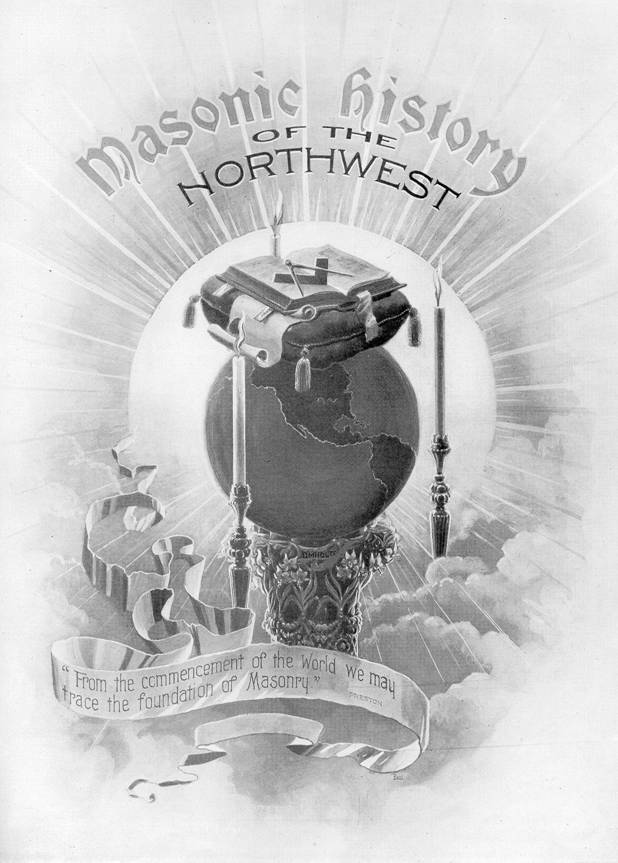
MASONIC HISTORY OF THE NORTHWEST
Graphic Recital of the Organization and Growth of
Freemasonry in the Northwest States
Comprising an Historical Review of the Institution
BY
JOHN MILTON HODSON, P. G. M., Oregon
WILLIAM H. UPTON, P. G. M., Washington
JONAS W. BROWN, P. G. M., Idaho
CORNELIUS HEDGES, P. G. M. and O. Sec'y, Montana
To which is prefixed a Narrative of the Origin of Freemasonry and Its Growth and Diffusion
throughout the World. Also an Account of the Capitular, Cryptic, and Scottish Rites
and the Knights Templar. Besides a Chronicle of the Rise and Progress
of the Modern Orders of the Mystic Shrine and Eastern
Star. To which are Added Brief Biographies
of Many of the Founders and
Builders of Masonry in
the Northwest
Entered According to Act of Congress In The Year 1902.
By The History Publishing Company
The astounding diffusion and marvelous growth of Freemasonry, not less than its wonderful vitality and remarkable influence upon men and nations, have constantly excited amazement among the peoples of the earth. It has seemed as if the Institution were not only of divine origin but also under the fostering care and protection of the Godhead, to such an extent has it been patronized apparently, by the Deity. But whether the countenance which the Craft has received is resolvable to celestial approval or merely to human favor, it is certain that its basic principles have ever contained essential elements of the larger conduct of man in his relations with his fellows; and from this Masonic seed has been germinated the vital code of liberty of speech, action and conscience, which is now recognized in all civilized countries as the birthright of every individual.
Progressive, modern thought, recent development of broadly free governments, and the constant advance of the times in every direction - material, mental and spiritual - are all directly traceable to the vitalizing system of postulates enunciated by the Masonic Fraternity, which spread beyond the limits of the Society and its devotees and unerringly pointed the course toward the consummation of the greatest happiness and freedom of the individual conjoined to his highest duty to Man and the State. The opposition of kings, priests and politicians was unable to stem or overcome the ever - increasing power of the Masonic tenets. The doctrines of equality, justice and liberty appealed too strongly to the weak and oppressed to be eradicated by command, cajolery, sophistry or threat. Hence the fulminations of temporal and religious sovereigns were fruitless. Persecution of the members of this new Fraternity was the natural reward of their temerity in setting up novel standards for the guidance of Man in his worldly and spiritual walks, but even this failed of its purpose. The feeble spark became the glowing flame which melted the shackles that Ignorance, Superstition, Intolerance and illiberalism had forged, and the enlightening conflagration from this fervent blaze is gradually consuming the remnants of the fanaticism, bigotry, oppression and false gods which the past has covertly and craftily attempted to transmit in their fullness to this period of light and reason, but which happily have come down the ages more and more denuded of their terror and power.
With the dethronement of the monstrous kingly and priestly domination and its entailed debasement, wrongs and harassments, and the installation in their stead of comprehensive freedom of thought and action, extended views of the rights of the citizen and enlarged mental and physical opportunities, was inaugurated the primal era of that felicitous succession which has opened to humanity the great avenues of knowledge and endeavor. Amid the advancement which followed the gradual displacement of illiteracy, ignorance and prejudice, the all - controlling factor in that remarkable work - the Masonic Organization - was preserved in all its purity and power. Neither assaults, calumnies, oppressions nor persecutions could swerve it from its purpose or stay its progress.
The fanatic, the bigot, the ignorant and the intolerant were alike impotent to impede its advancement or to destroy the force of its teachings. The inexorable laws of nature and the fate of the times worked transmutation of its membership, but its principles were external and immutable and their exploitation but added to its strength and dignity. Silently and imperceptibly, yet with cynical certainty and assurance and irresistible force, its persuasive and ameliorating dogmas were diffused until they were beyond all repression. The establishment of the new status softened the rigors and harshness of the old religious and political doctrines and afforded unhampered opportunity for honorable endeavor and purposeful effort.
Learning became widespread, the fallacies and falsehoods of the political and religious systems were uncovered, reason succeeded unthinking bias and nescience, the sects intermingled freely, clement notions increased, Man's correlative duty to his brother was now extensively cultivated and generous sufferance of divergent opinions ruled. The past was a hideous dream and was soon forgotten in the benign declarations of the new faith - the Brotherhood of Man and the Fatherhood of GOD. Thenceforward the path led easily and resistlessly to the ennobling triune of Liberty, Equality and Fraternity.
The Masonic Sodality then began to enjoy the fruits of its humanizing labors, and in its development penetrated the remotest portions of the globe. In the early years of the American Colonies it indoctrinated liberal polities which conceived the Revolution and produced the great Republic. And at that time it cast its spell upon the expansive woods and plains, mountains and fields of the great territory edging upon the North Pacific and claimed it for its own. In that remote region, long isolated and undeveloped, the untutored savage and the fearless adventurer practiced the elevating tenets of the Masonic Craft and hewed the way to the later erection of the illuminating altars of this sublime Fraternity.
The mighty secret of its wide dispersion, significant growth and momentous power has ever been TRUTH. And TRUTH now, as formerly, is the touchstone of its "landmarks," the basis of its creed, its teachings and its action. Fortified with this trenchant enginery of offense and defense, the Masonic Establishment has been invincible, and by means of TRUTH has furthered, benefited and encouraged mankind in every department of human affairs. It was the pursuit of TRUTH which led to the early exploration and settlement of the Northwest country, and it was the spirit of TRUTH which united the pioneer denizens of that far - off land for the practice of all which ennobles and inspires. In all the vicissitudes of life in that then border land the consuming attractiveness of TRUTH made for endeavor, security and honor. The Red man alike with the White knew, appreciated and respected its force; hence, all dwelt together in that concord which nothing else could induce.
Under the beneficent rule of TRUTH this vast territory was populated, developed and civilized. It is not singular, therefore, that in the history of this region now distributed among four imperial States of the American Federation, Freemasonry, the foster - mother of TRUTH, should have played an important and controlling part. To graphically depict the many varying but ever - fascinating phases of that anomalous growth was alluring to both the publisher and the editorial corps. It inspired the former to engage in the responsible undertaking, while the task of portraying, the romantic era of this famed land at first interested, then absorbed, and at last completely enthralled the latter.
Their combined labors, pursued with ever - increasing enthusiasm, have produced the present work, in the preparation of which nothing, has been spared that might contribute to a correct, pleasing and permanent picture of the rise of the Masonic Edifice in the Pacific Northwest Distinguished Craftsmen, of pronounced literary ability and with personal knowledge of the times of which they write, have chronicled the local annals of the Fraternity.
Their work has been a labor of love, and in its execution they have evidenced profound reverence, affection and erudition. To this has been added the abilities of other notable authors whose pens have sketched generally the history and achievements of the Masonic Foundation. With pictorial embellishment and dress commensurate to its worth and with a confidence born of earnest and honest effort this historical narrative, dedicated, to TRUTH, is sent forth in the hope that its pages will, in some measure at least, serve to enlighten and entertain, as well as guide to a fuller appreciation of the goodness, nobility and magnificent of the Masonic Guild.
THE HISTORY PUBLISHING COMPANY
CHAPTER I.
The Origin of Freemasonry
Its History and Works from the Building of Solomon's Temple to the Beginning of the New Era of Masonry.
Science was the Father of Freemasonry and Religion its Mother; it was born in the early dawn of Creation, when the SUPREME GRAND ARCHITECT OF THE UNIVERSE commanded, "LET THERE BE LIGHT," AND THERE WAS LIGHT; it was rocked in the cradle of PHILOSOPHY, taught to walk and read Nature by REASON, and fed by TRUTH. From the day of its birth it had to contend against the darkness of Ignorance, the persecutions of Superstition, and the deadly assaults of Fanaticism, in defense of its life, and maintenance of its existence, a struggle which will continue in one form or another as long as the Sun will shine or the Earth move in the plane of its orbit.
Said our late and beloved distinguished Brother, ALBERT G. MACKEY:
"The true history of Freemasonry is much in its character like the history of a nation. It has historic and prehistoric era. In its historic era, the institution can be regularly traced through various antecedent associations, similar in design and organization, to a comparatively remote period. Its connection with these associations can be rationally established by authentic documents, and by other evidence which no historian would reject. Thus dispassionately and philosophically treated, as though was the history of an empire that was under investigation - no claim being advanced that cannot be substantiated, no assertion made that cannot be proved - FREEMASONRY - the word so used, meaning, without evasion or reservation, precisely what everybody supposes it to mean - can be invested with an antiquity sufficient for the pride of the most exacting admirer of the society.
"And then for the prehistoric era - that which connects it with the mysteries of the Pagan world, and with the old priests of Eleusis, of Samothrace, or of Syria - let us honestly say that we now no longer treat of Freemasonry under its present organization, which we know did not exist in those days, but of a science peculiar, and peculiar only to the Mysteries and to Freemasonry - a science which we may call Masonic symbolism, and which constituted the very heart blood of the ancient and modern institutions, and gave to them, while presenting a dissimilarity of form, an identity of spirit. And then, in showing the connection and in tracing the germ of Freemasonry in those prehistoric days, although we shall be guided by no documents, and shall have no authentic spoken or written narratives on which to rely, we shall find fossils embalmed in those ancient intellects precisely like the living ones which crop out in Modern Masonry, and which, like the fossil shells of the fishes of the old physical formations of the earth, show, by their resemblance to living specimens, the graduated connection of the past with the present. "No greater honor could accrue to any man than that of having been the founder of a new school of Masonic history, in which the fictions and loose statements of former writers would be rejected, and in which the rule would, be adopted that has been laid down as a vital maxim of all inductive science - in words that have been chosen as his motto by a recent powerful investigator of historical truth.
"Not to exceed and not to fall short of facts - not to add and not to take away. To state the truth, the whole truth and nothing but the truth."
Our late Brother, ALBERT G. MACKEY, has thus clearly presented a true statement of the prehistoric and historic continuity of our Ancient and Honorable Fraternity. Tradition and symbolism have come down to us through the ages, as well as being recorded in hieroglyphics upon the monolithic monuments and in the temples of that most ancient land of mysteries and knowledge, Egypt, the land of the Pyramids and the Sphinx, watered by the River Nile, from whose bosom was recovered the infant MOSES, and with him in after times the knowledge and mysteries, in the Arcana of the past and the present Masonic world.
PHILO - JUDEUS says that "Moses was instructed by the Egyptian priests in the philosophy of symbols and hieroglyphics as well as in the mysteries of the sacred animals." The sacred historian also say's "he was learned in all the wisdom of the Egyptians." MANETHO and other traditionary writers inform us that "he was educated at Heliopolis (the City of the Sun) as a priest, under his Egyptian name, OSARSIPH, and that there he was taught the whole range of literature and science which it was customary to impart to the priesthood of Egypt. When, then, at the head of his people, he passed away from the servitude of Egyptian taskmasters, and began in the wilderness to establish his new religion, it is not strange that he should have given a holy use to the symbols whose meaning he had learned on the banks of the Nile."
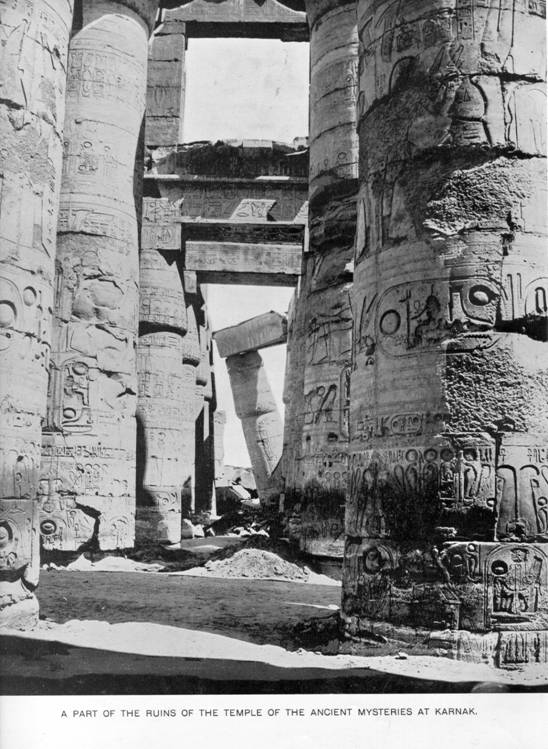
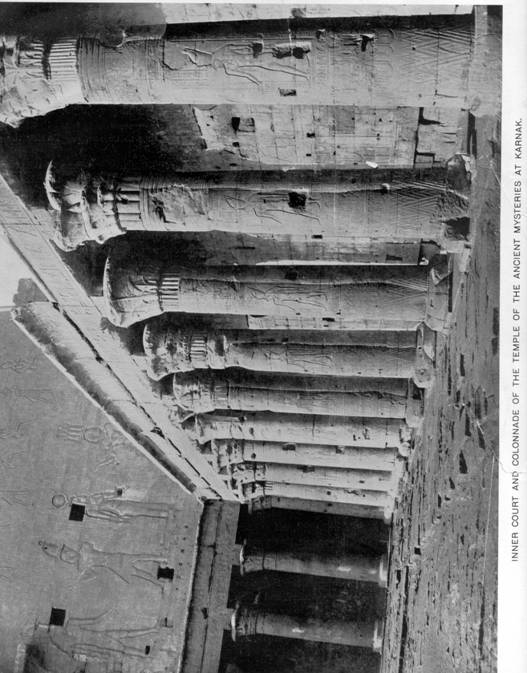
Karnak is the name of a village in Upper Egypt, occupying a portion of the site of ancient, Thebes. The Great Temple of Amon, commonly known as the Temple of Karnak, is located on the east side of the Nile, about two miles northeast of Luxor. An avenue of sphinxes led to the Water. Besides the Great Temple there are some twenty smaller edifices dedicated to Mut, Khonsu, Mentu, Ptah and other deities. These ruins combine to make the most extensive collection in the world. The whole is a wonderful aggregation of buildings of temples, colonnades, courts and the inner sanctuary. It is constructed with a unity of design, and is different in that respect from the temple at Luxor. The roof was supported by one hundred and thirty-four columns eighty feet in height, and upon them the hieroglyphics may still be read of the histories of the various dynasties of the race of PHARAOHS or kings. Here, was where MOSES was initiated and graduated in the Ancient Mysteries, and from his knowledge gained in this school or academy he was able to found and organize the Jewish religion with civil and military government and the worship of the true GOD.
It is reasonable also to suppose that when he was for so many years an exile in the wilderness to the eastward, that his superior knowledge and attainments enabled him to communicate readily and have intercourse with those persons of like character on the banks of the Tigris and Euphrates, and even from farther India, from whence the Egyptians originally derived in part and in a modified form the religion and mysteries they practiced, and which formed the curriculum of the hierarchy of Egypt.
REGHELLINI, in his work, "Masonry considered as the result of the Egyptian, Jewish and Christian Religions," published at Paris in 1833, says: "MOSES, in his mysteries, and after him, SOLOMON, adopted a great part of the Egyptian symbols, which, after them, we Masons have preserved in our own.
The direct traditional and historic base of our Craft rests upon the construction of Solomon's Temple at Jerusalem, itself a compendium of architecture, religion, science and philosophy, and the focus to which was directed the vision of all the learned of the ancient world, as well as the principal architects and builders, who came from Egypt, Phoenicia, Greece, from the West, along the shores of the Mediterranean to the far East, beyond the Euphrates and Tigris to India, and even far off Cathay, to construct the first and the most splendid Temple ever erected to the worship of the true GOD, and built by that ancient " Parliament of Religions," the Masonic Builders of the World. To be sure, the inner Temple or Sanctum Sanclorum, was to be sacredly and secretly used by the Levitical Priesthood, in accordance with the Mosaic ritual of the Tabernacle set up in the Wilderness, yet the knowledge of its purposes, and for what it was designed, was fully understood by the Architect Masons who constructed it and all the secret recesses and chambers of that wonderful edifice. The great porch or tower of 20 cubits or 39 77/100, feet square, and 120 cubits or 238 1/2, feet high in front of the Temple, before which stood the two great brazen pillars, was for astronomical as well as military purposes; to study the heavens, as did the Shepherd Kings centuries before on the plains of Chaldea, as also to serve as a watchtower to look over the City of Jerusalem, and watch the approach of invading enemies.
The great purpose of SOLOMON was to maintain peace, magnify his influence and power and to control the then great highway of overland commerce from India to the Mediterranean having unlimited resources and power, and having for his chief ally the friend of DAVID, his father, HIRAM, King of Tyre, with whom he divided the revenue of imports and exportation. Therefore, he cultivated the friendship of all surrounding countries and their governments, from whence came so many Craftsmen of all kinds and of all shades of religious beliefs, but having a central fundamental principle of the worship, each in his own way, of the one only and true GOD, for which the Great Temple was to be erected; and for the Deity Himself, each according to his nation and tongue, gave Him a name, accordingly, which was compounded and three names that were chosen by the chiefs of the architects at last became one for their own private recognition, according to legend and tradition.
When the time came for the dedication of the Temple, it was to be done out of doors in sight of everybody, and not in the Temple itself; nor was it done by the Jewish priesthood, but by King SOLOMON himself, as king and sovereign of the people, the representative of the people and for the people, not of the Israelites alone, but for everybody under his protection who might desire to come there and worship GOD in his own way and of his own free will; for in the midst of his memorable prayer he said:
“Moreover, concerning the stranger, which is not of thy people, Israel, but is come from a far country for thy great name's sake, and thy mighty hand, and thy stretched out arm; if they come and pray in this house; then hear thou from the heavens, even from thy dwelling - place, and do according to all that the stranger calleth to thee for; that all the people of the earth may know thy name, and fear thee, as doth thy people, Israel, and may know that this house which I have built is called by thy name."
This part of his prayer was chiefly intended for the foreign Masons who had helped to build the Temple, for we read, "And DAVID commanded to gather together the strangers that were in the land of Israel, and he set Masons to hew wrought stones to build the house of GOD." "And SOLOMON numbered all the strangers that were in the land of Israel, after the numbering wherewith DAVID, his father, had numbered them, and they were found an hundred and fifty thousand, and three thousand and six hundred. And he set threescore and ten thousand to be bearers of burdens, fourscore thousand to be hewers in the mountain, and three thousand and six hundred overseers to set the people at work."
Thus it will be seen came the first systematic organization of Freemasons of which we have any historic account, and to be directly employed upon government and religious work, under the immediate direction of one HIRAM ABIF, the chief architect of the work, who was sent by HIRAM, King of Tyre, in compliance with the expressed desire of King SOLOMON. It is upon the knowledge, education, skill, life, and tragic death of this most distinguished Mason of which there is any account, either historical, traditional, or legendary, that is formed the structure of our philosophic, semireligious, speculative, and symbolic Freemasonry of today, which has come down to us through the ages for a period of over twenty-nine centuries and carrying with it the history, tradition, and mysteries of as many centuries before. He is the central figure of all recorded time and the Master Builder of the Masonic World. He had the highest recommendation that could possibly be given to him at the time. HIRAM, King of Tyre, said of him in his letter to King SOLOMON:
"And now I have sent a cunning (wise) man, endued with understanding of HIRAM, my father's. The son of a woman of the daughters of DAN, and his father was a man of Tyre, skillful to work in gold and in silver, in brass, in iron, in stone, and in timber, in purple, in blue, and in fine linen, and in crimson; also to grave any manner of graving, and to find out every device which shall be put to him, with thy cunning men, and with the cunning men of my lord DAVID, thy father."
He was relieved, however, from having to originate the plans for the Temple, for DAVID, it seems, was the original designer who drew the plans of the Temple, in accordance with divine direction, for everything in and about this wonderful edifice then to be built, and had given them to his son, King SOLOMON, for the account given of it is as follows:
"Then DAVID gave to SOLOMON, his son, the pattern of the porch and of the houses thereof, and of the treasuries thereof, and of the upper chambers thereof, and of the inner parlors thereof, and of the place of the mercy seat; and the pattern of all that he had by the spirit, of the courts of the house of the LORD, and of all the chambers round about, of the treasuries of the house of GOD, and of the treasuries of the dedicated things. * * * * * All this, said DAVID, the LORD made me understand in writing, by His hand upon me, even all the works of this pattern," etc.
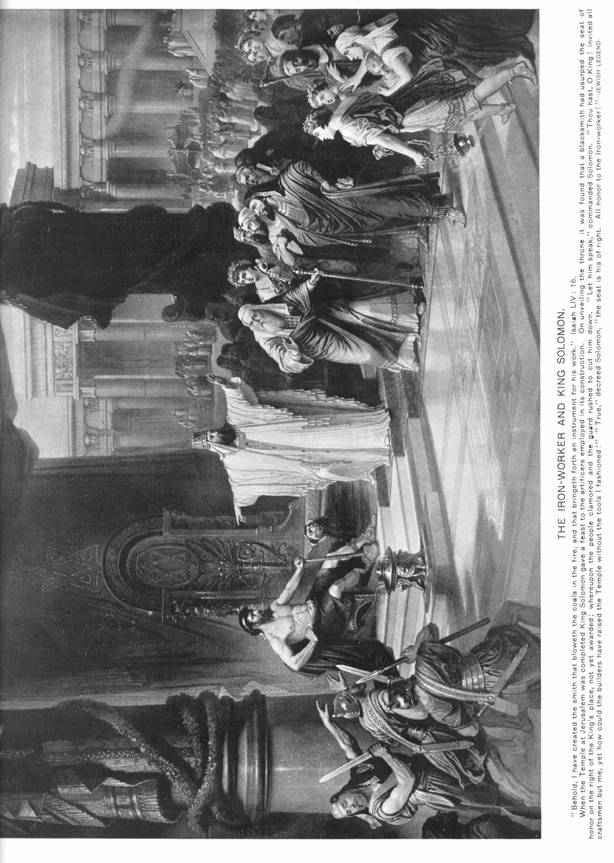
There is a secret tradition that King SOLOMON, when the Temple was nearly completed, had tired of HIRAM ABIF, the Chief Architect of the Temple, who was the representative of the people and who had risen from their level to become the companion of kings. The necessity of personal intercourse during the construction of the Temple had made his architect familiar with that royalty which was but recent and in the second generation only; and the Tyrian architect regarded SOLOMON as but a man and the son of a shepherd of fortuitous circumstances, who by causing the death of his elder brother ADONIJAH, the next in line to DAVID, had succeeded the first occupants of the throne upon the change of the autonomy and form of government of the people of Israel. King SOLOMON, being jealous of his power and glory, and determined that no other monarch should erect a similar temple of equal magnificence and splendor, is said to have himself, secretly and surreptitiously, secured the plans and the last designs drawn upon the trestleboard of the Temple, and secretly contrived to plot whereby his chief architect might be removed, that no other king or nation should have them or be able to secure his services. The unconscious instruments of his purpose performed the part they were incited to enact, not knowing who was the actual chief conspirator whose will they had carried out, when they supposed that they were only executing their own; and yet received the decision of their fate at his hands, the chief conspirator and criminal acting as their judge - his grief and indignation simulated and hypocritical and from whose royal decree there was no appeal.
Through the long line of martyrs whose lives have been sacrificed on the altars of Truth, Science, and Philosophy and for Civil and Religious Liberty, Freemasonry has come down to the
present age brighter in its effulgence, and like the sun in its course, will forever shine, giving life and light wherever the unfettered intellect and the freed soul of man can measure the distance and the courses of the stars and find repose in the bosom of its divine Creator, the All Father and the ALMIGHTY GOD.
As a Brotherhood, traveling from one country to another in camps or lodges, ready to undertake the reconstruction of buildings, destroyed by the ravages of war or of the elements, from their ruins, or to build new ones - whether churches, cathedrals, public or private edifices or fortresses - the banded Craftsmen pursued their calling in every country of Western Asia, Northern Africa, and throughout all the countries of Continental Europe and the British Isles. While temporarily sojourning in huts or lodges themselves, they were ever ready to contract to build a most gorgeous, sumptuous palace, a costly cathedral, a lordly castle, or a plain citizen's dwelling. The science of construction in Grecian, Roman, Moorish, or Gothic architecture was as familiar to them as the curriculum of the most noted universities of today to the scholarly professors who occupy the chairs at Oxford, Harvard, Princeton, or Yale. Whether in Athens or in Rome, Grenada, Seville, or in Paris, at Dresden, Munich, Cologne, or Rheims, at London, Edinburgh, Stirling, or Melrose, these journeying Craftsmen, with their masters schooled in the learning of the old Colleges of Architecture at Rome, traveled with freedom from toll over the face of Europe, carrying the secrets and mysteries of their Craft with them, fully understanding the purposes and nature or character of the buildings to be constructed, and their handiwork still remains to be seen commanding the admiration of the beholders for centuries since the last finishing strokes were given and the scaffolding removed.
The ancient mysteries and knowledge of all the religions were known to them, for they had to erect the temples and edifices for them, and thus they learned the symbolism, faith, and philosophy of each, and were always well prepared to digest and analyze all shades of doctrines and beliefs while inwardly committed to none but their own independent thoughts, studying Nature and reading her mysteries by the God - given Light of Reason, and worshiping their Creator in the starlighted Cathedral of the Universe, the mountains for their altars and the plains and valleys for the checkered pavement of their temple and kneeling floor. Their working tools furnished them symbols for teaching moral lessons and guides for their conduct, while the blade of the trowel of the Master Mason reminded him of the form of his coffin, upon which in the lines from the points at right angles, if a Christian, he could discern the symbol of his faith, and, in its handle, he grasped the everliving acacia, which again placed in the ground at the head of his grave, like AARON's rod, would take root and bud and bloom anew in full strength and fragrance, the symbol and type of his own immortality.
These scattered lodges were at last mostly found in England, and after the Great London Black Plague and Fire of 1666. The four lodges that were engaged in the finishing of St. Paul's Cathedral in 1717, having admitted to their fellowship the scholars and philosophers and scientific men of that day as "Accepted Masons," instructed them in the allegories, legends, and symbols of the Craft, and Freemasonry, thus augmented, expanded and widened to a larger sphere and became stronger in its growth, while the floor of its temples became neutral ground, where political disputations ceased and polemical discussion of sectarian religious beliefs were rigorously hushed and barred, and Nature's humanity and loving kindness were given a chance to bring good men of opposite opinions together, “who might have forever remained at perpetual distance from each other."
Such was the origin of Freemasonry in the beginning until the so-called "Revival of Freemasonry " in 1717, and which has come down to us with but few modified changes from that date for a period of one hundred and seventy-nine years. ESTO PERPETUA.
CHAPTER II.
The Objects of Freemasonry:
LIBERTY, EQUALITY, FRATERNITY, BROTHERLY LOVE, TRUTH, RELIEF TO THE WIDOW, THE ORPHAN AND THE DISTRESSED.
In stating the objects of Freemasonry at the head of this chapter as the cardinal tenets of our "Most Ancient and Honorable Fraternity," and which we desire to illustrate, it may truthfully and logically be said that there must be LIBERTY to maintain EQUALITY and FRATERNITY as the natural result of the two which compose the first triad of Masonic principles which forms the base of our institution and the second triad is the living, force and natural outflow in activity of the former; for there could be no BROTHERLY LOVE without FRATERNITY, no RELIEF without the active principle of EQUALITY in HUMANITY, and no LIVING TRUTH without the exercise of LIBERTY to declare and maintain it. This double triad forms the double interlaced triangular symbol of the cardinal tenets of our beloved Order; and the hexagon in the center formed by the crossing of the lines of these two equilateral triangles shows the outlines of the foundation stone of our Temple in perspective, upon which is inscribed the Trinity of every true Mason's religion, regardless of any particular creed: FAITH, HOPE, CHARITY.
A sublime FAITH in the ALL FATHER and Creator of the Universe without superstition, for otherwise no man could be free or fit to become a Mason. A well grounded HOPE of IMMORTALITY, like that of JOB: "For I know that my Redeemer liveth"; or like that of PAUL: "For we know that if our earthly house of this tabernacle were dissolved, we have a building of GOD, an house not made with hands eternal in the heavens." And CHARITY, which crowneth all, so well described and systematized by MOSES, the lawgiver of Israel: "When thou cuttest down thy harvest in thy field and hast forgot a sheaf in the field, thou shalt not go again to fetch it; it shall be for the stranger, for the fatherless, and for the widow: that the LORD thy GOD may bless thee in all the works of thy hands. When thou beatest thine olive trees thou shalt not go over the boughs again; it shall be for the stranger, for the fatherless, and for the widow. When thou gatherest the grapes of thy vinevard, thou shall not glean it afterward; it shall be for the stranger, for the fatherless, and for the widow. Thou shalt not pervert the judgment of the stranger, nor of the fatherless, nor take a widow's raiment to pledge. Thou shalt not oppress an hired servant that is poor and needy, whether he be of thy brethren, or of thy strangers that are in thy land within thy gates. At his day thou shall give him his hire, neither shall the sun go down upon it; for he is poor and setteth his heart upon it: lest he cry against thee unto the LORD and it be sin unto thee." Or as PAUL and PETER have said: "Even the mystery which hath been hid from ages and from generations; for brethren ye have been called unto liberty; but by love serve one another. Finally, be ye all of one mind, having compassion one of another, love as brethren, be pitiful, be courteous; fear GOD, love the brotherhood; honor all men. And now abideth FAITH, HOPE, CHARITY; but the greatest of these is CHARITY"; all of which latter is summed up in the Golden Rule, " Whatsoever ye would that men should do unto you, do ye even so unto them," as laid down by the Most Wise Master who ever appeared among men. These are the fundamental principles upon which the universal religion of Freemasonry is founded. In this connection we may revert to the Ancient Charges of a Freemason:
I. CONCERNING GOD AND RELIGION.
A Mason is obliged by his tenure to obey the moral law; and if he rightly understands the art, he will never be stupid atheist nor an irreligious libertine. But though in ancient times, Masons were charged in every country to be of the religion of that country or nation, whatever it was, it is now thought more expedient only to oblige them to that religion in which all men agree, leaving their particular opinions to themselves that is, to be good men and true, or men of honor and honesty, by whatever denominations or persuasions they may be distinguished, whereby Masonry becomes the center of union and the means of conciliating true friendship among persons that must have remained at a perpetual distance."
II. OF THE CIVIL MAGISTRATE, SUPREME AND SUBORDINATE.
"A Mason is a peaceable subject to the civil powers wherever he resides or works, and is never to be concerned in plots and conspiracies against the peace and welfare of the Nation, nor to behave himself undutifully to inferior magistrates; for as Masonry hath always been injured by war, bloodshed, and confusion, so ancient kings and princes have been much disposed to encourage the Craftsmen, because of their peaceableness and loyalty, whereby they practically answered the cavils of their adversaries, and promoted the honor of the fraternity, who ever flourish in times of peace. So that if a Brother should be a rebel against the State, he is not to be countenanced in his rebellion, however he may be pitied as an unhappy man; and if convicted of no other crime, though the loyal brotherhood must and ought to disown his rebellion, and give no umbrage or ground of political jealousy to the government for the time being, they cannot expel him from the Lodge, and his relation to it remains indefeasible."
FURTHER EXTRACTS FROM THE ANCIENT CHARGES OF A FREEMASON.
"The persons admitted members of a Lodge must be good and true men, free born, and of mature and discreet, age; no bondsmen, no women, no immoral or scandalous men, but of good report."
"All Masons shall work honestly on working days, that they may live creditably on holy days; and the time appointed by the law of the land, or by custom, shall be observed."
"The Craftsmen are to avoid all ill language and to call each other by no disobliging name, but Brother or Fellow; and to behave themselves courteously within and without the Lodge."
EDITORIAL NOTE. The Double Interlaced Triangle illustrated above was the device on DAVID'S shield and on SOLOMON'S seal. The twelve angles within and without each point had reference to the Twelve Tribes of Israel. Each angle being of sixty degrees, it is for this reason that in the jewel of a Past Master the compasses are extended to sixty degrees upon the segment or arc of a circle, the angle being that on which the bee forms its cell in the honeycomb within the hive, and which contains also a geometric problem and a key as well as moral lessons to be drawn therefrom.
"No private piques or quarrels must be brought within the door of the Lodge, far less quarrels about religion or Nations or State policy, we being only as Masons of the Universal religion above mentioned; we are also of all Nations, tongues, kindreds, and languages, and are resolved against all Politics, as what never conduced to the welfare of the Lodge or ever will. This CHARGE has always been strictly enjoined and observed; BUT ESPECIALLY EVER SINCE THE REFORMATION IN BRITAIN, OR THE DISSENT AND SECESSION OF THESE NATIONS FROM THE COMMUNION OF ROME."
We have cited these extracts from the "Ancient Charges of a Freemason " because within them is contained, preserved, and to be for all time perpetuated, the principles and doctrines of absolute civil and religious liberty to each individual member of the fraternity admitted within the sacred walls of its Temple; and, while its tessellated floor is neutral ground and no discussions of a debatable character upon matters of either religion or politics are permitted within the Sanctum Sanctorum, yet at the same time the good seed is sown. When the prejudices and passions of men are subdued to a peaceful tranquility, toleration prevails, the right of private choice and judgment is recognized, and the result is that, being honest, good men and true, pure in intentions, peaceably disposed, mutual respect and esteem is cultivated and a fraternal spirit of brotherly love and affection cements the Mystic bond of Brotherhood. Freemasonry has no punishment for sectarian religious heresy nor for political rebellion, excepting there be heinous crime connected therewith; for what may be considered treason today may by success be loyalty tomorrow, and by revolution the position of political parties be reversed in holding the reins of government.
These principles and maxims and the policy of our honored institution were well laid down for the government of the Craft by the Grand Lodge of England chiefly composed of those who had suffered as victims of persecution, Huguenots and Scotchmen when it was first organized by the four London Lodges on St. John the Baptist's Day, June 24, 1717, at the Apple Tree Tavern, London, when ANTONY SAYRE, the son of a French Huguenot, was elected Grand Master, at the time of the so called "Revival of Freemasonry," when speculative or philosophic Freemasonry became more general, and adopted or accepted by the operative guild or craft, which, continually traveling to and fro and in foreign countries, disseminated these principles whithersoever they journeyed in plying their vocation. As a distinguished writer has said, "The Grand Kabalistic Association known in Europe under the name of 'Freemasonry' appeared all at once in the world at the period when the Protest against the Papal Power came to break the Christian unity." As has also been well said by our late and lamented Brother, ALBERT G. MACKEY: "The design of Freemasonry is neither charity or almsgiving, nor the cultivation of the social sentiment, for both are merely incidental to its organization; but it is Ike search after truth, and that truth is the unity of GOD and the immortality of the soul. The various degrees or grades of initiation represent the various stages through which the human mind passes, and the many difficulties which men individually or collectively must encounter in their progress from ignorance to the acquisition of this truth."
It was this idea which generally prevailed in the seventeenth century among the operative Freemasons, who were called upon to construct religious and other edifices for the various sects which had divided the Christian Church, and that called forth a more general spirit of inquiry among them into religious and philosophical truths, and the calling to their aid the scientific, philosophic, and learned scholars of the age, who were welcomed into the Operative Guild as auxiliaries and were received and made Adopted or Accepted Freemasons, as had been their custom from time immemorial; and among those admitted was the learned antiquarian, ELIAS ASHMOLE, who also has left the impress of his work upon the drama in that portion of the ritual which now relates to the Fellow Craft Degree in particular and before Freemasonry was divided into three degrees. He was made a Freemason October 16, 1646, two centuries and a half ago and seventy-one years before the Grand Lodge of England was formed. Some thirty-six years after his admission into the fraternity, March 10, 1682, he was summoned to attend a Lodge of Masons the next day at Masons' Hall, London, an account of which he has left in his diary, in his collection in the Ashmolean Museum at Oxford. Among other things, he says:
"There is no doubt to be made that the skill of Masons, which was always transcendent even in the most barbarous times - their wonderful kindness and attachment to each other, how different soever in condition, and their inviolable fidelity in religiously keeping their secret - must expose them in ignorant, troublesome, and superstitious times to a vast variety of adventures, according, to the different fate of parties and alterations in government. By the way, I shall note that the Masons were always loyal, which exposed them to great severities when power wore the trappings of justice, and those who committed treason Punished true men as traitors. Thus in the third year of the reign of HENRY VI (1432), an Act of Parliament was passed to abolish the society of Masons and to hinder, under grievous penalties, the holding of Chapters, Lodges, or other regular assemblies. Yet this act was afterward repealed, and even before that, King HENRY VI and: several of the principal lords of his court became Fellows of the Craft."
Thus the principles of Freemasonry were those of absolute civil and religious liberty and equality of all men who were honest, good, and true, and worthy of admission to the Brotherhood, which were being fostered and strengthened within the sacred precincts of their Lodges, where they grew in strength and expanded and spread beyond their walls, and permeated society of every rank and degree, effectually but silently like the growth of the forest, doing their perfect work, and which in the course of events has proven irresistible; and all free government everywhere at the present day owes its existence primarily or indirectly to the influence of our beloved institution. The great mistake of many writers of Masonic history is the utter ignoring of the political and religious conditions of the times of which they write, of the controversies and conflicts of sects and parties of both Church and State, of the actors therein, who have directed the current of events of rival intolerant, superstitious, and persecuting religions, and of the antagonisms of contending political parties and armed adherents of ambitious kings and prelates.
Speculative Freemasonry itself is the child of both rational religion and liberal politics, but not of fanaticism and partisanship; it was begotten during a truce and born during an armistice; its clothing, the Master Mason's apron, is a flag of truce and at once commands, "Peace, be still!" for the place over which it flies is holy and neutral ground. The fugitive Huguenots driven from France upon the revocation of the Edict of Nantes in 1685, the despoiled Scottish noblemen, adherents of the House of the Stuarts, and liberalminded Englishmen who were scholars, fused with the operative Masons of the four Lodges that were engaged in the building of St. Paul's Cathedral in London, and became Accepted Masons and Brethren of the Craft.
They enriched the ritual and drama of initiation with moral and philosophic instruction, combined with scientific formula and symbols, and clothed it with legendary tradition blended with both sacred and profane history, and taught the most sublime truths that can be inculcated and impressed upon the hearts of men. The so-called "Revival of Freemasonry" in 1717 was the spiritual rebuilding of King SOLOMON's Temple in which every Mason to this day is engaged within himself, to be erected and dedicated to ALMIGHTY GOD. No slave or bondman was permitted to work on, in or about the Temple, not even to remove the rubbish. He therefore must be freeborn as well as a freeman in whom the spirit of Freemasonry is to dwell free as a citizen, morally free, and utterly free to worship GOD as he pleases, whose heart and mind are illuminated by the Great Light of the Holy Bible, which ever lies an open book, for all to read, upon every altar of Masonry, and erected to ALMIGHTY GOD.
It was the French Huguenot Reformer, JOHN THEOPHILUS DESAGULIERS, born March 12, 1683, at Rochelle, France, who having become a curate of the Church of England and initiated in the "Lodge of Antiquity" in St. Paul's Churchyard, secured the assistance of several older Masons to aid in the formation of the Grand Lodge of England, in which he was eminently successful. He was more of a scientist than a preacher, and PRIESTLEY styles him "an indefatigable experimental philosopher." Said our lamented Brother, ALBERT G. MACKEY: "To few Masons of the present day, except to those who have made Freemasonry a subject of special study, is the name of DESAGULIERS very familiar. But it is well they should know that to him, perhaps more than to any other man, are we indebted to the Present existence of Freemasonry as a living institution; for when in the beginning of the eighteenth century Masonry had fallen into a state of decadence which threatened its extinction, it was DESAGULIERS who, by his energy and enthusiasm, infused a spirit of zeal into his contemporaries which culminated in the revival of the year 1717, and it was his learning and social position that gave a standing to the institution, which brought to its support noblemen and men of influence, so that the insignificant assemblage of the four London Lodges at the Apple Tree Tavern has expanded into an association which now overshadows the entire civilized world. And the moving spirit of all this was JOHN THEOPHILUS DESAGULIERS."
ANTONY SAYRE, the son of a French Huguenot, was elected the first Grand Master. In 1718 he was succeeded by GEORGE PAYNE, and in 1719, DESAGULIERS was elected Grand Master, followed by the DUKE OF WHARTON, the EARL OF DALKEITH, LORD PAISLEY, and others. These three last named gentlemen, eminent Masons and Grand Masters, had been attainted and forfeited their titles in the British or rather Scotch peerages for their adherence to the House of Stuart, as will be seen by reference to DE BRETT'S "Peerage of Great Britain and Ireland." WHARTON forfeited his title in 1728. DALKEITH was a descendant of the DUKE OF MONMOUTH, illegitimate son of CHARLES II. CHARLES RADCLIFFE, who had married CHARLOTTE, Countess of Newburgh, a widow, was the third son of EDWARD II, Earl of Derwentwater, and assumed that title upon the death of his nephew, who was executed for rebellion against GEORGE II in 1716, and, fleeing to France, assisted in the planting of Freemasonry in that country and became the first Grand Master of Masons of France in 1725. His mother was MARY TUDOR, the illegitimate daughter of Charles II. He also had been attainted and convicted of treason before his flight. He left France in 1733 (sixteen years after the Grand Lodge of England was organized), and made several visits to England in unsuccessful pursuit of pardon. The blood of the Stuarts, though illegitimate, which flowed in his veins, operated as an effective barrier to his hopes and prospects. Filled with hopeless disappointment, he at last allied his fortunes with those of The Young Pretender in 1745, and sailed from France to join him, but the vessel in which he embarked was captured by an English man - of - war. He was taken prisoner and beheaded on Tower Hill, London, December 8, 1746. Under the skillful guidance of these eminent, learned and loyal craftsmen, the revivification of the decadent society became complete, and a higher appreciation of its principles and purposes attracted to its altar men of renown whose devotion insured the stability and growth of the institution as a fraternity dedicated to the uplifting of humanity.
The Grand Lodge of England, thus formed, made itself and its subordinates a Universal Bible Society and the sworn custodians of the Great Light of Freemasonry, and in the installation ceremonies of the Masters of Lodges, DESAGULIERS, when he framed them, borrowed almost the exact language in reference to it as used in the coronation ceremonies prescribed by King JAMES I of England
21
(who was also, at the same time, King JAMES VI of Scotland). For the information of the Brethren and as matter of historic curiosity, we subjoin the charges in parallel columns:
AT THE CORONATION OF THE KING PRESENTATION OF THE BIBLE BY THE ARCHBISHOP.
"Then shall the Dean of Westminster take the Holy Bible that was carried in the procession, from off the altar and deliver it to the Archbishop, who, with the rest of the Bishops going along with him, shall present it to the King, first saying these words to him:
"Archbishop - Our gracious King, we present you with this Book, the most valuable thing that this world affords. Here is Wisdom. This is the Royal Law. These are the Lively Oracles of GOD. Blessed is he that readeth, and they that hear the words of this Book, that keep and do the things contained in it, for these are the words of eternal life, able to make you wise and happy in this world, nay wise unto salvation, and so happy forevermore through faith, which is in CHRIST JESUS, to whom be glory forever. Amen!"
"Then the King delivers back the Bible to the DEAN OF WESTMINSTER, to be reverently placed again upon the holy altar."
AT THE INSTALLATION OF THE WORTHY MASTER -
PRESENTATION OF THE BIBLE TO THE MASTER ELECT.
"Then the Marshal of the Lodge, going to the altar and taking the Holy Bible therefrom (or if for convenience sake using another), will deliver it to the Past Master acting as the Installing Officer, who says:
"Installing Officer - My Brother, I now present you the Book of Holy Writings. It is the Great Light in Masonry, and should ever be the great law of the Brotherhood. It will guide you to all truth, it will direct you to eternal happiness, and an attentive regard to the divine precepts it contains will insure you success in the fulfillment of the duties you are now about to assume. * * In short, by a diligent observance of the bylaws of your Lodge and the constitutions of Masonry, and, above all, the Holy Scriptures, which are given as the rule and the guide of your faith, you will be enabled to acquit yourself with the highest honors here and lay up a crown of rejoicing which shall continue when time shall be no more."
It is again placed upon the altar [or table].
The Scottish element at the time of the so-called " Revival of Freemasonry" in 1717 in England prevailed, and the Masonic world is greatly indebted to a man born August 5, 1684, at Edinburgh, Scotland - a Doctor of Divinity of the Presbyterian faith, who removed to London and became the Pastor of the Scotch Presbyterian Church in Swallow Street, Piccadilly - the Rev.JAMES ANDERSON, who was commissioned by the Grand Lodge of England, September 29, 1721, to collect and compile the history and charges of the fraternity from the then existing constitutions of the Lodges. Those who then composed the Grand Lodge of England were comparatively young men, DESAGULIERS being only thirty-eight years and ANDERSON thirty-seven years of age. A French Episcopalian and a Scotch Presbyterian working in harmony in drawing their designs upon the Masonic trestleboard relegated sectarianism to where it belonged. Both of them were away from their native land - both direct descendants of those who had been persecuted for political and religious conscience sake - and laboring in concord at a time when a century of persecution had driven the best blood and the greatest intelligence out of the United Kingdom to find a refuge in the then wilderness of America, where the great lights of Freedom and of Freemasonry were to be soon established and in time illumine the entire New World. "Anderson's Constitutions and Old Charges and Regulations," compiled by him, have been the general standing regulations of the fraternity for a century and three - quarters, since they were collated and compiled. St. Paul's Cathedral in London had just been completed, its great architect, Sir
22
CHRISTOPHER WREN, had shortly afterward died and been immured within it when ANDERSON completed his important work for the Craft. The Brotherhood was soon thereafter to be divided and scattered.
It was during these troublous times that Free and Accepted Masonry had to be organized with a central authority placed within a representative body to be known as the Grand Lodge of England, that the Great Lights might be kept burning and send their refulgent rays around the globe and penetrate every corner of the earth. England, where it was organized, may therefore claim to have been the seat of WISDOM; Scotland, for having furnished the compiler of its constitution and laws which gave it STRENGTH; and France, the birthplace of the chief author and designer of its ritual, may claim its BEAUTY. ASHMOLE, ANDERSON, and DESAGULIERS, the rose, the thistle, and the lily, the floral symbols of light and power, of warning and protection, and of purity and adornment, represented in these three great master builders, will continue to bloom with the fragrant acacia, symbol of immortality, as long as there are compasses and squares to draw designs upon the trestleboards of the Craft, a trowel in the hands of a Master Mason to spread the cement, or the gavel of a Master to sound and direct the work. Thus Free and Accepted Masonry, at its revival in 1717, with a regularly constituted and organized Grand Lodge of authority delegated to it, created amidst political and religious strife of all parties, factions, and fanatics, started out on its grand, but quiet and peaceful mission, to humanize and civilize the world, with the silent but firm guaranty of the rights of conscience, bearing upon its snow white banners its grand principles of LIBERTY, EQUALITY, FRATERNITY, BROTHERLY LOVE, RELIEF, and TRUTH, and its standard planted upon its most perfect ashlar and chief cornerstone of FAITH IN GOD, HOPE IN THE IMMORTALITY OF THE SOUL, and CHARITY FOR ALL MANKIND, especially of the HOUSEHOLD OF THE FAITHFUL.
“Slave to no sect, who takes no private road,
But looks through Nature up to Nature's God;
Pursues that chain which links th' immense design,
Joins heaven and earth, and mortal and divine;
Grasps the whole world of Reason, Life, and Sense,
In one close system of Benevolence:
Happier as kinder, in whate'er degree,
And height of Bliss but height of Charity." - Pope.
CHAPTER III
Advent of Freemasonry into America.
MASONRY PROVIDED THE LEADERS THAT INCITED THE COLONISTS AND LED THEM TO VICTORY, LEAVING ITS IMPRESS UPON THE FREE INSTITUTIONS OF THE UNITED STATES.
Before entering upon the work of "The History of the Northwest" proper, it is expedient and appropriate that an account of our Masonic ancestry and descent in our own country of the American Republic should be given; and as there were individual Masons on the Pacific Slope, before American occupation, carrying the light within their own breasts, scattered over the country and traversing its solitude, so there existed a similar condition in the early settlement of the American Colonies upon the Atlantic Coast.
It is said that there is evidence that "Freemasonry existed in the then French Colony of Nova Scotia without the English language as early as 1606," or fourteen years before the Pilgrim Fathers landed at Plymouth Rock in Massachusetts. The first Mason of whom there is any account in that state or in America in colonial times was Governor Jonathan Belcher who was made in a Lodge in London in 1704, or thirteen years before the so-called "Revival of Freemasonry in 1717. SERNO D. NICKERSON, Past Grand Master and now Grand Secretary and Historian of the Grand Lodge of Massachusetts, who is always exact in his statements of facts of history, records the following: " In 1741 Governor JONATHAN BELCHER said to the first Lodge in Boston (St. John's), 'It is now thirty-seven years since I was admitted into the Ancient and Honorable Society of Free and Accepted Masons.' He was present and his health was drank in the Grand Lodge of England, September 26, 1744. The Craft spread far and wide, and whenever two or three of them were gathered together they made merry, and they made Masons!"
Thus it will be seen that wherever there were three Master Masons to come together, and thus have a quorum, they would open a Lodge of Master Masons pro tempore, initiate, pass and raise candidates, close and disband until another emergency should arise. There was no supreme authority to govern and control, no warrants or charters issued, and this loose system generally prevailed, though fortunately for Freemasonry the population at that time was very limited and every man knew his neighbor before admitting him to the fellowship of brotherhood. Even in 1733 the population of the city of Boston was only about 18,000, Philadelphia about 12,000, and New York even in 1777 numbered only 21,767, so that in the selection of material there was not much danger of going very far astray.
24
In the British Isles, however, Masonry had its Lodges which were permanent, kept their records, and were separate, independent sovereignties, amenable to no other regulations and laws but those established by themselves; and their government in legislation was shared by the humblest Entered Apprentice, who had both voice and vote in the administration of their affairs, and each was a free republic with freemen and Freemasons in itself, their Masters and other officers of their own choice, limited by their own laws and landmarks of the Order and the terms for which they were chosen; but when the Grand Lodge of England was organized at the Apple Tree Tavern in London, in 1717, then a new order of things commenced by its declaring, "That the privilege of assembling as Masons, which has been hitherto unlimitd, shall be vested in certain Lodges or Assemblies of Masons convened in certain places, and that every Lodge to be hereafter convened, except the four old Lodges at this time existing, shall be legally authorized to act by a warrant from the Grand Master for the time being, granted to certain individuals by petition, with the consent and approbation of the Grand Lodge in Communication, and without such consent no Lodge shall be hereafter deemed regular or constitutional." In "Anderson's Constitutions of 1723" we find among the General Regulations, "compiled first by Mr. GEORGE PAYNE, Anno 1720, when he was Grand Master, and approv'd by the Grand Lodge on St. John Baptist's Day, Anno 1721," the following, being the second paragraph of Article VIII:
"If any Set or Number of Masons shall take upon themselves to form a Lodge without the Grand Master's Warrant, the regular Lodges are not to countenance them, nor own them as fair Brethren and duly form'd nor approve of their Acts and Deeds; but must treat them as Rebels, until they humble themselves, as the Grand Master shall in his Prudence direct, and until he approve of them by his Warrant, which must be signify'd to the other Lodges, as the Custom is when a new Lodge is to be register'd in the List of Lodges."
Says Bro. SERENO D. NICKERSON: "The new system thus inaugurated met with general approval and was adopted by common consent by the English speaking portion of the Craft, from time to time, as it became known. In no quarter was the new departure more cordially approved, or more cheerfully conformed to than in the British North American Provinces."
In 1721 the Grand Lodge of Munster, Ireland, was formed, of which SPRINGETT PENN (the oldest son of the celebrated WILLIAM PENN, the founder of Pennsylvania) was the first Deputy Grand Master; but in 1730 the Grand Lodge of Ireland was regularly organized.
The Grand Lodge of Scotland was constituted in 1736. The Grand Master of Scotland, WILLIAM ST. CLAIR, Earl of Orkney, who then exercised supreme power, declared: "Taking into consideration that his holding or claiming any such jurisdiction, right or privilege might be prejudicial to the Craft and vocation of Freemasonry, renounced his claims and empowered the Freemasons to choose their Grand Master. The consequence of this act of resignation was the immediate organization of the Grand Lodge of Scotland, over whom, for obvious reasons, the late hereditary Grand Master or Patron was unanimously called to preside." This act carried with it all of the Scottish Lodges of one allegiance to the Grand Lodge of Scotland.
As all the duly constituted Masonic bodies in the American Colonies derived their warrant of authority from the Grand Lodges of England, Ireland and Scotland, it is necessary to briefly refer to the Grand Lodges in England, for there were several. According to ANDERSON and PRESTON, the first charter granted in England to the Masons as a body was bestowed by King ATHELSTAN in 926, upon the application of his brother, Prince EDWIN. "Accordingly," says a legend first cited by ANDERSON, "Prince EDWIN summoned all the Masons in the realm to meet him in a congregation at York, who came and composed a General Lodge, of which he was Grand Master; and having brought
25
with them all the writings and records extant, some in Greek, some in Latin, and some in French and other languages, from the contents thereof that assembly did frame the Constitution and Charges of an English Lodge. From this assembly at York the rise of Masonry in England is generally dated; from the statutes there enacted are derived the English Masonic Constitutions, and from the place of meeting the ritual of the English Lodges is designated as the 'Ancient York Rite.'"
For a long time the York Assembly exercised Masonic jurisdiction over all England, but in 1567 it was split in twain. The Masons of the southern part of the island elected Sir THOMAS GRESHAM, the celebrated merchant, their Grand Master. He was succeeded by the illustrious architect, INIGO JONES. There were then two Grand Masters in England who assumed distinctive titles: the Grand Master of the north being called "Grand Master of all England," while he who presided in the southern portion of England was called "Grand Master of England."
The political disturbances, civil wars, and conflicts of parties during the sixteenth and seventeenth centuries played havoc with Masonry, and the General Assemblies had ceased altogether. In 1715 there were but four Lodges in the south of England, all working in the city of London, and it was these four Lodges which came together on St. John the Baptist's Day, June 24, 1717, and formed the Grand Lodge of England and adopted the regulations, as already stated. This Grand Lodge and that at York maintained friendly relations until 1725, when the former invaded the jurisdiction of the latter, and again in 1735, when it repeated the offense by the EARL OF CRAWFORD, Grand Master of England, constituting two Lodges and appointing deputies for Lancashire, Durham, and Northumberland. Total non - intercourse and interdiction was the result between these two bodies. In 1738, or three years afterward, several Brethren seceded from the Grand Lodge of England, took advantage of this breach, and called themselves "York Masons," and when the latter body took action against them they then adopted the name of "Ancient York Masons," charged the Grand Lodge of England with making innovations, branding them with the name of "Modern Masons," and they then in 1739 established a new Grand Lodge in London under the name of the "Grand Lodge of Ancient York Masons." Thus these Masons not only seceded from their own regular Grand Lodge but appropriated the name of the other at York and affixed an amendment to it in the word "Ancient." The York Grand Lodge may have winked at or encouraged this revolt on account of the invasion of its own jurisdiction by repeated unfriendly acts of the Grand Lodge of England at London.
For some years the Ancient Lodges in several instances appear to have worked on an independent system, claiming the original right, which every body of Masons had, to assemble and work without a warrant; but finally in 1751 they changed the title again to "The Grand Lodge of Free and Accepted Masons of England, according to the old Constitutions," while the regular body was known as " The Grand Lodge of Free and Accepted Masons under the Constitution of England." This latter body soon after its organization was recognized by the Grand Lodges of Scotland and Ireland, and these four, Grand Lodges granted warrants to subordinate Lodges in the American Colonies, and the seeds of rivalry and jealousy took root in a virgin soil, which bore fruit for nearly three quarters of a century.
The first regular authority or appointment to constitute Masonic Lodges in the American Colonies was issued by the DUKE OF NORFOLK, Grand Master of Free and Accepted Masons of England, on June 5, 1730, to DANIEL, COXE, of New Jersey, appointing him Provincial Grand Master of New York, New Jersey, and Pennsylvania. This was followed by Lord Viscount MONTACUTE, the succeeding Grand Master, on April 30, 1733, appointing HENRY PRICE, of Boston, Provincial Grand Master of New England. There are no official records or accounts of Provincial Grand Master COXE having
26
created any Lodges or issued any warrants for Lodges while he held his appointment. There were independent Lodges within his jurisdiction which met semi - occasionally and did as they pleased, while he was in London the most of the time, looking after his own private interests. These independent single Lodges assumed each for itself the title of "Grand Lodge," and its Master that of "Grand Master.
On July 30, 1733, just three months from the date of his appointment, R\W\ HENRY PRICE, as Provincial Grand Master of New England, at the Bunch of Grapes Tavern, in Boston, was duly invested and congratulated, and St. John's Grand Lodge was then formed, the first regularly constituted Lodge of Masons in America, and the recognition of Freemasonry and of Lodges by the granting of warrants of authority was put in motion by his granting a warrant to eighteen Master Masons and their Brethren to form a subordinate Lodge known as First Lodge, in Boston, and installing their officers. In 1783 it took the name of St. John's Lodge, by which it has ever since been known. Among the first to recognize the authority of HENRY PRICE, who had been appointed Provincial Grand Master for all of North America, was BENJAMIN FRANKLIN, the so called Grand Master of the self - constituted "Grand Lodge of St. John's," in Philadelphia, in which he was made in February, 1731. The records of St. John's Grand Lodge of Boston recite that, "About this time (June 24, 1734) Our Worshl. Bro. Mr. BENJN. FRANKLIN from Philadelphia became acquainted with Our Rt. Worshl. Grand Master Mr. Price, who further instructed him in the Royal Art, and said FRANKLIN on his Return to Philadelphia called the Brethren there together, who petitioned Our Rt. Worshl. Grand Master, having this year Recd. Orders from the Grand Lodge in England to Establish Masonry in all North America, did send a Deputation to Philadelphia, appointing the Rt. Worshl. Mr. BENJN. FRANKLIN first Master; which is the beginning of Masonry there." This last sentence refers to regularly constituted Masonry by lawful authority.
During a period of forty years, up to December, 1773, this St. John's Grand Lodge bad granted forty charters or warrants for forty Lodges, as follows: Massachusetts eight, New Hampshire one, South Carolina one, West Indies three, Nova Scotia three, Newfoundland one, Rhode Island three, Maryland one, Connecticut eight, New York three, Maine two, New Jersev two, Canada one, North Carolina one, Dutch Guiana one, Virginia one. In this last mentioned Lodge, which was constituted at Fredericksburg, Virginia, GEORGE WASHINGTON was initiated on November 4, 1752, passed on March 3, 1753, and raised on August 4, 1753, with others, to the Sublime Degree of Master Mason. In addition to the foregoing, this St. John's Grand Lodge also granted several warrants or charters to so called Army Lodges in the colonial contingents during the French and Indian wars.
In 1752, a number of Masons who had probably received the degrees of Masonry under the authority of the Grand Lodge of Scotland, opened a Lodge at the Green Dragon Tavern in Boston, which was afterward known as St. Andrew's, and applied to the Grand Lodge of Scotland for a charter, having the approval of the Falkirk Lodge in Scotland. Action was delayed until May 21, 1759, when it was granted, but it failed to reach the Lodge until September 4, 1760 and Colonel JOHN YOUNG, who on November 14, 1757, had been appointed Provincial Grand Master of all Lodges in North America under the Grand Lodge of Scotland, does not appear to have done anything under its authority and seems to have been ignored. The Grand Lodges of the old country paid no attention to the jurisdictions of each other or those of the Provincial Grand Lodges which they established in the Colonies, when they made a single Subordinate Lodge a Grand Lodge by itself. On November 30, 1768, a committee of St. Andrew's Lodge, with its Master, JOSEPH WARREN, at its head, was appointed to confer with other "Ancient" Lodges in the town as to the expediency of
28
applying to the Grand Lodge of Scotland for a Grand Master of Ancient Masons in America. There were three British regiments stationed in Boston at that time, each with a Military Lodge attached, but working under different Constitutions: English, Irish and Scotch. The petition was granted on May 30, 1769, by the Grand Lodge of Scotland, and Dr. JOSEPH WARREN appointed "Grand Master of Masons in Boston, New England, and within one hundred miles of the same." The New Grand Lodge was duly organized on December 27, 1769, and the officers publicly installed. It was thenceforth known as "Massachusetts Grand Lodge." Soon afterward the movement of the British troops caused the Military Lodges to sever their connection with it. The matter of a quorum was decided by the Grand Lodge declaring that, "whenever a summons is issued by the Grand Master, or under his direction, and the Grand Lodge in consequence congregated, the same is to all intents and purposes a legal Grand Lodge, no matter how few in number." This " Massachusetts Grand Lodge" continued to meet regularly, and chartered thirty Lodges as follows: In Massachusetts sixteen, in Maine one, in the United States Army one (American Union Lodge, No. 1. during the Revolution), in New Hampshire four, in Connecticut five, in Vermont two, and in New York one.
As near as can be gathered from the records and from all of the authorities examined, from the time of the organization of the first regularly chartered and duly constituted Lodge, that of St. John's Lodge at Boston, Massachusetts, on July 30, 1733, up to the close of the Revolutionary War by the Treaty of Peace, Great Britain acknowledging the Independence of the United States in 1783, a period of fifty years in Masonic history, there appears to have been constituted by warrant in the American Colonies (now States), by England's Grand Lodges, "Ancient" and " Modern," forty-four Lodges, by the Grand Lodge of Scotland two Lodges, by the Grand Lodge of Ireland one Lodge, and by the Provincial Grand Masters and Grand Lodges one hundred and twenty, making in all one hundred and sixty-seven Lodges duly chartered and constituted in the thirteen American Colonies, which established their independence and formed our Great Republic, of which forty-two per cent. of the whole or fifty-seven and one - half per cent. of the American chartered Lodges were chartered by the two Provincial Grand Lodges of Massachusetts, the Chief Grand East being at the city of Boston. BENJAMIN FRANKLIN came from Philadelphia for legal authority and more Masonic light, as has already been stated, and it was the place of his birth, where he was born on January 17, 1706, and whence he went to Philadelphia in October, 1723, when a boy about seventeen years of age, and it is of him and his connection with Freemasonry and his acts that we will now treat.
BENJAMIN FRANKLIN, after two years of sojourning in Philadelphia, and when nineteen years of age, took his departure for London, where he worked at the printer's trade, and then again returned, to Philadelphia on October 1, 1726, lacking three months of being of age. The rule then was that "no Lodge shall make any Man under the Age of Twenty-five, who must be also his own Master." FRANKLIN attained that age in January, 1731, and was initiated in February following in St. John's Lodge at Philadelphia, a self - constituted Lodge which assumed the title of "St. John's Grand Lodge," without a constituency and without other authority than that spontaneously assumed, regardless of the fact that the mother Grand Lodge of England in 1817, ten years before, had expressly forbidden "any Set or Number of Masons to take upon themselves to form a Lodge without the Grand Master's Warrant." In this fact, however, we discern the spirit and the germ of independence of the mother country; but, Masonically speaking, without any recognition whatever by regularly constituted Lodges or Brethren, who properly could hold no fraternal intercourse with them. True the Philadelphia St. John's Grand Lodge was the oldest Lodge, but it was nevertheless
29
clandestine. BENJAMIN FRANKLIN was styled Grand Master, but he was not satisfied, having a strict regard for law and regular government. He had come into possession of "Anderson's Constitutions," and an examination of this work soon convinced him of the irregularity of St. John's Grand Lodge. The situation of the Lodge was also rendered more grave and precarious by the attitude and actions of certain Masonic pretenders who were attempting to establish an opposition body. FRANKLIN therefore on November 28, 1734, on behalf of his Lodge and himself, applied to HENRY PRICE, Provincial Grand Master of North America at Boston, for due authority for his Lodge that they might regulate Masonry in Pennsylvania and in Philadelphia, and in his letter said:
"I beg leave to recommend their request to you and to inform you that some false and rebel Brethren, who are foreigners, being about to set up a distinct Lodge in opposition to the old and true Brethren here, pretending to make Masons for a bowl of punch, and the Craft is like to come into disesteem among us, unless the true Brethren are countenanced and distinguished by some such special authority as herein desired. I entreat, therefore, that whatever you shall think proper to do therein may be sent by the next post, if possible, or the next following."
BENJAMIN FRANKLIN, having obtained a copy of the Constitutions of 1723, immediately went to work and reprinted them. This was the first Masonic book printed in America. He sent copies for sale to the Lodges in Boston, advertising them in the newspapers of that city, for the market was limited at home and the population of Philadelphia incongruous and about equally divided at that time between the Quakers, North of Ireland men, Germans, and other nationalities. There were no public free schools as in New England, and public education was not generally popular. To foster this, FRANKLIN founded a public library, and with his Masonic Brethren he went to work for the education of the rising generation. HAYDEN tells us of the difficulties he encountered: "He was well known at this period as the friend and patron of popular education and every useful art. It was not alone apathy and indifference on the part of the community respecting education that he had to contend with, but there was an element in the population of Philadelphia and its vicinity that regarded all measures for the greater diffusion of knowledge as dangerous innovations on the established customs of society." There still exists a correspondence between one CHRISTOPHER SOURS, a German printer in Germantown, and CONRAD WEISER, in which the former complains bitterly of the efforts of FRANKLIN and the Freemasons generally to establish free schools. He says, "The people who are the promoters of the free schools are Grand Masters and Wardens among the Freemasons, their very pillars." It is not strange that Freemasonry with great difficulty obtained a foothold among such a population.
BENJAMIN FRANKLIN was educating himself in science and philosophy, and his visits to England, as well as to his native city of Boston and other places in the American Colonies, enabled him not only to keep pace with the progress of the age and the development of the country, but to promote and stimulate advancement and preparation for a new epoch in history, for a radical change of affairs and for the accouchement of the daughter of the unfriendly, tyrannical Mother Country - the birth of a new Nation which was brought forth in violent suffering, blood, and tears. He had tapped the electric reservoir of the heavens and brought the lightning to the earth, but there was a greater storage in that mysterious river in the ocean sweeping along the Atlantic shores - the Gulf Stream - which contained mightier power, whose influence was felt from the St. Lawrence River on the north to the Gulf of Mexico on the south. Flowing in an opposite direction, but parallel with it, was the great current of public opinion, warmed by patriotism and love of country, with devotion to freedom created by a century and a half of struggle for existence - foreign foes with hostile, savage Indian allies to battle with, and no alternative but to conquer or die. In these
30
contests the American Colonies on American soil had to fight the battles, of England against her antagonists of Europe and pour out their blood like water against the greatest odds for the benefit of the Mother Country, which controlled their commerce and navigation, prevented manufactures and taxed the people not only for the government of the Colonies themselves but also for the support of the British Government, in which they had no voice or vote, being denied the right of representation and the rights and privileges of British subjects under the Constitution enjoyed at home. Acts of oppression, tyranny, and cruelty on the part of the British Government were continually repeated all
along the line. The American Colonial heroes, who had captured the fortress of Louisburg, the "Gibraltar of America," and helped WOLFE to Carry the Heights of Abraham and defeat the French army and its Indian allies under MONTCALM at Quebec, were treated with disdain and their manly courage with contempt. The British General BRADDOCK, with superciliousness and scorn, had rejected the wise and prudent suggestions of WASHINGTON when marching to attack Fort Duquesne, and strutting with arms akimbo, exclaimed, " High times, by G - D, when a young buckskin presumes to teach a British General how to fight!" And yet that same "buckskin" was to save the remnant of the defeated army and to bury its overconfident commander in the road near where he fell.
Wherever true Freemasonry flourishes there the light of the Sun of Liberty shines in all its glory and refulgence, and the people among whom it lives and moves and has its being are
31
enlightened, educated, free and intelligent, independent in character, patriotic to the core, and thoroughly imbued with the principle and sentiment of " Resistance to Tyrants is Obedience to God." In its temples they breathe the pure ozone of its spirit, perfumed with the incense of Liberty, Equality, and Fraternity: Liberty regulated by wise laws, Equality upon the level of human rights, and Fraternity cemented by brotherly love, ever ready to extend relief and to receive and impart the truth. Where Freemasonry does not flourish, tyranny, mental and corporeal, ignorance, superstition, fanaticism and cruelty prevail.
Thirty-one years had passed away since HENRY PRICE, Provincial Grand Master, constituted the first regular chartered Lodge in America - St. john's, at Boston, Massachusetts and when sixty-seven years of age he was elected to represent Townsend in the Provincial Assembly of that Colony during the years 1764 and 1765. Says Bro. SERENO D. NICKERSON: "They were important and eventful years in the history of the Colony. It was in 1764 that the first public opposition was made to the Parliamentary schemes for taxation without representation in America. It was in that year the 'alarm bell' was first rung by that sturdy old patriot SAMUEL ADAMS, anticipating the famous utterances of PATRICK HENRY by just one year. The obnoxious revenue acts projected in 1763 and culminating in the Stamp Act, which received the royal assent in 1765, were the real moving causes of the American Revolution.
The Instructions to the Representatives of the town of Boston in the Provincial Assembly of the Year 1764," drawn up by SAMUEL ADAMS, contain the first public denial of the right of the British Parliament to tax the Colonists without their consent, and the first suggestion of a union of the Colonists for the redress of their grievances. These instructions were adopted by the inhabitants of Boston, in town meeting in Faneuil Hall, on May 24th. A few days later they were published and circulated through the continent. The effect was immediate. They became the basis of the Provincial policy, the germs of the great issues of the Revolution.
The Provincial Assembly of Massachusetts came together in June, and at once acted in accordance with the wishes of the people. A memorial, addressed to the Colonial Agent in London, was drawn up by Bro. JAMES OTIS and adopted June 13th, vindicating the rights and privileges belonging to the people by charter or by birth. On the day following a committee was appointed to correspond with the several Assemblies on the continent and urge them to united efforts for the protection of their inalienable rights. During the same month Bros. JAMES OTIS and OXENBRIDGE THACHER had respectively published their famous pamphlets, "Rights of the Colonies," and, "Sentiments of a British American." The former the Assembly adopted as its own, and ordered it to be sent to the Colonial Agent in England. HENRY PRICE had for his colleagues in the Provincial Assembly at this time Bros. ANDREW BELCHER, the member from Milton (son of Gov. JONATHAN BELCHER), JAMES OTIS and OXENBRIDGE THACHER, and he was in full sympathy with Grand Master JOSEPH WARREN, PAUL REVERE, and the many other Brethren who wrought under his own Grand Mastership and who so bravely battled for freedom in and about the "great town" of Boston, which was in that day the Mistress of North America" and the "Cradle of Liberty."
Events were now ripening fast throughout the entire length and breadth of the American Colonies, and it was soon apparent that it was to be a struggle to the death between British tyranny, backed by wealth and formidable power, on the one hand, and American liberty, supported by an unconquerable spirit, with limited resources but aided by Divine Providence, on the other. Freemasonry was strengthening itself and continually augmenting its numbers, while its members as citizens were incessantly active as patriots and continually preparing for the impending conflict. "The Colonies were sparsely peopled, except on the sea coast. They were hemmed in on every side. A
33
hostile and insidious foe hung on the outskirts. A cordon of sixty French fortifications, from Montreal to New Orleans, encircled them on the west, threatening invasion and conquest. The Atlantic shut down upon them on the east, across which the Mother Country sent her emissaries, forcing submission to unreasonable demands or exacting tribute from a stricken and famished people; they must tamely submit or stubbornly resist. This discipline to these resolute and indomitable spirits was indeed bitter, but it developed a character and a reservation of force needful in events about to transpire." The ties of patriotism and Masonic Brotherhood combined were to be tested to the uttermost. Soon after the passage and signing of the Stamp Act a bill was passed by Parliament quartering British troops on the Colonies. These acts met with universal opposition. The whole country was wrought up into a state of intense excitement. Duties were imposed on
various needful articles of importation from Great Britain into the Colonies, and the collection was enforced by English troops quartered in Boston, which was followed by a combination of the merchants and people against the importation and consumption of the articles specified, and soon after by a repeal of the duties, except on tea. The people accordingly united in renouncing the use of tea. The shipment of the offensive article, however, was persistent. Two vessels bearing it eventually arrived in Boston harbor, and one of them, the Darimouth, anchored near Liverpool wharf.
We now come to the threshold of the initiatory step of physical defiance and resistance to the obnoxious acts of the British Parliament to coerce the Colonies, and in which Freemasons took the leading part. By concerted action the picked party of men in Boston were mostly Masons belonging to St. Andrew's Lodge and some few to St. John's Lodge, and they chose the others
34
to join them who were not Masons of these latter there were three true and trusty young men from the town of Milton, JOHN CRANE, SAMUEL GORE and HENRY PURKETT, the last named afterward becoming a member of St. Andrew's Lodge. They held their meetings in the Green Dragon Tavern, in the Lodge room of St. Andrew's Lodge, and were so careful that they should be held secret that every time they met every person swore upon the Bible that they would not disclose any of their transactions but to Messrs. HANCOCK, ADAMS, Doctors WARREN, CHURCH, and one or two more (who were all Masons, and WARREN Grand Master). On the night of December 16, 1771, a portion assembled at the Liberty Tree, and were soon joined by those who came from the Green Dragon Tavern, and with the exception of a few on watch, all were disguised as Mohawk Indians. They then marched down to Liverpool wharf and boarded the ship Dartmouth first and then the other and threw overboard the entire cargo of tea. This was the famous "Tea Party" which became the nucleus of the "Sons of Liberty," and finally expanded into the military organization of "Minute Men." As the fact of this action could not be concealed, HENRY PURKETT, on returning to his home in Milton, where Governor HUTCHINSON had his mansion and then resided, informed the Governor that "there was a great bowl of tea made last night in Boston harbor which might prove to be a little salty."
The whole of the American Colonies had become alarmed, and to provide for the preservation of their rights a Continental Congress had been determined upon, to be composed of delegates from all the Colonies. This Congress assembled at Philadelphia, September 5, 1774, and M\W\ Bro. PEYTON RANDOLPH, Grand Master of Masons of Virginia, was its President. The Massachusetts Colony had already suffered beyond endurance. As the Suffolk County Convention were unable to meet in safety in Boston by reason of the British soldiery, it was held first at Colonel DOTY'S tavern in Stoughton, April 16, 1774, and then adjourned to meet at the house of RICHARD WOODWARD, inn - older in Dedham, on September 6, 1774, where the delegates to the number of sixty from the nineteen towns of Suffolk County (which then embraced the whole of Norfolk) assembled. Gen. JOSEPH WARREN (Grand Master) was made chairman of a large committee to frame suitable resolutions and to report September 9th at the house of Bro. DANIEL VOSE, in Milton, to which time and place the convention was adjourned. This house is still standing. Here the convention met pursuant to adjournment on September 9, 1774, with a full roll of delegates, when Gen. JOSEPH WARREN presented that remarkable paper known as the " Suffolk Resolves."
These resolves mainly formed the text of the "DECLARATION OF RIGHTS" adopted by the Continental Congress, October 14, 1774, or about one month afterward, and from which THOMAS JEFFERSON, as the chairman of the committee, a year and eight months and a half after that, drafted the Declaration of American Independence the real author of which may be said to have been, in the recital of the list of grievances contained therein and the declarations made by, Grand Master JOSEPH WARREN, who was the active strategist of the initiatory movement of the Revolution, and Bro. PAUL REVERE, the successful courier and scout.
Events followed each other quick and fast. Boston had been closed as a port of entry, the British troops under General GAGE had been reinforced and a squadron of the British Navy was anchored in Boston harbor, getting ready for hostile movements against the Colonists. The Masonic Brethren were everywhere on the alert, active and watchful. The British troops of fresh arrival were quartered upon the people of Boston, with a system of the closest espionage upon its inhabitants to see that no communication or correspondence with the patriots was held, to warn them and give the alarm of the movements of the British troops, who were organizing an expedition to make an incursion into the country adjacent to Boston to disarm and disperse the armed bodies
35
of Continentals that were being formed of "Minute Men," and to destroy cannon and other military stores.
LONGFELLOW has so well described Bro. PAUL REVERE's ride and the circumstances connected with it that it has become classic in American poems. Yet it is greatly to be regretted that he does not give the whole story nor the name of PAUL REVERE'S friend who hung up the lanterns as a signal in the belfry of the Old North Church in Boston, giving information of the contemplated movements of the British troops on the night of April 18, 175. The facts, however, were as follows: The sexton of the Old North Church, who was a patriot and a friend of PAUL REVERE, was ROBERT NEWMAN, who was also a Brother Mason. This fact is proven by his grave in Copp's Hill Cemetery in Boston, which is but a short distance from the church. It is marked by a slate headstone with his name upon it, ROBERT NEWMAN, and also upon it is cut the Masonic emblem of the square and compass. Bro. ROBERT NEWMAN at that time had quartered upon him as unwelcome guests two of the British officers. On the evening of April 18, 1775, while they were out, he was sitting quietly in his house on Salem street, awaiting the arrival of his friend Capt. THOMAS BARNARD, who was watching the movements of the British regulars, while on the other side of the river
Bro. PAUL REVERE watched and waited for the signals that notified him of their route. Bro. ROBERT NEWMAN retired to bed on the arrival of the British officers, who also went to their rooms, and were soon, from their deep potations, fast asleep. Bro. NEWMAN then quietly arose and assuring himself that they were deep in slumber, took down the church keys, slipped out of the back entrance, met his friend Capt. THOMAS BARNARD, who apprised him of the news, and remembering his instructions from Bro. PAUL REVERE, proceeded to the tower of Old North Church, lighted the lanterns and hung them in the belfry arch, thus giving Bro. REVERE the signal agreed upon, that would tell him of the intended march of the British troops to Lexington and Concord.
After completing his momentous task, Bro. NEWMAN quickly descended, jumped out of a back window, and apparently unobserved entered his house and retired to bed. The British officers, having slept off the effects of their libations, awoke, and, after dressing and equipping themselves, became suspicious on learning that some one had been seen entering the house during the night. They went to Bro. NEWMAN's room and finding him asleep waked him and brought him out under arrest,
36
but no charges being proved against him he was set at liberty. To commemorate this historical event the city of Boston caused a tablet to be placed on the tower of the church, October 17, 1878, containing the inscription on the preceding page.
The patriotic example exhibited by Bros. JOSEPH WARREN and PAUL REVERE, and a large number of their Brethren who joined them, stretched the mystic cord of Brotherhood from one end of the American Colonies to the other, and proved the ties of patriotism and fraternity. Bro. ISRAEL PUTNAM of Connecticut un - harnessed his horses from the plow as soon as he heard of the battles of Lexington and Concord, and mounting one of them rode to the field of conflict. Bro. and Col. DAVID WOOSTER, the first Master of Hiram Lodge, No. 1, of New Haven, Connecticut, was with other Brethren of the Committee of Safety, preparing to send reinforcements and supplies. Bro. BENJAMIN FRANKLIN, Provincial Grand Master of Masons of Pennsylvania, became the Chairman of the Committee of Safety at Philadelphia, which enrolled volunteer companies and expressed the most patriotic resolutions.
So strong was the Masonic element in this patriotic movement throughout the country, which JOHN ADAMS of Massachusetts (though not a Mason himself) clearly saw would strengthen the patriot cause, that when it came to the question of measures of offense and defense, the selection of a commander in chief of the American forces who was both a Mason and a man of military experience was a necessity. In the Continental Congress ADAMS, speaking on the state of the Colonies and the army at Cambridge, proposed for commander in chief " a gentleman whose skill and 'experience as an officer, whose independent fortune, great talents and excellent universal character would command the approbation of all America and unite the cordial exertions of all the Colonies better than any other person in the Union, and that person is Colonel GEORGE WASHINGTON of Virginia."
BUNKER HILL MONUMENT
In addition to the appointment of Colonel WASHINGTON as the commander in chief, five Major Generals and eight Brigadier Generals were appointed, all but three of whom were Masons, while the commander in chief and the next in command were both Master Masons.
It was the patriotic and self - sacrificing example set by Bros. WASHINGTON, WARDE, PRESCOTT, WARREN, STARK, WOOSTER, SULLIVAN, PUTNAM, SPENCER, FRANKLIN and so many others, that animated our Masonic fathers of the American Revolution and united them with bands of steel in the one common purpose of resistance to tyranny and oppression, and made the present peaceful and unrestricted enjoyment of Freemasonry possible everywhere on the American continent.
Under the guidance and control of Freemasonry in the houses of the Provincial and Continental Congresses, the patriotic freemen and the Freemasons were knit together as a whole, and made common cause in the struggle for the freedom of the Colonies; and during this trying period the three Masonic Grand Lodges of the Provinces of New York, Massachusetts and Pennsylvania were extending the
37
mystic cord of Freemasonry among those who were armed to do battle in defense of American liberty and the rights of man. These Grand Lodges chartered and instituted ten Masonic Military Lodges, which were distributed through the American Army. The Lodges thus duly constituted were as follows:
First. ST. JOHN'S REGIMENTAL LODGE, in the United States Battalion, July 24, 1775, by the old Provincial Grand Lodge of New York (Moderns).
Second. AMERICAN UNION LODGE, in the Connecticut Line, February 15, 1776, by the Grand Lodge of Massachusetts (Moderns). [This Lodge is still in existence at Marietta, Ohio, and No. 1 on the roll of that State.]
Third. No. 19 on the Pennsylvania Grand Lodge registry, in the First Regiment of Pennsylvania Artillery, May IS, 1779, by the Grand Lodge of Pennsylvania (Ancients).
Fourth. WASHINGTON LODGE, in the Massachusetts Line, October 6, 1779, by the Massachusetts Grand Lodge (Ancients).
Fifth, Sixth, Seventh, Eighth, Ninth and Tenth on the Pennsylvania Grand Lodge registry in the following order: No. 20, in a North Carolina Regiment, 1779; No. 27, in the Maryland Line, April 4, 178O; No. 28, 1780, and No. 29, July 27, 1780, in the Pennsylvania Line; NO 31, March 26, 1781, and NO, 36, September 2, 1782, in the New Jersey Line, by the Grand Lodge of Pennsylvania (Ancients).
"Masonic records and the concurrent testimony of WASHINGTON'S compeers both show that while commander in chief of the American Revolutionary Army he countenanced the establishment and encouraged the labors of these Military Lodges, wisely considering them as schools of patriotism and urbanity, well calculated to disseminate those mild virtues of the heart, so ornamental to the human character, and particularly useful to correct the ferocity of soldiers and alleviate the miseries of war. The cares of his high office engrossed too much of his time to admit of his engaging in the duties of the chair, yet he found frequent opportunities to visit these Lodges, and thought it no degradation to his dignity to stand there on a level with his Brethren." BIGELOW'S Address.
Says MACKEY: "A few years ago Capt. HUGH MALOV, a Revolutionary veteran, then residing in Ohio, declared that he was initiated in WASHINGTON'S marquee tent, the chief himself presiding at the ceremony." These Military Lodges increased greatly in their membership. The drum with the American flag spread across it became a Masonic altar with the three great lights upon it, while three bayonets stuck in the ground beside it with candles in them furnished the three lesser lights, which bore silent testimony to the ceremonies within the well guarded tent where none but Americans and Masons were on guard.
In the summer of 1776, the independence of the American Colonies being a foregone conclusion, and in advance sustained by a consolidated patriotic sentiment of the people, it became apparent that a change in the Continental flag would have to be made and a national ensign prepared for the new nation about to be born. In accordance therewith a committee was appointed by the Continental Congress, consisting of Colonel GEORGE Ross and ROBERT MORRIS, who, accompanied by General WASHINGTON, in June, 1776, while he was called to Philadelphia, called upon a Mrs. JOHN ROSS, whose husband was the nephew of Colonel GEORGE ROSS, a member of the Continental Congress, to ask her assistance in making the new flag. This committee were all Masons. In response to their request to make the flag, she said, "I don't know whether I can, but I will try." A rough
38
drawing was presented to her, which at her suggestion was drawn again in pencil by General WASHINGTON in the back parlor of her house (which is still standing and is now No. 239 Arch street, Philadelphia).
The first flag of the United Colonies, which was designed mainly by Bro. BENJAMIN FRANKLIN who was at that time Provincial Grand Master of Pennsylvania, who with the rest of the committee visited WASHINGTON'S camp at Cambridge was thirteen stripes, alternately red and white, with the British Union jack retained, to symbolize the descent of the American people from the mother country. The new striped flag, which substituted the blue field with the thirteen stars for the field with the British union Jack, was hoisted for the first time over WASHINGTON'S camp at Cambridge.
The Continental Congress with but three or four exceptions was composed entirely of Masons. As Col. GEORGE Ross was of Scotch descent, the old Scotch Covenanters' "blue blanket," as it was called, may possibly have suggested the blue field for the union, which claim has been made for it; but casting aside this supposition, it is evident that General WASHINGTON, when he designed it, had in
39
mind the Masonic covering of the Lodge, the blue and starry decked canopy of heaven. The three colors, the five-pointed stars of fellowship or fraternity and the seven red stripes, all suggestive of the three, five and seven steps of the Masonry of the Blue Lodge, while the six stars on the Master's collar, the four stars on the Senior Warden's, the two stars on the junior Warden's, together with the blazing star, comprised the thirteen stars of the constellation of the Masonic union, and were the symbols also of the thirteen States which formed the American Union.
The same Masonic symbolism was carried out in the devices of the Great Seal of the United States and also in the seal of the President. Immediately following the declaration of American Independence, July 4, 1776, Bros. BENJAMIN FRANKLIN and THOMAS JEFFERSON, and Mr. JOHN ADAMS, were appointed a committee to prepare a device for a Great Seal for the United States of America. The allseeing eye of Providence in a radiant triangle, the overthrow of PHARAOH and his hosts in the Red Sea, the pillar of cloud by day and of fire by night which led MOSES and the Israelites through the wilderness, and other devices, were suggested by Bros. FRANKLIN and JEFFERSON. Finally after various modifications the present Great Seal of the United States was adopted, June 20, 1782, which is Masonic as well as national, and which will remain forever. The coat of arms of the United States on the obverse, the American eagle with the shield upon its breast, the bunch of arrows in its left talon and olive branch in its right, the motto E Pluribus Unum in its beak, the circle of clouds above its head with a glory of thirteen stars upon a blue field bursting through it, while American and national in its purpose is Masonic to the fullest extent. The eagle is the symbol of St. JOHN the Evangelist, the great patron of Freemasonry; the arrows refer to King DAVID, who was a man of many wars and of much bloodshed, while they also represent the token of the fraternal love and sign agreed upon between DAVID and JONATHAN; the olive branch of the peaceful reign of SOLOMON, who built the temple at Jerusalem; the motto, E Pluribus Unum (many out of one), JACOB and his twelve sons or tribes of Israel. The clouds represent the pillar of cloud which hid the Israelites from the Egyptians when they were delivered and PHARAOH and his hosts were overwhelmed in the Red Sea; the thirteen stars, in double triangular form and one in the center, are symbolical of the delivery of the children of Israel from their oppressors and their attainment to a glorious freedom. The reverse is entirely Masonic, it being an unfinished pyramid, showing two sides of thirteen layers of perfect ashlars, seven at the base on each side, while in the zenith in the clouds is a triangle surrounded by a glory; to complete the pyramid when finished is the alls - eeing eye of Providence there being twenty-eight stones on a side to complete this pyramid, and as it has a square base there are but two sides to be seen, and these two sides thus show fifty-six stones, just the number of members of the Continental Congress who voted for and signed the Declaration of Independence. Above it is the motto "Annuit Coeptis " (Heaven favors the undertaking). On the base in Roman numerals is the year MDCCLXXVI (1776). At the bottom of the seal is the motto "Novus Ordo Seclorum" (A new series of ages). The pyramid is Egyptian in origin and form, and a free interpretation of its symbolism in our Great Seal may read, As the Israelites were delivered from bondage in the land of the PHARAOHS and the pyramids of Egypt, so we are now free and in our own country, and hereafter we will build for ourselves.
At the same time the Great Seal was adopted Congress ordered a smaller seal for the use of the President of Congress. It was a small oval, about an inch in length, the center covered with clouds surrounding a blue sky, on which were seen thirteen stars in double triangular form, with one star in the center, the whole forming a six - pointed star. Over this device was the motto
40
"E Pluribus Unum." This seal was used by all the Presidents of the Continental Congresses. The seal now in use by the President of the United States is round in form, with an eagle engraved upon it.
It was the "Mystic Tie" of Freemasonry, and that alone, which upheld and preserved the cause of freedom in the dark hours of gloom, defeat and disappointment in the army under General WASHINGTON, and held its true and tried defenders together in one sacred band of brothers. When the hour of traitorous betrayal came, and the word went forth to "Put none but Americans on guard tonight," it was then that the "all - seeing eye" of the Masonic brethren covered the defenses of the patriot army, and presented that bold and resolute front that was the precursor of the great success that was to come.
41
CHAPTER IV.
The Origin of Royal Arch Masonry.
OUTGROWTH OF SCHEMING FOR THE CROWN OF ENGLAND. PRACTICED BY THE "ANCIENTS" PRIOR TO THE REUNION OF THE GRAND LODGES.
The symbolism of Freemasonry teaches the fundamental belief of mankind, the hope of all ages - an existence beyond. The intelligence of our present civilization is but the evolution of cycles. Our thoughts quicken with knowledge, but our faith requires no elaboration to fortify the hope that the hereafter has a place for all the sons of men. The tribes in the jungles of India have traditions more sacred to them than is history to the Caucasian; and in their simple life they believe ALLAH hath power to save. The Koran abounds with the fruits of living faith. The North American Indian is as sure of his happy hunting ground as is the surpliced Bishop of the Elysian fields prepared for the faithful of the LORD. The Ancient Mysteries taught the doctrine of death and resurrection as strikingly as did the APOSTLES OF CHRIST. Tracing history until its attenuation disappears in the mists of tradition, the one distinctive Rock of Ages, illumined by the Star of Hope is absolute, confiding, peaceful faith in the immortality of the soul.
It is the search for TRUTH which is the one great study of Freemasonry. It is this thought which underlies even the foundation of our beautiful superstructure, and which weaves its woof in the labyrinths of mystery and finds living expression in the symbolisms of sections and degrees. As the devotee of science is stimulated to greater research by one achievement, so the novitiate in the mysteries of Ancient Craftship advantages acquired knowledge as the open sesame to other chambers in search for TRUTH, which is the essence of beginning, the hope of present and the belief in eternity.
Symbolic, or Blue Lodge Masonry, is the splendid foundation upon which, in all ages and climes, Craftship has been sustained. The adornment of columns and pilasters, of frieze and coping, are outward evidences of inward beauty which the Master Mason realizes are hidden from present view, and which may be discovered and elaborated along the paths which lead to the Holy of Holies, where TRUTH is enthroned in everlasting reign, and where the great I Am is the Beginning and the End, the Alpha and Omega, the ONE in all, the ALL in one.
Royal Arch Masonry is a progressive step in the ladder of knowledge, though its ritualism as taught by this generation is somewhat incongruous. It is, however, more realistic in its relations to the construction of the Temple than some other branches of Masonry, and in every reference to operative Craftship speculative lessons are taught. In the quarries we delve for useful knowledge; in the completion we celebrate the glory of jah; and in the rebuilding we discover the Covenant of Promise,
42
and have the SIGNET OF TRUTH as our strength and fortress. And from this trinity of construction, completion, and rebuilding the student acquires knowledge which befits him for further research in the still greater development of other branches and other rites of Freemasonry.
The origin of Royal Arch Masonry is so intimately connected with the political disturbances of England and Scotland that a brief reference thereto becomes historically interesting. There are two parallel lines of history to be followed in relation to two separate Royal Arch degrees of Freemasonry, both of which, however, in their inception undoubtedly had a common origin. Both of these Royal Arch degrees evidently concealed purposes, both political as well as religious in their aims, in the interests of the rival houses of the STUARTS and the GEORGES, which were fraught with momentous issues, and which afterward culminated in civil and semi - religious war in Scotland and the northern portion of England, though Masonry in itself is declared to be utterly neutral. The biblical history of the rise and fall of the Jewish nation, the setting up of the Tabernacle and formulating the ceremonies of its religion largely borrowed from the Egyptian by MOSES, the building of the Temple at Jerusalem by SOLOMON, its repeated destruction and rebuilding in which NEBUCHADNEZAR, CYRUS, DARIUS, ZERUBBABEL, HEROD, TITUS VESPASIANUS, and others have been represented in history both sacred and profane, have produced legends and traditions, real and fictionary, mingled together and added to, for the purpose of parabling inventions in statecraft, politics, and religion of sects; while the Bible, with josEi~Hus and profane history, have served as vast quarries out of which material has been unlimitedly appropriated by legitimate and spurious Masonic inventors of degrees.
Freemasonry in the Old World from its very beginning was united in a greater or lesser degree to the crown and the established religion of the kingdom or state where monarchy prevailed either absolutely or constitutionally. In England and its dependencies, the so called " Revival of Freemasonry" took place on June 24, 1717 (ST. JOHN the Baptist's Day), when the four Lodges at St. Paul's Cathedral assembled at the Apple Tree Tavern and organized the Grand Lodge of England. It afterward divided the work into three degrees; Entered Apprentice, Fellow Craft, and Master Mason. It is necessary to briefly give some collateral history of the different reigns of monarchs and the times antecedent to this revival of Freemasonry in 1717 and for a period afterward, in order to better understand the conditions under which Freemasonry existed, in connection with government or incidental thereto, prior to its being planted in America. Monarchy was overthrown by OLIVER CROMWELL, when the royal troops were defeated at Marston Moor and CHARLES I beheaded on January 30, 1648. The Commonwealth was established with CROMWELL as Lord Protector and continued until his death in 1660, when CHARLES II succeeded to the throne and reigned until February 6, 1685. The latter was succeeded by his brother, JAMES II, who was false to his coronation oath to maintain the Protestant religion and was driven from his throne. He abdicated, but with a French army invaded Ireland and was with the Irish rebels defeated at the battle of the Boyne on July 1, 1690. He was succeeded by his son - in - law WILLIAM III (the Prince of Orange, by whom he had been beaten at the battle of the Boyne) and MARY, the eldest daughter of JAMES II. They were crowned King and Oueen April 11, 1689, and sworn to support and maintain the Protestant religion. MARV died without issue December 28, 1694, and WILLIAM III died March 8, 1702, and was succeeded by ANNE, his sisterinlaw, who, as Queen, was crowned April 23, 1702. She died August 14, 1714, and was the last of the house of the STUARTS to occupy the throne of the United Kingdom of England, Scotland, Wales, and Ireland.
Queen ANNE was succeeded, pursuant to the provisions of the Act of Settlement, by GEORGE I, of the house of Brunswick and Hanover, a Protestant German Prince. In England the Protestant line of royalty had run out, and it became necessary to import a foreigner to keep the Protestant
43
religion allied to the throne. The following is the Coronation Oath, taken in Section VII of the Order of Coronation Ceremonies:
"The sermon being ended, and his Majesty having in the presence of the two Houses of Parliament made and signed the Declaration, the Archbishop goeth to the King, and standing before him administers the Coronation Oath, first asking the King, 'Sir, is your Majesty willing to take the oath?' And the King answering, 'I am willing.'
The Archbishop ministereth these questions, and the King, having a copy of the printed Form and Order of the Coronation Service in his hands, answers each question severally, as follows:
Archbishop Will you solemnly promise and swear to govern the people of the United Kingdom of Great Britain and Ireland, and the dominions thereto belonging, according to the statutes in Parliament agreed on, and the respective laws and customs of the same ?
King I solemnly promise so to do.
Archbishop Will you to the utmost of your power cause law and justice, in mercy, to be executed in all your judgments ?
King I will.
Archbishop Will you to the utmost of your power, maintain the laws of GOD, the true Profession of the Gospel, and the Protestant reformed religion established by law? And will you maintain inviolably the settlement of the United Church of England and Ireland, and the doctrine, worship, discipline, and government thereof, as by law established within England and Ireland, and the territories thereunto belonging? And will you preserve unto the bishops and clergy of England and Ireland, and to the churches there committed to their charge, all such rights and privileges as by law do or shall appertain to them or any of them? King All this I promise to do. Then the King arising out of his chair, supported as before and assisted by the Lord Great Chamberlain, the Sword of State being carried before him, shall go to the altar, and there, being uncovered, make his solemn oath in the sight of all the people to observe the promises; laying his right hand upon the Holy Gospel in the Great Bible, which was carried before him in the procession and is now brought from the altar by the Archbishop and tendered to him as he kneels upon the steps, saying these words: King,The things which I have here before promised I will perform and keep. So help me GOD. Then the King kisseth the book and signeth the oath."
It is now necessary to revert to JAMES II, who was a Roman Catholic, and who abdicated the throne of England and Scotland in 1688 and died in Paris, September 6, 1701. He was married twice, first to ANNE, the eldest daughter of EDWARD HYDE, Earl of Clarendon, Lord High Chancellor of England, by whom he had eight children, the most of whom died in infancy. His first wife died March 31, 1671. He was married the second time to MARY BEATRIX ELEANORE, daughter of ALPHONSO, the second duke of Modena, by whom he had eight children. One of them, who had two sons and a daughter, was destined to keep Scotland in a ferment and England at the choppingblock at the Tower of London.
JAMES FRANCIS EDWARD was born June 10, 1688. After the death of his father, JAMES II, he was proclaimed at Paris King of England, and was designated in England by the name of "The Pretender." In 1719 he married MARY CLEMENTINA, daughter of Prince JAMES SOBIESKI, King of Poland, and died January 1, 1766, leaving issue two sons. First, CHARLES EDWARD Louis CASSIMER, commonly called "The Chevalier St. George," or in England "The Young Pretender." He was born in Rome, November 30, 1720, and married the Princess STOHLBERG of Germany, but died without issue, January 31, 1788. Second, HENRY BENEDICT, called "The Cardinal of York," who was born March 24, 1725, elevated to the purple by Pope BENEDICT XIV in 1747, and died in 1807, when the whole issue of JAMES II became extinct.
The socalled, revival of Freemasonry in 1717 occurred during the reign of GEORGE I, when The Pretender, through his friends and adherents in England, Scotland, and France, made use of
THE TEMPLE OF KING SOLOMON
45
Freemasonry as a quasineutral ground when desiring to promote their objects in ousting the German house of Brunswick and Hanover from the throne of England and Scotland and establishing the papacy in place of the Protestant religion. The contest was between GEORGE I and JAMES III or The Pretender, and was continued between the next generations of GEORGE II and CHARLES EDWARD, The Young Pretender. It was during these events that the so-called Revival of Freemasonry took place and the Royal Arch degrees invented, which afterward aided in rending the Grand Lodge of England in twain and caused Freemasonry to be transplanted to France and other countries on the Continent of Europe, and to the American Colonies, the latter having rival Grand Lodges, with non - intercourse, propagating Masonry in America and sowing the seeds of discord and disunion in the fraternity at large. During the contest between these rival houses for the united thrones of England and Scotland, there was a strong Scottish bias in favor of JAMES III and his son CHARLES EDWARD, as being the rightful heirs to the throne; and being Scottish in descent and of the "true bluid," even some of the Scotch Presbyterians were in favor of the STUARTS, though the latter were Roman Catholics. Many of the Scottish nobility allied their fortunes with those of the STUARTS, called "The Pretenders," and forfeited their titles and estates. There were not less than seventy earls, lords, and viscounts who had forfeited their titles and estates, and some their lives, because they had favored and supported the cause of the house of the STUARTS against that of Brunswick and Hanover represented by GEORGE I and George II.
Before the Revival of Freemasonry, JAMES RADCLIFFE, the Earl of Derwentwater, was executed for rebellion in 1716, being beheaded in the Tower of London. CHARLES RADCLIFFE, on the death of the unmarried son of his brother, who was thus executed, assumed the title of Earl of Derwentwater. He had married CHARLOTTE, the Countess of Newburgh, a widow. He was the third son of EDWARD, the second Earl of Derwentwater, and his mother was MARY TUDOR, the illegitimate daughter of CHARLES II. He had also been arrested and attainted and convicted of treason, but escaped to France and thence to Rome, where he received a small pension from "The Pretender." After a residence of some years he went to Paris, where, with the Chevalier MASKLYNE, Mr. HEGUETTY, and some other Englishmen, he established a Lodge in the Rue des Boucheries, which was followed by the organization of several others, and was elected Grand Master. Leaving France for a time in 1733 he was succeeded in the Grand Mastership in that country by Lord HARNOUESTER. He made several visits to England in unsuccessful pursuit of pardon. The blood of the STUARTS which flowed in his veins operated as an effective barrier to his hopes and prospects. Baffled repeatedly by the strength of the influences adverse to his desires and discouraged by many bitter and hopeless disappointments he at last allied his fortunes to those of The Young Pretender in 1745, and sailed from France to join him, but the vessel in which he had embarked was captured by an English manofwar. He was taken prisoner, and he, too, thirteen years after his nephewCHARLES RADCLIFFE, the titular Earl of Derwentwaterwas beheaded on Tower Hill, London, December 8, 1746.
Of the other Scottish noblemen whose titles and estates were forfeited there were the Duke of Wharton, the Earl of Dalkelth, Lord PAISLEY, and others, together with GEORGE PAYNE and JOHN THEOPHILUS DESAGULIERS (a French Huguenot reformer, born March 12, 1683, at Rochelle, France), who on June 24, 1717, organized the first Grand Lodge of England at the Apple Tree Tavern. The suspicions attached during this crisis to Scotchmen in London are described by Sir ANDREW MITCHELL in a letter to DUNCAN FORBES on October 23: "Already every man of our country is looked on as a traitor, as one secretly inclined to The Pretender and wanting but an opportunity to declare. The guilty and the innocent are confounded together, and the crimes of a few are imputed to the whole
46
nation." In his collection to be found in the Ashmolean Museum at Oxford, among other things, ELIAS ASHMOLE said: "There is no doubt to be made that the skill of Masons, which was always transcendent even in the most barbarous timestheir wonderful kindness and attachment to each other, how different soever in condition, and their inviolable fidelity in religiously keeping their secretmust expose them in ignorant, troublesome, and suspicious times to a variety of adventures, according to the different fate of parties and alterations in government. By the way, I shall note that the Masons were always loyal, which exposed them to great severities when power wore the trappings of justice and those who committed treason punished true men as traitors. Thus in the third year of the reign of HENRY VI (1432) an Act of Parliament was passed to abolish the society of Masons and to hinder, under grievous penalties, the holding of Chapters, Lodges, or other regular assemblies. Yet this Act was afterward repealed, and even before that King HENRY VI and several of the principal lords of his court became Fellows of the Craft."
Toward the latter part of the seventeenth century, on June 9, 1668, was born at Ayr, Scotland, ANDREW MICHAEL RAMSAY, the son of a baker, who was welltodo, and gave his son a liberal education in his own town and at the University at Edinburgh. By his great ability, diligence, and industrious perseverance he rose high in his scholarship to the position of a teacher. He was originally a Protestant in religion, and sought the practice of his profession, first in Holland, and was subsequently employed by JAMES III, the Pretender, as the tutor of his children. But having while in Holland imbibed the spirit of mysticism, he became the formulator of a Masonic rite bearing his name, from which several of the degrees were taken to form other rites and systems of Masonry out of the myths, legends, and histories of the ancient nations, with that of the Hebrew and Egyptian especially, and with the Temple of Solomon at Jerusalem as the central idea of concentration as a symbol. In 1728 he visited England and Scotland ostensibly with the object of having his system adopted by the Masonic Lodges there, while secretly engaged in the interest of the Pretender, but he did not meet with the success he hoped for. Being an apostate from Protestantism and a Roman Catholic he met with the strongest opposition from Rev. JOHN T. DESAGULIERS, a French Huguenot reformer, and Rev. JAMES ANDERSON, a Scotch divine, a native of Edinburgh and pastor of the Scotch Presbyterian Church in Swallow Street, Piccadilly, and compiler of the Constitutions and Ancient Charges of the Grand Lodge of England, and its history from 1717 to 1738. It was ANDERSON, under the direction and aid of DESAGULIERS, who reorganized the institution, and he was the veritable lawgiver of the fraternity at that time. RAMSAY returned to France, where he remained until 1740, when he again went to England for the same purpose, but did not succeed in establishing his work, and he returned to France, where he died May 6, 1743. But his visits to England were not entirely fruitless, as will be seen by the following.
The great majority of the fraternity in England were then communicants of the Established Churches of England and Scotland; a few only were Independents or Congregationalists, Methodists, and Dissenters, with some Roman Catholics of influence and of Scottish blood, but the greater portion of the minority were liberals in their religious sentiments and governed by a spirit of toleration toward all the various sects. While RAMSAY could not succeed in having the English Lodges adopt his system, especially the degree of the Royal Arch of Solomon or Enoch (which was also called the "Grand Scottish Knight of the Sacred Vault of James Vl," and used in France to promote the interests of the Pretender JAMES VI of Scotland, who was to be James III of England, if successful), yet he secretly furnished enough material and planted the seeds of jealousy, ambition, and discord, to bear fruit in the then near future, and to rend the Grand Lodge of England asunder and cause no less than three Grand Lodges to exist in England at one and the same time, at war with each other, and with intercourse interdicted.
47
RAMSAY's Royal Arch of Solomon had failed to be engrafted upon the Masonic system of England, it being covertly in the interest of the adherents of The Pretender and incidentally at least or constructively under the influence of Scottish Masons and some others, and consequently the Secret Vault was left in ruins beneath RAMSAY's ambition, from which was to arise a second Royal Arch degree, or the Royal Arch of Zerubbabel. Though RAMSAY did not succeed with his Royal Arch degree at that time in England, he left fragments behind nearly sufficient to form another, which were made use of by LAWRENCE DERMOTT and other Brethren whose curiosity and inventive genius were aroused. It could be used for the double purpose of maintaining indirectly the cause of the house of Hanover, and at the same time it would gratify the desires and aspirations of those who were ambitious for office among the Craft. The sacred history of the setting up of the religion of the Hebrews in the erection of the Tabernacle in the wilderness by MOSES was to be exemplified as a symbol of a state religion, maintained by the civil government, with the ultimate power of the throne yet invisible in the distance. The return from Babylon to Jerusalem to rebuild the Temple under ZERUBBABEL, in which labor no others were to be permitted but those who could prove their Jewish lineage and genealogy, confining the work to that people alone, from which all other Masons were to be excluded, was to signify that no Craftsmen friendly to the house of the STUARTS need apply. The legend of the discovery of the ruins of the Secret Vault over which the Sanclum Sanclorum, or Holy of Holies, had been erected, the finding of the fallen arch and the keystone on the highest part of the rubbish, the jewels of the three Grand Masters farther down on the heap, and the Ark of the Covenant and pillars at the bottom, which were recovered and brought to the surface for examination and the Book of the Law restored to the light, symbolized the Reformation in fact, under the government of the Crown, and the Bible recovered from the ruins, caused by the Dark Ages, for the use of the people had a signification which gave no promise of hope of a return of the British nations of England, Scotland, and Wales to the communion and authority of Rome.
The system of the Grand Lodge of England had become crystallized, impassive, and conservative, and during the foreign wars in which England was constantly engaged and at the same time combating the intrigues of the Jesuits and adherents of The Pretender both at home and abroad, it looked with ill favor upon RAMSAY's efforts to add anything more to Freemasonry, and was suspicious of everything that bore the appearance of innovation in the body of Masonry.
But there were those who believed in progress and adding new features to the work. Among these was a hot - blooded, restless agitator from Ireland domiciled in London, LAWRENCE DERMOTT, who with his companions seceded from the Grand Lodge of England proper in 1739, were expelled, and organized themselves into a new "Grand Lodge of Ancient York Masons," so called, without any authority of the Grand Lodge of York, while they styled the Grand Lodge and subordinates from which they had seceded as "Moderns." They added the Royal Arch degree to the other three. This new Grand Lodge of schismatics was under the leadership of LAWRENCE DERMOTT, who was at first the Grand Secretary and afterward the Deputy Grand Master of the seceders. "In 1756 he published his 'Ahiman Rezon,' a book of constitutions, wherein he proclaimed that the Masons of Ireland, Scotland, and the Ancient Masons of England had the same Customs, usages, and ceremonies, and that the Modern Masons in England differed materially, not only from the above but from most Masons in all parts of the world. He asserted that Ancient Masonry consisted of four degrees, the Apprentice, Fellow Craft, and the sublime degree of Master, and a Brother being well versed in these degrees and others well qualified, 'is eligible to be admitted.' The first reference to the Royal Arch degree that has been found either in print or manuscript and fairly considered is in a book published in 1744, by Dr. FIFIELD D'ASSIGNY, of the Grand Lodge of the Ancients, which states that the Royal Arch was
49
known in London about the year 1740, soon after the bull of Pope CLEMENT XII proclaimed death to all Masons and the confiscation of all their property, issued April 28, 1738. The Royal Arch degree is said to have originated among the British royalists (jacobins) and to have been manufactured by the Chevalier RAMSAY. The Scotch Kilwinning Masons in 1736 claim to have saved from oblivion many higher degrees in Masonry, and DOVE, of Virginia, asserts that from these RAMSAY must have taken his Royal Arch. LAURIE, in his history of the Grand Lodge of Scotland, says: 'M. REGHILLINI DE Schio distinctly states that it was invented by the Scotch Chevalier RAMSAY, who he says created a new rite of the three symbolic degrees and added four others founded upon new institutions and doctrines, the last of the seven being the Royal Arch.' In December, 1736, RAMSAY was Grand Orator of the Grand Lodge of France, and in 1740 he came to England. From all the authorities consulted and by the strong preponderance of evidence it would seem that RAMSAY, from material purported to have been gathered at Kilwinning, Scotland, invented the Royal Arch degree, and that between 1728 and 1743 probably in the year 1740 in the interest of CHARLES EDWARD, The Pretender, he brought over to England several new degrees, among which was one called the Royal Arch; that he first offered these degrees to the London Grand Lodge, and upon its refusal to accept them, that he tendered them to the 'Ancients,' and that LAWRENCE DERMOTT thus became possessed of the groundwork of his fourth degree. DERMOTT was an indefatigable opponent, and he early saw in the contest he was waging with the London Grand Lodge the immense advantage which this new degree would give to the Ancients. The ritual was not identical with RAMSAY'S, but it bore marks of his work, and OLIVER says in his day the English ritual still embodied some of the details of RAMSAY's Royal Arch."
The reason for this is obvious: for DERMOTT to have adopted RAMSAY's Royal Arch in the main would have led into complications which might have been treasonable; for in 1743 CHARLES EDWARD, The Young Pretender, had been advised by his brother HENRY BENEDICT (who in 1747 was made a cardinal by Pope BENEDICT XIV) to leave Rome and go to Paris and prepare for his departure for Scotland to strive for the possession of the crown of the United Kingdom. RAMSAY in 1728 had in a similar manner intrigued with some of the Scotch Masons in London and also in Scotland in the interest of JAMES III, the Old Pretender, and failed for reasons heretofore stated; and in his efforts in the interest of the son of JAMES III, by the introduction of his Royal Arch of Solomon, 'he again failed to have his scheme adopted, and returned to France. Hence DERMOTT, with a part of the material of RAMSAY'S Royal Arch, and with his own inventions, fabricated the Royal Arch of Zerubbabel, or the English Royal Arch degree, as it has come down to us with its modifications and changes, but somewhat in a different form from that now practiced and commonly, though erroneously, called a part of the York Rite. We shall refer to RAMSAY's Royal Arch of Solomon again when we come to give the history of the Ancient and Accepted Scottish Rite, where the oldest Royal Arch degree will be found in its proper place. In 1767 the degrees of Perfection of that rite were conferred at Albany, N.Y., among which was the Royal Arch, called the Royal Arch of Solomon.
"The Ancients with their Royal Arch made great progress. Their system of work was favored by the Grand Lodges of Scotland and Ireland, and soon the schism was introduced into America. As early as 1758 Lodge No. 3 at Philadelphia worked as a Chapter, conferring the Royal Arch in communion with a Military Chapter working under a warrant, No. 351, granted by the Grand Lodge of all England." M\W\ Bro. WILLIAM S. GARDNER, of Massachusetts, Past Grand Master of that State and Past Grand Commander of Knights Templar, in his oration delivered at the centennial anniversary
50
of St. Andrew's Chapter in Boston on September 29, 1869, states: "The establishment of the first Lodge in Massachusetts (St. john's) created dissensions between the Ancient and Modern Masons, the former being chiefly members of Military Lodges in the Royal regiments." Then he said: " Under this state of things they applied to the Grand Lodge of Scotland for a charter, and on the 13th of November, 1756, a warrant was granted by the name of St. Andrew's Lodge, No. 82. This charter is substantially in form like the one used by the Grand Lodge of Massachusetts, and grants to the petitioners and their successors full and ample power to meet, convene, and assemble in a regular Lodge, to enter and receive Apprentices, pass Fellow Crafts, and raise Master Masons." There is no allusion in the charter to the Royal Arch, nor to any other degrees than those specified above. The establishment of St. Andrew's Lodge in Boston did not remedy the difficulty, although the Brethren of this Lodge did everything in their power to promote friendly and fraternal relations with the members of the Modern Grand and subordinate Lodges. As late as 1766 a committee of St. Andrew's, in a letter to the Grand Master of Scotland, complain that "the Grand Lodge declared that the persons named in St. Andrew's charter were not at the time of their constitution Masons, but were irregular Masons, that they had at different times applied to the Grand Lodge for liberty to visit the Lodges under its jurisdiction, but have been refused, and members prohibited from visiting this irregular Lodge." "The Ancients soon retaliated, and in 1768 they voted to keep the Feast of ST. JOHN the Evangelist, and that none vulgarly called Modern Masons be admitted to the feast. Convinced that it would be utterly impossible to live on fraternal terms with the Modern Masons of Boston, they determined to strengthen themselves by the establishment of a Provincial Grand Lodge. Accordingly on St. Andrew's Day, 1768, JOSEPH WARREN being Master, they voted 'that there be a committee appointed to take into consideration the expediency of applying to the Grand Lodge of Scotland for a Grand Master of Ancient Masons in America, and to confer with such committees as shall be appointed by the other Ancient Lodges now in town.' The following month the committee reported favorably to the project, and proposed as officers Bro. JOSEPH WARREN of St. Andrew's Lodge, No. 82, for Grand Master; Bro. JEREMIAH FRENCH of the jurisdiction of Ireland, No. 322, for Grand Senior Warden; and Bro. THOMAS MUSGRAVE of the Duke of York's Lodge, No. 106, for junior Grand Warden. The petition was from four Lodges of Ancient Masons, viz.. St. Andrew's, No. 82, Registry of Scotland; Duke of York's, No. 106, Registry of Scotland, held in the 64th Regiment of foot; Lodge No. 58, Registry of England, held in the 14th Regiment; Lodge No. 322, Registry of Ireland, held in the 29th Regiment; Ancient Free and Accepted Masons, resident in Boston, Mass.
"In 1768 Boston was occupied by British troops. The commission to JOSEPH WARREN, Grand Master, was dated May 30, 1769, and received at Boston during the summer. Some of the members of St. Andrew's Lodge had seven years prior to this received the Royal Arch, for on the 29th of October, 1762, a committee of five from St. Andrew's Lodge, in a letter to the Grand Master of Scotland, say: 'We should likewise be glad to know if a charter could be granted to us for holding a Royal Arch Lodge, as a sufficient number of us have arrived to that sublime degree.' To this letter no response was received. August 28th, 1769, the first recorded meeting of the Royal Arch Lodge was held in Boston, and is in full as follows: "At a Royal Arch Lodge held at Masons' Hall, Boston, New England, August 28th, 1769present, the Right Worshipful Brother JAMES BROWN, Master; CHARLES CHAMBERS, S. W.; WINTHROP GRAY, J. W.; WILLIAM MCMILLON, HENRY GLYNN, WILLIAM McKANE, JOHN WORDDINGTON, JOSHUA LORING, D. Sy. The petition of Bro. WILLIAM DAVIS coming before the Lodge, begging to have and receive the parts belonging to a Royal Arch Mason, which being read was received, and, he unanimously voted in, and was accordingly
51
made by receiving the four steps, that of Excellent, Superexcellent, Royal Arch, and Knight Templar.' This is believed to be the first record of conferring the Orders of Knight Templar in this country, and was given as a part of the Royal Arch, or as an honorary degree until December 19th, 1794, after which time the record is silent in regard to it. The other degrees were undoubtedly taken from the Irish ritual, for OLIVER says that the Irish system consisted of three degrees, the Excellent, Superexcellent, and Royal Arch, as a preliminary step to which the Past Master's degree was indispensable."
DERMOTT's Grand Lodge of the Ancient Masons also soon after granted charters for conferring the Knight Templar degree brought from France to England in 1750 It was a singular fact, coincidental with the schism created by DERMOTT in the Grand Lodge of the Modern Grand Lodge, that speculative and operative Masonry began to divide about the same time, or rather as an organization the operative portion was to wane within the fraternity, though the Accepted Nlasons were to control its progress and destiny. The reason chiefly for this gradual change was the laws of the kingdom in relation to the wages of the various guilds of workmen, including Masons. "The statute of GEORGE I is for the regulating journeymen tailors, etc., especially those of London, who have lately departed from their services without just cause and have entered into combinations to advance their wages to unreasonable prices and lessen their usual hours of work." This statute affected Masons as well, and of course indirectly the whole fraternity of Freemasonry, and the Accepted Masons retained the control and government of the institution, leaving the operative portion, the actual architects and builders, to attend to the material directly affected by the law in relation to contracts and wages to be paid. It is evident that those independent Lodges of Freemasons in Scotland, Ireland, and those of London, York, and elsewhere, outside of the four Lodges in London which formed the first Grand Lodge of England, had ceremonies or forms of initiation which those four Lodges did not possess, LAWRENCE DERMOTT, the author of the Royal Arch of Zerubbabel, himself says ("The True Ahiman Rezon," by LAWRENCE DERMOTT, Deputy Grand Master, dedicated to the Duke of Atholl, Grand Master of Ancient Masons, first American from third London edition, New York, 1805): "Suppose we were to inquire into the origin of the present Grand Lodge of Master Masons (Modern). Upon inquiry it would appear that all their boasted supremacy is derived from an obscure person, who lived about sixtytwo years ago, and whose name is not to be found on record amongst Ancient or Modern Masons. Whoever doubts the truth hereof let him examine Dr. ANDERSON'S Constitutions (printed in 1738), page 109, where it is written 'four Lodges,' that is to say, some persons who were wont to meet 'at the Goose and Gridiron Ale House in St. Paul's Churchyard; at the Crown Ale House in Parker's Lane; at the Apple Tree in Charles Street, Covent Garden; and at the Rummer and Grapes in Channel Row, Westminster, did meet at the Apple Tree aforesaid, in the year 1716, or rather 17, and having chosen (the nameless person before hinted) a chairman, they constituted themselves a Grand Lodge.' Such are the words of the most authentic history amongst Modern Masons, and beyond contradiction prove the origin of their supremacy to be a selfcreated assembly. Nor was a selfcreation the only defect. They were deficient in numbers. To form (what Masons mean by) a Grand Lodge there must have been the Masters and Wardens of five regular Lodges, that is to say, five Masters and ten Wardens, making the number of installed officers fifteen. Their Moderns (I mean their writers) cunningly call those transactions a revival of the Grand Lodge. Plausible as this story of a supposed revival, etc., may appear, yet one minute's reflection will show (an Ancient Mason) the fallacy of this part of their history.
52
"This will be done by considering, that, had it been a revival of the Ancient Craft only, without innovations or alterations of anv kind, the Free and Accepted Masons in Ireland and Scotland, where no change has yet happened nay, Freemasons in general would agree in secret language and ceremonies with the members of the Modern Lodges. But daily experience points out the contrary. And this, I say, is an incontrovertible proof of the fallacy of their history.
Indeed, this is acknowledged by the Moderns themselves, in their calendar for 1777, page 31, where, speaking of the old Masons, we find these words, 'The Ancient York Constitution, which was entirely dropt at the revival of the Grand Lodge, 1717.” By this it is plain that, instead of a revival, a discontinuance of Ancient Masonry took place. To put this matter out of the reach of contradiction, take the testimony of Mr. SPENCER, one of their Grand Secretaries. Copy of an answer, in writing, given to Brother W. C_____LL, a certified petitioner from Ireland: 'You being an Ancient Mason, you are not entitled to any of our charity.' The Ancient Masons have a Lodge at the Five Bells in the Strand, and their Secretary's name is DERMOTT. Our Society is neither Arch, Royal Arch, or Ancient, so that you have no right to partake of our charity.'
"The case was briefly this: A Lodge at the Ben Johnson's Head in Pelham Street in Spital - fields, were composed mostly of Ancient Masons, tho' under the Modern Constitution. Some of them had been abroad, and had received extraordinary benefits on account of Ancient Masonry. Therefore they agreed to practice Ancient Masonry on every third Lodge night. Upon one of those nights some Modern Masons attempted to visit them, but were refused admittance. The persons so refused laid a formal complaint before the Modern Grand Lodge, then held at the Devil Tavern, near Temple Bar. And the said Grand Lodge, though incapable of judging the propriety or impropriety of such refusal, not being Ancient Masons, ordered that the Ben Johnson's Lodge should admit all sorts of Masons, without distinction, and upon noncompliance to that order they were censured."
The following is what LAWRENCE DERMOTT, the author of the Royal Arch of Zerubbabel, says about the socalled " Revival of Freemasonry," June 24, 1717, during the reign of GEORGE I, after stating that he was introduced into the Society of Moderns in 1748: "About the year 1717 some joyous companions [Bro. THOMAS GRINSELL, a man of great veracity, and a brother of the celebrated JAMES QUINN, Esq., informed the Lodge, No. 3, in London (in 1753) that eight persons whose ORIGIN OF ROYAL ARCH MASONRY.
53
names were DESAGULIERS, GOFTON, KING, CALVERT, LUMLEY, MADDEN, DE NOVER and VRADEN were the geniuses to whom the world is indebted for the remarkable invention of Modern Masonry, who had passed the degree of Craft, though very rusty, resolved to form a Lodge for themselves, in order (by conversation) to recollect what had formerly been dictated to them, or, if that should be found impracticable, to substitute something new which might for the future pass for Masonry amongst themselves. At this meeting the question was asked whether any person in the assembly knew the Master's part, and being answered in the negative, it was resolved, mem. con., that the deficiency should be made up with a new composition, and what fragments of the old order found amongst them should be immediately reformed and made more pliable to the humors of the people. The Ancients under the name of Free and Accepted Masons, the Moderns under the name of Freemasons of England; and though a similarity of names, yet they differ exceedingly in makings, ceremonies, knowledge, Masonical language, and installations, so much that they always have been, and still continue to be, two distinct societies, totally independent of each other." One of the questions that DERMOTT asks and answers is: "7th. Whether it is possible to initiate or introduce a Modern Mason into the Royal Arch Lodge (the very essence of Masonry) without making him go through the Ancient ceremonies? Ans. No."
Said our late good Bro. ALBERT G. MACKEY: "DERMOTT was undoubtedly the moving and sustaining spirit of the great schism, which, from the middle of the eighteenth to the beginning of the nineteenth century, divided the Masons of England, and his character has not been spared by the adherents of the constitutional Grand Lodge. LAURIE (Hist., P. 117) says of him: 'The unfairness with which he has stated the proceedings of the Moderns, the bitterness with which he treats them, and the quackery and vainglory with which he displays his own pretensions to superior knowledge, deserve to be reprobated by every class of Masons who are anxious for the purity of their Order and the preservation of that charity and mildness which ought to characterize all their proceedings.' I am afraid that there is much truth in this estimate of DERMOTT'S character. As a polemic he was sarcastic, bitter, uncompromising, and not altogether sincere or veracious. But in intellectual attainments he was inferior to none of his adversaries, and in a philosophical appreciation of the character of the Masonic institution he was in advance of his age. No doubt he dismembered the third degree, and to
54
him we owe the establishment of English Royal Arch Masonry. He had the assistance of RAMSAY'S Scottish degree Royal Arch Masonry as we now have it come from the fertile brain and intrepid heart of DERMOTT. It was finally adopted by his opponents in 1813, and it is now hardly a question that the change effected by him in the organization of the York Rite in 1740 has been of evident advantage to the service of Masonic symbolism."
As LAWRENCE DERMOTT was the author of the English Royal Arch degree and unjustly attacked the constitutional Grand Lodge of England and stigmatized them as "Moderns" and belittled its organizers, and that we may have all the light upon this subject, which is desired by every honest and true Masonic reader, it is proper to give the biographical sketch and Masonic history of one of its chief founders, eminent in Masonry, as given by our late Bro. ALBERT G. MACKEY, and there is no higher authority than this most eminent Masonic historian and scholar JOHN THEOPHILUS DESAGULIERS. of those who were engaged in the revival of Freemasonry in the beginning of the eighteenth century none performed a more important part than he, to whom may well be applied the title of the "Father of Modern Speculative Masonry," and to whom perhaps more than any other person is the present Grand Lodge indebted for its existence. A sketch of his life, drawn from the scanty materials to be found in Masonic records and in the brief notices of a few of his contemporaries, cannot fail to be interesting to the student of Masonic history. The Rev. JOHN THEOPHILUS DESAGULIERS, LL. D., F. R. S., was born March 12, 1683, at Rochelle, France. He was the son of a French Protestant clergyman, and his father having removed to England as a refugee on the revocation of the Edict of Nantes, he was educated at Christchurch, Oxford, where he took lessons of the celebrated Dr.KEILL in experimental philosophy. In 1713 he received the degree of Master of Arts, and in the same year succeeded Dr. KEILL as a lecturer of experimental philosophy at Hart Hall. In the year 1714 he removed to Westminster, where he continued his course of lectures, being the first one, it is said, who ever lectured upon physical science in the metropolis. At this time he attracted the notice of Sir ISAAC NEWTON. His reputation as a philosopher obtained for him a fellowship in the Royal Society. He was also about this time admitted to clerical orders and appointed by the Duke of Chandos his chaplain, who also presented him to the living of Whitchurch. In 1718 he received from the University of Oxford the degree of Doctor of Laws, and was presented by the Earl of Sunderland to a living in Norfolk, which he afterward exchanged for one in Essex. He maintained his residence in London, however, where he continued to deliver his lectures until his death. His contributions to science consist of a "Treatise on the Construction of Chimneys," translated from the French, and published in 1716; "A course of Experimental Philosophy," in two volumes, published in 1734; and in 1735 he edited an edition of GREGORY'S "Elements of Catoptrics and Dioptrics." He also translated from the Latin GRAVESANDES' mathematical "Elements of Natural Philosophy." In the clerical profession he seems not to have been an ardent worker, and his theological labors were confined to the publication of a single sermon on repentance. He was in fact more distinguished as a scientist than as a clergyman, and PRIESTLY calls him ((an indefatigable experimental philosopher."
"It is, however, as a Mason that Dr. DESAGULIERS will most attract our attention. Soon after his arrival at London he was made a Mason in the Lodge meeting at Goose and Gridiron in St. Paul's Churchyard, which subsequently took the name of the Lodge of Antiquity. 'The peculiar principles of the Craft,' says Dr. OLIVER, 'struck him as being eminently calculated to contribute to the benefit of the community at large, if they could. be redirected into the channel from which they had been diverted by the retirement of Sir CHRISTOPHER WREN.' It is said that he visited that veteran architect, and from his conversations with him was induced to inaugurate those measures
55
which led in 1717 to the revival of Freemasonry in the south of England. The reputation of DESAGULIERs as a man of science enabled him to secure the necessary assistance of older Masons to carry the design of revival into effect, and, supported by the activity and zeal of many Brethren, he succeeded in obtaining a meeting of the four London Lodges in 1717 at the Apple Tree Tavern, where the Grand Lodge was constituted in due form, and at a subsequent meeting on ST. JOHN the Baptist's Day, ANTONY SAYRE was elected Grand Master. In 1719 DESAGULIERS was elected to the throne of the Grand Lodge, succeeding GEORGE PAYNE, and being thus the third Grand Master after the revival. He paid much attention to the interests of the fraternity, and so elevated the character of Order that the records of the Grand Lodge show that during his administration several of the older Brethren, who had hitherto neglected the Craft, resumed their visits to the Lodges, and many noblemen were initiated into the institution.
"Dr. DESAGULIERS was peculiarly zealous in the investigation and collection of the old records of the Society, and to him we are principally indebted for the preservation of the 'Charges of a Freemason' and the preparation of the 'General Regulations,' which are found in the first edition of the Constitutions, which, although attributed to Dr, ANDERSON, were undoubtedly compiled under the supervision of DESAGULTERS. ANDERSON we suppose did the work, while DESAGUILERS furnished much of the material and the thought. One of the first controversial works in favor of Freemasonry namely, 'A Detection of Dr. Plot's Account of the Freemasons' was also attributed to his pen; but he is said to have repudiated the credit of its authorship, of which, indeed, the paper furnishes no internal evidence. In 1721 he delivered before the Grand Lodge what the records call 'an eloquent oration about Masons and Masonry.' It does not appear that it was ever published, at least no copy of it is extant, although KLOSS puts the title at the head of his 'Catalogue of Masonic Orations.' It is, indeed, the first Masonic address of which we have any notice, and would be highly interesting, because it would give us in all probability, as KLOSS remarks, the views of the Masons of that day in reference to the design of the institution.
"After his retirement from the office of Grand Master, in 1720, DESAGULTERS was three times appointed Deputy Grand Master in 1723 by 'the Duke of Wharton, in 1724 by the Earl of Dalkelth, in 1725 by Lord PAISLEY and during this period of service he did many things for the benefit of the Craft, among others that scheme of charity which was subsequently developed in what is now known in the Grand Lodge of England as the Fund of Benevolence. After this Dr. DESAGULIERS passed over to the Continent and resided for a few years in Holland.
In 1731 he was at The Hague, and presided as Worshipful Master of a Lodge organized under a special dispensation for the purpose of initiating and passing the Duke of Lorraine, who was subsequently Grand Duke of Tuscany and then Emperor of Germany. The Duke was during the same year made a Master Mason in England. On his return to England DESAGUI,IERS was considered, from his position in Masonry, as the most fitting person to confer the degrees on the Prince of Wales, afterward GEORGE II, who was accordingly entered, passed, and raised in an occasional Lodge, held on two occasions at Kew, over which Dr. DESAGULIERS presided as Master. Dr. DESAGULIERS was very attentive to his Masonic duties and punctual in his attendance on the communications of the Grand Lodge. His last recorded appearance by name is on March 19, 1741, but a few years before his death."
Of DESAGUILERS' Masonic and personal character Dr. OLIVER gives from tradition the following description:
"There were many traits in his character that redound to his immortal praise. lie was a grave man in private life, almost ai:)proaching to austerity; but he could relax in the private recesses of a tiled, Lodge, and in company with Brothers and fellows, where the ties of social intercourse are
56
not particularly stringent. He considered the proceedings of the Lodge as strictly confidential, and being persuaded that his Brothers by initiation actually occupied the same position as brothers by blood, he was undisguisedly free and familiar in the mutual interchange of unrestrained courtesy. In the Lodge he was jocose and freehearted, sang his song, and had no objection to his share of the bottle, although one of the most learned and distinguished men of his day. In 1713 DESAGULIERS had married a daughter of WILLIAM PUDSEY, Esq., by whom he had two sons ALEXANDER, who became a clergyman, and THOMAS, who went into the army and became a colonel of artillery and an equerry to GEORGE III. DESAGULIERS died on the 29th of February, 1744, at the Bedford Coffee House, and was buried in the Savoy.
“To few Masons of the present day, except to those who have made Freemasonry a subject of especial study, is the name of DESAGULIERS very familiar. But it is well they should know that to him, perhaps more than to any other man, are we indebted for the present existence of Freemasonry as a living institution; for when, in the beginning of the eighteenth century, Masonry had fallen into a state of decadence which threatened its extinction, it was DESAGULIERS who, by his energy and enthusiasm, infused a spirit of zeal into his contemporaries which culminated in the revival of the year 1717, and it was his learning and social position that gave a standing to the iiistitution which brought to its support noblemen and men of influence, so that the insignificant assemblage of four London Lodges at the Apple Tree Tavern has expanded into an association which now overshadows the entire civilized world. And the moving spirit of all this was JOHN THEOPHlLUS DESAGULIERS."
And it was this man and his contemporaries and fellows whom LAWRENCE DERMOTT attempted to belittle and treated with disrespect and disdain, drew off from this Grand Lodge with his fellow conspirators and organized a new Grand Lodge which he called the "Ancients," shifted the positions of the pillars, dismembered the third degree and manufactured the Royal Arch of Zerubbabel, as already stated, and which for a period of threequarters of a century was to divide the Masonic fraternity into two rival hostile factions in both Great Britain and America, while the two contending houses of the STUARTS and GEORGES for the throne kept both Great Britain and her American colonies in a turmoil, the mother country in a state of preparation to repel invasion and a portion of
57
the time in civil and religious war, by which the pure waters in the stream of Masonry were to be muddied by the caving in of the banks of political and religious rivalries between the adherents of the houses of the STUARTS and of Hanover.
In order to complete the early history of the Royal Arch degree before it was finished in England it is necessary to introduce the following brief biographical sketch and Masonic history of another individual which is of great importance to our readers and especially the Masonic student: THOMAS DUNCKERLEY. No one among the Masons of England occupied a more distinguished position or played a more important part in the labors of the Craft during the latter part of the eighteenth century than THOMAS DUNCKERLEY, whose private life was as romantic as his Masonic was honorable. THOMAS DUNCKERLEY was born in the city of London on October 23, 1724. He was the reputed son of Mr. and Mrs. MARY DUNCKERLEY, but really owed his birth to a personage of a much higher rank in life, being the natural son of the Prince of Wales, afterward GEORGE II, to whom he bore, as his portrait shows, a striking resemblance. It was not until after his mother's death that he became acquainted with the true history of his birth, so that for more than half of his life this son of a King occupied a very humble position on the stage of the world, and was sometimes even embarrassed by the pressure of poverty and distress. At the age of ten he entered the navy and continued in the service for twenty-six years, acquiring by his intelligence and uniformly good conduct the esteem and commendation of all his commanders. But having no personal or family interest he never attained to any higher rank than that of a gunner.
DUNCKERLEY had hoped that his case would be laid before his royal father and that the result would be an appointment equal to his birth. But the frustration of these hopes by the death of the King seems to have discouraged him, and no efforts appear for some time to have been made by him or his friends to communicate the facts to George III, who had succeeded to the throne. In 1767, however, the declaration of his mother was laid before the King. It made an impression on him, and inquiry into his previous character and conduct having proved satisfactory, on May 7, 1767, the King ordered DUNCKERLEY to receive a pension of 100 pounds, which was subsequently increased to 800, together with a suite of apartments in Hampton Court Palace. He also assumed and was permitted to bear the royal arms, with
58
the distinguishing badge of the bend sinister, and adopted as his motto the appropriate words, "Fato non merito." In his familiar correspondence and in his bookplates he used the name of FRITZ GEORGE. In 1770, when 46 years of age, he became a student of law and in 1774 was called to the bar, but his fondness for an active life prevented him from ever making much progress in the, legal profession. DUNCKERLEY died at Portsmouth in the year 1795, at the age of 71.
The Masonic career of THOMAS DUNCKERLEY, if less remarkable than his domestic life, is still more interesting to the Freemason. There is no record of the exact time of his reception into the Order, but it must have been not long before 1757, as he in that year delivered an address, as we should now call it, before the Lodges of Plymouth, which was published at the time under the title of "The Light and Truth of Masonry Explained," being the substance of a charge delivered at Plymouth in 1757. In the title of this production he styles himself simply as Master Mason, showing that he had not been long enough in the Order to have attained official position, and in the body of the charge he apologizes for the apparent presumption of one "who had been so few years a Mason." It is probable that he was initiated about the year 1755, being at that time in the navy, in one of the Lodges at Plymouth, which was then as now frequented by vessels of war. In this charge, it is worthy of note, a prayer written by DUNCKERLEY appears for the first time, which, slightly abridged, has ever since been used in all English and American Lodges at the initiation of a candidate. OLIVER says that shortly after his return to England he was elected the Master of a Lodge. This must have been in the year 1766 or 1767, for in the latter year he received from Lord BLANEY, the Grand Master, the deputation for Provincial Grand Master of Hampshire, which, we suppose, would scarcely have been given him if he had not "passed the chair." PRESTON speaks of his "indefatigable assiduity" in the discharge of the duties of the office and of the considerable progress of Masonry in the province through his instrumentality. He was soon after appointed to the superintendency of the Lodges in Dorsetshire, Essex, Gloucestershire, Somersetshire, and Herefordshire. And some years afterward the Grand Lodge, in grateful testimony of his zeal in the cause of Masonry, resolved that he should rank as a Past Senior Grand Warden, and in all processions take place next the Senior Grand Warden for the time being. During the rest of his life DUNCKERLEY received many evidences of the high esteem in which he was held by the Masonic authorities of the day, and at the time of his death was occupying the following prominent positions, in addition to that of Provincial Grand Master, which he held from the Prince of Wales, viz.: Grand Superintendent and Past Grand Master of Royal Arch Masons of Bristol and several counties, appointed by the Duke of Clarence, and Supreme Grand Master of the Knights of Rosa Crucis, Templars, and Kadosh, under Prince EDWARD, afterward Duke of Kent. His royal kinsmen did not neglect his claims to patronage.
Far higher, however, than any of these titles and offices and of more lasting importance to the Craft was the position occupied by DUNCKERLEY as an instructor of the Lodges, and a reformer, or at least a remodeler, of the system of lectures. To these duties he was called by the Grand Lodge of England, which authorized him to construct a new code of lectures, a careful revision of the existing ritual, and a collation of all ancient formulas. In the lecture of the third degree, as prepared by DESAGULIER, and ANDERSON, it is said "that which was lost is now found," meaning, says OLIVER, that the Master Mason's word was delivered to the newly raised Master in the latter ceremonies of the third degree, which would preclude the necessity of a Royal Arch degree. But DUNCKERLY was intent on also having a Royal Arch degree for his own constitutional Grand Lodge, or the Moderns, and he often visited the Lodges of the Ancients for the purpose of ascertaining what were the essential differences between the two systems, and of that which was good he culled
59
the best and transplanted into the workings of the legitimate Grand Lodge. He dismembered the third degree, taking from it the Master's word. This involved the necessity of a new degree. Says OLIVER, concerning DERMOTT's Royal Arch. "As it was originally constructed, it was jumbled together in a state of inextricable confusion, the events commemorated in RAMSAY's Royal Arch, the Knights of the Ninth Arch, of the Burning Bush, of the East or Sword, of the Red Cross, the Scotch Fellow Craft, the Select Master, the Red Cross Sword of Babylon, the Rose Croix," etc. DUNCKERLEY borrowing from RAMSAY, DERMOTT, and from his own invention, fabricated his degree of Royal Arch for the Modern Masons, a violent innovation, for the success of which he was indebted only to his own great popularity among the Craft and the influence of the Grand Master.
GEORGE III, being the first native born King of England of the house of Hanover, there was no danger of further trouble from the house of the STUARTS, which soon became extinct, and the illegitimate brother of GEORGE III was engaged in reconstructing the Masonry of the Grand Lodge and using a portion of the work in the construction of his Royal Arch that had been invented by RAMSAY in the interest of the unsuccessful Pretenders, and some of the material of the " lost cause " was to be worked in for the moral support of Freemasonry given to the house of Hanover in the mother country and cemented to the throne. To DUNCKERLEY is the Craft indebted for the introduction into the lectures of the ancient astronomical figures, giving a new definition of the two parallel lines as a symbol of the two Saints JOHN and the "theological ladder." DUNCKERLEY wrote nothing of great importance. His contributions to Masonic literature seem to have been confined to a few charges or addresses delivered in 1757 and in 1769, and to a very brief chronological sketch of the Order of Knights Templar which was published in the third volume of the Freemason's Magazine. He was also the author of some Masonic poetry, and two of his odes are inserted in NOORTHOUCK's edition of the Book of Constitutions. But his most effective labors were almost altogether esoteric and his instructions oral, and his industry in this way seems to have been indefatigable and his influence extensive. The results are felt, as has already been said, to the present day. His popularity as a lecturer is to be attributed to the active character of his mind and his thorough mastership of the subjects which he taught, and the fluency of his delivery. His conduct was irreproachable and hence he was fortunate in securing the esteem and regard of the Craft, and the friendship of the most distinguished Masons who were his contemporaries. PRESTON styles him "that truly Masonic luminary," and OLIVER says he was the oracle of the Grand Lodge and the accredited interpreter of its consti
60
tutions. His decision, like the law of the Medes and Persians, was final on all points, both of doctrine and discipline, and against it there was no appeal.
We have thus given the origin of the Royal Arch degrees, who made them, and the history of their authors in the Old World. The further history of the first Royal Arch degree, that of the Royal Arch of Solomon made by RAMSAY, will be found in the history of the Ancient and Accepted Scottish Rite of Freemasonry, in a subsequent chapter of this work. The Royal Arch of DERMOTT and the Royal Arch of DUNCKERLEY were welded together when the constitutional Grand Lodge of Freemasons or Moderns and the Atholl Grand Lodge of the Ancients created by DERMOTT and his adherents were consolidated in 1813 into the present "United Grand Lodge of Ancient Freemasons of England," twenty-five years after the death of CHARLES EDWARD STUART, The Young Pretender, who died January 31, 1788, when that house of the STUARTS became extinct. In England in 1834 considerable changes were made in the ceremonies of exaltation, but the general outline of the system was preserved. The Royal Arch degree is now conferred in Chapters under the Supreme Grand Chapter of England and is the fourth degree in the Masonic series, and a Master Mason who has been so for twelve months is eligible for exaltation, unless this rule has been recently changed. The principal officers of an English Chapter are three Principals, Zerubbabel, Haggai, and Joshua; three Sojourners; two Scribes, Ezra and Nehemiah; a Treasurer and a janitor.
The American degree of Mark Master was established in London, England, and in June, 1856, the Grand Lodge of Mark Masters of England established, which governs that degree only. The American degrees of Mark, Past, Excellent, and Superexcellent Masters were extended to Scotland, and are the preliminary degrees required before receiving the Royal Arch degree in that country, the Chapters of which also confer the Order of the Knight of the Babylonish Pass, which is the same as the Knight of the East and Prince of Jerusalem, the fifteenth degrees of the Ancient and Accepted Scottish Rite and the Order of the Red Cross given in an American Commandery of Knights Templar. The officers of a Royal Arch Chapter in Scotland are the same as in England. In Ireland the officers are about the same as in an English or Scotch Royal Arch Chapter, and a new ritual has been adopted nearly conforming to the American. Said Bro. MACKEY: "However the legend or historical basis might vary in the different rites in all of them, the symbolical signification. of the Royal Arch was identical. Hence the building of the second Temple, so prominent in the English and American systems, and so entirely unknown in the Continental, cannot be considered as an essential point in the symbolism of the degree. It is important in the systems in which it occurs, but it is not essential. The true symbolism of the Royal Arch system is founded on the discovery of the Lost Word, which is the symbol of Truth."
It is most appropriate, in connection with the narrative of the origin of Royal Arch Masonry, and the story of the dissensions and triumphs of the Craft, to illustrate this chapter with the practical work of our ancient Brethren of operative Craftship. Four old English Cathedrals are selected for this purpose, each of which was projected in the seventh century. Razed by conflicting wars, rebuilt, and added to, their beauty of proportion and grandeur of construction command the admiration of succeeding generations. Canterbury, St. Paul's, York, and Rochester are enduring monuments to the brain and toil of their projectors. At St. Paul's Cathedral the four Lodges of London met to organize the Grand Lodge of England in 1717. The first stone of this edifice, destroyed by fire in 1666, was laid by Sir CHRISTOPHR WREN, eminent Mason the last by his son. Speculative Masons view with admiration the work of the old masters. They build not in the operative sense, but they mold and fashion the rough stones of humanity into perfect ashlars for the glory of "that spiritual building, not made with hands, eternal in the Heavens."
CHAPTER V.
Royal Arch Masonry in America.
AMENDED, ALTERED, ADDED TO, AND THE DEGREE OF MOST EXCELLENT MASTER INVENTED - THE WORK OF THOMAS SMITH WEBB.
THE recorded history of the Royal Arch degree in America gives the seniority to Royal Arch Lodge, No. 3, in Philadelphia, as being in possession of the work in 1767; but, as already mentioned, St. Andrew's Chapter, in Boston, originally called Royal Arch Lodge, first conferred the Royal Arch degree on August 28, 1769. In England between these two years the title of Chapter was adopted April 29, 1768, and ten years afterward the word Companion was first used in England February 8, 1778. The name and the title were subsequently adopted in America, though the Royal Arch Chapters were held in the bosoms of the Lodges of the Ancients in this country until the Royal Arch degree was severed from the control of the symbolic Lodges and organized under a separate government. While connected with the Lodge the Royal Arch had the three degrees of Entered Apprentice, Fellow Craft, and Master Mason to support it; but left to itself, it required additional degrees to produce a self - sustaining and attractive organization. Hence the addition of the Mark, Past, and Most Excellent degrees.
The Master is the first degree conferred in an American Royal Arch Chapter, as every Companion and well informed Mason knows. Beyond all question or doubt its origin was in the work of the "Fellows of the Craft," or what is now denominated the Fellow Craft degree, but shorn of that portion of what actually pertains to it, though THOMAS SMITH WEBB revamped it and introduced anachronisms into the ritual by putting in a parable of CHRIST [Matthew XXI and also a portion of the Revelations of ST. JOHN the Evangelist [Revelations 11, 17] chronologically 1043 years and 1106 years respectively after the erection of King Solomon's Temple. The parable refers to the enforced keeping of a contract without regard to the equities in the case where the price of labor is involved, and the other, the Revelation of ST. JOHN, in relation to the having an attentive ear and the giving of a precious white stone as a jewel, seal, keepsake, or talisman. It has no reference to a keystone or a building stone, but in the American degree is made to appear as a keystone with the misapplication of Scripture of "the stone which the builders refused is become the headstone of the corner." [Ps. cxviii, 22; Matt. xxi, 42; Mk. Xii, 12.] Now, a keystone is not a headstone or cornerstone, and the letters placed in the circle of the keystone in the Mark Master's
62
degree express nothing whatever, though it is implied that the stone was shipped from Tyre to Jerusalem as a gift from the donor to be placed in the Temple.
The original degree of Mark Mason very properly has a cubic stone. This stone was translucent, of the purest alabaster or white marble, and finished and polished with the greatest of skilI. Upon its upper face were two circular lines with the letters H. T. W. S. S. T. K. S., which were the initials of a message that the True Word would be sent up in accordance with the compact or agreement between the two kings. This stone was to be placed on a pedestal in the center of the Secret Vault, or arch under the Sanctum Sanclorum or the Holy of Holies of the Temple, and afterward upon it was to be placed and sunk in the center of the stone a triangular plate of gold, which HIRAM, the King of Tyre, was having prepared with precious gems and costly stones and the letter's of the True Word in three languages engraved upon it. If the inventor of this, the oldest Mark degree, or if THOMAS SMITH WEBB, while quoting from Revelations had gone a little further, it would have been more complete and satisfactory to all who have received the degree, as witness the following from the next Chapter: -
"Hold that fast which thou hast, that no man take thy crown. Him that overcometh will I make a pillar in the temple of my GOD, and he shall go no more out; and I will write upon him the name of my GOD, and the name of the city of my GOD, which is New Jerusalem, which cometh down out of Heaven from my GOD; and I will write upon him my new name."
Instead of the above, regardless of the information conveyed in the cabalistic letters in the circle of what yet was to be sent and placed in the center of the stone, the candidate himself is to enter his own device or mark, regardless of what it may be. There is no application of the message contained in the circle to the mark chosen by the newly made Mark Master Mason, though the candidate himself symbolically represents what is sent up to Jerusalem. Many marks are chosen which are nowise Masonic or have any Masonic symbolism or application. In one Chapter book of marks the device which a member chose, some years ago, was that of a ringtailed monkey climbing a pole. Although this is an extreme instance of the perversion of selected marks, it illustrates forcibly the point made.
The Mark Master degree teaches several important lessons which should be deeply engraved upon the mind and heart of every one who has received it, regardless of the incoherency of the matters and events which are embraced in the ritual of the degree itself.
The earliest date on which this degree was conferred in America of which there is any record was November, 17, 1774, in Halifax, Nova Scotia; next on May 17, 1791, in Hiram Chapter, No. 1, in Newtown, Conn. It was known in St. Andrew's Chapter in Boston in March, 1793, and conferred July 25, 1793, by the Chapter in that city. It was conferred by Washingion Chapter, in Providence, R. I., on October 5, 1793, and in Jerusalem Chapter, in Philadelphia, on May 18, 1795.
The degree of Past Master is thus defined by the eminent Masonic author ALBERT G. MACKEY: "An honorary degree conferred on the Master of a Lodge at his installation into office. In this degree the necessary instructions are conferred respecting the various ceremonies of the Order, such as installations, processions, the laying of cornerstones, etc. When a Brother who has never before presided has been elected the Master of a Lodge, an emergent Lodge of Past Masters, consisting of not less than three, is convened, and, all but Past Masters retiring, the degree is conferred upon the newly elected officer. Some form of ceremony at the installation of a new Master seems to have been adopted at an early period after revival. In the 'manner of constituting a new Lodge,' as practiced by the Duke of Wharton, who was the Grand Master in 1723, the language used by the
63
Grand Master when placing the candidate in the chair is given, and he is said to use 'some other expressions that are proper and usual on that occasion, but not proper to be written.' Whence we conclude that there was an esoteric ceremony. Often the rituals tell us that this ceremony consisted only in the outgoing Master concerning certain modes of recognition to his successor. And this actually, even at this day, constitutes the essential ingredient of the Past Master degree. The degree is also conferred in Royal Arch Chapters, where it succeeds the Mark Master degree. The conferring of this degree, which has no historical connection with the rest of the degrees in a Chapter, arises from the following circumstance. Originally, when Chapters of Royal Arch Masonry were under the government of Lodges in which the degree was then always conferred, it was a part of the regulations that no one could receive the Royal Arch degree unless he had previously presided in the Lodge as Master. When the Chapters became independent the regulation could not be abolished, for that would have been an innovation; the difficulty has therefore been obviated by making every candidate for the degree of Royal Arch a Past Master before his exaltation."
DUNCKERLEY dismembered the third degree, which was only conferred upon the Master of a Lodge and who at the time he was raised to the sublime degree of Master Mason was invested with the True Word. This DUNCKERLEY eliminated from the Master degree and placed in the Royal Arch. Consequently a substitute word was given to the Master degree, as also a substitute to the Past Master degree, upon the induction of a new Master elect into office, or when the degree was conferred in a Royal Arch Chapter as a prerequisite to being exalted to the Royal Arch degree. For several years past the question has been agitated in some of the Grand Lodges of the United States whether this degree is within the jurisdiction of symbolic or Royal Arch Masonry. The explanation just given of its introduction into Chapters manifestly demonstrates that the jurisdiction over it by Chapters is altogether an assumed one. The Past Master of a Chapter is only a quasi Past Master; the true and Legitimate Past Master is the one who has presided over a symbolic Lodge.
The jewel of a Past Master in the United States is a pair of compasses extended to sixty degrees on the fourth part of a circle, with a sun in the center. In England it was formerly the square on a quadrant, but is at present the square with the forty-seventh problem of EUCLID engraved on a silver plate suspended within it.
In England Past Master is understood to mean one who has actually served twelve months as Master of a Lodge. It is under control of the Grand Lodge, but is not termed a separate degree. In 1744 the words " having passed through the chair" were used to describe a ceremony. It has been said also that the Installed Master was originated about this period. The Constitution of 1723, concerning the installation of the Master, speaks of certain "significant ceremonies and ancient usages." The late Comp. JOHN DOVE, Grand Secretary of the Grand Lodge and the Grand Chapter of Virginia for many long years, said to his Grand Lodge in 1872: -
"I intended to have said something in condemnation of the action of the M\ E\Grand Chapter of England, in abolishing the degree of Past Master and substituting a socalled 'Chair Degree.' A degree which has thus been practiced for one hundred years, and by us in Virginia since 1790, ought not thus summarily be thrown out at the dictum of any one Grand Body."
In a code of bylaws, adopted by Jerusalem Chapter in Philadelphia, September 5, 1789, it is said: "No Brother can be exalted until he has been at least three years a Master Mason and has presided six months as Master of some regularly warranted Lodge or has passed the chair by dispensation."
The charter of Washington Chapter, already referred to, shows that the position now occupied by the degree was well defined prior to September, 1793. The Companions in Boston moved more
64
slowly, as the degree has no Chapter record there prior to March 16, 1796, when three Brethren were " Past" and thirteen others were "Past" during that year.
At about this time the Chapter working under the charter of Harmony Lodge, No. 5?, in Philadelphia, conferred the degree. The bylaws required "that every Brother who has not passed the chair shall pay fourteen dollars, out of which the dispensation shall be paid for; if past the chair for being exalted, eight dollars."
This bylaw was adopted June 19, 1799. In January, 1801, a committee of the Grand Chapter found that two Brothers had been passed the chair without having been duly elected Worshipful Masters of said Lodge and without previously obtained dispensations from the R\W\Grand Master.
The degree was held as prerequisite to receiving the Royal Arch degree; therefore the necessity of a dispensation. This rule is still observed in Pennsylvania, where a candidate for the Mark Most Excellent, or Royal Arch degree must be a "Past Master, either by election or dispensation."
Respecting the Most Excellent Master's degree a celebrated Masonic writer has recorded the following: "The sixth degree in the York Rite. Its history refers to the dedication of the Temple by King SOLOMON, who is represented by its presiding officer under the title of Most Excellent. Its officers are the same as those in a symbolic Lodge. In some rituals the junior Warden is omitted. This degree is peculiarly American, it being practiced in no other country. It was the invention of WEBB, who organized the Capitular system of Masonry in this country, and established the system of lectures which is the foundation of all subsequent systems taught in America."
In speaking of WEBB's work, the late distinguished Bro. ALBERT PIKE said: "The Mark Master and Most Excellent Master were made by him, out and out. So was what there is of the Past Master."
It is not the intention in this work to open up a controversy, but simply to state facts and give the authorities when quoted.
The following biographical sketch and Masonic history of THOMAS SMITH WEBB Is of interest, especially to Royal Arch Masons, and is from the pen of Comp. MACKEY: "No name in Masonry is more familiar to the American Mason than that of WEBB, who really was the inventor and founder of the system of work, which, under the appropriate name of the American Rite (although often improperly called the York Rite, is universally practiced in the United States. The most exhaustive biography of him that has been written is that of Bro. CORNELIUS MOORE in his 'Leaflets of Masonic Biography,' and from that with a few additions from other sources, the present sketch is derived. THOMAS SMITH WEBB, the son of parents who a few years previous to his birth had emigrated from England and settled in Boston, Mass., was born in that city October 13, 1771. He was educated in one of the public schools, where he acquired such knowledge as was at that time imparted in them and became proficient in the French and Latin languages. He selected as a profession either that of a printer or bookbinder, his biographer is uncertain which, but inclines to think it was the former. After completing his apprenticeship he removed to Keene, N. H., where he worked at his trade, and about the year 1792 (the precise date is unknown) was initiated into Freemasonry in Rising Sun Lodge in that town."
[The Grand Commandery of Massachusetts and Rhode Island shows that THOMAS SMITH WEBB was born in Boston October 30, 1771. The records of Rising Sun Lodge, formerly in Keene, N. H., show that he was initiated December 24, 1790, passed and raised December 27, 1790. He withdrew from membership, was again admitted December 27, 1791, and finally withdrew March 7, 792. The evidence in Keene is that he was a bookbinder. On May 18, 1796, he received the
65
Royal Arch degree in Harmony Chapter, No. 52, in Philadelphia, and was entered in the records as a sojourner.]
"While residing at Keene WEBB married Miss MARTHA HOPKINS, and shortly afterward removed to Albany, N. Y., where he opened a bookstore.
"Comp. ALFRED F. CHAPMAN, P. G. G. H. P., says: -
"'We have never seen authority for saying when or where he received the other Chapter degrees. He came into notice at the organization of Temple Lodge in Albany, N. Y., by authority of Grand Lodge, November 1, 1796. of this Lodge JOHN HANMER was Master, and WEBB was Senior Warden.
A special convention of Royal Arch Masons in Albany, including HANMER and WEBB, was held.
The former " proposed that the subject of opening a Royal Arch Chapter should be taken into consideration by all the Companions present, * * * as there is no Chapter in this part of the country."
"'WEBB was elected High Priest on February 14, 1797, when with " BENJAMIN BEECHER and JAMES PAMELLY," the "Lodge was opened in the degree of Most Excellent Master." This was the first time his name appeared in connection with that degree, nor does it appear in the records of Temple Chapter later than June, 1799.
66
" 'It was at this early period of his life that WEBB appears to have commenced his work as a Masonic teacher, an office which he continued to fill with great influence until the close of his life. In 1797 he published at Albany the first edition of his "Freemasons' Monitor; or Illustrations of Masonry." It purports to be by a Royal Arch Mason, K. T., K. M., etc. He did not claim the authorship until the subsequent edition, but his name and that of his partner, SPENCER, appear in the imprint as publishers. He acknowledges in the preface his indebtedness to PRESTON for the observations on the first three degrees. But he states that he has differently arranged PRESTON's distributions of the sections, because they were "not agreeable to the mode of working in America." This proves that the Prestonian system was not then followed in the United States, and ought to be a sufficient answer to those who at a later period attempted to claim an identity between the lectures of PRESTON and WEBB.
"'About the year 1801 he removed to Providence, R. I., where he engaged in the manufacture of wallpaper on an extensive scale. By this time his reputation as a Masonic teacher had been well established, for a committee was appointed by St. John's Lodge of Providence to wait upon and inform him that "this Lodge [for his great exertions in the cause of Masonry] wish him to become a member of the same." He accepted the invitation, and passing through the various gradations of office was elected, in 1813, Grand Master of the Masons of Rhode Island.
"'But it is necessary now to recur to preceding events. In 1797, on October 24th, a convention of committees from several chapters in the Northern States was held in Boston for the purpose of deliberating on the propriety and expediency of establishing a Grand Chapter of Royal Arch Masons for the Northern States. of this convention WEBB was chosen as the chairman. Previously to this time the Royal Arch degrees had been conferred in Masters' Lodges under a Lodge warrant. It is undoubtedly to the influence of WEBB that we are to attribute the disseverance of the degree from that jurisdiction and the establishment of independent Chapters. It was one of the first steps that he took in the organization of the American Rite. The circular addressed by the convention to the Chapters of the country was most probably from the pen of WEBB.
"'The Grand Chapter having been organized in January, 1798, WEBB was elected Grand Scribe and reelected in 1799, at which time the body assumed the title of the General Grand Chapter. In 1806 he was promoted to the office of General Grand King, and in 1816 to that of Deputy General Grand High Priest, which he held until his death, During all this time, WEBB, although actively engaged in the labors of Masonic instruction, continued his interest in the manufacture of wallpaper, and in 1817 removed his machinery to the West, MOORE thinks with the intention of making his residence there.
In 1816 he visited the Western States and remained there two years, during which time he appears to have been actively engaged in the organization of Chapters, Grand Chapters, and Encampments. It was during this visit that he established the Grand Chapters of Ohio and Kentucky, by virtue of his powers as a General Grand officer. In August, 1818, he left Ohio and returned to Boston. In the spring of 1819 he again began a visit to the West, but he reached no farther than Cleveland, 0hio, where he died very suddenly, it is supposed in a fit of apoplexy, on July 6, 1819, and was buried the next day with Masonic honors. The body was subsequently disinterred and conveyed to Providence, where, on the 8th of November, it was reinterred by the Grand Lodge of Rhode Island.'
"WEBB'S influence over the Masons of the United States, as the founder of a rite, was altogether personal. In Masonic literature he has made no mark, for his labors as an author are confined to a single work, his ' Monitor,' and this is little more than a syllabus of his lectures, although,
67
if we may judge by the introductory remarks to the various sections of the degrees and especially to the second one of the third degree, WEBB was but little acquainted with the true philosophical symbolism of Freemasonry, such as it was taught by HUTCHINSON in England and by his contemporaries in this country, HARRIS and TOWNE. He was what CARSON properly calls him, 'the ablest Masonic ritualist of his day, the very prince of Masonic workmen,' and this was the instrument with which he worked for the extension of the new rite which he established. The American Rite would have been more perfect as a system had its founder entertained profounder views of the philosophy and symbolism of Masonry as a science; but as it is, with imperfections which time, it is hoped, will remove, and deficiencies which future researches of the Masonic scholar will supply, it still must ever be a monument of the ritualistic skill, the devotion, and the persevering labor of THOMAS SMITH WEBB. The few odes and anthems composed by WEBB for his rituals possess a high degree of poetic merit, and evince the possession of much genius in their author."
Such is the opinion of the greatest Masonic lexicographer, philosopher, historian, and writer that America in fact, the entire Masonic worldhas yet produced, the late most distinguished Brother and Companion ALBERT GALLATIN MACKEY.
But Past General Grand High Priest ALFRED F. CHAPMAN has formed a different opinion of WEBB and his ability as a ritualist, and placed his crowbar under WEBB'S monument which would overthrow it in his treatment of the Most Excellent Master and WEBB'S connection with it. These divergent opinions are historically of much interest.
He says: "Necessarily something more than an outline sketch of this degree must be given, and largely from the fact that so much has been said in allusion to it that is incorrect and misleading. In his oration at the centennial celebration of St. Andrew's Chapter, in Boston, 1869, the late Hon. WILLIAMS. GARDNER, Grand Master of Massachusetts and Grand Master of Knights Templar of the United States, treated it lightly, as indeed he did the system, and evidently without much prior investigation as the occasion was entitled to.
In his history of 'Royal Arch Masonry in the United States,' appended to GOULD'S American edition, M\E\JOSIAH H. DRUMMOND quotes Comp. GARDNER in such a way as to leave the impression that his treatment of the subject is to be relied upon. M\E\ THEODORE S. PARVIN, in his addition on 'Templar Masonry in the United States,' does worse and repeats the glaring error, saying: 'The first mention of the
68
Most Excellent Master degree, and without doubt the first time it was ever conferred in any Chapter outside of Temple Chapter, Albany, where it originated, was in the old St. Andrew's Chapter, Boston, during the visit made to it by THOMAS SMITH WEBB, in February, 1795.'
"In his address to the General Grand Chapter in 1783, the acting General Grand High Priest said enough about WEBB to have prevented the repetition of errors concerning him; but error reasserts itself, and necessitates the reiteration of facts here. It is of itself sufficient to show that WEBB could not have worked the Most Excellent degree in Temple Chapter two years before the body existed, and fifteen months before he was made a Royal Arch Mason. Neither could he have worked it in St. Andrew's Chapter at the time specified, and when he and HANMER did work the Most Excellent degree, (after their manner,' in this Chapter, on October 24, 1797, the degree had been known for years, outside of Temple Chapter, and familiarly so in Connecticut and Rhode Island. In the latter case, witness the charter of Washington Chapter.
"JOHN HANMER was an English Mason, and, as deduced from his own writing, came to the United States in 1793 or 1794. He exhibited a document from the Grand Master of Masons in England to the effect that he was 'skilled in the Ancient lectures and mode of work, as approved and practiced in England.' Writing from Charleston, S. C., under date August 23, 1809, HANMER said that he had been engaged in 'Masonic proceedings in America for more than fifteen years.' This shows that he did not originate the degree, although it is probable that WEBB and he added a large portion of Scripture to the ritual. Clearly HANMER was the ritualist at the outset, as see proceedings of the Grand Chapter of New York. At the convention of March 14, 1798, to organize a Grand Chapter, HANMER was High Priest of Temple Chapter, and was chosen Deputy Grand Secretary. He was chairman of a committee of five to draft a code of bylaws, chairman of a committee to draw up a form of warrant, to print the same, and procure a seal; also of a committee to receive applications of Chapters and Mark Lodges for warrants and to grant them; and on January 30, 1799, he was appointed to superintend the different Chapters and Mark Lodges in this State, to establish a uniform mode of working and lecturing, according to the directions of the Grand officers.
"At the Convention WEBB represented Hiberian Chapter, New York, and on January 29, 1799, was elected Deputy Grand High Priest. Whatever else this may indicate, it strongly suggests that WEBB was then better known for executive ability.
The publication of the Freemason's Monitor in 1797, in Albany, in view of all the facts, in no way weakens this suggestion.
"As to the origin of the Most Excellent degree that is obscure. The Irish system embraces the Chair, the Excellent, the Superexcellent, the Royal Arch, the Knight Templar, and the Prince Rose Croix; and the Scotch system, the Mark Master, Past Master, Excellent, and Royal Arch. Excepting the Chair, St. Andrew's Chapter (Lodge) in Boston worked the degrees named in the Irish system in 1769 and as late as 1797. The first to give way to a change of name was the Superexcellent. On December 14, 1797, OLIVER PRESCOTT received the Excellent and Most Excellent degrees, and the Royal Arch in August, 1799. The Mark and Past degrees had been received by him November 13, 1797. This indicates transition, and suggests that the Superexcellent degree
69
of 120 years ago contained the marrow and something of the bone of the Most Excellent degree.
"Be this as it may, we do not have space to discuss probabilities, and so return to dates. The charters granted in Connecticut by Washington Chapter of New York, heretofore spoken of, show that Hiram Chapter, chartered April 29, 1791, had the degree, as noticed in' speaking of the Past degree. The charter of Washington Chapter, Providence, R. I., date of September 3, 1793, gives the names of the degrees as Mark, Past, Most Excellent, and Royal Arch, and its records show that all of them were conferred October 5, 1793. Four other chapters chartered in Connecticut by Washington Chapter bear unimpeachable testimony to the fact that the degree of Most Excellent Master was familiar to Washington Chapter in the earliest months of 1791. Where this Chapter found it is not known; the accident by fire obliterated a history that otherwise would have been instructive. In Pennsylvania, where the supremacy of the General Grand Chapter was never acknowledged, and where the work of WEBB was never encouraged, the Most Excellent degree was conferred in Jerusalem Chapter, No. 3, on November 5, 1796, more than three months before Temple Chapter existed.
We have thus fully given all the information that can be gathered concerning the Most Excellent Master degree and of its reputed origin. Whether THOMAS SMITH WEBB, JOHN HANMER, or any other Mason was the author of it matters not. It was a logical necessity that gave it birth, and in some form or other its birth would have been spontaneous, upon reflection, that, according to the legend and tradition, the Temple of Solomon was incomplete at the time of the death of its master builder, and that before there could have been a dedication it must have been completed by his successor, who took up the work where HIRAM ABIFF left off. The Temple was finished and dedicated, according to Holy Writ, the Jewish historian JOSEPHUS, and other authorities; the foundation stones still remaining intact beneath the holy hill of Mt. Moriah to attest the truth of history; and form the base of a thousand legends and tales of tradition that are interwoven into story and song to make the charm of the beautiful degree of Most Excellent Master.
A most egregious blunder was committed by WEBB, or whoever invented the degree, in leaving out the Masonic portion of King SOLOMON's prayer in the dedicatory ceremonies of the Temple, which should have been inserted as follows:
Moreover concerning a stranger, that is not of Thy people Israel, but cometh out of a far country for Thy name's sake (for they shall hear of Thy great name, and of Thy strong hand, and of Thy stretched out arm): when he shall come and pray toward this house, Hear Thou in Heaven, Thy dwellingplace, and do according to all that the stranger calleth to Thee for that all people of the earth may know Thy name to fear Thee, as do Thy people Israel; and that they may know that this house which I have builded is called by Thy name; that all the people of the earth may know that the Lord is God, and that there is none else." [Kings 1, 8, 41, 42, 43, 6o; Chronicles 11, 6, 32, 33]
70
JOSEPHUS gives this portion of Solomon's prayer as follows: "Nay, moreover, this help is what I implore of thee, not for the Hebrews only when they are in distress, but when any shall come hither from any ends of the world, and shall return from their sins and implore Thy pardon, do Thou then pardon them and hear their prayer. For hereby all shall learn that Thou wast pleased with the building of this house, and that we are not ourselves of an unsociable nature nor behave ourselves like enemies to such as are not of our own people, but are willing that thy assistance should be communicated to all men in common, and that they may have the enjoyment of Thy benefits bestowed upon them."
In homely phrase it may be said that this was the first union meeting nouse ever built in this world. It was the spirit of Freemasonry, of religious liberty, and perfect toleration for everybody. HIRAM, King of Tyre, worshipped GOD in a different manner from the Hebrews, as did the foreign Masons from all countries who worked upon the Temple, and each of the three divisions had a name for GOD, which was also known and recognized by the other two who had been brought together. "Then DAVID said, This is the house of the LORD GOD, and this is the altar of the burnt offering for Israel. And DAVID commanded to gather together the strangers that were in the land of Israel, and he set Masons to hew wrought stones to build the house of God." [I Chronicles, XXii, 1, 2.] "And the king commanded, and they brought great stones, costly stones, and hewed stones, to lay
71
the foundation of the house. And SOLOMON's builders and HIRAM's builders did hew them, and the stone squares; so they prepared timber and stones to build the house." [1 Kings, v, 17, 18.]
And so it will be seen that these different nationalities of Masons who worshiped GOD each in his own way, who built and finished the Temple, were duly recognized by SOLOMON in his dedicatory prayer, and they could worship in that Temple as well as the Israelites, though the ceremonies and forms of the Jewish religion were used by the Levites as ordained by MOSES. This portion of the dedicatory prayer should be restored to its place in the ritual of the Most Excellent Master degree.
A full history of the Royal Arch degree in relation to its origin, the inventor in England, and its translation to America has already been given. THOMAS SMITH WEBB worked it over, making almost an entire new ritual of it to adapt it to his system, which now forms, as COMP. MACKEY says, the American Rite. In the English organization of the Chapter the presiding officer is the Prince and heir to the Jewish throne, ZERUBBABEL (being descended in the direct line from King SOLOMON), and as such represents the King, though nominally a tributary Prince, first under the Persian King CYRUS and afterward DARIUS. The too recent severing of political relations with the mother country, by reason of the war of the Revolution for American independence, caused the word Royal to be looked upon with disfavor by patriotic American Masons; and, as OLIVER, the English Masonic historian, truly says in his "Historical Landmarks" - "Our transatlantic Brethren, impelled probably by a dislike to royalty, have deposed ZERUBBABEL from the first chair and placed the High Priest in his place, giving the King only the second throne, which is evidently erroneous; and they have also greatly injured the force of the illustration of the triple office of the MESSIAH, by substituting a scribe for a prophet in the third chair."
In the American Royal Arch degree there is no illustration in regard to the MESSIAH, which in England is made to represent the alliance of Freemasonry and the established religion with the throne, but which in America can bear no such interpretation or significance. On this subject Comp. ALBERT PIKE says: "When Freemasonry appeared in Europe in the Middle Age it had a mission that exosed it to persecution, and that accounts for the obligations of its lesser mysteries. If it had then been only what Blue Masonry now is, in England and America, its obligations, being out of all proportion to its objects and unnecessary, would have been inexcusable or absurd. The objects to which the Order owed its existence were abandoned in England about the time when it crossed the Atlantic, and continuing to be a charitable and mutual beneficial association, it became the ally of the Enolish Government and Church. It carefully avoids giving offense to power and is dumb to all political truth, confining itself in its teachings within the domain of morality alone."
The symbolic Masonry of the present day in the United States is comparatively lethargic, passive, and selfish, and has not the living, active force and spirit and unity of purpose which animated the Masonic fathers of the American Revolution in their struggles for liberty and independence. The pall of apathy and indifference until lately seems to have obscured the starry canopy of heaven, but the American flag, the gift of WASHINGTON and the other Masonic founders of our
72
constitutional liberty and American nationality, now occupies the place of honor in the East of many Masonic bodies.
There are several incongruities and anachronisms in the ritual of the Royal Arch degree of Zerubbabel that prove that WEBB was not a wellposted biblical scholar. The introduction of the Ark of the Covenant to the degree as one of the recovered treasures in the discoveries made among the ruins of the Temple is so contrary to the truth of history as to render a portion of the ritual absurd. The only contents of the Ark of the Covenant, when placed in the Sanctum Santiorum, or Holy of Holies in King SOLOMON'S Temple, were the two tables of stone: -
Kings 1, 8, 9 - "There was nothing in the ark, save the two tables of stone, which MOSES put there at Horeb, when the LORD made a covenant with the children of Israel when they came out of Egypt."
Chronicles 11, 5, 10 - "There was nothing in the ark, save the two tables, which MOSES put therein at Horeb, when the LORD made a covenant with the children of Israel when they came out of Egypt."
And when the Temple was rebuilt on the return of the Jews from their captivity at Babylon, there was no Ark of the Covenant at all recovered or placed in it.
In JOSEPHUS we find the following commentary upon this subject: "Some are of opinion that among the sacred things which CYRUS ordered to be restored the Ark of the Covenant was one, but it nowhere appears that this ark was carried from Jerusalem to Babylon. They tell us, indeed, that in the second temple sacrifices were offered as in the first, and all solemn days observed, especially the great day of expiation, when the law ordained that the blood should be sprinkled upon the mercy seat, and mercy seat, say they, was part of the ark; but, besides that, the ark, without the Shekinah or divine glory (which was then withdrawn), would have been of no great significance: the Jews universally acknowledged that the ark was one of the five things that were wanting in the second temple." So much upon the history of the origin and nature of the Capitular degrees.
______________________
THE GENERAL GRAND CHAPTER OF ROYAL ARCH MASONS OF THE
UNITED STATES.
We now come to the establishment of the regularly organized government of Royal Arch Masonry in the United States. Says Bro. MACKEY: -
" Until the year 1797 the Royal Arch degree and the degrees subsidiary to it were conferred in this country either in irresponsible bodies calling themselves Chapters but obedient to no superior authority or in Lodges working under a Grand Lodge warrant."
The first steps taken to organize a Grand governing body were by a convention of committees from St. Andrew's Chapter of Boston, Mass., Temple Chapter of Albany, N. Y., and Newburyport Chapter of Newburyport, Mass. This convention assembled in Mason's Hall, Boston, October 24, 1797, and was attended by BENJAMIN HURD, JR., High Priest, JOHN SOLEV, King, and WILLIAM WOART, Secretary, of St. Andrew's, THOMAS SMITH WEBB, High Priest, and JOHN HANMER, Scribe, of Temple; JONATHAN GAGE, Past King, and JOSHUA GREENLEAF, JR., King, of Newburyport Chapter. Two States were represented. These seven delegates from three Chapters and two States were
73
Masons well known and of marked ability. THOMAS SMITH WEBB was chosen Chairman, and WILLIAM WOART, Scribe or Secretary. The convention unanimously adopted the following circular letter:
"Companions: From time immemorial we find that Grand Lodges of Free and Accepted Masons have been established wherever Masonry has flourished, for the purpose of granting warrants for the erection of private Lodges, as well as for the establishment of certain general rules and regulations for the government of the same. It is an opinion generally received, and we think well authenticated, that no Grand Lodge of Master Masons can claim or exercise authority over any convention or Chapter of Royal Arch Masons, nor can any Chapter, although of standing immemorial, exercise the authority of a Grand Chapter. We therefore think it highly expedient for the regular government of all Chapters within the said States who exercise the rights and privileges of Royal Arch Masons, and to prevent irregularities in the propagation of those rights and privileges, that there should be a Grand Chapter of Royal Arch Masons established within those States. And whereas this convention has received official information from our Companions at Philadelphia that the several Chapters within their vicinity have recently assembled and established a Grand Chapter of Royal Arch Masons for their government. In conformity to their example we think it our duty to recommend to the several Chapters within the said States of New Hampshire, Massachusetts, Rhode Island, Connecticut, Vermont, and New York to unite and form a Grand Chapter for the said States. The local situation of the States before mentioned, the easy and frequent intercourse between their several principal towns and cities, as well as the similarity of habits, manners and customs, as citizens and as Masons, which prevail throughout the said States, induce us to believe that a union of all the Chapters therein in one Grand Chapter will have the most useful, lasting, and happy effect in the uniform distribution and propagation of the sublime degrees of Masonry. They therefore take the liberty of recommending to the consideration of your Most Excellent Chapter the propriety of appointing one or more delegate or delegates to represent your Chapter at a meeting of the several Chapters before mentioned, to be holden at the city of Hartford, in the State of Connecticut, on the fourth Wednesday of January next ensuing, investing them with full power and authority, in conjunction with the other delegates, to form and open a Grand Chapter of Royal Arch Masons and to establish a constitution for the government and regulation of all the Chapters that now are or may be hereafter erected within the said States."
It will be noted that what is now the State of Maine then formed a part of the State of Massachusetts, so that the territory then embraced all of New England and the State of New York, which was to form the preliminary jurisdiction of the Grand Chapter to be created.
This circular letter was signed by the seven Companions present in the order named and as a committee from each of the three Chapters represented. It was duly attested, also, by WILLIAM WOART, Scribe, under date of October 24, 1797, as "a true record of the doings of this Convention of Committees." In accordance with the request made in this letter, nine Royal Arch Chapters responded and sent delegates to a convention which assembled in Hartford on January 24, 1798: St. Andrew's BFNJAMIN HURD, JR., H. P.; HENRY FOWLE, S.; WILLIAM WOART, Sec. This Chapter held under warrant of St. Andrew's Lodge, No. 82, registry of Scotland, and has its records from August 12, 1769. King Cyrus Chapter, instituted in 1790. JONATHAN GAGE, P. K., and JOSHUA GREENLEAF, K. This Chapter was called Newburyport in the first convention records. Washinglon Chapter, No. 2, Providence, R. I., instituted September 3, 1793 Rev. ABRAHAM L. CLARKE, H. P., and WILLIAM WILKINSON, Scribe. Solomon Chapter, Derby, Conn. DANIEL HOLBROOK. The record of proceedings says this Chapter was instituted in 1794. As a matter of fact its first record bears date of
74
December 29, 1795, and its charter the date of March 15, 1796. Franklin Chapter, No. 4, Norwich, Conn., chartered March 15, 1796 GURDON LATHROP. Franklin Chapter, No. 6, New Haven, Conn., chartered May 20, 1795 PETER JOHNSON. Hudson Chapter, Hudson, N. Y., instituted 1796 SAMUEL EDMONDS, JR., H. P., and JOHN C. TEN BROECK. Temble Chapter, Albany, N. Y., established February 14, 1797 THOMAS SMITH WEBB, H. P. Horeb Chapter, Whitestown, N.Y. JEDEDIAH SANGER. of the three lastnamed Chapters Temple is No. 5, Hudson is No. 6, on the roll of the Grand Chapter of New York, and Horeb is extinct. From these nine Chapters there were eleven representatives present. This convention established a Grand Chapter, to have jurisdiction over the States of New Hampshire, Massachusetts, Rhode Island, Connecticut, Vermont, and New York, under the name and title of "The Grand Royal Arch Chapter of the Northern States of America." It adopted a constitution and provided for a Deputy Grand Chapter in each of the States
"To have the government and superintendence of the several Chapters, and of the Lodges of Most Excellent Masters, Past Masters, and Mark Master Masons, within their respective jurisdictions; and shall have power, by patent, under their seal and the sign manual of the Deputy Grand High Priest for the time being, attested by their Secretary, to constitute new Royal Arch Chapters and Lodges of Most Excellent Masters, Past Masters, and Mark Master Masons' degrees, to establish a uniform mode of working, to assign the limits of Royal Arch Chapters respectively, and to superintend and regulate the general police of Royal Arch Masonry within their respective jurisdictions, according to the ancient usages and customs of Royal Arch Masonry.
On January 9 and 10, 1799, an adjourned meeting was held in Providence, R.I., at which time by the adoption of amendments to the constitution the title of this Grand Chapter was changed to "General Grand Chapter of Royal Arch Masons for the six Northern States of America." At the septennial convocation held on January 9, 1806, the title was finally changed to "The General Grand Chapter of Royal Arch Masons for the United States of America," which title it still continues to bear.
Pennsylvania refused to acknowledge allegiance to the General Grand Chapter, and to the present day maintains its independence. The Grand Body of the Keystone State is designated as the "Grand Holy Royal Arch Chapter of Pennsylvania." Virginia followed the same course, as did West Virginia, while Texas seceded.
In 1826 the septennial meetings were abolished and the general body has ever since met triennially. The General Grand Chapter consists of the present and past Grand High Priests, Deputy Grand High Priests, Grand Kings, and Grand Scribes of the State Grand Chapters of its own Jurisdiction and the past General Grand officers. The officers are a General Grand High Priest, Deputy General Grand High Priest, General Grand King, General Grand Scribe, General Grand Treasurer, General Grand Secretary, General Grand Chaplain, General Grand Captain of the Host, and General Grand 'RoyalArch Captain. It originally possessed large prerogatives, extending even to the suspension of Grand Chapters; but the spirit of the doctrine of independent State rights asserted itself, in a measure successfully, and by the present constitution it has "no power of discipline, admonition, censure, or instruction over the Grand Chapters, nor any legislative powers whatever not specially granted" by its constitution. "It may, indeed, says MACKEY, "be considered as scarcely more than a great Masonic Congress, meeting triennlally for consultation. But even with these restricted powers, it is capable of doing much good."
The General Grand Chapter experienced many vicissitudes before it became established in perpetuity. Its anomalous autonomy rendered it peculiarly sensitive to prevailing disturbances incident to the development of the new Republic. Interest lagged when the country became involved in the
75
second war with England. Membership was small, communication between the States was slow, and the affairs of the nation dominated the people and overshadowed all other considerations. But the plant which originated in the garden of the "Convention of Committees" was well rooted and grew in strength and numbers. In 1816, in New York, the General Grand Chapter experienced a revival of interest, and from that year there was no doubt about its life and usefulness. When the anti-Masonic crusade swept over the land, many Brethren withdrew and many Lodges surrendered their charters. The Chapters were sympathetically depressed, but the General Grand Chapter pursued the even tenor of its way. Comp. EDWARD LIVINGSTON, Secretary of State, in President JACKSON'S Cabinet, was the General Grand High Priest of the Order, and ANDREW JACKSON himself was Past Grand Master of Masons of Tennessee. Eminent citizens espoused the cause of Freemasonry, and their integrity, zeal, and patriotism preserved the Order when less sturdy institutions would have been swept from remembrance. The war between the States seriously affected the General Grand Chapter. Upon the restoration of peace the efforts to reestablish amity between the sections acknowledging allegiance to the General Grand Chapter only partially succeeded at the triennial convocations of 1865 and 1868. In 1871 the triennial was held in Baltimore, and at that memorable convocation peace, harmony, and unity prevailed. Thenceforth no sectional differences marred the proceedings of the General Grand Chapter, and Companions from the several Grand jurisdictions could thereafter most fraternally invoke the agreement which ever follows "where three such as we shall meet of one accord."
From the small beginning in 1797 the General. Grand Chapter increased to an allegiant membership of 178,857 during its first century. In addition to this large membership, in 1897 there were 16,439 Royal Arch Masons in Pennsylvania, 2,505 in Virginia, and 6,205 in Texas, making 204,005 Companions in the United States. In British North America there were 6,758, divided as follows: Canada, 5,142; New Brunswick, 396; Nova Scotia, 706, and Quebec, 514. The total membership in all these States and Dominions has since greatly increased.
The centennial of the existence of the General Grand Chapter in the United States was celebrated in Baltimore during the week of October 11, 1897. The occasion was one of great rejoicing and bountiful hospitality. The chivalry of the Monumental City was most pleasantly taxed to its limit in providing entertainment and comfort for the numerous delegates who congregated under such auspicious circumstances. In addition to the centennial convocation, the General Grand Council of Royal and Select Masters also assembled in Baltimore the same week, as did the General Masonic Relief Association of the United States and Canada, and the Masonic Veteran Association of the United States. The Grand Chapter
R.A.M., of Maryland, and the Grand Council R. and S. M., of that State, were also in session. These lesser meetings were fraternally auxiliary to the splendid centennial which was ushered with thanksgiving and song, with speeches and good cheer. The whole week was given over to the celebration, which, in conception of arrangement and detail of programme, was appropriate, intellectual, and brilliant. Addresses of felicitation and congratulation were made by distinguished Companions, including His Excellency Governor LOWNDES, of Maryland; the venerable Nestor of Masonry, JOSIAH H. DRUMMOND, of Maine, Past General Grand High Priest; THOMAS J. SHRVOCK, Grand Master of Masons of Maryland; GEORGE L. MCCAHAN, General Grand High Priest; judge REUBEN C. LEMMON, of Ohio, since General Grand High Priest, and DAVID F. DAY, Past General Grand High Priest.
Thus, in the strength of vigorous age, the General Grand Chapter celebrated its natal day, and began its second hundred years with constituent Grand jurisdictions in forty States and Territories, and with thousands of subordinate Chapters, which in every section of the United States are building and rebuilding the Temple of Manliness and Uprightness, and yearly are making Capitular
76
Masonry in this country one of the very strongest and one of the most influential branches of the Masonic family of the world.
Citizens and Masons vied with each other in making the centennial impressive and of historic interest. The occasion was referred to at each session of the various bodies, and Masonic lore was stored in the archives as a memorial for future generations. One hundred years is a long span. In our Republic of manifest destiny, and in this age of momentous undertakings, rapid strides and frequent changes, the present conditions of people, the boundary of possession, and the methods of government bear small semblance to the customs and practices which prevailed at the close of the eighteenth century. Freemasonry, however, stands immutable, unchanged, and unchangeable. Its landmarks are imperishable; and substantially as Royal Arch Masonry existed when THOMAS SMITH WEBB was the moving spirit of organization in 1797, it remained in 1897.
Among the many happy features of the centennial celebration was the presentation to M\E\Comp. GEORGE L. MCCAHAN, in retiring from the office of General Grand High Priest, after five years of faithful service, a magnificent jewel composed of a wreath of oak and laurel typical of victory, surrounding a circle containing one hundred diamonds, emblematical of a century. In the center of the circle were three equilateral triangles, severally ornamented with the keystone, pot of incense, and triple tau, with the High Priest's breastplate, set with precious stones, resting centrally thereon. These emblems were superimposed on three equilateral triangles, interlaced, the points of which extended to and joined the circle. The wreath was joined below by a High Priest's miter and was united at the top by a diamond. The jewel was suspended from an enameled coat of arms of the United States in relief, and the whole was attached to a heavy bar in bearing the legend "The General Grand Chapter U.S.A." The reverse was inscribed "The General Grand Chapter of Royal Arch Masons of the United States to GEORGE L. MCCAHAN, Past General Grand High Priest, October 15, A. 1. 2427."
In further commemoration of the centennial anniversary the General Grand Chapter ordered a bronze medal to be struck, on the obverse side of which should be the profiles of Comps. EPHRAIM KIRBY and GEORGE L. MCCAHAN, the first and last General Grand High Priests, with the figures 1797 and 1897 representing the first century of the founding and the centennial anniversary of the General Grand Chapter of Royal Arch Masons of the United States of America, and on the reverse the coat of arms of the same.
THE ORDER OF HIGH PRIESTHOOD.
Intimately associated with, but not a constituent part of the Grand Chapters of the United States, is the Order of High Priesthood. It has become the practice to confer the Order at the annual convocations of the Grand Chapters, and no Mason is eligible to its privileges who has not been elected a High Priest of a subordinate Chapter. The following description of the Order is taken from MACKEY'S " Book of the Chapter": -
"The design of this degree, so far as it relates to. its symbolic ceremonies, appears to be to present to the candidate the bond of brotherly love which should unite those who, having been elevated to the highest station by their Companions, are thus engaged in one common task of preserving the landmarks of the Order unimpaired, and in protecting, by their high authority, the integrity and honor
77
of the institution. Thus, separated from the general mass of laborers in the field of Masonry and consecrated to a sacred mission as teachers of its glorious truths, those who sit in the tabernacle as the representatives of the ancient High Priesthood are, by the impressive ceremonies of the degree, reminded of the intimate friendship and fellowship which should exist between all those who have been honored with this distinguished privilege."
"It is impossible, from the want of authentic documents, to throw much light upon the historical origin of this degree. No allusion to it can be found in any ritual works out of America, nor even here anterior to about the end of the last and beginning of this century. WEBB is the first who mentions it and gives it in the series of Capitular degrees. It is probable that it was established by WEBB at the same time that he gave that form to the Prestonian lectures and ceremonies of the inferior degrees which have since so universally obtained in this country. If so, we may make a guess, and a guess only, at the source whence he derived his general idea of the degree. In 1780 a Masonic rite was founded at Berlin, Prussia, called the ' Initiated Brothers of Asia.' It was a philosophical rite, intended to give what was supposed to be a true explanation of all Masonic symbolism. The fifth degree of this rite was entitled 'Melchizedek, or the Royal Priest.' It is possible that this degree may have suogested to WEBB his idea of the Order of High Priesthood."
CHAPTER VI.
The Cryptic Rite of Royal and Select Masters.
WITH THE APPENDANT DEGREE OF SUPEREXCLELLENT MASTER;
RITUALISM APPROPRIATED FROM THE SCOTTISH RITE.
CRYPTIC MASONRY possesses absolute independence of all other rites and branches of Masonry. It owes its existence to the Ancient and Accepted Scottish Rite, though it is disclaimed by that venerable body. It is beautifully and intimately associated with the drama of Symbolic and Capitular Masonry, yet the Chapter refuses to officially make of it a "tie that binds." Located by usage between Royal Arch Masonry and the Commandery, yet Templarism declines to fellowship with it. Still, in the Masonry of America it is a regular body which is much respected and which has a wealth of years and a strength of membership. It is recognized, yet its irregularity of origin and its singularity of relative position is admitted.
Withal it has a ritual of deep philosophy and earnest significance. It is a diamond setting in the precious stones of the Temple.
Referring to the origin of Cryptic Masonry, MACKEY says:
"There is no doubt that these degrees belonged originally to the Ancient and Accepted Rite and were conferred as honorary degrees by the inspectors of that rite.
This authority and jurisdiction the Supreme Council for the Southern jurisdiction of the rite continued to claim until the year 1870, although through negligence the Councils of Royal and Select Masters in some of the States had been placed under the control of independent jurisdictions called Grand Councils. Like all usurped authority, however, this claim of the State Grand Councils does not seem to have ever been universally admitted or to have been very firmly established. Repeated attempts have been made to take the degrees out of the hands of the Councils and to place them in the Chapters, there to be conferred as preparatory to the Royal Arch. The General Grand Chapter, in the triennial session of 1847, adopted a resolution granting this permission to all Chapters in States where no Grand Councils exist, but seeing the manifest injustice and inexpediency of such a measure, at the following session of 1850 it refused to take any action on the subject of these degrees. In 1853 it disclaimed all control over them and forbade the Chapters under its jurisdiction to confer them. As far as regards the interference of the Ancient and Accepted Scottish Rite that question was set at rest in 1870 by the Mother Council, which at its session at Baltimore formally relinquished all further control over them."
79
Said the late Ill\ Comp. ALBERT PIKE, 33 degree, then Grand Commander of the Southern Supreme Council:
"We do not know by what authority these degrees were introduced into Missouri, but we know that in Mississippi,the bodies were established by the Grand Council of Princes of Jerusalem; in Arkansas by the Supreme Council for the Southern jurisdiction, by whose authority also the Grand Council of the State was created; and that nearly every Grand Council in the United States owes its being either to the Supreme Council for the Southern jurisdiction or to JEREMY L. CROSS, who pretended to hold a commission from it."
Of these degrees the Grand Master of the Grand Council of Vermont said, at a late meeting of that body:
"It is a well established fact that the Supreme Council of the 33' of the Southern jurisdiction at Charleston, S. C., were the original possessors of these degrees in this country.
"In 1817 they were conferred in Baltimore on the members of the Grand Royal Arch Chapter of the United States, of which THOMAS SMITH WEBB of Boston, Mass., then Deputy General Grand High Priest, was one. He came to Windsor, Vt., and on the 24th day of December, 1817, conferred the degrees upon the following Companions: L. W. HUBBARD, LEWIS F. GALLUP, GAIUS PERKINS, JONATHAN NYE, SILAS BOWEN, JOHN H. COTTON, and BENJAMIN NILES. In May, 1818, COMP. COTTON issued a charter to certain Companions at Bennington, Vt., dated May 23d, which is now in possession of HYMEN TUTTLE of that place. About this time they were introduced into Rutland and Addison Counties by JEREMY L. CROSS; by JOHN BARNEY into Franklin County, where he remained three weeks at the house of Comp. IRA HILL and gave him the work and lectures. This work is believed to be the oldest in Vermont, and nearly corresponds with our present work.
"NAPHTALI SHAW, of Bradford, disseminated these degrees in Orange, Caledonia, and Essex Counties in the autumn of 1818, and in the northeastern part of New York."
Authority for organizing Councils of Royal and Select Masters in the several States was derived as follows: -
From the Southern Supreme Council Direct: Arkansas, Florida, Georgia, Mississippi, Nebraska, North Carolina, South Carolina, and Tennessee. By its authority to JOHN BARKER, 33\ Inspector General: Alabama, Kentucky, Louisiana, and Ohio. Mediately through the Scottish line above mentioned: California, Illinois, Indiana, Kansas, Michigan, Missouri, New Jersey, Pennsylvania, and Wisconsin. By JEREMY L. CROSS, 33\, in the Southern jurisdiction, Virginia; in the Northern jurisdiction, Connecticut, Delaware, Massachusetts, Rhode Island, and Vermont. Total by Southern Supreme Council direct, eight; by BARKER, as Deputy, four; by CROSS, sevenmaking nineteen who had their direct origin from the Southern Supreme Council. The number indirect from their original progenitor, ninemaking in all twentyeight Grand Councils from their Scottish Rite mother and grandmother. And this is also confirmed by Ill\ Comp. EUGENE GRISSOM, 33\, of the Southern Supreme Council, in his history of the Cryptic Rite. It is not now a question of jurisdiction, for all are independent of themselves or now owe allegiance to the General Grand Council constituted at Detroit, Mich., on August 23, 1880.
The strongest efforts have frequently been made to induce the Grand Encampment of Knights Templar of the United States to make the degrees of Royal and Select Masters prerequisite to receiving the Orders of knighthood, but without avail. They must stand alone in their beauty and strength, and teach their beautiful lessons without aid from any friends, either above or below.
The Mississippi plan to incorporate them into the Royal Arch Chapters has only been followed in three or four States Iowa, Virginia, Mississippi, and Texas. This has been generally opposed.
80
RITE OF ROYAL AND SELECT MASTERS.
Said Ill\COMP. JOSIAH DRUMMOND in 1879: -
"Mississippi and Illinois have taken measures to transfer the Council degrees to their several Royal Arch Chapters, provided the General Grand Chapter will allow them to do so. We cannot see any advantage in so doing, as some are already complaining of too many degrees in the Chapter. If the Council degrees are not worth the working as they are, give them up disband. Do not try to foist them where they never belonged. If you give them to anybody, return them to that body from which we received them the A. & A. S. Rite. We are not aware that the Royal Arch Chapter ever had any control over them."
The degree of Royal Master and its complement, that of Select Master, furnish symbols of profound meaning, for deep reflection and contemplation upon the uncertainty of life and the possibility of a sudden death, and the necessary preparation for all the contingencies of a fatal catastrophe. Both degrees have reference to the Secret Vaults, an account of which we quote from MACKEY and OLIVER, as follows: -
"As a symbol the Secret Vault does not present itself in the primary degrees of Masonry. It is found only in the high degrees, such as the Royal Arch of all the rites where it plays an important part."
Dr. OLIVER in his " Historical Landmarks" (vol 11, P. 434), gives, while referring to the buildiiig of the second Temple, the following general detail of the Masonic legend of this vault:
"The foundations of the Temple were opened and cleared from the accumulation of rubbish, that a level might be procured for the commencement of the building. While engaged in excavations for this purpose, these fortunate sojourners are said to have discovered our ancient stone of foundation, which had been deposited in the secret crypt by Wisdom, Strength, and Beauty, to prevent the communication of ineffable secrets to profane or unworthy persons. The discovery having been communicated to the prince, prophet, and priest of the Jews, the stone was adopted as the chief cornerstone of the re - edified building, and thus became, in a new and more expressive sense, the type of a more excellent dispensation. An avenue was also accidentally discovered, supported by seven pairs of pillars, perfect and entire, which from their situation had escaped the fury of the flames that had consumed the Temple and the desolation of war that had destroyed the city. The Secret Vault which had been built by SOLOMON as a secure depository for certain secrets that would inevitably have been lost without some such expedient for their preservation, communicated by a subterranean avenue with the King's palace; but at the destruction of Jerusalem, the entrance having been closed by the rubbish of falling buildings, it had been discovered by the appearance of a keystone amongst the foundations of the Sanctum Sanctorum. A careful inspection was then made and the invaluable secrets were placed in safe custody."
Considered simply as a historical question, there can be no doubt of the existence of immense vaults beneath the superstructure of the original Temple of SOLOMON. PRIME, ROBINSON, and other writers, who in recent times have described the topography of Jerusalem, speak of the existence of these structures, which they visited and in some instances carefully examined. After the destruction of Jerusalem by TITUS, the Roman Emperor HADRIAN erected on the site of the "House of the LORD" a Temple of Venus, which in its turn was destroyed, and the place subsequently became a depository of all manner of filth. But the Caliph OMAR, after his conquest of Jerusalem, sought out the ancient site, and, having caused it to be cleansed of its impurities, he directed a mosque to be erected on the rock which rises in the center of the mountain. Fifty years afterward the Sultan ABDELMELUK displaced the edifice of OMAR and erected that splendid building which remains to this day, and is still incorrectly called by Christians the Mosque of OMAR, but known to Mussulmans
81
as Etkubbetes Sukrah or the Dome of the Rock. This is supposed to occupy the exact site of the Solomonic Temple, and is viewed with equal reverence by Jews and Mohammedans, "the former of whom," says Mr. PRIME ("Tent Life in the Holy Land," p. 183), "have a faith that the ark is within its bosom now."
DOME OF THE ROCK
"The degree of Royal Master is the eighth of the American Rite," says COMP. MACKEY, "as that rite is now constituted. It is the first of the degrees conferred in a council of Royal and Select Masters. Under the present order the officers are a Thrice Illustrious Grand Master, representing King SOLOMON; Deputy Illustrious Master, representing HIRAM, King of Tyre; Principal Conductor of the Works, representing HIRAM ABIF; Treasurer, Recorder, Captain of the Guards, Conductor of the Council, Steward, and Sentinel. The place of meeting is called the Council Chamber, and represents the private apartment of King SOLOMON, in which he is said to have met with his two colleagues during the construction of the Temple. Candidates who receive this degree are said to be 'honored with the degree of Royal Master.' Its symbolic colors are black and red the former significant of grief and the latter of martyrdom, and both referring to the chief builder of the Temple.
82
"The events recorded in this degree, looking at them in a legendary point of view, must have occurred at the building of the first Temple and during that brief period of time after the death, of, the builder, which is embraced between the discovery of his body and its 'Masonic interment.' In all the initiations into the mysteries of the ancient world there was, as it is well known to scholars, a legend of the violent death of some distinguished personage to whose memory the particular mystery was consecrated, of the concealment of the body, and its subsequent recovery. That part which referred to the concealment of the body was called the aphanism, from a Greek verb which signifies 'to conceal,' and that part which referred to the subsequent finding was called the euresis, from another Greek verb which signifies 'to discover.' It is impossible to avoid seeing the coincidences between the system of initiation and that practiced in the Masonry of the third degree. But the ancient initiation was not terminated by the euresis or discovery. Up to that point the ceremonies had been funereal and mournful in their character. But now they were changed from mourning to rejoicing. Other ceremonies were performed by which the restoration of the personage to life, or his apotheosis or change to immortality, was represented, and then came the autopsy or illumination of the neophyte, when he was invested with a full knowledge of all the religious doctrines which it was the object of the ancient mysteries to teach when, in a word, he was instructed in divine truth. Now a similar course is pursued in Masonry. Here also is there an illumination, a symbolic teaching, or, as we call it, an investilure with that which is the representative of divine truth. The communication in the Master's degree of that which is admitted to be merely a representation of or a substitution for that symbol of divine truth (the search for which, under the name of the True Word, makes so important a part of the degree), how imperfect it may be in comparison with that more thorough knowledge which only future researches can enable the Master Mason to attain, constitutes the autopsy of the third degree. Now, the principal event recorded in the legend of the Royal Master, the interview between ADONIRAM and his two Royal Masters, is to be placed precisely at that juncture of time which is between the euresis or discovery in the Master Mason's degree and the autopsy, or investiture with the great secret. It occurred between the discovery by means of the sprig of acacia and the final interment. It was at the time when SOLOMON and his colleague, HIRAM of Tyre, were in profound consultation as to the mode of repairing the loss which they then supposed had befallen them. We must come to this conclusion because there is abundant reference, both in the organized form of the Council and in the ritual of the degree, to the death as an event that had already occurred; and, on the other hand, while it is evident that SOLOMON had been made acquainted with the failure to recover on the person of the builder that which had been lost, there is no reference whatever to the well known substitution which was made at the time of the interment. If, therefore, as is admitted by all Masonic ritualists, the substitution was precedent and preliminary to the establishment of the Master Mason's degree, it is evident that at the time the degree of Royal Master is said to have been founded in the ancient Temple by our 'first Most Excellent Grand Master,' all persons present, except the first and second officers, must have been merely Fellow Craft Masons. In compliance with this tradition, therefore, a Royal Master is at this day supposed to represent a Fellow Craft in the search, and making his demand for that reward which was to elevate him to the rank of a Master Mason.
"If from the legendary history we proceed to the symbolism of the degree we shall find that, brief and simple as are the ceremonies, they present the great Masonic idea of the laborer seeking for his reward. Throughout all the symbolism of Masonry, from the first to the last degree, the search for the Word has been considered but as a symbolic expression for the search after Truth. The attainment of this truth has always been acknowledged to be the great object and design of all
83
Masonic labor. Divine truth the knowledge of GOD, concealed in the old cabalistic doctrine under the symbol of His ineffable name, and typified in the Masonic system under the mystical expression of the True Word is the reward proposed to every Mason who has faith fully wrought his task. It is, in short, the ' Master's wages.' Now, all this is beautifully symbolized in the degree of Royal Master. The reward had been promised, and the time had now come, as ADONIRAM thought, when the promise was to be redeemed, and the True Word - Divine Truth - was to be imparted. Hence in the person of ADONIRAM, or the Royal Master, we see symbolized the Speculative Mason, who, having labored to complete his spiritual temple, comes to the Divine Master that he may receive his reward and that his labor may be consummated by the acquisition of truth. But the temple he had been building is the temple of this life, that first temple which must be destroyed by death that the second temple of the future life may be built on its foundations. And in this first temple the truth cannot be found. We must be content with its substitute."
THE GOLDEN VESSELS
The following description and explanation of the degree of Select Master is also from the pen of MACKEY: -
"The degree of Select Master is the ninth degree of the American Rite and the last of the two conferred in a Council of Royal and Select Masters, and the officers are the same as in the Royal Master's degree. The first three represent the three Grand Masters at the building of SOLOMON's Temple. The symbolic colors are black and red, the former significant of secrecy, silence, and darkness; the latter of fervency and zeal. A Council is supposed to consist (like that of the Lodge of Perfection of the 14th degree of the A. & A. S. Rite, from which it is borrowed) of neither more nor less than twentyseven; but a smaller number, if not less than nine, is competent to proceed to work or business. The candidate when initiated is said to be 'chosen as a Select Master.' The historical object of the degree is to commemorate the deposit of an important secret or treasure which, after the preliminary preparations, is said to have been made by HIRAM ABIF. The place of meeting represents a secret vault beneath the Temple.
"A controversy has sometimes arisen among ritualists as to whether the degree of Select Master should precede or follow that of Royal Master in the order of conferring. But the arrangement now existing by which the Royal Master is made the first and the Select Master the second degree of Cryptic Masonry has been very generally accepted, and this for the best of reasons. It is true that the circumstances referred to in the degree of Royal Master occurred during a period of
84
time which lies between the death of the chief builder of the Temple and the completion of the edifice, while those referred to in the degree of Select Master occurred anterior to the builder's death. Hence in the order of time the events commemorated in the Select Master's degree took place anterior to those which are related in the degree of Royal Master, although in Masonic sequence the latter degree is conferred before the former. This apparent anachronism is, however, reconciled by the explanation that the secrets of the Select Master's degree were not brought to light until long after the existence of the Royal Master's degree had been known and. recognized."
[In fact, the Royal Master's degree was fabricated for the purpose of being used to aid the cause of the First Pretender of the house of the STUARTS, who failed in his object; and the degree of Select Master was fabricated for the benefit of his son, CHARLES EDWARD, the Second Pretender, who also failed in his object.]
In other words, to speak only from the traditional point of view, Select Masters had been designated, had performed the task for which they had been selected, and had closed their labors, without ever being openly recognized as a class in the Temple of SOLOMON. The business in which they were engaged was a secret one. Their occupation and their very existence, according to the legend, were unknown to the great body of the Craft in the first Temple. The Royal Master's degree, on the contrary, as there was no reason for concealment, was publicly conferred and acknowledged during the latter part of the construction of the Temple of SOLOMON; whereas the degree of Select Master and the important incidents on which it was founded are not supposed to have been revealed to the Craft until the building of the Temple of ZERUBBABEL. Hence the Royal Master's degree should always be conferred anterior to that of the Select Master."
"The appendant degree of Superexcellent Master was originally an honorary degree conferred by the InspectorsGeneral of the Ancient and Accepted Scottish Rite at Charleston," says Mr. MACKEY. "It has since been introduced into some of the Royal and Select Councils of the United States and there conferred as an additional degree. This innovation on the regular series of Cryptic degrees, with which it actually has no historical connection, met with great opposition, so that the convention of Royal and Select Masters which met at New York in June, 1873, resolved to place it in the category of an honorary degree, which might or might not be conferred at the option of a Council, but not as an integral part of the rite. Although this body had no dogmatic authority, its decision doubtless had some influence in settling the question. The degree is simplv an enlargement of that part of the ceremonies of the Royal Arch which refer to the destruction of the Temple. To that place it belongs, if it belongs anywhere, but has no more to do with the ideas inculcated in Cryptic Masonry than have any of the degrees lately invented for modern secret societies."
CHAPTER VII.
Ancient Knighthood and the Crusades.
THE SCHEMING OF THE CHURCH, AVARICE OF ADVENTRUERS, AND THE PIETY OF THE CHRISTIAN FOLLOWERS OF THE CROSS. - RISE AND FALL OF CRUSADING KNIGHTS.
BEFORE entering upon the recital of the history of the Masonic Knights Templar, a brief sketch of the Crusades and the Orders of religious knighthood is necessary in explanation of the real causes that led to those religious military expeditions which ended in disaster and ruin to the hopes of misguided Christendom.
"In the early dawn of the eleventh century," says DRAPER in his "Intellectual Development of Europe," "the evil union of Church and State, their rivalries, intrigues and their quarrels had produced an inevitable result, doing the same in the west that they had done in the east, disorganizing the political system and ending in a universal demoralization. The absorption of small properties into large estates steadily increased the number of slaves; where there had once been many free families there was now found only a rich man. Even of this class the number diminished by the same process of aibsorption until there were sparsely scattered here and there abbots and counts with enormous estates worked by herds of slaves whose numbers, since sometimes one man possessed 20,000 of them, might deceive us if we did not consider the vast surface over which they were spread. Examined in that way, the west of Europe proves to have been covered with forests, here and there dotted with a convent or a town. From those countries, once full of the splendid evidences of Roman civilization, mankind was fast disappearing. There was no political cause, until at a later time, when the feudal system was developed, for calling men into existence. Whenever there was a partial peace there was no occasion for the multiplication of men beyond the intention of extracting from them the largest possible revenue, a condition implying their destruction. Soon even the necessity for legislation ceased; events were left to take their own course. Through the influence of the monks the military spirit declined; a vile fetichisni of factitious relics, which were working miracles in all directions, constituted the individual piety. Whoever died without bequeathing a part of his property to the Church, died without confession and the sacraments and forfeited Christian burial. Trials by battle and the ordeals of fire and water determined innocence or guilt in those accused of crimes. Society was dissolving, the human race was disappearing, and with difficulty the melancholy ruins of ancient civilization could be traced."
86
Northern and Central Europe was becoming an inviting field for invasion by the Saracens, who, along the western shores of Asia impelled by the impending storm arising in the northeastern portion of that continent, had been crowded into the southwestern, and occupying Persia, Arabia, Western and Southern India, had already seized the Holy Land, taken possession of Jerusalem, driven Christianity from Northern Africa, invaded and occupied Spain and Portugal, and threatened Southern France; and the Crescent, approaching also from the eastward, threatened by the appearance of clouds of horsemen and warriors of the Mohammedan faith to entirely obliterate Christianity from the entire face of Europe. The hatred of the Latin or Roman Church against the Greek which rent Christendom in twain was to be adroitly used in precipitating armies of hundreds of thousands of men upon the territories of the Grecian Emperor in the disguise of friends while en route to the Holy Land to rescue the Holy Sepulchre from the hands of the infidels.
Among the pilgrims about the year 1093 was the monk PETER the Hermit, a Frenchman by birth, who on a secret mission of Pope URBAN II undertook the journey to the Holy Land. He was a native of the city of Amiens in Picardy. This monk during his sojourn at Jerusalem paid several visits to the Patriarch of that city, who gave him an exaggerated account of the evils under which the Christians of Judea labored from the sway of the Musselmans. PETER, ambitious like all other monks, seized with avidity on the opportunity which offered itself to him of acquiring a certain kind of importance, and promised the Patriarch to ask aid from the Pope against the infidels. On his return to Italy he presented himself at the Court of Rome, which he found fully disposed to second his views.
The indications were that ere long there would be a great uprising and overflow of the Mongol Tartar race that would force even the Turks from the continent of Asia into Europe and eventually submerge both Moslem and Christian in the waters of the Atlantic, for America then was an undiscovered land excepting to the Norsemen, who long centuries before had anticipated COLUMBUS. Christianity was extinguished in the East. The Musselmans had already conquered the greater part of Asia Minor. Greece and its Capital Constantinople was threatened with invasion and capture by the Turks. Its Emperor, ALEXIS COMNENUS, in vain appealed to the powers of Western Europe for assistance, which met with no response. In his extremity he was driven to appeal to Pope URBAN, binding himself by an oath to recognize him as the universal bishop. The bargain was concluded, and PETER the Hermit was directed to embark in the First Crusade. There were no grand military organizations, no welltrained armies, no tactical discipline or skill, and strategical movements of large forces were comparatively unknown. The populace were roused everywhere to the highest pitch of enthusiasm by Pope URBAN and PETER the Hermit, and the people, carried away in their fervor of excitement, spontaneously shouted, "GOD Wills it! Let us march."
The great military mob was at last gathered, and the Pope fixed the day of departure for Jerusalem on the day of the Assumption in the same year, 1096. The armies of the Crusaders began to move on all points. The first division was commanded by WALTER the Penniless. He departed on March 8, 1096, with a multitude of persons clothed in rags and on foot, like himself. They took the route through Germany and stopped at Mayance and Cologne. "There they committed so many horrors and atrocities," says the monk GULBERT, "that the citizens barricaded themselves in their houses to escape from the barbarity of these monsters. Mothers became furious, murdered the infants whom they nourished; husbands poniarded their wives,, and young people put themselves to death to avoid falling into the hands of those merciless fanatics who bore the cross on the shoulder." These first bands were followed by 40,000, led by PETER the Hermit, and recruited in France or on the borders of Germany. A monk named GONDESCALE went by way of Hungary, with an army of 15,000 pillagers. They committed so many atrocities by the way that the exasperated inhabitants
THE CRUSADES - ST. DAMIETTA BEFORE THE CRUSADES.
88
rose in mass and massacred them to the last man. But this gallant nation was soon exterminated by 200,000 bandits.
AN ANCIENT KNIGHT OF MALTA
In spite of the friendly hospitality extended by the Greek Emperor, who provided every comfort and luxury even when BOHEMOND with his division arrived at Constantinople, the Crusaders sacked the environs, burned the dwellings, massacred the cultivators, forced the convents of the nuns, and in their thirst for pillage tore even the leaden roofs from off the churches to sell them to the Jews at forced sale upon them. ANNA COMNENA, the daughter of the Emperor, relates that PETER the Hermit was one of the most cruel and rapacious of the leaders of the Crusade. Said she, "His soldiers committed such frightful atrocities in the environs of Nice that the other Crusaders were indignant at them.”
Another historian says:
"It was only now that the true Crusaders entered upon the scene. Six armies embracing all the chivalry of Europe and led respectively by GODFREY of Bouillon, HUGH the Great (Count of Vermandoro), ROBERT CUITHOSE, Count ROBERT of Flanders, Prince BOHEMUND of Tarentum (under whom was TANCRED), and Count RAYMOND of Toulouse, set forth for Constantinople. Having united their forces and spent some time at this place, they crossed into Asia Minor. Here their first step was the capture of Nice, June 24, 1097. They also defeated the Sultan SOLIMAN at Dorylacum and took the principality of Edessa. They then marched into Syria and laid siege to Antioch. After seven months' siege, during which the Crusaders suffered terribly from famine and disease, the city surrendered, June 3, 1098. The inhabitants were massacred by their captors, who were besieged in their turn by an army of 200,000 Musselmans. On June 28, 1098, the Mohamniedans were put to rout and the way opened to Jerusalem. In the summer of 1099, 40,000 Crusaders, the remnant of a vast host which had comprised not less than 600,000 warriors, laid siege to Jerusalem. The city was taken on July 15, 1098, after a siege of somewhat more than five weeks. Eight days later, on July 23, 1098, GODFREY of Bouillon was elected King of Jerusalem. The three Latin principalities of the East, Edessa, Antioch, and Jerusalem maintained themselves against the attacks of the Mohammedans till the year 1144, when the Emir of Mosul conquered Edessa and massacred its Christian inhabitants. His son, NOOREDDEEN, marched upon Syria and Palestine."
A Second Crusade was preached by ST. BERNARD, Abbott of Clairvaux, and in 1147 two large but poorly disciplined armies set out for Jerusalem. They were commanded by Louis VII, King of France, and CONRAD III, Emperor of Germany. This expedition utterly failed through the treachery (it is said) of the Greek Emperor, MANUEL COMNENUS, and neither army ever saw the Holy Land. In 1187 SALAHEDDEEN, or SALADIN, Sultan of Egypt, invaded Palestine, and in October of that year took Jerusalem. This event gave rise to a Third Crusade, under the leadership of FREDERICK BARBAROSSA, Emperor of Germany, PHILIP AUGUSTUS, King of France, and RICHARD C(I,UR DE LION, King of England. BARBAROSSA died of fever on the way. The Crusaders gained some important victories, but they were not united among themselves and the Crusade was closed by a treaty in which SALADIN agreed to impose no taxes on Christian pilgrims to Jerusalem. In 1195 HENRY VI of Germany undertook a Crusade (sometimes called the fourth), but the death of the Emperor caused the project to be abandoned. A Fourth Crusade, instituted by Pope INNOCENT III in 1203, turned from its course to take possession of the Byzantine Empire, and never reached Palestine at all.
89
The Children's Crusade in 1212 (of which an excellent account has been written by the Rev. GEORGE ZABRISKIE GRAY of New York) is one of the strangest episodes in history. An army of unarmed French children, 30,000 strong, headed by a boy named STEPHEN, Set out for the Holy Land by the way of Marseilles. A similar army of German children, 20,000 strong, led by a boy named NICHOLAS, crossed the Alps at Mont Cenis. A second army of German children, numbering nearly 20,000, the name of whose leader is not known, crossed the Alps by a more easterly route, touching the sea at Brindisi. Their idea was that the Mediterranean would open a path for them to Palestine and that the Holy Land would be recovered and the Moslems converted by miracles. Some of the children got discouraged and returned to their homes, many stopped by the way, but most of them perished on the march, were lost at sea, or were sold into slavery. The great Mongolian Tartar Chieftain in Northern Asia, GENGHIS KHAN, or CHINGHIS KHAN (literally, the greatest khan, or ruler), originally TEMUDGIN, with probably the largest host ever assembled by a ruler, now began to move westward and southward across the great steppes and mountain ranges of Asia toward Europe and Northern Africa. It was the secret hope of the popes that this threatened human inundation might be prevented by driving the Turks back from the Holy Land, of which the Christians would regain possession, that the Turks would be forced to act as a wall or barrier against the impending invasion of the Tartar hordes, and that it would be better policy to make Palestine or the Holy Land the battleground rather than the eastern shores of Europe.
PETER THE HERMIT, PREACHING THE CRUSADES.
GENGHIS KHAN was born at Deylun Yeldok on the Hwang Ho in 1162, and was the son of Chief of the Mongol tribe Neyrun. He succeeded his father when thirteen years old, but a civil war followed and in 1178 he was compelled to flee to TOGEIRUL UNGH, Khan of the Keraite Tartars, whose daughter he married and whose armies he commanded with success. In 1203 he made himself master of the Keraites, and in 1204 utterly overthrew the
90
Nayman tribes and made himself Chief of Mongolia. In 1206 he was declared GENGHIS KHAN, or chief of rulers, and the civilized Uigurs submitted to him. He soon published his great code, attacked Cathay or Northern China, crossed the Great Wall in 1211, sacked and burned Peking in 1215, and exterminated some rebellious tribes. He attacked ALLAHEDDIN MOHAMMED, Sultan of Chorasmia, in 1218, and had conquered all Turkestan in 1220; ravaged Balkh, Khorassan, and Persia; plundered all Asia as far south as the Sutlej, and penetrated Europe as far as the Dnieper, carrying slaughter and destruction evervwhere. GENGHIS KHAN was the founder of what became the Mogul Empire. His chief capital was Karakorum, in Tartary. It is stated that more than 5,000,000 persons, equal in number to all the present standing armies in Europe, were slain in his wars, which were carried on with the most heartless cruelty; but that through his vast dominion he enforced the strictest order, established a postal system, and tolerated all religions. GENGHIS died at Lupan in China, August 18, 1227. His four sons carried on his work of terror.
In 1228 FREDERICK II of Germany commanded a Fifth Crusade, by which he became master of Palestine and was crowned King of Jerusalem.
In 1239 the Turks having again seized upon Jerusalem, a Sixth Crusade was undertaken under Thibaut, Count of Champagne. A normal surrender of the Holy Land was the result. In 1244 Jerusalem was burned and pillaged by a new race of Turks.
A Seventh Crusade was headed by Louis IX (ST. Louis) of France, who set out in 1249. It was badly defeated by the Sultan of Egypt, who also made a prisoner of the King.
The Eighth and last Crusade was also undertaken by ST. Louis, in 1270. The King died at Carthage of the plague, and Prince EDWARD, afterward EDWARD I of England, assumed command of the army. The expedition accomplished nothing of importance, and in July, 1272, EDWARD returned to England with the last of the Crusaders.
The chief result of the Crusades was a better acquaintance by the people of Western Europe with two civilizations more advanced than their own the Greek and the Saracenic. Thus a powerful impulse was given both to the literature and the commerce of Europe.
Our greatest Masonic historian in America, ALBERT G. MACKEY, draws these conclusions from the long and sanguinary campaigns of the Crusaders to recover the Holy Land from the control of the infidels:
"There was between Freemasonry and the Crusades a much more intimate relation than has generally been supposed. In the first place, the communications frequently established by the Crusaders, and especially the Knights Templar, with the Saracens, led to the acquisition by the former of many of the dogmas of the secret societies of the East, such as the Essenes, the Assassins, and the Druses. These were brought bv the Knights to Europe, and subsequently, on the establishment by RAMSAY and his contemporaries and immediate successors of Templar Masonry, were incorporated into the high degrees, and still exhibit their influence. Indeed, it is scarcely to be doubted that many of these degrees were invented with a special reference to the events which occurred in Syria and Palestine. But the influence of the Crusades on the Freemasons and the architecture of the Middle Ages is of a more historical character. In 1836 Mr. WESTMACOTT, in a course of lectures on art before the Royal Academy, remarked that 'the two principal causes which materially tended to assist the restoration of literature and the arts in Europe were Freemasonry and the Crusades. The adventurers,' he said, 'who returned from the Holy Land brought back some ideas of various improvements, particularly in architecture, and along with these a strong desire to erect castellated, ecclesiastical, and palatial edifices, to display the taste they had acquired; and in less than a century from the first Crusade, above six hundred buildings of the above description
THE CRUSADES. – ENTRY INTO CONSTANTINOPLE.
92
had been erected in Southern and Western Europe. This taste was spread into almost all countries by the establishment of the fraternity of Freemasons, who, it appears, had, under some peculiar form of brotherhood, existed from an immemorial period in Syria and other parts of the East, from whence some bands of them migrated to Europe, and after a time a great influx of these ingenious menItalian, German, French, Spanish, etc. had spread themselves in communities through all civilized Europe; and in all countries where they settled we find the same style of architecture from that period, but differing in some points of treatment, as suited the climate.'"
ORDERS OF RELIGIOUS KNIGHTHOOD CONNECTED WITH THE CRUSADES.
RHODES – IN THE TIME OF THE CRUSADES.
Prior to the commencement of the preaching of PETER the Hermit of the first Crusade in the middle of the eleventh century, some merchants of Amalfi, a rich city of the kingdom of Naples, while trading in Egypt obtained from the Caliph MONSTASER BILLAH permission to establish hospitals in the city of Jerusalem for the use of poor and sick Roman Catholic pilgrims. A site was assigned to them close to the Holy Sepulchre, on which they erected a chapel dedicated to the Virgin, giving it the name of St. Mary ad Latinos, to distinguish it from those churches where the service was performed according to the ritual of the Greek Church. The building was completed in the year 1048, and at the same time two hospitals for either sex were erected in the vicinity of the chapel for the reception of pilgrims. Subsequently each of these hospitals had a separate chapel annexed to it, that for the men being dedicated to ST. JOHN the Almoner and that for the women to ST. MARY MAGDALEN. Many of the pilgrims who had experienced the kindness so liberally bestowed upon all wayfarers abandoned all idea of returning to Europe, and formed themselves into a band of charitable assistants and without assuming any regular religious profession devoted themselves to the service of the hospital and the care of its sick inmates. The chief cities of the south of Europe subscribed liberally for the support of this institution, and the merchants of Amalfi, who were its original founders, acted as the stewards of their bounty, which was greatly augmented from the favorable reports of grateful pilgrims who had returned home, and the revenues of the hospital were thus increased. The associates assumed the name of Hospitalers of Jerusalem.
93
When the Holy City was conquered by the Crusaders many of the latter laid aside their arms, joined the society, and devoted themselves to the pious vocation of attending the sick. It was then that GERARD, the rector of the hospital, induced the brethren to take upon themselves the vows of poverty, obedience, and chastity, which they did at, the hands of the Patriarch of Jerusalem, who clothed them in the habit selected for the Order, which was a plain black robe, bearing a white cross of eight points on the left breast. This was in the year 1113, when the society had taken up arms and assumed the title of Knights Hospitalers of St. John of Jerusalem, and GERARD by decree of Pope PASCAL II was made the first Grand Master of the Order. Pope ANASTATIUS IV in 1153 published that remarkable bull which is most explicit concerning the Knights of the Hospital of St. John of Jerusalem, confirming the Grand Master RAYMOND in his right of exemption from the jurisdiction of the Patriarch of Jerusalem. He added: "As all your property is designed for the support of the pilgrims and the poor, we prohibit laymen and ecclesiastics of any rank from exacting tithes therefrom. We interdict all bishops from publishing suspensions or anathemas in the churches placed under your authority, and even when an interdict is obliged to be fulminated in any country in which you are located, divine service shall still be celebrated in your churches, only with closed doors and without ringing the bells. That you may be able always to celebrate mass we permit you to receive into your temples priests and clergy of all nations, after first having informed yourselves of the correctness of their morals and the regularity of their ordination. If the prelates to whom they are subjected refuse to grant them to you, I authorize you, by virtue of the power which has been delegated to the Holy See, to take them by force, and from the moment they shall have entered your temples they shall be subject to your Chapter and the Pope alone. We also permit you to receive into your hospitals laymen to serve the poor. We prohibit the laymen that is, the knights who shall be received into your company from returning to the world after having taken the habit and the cross. We prohibit them also from going into another Order, under the pretense of leading a more austere life. You will cause your altars and oratories to be dedicated by the diocesan bishop, if he will do it gratuitously; but if not, you will select another prelate. Finally, we confirm you in all the domains and lordships which your Order possesses in Asia or in Europe, or which it may in future acquire." Pope ANASTATIUS IV, after having reigned a little over fourteen months, died on December 2, 1154, and was succeeded by ADRIAN IV, the Pope who gave the crown of Ireland to the King of England.
In 1156 the Knights Hospitalers of St. John of Jerusalem had become so arrogant of their power and independence of the authority of FOUCHER, the Patriarch of Jerusalem, and gave such great annoyance that he sent letters to the Pope, complaining of the Knights Hospitalers and of the abuses which they made of their privileges by receiving into their churches Christians who had been excommunicated by the bishops and by causing the priests of their Order to administer the viaticum, extreme unction, and ecclesiastical sepulchre. In his letter FOUCHER accused them of not observing the interdicts launched against cities, of ringing the bells of their churches in contempt of the canons, of celebrating service publicly and in a loud voice, and in receiving the offerings of the people to the prejudice of the mother churches. He finally besought the Holy Father to prohibit them from proceeding to the consecration or deposition of their priests without the participation of the prelates, and to order them to pay him a tithe on their lands and revenues. He further accused them of having made him undergo humiliation by erecting a magnificent hospital opposite the Church of the Holy Sepulchre, which, from the richness of its architecture, eclipsed his metropolitan church. He complained that they rung their bells with all their might whenever he rose to preach, and added, that having dared to reproach them for their conduct, he had been assailed by the knights even in
94
the patriarchal palace, and that darts had been hurled at him even at the very altar of the Holy Sepulcher. The Hospitalers had, in fact, rendered themselves so redoubtable that no one dared to resist them in the kingdom of Palestine, not even the bishops and Patriarch, because they were entirely independent, by virtue of the bull granted them by ANASTASIUS IV.
FOUCHER was a Frenchman, and, worn out by the continual harrassing and contumely of which himself and his clergy were the objects, determined to go to Rome to fortify his demands, and, accompanied by two bishops, he went thither; but Pope ADRIAN was already advised of his coming by the Hospitalers, who had gained him to their side, and when the Patriarch and his prelates presented themselves to His Holiness, they found an inflexible judge who refused to give them the slightest satisfaction. They were then compelled to retrace their steps and return in sadness to Jerusalem. The death of ADRIAN occurred on September 1, 1159. He drank a cup of water from a fountain in which there was accidentally an insect, which fastened on his throat and ate the oesophagus, notwithstanding all the aid of the most skillful physicians.
The Order of Knights Hospitalers of St. John of Jerusalem in the beginning was composed chiefly of Italian monks and men at arms, pilgrims and Crusaders. As seen by the bull of PASCAL II, who also was a native of Italy, and confirmed them as an Order of religious knighthood, they had a monopoly of that profession, and in the short period of five years, by the importunities of themselves and their friends, rapidly became wealthy, domineering, and arrogant. They owned the choicest spots in Jerusalem and other places in Palestine, and there did not seem to be anything left for anybody else, so grasping had they become as an association in so short a time. They became neglectful of the protection of pilgrims on the road to Jerusalem from the place of debarkation at Jaffa, and the consequence was that those pilgrims who were unarmed, and there were great numbers of them, after the Christians had captured Jerusalem, were insulted, robbed, maltreated, and murdered, for the want of proper escort and protection against the assaults of the Arabs and Mohammedan robbers of the deserts.
It was at this juncture, to protect the pilgrims and see them safely through, that nine French knights, the followers of BOUILLON or BALDWIN, united in the year 1118 in a military confraternity or brotherhood in arms, and entered into a solemn compact to aid each other in clearing the roads and in defending the pilgrims in their passage to the holy city. Two of these knights were HUGH DE PAYENS DE GUENCE (or Hugh of the wild, marshy lands of Guence in France) and GODFREY DE ST. ALDEMAR (or Omar). RAYNOUARD (" Les Templiers ") says that the names of the other seven have not been preserved in history, but WILKE (" Geschichte des T. H. Ordens") gives them as RORAL, GUNDEMAR, GODFREY BISOL, PAVENS DE MONTIDIER, ARCHIBALD DE ST. AMAN, ANDRE DE MONTBAR, and the Count of Provence. This little squad of French noblemen took upon themselves the arduous duty of protecting and escorting the pilgrims, which of itself was a silent rebuke and reflection of neglect on the part of the Knights Hospitalers of St. John of Jerusalem. But as these French Knights were so insignificant in numbers they only excited derision and contempt. They were comparatively without means, having exhausted their resources, but they had friends. They were humble, modest, and unpretending, but with noble blood, lionlike courage in action, and capable of making the greatest sacrifices in their devotion to the sacred cause in which thev had engaged, They resolved themselves into another organization of knighthood, uniting the monastic with the military character, and they took, in the presence of the Patriarch of Jerusalem, the usual vows of poverty, chastity and obedience, and with great humility assumed the title of " Poor Fellow Soldiers of CHRIST." BALDWYN, the King of Jerusalem, assigned for their residence a part of his palace, which stood near the former site of the Temple; and the abbot and canons of the Temple gave
LOUIS VII RECEIVING THE CROSS FROM ST.BERNARD.
96
them, as a place in which to store their arms and magazines, the street between the palace and the Temple, whence they derived the name of Templars, a title which they ever afterward retained.
RAYNOUARD says that BALDWYN sent HUGH DE PAYENS to solicit a new Crusade, and that while there he presented his companions to Pope HONORIUS II, from whom he craved permission to form a religious military Order in imitation of that of the Knights Hospitalers of St. John of Jerusalem.
KNIGHT TEMPLAR CASTLE CRAGIN IN THE HOLY LAND.
The Pontiff referred them to the ecclesiastical council, which was then in session at Troyes, in Champagne. Thither DE PAYENs repaired and represented to the fathers the vocation of himself and companions as defenders of the pilgrim. The enterprise was approved, and ST. BERNARD was directed to prescribe a rule for the infant Order. This rule, in which the knights of the Order are called "Pauperes Commililis Christi et Templi Solomonis," or "The Poor Fellow Soldiers of Christ and of the Temple of Solomon," is still extant. It consists of seventytwo Chapters, the details of which are remarkable for their ascetic character. It enjoined severe devotional exercises, self - mortification, and prayer. It prescribed for the professed knights white garments, as a symbol of a pure life; esquires and retainers were to be clothed in black. To the white dress Pope EUGENIUS II subsequently added a red cross, to be worn on the left breast as a symbol of martyrdom.
Thus was confirmed and established that diamond Order of Christian chivalry, the crown of the Crusades, the magnanimous and chivalric Order of Knights Templar. Its origin was as humble as the babe in the manger, but with a grand and glorious life when in full power of manhood, and yet destined to perish in the flames and burnt from off the face of the earth betrayed to its death by the Order of Knights Hospitalers of St. John of Jerusalem, who were jealous and haters of it from the beginning, and who were the secret instruments in part of its destruction, and as a reward for their vile treachery received a portion of the spoils with the islands of Rhodes and Malta, and became known ever after as "Knights of Rhodes and of Malta." The Order of Knights Templar existed 195 years, from 1118 to 1313 It had just twentytwo Grand Masters from the beginning, who, with the years in which they were elected, are as follows, compiled on the authority of ADDISON: 1. HUGH DE PAYENS (1118); 2. Robert of Burgundy (1136); 3. EVERARD DE BARRI (1146); 4. BERNARD DE TREMFLLAY (1151); 5. BERTRAND DE BLANQUEFORT (1154); 6. PHILIP of Naplous (1167); 7. ODO DE ST. AMAND (1170); 8, ARNOLD DE TROYE (1180); 9. GERARD DE RIDEFORT (1185); 10. Brother WALTER (1189); 11. ROBERT DE SABLE (1191); 12. GILBERT HORAL (1195); 13. PHILIP DE PLESSIS (1201); 14. WILLIAM DE CHARTRES (1217); 15. PETER DE MONTAIGU (1218); 16. HERMANN DE PERIGORD (1236); 17. WILLIAM DE SONNAC (1245); 18. REGINALD DE VICHIER (1252); 19. THOMAS BERARD (1256); 20. WILLIAM DE BEAUJEU (1273); 21. THEOBALD DE GAUDINI (1291); 22, JAMES (or JACQUES) DE MOLAY (1297).
97
There could be but one Grand Master of Knights Templar in the world, and when on May 12, 1310, his entire staff and escort of fiftyfour Knights Templar, and on March 18, 1313, after nearly seven years of imprisonment, DE MOLAY, the actual last Grand Master of the Templars, was burned at the stake in the city of Paris by order of Pope CLEMENT V and PHILIP the Fair, the avaricious and treacherous King of France, there were no more conclaves or asylums or elections, and the Order with its name excepting in history utterly perished. Those in Spain and Portugal who were exempted from such a cruel fate took the name of "Knights of Christ." Those in England and Scotland were forced to unite with their enemies and enter the priories and preceptories of the Knights of St. John of Jerusalem, where they still retained that name. They were noblemen, and none but those of noble blood were admitted to the Order of its knighthood, and being military priests sworn to chastity never married, and consequently no children to inherit their names and property. The Order, however, had become liberalized by contact with the Christians of the Greek or Eastern Church, and in truces with the Saracens found that humanity could be exercised toward a fallen foe who would give a sign of appeal for mercy upon the battlefield. Like all men who travel they became enlightened by contact with other people and grew less bigoted when peace ruled for a time and mankind were spared the horrors and atrocities of a fanatical and religious war.
THE CHRISTIAN ARMY IN THE MOUNTAINS OF JUDEA.
There was another Order of knighthood organized during the Crusades in the year 1190. This was The Teutonic Knights of St. Mary of Jerusalem. The origin of this Order was an humble but a pious one. During the Crusades a wealthy gentleman of Germany who resided at Jerusalem, commiserating the condition of his countrymen who came there as pilgrims, made his house their receptacle and afterward built a hospital, to which by permission of the Patriarch of Jerusalem, he added an oratory dedicated to the VIRGIN MARY. Other Germans coming from Lubeck and Bremen contributed to the extension of this charity, and erected at Acre during the third Crusade a sumptuous hospital and assumed the title of
98
Teutonic Knights or Brethren of the Hospital of our Lady of the Germans of Jerusalem. They elected HENRY WALPOTT their first Master, and adopted for their government a rule closely approximating to that of both the Hospitalers and the Templars, with an additional one that none but Germans should be admitted into the Order. Their dress consisted of a white mantle, with a black cross embroidered in gold. CLARK says (" Hist. of Knighthood," ii, 6o) that the original badge, which was assigned them by the Emperor HENRY VI, was a black cross potent, and that form of cross has ever since been known as a Teutonic Cross. JOHN, King of Jerusalem, added the cross double potent goldthat is, a cross potent of gold on the black cross. The Emperor FREDERICK II gave them the black doubleheaded eagle, to be borne in an escutcheon in the center of the cross; and ST. Louis of France added to it, as an augmentation, a blue chief strewn with fleurdelis.
During the siege of Acre they did good service to the Christian cause, but on the fall of that city the main body returned to Europe with FREDERICK II. For many years they were engaged in crusades against the pagan inhabitants of Prussia and Poland. ASHMOLE says that in 1340 they built the city of Maryburg and there established the residence of their Grand Master. They were for a long time engaged in contests with the kings of Poland on account of their invasion of their territory.
The Knights Templar who had made their escape from France to Germany when their Order was destroyed found shelter and protection in that country at the hands of the Teutonic Knights, who were engaged in looking up the frauds perpetrated by the rapacious monks and clergy, who had forged title deeds and mortgages upon lands and property of absent Crusaders or those who had fallen in defense of the cross in the Holy Land. While so engaged the self - crowned Pope, JAMES D'Ossa, who had been made a cardinal by CLEMENT V, succeeded that Pope and took the name of Pope JOHN XXII. He excommunicated the Teutonic Knights, but they, relying on their great strength and the remoteness of their province, bid defiance to ecclesiastical censures, and the contest ended in their receiving Prussia proper as a brief of the kings of Poland.
In 1511 ALBERT, Margrave of Brandenburg, was elected their Grand Master. In 1525 he abandoned the vows of his Order, and with a large number of the Teutonic Knights became a Protestant and exchanged his title of Grand Master for that of Duke of Eastern Prussia. Thus the dominion of the Teutonic Knights was brought to an end, the foundation laid of the future kingdom of Prussia, and the national colors were those of the Knights Templar and Teutonic Knights blended, the beauseant of black and white with the broad red stripe beneath it, which is the flag of Prussia today. The Order, however, still continued its existence, the seat of the Grand Master being at Mergentheim in Swabia. By the peace of Presburg in 1805 the Emperor Francis II obtained the Grand Mastership with all its rights and privileges. In 1809 NAPOLEON abolished the Order as he did that of the Knights of Malta or Knights Hospitalers of St. John of Jerusalem in 1798. It is not the purpose in this work to give a full and complete history of these three religious military Orders of knighthood established during the Crusades. These three Orders had an existence as follows: The Knights Hospitalers of St. John of Jerusalem or Knights of Malta, 685 years; Knights Templar, 195 years; the Teutonic Knights of St. Mary, 335 years of the Prussian division and 619 of the Austrian continuance, counting from A. D. 1190, the year of the founding of this third Order of knighthood.
It was during the Crusades in Palestine that the rivalry between the Knights of St. John of Jerusalem and the Knights Templar culminated in intense hatred and Jealousy of the former toward the latter, that bitter hostilities broke out between them and frequent conflicts occurred. When the orders came from Pope GREGORY IX to give no quarter to the infidel Saracen the German Emperor FREDERICK II, in command of the crusade, directed that no attention be paid to this inhuman order,
99
but that whenever any man of the enemy threw down his arms add made the sign of distress or appeal for mercy that his life should be spared. The Knights Templar and Teutonic Knights obeyed their immediate commander, but the Knights Hospitalers of St. John of Jerusalem obeyed the orders of the Pope. This also caused the breach to be widened between these two Orders, while the Pope excommunicated the German Emperor and at the same time engaged in infernal treachery by secretly conspiring with the Sultan and betraying the plans of FREDERICK to the enemy that even the Crusaders themselves should be defeated. When the objects of the crusades had utterly failed, so far as the Saracens were concerned, and all Palestine had been rid of every vestige of the defenders of the cross, Constantinople itself in possession of the Mohammedan power, which is still retained, and the Crusaders had withdrawn from the field and these Orders of knighthood had gone into garrisons denominated preceptories and priories, and taken possession of confiscated lands that had belonged to exterminated heretics, each Order of knighthood for itself when it had become permanently domiciliated naturally drew around it the people among whom it had fixed its habitation.
DEPARTURE OF CRUSADERS FOR PALESTINE.
The Teutonic Knights returned to their own country of Germany. The Knights Hospitalers of St. John of Jerusalem divided the map of Europe between them, and were located in provinces where there were indications of heresy still remaining, to be ready to crush it, as well as along the shores of Italy and the Mediterranean, and at the Holy See of Rome; the Knights Templar, chiefly in France, with priories also in England and Scotland, but the Grand Master and chief military divisions at the islands of Cyprus, Malta, and others, to repel invasions and attacks of the Turks or Saracens on Southern Europe.
100
The chiefs of the Knights Templar were the elite of the nobility, including some scions of royalty not in the line of regal ascension, and also of the most intelligent and courageous warriors of their times. One cause of their defeat was the overwhelming numbers of their enemies. The Orders of knighthood could not breed legitimately or beget their own kind. Their vows of celibacy prevented any recruits springing from their own loins, while the fruits of polygamy of their Moslem foes, in which some were fathers of even eighty children, kept the Moslem military strength up to the highest standard and condition. The monastic vows were a declaration of war against GOD and nature itself. The command of JEHOVAH or ALLAh to the Hebrew and the Ishmaelitish races were implicitly obeyed, and there was no lack of virile energy and courage, and an abundance of men.
The Knights Templar in their respective garrisons of castles, forts, priories, and preceptories, while keeping up their military and religious discipline, nevertheless found time for reflection and study of the causes of the crusades at home and abroad, when, other than the scum of Europe which settled upon its dregs, the best people had been almost entirely obliterated from the face of the continent. The rapacity of the popes and clergy down to the lowest monks was appalling to these self - sacrificing stalwart warriors of the Cross, who had returned and found utter strangers in the places and homes of their kindred; and upon investigation it was discovered that frauds, forgeries of title deeds, and confiscations under pretexts of heresy had despoiled their kindred, and the meagre few who survived were beggars upon the highways and lanes, perishin as tramps by the wayside. The entire Order of Knights Templar was becoming permeated with a profound sense of the injustice and wrong which had been perpetrated against so many of their own blood, while expression was carefully suppressed. The indications, however, were such that the Templars anticipated a bull from the Pope for a dissolution and disbandment of their Order, which might be expected at any time. But there was a determined unwritten resolve to stand fast together. They quietly continued their investigations, and where wrong, fraud, and forgery had been successful, they took possession of lands and property and held them in trust for the rightful heirs when they should present themselves, and large numbers of estates were thus recovered and delivered to those to whom they rightfully belonged. The Teutonic Knights in Germany did the same. By prudence, economy, and thrift they managed their property successfully, and being powerful in numbers and increasing in wealth they excited the suspicion, the avarice, and hatred of both kings and popes, while the senior and rival Order of Knights Hospitalers of St. John of Jerusalem - envious, jealous, and revengeful was ever ready to do them an injury and a wrong.
But the time was near at hand when this grand chivalric Order of Christian knighthood of the Templars was to have its beauseant, its banners of the Cross, which it had bravely borne in the storms of battle for nearly two centuries, go down in gloom and blood and be buried in the ashes of their martyr defenders, through treacherous betrayal, to gratify the envy, jealousy, and murderous avarice of both King and Pope. The altar and the throne united the combined enemies of the liberties of mankind on earth and the would-be tollgate keepers of the road to the upper world. PHILIP the Fair of France, who had a quarrel with Pope BONIFACE VIII, was delighted on hearing of the death of his enemy on October 11, 1303 Pope BENEDICT II then ascended the throne, but as he did not please the cardinals they resolved on his destruction, and a youthful looking priest dressed as a nun of a neighboring convent approached the Holy Father when at a banquet and in the name of the abbess, who was one of his penitents, presented him with a silver plate of figs. The Pope took two of them and offered the others to the guests, who refused them, not to deprive His Holiness of them. On the same night he was attacked with severe pain in his bowels and with vomiting; his physician perceived that he was poisoned, but it was too late to arrest the
THE CRUSADERS. – THE BATTLE OF ANTIOCH.
102
evil, and he died on July 6, 1304.
He was not the man that was wanted for what was to follow. He was succeeded by BERTRAND DE GOT, a Frenchman who assumed the title of CLEMENT V, who was made such through the influence of PHILIP the Fair, who was at first hostile, but sent him a letter for a conference which had been arranged. BERTRAND DE GOT as Archbishop cast himself at the feet of the King, exclaiming: "Sire, I now see why you wished to render me good for evil, and I submit entirely to you. Command and I am ready to obey. From this moment I forget the past; I renounce my friends, and am ready to sacrifice all my existence for you." PHILIP raised him to his feet, and having embraced him, said: "Thus, then, it depends on me to make you Pope, but I will only do it on the express condition that you reconcile me with the Church; that you commune with me and those who have followed my party; that you grant me all the titles of my kingdom for five years, and that you condemn the proceedings and memory of BONIFACE; that you entirely reinstate the COLONNA in their wealth and dignities; and, finally, that you will make cardinals of the ecclesiastics whom I will designate to you. I also reserve an important condition which you must accept without knowing what it is." The Archbishop swore upon the host to comply with the wishes of the King. All went to the city of Lyons, and in the Church of St. just, on November 14, 1305, the ceremonies of consecration were held, and in the presence of an immense concourse of archbishops, bishops, kings, and princes, he was crowned as Pope CLEMENT V.
CLEMENT created ten French Cardinals, took off the bulls launched by BONLFACE VIII against the COLONNA, and restored the cardinalate to JAMES and PETER, with power to reach all the dignities of the Church, even that of Sovereign Pontiff. He extorted enormous sums from the bishops and abbots of France who came to his court, and when he perceived that a fear of being mulcted prevented the clergy from visiting him, he determined to make a tour through the dioceses. He passed through a great number of cities and everywhere carried off treasures from the churches and monasteries. It is related that it took five whole days to carry away from the rich abbey at Cluny the gold and silver, and not content with his own extortions he sent his legates everywhere, who forced the exactions to that extent that an appeal was made in despair to the King. PHILIP Instructed MILON DE NOYERS, the Marshal of France, to complain to the Holy Father against his extortioners, and to obtain their recall. But this only increased the evil. The Pope, fearing lest energetic measures would be taken to shackle his financiering expedition, urged the receipt of the money, and ordered his legates to increase their severity and set all ecclesiastical dignities up at auction. He also resolved to use the tribunals of the inquisition with which BLANCHE of Castile and ST. Louis had endowed France, so as to avail himself of the decrees of the fourth council of the Lateran, which provided that the property of heretics and their accomplices belonged to the Holy See, without the children or relatives of the condemned being able to claim the least part.
We now come to the great conspiracy. Pope CLEMENT V and PHILIP the Fair, while the latter was at Poitiers, entered upon the infernal project for the destruction of the Knights Templar, who were to be proclaimed and attacked as heretics, destroyed, and their wealth divided between the Pope and the King. While the King was laid up with his disorders he with the Pope meditated upon the plan - how the matter was to be brought about and meet with success. CLEMENT adopted the following ruse: He first caused a new crusade to be preached in Europe and even at points in Syria. He then sent the following letter to the Grand Masters of the Templars and the Hospitalers: "We inform you, my Brethren, that we have been urgently solicited by the kings of Aragon and Cyprus for aid for the Holy Land. We order you to come to France as secretly as possible, to deliberate with us. You will also be careful to bring with you large sums to equip a numerous army." JACQUES DE MOLAY, Grand Master of the Templars, promptly obeyed the injunctions of the Holy Father. The unfortunate DE MOLAY with a large amount of treasure and his retinue and staff of sixty knights, with no suspicion of treachery, sailed for France, and on his arrival in Paris early in
103
1307 fell directly into the trap that was set for him by his enemies. The Pope and PHILIP had agreed that the Knights of the Temple should be arrested at the same time, in the different Christian kingdoms, and that they should be handed over to the inquisitors as suspected of heresy, that their property should be seized in the name of the Church, and that they should be put to death on the scaffold, after having been put to the torture to make them avow imaginary crimes. The execution of this hellish plot was not deferred. The Pope informed the kings of Aragon, Castile, and Portugal of his determination to annihilate the Templars, and on the appointed day they were all arrested and plunged into the dungeons of the inquisition on October 13, 1307.
MALTA. – FORTIFIED BY THE CRUSADERS.
To a renegade, said to be an expelled Prior of the Order, SQUIN DE FLEXIAN or FLORIAN, with NOFFODEI, and, as some say, another unknown person, is attributed the invention of the false accusations upon which were based the persecutions and downfall of the Knights Templar. He was a native of the city of Bezieres, in the south of France, and having been received as a Knight Templar had made so much proficiency in the Order as to have been appointed to the head of the Priory of Montfaucon. REGHELLINI states that both SQUIN DE FLEXIAN and NOFFODEI were Templars and held the rank of Commanders; but Dupuy ("Condemnation des Templices") denies that the latter was a Templar. He says: "All historians agree that the origin of the ruin of the Templars was the work of the Prior of Montfaucon and of NOFFODEI, a Florentine banished from his country and whom nobody believes to have been a Templar. The Prior by the sentence of the Grand Master had been condemned for heresy and for having led an infamous life to pass the remainder of his days in a prison. The other is reported to have been condemned to rigorous penalties by the provost of Paris." REGHELLINI's account ("La Maconnerie Consideree, etc., i, P. 451) is more circumstantial. He says: "In 1306 two Knights Templar, NOFFODEI and FLORIAN, were punished for crimes and lost their Commanderies, that of the latter being Montfaucon. They petitioned the Provincial Grand Master of Mount Carmel for a restoration to their offices, but met with a refusal. They then
104
obtained an entrance into the Provincial Grand Master's country house, and having assassinated him concealed the body in the woods under some thick shrubbery, after which they fled to Paris. There they obtained access to the King and thus furnished PHILIP with an occasion for executing his projects by denouncing the Order and exposing to him the immense wealth it possessed. They proposed the abolition of the Order, and promised the King for a reward to be its denouncers. The King accepted their proposition, and assuring them of his protection, pointed out to them the course which they were to pursue. They associated with themselves a third individual, called by historians 'the Unknown' (l'inconnu), and NOFFODFI and FLORIAN sent a memorial to ENGUERAND DE MARIGNI, superintendent of the finances, in which they proposed, if he would guarantee them against the attacks of the Order of the Templars and to grant them civil existence and rights, to discover to the King secrets which they deemed of more value than the conquest of an empire.
As a sequel to the first declaration they addressed to the King an accusation, which was the same as he had himself dictated to them for the purpose of the turn which he desired to the affair. This accusation contained the following charges: -
“1. That the Order of Templars was the foe of all kings and of all sovereign authority; that it communicated secrets to its initiates under horrible oaths, with the criminal condition of the penalty of death if they divulged them; and that the secret practices of their initiations were the consequences of irreligion, atheism, and rebellion.
“2. That the Order had betrayed the religion of CHRIST by communicating to the Sultan of Babylon all the plans and operations of the Emperor FREDERICK II, whereby the designs of the Crusaders for the recovery of the Holy Land were frustrated.
“3. That the Order prostituted the mysteries most venerated by Christians by making a knight when he was received trample upon the Cross, the sign of redemption; and abjured the Christian religion by making the neophyte declare that the true GOD had never died and never could die; that they carried about them and worshiped a little idol called Bafomet, and that after his initiation the neophyte was compelled to undergo obscene practices.
“4. That when a knight was received the Order bound him by an oath to a complete and blind obedience to the Grand Master, which was a proof of rebellion against the legitimate authority.
“5. That Good Friday was the day selected for the grand orgies of the Order.
“6. That they were guilty of unnatural crimes.
“7. That they burned the children of their concubines, so as to destroy all traces of their debauchery."
105
These calumnies formed the basis of the longer catalogue of accusations, afterward presented by the Pope, upon which the Templars were finally tried and condemned.
In the preliminary examination of the accused SQUIN DE FLEXIAN took an active part as one of the commissioners. In the pleadings for their defense presented by the knights they declare that "knights were tortured by FLEXIAN DE BEZIERES, Prior of Montfaucon, and by the monk WILLIAM ROBERT, and that already thirty-six had died of the tortures inflicted at Paris and several others in other places." of the ultimate fate of these traitors nothing is really known. When the infamous work which they had inaugurated had been consummated by the King and the Pope, as their services were no longer needed they sank into merited oblivion. The author of the "Secret Societies of the Middle Ages," page 268, says "SQUIN was afterward hanged and NOFFODEI beheaded, as was said, with little probability by the Templars."
JACQUES DE MOLAY, the last Grand Master, when under torture and nature was weak confessed to being guilty of the charges, but on regaining his strength flatly denied them. The Papal commission assembled in Paris on August 7, A. D. 1309. The Grand Master was brought before it. He professed his belief in the Catholic faith, and denied that the Order was guilty of the charges alleged against it, as also did many of the other knights. At the Porte St. Antoine on many pleasant evenings in the following May 113 Templars were in slow succession burned at stakes. Yet of this vast concourse of sufferers all died protesting their innocence; not one proved an apostate. Stout of heart and supreme in faith, these men, who were ready to lay down their lives and to meet with unshaken constancy the fire, were surely the bravest of the knights, and their dying declarations are worthy of our most reverent consideration.
After a weary imprisonment of six years, embittered by many hardships, the Grand Master DE MOLAY was brought up for sentence. He had been found guilty. On March 13, 1313, when the vesper bell was sounding, DE MOLAY and other Templars were led forth to their stakes. With his dying breath - "before heaven and earth, on the verge of death, when the least falsehood bears like an intolerable weight on the soul" he declared the innocence of the Order and of himself. Some averred that forth from the fire DE MOLAY'S voice sounded, "CLEMENT, thou wicked and false judge, I summon thee to meet me within forty days at the bar of GOD!" Some said that he also summoned the King. In the following year King PHILIP the Fair and Pope CLEMENT V were dead. of these mention will be made shortly.
106
The Order of Knights Templar was wholly destroyed. Those of it who fled to Germany, as has been already stated, were received by their Brothers in arms, the Teutonic Knights, and were incorporated as part of them, greatly augmenting their numbers. In after years, like their Grand Master, they adopted the Protestant faith, and it was this Order of knighthood which secretly protected MARTIN LUTHER on his return from Worms at the beginning of the Reformation by seizing his person and concealing him in the Castle of Wartburg. The Knights Templar in England, Ireland, and Scotland by edict were forced to enter the preceptories and priories of their enemies the Knights Hospitalers of St. John of Jerusalem. The bloody executions having terminated the two execrable tyrants Pope CLEMENT V and PHILIP the Fair divided between themselves the riches of the Templars. PHILIP kept the land and CLEMENT took all the ornaments of gold and silver and the coined money, which enabled him to reward the panderings of his nephew and the Countess de Foix. The Knights Hospitalers of St. John of Jerusalem who had secretly aided in the schemes for the destruction of their hated rivals were given as a reward the islands of Rhodes and of Malta, and were ever after known as the Knights of Malta.
DISCOVERY OF THE TRUE CROSS.
The Knights Templar in the north of England and in Scotland rallied to the aid of King ROBERT BRUCE in his efforts to gain the independence of Scotland and regain his crown. At the battle of Bannockburn on June 24, 1314, before a year had expired since the martyrdom of DE MOLAY, they helped BRUCE to win his victory against overwhelming odds over his enemy EDWARD II of England, the son - in - law of PHILIP the Fair of France, and Scotland was free. As these Knights Templar could no longer be known as such they were incorporated by BRUCE into the Scottish Order of Knighthood of Chardon or of the Thistle, with which was connected the Order of the Rosy Cross or Royal Order of Scotland, of which mention will be made hereafter.
Such is the history of the grandest Order of knighthood, which for sublime faith and indomitable courage (every member of which was sworn not to flee from the presence of its enemies, and who preferred death to dishonor) took foremost rank of any that ever existed upon earth.
CHAPTER VIII.
How the Holy Cross was Lost.
THE LEGEND OF THE FINAL LOSS OF THE HOLY CROSS AND THE LAST STAND OF THE CRUSADERS - TOLD BY WILLIAM C. PRIMM IN "TENT LIFE IN THE HOLY LAND."
HERE beginneth the story of the great battle of the Cross, wherein the wood that HELENA found in the pit near Calvary which HERACLIUS, barefoot and bareheaded, carried on his shoulder into the gates of the Holy City, after he had regained it from the Persians; which holy men of many centuries had gathered around with devoted affection was lost unto Christians forever. There are prayers in the golden vials spoken of in the Apocalypse that went up before that wood and sanctified it, whether it were or were not the wood of CHRIST'S Passion. The story is told as it was heard. The principal historic facts have been abundantly verified by examination the incidents were gathered from the monks of Terra Santa, and especially from FRA GIOVANNI was a treasure house of fine old legendary lore.
It was the year of grace and peace, A. D. 1187, that the kingdom of Jerusalem fell. Dark clouds gathered in the previous year. Dire portents were in the heavens. Earthquakes and terrible tempests shook Jerusalem on her throne of hills. The jealousies of the Knights of St. John and of the Temple, the contests for superiority and the rival claims to the kingdom itself, might well make BALDWIN IV believe that his crown was the lost crown of CHRIST, not that of SOLOMON. Meanwhile YUSEF SALAH - E'DEEN, the new Egyptian Calif, having made firm his throne in that country, had extended his power around Palestine, and was now in Damascus, meditating on a way to excuse himself from a violation of the treaties and make an attack on Jerusalem. The excuse was at hand. REGINALD of Chatillon, a Knight of the Cross, had come to Palestine with Louis LE JEUNE and joined the forces of RAYMOND of Poitiers, Prince of Antioch. Keen as a hawk and as brave as a lion, the young soldier, nameless and of low origin, not only won a name but on the death of RAYMOND won his widow (CONSTANCE) and his throne.
The stories of his bravery and beauty, sung by the troubadours of that day, were countless, nor was any one more mentioned as a stout knight and valiant soldier than REGINALD of Chatilion. His career is the theme for a history. His arm never grew weary in battle, nor did his sword rust in its scabbard, until he was taken prisoner by the Moslems and kept in chains for years at Aleppo. Released at last, he found his wife dead and his son on his throne. He gathered around him the most daring and reckless of the Templars, and having by a second marriage obtained other castles and possessions, he made it the business of his life to harass and annoy the Saracens wherever
108
he could find them. At length, emboldened by his success, he conceived the idea of marching to Medina and Mecca, and plundering the holy Kaaba itself. With his hitherto invincible band of warriors he set out on this perilous enterprise. They surprised and captured the Egyptian caravan crossing the desert from India and advanced in triumph to the valley of Rabid, scarcely thirty miles from Medina, where they were met by an overwhelming force and routed with terrible slaughter. REGINALD escaped even here, but YUSEF SALAH - E'DEEN was aroused by this sacrilegious undertaking. He swore an oath that could not be violated that the knight should die and Jerusalem should be taken.
BALDWIN V, the infant successor of the imbecile BALDWIN IV, died. The proud and weak Guy of Lusignan took the throne. His own brother, GEOFFREY, on hearing of the succession, exclaimed, "If they made a king out of Guy, they would make a god out of me, did they but know me." Once and again SALAH - E'DEEN advanced into Galilee. Treaties were made from time to time, and for a little while observed; but the bold REGINALD held himself aloof from all treaties and continued to capture Moslem caravans wherever he could overtake them. At length the end came. RAYMOND, Count of Tripoli, had strengthened himself in the city of Tiberius against King Guy, with whom he was now at enmity, for RAYMOND had claims to the throne which had been disregarded in behalf of Guy of Lusignan. A Moslem army entered Galilee by way of Damascus, summoned by RAYMOND to his aid. The Grand Master of the Templars and the Master of the Hospitalers were surprised and surrounded near Tabor. of the deeds that were done that day there are records in ancient books and songs that make it illustrious among days of battle. Overwhelmed by thousands, they held the field one long day, nor had any Christian knight thought of leaving the field (save three cowards, of whom hereafter), but every man, fighting as it were his own battle, fell where he fought and died on the plain. They exhausted their quivers and drew the reeking shafts from their bodies to hurl them back again on the foe. They lost their lances and wrenching the spears of the Saracens from their bleeding sides died piercing the enemy with a last thrust of his own javelin. One by one they went down on the bloody field, until the Master of the Hospitalers had fallen; one Knight of the Temple remained on the field alone of all that company to fight the battle of the Lord. JACQUES DE MAILLE, Mounted on his white charger, still lived and still his battle ax flashed death in the closing ranks of the foe. "Ha, ha! ST. JACQUES for the Holy Cross!" he shouted, as he hewed his way hither and thither through the ranks of the Moslems, who now believed that he was the very ST. GEORGE, who the Christians boasted came down to fight their battles. "That for the Holy Sepulchre!" and a tall Saracen went down with crushed brain among the hoofs of the horses; "That for the good ST. JAMES!" he shouted, as the leader of his enemies fell headless before the swoop of his falchion; "And that for Holy JACQUES, my patron saint!" as with his blade he made the sign of the Cross in the air, and cleaving as he brought it down the head even to the chin of a Saracen, as if he would thus make a socket for the holy sign to stand in. "That for the Cross!" "That for Jerusalem!" "That for King Guy!" "And that and that and that for JACQUES DE MAILLE!" "Ha, ha! ST. JACQUES' Holy Cross! and that for the dead lady of my love, MARGUERITE, may GOD have mercy on her soul!"
The white horse staggered as a javelin went through him from beneath, and now plunging forward bearing his brave rider to the ground. Nothing daunted, the knight sprang to his feet, waving his ax around and shouting the war cry of the Templars, as the steel went crashing through the dense flesh that gathered around him. They lay heaped up to his knees, a hideous, gasping pile, life gurgling out of their lips through blood, while the living shrank back aghast, forming a dismayed circle around him, and silence took possession of the scene. Then DE MAILLE, bleeding
110
from twenty wounds, worn out with labor of killing, fell on his knees, and murmuring a prayer, died as a brave man should die, with his arms stretched to heaven and his face to the astonished foe. The Moslems rushed on him, tore his armor to pieces and distributed it among themselves as relics of a brave man. They even mutilated his body and preserved portions of it for talismanic purposes, such was their respect for his prodigious valor. This battle occurred May 1, 1187.
SALAH - E'DEEN now advanced into Galilee with 80,000 horsemen. The imminent danger which threatened the kingdom united all the Christian knights. Even RAYMOND of Tripoli obeyed the summons of Guy to all Christians to assemble at Sephouri, about five miles north of Nazareth, now called Sefurich. While the armies were gathering here SALAH - E'DEEN attacked Tiberius and captured the city. The citadel held out against him, defended by RAYMOND's brave wife.
“THE CRY OF THE BATTLEFIELD WENT UP BEFORE ….
Fifty thousand Christian troops were gathered at the fortresses of Sephouri. Had they remained there to await the coming of SALAH - E'DEEN the fate of the world would have been different. RAYMOND strongly counseled it. He pointed as an evidence of his good faith in the advice to his wife now in prison at Tiberius, to whose rescue he would gladly march, but he believed it fatal to the hopes of Jerusalem to advance on the plain with this army, to raise which had exhausted the powers of the kingdom. The Grand Master of the Templars, who, two months before that day bad fled from the field of Tabor and with two of his knights alone survived the slaughter that was ended
111
with the fall of DE MAILLE, called RAYMOND a traitor to his face and ridiculed his advice. "I swear to GOD and man that I am willing to lose Tripoli and all I possess on earth if we may only secure the safety of the Holy City," said RAYMOND. "We have seen wolves in sheep's clothing," sneered the Templar. "I call on Him who died on the Cross to witness my sincerity!" said RAYMOND. "The name of MOHAMMED would sound better on the lips of a traitor," said the Templar. To this RAYMOND, nobly resolving not to open a private quarrel then, made no reply. Evil counsels prevailed and the army advanced toward Tiberius. All the nobles and knights except the Templar agreed with RAYMOND, but Guy yielded to him and they advanced to a certainty of defeat and death.
… GOD, AND HE PERMITTED THE END TO COME.”
To the northeast of Tabor is a great plain above which rises a conspicuous hill known as the mountain of CHRIST'S sermon, or the mount of the Beatitudes. The Arabs called it in those days as now TellelHattin. This hill covered the left of the Christian hosts as they advanced. The Moslems were on the heights that crown the western bank of the sea of Galilee, north of Tiberius, and were scattered through all the passes and defiles, so that as soon as the Christians were fairly advanced on the plain the great number of the enemy and their skill as horsemen enabled them to surround the army of Guy and pour on them unceasing volleys of arrows. It was on the morning of July 4, 1187, that the Christians advanced over the plain. Annoyed by the shafts of the Saracens and their constant sallies on both flanks, they yet advanced steadily to the middle of the plain,
112
intending to cut their way through the ranks of the enemy and thus gain the shore of the sea of Galilee. It was here that SALAH - E'DEEN came down upon them like a thunderbolt at the head of 20,000 horsemen. It was one of the most terrible charges on record. But the Christians, closing up their ranks, received it as the rock receives the sea and it went back like the foam. Now high up among the Christian host the Holy Cross itself was elevated, and men knew for what they were to fight and die. Around it, to use the words of SALAH - EDEEN himself, they gathered with the utmost bravery and devotion, as if they believed it their greatest blessing, strongest bond of union, and sure defense. The battle became general. On all sides the foe pressed the brave knights and their followers. The latter fell by the hundreds from exhaustion and thirst, for they had been short of bread and water for a week. Twice did SALAH - E’DEEN repeat that tremendous charge, penetrating into the ranks of his enemies, and fighting his way out again without breaking their army. Night came down on the battlefield while its fate was yet undetermined, and they rested for the morrow. What wild despairing cries and prayers went up to GOD before the Cross of CHRIST that night we may not know until the vials of the elders are opened.
“’Holy Cross!’ shouted the Grand Master of the Templars.”
Long before day by the admirable disposition of his army SALAH - E’DEEN had decided the battle even before it was fought. But he had not decided how many of his host were to be slain on the soil of Galilee by the swords of the Christians. As the day advanced the two armies beheld each other. SALAH - E’DEEN waited till the sun was up, and then the "sons of heaven and the children of fire" fought their great battle. The Christians fought as they were accustomed. Their heat and thirst was terrible, and increased by the enemy setting fire to the dry brush and grass, from which the strong wind blew a dense smoke before them, nearly suffocating them. The scene was like a very hell: knights and devils contending among the flames. Again and again the bands of the Templars threw themselves upon the Saracen front and endeavored to pierce
113
through its steel walls to reach the citadel of Tiberius, but in vain. The cry of the battlefield went up among the smoke and flame before GOD, and He permitted the end to come. "Holy Cross!" shouted the Grand Master of the Templars, as he fought his way toward the banner of the Calif, followed by his brave knights. " RAYMOND for the Sepulchre! " rang over the clash of steel in the battle. "Ha, ha! RENAUD RENAUD CHANTILLIAN CARRAC No rescue! Strike, Strike!" shouted the proud retainers of the old knight, who were reveling in the blood of the conflict.
By this time in the center of the field the fight had grown thickest and most fierce around the True Cross, which was upheld on a slight eminence by the Bishop of Ptolemais. Around it the bravest knights were collected. There GEOFFREY of Lusignan, brother to the King, performed miracles of valor, and the Knights of the Temple and the Knights of St. John vied with each other in bravery. As the fray grew darker and the shafts flew swifter around them, and one by one they fell down before the holy wood, the stern, calm voice of the bishop was heard chanting "De Profundis clamavi ad te Domine exaudi vocem meam" in tones that overpowered the din of the battle and reached the dying, even as they departed. Nearest of all to the Cross was a man wielding a sword which had already done fearful work on the Saracens. The sign on his back was not sufficient to distinguish him from the other soldiers, but they who fought by his side well knew the brave Precentor of the Sepulchre, Bishop of Lydda, the city of St. George. How many souls he had sent to hell that day it is impossible to relate. He and four others remained around the old Bishop of Ptolemais, who was fainting from loss of blood, for many arrows had pierced him and his life was fast failing. "BOHEMOND for the Cross!" shouted the young Prince of Antioch, as he swept the Paynims down by the scores. "St. George, St. George!" shouted the holy bishop, his bright eye flashing around him. He caught sight of the tottering Cross as the Bishop of Ptolemais went down dead. Springing forward, he seized it with his left arm and with prodigious strength threw himself into the faces of the foe. The lightning is not more fierce or fast than were the blows of his sword as he hewed his way along, followed by BOHIEMOND of Antioch, RENAUD of Sidon, and one unknown Knight of the Temple. The latter pressed forward to the side of the brave bishop. BOHEMOND and RENAUD were separated from them, but the two fought on alone in the midst of thousands of their enemies.
At length, the unequal contest was well nigh over The eye of SALAH - E’DEEN was fixed on that dense mass that surrounded the Cross. He smiled bitterly as he saw it trembling and ready to fall from the hand of the gallant bishop, who held it aloft with his left arm while with the right he cursed the infidels with the curse of steel that damned them then and forever. Well might the Soldan believe that as long as he held that holy wood so long his mighty arm would remain strong and the blood replace in his brave heart the flood issuing from his wounds. But he grew faint at length, and yet shouting in clear tones, "St. George, St. George!" knelt down by the Cross, shielded by the strong arm of the Templar who fought above him, still unwounded and undaunted, though he now found himself the last knight at the Cross of his LORD. One glance of his eye over the plain told him that all was lost, and nothing now remained for him to do but to die bravely for GOD and for Jerusalem. Far above the field above the summit of the Mount of Transfiguration he beheld the heavens opened and saw the gates of pearl. Clear and distinct above the clash of arms and loud cries on the field of blood he heard the voices of angels singing triumphant songs. So he took courage as the darkness of the battle gathered blacker around him. For now, as the Bishop of Lydda fell prostrate on the ground, the Cross had nearly fallen, and the Paynims raising a shout of triumph rushed in upon their solitary foe. But they rushed through the gates of hell sheer down to the depths of death to everlasting perdition. Down came the flashing ax on head and shoulders and limbdown through eyes and chin and breast; so that when they went to Hades in that plight their prophet had difficulty in recognizing them even as of mortal shape. The dead lay all around him.
114
He trod his iron heel in their faces and crushed it in their breasts, and laughed as he dealt these more than human blows with cool, calm aim, but lightning force and velocity. No sound but the clashing steel was heard in this part of the plain, where for awhile it appeared as if the saint of the fallen bishop was standing over him in arms for the cause of the Sepulchre. But every inch of his armor bristled with arrows that were drinking his blood; a well sped javelin had made a hideous opening in his throat, and the foam from his lips was dropping red on his steel breastplate.
Looking up once more, far over hill and plain, he saw again the battlements of heaven and a shining company that were approaching even to his very front. The battle was visible no longer, but close beside him the divine eyes of the Virgin Mother were fixed on him with the same look that she of old fixed on that Cross when holier blood than his ran down its beam. But that was not all he saw. There was a hideous sin on the soul of the knight of the Cross. To expiate that sin he had long ago left the fair land of France, where he had lordly possessions, to become an unknown Brother of the Order of the Temple. And now through the fast gathering gloom he saw the face of that one so beloved and so wronged, as she lay on the very breast of the matchless Virgin, and the radiance of her countenance was the smile of heaven. Though he saw all this the gallant knight fought on, and his swift ax flashed steadfastly above the melee. There was a sudden pause: his lost love lay warm and close on his breast lay clasped in his arms on his heart of hearts. He murmured a name long forbidden to his priestly lips, and then, waking for one instant to the scene around him, he sprang at the throat of a Saracen, grasped it with his stiffening fingers, and the soul of the Paynim went out with his, as he departed to join the great assembly of the soldiers of the Cross. So the Cross was lost on the field of Galilee.
Guy of Lusignan, eighth and last king of Jerusalem, with a small band of faithful knights still held his ground on the hill of Hattin. When the Cross vanished from the field a wail of anguish rose from all the plain and quivered in the air at the very gates of the celestial city. RAVMOND of Tripoli and RENAUD of Sidon cut their way through the ranks of the Saracens and escaped around the foot of Mount Tabor to Ptolemais. All the rest that were living fell into the hands of SALAH - E'DEEN. The next day he executed his threatened vengeance on REGINALD of Chatillon, hewing him down to the ground and leaving him to be dispatched by his followers. The fearful sacrifice which he then made of the Templars, how they crowded to its martyrdom, and others sought to be included in it, is a well known page in history. The Cross which was lost on this field was never regained by the Christians. It remained for some time in the custody of SALAH - E’DEEN, and a few years later, A. D. 1192, it was shown to the pilgrims to Jerusalem through the condescension of the Calif. And so ends the story of the last battle of the Holy Cross.
GRAND MASTER OF GRAND ENCAMPMENT OF KNIGHTS TEMPLAR, U.S.A.
CHAPTER IX.
Order of Masonic Knights Templar.
THE TRUE ORIGIN OF THE ORDER NOT OFABSOLUTE KNOWLEDGE, THOUGH THE CHRISTIAN SUCCESSION FROM CHIVALROUS KNIGHTHOOD IS CLEARLY UNDERSTOOD THE WORK IN THE UNITED STATES OF AMERICA.
It is a singular fact that the first Knight Templar degree of which there is any record was conferred in America in 1769, and afterward in Ireland in 1779, or ten years later. St. Andrew's Chapter of Royal Arch Masons, of Boston, Mass., then St. Andrew's Royal Arch Lodge, authorized by the Grand Lodge of Scotland, held its first recorded meeting on August 28, 1769, in Masons' Hall, Boston, and the record of that meeting contains the first account of the conferring of the degree of Knight Templar that has been discovered, either in this country or Great Britain, and the record is as follows: "Bro. WILLIAM DAVIS came before the Lodge begging to have and receive the parts belonging to the Royal Arch Masons, which being read was received, and he unanimously voted in, and was accordingly made by receiving the four steps, that of Excellent, Superexcellent, Royal Arch, and Knight Templar."
The records of Kilwinning Lodge, Ireland, warranted October 8, 1779, show that its charter was used as the authority for conferring the Royal Arch, Knight Templar, and Rose Croix degrees as early as 1782. Both St. Andrew's Lodge of Boston, Mass., and Kilwinning Lodge of Dublin, Ireland, in which the first recorded mention of the Templar Order is to be found, derived their charters from Scotland. The late THEODORE S. PARVIN, Past Grand Recorder of the Grand Encampment of Knights Templar of the United States, thought "that the Military Lodges attached to the Irish regiments of the British army brought the degree with them from the motherland, and our American Brethren first obtained it from that source." In St. Andrew's Lodge, Boston, it was given as a part of the Royal Arch or as an honorary degree until December 19, 1794, after which time the record is silent in regard to it.
The true origin of the Masonic Knights Templar has been the subject of long and ardent discussion. Its actual connection with, or succession from, the Knights Templar of the Crusades is not generally claimed, though its militarism, and the essence of its sublime ritual come to the Order as a heritage from chivalrous knighthood and from pilgrimages of warfare and penitence. In the tomes of learned essays and dissertations upon Templarism, the best and most succinct account is from the pell of MACKEY. On the origin of Masonic knighthood he says: -
"There are four sources from which the Masonic Templars are said to have derived their existence, making therefore as many different divisions of the Order.
1. The Templars who claim JOHN MARK LARMENIUS as the successor of JAMES DE MOLAY.
2. Those who recognize PETER D'AUMONT as the successor of MOLAY.
3. Those who derive their Templarism from the Count BEAUJEU, the nephew of MOLAY.
4. Those who claim an independent origin, and repudiate alike the authority of LARMENIUS, of D'AUMONT, and of BEAUJEU.
"From the first class sprang the Templars of France, who professed to have continued the Order by authority of a charter given by MOLAY to LARMENIUS. This body of Templars designate themselves as the 'Order of the Temple.' Its seat is in Paris. The Duke of Sussex received from it the degree and the authority to establish a Grand Conclave in England. He did so, and convened that body once, but only once. During the remaining years of his life Templarism had no activity in England, as he discountenanced all Christian and chivalric Masonry.
"The second division of Templars is that which is founded on the theory that PETER D'AUMONT fled with several knights into Scotland, and there united with the Freemasons. This legend is intimately connected with RAMSAY'S tradition that Freemasonry sprang from Templarism and that all Freemasons are Knights Templar. The Chapter of Clermont adopted this theory, and in establishing their high degrees asserted that they were derived from these Templars of Scotland. The Baron HUND carried the theory into Germany, and on it established his rite of Strict Observance, which was a Templar system. Hence the Templars of Germany must be classed under the head of the followers of D'AUMONT.
"The third division is that which asserts that the Count BEAUJEU, a nephew of the last Grand Master, MOLAY, and a member of the Order of Knights of CHRIST the name assumed by the Templars of Portugal had received authority from that Order to disseminate the degree. He is said to have carried the degree and its ritual into Sweden, where he incorporated it with Freemasonry. The story is, too, that BEAUJEU collected his uncle's ashes and interred them in Stockholm, where a monument was erected to his memory. Hence the Swedish Templar Masons claim their descent from BEAUJEU, and the Swedish Rite is through this source a Templar system.
"Of the last class, or the Templars who recognized the authority of neither of the leaders who have been mentioned, there were two subdivisions, the Scotch and the English; for it is only in Scotland and England that this independent Templarism found a foothold.
It was only in Scotland that the Templars endured no persecution. Long after the dissolution of the Order in every other country of Europe, the Scottish preceptories continued to exist and the knights lived undisturbed. One portion of the Scottish Templars entered the army of ROBERT BRUCE, and after the battle of Bannockburn were merged in the 'Royal Order of Scotland,' then established by him.
"Another portion of the Scottish Templars united with the Knights Hospitalers of St. John. They lived amicably in the same houses, and continued to do so until the Reformation. At this time many of them professed Protestantism. Some of them united with the Freemasons, and established 'the Ancient Lodge' at Stirling, where they conferred the degrees of the Knight of the Sepulchre, Knight of Malta, and Knight Templar. It is to this division that we are to trace the Masonic Templars of Scotland.
"The English Masonic Templars are most probably derived from that body called the 'Baldwyn Encampment,' or from some one of the four coordinate Encampments of London, Bath, York, and Salisbury, which, it is claimed, were formed by the members of the Preceptory which had
117
long existed at Bristol, and who, on. the dissolution of their Order, are supposed to have united with the Masonic fraternity. The Baldwyn Encampment claims to have existed from 'time immemorial,' an indefinite period, but we can trace it back far enough to give it a priority over all other English Encampments. From this division of the Templars, repudiating all connection with LARMENTUS, With D'AUMONT, or any other of the selfconstituted leaders, but tracing its origin to the independent action of knights who fled for security and for perpetuity into the body of Masonry, we are, I think, justly entitled to derive the Templars of the United States."
A document engrossed on parchment and dated December 20, 1780, is the earliest, preserved by the Baldwyn Encampment. It states that by "charter or compact our Encampment is constituted the Supreme Grand and Royal Encampment of this noble Order." In the circular letter this charter or compact is considered to refer to a previously existing document, but on what grounds it is difficult to imagine. The manuscript contains some twenty clauses, some of which appear to hint at the modern constitution of this Grand Encampment, partly from the fact that knights would be recognized as legal if made before 1780 in Encampments not acknowledged by this constituted authority. It bears the signature of the Supreme Grand Master, JOSHUA SPRINGER, and is the first information we have of the institution of a Grand Encampment south of York. Part of a minute book of the honorable Order of Knights Templar, "assembled in the Grand Lodge room at York," still preserved, commences February 18, 1780, "Sir FRANCIS SMYTH, Grand Master" (Bro. FRANCIS SMYTH, according to Bro. Dr. BELL'S valuable "Stream of English Freemasonry," was Grand Master of the Grand Lodge of all England, held at York, A. D. 1780). There is also among the archives of the old Grand Lodge at York a copy of a certificate signed by JOHN BROWN, G. S., as follows: -
"Admitted 1st degree, 26th January, 1779. Raised 2d degree, 28th February, 1779. Raised 3d degree, 27th September, 1779. Raised 4th degree, or R. A. M., 27th October, 1779. Knight Templar, 29th November, 1779.
"So far as existing documents go, York possesses the earliest as to a constituted authority for Knight Templary. After Bristol comes London, under THOMAS DUNCKERLY, A. D. 1791 (the third in point of antiquity). The Encampment held at Bath was under the control of the Baldwyn Grand Encampment, and joined the Grand Conclave when the Baldwyn did, on the revival of the Bristol authority, A. D. 1857. Bath, Birmingham, Warwick, Highbridge, Salisbury, and other Encampments, we believe, recognized and supported the movement, which Templars today know nothing of. Then, however, it was an active organization, but soon collapsed. Correspondence with the Grand Conclave of London commenced in A. D. 1809, and continued from time to time up to A. D. 1820, when all communication ceased until about A. D. 1860."
Lieut. - Col. WILLIAM JAMES BURY MACLEOD MOORE, G. C. T., Supreme Grand Master of the Sovereign Great Priory of Canada, who was born January 4, 1810, and died September 1, 1890, and who wrote Division XVII on British Templary in the work of the "History of Freemasonry and the Concordant Orders," enters very fully upon the history of Knights Templar in England, Scotland, and Ireland, and on page 773, under the head of "The Rose Croix and Kadosh originally Templar Degrees," says: "The name Masonic Knights Templar (1791) was now first heard of in England, and up to this time all the Templar Encampments were qualified to give the degrees of the Rose Croix and the Kadosh, which had existed in England as Templar degrees years before the establishment of the Ancient and Accepted Scottish Rite. In the original form of the Templar ceremonies the Rose Croix de Herodom was the one step above the Templar installation, followed by the Kadosh, and the emblems were engraved on the certificates issued prior to 1851, all these degrees possessing
118
similar characteristics, their object being the same. The Templar ceremony proper perhaps confined itself more to facts of history; the Rose Croix taught the truths of Christianity, displaying more of the allegory in its symbolic teaching of the Christian faith; the Kadosh was instituted to perpetuate the memory of the persecution of the ancient Order, the constancy and suffering of the knights on their dissolution, with the martyrdom of DE MOLAY at Paris in 1314."
There is much dispute in regard to the formation of the first Encampment or Commandery of Knights Templar in the United States and where it was organized. M\E\ Sir FREDERIC SPEED, Past Grand Commander of the Grand Commandery of the Knights Templar of Mississippi, has made an exhaustive examination of this subject, as appears in the "History of Freemasonry and Concordant Orders," and he differs from others in the claims as to the oldest or first organized Commandery:
"'Grand Master DEAN, in his address to the Grand Encampment in 1883, submitted what he regarded as "indisputable evidence that the degrees of Knight of the Red Cross and Knight Templar were conferred in Charleston, S. C., in a regularly organized body as far back as the year 1783." And this is the earliest period at which it is claimed that a regularly organized body existed. The evidence upon which this claim is based is an old seal formerly in the records of the South Carolina Encampment, No. 1, Charleston, and now in the archives of the Grand Encampment, and an ancient diploma, (written in a very neat chirography on parchment, with two seals in wax attached, one in red of the Royal Arch, and the other in black of the Knights Templar. The upper part of the diploma contains four devices within four circles, all skillfully executed with the pen. The first device, beginning on the left hand, is a star of seven points with the Ineffable Name in the center and the motto "Memento Mori"; the second is an arch on two pillars, the All - seeing Eye on the keystone and a sun beneath the arch, and 'Holiness to the LORD' for the motto; the third is the cross and a brazen serpent erected on a bridge, and 'Jesu Salvator Hominum' for the motto; and the fourth is the skull and crossbones, surmounted by a cross, with the motto 'In hoc signo vinces.' The reference of the last three devices is evidently to the Royal Arch, the Red Cross, and the Templar degrees. The first is certainly a symbol of the Lodge of Perfection; and hence, connectedly, they show the dependence of the Order of Templarism in the State at that time upon the Ancient and Accepted Rite." The diploma is in these words: "We, the High Priest, Captain Commandant of the Red Cross, and Captain General of the Most Holy and Invincible Order of Knights Templar of St. Andrew's Lodge, No. 1, Ancient Masons, held in Charleston, S. C., under charter from the Grand Lodge of the Southern District of North America, do hereby certify that our trusty and well beloved Brother, Sir HENRY BEAUMONT, hath passed the chair, been raised to the sublime degree of an Excellent, Superexcellent, Royal Arch Mason, Knight of the Red Cross, and a knight of that most Holy, Invincible, and Magnanimous Order of Knights Templar, Knights Hospitalers, Knights of Rhodes, and of Malta, which several Orders are above delineated; and he having conducted himself like a true and faithful Brother, we affectionately recommend him to all the fraternity of Ancient Masons around the globe wherever assembled. Given under our hands and seal of our Lodge, this first day of August, 5783, and of Malta 3517. GEO. CARTER, Capt.Gen'l; THos. PASHLEY, 1st King; Wm. NISBETT, 2d King; Wm. NISBETT, Rd. Mason Recorder."'
"A careful examination of the diploma discovered on the seal the words 'Lodge No. 40.' This Lodge was formerly St. Andrew's Lodge, No. 1, of Pensacola, Fla., established by JAMES GRANT, Provincial Grand Master of the Southern District of North America, which embraced cast and west Florida, and its registry number in Scotland was 143. It appears to have been worked at Pensacola until about the close of the Revolution, when, as Florida became again a Spanish province, Pensacola was deserted by many of its inhabitants who had been British subjects, they removing to Charleston S. C. This removal was mostly in 1873 and the year before, and with them it seems St. Andrew's Lodge was also removed, and it applied for and in July, 1783, received a charter from the Grand Lodge of Pennsylvania as No. 40 on its registry."
Maryland Encampment, No. 1, of Baltimore, it is claimed was organized in the year 1790. It sets up the claim that Bro. EDWARD DAY, who resided in the vicinity of Baltimore, was in possession of the work if the Templar Order and that of Malta as early as the year 1780, the presumption being that he received them in some body in the city of Baltimore whose members subsequently organized Encampment No. 1.
Sir ALFRED CREIGH, in his history of the Knights Templar in Pennsylvania, asserts that Commanderies Nos. 1 and 2 in Philadelphia, No. 3 of Harrisburg, and No. 4 of Carlisle were organized in the years 1793 to 1797 respectively, deriving their authority from Blue Lodge warrants.
Woslon Commandery was duly organized May 15, 1805, having previously existed as a Council of Red Cross from the year 1802. From the fact that it was organized by Knights Templar who received that degree in St. Andrew's Lodge in 1769, its organization is claimed to date from that year.
St. John's Commandery, No. 1, of Providence, R. I., organized in the year 1802, claims precedence from the fact that it is the oldest chartered Commandery, and has continuous records from the date of its organization. The original records are still preserved and are as follows:
"PROVIDENCE, August 23, 1802
"The knights of the most noble and magnanimous Orders of the Red Cross, and of Malta, Knights Templar, and of the Order of St. John of Jerusalem, residing in the town of Providence, having at a previous assembly determined 'that it is proper and expedient for the preservation and promotion of the honor and dignity of the Orders of knighthood that an Encampment should be formed and established in said town,' assembled at Masons' Hall for that purpose at 7 o'clock P.M. Present Sir THOMAS S. WEBB, Sir JEREMIAH F. JENKINS, Sir SAMUEL SNOW, Sir DANIEL STILLWELL, Sir JOHN S. WARNER, Sir NICHOLAS HOPPIN. The Sir Knights having unanimously placed Sir THOMAS S. WEBB in the chair, then proceeded to form and open a regular Encampment of the several Orders before mentioned, in solemn and ancient form, by the name of St. John's Encampment. The Encampment then proceeded to the choice of officers by ballot, when the following knights were duly elected and qualified to the offices affixed to their respective names, viz.: Sir THOMAS S. WEBB, Grand Master; Sir JEREMIAH F. JENKINS, Generalissimo; Sir SAMUEL SNOW, CaptainGeneral; Sir DANIEL STILLWELL, Standard Bearer; Sir JOHN S. WARNER, Sword Bearer; Sir NICHOLAS HOPPIN, Guard.
"A committee was appointed at the meeting, consisting of Sir THOMAS S. WEBB, Sir JEREMIAH F. JENKINS, and Sir SAMUEL SNOW, to prepare and report a code of bylaws for the new Encampment. This committee reported through their chairman at the next meeting, held on the 13th of September, when a code was adopted."
The first assembly of the Encampment for work was held September 27, 1802. The record, which doubtless contains the earliest recorded account of the election and creation of Knights of the Red Cross in a regularly organized Encampment not held under the sanction of a Lodge warrant, possesses unusual interest and is as follows: -
"Comps. NATHAN FISHER and WILLIAM WILKINSON, having been in due form proposed as candidates for the Order of the Red Cross, were balloted for and accepted, having paid their fees into the hands of the Recorder. A Council of the Knights of the Red Cross being then summoned
120
and duly assembled, the said Companions were in the ancient form introduced and dubbed knights of that Order with the usual ceremonies. Sir JOHN CARLILE, Sir EPHRAIM BOWEN, JR., Sir NATHAN FISHER, and Sir WILLIAM WILKINSON were then severally proposed as candidates for the Orders of Knights Templar, and of Malta."
At the next assembly, held September 29, 1802, Sir WILLIAM WILKINSON and Sir NATHAN FISHER, who had previously been proposed, were balloted for and accepted as candidates for the Orders of Knights Templar and Knights of Malta. They were accordingly prepared and introduced by the master of ceremonies (W\ Sir HENRY FOWLE), and after the usual solemnities were knighted and admitted members of those ancient Orders.
Washington Commandery, No. 1, of, Hartford, Conn., claims to date from the year 1796; St. Peter's Encampment, in New York, from 1799. The honor of organizing the first Grand Encampment is claimed by Pennsylvania as having been organized in Philadelphia on May 12, 1797, and had four subordinates Nos. 1 and 2 in Philadelphia, No. 3 in Harrisburg, and No. 4 in Carlisle.
The close of the Revolution found the various bodies practicing the ritualism of knighthood, as disorganized as were the American colonies. The succeeding years were without cohesion or definite purpose and unity. In this respect the conditions were similar to those which affected the Colonies in their weak and discredited Confederation. This has been well termed the transition period of the Templar Order in America. Hitherto the various bodies were in great measure selfcreated and independent, but at this time was inaugurated a more permanent organization, with a superior power for the regulation and government of the Chivalric degrees. It was only a few years before that the Red Cross and Knight Templar degrees were conferred, under Lodge and Chapter warrants, in conjunction with the Royal Arch degree. The former were at length and by the slow processes of evolution, eliminated from the latter. Upon the separation of the Red Cross and Templar degrees from the Royal Arch, Encampments were created which assumed the right to impart this work to the exclusion of Chapters. In this assumption the Capitular bodies gradually acquiesced and thus sealed with approval the transference of authority over this branch of the Masonic institution. Thus placed upon a firm basis, with proper supervision, the Templar Rite began to grow and to assume its potential place in the Masonic system. The need for a more extended and attractive ritual was early apparent, and this demand was met by THOMAS S. WEBB and JEREMY L. CROSS. They remodeled and revised the existing forms, augmenting the work and adding to its dignity and beauty. The labors of these Masonic ritualists form the basis of the admirable work of today. As their efforts in respect of other Masonic rituals produced results that raised their dignity and insured their permanence, so did the revisions and extensions of these esoteric enthusiasts enhance the sublimity of the knightly ceremonials and by their fascination assure their growth and power.
The early years of the Nineteenth Century discovered the few Templar bodies in America widely scattered and without any Grand Encampment, but the demands for better government, harmonious policies and fraternal unity, induced the establishment of various Grand Encampments, the first being that of Massachusetts and Rhode Island in 1805, followed by New York in 1814, Virginia in 1823, Vermont in 1824, New Hampshire in 1826 and Connecticut in 1827. The further organization of Grand Encampments and even of subordinate Encampments ceased for a period of sixteen years, due to the AntiMasonic excitement, the outgrowth of the Morgan incident, so craftily inspired and used by Thurlow Weed and his associates to further their political designs. With the gradual subsidence of the ridiculous prejudices and passions engendered by this occurrence and restoration to sanity of the people of the different States, the various bodies of Masonry, many of which had wholly ceased to meet or perform any function, resumed their labors. Thenceforth the principals and
121
practices of Masonry prospered and advanced beyond any prior measure, and, with greater knowledge of its true purposes, became strongly and safely ensconced in the good opinion and friendship of the masses.
As the natural sequence of the efforts of the different Grand Encampments to become integral parts of a general body with authority to establish uniformity and cohesiveness in the various subordinate and grand bodies, a Grand Encampment of the United States, with jurisdiction over all, soon came to be formed. The first effort was made in 1816, but proved abortive. This, however, paved the way for the final organization of the Grand Encampment. THOMAS S. WEBB, HENRY FOWLE, JOHN SNOW and THOMAS LOWNDES journeyed to Philadelphia in June, 1816, to confer with the Grand Encampment of Pennsylvania with the view of uniting all the Encampments in the United States under one head and system of government. The three first named represented what was then known as the "Grand Encampment of the United States," by which term the Encampment of Massachusetts and Rhode Island was designated, and the fourth was a delegate from the Grand Encampment of New York. The mission to Pennsylvania failed owing to the refusal of the delegates from this Encampment to concede certain demands of the New England and New York contingent. WEBB and his associates thereupon returned to New York and formulated a Constitution which was subsequently ratified by their respective Encampments and eventually became and to this day, with minor amendments, has remained the supreme law of the American Templar system. One of the more important of the changes, enacted in 1856, was the revision of the terms used to designate the supreme and State bodies the word "General" being omitted from the name of the Grand Encampment and the State organizations being called Grand Commanderies. By means of the Constitution thus framed by WEBB and his confreres the whole Templar fabric was brought into harmony with the legislative and governmental system of Freemasonry, and from this period dates the actual success of the Masonic Knights Templar in America; and since that time it has spread and grown until it is now almost universal, and has become recognized as one of the most useful, beautiful and beneficent of the appendant Orders.
The British Templar system, as now known, was revived in the year 1791, when a Grand Conclave was held in London, at which the statutes of the degrees were remodeled, and a brief ritual was adopted in commemoration of the union of the Orders of ST. JOHN of Jerusalem and the Templars. THOMAS DUNCKERLEY, who had been chosen by the Knights Templar chief of their own Encampments, assumed, without any apparent authority, the direction and government of the combined Orders and thus continued until his death in 1795, Upon his demise the Templar organization became decadent. About nine years after DUNCKERLEY's death the Duke of Kent, upon solicitation of some of the survivors, issued a new warrant or charter for the continuance of the Order. Three years later another warrant was issued in which the Duke of Kent was recognized as the permanent patron of the Order, WALLER RODWELL WRIGHT being designated as Grand Master. WRIGHT was in 1812 succeeded in this office by the Duke of Sussex, who continued to occupy the chair until his death in 1846, when he was succeeded by Colonel CHARLES TYNTE, to whom is due the credit of having finally revivified the system and placed it upon a lasting basis. Colonel TYNTE died in 1860 and Colonel WILLIAM STUART was advanced to the Grand Master's seat. Under Colonel STUART's administration the Order grew in popularity and numbers and attained a high social position. At length, in 1873, the branches of the Order in England and Ireland were united under the Grand Mastership of the Prince of Wales ALBERT EDWARD, now King EDWARD VII. The Scottish branch failed to respond to the summons to join with the English and Irish branches. The acceptance by the Prince of Wales of the responsible duties of the Grand Mastership procured for the Order a new
122
and higher status, and it immediately entered upon a prosperity theretofore unknown. A national body was thereupon formed, called the "Convent General," having the government of the Order throughout the Empire. This body revised the laws, nomenclature, costumes and the ritual of the Order, establishing uniformity in all departments and welding the institution into a homogenous and purposeful whole.
The Order of Knights Templar is a very popular branch of Masonry in the United States. The ritual possesses a deeply reverential charm, while the splendor of the knightly accompaniments adds to the impressiveness of the ceremonies and has a salutary effect upon the citizenship of the Christian Knight. The public parades of Commanderies in State and Triennial Conclaves have a stimulating effect upon the Order in the several Grand jurisdictions, and illustrate to the public the uniformly high character of citizens who espouse the cause and assume the vows of Knighthood.
The following data, arranged in tabular form, must delight the heart of every Knight Templar as evidence of the great growth of this grand chivalric Order.
The officers of the Grand Encampment for 1901 - 1904, elected and appointed, are herewith given. Sir Knights will recognize in the line some of the most distinguished Masons in the United States Knights who ably support the Most Excellent Grand Master: -
Grand Master - M\E\ Sir HENRY B. STODDARD, Bryan, Tex.
Deputy Grand Master R\E\ Sir GEORGE M. MOULTON, Chicago, Ill.
Grand Generalissimo V\E\ Sir HENRY W. RUGG, Providence, R. I.
Grand Captain-General V\E\ Sir WILLIAM B. MELISH, Cincinnati, 0.
Grand Senior Warden V\E\ Sir JOSEPH A. LOCKE, Portland, Me.
Grand Junior Warden V\E\ Sir FRANK H. THOMAS, Washington, D.
Grand Prelate V\E\ Sir DANIEL C. ROBERTS, D. D., Concord, N. H.
Grand Treasurer V\E\ Sir H. WALES LINES, Meriden, Conn.
Grand Recorder V\E\ Sir JOHN A. GFROW, Detroit, Mich.
Grand Standard Bearer V\E\ Sir ARTHUR MACARTHUR, Troy, N. Y.
Grand Sword Bearer V\E\ Sir CHARLES C. VOGT, Louisville, Ky.
Grand Warder V\E\ Sir ROBERT STRONG, New Orleans, La.
Grand Captain of the Guards V\E\ Sir CHARLES E. ROSENBAUM, Little Rock, Ark.
The list of Grand Commanderies with dates of organization and numbers enrolled are subjoined:
There are 43 Grand Commanderies, 1,017 Subordinate Commanderies, with an army of 126,020 KnightsTemplar under the jurisdiction of the National Grand Encampment of the United States.
There have been 28 Conclaves held since its organization, and the following are the times and places of meeting and of the several Grand Masters:
125
CHAPTER X.
Ancient and Accepted Scottish Rite of Freemasonry.
"THE APOSTLE OF FREE THOUGHT, FREE SPEECH AND FREE CONSCIENCE"
- EARLY ACCOMPLISHMENT AND CONTEMPORANEOUS
HISTORY - THE LESSONS OF PROFOUND PHILOSOPHY.
THE Grand Cabalistic Association, known in Europe under the name of Freemasonry, appeared all at once in the world at the period when the protest against the papal power came to break the Christian unity. The destruction of the Order of Knights Templar and the burning at the stake of JACQUES DE MOLAY, their last Grand Master in Paris on March 11, 1313 - thousands of their members proscribed or persecuted to their tir death under the pretext of heresy, excommunicated and scattered under the terrible conspiracy of Pope CLEMENT V, PHILIP the Fair of France, and the ultramontane Order of Knights of St. John of Jerusalem, who received as a reward for their perfidy the possessions of the Templars in the islands of Rhodes and of Malta (obtaining as well a new title, that of the Knights of Malta), - caused the remnants of Knights Templar to seek refuge in other countries than their own, where they might enjoy life, liberty, and the pursuit of happiness."
One portion fled to Germany, where protection was found under an excommunicated Emperor, and were incorporated into a branch of the Teutonic Order of Knights of St. Mary, which had fought by the side of the other in the wars of the Crusades in the Holy Land. The beauseant or battleflag of black and white in the form of a pennon (swallow - tail), which could no longer be carried was taken, the swallow - tail part cut off, and, as a reminder of the blood of the martyred Templars so unjustly and wickedly put to death, the broad red stripe was placed under it and adopted as the flag of Germany, which still continues to be the standard of that nation under the House of Brandenburg. Some of the Knights in northern France and Germany renounced the vows of a military priesthood of an Order dismembered, dissolved, and scattered, and, contracting matrimonial alliances, reared families and were absorbed among the people according to their condition and estate. Yet secretly to distinguish their origin they adopted a name as the followers of HUGO DE PAYENS DE GUENOC, the founder of the Order of the Temple, and in time became more generally known as Les Huguenots, or French Protestants. Having preserved their blood and language distinct, many of the Knights gradually returned to France, from which in after years, upon the revocation of the Edict of Nantes in 1685, their descendants were again robbed of their property, expelled from France, and driven to other countries, being a repetition in part of what in 1313, or 372 years before, had been visited upon their ancestors, the Knights Templar.
The remnants of the Knights Templar in England, Scotland, and Ireland were ordered to disband their organization, dissolve, and become incorporated with the English branch of Knights of St. John of Jerusalem, or Knights of Malta, to enter their priories and preceptories, or suffer the
126
like consequences as had been visited upon the Brethren in France and throughout southern Europe. EDWARD II, the son - in - law of their bitter enemy, PHILIP the Fair of France, was then on the throne of England, and equally fierce in his determination to carry out the relentless measures of persecution against the Templars in his dominions. America had not then been discovered and there was no place of refuge in the British isles except in the Kingdom of Scotland, then harassed by raids from England across the border and threatened with subjugation by EDWARD II. It was at a time when ROBERT the Bruce, the rightful heir to the Scottish throne, was contending for the freedom and independence of Scotland and his lawful inheritance to the crown. To him a remnant of the Knights Templar, who refused to join with their enemies the Knights of Malta, fled for protection. He had led a portion of them in the wars of the Holy Land to regain possession of the sepulchre of CHRIST.
JAQUES DE MOLAY
Their faith in him did not prove groundless, but the name of Knight Templar as elsewhere throughout Europe had to be dropped, on account of the hostility and power of their enemies, and that branch was incorporated by BRUCE into the Order of Knights of St. Andrew of Scotland, of Chardon, or of the Thistle, which with their aid on ST. JOHN the Baptist's Day, June 24, 1314 (a little more than a year after their last Grand Master DE MOLAY had been burned at the stake), at the battle of Bannockburn the army of EDWARI) II was overthrown, the independence of Scotland was secured, and ROBERT BRUCE was restored to the throne. In honor of the victory secured by him on that day he instituted the Order of the Rosy Cross at Kilwinning in the county of Ayr, which served alike for the Knights of St. Andrew and Royal Order of Scotland and the Knights Templar which had been incorporated into that Order - that in the persecution, sufferings, death, burial, resurrection, and ascension of the SAVIOR the Knights Templar might see symbolized the persecution, suffering, and death of their Grand Master DE MOLAY and the resurrection of their lost cause and restoration of their possessions wrongfully held by their inveterate enemies, the Knights of Malta; while as Scottish Knights of St. Andrew they saw the past woes of Scotland, her deep misery and degradation heaped upon her by the same relentless foe, and which had now risen with their aid to a glorious independence, with the brightest hopes of peace, prosperity, and happiness before her.
From the loins of the old Knights Templar of Great Britain and France and the Teutonic Knights of Germany sprang the fathers of Freemasonry and the Reformation, and to them is the Masonic world indebted for all there is of Speculative Freemasonry, their colleges of science and philosophy, with the grand triune principles of Liberty, Equality, and Fraternity emblazoned on its banners with the interlaced triangles of Faith, Hope, and Charity. The subsequent wars between England and Scotland caused many to flee from Scotland to the Continent and seek asylum in France and Germany, and to again return to their native land when the times were more propitious and there were favorable opportunities. And for nearly five hundred years the chivalry of Scotland was in constant migration to and from the Continent, and it was but natural that during that long period
127
those descended from or allied in blood to the Knights Templar of Scotland, when seeking an asylum abroad where they were welcomed as friends and given protection, should carefully seek out those of the same blood and visit the localities where once had stood the priories and preceptories of their Templar ancestry. In those times Scotchmen generally traveled in foreign 'Countries while the English landsmen remained at home.
In 1324, ten years after the battle of Bannockburn, which made Scotland free from EDWARD II, there was born in the small village of Spresswell, in the northwest portion of the county of York, England, a male infant who was destined to start a movement that in time - should revolutionize the world. There were no printing - presses in those days and all the learning acquired in colleges was from bound manuscripts only, mainly written in black letter of the old Gothic style. As this infant grew up to youth and manhood he was sent to Oxford, where he was educated and became a Master in Baliol or Queen's College. He arose to eminence in his profession, but it was another work which was to make his name immortal. There was no printing - press, but he employed hundreds of pens to transcribe his the first translation of the Bible into the common English tongue from the Latin vulgate of ST. JEROME, for he was not familiar with either Hebrew or Greek. This was no other than JOHN WYCLIF, the "morning star" of the Reformation. There are still extant 170 copies of WYCLIF'S translation of the Great Light, and one may be seen in the Lenox Library in New York. The flames have not been permitted to consume them, and the centuries have not obliterated the hand - writing. The Bible was precious in those days. It required nearly $200 to buy a single copy, or what would be not less than $1,000 now. It was beyond the reach of the poor, except as they had access to the house of the wealthy or families united in its purchase. JOHN WYCLIF died in his bed on December 31, 1384, and his remains were reverently laid near the Lutterworth pulpit, but not to rest in peace. Thirty years later, in 14l5, the Council of Constance, which condemned JOHN Huss and JEROME of Prague and burnt them outside the city gate, ordered WYCLIF's books to be destroyed and his bones to be exhumed and burned. Pope MARTIN V commanded FLEMING, Bishop of Lincoln, to execute the decree, and it was done but not until 1428. The harmless bones were consumed and the ashes were thrown into the Swift, as the ashes of DE MOLAY were thrown into the Seine. But the Great Light was preserved by its friends and destined to illumine the world.
A century rolls by, and a German monk, the son of a silver miner in the Hartz Mountains, is a guest in the hotel of the Knights of Rhodes and of Malta in the city of Worms, by command and appointment, and to confront in the Diet to be held the Emperor CHARLES V, whose kingdom extends over the Old and the New Worlds; his brother, the Archduke FERDINAND; six Electors of the empire, whose descendants now almost all wear kingly crowns; eighty dukes, most of them reigning over countries of greater or lesser extent; the Duke of Alba and his two sons, eight margraves, thirty archbishops, bishops or prelates; seven ambassadors, among whom are those of the kings of France and England; the deputies of ten free cities, a great number of princes, sovereign counts, and barons; and lastly, the Pope's nuncios - in all, 204 of the highest of the world's rulers and personages - constituting the imposing court before which this son of a peasant and silver miner is summoned to appear to testify to the truth, the Great Light of Masonry. When the Pope's agent asks him: "Will you or will you not retract?" he instantly, without hesitation, replies in a few words, thus concluding, "I cannot and I will not retract anything, for it is not safe for the Christian to speak against his conscience." Then looking around on the assembly that holds his life in its hands, says: "Here I am, I can do no otherwise, - God help me! Amen." Thus spake MARTIN LUTHER.
He had a safe conduct to go to Worms and return. Some of the papal representatives present demanded that the safe conduct granted to LUTHER should not be respected. "The Rhine," they
“INTO THAT SOLITARY CASTLE, CALLED THE WARTBERG, LUTHER WAS CONDUCTED.”
129
said, ought to receive his ashes as it did a century ago those of JOHN Huss." "When this was learned," says PALLAVICINI, "four hundred nobles were ready to maintain the integrity of the safe conduct with their swords." These were the Teutonic Knights. LUTHER left the city of Worms to return home, but while on his way his friends feared treachery, for the Emperor CHARLES V had proclaimed against him. As his vehicle was following the road near the forest of Thuringen the driver was suddenly set upon by five horsemen and three of them seized LUTHER, dragged him from the carriage, flung a cloak over his shoulders, and placed him on a led horse and rode off with him as a prisoner, being soon afterward joined by the other two mounted men. They first took the road to Broderode, but soon doubled back by another route, and tracked the wood backward and forward in all directions, to confuse any one who might pursue them. Night having fallen and there being no chance of any one following them, LUTHER'S captors struck into a new route. It was nearly 11 o'clock when they reached the foot of a mountain, which their horses slowly ascended; on the summit was an old fortress, surrounded on all sides except the approach by the black forests that cover the mountains of Thuringen. Into that solitary castle, called the Wartburg, formerly the retreat of the ancient landgraves, LUTHER was conducted. Bolts were drawn, iron bars fell, the gates were thrown open for the reformer to pass, and then closed upon him. He dismounted in the courtyard. One of the horsemen, BURKARD VON HUND, Lord of Altenstein, withdrew; another, JOHN VON BERLEPSCH, provost of the Wartburg, led MARTIN LUTHER to the chamber that was to be his prison, and in which lay a knight's uniform and a sword. The three other cavaliers who were under the provost's orders took off LUTHER's ecclesiastical habit and clothed him in the habit of a knight', telling him that he was to let his hair and beard grow, so that no one even in the castle might find out who he was; the people of the castle were only to know the prisoner by the name of Knight GEORGE. LUTHER could scarcely recognize himself in his new garb. At last they left him to his solitude, and his mind roamed by turns over the wonderful things which had just come to pass in Worms, the uncertain future that awaited him, and his strange abode. Through the narrow windows of his dungeon he could see that he was encompassed by dark, lonely, and immense forests. They were the Teutonic Knights who had thus made him prisoner, to keep him safely from the Wolves of Rome, and it was a long time before his friend FREDERICK the Elector knew of his place of concealment.
Here, like ST. JOHN on the Isle of Patmos, LUTHER was shut up for a year, while Germany was mourning his supposed death. Here he translated the Bible from the Latin into his German mother tongue. "Let there be light, and there was light!" LUTHER now voluntarily left the Wartburg and returned to his home. The printing - press, which had been invented, was printing the Great Light, which was being seen and read throughout all Germany; and ALBERT of Brandenburg, the Grand Master of the Teutonic Knights, and hosts of others espoused LUTHER'S cause in its defense. In Germany its security was assured at least. The 19th of April is a day of the most notable anniversaries of the whole year. On April 19, 1529, the great declaration of religious independence in favor of the Bible was made at the Diet of Spires by the princes of Germany, who protested against the decree of the Emperor CHARLES V suppressing it, and the rights of conscience for which they were denominated Protestants.
King HENRY VIII of England took up the cause of the papacy and wrote against LUTHER, for which he had added to his title "Defender of the Faith," given him by the Pope. But because the Pope would not sanction his divorce from CATHARINE of Aragon that he might marry ANNE BOLEYN, he cut loose from Rome, divorced himself, and proclaimed himself the head of the Church in England, which act Parliament confirmed. He soon caused ANNE BOLEYN to be beheaded, and the next day married JANE SEYMOUR, who lived but a year, when he married ANNE of Cleves,
130
a Protestant, from whom he was divorced after he had beheaded THOMAS CROMWELL, who had advised the marriage. He then married the guilty and unhappy CATHERINE HOWARD, whom he soon afterward beheaded. And finally he chose for his sixth wife CATHERINE PARR, the virtuous widow of Lord LATIMER, who survived him. He died on January 28, 1547, and the world was made better for the removal of this bloody monster from the face of the earth by the Almighty hand, for it prepared the way in a measure for Freemasonry and free conscience, with the Great Light that was to illumine the British Isles.
All the monasteries throughout Christendom were stirred up, and imprisoned knowledge, history, and the concealed sciences, so long buried like caged birds and chained souls, were occasionally making a break for freedom. Some were to fall into the flames and become martyrs for conscience sake, perish by the wayside, or successfully make their escape and become torch - bearers of the light of freedom and the truth. Scotland at this time swarmed with ignorant, idle vagabonds in the garb of monks, who like locusts devoured the fruits of the earth and filled the air with pestilential infection; with friars, white, black, and gray; canons, regular and of ST. ANTHONY; Carmelites, Cordellers, Dominicans, Franciscans, Conventuals, and Observantines; jacobins, monks of Tyrone, and the Templars' old enemies, the Holy Knights of St. John of Jerusalem; and others, miserable libels even on ordinary depraved humanity. But ere long a change for the better came over Scotland, produced by the most remarkable Scotchman of that age.
In the year 1505, in the suburbs of Haddington - or, as some believe, in the village of Giffordgate - Scotland, was an infant born, in the same year that MARTIN LUTHER entered the Augustinian Monastery at Erfurt. He took his name, as it was supposed, from the paternal mansion, which was called the "knock" It was situated near the birthplace of that great patriot WILLIAM WALLACE and the ancestral home of MARY STUART. Here was born JOHN KNOX. He attended the grammar school until he was sixteen years of age, when he was sent to the University of Glasgow. He had for his teacher JOHN MAIR, who was well calculated by a vigorous mind, strong convictions, and progressive thought, to mold and shape the intellect of his pupil, who soon outstripped his master, who encouraged him forward in the direction of his inclination which fixed the line of his destiny. MAIR held sentiments which were in perfect consonance with the principles and teachings of the Ancient and Accepted Scottish Rite of Freemasonry today, which but few held then, and a smaller number dared to express, with respect to the authority of the Pope and the prerogatives of kings, which found their fruitage at a later day in religious and civil freedom - on the one hand, freedom of conscience and the overthrow of civil and spiritual despotism; on the other, the lifting up of the people as the source of all civil authority and the court of highest appeal. These sentiments which had previously been held by a few on the Continent were readily imbibed by the young student. They commended themselves to his innate sense of right, and he was prepared to follow them on to their legitimate results. Although he became a priest, yet JOHN KNOX was at the same time like the rest of his countrymen not impervious to the truth. They were strong, rugged, and courageous. Give them a little light, they crave more and will have it. And even at that period, despite the depression of the dominant religion, they were brave, resolute, and powerful, stern as the mountains of the North, and unbridled as the air which swept the highlands and the moors. Bannockburn told the story of their prowess, and EDWARD II, unable to conquer them, was driven back to the Southland, the border bristling with bayonets, and guarded by frowning castles which lifted their dark bastions and towers into the murky sky.
Among the acquaintainces of JOHN KNOX Was PATRICK HAMILTON, the great - grandson of JAMES II and one year the senior of JOHN KNOX. He was made Abbot of Ferne when only thirteen
BURNING OF WYCLIF’S BIBLES.
132
years old. He had been a student in the University of Paris. Here he heard of MARTIN LUTHER, and his attention as a student of the sacred languages was directed to the Great Light, which he was soon able to read in the original tongues, and his faith in the papacy became weakened. He returned to Scotland, where Cardinal BEATON of St. Andrew's, learning of his defection from the faith, charged him with heresy and declared that he ought to be put to death. HAMILTON deemed it best to return to the Continent, and went to Wittenburg, where he met MARTIN LUTHER, PHILIP MELANCTHON and FRANCIS LAMBERT; he then went to Marburg, where he formed the acquaintance of WILLIAM TYNDALE and JOHN FRITH. With their instruction and encouragement he resolved to return once more to Scotland, his native land. In his own country he preached to noblemen and their families, who were his own kindred, some of whom believed. Then he ventured to proclaim the truth in public places and to common people. Some heard him gladly, others pronounced him a heretic afid reported his words to the ecclesiastical autocrat of St. Andrew's. HAMILTON was induced to appear at a conference for the ostensible purpose of calmly discussing the principles of his faith. Then followed a mock trial, after which he was cast into the old sea - tower, which still remains, and on a wintry day in 1528 he was burned at the stake. With his dying breath he prayed for his murderers. When nearly burned through the waist by the fiery chain which bound him to the stake, and when power of speech was gone, a spectator, addressing him from the crowd, asked that if he still had faith in the views for which he was condemned he should indicate it by a sign. Thereupon he lifted his mutilated hand and held it aloft until he died, thus declaring his unfailing trust in GOD and pointing the way to that Heaven which opened for his entrance. Thus perished, at the age of twenty-four, the great - grandson of JAMES II, King of Scotland. Some of the nobility of Scotland were deeply affected by the martyrdom of this royal youth. Does a Roman cardinal hold in his hands the lives of men nobly born? Are we answerable for our faith to a cruel hierarchy? Whereunto shall this matter grow? Then came the inquiry, "For what did HAMILTON die? Many sought an answer, and in finding it discovered the truth. On the day that HAMILTON died the papacy unwittingly kindled a fire which shone all over Scotland, in the flames of which it was itself consumed.
A few years later the Earl of Arran was appointed to administer the government during the minority of the Queen. The Scottish Parliament granted to all the privilege of reading the Bible in their own language, and it was scattered throughout Scotland, but the man who dared to read and interpret for himself was accused, and another fire was to be kindled. GEORGE WlSHART, brother of the Laird of Pittarrow, a man of extraordinary power and eloquence, commenced preaching the truth and crowds accompanied him everywhere. Among them there followed him wherever he went a thoughtful man of small stature and intellectual countenance, whose love for WISHART, like that of JONATHAN for DAVID, surpasses that of woman. The holy fire of the preacher burned into his soul and consumed the last remains of a superstitious belief. The day that an attempt was made to assassinate WISHART this attendant interfered and saved his life. But by order of the Earl of Bothwell, WISHART was seized. His faithful friend preferred to share his fate. "GOD bless you!" said WISHART; "one is sufficient for a sacrifice," and so they parted. That young man who went sorrowfully away was no other than JOHN KNOX, he who was to carry on the work which WTSHART laid out. WISHART was tried and condemned to death. They put on him a black robe, attached bags of gunpowder to his person, and with a chain about his waist led him to the stake. When he came to the place of execution he knelt down and rose again, thrice repeating the prayer: "O! thou Savior of the world, have mercy upon me! Father of Heaven, I commend my spirit into Thy hands." The same words were spoken at the stake by DE MOLAY, the last Grand Master of the Templars. A trumpet sounded; it was the signal for execution. WISHART was bound to the stake and the fires kindled. Archbishop BEATON
“GOD BLESS YOU!” SAID WISHART: “ONE IS SUFFICIENT FOR A SACRIFICE.”
134
looked from his castle window and "fed his eyes with the martyr's torments." Some who witnessed the martyr's death said, "BEATON is WISHART'S murderer, and he shall die." "Law in its pure and proper sense," says a modern historian, "there was none in Scotland. The partition lines between evil and good were obliterated in the general anarchy, and right struggled *against wrong with such ambiguous weapons as the wild justice of Nature suggested."
On another day three men made their way along the dark passages of the castle to the chamber of BEATON, into which they forced an entrance. They bade the cardinal "repent him of his former wicked life," after which they smote him with their swords until he died. Then from the window of the castle from which he had witnessed the execution of WISHART they exposed the dead cardinal to the view of the multitude now gathered about the castle gate, and then carried the body to the old sea - tower, in which HAMILTON had been imprisoned and before which WISHART had been burned. It was lawless justice smiting down one beyond the reach of the law. The murderer died for his crimes, and on that day rang the death - knell of superstition, fanaticism, and irresponsible power. The long night waned and the light of the dawn of civil and religious liberty appeared in the low horizon. Now JOHN KNOX, whose life is interwoven with the woof and web of all Scottish history until the fires of persecution are utterly extinguished in that noble land made holy by the blood of the martyrs, and grand in history, legend, poetry, and song, once more appeared upon the scene.
A year after the death of BEATON, JOHN KNOX was quietly engaged as a teacher in St. Andrew's. He was selected as an assistant to the preacher, a converted monk, late from the monastery at Stirling, by the name of JOHN ROUGH, and he entered upon the work.
The parish church was crowded to hear the new preacher. He made the arches ring with his vehement eloquence. His lone voice in St. Andrew's Church reached farther than the walls that shut him in. All Scotland heard it and was moved as by an earthquake. His followers multiplied as the rain - drops of a continuous shower. Rome was alarmed. Something must be done and done quickly. A French fleet hastened to St. Andrew's. The people saw the white sails at the foot of every street, and soon discovered that they were surrounded by the enemy. Then came the contest, but it was unequal. The garrison surrendered. The castle was taken. JOHN KNOX and many others went aboard the French galleys, and, in violation of solemn pledges, were bound with chains and conveyed to France. The heretics were commanded to recant, and were threatened with tortures if they refused. They said they were ready to die, but not to deny their faith. Once the galleys returned to the vicinity of St. Andrew's, and when JOHN KNOX saw the spire of the parish chapel, though denied his liberty and sick of a fever, he said, " I shall not depart this life until that my tongue shall glorify GOD'S goodly name in that place."
The fleet returned to France. After nineteen months of imprisonment it, was supposed that heresy had received its death - blow in the consent of the Scottish Parliament to the marriage of the beautiful Queen MARY to the dauphin of France, and in the belief of this, KNOX was contemptuously liberated. For Rome - it was a great blunder. JOHN KNOX was greater than the Scottish queen - a mightier factor in the world's history than the thrones of Scotland and France combined. After his liberation he went to London, where he labored
136
earnestly. EDWARD VI offered him a bishopric, but he declined. The condition of affairs was unsatisfactory and it was but a question of time that there would be a relapse of the people, and on the accession of Queen MARY to the throne of England it came. Under the reign of MARY his fears were more than realized. Persecution was revived. The heavens were red with flames and the - earth with blood. KNOX was urged by his friends to go to the Continent, but he at first refused. They begged him in tears for his own sake and theirs to go, and he reluctantly consented. He crossed the English Channel to Dieppe, where he waited for a short time, then traveled into France, Germany, and Switzerland, and at Geneva waited patiently for the time when he might resume his labors in his own land, while Scotland waited with anxious hopes and fears for his return.
Five years had elapsed since he was exiled from England, and finding that it was possible for him to return to Scotland, though denied a passage through England, he sailed direct from Dieppe to Leith, Scotland, and arrived at a most critical period. He went to Perth and commenced his labors. It was determined to give him a welcome at St. Andrew's. As he approached the old town and saw the spire of the cathedral lifted above the trees, JOHN KNOX'S prophecy when a prisoner on the French galleys, that he would live to preach in the parish church, was at once recalled. The archbishop of St. Andrew's, hearing that KNOX proposed to preach in the cathedral, collected a number of armed men and notified him that if he attempted to address the people he would do it at the peril of his life. JOHN KNOX was urged by the noblemen to preserve silence. He declined. It was a question of life and death - not of one, but of civil and religious liberty in Scotland. He announced that he would preach on the following day. To his enemies he said, "I call to GOD to witness that I never preached in contempt of any man nor with the design of hurting any earthly creature, but to delay to preach on the morrow, unless forcibly hindered, I cannot agree." To his friends he said: "As for the fear of danger that may come to me let no man be solicitous, for my life is in custody of Him whose glory I seek. I desire the hand or weapon of no man to defend me. I only crave audience, which if it be denied me here at this time I must seek where I may have it." He stood in his purpose immovable as Ben Lomond Mountain, which from a serene heaven looks down its slopes to the valleys beyond. The day came. The sun struggled through the mists which overhung the town. The attention of the people was now turned toward the castle, where the soldiery awaited the command of the archbishop to do their work of death, and again to the parish church, toward which a multitude were wending their way. The hour of service came. JOHN KNOX passed fearlessly down the street, entered the church, ascended the pulpit, before him a sea of faces, and a breathless silence of the people as he rose in his place. He preached. And not only that day, but on several successive days, to large assemblies, not only at St. Andrew's but at Kelso, Jedburgh, Ayr, Stirling, Perth, Montrose, and Dundee, making a tour through Scotland, which everywhere felt the magnetic influence of his presence.
Provision was made for the education of the young, schools were established, and Scotland took on a freer and better life, and there was a season of quiet, King FRANCIS II of France died, and on August 19, 1561, MARY, Queen of Scots, returned to Scotland. Her return was greeted with many demonstrations of joy, but the "deil" came with her in her retinue. She married Lord DARNLEY, but had for a paramour an Italian named DAVID Rizzio, her private secretary. One evening, while the queen, Rizzio, and a few of MARY'S friends were sitting in the supping room in the Holyrood House, muffled steps were heard on the stairway leading to this room. A moment later, Lord DARNLEY entered, pale and trembling, followed by armed men, who seized the Italian and slew him, regardless of the entreaties of the queen to spare his life. MARY dried her tears and said, "Now I will study revenge." The murder of her paramour, instigated by DARNLEY, diverted her attention
137
from her designs against JOHN KNOX and the reformed religion. She had but one idea, the avenging of Rizzio's death. The unprincipled BOTHWELL was ready to become her agent. DARNLEY was enticed to an isolated dwelling in Edinburgh, and on the night of February 10, 1569, was murdered, the house in which he was lying being blown up by gunpowder, MARY had found her revenge. Shortly afterward she was married to BOTHWELL. Before the bar of public opinion and at the tribunal of GOD she was pronounced a murderess and an adulteress. Thereafter her hands were covered with blood - she was more unhappy than ever before. Her energy of character deserted her; her guilt haunted her. Avengers seemed ever on her track; her power over her former friends was broken. Scotland was frowning and sullen, and would no longer come at her call. Armies would no longer fight for the beautiful but wicked queen. BOTHWELL was hated and fled for his life. MARY was a prisoner in Lochieven Castle, made her escape aided by the HAMILTONS and their allies, attempted to hew her way back to the throne, was defeated, exiled to England, there imprisoned, and after a long confinement in the Tower of London was beheaded.
Thus closed the wretched life of the beautiful but unprincipled MARY, Queen of Scots. Upon the regency of the Earl of Murray the kingdom had comparative peace. On December 15, 1567, the Scottish Parliament confirmed the action of i56o in favor of the Protestant religion. It took deep root and extended its branches. Then JOHN KNOX, worn with labor, depressed by disease, and in the course of nature approaching the end of life, thought to lay off his armor and compose himself for a change of worlds. But suddenly with all Scotland he was startled by the intelligence of the good regent's death. While passing through a narrow street in Linlithgow, the Earl of Murray was shot and mortally wounded by a concealed assassin, the ingrate HAMILTON, the bastard son of the Archbishop of St. Andrew's, whose life, after the battle of Langside, the regent himself had spared. In a few hours the regent - the wise ruler, the earnest Christian, the friend of the Reformation - a man of rare beauty of character, was no more. Scotland deeply mourned his death. JOHN KNOX was almost crushed by the blow which smote down the beloved regent. Ever memorable is the sermon that JOHN KNOX preached over the remains of the Earl of Murray and the prayer that he offered on the sad funeral day. But JOHN KNOX himself was not safe from the papal assassins. One evening as he took his accustomed seat at his table he felt impelled to change his place. A moment later a musket - ball passed through the window over his vacant chair; it was deflected from its course and deeply imbedded in the ceiling. KNOX'S time had not yet come. Yielding to the solicitation of friends, he removed to St. Andrew's, where he continued his work for a short time, when he was invited to Edinburgh, his friends desiring to hear him once more before he died. He went on the condition that he should not be required to keep silence respecting the conduct of those who kept the castle, "whose treasonable and tyrannical deeds he would cry out against as long as he was able to speak."
In the early part of September of the year 1572 the news came to Edinburgh of the massacre of St. Bartholomew in Paris. CHARLES IX, at the instigation of his mother, CATHERINE DE MEDICI and the papacy, had ordered the murder of Admiral COLIGNY, and in Paris and throughout France 70,000 men and women, old and young, and little children were put to death in the short space of only one week. By direction of Pope GREGORV XIII a public thanksgiving was held throughout all papal countries. When the envoys of CHARLES IX reached Rome the Pope wished that they should hand to him in solemn audience the letters of the Court of France and the strange present which CATHERINE DE MEDICI sent him. "It was the head of Admiral COLIGNY," says BRANTOME, "whom the mother and son, those crowned murderers, had sundered from his noble body and which they sent to the Pope, as the most agreeable offering they could make to the vicar of CHRIST." Pope
138
GREGORY received this head with transports of ferocious joy, and in testimony of his gratitude to the king he sent him a magnificent blessed sword, on which was represented an exterminating angel. He also had a medal struck in honor of the event, and in theVatican's galleries is still to be seen a painting of those horrible and cruel deeds. Lovers of civil and religious liberty everywhere were bowed down under this great affliction. Scotland was overwhelmed with sorrow. JOHN KNOX was sorely distressed, but his faith in GOD and in the final triumph of the right did not fail him. He asked that, although he was partly paralyzed, he might be carried to the pulpit of old St. Giles' Church, and there he forgot his physical pains in the expression of his holy wrath. The wavering grew firm. The discouraged became hopeful. The voice of the people was as one man: "Come what may, we will hold fast to the Holy Bible."
But the great life - work of JOHN KNOX was done. On Monday, November 24, 1572, the brave old lion of Scotland passed away in peace in the sixty-seventh year of his age. Well did THOMAS CARLYLE say, "that for her liberty Scotland owed more to JOHN KNOX than to all other men." His influence was far more potent than that of ROBFRT BRUCE, of DAVD II, or of HENRY VIII. Had he not, with MARTIN LUTHER, MELANCTHON, FAREL, ZWINGLE, RIDLEY, LATIMER, CRANMER, and others, prepared the field, there would not have been any such thing known as speculative or philosophic Freemasonry and the Ancient and Accepted Scottish Rite, or any other rite of Masonry ever come into existence, with Morality, Liberty, Equality, and Fraternity for its base, an altar erected with the chief Great Light of Masonry thereon as the silent witness of the solemn obligations taken upon it. But we are anticipating what is hereafter to follow.
On Wednesday, November 25, 1572, JOHN KNOX was buried in the churchyard of St. Giles. A multitude of people witnessed his burial. Loving and grateful hands laid him in his grave, and Regent MORTON, looking into that lowly resting - place, exclaimed in words immortal as their subject, "There lies he who never feared the face of man - who, though often threatened with dog and dagger, hath ended his days in peace." The strides of the Reformation through streams and seas of blood and persecution for nearly three centuries materially changed the character of nearly the whole population of Europe and converted the island of Great Britain into a home of refuge for the persecuted, exiled reformers, fleeing before the armies of the papacy, led by those bloodhounds in human form the Dominicans and Jesuits. On the continent of Europe operative Masonry was comparatively at a halt. The renunciation by HENRV VIII of the papal authority and declaring the English Church independent of the Vatican added fresh fuel to the fire of the wrath of the Pope. When ELIZABETH
139
upon the death of bloody MARY was called to the throne both England and Scotland were in a constant state of inflammation consequent upon the great religious and political conflicts and warfare which extended throughout Christendom. Under her patronage a new style of architecture called the "Elizabethan" was introduced and newer designs were drawn upon the trestle - boards by the master workmen of the Craft, while the noblest spirits - poets, scholars, and philosophers of the agefound patronage and protection at the hands of this masculine "Virgin Queen of England," against whom the thunders of the Vatican roared in vain and the daggers of its Jesuit assassins failed when directed at the breast of their intended royal victim.
When ELIZABETH passed away on March 24, 1603, she was succeeded by JAMES (STUART) VI, the Protestant King of Scotland, who became JAMES I of England, uniting the thrones of both countries on July 25, 1603, in the very dawn of the seventeenth century - an age of stupendous convulsions and disturbances, which shook the British Isles to their foundations, and were the cause of forced as well as voluntary expatriations, peopling the Atlantic shores of America with English colonies along the watery edge of a rock - rimmed wilderness inhabited by hostile savages, but where the vision of ST. JOHN the Evangelist was fully materialized in after years in the form of perfect civil and religious liberty. "And the woman [Liberty] fled into the wilderness, into her place where she hath a place prepared of GOD. And to the woman were given two wings of a great eagle, that she might fly into the wilderness, into her place where she is nourished from the face of the serpent," said ST. JOHN the Evangelist in his Revelations.
Religious freedom in the main was secured. The Scottish King of England and the United Kingdom had the Great Light brought forth and translated out of the dead tongues and given to the people, and appointed to be read openly in the churches in a language that could be heard and understood by all. He provided an honored place for it in public processions and in the coronation ceremonies to be forever used in the crowning of the Protestant sovereigns of Great Britain and none others, and in after years the same ceremonies, modified, were to be continually used in the installation of Masters of Lodges of Freemasonry and other ceremonies of the Craft. Rome had nothing to expect in her favor from JAMES I, and through her deadly corps of Jesuit conspirators and assassins attempted to destroy both JAMES I and the Parliament of England bN blowing them into the air. Fortunately for him and his kingdom and for humanity, the Gunpowder Plot failed, and the immediate conspirators and assassins met the due punishment of their intended crime, while the Pope, in anger and disappointment, said low mass for their lost souls. The first quarter of a century passed away, terminating his reign on the throne by a natural death, on March 27, 1625, and he was succeeded by his
140
eldest son, CHARLES I. During the latter's reign, he having married HENRIETTA MARIE (daughter of HENRV IV of France), a papist wife, and imported a retinue and horde of priests and Jesuits with her from France, the realm was rent with wars and bloodshed. At last he was brought to trial by Parliament, and two years before the first half of the century closed, he was on January 30, 1648, beheaded for his treason to the British Constitution and to the people.
In the midst of these wars and troubles operative Freemasonry was inactive and silent, while speculative Freemasonry, in connection with it as we now have it, had not been dreamed of by the wisest philosophers and scholars of those days. The Protectorate of CROMWELL, however, materially changed this state of affairs. On the pacification of the people and the restoration of peace, the affairs of Great Britain underwent a favorable transformation, and he caused her flag to be honored at home, respected abroad, and dreaded by her enemies throughout the world. At home the schools and universities advanced to a high state of improvement and culture; commerce, manufactures, and navigation flourished to a degree that had never been reached before; and the erection of magnificent buildings and structures had begun to a liberal extent, giving employment to architects and the guild of Freemasons in their construction, when suddenly it was brought to a stop by the death of OLIVER CROMWELL, on September 3, 1658. The year and a half that his son RICHARD ruled as the Protector of the Commonwealth was not marked by any event of importance, and the tide of progress and good government was to be turned back, and all the evils which could be brought upon a nation within itself were consummated upon the accession of CHARLES II to the throne, on May 29, 1660. For the twenty-five years of his reign of revenge, profligacy, debauchery, and immorality, no period of the world's history since the days just before the flood has had its equal among any people. If he could have covered his kingdom with a roof he would, had he been able to entirely debauch and corrupt the people, have converted it into a general house of prostitution. During his reign in the summer of 1664 the Great Plague broke out in London and spread over the kingdom, and in London alone, in the short space of four months, not less than 100,000 people were swept away by its ravages. Two years afterward, on September 3, 1666, the Great Fire of London broke out, which raged for three days, in which over 13,000 houses and 90 churches, including St. Paul's, were destroyed and laid in ashes. To restore and rebuild the city caused the influx of an immense gathering of operative Masons from all over the kingdom and from abroad to find employment in London, which also received a new addition to its population in the expatriated Huguenots from France and other religious reformers, who, in exile, sought security from persecution, hoping to find that freedom of conscience denied them at home. These people having to depend upon their own industry for their maintenance, fused with the guilds of London and the other cities in their various branches of labor and swelled the ranks of operative Freemasons and other organizations, and indoctrinated them with their own ideas of civil and religious liberty.
On February 6, 1685, the world was relieved of the presence of CHARLES II, and on April 23d following, JAMES II ascended the throne, and he was the last of the male line of the STUARTS to be crowned King of Great Britain and Ireland. But he, treacherous and false to his oath, after four years' efforts to restore the supremacy of the papacy, was forced to abdicate by the people and driven into exile, from whence he returned to make one more, and the last but fruitless effort to regain his throne. Says the French historian DU CORMENIN (himself a Catholic), in his " History of the Popes": "CLEMENT XI addressed a brief to JAMES II, the dethroned King of Great Britain, who had come to France to hide his shame, to console him in his exile, and to announce to him in the name of GOD that he would return in triumph to London with an escort of Jesuits, a prediction which most happily for England was not realized. Some months afterward the infamous JAMES II surrendered his soul
141
to the devil in the Castle of St. Germain en Laye, and made this singular exhortation to the Prince of Wales, his son, whose legitimacy was more than suspected: 'Remember, my son, that if ever you remount the throne, we owe all to the Pope and the Jesuits. Spare no means to re - establish the Catholic religion in your kingdom. Burn, sack, murder; and remember that it is better to gain Heaven than to merit the blessings of the people.' The young prince promised to follow these instructions faithfully. Immediately after the death of his father he assumed the title of JAMES III, and styled himself King of Great Britain, by which two or three valets attached to his person, and the papal nuncio, saluted him. The solicitude of CLEMENT XI for the STUARTS had only regard to the interests of the Holy See, for the Pontiff did not believe they could ever be re - installed on the throne of Great Britain, and he appeared so ardent in maintaining their interests only to excite disturbances in the three kingdoms and call off the attention of the powers to that quarter, whilst he was preparing to seize Sicily or the Milanese, or even the kingdom of Naples, which excited his covetousness.".
The revocation of the Edict of Nantes by Louis XIV of France in 1685 had driven a million of Huguenots with their families to England, Holland, and America, and WILLIAM of Nassau and Prince of Orange (the grandson of William the Silent and great - grandson of COLIGNY, the Huguenot Admiral of France, slain at the massacre of St. Bartholomew) was called to the throne, with the Protestant daughter of JAMES ii as Queen, and they were jointly crowned as WILLIAM III and MARY II, King and Queen of Great Britain, Ireland, and the Colonial Dependencies. In after years, Pope BENEDICT XIV in 1747 elevated to the purple HENRY BENEDICT, the second son of The First Pretender, as the Cardinal of York, who died at Rome in 1807 - the last of the STUARTS.
During the middle portion of the eighteenth century, while the Continental wars were in full activity, Freemasonry continued to thrive in spite of the devastation of war and the hostility of nations. The thunders of the Vatican against it in the fulmination of the bulls of Pope CLEMENT XII and his successors, threatening excommunication, confiscation of property, imprisonment, and death to all who belonged to the hated and persecuted Order, failed to crush the spirit or destroy the bonds of fraternity which bound it together. During this period English Freemasonry remained comparatively inactive or was engaged in dissensions and bitterness of strife; its power for good was rendered inoperative, the true spirit of Freemasonry emasculated, and the two Grand Lodges of England were like tired and exhausted eunuchs, who had become worn out in a boxing or wrestling match in the aretia and were no longer capable of doing each other harm. Each changed its lectures and formula repeatedly, and English Freemasonry stood still. It has been well and truly stated by a most distinguished Masonic writer that at this time "it became envious and suspicious of the higher degrees. It refused to recognize them as Masonic or to form any connection with them, or with the Royal Arch of DERMOTT, framed from the Royal Arch of ENOCH or SOLOMON. It never had any object after the struggle of the Stuarts had ended. But Scottish Freemasonry, on the contrary, engaged in its long controversy with royal and Pontifical despotism, and became the apostle of free thought, free speech, and free conscience."
At the beginning of the eighteenth century there were thirty-four counties in England without a printer. The only press in England north of the Trent was at York. As to private libraries there were none deserving the name. Until now man was wandering in the midst of thick darkness the truth appeared to him but as a doubtful light - - in a morbid atmosphere. In the eighteenth century priestly influence was annihilated and the reason of mankind developed itself in a prodigious manner; while philosophy enlightened the minds of all and mankind recovered its rights, but only after tremendous struggles in blood and carnage, in both the Old and New World. The sacred love
142
of liberty, that divine sentiment the lightnings of which despots had restrained, was reanimating all hearts. The planting of Freemasonry upon the continent of Europe set the whole philosophic world ablaze, and it was moving almost in a meteoric shower upon the minds of men ardently searching for liberty and the truth. The house of the STUARTS used it as far as possible in the bonds of a newly created fraternity among fresh adherents, but as soon as the STUARTS' objects were understood by men of keen foresight and perception they ceased to follow after the false lights, which ere long ceased to glow and the efforts to use it were made in vain. The Jesuits, seeing that papal bulls of excommunication, confiscation of property, imprisonment, torture, and death failed to arrest its progress, to destroy it inveigled themselves into it and manufactured degrees and rites almost innumerable to confuse the fraternity and divert the life - giving stream into useless channels, to be dissipated and lost in the desert of vain ideas and hopeless anticipations. The unsatisfactory termination of the Master Mason's degree in a historic sense created a desire for further knowledge in the finishing of King SOLOMON'S Temple after the death of the master builder, over which a veil of mystery was hung, the neophyte not being fully able to discern the spiritual sense and symbolism of the third degree. With the Great Light before him the seeker of knowledge and truth was still groping in fog, endeavoring to brush the mists aside, to get a fair view of the retrospective past and that which was in the future beyond.
That which is called Ancient Craft Masonry had already, so far as its progenitors and promoters were concerned in England, served its purpose, was tied to the throne and interests of the house of Hanover, and all further progress except on those lines was stopped. So - called "landmarks" were set UP, and borrowed, and misappropriated, and made apt the language of ST. JOHN the Evangelist in the closing of his Revelation: "If any man shall add unto these things, GOD shall add unto him the plagues that are written in this book. And if any man shall take away from the words of the book of this prophecy, GOD shall take away his part out of the book of life, and out of the holy city, and from the things which are written in this book."
Yet the first Grand Lodge of England, or the Moderns, violated its own landmarks, changed the names and positions of the pillars, and its ritual; expelled the seceders, who organized a Grand Lodge of their own, which conferred new degrees, manufactured by RAMSAY and others, imported from France; and after a period of sixty years, in 1813, both united in organizing the present Grand Lodge of England. To elucidate the history of the Temples of SOLOMON, of ZERUBBABEL and of HEROD, the traditions, legends, and instructions in the Blue Lodge, there is neither time nor opportunity, for "Masonry is a progressive science," and not an inert, inoperative, passive, and immobile institution.
Soon after Freemasonry was introduced into France by Lord DERWENTWATER, really in the interest of the house of the STUARTS, philosophers and scholars from all over Europe who were admitted to the fraternity saw that the meagre curriculum of its ritual was but of a primary or kindergarten nature. The chief thing, however, was the right of conscience in the reading and interpreting the great Light of Masonry each for himself, and the Bible was a free book. Wherever a Masonic Lodge was organized and its altar set up there was the Holy Bible, in this sense following directly in the path and field of the great Reformation. While not teaching any form of religious belief, the Order of Freemasonry at once became the first great Bible society of the world. Protestantism and Roman Catholicism might clash in fierce contests without, but the voice of sect had no place in a Masonic Lodge, where the silent and invincible Word of GOD, the mighty and everlasting truth, uttered for itself without creed, "I Am that I Am, and my word shall not return unto me void, saith JEHOVAH," and the Great Light must shine. In this respect Freemasonry became a passive bulwark of defense to Protestantism without declaration, a partial asylum to the Hebrew, and
143 - graphic
THE DYING KING EXHORTS HIS SON TO PERSECUTE ALL DISSENTERS FROM THE “FAITH.”
144
a neutral ground where men of opposite religious and philosophic opinions might meet, leaving their particular notions and prejudices outside, having the Bible for their guide and the grand doctrine of the " Fatherhood of God and the Brotherhood of Man," with the Golden Rule - "Whatsoever ye would that men should do unto you do ye even so unto them, and love thy neighbor as thyself" - to measure and lay out their work. In other words, the Bible for authority was per se the substitute for the Pope, with a sublime, trusting faith in GOD and the immortality of the soul, being all that was and is required by Freemasonry, leaving the conscience to be drawn to the Infinite by the superior power of the celestial magnet of the Holy Spirit, while to the true, Christian Mason the cross will remind him of the words spoken by Him " who spake as never man spake," " If I be lifted up, I will draw all men unto me."
When MICHAEL RAMSAY commenced his speculative Masonry in Paris he carried with him beyond doubt from his native Scotland some remains of the ancient myths, legions, and fragments of Masonic and chivalric history from Kilwinning and elsewhere, which he sought to make use of first in Holland and then in France, where, becoming the tutor of the children of JAMES II and of The Pretender, he changed outwardly at least his religion from that of the Protestant to the Roman Catholic. But mysticism, the Passion Play, and the religious dramas enacted in the papal church presented a field for his inventive talent, in which also he found many Jesuit and other collaborators and competitors, until there seemed to be as many rites and degrees of Freemasonry as there are visible stars in the heavens. They were all built up from the same foundation, that of the Blue Lodge, which in its essentials ever remained the same, like the Ten Commandments, as a constitution and a base of all the statutory and sanitary laws in the Mosaic dispensation. The history of the Jewish race - its progress and autonomy as a nation, its fall and the destruction of its temples of worship, its legend and myths in common with its half - kindred, the descendants of ISHMAE - furnished material, added to the Egyptian, Indian, and Grecian religions, out of which, with science and philosophy, to mold them in as a composite speculative system, each according to the phantasm of the inventor, with the tales of the Crusades thrown in, like fragments of colored glass in a kaleidoscope, to give brilliancy to the invention. In spite of RAMSAY's apostacy from the Protestant faith, he was nevertheless a Scotchman, mingled with his countrymen abroad, and retained in part some of the tenets of his early Protestant training, while there still lingered in his memory the tradition of the destruction of the Order of the Temple and the Scottish remnant which aided ROBERT BRUCE in the defense of Scotland at the battle of Bannockburn. He was now in Paris, where the Order was first destroyed. Says MACKAY: "He had while in Holland become acquainted with PIERRE POIRET, one of the most celebrated teachers of the mystic theology which then prevailed on the Continent. From him RAMSAY learned the principal tenets of that system, and it is not unreasonable to suppose that he was indoctrinated with that love of mystical speculation which he subsequently developed as the
145
inventor of Masonic degrees and as the founder of a Masonic rite. In 1710 he visited the celebrated FENELON, Archbishop of Cambray, of whose mystical tendencies he had heard, and met with a cordial reception. The archbishop invited RAMSAY to become his guest, and in six months he was converted to the Catholic faith. FENELON procured for him the preceptorship of the Duc de Chateau - Thierry and the Prince de Turenne. As a reward for his services in that capacity he was made a Knight of the Order of St. Lazarus, whence he received the title of Chevalier, by which he was usually known. He was subsequently selected by JAMES III, The Pretender, as the tutor of his two sons, CHARLES EDWARD and HENRY, the former afterward The Young Pretender, and the latter the Cardinal York. For this purpose in 1724 he repaired to Rome. But the political and religious intrigues of that court became distasteful to him, and in a short time he obtained permission and returned to France. In 1728 he visited England and became an inmate of the family of the Duke of Argyle. He had already acquired so great a literary reputation that the University of Oxford conferred on him the degree of Doctor of Laws. He then returned to France and resided for many years at Pointoise, a seat of the Prince of Ttirenne, where he wrote his 'Life of Fenelon' and a 'History of the Viscount Turenne.' During the remainder of his life he resided as intendant in the prince's family, and died May 6, 1743, in the fifty-seventh year of his age. No one played a more important part in the history of Freemasonry in the eighteenth century than the Chevalier RAMSAY, and the influence of his opinions and teachings is still felt in the high degrees which have been adopted by the various rites into which Masonry is now divided.
That portion which related to the Roval Arch and that of the Knights Templar in part, which were the composition and inventions of RAMSAY, who has been mentioned as having been converted to the Catholic faith by FENELON, the Jesuit Archbishop of Cambray, have already been given. In reference to FENELON, Chancellor D'AGUESSEAU said: "He is a gossip, simple and artful, open and deceitful; modest and ambitious; sensitive and indifferent; capable of desiring everything, and of despising everything; always agitated, always tranquil; mixing in nothing, taking part in everything; a sulpician, a missionary, even a Jesuit and a courtier, all at once; fit to play the most brilliant parts, fit to live in obscurity; competent for all things, and yet still more competent for himself; a versatile genius who
146
knows how to assume all characters without ever losing his own, and at the bottom of which is a fruitful and graceful imagination." Du CORMENIN adds, "He was cowardly, hypocritical, and persecuting"; and he says further: "What will appear still more extraordinary than the intimate friendship between the Archbishop of Cambray and the Abbe DUBOIS, was his affiliation with the Templars. All historians agree in saying that FENELON was received as a Knight of the Temple in 1699, a period at which he was already in possession of his see, and that on the day of his Joining the Order he pronounced the usual oath, which contains a full and entire adhesion to the doctrine of pantheism; it is this: 'GOD is all which exists - each part of that which exists is a part of GOD, but is not GOD. Immutable in His essence, GOD is mutable in His parts, which, after having existed under the laws of certain combinations, more or less complicated, revive under the laws of new combinations. All is uncreated.' Thus, then, FENEI,ON - that devoted servant of the Holy See, that intrepid defender of pontifical authority, that fierce apostle of Jesuitism, that bitter Catholic - was not even a Christian! He died at the age of sixty-four years, on the 7th of January, 1715, at the time when Louis XIV, to assure the triumph of the Society of Jesus, was preparing to force Parliament to register the edicts which assimilated the refusal to accept the bull 'Unigenitus' to heresy, and rendered the guilty liable to be burned. He was also preparing to restore the heated chambers, which under his predecessors had put to death so many victims, and he would certainly have executed this criminal design if death had not delivered France of him."
This Order of Knights Templar was the spurious and pretended successor to the real one, and which existed under a forged and pretended charter of LARMENIUS and statutes constructed by an Italian priest named BONANI, under the direction of PHILIP of Orleans, the Regent of France during the minority of Louis XV. FENELON being dead, RAMSAY proceeded with his inventions, and to counteract the evils of the pretended Order of the Temple in Paris invented for his system the Templar Kadosh degree, which after his death was incorporated in 1754 by the Chevalier DE BONNEVILLE into the Rite of Perfection. The first part of the degree being severed from the latter, became the true Trinitarian Knights Templar degree, and with the Rose Croix, which was taken to England, Scotland, and Ireland, adopted in the Athol Grand Lodge at York, upon which the Baldwin and all other Encampments were organized, and in the manner already stated came to America, with which the WEBB Templar manufactured degree was welded and fused, and from which the American Knights Templar system arose and has reached its prominent position in the Masonic world today. In 1747 The Young Pretender, four years after the death of his tutor RAMSAY, established a Chapter of Rose Croix in the town of Arras, in France, with the title of Chapitre Primordial de Rose Croix. The charter of this body is now extant in an authenticated copy deposited in the departmental archives of Arras. In it The Young Pretender styles himself King of England, France, Scotland, and Ireland, and, by virtue of this, Sovereign Grand Master of the Chapter of Heredom, known under the title of the Eagle and Pelican, and, "since our sorrows and misfortunes, under that of Rose Croix." From this we infer that the degree had formerly been known as Knight of the Eagle and Pelican, a title which it still retains; that it was at that date introduced into France by The Young Pretender, who borrowed it from the Rosy Cross of the Royal Order of Scotland, of which, because as the King of Scotland is the Hereditary Grand Master, he, by virtue of his claim to the throne, assumed the Grand Mastership. Hence it is probable that the Rose Croix degree has been borrowed from the Rosy Cross of the Royal Order of Heredom, but in passing from Scotland to France it greatly changed its form and organization, as it resembles in no respect its archetype, except that both are eminently Christian in their design.
This degree became diffused through numerous rites of Masonry, but became the eighteenth of the Rite of Perfection, the eighteenth afterward of the Council of Emperors of the East and West
147
and of the Ancient and Accepted Scottish Rite, the seventh of the French or Rit Moderne, the third of the Royal Order of Scotland, the twelfth of the Elect of Truth, the seventh of the Phlalethes, and went with the Templar Kadosh to England and became the sixth of the degrees conferred by the Encampment of Baldwin at Bristol, England. This now brings us to.
THE RITE OF PERFECTION.
In 1754 the Chevalier DE BONNEVILLE established a Chapter of the high degrees at Paris, in the College of Jesuits of Clermont, hence called the Chapter of Clermont. The system of Masonry he there practiced received the name of the Rite of Perfection, or Rite of Heredom. The College of Clermont was, says REBOLD, the asylum of the adherents of the house of the STUARTS, and hence the rite is to some extent tinctured with STUART Masonry. It consisted of twenty-five degrees, as follows: 1, Apprentice; 2, Fellow Craft; 3, Master; 4, Secret Master; 5, Perfect Master; 6, Intimate Secretary; 7, Intendant of the Building; 8, Provost and judge; 9, Elect of Nine; 10, Elect of Fifteen; 11, Illustrious Elect Chief of the Twelve Tribes; 12, Grand Master Architect; 13, Royal Arch; 14, Grand Elect Ancient Perfect Master; 15, Knight of the Sword; 16, Prince of Jerusalem; 17, Knight of the East and West; 18, Rose Croix Knight; 19, Grand Pontiff; 20, Grand Patriarch; 21, Grand Master of the Key of Masonry; 22, Prince of Libanus; 23, Sovereign Prince Adept Chief of the Grand Consistory; 24, Illustrious Knight Commander of the Black and White Eagle; 25, Most Illustrious Sovereign Prince of Masonry, Grand Knight Sublime Commander of the Royal Secret.
Four years later this Chapter of Clermont gave way to the Council of Emperors of the East and West. These degrees, so far as they go, were of course the same. The distinguishing feature of this rite is that Freemasonry was derived from Templarism, and that consequently every Freemason is a Knight Templar. It was there that the Baron VON HUND was initiated, and from it through him proceeded the Rite of Strict Observance, although he discarded the degrees and retained only the Templar theory. The Rite of Perfection, with its degrees and divisions, was but a series of traps organized by the Jesuits for the purpose of discovering the true animus of men at the last in their real sentiments toward the papacy in the Templar Kadosh degree and disposition toward the house of the STUARTS; and the real head was The Young Pretender, CHARLES EDWARD. His project having failed and the prospect of his ever regaining the throne of Scotland and England becoming hopeless, the Rite of Perfection was but lukewarmly maintained, as political events in the world were soon to assume remarkable changes. The Baron VON HUND, after receiving the degrees of the Rite of Perfection and seeing it on the wane, went to work and borrowing from it constructed the Rite of Strict Observance, and it was divided into seven degrees: 1, Apprentice; 2, Fellow Craft; 3, Master; 4, Scottish Master; 5, Novice; 6, Templar; 7, Professed Knight. He took the first half of the Templar Kadosh degree of the Rite of Perfection for his Templar degree, leaving out the Kadosh. This was after VON HUND returned to Germany and had been appointed a deputy from the French authority to disseminate the high decrees in that country; but he took advantage of the knowledge gained, and it is said proceeded to formulate the Templar Rite of Strict Observance. ROBISON Says that "while VON HUND was in Paris he there became acquainted with the Earl of Kilmarnock and some other gentlemen who were adherents of The Pretender, and received from them the new degrees, which had been invented, so it is said, for political purposes by the followers of the exiled house of STUART." "While he resided in Paris," says FINDEL, "he received some intimations of the Order of Knights Templar in Scotland. The legend, which it is unnecessary to say has been deemed fabulous,
148
is given to us by CLAVEL ('Hist. Pitton,' p. 184), who tells us that 'after the execution of JACQUES DE MOLAY, PIERRE D'AUMONT, the Provincial Grand Master of Auvergne, accompanied by two Commanders and five Knights, escaped to Scotland, assuming during their journey, for the purpose of concealment, the costume of operative masons. Having landed on one of the Scottish Islands they met several other companions Scottish Knights, with whom they resolved to continue the existence of the Order, whose abolition had been determined by the Pope and the King of France. At a Chapter held on St. John's Day, 1313, D'AUMONT was elected Grand Master, and the Knights, to avoid in future the persecutions to which they had been subjected, professed to be Freemasons and adopted the symbols of that Order. In 1361 the Grand Master transported his see to the city of Aberdeen, and from that time the Order of the Temple spread under the guise of Freemasonry throughout the British Islands and the Continent.'"
The question is not now as to the truth or even the probability of this legend. Baron VON HUND accepted it as a historical fact. He was admitted at Paris to the Order of Knights Templar (RAMSAY'S), CLAVEL says by The Pretender, CHARLES EDWARD, who was the Grand Master of the Order. ROBISON intimates that he was inducted by the Earl of Kilmarnock, whose signature was attached to his diploma. GADICKE says that he traveled over to Brabant to the French army and was there made a Templar by high chiefs of the Order; and this statement may be reconciled with that of ROBISON, for the high chiefs of GADICKE were probably the followers of The Pretender, some of whom were likely to have been with the French army. RAGON also asserts that "the Templar system of RAMSAY was known in Germany before the foundation of the Chapter of Clermont, whence VON HUND derived his information and his powers; that it consisted of six degrees, to which VON HUND added a seventh; and that at the time of VON HUND's arrival in Germany this regime had Baron VON MARSHALL at its head, to whom VON HUND'S superiors in Paris had referred him." This seems to be the correct version of the affair, and so the Rite of Strict Observance was not actually established but only reformed and put into more active operation by VON HUND. Continuing the line of descent, we come to the -
COUNCIL OF EMPERORS OF THE EAST AND WEST.
In 1758 the Rite of Perfection having become dormant it was revived in Paris in a Chapter called the Council of Emperors of the East and West. The members assumed the titles of Sovereign Prince Masons, Substitutes General of the Royal Art, Grand Superintendents and Officers of the Grand and Sovereign Lodge of St. John of Jerusalem. Their ritual, which was based on the RAMSAY Templar system of the Rite of Perfection, consisted of 25 degrees: 1 to 19, the same as that rite; 20, Grand Patriarch Noachite; 21, Key of Masonry; 22, Prince of Lebanon; 23, Knight of the Sun; 24, Kadosh; 25, Prince of the Royal Secret. It granted warrants for Lodges of the high degrees, appointed Grand Inspectors and Deputies, and established several bodies in the interior of France, among which was a Council of Princes of the Royal Secret at Bordeaux. In 1763, the Jesuits seeing that these degrees had passed beyond their control now, for the purpose of destroying them and Freemasonry with them altogether, if possible, induced a tool of theirs, one PINCEMAILLE, the Master of the Lodge La Candeur at Metz, to publish an exposition of these degrees in the serial numbers of a work entitled "Conversations Allegoriques sur la Franche - Maconnene." In 1764 the Grand Lodge of France offered him 300 livres to suppress the book. PINCEMAILLE accepted the offer but continued the publication, which lasted until 1766.
149
Between the years 1760 and 1765 there was much dissension in the rite. A new Council of the Knights of the East was established at Paris in 176o as the rival of the Emperors of the East and West. The controversies of these two bodies were carried into the Grand Lodge, which in 1766 was compelled for the sake of peace to issue a decree in opposition to the high degrees, excluding the malcontents and forbidding the symbolical Lodges to recognize the authority of these Chapters. But the excluded Masons continued to work clandestinely and to grant warrants. From that time until its dissolution the history of the Council of the Emperors of the East and West is but a history of continuous disputes with the Grand Lodge of France. At length in 1781 it was completely absorbed in the Grand Orient and has no longer an existence. Before it ceased to have an existence it had granted and delegated powers to propagate the rite in other countries, and therefore, to preserve the connection, the following is given:
In 1758, the year of their establishment in France, the degrees of this Rite of Heredom, or of Perfection, as it was called, were carried by the Marquis De BERNEZ to Berlin and adopted by the Grand Lodge of the Three Globes. Three years afterward, on August 27, 1761, the Deputies General of the Royal Art, Grand Wardens, and officers of the Grand and Sovereign Lodge of St. John of Jerusalem, established at Paris (so reads the document itself), granted a patent to STEPHEN MORIN, by which he was empowered "to multiply the sublime degrees of High Perfection and to create Inspectors in all places where the sublime degrees are not established." THORY, RAGON, CLAVEL, and LENNING say this patent was granted by the Grand Council of Emperors of the East and West; others say by the Grand Lodge; DALCHO says by the Grand Consistory of Princes of the Royal Secret at Paris. Bro. ALBERT PIKE, who has very elaborately investigated the question, says that "….the authority of MORIN was a joint authority of the two then contending Grand Lodges of France and the Grand Council, which is what DALCHO calls the Grand Consistory. From the Grand Lodge he received the power to establish a symbolic Lodge, and from the Grand Council or Consistory the power to confer the higher degrees. Not long after receiving these powers MORIN sailed for America and established bodies of the Scottish Rite or of Perfection in St. Domingo and Jamaica. The first Deputy Inspector - General appointed by STEPHEN MORIN under his commission from the Emperors of the East and West was HENRY A. FRANCKEN, who received his degrees and appointment at Kingston, Jamaica. The date is not known, but it must have been between 1762 and 1767. FRANCKEN soon repaired to the United States, where he gave the appointment of a deputy to MOSES M. HAYES at Boston, and organized a Council of Princes of Jerusalem at Albany. He was the first propagator of the high degrees in the United States."
After appointing several deputies and establishing some bodies in the West India Islands, MORIN is lost sight of. Nothing is known of his subsequent history or of the time and place of his death. RAGON, THORY, and CLAVEL say that MORIN was a Jew; but MACKAY says, "As these writers have judaized all the founders of the Scottish Rite in America, we have no right to place any confidence in their statements. The name of MORIN has been borne by many French Christians of literary reputation, from PETER MORIN, a learned ecclesiastical writer of the sixteenth century, to STEPHEN MORIN, an antiquary and Protestant clergyman, who died in 1700, and his son HENRY, who became a Catholic and died in 1728."
As we have already stated, the Monk of Eisleben of Germany was the great pioneer and torch - bearer of the Reformation to bring out the Great Light which had been hidden and concealed in the monasteries of Europe for centuries. When MARTIN LUTHER released the Bible from its chains in his monastery and from the fetters of a dead language not understood by the common people, and it was given to the world literally on the wings of the printer's press, he prepared the way to unlock the treasuries where the wisdom and knowledge of the centuries had been imprisoned
150
for ages and came forth liberated and disenthralled. The myths and legends of history and tradition, with the arts, sciences, and philosophy that burst forth from their prison cells like birds just out from their cages, by natural instinct had to look around for a place to perch for safety, and after two centuries it became at last firmly secured under the protecting wings of the Black Eagle of Germany in the person of FREDERICK the Great. He saw what the Jesuits had done in the collating of degrees, formulating others, and combining the whole in the Rite of Perfection, that in the outcome the unwary might be caught at last in the Templar Kadosh degree. Not that there is anything improper in the degree itself, but the spirit manifested by the one who received it would show his real animus toward the papal power which put the Templars to death and robbed them of their possessions, and by this test thus mark their victims for destruction; for the Jesuits everywhere were pursuing a deadly still hunt for the blood of the real Knight Templar, wherever he might be found, where Rome controlled the religion of the state.
That we may understand the Masonic character of FREDERICK the Great, we give the following: In the year 1778, during our American Revolution for independence, FREDERICK the Great of Prussia, the friend of WASHINGTON, whom he greatly admired as a patriot and a Freemason, to whom he sent the present of a sword (as did also the Earl of Buchan of Scotland), and for whom Fredericksburg, Virginia, was named, found trouble in his own dominions, which he promptly suppressed. The Superior of a Dominican Convent at Aix - la - Chapelle (Father GREINEMAN) and a Capuchin Monk (Father SCHIFF) were trying to excite the lower classes against the Lodge of Masons at that place, which had been reconstituted by the mother Lodge at Wetzlar. When FREDERICK the Great heard of this he wrote the following letter to the instigators, dated February 7, 1778:
"Most Reverend Fathers - Various reports, confirmed through the papers, have brought to my knowledge with how much zeal you are endeavoring to sharpen the sword of fanaticism against quiet, virtuous people called Freemasons. As a former dignitary in this honorable body I am compelled as much as it is in my power to repel this dishonoring slander, and remove the dark veil that causes the temple we have erected to all virtues to appear to your vision as a gathering point for all vices. Why, my most reverend Fathers, will you bring back upon us those centuries of ignorance and barbarism that have so long been the degradation of the human reason - those times of fanaticism upon which the eye of understanding cannot look back but with a shudder - those times in which hypocrisy, seated on the throne of despotism with superstition on one side and humility on the other, tried to put the world in chains and commanded a regardless burning of those who were able to read? You are not only applying the nickname of masters of witchcraft to the Freemasons, but you accuse them of being thieves, profligates, forerunners of anti-Christ, and admonish a whole nation to annihilate such a cursed generation. Thieves, my most reverend Fathers, do not act as we do and make it their duty to assist the poor and the orphans; on the contrary, thieves are those who rob them sometimes of their inheritance, and fatten on their prey in the lap of idleness and hypocrisy. Thieves cheat, Freemasons enlighten humanity. A Freemason returning from his Lodge, where he has only listened to instructions beneficial to his fellow-beings, will be a better husband in his home. Forerunners of anti-Christ would in all probability direct their efforts toward an extinction of divine law. But it is impossible for Freemasons to sin against it without demolishing their own structure. And can those be a cursed generation who try to find their glory in the indefatigable efforts to spread those virtues which constitute them honest men? - FREDERIC."
In his own country of Germany the Rite of Perfection under FREDERICK the Great, freed from the intrigues and power of the Jesuits, continued to flourish, and he gave it its Grand Constitutions in 1762, which on October 25th of that year were finally ratified at Bordeaux, France, and proclaimed
151
for the government of all the Lodges of sublime and perfect Masons, Councils, Colleges, and Consistories, of Sublime Princes of the Royal Secret, over the two hemispheres. This was done with the consent and approval of the Grand Consistory of Berlin, of which FREDERICK the Great was the Grand Commander and the Supreme Chief of the Scottish Rite or of Perfection. But he seeing the success of the War of the American Revolution for liberty and independence, a new nation born and established on the western shores of the Atlantic, whose independence had in 1783 been acknowledged by the mother country of Great Britain and a treaty of peace made and declared; and knowing what influence Masonry had exerted in producing that result, and the new American nation with an immense continent behind it with a vast future before it, resolved upon a change and an augmentation of the Rite of Perfection. Thus, after a period of twenty-four years, he reconstructed and reorganized it upon a new basis, and to prevent its control from again falling into the hands of the Jesuits and to bring into it also the history of the Teutonic Knights during the Crusades, that Order now being composed of Protestants, he added and interlaced eight other degrees to it, named the new and reformed system,
THE ANCIENT AND ACCEPTED SCOTTISH RITE OF FREEMASONRY,
and established the Grand Constitutions, which were ratified and signed at Berlin on May 1, 1786. By these Constitutions of 1786 he resigned his authority, and his Masonic prerogatives were deposited with a Council in and for each nation, to be composed of Sovereign Grand Inspectors - General of the thirty-third and last degree of legitimate Freemasonry, limited in number to that of the years of CHRIST on the earth.
On August 17, 1786, FREDERICK the Great died. In France the Rite of Perfection was condensed into seven degrees, called the Kil Alotierne, or the Modern French Rite, which was composed as follows: 1, Apprentice; 2, Fellow Craft; 3, Master; 4, Elect; 5, Scotch Master; 6, Knight of the East; 7, Knight Rose Croix. Bro. FRANCKEN instituted a Lodge of Perfection of the fourteenth degree at Albany, N. Y., on December 20, 1767, nine years before the Declaration of Independence, and conferred the degree of Sublime Prince of the Royal Secret (then the twenty-fifth degree, but now the thirty-second) upon a number of brethren. This body after its creation remained comparatively dormant for many years, and its original warrant, books of record, and patents of brethren were fifty-five years after its establishment discovered and brought to light in 1822 by the late Bro. GILES FONDA YATES. This was the first body of the Rite of Perfection planted on the continent of North America. From its ritual and material no doubt it aided THOMAS SMITH WEBB to formulate his system of degrees in the Royal Arch Chapter, to appropriate the fifteenth and sixteenth degrees entire, to make his Red Cross degree as he did, and, from the Rose Croix and other material with his own invention, to make his American Knight Templar degree, for he resided at Albany in the interim and prepared his system there. Bro. YATES by due authority revived the Lodge of Perfection and placed it under the superintendency of a Grand Council of Princes of Jerusalem, as required by the old Constitutions of 1762, and such Grand Council was subsequently opened in due form in that city. Bro. MOSES M. HAYES in 1781 appointed Bro. DA COSTA as Deputy Inspector - General for South Carolina, Bro. Solomon Bush for Pennsylvania, and Bro. Behrend M. Spitzer for Georgia, which appointments were confirmed by a council of Inspectors - General on June 15, 1781, two years before the close of the Revolutionary War. After the death of Bro. DA COSTA, Bro. JOSEPH MYERS was appointed by Bro. HAYES to succeed him. Before DA COSTA died, he, in accordance with the Constitutions of 1762, established a sublime Grand Lodge of Perfection in Charleston, S. C., where
152
for the first time in the United States of America were the degrees from the fourth to the fourteenth, inclusive, actually worked; for in this country the three symbolic degrees are under the control and government of the Grand Lodges by which they were established, their authority duly recognized by all legitimate Scottish Rite Brethren who have remained true and loyal in their allegiance to the sovereign powers of Ancient Craft Masonry, which in turn appoints representatives to and receives them from the regular legitimate Councils of the Ancient and Accepted Scottish Rite of Freemasonry in various countries of the world and are in amity with them.
On February 20, 1788, a Council of Princes of Jerusalem was duly constituted at Charleston, S. C., and the officers installed by Bros. BEHREND M. SPITZER and A. FROST. The researches into the early history of the planting of the Scottish Rite or that of Perfection in this country prove that, notwithstanding the appointment of Inspectors - General in the several States, the Rite was worked in Charleston, S. C., only, and to the zeal of our Charleston Brethren (the most of whom were of Huguenot descent), to their constant application to the Scottish Rite, are we indebted for the foundation of the first real bodies of the rite in America and the parent of all legitimate bodies of the rite in existence. In 1796 a Council of Knights Kadosh (now of the 30th degree) was organized in Philadelphia by Brethren who had fled thither from the West Indies. This Council soon after became extinct through the return of its founders, and in 1797 a Chapter of the Rose Croix (of the 18th degree) was founded in New York City. The condition of France and of French Freemasonry was in constant ebullition and trouble through the machinations of the Jesuits. In the terrible upheaval and revolution of that people in 1798 everything civil, judicial, political, and Masonic were in a state of unutterable confusion, conflict, and chaos. The Rite of Perfection in a mutilated and sickly condition continued to exist in the French West India Islands, where remnants of the bodies were scattered. The Constitutions of 1786 established by FREDERICK the Great, as well as the rituals of the eight additional degrees which constituted the Ancient and Accepted Scottish Rite of Freemasonry, had been received by the Brethren at Charleston, S. C. Although the Revolutionary War in America had been successful and the United States had been established on a sure foundation with a constitutional government, yet it was in its infancy. In some portions Freemasonry under different and several Grand Lodges, the inheritors of their English Grand Lodge progenitors, was still unsettled, and a hostile feeling manifested itself for many years. There were two opposing Grand Lodges in South Carolina, one the "Ancients" and the other the "Moderns." In this state of affairs the Brethren of the Rite of Perfection in Charleston found themselves between two fires, and without a supreme head to their own rite existing anywhere; and, as related by Sir WALTER SCOTT, in "Quentin Durward," one of the Waverley Novels, in the reply made by QUENTIN DURWARD to CHARLES, Duke of Burgundy, when he said, "And that finally, when I did avail myself of that imputed character, it was as if I had snatched up a shield to protect myself in a moment of emergency and used it, as I surely should have done for myself and others, without inquiring whether I had a right to the heraldic emblazonments which it displayed."
So it was with the Brethren at Charleston, S. C. They were in possession of the Grand Constitutions of 1786 as well as 1762, together with the rituals of the new rite formed as the Ancient and Accepted Scottish Rite, and the new rite and Grand Constitutions of 1786 became their shield of protection and defense, by their appropriation and adoption, no power then on earth existing to dispute their right to them; and the parent Supreme Council, which was formed agreeably to the Constitutions of 1786, was that founded at Charleston, S. C., on May 31, 1801, by Bros. JOHN MITCHELL and FREDERICK DALCHO - the former a colonel in the American army, and the latter a Protestant clergyman and a most distinguished writer. And so was formed the first Supreme Council.
CHAPTER XI.
Supreme Council of the Thirty-Third Degree.
INSTITUTION OF THE MOTHER COUNCIL OF THE WORLD AT CHARLESTON, SOUTH CAROLINA - DIFFICULTIES ENCOUNTERED AND OVERCOME IN THE
PROPAGATION OF THE RITE - FRAUDULENT BODIES
THE CURRICULUM.
THE Supreme Council, founded at Charleston, South Carolina, though composed of but two Inspectors - General in the beginning, became the mother and grandmother of all other legitimate Supreme Councils that were brought into existence after it was first established, and which with itself are the only legal authority of the Ancient and Accepted Scottish Rite of Freemasonry in America or elsewhere.
[THOMAS SMITH WEBB and HENRY FOWLE of Boston, JOHN SNOW of Providence, and THOMAS LOWNDES of New York - they four only - organized themselves into the General Grand Encampment of Knights Templar of the United States, and adopted a constitution for themselves and all Grand and subordinate Encampments or Commanderies thereafter constituted under its authority. This was done at New York on June 20, 1816. They had the Supreme Council of the Ancient and Accepted Scottish Rite for an example to follow, though they had twice the number to start with. It had two and they four.] In 1802 the Supreme Council at Charleston conferred the 33d degree on Bros. Count DE GRASSE TILLEY, HACQUET, and DE LA HOGUE, and these Brethren by its authority of Letters Patent, dated February 21, 1802, established the Supreme Councils of France and those of the French and English West India Colonies. The Supreme Council of France was duly installed by Ill\DE GRASSE TILLEY on December 22, 1804, at Paris, in the hall known as the gallery of Pompeii, situated in the Rue Neuve des Petits Champs. This Supreme Council was the first and only one established in France, and it was afterward divided into two branches, one called the Supreme Council of France and the other the Supreme Council of the Grand Orient of France. These two bodies are still in existence, but the former only is in relation of comity with the mother Supreme Council (which created it) and all the other regular Supreme Councils of the world. Ill\Bro. DE GRASSE TILLEY also established the Supreme Councils of Italy, Naples, Spain, and the Netherlands.
Article V of the Grand Constitutions of 1786 provides that there shall be only one Supreme Council of the 33d degree in each nation or kingdom; two in the United States of America, as distant as possible one from the other; one in the British Islands of America, and one also in the French Colonies.
154
The first Supreme and mother Council of the World, having commenced its. labors on May 31, 1801, at Charleston, S. C., its own jurisdiction extended over the whole of the United States of America until August 5, 1813, when the Supreme Council of the Ancient and Accepted Scottish Rite of Freemasonry for the Northern jurisdiction of the United States was established by the former through its special proxy and representative, EMMANUEL DE LA MOTTA. This Supreme Council, whose M P S Grand Commander was Bro. DANIEL D. TOMPKINS, Vice-president of the United States, replaced the Grand Consistory of Sublime Princes of the Royal Secret, 32d degree, which had been established by the same authority August 6, 1806. Subsequently in after years the seat of the Northern Supreme Council was removed to Boston.
Its jurisdiction embraces all the northern or northeast quarter of the United States east of the Mississippi River, excepting the small eastern fraction of Minnesota, and embraces the States of Maine, New Hampshire, Vermont, Massachusetts, Rhode Island, Connecticut, New York, New Jersey, Pennsylvania, Michigan, Ohio, Indiana, Illinois, Wisconsin, and Delaware. All the rest of the States and Territories were reserved by the Supreme Council for the Southern jurisdiction of the United States, which remained undisturbed and unaffected by the acts of secession of the Southern States which formed the Southern Confederacy during the Civil War.
The Supreme Council for the Northern jurisdiction of the United States of America created the Supreme Council of England and Wales in March, 1846, and this body in its turn created the Supreme Councils of Scotland and the Canadian Dominion, the Southern Supreme Council creating the Supreme Councils for Ireland, Mexico, and others on the American continent. The labors of the two Supreme Councils of the United States and their subordinates have never ceased, and from the first days of their creation up to the present time both have enjoyed the rights and privileges of Supreme Cotincils as the regular constituted and administrative heads of the Ancient and Accepted Rite, each in its respective Jurisdiction; and whenever an attempt has been made to invalidate their authority and prerogatives it has been met with a denunciation of the individuals or bodies encroaching upon their rights. Therefore, since August 5, 1813, the provisions of Article V of the Constitutions of 1786 have been complied with, and there are in the United States of America, consequently, but two regular Supreme Councils. They have ever preserved and enforced their authority, and they have never failed to discountenance all attempts against an authority which rightfully ab initio et de jure et de facto belongs to them. It was impossible for a third Supreme Council to be established in the United States of America without violating the Constitutions of 1786, and without which, as already stated, neither the 33d degree nor a Supreme Council can exist. It was an unwise measure to establish a second Supreme Council in the United States, as subsequent events proved. It was a strange historic coincidence that the very year that saw Blue Masonry of the two Grand Lodges in England consolidated into one body, that Scottish Freemasonry in the United States should have even amicably divided into two separate organizations, each Supreme Council altering and amending its own constitutions and statutes, changing and making alterations of its ritual, destroying the beauty, harmony, and uniformity of the work.
In 1813 there were no railroads or steamboats, and the distances being great, modes of conveyance difficult, accompanied with loss of time and great expense in traveling to and from the place of meeting, and the country again at war with Great Britain, it was at that time considered advisable to establish a second Supreme Council. It will be a happy day for the rite when both Supreme Councils shall again be consolidated into one national Supreme Council of the Ancient and Accepted Scottish Rite of Freemasonry for the United States of America, with a representative government established upon the principles of Liberty, Equality, and Fraternity, which are emblazoned upon its banners and which it professes to teach.
By reason of its self - preservation as the Royal and
156
Military Order of the House of the Temple, and because of its progressive Freemasonry - rescued from the hands of the Jesuits and its weapons turned against them by FREDERICK the Great, who gave its Grand Constitutions in 1762 and 1786 - its system and autonomy of government cannot be fundamentally disturbed. Scottish Freemasonry, from its foundation to the top of its loftiest spire, is the Temple of Civil and Religious Liberty, teaching and practicing the true principles of liberty, equality, and fraternity. "It has the old Knights Templar for its models, the Rose Croix for its fathers, and the Johannites for ancestors." It is the perpetuator of the school of Alexandria, heir of all the ancient initiations; depository of the secrets of the Apocalypse and the Sohar; the object of its worship is Truth, represented by the Light; it tolerates all creeds and professes but one and the same philosophy. The allegorical object is the rebuilding of the Temple of SOLOMON; its real object is the reconstruction of social unity by the alliance of reason and faith in accordance with knowledge and virtue, with initiation and tests by means of degrees; and, we may add, to preserve the natural liberties and rights of man - corporeal, intellectual, and spiritual - against all usurpations of royalty and priestly power. Said that implacable enemy of Freemasonry and the mouthpiece of Pope Pius VI, the Abbe BARRUEL, in 1797, charging the Freemasons with revolutionary principles in politics and with infidelity to the Roman Catholic religion, seeking to trace the origin of the institution to those ancient heretics the Manicheans and through them to the old Knights Templar, against whom he revived the old accusations of PHILIP the Fair and Pope CLEMENT V: "Your whole school and all of your Lodges are derived from the Templars. After the extinction of their Order a certain number of guilty knights, having escaped proscription, united for the preservation of their horrid mysteries. To their impious code they added the vow of vengeance against the kings and priests who destroyed their Order and against all religion [papal] which anathematized their dogmas. They made adepts who should transmit from generation to generation the same mysteries of iniquity, the same oaths, and the same hatred of the GOD of the Christians [the Pope] and of kings and priests [papists]. These mysteries have descended to you, and you continue to perpetuate their impiety, their vows, and their oaths. Such is your origin. The lapse of time and the change of manners have varied a part of your symbols and your frightful systems, but the essence of them remains; the vows, the oaths, and the conspiracies are the same." So far as concerns teaching hatred of the temporal and spiritual tyranny of such monsters as PHILIP the Fair, Pope CLEMENT V, and the treacherous Knights of Malta, of persecution and the tortures of the inquisition, and of the burning at the stake of DE MOLAY (the last Grand Master of the Templars) and his fellow Knights, the fanatical Abbe BARRUEL was correct. Archbishop Du - PANLOUP, in his book against Freemasonry, after quoting all the anathemas of the Popes and the declarations of other Church authorities in 1876, said, "A Catholic who becomes a Freemason descrates the temple of the living GOD to work at the temple of an idol." What a vast number of idolaters there are in the Christian and civilized world! But they are chiefly those who make their god of dough into a myriad of wafers with a stamp of the crucified SAVIOR upon them, and then with their blind followers become cannibals and eat the god of their own creation. They are not like the Freemasons who, obeying the voice of their Most Wise and Divine Master in partaking of the bread and the wine in the celebration of the Passover, "As oft as ye do this, do it in remembrance of Me." It is a memorial service and not a logical cannibalism. But this is a digression.
Of the legitimate Supreme Councils in the world duly recognized by each other in the sustainincy of fraternal relations, there are the following, with the dates of their constitution: Southern Jurisdiction, U.S.A., May 31, 1801; France, September 22, 1804; Northern jurisdiction, U.S.A., August 5, 1813; Belgium, March 11, 1817; Ireland, June 11, 1825; Brazil, April 6, 1826; Peru,
158
November 2, 1830; New Granada, 1833; England, Wales, and Dependencies, March, 1846; Scotland, 1846; Uruguay, 1856; Argentine Republic, September 13, 1858; Turin of Italy, 1848; Colon, Cuba, 1855; Venezuela, 1864; Mexico, April 28, 1868; Portugal, 1842; Chili, May 24, 1862; Central America, May 27, 1870; Hungary, November 25, 1871; Greece, June 24, 1872; Switzerland, March 30, 1873; Canada, October, 1874; Rome of Italy, January 14, 1877; Egypt, 1878; Spain, 1879; Tunis, May 11, 1880. The following Supreme Councils have been formed but have not received formal recognition and the courtesy of an exchange of representatives: Naples of Italy, Dominican Republic, Turkey, Palermo of Italy, Florence of Italy, and Luxembourg. To several of the Supreme Councils the Grand Lodges of the maritime States of the Atlantic and Pacific Coasts appoint representatives and in turn receive representatives from them, being also Grand Lodges having the government of the Blue degrees. But in the United States, England, Scotland, Ireland, and the Dominion of Canada the government of the symbolic Lodges and the control of the Blue degrees remain with the Grand Lodges which are sovereign in their jurisdictions.
In the United States, in both the Southern and Northern jurisdictions, there has been much annoyance in the past from spurious and clandestine individual imposters and the bodies created by them. One JOSEPH CERNEAU, a French jeweler, born at Villeblerin, France, in 1763, in the beginning of the nineteenth century (1806) removed from the French West Indies to the city of New York.
There in 1812 he invaded the jurisdiction of the Supreme Council of Charleston, S.C., which then governed the whole of the Ancient and Accepted Scottish Rite in the United States, and established a spurious body under the title of "Sovereign Grand Consistory of the United States of America, its Territories and Dependencies." This Masonic charlatan, who claimed the right to organize bodies of the Ancient and Accepted Scottish Rite, was expelled and his pretensions denounced in 1813 by the legal Supreme Council sitting at Charleston, S.C.
CERNEAU and his adherents gave much trouble in the Scottish rite for many years, and the bodies which he had formed were not entirely dissolved until long after the establishment of the legal Supreme Council for the Northern Jurisdiction. By his fraudulent successors and to the harm and disgrace of Masonry, spurious Masonry has been, in some form or other, set up in various portions of the country to this day to disturb the harmony of the Order. This imposter, with the old Rite of Perfection which had ceased to exist, consisting of twenty-five degrees, established clandestine bodies not only of that rite but of Royal Arch Masons and Knights Templar in New Orleans, as he had previously done in New York; and by jugglery shifted and changed the names of his bodies from time to time, as suited his pleasure, and by mere dicta per se declared himself and his coadjutors Sovereign Grand Inspector - Generals of the 33d degree. A clandestine Lodge of Fellow Craft Masons might with equal propriety resolve itself into a Grand Lodge of Master Masons, without ever having been even clandestinely raised to the sublime degree of Master Mason. Afterward, unfortunately, the Northern Supreme Council for a few years was divided into two factions, of which the imposters took advantage. One of these factions compromised with, healed, and affiliated some of the dupes of these frauds, and when the schism or breach was afterward healed, the Northern Supreme Council for a time was infected with an unhealthy absorption by an unwise compromise which was made with the best of intentions for the good of Freemasonry. Some of the healed frauds violated their oaths, broke their plighted sworn faith, repeated their nefarious practices and were expelled. With additional Masonic knowledge gained through degrees regularly conferred upon them, and more Masonic stock in trade with which to do business, they proceeded to establish new bodies of clandestine Scottish Rite Masonry, quarreled among themselves and again divided into several so-called Supreme Councils, spreading confusion among the Craft.
159
JOSEPH CERNEAU had been a member of several Masonic bodies in the West Indies. He had a patent from MATHIEU DUPOTET, certifying that he had received the degrees of the Scottish Rite of Heredom, and authorizing him to confer the degrees up to the twenty-fourth and organize bodies in the northern part of Cuba, and to confer the twenty-fifth on one person in each year, the twenty-fifth being then the highest degree of that Rite of Perfection, and the highest CERNEAU had received according to his patent. CERNAU had his patent from DUPOTET, who had his from GERMAIN HACQUET, who had his from Du PLESSIS, who had his from PREVOST in 1790, who had his from FRANCKFN. As stated, what authority he had was outside of the United States. He had but twenty-five degrees, was not in possession of the eight other, including the thirty-third, and invaded the jurisdiction of the Supreme Council at Charleston, S. C., which then embraced the whole of the United States, by issuing a warrant for a Grand Consistory in New York City on October 28, 1807, which was not fully organized until the autumn of 1808. It organized the Grand Encampment of Knights Templar of New York on January 22, 1814, whose subordinates were: Ancient Encampment, New York; Temple Encampment, Albany; Montgomery Encampment, Stillwater. The first official proceedings show that on the day mentioned the Sovereign Grand Consistory "decreed the establishment of a Grand Encampment of Sir Knights Templar and Appendant Orders for the State of New York, and immediately proceeded to its formation by choosing the Grand Officers thereof" from among the members of the Consistory. Not a single Commandery had requested such action, nor had a single Knight Templar, as such. It was the voluntary action of an alien body, which in itself had no such authority as it assumed to exercise. A warrant of recognition was issued in 1816 to Columbia Commandery of New York and a warrant for a new Commandery at New Orleans the same day. CERNEAU had also established a spurious and clandestine body of the Rite of Perfection in the latter city. The following quotation is from the records: "On the 4th day of May, 1816, a meeting of the Grand Encampment of Knights Templar of New York was called to act upon an application by a collected body of Sir Knights Templar, Royal Arch Masons, and members of the Sovereign Grand Council of Sublime Princes of the Royal Secret for the State of Louisiana, sitting at New Orleans, praying that a constitutional charter be granted them, etc. They had previously to this application elected and installed their officers. The charter, by resolution, was granted them, and it was also Resolved, That the Ill\Bro. JOSEPH CERNEAU having been designated by the Louisiana Encampment, be and is hereby acknowledged and accredited as such." Just one month and seventeen days afterward (June 20 - 1, 1816), the General Grand Encampment of Knights Templar of the United States was established in New York by four men only, as already stated, who were self - appointed delegates, viz,, THOMAS SMITH WEBB, HENRY FOWLE, and JOHN SNOW, of Boston and Providence, and THOMAS LOWNDES of the CERNEAU Grand Encampment of Knights Templar of New York, and representing also the CERNEAU Temple Encampment of Albany and Montgomery Encampment of Stillwater, N. Y. So from the very beginning this CERNEAU fraud was interwoven into the fabric of the General Grand Encampment of Knights Templar of the United States, as well as the Cryptic Rite so called, or the side degrees of the Ancient and Accepted Scottish Rite of Royal and Select Masters, LOWNDES creating Columbia Council, No. 1, of Royal Masters, he not then being in possession of the ritual of the Select Master's degree. Says Past Grand Master HOPKINS, in the Grand Encampment proceedings for 1889, page 192: "What authority JOSEPH CERNEAU had for conferring the Orders of Knighthood and constituting Commanderies, and whence he derived his authority, has not been ascertained. No authority to confer the Orders of Knighthood is contained in his patent; at least there is no such authority in the patent of July 15, 1806, granted to MATHIEU DUPOTET. If he had any other patent, or if he
160
himself had ever received the Orders of Knighthood, no evidence of the fact has been found." If Past Grand Master HOPKINS had been posted he would have had no difficulty in understanding it.
If JOSEPH CERNEAU, as a Deputy Inspector - General for the old Rite of Perfection (25th degree), had possessed the legal right to have conferred its degrees in the United States at the time he did, and had not invaded the jurisdiction of the Supreme Council at Charleston which already occupied the territory, he would not have required any special patent or authority to confer the Knight Templar degree, as it was a part of the Kadosh degree of that rite. As he had no legal authority to enter the United States to propagate that rite, and it was an invasion of jurisdiction to establish it as he did, it was of course clandestine and so declared. But he did what the Supreme Council of the Ancient and Accepted Scottish Rite did not do, and this presents a new question. The Supreme - Council at Charleston, in the re-arrangement of the Kadosh degree, dropped the first part of the degree or concluded not to work it, and declared CERNEAU's Consistory at New York clandestine and probably supposed that in so doing it disposed of the whole matter. But it did not, and CERNEAU no doubt learning in some way that as the authority of the Ancient and Accepted Scottish Rite, which declared him an imposter and his work clandestine, did not work the first or Templar part of the Kadosh degree, saw an opening for himself and his Consistory by detaching the Templar part of the Kadosh degree, and established the Grand Commandery of Knights Templar of New York on the segment of the Kadosh degree. The first constitution of this Grand Commandery made its membership consist of officers and members of the Grand Conimandery and delegates from such subordinates under its jurisdiction as might recognize its authority. It also provided that the Grand Master should be admitted as a member of the Supreme Council without fee, that the Commanders of subordinates should be entitled to the degree of Prince of the Royal Secret, and that the members of the Consistory should be admitted free of charge. Thus the reciprocity of these two branches of clandestine Masonry was made complete, which was quite natural, as they were composed of the same individuals. This CERNEAU Consistory did just what the Supreme Council at Charleston should have done in the first place by in effect keeping the Templar degree active within its bosom, as the first part of the Kadosh. In this respect CERNEAU got ahead of it and even further, for THOMAS LOWNDES was the delegate from the CERNFAU Grand Commandery of New York to the convention of the four individuals who organized the General Grand Encampment of Knights Templar of the United States a little more than six weeks afterward; and what is more surprising than all, is, that at that convention the CERNEAU delegate (LOWNDES) was the only one really in possession of the Templar degree. The other three (WEBB, FOWLE, and SNOW) only had a Templar degree, which, as the late Bro. ALBERT PIKE said, "… was manufactured by THOMAS SMITH WEBB out of whole cloth." They adopted a constitution for the General Grand Encampment of Knights Templar of the United States first, ratified it, subscribed to it, installed officers under it, and left the matter of the ritual and degrees to be adjusted afterward. WEBB had previously obtained possession in some way at Albany, N.Y., of the ritual of the Council of Princes of Jerusalem, or had access to it, "and taking the 15th and 16th degrees bodily," as PIKE says, "and putting them together made one degree of them and called it the Red Cross degree." It was this degree alone, which is entirely Hebrew and Persian in drama and history of events 536 years before CHRIST, upon which Boston Commandery was first organized in 1802. St. John's Commandery, No. 1, at Providence, R.I., was organized on August 23, 1802, with WEBB'S manufactured Knight Templar degree. In the archives of this St. John's Commandery, No. 1, is said to be the original manuscript of WEBB'S Templar degree. This
162
will account in a great measure for WEBB'S strenuous earnestness in the organization of the National Encampment, and, with three other individuals, getting the control in the start, and his willingness to accept the representative of the CERNEAU Grand Coinmandery of New York in its organization for his own situation and that of the bodies of his own creation upon his own made rituals. He was becoming desperate and apprehensive lest they might not be recognized as legitimate after the other and more regular Commanderies of Knights Templar came out from under the folds of the Lodges of the Ancients, under whose authority they claimed to be organized or to which they were appendant.
Reverting again to the Supreme Council for the Southern jurisdiction of the United States: It may be noted that the rite suffered severely from the misfortunes incident to the late Civil War. Its treasury was exhausted in Masonic charity, its records and rituals lost and burned in the conflagration of Charleston (the birthplace and home of the late Bro. ALBERT GALLATIN MACKAY, 33°, its Secretary - General), and other cities. At the close of the war but few bodies had any existence, and the brethren who had not died were scattered and left impoverished, so that it seemed almost impossible to resuscitate the rite in that portion of the jurisdiction. There is something inexpressibly sad and touching as the records are read of the last two meetings of the Supreme Council for the Southern jurisdiction of the United States, held just previous to the late Civil War and those immediately following it - that of March 28 - 31, 1860, held at Washington City, D. C. of the nine active members who assembled then but one survives, the good, noble, and beloved Bro. FRED WEBBER, 33°, Secretary - General. The last act of that session was to pay a pilgrimage to Mt. Vernon, escorted by Washington Commandery of Knights Templar, and hold a Lodge of Sorrow in honor of the memory of GEORGE WASHINGTON, the Father of his Country, a little more than a year before the flames and explosions of the Civil War were to burst forth over the land. The session of April 1, 1861, was held at New Orleans, when twelve of the officers and active members were present, of whom only one is now living, Bro. FRED WEBBER. At the session of February, 1862, at Charleston, only four were present, and all are dead. War was then raging in all its fury, Freemasonry being apparently dead, and silence prevailing in all the valleys, while tears were flowing in that dark hour from the eyes of men unused to weeping. The Southern Supreme Council did not meet again until after the close of the war, and then in the Masonic Hall in Charleston, S. C., on November 17, 1865 - only six members were present and all have since died.
The Northern Supreme Council was then sundered in twain, and imposters and frauds were like jackals gorging themselves on the battle - field with the bodies of the slain. "Ardet ut vivatl" (she burns that she may live) was once a motto of the old Knights Templar, and the phoenix was again to rise from the ashes of the funeral pyre; for with indomitable energy and zeal of Grand
163
Commander, ALBERT PIKE, 33° - of matchless scholarship in ancient lore and of profound knowledge in the old mysteries and philosophy - commenced the reconstruction of the rite at Charleston, S. C., upon the old foundations which remained undisturbed, aided by that other most illustrious Mason, the MOSES and lawgiver of the fraternity of Freemasons around the globe, ALBERT GALLATIN MACKAY, 33°, the late Dean and Secretary - General of the Southern Supreme Council (assembling like ZERUBBABEL and HAGGAI with a few others at the ruins of their Temple at Jerusalem). Though the temple and city were destroyed, yet their jurisdiction of the holy empire remained intact. Without money and means they devoted themselves to the work. That portion of the jurisdiction which before had been comparatively unoccupied had happily escaped the ravages of war, and the black cloud of sorrow and desolation which covered the southern and eastern portions of their jurisdiction, still moistened with blood and wet with the tears of the sorrowing and afflicted, had a silver and even a golden lining when lifted by the fresh breezes from the Pacific shores, borne across the Sierras and the crest of the Rocky Mountains to the woe - stricken hills and valleys of the South. During two and a half years of the war Bro. PIKE had been engaged in rewriting and restoring the rituals of the Rite and upon the cessation of hostilities he undertook the work of reconstruction and propagation. This was a most herculean task to attempt or accomplish, and in the midst of it there arose opposition and bitter controversy from ignorance and prejudice which continued for many years. It was happily allayed, and the error acknowledged by those brethren who had wantonly assailed the rite, but who afterward became its most vigorous and ardent defenders.
On the Pacific Coast the - late Ill\E. H. SHAW, 33°, Active Inspector - General for the State of California, aided by Ill\ THOMAS H. CASWELL, 33° (late Grand Commander of the Southern Supreme Council), in 1866 - 70 established twenty bodies of the rite in California, including the Grand Consistory, and subsequent to that time as Inspector - General Bro. CASWELL established two other bodies of the rite in California, besides doing a very large amount of work in advancing the interests of the rite on the Pacific Coast; and, as the late Grand Commanders PIKE, BATCHELDER, and TUCKER passed away, he by seniority in rank and line became the Grand Commander of the Supreme Council in 1895, a worthy successor to such eminent and distinguished Masons and Commanders, and whose eminent labors for the rite ceased only at his death. In Oregon in the same period the late Ill\JOHN C. AINSWORTH, 33°, then Active Inspector - General of that State, aided by the late E. H. SHAW, 33°, established six bodies of the rite. The latter also established four bodies of the rite at Virginia City, Nev., in 1867, and in 1871 one at Salt Lake City, Utah. Ill\E. H. SHAW, 33°, by deputy, constituted one body at Hamilton, White Pine County, Nev., in 1871, and Ill\THOMAS H. CASWELL, 33°, by deputy, one body at Eureka, Cal., in 1871. The Southern Supreme Council in 1872, by deputy, established fifteen bodies of the rite at Seattle, Olympia, Port Townsend, and Port Gamble, on Puget Sound, in the then Territory but now the State of Washington. In 1874 - 5 two bodies of the rite were organized at Carson City, Nev. In October, 1883, three bodies of the rite were established in Oakland, Cal. The late Ill\CHARLES F. BROWN, 33°, in 1883 constituted three bodies of the rite in Los Angeles, Cal.
The see of the Supreme Council for the Southern jurisdiction of the United States is nominally at the place of its foundation, which is Charleston, S. C., but its headquarters is really at Washington City, D.C., where it has been for a third of a century. It owns its own House of the Temple, which belongs to all the members of its jurisdiction alike, with the grandest Masonic Library and the rarest and most valuable books to be found in the world, the gift of the late Grand Commander ALBERT PIKE, the rebuilder and restorer of the ancient mysteries of the Ancient and Accepted Scottish Rite - the sage, philosopher, scholar, lawyer, poet, and the most renowned Mason of modern
164
times - linking the present with the past; the only man on earth who took up the gauntlet thrown down by Pope LEO XIII and smote the brazen face of the papacy with a mailed hand squarely on its frontlet between the eyes as the champion of Freemasonry, and the rights of free conscience, the natural heritage of all mankind.
SECRET MASTER.
His re-clothed and incomparable ritual of the degrees of the Ancient and Accepted Scottish Rite - the legend, the morals, and dogma - are a curriculum for the Masonic student and scholar, a compendium of knowledge beyond price; and he who has the time, the means, and the capacity to acquire and retain the same, will become possessed of the exhaustless treasures of the dowry of Truth, the daughter of ALMIGHTY GOD.
The Ancient and Accepted Scottish Rite confers no degrees but what are strictly and legitimately its own, and its doors are open to every worthy, intelligent Master Mason, who is seeking for knowledge and light, who is willing to use the sword when necessary in defense of the trowel in the building of the Temple of Civil and Religious Liberty, where the principles of liberty, equality, and fraternity are inculcated and where the loftiest truths of science and philosophy are taught and demonstrated, and the religion of humanity without creed and politics without party are most studiously cultivated: a ladder like that in JACOB's dream, where the Christian, the Jew, the Mohammedan, the Brahmin, or the Buddhist Brother, inspired by the angels of their better natures, may climb to its summit, view the Infinite, and hold communion with the All - Father, if he so desires, without encroaching upon the rights and privileges of his Brother Mason. It is this spirit of toleration which the rite inculcates, and is like the bee which gathers honey from every flower for the common hive, yet carries a weapon to defend itself when attacked in its course by the oppressor, the thief, and the robber in every land.
PERFECT MASTER – PART I.
Before giving further history of the Ancient and Accepted Scottish Rite, it is proper at this time to state the requisite qualifications to receive the degrees, an outline of each, and what they teach, so far as they can be made known outside the arcanum in which they are conferred. To receive the degrees of the Ancient and Accepted Scottish Rite it is only necessary to be a Master Mason in good standing, in the United States, the three degrees of Entered Apprentice Mason, Fellow Craft, and Master Mason having been conferred by proper authority under the jurisdiction of the Grand Lodges whose sovereignty over those degrees is fully recognized and respected; these degrees are accepted and counted in the scale of the thirty-three.
In some countries the Supreme Councils are the Grand Lodges under whose authority the symbolic degrees are also conferred. In the United
165
States the degrees of the Scottish Rite are conferred in regularly constituted bodies at or in the vicinity of the applicant's residence, if there be any; or they are conferred by communication by Active Inspectors - General of the 33d degree of that rite, or by their duly appointed deputies, who are authorized to communicate them and create members at large, as nuclei for others, to be afterward constituted into bodies when there are a sufficient number, the fees being paid into the treasury of the Supreme Council. While the number of degrees may be considered large, yet the lessons and catechism to be learned are very short, not averaging over five questions and answers to a degree in order to be perfect. The patent or diploma will at all times admit the lawful possessor to any body of the rite which he is entitled to visit by virtue of the rank of the degree to which he has attained.
PERFECT MASTER – PART II.
The following is the scale of degrees of the Ancient and Accepted Scottish Rite of Freemasonry: -
SCALE OF DEGREES OF THE ANCIENT AND ACCEPTED
SCOTTISH RITE OF FREEMASONRY.
The Ineffable Degrees. - The Ineffable degrees pertain to King SOLOMON's Temple only, and commence where the Master's degree of the Symbolic Lodge stops.
There are eleven degrees which are conferred in a Lodge of Perfection, beginning at the brow of Mt. Moriah and ending with the dedication of King SOLOMON'S Temple, with the final instructions to the workmen, enabling them to travel in other countries to be received with honors and entrusted with other work. These degrees are: 4°, Secret Master; 5°, Perfect Master; 6°, Intimate Secretary; 7°, Provost and judge; 8°, Intendant of the Building; 9°, Knight Elect of the Nine; 10°, Illustrious Elect of the Fifteen; 11°, Sublime Knight Elect of the Twelve; 12°, Grand Master Architect; 13°, Royal Arch of SOLOMON; 14°, Perfect Elu, or Grand Elect Perfect and Sublime Mason. The 4th and 5th degrees have relation to the proper tribute due to the memory of the third Grand Master of the Temple; the 6th, 7th, and 8th degrees, to supplying the place made vacant by the death of the architect of the Temple, in keeping the record of the plans agreed upon by the two kings, the adjustment of the accounts and demands of the workmen, the settlement of disputes, and the resumption of work upon the Temple; the 9th and 10th degrees, to the faithful administration of justice, which never tires or sleeps; the 11th degree, the rewarding of the faithful and true for bringing offenders to justice, and the regulation of the equitable collection of the revenues of the realm; the 12th degree, the science of architecture, the use of all the instruments and their morals, and the science of astronomy, with geometry and the lofty lessons to be learned in the starry heavens above us; the 13th degree, the fortunate discovery of that which has been lost, but still unknown to the discoverers; the 14th degree, the preparation of the heart, mind, and body, by consecration to the service of true Freemasonry, to receive, on the completion of the Temple, with the fullest and most ample explanations, the great treasure and reward which is delivered by the two kings to the patient, discreet, and faithful workman, thereby enabling him in all his journeys through life to be welcomed and received as a true Brother, earn his wages and the bread for himself and his family, and contribute to the relief of his fellows.
166
[From the 6th and a portion of the 14th degrees, with other matter added, the side degree of Select Master was made; and from the 13th and 18th degrees, with a change of history applied to the second Temple, RAMSAY made the Royal Arch of ZERUBBABEL, which DERMOTT engrafted upon his seceding Grand Lodge of the Ancients. This, in a slightly modified form, is now the Royal Arch conferred in England; and in this country, remodeled by WEBB, is the Royal Arch of the American Rite.]
KNIGHT ELECT OF THE NINE.
Second Temple Degrees - The following are the Second Temple series: 15°, Knight of the East, of the Sword, or of the Eagle; 16°, Prince of Jerusalem. These two degrees are founded upon the history of the two reigns of the Persian monarchs, CYRUS and DARIUS; the destruction of the Temple of SOLOMON by NEBUZURADAN; the captivity of the Jews, who were carried away to Babylon; the decrees of these two kings permitting the rebuilding of the Temple by ZERUBBABEL, the restoration of the holy vessels, and the release of the Jews from captivity, with the hindrances and opposition from the Samaritans - all serving to symbolize the destruction of the Order of Knights Templar, which was ruined, scattered, and proscribed, and of a country which had lost its liberties and the difficulty of regaining them - teaching Freemasons, as brethren, the lessons of patience and perseverance under affliction and trials, and that they should never despair in their efforts to regain what, through treachery, persecution, oppression, and robbery, whether of liberty or possessions, they like the old Knights Templar may have lost.
The history of these degrees will be found in full in the first book of Esdras, in the Apocrypha in the Bible, and is dramatized from it, and furnishes the foundation upon which these degrees are constructed.
[These two degrees were taken bodily by THOMAS SMITH WEBB from the Ancient and Accepted Scottish Rite, telescoped or consolidated by him, mis-called the Red Cross degree, and placed by him in the American Commanderies of Knights Templar. They are entirely Jewish and Persian in history and drama, the events occurring 536 years before the crucifixion of CHRIST.] "Knight of Ihe East. - The fifteenth degree of the Ancient and Accepted Scottish Rite. It is substantially the tenth degree, or Knight of the Red Cross of the American Rite. " - Mackay's Enc., P. 415.
"Knight of the Red Cross. - WEBB, or whoever else introduced it into the American system, undoubtedly took it from the sixteenth degree, or Prince of Jerusalem, of the Ancient and Accepted Rite. It has within a few years been carried into England under the title of the Red Cross of Babylon. In New Brunswick it has been connected with Cryptic Masonry. It is there as much out of place as it is in a Commandery of Knights Templar. " - Mackay's Enc., P. 418.
"Babylonish Pass. - A degree given in Scotland by the authority of the Grand Royal Arch Chapter. It is also called the Red Cross of Babylon, and is almost identical with the Knight of the Red Cross conferred in Commanderies of Knights Templar as a preparatory degree." Mackay's Enc., p. 99.
"Embassy. - The embassy of ZERUBBABEL and four other Jewish chiefs to the Court of DARIUS,
167
to obtain the protection of that monarch from the encroachments of the Samaritans, who interrupted the labors in the rebuilding of the Temple, constitutes the legend of the sixteenth degree of the Ancient and Accepted Scottish Rite, and also of the Red Cross degree of the American Rite, which is surely borrowed from the former." - Mackay's Enc., P. 250.
The Spiritual Temple Degrees. - 17°, Knight of the East and West; 18°, Knight of Rose Croix (Rosy Cross). [The 15° and 16°, embraced in the Council of Princes of Jerusalem, are now, with the 17° and 18E, in the Southern jurisdiction, conferred in the Chapters of Rose Croix.] The 17°, or Knight of the East and West, portrays the history, life, and doctrines of ST. JOHN the Baptist, and his sad fate, like that of the master builder of King SOLOMON's Temple, who fell a victim and a martyr to the principles of virtue, integrity, and truth; and also the history and teachings of ST. JOHN the Evangelist, who in his gospel declared that "in the beginning was the Word, and the Word was with GOD, and the Word was GOD," and whose rapturous vision of the new Jerusalem on the Isle of Patmos, in which he was told to "weep not, behold the Lion of the Tribe of Judah hath prevailed," made him the Knight of the West, to proclaim the truth in revelation, as ST. JOHN the Baptist had been the Knight and Herald of the East, at the head of the Order of the Essenes, to declare the approach of "One that cometh after him and who is preferred before him." The 18°, or Knight Rose Croix, portrays the history of Him who came to elevate His race and to be the reformer and redeemer of men - one whom all liberal - minded men, regardless of creed, will readily admit was unjustly and inhumanly put to death, to satisfy the insensate clamors of a fanatical mob, at the instigation of a hierarchy that was false to its race and content to willingly serve under the foreign yoke of a conqueror, to pay tribute to his power, that priestly authority might control the destiny of its own people whom it was willing should be kept in subjection that they might, with a rod of iron, rule over the heart and conscience of men: a hierarchy that finds today its counterpart at the Vatican in Rome. In the Rose Croix degree no violence is done to any man's religious faith, while the Christian may draw its lessons more closely to heart than others; yet the grand principles of Toleration, Humanity, and Fraternity are taught, in which all good men may recognize CHRIST as a most wise master builder and one endeared to us as "our elder Brother," who has taught us to say "Our Father which art in Heaven," and "Whatsoever ye would that men should do unto you do ye even so unto them, and love thy neighbor as thyself."
GRAND ELECT PERFECT AND SUBLIME MASON
OR PERFECT ELU.
The Historic, Philosophic, and Chivalrous Degrees. 19°, Grand Pontiff; 20°, Grand Master of all Symbolic Lodges; 21°, Noachite or Prussian Knight; 22°, Prince of Libanus or Knight of the Royal Axe; 23°, Chief of the Tabernacle; 24°, Prince of the Tabernacle; 25°, Knight of the Brazen Serpent, 26°, Prince of Mercy or Scottish Trinitarian; 27°, Knight Commander of the Temple; 28°, Knight of the Sun or Prince Adept; 29°, Grand Scottish Knight of ST. ANDREW; 30°, Knight Kadosh, of the Black and White Eagle, or Knight Templar.
The 19th degree relates to the Apocalyptic Vision or Revelation of ST. JOHN the Evangelist, and the hoped - for millennium, when there shall be a perfect union of mankind under the benign sway of toleration and charity. In this degree it is plainly to be discerned that ST. John the Evangelist had been initiated into the ancient mysteries, for his revelations followed in parallel
168
lines; and what has always been a mystery and a puzzle to Christians generally and to biblical scholars in the main, is made so clear, so lucid, and apparent that this degree gives the most profound satisfaction to the Masonic searcher after the truth. The 20th degree teaches the full arcana of the Grand Oriental Chair, inculcating the most pious reverence for the Deity, knowledge, science, philosophy, charity, generosity, heroism, honor, patriotism, justice, toleration, and truth. The 21st degree portrays the history of the Knights Crusaders, who returned to Europe from the wars in the Holy Land to find themselves and their kindred stripped of their properties by the rapacity, cunning frauds, and forgeries of the monks, and the punishment meted out to those cowled thieves and robbers who plundered the estates of the living and dead, the absent defenders of the faith in Palestine, and turned old men, women, and children out upon the highways to starve and perish by the roadside. The 22d degree relates to the work upon Mt. Lebanon and the preparation of the timbers and woodwork for the Temple; the dignity of labor, that in Freemasonry rank and nobility go for naught, and that he who will not work and share equally with his fellows of the Craft shall not eat. The 23d and 24th degrees relate to the history of the formulation of the ceremonies of the Jewish religion in the setting up of the Tabernacle in the wilderness, and the doctrine and laws given by Moses, who was well versed in all the knowledge of the Egyptians. The 25th degree portrays the sufferings of the Children of Israel, who were bitten by fiery serpents in the wilderness, and the raising up of the brazen serpent by Moses, that those who looked upon it might live, and teaches the profoundest doctrines of life and death, to lead men away from their evil passions, and to look for help and relief from above. The 26th degree particularly treats of mercy, charity, and loving kindness, of toleration, and that men are not to be persecuted and tortured on account of different creeds or faiths, all of which is set forth by recounting the sufferings and woes inflicted for religious differences of opinion in the ages that are past. The 27th degree relates to the Crusades to the Holy Land under HENRV VI, Emperor of Germany, son of FREDERICK BARBAROSSA, aided by all the knighthood and chivalry of Europe, and joined by PHILIP AUGUSTUS of France and RICHARD CEUR DE LION of England. This became the Teutonic branch of the Order of the Temple, known as the Knights of ST. MARY, which established a hospital on Mt. Zion for the reception of pilgrims.
PRUSSIAN KNIGHT. – OATH OF THE TEUTONIC KNIGHT ON
THEIR RETURN FROM THE CRUSADES.
These Teutonic Knights afterward gave protection to the persecuted Templars, and subsequently to MARTIN LUTHER, and became the defenders of the great Reformation. The lessons taught are to defend the honor of Freemasonry, to uphold its banners and vindicate its principles; to love, revere, and preserve liberty and justice, and to - favor, sustain, and defend the oppressed, without neglecting the sacred duties of hospitality. The 28th degree treats of astronomy, science, and philosophy, and inculcates the full exercise of intelligent reason and faith in the reading of the great book of Nature, with a well - grounded trust in the wisdom and mercy of the Creator. The 29th degree portrays the history and valor of the Scottish division of Knights Templar or Grand Scottish Knight of ST. ANDREW; the
169
inculcation of a spirit of humility, patience, and self-denial, with charity, clemency, and generosity, based upon virtue, truth, and honor; resistance to all oppression, whether it proceed from temporal or spiritual authority, and the recovery of what was lost through persecutions, robbery, and death, inflicted by those powers which destroyed the Order of the Temple and plundered it of its lawful possessions, giving a portion as a reward to its enemies, the Knights of ST. JOHN of Jerusalem or Knights of Malta. The 30th, or true Knight Templar degree, Knights Kadosh or of the Black and White Eagle. Kadosh means holy. Kadosh Kadoshim is Hebrew for the Sanctum Sanctorum, or Holy of Holies of the Temple. It relates to the history of the Order of the Temple, its woes, confiscation of property, sufferings, banishment, destruction, and death, and bears the same relation to the Knights Kadosh that the 3d degree does to the Master Mason, the 9th degree to the Knights Elect of the Nine, and the 18th degree to the Knights Rose Croix, with this difference, that it is vastly more profound in its depth of meaning and more determined in its aims and objects. It is the Areopagus and citadel of Freemasonry.
It neither attacks nor defends any man's creed or religious faith, but it determinedly maintains the rights of conscience, freedom of speech, and free government. The horrors of the past committed by crowned and mitred tyrants like PHILIP the Fair of France and Pope CLEMENT V, crushing out the souls of men, burning them at the stake or torturing them in the dungeons of the Inquisition, and trampling liberty in the dust, are neither forgotten nor forgiven so long as oppression and wrong from temporal and spiritual despots are permitted to 'exist and curse the sons of men.
Liberty, Equality, and Fraternity are its cardinal tenets, with the warning ever in view that eternal vigilance, education, and enlightenment are the life and guaranties of liberty. These are the avengers of the martyred DE MOLAY, the last Grand Master of the Templars, and his Brethren who were burned at the stake and all the victims of that terrible power which for centuries has cursed the earth and is a continuous menace to the rights of man. The Jesuits once were in the possession of these degrees, and the Kadosh degree was used by them as the last trap into which the candidate was led, to ascertain and discover if possible his true animus toward the papacy and to learn if he was a descendant of the Templars or a Huguenot in secret, and if so, he was marked for a victim to be boycotted in business, persecuted and proceeded against, according to the conditions of the times and the powers they possessed. When it was learned that the Kadosh were the true descendants and successors of the Knights Templar in disguise they changed the name to that of Knights of the Black and White Eagle, referring to the colors of their beauseant. And when finding that they could no longer work the Kadosh degree in safety under the new name they then worked in the 9th degree, or Knight Elect of the Nine, which symbolized the same thing.
The first part of the original Kadosh degree was what is now, with the ritual modified and somewhat changed, the Knights Templar degree. The Knights Templar who survived the persecutions and massacres of their Brethren retained the Christian faith, which was essential to their existence, though disguised or mixed with other Orders. But in order to be revenged upon their enemies PHILIP the Fair, Pope CLEMENT V, and the treacherous Knights of Malta - the surviving Knights took a solemn oath to aid, though it might not be literal in its methods, yet in effect by any and every lawful means, the Reformation, and LUTHER, KNOX, and others; and in spirit they and their successors have done likewise in every country where conscience has been fettered and liberty enchained or stifled. No one under the inflexible rule of the real Order of the Temple, or "Poor Fellow Soldiers of King SOLOMON'S Temple or of JESUS CHRIST," could be admitted and created a Knight Templar unless he was of noble blood. The remnant of Knights Templar who, after the battle of Bannockburn, Scotland, June 24, 1314, had been created by BRUCE, at Kilwinning, Knights of the Rosy Cross
170
and Knights Grand Crosses of ST. ANDREW of Scotland, are said to have created the Order of Knights Kadosh, to be composed of themselves and those they saw proper to admit to their fellowship and confidence, after having tested the patience, fidelity, and courage of the latter. And as they could no longer be known as Knights Templar, they chose the name of Kadosh, which is Hebrew, the better to conceal their identity for personal safety, and to be retained in remembrance of the holy house of the Temple on Mt. Moriah near where the Order of the Temple was founded. It is greatly to be regretted that their true name of Knights Templar was not retained to the end; but being sensitive and proud of their blood, achievements, and history, they preferred to let the true name or title go down in honor and be concealed by the adoption of a new one (Knight Kadosh), not dreaming that other persons of another and future age and another land across the Atlantic Ocean (not then discovered) should presume to take their names and titles and consolidate them with those of their enemies, the Knights of Malta, unwarrantedly use emasculated portions of their work, and ignorantly but innocently flaunt their insignia and banners before the world, without lineage of blood or lawful inheritance of their ancient rights, honors, and privileges, and without carrying out the objects and purposes of the old and true Knights Templar, as faithfully delineated by their true successors, the Knights Kadosh, in the degrees of the Ancient and Accepted Scottish Rite of Freemasonry by its regular and legally constituted authorities. Happily, however, the error is being condoned and compensated for in a measure by the swelling of the ranks of the Scottish Rite by those who have received the consolidated WEBB and CERNEAU Templar degree.
As NAPOLEON once said, " If you prick a Russian you bleed a Tartar," so it may be said with nearly equal truth, that if one happens to prick an intelligent Knight Templar of the American Rite, who has attained any distinction at all, he will in all likelihood find himself drawing the blood of a Rose Croix Knight or of a Knight Kadosh of the Ancient and Accepted Scottish Rite of Freemasonry, the parent of all true Masonic knighthood, chivalry, and philosophy.
In connection with this subject all hostility is disclaimed to a rite long established, especially when it is too late to remedy the original wrong or correct the error, but it is believed that the motto "Magna est veritas et prevalebit," will eventually contribute to the reformation of the error; and that in writing the history of Freemasonry impartially and unbiased "the truth, the whole truth, and nothing but the truth" should be stated clear from the fountain head - "nothing extenuated and naught set down in malice." Compensation is being made by the manly, chivalric, and Masonic support being given by the Grand Lodges, Grand Royal Arch Chapters, and Grand Commanderies of American Knights Templar in recognizing the legality and regularity of both the Southern and the Northern Supreme Councils of the Ancient and Accepted Scottish Rite of Freemasonry, which so far as they are concerned at the present day is ample atonement for the infringement and wrongs perpetrated nearly a century ago by WEBB, LOWNDES, and their coadjutors, for which their innocent successors are in no wise to be held responsible.
Consistorial and judicial Degrees. - 31°, Grand Inspector Inquisitor Commander; 32°, Master of the Kadosh, or Sublime Prince of the Royal Secret.
The 31st degree is the highest judicial degree, and in it the Supreme Council and the Consistory sits as a Supreme Court, in which all appeals are heard and the trials of all cases had above the isth degree of the rite. The lessons taught in the ritual are of the highest order of justice, in which MOSES and lawgivers of the ancient nations are represented and cited, and it is the most august tribunal held in Freemasonry to teach the loftiest principles of truth, equity, and justice.
The 32d degree teaches the ancient truths and philosophy of our Aryan ancestors, as they have come down to us drained through the Alexandrian school of science, and the Zoroastrian doctrines;
171
the fundamental principles of the Mosaic and Christian dispensations, the resurrection of the body, and the immortality of the soul, with all the symbolism of our ancient Brethren left us as monuments to guide us in our investigation and search after truth.
The symbolic plan of organization and division of the Masonic army, with the headquarters of its chiefs arranged geometrically with the mystic numbers 1, 3, 5, 7, and 9,.are thus classified: No. 1 represents unity or the sun, the ancient symbol of the Creator, the source of life, light, heat, or GOD; No. 3, the trinity of creation - the father, the mother, and the son - also the three highest officers who constitute a Master Mason's Lodge; No. 5, the five senses with which man is endowed, the five orders of architecture, and the five points of fellowship of the Fellow Craft Mason whose Lodge consists of five and from which he is raised to the sublime degree of Master Mason; No. 7, the seven liberal arts and sciences, the seven planets represented in the seven golden candlesticks or candelabrum; the seven prismatic colors in the rainbow, the symbol of the first covenant made by GOD with man; the seven days of the week, and the seven who compose the Entered Apprentice Lodge. Besides the foregoing other explanations are taught at the proper time, which brings the searcher after the hidden truth face to face with the splendid images of the Prophet EZEKlEL and the Apocalypse of ST. JOHN the Evangelist, which the old Knights Templar sought in the secret reading of the Great Light for themselves and which was the real pretext for charging them with heresy.
If the printing - press had been invented and brought into action at that time, the Knights would have anticipated the Reformation under MARTIN LUTHER, MELANCHTHON, and ZWINGLE fully two hundred years before.
In the Northern Masonic jurisdiction the degrees of the Council of Kadosh are embraced within the Consistory the 32d degree, being directly connected by representation with the campaigns of the Crusades against the Saracens, and requiring the skill and adroitness to delineate the drama presented. The ritual of the Southern jurisdiction is intellectual, historic, and philosophical. The rite in the Southern jurisdiction has a high culture for its initiates, and seeks to instruct and not to astonish and amuse. The refined scholar as well as the robust and athletic, can find food in both jurisdictions for thought and liberal advancement along moral, patriotic, and intellectual lines.
In the Northern jurisdiction Councils of Deliberation of all the bodies from the 14th to the 32d degree, inclusive, are held in each State, presided over by a deputy for the State (who is an Active Inspector - General of the 33d degree and of that Supreme Council), in which all local legislation is presented and acted upon, to be afterward approved, ammended, or annulled by that Supreme Council. In some of the States until recently there have been Grand Consistories governing the lower bodies, but they have nearly all surrendered their charters as Grand Bodies and are now merely Consistories without any powers of supervisional government.
THE SUPREME COUNCIL OF THE THIRTY - THIRD AND LAST DEGREE OF
THE ANCIENT AND ACCEPTED SCOTTISH RITE OF FREEMASONRY (THE
MOTHER COUNCIL OF THE WORLD) FOR THE SOUTHERN JURISDICTION
OF THE UNITED STATES OF AMERICA.
33° Grand Master of the Kadosh, or Sovereign Grand Inspector - General of the Royal and Military Order of the House of the Temple.
The 33d degree is conferred in the Supreme Council of the rite, which is the governing body over all and which prescribes its laws and statutes for the various divisions into which the organized
172
bodies are divided. The active members are limited to thirty-three, including the officers, who for their respective States are relatively the Grand Master of the rite and who hold their offices during good behavior and their good standing in their Blue Lodges as Master Masons, and no longer Honorary Inspectors - General are those who are elevated to the degree, but have no other powers than those specifically delegated to them, or are appointed to act upon committees or as deputies to propagate the rite by communicating the degrees and establishing bodies. In all other respects they are like delegates from Territories to Congress, with the right to a voice but not to a vote. In the Northern Supreme Council the active members are sixty-six, or just double the number.
OFFICE OF THE SOVEREIGN GRAND COMMANDER, SUPREME COUNCIL, S.J., WASHINGTON, D.C.
In the Southern Supreme Council there is what may be called the vestibule, the Court of Honor, which is composed of two grades or ranks, and each active and emeritus member of the Supreme Council is ex officio a member of both grades.
The first grade is that of Knight Commander, which is conferred for general meritorious services supposed to have been rendered to the rite, and is conferred upon Brethren of the 32d degree, upon the recommendation of Grand Consistories or by the Active Inspectors-General of their respective States. The second or higher grade is that of Knight Grand Cross, which, with the jewel, is conferred upon Brethren of the 32d or honorary 33d degrees for extraordinary service and merit in the rite. Both of the grades of honor are reserved and cannot be conferred upon any Brother who asks for them. When conferred it is an act of gratuity and appreciation of services rendered. It is necessary to have the rank of Knight Commander of the Court of Honor in order to be eligible to receive the 33d degree.
In the Southern Supreme Council there are 27 Active Members, with 6 vacancies to fill. There are 406 Honorary Members of the 33d degree, and 13 Knights Grand Crosses of the Court of Honor. There are also 792 Knights Commanders of the Court of Honor.
173
There are 3 Grand Consistories - Louisiana, Kentucky, and Japan - with a membership of 562, and 33 Consistories of the 32d degree, with a membership of 4,636, or a total of 5,198. There are 39 Councils or Preceptories of Knights Kadosh, with a membership of nearly 6,000; 51 Chapters of Rose Croix, with a membership of nearly 6,000; 84 Lodges of Perfection, with a membership of nearly 7,000, all under the jurisdiction of the Southern Supreme Council.
SUPREME COUNCIL CHAMBER, S.J., WASHINGTON, D.C.
The following have been the Grand Commanders and the life terms which they have served in the Southern Supreme Council: JOHN MITCHELL, 33°, 1801 to 1823; FREDERICK DALCHO, 33°, 1823 to 1844; ALEXANDER McDONALD, 33°, 1844 to 1855; JOHN HENRY HONOUR, 33°, 1855 to January, 1859, when he resigned; ALBERT PIKE, 33°, from January, 1859, until his decease, April 2, 1891; JAMES CUNNINGHAM BATCHELOR, 33°, from October, 1892, until his death, July 28, 1893; PHILIP CROSBY TUCKER, 33°, from October, 1893, until his death, July 9, 1894; THOMAS HUBBARD CASWELL, 33°, from October 26, 1895, until his death, November 13, 1900. The three latter were Lieutenant and Acting Grand Commanders during the interims between the date of the deaths of their predecessors and the elections at the next regular meetings of the Supreme Council. The following are the present officers and Active Members of the Southern Supreme Council, also the Honorary Members and the Grand Cross for California:
Elective Officers - JAMES D. RICHARDSON, Grand Commander, Murfreesboro, Tenn.; SAMUEL E. ADAMS, Lieutenant Grand Commander, Minneapolis, Minn.; ERASMUS T. CARR, Grand Prior, Miles City, Mont.; MARTIN COLLINS, Grand Chancellor, St. Louis, Mo.; RUFUS E. FLEMING, Grand Minister of State, Fargo, N. Dakota; FREDERICK WEBBER, Secretary - General, Washington, D.C.; W. FRANK PIERCE, Treasurer - General, San Francisco, Cal.; RICHARD J. NUNN, Grand Almoner, Savannah, Ga.; SAMUEL M. TODD, Grand Auditor, New Orleans, La.
174
Appointed Officers - JAMES R. HAYDEN, Grand Mareschal of Ceremonies, Seattle, Wash.; BUREN R. SHERMAN, Grand Chamberlain, Vinton, Iowa; IRVING W.
PRATT, First Grand Equerry, Portland, Ore.; ADOLPHUS L. FITZGERALD, Second Grand Equerry, Carson City, Nev.; GEORGE F. MOORE, Grand Standard - Bearer, Montgomery, Ala.; FRANK M. FOOTE, Grand Sword - Bearer, Evanston, Wyo.; HARPER S. CUNNINGHAM, Grand Herald, Guthrie, Oklahoma.
Active Members - THEODORE SUTTON PARVIN, Iowa; JAMES DANIEL RICHARDSON, Tennessee; JOHN FREDERICK MAVER, Virginia; NATHANIEL LEVIN, South Carolina; GEORGE FLEMING MOORE, Alabama; FRANK MILLs FOOTE, Wyoming; IRVING WASHINGTON PRATT, Oregon; JAMES A. HENRY, Arkansas; AUSTIN BEVERI,V CHAMBERLAIN, Texas; WILLIAM ALLEN MCLEAN, Florida; JAMES WAKEFIELD CORTLAND, North Carolina.
SUPREME COUNCIL CHAMBER, S.J., WASHINGTON, D.C.
Emeritus Members - GEORGE B. WATERHOUSE, North Carolina; JOHN MCCRAKEN, Oregon; WILLIAM ROBERTS BOWN, Nebraska; JOHN LONSDALE ROPER, Virginia; ROBERT S. INNES, Minnesota; THOMAS A. CUNNINGHAM, Maryland; EUGENE GRISSOM, North Carolina; HARRY R. COMLY, Montana; ROBERT CARROLL JORDAN, Nebraska.
It may be here mentioned that the Supreme Council of the Ancient and Accepted Scottish Rite of Freemasonry for the Northern jurisdiction of the United States, of which HENRY L. PALMER, 33°, is the Sovereign Grand Commander, has 48 active members (being 18 less than its full number of 66), 2 Emeritus Members, and 649 Honorary Members, or a total of 699 members of the 33d degree. There is no Court of Honor. There are 32 Consistories of the 32d degree, with 22,406 members; 58 Chapters of Rose Croix of the 18th degree, with 22,899 members; 63 Councils of Princes of Jerusalem of the 16th degree, with 23,464 members; and 80 Lodges of Perfection of the 14th degree, with 26,187 members. These subordinate bodies are represented in each State in a
175
Council of Deliberation, presided over by a deputy, who is an Active Member of the Supreme Council. All legislation of local character is there acted upon, and all laws passed by such body have to be approved by the Supreme Council before becoming laws in active operation.
REMARKS IN CONCLUSION UPON THE ANCIENT AND
ACCEPTED SCOTTISH RITE OF FREEMASONRY.
In the foregoing pages are recorded a condensed statement and history of the Ancient and Accepted Scottish Rite of Freemasonry. Originally the Rite of Perfection, with twenty-five degrees, was established in 1754, compiled or rather grouped in one system by the Chevalier DE BONNEVILLE in the College of Jesuits of Clermont at Paris; hence called the Chapter of Clermont, which there received the name of the Rite of Perfection or Rite of Heredom. "The College of Clermont was," says REBOLD, "the asylum of the adherents of the house of STUART, and hence the rite is to some extent tinctured with STUART Masonry." The Pretender, Prince CHARLES EDWARD, in the town of Arras in France, in 1747 established a Chapter of Rose Croix, borrowing it from the Rosy Cross of the Royal Order of Scotland. He, being hereditary King and Grand Master, changed the forms to symbolize his misfortunes, - the fall of his cause, the lost hope of its resurrection and his restoration to the throne, - comparing his life and fate to that of the SAVIOR of the world. The Chapter of Rose Croix authorized any three of its members, whenever they should meet and there was an attached friend, to confer the first three degrees of Masonry upon him, and it was in this way that Masonry on the continent of Europe was perverted and divided, as it was intended to be by the Jesuits. In 1758, when the Rite of Perfection no longer served the purposes of the Jesuits, it was taken possession of by the Council of the Emperors of the East and West, and by the Marquis DE BERNEZ carried to Berlin. In 1759 a Council of Princes of the Royal Secret - the highest degree conferred in that rite, the 25th - was established at Bordeaux, France. On September 21, 1762, nine commissioners met and drew up Constitutions for the government of the Rite of Perfection, which have since been known as "The Constitutions of 1762." Those only pertained to the Rite of Perfection, and as they carried that of the Templar Kadosh or 24th degree, the ne Plus ultra under these Constitutions, it is highly probable that some sea voyagers who visited Bordeaux received the Templar portion of that degree - either received or retained in their memory its ritual - and carried the same to Boston, Mass., where in St. Andrew's Lodge or Chapter, on August 28, 1769, in Masons' Hall, "Bro. WILLIAM DAVIS came before the Lodge begging to have and receive the parts belonging to the Royal Arch Masons, which being read, was received, and he unanimously voted in and was accordingly made by receiving the four steps, that of Excellent, Superexcellent, Royal Arch, and Knight Templar." The record of that meeting contains the first account of the conferring of the degree of Knight Templar that has been discovered in Great Britain or this country. The next was in Ireland. This part of the Templar Kadosh degree was no doubt thrown out as a feeler for the introduction of the Rite of Perfection, and that part was successful, as we have already shown, by the adoption of it by the Athol or Dermott Grand Lodge of the Ancients in 1780 at York, England, and through that source it came to the Lodges of the Ancients established in America.
Up to the end of the 18th century the Rite of Perfection of twenty-five degrees was the only rite worked in the French West India Islands, and it was that rite that was established by MORIN, FRANCKEN, HAYES, and other Deputy Inspectors - General, either there or in the United States, and its source was entirely French. The French Revolution in 1798 utterly destroyed all true Masonic organization and government. 'Riot, anarchy, butchery, and bloodshed prevailed, until a directory, consulate, and an empire under NAPOLEON the Great arose to bring order out of chaos and new life
176
from the ashes of the dead. Freemasonry had fled from France to Germany and the rest of western Europe. The Prussian King - prior to NAPOLEON, the world's greatest soldier and general - FREDERICK the Great, during the War for American Independence, watched its beginning and observed its triumphant close. In his latter years the Rite of Perfection had been brought into his kingdom and he had no doubt given it due investigation, and saw that in substance it was a fine system of Freemasonry, if divested of its sinister objects for which it had been formulated by the Jesuits, and that it could be used for better and nobler purposes; but the principles it inculcated were better adapted to the republican soil of America than to any portions of the Old World and to render it more effective he caused the Constitutions of a new rite to be framed embracing the Rite of Perfection of twenty-five degrees, reinforced by eight others, to be known as the Ancient and Accepted Scottish Rite of Freemasonry, consisting of thirty-three degrees, corresponding to the number of years of CHRIST upon earth. These Constitutions are known as "The Constitutions of 1786," said to be or purported to have been made by FREDERICK II, King of Prussia. Much dispute and controversy has been had over their authenticity and genuineness, but our late Grand Commander, ALBERT PIKE, made an elaborate and exhaustive examination of this subject, and his logic and reasoning are conclusive as to their being genuine.
How or when these Constitutions of 1786 and the additional eight degrees to the Rite of Perfection came to Charleston, S.C., to enable one or two men to first establish the rite on May 31, 1801, has never been adequately explained.
FREDERICK the Great had by this time been dead fifteen years. If the two Brethren, MITCHELL and DALCHO, found these Constitutions and the rituals of the additional degrees, took them up and mutually obligated each other to form the first Supreme Council of the Ancient and Accepted Scottish Rite in the world, then they were greater than FREDERICK the Great himself, who only governed a kingdom, while they founded an empire, and of the means by which this sovereignty was established there is no record. Omitting entirely the question of government, the eight additional intercalary degrees added to the Rite of Perfection furnish the internal and confirmatory evidence of the authenticity and origin of the Constitutions of 1786. They are almost entirely of German history, origin, and construction. The 21st degree of Noachite or Prussian Knight is evidently connected with the Teutonic Knights of the House of Brandenburg, which protected MARTIN LUTHER and became Protestant, of which FREDERICK the Great was the lineal successor. The 23d, 24th, and 25th degrees - Chief of the Tabernacle, Prince of the Tabernacle, and Knight of the Brazen Serpent - are delineations and explanations of the setting up of the religion of the Hebrews in the Wilderness by MOSES, the history of the Israelitish nation in its wanderings and sufferings in the desert when bitten by serpents. In that age the Germans were great students of the Bible, and as all Masonry is connected with the history of the Jewish people, it was but natural that what is taught in those degrees was intended to act as a searchlight into the inner sanctuary of that religion. The 26th degree, Scottish Trinitarium or Prince of Mercy, was intended for the principal benefit of Scottish exiles and sojourning Knights within his kingdom, where they had always been protected from persecution and given asylum.
The 27th degree, or Knight Commander of the Temple, is entirely German in its construction, and gives the history of the Teutonic Knights and other German Crusaders in the Holy Land, when they fought under an excommunicated German Emperor and side by side with the Knights Templar, to whom afterward they gave asylum and protection when they were fugitives, fleeing from persecution, torture, and death at the stake in France. The 28th, or Knight of the Sun or Prince Adept, is a scientific, philosophic, and astronomic degree, and accounts for the fact that there is not one calendared or other saint to be found among the fixed stars, constellations, or other heavenly
177
bodies on the celestial globe. The Copernican system does not demand a copper or a nickel as toll for the passage of a soul on its way to heaven. The 29th degree, or Grand Scottish Knight of ST. ANDREW, is preparatory to the Templar Kadosh degree or the 30th, and is devoted to the Scottish Templars. The 31st degree, or Grand Inquisitor Commander, is a substitute for that secret examination which the Jesuits pursued in the torture chamber of the Inquisition, after they had caught their victim in the last part of the Templar Kadosh degree in the Rite of Perfection, and after they had made him betray himself by certain acts required in which his true sentiments were expressed. The name Inquisitor was retained, but the candidate himself is the inquisitor, and it is self - examination and a study of the great lawgivers of the past that is to render him capable of acting and deciding questions of justice and equity as a judge, and be prepared for that final examination held before the Supreme judge of the world.
The 33d degree of Sovereign Grand Inspector - General represents FREDERICK the Great as the Grand Commander or Grand Master of the rite himself - his position on the tracing - board, in the center of his encampment when in the field and in command of the symbolic Masonic army. Prior to his death, when all supreme authority was vested in himself and with the Princes or Masters of the Royal Secret, he formed his military Masonic court. The insignia, colors, standards, devices, and words, although in Latin, are all German and Scottish in their combination, meaning, and symbolism; and the Grand Constitutions of 1786, which combined these eight additional degrees with the Rite of Perfection which now form the Ancient and Accepted Scottish Rite, are as evidently authentic to the member as would be a state paper received from the Chancellor of the German Empire at Berlin, with the signatures and all the seals attached thereto.
FREDERICK the Great was a successful strategist as well on the field of war as in his palace at Potsdam. He was a profound French scholar, a liberal Protestant Christian and philosopher, and surrounded himself with the greatest men intellectually, philosophically, and otherwise of that age. From expelled Jesuits like VOLTAIRE and others he learned much. The Jesuits could no longer divert, scatter, or control Masonry nor subdue it; and when FREDERICK the Great took it in hand he completely rescued it, shaped its organization as the Royal and Military Order of the House of the Temple, and provided that the sovereign power held by himself should be deposited in the bosoms of the Supreme Councils of the nations when they should be created after his death, and their foundations should be in the virgin soil of the New World. And it was so.
One hundred years ago there was not a man in America that could devise such a system, and even if it were possible there was no field for it in the distracted, disordered, and divided Masonic mind. The rivalry between the "Ancients" and "Moderns," few in number; the people impoverished and sore from the War of the Revolution and on the verge of another war, either with France or England, and the fires of political rivalry and of factions aflame, the more intense because of the limited population everywhere - precluded the possibility of the creation or production at that time in the United States of such a scale of degrees with such a system of government as the Grand Constitutions of 1786 of the Ancient and Accepted Scottish Rite. This is proved by the very fact that, beyond themselves, no immediate attempt was made to establish it in this country; and only a foreigner and a Frenchman would start out with it as did Count DE GRASSE TILLEY, who went first with it to the French West Indies and then to Paris and Belgium, where he established Supreme Councils that astonished their mother at Charleston. When it is considered that in the whole of the United States at that time there were not more than five thousand Masons, all told, that were enrolled, it is not strange that Scottish Rite Masonry, waiting for hostile Blue Lodges to cease their quarreling and make peace, had to stand still until times were more propitious
178
for its growth. Neither MITCHELL, DALCHO, or any American Mason concocted the Constitutions of 1786. French Masons did not formulate them, nor invent the additional eight degrees, for they express the Lutheran spirit and are German in their conception and tone, and of the highest order at that.
All the history has been given in relation to the field prepared, the good seed sown, and the fruit produced from the Ancient and Accepted Scottish Rite of Freemasonry, which is doing so much good in countries with less liberal forms of government, encouraging priestridden and downtrodden people, long under the iron heel of tyranny, superstition, and fanaticism to look up and hope for the time when the presence of a Dominican or Jesuit priest shall no longer darken their doors and the people so long cursed shall be disenthralled. This is the mission of Scottish Freemasonry, as proclaimed by its greatest Grand Commander, ALBERT PIKE - who did more when alive to that end than an army with banners, whose words are weapons upon thousands of tongues, and will be repeated until the end of time.
179
CHAPTER XII
Freemasonry Subsequent to the Revolution.
THE GROWTH OF THE FRATERNITY AND THE ESTABI,lSHMEN - l' OF THE SEVERAL AMERICAN JURISDICTIONS, DUE TO THE WIDE DISPERSION OF LOYAL COLONIAL CRAFTSMEN.
UPON the conclusion of the Revolution a strong spirit was manifested for independence of the Mother Country in all matters pertaining to the Craft. This disposition had been apparent in many ways prior to the commencement of hostilities, and at the close of the war was openly advocated. Most of the Brethren had been actively engaged in the conflict, and all its horrors, sufferings, and bloodshed but accentuated the bitterness of the Colonists. It was natural, therefore, with the return of peace, that an effort should be made in this direction.
Appropriately, Massachusetts, the birthplace of the Revolutionary spirit and the scene of the first encounters, assumed the lead. Its Grand Lodge declared for absolute independence. The Grand Lodge of Pennsylvania followed, and its voice was soon supplemented by that of others. The proposition was advanced to form a Masonic Union patterned after that of the States, wherein every Grand Lodge should have representation. It was intended to confer upon GEORGE WASHINGTON the distinctive honor of General Grand Master, but opposition to the plan soon developed. Unfortunately for the success of the plan many of the Tories, who had remained loyal to the crown, were active members of the Craft and exerted their influence to overcome the tendency of the time. Several Grand Lodges were thereby placed in opposition to the scheme, and it was abandoned, although not until the seed thus sown had borne fruit which eventually emancipated the Craft and established the existing American system of independent Grand jurisdictions. The death of WASHINGTON was largely instrumental in repressing temporarily the active movement for a General Grand Lodge. A few years later the plan was attempted to be revived, but failed to evoke the support anticipated. One of the strongest factors to this end was the jealousy of the various Grand Lodges of their jurisdictional rights, which they had now fully learned and thoroughly appreciated.
During the dark period of the Revolutionary strife, the labors of the several Lodges had been slight and indifferent except for the work performed by the Army Lodges. With the cessation of the sanguinary struggle the work was resumed, but it found the Lodges mostly disorganized and dispirited. The conditions prevailing were exact reflections of the status of the people and Colonies
180
during the experimental period from the distrusted Confederacy to the formation of the Federal Government under the Constitution. But with the return of confidence in the stability of the Republic, under its written organic law, came a renewal of hope in the Masonic Institution, and thence its career became a progressive march toward the full consummation of its glorious purposes, unhindered save by the MORGAN episode, and demonstrating by its works its right to endure as the exemplar of principles at once gracious and divine.
The renewal of interest in Freemasonry induced the formation of many new Lodges throughout the Atlantic Slope, every portion feeling the effect of the revival, and the altar fires, new and old, dotting town and hamlet from the driven snows of the extreme north to the glowing warmth of the south. Then the Great Lights, like the sun in its course, began to tip the crests of the Alleghany and the Appalachian range of mountains, which were then the Western boundary of civilization, and soon thereafter to dart their beaming rays down the western slopes and across the lakes, the fountains of the St. Lawrence River, and the broad Valley of the Mississippi, "The Father of Waters," and its tributaries, and thence up the steep sides of the rugged and rocky granite piles of the Far West, dipping at length, across peaceful vales, into the broad and peaceful western sea. The Masonic and patriotic spirit and memories of the Masonic fathers of American Independence accompanied the Great Lights wherever the altars of Freemasonry were set up in the then vast wilderness filled with hostile tribes of Indians.
The first Lodge to be opened for work was at the town of Lexington in Kentucky under a charter issued by the Grand Lodge of Virginia, November 17, 1788, as Lexington Lodge, No. 25, the town and Lodge having been named after Lexington in Massachusetts, where the first blood was shed in the American Revolution. The next in order was American Union Lodge, the charter having been granted to it by the Grand Lodge of Massachusetts, February 15, 1776, as a Military Lodge in the Connecticut Line of the American army during the Revolutionary War, which found lodgment at Marietta, Ohio. It was opened by the Master, Lieutenant JONATHAN HEART, with Colonel BENJAMIN TUPPER and General RUFUS PUTNAM as Wardens. There were several Brethren who had been members of the Military Lodge, No. 10, also warranted by the St. John's Grand Lodge of Massachusetts, and in all there were ten of these officers and soldiers of the Revolutionary army who met and elected their officers and opened this Lodge June 28, 1790. The Grand Lodge of South Carolina chartered Parfait Union Lodge at New Orleans, Louisiana, March 30, 1794, to French refugee Brethren from the Island of Hayti, while the Grand Lodge of North Carolina granted a charter to St. Tammaity Lodge, No. 29, at Nashville, Tenn., December 17, 1796.
From the altars of these first Lodges planted on the western slopes of the Alleghany Mountains the lights of Masonry began to burn like blazing beacons, lighting up the Mississippi Valley and its tributaries from the lakes to the gulf and casting over the barren wastes and stony sentinels of the plains and the sun - kissed shores of the Pacific a flood of golden light. Their united glow spread a sheen of effulgent brilliance over the vast expanse and started the flames upon new Masonic altars set up in every direction by the pioneer torch - bearers of the Craft. The French traders of St. Louis and St. Genevieve in the then French Territory of Louisiana, who purchased their goods at Philadelphia, were initiated into Masonry in the old French Lodges L'Amerite, Nos. 71 and 73, on the roll of the Grand Lodge of Pennsylvania. Those Lodges had been formed chiefly of officers and soldiers who had volunteered and served under Bro. LAFAYETTE in the American Revolution, and becoming imbued with the spirit of Freemasonry, awaited with patience the negotiations between THOMAS JEFFERSON, President of the United States, and NAPOLEON BONAPARTE, the Consul of France (both Masons), for the purchase and cession of Louisiana to the United States, which took place
181
April 30, 1803. As their numbers became augmented from time to time, they at last made application in the year 1807 - 8, for a warrant of Constitution, which was granted by the Grand Lodge of Pennsylvania, for Louisiana Lodge, No. 109, to be held in the town of St. Genevieve, Territory of Louisiana, OTHO STRADER being its first Master, and Dr. AARON ELLIOTT and JOSEPH HERTICH its first Wardens.
It numbered among its members PIERRE CHOUTEAU and BARTHOLOMEW BERTHOLD, the founders of the great American Fur Company, and many others, who subsequently became prominent merchants of St. Louis. This was the first Lodge established in what is now the State of Missouri.
The war with Great Britain in 1812 - 14 greatly disturbed the progress of Freemasonry in the valley of the Mississippi as well as elsewhere in the United States. For several years thereafter but little advance was made by the Craft in this region, but on November 29, 1818, the Grand Lodge of Kentucky granted a dispensation for Arkansas Lodge at the Post of Arkansas, but when Little Rock became the capital of Arkansas it surrendered its dispensation by reason of the removal of the seat of government. And thus Freemasonry on the west bank of the Mississippi River was established in its infancy. The first meeting of the Convention for the organization of the Grand Lodge of Missouri was held on WASHINGTON's birthday, February 22, 1821, and adjourned to April 21St of that year,, when it was duly organized. It may also be noted as of general interest that among the famous Masons of the Mississippi Valley, HENRY CLAY became the Grand Master of Kentucky and ANDREW JACKSON, the hero of the battle of New Orleans, became the Grand Master of Tennessee.
The Freemasonry of the Mississippi Valley was not hide - bound, nor were the strict rules and regulations which now generally govern it then enforced.
Non - affiliation and suspension for noii - payment of dues were not then in vogue, nor were they considered Masonic crimes, nor was membership then altogether confined to one Lodge; but whenever and wherever one brother could render a kind office to another it was freely given, even life for a life in defense when rendered necessary. Not a party of hunters, trappers or traders or any expedition set out from the Western Mississippi cities or towns toward Texas, New Mexico, the Rocky Mountains, to Oregon as then known, or California, but there were the Brethren of the Mystic Tie to a greater or lesser extent to be found among them, and the Grand Lodge of Missouri was their lenient, fostering, protecting, and indulgent mother. I n those early days she did not invoke the stern rigor of the statutes of her sovereignty, but allowed the elasticity of human nature some recognition in the administration of her government. It is true that there was a great laxity for want of a perfect system and regularity at 'her Grand East in those early times but for men of moral courage, stern integrity, fidelity to principles, and Masonic obligations, and with physical strength, pluck and daring, even to the risking of life itself, the material of the jurisdiction of the then frontier Grand Lodge of Missouri was the peer of any Grand Lodge.
While new altar fires were set aflaming in the West, those of the East were kept glowing. The progress along the Atlantic seaboard was constant and inspiring.
Many of the disputes arising from conflicts of authority were settled and the Craft placed upon a harmonious basis. In Massachusetts the two Grand Lodges ended their contentions by uniting on March 5, 1792, thereby restoring concord, encouraging labor, and assuring prosperity to the fraternity. St. Andrew's Lodge, which refused to acquiesce in the Union, finally united its fortunes with the new Grand Lodge, and thus completed the Masonic circle.
If the claim that the Massachusetts Grand Lodge was of the "Ancients" be true, then the coalition mentioned antedated the union in England of 1813 by twenty-two years. Immediately after the uniting of the Grand Lodges, a new "Book of Constitutions" was published, dedicated to GEORGE WASHINGTON, and this has since, with minor changes, been the manual of Massachusetts. The Grand Lodge officiated at the laying of the cornerstone of the
182
Bunker Hill Monument, June 27, 1835, General LAFAYETTE being present and assisting as a brother Mason. The MORGAN excitement affected the prosperity of the Craft in the State, as elsewhere, to great degree, the utmost bitterness prevailing, and leading eventually to the surrender of the Grand Lodge incorporation, but it was probably due to this Grand Lodge and one of its members that the utter idiocy of the agitation then prevailing was made patent to the people at large, who thereupon moderated their views and at length completely changed their ideas regarding the institution, so much so that the Legislature of the State has since been extremely considerate of Masonic interests, and has enacted many laws in its behalf.
The Grand Lodge of Massachusetts strongly advocated the establishment of a General Grand Lodge, the feeling against English domination of the Craft being very emphatic. The same spirit permeated the Craftsmen of Pennsylvania, probably the earliest home of Freemasonry in the United States. The propriety of severing official relations with the Grand Lodge of England was considered at the quarterly communication of the Pennsylvania Grand Lodge, held at Philadelphia in September, 1786, when it was formally declared that all ties except those of brotherly love and affection were determined. Thereupon the Grand Lodge, acting under the British warrant, was closed forever, and an independent sovereign body called the Grand Lodge of Pennsylvania was created. This action was concurred in by thirteen Lodges, which had theretofore worked under the authority of the English warrant. The former Grand Officers were continued in their positions with full powers. From this later Grand Lodge were issued warrants authorizing the creation of subordinate bodies in Delaware, Maryland, New Jersey, Virginia, South Carolina, Georgia, Louisiana', Ohio, Indiana, Missouri, Haiti, Trinidad, Cuba, and Mexico, in addition to army Lodges and two in South American countries. From these various bodies several Grand Lodges were subsequently organized. As illustrative of the extent of the Lodge powers and the freedom then prevalent in the conferring of various degrees which had not yet been separated into different orders, it may be observed that under the warrant of the Lodges, Nos. 2 and 3, the Knight Templar degree was conferred by these bodies during the period from 1783 to 1787. In 1782 - 1783 the Ahiman Rezon, containing the Constitutions of Pennsylvania, was published, the dedication being inscribed to WASHINGTON as General of the American armies and as a distinguished brother.
Originally, the Pennsylvania Brethren favored the establishment of a General Grand Lodge, having in view the selection of WASHINGTON as General Grand Master, but with his demise this sentiment changed and strong opposition to the plan developed. The Craft in Pennsylvania manifested a sincere affection for WASHINGTON at all times, and at his death mourned his loss as personal. On several public occasions WASHlNGTON attended the Grand Lodge, which is possessed of one of his Masonic letters. His legatees also presented to the Grand Lodge one of his Masonic aprons, and the Grand Lodge in turn voted $1,000 for the erection of a monument over his remains at Mount Vernon, and contributed a block of marble for the great WASHINGTON Monument in Washington, D. C.
LAFAYETTE, the associate of WASHINGTON in the gloomy days of the Revolution, was also cherished by the Pennsylvania Brethren both as patriot and brother, and upon his return to the United States was received with many manifestations of love and reverence. He was honored with membership in the Grand Lodge, and was received everywhere by the Brethren with every mark of esteem. The loyalty of the Pennsylvania Brethren has ever been pronounced, and every demand of the Government has been met promptly. When Great Britain in 1812 provoked its second war with the Americans, the Grand Lodge immediately offered its services in defense of the Quaker City, and upon the call for aid, five hundred and ten members responded. The same devotion to the flag inspired the organization of a relief association for Masonic soldiers enlisted in the Union cause during the Rebellion, but this help was not confined to members of the Craft, and gradually extended
183
to all of the soldiers, and eventually resulted in the formation of hospital and other corps for the alleviation of the troubles incident to war. By enactment of the Grand Lodge in 1799, one - third of its receipts were devoted to charity, and these, with the accumulations from a bequest of $20,000 made by STEPHEN GIRARD, and of $50,000 donated by THOMAS R. PATTON, former Grand Treasurer, aggregate about $200,000. Through the loving efforts of the Brethren, a shelter for the aged, decrepit, and forlorn Mason, his wife, widow, and orphan has been established at Philadelphia, and in the beneficence of its work will rival the magnificence of the Temple, said to be the finest in the world, which has been erected in the same city by the same exalted spirits.
All of the New England Jurisdictions were nurtured by Massachusetts and she proved a worthy mother to all, giving of her substance and earnestness much that contributed to the early and permanent success of the Craft. The same spirit of independence which led the Colonies to throw off the yoke of the mother country, early induced the Craftsmen in the various portions of New England to establish their own Grand Lodges and year after year discovered them setting up their own altars. The first of the offshoots to erect its own Grand Lodge was Connecticut. St. John's Lodge, of which PAUL REVERE was at one time Grand Master, had chartered a number of Lodges in this territory of which six survived. A similar number had been warranted by the Massachusetts Grand Lodge, and four Lodges had received authority from the Provincial Grand Master of New York.
American Union, an Army Lodge, chartered by St. John's Lodge and attached to a Connecticut regiment was also working. These bodies, although working under different dispensations, labored in concord and eventually convened for the purpose of forming a Grand Lodge. The first meeting to this end was held in April, 1783, and the second in January, 1784, but the work was not consummated until May, 1789, when a Constitution was adopted and officers were elected. The Grand Lodge was formed by twelve of the Lodges and it was noted as remarkable that all of these Lodges were still in existence and represented at the centenary observance of the Grand Lodge in 1889. Under the Grand Lodge the Fraternity prospered and at the commencement of the nineteenth century the membership had grown to 3,000 - Some trouble was experienced from the establishment of spurious Lodges by JOASH HALL about the year 1800, but this was soon remedied.
Out of Connecticut came charters for Erie Lodge and New England Lodge which, with American Union, the Army Lodge before mentioned, assisted in the formation in 1808 of the Ohio Grand Lodge. The Grand Lodge was incorporated by act of the Legislature in 1821 and five years later voted $500 for a monument to WASHINGTON. In common with other Masonic Bodies, the Grand Lodge felt the effects of the MORGAN crusade, and it created such demoralization that in 1831 the Grand Treasurer was the only officer who did not refuse to continue in office.
Although new officers were elected at that session all but the Grand Master and Grand Treasurer failed to appear at the convocation the following year.
New Hampshire was the second of the Massachusetts branches to form a Grand Lodge. The first Lodge in this colony was warranted about 1737 and it remained the sole Lodge for forty-five years when another was constituted, but the latter did not long survive. During the period immediately following the cessation of hostilities between Great Britain and the colonies, several other Lodges were consecrated to the cause of Masonry. The first movement toward the creation of a Grand Lodge was a meeting of deputies at Keene in July, 1789, at which a resolution to that end was adopted. A second meeting was held the same month, but the Grand Master was not installed until April, 1790. For several years the Grand Lodge celebrated ST. JOHN's Day by parading to a church and there commemorating by appropriate services the recurrence of this Masonic patron's festival. The organization of Washington Lodge at Exeter, July 22, 1801, was marked by rather novel ceremonies.
184
The Grand Lodge was opened by the Grand Master who thereupon summoned the officers of the new Lodge. These were then severally examined and ascertained to be worthy and well skilled in the Ancient Art. The Grand Lodge, headed by a band of music, marched to the meeting - place of the new subordinate where the Lodge was opened, the Grand Officers taking their official positions. The Master was then obligated and inducted into the Oriental Chair in the presence only of all attending Past Masters. Then the procession was reformed and proceeded to a near - by church where the ceremonies were enlivened by the music of a male and female choir. After the consecration of the Lodge, investiture of the Master, proclamation and prayer, the Brethren again formed in procession and marched to a hostelry where a sumptuous banquet had been provided by the stewards. Later the Lodge was closed. This Grand Lodge was probably the first to establish a form of application for the degrees. The form was adopted in 1802, the first half being substantially the declaration now set forth upon all of the petitions. The second half was a formal recommendation of the applicant by two members of the Lodge who attested the moral and other qualities necessary to constitute him a fit member of the Craft, and two other members vouched for the petitioner. In 1807 the Grand Lodge appointed a delegate to represent it in a Grand Masonic Convention at Washington, D. C., authorizing him to propose and agree to a systematic method of working and lecturing in the United States, but it also expressed its opposition to the formation of a General Grand Lodge as had been proposed.
The Grand Lodge of Rhode Island was organized on June 25, 1791, by two Lodges - one located at Newport and the other at Providence. The Constitution adopted provided for annual sessions, alternating between Newport and Providence. A memorial service was adopted in 1797. In this jurisdiction the Lodges were required to work under dispensations for several years before charters were issued, a practice which has since become general. It was not until the year 1800 that the Lodges of this State were numbered. New Lodges were usually constituted and the installations of officers held in public. Originally the Lodges had no authority to confer the Third or Master's degree, which was worked by a separate Masters' Lodge. Another strange regulation was that which declared that an Entered Apprentice did not become a member of the Lodge which conferred it.
This was supplemented by another requiring Fellow Crafts to apply by petition for, advancement. St. John's Lodge of Providence was the home Lodge of THOMAS S.
WEBB, who in 1813 - 1814 was Grand Master, and whose chief celebrity in the Masonic Institution is as the revisionist of the rituals of the several bodies. During WEBB'S mastership in 1814 the Grand Lodge fortified the harbor of Providence against the British, and he named the defenses Fort Hiram. An application was made to this Grand Lodge in 1811 for a warrant to open a Lodge on the Island of St. Bartholomew, but it was refused, the Grand Lodge placing its denial upon the ground of want of jurisdiction. The Grand Lodge in 1826, and again in 1848, revised its Constitution, and also in 1863 adopted a revision of the ritual. All of the Lodges but one acquiesced in the latter changes, and that one for continued contumacy was suspended.
Vermont was the next of the Massachusetts Masonic progeny to build its own household. Duly accredited delegates from three Lodges assembled at Manchester in August, 1794, and several preliminary meetings were held at which the necessary formula for the formation of a Grand Lodge were pursued and adopted. Eventually, on October 13, 1794, a Constitution was adopted and officers chosen. The growth of the Order was rapid, and many charters were granted. In fact, so great was the progress and so numerous the applications for warrants, that the Grand Lodge passed a number of measures tending to protect the Fraternity from imposition. Among other regulations it required the petition of five known Master Masons for a charter, the examination of the Master and
185
Wardens as to their knowledge of the Masonic art, the approbation of the two nearest Lodges, and a distance of at least twenty miles between Lodges, unless at certain seasons of the year the Brethren would be obliged to travel round creeks and bays to get to the Lodge to which they belonged, in which case the Grand Lodge was authorized to dispense with the rule enforcing, distance. In January, 1802, the Grand Lodge adopted a standard work for the Lodges, and in January, 1804, it ordered the discontinuance of the chisel as a working - tool of the Entered Apprentice degree. In 1805 the Grand Lodge adopted a law conferring upon Master Masons the sole right to vote in the Lodges, and also conferred upon the Lodges the power to hear and determine all disputes between their members and to suspend, expel, and restore them, all without right of appeal. It may be noted as curious that the Grand Lodge, in 1807, directed the publication in local newspapers of the expulsion of members, to which was added a request to the publishers throughout the Union to reprint the item. Some years later the Grand Lodge provided the correlatively curious rule that all restorations to membership should be likewise printed in the public journals. This Grand Lodge also appropriated various sums in the first quarter of the nineteenth century for the distribution, gratuitously, of the Bible, and also aided several Bible societies. A sum of money was donated in 1824 to a Craftsman who had been deprived of his place and emoluments as an elder of a Christian church because he had become a Mason. This Grand Lodge also early expressed its disapproval of the use of ardent spirits, and also frowned upon public dinners at its communications, adopting a resolution to this effect in 1826, and in the following year it recommended to all subordinates to exclude the use of ardent spirits on all public occasions. It seems to have been the disposition of both the Grand and Subordinate Lodges of Vermont to aid all public movements, contributing moneys' freely toward the same, and in this manner advancing the interests of educational, colonization, and other projects. This jurisdiction suffered from the intense feelings aroused by the anti-Masonic agitation, 'the bitterness engendered thereby being almost beyond conception. Most of the Brethren held resolutely to their principles, and, though sore tried, the justness of their cause eventually triumphed, and since the progress of the Fraternity has been more than satisfactory. In this State the Legislature, during the height of the MORGAN excitement, passed a law making it a public offense to administer what were termed "extra - judicial" oaths, the law being aimed directly at the Masonic fraternity, and being designed to abolish all forms of obligations, but, as was to be anticipated, the law was ineffectual to accomplish the end desired.
The Craft had become a well - known and thriving institution in Maine at the date of its admission to Statehood, there being thirty-one Lodges, all of which had been chartered by Massachusetts. The State was admitted to the Union in 1819, and later in the same Year a convention of the Lodges was held to promote the organization of a Grand Lodge, twenty-nine of the Lodges being represented. In June, 1820, the representatives of twenty-four Lodges met, adopted a Constitution, and elected officers, the first Grand Master being WILLIAM KING, Governor of the State. The Mother Grand Lodge donated the sum of one thousand dollars to its youngest Masonic child, as the basis of its charity fund, and helped it in many ways. At the session of 1820 a proposition was made to the Grand Lodge to set apart one - tenth of all moneys to be received thereafter from charter and initiatory fees for the purpose of translating the Bible into various tongues and distributing the same without note or comment, but it was decided that as the funds of the Grand Lodge were devoted to other objects of charity, such as supplying the temporal wants of the needy, no part thereof could be applied, to such purpose. This Grand Lodge in 1824 adopted the report of a committee favoring the admission of candidates by solemn affirmation in all cases in which applicants
186
had conscientious scruples against taking an oath. This invasion of one of the most sacred of the Landmarks of the Craft raised a cloud of protests throughout the United States, and eventually the Landmark was restored.
All of the Lodges in New York, with one exception, had been chartered by the English Grand Lodge of "Moderns" when the Revolutionary outbreak occurred, and all but one suspended labor until the close of the war. Many of the regiments stationed in New York City during its occupation by the British had attached to them so-called Army Lodges, which were exceedingly active, and in these Lodges Whigs and Tories, Federalists and Royalists, were accustomed to meet, forgetful for the nonce of the bitterness aroused by the conflict between the Crown and its Colonies. A Provincial Grand Lodge having been established in New York City in December, 1782, upon the evacuation of the British troops, it was decided to leave the Grand Warrant for use of the successors of the incumbent Grand Officers, most of whom, being British soldiers, were obliged to depart. The first American Grand Master of this body was WILLIAM COCK, who was succeeded by ROBERT R. LIVINGSTON in 1784. Two years later all Lodges in the State were ordered to deposit their warrants, so that the rank of all might be determined. In the same year a committee was appointed to consider the propriety of holding the Grand Lodge under its then warrant, and to effect a change if it should be thought expedient. This committee afterward reported that no change was necessary. The festivals of the two SAINTS JOHN were observed by the Grand Lodge in 1785 and 1789 with much ceremony. In August, 1790, the Grand Lodge declared in favor of a Supreme Federal Grand Lodge. Owing to conflicts between the "Moderns" and "Ancients" and a number of clandestine Masons, a check - word was adopted by the Grand Lodge in 1793, but the next year it was changed. The use of this safeguard was continued for several years. In 1796 it was resolved by the Grand Lodge to refuse to grant any dispensation or charter for a Lodge to any persons residing out of the State and within the jurisdiction of another Grand Lodge. JACOB MORTON was in 1801 inducted into the Grand Orient as successor of ROBERT R. LIVINGSTON with elaborate ceremonials, Knights Templar officiating and the Grand Master delivering a felicitous address.
The second war with England caused an emergency convocation of the Grand Lodge, September, 1814, seventeen Lodges responding, and the members, with other Brethren, devoted several days' labor toward the erection of a fort on Brooklyn Heights as a defense of the city. The Grand Lodge on June 5, 1816, prohibited the use of distilled spirits in Lodge rooms. For many years the jurisdiction was torn by dissentions arising from attempts to establish a second Grand Lodge.
Three Lodges of Albany in December, 1801, issued a circular to the country Lodges advocating the formation of another Grand Lodge. The Lodges divided upon the proposition, some of the country Lodges uniting with the city Lodges in opposition. Action was postponed until 1823, when it was discussed with much bitterness. Before this was settled the subordinates in ten of the western counties convened and petitioned the Grand Lodge for the formation of a second Grand Body in the western portion of the State. In June, 1822, another proposal was made to erect a new Grand Lodge in the country. Many objections were made to the Grand Lodge by the interior Lodges, the principal ones being in regard to payment of mileage and expenses of representatives, the right to vote, and representation of country Lodges by proxies to the Grand Lodge. The Grand Lodge was in many respects purely a city organization, and gradually excited the opposition of the country members. It was fast becoming discredited, and in June, 1822, the dissentions culminated in the organization of another, or country, Grand Lodge, which was known as St. John's Grand Lodge. Five years later the country and city Grand Lodges under a compromise treaty coalesced, it having been agreed that there should be but one Grand Lodge, that the records should remain in New York City, that
187
the Grand Secretary and Grand Treasurer should be elected from that city, that the other officers should be chosen alternately from city and country, that Past Masters should not be represented by proxies, and that no Master or Past Master should represent more than three Lodges. New York State was the home and hotbed of the anti-Masonic crusade brought about by the MORGAN incident, and so intense was the excitement that all but seventy-two of the 502 Lodges surrendered their charters. For seven years no work was done. The Grand Lodge, to help allay the feeling of opposition, prohibited all public parades. Despite this inhibition and in the face of special notifications York, Hibernia, Benevolent, and Silentia Lodges, under the leadership of HENRY C. ATWOOD, resolved to appear in public to celebrate ST. JOHN's Day, 1837. The parade was held, three hundred joining in the same. In July succeeding ATWOOD was expelled, the specific charge being disobedience to the mandate of the Deputy Grand Master, who had warned him against proceeding with the march and celebration. The Lodges participating met and on September 12, 1837, established a Grand Lodge under the name of St. John's. This body and its subordinates were refused recognition by the American and European Grand Lodges, being declared clandestine, and so continued until 1850, when the St. John's Grand Lodge was merged with the Grand Lodge of New York and its members healed. In June, 1853, the St. John's Grand Lodge drew away from the Grand Lodge of New York, basing its action upon four grounds, the first being to the Grand Master, REUBEN H. WALWORTH, for his claimed disloyalty to the Masonic Institution; the second, that large amounts of money had been squandered; the third, that Lodges had been inordinately taxed, and the fourth the inquisitorial exercise of power over subordinate Lodges and individual members.
When the term of Grand Master WALWORTH expired, three years later, the St. John's bodies returned to the regular Grand, Lodge and the schism was finally closed. The St. John's Grand Lodge at this time had about one thousand members enrolled in its subordinates. The Grand Lodge of New York has ever been liberal in its charities and consistent in its help to the needy. In 1810 it provided instruction to fifty poor orphan children. In 18l2 the destitution and suffering of the people at Buffalo was relieved by the citv Lodges. Moneys were raised in 1815 for the presentation to each scholar in the Fraternity's free school of an outfit of clothing.
The movement to erect a building for the Grand Lodge in New York City and an asylum for Masons, widows, and orphans was started in 1843, and has since seen fruition in the magnificent Temple of the Craft in New York City and the more useful and gracious home at Utica. The Grand Lodge is the possessor of one of the finest Masonic Libraries in the world, and is adding to it constantly. Six of the original Lodges still exist, their antiquity not having impaired their vigor or usefulness.
Closely following the termination of the War of Independence, the various Lodges in New Jersey united to establish a Grand Lodge. Accordingly, the representatives of the different subordinates met at New Brunswick, and on December 18, 1786, organized the Grand Body, most of those participating having been actively engaged in the conflict. A number of the military Lodges connected with the forces operating in New Jersey joined in the creation of the Grand Lodge, accepting later the warrants of the new governing body. New Jersey was the theater of many of the notable encounters of the Revolution, and during the interims of warfare the members of the several Army Lodges and those Masons whose membership was in regularly located Lodges, availed themselves fully of the opportunities thus afforded to meet their Brethren of the Mystic Tie, and many strong and in some cases romantic attachments were formed which outlasted hostilities. Although the Grand Lodge was organized in 1786, it was four years later before its Constitution was formally promulgated and adopted. As might be expected, General WASHINGTON, during his prolonged stay in and about New Jersey, was a frequent attendant upon the Masonic communications, and his presence
188
and inspiring words were always keenly welcomed. This jurisdiction, while consistently opposed to the creation of a General Grand Lodge, was nevertheless favorable to the appointment of WASHINGTON as Grand Master of the United States, and even went so far as to receive a favorable report from a committee, but the proposition meeting with no general favor, owing to the objection that it would create a precedent that might prove injurious to the Craft in general, was permitted to lapse. The anti-Masonic crusade affected this Grand Lodge to some extent, but not as much as the other jurisdictions to the north and east. After the gradual decline of prejudice growing out of the MORGAN trouble, the Lodges began to prosper, and their course has since been pleasant and beneficial.
Two months after peace had been proclaimed the Lodges meeting on the Eastern Shore of Maryland assembled at Talbot Courthouse to establish a Grand Lodge, representatives from five Lodges being present to forward the project. At the meeting when it was proposed to elect officers for the Grand Lodge, some question was made as to the right of the convention to do so. It was then decided to appeal to the Grand Lodge of Pennsylvania which had warranted most of the Maryland bodies for authority to set up an independent Grand Lodge. No definite reply to this request appears to have been given, probably for the reason that the supplicating bodies possessed the inherent right to establish their own Grand Lodge when they so determined. The convention met in July, 1783, for the second time, the Masters and Wardens of the Lodges being present instead of deputies. At this session the indisputable right of the Lodges to form an independent Grand Body was strongly declared and the assembly also elected a corps of officers. It was also decided that the Grand Lodge should meet quarterly and should sit at different places at its various communications. There were some members of the Grand Lodge who continued of doubtful belief as to their power to constitute a new Grand Body without the sanction of the Pennsylvania Grand Lodge, and the Grand Master of Maryland endeavored to obtain the final opinion of the Pennsylvania body, but without success, although a committee for the purpose of determining the question was appointed by the latter, but this committee does not appear to have made any report concerning the matter. Eventually the Maryland body concluded the matter by a declaration recognizing its right to form a Grand Lodge and the incident was considered closed. Thereafter there was no representation in the Grand Lodge of Pennsylvania from Maryland. To settle all questions concerning the regularity and validity of the organization of the Grand Lodge in April, 1787, the officers of the different Lodges were summoned and the Grand Lodge was then formally reorganized and this date is generally accepted as that of the formation of this body. The three Lodges on the Western Shore, being two at Baltimore and one at Joppa, did not join in the establishment of the Grand Lodge but later submitted to its authority. With the settlement of the questions affecting the regularity of the organization of the Grand Lodge, the subordinates increased rapidly, twenty warrants being issued in the period to 1800, but of these seven became dormant.
For twenty years thereafter very little progress was made, but in 1820 interest in Masonry revived and for a decade there was great activity, no less than eighteen charters being issued for the establishment of new Lodges or the rejuvenation of old ones. In the following decade, however, there was a cessation of activity and the Fraternity lapsed to such extent that the entire membership did not exceed 300 and it was distributed among thirteen Lodges. This remarkable decrease in Lodges and membership was due wholly to the anti-Masonic excitement, but this decadent condition was of comparatively short duration and by 1845 interest was revived and the Craft began to prosper again and in the ensuing five years ten new Lodges were formed and many others revived. The Grand Lodge in 1797 Petitioned the Legislature for an Act of Incorporation which was granted finally in 1822. Under this Act the Grand Lodge continued to exercise its corporate powers for forty-four years when the Act was so amended as to enable the Grand Lodge
189
to acquire additional property. A curious tribunal existed in this State up to 1872 called the "Grand Stewards' Lodge," composed of the Masters of the Baltimore Lodges and a Past Master from each Lodge in the State. Originally this Lodge was composed of the Deputy Grand Master and eight Brethren appointed annually by the Grand Lodge to which body was delegated the charge of the Grand Lodge Charity Fund. In time this Lodge extended its power and in addition to managing the financial interests of the Grand Lodge, received authority to act as an intermediate appellate court with power of discipline. After an existence of seventy-five years this Lodge was abolished, the Grand Lodge assuming its proper authority. This Grand Lodge on September is, 1793, in conjunction with the Lodge at Alexandria, Virginia, laid the cornerstone of the Capitol at Washington, D. C., the ceremonies being performed by GEORGE WASHINGTON, then President. This body also on July 4, 1815, laid the cornerstone of the WASHINGTON Monument in Baltimore, the Grand Master officiating and being the first monument erected to the memory of the distinguished patriot. On many occasions the Grand Lodge has been called upon to lay the corner - stones of public and private buildings and to participate in many public ceremonies. In 1845 a charity fund was established and much money was donated, ultimately reaching the sum of $54,000 which was invested in a new Temple which for many years was a losing venture. Many valuable records were destroyed Christmas Day, 1890, by a fire which consumed the old Masonic Hall on St. Paul Street.
Although the first warrant for a Lodge in Virginia was issued in 1741, a Grand Lodge was not formed therein until 1777. A number of Lodges were warranted by other Grand Bodies, but all were either united afterward to the Virginia Grand Lodge or surrendered their authority. Alexandria Lodge, No. 39, which was constituted by the Grand Lodge of Pennsylvania, February 3, 1783, in April, 1788, surrendered its warrant and obtained one from the Grand Lodge of Virginia, and in 1804 gained permission to change its name to "Alexandria - Washington Lodge, No. 22." The Grand Lodge in 1798 declared against any member of the Virginia Lodges visiting the Lodges of the "Ancients," under penalty of expulsion, and this penal statute had the desired effect. WASHINGTON was made a Mason in this State on November 4, 1752, receiving the degrees in Fredericksburg Lodge. A monument to his memory was dedicated in 1858 by the Grand Lodge on the anniversary of his birth, with imposing ceremonies. The Grand Lodge also laid the cornerstone of the monument to commemorate the surrender of Yorktown, which the United States erected at the latter place. The Grand Lodge of Virginia was the parent of the Grand Lodge of West Virginia, which was formed in 1865, having chartered most of the Lodges which engaged in the formation of the latter, and also furnishing the form of Constitution which was used for several years. The prosperity of the Lodges in Virginia and West Virginia was sadly affected by the War of the Rebellion, but upon its culmination all again became successful and useful.
Among the earliest of the Colonies to receive the Masonic Institution was South Carolina, in which as early as 1735 a Lodge was constituted, known as Solomon's Lodge, located at Charleston, under a warrant issued by Lord WEYMOUTH, Grand Master of the Grand Lodge of England. At the same time that the warrant was granted to this Lodge, another was granted for a Lodge bearing the same name and located at Wilmington, North Carolina. The Charleston Lodge thus formed is still in existence. The Provincial Grand Lodge which had existed in South Carolina since 1737, declared itself in 1787 independent of England, and organized as a regular Grand Lodge. All the Lodges under this Grand Lodge were "Ancients." The "Moderns" in the same year formed a second Grand Lodge. For many years these bodies maintained a most un - fraternal rivalry, the "Ancients " being particularly energetic, while the "Moderns" sedulously adhered to the old regulations that required the uninitiated to voluntarily seek them. In December, 1808, the two Grand Lodges united
190
as the "Grand Lodge of South Carolina," but dissentions soon arose over the eligibility of the "Moderns," the "Ancients" holding that the former could not become "Ancients" except by submitting to the ceremonies of the latter. The dispute raged bitterly and other Grand jurisdictions interdicted the members. At length the "Ancients" revived their Grand Lodge and the civil tribunals were appealed to for relief. In 1817 the two Grand Lodges were again united upon terms mutually satisfactory and the Brethren have since abided together in peace and harmony. In this jurisdiction Orange Lodge, No. 14, has maintained a continuous existence since May 28, 1789.
In North Carolina the first Grand Lodge was formed in 1771 and it met alternately at Newbern and Edenton. Its records were destroyed during the Revolution. The Grand Lodge suspended its labors during the war, but it was reorganized in 1787 when new officers were elected and installed, all Lodges renumbered and new charters issued. In 1797 the Legislature enacted a law for the incorporation of the Grand Lodge, under which it has since acted. In 1856 the Grand Lodge established ST. JOHN'S College, a Masonic educational institution, at Oxford, and in 1872 converted it into an orphan asylum, which has been recognized by the people and State in many substantial ways.
The first Lodge in Georgia was known as Solomon's, 139, and was warranted by Lord WEYMOUTH, Grand Master of England. This Lodge existed until the close of the Revolution, when it ceased to exist. In 1786 the Grand Lodge was formed. The progress of the Fraternity thereafter was marked in the city of Savannah, but the country Lodges failed to prosper and in 1818 most of the interior bodies had ceased to exist. To remedy this condition of affairs a new Constitution was adopted in 1820 providing for quarterly meetings, those of March and June at Savannah and those of September and December at Milledgeville, and for the election of Grand Officers annually at the March meeting at Savannah. These changes did not, however, meet with the approval of the members generally and a conflict arose between the country and city members, the former vacating the work of the latter. At length a meeting was held in December, 1826, to correct the evils growing out of this condition of affairs, and a new Constitution was adopted abolishing the quarterly meetings and fixing the regular meeting - place at Milledgeville. The Savannah session of the Grand Lodge repudiated these acts of the Milledgeville communication and elected Grand Officers as usual. At the December meeting of the Milledgeville Grand Lodge, Grand Officers were elected, the March session at Savannah was declared illegal and the Brethren espousing the cause of the latter were expelled. As might be expected the bitterest feelings were engendered by this action, intensified by the course of one of the Savannah Lodges in adhering to the Milledgeville Grand Lodge. While these factional controversies were waging, the anti-Masonic crusade was begun and this served more than any other cause to reunite the warring partisans, and all Lodges but Solomon's, No. 1, of Savannah renewed allegiance to the Milledgeville Grand Lodge. In November, 1889, Solomon's, No. 1, was received into the Grand Lodge and the sentence of expulsion was removed, thereby completely restoring the harmonious relations of the Craft. The most notable event in the career of the Grand Lodge was its participation March 21, 1824, in the laying of the corner - stones of the monuments erected to the memory of Generals GREENE and PULASKI, in which ceremonies LAFAYETTE participated.
The early Lodges in Florida had ephemeral existence, all constituted, for one cause or another, surrendering their charters or becoming extinct. This condition of affairs continued until the organization of several subordinates in the early years of the nineteenth century. Three of these Lodges met in July, 1830, and formed a Grand Lodge. This Grand Lodge "has the distinction of being the first Grand Body erected in a territory, Florida not being then admitted to Statehood. Its career has been harmonious and the Craft has prospered under its wise administration.
Although possessing a comparatively small enrollment, the members of this jurisdiction have worked in unison to promote
191
the principles of the Fraternity and have a proud record for genuine charity. Lodges have been chartered in all of the principal cities and towns and the future of the Craft is bright indeed. The records of the Grand Lodge were unfortunately destroyed by fire in 1888, together with much other valuable property.
The Grand Lodge of Delaware was organized in 18o6 under circumstances of such doubtful character, that for many years sister Grand Lodges refused it recognition. There seemed to be no concerted action by the Lodges as such for the formation of a Grand Body. A number of Brethren, said to have been nine, held a meeting at Wilmington, and decided to create a Grand Lodge for the better government of the Fraternity. A committee was accordingly selected to prepare the necessary articles, and in June, 1806, the same were received and approved, and temporary officers appointed. The Grand Lodge was then formally consecrated and established.
The distinctive events in the history of the Grand Lodge of the District of Columbia were its participation in the laying of the cornerstone of the new Capitol of the United States, and its dedication of the Great WASHINGTON Monument.
The cornerstone of the first Capitol was laid on September 18, 1793, by WASHINGTON, who was then President, assisted by the Craft, and the ceremonies were entirely those of the Fraternity. The Grand Lodge was in charge of the ceremonies attending the laying of the commemorative stone of the new Capitol, on July 4, 1851 - More recently the Grand Lodge placed the cap - stone of the WASHINGTON Monument, and performed the dedicatory services. Five Lodges united in establishing this Grand Lodge in February, 1811, the only subordinate not joining being Alexandria - Washington Lodge, which continued under the Virginia Jurisdiction.
The first Grand Lodge organized in the Mississippi valley was that of Kentucky, which was formed in October, 1800, by the Masters of five Lodges all under the jurisdiction of the Grand Lodge of Virginia. Among these Lodges was Lexington, No. 25, which is said to be the first Lodge organized west of the Alleghanies. The preliminary meeting of the representatives of these five Lodges was held in September, 1800, at Lexington, at which the inspiring cause for the setting up of a separate authority was declared to be the impossibility of extending the charities of the Virginia Grand Lodge to the Brethren and their families in Kentucky, and the difficulty of attending the Grand Lodge and receiving visits from the Grand Master. The Masters of the several Lodges participating exhibited the charters under which they were acting, and their own authorities as representatives whereupon the Grand Lodge was created in accordance with the customary forms.
Six years later the Grand Lodge Articles of Constitution were drafted by a convention of delegates. These were based upon the Virginia code and were adopted, and were in 1808 amended and then published. In 1802 the Grand Lodge established a charity fund, the moneys for the same being procured by a tax of one dollar for every subordinate initiation, and five dollars for every Grand Lodge initiation, and in this manner a large fund was accumulated. In 1867, a home for widows and orphans - the first of the Masonic homes - was incorporated, and the Grand Lodge evidenced its favorable consideration of this praiseworthy charity by levying a special tax upon the entire membership, and the funds thus derived were devoted to extension and maintenance of the home. The high - spirited denizens of Kentucky gave the State a reputation for dueling that reached to every quarter of the globe, and the tendency among them to resort to this means of satisfying their honor penetrated even beyond the lines guarding the Masonic Brotherhood. It accordingly early became necessary for the Grand Lodge to act upon several such incidents involving Brethren of the jurisdiction. A Brother who bore a challenge from one Brother Mason to another was in 1814 suspended by his Lodge, but on appeal to the Grand Lodge this sentence was modified and reduced to reprimand.
192
Four years later the Grand Master himself engaged in a duel with a member of his own Lodge, and was summoned by the Grand Lodge to answer for his conduct.
After considerable debate both Brethren were suspended from all Masonic privileges for one year.
The second of the Grand Lodges formed in the territory west of the Alleghanies was in Ohio. The first Lodge opened in that district was American Union Lodge at Marietta, being the same Lodge for which a warrant was issued by the St. John's Grand Lodge of Massachusetts as an army Lodge connected with the Connecticut Line. This Lodge held its first communication June 28, 1790, JONATHAN HEART being Master. In December, 1794, Nova Cesarea Lodge was organized at Cincinnati. In 1803 warrants were issued by the Connecticut Grand Lodge for Lodges at Warren and Worthington; in 1805 the Pennsylvania Grand Lodge issued authority for a Lodge at Zanesville, and in 1806 the Kentucky Grand Lodge warranted a Lodge at Cincinnati. Delegates from five of these Lodges met at Chillicothe in January, 1808, and decided to form a Grand Lodge, and fixed on January 2, 1809, for the first meeting. General RUFUS PUTNAM was the first Grand Master. At the session in January, 1809, but four Lodges were represented, and the question was at once raised whether or not four Lodges could form a Grand Lodge. According to the DERMOTT Constitution five Lodges were necessary to form a Grand Lodge. It was finally determined, however, to proceed with the organization of the body, which was accordingly formed. The validity of the formation of the Ohio Grand Lodge has never been attacked, though it did not conform strictly to the ancient usage in respect to the number required to constitute it. The Kentucky Constitution was adopted temporarily for the guidance of the Grand Lodge. Although American Union Lodge was represented at the preliminary convention it declined to submit to the authority of the Grand Lodge, asserting superior prior rights. Afterward the Lodge was declared clandestine, but on petition of several of the Brethren a new charter was issued to them in 1816, and since 1842 the Lodge has been extremely active. The Grand Lodge has no fixed meeting - place, the sessions being held annually at such place as has been previously chosen. The same effects were produced in Ohio by the anti-Masonic crusade as were noted in the other jurisdictions. The membership fell away in every direction, and the number of Lodges decreased from ninety-four to seventeen.
Since 1840 the progress of the Craft in Ohio has been steady, uniformly harmonious, and eminently satisfactory to the Fraternity at large. In all that makes for the betterment of the Fraternity and in the living exposition of its vital principles, Ohio has ever been foremost and is a worthy exemplar of beneficent acts well done.
The Masonic Institution was introduced to the territory now known as Louisiana by LAURENT SIGUR, who, with a number of Gallican refugees from the West Indian Islands, formed a Lodge in 1793 known as Parfait Union. The original authority of these Brethren being doubtful, they applied to the South Carolina Grand Lodge for a charter, which was granted. In the following year several discontented Brethren obtained from the Provincial Grand Lodge of Marseilles, France, a warrant for a Lodge called Polar Star, and in 1803 it was finally chartered by the Grand Orient of France. Several Lodges were also warranted by the Pennsylvania Grand Lodge, and one by the New York Grand Lodge. All of these Lodges were located in New Orleans, and all but Louisiana Lodge, which had been authorized by New York, and Harmony Lodge, worked in the French language. The Grand Lodge was formed in 1812 by seven of the Lodges, Louisiana and Harmony Lodges, the only bodies working in English, refusing to participate. The non-concurrence of these two Lodges did not, however, stay the organization of the Grand Body, which elected officers, adopted a Constitution and regulations and re-chartered the participating Lodges, and was subsequently recognized and greeted by the other Grand Lodges. For many years differences existed among the Lodges over
193
the various rites worked by the different bodies, and these differences were the subject of much consideration and action by the Grand Lodge. The Grand Lodge had been organized by York Rite Lodges, but its natural tendency to uphold this rite was subverted by those in control of that body. The Grand Orient of France invaded the jurisdiction in 1818 by warranting a Lodge to work the French Rite.
Some of the bodies under the Grand Lodge inaugurated the custom of working both rites. Those in control of the Grand Lodge had become members of the French Rite and favored its interests. These members determined to force the Grand Lodge to recognize the French Rite, and thus to remove all possible questions as to its legitimacy. It was at length decided to have a special meeting of the Grand Lodge, which was held in November, 1821, at which the city Lodges entirely ignored the country Lodges, of which there were seven, and five of which worked in English.
At this meeting of the Grand Lodge the Constitution was amended and recognition was accorded to the three rites - French, Scotch and York. In 1826 a new Lodge at New Orleans was chartered by the Grand Lodge, under the name of Harmony, the former Lodge of that name having become extinct some years before. This Lodge worked in English. From this subordinate, two years later, a delegation of Brethren separated and formed another Lodge, under the name of Louisiana. This schism was due entirely to the old differences over the various rites. Harmony Lodge was pronounced in its opposition to the French Rite, and on the recurrence of the anniversaries of the SAINTS JOHN, in 1828, refused admission to deputations from the Lodges working the French Rite. Complaint was made to the Grand Lodge, but it failed to act. Subsequently, however, the Grand Lodge recognized the regularity of the three rites, and peace was forced for a time. This was followed by the adoption by the Grand Lodge of a new set of laws, copied principally from the code of the Grand Orient of France, which brought about a status bordering on chaos.
There seemed to be no regularity or precedent and no firm power for the arbitrament of differences or the elucidation of many vexatious problems and conditions. Finally the "York" Lodges declared the Grand Lodge illegal for its recognition of the French Rite and for its permission to subordinates to work both the French and Scotch Rites at volition. In the midst of these difficulties the Grand Lodge of Mississippi declared against the regularity of the Louisiana Grand Lodge, and in 1847 issued charters for seven Lodges in and about New Orleans. These bodies met in 1848 and organized a "York" Grand Lodge. Early in 1849 steps were taken to unite the two Grand Lodges, and in March, 1850, the union was perfected, when a committee was named to prepare a new Constitution, which was subsequently, in the same year, ratified by nearly all the Lodges. Since then the progress of the Craft, with some fluctuations, has been satisfactory in every respect, the increase in membership and material wealth being large.
The first Lodge in Mississippi was Harmony, No. 7, at Natchez, which was opened by virtue of a warrant from the Grand Lodge of Kentucky. The date of its institution was October 16, 1801. This Lodge labored for thirteen years, when it surrendered its authority and effects. Two years later, however, it was revived.
Another Lodge, known as Andrew Jackson, was in the same year chartered by the Tennessee Grand Lodge, and the latter body again in 1817 warranted Washington Lodge at Fort Gibson. These three Lodges in July, 1818, organized the Grand Lodge at Natchez. A full corps of officers was selected and a Constitution adopted.
In 1819 a meeting of the Grand Lodge was held to consider the advisability of appealing to the State authorities for permission to establish a lottery as the means of obtaining money with which to buy a site for a Masonic Hall. The authority sought was obtained, but the lottery was not successful. Donations were then sought from the members. This plan proved more successful, and several years later the building was dedicated with imposing ceremonies.
194
As was the case with many other Western jurisdictions, Masonry was carried into the Territory of Indiana by the Brethren of the Army Lodges. The first Lodge organized was Vincennes, No. 15, named for the little settlement where it was located. It was constituted in 1808. It was opened under a dispensation from the Kentucky Grand Lodge. In the period from 18l5 to 1817 the Kentucky Grand Lodge issued charters to five and dispensations to two Lodges in this district, while one dispensation was issued by Ohio. The chartered Lodges in 1818 met at Madison, and formed a Grand Lodge for Indiana. A Constitution was adopted, and WEBB'S Work was selected as that to be pursued by the subordinates. In 1828 the Grand Lodge was located permanently in Indianapolis. In 1848 it built a hall at Indianapolis for its accommodation, but this was superseded in 1875 by a magnificent Temple, which was constructed at a cost of $200,000, and which has since been one of the architectural attractions and show places of the city.
The early settlements along the Mississippi were made by the French, and by these were established the trading posts of St. Genevieve and St. Louis in the middle of the eighteenth century. The traders located at these posts purchased their wares in Philadelphia, and while temporarily abiding at the latter city some of them became members of the French Lodge there. Enough members of the Craft thus made had settled in these outlying posts to warrant the Pennsylvania Grand Lodge in 1807 to issue authority for the formation of Louisiana Lodge at St. Genevieve, and in 1809 for the establishment of a Lodge to be known as St. Louis, and to be located at the post of that name. In 1816 Tennessee chartered Missouri Lodge at St. Louis; Elkton Lodge, Elkton, in 1819; Joachim Lodge, Herculaneum, 1819, and St. Charles Lodge, St. Charles, 1819. of these Lodges Missouri, Joachim, and St. Charles united, in April, 1821, in organizing the Grand Lodge of Missouri. The officers elected were not installed, however, until the following month. Then the Brethren, parading in column, proceeded to the Baptist Church, where the ceremonies were duly performed, with strict adherence to the old formulas. The work of the Grand Lodge was thereupon resumed, and a Constitution drafted by a committee was presented and adopted. A special communication of the Grand Lodge was held in St. Louis, April 29, 1825, for the purpose of receiving LAFAYETTE, who was then in the city. LAFAYETTE was elected an honorary member, and was escorted to the Grand Lodge by a committee. He was accompanied by his son, GEORGE WASHINGTON LAFAYETTE. Both were received by the Grand Lodge standing, and after a felicitous welcome, to which LAFAYETTE responded in graceful terms, he was conducted to a seat in the Grand East. His son was also elected an honorary member of the Grand Lodge. Before retiring, LAFAYETTE addressed the Grand Body at some length. This Grand Lodge held its regular semi - annual meetings throughout the whole period of the fanatical anti-Masonic crusade. In April, 1832, the Grand Lodge decided to hold but one session annually, which has since been its rule. Prior to 1840 there was no law fixing a permanent headquarters for the Grand Lodge, but in that year a new Code of Laws was adopted, which provided for annual meetings in St. Louis. The Grand Lodge in 1881 appointed a committee to investigate and report upon the feasibility of establishing a home for Masonic widows and orphans. Several years later the committee reported in favor of the project, whereupon the Grand Lodge agreed to donate $10,000 toward its consummation. The necessary organization was immediately perfected, and moneys raised, and in 1888 a fine site, already improved, in West St. Louis was purchased for $40,000. The Grand Lodge dedicated the Home in June, 1889, and at that time the Home had assets of almost $100,000.
The Grand Lodge of Alabama was organized in June, 1821, by Lodges warranted by the Grand Lodges of Kentucky, Tennessee, North and South Carolina, and Georgia. These Lodges were all organized subsequent to the year 1811. The MORGAN excitement produced its effect upon this
195
jurisdiction to such extent that in 1836 the Grand Lodge was unable to muster a quorum and the members in attendance declared it dead. A reorganization was effected, however, officers chosen, new charters issued and old ones validated and a new and stringent Constitution adopted. Among the provisions of the Constitution was the very drastic one that any Lodge which was not represented in the Grand Lodge for two successive sessions should be considered functus and its charter surrendered. Three of the original Lodges are still in existence and with the other subordinates are actively engaged in spreading the light.
The first Lodge in Michigan was warranted in 1764 by the Provincial Grand Master of New York, GEORGE HARRISON, and located at Detroit. It was intended to be an Army Lodge. But little is known of its operations. In 1773 authority was granted by the Grand Lodge of the "Moderns" in England for two Lodges at Detroit and one at Mackinaw in 1785. The latter were also Army Lodges and ceased when the British troops were withdrawn after the cession by England upon the close of the Revolution. In 1794 the Canadian Provincial Grand Lodge warranted a Lodge at Detroit which is supposed to be a revival of the original Lodge established in 1764, but in 1806 it was warranted again by the Grand Lodge of New York under the original name and number of Zion, No. 1. This Lodge was closed for some time owing to the capture of Detroit by the English in 1812. In 1816 General LEWIS CASS, who was then Governor of the Territory, was chosen Master. The original warrant of this Lodge was discovered in 1819 and surrendered to the Grand Lodge but resumed work upon the termination of hostilities.
In 1821 the second Lodge to be located in the Territory was warranted by the New York Grand Lodge. Within the next three years three other Lodges were authorized by the same Grand Lodge. In the summer of 1826 these four Lodges assembled and formed a Grand Lodge. LEWIS CASS was chosen Grand Master and a Constitution was adopted. This Grand Lodge was, however, superseded by another in 1827. Four subordinates were chartered by this later body. Owing to the anti-Masonic crusade which penetrated even into this far - off region, the Grand Lodge in 1829 suspended labor and upon its recommendation all the subordinates but one did the same and for eleven years this jurisdiction was practically dead. In 1842 a charter was obtained from New York by certain Brethren residing at Niles and in 1844 charters were issued by the same Grand Lodge to three others, being in reality the revival of former bodies. Once more did the representatives of four Lodges meet and form a Grand Lodge. The meeting was held in Detroit in September, 1844. At this session officers were elected, a Constitution was adopted and the Grand Lodge was once more launched upon the great Masonic sea with the cordial greetings and fraternal good - will of the Craft throughout the world.
This body succeeded to the property of the former Grand Lodge and has maintained a continuous and successful existence. It has no permanent abiding - place, its communications being held in the different cities of the commonwealth at pleasure. The Brethren of this jurisdiction have established near Grand Rapids a stately Masonic Home which was dedicated by the Grand Lodge in 1891 and is devoted to the care of Michigan Brethren and their widows and orphans.
The pioneer Lodge of Arkansas was organized in 1819 at the Post of Arkansas under a dispensation from the Grand Lodge of Kentucky. It was called Arkansas Lodge. Upon the removal of the seat of government to Little Rock the Lodge lost many of its members by demission and the Lodge was obliged to surrender its dispensation. In 1836 the Tennessee Grand Lodge granted a dispensation for a Lodge named Washington Lodge, to be located at Fayetteville. Other Lodges were constituted at Little Rock, Post of Arkansas, and Washington. These Lodges, through their representatives in 1838, met at Little Rock and formed a Grand Lodge. Officers were elected and installed, a Constitution was adopted, and the Fraternity was placed upon an organized basis. It has
196
since made fairly satisfactory progress. The Grand Lodge, in 1857, founded ST.
JOHN'S College, and for some years thereafter it was a prosperous and highly creditable institution, but it was closed in 1883, owing to the difficulty of procuring the right man to guide its destinies. During its existence it did much good, a large number of Masonic dependents being the beneficiaries of its curriculum. The fiftieth anniversary of the Grand Lodge was fittingly observed in 1888. When the annual communication was closed, the hall was opened to the public and a grand commemorative demonstration was held. The programme included the reading of the proceedings of the original convention and a short historical account of the Lodges which participated in the organization of the Grand Lodge. JOHN P, KARNS, the sole survivor of the little band of representatives who formed the Grand Body, attended and related in an interesting way many incidents of note in its early history. His recital was supplemented by an extended address by one of the later Grand Officers. This was followed by an elaborate banquet to over five hundred Brethren, ladies and visitors, which was enlivened with toasts, music, and song. The Brethren of Fort Smith are the possessors of a magnificent temple, which was dedicated by the Grand Lodge in 1889. Part of the funds were contributed by the relatives of the late BARNARD BAIER, a member of the Craft, as a fitting monument to his memory, and additional funds were supplied by J. H. T. Main.
The primary Masonic meeting in Texas was held in the town of San Felipe, on the Brazos River, February 11, 1828, seven members of the Craft being present. At this little assembly it was decided to organize a Lodge. Accordingly it was agreed to apply to the Grand York Lodge of Mexico for a charter or dispensation, and STEPHEN F. AUSTIN, for whom the city of Austin was named and who was prominent in the settlement of Texas, was selected as Master.
Mexico was then rent by disturbances between the Masons and the "profane" growing out of a Bull of the Pope against the Masonic institution.
The Scotch Masons were principally citizens of means and distinction, and the York Masons opposed a central government. The latter were also in favor of expelling all Spaniards from the country. Hence the attitude of the Pope. In the civil war which followed, and in which the Scotch Masons were opposed by the York Masons, the Masonic Fraternity lost its power, and the petition of the San Felipe Brethren was not considered or granted. In March, 1835, the next and this time successful attempt to establish a Lodge in Texas was undertaken. Six Brethren met in a retired spot in a little wood near Brazoria and resolved to present a petition to the Louisiana Grand Lodge for a dispensation to establish a Lodge. With an additional signature, the petition was forwarded, and the same having been favorably considered, a dispensation was issued to Holland Lodge, and in December, 1835, the first Lodge was duly consecrated and opened. It required considerable moral as well as physical courage to declare one's adhesion to the Craft at that time in Texas, due as much to the distrust of the Mexican government of every movement in that border land as to the violent and bitter opposition of the Romish priesthood. The Lodge met until the following February, when the war with Mexico started. The town of Brazoria was deserted, and a detachment of the Mexican army seized the place and destroyed all the records and property of the Lodge. A charter having been granted in the meantime by the Louisiana Grand Lodge, it was, after many vicissitudes, safely delivered to the Master, and in October, 1837, the Lodge was reopened at Houston. Two other Lodges had in the interim been chartered by the Louisiana Grand Lodge. Representatives from one of these - Milam Lodge of Nacogdoches - met at Houston with delegates from Holland Lodge in December, 1837, to form a Grand Lodge. A representative was at the request of these two Lodges appointed to represent McFarlane Lodge of St.
Augustine, and the convention was opened - SAMUEL HOUSTON being selected as chairman. When Grand Officers were chosen ANSON JONES, first Master of Holland Lodge, was elected Grand Master. The Constitution and regulations of the
197
Louisiana Grand Lodge were adopted temporarily, and a committee was designated to draft a Constitution. The Grand Lodge met in April, 1838, being opened in ample form, but did not adopt a Constitution until the following month. It was provided by this instrument that ten per cent of all revenues of the Grand Lodge should be appropriated for educational purposes. At the annual session in January, 1847, the Grand Lodge declared itself emphatically against the intemperate use of ardent spirits, profane swearing, and gambling as derogatory of the vital principles of Ancient Freemasonry, and provided that any Brother convicted for any of these offenses should be by the Lodge first admonished, then reprimanded, and finally, for persistent infractions, suspended or expelled. At the same session a resolution was adopted, requesting subordinates to solicit and receive donations of lands for the endowment of a college. In 1846 some of the Grand Lodge Records at Austin were destroyed by fire. This Grand Lodge in 1850 issued a dispensation for, and in 1852 chartered Union Lodge at Panama, but in 1855 the Lodge surrendered its charter. During the great migration to California in this period the Lodge rendered invaluable services to the Brethren on their way to the gold fields of the new El Dorado. Although its existence was short, it wrought well and creditably, and brought additional honor to the Fraternity and its brief career was the subject of genuine regret. The Grand Lodge owns a splendid Temple in Houston, which cost over $130,000, and was erected in 1873. In all that makes the Masonic Institution beloved, the Craftsmen of Texas, from the beginning, have been shining exemplars, and have with characteristic generosity practiced all those noble precepts which make the heart glad.
Tennessee was originally part of North Carolina, and the Grand Lodge of the latter from 1796 to the summer of 1812 organized nine Lodges in what is now the former State. The Kentucky Grand Lodge warranted a Lodge in this Territory in 1805, but on the protest of the North Carolina Grand Lodge that the former had invaded the Masonic Territory of the latter, the charter was revoked. The first steps for the formation of a Grand Lodge in Tennessee were taken in 1811, a convention for that purpose being held in December at Knoxville. The consent of the mother Grand Lodge was sought, and almost two years later it was granted. Acting upon the suggestion of the North Carolina Grand Lodge, delegates from the eight active Lodges were assembled. Authority to organize a Grand Lodge was presented from the North Carolina Grand Lodge, and the representatives thereupon selected a Grand Master and the other necessary officials. The Grand Lodge of Tennessee was then formally opened in accordance with Masonic custom. A Constitution was adopted, providing for four sessions annually, but this was changed in 1819 to annual sessions. The Tennessee Grand Lodge has the distinction of being the only Grand Body in the United States which was constituted by virtue of a warrant from another Grand Lodge, its creation being analogous to the formation of the Provincial Grand Lodges in the Colonies by the British Grand Lodge. This Grand Lodge in 1816 proclaimed that it had supreme jurisdiction over all Lodges of York Masons in Tennessee, and that it was the right of all regular warranted Lodges to make Masons in the higher degrees. Under this declaration, authority was granted for the holding of a Royal Arch Chapter in Nashville to confer the four degrees now worked by Chapters of Royal Arch Masons, the applicants being obliged to contribute $20.00 to the Grand Lodge Charity Fund. This charity fund was also augmented by the payment of $10.00 annually by each Lodge. In May, 1825, LAFAYETTE and his son visited this Grand Lodge. He was introduced by ANDREW JACKSON and received with grand honors, and made an impressive address. He had prior to admission been elected to honorary membership therein. The anti-Masonic crusade affected this jurisdiction, bitter feelings being engendered thereby even among the members, and having a most depressing effect upon the Fraternity. When the excitement
198
subsided the Craft began to prosper again, but the Rebellion dispersed the Brethren and decimated the roster. In the early years of the war the Grand Lodge did not meet, but resumed its work after the internecine conflict was over, and it has since grown steadily.
The first Lodge warrant for what is now the State of Illinois was issued by the Grand Lodge of Pennsylvania to Western Star Lodge at Kaskaskie. This authority was issued in June, 1806, after the Lodge had worked under a dispensation for a space of nine months. Charters were also issued by the Grand Lodges of Kentucky and Tennessee for Lodges at Shawneetown and Edwardsville in 1815 and 1819 respectively. The Missouri Grand Lodge also granted warrants in 1822 to five Lodges. Representatives from all but one of these Lodges assembled at Vandalia in December, 1822, and adopted a Constitution, and in December, 1823, the Grand Lodge was duly constituted. Four years later this Grand Lodge and every subordinate became extinct, due probably to the anti-Masonic excitement. The Grand Lodge of Kentucky from 1827 to 1840 granted authority to three Lodges in Illinois and its Grand Master issued a dispensation for a fourth. The Missouri Grand Lodge in the same period chartered six Lodges and issued one dispensation all for the same State. From these Lodges the second Grand Lodge of Illinois was formed in 184o. At the convention held for the purpose six chartered Lodges and one of those under dispensation were represented. All of the records of the Grand Lodge were destroyed by fire at Peoria in February, 1850. The celebration of the fiftieth anniversary of the formation of the Grand Lodge was held on October 1 and 2, 1889. The Brethren of this jurisdiction in 1885 established a Masonic Orphans' Home for the nurture and culture of indigent Masonic children and the care of Masonic widows, and its record has been such as to win the commendation of all Masons. The great Masonic Temple in Chicago is a most remarkable structure and a source of unending pride to the Fraternity. The cornerstone was laid in 1890. There are eighteen stories in the building, and fourteen elevators with a carrying capacity of 40,000 passengers daily. The seventeenth and eighteenth stories are used by the Craft, a roof - garden crowns the building and the rest of the great pile is let for commercial purposes. The aggregate cost of lot and building was more than $3,000,000. The view from the top of the building is said to be the most inspiring in the United States, while the extreme height of the structure, towering far above all others, renders it a landmark easily discernible many miles away. It is an eloquent, if mute, testimonial of the great love, fealty, and courage of the Illinois Craftsmen.
The original Lodges of Iowa were all chartered by the Grand Lodge of Missouri. The body first authorized was Des Moines Lodge at Burlington. It was organized in 1840 and chartered the following year. Subsequently Lodges were chartered at Bloomington, Dubuque, and Iowa City. A meeting of representatives of the latter bodies was held in the fall of 1843 at the hall of the Missouri Grand Lodge and this meeting decided in favor of calling a convention of all the chartered Lodges in the Territory to meet at Iowa City, January, 1844, to form a Grand Lodge. Accordingly delegates from four chartered Lodges and from two working under dispensation met at the appointed time and place. Representatives of the Missouri Grand Lodge thereupon opened a special convocation of that body for the purpose of constituting the Grand Lodge of Iowa. Grand Officers having been elected, the entire assemblage marched in procession to a church. There an oration appropriate to the occasion was delivered by one of the Iowa Brethren and at its conclusion the officers of the new Grand Body were duly installed. The Grand Lodge was then consecrated in due and ancient form. The Brethren then returned to the hall of Iowa City Lodge, whereupon the Missouri Grand Lodge was closed.
The Grand Master of the Iowa Grand Lodge was then conducted to the Grand East and with the usual formalities the Grand Body was opened and proceeded to business. All the chartered Lodges deposited their charters and by-laws and new charters were
199
issued to them numbered consecutively according to the dates of their formation.
The two Lodges working under dispensation were granted charters by the Grand Lodge. Each year thereafter the Grand Officers were publicly installed and annual orations were delivered by eminent Brothers. The just pride of the Brethren of this jurisdiction is their Masonic Library which is probably the finest collection of Masonic literature in the world. The first suggestion for the establishment of a Masonic Library was made in 1847 when the Grand Master, OLIVER COCK, advised the consideration of a plan to collect books on Masonic subjects for the Grand Lodge. A committee reported favorably, but owing to the limited funds at the disposal of the Grand Lodge the scheme could not then be considered in the fulness suggested, but believing that a start should be made the sum of $5 was voted for this purpose and the Grand Secretary, THEODORE S. PARVIN, who became librarian of the later magnificent collection and attained high celebrity as a Masonic bibliographer, was deputed to expend the same. Three books were purchased and a subscription entered for a Masonic periodical. Thus was begun the great Iowa Library. It now comprises over 3,000 bound volumes and an almost endless catalogue of proceedings, periodicals, pamphlets, addresses, and various other printed matter besides a large department of Masonic curios, medals, etc.
The library is a monument to the genius and zeal of the late Brother PARVIN, whose devotion to its interests ceased only with his death.
Through his efforts the Grand Lodge in 1883 purchased the entire Masonic collection of ROBERT F. BOWER of Keokuk, a collection so vast and rare as to be practically impossible of duplication. So fast did the Masonic literary treasures accumulate that the Grand Lodge in 1883 resolved to build a suitable building in which to safely secure them. Accordingly a suitable location was obtained at Cedar Rapids and work was almost immediately begun. The cornerstone was laid in 1884 and in 1885 the library was moved into the building. The building is a handsome fire - proof structure having two stories and tower in front with a high story in the rear and is located in the center of a large lot. The cost of the lot and building was $40,000 while the contents are estimated to be worth over $50,000.
Several catalogues of the library have been published, the last in 1883.
About the same time that the Iowa Grand Lodge was formed the Brethren resident in Wisconsin met and established a governing body. The Grand Lodge of New York in 1823 granted a dispensation to a few Brethren then residents of Green Bay. A Lodge was thereupon opened and continued for many years to work, rendering important services to the Craftsmen in that district. In 1842 the Missouri Grand Lodge issued its authority to Brethren of Mineral Point and in 1843 granted its warrant to Brethren at Platteville. The Illinois Grand Lodge in 1843 also authorized the convening of a Lodge at Milwaukee. These three Lodges known respectively as Mineral Point, Melelody, and Milwaukee in 1843 organized the present Grand Lodge of that State. The first Grand Lodge in Wisconsin was organized in 1826 but lived only three years. The existing Grand Lodge was established by three subordinates, but no question seems to have been raised to its validity for this reason, though not in conformity with the requirements of the DERMOTT regulations. In this respect, however, it is not alone, as most of the extreme Western and Pacific Coast Grand jurisdictions were inaugurated by a similar number of Lodges and no objections appear to have ever been recorded to their regularity. The Wisconsin Grand Lodge has always been an active and harmonious body, guiding the Craft carefully, inspiring the Brethren with a proper appreciation of the goodness of the institution and manifesting at all times a kindly regard for the widow and orphan, the distressed, the sick, and the needy.
The discovery of gold in California in January, 1848, brought to that then terra incognita, in the years immediately succeeding, a host of Craftsmen, and led to the early establishment of a Grand Lodge. With all their feverish desire to hurry to the mines of the new El Dorado, the Brethren of the different
200
States did not forget their Masonic affiliations. The Grand Lodge of Missouri was the first to issue a charter for a Lodge in the Golden State, its warrant being dated May 10, 1848, for Western Star Lodge, to be located at Benton City, near the head waters of the Sacramento River. The second charter issued from the District of Columbia Grand Lodge in November, 1848, for California Lodge, while the third warrant was granted by the Connecticut Grand Lodge in January, 1849, for Connecticut Lodge to be established at Sacramento. The Wisconsin Grand Lodge chartered Lafayette Lodge at Nevada City, and the Illinois Grand Lodge granted a dispensation for the establishment of a Lodge in any State or Territory where no Grand Lodge existed. Under this latter authority a Lodge was opened at Marysville.
A dispensation was also issued by the Deputy Grand Master of New Jersey for a Lodge, which was finally located at Sacramento in 1849, under the name New Jersey. Dispensations for two Lodges were issued by the Grand Master of the clandestine Grand Lodge of Louisiana, one of which, located at Benicia, through its representative, assisted in forming the Grand Lodge. New Jersey Lodge was the prime mover for the organization of the Grand Body, but when the project started by it culminated in proceedings for the formation of a sovereign power, it was excluded until the Grand Lodge was formed, and it was then granted a charter. The convention to erect a Grand Lodge in California met at Sacramento on April 17, 1850, and upon report of a committee California, Connecticut, and Western Star Lodges were declared to be the only legally chartered bodies represented. A Lodge of Master Masons was opened, and the Grand Lodge was then organized. Officers were elected and a Constitution was adopted. JONATHAN D. STEVENSON, who had commanded a regiment of New York Volunteers in the Mexican War, was elected Grand Master. A charter was issued to the spurious Benicia Lodge, and later to its other clandestine sister. Four of the five Lodges chartered at the organization of the Grand Lodge, namely, California, Western Star, Tehama (originally Connecticut), and Benicia, are in existence and are all thriving and vigorous. California Lodge is the first on the roll of the Grand Lodge, and for many years was first in membership, but in recent years Mission Lodge of San Francisco has forged ahead of California, having a present membership of 628, while the Mother Lodge has fallen to second place with 561 members. This Grand Lodge has granted dispensations and charters for two Lodges in Oregon, seven in Nevada, two in Arizona, three in the Hawaiian Islands, and one in Chili. In all, 349 Lodges have been chartered by the Grand Lodge, of which number 278 are alive.
The charities of the Fraternity and the individual Brethren of California have been prodigious. The amounts contributed for charitable purposes have been so large as to be matter of wonderment. The sudden migration of thousands of persons from every quarter to California, many without adequate provision, produced conditions that required immediate attention. Although Nature had smiled benignly upon California, many of the immigrants became sick, the death roll grew greater day by day, and the necessities of many of the new arrivals were urgent. As if by magic, the Brethren of the Mystic Tie, without Lodges or other organization, formed relief associations, established hospitals, waited upon the dying, and buried the dead and performed all those other kindly offices which fraternal love could suggest. For years the tide of immigration was set toward the Golden State, and its isolation and the difficulty and cost of departure placed upon the Brotherhood unusual burdens, all of which were borne cheerfully. In later years when the transcontinental railroads were opened and fares cheapened, somewhat similar conditions were produced, and the calls for aid were many, but they were all met with the same ready and hospitable response which has ever been characteristic of the Craftsmen of the pioneer Pacific State. Through the various Boards of Relief in almost half a century more than $350,000 has been disbursed, of which seventy-five per cent has been expended for the relief of Brethren, widows, and orphans of other jurisdictions, those of California being cared for by the various subordinates.
201
The Grand Lodge has ever responded promptly to the call for help. It has contributed largely in times of public calamity, sending its funds to every portion of the globe to relieve the distress of suffering humanity. The Craft is possessed of a fine Temple on the Gothic order in San Francisco, in which the Grand and many of the Subordinate Lodges meet. In this building the Grand Lodge has its office and library. A beautiful and comfortable home for decrepit Brethren and their wives, widows, and orphans has been established at Decoto, in Alameda County, across the bay from San Francisco. It is maintained by an annual per capita tax of one dollar, levied upon the entire membership. The Brethren of California have ever been loyal to Masonic principles and thus true to the allegiance due to their country. It was due primarily to the Masons then in California that the State in 1850, when applying for admission to the Union, insisted upon becoming a free State, and it was also owing to their active intervention at the outbreak of the Rebellion in 1861, that California was preserved to the North, a task both dangerous and difficult, in consequence of the presence of a large and bitter population which had migrated from various portions of the South.
Four months after the sequestration of the Territory of Minnesota the first meeting of Masons was held in St. Paul, and it was there resolved to make application to the Ohio Grand Lodge for a dispensation to form a Lodge. The petition was signed by twelve Brethren. The dispensation was granted in August, 1849, and the Lodge, which was named St. Paul, was thereupon opened. It was rent by internal troubles which delayed the issuance of a charter until January, 1853. The second Lodge started in the Territory commenced its labors at Stillwater, under a dispensation issued by the Grand Master of Wisconsin. It was chartered in June, 1852, under the name of St. john's. A dispensation was also issued in the latter year by the Grand Master of Illinois for Cataract Lodge at St.
Anthony's Falls, and later in the same year it was chartered. These three Lodges, through their duly accredited representatives, met at the hall of St. Paul Lodge in February, 1883, and inaugurated the measures necessary to form a Grand Lodge.
A Constitution was drafted and adopted and officers chosen, and then the Grand Lodge was opened, the officers installed, and the body duly constituted. All the participating Lodges deposited their charters and were re - chartered and re - numbered. In the five years ensuing the Grand Lodge chartered twenty-two Lodges, among the number being a new St. Paul, in place of the original one of that name, which had surrendered its charter. The Grand Lodge donated to the new St. Paul Lodge all the property of the old Lodge. The Grand Lodge was incorporated by the Act of the Territorial Legislature in 1853, and the charter as amended February, 1885, is still in force. Grand Master A. T. PIERSON occupied the Grand Oriental Chair from 1856 to 1863, being one of the longest consecutive periods of service known to the Craft. The Grand Lodge Library and all its other property was lost by fire in 1868, but this calamity did not abate its labors or diminish its prosperity. The Constitutions of ANDERSON form the foundation of the Grand Lodge regulations, and have been maintained with but little revision. The Grand Lodge fixed the minimum fee for the degrees at $15, though most of the Lodges charge twice that amount and some more than thrice that sum. The dues of the members are extremely low, some of the subordinates requiring but two dollars per annum. The Grand Lodge has laid many cornerstones, including those of the various Masonic Temples. The most notable of the latter are those at Minneapolis, Duluth and Litchfield. The Minneapolis Temple is probably the finest in the State, its cost being in the neighborhood of a third of a million dollars. It is of white sandstone, eight stories in height, entirely fireproof, and modern in every respect. It has accommodations for three Lodges, a Chapter, Council, Commandery, and the various Scottish Rite Bodies, as well as an Armory and Drill Hall. The destruction of the Grand Lodge Library in 1868 was a sad blow, many rare works being lost; but with
202
characteristic Masonic energy the Grand Body almost immediately took steps to replace the loss as far as possible, and has since accumulated a most interesting collection of Masonic publications.
The first Lodge in Nebraska held its initial meeting in April, 1855, in a trading-post at Bellevue. This Lodge was known as Nebraska and worked under a dispensation issued by the Deputy Grand Master of Illinois. To obtain the necessary privacy the Brethren were obliged to hang large blankets around the room, while an altar was improvised by stacking up a lot of Indian blankets. The Illinois Grand Lodge chartered this Lodge in October, 1855, and two years later the Lodge was chartered a second time by the Nebraska Grand Lodge. In 1855 the Missouri Grand Lodge through its Grand Secretary granted authority to open Giddings Lodge at Nebraska City and in 1856 it obtained a charter and was consecrated in due and ancient form. The Grand Master of Iowa in January, 1857, issued a dispensation to organize Capital Lodge at Omaha and in June, 1857, it was formally constituted under charter. With the formation of these bodies the desire for a Grand Lodge naturally developed and in September, 1857, a meeting was held at Omaha for that purpose. The members present pursued the usual preliminaries and the Grand Lodge of Nebraska was formally organized and it was shortly thereafter incorporated under State authority. At the annual communication in 1858 the Grand Master reported the issuance of three dispensations for Lodges.
Thereafter the increase of subordinates was steady. At each yearly session the number of charters was augmented. The original monitor selected by the Grand Lodge was Moore's "Craftsman," but in 1864 it adopted the "Webb - Preston Work." In 1866 the Grand Lodge appointed a standing committee of one from each subordinate Lodge with the Grand Master as chairman to take measures to form a home for the education of orphans of deceased Masons. This committee reported in 1867. The project having been favorably considered by the subordinate Lodges and the committee, a plan was adopted whereby an annual tax of $1i was levied upon every member of each subordinate and $2 upon every non - affiliate. It was also provided that every Lodge should each year conduct a fair or festival the proceeds of which should be devoted to furthering the scheme. Later the requirement for the holding of annual fairs or festivals was abolished. Afterward the annual tax upon the members and non-affiliates was reduced materially and in 1872 it was repealed entirely. By means of these several measures a considerable sum was obtained for the education of the intended beneficiaries and much good was derived from the fund. In 1888 the establishment of a Masonic Home was undertaken and in the following year a corporation was formed and the plan inaugurated under the fostering guidance and care of a board of twelve trustees.
In marked contrast to the political divisions which harassed and tore the Territory of Kansas until it earned the pitiful appellation of "Bleeding Kansas," the Masons of the State whatever their political beliefs or predilections, or bias on the questions then agitating the Territory met in the quiet of their Lodge rooms upon an equality and amid an honest peace that was impossible elsewhere. The conflicts between the "slave" and "free" parties were frequent and bitter in the extreme and here, as elsewhere, the Masonic Institution cast the weight of its quiet influence in behalf of the lawful liberty of every human being. The Missouri Grand Lodge was the parent and sponsor for the early Kansas. Lodges. The first dispensation was issued in August, 1854, to open a Lodge in Wyandotte Territory and to be known as Kansas Lodge, and in October, 1855, it was chartered. Thereafter in 1855 charters were issued for Lodges at Smithfield and Leavenworth. Two of these Lodges in November, 1855, sent delegates to Leavenworth with the purpose in view of organizing a Grand Lodge, but as Wyandotte Lodge was not represented the convention adjourned until the following month. Wyandotte Lodge being still un - represented, it was determined to organize a Grand Lodge, send a copy of the proceedings to Wyandotte Lodge for approval and when approved to install the
203
Grand Officers and formally constitute the Grand Body. A Constitution and regulations were adopted. In March, 1856, another meeting was held at which all the chartered Lodges were represented. Doubts existing as to the validity of the proceedings of the convention held in December, 1855, the Grand Lodge was again formally organized. The Grand Master was installed by the three Masters present. In the five years following the formation of the Grand Lodge thirty-four Lodges were chartered by it. This Grand Body issued a number of dispensations and charters to Lodges in the Territory of Colorado. The Constitution of the Kansas Grand Lodge did not provide for the raising of moneys in excess of current needs and charities, and it has not therefore gathered any fund such as is found in so many of the jurisdictions, nor has it any home or organized charity. It was thought better to aid the needy when requisite, and then only far enough to enable them, whether Brother, widow, or orphan, to help themselves rather than to overburden the Craft with onerous taxes to be expended in encouraging profligate notions and hopeless dependency. Hence this jurisdiction enjoys low fees and dues, the former being $30 for the three degrees and the latter varying from $3 to $5 yearly. The career of both Craft and Grand Lodge has been singularly free from discord, which is all the more remarkable when the turbulence which surrounded them is appreciated. Many of the subordinates have erected convenient halls and buildings, but there are no large or costly structures in the jurisdiction, nor has the Grand Lodge seen fit to build a Temple, though it has fostered the establishment of a Masonic Librarv, and has a splendid collection of works and periodicals relating to Freemasonry.
The pioneer dispensation for Colorado came out of Kansas. The discovery of gold attracted many immigrants in 1858 and 1859, and in the latter year the Grand Master of Kansas issued his dispensation for a Lodge to be held at what is now the city of Denver. The Lodge was regularly formed, and under the name of Auraria, the then designation of the town of Denver, it continued its labors under dispensation for several years, and was twice chartered, once by Kansas and subsequently by Colorado. This Lodge afterward became known as Denver Lodge.
The Kansas Grand Lodge in 1860 chartered Golden City Lodge and in 1861 Nevada Lodge at Nevada City. The Nebraska Grand Lodge chartered two Lodges in 1861, one at Parkville under the name of Summit, and the other at Gold Hill with the name of Rocky Mountain. The Grand Lodge was formed in 1861 by delegates from Golden City, Summit, and Rocky Mountain Lodges. The meeting was held at Golden City, in August, and a full corps of officers was elected, and an elaborate Constitution was adopted. One of the provisions of the Constitution required the payment by the Lodges of $5 to the Grand Lodge for every initiation. Charters were issued by the Grand Lodge in 1865 for two Lodges in Montana, which subsequently united in establishing the Grand Lodge of that jurisdiction. Lodges were also chartered in Wyoming and Utah. A large number of charters was issued by the Colorado Grand Lodge for subordinates within its own jurisdiction, but many of the early warrants were surrendered owing to the dispersion of the Brethren.
The country being almost entirely mountainous, and mining the chief industry, the discovery of new districts caused immediate, and in many instances entire abandonment of the old camps and towns. Later, other occupations produced a more settled condition, and the Fraternity became an established institution, and its growth was then permanent and steady. A beautifully polished granite block, suitably inscribed, was in 1876 presented by the Grand Lodge for the WASHINGTON Monument at Washington, D. C., and the sum of $500 was also appropriated to assist in the completion of the same. A handsome five - story building of stone for the use of the Craft of Denver was dedicated in 1890. It is a monument to the faith and loyalty of the Brethren. The cost was over $300,000.
The first Lodge located between the Rocky Mountains and the Sierra Nevada Range was at
204
Carson City, Nevada. A dispensation was issued by the Grand Master of California in February, 1862, for Carson City Lodge. It subsequently became Carson Lodge, No. 1, of the Nevada Grand Body. Thereafter the California Grand Lodge chartered Washoe Lodge at Washoe City, Virginia Cily and Escurial Lodges at Virginia City, Silver City Lodge at Silver City, Silver Star Lodge at Gold Hill, Esmeralda Lodge at Aurora, and Lander Lodge at Austin. The two Lodges at Virginia City in November, 1864, entered into communication with the other Lodges in Nevada as to the feasibility of establishing a Grand Lodge. Five of the eight chartered Lodges adopted a resolution favoring the erection of a Grand Body, and in January, 1865, the Masters and Wardens of seven of the Lodges met at Virginia City and after the usual preliminaries organized the Grand Lodge. Lander Lodge later submitted to the authority of the Nevada Grand Lodge, it having failed to be represented in the formation of the Grand Lodge. The Masonic Hall at Virginia City having been burned early in September, 1875, the Master of Virginia Lodge on the 9th of that month opened his Lodge on the top of Mt. Davidson, a granite pile almost 8,000 feet above sea level and about 1,700 feet above the main business street of the city.
This mountain rises like a shaft, having an angle of nearly 45 degrees. A flagstaff was erected on the apex of the mountain and from it was floated a white flag having in the center the square and compass and letter G. The call for this unusual convocation of the Craft induced an attendance of ninety-two members of the Lodge, and in addition the Grand Master and almost 300 visitors from various American and foreign Jurisdictions. An altar was constructed from rough stones on the summit and the boundaries of the Lodge were marked off. A Bible was supplied and, after consecration, was placed upon the archaic altar. The three lesser lights were not set up as the sun was at meridian height, the moon shining clear and resplendent in the West and the Master reigning in the East. Being duly tiled and guarded, the Lodge was opened in ancient form and the regular business transacted. Then the Grand Master was invited to the chair and officiated while an appropriate programme was rendered, including several notable addresses and songs. The Lodge was at length called from labor to refreshment and after refection, called on again and closed. This session of Virginia Lodge was probably the most unique ever held by a Masonic Lodge.
The earliest Masonic Body in Utah, which was regularly constituted, was Rocky Mountain Lodge under authority of the Missouri Grand Lodge. It was composed principally of Federal officers and soldiers stationed at Camp Floyd, afterward known as Fort Crittenden. The dispensation was issued in March, 1859, and the charter in June, 1860. Later when most of the membership was, by the exigencies of the military service, transferred to New Mexico, the charter, records, and property were surrendered. The second Lodge established in the then Territory of Utah was under dispensation from the Nevada Grand Lodge. A meeting to effect an organization of the Masons then residing at Salt Lake City was held in November, 1865. It was decided to establish a Lodge and to apply to the Nevada Grand Lodge for authority. The petition was favored by Lander Lodge at Austin, Nevada, the latter being the nearest Lodge working in the Nevada jurisdiction. The dispensation was issued but conditioned that none of the Mormons, who then were overrunning the Territory and had already established their viciously immoral institution of polygamy, should ever be admitted to fellowship. This prohibition being accepted, the primary assembly of the members as Mt. Moriah Lodge was held in February, 1866. A short time thereafter the Lodge requested advice as to the treatment to be accorded to Mormons claiming to be Masons and requesting the privilege of visiting. The Grand Master advised the exclusion of all Mormons on the ground that by their practices they were not only violating the laws of the land prohibiting polygamy, but those of the moral code as well. In this decision the Grand Master was upheld by the Grand Lodge at its communication
205
in September, 1866. The Grand Lodge refused to grant a charter to the body but extended the dispensation. A year later another petition for a charter was again denied and the dispensation was also recalled. The latter action was taken in consequence of the rebellious and insubordinate disposition of the officers who desired to be the judges of the material to be admitted and therefore desired the inhibition as to Mormon Masons repealed. The Grand Lodge ordered demits issued to all the members and donated to them the furniture and jewels of the Lodge. The members then sought a dispensation from the Grand Master of Montana but he denied their request. The revocation of the dispensation and the refusal of the Grand Master of Montana were approved by every Grand Lodge in the United States. About two months later the Grand Master of Kansas issued his dispensation authorizing the opening of a Lodge at Salt Lake City under the same name and in October, 1868, a charter was issued. In October, 1866, the Grand Master of Montana granted a dispensation for Wasatch Lodge also at Salt Lake City, and in October, 1867, a charter was issued to this Lodge. Argenta Lodge was next organized at Salt Lake City, under a dispensation from the Grand Master of Colorado, dated April 8, 1871. A charter was granted to this Lodge in the following September. In January, 1872, the Masters and Wardens of these three Lodges met and organized a Grand Lodge and placed Masonry on a firm and lasting basis in this Territory. All attempts of the Mormons to invade and overwhelm the Masonic Institution were checked and the career of the Fraternity has been honorable and in all respects eminently satisfactory to the Craft in general.
A dispensation from the Grand Master of Colorado was the first authority for the erection of a Masonic Lodge in the Territory of Wyoming. Later in the year, October, 1868, a charter was issued to this body under the name of Cheyenne Lodge, located at Cheyenne. The Nebraska Grand Lodge, in June, 1870, chartered Wyoming Lodge, at South Pass City. A third charter was granted September, 1870, to Laramie Lodge, Laramie City, by the Colorado Grand Lodge, and in September, 1874, it warranted Evanston Lodge, at Evanston. These Lodges in December, 1874, established the Grand Lodge of Wyoming, at a session held at Laramie City. At the session of the Grand Lodge in October, 1878, a square and a compass, made from pasteboard, and a Bible, were presented as memorials of a quaint meeting of emigrant Masons, held at Independence Rock, on July 4, 1862.
About twenty Masons, who were in several emigrant parties then en route to the West, decided to observe the National holiday. By good fortune a large, basin - like depression was found among the rocky hills admirably adapted for use as a Lodge room. An altar of thirteen stones, in token of the original Colonies, was hastily erected, the square and compass before mentioned were improvised, and the Bible procured, stations for the officers were set up, and with a patriarchal Brother on guard as tiler, a Lodge of Master Masons was opened according to ancient forms.
Those assembled were then entertained with addresses appropriate to the occasion, after which the Lodge, which was named "Independence Lodge, No. 11," was closed forever. The Wyoming Grand Lodge, in 1877, established a Masonic Library, which has since grown to goodly proportions and is a credit to the Craft of that jurisdiction. In 1884 the Grand Lodge was permanently located at Laramie.
ANDERSON'S Constitutions are the basis of work in Wyoming.
The Grand Lodge of Arkansas was the mother of the Masonic Bodies located in what are now the Indian and Oklahoma Territories. The first Lodge was Cherokee, at Tahlequah, organized in 1850. Subsequently charters were issued to Choctaw, at Doaksville, Flint, at Flint, and Muscogee, at Old Creek Agency. In 1861 these Lodges suspended labor owing to the Rebellion. In July, 1868, Oklahoma Lodge was organized at Boggy Depot. This was followed by Doaksville, in 1870, and Caddo, in 1873. The organization of the Indian Territory Grand Lodge was accomplished by a convention which assembled in October, 1874, at Caddo, when a Constitution and full complement
206
of officers were selected. Within the next three years all the other Lodges in the Territory, which had been warranted by sister jurisdictions, had surrendered their charters to the Indian Territory Grand Lodge, and had been re-chartered. These with the Lodges organized by the Grand Lodge itself increased the roster to twelve subordinates. This Grand Lodge is a migratory body, meeting at such place as may be selected at the preceding session. The early history of the Grand Lodge was one of financial travail, it being obliged to borrow money to pay for the barest necessities. It was required to exercise the highest order of economy, but its experience with the problem of financing a Grand Body without capital or income, while a hard dispensation, nevertheless proved beneficial afterward, and taught the Grand Body the secret of material success, and it has now a substantial treasury.
Several handsome and commodious halls have been erected by the Lodges for their accommodation. An orphanage for Masonic children has been founded, and the Grand Lodge has given much encouragement to a library, which has now attained considerable proportion and value.
The square and compass were officially introduced to the country now comprised within the Dakotas under dispensation of the Iowa Grand Lodge. All of the dispensations and charters for Lodges in what was originally the Territory of Dakota were issued by that Grand Body, with two exceptions. The first altar of the Craft erected was named Dakota, was located at Fort Randall, and was opened in April, 1862, but was not chartered, and became extinct. In the succeeding years up to June, 1875, the Iowa Grand Lodge chartered six Lodges. At the convention which met at Elk Point in June, 1875, to organize the Grand Lodge, delegates were present from five of these bodies. It was decided to establish a Grand Body, which was accordingly done. As was formerly the custom, the officers of the Grand Lodge, escorted by the Brethren, marched to a church, listened to a Masonic address the officers were installed, and then all returned to the Lodge room, where the actual work of the new governing body was commenced. At the time of the formation of the Grand Lodge, there was a Lodge at Fargo known as Shiloh, and one at Bismarck called Bismarck, both authorized by the Minnesota Grand Lodge.
These bodies refused to join with the other Lodges in forming the Dakota Grand Lodge, owing to the claim of the Minnesota Body of exclusive jurisdiction over them. Considerable friction ensued between the two Grand Bodies over this claim, but it was at length settled by the action of the Lodges, which surrendered their charters to the Dakota Grand Lodge and accepted its charters instead. Eight charters were issued for new subordinates during the ensuing five years. At the annual communication of the Grand Lodge at Mitchell, in June, 1889, that body, in view of the then recent action of Congress in dividing the State and creating the commonwealths of South Dakota and North Dakota, adopted a series of resolutions, according to the Lodges north of the dividing line, its full consent to organize the Grand Lodge of North Dakota, granting the representatives of those Lodges permission to withdraw, and extending its best fraternal wishes for the success of the contemplated new Grand Body. The Dakota Grand Lodge also appointed a committee to report on equitable division of the Grand Lodge property and moneys. The report of this committee fixed the value of the property and moneys at $4,590, and recommended the payment of one - third of this amount as fair, there being twenty-six Lodges in North Dakota and seventy-three in South Dakota. This was agreed to, and the amount was thereupon paid. The Grand Lodge also presented its jewels to the North Dakota Grand Lodge as a token of its fraternal affection and good-will. The Dakota Grand Lodge then changed its own designation by proper amendment, and styled itself the "Grand Lodge of Ancient Free and Accepted Masons of South Dakota." Meanwhile, the representatives in attendance upon the Grand Lodge from the Lodges north of the seventh standard parallel, which was to be the dividing line between the Dakotas, convened for the purpose of
207
forming the North Dakota Grand Lodge. Twenty of the Lodges were represented. A resolution was adopted, declaring the expediency of a Grand Lodge in North Dakota. A Constitution and Bylaws were adopted and officers chosen. By invitation of the Dakota Grand Lodge, the officers of both Grand Bodies were installed together, an incident probably without precedent in the Fraternity. After installation, the new body assembled and concluded its labors. Each of the Grand Bodies elected to honorary membership the Past Elective and Officiating Elective Grand Officers of the other. In addition to this, each of the bodies extended to the other the right hand of fellowship, while the North Dakota Grand Lodge adopted a series of resolutions expressive of its great appreciation of the fraternal love and kindness of the South Dakota Body, and also tendered thanks for its generosity and good-will. When the North Dakota Grand Lodge closed its first session, it had enrolled and chartered thirty Lodges.
Shortly after the cession by Mexico of the country which was in 1850 partly segregated as New Mexico, a Masonic Lodge was established at Santa Fe. The Missouri Grand Lodge in 1851 chartered this body as Alonlezuma Lodge. The same Grand Lodge granted seven charters subsequently at different times up to 1874.
Two of these Lodges surrendered their charters and the charter of a third was arrested. In August, 1877, delegates from three of the five Lodges met at Santa Fe and organized a Grand Lodge. An address was prepared to the Lodges not represented inviting them to unite with the New Mexico Grand Lodge. Recognition of the Grand Lodge was almost immediately accorded by eighteen sister Grand Lodges including Missouri, the mother Grand Lodge. At the session of the Grand Lodge in January, 1881, all Masonic intercourse with Missouri was forbidden, this course growing out of certain troubles with Silver City Lodge, whose charter had been arrested. At the following session the troubles were healed and harmonious relations again established with Missouri. The Grand Master advised the Grand Lodge in 1882 that he had refused requests to lay corner - stones for an Episcopal church and a female seminary owing to doubt of their being it "public" edifices. In January, 1881, the Grand Lodge chartered White Mountain Lodge at Globe City, Arizona, and this Lodge was one of those which subsequently assisted in the formation of the Arizona Grand Lodge.
California was the progenitor of the first Lodges in Arizona. The original was Aztlan, chartered October, 1876, and located at Prescott. Arizona Lodge of Phoenix was warranted October, 1879, and Tucson Lodge of Tucson October, 1881. In the latter year a dispensation was issued for Solomon Lodge at Tombstone. White Mountain Lodge at Globe City, under the jurisdiction of New Mexico, was opened in February, 1881, being the only Lodge having other than California authority. These Lodges, excepting only Aztlan, convened and organized the Grand Lodge. The delegates for the purpose held a convention at Tucson in March, 1882, and after careful examination of the authority under which each Lodge was working, adopted a resolution declaratory of the expediency of establishing a Grand Lodge in the Territory. After the adoption of a Constitution a Lodge of Master Masons was opened and officers were then elected and installed.
The Lodge was then closed whereupon the convention was also finally adjourned.
The Grand Lodge was then opened with appropriate ceremonials and proceeded to the transaction of its business. All of the Lodges were renumbered according to the date of chartering, Azilan, which shortly after the erection of the Grand Lodge submitted to its authority, being accorded the first number. At the date of the institution of the Grand Lodge and for some years thereafter the Territory was in such unsettled condition in consequence of the hostility of savage Indians, the sparsity of habitations and general lawlessness, that the attendants upon the annual communications were literally obliged "to take their lives in their hands" in traversing the parching deserts. Loyalty to the Craft could not be better exemplified. By
208
the stout courage and unbending devotion of the Craftsmen the Masonic structure was maintained and progressed and it contributed not a little toward the ultimate assurance of peace and security. The same sturdy qualities which feared no foe and braved the perils of the sandy wastes have bent eagerly and tenderly to the cry of the penniless and the suffering and have by their merciful dispensations crowned the works of the Brethren with a halo of glory which will outlive all human institutions.
The recent acquisition of the Hawaiian Islands to the American Union necessitates some allusion to the state of Masonry therein. The first Lodge which was opened was under authority from the Supreme Council of the Scottish Rite of France. This latter body granted a warrant for Le Progr'e s de L'Oceanie Lodge, and it was located at Honolulu and began its labors about 1843. Its progress for seven years was very satisfactory, but the discovery of gold in California and the migration thereto of most of the members in quest of fortune left the Lodge without Brothers sufficient to carry on it labors. The warrant reposed for many years in a dusty box, and was not thought of until 1855, when it was rescued from its dirt - laden resting - place by several Brethren who had seceded from Hawaiian Lodge, which was under the California jurisdiction. The Hawaiian Islands are within the authority of California and have been so since the formation of Hawaiian Lodge. In 1852 some sojourning Craftsmen united with several of the Brethren who had belonged to the original subordinate in petitioning the California Grand Lodge for a dispensation. The authority to open a Lodge was granted, and in May, 1852, a charter was issued as Hawaiian Lodge, No. 21. This Lodge is still a vigorous body and has a membership of two hundred. The seceding Brethren revived Le Progr'es de L'Oceani'e Lodge, and immediately friction arose over the legality of the latter body, and culminated in the interdiction of Masonic intercourse. The California Grand Lodge upheld its subordinate. After several years' disputation and correspondence, the quarrel was settled and harmony has since reigned between them. The second subordinate under California authority was organized in July, 1872, and chartered October, 1873, as Maui Lodge, at Wailuku, but for lack of sufficient material it at length surrendered its charter. The property of this Lodge when sold realized $417, which sum was presented by the parent Grand Lodge to Hawaiian Lodge for charitable purposes. The third Lodge established at the Islands was at Hilo, a charter issuing from the California Grand Lodge in October, 1897, under the name of Kilauea, No. 330. It now has a membership of seventy-five, and gives every evidence of a long and successful career. The ambition of the Brethren of Hawaii. is the ultimate erection of their own Grand Lodge; and the recent changes in the government of the Islands and the migration thither of many Americans indicate the early accomplishment of this purpose, in the fulfillment of which the California Grand Lodge will doubtless lend its hearty aid and extend sincere fraternal good-will. The Grand Master, EDMUND C. ATKINSON, and other Grand Officers of California, in 1886 visited Hawaiian Lodge officially. The event was such an unusual one for the Lodge that it and the citizens generally united in making the visitors' welcome pronounced and their stay enjoyable. The King, KALAKAUA, and Prince DOMINIS, both Masons, united with their Brethren in a series of royal entertainments to the distinguished Craftsmen. This is probably the longest official trip ever made by a Grand Master in visiting a subordinate Lodge, the entire distance traveled being 4,170 miles.
The spread of Masonry since the Revolution has not been confined to the United States. It has been extended, principally by Americans, to nearly all of the countries in the Western Hemisphere. The Scottish Rite was about 1820 introduced to Mexico in the first instance by the French Diplomatic Corps. The membership was composed principally of Europeans and Americans. In 1825 three Lodges of the York Rite were founded in the City of Mexico under authority of the New
209
York Grand Lodge. These were followed by others, and in 1826 there were twenty-five Lodges scattered through the States. Later a Grand Lodge was formed in the City of Mexico. Afterward the rites became involved in a bitter political feud, and this, with the opposition of the priests, led to the extinction of the Fraternity.
In December, 1860, a Supreme Council of the Scottish Rite was established in Mexico by the Supreme Council, Southern jurisdiction of the United States, with authority over Mexico and all of the Central American States. Lodges of the York Rite were also successfully established and maintained, and recently they created a Grand Lodge under the name of Gran Dieta Simbolica, which has been generally recognized by the Grand Lodges of the world as a true and legal body. In 1870 the Southern Supreme Council of the United States established at Guatemala the Central American Supreme Council of the Scottish Rite, with authority over all of the States of Central America.
The English Grand Lodges of "Moderns" and "Ancients" have aided materially in the spread of Masonic principles in South American countries, and since the union of these Grand Lodges as the United Grand Lodge of England the work has been continued. Under these various Grand Bodies one Lodge has been established in the United States of Columbia, one in Venezuela, four in British Guiana, three in Brazil, one in Uruguay, five in the Argentine Republic, and one in Chili.
In the British Provinces of North America there were also warranted under the English Constitution seventy-three Lodges in Ontario, forty-seven in Nova Scotia, thirty-four in Quebec, twenty-five in New Brunswick, fifteen in Newfoundland, eight in Prince Edward Island, and four in British Columbia. In addition to these, there were many constituted by Provincial Grand Lodges, and not a few by American Grand Lodges. All of these bodies, save those which became extinct, united their fortunes with those of the Grand Lodges afterward formed in the various provinces.
The first Provincial Grand Master for Ontario, with headquarters at Niagara, was appointed in 1792 by the "Athol" or "Ancient" Grand Lodge. He issued twenty warrants up to 1804. Dissatisfaction arose over his administration of affairs, and an irregular rival Grand Lodge was formed. In 1817 a Grand Masonic Convention was opened at Kingston, and nearly all of the Lodges submitted to its authority.
The Craft having become disorganized and decadent, the Grand Lodge of England in 1822 sent a deputy to reorganize the Craftsmen. This led to the organization of the Provincial Grand Lodge of York, which worked effectively until 1830, when it became dormant owing to the MORGAN furor, and so continued until 1845.
Interest was then revived, and Masonry flourished for almost a decade. In 1853 a number of the Canadian Lodges with Irish warrants organized a Grand Lodge and made proposals to the Provincial Grand Lodge for a union, which, however, was declined by the fatter. This brought about a secession of many of the Lodges of the Provincial Grand Lodge and the formation of the "Grand Lodge of Canada" in 1855. Two years later the Provincial Grand Lodge severed its relations with the Mother Grand Lodge and formed the "Ancient Grand Lodge of Canada." A bitter feud between these Grand Lodges resulted, but the differences were harmonized in July, 1858, when both bodies united under the name of "The Grand Lodge of Ancient Free and Accepted Masons of Canada." This body was finally recognized by the Mother Grand Lodge. From that time the progress of the Craft was steady and satisfactory, the membership, Lodges, and wealth of the Grand Lodge increasing each year, while the charities kept pace with the progress in other respects.
In 1867 the Province of Canada was, by Act of Parliament, severed and formed into two Provinces, one called the Province of Ontario, and the other the Province of Quebec. In October, 1869, the Grand Lodge of Quebec was formed by delegates from twenty-one Lodges, being more than
210
a majority of all in the Province. In the following year seven other Lodges admitted obedience to the Grand Lodge. In 1872, two others submitted to its authority; in 1874, seventeen additional Lodges did the same, and in 1881 three more declared their allegiance. The erection of this Grand Lodge led to bitter opposition by the Grand Lodge of Canada, which claimed exclusive jurisdiction over Lodges of its own creation, located in the separated territory, and denied the right of the Brethren in the new Province to set up an independent Grand Body. The officers of the Grand Lodge of England objected to the claims of the Quebec Grand Lodge that it had exclusive jurisdiction within the limits of the Province, but were willing that the Montreal Lodges, which were on the English register, should submit to the Quebec Grand Body, and agreed to form no new Lodges in the Province; but coupled to this was an affirmance of the right of the Montreal bodies to continue under the English Grand Body if they so desired. Recognition offered on this basis was declined by the Quebec Grand Lodge. A further assertion was made that the doctrine of exclusive jurisdiction was purely an American invention. The Quebec Grand Lodge met all these propositions and many others with precedents innumerable, and demonstrated that the doctrine of exclusive jurisdiction was coeval with the British Constitutions. The American Grand Lodges promptly granted recognition to the Quebec Grand Lodge, and year by year thereafter its legality was acknowledged. In 1873 non - intercourse with the Canada Grand Lodge was declared owing to the latter's invasion of the Territory of the Quebec Grand Lodge. In 1874 this edict was withdrawn, as the Lodges formed by the Canada Grand Lodge united with the Quebec Grand Lodge. In this year the Canada Grand Body formally recognized the Quebec Grand Body. Non - intercourse with the Scottish Grand Lodge was declared in 1878 for invasion of the Quebec Territory; also with England in 1886 for the same cause. Among the Lodges of Quebec registry is Antiguity of Montreal. It was of Irish origin, and called the Lodge of Social and Military Virtues, and for nearly a century, as an Army Lodge, met in various parts of the world. It was warranted in 1752. Four years later it held meetings at Halifax, in Nova Scotia. In 1760 it met at Montreal; in 1764, 1765, and 1766 in the American Colonies; in 1767, in Ireland; in 1776, in New York; in 1777 - 1778, at Philadelphia; in 1816, at Sydney, N. S. W.; in 1846, at Kingston, Canada, and in 1857 it was finally permanently located at Montreal, and numbered 1.
The Grand Lodge of Nova Scotia was organized at Halifax, in February, 1866, by delegates from nine Lodges. In three years twelve Lodges were added. In 1869 the District Grand Lodge under the English Constitution coalesced with the Nova Scotia Grand Body, bringing to it twenty-five additional Lodges. This Grand Lodge has erected a handsome Temple and has established a Masonic Library.
The Grand Lodge of New Brunswick was established in October, 1867, by delegates from fourteen Lodges, who met at St. John. At that time there were twenty-six Lodges at work in the Province. Nineteen Lodges were actually represented, but five for various reasons did not unite in the resolution creating the Grand Lodge. The Grand Lodge was not, however, consecrated, nor were its officers installed until January following. All of the non - participating Lodges subsequently united with the New Brunswick Grand Lodge.
All of the Lodges - eight in number - in the Province of Prince Edward Island, united in June, 1875, and formed the Grand Lodge therein. A Constitution was adopted and Grand Officers were elected and installed. While the membership in this Province is small, the enthusiasm and earnestness of the Brethren are great, and many charities are credited to the jurisdiction. The roster is now about one thousand, but it is now receiving marked additions to the roll. A new Constitution was adopted in 1882, the principal amendments being to conform the code to changes in physical and political conditions.
211
Like the New Brunswick Grand Lodge, the Grand Lodge of British Columbia was formed by eight Lodges, The delegates assembled at Victoria in October, 1871, and erected their Grand Body, adopting a Constitution and electing Grand Officers. The representatives of the English and Scottish Grand Lodges aided the movement to form the Grand Lodge, which was quite an unusual procedure. The year after the organization of the Grand Lodge, the only unrepresented Lodge at the creation of the Grand Body submitted to its authority. The first Lodge formed in this Province under the English Constitution was in 1859. A handsome Masonic Temple has been erected at Victoria.
A Grand Lodge was established in Manitoba in May, 1875. The representatives of three Lodges met at what is now the City of Winnipeg, and passed the necessary measures and took the needful steps to set up their own Grand Body. A few years later this Grand Lodge had forty-five enrolled Lodges and a membership of two thousand. In 1878 a division resulted from a dispute over the use of the Ancient York and Canada rituals, and an independent Grand Lodge was organized, but the next year the breach was closed, and the Brethren again united under one Grand Lodge. This Grand Body has since had a happy and successful career.
No history of Freemasonry would be complete which omitted some reference, at least, to the events growing out of the MORGAN episode, and this is particularly applicable to a sketch of the historical events subsequent to the American Revolution. The excitement, political and other, which was developed by it, is perhaps without parallel in the annals of the world, and it has certainly had no prototype in the records of fraternal confederations. The author of the trouble was WILLIAM MORGAN, an idle, dissolute, and drunken stone-mason, who spent most of his time in drinking - houses. His disposition was low and malicious, to which was added a small cunning filled with hate. He had lived in Canada, but moved to New York, and in 1823 settled at Batavia. MORGAN claimed to have received the Masonic degrees in Canada, but of this little is known. He succeeded, however, in gaining the confidence of some of the Craft, and was exalted to Royal Arch Masonry at Le Roy, in New York. He also gained entry to Wells Lodge at Batavia.
In 1826 his name was attached to a petition for a Chapter of Royal Arch Masons then in process of formation at Batavia. His name was objected to, however, and a new petition was drawn from which he was omitted. Afterward he tried to affiliate with the Chapter and was rejected. His rejection angered him and aroused all his base passions. He then conceived the notion of printing and selling the secrets of Freemasonry, both as a means of revenge and as a method of replenishing his purse, hoping thereby to grow rich, MORGAN succeeded in enlisting in his scheme DAVID C. MILLER, the publisher of a small weekly newspaper at Batavia, who was as unprincipled as MORGAN was worthless. On several occasions intimations were given of the prospective publication, and attempts were made to suppress the same. MORGAN proclaimed his willingness to do so, and surrendered some of his manuscript. In some manner information was received by a few Craftsmen of Batavia that part of the book had already been printed and was in MILLER'S printing - office. These zealous though misguided Brothers purposed breaking into the printing-shop and possessing themselves of the sheets, but were finally dissuaded from attacking the place. Two days later, September 10, 1826, incendiaries attempted to destroy MILLER'S office, but the fire was discovered and extinguished. The following day MORGAN was arrested for larceny and taken to Canandaigua. He was acquitted of this charge, but was immediately rearrested for debt and sent to jail. In the meantime MILLER had also been arrested upon a trivial charge, but was discharged from custody. MORGAN, having been released by payment of the debt, was, it is said, seized on leaving the jail and taken in a carriage some distance beyond Rochester, and thence to Niagara and Canada.
There is, however, no proof that MORGAN was carried away except by his own consent, and
212
this was probably gained by the payment of some money and the promise of more, added to which was his fear of personal violence. Immediately it was charged that MORGAN had been abducted and killed by the Masons to avoid the revelation of their inner workings. The excitement grew apace, increased daily by violent and inflammatory handbills, circulars, and lying stories of the most improbable character. Meetings were held at which ignorant, vicious, and fanatical persons indulged in the most ridiculous tirades and denunciations of Masonry. Had MORGAN been left unnoticed, his publication would have been a financial failure, and it would have died a natural death. His subsequent claimed abduction would also have been without lasting effect, but for the actions of certain politicians in New York, who saw an opportunity to use the MORGAN incident to further their own schemes and ambitions. The Masons of the State, both as individuals and as organized bodies, denounced the asserted abduction of MORGAN as wholly contrary to Masonic principles. DE WITT CLINTON, a Mason, was then Governor of New York, and he issued several proclamations for the arrest of the kidnappers, and offered rewards to stimulate their apprehension. Subsequently, several persons concerned in the removal of MORGAN were indicted, and convicted of conspiracy to abduct him to foreign ports. The Sheriff of Niagara County was also charged with participation in the seizure and removal of MORGAN, but was acquitted by a justice of the Peace. The Governor, however, removed him from office, and he was later again charged with abduction, and was imprisoned for several years. Violent and bitter feelings were aroused among the people of the State. Meetings of all kinds were held, Masonry was denounced as an emanation of the devil, and the passions of all classes of citizens were aroused to the highest pitch. Politicians seized the opportunity to still further inflame the populace. Masons were pursued relentlessly, and many were forced to sever their connection with the institution, and those who refused to leave the Fraternity were persecuted and ostracized.
Resolutions were freely adopted against supporting Masons for any of the public offices, and meetings of the Craft were forcibly prevented, - in many cases by show of arms. Different religious societies declaimed against the Brotherhood in strong language, and demanded public renunciation by their communicants of all connection with the execrated society, on pain of excommunication. Hatred of the Fraternity increased with time, and the intensity of opposition was accentuated instead of decreased. Gradually the fanatical furor spread throughout the country, and overwhelmed the New England and Atlantic Coast States. It crossed the mountain ranges and raged with fury even in remote territories of the West. The effect upon the Fraternity was naturally disastrous. In New York, where the anti-Masonic crusade had its incipiency, the antagonism was greatest. This resulted in the suspension of most of the Lodges. In 1826 there were twenty thousand members included in four hundred and eighty Lodges, but the roll of membership decreased to three thousand in seventy-five Lodges by 1835, one-third being in New York City. The depressed condition continued until about 1840, when Masonry began to recover from the effects of the persecution and has since steadily progressed in numbers, wealth, and public estimation. In New Jersey the number of subordinates fell from thirty-three to six, while in Vermont and Maine the Grand Lodges failed to meet for several years. Many subordinate Lodges in all of the States suspended or surrendered their charters and ceased to work. Sturdy spirits, however, in all the States, particularly in New York, maintained their attachment for the institution and kept the altar fires ablaze. It required courage of high order and an exalted devotion to proclaim one's adhesion to Masonry, but both these qualities were in evidence everywhere. This was emphatically the case in Western New York where a few Lodges were kept alive continuously despite the rank and bigoted opposition. To the brave and loyal Brethren of that portion of the Empire jurisdiction all honor is due. Proscribed for their attachment and fealty, their
213
persecutors were not content to leave them unmolested but attacked them on all occasions and made their lives a daily peril. It became necessary in some cities to meet clandestinely, the members resorting to various devices to avoid discovery and injury.
The whole series of incidents leading to MORGAN's disappearance was reprobated by the Craft. The Grand Lodge and Grand Chapter of New York not only disclaimed all knowledge, participation, or approbation, but emphatically denounced the occurrence as violative of law, the rights of personal liberty, and the principles of Masonry. Action was also taken by the various subordinate Lodges and Chapters of New York in which the abduction of MORGAN was stamped as an outrage and repudiated. Sister Grand Lodges in the United States, Canada, and foreign countries also disapproved of the act and proclaimed in decided language the lawfulness and beneficence of Masonry. In time these various declarations secured for the Craft a return of confidence and ultimately brought it into harmonious relations with the State and society.
In all probability the MORGAN excitement would have been of short duration but for the craftiness of politicians who sought to keep it alive as a lever to foster their ambitions. Among the noted political manipulators who did not hesitate to resort to this questionable method of promoting their power were THURLOW WEED, W. H. SEWARD, JOHN QUINCY ADAMS, WILLIAM WIRT, and many others of less renown. Among these THURLOW WEED was undoubtedly the ablest and at the same time the most unscrupulous. He established a newspaper at Albany to aid in attacking Masonry and at the same time to progress his political aspirations.
Many newspapers were established whose avowed purpose was hostility to Masonry. It is said that at one time there were one hundred and fifty public journals in New York, New Jersey, Pennsylvania, and Massachusetts whose sole object was to attack the Fraternity. The whole institution was constantly assaulted, the vituperation and bald falsehoods poured out by these publications being beyond conception or the possibility of description. In the interest of the elections WEED succeeded in having a body identified as that of MORGAN. In October, 1827, the remains of a Canadian were found on the beach at Oak Orchard Harbor, forty miles from Niagara. The body was badly decomposed, and notwithstanding that at the inquest it was positively stated not to be that of MORGAN, WEED succeeded in forcing a second inquest a few days later in which it was found to be MORGAN's body though there,was nothing upon which to predicate this. A few days later, however, it was demonstrated beyond all question not to be the body of MORGAN. WEED undoubtedly knew all the time that the body was not MORGAN's, but he is said to have observed: "It's a good enough MORGAN till after election." This furnishes the keynote to the then political situation. In the fall of 1827 the anti-Masonic party became active politically, and in the following year held two conventions. The candidates of the party were not generally successful, but for many minor offices, particularly in western New York counties, they were victorious. The anti-Masonic party soon became moribund, owing to the growing knowledge of Freemasonry among the people at large, and died in 1836, when it held a National Convention at Philadelphia and nominated a presidential ticket which received no support from the electors of the country. The party's strength was greatest in New York, the high-water mark being reached in 1832 when it polled about 157,000 votes.
There were two theories respecting the disappearance of MORGAN. The first was that MORGAN'S arrest was merely intended to cover his removal from his Batavia friends, and that he was released from the Canandaigua jail by false pretense, and conveyed violently and against his will out of the United States and then put to death. The second was that the entire affair was pre-concerted and that MORGAN was without violence and with his consent taken from his home to Canada and there left upon certain understandings, not the least of which was the probable profit to himself by his
214
supposed abduction. The first theory led to the formation of the anti-Masonic party. The second theory has been prolific of inquiries as to MORGAN'S fate. It is not definitely known what became of MORGAN, and his subsequent career will probably never be ascertained. It is presumed that he eventually shipped to a foreign country and died abroad. For many years reports were made at intervals that he had been seen in various parts of Europe, Asia, and Africa, but many of these were doubtless apocryphal. All the evidence available seems to support the theory that MORGAN consented to his "abduction," the inducement being the payment of $50 immediately and $500 after his arrival in Canada by several over-zealous Brethren, and that part of the bargain was an agreement to quit the United States forever. This amount of money was large in MORGAN'S eyes and undoubtedly led to early and free consent on his part. The great and unexpected disturbance caused by his disappearance, if known to him, probably frightened MORGAN to such extent that he feared to reveal himself to his friends and thus unconsciously added to the ferocity of the attacks upon the Masonic Institution.
[END OF GENERAL MASONIC INFORMATION]
214
CONTINUE ON PAGE 21
CHAPTER XIII.
Ancient Arabic Order of Nobles of the Mystic Shrine.
OBSERVATIONS ON THE ORIGIN OF THE SOCIETY AND AN HISTORICAL
ACCOUNT OF ITS RECENT DIFFUSION IN AMERICAN COUNTRIES.
By W. H. UPTON, P. G. M., OF WASHINGTON.
ONE of the difficulties which beset the writer of history is well illustrated by the fact that although the Ancient Arabic Order of Nobles of the Mystic Shrine, in the form in which we know it in America, is only about one - third of a century old, although it was organized by men who are still living, and although both of the two men who may justly be styled, so far as America is concerned, its founders, have written upon the very subject of its origin, yet no man now living, except one of the two already referred to, its first Imperial Potentate, Dr. WALTER M. FLEMING, can sit down to recount the origin of the American Shrine or its connection, if any there be, with an older with any assurance that his narrative will stand the test of time, when the capricious hand of Fortune shall have cast up to the light letters, diaries, minutes, and other documents which are as yet carefully and, it seems to us, unnecessarily and unwisely buried in darkness. To the present writer it seems as though Brother FLEMING in what he has written concerning the Shrine, has attempted to reveil rather than reveal the true origin of the American Order; and that a few distinct words from him concerning the particular local society to which RIZK ALLAH HASSOON EFFENDEE belonged, the nature of the latter's authority, and, perhaps, a copy of the "authority" which Brothers FLEMING and FLORENCE received to "introduce the Order" into America would have been of more historical value than the interesting account of the Bektash with which he has favored us. And this must not be considered harsh or even uncomplimentary criticism; for few qualities have ever been more highly esteemed among Masons than "silence and circumspection." And if the reader should think that, in his journey back to Mecca and the days of KALIF ALEE, and the Past Imperial Potentate occasionally strayed intentionally or inadvertently from the arid sands which mark the dry road of history, into the cool groves and beside the perfumebreathing fountains of the garden of Romance, yet must we admit that he had ample Masonic precedents for doing so. Indeed, for at least five hundred years from the day that the Brethren, at the behest of good King ATHELSTAN or some other ruler for whose now forgotten name that of the king is an honorable even if pseudepigraphus, substitute, comoiled the lonly legendary romance which we find in the Masonic "manuscript constitutions, down to within the memory of men still young partly perhaps on account of a lack of full knowledge of the real facts, it was deemed an act of Masonic piety, in an historian, to interweave with the thread of Masonic history and circumstance, however fictitious, which seemed to reflect
216
honor or dignity on the Fraternity. The example of such romancing may have influenced Dr. FLEMING and others who have written concerning the Shrine; for we see results of that method of writing "history" and see them everyday not merely when an innumerable cloud of writers repeat the old fictions handed down or invented by an ANDERSON, a PRESTON, a LAURY, an OLIVER, a MITCHELL, or a MACKEY, but as often as our Masonic Knight Templar imagines that his organization is descended from that of DE PAYENs and DE MOLAY; our Scottish Rite Brother prates of FREDERICK the Great and "The Constitutions of 1786"; or our Royal Arch Mason or Royal and Select Master confounds the beautiful allegory of the Temple with history. "Such digressions as these," to quote the quaint apology of honest old PLUTARCH in his life of ALEXANDER, "the nicest reader may endure, if they are not too long."
The reticence, already alluded to, of the writers from whom we might have expected most light, makes it possible to say little with absolute certainty concerning this Ancient Arabic Order, so favored of Masons, except that it is no part of Masonry and probably has no present connecting link with Arabia. Yet, on the other hand, there may be danger that a healthy revolt from the fictions administered by the pseudo - historians of the credulous ages may result the pendulum swinging too far in our jumping at the conclusion that the Shrine had no ancestor, but was invented, in New York in the eighth decade of the last century, out of whole cloth.
That conclusion we may reject with confidence. That the Shrine, as we have it, was greatly modified perhaps we should say reconstructed in New York about 1871 may be freely conceded; but that it was not then evolved exhilo, and that it had an ancestor, is no less certain. What its ancestry was is the unsolved riddle.
In a letter written in 1882 by Bro. WILLIAM J. FLORENCE, 32° - the well - known actor - that writer claims to have met that ancestry at Marseilles, France, in 1870. At that time, says the letter, he was introduced by a banker's clerk who "knew him to be a Mason" into what Bro. FLEMING styles "Bokhara Temple of the Arabic Bektash." What was the Bektash? It is usually stated and this is the view of Dr. FLEMING that the Bektash was an Order instituted by KALIF ALEE, "cousin - german and son - in - law" of MOHAMMED at Mecca, Arabia, A. D. 644, though others say "in the year of the HEJIRA 25, A. D. 656." It was organized, we are told, "as an Inquisition or Vigilance Committee, to dispense justice and execute punishment upon criminals who escaped their merited deserts through the inability or tardiness of the courts of justice." "The original secret intention was to form a powerful alliance among prominent, sterling men who would, upon a valid accusation, proceed to a trial ignoring all fear or favor, judge and execute, if it were merited, and within the day or hour inflict the death penalty, at the same time observing every precaution as to secrecy and security." Another purpose of the organization is said to have been "to promote religious toleration among cultured men of all nations." Its organization was perfected "and did such prompt and efficient service that they (sic) speedily excited the alarm of all the criminal classes throughout the domain of the Star and Crescent." It derived its name, "Bektash," "from the peculiar tall, white hat or fez which was always worn by the highest officials in the Mosque or during services and devotions in the Shrine." It is not to be confounded with that warlike sect, the Bektash Dervishes, although the latter are said to be "in alliance with the Bektash or Shrine" and are "counted among its most honorable patrons." Notwithstanding this disclaimer by Bro. FLEMING, it will be found that much that he and those who have followed his accounts have to say about "Shrines" in Cairo, Jerusalem, Constantinople, etc., seems to relate solely to the Shrines of the Bektash Dervishes and not to what we may style the Bektash proper.
The ceremonial of the latter is declared to be, or to have been originally "crude, membership
217
being acquired on taking the 'Arab oaths.' The Order is said to have had a continuous existence in Oriental countries, and now gathers around its Shrines the best educated and most cultivated classes among Mohammedans, Hebrews and Christians."
Thus far we have been able to follow Bro. FLEMING and our other authorities with entire complacency, both on account of our implicit confidence in their sincerity, and because we are in possession of no information which conflicts with what they have told us. But when they go a step further and not only claim the Rosecrucian WEISHAUPT as a member of the Bektash but assert that he revived that Order, in Bavaria, in 1776, and identify it with the Illuminati; or when evidently identifying the Shrine with nearly every Hermetic, Kabalistic or Rosecrucian Fraternity known to Western Europethey claim Lord BACON, FREDERICK THE GREAT, GOETHE, SPINOZA, KANT, MIRABEAU and a long list of other occultists as members of the Bektash, we come to "the parting of the ways." We can go with them no further; nor do we think there is anywhere a single Masonic scholar who would, without new and convincing evidence, acquiesce in those statements which are inconsistent with all the evidence yet known to students at large.
Passing that point, then, and coming to more recent times leaving, it must be confessed, a considerable hiatus in the pedigree of our Order we are told by Bro. FLEMING that: -
"As to the Shrines or Bektash prevailing as independent bodies throughout Oriental Europe, their numbers reach away into the thousands. They are formed in all the large cities, after leaving Paris: Marseilles boasts no modest one; thence, to Rome, Naples, Cairo, Alexandria, Malta, Damascus, Tunio, Algiers, Tangier, and on and on through the endless territories of Arabia, Egypt, Turkey, Morocco, and Syria, comprising vast thousands of Shrines, or Bektashheeyeh, and its (sic) millions of Disciples, all characterized by the same insignia, all derived from Mohammedan faith, and robed in steel, gold, and glory, and exemplified in a pomp and power unknown to any other institution on the globe."
Surely a brilliant and striking picture! Perhaps it may be as well to consider at this point, though it slightly interrupt our narrative of the origin of the American Shrine, to what extent recognition would be accorded by a Bektash at, say, Damascus, to a Noble of the Mystic Shrine hailing from America, or even to a Disciple from a Bektash at Paris or Marseilles. On that point Bro. FLEMING says: -
"An European, or a member from the Western Hemisphere, coming into any of the Shrines of the East, must, primarily, be vouched for by reliable authority or by one or more of the Moslems, who are satisfied that the stranger is entitled to enter. This endorsement having been received, the visitor or foreign member is escorted into the ante - chamber of the Shrine, where he is catechized through an interpreter that he is duly and truly qualified to enter. After such sanction is rendered, he is required to perform the ablution of purification from all sordid intentions; then, to take a preliminary obligation; and then, requested to kiss or salute the Holy Black Stone, a symbol of the same in the Mosque at Mecca; and, after burning the incense, as a purification of all siti and forbidden purposes, he is clothed in a garment or gown of pure white and a white fez. He is guided into the inner sanctuary or sacred Shrine, there conducted before the altar, and caused to subscribe to the Moslem oath, which is administered by an interpreter, and (is) then led to the Potentate, who proceeds to administer the secret obligation of the Holy Bektashheeyeh, which comprises the ceremonials of such as are permitted to make the Holy Pilgrimage to Mecca. This ceremony is both complicated and intricate, and not admissible to repeat or put in matiuscriptal form. It varies somewhat from our own form of ceremonies, but adheres closely to our own text of Mohammedan Attributes. The regalia, jewels, and general paraphernalia conform to such as we use in our own Temples, except, perhaps, more
218
elaborated and more permanent in their texture; the insignia, jewels, and special badges of the Order are very similar to our own, only, perhaps, more gorgeous. The degree, as conferred, differs greatly from our usual ceremony, more particularly by containing all the ceremonies of the dancing, whirling, and howling Dervishes, which is (sic) simply impossible to the European. This is followed by the Muezzin cry * to prayer. * * * The degree of 'KaabahilAllah,' or the entrance into the Holy Sanctuary of the Mosque, is then conferred, the details of which I am not qualified to explain. But it is an elaboration of our present degree of the Shrine, particularly adapted to the Mohammedan rule, and difficult to adapt to a Christian country." * * *
From this quotation which we have extended somewhat further than strictly essential to the point immediately under consideration assuming the correctness of its statements, we may infer that "an European or member from the Western Hemisphere," however well vouched for, would at best be received but as one imperfectly initiated. He would be re-obligated according to the "Moslem oath," and would take "the secret obligation of the Holy Bektashheeyeh" exactly as though he had never taken it before. In other words, he would in Masonic parlance be "healed." But, owing to a fact very honorable to the occultism of the far East, the circumstance that an American Shriner may gain admission to an Asiatic Bektash, is not absolutely conclusive evidence that the two Orders are identical, or even related.
In the Orient, especially in Central and Southern Asia, the occult Fraternities, though fairly numerous, are not of mushroom growth, or designed primarily to promote financial, social, or insurance ends. They are depositaries of the most sacred mysteries of religion and the profoundest teachings of philosophy. They are, to the initiate, the most sacred of all human institutions; but are so only because the ends at which they aim are the most important to which the human soul can aspire. In some of them, so broad a conception of humanity is developed in the minds of the greatest of their adepts, and so profound an appreciation of the sacredness of the search for truths by means of the occult initiation, that instances are not unknown where initiates of one cult have extended a most appreciative and sympathetic welcome to those whom they had come to recognize as sincere seekers after the same "Lost Word" through an entirely different initiation. It may be safely stated as a general rule that, owing to racial differences of temperament between the Asiatic and the European, almost any Oriental Fraternity would extend to an Occidental Fraternity of similar ends and aims, irrespective of any connecting link between the two far more consideration than it would ordinarily receive from the other, were matters reversed.
In this connection it remains only to add that, while in earlier years of the American Shrine its members might have been received in the Bektash Bodies in the countries surrounding the Mediterranean bodies of which those at Marseilles and Algiers, respectively, are perhaps the best known if not also the oldest with some hesitation, and rather as initiates of a similar than of an identical Order, and were, no doubt, subjected to the "healing" procedure already mentioned, yet, since rumors of the phenomenal growth of the American Order during the last two decades of the nineteenth century, and of its influence and magnificence in the New World, spread through Northern Africa and the Levant especially through the return of Orientals from the World's Fair at Chicago in 1893, there has been a very noticeable disposition, on the part of those bodies, to fully identify the American Shrine with their own Order, and to recount with pride the tale of the splendors with which it has pleased ALLAH to endow the Bektash in its new home beyond the pillars of Hercules. As a result, the American Noble of the Mystic Shrine unquestionably has a more exalted standing in what we may call the Bektash Bodies, in the countries about the Mediterranean than he had twenty years ago.
On the fact that those bodies are numerous, influential, and scattered over a wide district, the
219
evidence seems ample. When, in their modern form, they originated, or under what circumstances, has not been told. That they trace from ALEE, the Kinsman of the Prophet, we may think neither proven nor disproven by any accessible evidence. Let us, then, pass their former history, as an enigma to be solved when future generations shall find out the right, and consider the rise of the New Temple in the Occident.
The genesis of our American Order dates from the visit of Brother WILLIAM J. FLORENCE to the Temple of the Arabic Bektash at Marseilles, already mentioned. In that Temple, FLORENCE tells US he found many distinguished visitors and members who seemed absorbed in learning "how the French of Marseilles had succeeded in getting possession of such interesting secrets." If they found out, it is a pity our informant did not tell us what they found. It is also tantalizing to be told of the existence of "interesting secrets," and augments any doubt one may have as to the exactness with which the American Shrine is a reproduction of the Marseilles or other Bektash; for we think it will be readily admitted that, however "interesting" the American Shrine may be, the possession of any particularly remarkable "secrets" is the very last feature it would arrogate to itself.
Of Brother FLORENCE'S visit to the body at Marseilles, and of his subsequent movements, Brother FLEMING speaks as follows: -
"He at this time simply witnessed the opening session of the exoteric ceremonials which characterize the politicoreligious Order of Bektash of Oriental Europe. A monitorial historic and explanatory manuscript he also received there. It did not embrace the esoteric Inner Temple exemplification or obligation, nor the 'Unwritten Law,' which is never imparted to any one except from mouth to ear. Shortly afterward Mr. FLORENCE was similarly favored in Algiers and Aleppo. Through letters and commendations he finally secured the manuscript monitor history and descriptive matter from which sprang the Order in this country. It was in Algiers and Aleppo that he was received into the Inner Temple under the domain of the Crescent, and first became possessor of the esoteric work, the Unwritten Law,' and the Shayk's obligation. Subsequently he visited Cairo, Egypt, and was admitted and collected more of Oriental history and the manuscript of 'Memorial Ceremonials.' But Mr. FLORENCE was never fully recognized, or possessed of authority, until long after his return to America. All he possessed was a disconnected series of sheets in Arabic and French, with some marginal memoranda made by himself from verbal elucidation in Aleppo. Through Professor ALBERT L. RAWSON, these with others received afterward through correspondence abroad, comprised the translations from which the Order started here."
Another account states that FLORENCE returned to the United States in 1871 and suggested to Dr. FLEMING that they establish "the Shrine" in New York; that FLEMING had already received "detached and mutilated sections of a translation of the ritual" which had been "brought to America by a member," together with some vague history and ritualistic sections brought from Cairo by SHERWOOD C. CAMPBELL of New York; but that, as the FLORENCE ritual "came from Oriental Europe" and was "marked with certain sections of the Koran for notes and allusions which facilitated revision, Dr. FLEMING, with the assistance of Professor RAWSON, compiled the work which became the foundation of the Order in America.
Dr. FLEMING states that, "Mr. FLORENCE and myself received authority to introduce the Order here"; and elsewhere we are informed that that authority or, rather, that "Jurisdiction over the Order for America" was given to Dr. FLEMING by "the Arabic scholar, RIZH ALLAH HASSOON EFFENDEE"; but whence the latter's authority was derived, or in what manner he transmitted it, we are not told.
It is stated that the ritual now in use in America is "a translation from the original Arabic" found "in the archives of the Order at Aleppo," and carried thence to London, in 1860, by RIZH
220
ALLAH HASSOON EFFENDEE, who afterwards placed it in the possession of Dr. FLEMING. In Arabic this ritual is known as the "Pillar of Society" and called the "Unwritten Law," in distinction from the Koran, or "Written Law."
On June 16, 1871, at the Masonic Hall, at No. 114 East Thirteenth Street, New York City, Brothers FLEMING and FLORFNCE conferred the "new Order" upon the following named Scottish Rite Masons: EDWARD EDDY, 33°; OSWALD MERLE D' AUBIGNE, 32°; JAMES S. CHAPPELL, 32°; JOHN A. MOORE, 32°; CHARLES T. MCCLENACHAN, 33°; WILLIAM S. PATERSON, 33°; GEORGE W. MILLAR, 33°; ALBERT P. MORIARTY, 33°; DANIEL SICKLES, 33°; JOHN W. SIMONS, 33°; and SHERWOOD C. CAMPBELL, 32°; and, with these and ALBERT L. RAWSON, 32°, "Arabic Translator," they, on September 26, 1872, instituted Mecca Temple, Ancient Arabic Order of Nobles of the Mystic Shrine the first of present Temples in the United States. As the "next session" was not held until January 12, 1874, it will be seen that the Order did not grow rapidly at first. But on January 4, 1875, a Temple called Damascus was organized at Rochester, N. Y.; and Dr. FLEMING, Potentate of Mecca Temple from 1871 to 1886, invested the following thirtythird degree Masons with the rank and prerogatives of Past Potentates, to enable them to act in establishing Temples throughout the countrv, to wit: ORIN WELCH, Syracuse, N. Y.; CHARLES H. THOMSON, Corning, N. Y.; TOWNSEND FONDEY, JOHN S. DICKERMAN and ROBERT H. WATERMAN, Albany, N. Y.; JOHN F. COLLINS, N. Y. City; JOHN L. STETINUS, Cincinnati; VINCENT L. HURLBURT, Chicago; SAMUEL H. HARPER, Pittsburg, Pa.; and GEORGE SCOTT, Paterson, N.J.
By what has been said, attention is attracted to two important facts: First, that in America, membership in the Order has from the beginning been limited exclusively to Masons. This is probably not always the case in the allied Temples in the Orient, to which we have alluded, and cannot always have been the case with them if the Bektash is of any such antiquity as is claimed for it, for it is the merest romance to claim that any Freemasonry existed in Asia or Africa between the twenty-fifth year of the Hejira and the same year in the eighteenth century of the Christian Era. The second fact which attracts our attention is, that in earlier years of the Shrine in this country the Order was conferred upon Scottish Rite Masons only. Later, the rule was relaxed; the Royal Arch Masons, who were also Knights Templar, were also made eligible. Cogent reasons both for and against that innovation could be presented. It must have tended to weaken, to some degree, the very exalted opinion formed of the American branch of the Order by what we may, by way of distinction, call the Bektash Bodies, in the Orient; for, around the Mediterranean, "Masonic" Knights Templar were practically unknown, and the Royal Arch ranks only as a fourth or fifth degree. It may be conceded, also, that it was unfortunate that, if no knowledge of "Ineffable Masonry" was to be demanded of candidates for the Shrine, the change did not either render all worthy Master Masons eligible or else limit membership to Scottish Rite Masons of the 32°, and Masons of the "American Rite" who had taken the whole of that Rite, Royal and Select Masters. The Select Master has had an opportunity to complete the study of one of the allegories of Masonry, while the Knight Templar who had taken neither the Scottish Rite nor the Cryptic degrees has seen but a broken pillar. But, on the other hand, had the Shrine been reserved for Scottish Rite Masons exclusively, it would have augmented the popular error that the Shrine is a Masonic Body, an error based solely on the fact that its membership is confined exclusively to Masons and, in particular, the further error that the Shrine is "the highest degree in Masonry." Indeed, in connection with that error, it is not improbable that, in time, the degree of the Shrine would have been regarded as a rival of the 33', and the Order might thus have aroused the ill - will and hostility of the Supreme Councils of the 33°. But perhaps the strongest vindication of the step taken when the standard of admission
221
was lowered is found in the resultant experience that it has made the Shrine a "center of union and the means of conciliating true friendship" between Brethren who, separating at the door of the Lodge, had traveled different paths, the one in the Scottish Rite and the other in the so-called American Rite; and who might, therefore, but for the Shrine, "have remained at a perpetual distance," but who, in it, find themselves once more under a common rooftree.
In June, 1876, an Imperial, that is, governing Council of the Order was organized in New York City, with the following officers, all of them, except where otherwise stated, belonging to Shrines in the State of New York: WALTER M. FLEMING, Imperial Potentate; GEORGE F. LODER, Deputy Potentate; PHILIP F. LENHART, Chief Rabban; EDWARD M. L. EHLERS, Assistant Rabban; WILLIAM H. WHITING, High Priest; SAMUEL R. CARTER, Oriental Guide; AARON L. NORTHROP, Treasurer; WILLIAMS. PATERSON, Recorder; ALBERT P. MORIARTY, Financial Secretary; JOHN L. STETINUS, Cincinnati, First Ceremonial Master; BENSON SHERWOOD, Second Ceremonial Master; SAMUEL HARPER, Pittsburg, Marshall; FRANK H. BASCOM, Montpelier, Captain of the Guard; and GEORGE SCOTT PATERSON, Outer Guard.
Meetings of the Imperial Council have been held annually ever since, and its officers elected, at first triennially, but in later years annually. As early as the beginning of the year 1877, it was announced that the Imperial Council had perfected its "ritual, statutes, history, diplomas, dispensations, and charters"; and within the next two years the foundations were laid for the elaborate ceremonial, gorgeous scenic effects and realistic dramatic renditions of the ritual which are now characteristic of the Order. In 1877 there were four Temples represented in the Imperial Council; and the Nobles regarded the progress of the Order as eminently satisfactory when the close of the year 1879 showed thirteen Temples, with a total membership of 438. But, satisfactory as was that progress, it sinks into insignificance when compared with the growth of the Order during the last dozen years, which, indeed, has exceeded all precedents among similar societies. On May 1, 1901, its total membership was 60,422, distributed among eighty-three Temples in as many cities; and its present net increase of membership is at the rate of nearly five thousand per annum. The Order was introduced into the Pacific Northwest by the establishment of Al Kader Temple, at Portland, Oregon, January 3, 1888; Algier Temple, at Helena, Montana, March 23, 1888; Afifi Temple, at Tacoma, Washington, August 1, 1888; El Katif Temple, at Spokane, Washington, June 10, 1890; and El Korah Temple, at Boise, Idaho, June 23, 1896. Some accounts of these Temples will be given in later pages.
The annual sessions of the Imperial Council have been held in the following cities: In New York, in 1876, 1878, 18801885; in Albany, N. Y., 1877, 1879, 1880; in Cleveland, 1886, 1896; in Indianapolis, 1887; in Toronto, 1888; in Chicago, 1889; in Pittsburg, 1890; at Niagara Falls, 1891; in Omaha, 1892; in Cincinnati, 1893; in Denver, 1894; at Nantasket Beach, 1895; in Detroit, 1897; in Dallas, Texas, 1898; in Buffalo, 1899; in Washington, D. C., 1900; in Kansas City, 1901; and in San Francisco, 1902.
Its Imperial Potentates have been: WALTER M. FLEMING, of New York; SAM BRIGGS, of Ohio; WILLIAM B. MELISH, of Ohio, elected 1892; THOMAS J. HUDSON, of Pennsylvania, 1893; WILLIAM B. MELISH, again, 1894; CHARLES L. FIELD, of California, 1895; HARRISON DINGMAN, of Washington, D. C., 1896; ALBERT B. McGAFFEY, of Colorado, 1897; ETHELBERT F. ALLEN, of Missouri, 1898; JOHN H. ATWOOD, of Kansas, 1899; Louis B. WINSOR, of Michigan, 1900; PHILIP C. SHAFFER, of Pennsylvania, 1901; and HENRY C. AKIN, of Nebraska, 1902.
It is not allowable to convey to the reader who is not a Noble of the Order any conception of the peculiar forms and ceremonies which are found within the zealously guarded doors of its
222
Temples, nor would it be easy to do so were it permissible; for there are some things which can be apprehended by the eye alone, or by the reason; but others which require no less than the action of all the five senses at one time, and these, aided by a mind rendered receptive and a body duly prepared in accordance with the most approved formulae, as well as by a conscience void of offense. It may be mentioned, however, that the same respect for justice, and the same disapproval of the lawbreaker, which led the KALIF ALEE to found the original Bektasb, still flourish in all their pristine vigor within the precincts of the Shrine, but, of course, without the punitive feature which characterized the KALIF'S sodality. Moreover, because the Nobles are all Masons, and because the overwhelming majority of them are Masons who appreciate to the highest degree the incomparable value of Masonry and Masonic principles, and for this reason chiefly, and not because the ritual expressly undertakes to reiterate Masonic principles, as such the basic virtues upon which Masonry itself is established Temperance, Fortitude, Prudence, and justice; Faith, Hope, and Charity; Brotherly Love, Relief, and Truth, not only permeate every precinct of the Shrine, but are there practically exemplified to a degree known to few other societies.
The ritual and ceremonies in which the precepts of the Shrine are clothed, unlike those of most other societies, are not taken from the Jews or from those who worshiped the gods of Greece, Rome, or Egypt, or from Knightly Orders of the Middle Ages, but are those which characterize the followers of Mohammed. Being Masons, the Nobles of the Mystic Shrine cannot conceive that there can be more than one God, by whatsoever name He be called. In this Shrine He is called upon under His name, ALLAH; but neither Mohammedanism nor any other sectarianism is taught in the Shrine. The frequent appearance of the Nobles in public procession, clad in gorgeous apparel, accompanied by strange music, and often traveling with elephants, camels, dromedaries, and other Asiatic animals, has rendered the public so familiar with the general appearance of their regalia and the general conduct of the Nobles when journeying on missions of peace and charity, and conducting candidates on their way to the happy Gates of Initiation, that no more would seem necessary to be said under this head. These public appearances have also conveyed to the outer world the impression that there is much jollity and gaiety among the Nobles of this Order. The impression is a correct one. The Temple of the Mystic Shrine is not a house of mourning. Though the neophyte may travel across the hot sands of the desert with a calm dignity that inspires the admiration of all beholders; though he may ascend to the loftiest heights to grasp the mystic cord which, like the mighty sheet seen by PETER in his vision, seems to be let down from the seventh heaven to sustain and support him; and though he may hold on to the rope, as it were, "amid the crash of matter and the wreck of worlds," with a devotion which inspires the most profound emotion, yet there are, within the Shrine, other scenes than these. It is not well that man should forever climb, without rest or refreshment, in his search for that which is high. The mind, as well as the body, may lose its balance. Even old OMAR KHAYYAM, the Poet Laureate of our Order, tells us:
"You want to know the secret, so do I;
Low in the dust I sought it, and on high,
Sought it in awful flight from star to star;
* * * * * * * * * * * * * * * * * *
My soul went knocking at each starry door,
Till, on the stilly top of heaven's stair,
Clear - eyed I looked and laughed and climbed no more."
223
And therefore - few, we think, who have entered its portals will deny it - there are descents within the Shrine as notable as any other feature in it. In some Temples it has been shown that even the ceremonies of the "whirling Dervishes" are not - pace Dr. FLEMING, whom we have quoted to the contrary - impossible to the European. These occasional descents from "the stilly top of heaven's stair" are, for reasons before assigned, not without benefit. Their tendency is to restore men to that level upon which, it is the boast of the Craft, Masons should always meet. Then, too, LULU is rarely absent, and the "traditional banquet" never!
For –
"He may live without love - what is passion but pining?
But where is the man that can live without dining?"
"To relieve the distressed is a duty incumbent on all men; but particularly on Masons * * * On this theme we contemplate, and by its dictates endeavor to regulate our conduct." Indeed, so indispensable a feature is "the traditional banquet," that in connection with the fact that the Order usually initiates a large sum of money in fees, it has been held by some of the most learned Sages of the Order that "The Mystic Shrine has but one Landmark: There must never be any money left in the treasury." However this may be, in all Temples where the principles of the Order are properly respected, the banquet - board invariably groans with the best the market affords, the wines are the rarest that money can buy, and camel's milk is as abundant as the sands of Arabia. Hence it is that the assemblies of the Nobles of the Mystic Shrine are known far and wide as the meeting place of -
"Jest and youthful jollity,
Quips and Cranks and harmless Wiles,
Nods and Becks with wreathed Smiles.
* * * * * * * * * * *
Sport that wrinkled Care derides,
And Laughter holding both his sides."
Two peculiarities of American life and American Masonry, in connection with, what has been said concerning the nature of Shrine meetings, throw light on the extraordinary popularity of the Order, and help to answer the question as to what its future will be. The strenuous, restless, nerve-destroying life led by the American of our day; the wild, mad, unceasing struggle for wealth and business, political or professional success, mean destruction, both for the individual and for the race, unless the tension of almost incessant strife be broken, now and then, by periods of complete change of life and thought, through entire substitution of scene or environment.
Were Masonic Lodges conducted now and in America as they were conducted everywhere in the eighteenth century, and as some of them are, to a certain extent, in England yet were an hour of every meeting set apart to "talk Masonry," and the Lodge made a place for social intercourse, gay diversion, and complete mental relaxation a place to bring the latest story and the jolliest song, while, as in olden times, the punchbowl was always full, and the brimming glass went round the American Mason would probably find in the Lodge itself, as his fathers did, a sufficient release from the cares of life, and the only tonic needed to keep him invigorated for even the exhaustive life of today. But, changed as our Lodges are unavoidably changed, both by mutation in public sentiment as to certain social pleasures, and by an apparently unavoidable necessity of devoting nearly all their time to the single matter of conferring degrees; compelled, as the Lodges seem to be, to almost totally neglect the social side of Masonry, and the same being equally the case, and for the
224
same reasons, with the so-called High Degree Bodies it is inevitable that the Mason should now look elsewhere for that relaxation and recreation which, in olden time, he found in the Lodge. Most fortunately by a happy accident, it would almost seem the Shrine came into American life just at the right time to supply that want, one of the most important needs of the age. And it is no reflection on the Lodge that the Mason goes from it to the Shrine to supply the demands of his social nature, to recuperate both mind and body by wisely becoming, for a few hours, as nearly a boy again as he possibly can. On the contrary, it is no doubt a benefit to the Lodge to relieve it from some of the lighter features, which our fathers, in the absence of social clubs, engrafted upon it, and permit it to devote itself uninterruptedly to the more important purposes for which Masonry exists. The Shrine would not be what it is did not its members carry into it the noble lessons which they learn at the sacred altar of Freemasonry; and the Mason returns from the Shrine to the Lodge, refreshed and recuperated, and with a new zeal to learn and teach the grand old truths of which the Lodge is the custodian.
We have never known a Shriner who was disappointed in the Shrine. Her features are so many and so varied that they are never exhausted and never tire. As was said of Egypt's Queen:
"Age cannot wither her, nor custom stale
Her infinite variety."
When, in connection with this, we consider as has been suggested above that the Ancient Arabic Order of Nobles of the Mystic Shrine supplies a real need of the age, and especially of the life of the American Mason as he finds life in the twentieth century, we must draw the conclusion that its future is bound to be one of continuing and increasing prosperity, and that its popularity or usefulness cannot wane as long as American life and American Masonry remain similar to what they are today.
CHAPTER XIV.
The Order of the Eastern Star.
A NARRATIVE OF THE ORIGIN AND SPREAD OF THE SOCIETY, AND AN ACCOUNT OF THE ORGANIZATION OF THE NATIONAL AND GRAND BODIES.
THE ORDER of the Eastern Star is commonly believed to have been originated by ROB MORRIS. Recent investigation of the sources of this associated branch of Masonry, however, has proven conclusively that the degrees were in existence conferred long prior to the time that MORRIS claimed to have created them. work of the Order seems to have been transplanted to the United States from Europe, presumably France, in the latter part of the eighteenth century, under the name it now bears. The rite was imperfect and undeveloped, and at that time imparted without cost to Masons and their wives and widows, as a ready means of protection and succor. There was no government or system for its control, and its progress was slight and slow. These conditions were also found in other collateral degrees conferred upon the women of Masonic households, such as the "Heroine of Jericho," "Daughter of Zion," "Maids of Jerusalem," etc., and the number of these Orders which sprang up or were imported contributed largely to the uncertain status and indifferent labors of these various rites. To MORRIS is probably due the credit of modernizing and embellishing the former ritual of the Eastern Star and establishing a systematic form for its government. The time of MORRIS' work is variously stated, but the most authentic sources seem to establish the year 1850 as the commencement of his labor. In certain documents left by MORRIS, he states that he received the degrees of the Eastern Star in the year 1849 by communication, which was the customary mode for transmitting the same at that period.
MORRIS was brought to Masonic light, March 5, 1846, in Oxford Lodge of Oxford, Mississippi. He was then twenty-eight years of age, and the principal of an academy at that place. To natural aptitude for learning he added an excessive love of books. His temperament was poetic, and naturally the loftiest sentiments and the most exalted thoughts filled his mind. Love of the beautiful, admiration for the works of Nature, a truly sincere religious disposition, largeness of heart, and sympathy for distress and affliction, mingled with a longing to know and to solve the philosophies of life and death, were also marked characteristics. This rare combination of qualities, a single one of which would have been sufficient even for men of unusual ability, fitted MORRIS above all other persons of his time for what became his life work. His innate tendency to poetry made him a dreamer, a delver into the mysterious and the occult, and unerringly led him into the sentimental and the beautiful. It is
226
not singular, therefore, that with his admission to the Masonic Institution he found much to captivate him. His admiration soon enlisted his splendid talents in its behalf, and thenceforth to the time of his death, in 1888, he was ever active in behalf of Masonry. His Masonic labors were unceasing, and ranged every department of the Fraternity; and he touched nothing that he did not adorn. His writings cover Masonic jurisprudence, rituals, handbooks, poetry, history, travels, biography, songs and contributions innumerable to Masonic journals. The immortal "We meet upon the Level and we part upon the Square," is from his pen, and stands as his imperishable monument in the Masonic Fraternity. In 1858 - 59, MORRIS was the Grand Master of Masons of Kentucky, a notable honor in itself, but his chief distinction is as the patriarch of the Order of the Eastern Star. The only reflection upon his efforts in behalf of the Eastern Star was his apparent desire to profit financially by propagating the degrees. While the mercenary spirit is not altogether strange, or even unusual, among fraternalists, it nevertheless seems a conflicting element among the many lovable traits and qualities of MORRIS. His was not a nature in which selfishly commercial instincts would be expected to find lodgment, yet to the confusion of all judgment, MORRIS revealed the sordid aspiration, which is the only blot upon his career.
About the year 1855 MORRIS instituted a "Supreme Constellation," which was a self - constituted body, assuming to be the supreme authority of the Order, and promulgating a system of rules and laws for the government of the rite. MORRIS became its "Most Enlightened Grand Luminary," and associated with him were three others, all bearing somewhat similar titles. The subordinate bodies were called "Constellations," and were formed upon petition of not less than five Master Masons. A charter was prepared and issued to these inferior bodies, authorizing them to confer the five degrees of the American or MORRIS Rite in accordance with the ceremonials arranged by him. Provision was made in the ritual for five "pillars" and five "correspondents," and these, with not more than twenty-five of each sex, composed a Constellation. As many Constellations thus formed as were desired might be connected with one Lodge. By the beginning of the year 1856, over seventy-five charters had been granted throughout the United States, extending from the Atlantic to the Pacific, and a year later nearly three hundred Constellations were in existence under the charters of the MORRIS Supreme Constellation. About this time MORRIS, despite his connection with the Supreme Constellation, renewed his former practice of selling the degrees for an inconsiderable amount. This led to his repudiation by the Supreme Constellation, which maintained an indifferent existence for some years under another ritual and then ceased to exist. MORRIS pursued his methods, effecting some slight changes in the nomenclature of the offices as well as in the ritualism; also discarding the use of the word "Constellation" and substituting for it that of "Family." He was careful, however, to assure to the members of the "Constellations." their full rights and privileges in the new "Families." In the period from 1860 to 1867 over one hundred "Families" were instituted, but there was as yet no formal organization of the Order in the strict sense of the term.
In 1866 ROBERT MACOY of New York formulated and published a manual and also several rituals of the Order. MACOY assumed in 1868 the prerogatives of MORRIS, upon the departure of the latter for an extended visit to the Holy Land and attempted to establish a Supreme Body which he called the "Supreme Grand Chapter of the Adoptive Rite of the Order of the Eastern Star." He styled himself variously as Grand Secretary and National Grand Secretary. This so-called body issued charters for over seven hundred subordinates in the United States and foreign countries. These organizations were by MACOY termed "Chapters." The designation "Chapter," taken by MACOY from the Royal Arch Body of Masonry, has since been used by the Order of Eastern Star as 'the distinctive appellation of its various bodies. MACOY apparently but the Grand Secretary of the
227
Supreme Grand Chapter was in reality the entire body, though several persons of more or less prominence were supposed to hold the purely honorary positions. For some time MACOY disposed of charters, rituals and supplies, either directly or through appointed agents, doing a flourishing business and deriving a large income therefrom. MACOY was later joined by MORRIS in this traffic, the former being styled in the charters issued as M\E\Grand Patron and the latter signing as Grand Secretary.
The gradual spread of the Order of the Eastern Star, due at first to the purely selfish and mercenary motives of MORRIS and MACOY and later to the desire of Masons generally to have some permanent concordant institution founded upon rational bases for protective and social purposes, led to the ultimate formation of a supervisory body with ample powers. In several localities Grand Bodies had been formed and had begun to supplement the efforts of MORRIS and MACOY in setting up new altars of the rite. Several of these Grand Bodies did not confine the issuance of charters to subordinates in their own jurisdictions, but granted permission to form Chapters in other States. Notable among these were the Grand Chapter of New York which granted charters to Chapters in Maryland, Kentucky, and Wyoming in 1879 and 1880, the Grand Chapter of California which in 1879 issued permission to three Chapters in the State of Nevada, and the Grand Chapter of Mississippi which in 1876 granted authority to form a Chapter in Florida. There was no authority or body to govern or supervise any of the Grand Bodies, while the allegiance of subordinate bodies to the Grand Chapters creating them was more largely abstract than concrete. Moreover, the MORRIS and MACOY bodies were without the necessity of any fealty and acknowledged no supervisory authority. No power existed for the adjustment of disputes between the various Grand Chapters or between Subordinate Chapters and Grand Chapters. The laws and regulations of the Order were few, crude and unsystematic and the jurisprudence resulting therefrom was yet undeveloped. The rituals contained some slight rules, but they were indefinite and insufficient, and contributed, if at all, to complicate the general chaos and confusion. As the necessary consequence of all these conditions every jurisdiction proceeded in its own way and after its own notions and gradually raised a body of rules, which in many instances was wholly at variance with the spirit of the institution and its ritualism, while most of the legislation was in complete conflict with the enactments of the various other jurisdictions. Again, in the several jurisdictions there were many members stoutly advocating measures to narrow the operations of the Order to the female members, while in many of the Grand Chapters hopeless confusion was arising through the use of dissimilar rituals and the adoption of various and conflicting statutes defining the status of male and female members, and the setting up of different standards to the disadvantage of the male members. Among the repressive rules were those requiring of male members payment of fees and dues double that paid by females and depriving the Brethren of the right to vote upon applications for membership and at elections of officers.
The confusion resulting from existing conditions had grown to be intolerable, and in the summer of 1873 the first effort was made to establish, upon a sound and orderly basis, a Supreme Grand Council with worldwide jurisdiction. The meeting was held at New York, and a provisional organization was effected, with MACOY as Supreme Grand Patron, and MORRIS as Supreme Recorder, and other officers representing the States of New York, Mississippi, Missouri, and Tennessee. It was decided to meet at New Orleans in December, 1874, to complete the organization, and a Committee on Constitution and Regulations was appointed to report to an adjourned meeting to be held at New York in September, 1873. This committee failed to report, and the provisional body also failing to meet, the proposed Supreme Grand Council was not formed. But this tentative effort, though abortive, cleared the way for the eventual creation of a Supreme Governing Body with plenary capacity. The agitation for the organization of a Supreme Grand Chapter began in the summer of
228
1874, and continued until the eventual establishment of the General Grand Chapter in 1876. Indiana was the birthplace of the active movement to this end, and credit for the same is undoubtedly due to the Rev. WILLIS D. ENGLE, of Indianapolis, who afterward became the first General Grand Secretary, and continued as such for many years. Bro. ENGLE early saw the need for a more orderly administration of the Order, and courageously inaugurated the plans, which were consummated later in the formation of the General Grand Chapter. Bro. ENGLE, young and impetuous, rebelled at the crudeness and imperfection of the whole system. He was particularly emphatic in his disapproval of the MORRIS and MACOY methods of bartering the degrees as a means of livelihood. The boldness and bluntness, and probably also the truthfulness, as well as the sincere vigor of Bro. ENGLE, brought down upon him the wrath of many of the MORRIS and MACOY adherents. The seed had, however, been planted in good soil, and soon rooted, grew amazingly, and finally bore fruit. The Grand Chapters of Indiana, Missouri, Mississippi, New Jersey, and California in 1875 adopted resolutions expressive of their desire to join in the formation of a Supreme Body, but no decisive step having been taken by any of them to call a convention for this purpose, Indiana again assumed the lead. At the meeting of the Grand Chapter of Indiana in April, 1876, the Grand Patron drew attention to the adoption of the various resolutions of sister bodies, respecting the formation of a Supreme Grand Chapter, and recommended that a call for a convocation of representatives of the different Grand Chapters be issued, that a time and place for the meeting be fixed and the qualification and number of members be declared. In conformity with this suggestion, the Grand Chapter adopted a lengthy resolution reciting the need for speedy and definite action to insure uniformity of work, modes of recognition, and regulations governing eligibility to membership. All Grand Chapters were invited to appoint seven delegates, of which the Grand Patron and Grand Matron should be, ex officio, two, with full power to do everything necessary to effect the end in view. It was also decided to meet in convention, for the purpose of organizing, at Indianapolis on November 8, 1876. A delegation of seven, including the Grand Patron and Grand Matron, was selected to represent Indiana.
The Grand Chapters of Nebraska, Illinois, Missouri, New Jersey, and California, responded to the invitation and appointed delegates, as requested. Owing to the nearness of the Presidential election, it was decided to postpone the convention until November 15, 1876. On this date the delegates met at the Masonic Temple, Indianapolis, and effected the organization of the General Grand Chapter. At the time of the formation of the General Grand Chapter, there were ten Grand Chapters, viz.: New Jersey, New York, Mississippi, California, Vermont, Indiana, Connecticut, Nebraska, Illinois, and Arkansas. Five of these, viz.: New Jersey, California, Indiana, Illinois, and Missouri, were represented, and two others were favorable to the organization. The convention was called to order by JAMES S. NUTT, Grand Patron of Indiana, and JOHN M. MAYHEW of New Jersey, was elected President, and JOHN R. PARSON, of Missouri, Secretary of this preliminary body. A Constitution was adopted, and a committee was appointed to prepare a ritual. The Most Worthy Grand Patron was granted authority to issue, without cost, dispensations to all subordinate Chapters holding charters from the MORRIS and MACOY Supreme Grand Chapters. The Constitution adopted carefully expressed the limited authority of the General Grand Chapter, reserving to the Grand and Subordinate Chapters, and to the members individually, all powers not specifically delegated, thereby fully disposing of any possible recognition of the claims of MACOY, which the latter insistently contended for, sometimes with more zeal than judgment. Provision was also made in the Constitution for uniformity of the ritualistic work, and of the formula for installation of officers.
The second meeting of the General Grand Chapter was held at Chicago, Illinois, May 8 - 10,
229
1878, seven Grand Chapters being represented. Five MACOY Chapters had exchanged their charters and five Chapters had been organized. Chicago was also the meetingplace of the third session of the General Grand Chapter, eleven Grand Chapters being represented. An additional MACOY Chapter had exchanged its charter, and the two charters issued by the Grand Chapter of New York, viz.: Maryland and Wyoming, had been surrendered for others of the General Grand Chapter. Eleven Chapters had also been instituted. Two additional Grand Chapters had been formed. ROB MORRIS attended this meeting and was made an honorary member, and as additional recognition of his position as "Father of the Order," his birthday, August 31st, was made the festal day of the Order. In this connection it may not be amiss to state that when MORRIS perceived the trend that was making for the organization of a Supreme Chapter, he quietly acquiesced, and thereupon endeavored to advance the interests of the Order by forming a Grand Chapter in Kentucky, but in this he was unsuccessful. In his address to the General Grand Chapter in 1880, acknowledging the honors conferred upon him, Bro. MORRIS expressed his disapproval of the course pursued by MACOY, although extenuating it to some extent, owing to what he conceived to be improper treatment of MACOY at the organization of the General Grand Chapter. He also voiced the sentiment that with the organization of the General Grand Chapter the Order had at last been placed upon a permanent basis, and correctly prophesied that time would demonstrate its utility and benefit as a helpmeet to Freemasonry. Bro. MORRIS attended the meeting of the General Grand Chapter, which met in St. Louis in 1886, and remained consistently faithful to the end, death claiming him July 31, 1888.
The spirit manifested by Bro. MACOY was strongly antagonistic to the General Grand Chapter, and directly opposite that of Bro. MORRIS. The latter wisely appreciated the tendency to systematic control of the Order, and gracefully submitted to what seemed to him to be the inevitable destiny of the institution which he had so largely nurtured. The antipathy of Bro. MACOY was deep-seated and lasted throughout his life. The motive generally ascribed for his opposition was the deprivation of the fees paid for charters, rituals and other supplies from which he had theretofore obtained a handsome income. Bro. MACOY was charged with having frequently changed the ritual as a means of completely enslaving the Chapters working under his charters, and of further augmenting his revenues from this source. His attacks upon the General Grand Chapter and upon individual members of both sexes, including prominent officials, were constant and vitriolic, at times descending to the utmost degree of virulence and indecency. He freely asserted that the General Grand Chapter was a fraud upon the Order, its members thieves and their motives base and degraded. Much of this was founded upon his claims to the exclusive right to the ritual. This he contended was of his own origin. He attempted to show that the ritual had been plagiarized or stolen by the General Grand Chapter. Although suit was threatened to enforce his pretensions, Bro. MACOY never had the temerity to try conclusions in a legal forum, contenting himself with the making of false claims and the vilifying of all whom he conceived to be parties to his undoing. To such fierceness did Bro. MACOY's opposition extend that he copied liberally from the ritual promulgated by the General Grand Chapter, which he published and sold and also distributed gratuitously throughout the country, sending copies to many Masons not members of the Order. The sources of the MACOY rituals were the "Mosaic Book," the "Ladies' Friend," the "Adoptive Rite," and the "Tatem Monitor." From these works the General Grand Chapter also drew the inspiration for its ritualistic ceremonies. Hence the claims of Bro. MACOY were unsubstantial and his grievances imaginary. Nevertheless, MACOY continued to the time of his death to assert the sole right to the ritual, and also claimed to be the supreme head of the Order. His objections to the establishment of the General Grand Chapter he attempted to frame upon high lines and as being dangerous to the independence of the State bodies and inimical to the
230
perpetuity of the institution, but through it all was manifest his chagrin and disappointment over the loss of his revenues as a dispenser of charters and supplies. That MACOY did much to overcome opposition among Masons to the establishment of the Eastern Star as an associate androgynous Order cannot be denied; that he did much to dispel the idea, formerly prevalent, that women were not fitted for fraternal work, cannot be gainsaid, and that his labors in the field chosen by him helped the cause of Freemasonry, are undisputed. In addition to this credit, MACOY is entitled to the further honor of having labored for a systematic arrangement of its laws and ritualism. These efforts were generously recognized by the General Grand Chapter in 1895, after MACOY's decease, in the adoption of a report ordering his name enrolled upon the Memorial Scroll, though he had never been a member or connected with any body affiliated with it.
The fourth meeting of the General Grand Chapter was convened in San Francisco, California, August 1723, 1883. At this session, twelve Grand Chapters were represented. Two of the MACOY Chapters had exchanged their charters, and twenty-seven Chapters had been formed, and another Grand Chapter Ontario had been organized.
St. Louis had the honor of the fifth meeting of the General Grand Chapter. The meeting opened September 23, 1886, and continued in session for three days. There were ten Grand Chapters represented. One more MACOY Chapter surrendered its charter, and accepted a new warrant from the National Body. The report of the Right Worthy Grand Secretary showed the organization of twenty-nine Chapters and the formation of the Grand Chapter of Texas. The Most Worthy Grand Patron announced that in consequence of wanton disregard of the law, he had withdrawn recognition from the Minnesota Grand Chapter, and had recognized a new Grand Chapter, which had been organized in the place of the former. In 1883, in his address to the Grand Chapter of Minnesota, the Grand Patron criticized the exemplification of the work by Minneapolis Chapter as an infraction of the prescribed ritual. The Grand Chapter, however, did not coincide with the views of its Grand Patron, and adopted a resolution declaring that the ritualistic ceremony, as performed by the Chapter, was not contrary to law or a departure from the spirit of the ritual, being an attempt merely to dramatize the work, which the committee declared to be an enrichment of the initiatory ceremonies. At the session of the Grand Chapter in 1884, the Grand Matron alluded to the matter in her address. In order to avoid further consideration or action respecting the subject, the Grand Chapter precipitously adjourned, without having transacted its business or elected officers.
In March, 1885, the Grand Matron exercised her authority, and suspended all of the officers and members of Minneapolis Chapter from all privileges until the ensuing session of the Grand Chapter. As the Grand Secretary of the jurisdiction was a member of this Chapter, the action of the Grand Matron disqualified her, temporarily at least, as such officer, and the Grand Matron thereupon designated another Sister to discharge the duties of the position. A special session of the Grand Chapter followed, and all the acts of the Grand Matron were ratified. A new Chapter had meantime been formed, and officers elected and installed. This added to the intensity of the feelings prevalent. The Most Worthy Grand Patron thereupon withdrew recognition of the Grand Chapter, and recognized a new Grand Chapter, which was then formed. His action was approved by the General Grand Chapter, which authorized him to call a convention of all the Minnesota Chapters for the purpose of organizing a new Grand Chapter, and that this body, when thus formed, should alone be regarded as the lawful Grand Chapter. A call for a convention was issued in pursuance of the decision of the General Grand Chapter, but before the time designated, the Most Worthy Grand Patron recalled it, and afterward decreed that all Chapters should recognize the first Grand Chapter as the only valid body in the State. This course seemed just and right, and was approved by the General Grand Chapter at its session in 1889.
231
The latter body directed recognition of the original body and also required all the Chapters in the State to pay dues and make report to it. The General Grand Chapter further required the primary Grand Chapter to receive into full membership all Chapters which complied with the requirement respecting payment of dues and the filing of reports. The original Grand Chapter would not, however, submit to the conditions imposed, and in 1891 recognition was again withdrawn. The General Grand Chapter in the following year confirmed this withdrawal and then gave its recognition to the second Grand Chapter. This led to bitter opposition on the part of the adherents of the older Grand Body and for several years a fierce controversy was waged by the partisans of the two bodies. At length in 1894, through the mediation of influential members, the factions were brought together and the Fraternity, after eleven years of wrangling and disputation, was reunited and, with harmony in the ranks, was initiated an era of prosperity which has continued to this day. At this session of the General Grand Chapter the Most Worthy Grand Patron also reported the assumption in 1885 of jurisdiction over Mississippi owing to the extinction of all the Chapters in consequence of repeated epidemics of yellow fever. ROB MORRIS, the Poet Laureate of the Masonic Fraternity and of the Order of the Eastern Star, attended this session of the General Grand Chapter and was warmly welcomed. It proved his last, as he died before the next session.
Twelve Grand Chapters were represented at the sixth session of the General Grand Chapter which met at Indianapolis in September, 1889. The reports showed the organization of twenty-eight Chapters and four Grand Chapters - Washington, South Dakota, Indian Territory and Ohio. The permanent withdrawal of the New Jersey Grand Chapter from the General Grand Chapter in 1887 was also this year reported. The two most important acts of this session were the adoption of the revised ritual, as now performed, and the investiture of the Most Worthy Grand Matron with full power and authority as the executive head of the Order excepting only the organization of Chapters and the issuance of charters which powers were reserved to the Most Worthy Grand Patron. The death of ROB MORRIS July 31, 1888, being reported, appropriate action was taken by the General Grand Chapter. The decay of the Order in Canada and re - assumption of jurisdiction was also reported.
At the seventh assembly of the General Grand Chapter in September, 1892, at Columbus, Ohio, the organization of six Grand Chapters was reported. These were Oregon, Montana, Wisconsin, New Hampshire, Colorado and Maine. Sixteen Grand and two Subordinate Chapters were represented at this session. The formation of fifty-seven Chapters in unoccupied territory was reported.
The meeting of the General Grand Chapter in Boston, Massachusetts, in 1895 the eighth since its formation was characterized by the utmost good feeling and bright anticipations for the future. Twenty-four Grand Chapters were represented, being the greatest number up to that time. Fifty-eight Chapters were reported as having been established since the prior session. The organization of two Grand Chapters - North Dakota and Pennsylvania was also announced. The offices of Worthy Grand Conductress and Worthy Grand Associate Conductress were made elective instead of appointive.
The City of Washington, District of Columbia, was the meeting place of the ninth session, September, 1898. There were twenty-six Grand Chapters represented. In addition to the regularly accredited delegates, there were present from the Grand Chapters of New York, New Jersey, and Connecticut members of those bodies. A conference was had with them with the view of causing their affiliation with the National Body. Three Grand Bodies had been formed in Rhode Island, the District of Columbia and Wyoming. The reports showed the organization of sixty-five additional Chapters.
The tenth triennial session of the General Grand Chapter was held in the city of Detroit,
232
Michigan, on September 2427, 1901. The Most Worthy Grand Matron was presented with two gavels, one made from the wood of an apple tree planted in 1826 by General LEWIS CASS, first Grand Master of the first Grand Lodge of Freemasons in Michigan, and the other from wood used in playing the chimes of ST. GILES Cathedral, Edinburgh, in which edifice the Masons of olden times held some of their meetings. The reports showed that the Grand Chapters of Connecticut and Vermont had become constituent members of the General Grand Chapter, leaving but two Independent Grand Chapters New York and New Jersey and that Grand Chanters had been formed and recognized in Maryland, Arizona, Louisiana, Tennessee, Georgia, and Alabama. In the interim of the sessions Chapters had been organized in British Columbia, Hawaiian Islands, and India, which, with additional subordinates organized in Scotland, took the Order out of the category of an exclusively American society and made it international. Sixty-four Chapters were organized with 2,185 members in sixteen States and three Territories and in British Columbia, India, and Scotland, making 181 under the jurisdiction of the General Grand Chapter. Thirty-one Grand Chapters were represented during the session. A representative was also present from the Chapter in Honolulu, H.I. Seventy-eight Chapters, with a membership of 3,581, had been released to form the Grand Chapters already named. A number of changes were made in the ritual of considerable importance to the Order. The Most Worthy Grand Patron was directed to organize a Grand Chapter in the State of Nevada as soon as practicable, a sufficient number of Chapters having been formed therein and the creation of a Grand Chapter there being desired by the National Body. The session was one teeming with earnestness and goodwill and the prospects seemed to warrant the many prophecies of the greatest advance in the history of the Order.
Under the beneficent government of the General Grand Chapter the Order has been placed upon a firm and lasting foundation; regularity and order have been evolved from conflict, confusion and disunion; the esoteric work has been made uniform and more beautiful and exalted than before; system has succeeded chaos; confidence has replaced distrust; esteem has supplanted derision; and purposeful energy has overthrown indifference and disloyalty. Hence it is not surprising that from thirteen Grand Chapters, in existence at the time of the formation of the National Grand Chapter, with a membership of less than 13,000, the Order of the Eastern Star has grown to thirty-eight Grand Chapters acknowledging obedience to the General Grand Body, besides two other Independent Grand Bodies, with an aggregate membership of more than 275,000 in 3,700 Chapters. This is truly a demonstration of the advantage of a Supreme Body and proves the wisdom and prescience of the founders. They early appreciated the dangers and difficulties in the way of the Order. None better than they realized that, without organization and systematic administration, this helpful adjunct of the Masonic Craft would be engulfed in the maelstrom of prejudice, ignorance, jealousy, and sordidness. Happily such an untoward fate was averted and the Fraternity assured a long and useful career in all those fields where the finer sensibilities and sympathies of the woman's heart discover readily the need and way to bring joy and happiness to the weary and despondent, the hapless and sore and the troubled and worn.
It may not prove uninteresting to note some of the more important acts, measures, and declarations of the various Subordinate and Grand Chapters, and the parent Superior Body Michigan - naturally merits first consideration. In October, 1867, sixty delegates from fifteen Lodges met at Adrian and formed a Grand Lodge of Adoptive Masonry. A number of rituals were exemplified, and finally what came to be known as the "Tatem Work" was selected. The Grand Matron, then called Grand Worthy President, was made the executive head of the body. In 1869 the ritual was revised and a funeral ceremony was added. The following year MACOY complained that his ritual and burial
233
service had been appropriated without permission. A committee appointed to consider the objection denied MACOY'S claim of right to the ritual, but conceded the justness of his ownership of the funeral service and its further use was prohibited. The next year a new funeral service of local origin was adopted. In 1876 a new ritual was promulgated, known as the "Michigan Ritual." In 1877 the General Grand Chapter was recognized and in 1878 its jurisdiction over the Eastern Star in Michigan was acknowledged and the laws and ritual were revised to conform to the regulations of the National Grand Body. In 1881 the Grand Chapter declared in favor of total abstinence from all intoxicants. The Grand Chapter in 1890 recommended to the General Grand Chapter the adoption of a uniform sign to be known by all Masons and members of the Eastern Star. The Grand Chapter in 1890 aided in promoting a State Masonic Fair for the benefit of the Michigan Masonic Home and $7,000 were obtained. Yearly since the Order has aided in promoting the Home. The Grand Chapter in 1899 designated a "Masonic Home Day," and on that day annually funds are raised in various ways to assist in the maintenance of the institution. The Great Seal of State, which was designed by Governor LEWIS CASS, first Grand Master of Masons in Michigan, was in 1898 ordered to be printed on the cover of the proceedings. This jurisdiction decided in 1886 that a member who becomes an infidel should not retain membership in a Chapter, and in 1900 that a person who can neither read nor write is, nevertheless, eligible to membership.
The Order of the Eastern Star was first established at Keyport, New Jersey, in March, 1869. Two additional Chapters were formed and these three organized the Grand Chapter at Newark in July, 1870. But one of these Chapters is still at its labors. The Grand Matron was by the Constitution declared the presiding officer. In 1871 the word "Supreme" was stricken from the ritual. MACOY chartered two Chapters subsequent to the organization of the Grand Chapter, and on being reproved for the same declined further participation in the affairs of the Order in the State. However, he afterward offered to sell to the Order certain supplies. In 1873 MACOY, who was then Grand Patron of New York, attended the Grand Chapter session and congratulated the body on its success. The New York Grand Chapter recognized the New Jersey Grand Chapter in 1874. Star officers and the Patron's lecture were added to the work in 1875 and in the following year the new MACOY ritual was adopted. The New Jersey Grand Chapter is one of the two remaining "Independent" Grand Bodies. It aided in the organization of the General Grand Chapter and adopted its ritual, but in 1880 withdrew. A year later it rescinded this action and rejoined, but in 1887 again withdrew and has thus continued. For a time it used a ritual of its own but in 1890 adopted the ritual of the General Grand Chapter which has since been used. Intercourse with Minnesota members belonging to Chapters other than those under the pioneer Grand Chapter was in 1891 interdicted. The twenty-fifth anniversary of the founding of the Order in the State was fittingly observed in September, 1894. The growth of the Order in the State has been slow, but is now improving.
The original Chapter in New York State was Alpha, No. 1, at New York City. It was organized in December, 1868. In 1870, when the Grand Chapter was organized, there were twenty Chapters, of which fourteen united to form the Grand Body. The Grand Patron was made executive head of the Order. The Grand Matron was merely a figurehead, having few duties to perform, and not being required to make any report or address. An Eastern Star mutual benefit association was formed in 1873, which did much good and then became extinct. In 1866 the members of the Order aided materially at a great Masonic fair, projected for the purpose of raising funds for the Masonic Hall and Asylum, at which $50,000 was realized. In 1873 the members again assisted for the same purpose, and helped to raise a substantial sum. In April, 1886, an entertainment was given by the Order for the Hall and Asylum Fund, which netted $500, and in 1889 the Masonic
234
Home was benefited to the extent of $2,278 by a fair managed by the Eastern Star Association. In 1873, Star officers were added to the roster of Grand Officers. The following year a law was adopted, making it imperative that officers chosen should alternate between the city and the country. Sisters were also exempted from depending upon the standing of Masons through whom they gained admission. The MACOY burial service was adopted and distributed to the Chapters. Recognition was in 1874 accorded to the Grand Chapters of Vermont, Massachusetts, New Jersey, Indiana, and California. MACOY, in his report on correspondence to the session of 1877, attacked the General Grand Chapter, and endeavored to demonstrate that the New York Grand Chapter was "the parent Grand Chapter of the world." An effort to engraft upon the Order, as a second or advanced degree, the "Good Samaritan" work of MACOY failed upon an adverse committee report. A new Constitution was adopted, prescribing that the territorial jurisdiction of the Grand Chapter should be coextensive with the geographical limits of the State, but the executive officers were empowered to grant charters in all places where no Grand Chapter existed. The degree of the "Amaranth" was exemplified at the session of the Grand Chapter in 1884. The Grand Chapter in 1888, by resolution and without trial, suspended a Past Matron until such time as she returned certain property of a defunct Chapter, but this action was reversed the next year, and she was restored to membership without having complied with the resolution. This was followed in 1890 by the abolition by the Grand Matron of the office of Grand Lecturer, because he had used his position to promote the MACOY degree of "Queen of the South," which action was set aside as unprecedented. Two hundred dollars, raised by an entertainment in New York and Brooklyn, was in 1891 appropriated for the furnishing of a room in the Utica Masonic Home for deserving members of the Order. At the session of the Grand Chapter in 1891, it was prescribed that the candidate should repeat the obligation kneeling, and that the room should be darkened from the time of entrance until the conclusion of the obligation, thereby reversing a former decision, and disregarding one of the MACOY regulations, that the obligation should be taken standing. The formation of an Eastern Star Home Association was reported. This association now has about $5,000 toward the founding of a Home for members of the Order. May 30th of each year was, in 1894, established as "Decoration Day," when the graves of deceased members are decorated, and memorial services are held to commemorate the goodness and virtues of the Sisters and Brothers who have passed to the Supreme Chapter of the Universe. The matter of ritual has been the source of much tribulation to the New York jurisdiction. As early as 1873 the Grand Patron advised certain improvements in the work then in use. A committee was appointed, and in 1874 it reported a number of changes and amendments, which were adopted, and with these emendations the ritual was promulgated as the "standard" work. In 1875 the ritual was further amended by the addition of the Patron's lecture, and another committee was named to "revise" the ritual. A year later the work, as revised by the committee, was submitted to the Grand Chapter and adopted. Not content with these revisions, certain parts of the ritual of the General Grand Chapter were added in 1879, and further amendments were made in 1880. A committee was also appointed in 1881 to consider the propriety of adding new degrees to the ritual. This committee reported in 1882 and suggested many radical changes, but the report was re - referred to the committee, which again reported in 1883, but its report was tabled. The "Floral Addenda" of ALONZO J. BURTON, however, was added to the work. In 1885 a regulation was adopted permitting the exemplification of the "Floral Addenda" in public, but in 1886 this was repealed. Another set of revisionists was selected in 1888, and its report in 1889 was tabled. The Sisterhood degree was, in 1895, adopted as a ritualistic auxiliary, and in the same year further additions were made to the ritual, including a distress sign and motto. In 1896 the Grand Chapter bought the copyright of the ritual from the
235
owners for $300, and prohibited the use of rituals not purchased from the Grand Secretary. Still another committee on reform of the ritual was designated in 1897, and two years later the work now known as the "New York Ritual" was formally adopted and promulgated. This Grand Chapter, through the influence of MACOY and since his death by force of habit, has refused to unite with the General Grand Chapter, but it is believed that the New York fraters will experience a change of heart in the near future and join their fortunes with those of the Sister jurisdictions.
The first Chapter in Mississippi was organized in April, 1870, and in December following the Grand Chapter was formed at Rienzi by representatives from five of the seven Chapters. Forty-one Chapters were organized in the State by the Grand Chapter, of which but seventeen reported to the Grand Body in 1877. At this session ten Chapters were represented. No meetings of the Grand Chapter were held in 1878 and 1879 owing to the prevalence of yellow fever. Lack of interest and other causes were accountable for the omission of meetings in 1880 and 1881, and after ineffectual efforts to overcome the moribund tendency of the bodies, Grand and Subordinate, the General Grand Chapter in 1885 assumed jurisdiction over the State, by which time every Chapter had died. During its early existence the Grand Chapter was active and earnest. It pledged cooperation for a Supreme Grand Council in 1873, but in 1875 withdrew its recognition and adopted resolutions for the establishment of a National Grand Body, and later gave its support and adherence to the General Grand Chapter when it was formed. During the entire existence of the Mississippi Grand Body, JOHN L. POWER was Grand Patron. This Grand Chapter for many years held public Grand Chapters of Sorrow. At these sessions obituaries were read, floral emblems presented, and music and songs rendered in commemoration of the departed members. On several occasions the Masonic Bodies attended in uniform. In 1895, shortly after the General Grand Chapter assumed jurisdiction of Mississippi, a new Chapter was organized, and since then six additional Chapters have been formed, and a new Grand Chapter will soon be instituted. After the National Body assumed jurisdiction of the State of Mississippi, it endeavored to revive the Order therein, and in May, 1886, it chartered a Chapter at Natchez, but its life was of short duration. After nine years of inaction, Winnie Davis Chapter was organized at Brookhaven, in April, 1895, with thirty charter members. Two years later two more Chapters were formed. In 1898 the fourth and fifth bodies were constituted. Another subordinate was authorized in 1900, and the seventh in 1901. Three of these Chapters are dormant, and the active Chapters now have a membership of almost two hundred. There is hope of an early revival of the Grand Chapter.
The pioneer Chapter of the Eastern Star in California was Golden Gate, of San Francisco, which was formed in May, 1869. For some time prior to this the degree had been conferred by communication. In 1873 there were ten Chapters regularly formed, and seven of these united in April of that year in the establishment of the Grand Chapter. Six of the original Chapters still exist. The Constitution adopted made the Grand Patron the executive head and presiding officer of the Grand Chapter. This is the sole Grand Body in which the Grand Patron is in exclusive control of the affairs of the Order. This anomalous condition was in 1886 attempted to be excused by a committee which, while admitting the mental equality of the Brothers and Sisters, asserted that the Brothers were better able to endure the labor of presiding over several days' deliberations. In 1899 an effort was made to rectify this perversion of authority, but it failed for want of a constitutional number of votes. In 1880 a Grand Chapter of Sorrow was held. The State was in 1882 divided into districts and a Deputy Grand Matron appointed for each. This system, modeled upon that of the Masonic Grand Lodge of the State, existed for sixteen years, when it was abolished and that of District Schools of Instruction established in its stead. Both systems worked well, but the later
236
one is believed to be more comprehensive and successful. The session of the General Grand Chapter at San Francisco, in 1883, created a greater stimulus and enthusiasm than bad existed before, the number of subordinates and members being materially increased. The entertainment of the National Body was elaborate and pleasurable, and to the fund the Grand Chapter contributed $1,465. The General Grand Chapter in 1892 waived its jurisdiction over several Chapters in the State of Nevada in favor of the California Grand Chapter. This was done at the request of the Chapters and was consented to as it seemed unlikely that a Grand Chapter would ever be formed in Nevada, owing to its limited population and the improbability of an increase. An effort in 1901 to permanently transfer to California jurisdiction over the entire State of Nevada failed to receive the approval of the General Grand Chapter, which directed the organization of a Grand Body therein. A memorial service was held in San Francisco in 1888 in honor of ROB MORRIS. The Grand Chapter attended and included the programme in its printed proceedings. At the session of the Grand Chapter that year MORRIS was recognized as "the author and founder of the Order," while MACOY was acknowledged "the master builder, who systematized the work of the Order." The Grand Chapter, by resolution, deprecated the conferring of side - degrees by Chapters as not conducive to the wellbeing of the Fraternity and opposed to the regulations thereof. In line with this, the Grand Patron in April, 1898, issued a circular warning the members against recognizing the Order of the Amaranth. In his fulmination against this degree the Grand Patron ignorantly ascribed its authorship to MACOY, asserted that MACOY was not a member of the Order when he wrote the degree and had not been affiliated with the Eastern Star for several years before his death, and dogmatically alleged that the degree was used exclusively by colored Chapters. In all of these alleged challenges the Grand Patron was in error, a characteristic which marked everything which he said or did during his incumbency. MORRIS adapted the degree and MACOY revised it, as he did with so many other degrees culled by MORRIS from foreign sources. MACOY's revision was issued during the period of his greatest activity, and he continued in full fellowship to the date of his death. It may be added as a curious commentary upon this official denunciation that at the time of its issuance two Past Grand Matrons and the then Grand Matron of the State, together with many of the active workers of the Order, were members of the Amaranth. The Grand Chapter Committee, to which this pronunciamento was referred, rightly decided that it saw no harm in making membership in the Eastern Star a prerequisite to joining the Amaranth. The original ritual of this jurisdiction was adopted at the organization of the Grand Chapter. It was prepared by a committee appointed for the purpose. Two years later another committee was designated to revise the work, the desire of the Grand Body being the abbreviation of the initiatory ceremonies and the addition of the responses for the points as practiced in New York. After two years' labor this committee reported in 1877, and its recommendations were adopted, and the work known as the "California Revised Ritual" was published. The succeeding year this ritual was abandoned and that of the General Grand Chapter was adopted, and this has since been the prescribed ritual for California. When the project for establishing a Masonic Home at Decoto was inaugurated by the Masonic Grand Lodge, the Grand Chapter pledged $500 toward furnishing the building, while the Order, through the efforts of Chapters and members, added more than $6,000 to the building fund, besides active cooperation in a great Masonic festival at San Francisco, which netted about $40,000 for the Home. This Grand Chapter and its subordinates contributed $1,400 to relieve the distress occasioned by the Galveston flood in September, 1900. The membership of this Grand Body is now over 15,000, making it one of the largest jurisdictions.
The Grand Chapter of Vermont was formed in November, 1873. Representatives from five
237
Chapters assembled at Brandon and perfected the organization of the Grand Body. There were six Chapters in the State at the time, one of which had been organized in July, 1869. A Constitution was adopted based upon that of New York. For many years this jurisdiction was troubled by the lack of a proper ritual. A committee appointed in 1875 to prepare a "uniform" work reported to the next session recommending the use of the New York ritual. This report was adopted and a supply of the rituals was directed to be procured, but in 1877 the new MACOY ritual used in New York was adopted. Two years later a committee on revision was appointed and directed to recommend a work calculated to promote the good of the Order. This committee reported in 1880, and the matter was postponed until the next convocation to gather the sentiment of the subordinate Chapters. An effort in 1881 to adopt the ritual of the General Grand Chapter met with no success. In 1888 the use of any ritual not formally adopted by the Grand Chapter was interdicted. A syllabus of the authorized work was issued to the Chapters in 1899 and later to the Patrons. Still another committee was appointed in 1892 which was authorized to arrange for the preparation and publication of an exclusive ritual for the use of the jurisdiction. This committee reported in 1893 in favor of adopting the General Grand Chapter ritual, but permitting Chapters desirous of so doing to continue the use of the MACOY ritual and in some instances to substitute for the historical portion of the ritual of the General Grand Chapter part of the ritual then in use. The recommendations of the committee were adopted and two years later all but five Chapters were using the ritual of the General Grand Body, and thereafter the latter work was gradually adopted and is now the exclusive work of the jurisdiction. In 1876 Sisters were freed from dependence upon the continued Masonic good standing of those through whom they acquired eligibility, and in 1879 it was decided to require a password from members visiting the convocations of the Grand Chapter. District conventions were made compulsory in 1895.
The Rite of Adoption was the first established in Indiana and was modeled upon that of Michigan. A Grand Lodge of this rite was established in January, 1869, at a meeting held at Elkhart. Five Lodges were represented. The work used was the "Tatem Ritual." This Grand Body held a second meeting in October, 1869, and the rite soon after died. In 1870 MACOY chartered a Chapter at State Line City and thereafter he granted charters for twenty-five other Chapters. The Grand Chapter was organized in May, 1874, ten Chapters being represented out of fifteen which still existed. The Grand Patron was selected as the chief executive. In the Grand Chapter the Brothers were permitted to vote while that privilege was denied them in the subordinate bodies. This rule was changed in 1877, at which time the Grand Matron was made the executive officer of the Grand Chapter. At the session that year Grand Officers were selected for the Star points. In 1879 the location of the Grand Chapter was permanently fixed at Indianapolis, but in 1899 it met at Fort Wayne when it celebrated its silver anniversary. In 1892 the Grand Chapter adopted a resolution declarative of its sentiment that a home for widows, orphans, and aged members of the Masonic Fraternity should be established.
The early Chapters of Connecticut were established by MACOY, the first being formed in April, 1869, at Bridgeport. Five years later the Grand Chapter was organized at New Haven, by which time twelve Chapters were in existence, and of which eleven were represented. The Grand Patron was given sole authority as head of the Order, but in 1876 this authority was rightfully bestowed upon the Grand Matron, and has so continued. MORRIS' birthday was in 1878 set apart as a day of recreation and social greetings, and has since been observed annually in some form, more recently by the giving of picnics. The Chapter of Sorrow, written by ADDDIE C. S. ENGLE, of Indianapolis, was adopted in 1889 for the use of subordinate Chapters as an appropriate ritual for commemorative services. In September, 1898, a monument to the first Grand Patron, CHAUNCEY
238
M. HATCH, was unveiled, appropriate ceremonies being held under the direction of the Grand Matron. In 1897 a committee was detailed to confer with the General Grand Chapter relative to affiliating with the latter body. This Committee reported favorably in 1899, and in 1900 the Grand Chapter became a constituent of the National Grand Body. A committee on uniformity of work was appointed, which reported in February, 1875, in favor of the Rite of Adoption, with additions from the Mosaic Ritual. This was adopted, and was known as the "Connecticut Ritual or Addenda." Several of the Chapters rendered the work in dramatized form. The old MACOY custom of forcing Chapters to buy newly revised editions of the ritual led to comment thereon by the Grand Matron in 1876, and eventually forced the Grand Chapter into adopting the ritual issued by the General Grand Chapter, which was done in 1878, and the revised ritual of the General Grand Body was adopted as the Connecticut work in 1890. The Grand Chapter and its subordinates have been active in their efforts in behalf of the Wallingford Masonic Home, contributing money and furnishings quite liberally. In 1896 a visiting board of Sisters was appointed. This jurisdiction has for years transacted its annual business in one day, and has levied extremely small taxes, the per capita being five cents, with fifty cents for each member initiated. The Order is in the most prosperous condition in this State.
Nine of the twelve Chapters in Nebraska united to form the Grand Chapter in June, 1875. The meeting was held in the city of Lincoln, and the Grand Body was duly formed. The Constitution adopted made the Grand Patron the head of the Order, and granted membership to Past Patrons and Past Matrons, but without the privilege of the ballot. In 1888 the Grand Matron was invested with full authority as chief executive, and the Grand Patron was relegated to his true function of an adviser and counselor. For many years this jurisdiction made but little progress, and the Order was kept intact by the labors of a few willing hearts and hands. In 1892 the custom was established of having yearly Chapters of Sorrow. A Commandery of Knights Templar escorted a Chapter in 1894 at the funeral of a Sister. A public Christmas service was adopted in 1895, and in 1896 the plan of having district conventions was started. An attractive exhibition was made at the Trans Mississippi Exposition. In 1887 the Grand Chapter appointed a committee to confer with the Masonic Grand Lodge for the purpose of initiating plans for a Masonic Home, and in 1888 it adopted resolutions approving the project and pledging support to further the plan. Saloonkeepers are not eligible for the degrees in this State, but their female relatives may be received.
Illinois was one of the States which was favored with the early attention of MORRIS. He organized a "Family" in Chicago in October, 1866, and three years later it was converted into a "Chapter." MORRIS presided over the convention which met in Chicago in October, 1875, to organize the Grand Chapter. There were representatives present from twenty-two Chapters. At that time there were 181 Chapters in the State, many of them organized as MACOY Chapters. In this jurisdiction, as in so many others at organization, the Grand Patron was made the executive, but in 1877 the authority was shifted to the Grand Matron. The Illinois Grand Chapter participated in the organization of the General Grand Chapter, and recognized the National Body in 1877. A tempest in a teapot occurred over the action of the Acting Grand Secretary, who, in 1879, printed the proceedings, apparently without authority. The next session repudiated the publication, and appointed a committee to rewrite the proceedings from "memory," but in 1882 the printed proceedings of 1879 were formally adopted. The Grand Patron having appointed a Sister as Deputy Grand Patron, the Grand Chapter, in 1882, adopted a resolution declaring the appointment unconstitutional and all acts performed by her null and void. By invitation, MORRIS was present in 1883 and installed the officers. The next year he delivered an address before the Grand Chapter. In 1884 a committee
238?
239
was appointed to take action relative to the establishment of a Home for widows and orphans of Master Masons, with full power to solicit aid for the purpose. In the following year the Masonic Bodies inaugurated their plans for a Masonic Home. The Eastern Star sought recognition on the Board of Trustees. This was at first refused, but in 1886 it was granted. Contributions were made by the Chapters, and the Grand Chapter attended the dedication. In 1891 the Grand Chapter endeavored to have widows and orphans of the Eastern Star placed upon an equal footing with the widows and orphans of Masons respecting admission to the Home, but in this it failed. This led to the establishment of a separate institution wholly under control of the Eastern Star. The Order decided in 1895 to conduct a Masonic and Eastern Star Home, and thereupon purchased a tract containing twenty-eight acres, and upon which there was a large and roomy mansion. The Home was dedicated in July, 1897, and the Order has since conducted the institution in a most admirable manner. In 1900, the Illinois Grand Lodge of Freemasons presented $1,000 to the Home, which is free from debt, with a comfortable credit balance. The State was divided into districts in 1888, with a Deputy Grand Matron in charge of each; but this method of imparting the work was discontinued in 1893, when the Grand Matron and Grand Lecturer were directed to hold schools of instruction, and this plan has become both popular and successful. Memorial services in honor of MORRIS were held in Chicago in October, 1888, and were attended by the Grand Chapter. The degree of the Amaranth was exemplified before the Grand Chapter in 1893. At the same session it was ordered that all copies of the secret work should be surrendered to the Grand Chapter, and the work has since been imparted orally. Associate Matrons were in 1893 denied membership in the Grand Chapter. The twenty-fifth anniversary of the Grand Chapter was celebrated in October, 1899, in an appropriate manner, several able addresses and an historical sketch marking the occasion. In this jurisdiction it has been declared that the titles "Sister" and "Brother" should be used only in the precincts of the Chapter room. Electioneering for office by a candidate is an offense for which the punishment is forfeiture of office if elected, and ineligibility if not already elected.
At the organization of the Missouri Grand Chapter there were delegates present from forty=five Chapters. Ninety-nine Chapters were not represented. The convention was held in St. Louis in October, 1875. The Constitution provided for triennial meetings, commencing at seven o'clock in the evening. An evident desire to provide Grand Offices for all attendants upon the sessions led to the creation of a large number of Grand Deputies. In addition to a Deputy Grand Patron and a Deputy Grand Matron, there were provided a Deputy Associate Grand Matron, a Deputy Grand Conductress, a Deputy Associate Grand Conductress, five Grand Chaplains, five Assistant Grand Marshals, three Assistant Grand Adahs, three Assistant Grand Ruths, three Assistant Grand Esthers, three Assistant Grand Marthas, three Assistant Grand Electas, an Assistant Grand Warder, and thirty District Deputy Grand Patrons. There were in all seventy-seven Grand Officers, of whom seven only were elected. Besides this array of officials there was the usual representation from all subordinate bodies, including all Past Patrons and Past Matrons. In the interims of the Grand Chapter sessions the authority of the Grand Body was vested in a board of seven officers, which was required to meet annually. The many queer features of the Constitution led to an early revision of that curious instrument. A special session of the Grand Chapter was called in 1876, when the Constitution was entirely revised and brought into conformity with those of sister Grand Chapters. At this session representatives were selected to the convention which subsequently met, and formed the General Grand Chapter, and the Grand Chapter afterward declared its adhesion to the Federal Grand Body. The Grand Matron in 1880 arrested the charters of one hundred Chapters for failing to report. All but two of these bodies had the MACOY authority. In 1889 the law of this jurisdiction permitting
240
the admission of ladies at the age of sixteen years was amended, and the minimum age fixed at eighteen years. The system of district schools of instruction was established in 1897, and has worked well. The members of the Order in this State have been extremely active in all matters of a charitable nature, and in 1878 took the initiative for the establishment of a Widows' and Orphans' Asylum. In 1888, when the Masonic Brotherhood inaugurated measures for the establishment of a Home, the Grand and Subordinate Chapters began making contributions, and the amount in eight years reached the sum of $2,000. An Eastern Star Chapel was built at the Home, and dedicated in 1897, the cost being over $3,500. It has a beautiful interior, with emblematic windows, and is a handsome as well as useful addition to the Home buildings. In 1900 the Grand Chapter agreed to give $3,000 toward the erection of the Old Peoples' Building, and to contribute annually fifteen cents per member toward the maintenance of the Masonic Home, provided members of the Eastern Star and their children were admitted upon an equality with those of the Masonic Fraternity, and two female members of the Grand Chapter were admitted to the Board of Directors. It was also decided to devote the Charity Fund to the establishment of an Old Ladies' Home. At this session of the Grand Chapter almost $1,500 was raised by voluntary donations in less than an hour. The Grand Chapter has made annual donations for Christmas presents for the aged inmates of the Home. A lady who cannot write her name is ineligible for membership, and electioneering, for office is prohibited. Chapters cannot parade with any other than Masonic Bodies.
The primary Chapter in Arkansas was established in 1870 and six years later in October the Grand Chapter was formed. The first annual meeting was held at Searcy, with six Chapters represented. The Grand Matron was given full authority in the management of the affairs of the Order. The Grand Chapter in 1879 created the office of Grand Orator and prescribed as his duty the preparation of an address on the principles and purposes of the Fraternity to be delivered before the Grand Body at the yearly convocation, which official duty it may be observed has been of infinite advantage to the jurisdiction and will in all probability be adopted eventually in all the States. The Grand Chapter in 1880 formally recognized the General Grand Chapter, submitted to its authority, adopted its ritual and prohibited the use of any other work or the conferring of the ritual except as directed by law. The Grand Chapter also sought recognition for the Order from the Masonic Grand Lodge. Eighteen districts were established in 1886 for instruction, each being in charge of a Deputy Grand Matron and a Deputy Grand Patron, but this method of imparting knowledge was abolished in 1891 when schools of instruction were substituted and the districts reduced to ten. The Grand Chapter attended the dedication of the Masonic Temple at Little Rock in 1892 by special invitation and since 1898 has used the hall of the Grand Lodge by tender of that body. In Arkansas the members vote by raising the right hand.
The effulgent rays of the Eastern Star first spread their glowing love and goodness in Kansas in December, 1875. A Deputy of MACOY organized eighty-two Chapters before October, 1876, when the Grand Chapter was formed. The following year delegates were elected to the General Grand Chapter and in 1878 they, under their authority, recognized that body and thereby discountenanced the MACOY system and practices. Control of affairs was placed in the hands of the Grand Patron, but this was changed in 1877 when authority was transferred to the Grand Matron. A Deputy Grand Patron and a Deputy Grand Matron were among the officers created by the Constitution, but in 1878 these positions were legislated out of existence. The Grand Matron, Grand Patron, and junior Past Grand Matron are the sole custodians of the ritualistic work. Originally this Grand Chapter held its meetings at the same time and place as the Grand Chapter of Royal Arch Masons, but this provision was amended in 1882 and since then the Eastern Star Grand Body has met at such times and places as
241
it has selected. A resolution was adopted in 1880 expressive of the sense of the Grand Chapter that all Master Masons in the jurisdiction should unite in active membership with the Order of the Eastern Star. An organization known as the Eastern Star Association was formed in 1884 to celebrate the festal day of the Order and its success has been most pronounced. In 1891 the Grand Chapter voted an annual appropriation of $50 to a Chapter which was caring for an orphan, the money to be paid as long as the Chapter continued to have charge of the child. In 1893 the Grand Chapter met at Topeka by invitation of the Grand Commandery of Knights Templar and many courtesies were extended to the visitors. Two years later the Grand Chapter attended a Knights Templar reception and ball at the invitation of a local Commandery. The Grand Commandery in 1898 also adopted a resolution extending greetings to the Grand Chapter, wishing it a pleasant and harmonious session and wise and judicious legislation. The Grand Chapter in 1885 inaugurated a plan for the establishment of a Home for widows and orphans and the aged and decrepit, which eventually found fruition in 1896 in a splendid institution, comprising a three - story structure of stone placed in the midst of a tract of fifteen acres. The initiation of more than four persons at one time is prohibited and the initiation of but one person is recommended unless it be husband and wife. The petitions of a Mason and his wife, if presented together, must be voted upon by the same ballot.
The institution of the Order of the Eastern Star in Massachusetts was accomplished in March, 1869, and this was followed by the formation of eight bodies prior to the organization of the Grand Chapter. After tentative efforts in that behalf, the Grand Chapter was established in December, 1876, five Chapters being represented. The Grand Patron, as was usual at that period, was made the chief executive. He was shorn of his power entirely in 1894, after gradual enlargement of the Grand Matron's powers, and the latter officer now wields the gavel of authority. The Constitution formerly gave the Grand Patron the designation of all appointive officers, including a Deputy Grand Patron. The membership of the Grand Chapter consisted originally of all incumbent and Past Matrons, Patrons and Associate Matrons, together with such other persons as the Grand Chapter might elect. In 1876 a committee on revision of the ritual was appointed, and in 1877 this committee recommended that action be deferred until the General Grand Chapter should finally decide on its work. This was done, and the ritual of the National Body was accepted and exemplified at a special meeting of the Grand Chapter in 1879. The Grand Chapter early acknowledged allegiance to the General Grand Chapter. It sent THOMAS M. LAMB as its representative, and he became a distinguished worker in that body, aiding it largely and beneficially in every department of its work, especially in the formulation of the esoteric and funeral ceremonies. In 1878 the Grand Chapter elected to membership fifteen persons who were not past officers. The State was divided into districts in 1892, and a Deputy Grand Matron placed in charge of each. All of the Chapters contributed freely for the purpose of maintaining the Eastern Star corner at the World's Fair, and another instance of the liberal tendencies of the members was illustrated in 1894, when a deficiency in the Grand Treasury was overcome by the individual donations of the representatives present at the session. Contributions to the extent of $1,664 were also made by the Chapters for the entertainment of the General Grand Chapter, which met at Boston in August, 1895. From this fund a banquet was provided, a theatre party given, souvenir badges and jewels presented, headquarters maintained and an information bureau conducted. With all the expenditures thus involved a small balance was left, and this was paid into the treasury of the Grand Chapter. The "Vocal Star" was rendered for the first time in the State at the session of 1896, and the Grand Patron recommended the exemplification of either the "Vocal Star" or the "Floral Addenda" at every session of the State Body.
The Order had a turbulent career in Minnesota for some time, but its early career was placid
242
and prosperous. The primal body was organized in October, 1869, and this was followed by ten others up to the date of the formation of the Grand Chapter. The State Body was created in June 1878, at Minneapolis, five Chapters being represented. The Grand Matron was made the administrative head, and all Past Matrons and Past Patrons were constituted members of the Grand Body. Three districts, each in charge of a Deputy Grand Patron, were organized in 1882 for the purpose of imparting the work. The Grand Patron in 1883, in his address to the Grand Chapter, severely criticized the ritualistic work of Minneapolis Chapter, No. 9. The criticism reprobated an attempted dramatization of the work. The Committee on jurisprudence did not approve the Grand Patron's arraignment of the Chapter, and recommended that his comments be not entered on the Grand Chapter records. The committee declared that the dramatic form adopted by the Chapter was not only not an infraction of the prescribed ritual, but was an enlargement enhancing the beauty and attractiveness of the inductive ceremony. This report was adopted, but in 1884, while the report of a special committee disapproving of the Minneapolis Chapter work was being considered, the Grand Chapter was adjourned precipitately without the completion of the business of the session or the selection of officers. This necessitated a special meeting in May of the following year. The Grand Matron condemned the Minneapolis work, and four days after the organization, contrary to law, of another Chapter in Minneapolis, she suspended the charter of Minneapolis Chapter for its persistent rendition of the abhorrent histrionic ceremonial, and interdicted all intercourse with the offending fraternalists. This autocratic mandate also engulfed the Grand Secretary, as a member of the obnoxious subordinate, but she declined to surrender the Grand Chapter property in her possession when demanded. The Most Worthy Grand Patron of the General Grand Chapter was then drawn into the swirling and seething fraternal pool. In August, 1885, he uttered an official edict declaring that the Grand Chapter was no longer a legally qualified body, terminated its existence, and for the General Grand Chapter assumed jurisdiction over all lawful members and Chapters. Notwithstanding this momentous declaration, the Grand Chapter met in October, 1885, and arrested the charter of the suspended body, and approved the course of the Grand Matron and Grand Patron. In May, 1886, a second Grand Chapter was organized under the auspices of the General Grand Chapter, but the original Grand Chapter continued its labors with varying success. It maintained its existence, however and met regularly. All efforts to harmonize the warring, factions proved fruitless until 1894 when a union was perfected with the second Grand Chapter. At the time of the coalition the first Grand Chapter had eight subordinates and two hundred and eighty members, while the younger Grand Body had grown from six Chapters to sixty-four, with a membership of more than three thousand two hundred. The joinder of the contending Grand Chapters was effected in May, 1894, upon the basis of the preservation of the status of all officers and members of all subordinate Chapters and of the charters of all the Chapters. Thus the offending Minneapolis Chapter; which had caused all the turmoil, and which had gone over to the second Grand Chapter and had maintained its organization, again became a constituent body of the only Grand Chapter of the State but it, in common with all other Chapters, was obliged to conform to the work as promulgated by the General Grand Chapter. Hence, there was balm for both parties to the long and acrimonious contest. Peace spread her white wings and affectionate concord has since reigned. The Grand Matron of 1899 was, on her retirement from office, presented with an elaborately decorated robe de nuit, having on its center a white satin square decorated with the signet, the recipient's monogram, and the name of the Chapter presenting it, while the corners were embellished with silk flags. Twenty-one district schools of instruction were established in 1900, and the "Vocal Star" was worked during the session. The Grand Chapter has appointed a committee and levied a tax of ten cents per member
243
for the purpose of aiding the Masonic Grand Lodge in the establishment and maintenance of a Masonic Home. The wearing of hats or bonnets during Chapter sessions is prohibited, as is also suspension or expulsion for nonpayment of dues. Newly initiated members are required to become familiar with the obligation, and a committee of three is maintained in every Chapter to impart instruction relative thereto. No appeal is permitted from the decision of the presiding officer of the Grand Chapter.
MACOY charters predominated in the early history of the Eastern Star in Iowa. Fifty-nine were sold by MACOY, the first in April, 1870. The first Chapter organized by the General Grand Chapter in this State was located at Iowa City and was established in May, 1877. A Grand Chapter was organized at Cedar Rapids in July, 1878, under the auspices of the National Body. There were seven Chapters represented. The Grand Patron was at first the executive officer, but the Grand Matron in 1881 was accorded this distinction. In 1879 regalia was adopted consisting for Sisters of a scarf with white ground and five colors worked on the edge, and for Brothers of a Masonic
243
apron with a five - colored border and two stars at the points. Districts in charge of Deputy Grand Matrons were established in 1893. The secret work in cipher has been placed in the hands of the officers. The ENGLE memorial service is rendered at the yearly sessions. The Iowa Grand Lodge has extended to the Order the privilege of occupying Masonic halls for festal and ceremonial purposes. A Charity Fund was created by the Grand Chapter in 1893 and it now amounts to about $1,000. The sum of $832 was contributed in 1900 for the relief of the sufferers from the Galveston flood. A Sister under charges cannot defend for herself in this jurisdiction, but must be represented by a Brother member. It has been decided that affiliates may be elected by a two - thirds vote; that eligibility is not dependent upon perfect physical organization, and that the square and compass may be used on the Bible.
The first charter in Texas issued by the General Grand Chapter was on June 22, 1877, for a Chapter located at Dallas. About seven years before MACOY sold five charters for Chapters but they did not long survive. In May, 1884, when the Grand Chapter was organized, the National Body had authorized twelve subordinates. For several years the Fraternity struggled against adverse conditions and in 1888 the affairs of the Grand Chapter were in a chaotic state. In 1889 matters were even worse, and but two officers were present at the annual session, while the absence of the Grand Secretary was accentuated by the lack of report, statistics, and other data essentially necessary. The accounts were hopelessly muddled, and in many instances credit and debit entries were entirely omitted. Despite this discouraging state of affairs, the members resolutely faced conditions and immediately proceeded to enact measures to rehabilitate the business of the Order. Since that session the progress of the Eastern Star has been steady and prosperous. The ENGLE Chapter of Sorrow and the Floral Work were adopted for use in Subordinate Chapters while July 31st has been set apart as the MORRIS Memorial Day. The State has been districted for purposes of instruction, there now being ten districts in place of fifty-five as originally enacted. In this jurisdiction the Grand Patron held authoritative sway until 1895 when the prerogative of administration was placed in the Grand Matron's hands. No copies of the secret work are now in the possession of subordinate officers, the Grand Chapter requiring the members of the State Body to acquire proficiency through a Grand Chapter committee and to communicate the work in turn to the various officers. A circular was issued in 1897 warning all Chapters and Masonic Lodges against certain persons dubbed "pirates," who were going through the State imparting the work without right or permission. For several years the Grand and Subordinate Bodies contributed liberally for the aid of a Past Grand Patron By the great flood which overwhelmed Galveston in September, 1900, several members of the Order
244
were lost and many others bereft of every possession. An appeal was made to the members of the Fraternity in Texas and elsewhere to which the responses were prompt and generous, and a sum aggregating $6,300 was secured in this manner. The Grand Chapter in 1891 started the proposition of erecting a Masonic Home and it has since continually favored the project contributing moneys liberally, part of which have been obtained by the sequestration of portion of the Grand Chapter income. In this State the Worthy Matron has the right to obligate candidates if necessary; none but Past Matrons and Past Patrons are eligible for Grand Chapter offices; suspension of a Brother by his Lodge does not deprive him of standing in the Chapter; and aid cannot be given by a Chapter to a Brother.
The first Chapter in the State of Washington was warranted by MACOY in 1869, and the first Chapter authorized by the General Grand Chapter was established in 1881. The Grand Chapter was formed in June, 1888, at Port Townsend, eight Chapters, all then organized participating. The Grand Patron, as usual, received full powers as head of the Order, but these were delegated to the Grand Matron in 1890. All Past Matrons and Past Patrons were made members of the Grand Chapter. The Constitution of the Iowa Grand Body was used as the basis of that formulated for this jurisdiction. The Grand Chapter in 1898 disapproved of the action of the Grand Matron, who had authorized a Chapter to confer the degrees at a town some distance from its regular meeting place, as violative of the law, and as an infringement of the territorial rights of another Chapter. The Grand Chapter also deprecated any chances in the ritual, and declared that the secret work ought not to be printed, except in cipher. The ritual in use is that of the General Grand Chapter, but notwithstanding this, the Grand Chapter in 1900 announced its independence of the National Body, also asserting formally that it had never granted consent to any one to represent it at the meetings thereof. The earnestness and enthusiasm of the members, and especially of the officers, may be fully understood when it is stated that a trip of four hundred miles was made by a Spokane Chapter in 1899 to exemplify the work before the Grand Chapter. By request of the Masonic Grand Lodge, the Grand Chapter in 1890 attended the ceremonies attendant upon the laying of the cornerstone of the Masonic Hall at Ellensburg. The right of the General Grand Chapter to enforce payment of dues from a Grand Chapter was denied in a decision rendered in 1895.
A charter for a Chapter to be located at the town of Vermillion, in South Dakota, was issued by MACOY in July, 1871, but, as was usual with his bodies, its life was short, and for many years thereafter the Order was unrepresented in this territory. In February, 1882, the General Grand Chapter warranted its first subordinate at Mitchell. The Grand Chapter was constituted at Watertown in July, 1889, by six of the Chapters. The duties of governing the Order were placed directly upon the Grand Matron. A somewhat recent amendment to the Constitution provides that the first six elective officers of any Grand Chapter under the General Grand Chapter shall, upon affiliation with any subordinate of the State, become permanent members of the Grand Chapter. The first Grand Matron elected very modestly declined the distinguished honor, - a quite unusual procedure. The widow of a Freemason of one of the South Dakota Lodges was in 1895 afforded liberal relief by the Grand and Subordinate Chapters upon the appeal of the Grand Matron. In 1896 the Floral Work was recommended for use by the Chapters, and in 1898 the "Vocal Star" was performed before the Grand Chapter. In this latter year the State was subdivided, and district conventions established for instruction of the subordinates. The Grand Chapter in 1898 voted $100 toward a fund to found a Masonic Home, and this has been supplemented yearly by the Chapters. The secret work of the jurisdiction is now communicated orally. Memorial services have been held at all of the recent yearly convocations. In June, 1899, the Grand Chapter attended the jubilee banquet, given by St. John's Lodge of Yorktown to the Masonic Grand Lodge on the occasion of the latter's silver anniversary.
245
The odd guttural combination, O-ho-yo-hom-ma, signifying to belong to the Red Woman, was the characteristic name imposed upon the first Chapter formed in Indian Territory. This body was organized at Atoka, under the supervision of the General Grand Chapter, in February, 1879. In 1881 Antek Homma Chapter was started at McAlester. Thereafter six more Chapters were established up to July, 1889, when the Grand Chapter was created. The convention met at Atoka, with representatives present from six Chapters. The management of the affairs of the Order in the Territory was placed in the sole charge of the Grand Matron, and the General Grand Chapter was recognized. The Floral Work was rendered at the Grand Chapter session of 1891. Since 1893 each Grand Matron has, upon retirement from office, been presented with a Past Grand Matron's jewel. Districts were created in 1892 for the purpose of extending knowledge of the Order and its ritualism, and Deputy Grand Matrons were charged with this work. When the Oklahoma Territory was carved out of Indian Territory a controversy arose between the Grand Chapter and the General Grand Chapter as to which had authority over the new Territory. This question gave promise of a sharp conflict, but the General Grand Chapter, in 1892, graciously accorded the Grand Chapter jurisdiction over the disputed country and the prospective trouble was avoided. The concession of the General Grand Chapter placed the Grand Chapter in an unique position, from which disturbance was likely to ensue unless the Grand Chapter would concede jurisdiction to the Oklahoma Bodies as gracefully and fraternally as did the General Grand Chapter to the Indian Territory Grand Body. In each of the Territories there is a Masonic Grand Lodge, and in many matters the Grand Chapter was, by its own regulations, obliged to follow the law of the Masonic Grand Body. Hence as the Grand Chapter had authority over territory comprising two Grand Lodge jurisdictions, it was forced into the inconsistent position of enacting or enforcing laws which were valid in one part of its domain and invalid in another. A petition from eleven of the Oklahoma Chapters was submitted to the Grand Chapter in 1900 requesting permission to withdraw and organize a Grand Chapter in the new Territory, but the memorial was denied. The difficulty just suggested as to lack of uniformity in the application of its laws and a better fraternal spirit at length, at the Grand Chapter session held at Durant, in August, 1901, caused a reconsideration of the action of the previous year. The petition of the Oklahoma Chapters was granted, and the jurisdiction of the Indian Territory Grand Chapter was released. Upon official notification of the action of the Grand Chapter, the General Grand Chapter, at its session in 1901, directed the organization of a Grand Chapter in Oklahoma, and on February 14, 1902, at a convention held at the City of Guthrie, this was successfully accomplished. An Orphans' Fund has been established by the Indian Territory Grand Chapter and is gradually increasing. By regulation of the Grand Chapter every Past Grand Master of Indian Territory is a member of the Order. In 1896, among the candidates initiated by the Grand Chapter of Indian Territory were the Grand Master of Masons and the Grand Commander of the Knights Templar. The former was the last chief of the Wyandotte Indians. All intercourse with the Grand Chapter of New York was interdicted in 1896, and that body was declared clandestine. In 1900 the Grand Patron issued a special dispensation by "telephone." The Indian Territory Grand Chapter has engaged actively in aiding the Orphan Home projects of the Grand Lodges of Indian Territory and Oklahoma.
The Masonic Grand Lodge of Ohio, as early as 1868, placed itself squarely upon record as being opposed to the Eastern Star and other androgynous Fraternities. At its session that year it adopted a strong resolution, breathing the condemnatory spirit and pronouncing the degrees thus imparted as not Masonic nor entitling the recipients to any Masonic rights or privileges, and as being calculated to deceive and mislead women, and therefore improper. The resolution also forbade the
246
use of Masonic halls, under any pretense whatever, for the purpose of conferring any of these degrees. This was the legitimate result of the traffic in this class of degrees by MORRIS, MACOY, and their followers and agents, and, while a narrow and prejudiced view of societies composed of both sexes was not altogether unjustified by the course of the men who, under the guise of unselfish advocacy of the Order of the Eastern Star and similar bisexuous institutions, had degraded them to the plane of commercial barter. Some years elapsed after the passage of this stringent and uncomplimentary resolution before any Chapter was organized under the auspices of the General Grand Chapter, although a MACOY Chapter, which was subsequently organized, had a brief career. The first Chapter of the National Body was formed at Columbus in November, 1883. Three years later, a second found lodgment at Cleveland. Thereafter others followed rapidly, and in July 1, 1889, a Grand Chapter was instituted at Cleveland, the meeting being held in the hall of the Knights of Pythias. The spirit of the Sisters of the Eastern Star rebelled against the injustice of the Grand Lodge resolution, and they early began a campaign of education, not only by addressing themselves to the subject verbally and by writing and printing, but also by those generous and loving acts which come spontaneously from the feminine heart, and which endear them to the sterner though kindly sex. The leaven of knowledge thus started began to work in the mass of ignorance and prejudice, and supplemented by constant loving help in every department of Masonic charity, and the growing conviction of woman's ability to manage herself and her affairs, gradually and surely produced the inevitable result. The Masonic Fraternity in general in the State was soon satisfied of the helpful ability of the Order of the Eastern Star in many directions in Craft work, but the conservatism of the Grand Lodge was not so easily overcome. Hence, in 1891, a committee was appointed to memorialize the Grand Lodge, requesting permission to hold Chapter meetings in the Masonic Lodge rooms. In 1892, this committee was made a permanent one, and an appropriation was voted to cover the expenses of the chairman of the committee. The Grand Lodge, at its session in 1892, receded slightly from its rigorous edict, and decided that with the consent of the Grand Master and the unanimous assent of the members of all Masonic Bodies occupying Masonic halls, the use of the latter might be awarded to Chapters of the Eastern Star for festival and ceremonial purposes. Guarded as was this concession, it was a substantial victory, in that it recognized the Order as an adjunct, at least, of the Masonic Fraternity, and it caused much rejoicing. Many of the Chapters were soon thereafter installed as occupants of Masonic halls. The constrictive conditions imposed were, however, soon observed to work to the detriment of the Fraternity, in that they placed in the power of the small - minded and biased few the exclusion of the Chapters from Masonic halls - when the large majority favored their reception. Indeed, one Grand Master was so ill - natured or prejudiced that he declared the Chapters had no legal right to meet in Lodge rooms, and obliged many of them to seek quarters elsewhere. At the following communication of the Grand Lodge, in 1897, the power of the Grand Master in this respect was abrogated, and the bigoted few were shorn of their right to object, and for the first time the Grand Lodge, in this its latest official utterance upon the matter, assumed a dignified, generous, consistent, and defendable position. The Grand Lodge thus finally decreed that Chapters might use Masonic halls merely by obtaining the consent of the bodies using the same. For this legislation the Order was duly grateful, and at length had genuine cause for sincere exultation. Thereafter the Order grew with celerity. The Grand Chapter in 1890 appointed a committee to secure means to provide a Home for indigent Masons and their children, and in 1897 it donated $100 to the Masonic Home at Springfield. The following year it contributed a like sum, and did likewise in 1899. Twenty-eight Chapters sent Christmas gifts to the Home in 1898, and in 1899 and 1900 and 1901 the various Chapters donated large sums of money at Christmas time for the benefit of the inmates. The Grand
247
Chapter in 1898 approved of the use of the Sedgwick Monitor in conjunction with stereopticon views, and recalled the printed secret work, which was later issued in cipher. The Superintendent of the Masonic Home and his wife were honored by the receipt of the degrees at the hands of the Grand Chapter in 1899, and the following year the Grand Chapter adopted the infant child of the Grand Secretary. A new Code of Laws was framed in 1900, and adopted. In conformity therewith, it has been decided that a quorum is necessary to close a Chapter; that the ballot box should not be placed upon the Bible; that soliciting votes for an office is an offense and punishable; that the Worthy Matron, Worthy Patron, and Associate Matron cannot be elected to the same office for more than two consecutive years; that the Worthy Patron must be a Master Mason and a contributing member to both Lodge and Chapter; that a dispensation cannot be issued to ballot and initiate the same evening a petition is presented; and that upon the trial of a Sister the Brethren must retire at the request of a majority of the Sisters present, a similar regulation applying upon the trial of a Brother.
Four Chapters were organized in Oregon under MACOY charters, but all died. In February, 1880, the first Chapter was warranted by the General Grand Chapter. When the Grand Chapter was formed there were nine Chapters in the State. The Chapter at Roseburg issued a call for a convention to establish a Grand Lodge. This assembly was held at Roseburg in October, 1889, six Chapters participating, and the Grand Body was fairly launched on the fraternal sea with an able crew to guide the bark by the light of the Eastern Star through the rough waters to the haven of Loving Help. The Constitution of the Grand Chapter of California was adopted with some changes, but the provision of that code, placing executive authority in the hands of the Grand Patron, was not altered and remained the law of this jurisdiction until 1892, when the Grand Matron was rightly awarded her proper powers. Like the California Constitution, Past Matrons, Past Patrons and the Worthy Matron, Worthy Patron and Associate Matron, were constituted members of the Grand Body, with power to the Chapters to elect a representative when the first three officers were unable to attend. In 1892 the Grand Chapter supplicated the Masonic Grand Lodge to be permitted to aid in promoting its work. The Grand Lodge with true nobility accepted this proffer of help in its fraternal and charitable duties, and pledged its members to further the interests of the Eastern Star. In 1896 assurances of a like nature were extended. Until 1897 Oregon had the district system for instruction in the work, but it was then discontinued. Originally the minimum fee for ladies was $2.50 and for gentlemen $5, but later it was made uniform. The Grand Chapter has for many years, at its sessions, devoted part of its time to memorial services, when affectionate and touching tributes to the departed are uttered, every mourning Chapter recalling the virtues and goodness of those who have been enthroned in the Great Chapter on High. The ceremonial is very pretty, and the offerings of floral and verbal tributes to the beloved dead are both beautiful and inspiring. The Grand Chapter, as a body, attended by invitation a Lodge of Sorrow of the Masonic Grand Lodge in 1894. In 1895 all printed copies of the secret work were destroyed, and in 1896 the custom of veiling candidates during initiation was abandoned. The Grand Chapter took the initiative for the establishment of a Masonic Home, and with the assistance of the Masonic Grand Lodge, a goodly sum has been accumulated. Relief to the extent of $357 was contributed in 1899 to a number of members who had been left homeless and destitute by fire at Canyon City. The ENGLE memorial service was in 1900 adopted for use by the subordinate bodies. Each Grand Matron is presented with an appropriate jewel upon retiring from office. Participation in public celebrations or assemblies not Masonic is prohibited, as is also the giving of balls. The National Flag is required to be displayed at every convocation of the Grand Body. Relief from Chapter funds is restricted to females and children, and Chapters cannot be established at any place where a Masonic body does not regularly meet.
248
The General Grand Chapter organized the Subordinate Bodies of Montana which subsequently set up their own Superior Body. The original Chapter, located at Helena, was granted its authority in December, 1880. Five Chapters - all that were then established there - united in September, 1890, in forming, the Grand Chapter. The meeting was held at Livingston and the Constitution was modeled upon that of Michigan. Although the Grand Matron was given direction of affairs she was not endowed with absolute authority until 1892 when she was empowered to issue dispensations and organize Chapters, The election of representatives for the Worthy Matron, Worthy Patron, and Associate Matron, in case of their inability to be present at the Grand Chapter sessions, was provided by a law adopted in 1897. In 1898 the Order inaugurated the proposition of establishing a Masonic Home which met with hearty support by the Masonic Grand Lodge, and in three years more than $1,000 was contributed for the purpose by the Chapters. This Grand Chapter in 1899 repudiated the claim of the General Grand Chapter, enunciated at its Washington meeting, that all printed matter between the covers of the ritual should be considered law and binding upon all Grand Chapters. The action of the Grand Chapter was considered by the General Grand Chapter at its session in 1901 and the Committee on jurisprudence reported recommending that the prior decision declaring all matter contained in the ritual binding upon Grand Chapters be rescinded as an infringement of the rights of the Grand Bodies and that only such portions as refer to landmarks and ritualistic work be made binding upon Grand Chapters, but that all matter contained in the ritual should continue to be binding upon Subordinate Chapters under the jurisdiction of the General Grand Chapter. This report was adopted.
The efforts of the Supreme Grand Chapter - the irresponsible and mercenary concern already mentioned - to dispense its fraudulent wares in Wisconsin were balked and blocked by the Grand Master of Masons who in 1874 issued a circular of warning to the Craftsmen and Lodges. The factotum of this meretricious manufactory of charters and degrees openly avowed the venal character of the industry and promised to abandon the business in this State and his promise was enforced by the issuance of the circular of the Grand Master. No effort was made to organize Chapters of the Eastern Star until July, 1890, when the pioneer subordinate was instituted at Sturgeon Bay. In seven months thereafter nine other Chapters were founded. This led naturally to the establishment of a Grand Chapter. A convention to create a State Body was held at Milwaukee in February, 1891, eight of the ten Chapters being represented. A Constitution was adopted and Grand Officers were elected. The officers were installed by the Most Worthy Grand Matron and Right Worthy Grand Secretary of the General Grand Chapter. The Constitution conferred full executive powers upon the Grand Matron and provided that all Past Matrons and Past Matrons should be members of the Grand Chapter, but this was changed in 1897 to exclude such officers thereafter. Nineteen Chapters were organized during the first year of the existence of the Grand Body. The Masonic Grand Lodge in 1890 extended its fraternal welcome to the Order of the Eastern Star and directed the Grand Master to issue without charge dispensations, when deemed expedient, to enable Chapters to hold their meetings in Masonic Lodge rooms; and this courtesy has since been uniformly and cheerfully accorded to the various subordinates. June 24th was in 1892 set apart as an Eastern Star day of recreation and enjoyment. District Chapters were established in 1894. The Floral Work was presented for the first time at the Grand Chapter session of 1895 and the "Vocal Star" was performed at the session of 1899. A handsome silk flag of the United States was presented to the Grand Chapter in 1898 by some of the Past Officers. Substantial aid was afforded the widow of a Master Mason in 1898 and at her death in 1899 the funeral expenses were paid by the Grand Chapter. Relief to the extent of $1,200, by contributions of the Chapters, was given to members in New Richmond which was destroyed by a
249
tornado. In 1893 the Grand Chapter started a movement to procure a Masonic Widows' and Orphans' Home and the project is making good progress under the joint auspices of the Masonic Grand Lodge and the Grand Chapter of the Eastern Star and will soon be an accomplished fact. It has been decided in this jurisdiction that twenty candidates may be initiated at once; that inability to read or write does not disqualify for the degrees; that the cabalistic word should be taken on opening a Chapter; that the funds may be appropriated for any purpose; and that nonattendance for four successive meetings vacates an office.
The Grand Chapter of New Hampshire was organized in May, 1891, by a convention of delegates from six Chapters, which met at Lancaster. At that time there were but six subordinates in the State. The original Chapter was formed under the auspices of MACOY, and this was followed by three others under the same authority. Two of them are now extinct, and two accepted charters from the General Grand Chapter. The Constitution adopted at the creation of the Grand Body placed the authority of administration in the Grand Matron's hands, and constituted all Past Matrons and Past Patrons members of the Grand Chapter. In 1895 the Chapters were each allowed one representative in addition to the first three officers. The ritual has been performed at nearly every session since the formation of the Grand Body, and it has been uniformly exemplified in faultless manner. The Floral Work was exhibited to the Grand Body in 1899, and evoked much favorable comment. The Grand Matron is required, either personally or by deputy, to visit every Chapter each year, the Grand Chapter bearing the expense. It has been decided in this jurisdiction that a Chapter cannot have a public installation except by special dispensation of the Grand Matron.
In June, 1892, eleven years after the organization therein of the first Chapter of the General Grand Chapter, and fifteen years after the establishment there of several MACOY Chapters, the Grand Chapter of Colorado was formed. The MACOY Chapters, as usual, died after brief struggles for life. The primary Chapter of the National Body was located at Trinidad, and was chartered in 1881. When the Grand Chapter was founded, there were thirteen subordinates in the State. Ten of these united to create the State Body, which remained in session for three days before its work was completed. By the Constitution adopted the Grand Matron was made the administrative head, and all Past Matrons and Past Patrons were made life members. The Leadville Chapter donated $50 toward liquidating the expense of organizing the Grand Chapter. In this jurisdiction the secret work has been communicated orally since 1895, when the printed copies of the same were ordered surrendered and then destroyed. The word "session" has been officially pronounced the correct term to be used in designating meetings of the State and Subordinate Bodies. The Floral Work was performed for the edification of the Grand Chapter in 1893. The Grand Matron in 1900 recommended the appointment of a committee for the purpose of devising some plan, in conjunction with the Masonic Bodies, for the establishment of a Home to which members of the Order should be admitted equally with the widows and orphans of Craftsmen. This suggestion met with instant approval, and plans are now being formulated to effect the purpose outlined. The Grand Chapter has decided that a member of an extinct Chapter cannot visit a Chapter, and that the Worthy Patron must be an affiliated Master Mason.
Eleven weeks after the Colorado Grand Chapter was formed, the Chapters in Maine erected their own Grand Altar. The Order had then existed in the State under different authorities for twenty-two years. The first MACOY Charter was issued in May, 1870, and the first warrant from the General Grand Chapter was sealed and delivered in April, 1888. Thereafter, up to the date of, the convention which framed the Grand Chapter, ten more bodies were created. The State Body was established at a meeting held at Rockland in August, 1892, seven Chapters participating. As
250
has been customary with the lately organized Grand Chapters, the Grand Matron was, without question, selected as the head of the Order. All Past Matrons and Past Patrons were constituted life members, but they, in 1896, lost their right to individual votes, and were given one vote collectively, as is the custom in most Masonic Grand Lodges. In addition to the first three officers of a Chapter there was formerly allowed additional representation based upon membership, but this law was found to work disadvantageously, and was, therefore, repealed. All Grand Matrons and Grand Patrons, on retirement from office, are presented with standard jewels costing $15 each. Every subordinate body is visited each year by the Grand Matron under a law making this an obligatory duty-a rule somewhat stringent, perhaps, but which, if imitated in other jurisdictions, would undoubtedly result in vast benefit to the Chapters. The State was divided into districts in 1896, and a Deputy Grand Matron assigned to each for the purpose of holding schools of instruction therein. These district meetings have been held constantly, and have been most beneficial, the members being brought into closer touch, ideas exchanged, new inspirations received, and increased interest manifested in the work. In this State it is the duty of the Worthy Matron to install her successor, though she may delegate the authority to another who is qualified. A Chapter, whose jurisdiction extends half way to the next subordinate, exercises authority over territory which is calculated by the usual traveled routes, and not by airline measurements. It would appear to have been the practice in Maine for the good ladies of the Chapters to take their children to Chapter meetings, for the Grand Chapter in 1900, after due deliberation, decided that the Eastern Star youth, irrespective of age, should be barred from the sessions.
North Dakota has from the beginning been a General Grand Chapter protιgι'. The National Body constituted the first Chapter in September, 1887, at Jamestown, and subsequently it warranted twelve others. In June, 1894, the Grand Chapter was formed under the personal guidance of the Right Worthy Grand Secretary as deputy of the Most Worthy Grand Matron, with the Most Worthy Grand Patron as counselor and friend, at a convention held at Valley City. All of the Chapters were represented. A Constitution was adopted and officers elected, and the Grand Matron was placed in charge of affairs. The day preceding the organization of the Grand Chapter an invitation was extended to the delegates of the several Chapters of the Order by the Masonic Grand Lodge, which was then in session at Valley City, to attend the installation of the Grand Lodge officers. This invitation was accepted, and the Right Worthy Grand Secretary was invited to a seat in the Grand East, being the first time a woman ever received such a distinguished honor at the hands of Masons, and for which distinction she thanked the Grand Lodge in an able and impressive address. A magnificent reception and banquet were had in the evening, to which the Eastern Star representatives were also invited. When the Eastern Star officers had, been elected, the Grand Chapter of Royal Arch Masons extended an invitation to the former to unite with the latter in a joint installation. This invitation was accepted, and the two corps of Grand Chapter officials were thus inducted into office. It may be observed that this was the first double ceremony of the kind recorded up to that time. The Grand Chapter of the Eastern Star, before closing, adopted a resolution of thanks to the Grand Lodge, Grand Chapter, and Grand Commandery for the encouragement extended and courtesies bestowed by those Masonic Bodies at the beginning of its career. It nay be stated further that the fraternal patronage and support given the Eastern Star by the various branches of Masonry in North Dakota not only placed the Order upon a high plane and contributed materially to its advancement and success but also developed a social activity which, conjoined to the practice of the truest charity, has pointed unerringly the true mission of this young and potential handmaid of the Masonic Institution. The attitude of the North Dakota Masonic Orders is in refreshing contrast to the
251
severely condemnatory spirit of the earlier years of the Order of the Eastern Star. That the Sisters of the North Dakota Bodies appreciate the favorable disposition of the Masons of their State has been made patent on many occasions. In 1896 the Grand Chapter of Royal Arch Masons held its annual communication in a room adjoining that of the Grand Chapter of the Eastern Star and the latter body manifested its regard by presenting to that body a handsome floral piece, which action was suitably acknowledged. Schools of instruction, according to the district plan, were inaugurated by the Grand Matron in 1899. At the session of 1900 twenty-four of the participants in the organization of the Grand Chapter who were no longer members were granted the honor of life membership. At the same session the printed secret work was recalled and a cipher substitute distributed. The Grand Chapter also set apart the second Sunday in September to be observed as an annual memorial day when Chapters of Sorrow are held to commemorate the dead of the Order. The Floral Work has been rendered before the Grand Chapter which decided in 1898 that this work should be given only in the presence of members, which decision, though consonant with reason, is not in accord with the current of opinions heretofore expressed by Sister jurisdictions. Chapters in this State are not permitted to be named after living persons, which is undoubtedly a good rule. Four is the maximum number of candidates that can be obligated at the same time.
Pennsylvania was afflicted with three MACOY charters, the first as early as 1869, but all became extinct. In 1887 the General Grand Chapter chartered a Chapter at Pittston. Seven years later the Grand Chapter was formed. It met at Scranton in November and all of the five Chapters then existing were represented. The call for the organization of the Grand Body was promulgated by the Most Worthy Grand Patron and the Most Worthy Grand Matron attended and presided over the convention. After the usual preliminaries a Constitution was adopted and officers were elected and installed. The Grand Matron was designated as head of the Order with full administrative powers and all Past Matrons and Past Patrons were declared permanent members of the Grand Chapter. The Grand Matron in 1898 decided that any member in good standing could act as a proxy at the Grand Chapter sessions. This adjudication was overruled by the Grand Chapter, but the following year the Grand Body reversed itself and then amended the law making it obligatory that the proxy be a member of the Chapter represented. The Grand Chapter in 1899 decided that a candidate might unite with a Chapter located elsewhere than his home without procuring the consent of the Chapter established at the place of his residence.
The first Chapter constituted in Rhode Island was the subordinate at Providence. It was chartered in December, 1890, by the General Grand Chapter which also warranted four others up to August, 1895, when the Grand Chapter was formed. The call for the formation of the Grand Body emanated from the National Body. In compliance with this direction delegates from the five Chapters in the State assembled at Providence in August, 1895, and the meeting was convened with the Most Worthy Grand Matron in the chair. The usual Constitution was adopted and a full corps of officers was chosen. To the Grand Matron was assigned the responsibility of guiding the Order, and Past Matrons and Past Patrons were accorded seats in the Grand Body. A majority of Chapters or a majority of the members of the Grand Chapter was the alternative prescription fixed for a quorum, a rather unusual enactment, but one which has worked well in this jurisdiction. At the organization of this Grand Chapter it was accorded the unusual honor of having among the witnesses of its creation several distinguished members of the Order who were en route to the General Grand Chapter which met at Boston a week later. The Grand Body has adopted the custom of presenting to all its Past Grand Matrons jewels indicative of their rank and honors. It has been decided in this jurisdiction that a Chapter may have a duplicate charter, depositing the original in some place secure from fire.
252
The seal of the Grand Chapter is an appropriate combination of the arms of Ancient Craft Masonry, the Arms of the State and distinctive features of the ritual of the Eastern Star.
Six Chapters had been established in the District of Columbia when the Grand Chapter was formed, the first in July, 1892. These Chapters were all represented and participated in the organization of the Grand Chapter, which was completely constituted in April, 1896. Semiannual sessions of the Grand Body are provided by the Constitution, the annual meeting, so-called, being held in January and the second meeting in June. Occasionally special sessions are held at other times. All the Grand Officers are elected in this jurisdiction. The Grand Matron is the Order's sole executive. In 1897 the New York Grand Chapter and all of its members were declared clandestine and all intercourse was interdicted for refusal to declare allegiance to the General Grand Body, but this decree was partially suspended in 1898, the purpose being to extend proper reception and treatment to representatives of the New York Body who attended the session of the General Grand Chapter held at Washington, D. C., in September, 1898, to confer with the National Body respecting submission to its authority. In June, 1899, the declaration against the New York Grand Chapter was withdrawn. The Matrons of the several Chapters in 1896 established an organization for helping the destitute, and material aid was thereby extended and much benefit conferred upon the deserving poor. In the following year, $1,436 was raised by a committee designated to aid a Masonic Fair. An association for the relief of soldiers and sailors engaged in the American-Spanish War was formed and contributions of ten cents a month were made by the members and disbursed for the alleviation of the sufferings of the Nation's warriors. The General Grand Chapter was handsomely entertained by this Grand Body in 1898. At the annual session of the Grand Chapter in 1898 yearly visitations and inspections of the work and records by Grand Officers were provided to be made, and at the same session the esoteric work was abolished in the printed form and thenceforth required to be communicated by word of mouth. The project of establishing an Eastern Star and Masonic Home was set in motion in 1899, when a committee was selected to ascertain the feasibility of the plan. At the following session the committee submitted a report which favored the proposition and requested the cooperation of Masonic Bodies, and thereupon an annual tax of twenty-five cents a member was levied to provide funds for the Home. The Grand Patron, in 1900, reported the addition to the membership of a large number of Masons of high standing and a constantly increasing popularity of the Order among the Masonic Brethren. This jurisdiction forbids the rehearsal of the ritualistic forms at any other than the regular meeting place. The Worthy Patron is required to kneel at the altar with candidates while the Lord's Prayer is recited or chanted, and all new members must be instructed thoroughly in the obligation.
The Grand Chapter of Wyoming was organized in September, 1898. The meeting for the purpose was held at Casper upon the direction of the Most Worthy Grand Patron. Six Chapters were represented at the convention. Two Chapters did not participate in the meeting, but later submitted to the authority of the newly created Grand Body. A Constitution was framed and a full corps of officers was selected.
The Grand Officers were jointly installed with the Grand Officers of the Wyoming Masonic Grand Lodge at a public meeting, the ceremonials of induction being very impressive. The various Masonic Grand and Subordinate Bodies in Wyoming have ever exhibited a most kind and fraternal spirit toward the Eastern Star, which has in consequence prospered, and the Order of the Eastern Star has in turn in many ways beyond the possibility of computation or expression requited the friendly attitude of the great Brotherhood. The Grand Matron has exclusive control of administration, and all Past Matrons and Past Patrons at the date of the formation of the Grand Chapters were made life members thereof. The first Chapter organized in Wyoming was
253
located at Laramie, under a charter from the New York Grand Chapter, dated in December, 1879, but the following year this warrant was surrendered and another was then procured from the National Body.
A short time before the New York Grand Chapter issued its charter in 1879 for the first Chapter in Wyoming, it granted authority to a Chapter at Baltimore, in Maryland. Each of these Chapters was designated as Alpha, No. 1, and each, by a singular coincidence, surrendered its original authority in the year following its formation, and sought the patent of the General Grand Chapter. The progress of the Fraternity in Maryland was rather slow, and it was not until more than eighteen years had elapsed after the issuance of the first charter that the Grand Chapter was formed therein. In the meantime, eight other Chapters had been formed, and of the nine subordinates, six participated in the organization of the State Body. In pursuance of the custom of the General Grand Chapter to establish a Grand Body as soon as the permanence of a State Chapter is assured, the former body directed the erection of the Grand Chapter of Maryland. In conformity with this legislative order, the Most Worthy Grand Patron issued a proclamation convening the subordinates for the purpose at Baltimore in December, 1898. When the representatives had assembled, and the proposition to organize a Grand Chapter was put to a vote, six Chapters favored the resolution, and one opposed it. Upon the announcement of the vote, the minority Chapter seceded. The following year but five Chapters were represented, and an equal number did not participate. Some of the Sisters from the unrepresented Chapters had been appointed to certain offices, but they declined the honors. At the semiannual meeting in June, 1899, two of the recalcitrant bodies were represented, having reconsidered their opposition, and having concluded that the benefit of a State Body was greater than any resulting disadvantages. The only dissenting Chapter was the same year declared clandestine, but in 1900 it yielded obedience to the Grand Chapter, and with every link in the golden chain united in fraternal union for one glorious purpose, the Order has steadily advanced toward the consummation of its beneficent purposes. Life membership was by the Constitution extended to all Past Matrons and Past Patrons, and the Grand Matron was charged with the superintendence of the Order. Two sessions of the Grand Chapter each year were decided upon, one in January, and the other in June. The Constitution also provided that a quorum should consist of a majority of the Chapters. This requirement was not strictly observed at the January session in 1899, when but five Chapters were represented, but the exigencies of the time were put forth in excuse of this disregard of the law. It was ruled in 1899 that a Past Matron or Past Patron who affiliates from another jurisdiction is entitled to voice and place in the Grand Chapter, which decision may be regarded as the ultimate of fraternal liberalism.
The Grand Chapter of Louisiana was organized in October, 1900, at a meeting called under the authority of the General Grand Chapter. The session was held in the city of Alexandria, representatives being present from eight of the ten Chapters then existing in the State. In June, 1901, the second annual session was convened eight months after organization - when a decided gain in membership was reported, and four new Chapters had been established. In this short period the Grand Chapter accomplished four times as much work as the General Grand Chapter had done in four years. The first Chapter organized in Louisiana was Rob Morris, at New Orleans, which was chartered in April, 1884. It soon became dormant, but was rejuvenated in September, 1900. Twelve of the fourteen Chapters chartered in this State still exist, the aggregate membership being four hundred and fifty. Although the roster in this jurisdiction is small, the members are earnest and energetic, and there seems but little doubt that in a short time the roll will be materially augmented.
The Tennessee Grand Chapter was formally instituted in October, 1900. The convention
254
assembled at the city of Nashville at the request of the General Grand Chapter, and adopted a Constitution, and elected and installed a full complement of officers. There were eleven Chapters in existence at the time of the organization of the Grand Chapter. The Order was introduced to the State as early as 1874, when a MACOY Chapter was founded at Nashville. Afterward two other MACOY Chapters were started. All of these Chapters became moribund. The General Grand Chapter granted its first Charter in Tennessee in 1880. Two other Chapters were subsequently warranted, but they, with the first, succumbed to fraternal inanition. For many years the Order was unrepresented in the State, but in March, 1893, the third series of Chapters was started, the immediate subordinate being located at Nashville. Thereafter, up to the organization of the State Body, eleven other Chapters were created, all under the authority of the National Body. One of these, Chattanooga, No. 2, surrendered its Charter in June, 1900, at which time the membership in the Chapter had dwindled to seven. The membership at the date of the establishment of the Grand Chapter approximated five hundred.
For almost seventeen years, one Chapter was the sole representative of the Eastern Star in the Territory of Arizona. This is Golden Rule, No. 1, of Prescott. Its charter was granted in February, 1882, by the General Grand Chapter. The second charter issued by the National Body was dated in November, 1898, and given to Arizona, No. 2, at Tucson. Subsequently, up to November, 1900, six additional authorities were granted, and of these eight Chapters, five united in forming the Grand Chapter. The convention for the same was held at Phoenix under a call of the General Grand Chapter, which issued its recognition in December, 1900. Officers were elected and installed, and a Constitution was adopted. The Masonic Grand Bodies extended an invitation to the members of the Grand Chapter to a banquet in their honor, which was accepted. With the aid and cooperation of the Masonic Brotherhood, the Order, at the commencement of its career in the Territory, starts under the most favorable auspices, and gives promise of great usefulness. The present membership is about five hundred.
A MACOY Chapter was organized at Covington, in Georgia, to which a charter was issued in December, 1875. Like many other Chapters organized under the MACOY authority, it did not survive long. Sixteen years later, the General Grand Chapter entered this field and organized Lithonia Chapter, No. 1, at Lithonia. Other Chapters were formed at intervals until fifteen had been organized. Six of these became dormant, and one surrendered its charter, but the others are actively engaged in promoting the advancement of the Order. The Grand Chapter was organized in February, 1901, at Brunswick by eight Chapters, under a call issued by the Most Worthy Grand Patron. The occasion was graced and made distinctive by the presence of the Most Worthy Grand Matron, who made a tour of the South, visiting the various subordinates, and encouraging them by her presence, words, and enthusiasm. The proclamation recognizing the new Grand Chapter was issued in April, 1901. There are now about four hundred members in the jurisdiction.
Alabama was one of the States in which MORRIS established a "Constellation." When MACOY succeeded to the dignity and assumed prerogatives of MORRIS he endorsed this body, which was located at Stevenson. This recognition did not, however, add to its strength or longevity, and it at last ceased to exist. The State was not, it would seem, an available field for the propagation of the Order, as no effort was made to organize a Chapter of the Order until March, 1891, when a subordinate was chartered by the General Grand Chapter at Burleson, under the name of Charity, No. 1. This Chapter is now dormant. A total of fifteen Chapters had been warranted by the National Body prior to the organization of the Grand Chapter, of which eleven are active. The State Body was established under the auspices of the General Grand Chapter in March, 1901, the Most Worthy
255
Grand Matron officiating as the deputy of the Most Worthy Grand Patron. The convention assembled at Birmingham and adopted a Constitution and selected the usual corps of officers, who were duly installed. Nine of the Chapters were represented. Seven of these bodies had been organized within two years of the formation of the Grand Chapter. The delegates were all enthusiastic and promised a great advance in the work. Recognition by the General Grand Chapter was formally issued to the Grand Chapter in April, 1901. The membership roll contains about five hundred and fifty names.
The Order was extended to New Mexico in November, 1888, when Queen Esther Chapter was formed at Raton, under the authority of the National Body. Three years later the second subordinate was organized, and thence Chapters were founded from time to time until the number has increased to seven. None of the Chapters established in this Territory has become dormant. The bodies have all been active, the largest being Ransford, at Las Vegas, with a membership approximating one hundred. The total enrollment is about three hundred and fifty. In 1898 the Most Worthy Grand Patron on assuming office, endeavored to induce the members to create a Grand Chapter, and his urging resulted, in 1901, in a petition to the General Grand Chapter for the erection of a Grand Body in the Territory, but request was so long delayed that it was not received until just prior to the session at Detroit, when it was too late to take active measures to that end, The National Body approved the project, and a State jurisdiction has since been established. The Most Worthy Grand Patron, upon the direction of the General Grand Chapter, issued a call for a meeting of the State Bodies to create a Grand Chapter. The meeting for this purpose was held at Albuquerque on April 11, 1902, a majority of the Chapters being represented. Officers were elected and installed and a Constitution was adopted, whereupon the Grand Chapter was formally dedicated. Recognition of this Grand Body, as a constituent of the General Grand Chapter, was formally accorded on May 1, 1902.
The first Chapter organized in Idaho was known as Mt. Idaho and was located at Mt. Idaho in May, 1880, but it had no vitality and soon died. The second Chapter, named Hugh Duncan, No. 2, was located at Salmon City in March, 1886. Altogether nineteen Chapters have been warranted in this State by the General Grand Chapter. All but three of these have survived and are active bodies having an aggregate membership of 850. In 1898 a request was received by the Most Worthy Grand Patron for the organization of a Grand Chapter and a call for a convention was issued but the attempt to institute a Grand Body was not successful. A second petition was placed in the hands of the Most Worthy Grand Patron in 1901, shortly before the triennial meeting of the General Grand Chapter. Owing to the lateness of the reception of this request, the formation of a State Body was referred to the session and the establishment of a Grand Chapter in this jurisdiction was approved. The Most Worthy Grand Patron was directed to take the necessary steps to form the Grand Body at as early a date as possible. A call was accordingly issued and a constitutional number of Chapters met at Weiser on April 18, 1902, and through their legal representatives formally founded the Grand Chapter. A Constitution was adopted and officers were elected and installed. The official recognition of the new State Body by the General Grand Chapter was made May 1, 1902.
A Grand Chapter will soon be ordained in South Carolina which has now six active Chapters with several more immediately in prospect. The first Chapter chartered in this State was at Charleston by MACOY in 1873, but it met the fate of so many of his bodies and soon became extinct. The original Chapter of the General Grand Chapter was Gate City at Florence which was chartered in March, 1893. It surrendered its authority in February, 1895. The third Chapter of the National Body, Lily of the Valley of Orangeburg, chartered in July, 1896, has become dormant. The present State membership is about two hundred and seventy-five.
256
One of the largest States numerically still under the immediate jurisdiction of the General Grand Chapter is Kentucky, which has a membership of four hundred and fifty distributed among eleven active Chapters. In all twenty-six subordinates have been chartered in the State, thirteen of which with an enrollment of four hundred and fourteen have become dormant and two have died. The first Chapter organized by the National Body was Queen Esther at Louisville in March, 1882, It had been a MACOY Body but surrendered its warrant and accepted another from the General Grand Chapter. Its career was a continuous struggle and it finally ceased to exist. The first Chapter in Kentucky was organized by MACOY at Lancaster in August, 1870. There is now every prospect that within a very short time a Grand Chapter will be established in this State.
West Virginia set up its first Eastern Star Altar in April, 1892, when Miriam Chapter was organized at Wheeling under a charter from the General Grand Chapter. Five other Chapters have since been established. The aggregate membership is now about two hundred. The Order has been progressing admirably in this State and promises to become an active jurisdiction. The formation of a Grand Chapter is now being agitated by the various subordinates and there is little doubt that a State Body will shortly be erected. The several Masonic Bodies of the State have been kindly disposed toward the Order and have given encouragement and, when needed, material help to the subordinates.
The first constituent of the General Grand Chapter in Utah was Lynds Chapter at Salt Lake City, for which a charter was granted in June, 1892. The second Chapter was formed at Park City in April, 1894, the third at Provo City in May, 1897, and the fourth at Ogden in December, 1899, Lynds Chapter has the largest membership, with Queen Esther of Ogden a close second. The latter Chapter was organized with forty-one charter members and doubled its roll in its first year. All of the Chapters are extremely active, the roster of membership now reaching beyond three hundred. These Chapters are eagerly looking forward to the early creation of a Grand Chapter.
In Florida the pioneer Chapter was organized at Jacksonville, under a MACOY warrant, in January, 1873. This Chapter maintained an active existence for a number of years, and was then overtaken by the doleful destiny which pursued nearly every charter issued by that fraternal empiric. In March, 1875, the Grand Patron of Mississippi issued a circular letter withdrawing all further recognition of the MACOY Supreme Grand Chapter, and assumed jurisdiction for his Grand Chapter of all unoccupied territory equidistant to other State Grand Chapters. The Mississippi Grand Chapter also undertook the care of the Chapter at Jacksonville until such time as Florida should have a State Grand Chapter of its own. The year following this proclamation of suzerainty, the Mississippi Grand Body chartered a Chapter at Cedar Creek. In June, 1880, the General Grand Chapter established a subordinate at Tampa, and later it authorized another body at Palatka. All of these Chapters died afterward. In December, 1889, the National Body again attempted the introduction of the Order in Florida by chartering a Chapter at Green Cove Springs. The subordinate at Palatka was revived in October, 1893, and thrived for several years, when it became dormant. The Chapter at Green Cove Springs had by this time ceased to exist. For many years it had seemed as if some superior evil power was operating to bewitch every effort to spread the Order in Florida, and though the Chapters at Green Cove Springs and Palatka appeared to have succumbed apparently to this occult force, the Fraternity finally attained such foothold and impetus, shortly after the rejuvenation of the Palatka Body, as to be proof against all incantatory processes. Following the reorganization of the PALATKA Chapter, each year has witnessed the formation of one or more bodies. Eleven Chapters have been established under the existing succession, of which one is dead, three dormant and seven active. The present membership is about two hundred and fifty. It is expected
257
that a Grand Chapter will be created in this State in a short time, and the Order will then be placed upon a basis which will insure growth and fraternal success.
Virginia was invaded by MACOY as early as January, 1872, when he issued a charter for a Chapter at Portsmouth, but it went the way of the many other gregarious fraternal bands of which he was the progenitor. The first authority issued by the General Grand Chapter was dated March 30, 1896, to Adah Chapter of Woodstock. On the same day a charter was issued to Alpha Chapter, No. 2, at Petersburg. Later in the same year two other warrants were granted to bodies at Shenandoah and Gloucester. In 1897 three additional subordinates were created, and in 1899 a Chapter was organized in Richmond. Two of these Chapters are dormant, and the others reported a membership of one hundred and ninety-nine in 1900.
The Eastern Star Sodality has never been able to make much progress in North Carolina, owing entirely to local conditions. With habitual complacent assurance MACOY forwarded one of his charters to Kingston in 1869, but the body was short - lived. The General Grand Chapter manifested its authority in April, 1882, when it granted formal consent for the formation of a Chapter at Boone. Like the MACOY Chapter, this fledgling of the National Body had no vitality, and expired of fraternal innutrition. In July, 1890, another effort was made by the General Grand Body to establish the Order in the State, when it issued authority for a branch at Center Grove. Although it had twenty-seven charter members, this Chapter was unable to gather strength, and soon became quiescent. The third attempt to extend the Order to this State was made in 1900, a Chapter under the name of Stonewall being instituted in March at Robersoliville, with a charter list of twenty-four. This subordinate gave promise of long and active life, but finally succumbed in April, 1901, when it surrendered its charter. The State is thus left without any representation in the Order.
The largest unorganized district is the State of Nevada. Friendship, No. 1, was the original Chapter constituted by the General Grand Chapter. It was located at Elko, and was chartered in November, 1879, but it did not long survive. Thereafter, Electa, at Austin, Esther, at Carson City, and Adak, at Reno, were warranted and still exist. The proximity of these Chapters to California, the remoteness of other jurisdictions, the scarcity of population, and the intimate social relations existing between the residents of these two Pacific Coast States, led to the transfer of jurisdiction over these Chapters from the National Body to the Grand Chapter of the Golden State. At the seventh triennial convocation of the General Grand Chapter at Columbus, 0., in September, 1892, a resolution was adopted at the instance of the California representatives, upon the request of the Nevada bodies, in view of the improbability of the further extension of the Order in the Silver State, conferring supervision of these subordinates upon the California Grand Chapter. In April, 1894, jurisdiction over these Chapters was formally released by the General Grand Body. Thereafter, under the careful guidance, nurture, and inspiration of the California Grand Chapter, these subordinates prospered beyond all anticipation, Adah having recently attained the largest membership, and having a roster approximating one hundred and fifty. This cheering growth led to the organization of four other Chapters, viz.: Martha, at Wadsworth, Silver State, at Winnemucca, Argenta, at Virginia City, and Iphigenia, at Eureka. The institution of these subordinates, all of which acknowledge obedience to the California Grand Body, provoked a protest from the Most Worthy Grand Patron, who insisted that the California Grand Chapter had, without authority, assumed jurisdiction over the State of Nevada. In his report to the General Grand Chapter, the Most Worthy Grand Patron recommended the early organization of a Grand Chapter in Nevada. To accentuate its contention of jurisdiction over the State, the General Grand Chapter in May, 1900, issued a charter for Sabra, No. 9, at Delamar, and it was organized the following month with thirty-nine members. The understanding of the California
258
members was, of course, strongly antipodal. By agreement between the Most Worthy Grand Patron and the Grand Patron the question as to which of the governing bodies had jurisdiction was referred to the General Grand Body. At the session of the latter, in September, 1901, the California delegates voiced the sentiment of their Grand Body in no uncertain tones in a resolution, wherein it was sought to settle the dispute permanently by waiving jurisdiction over the entire State of Nevada in favor of the California State Chapter. This resolution also expressed the desire of the Nevada Chapters to remain under the protecting care of their neighbor and friend. The General Grand Chapter praised the Grand Chapter of California for its unselfish labors, involving inconvenience and financial loss, in nurturing the Nevada constituents, but concurred in the views of the Most Worthy Grand Patron, and recommended the formation of a Grand Chapter as soon as practicable. This action was received with disfavor by the Nevada Bodies. Special committees were appointed by the latter to investigate the matter and to consider and report upon a communication from the General Grand Chapter, directing that a petition for the establishment of a Grand Chapter be formulated and forwarded to the National Grand Body. These committees reported against summary removal from the protectorate of the California Grand Chapter upon various grounds, the principal objections being the necessarily heavy capitation tax that would result, the paucity of membership, inadequacy of benefits for the unusual burden assumed, and probable destruction of the Order in the State. All of the Chapters prefer to remain under the California jurisdiction, and it will be interesting to note the progress of the effort to impose a Grand Body upon the Nevadans.
The first of the recent Chapters formed beyond the limits of the United States, under the authority of the General Grand Chapter, was Hawaii, No. 1, at Hilo, in the Hawaiian Islands. The charter for the same was issued in March, 1899, and this Chapter, the first of the extraterritorial subordinates, was fully organized in June following with thirty-four charter members. One year later its roster contained fifty-two names. The second Chapter formed in these islands was chartered in February, 1901, under the name of Leahi, No. 2. It is located at Honolulu, the chief city, and was organized in March, 1901, with a charter roll of sixty-two. Both of these bodies give assurance of vigorous careers and much usefulness, and their helpfulness is made certain by the friendly attitude of the Masonic Bodies established in these new possessions of the great American Republic. The second venture of the General Grand Chapter beyond the domain of the States was to British Columbia. In May, 1899, the charter of Alpha, No. 1, was issued to applicants at Rossland.
Forty-two persons assisted in June, 1899, in organizing the Chapter. The field of this subordinate is an exceptionally good one, the addition of thirty-seven members in one year being recorded in 1900, with better prospects for the future.
The primary Chapter in India is appropriately named The Pioneer, No. 1. It is located at Benares. The charter for this body was granted in October, 1899, but it was not organized until March, 1900. There were eight charter members, four of them related and named MADDEN. It is yet too early to hazard any prophecy as to the permanence of this foreign constituent of the National Body, but there should be no insuperable obstacle to the advancement of the Order in that or any other place where the Masonic Institution is planted unless it be the deep - rooted and absorbing prejudices of foreign Masons to androgynous degrees. It is hoped, however, that the bias that found its basic strength in ignorance has long since been dissipated and that tolerant views have supplanted the illiberalism of former days. A second Chapter has recently been formed in Calcutta and gives promise of great growth and usefulness. A Shrine of the Order has also quite recently been erected at Auckland. The pertinacious activity of MACOY, which could not be confined or controlled in the United
259
States, was manifested even in far - off Scotland, where he chartered a number of Chapters, by some said to be as many as ten, but whatever the number, only four have survived. Glasgow claims the first body. Afterward Edinburgh and two small cities were honored. These Chapters use the MACOY ritual. Chapters of the Eastern Star were also organized at various places in Scotland by JOHN CROMBIE, the ritual used by him being a composite of the Adoptive Rite and the MORRIS Manual. This ritual was so crude that no interest was created, and eventually all of the CROMBIE Bodies died. The General Grand Chapter, in May, 1901, granted charters to Chapters in Dundee and Aberdeen. ALONZO J. BURTON of New York, for many years an active worker in the Order, was deputized by the Most Worthy Grand Patron to found branches of the Eastern Star in Scotland, and he succeeded in organizing two subordinates. Each of these Chapters was named for the city of its location. Dundee had the honor of the first number, and commenced its career with twenty-four charter members. The Chapter at Aberdeen was formed with thirteen applicants. It is hoped that the MACOY Chapters will unite their fortunes with those under the General Grand Chapter, and the establishment of a Grand Body will then be speedily consummated. The penetration of the Eastern Star, under the General Grand Body, through the mists of opposition to successful operation in the Scottish country will do much to advance the interests of the Order generally. When its beneficial operation upon the progression of the staid Masonic Craft is appreciated it will be eagerly welcomed by the now prejudiced jurisdictions, and with the general diffusion of the Eastern Star throughout the world, with its resultant benefits to the entire Masonic Institution, will be realized the fulfillment of its magnificent destiny as a coworker in fields that uplift and benefit mankind.
A brief reference to the more important of the various rituals heretofore used, together with some of the elements which made them distinctive, and from which the present work was evolved, may, it is hoped, prove not uninteresting. In the order of time, the "Thesauros" first commands attention. It is claimed to have been originally published in 1793, with various editions extending down to 1850, and purports to be a compendium of the laws and ritual of the Order of the Eastern Star as arranged by a committee of the Supreme Council thereof. The authenticity of this work is open to grave doubt, and there is every reason to believe that it was issued at a late period, after the Eastern Star had attained permanence, and for some ulterior and unwholesome purpose. The subordinates are by this publication variously denominated "Constellations" and "Councils." No officer was permitted to receive any remuneration for any services rendered, nor could any treasury or permanent fund be established in connection with the Order. Meetings were provided to be held quarterly, and the officers were called Principal, Vice - Principal, Treasurer, Secretary, and five Sisters of the Raysthe latter being blue, orange, white, green, and red. JEPHTHAH's Daughter, RUTH, ESTHER, MARTHA, and ELECTA were symbolized in the ritualistic work. The "Mosaic Book" was published at New York in 1855 under the authority of the Supreme Constellation of the American Adoptive Rite. A second edition of this work was printed in New York in 1857. The officers of the constellations symbolized various animals and flowers. These symbols, with the names of the officers to which they related, were as follows: Males - Heleon (lion); Pliilomath (coiled snake); Verger (raven); Herald (eagle); Warder (dove). These officials were also designated as "Pillars," and in the order of succession from First Pillar to Fifth Pillar, officiated as follows: President of Council, Lieutenant, Treasurer, Secretary, and Keeper of Portals. The first four each impersonated a Biblical character, viz.: JEPHTHAH, BOAZ, AHASUERUS, and ST.JOHN. Females Luna (violets); Flora (sunflower); Hebe (lilies); Thetis (pine branch); Areme (roses). These officers were termed "Correspondents," and ranked in the order named from First Correspondent to Fifth Correspondent, and represented ADAH, RUTH, ESTHER, MARTHA, and ELECTA. The Pillars had the sole authority to appoint the Correspondents, elect candidates,
260
name their own successors, and appoint the times and places of meetings. Three Pillars were required to open a Constellation, and five of each sex were necessary to perform the ritual. At each meeting the names of all persons not entitled to attend were stricken from the roll by the joint action of the Pillars and Correspondents. After a stilted colloquy between Heleon and Warder relative to guarding the meeting place, the officers assumed their stations, whereupon members were admitted in pairs one of each sex. A labyrinth was passed in entering, the initiatory sign being given to the officers in passing, which salutation was returned with the responsive sign. When the members arrived before Heleon, they exhibited a tessera (a metallic star or other identifying instrument) which was examined, and on being found to be correct, they were permitted to be seated. After Scriptural readings, the signs and symbols were rehearsed. In contrast with the opening ceremonies, the concluding ceremonials were extremely brief, but included a prayer. In the initiatory work the candidate was first welcomed, then presented with a small Bible, and after being conducted to Heleon, and obligated by him, was taken through a "labyrinth," representing in its evolution a star, during which the five degrees were conferred. In this portion of the work one of the Correspondents represented the candidate. All of the degrees but that of MARTHA were modeled upon dramatic lines, and required much histrionic ability, as well as a considerable amount of stage paraphernalia. Lectures also accompanied the degrees, all being of great length, and delivered by Heleon. In the second edition of the Mosaic Book, words were substituted for the symbols, and the references to the laws and illustrations of the signs were omitted. The MORRIS' Manual was published in 1860, and was designed solely for communicating the degrees. The nature of Freemasonry and its advantages to women were explained, as were also the signs, signet, emblems, and colors (the latter in manuscript). The work also contained an obligation of secrecy. In the following year MORRIS published a Book of Instructions for use in conjunction with his Manual. In this supplement MORRIS provided a social grip and hailing sign, and originated a "membership board," which was a device with particolored rays, extended from a common center to a rim of double lines, in which were printed the several virtues, such as "affection," "charity," "truth," etc., the whole having the appearance of a gaily decorated wagon wheel, and in the interstices of the spoke - like radiations it was intended that the names of members, their character as wife, widow, etc., and the names of their sponsors should be recorded. The Patron and Patroness were made the exclusive judges of candidates and membership in the "Family," as MORRIS termed these bodies. The ritual was much like that contained in the Mosaic Book. It symbolized the virtues of ADAH, RUTH, ESTHER, MARTHA, and ELECTA by similar flowers and drew appropriate lessons from their lives. Each Sister was required to select one of the five flowers as her life emblem. MORRIS in 1865 published a revision of these works under the title "Rosary of the Eastern Star," in which he shortened the lectures, and the degrees were classified as "traditions," there being a tradition of the "Veil," the "Barley Field," the "Crown, Robe, and Scepter," the "Uplift Hands," and the "Martyr's Cross." A Christian application was also made of the story of each degree. In 1866 "The Ladies' Friend" was published by G. W. BROWN, of Michigan, which was a substantial reprint of MORRIS' work, the secret work being indicated by initial letters. JOHN H. TATEM of Adrian, Michigan, in 1867 compiled and published a monitor. This was a composite drawn from the Mosaic Book and MORRIS' Manual to which were added new opening, closing and installation forms. The method of communicating the cabalistic word and motto as now practiced was first given vogue in this monitor, which also first published the instruction that when a Mason saw one of the signs given he should immediately write his name and the appropriate pass on a card and hand it to the person making the sign. This book also used initial letters for the secret work. The Matron in TATEM'S Monitor was called Worthy President; the Patron, Vice President; ADAH,
261
First Patron; RUTH, Second Patron, etc. MACOY'S Manual was issued in 1866 and was intended for use principally in imparting the degrees by communication. The only pledge was one of secrecy. It contained a grip, and also illustrated the symbols, lectures and general system of Adoptive Masonry. In 1868 MACOY issued his second manual under the title "Adoptive Rite," in which he styled himself "Grand Secretary of the Supreme Grand Chapter." This monitor provided the first form of Chapter organization; prescribed jewels for the officers and a floor Star and also exempted the Brothers from the necessity of initiation, their pledge of honor being deemed sufficient. The "covenant of adoption" required secrecy, obedience to law, advice, sympathy and aid and avoidance of unjust and unkind acts. The lectures at the Star points were similar to those of the former works. MACOY also included in the book an installation ceremony, a ritual for a Chapter of Sorrow and a funeral service. These were rendered principally by the Patron. In 1874 MACOY published his "Adoptive Rite Revised," in which he provided for a formal entry of the officers in procession, responses from the Star officers in opening the Chapter, an increase of the officers to fourteen and the addition to the Matron's part of the explanation of the emblems of the Star. These changes he procured from the California Ritual. The next work published by MACOY was entitled "Ritual of the Order of the Eastern Star." It was issued in 1876 and purported to be a book of instruction for the organization, government, and ceremonies of Chapters "in every department." This ritual made a number of changes based upon the California Ritual. The chief amendments were the introduction of the golden chain, the initiation of gentlemen (which ceremony had before been deprecated by MACOY), and a lecture by the Patron explanatory of the signs, passes, etc. The latter he took from a pamphlet issued by a Grand Lecturer of New York. MACOY in this work also put upon the Conductress the duty of ascertaining at the opening of the Chapter if all ladies present were qualified, while the Patron assured himself that all gentlemen were entitled to remain. Formula for organizing Chapters, dedicating halls and burying the dead were also included. Two years after the publication of his "Ritual, etc.," MACOY issued a work entitled "Critical and Explanatory Notes," in which portions of the ritual of the General Grand Chapter, which had just been distributed, were printed and reviewed. The criticisms and explanations were merely reiterations of the pretensions of MACOY which he had exploited so often as to become wearisome. MACOY again asserted that MORRIS had originated the Order and its ritualism and had conveyed all his rights and authority to the former. In this critique MACOY "explained" that his opposition to the formation of the General Grand Chapter was based upon the dread "that the spirit of innovation would destroy all that to which so much labor had been devoted to build UP," and prophesied that the ritual of the National Body would produce confusion and discord in the Order. MACOY also imposed upon the fraternal public a work called the "Standard." It made pretense to being a correct exposition of the ritual of the Order. MACOY in this copied the general arrangement of the ritual of the General Grand Body, and subordinated the authority of the Worthy Patron to that of the Worthy Matron. He took from that ritual other regulations of the National Charter, but retained, however, his own initiatory and other ceremonials with some minor changes. He also embodied in this work the degrees of the Amaranth, Queen of the South and Matron's Administrative. At the time of the publication of the book these three degrees did not attract any attention. The Amaranth, however, was a few years afterward dragged from its dusty limbo and galvanized by a few seekers after ritualistic novelty and bombast. It has not attained much favor or progress, and but for the antagonistic attitude of a few overzealous and truculent members of the Eastern Star would soon have been reinterred without ceremony in its forgotten charnel. In 1873 the California Grand Chapter published a work containing its ceremonials, including the opening and closing of the Chapter, the conduct of business, installation forms and the ritual as authorized and practiced in that jurisdiction. The
262
initiatory ceremonies were modeled after those of the Adoptive Rite. This ritual first prescribed the square and compass as the official emblem of the Patron, while collars in the five colors of the Order were provided for eight officers. The Star officers were required to adorn themselves with appropriately colored aprons and sashes. The altar was an elaborate affair, having five glass sides, in different colors, and ornamented with emblematic designs and illuminated by means of a candle or lamp inserted inside. Surrounding the altar were cushions in five colors, and an illuminated five-pointed star was displayed in the East, sometimes suspended immediately above the Worthy Matron's station. In some Chapters this star was so arranged that by pressure upon an electric button the device burst into flame, and the glowing fire upon the astral figure produced an effect strikingly dramatic and impressive. Fourteen officers were required to complete the official roster. The candidates were required to kneel at the altar and to repeat the obligation. The ritual was a close imitation of the Adoptive Rite, including the lectures, and the degrees were conferred upon candidates standing. The initiation of Master Masons was in conformity with a special form and comprised the obligation, signs, passes, grip and the cabalistic motto, without the lectures. Numerous minor and verbal changes and additions were made, and the work became generally known as the "California Ritual." Four years after its adoption the California inductive ceremony was revised, the chief change being the elimination of the special form for initiation of Master Masons. In 1878 the General Grand Chapter adopted a ritual for the use of its constituent bodies, and it met with instant favor throughout the country. This work introduced the "alarm" now practiced and the grand honors, and also provided for the giving of the signs and responses in the opening ceremony. Prayers at opening and closing were also prescribed. New lectures were drafted for RUTH, ESTHER and ELECTA, and that for MARTHA was elaborated. The address of the Worthy Patron was wholly rewritten, and the use of Scriptural quotations in the Star labyrinth was sanctioned. Appropriate jewels for the various officers were provided, and the Worthy Patron was made the second officer. This ritual was revised by the National Grand Body in 1890, and a Marshal and an Organist were added to the list of officers. The lecture of ELECTA was recast and shortened, while the Worthy Patron's part was rearranged and abbreviated. In 1901 the General Grand Chapter again made some minor changes, and for the first time divided the monitorial and the secret work, directing the publication of the latter in a separate volume. The "Michigan Ritual," printed in 1875 for use in the Michigan jurisdiction, was issued by the State Body and was practically the "TATEM Monitor," with some slight alterations and changes. The "New York Ritual" was a redaction of the MACOY publication. The opening prayer was changed and a closing prayer was provided, as MACOY'S ritual did not have the latter. The Star lectures were changed and shortened, an interrogatory relative to belief in the existence of a Supreme Being was inserted, and a rehearsal of the Patron's duties was added to the opening ceremony. This ritual was revised on many occasions, there having been no less than eight edition published from 1876 to 1900. The "CROMBIE Ritual" was a work by JOHN CROMBIE of Aberdeen, Scotland, published. in 1889, and was largely a compilation from the MORRIS Manual and the MACOY Adoptive Rite. It was a crude and dull effort and contributed largely to the decadence of the Eastern Star Bodies organized by CROMBIE in Scotland. In 1881 one THOMAS LOWE, of Michigan, published an alleged "Expose" of the degrees of the Eastern Star. The character of his revelations may be readily determined from the statement that his claimed disclosures were unlike anything contained in any of the several monitors or manuals then purchasable in any book store, the lectures contained in the latter being then followed somewhat closely by the subordinates, though the secret work had been changed. In his divulgation LOWE displayed a deep-seated animus against all secret societies, but his controlling motive in printing the volume was to make money for himself by a
263
false and fraudulent pretense respecting the inner workings of Masonic and Eastern Star Bodies. The book, it is pleasing to relate, was not well received, and LOWE failed in his effort to get rich by venting his splenetic attack upon these Fraternities.
More or less related to the MACOY rituals just noted were the Queen of the South, the Cross and Crown, the Amaranth, and the Matron's Administrative. The last named was designed to be conferred upon the Matron at or before her installation. The degree was intended to be conferred in a Council composed of Past Matrons and Past Patrons, and attempted an exposition of the duties, powers, and responsibilities of the Worthy Matron as the administrative head of the Chapter. The Scriptural heroine DEBORAH was typified in the degree as an instance of what might be accomplished by a woman whose faith is strong. This work was but little used and fell into desuetude. The Queen of the South was of French origin, and was recast by MORRIS. As originally written and performed in France it was a glowing and strikingly melodramatic composition, somewhat turgid, yet interesting because of the novelty of the plot, if the term may be permitted in reference to a fraternal degree. The design of the work was the attempted demonstration of woman's equality with man, and her fitness for a part of the work assumed by the male associations or fraternities. The visit of the Queen of Sheba to King SOLOMON was used as the basis of the story, into which were injected many incongruous biblical references. This is probably the first fraternal decree in which woman's rights, as known at the present time were advocated. Notwithstanding its many fantastical features, the Gallic production contained much merit, and was practiced for many years in France. It died, as did so many other bisexuous Orders in that country, in consequence of the constant warring and contentions between the Masonic Rites to which it was attached. The degree was translated for MORRIS, but the rendition into English was evidently very poorly done, as the spirit, beauty, and even much of the sense were lost. MORRIS, with all his imagery and poetic ability, was unable to restore its pristine beauties, hence it came from his hands lacking in fancy, devoid of action, and bereft of vivacity and fire an imperfect and impotent shadow of the primordial creation. MACOY tried his hand at revising it, but he, too, was unable to make it attractive and though included in a number of his publications, it was seldom performed. The gorgeous caparison required for the proper rendition of the degree probably conduced to its nonuse, but in this day of straining after unique effects, it is not unlikely that it will be revived and perhaps become one of the most successful of the androgynous degrees. The degrees of the Cross and Crown, and the Amaranth, were probably drawn by MACOY from foreign sources, and augmented and revised as supplements of the Eastern Star; and these, with the Queen of the South, were intended by him to be a series of connected degrees, constituting with the Eastern Star a complete system, but his hopes were doomed to disappointment, as all of these degrees failed owing to their inanity. In the Cross and Crown, four crosses - ingratitude, poverty, sickness, and death endured in life, crystallized in death as the crown of immortality, and were contrasted with five graces - piety, friendship, resignation, truth, and constancy and all of these were symbolized in the life and death of Christ. In the Amaranth there was an imitation of the ancient ceremony of knighting, in which the candidate was touched upon the head and shoulders with a sword, and also crowned with a wreath, and was then obliged to carry a banner with appropriate symbols, while the beauties of friendship, truth, wisdom, charity, and faith, were explained by the Star officers. Both of these degrees were crude in the extreme, and unworthy of intelligent attention.
Among the more important ceremonials adopted by the various Grand Chapters are the "Floral Work" and the "Vocal Star." Both of these are of recent origin and have become popular with the members of the Eastern Star. The "Floral Work" was written by ALONZO J. BURTON of New York
264
and requires the services of ten officers. In it flowers are used to typify the principles of the Order, and appropriate flowers are presented by the Star officers to the candidates. There is in addition a floral march in which letters and figures are formed. Some of the secret work is also communicated for which reason a number of Grand Chapters have ruled that none of the work should be performed in public, which custom formerly obtained. The work is also supplemented with much vocal music. This ritual when rendered in full is beautiful and enhances the attractiveness of the Chapter work. The "Vocal Star" is not as might be imagined from its name an effort to emphasize the teachings of the points by means of song, but a ceremonial in which the symbolisms of the Star are explained or "voiced" by means of emblems and flowers. Some of the work was drawn from several of the earlier rituals and the whole was compiled by Mrs. A. C. S. ENGLE of Indianapolis, Indiana. Besides the verbal recitals there is a march in which letters and figures are evolved in addition to vocal and instrumental music and a poetic valedictory. A number of other works intended chiefly as additions to the regular ritual have been written but they are of minor importance and are designed principally for local use. Several memorial and funeral services have been composed by members of the Order, all of more than usual worth and beauty and which have not only deserved but have received recognition from the National and most of the State Bodies.
264
265
FIRST GRAND MASTER, GRAND LODGE, F. & A.M., OF OREGON.
CHAPTER XV
The Grand Lodge of Oregon.
By JOHN MILTON HODSON, P. G. M.
WERE it possible for us to perfectly portray with the pen the noble impulses, the high hopes and aspirations of the faithful Brethren who laid the foundation stone and erected the first Masonic Altar upon the Pacific Coast; to tell the complete story of the difficulties encountered and triumphs achieved, it would indeed be a most pleasing task, and present a picture of fraternal fidelity and Masonic enthusiasm on the part of those noble pioneers that would be most gratifying to the reader.
Unfortunately, many of the early records were not carefully kept., little thought being had of their great interest to the coming generations. Several of them have been lost or destroyed, and the traditions have been but partially preserved in the fading memories of the few who remain who took part in the first Masonic organizations of the great Northwest; but such facts as are available have been collected and in the following pages will be set forth in as concise form as the ability of the writer will permit.
From the nature of the conditions surrounding the early immigrants, their character and known statements preserved, there were among, them many who had knelt at our altars before attempting to penetrate the wilds of the unknown country. And from later combinations, in both social and business relations, we have every reason to believe that Masonry formed the basis of introduction, as well as the tie for the most friendly associations of later years.
The first recorded action which we have been able to discover looking to the legal organization of the ancient fraternity upon the Pacific Coast is outlined in a notice published in the initial number of the Oregon "Spectator," a ' facsimile copy of which is before us. The "Spectator" was published at Oregon City, by the Oregon Printing Association, and edited by W. G. T'VAULT, and in the advertising columns of February 5, 1846, we find the following:
MASONIC NOTICE.
The members of the Masonic Fraternity in Oregon Territory are respectfully
requested to meet at the City Hotel in Oregon City, on the 21st inst.,
to adopt some measures to obtain a charter for a Lodge.
[Signed] JOSEPH HULL,
February 5, 1846. PETER G. STEWART,
WM. P. DOUGHERTY.
266
THE GRAND LODGE OF OREGON.
Seven Master Masons responded to this call, to wit: Brothers JOSEPH HULL, PETER G. STEWART, Wm. P. DOUGHERTY, FENDAL C. CASON, LEON A. SMITH, FREDERICK WAYMIER and LOT WHITCOMBE. These Brethren, after consultation, prepared and signed a petition addressed to the Grand Lodge of Missouri, praying for a charter authorizing them to establish a regular Masonic Lodge at Oregon City, Oregon Territory, to be named Multnomah Lodge. PETER G. STEWART suggested the name.
There were no mail routes at that time extending across the continent, and it required several months for the pioneers of Oregon to communicate with the nearest settlements in the Mississippi Valley. Bro. W. P. DOUGHERTY undertook to secure the sending of the petition to the Grand Lodge of Missouri. He placed it in the care of Bro. JOEL PALMER, afterward a member of Lafayette Lodge, No. 3, who was at the time one of the messengers of the Hudson Bay Company, between St. Louis and the Pacific Northwest, and he delivered it to Brother JAMES A. SPRATT, of Platte City, Missouri. Brother SPRATT was an old friend and the financial agent of Brother DOUGHERTY, and at his direction presented the petition to the Grand Lodge of Missouri, and paid from money in his hands belonging to Brother DOUGHERTY the expense of securing its issue.
The Grand Lodge of Missouri being in session, on the 17th day of October, 1846, received the petition and granted its prayer, saying in its proceedings: "A charter was granted to Multnomah Lodge, No. 84, to be located at Oregon City, Oregon Territory." The officers named in the charter were: JOSEPI - I HULL, W. M.; WM. P. DOUGHERTY, S. W.; and FENDAL C. CASON, J. W. The names of the officers of the Grand Lodge of Missouri signing the charter for Multnomah Lodge were JOHN RALLS, Grand Master; J. D. TAYLOR, Deputy G. M.; F. S. RUGGLES, Senior G. W.; I. F. L. JACOBY, junior G. W., attested by F. L. BILLOW, Grand Secretary, with seal of the Grand Lodge.
We have before us the following from Brother JOHN D. VINCIL, Grand Secretary, presumably written in reply to a letter written to him by our late Brother PETER PAQUET, concerning the granting of the charter:
COPY
Of record of Grand Lodge proceedings concerning Multnomah Lodge, No. 84, located at Oregon City: -
October 17, 1846. "The petition of Brothers JOSEPH HULL, Jr., W. P. DOUGHERTY, FENDAL C. CASON, and others, Master Masons, residing in Oregon City, Oregon, for a warrant or charter for a new Lodge, and recommended by Platte City Lodge, No. S6, was presented, read and referred to the Committee on Applications."
Report on above by the committee, same date:
Your committee have had before them the petition of Brethren residing in Oregon Territory, asking for a charter, properly recommended by Platte City Lodge, No. ~6. Your committee would recommend that the Most Worshipful Grand Master be requested to grant them a charter, in accordance with ancient regulations of the Fraternity. Respectfully submitted,
WM. HUMPHREYS,
Chairman of the Committee.
In the list of Lodges there is the following:
"Multnomah, No. 84, Oregon City."
The above is all that can be found in the Grand Lodge proceedings' concerning the aforesaid Lodge.
I do not wish to be held responsible for the way in which records were kept or business done forty years ago, by the "Fathers."
Very truly and fraternally,
JOHN D. VINCIL,
Saint - Louis, Mo., March 19, 1886. Grand Secretary.
267
Owing to the great distance and the infrequent departure of emigrant trains for the Northwest) it was several months before an opportunity was found to transmit the charter to the Brethren for whose benefit it had been ordered. In the latter part of December, 1847, Brother P. B. CORNWALL was making up a party to come West, from St. Joseph, Missouri; and to his care Brother SPRATT intrusted the charter. Brother CORNWALL started from St. Joseph with a party of five persons, about the ist of April, 1848, but, on account of hostile demonstrations on the part of the Indians, they were detained near Omaha for
TRUNK IN WHICH THE KELLOGGS BROUGHT THE FIRST CHARTER ACROSS THE PLAINS IN 1848.
several days, until the arrival of a large train of emigrants, mostly from Ohio, in which company he traveled until they reached Fort Hall, some time in August, 1818. Brother CORNWALL and several others having heard of the discovery of gold in California, decided to seek their fortunes in that country instead of coming on to Oregon, as originally intended; 'he therefore placed the charter in the keeping of Brothers ORRIN and JOSEPH KELLOGG (father and son), of whom he says: "I had tested them and found them to be Master Masons." Brother JOSEPH KELLOGG had with him a small cowhide trunk, which he had made in 1834, and for the greatest possible safety of the charter, he placed it in this trunk and carefully conveyed it to Oregon City, and delivered it to Brother JOSEPH HULL, one of the original petitioners, on the 11th day of September, 1848, two years, seven months and six days from the first publication of the Masonic notice calling the informal meeting, at which the first petition was formulated. The trunk - referred to, in which the KELLOGGS brought the charter from Fort Hall, was some years ago
268
presented to Multnomah Lodge by Brother JOSEPH KELLOGG, and is by the Lodge carefully preserved as an interesting historical relic.
Brother BERRYMAN JENNINGS installed the officers, and it is presumed performed the cere monies of constituting the new Lodge, but the first records of the Lodge having been destroyed by fire some years after the opening of the Lodge it is impossible to present a complete list of those present, or an exact account of how the ceremonies were conducted. However, it is related that Brother JOSEPH HULL called the Masons together upon the same day in which he received the charter, and at noon began the work of organization. That the meeting was held in the upper story of a log store building belonging to Brother Wm. P. DOUGHERTY; that the altar was a rough packing box, the Master's pedestal a barrel of flour - , the Senior Warden's a barrel of whisky, and the junior Warden's a barrel of sal,t pork, supplies belonging to the United States Government or Hudson Bay Company, but to them representing the corn of nourishment, the wine of refreshment, and the oil of joy. Brother DOUGHERTY having been attracted bv the discoveries of gold in California, had departed for that El Dorado some time previous to the arrival of the charter, hence could not be present to be installed Senior Warden, for which office he was named by the Grand Master of Missouri.
Brother ORRIN KELLOGG was elected and installed in his place. The officers of the new Lodge as installed, so far as we are able to secure the list, were: JOSEPH HULL, W. M.; ORRIN KELLOGG, Senior Warden; FENDAL C. CASON, junior Warden; JOSEPH KELLOGG, Treasurer; JOEL PALMER, Secretary; LOT WHITCOMBE, S. D.; BERRYMAN JENNINGS, J. D., and J. H. BOSWORTH, Tyler; of this we are not positive except of the first six officers, owing to the unfortunate loss of the records by fire in 1857. It appears that several petitions for the degrees were already on file, and we find that there were three acted upon at this first meeting of the Lodge. CHRISTOPHER TAYLOR, Amos L. LOVEJOY and ALBERT E. WILSON were severally elected; TAYLOR and LOVEJOY were initiated, passed and raised, and WILSON received the Entered Apprentice and Fellow Craft before the closing of the Lodge, which did not occur until the morning hours of the 12th, and the Brethren were well worn by the duties of a session lasting over sixteen hours.
Brother TAYLOR was chosen to take the obligations first, and in that way was entitled to the honor of being the first home - made Mason of the Pacific Coast, though Brothers LOVEJOY and WILSON were close in line, and some writers have asserted that all three were made at the same time and received the lectures togethet. This last feature may be correct, but upon the personal authority of Brother TAYLOR we can vouch that he was the first man to take the Master Mason's obligation, on the occasion of the organization of Multnomah Lodge.
Several of the Brethren soon became interested in, mining in California, and for a year or two the Lodge did not do a large amount of work, as its most active promoters, including Brother HUI,L, the first Master, were absent in the mines or in commercial occupations depending upon the rapid development of their interests in California. Brother HULL, the Master of the Lodge, started to the mines within a day or two after the organization, and did not return until in February, 1849, when he remained in Oregon but a short time, and in none of his letters of subsequent years does he speak of doing any further Masonic work. It therefore appears to have become dormant until the Grand Secretary of Missouri requested the late Captain J. C. AINSWORTH to overhaul the records of Multnomah, No. 84, and report to him the condition of affairs. We have before us a, letter from Brother AINSWORTH to our late Brother PETER PAQUET, under date of March 21, 1886, in which he speaks of his connection with Multnomah, No. 84. He says: "In 1850 I overhauled the records of Multnomah, No. 84, at Oregon City, and made a report of the situation to the Grand Secretary of the Grand Lodge of Missouri. I revived the old Lodge, and after much, labor got it in working order, and was elected Master at the
269
first election ever held under the charter) and was, therefore the first elected Master under (of) the oldest chartered Lodge on the Pacific Coast." At this same election Brother R. R. THOMPSON was elected Senior Warden and Brother FORBES BARCLAY junior Warden, but of the other offices, we have no means of ascertaining who filled them.
From the date of the revival of Multnomah Lodge by Brother AINSWORTH, and his installation as its Master, it has enjoyed a fair degree of prosperity, and has numbered among its members many of the most prominent and enthusiastic Masons of the State. Names of men, not only leaders in Masonic thought and action, but in civil, political and religious life as well, and barring unavoidable difficulties, which naturally impede the progress of all societies organized for the elevation of the standard of morality and the betterment of human conditions, Multnomah Lodge has enjoyed a career of usefulness and high achievements of which any Lodge may well be proud.
WILLAMETTE LODGE, No. 2.
The records of this Lodge are in the best condition of any of the pioneer Lodges, and contain the principal points of interest from its first organization up to the present time. Such care reflects great credit not only upon those who first organized the Lodge, but also upon their successors. The proud position held by Willamette Lodge in the Grand jurisdiction of Oregon has been faithfully earned and is the result of systematic and enthusiastic Masonic management. The first settlement in the City of Portland was made in the latter part of the year 1842, by A. L. LOVEJOY. He established a landing which for several years was known to the people of Oregon City, then the largest settlement on the Coast, as "Twelve Miles Below," but being joined in 1844 by F. W. PETTYGROVE, they laid out a town site and named it Portland. Mr. PETTYGROVE established the first store in the new town. It was located in a log house on the southwest corner of Front and Washington Streets. These enterprising pioneers were shortly joined by Captain JOHN H. COUCH, who made a large addition to the town plat, when they proceeded to push their enterprise with their characteristic energy, which soon demonstrated the superiority of their position and fixed the location for the metropolis of the Pacific Northwest, as it stands todav and must ever continue, the commercial, social and Masonic center of all that great and flourishing section.
Seven years subsequent to the building of the first house in Portland, three Master Masons, known to each other as such - BENJAMIN STARK, BERRYMAN JENNINGS and S. H. TRYON - desiring to more fully enjoy the privileges of the Fraternity, united in an invitation to all Master Masons residing in or near the settlement to meet on June 24, 1850 (ST. JOHN's Day), to take council regarding the propriety of attempting the organization of a Masonic Lodge. Fifteen Brethren responded to this call, and after legally satisfying each other that they were all Master Masons and entitled to participate, they proceeded to business. The meeting was held in the store of Brother J. B. V. BUTLER, at or near the present corner of First and Alder Streets. After mature discussion they unanimously resolved to petition the Grand Master of California for a dispensation to open and hold a regular Masonic Lodge in Portland.
BENJAMIN STARK drew up the petition. It was dated June 24, 1850, and signed - by JAMES P. LONG, THOS. J. HOBBS, ALBERT E. WILSON,WM. M. KING, BENJ. STARK, JACOB GOLDSMITH, NATHAN CROSBY, SAMUEL W. BELL, RALPH WILCOX, S. H. TRYON, DENNIS TRYON, JOSEPH B. V. BUTI,ER, ROBERT THOMPSON, J. W. WHAPLES and GEO. H. FLANDERS.
They agreed upon the following list of officers: J. P. LONG, W. M.; RALPH WILCOX, S. W.;
270
THOMAS J. HOBBS, J. W.; WM. M. Kli\TG, Treasurer; BENJ. STARK, Secretary; J. W. WHAPLES, Senior Deacon; DENNIS TRYON, junior Deacon, and J. B. V. BUTLER, Tyler. All who attended this meeting have passed over to the silent majority, but their valuable work remains as a bright example of earnest Masonic enthusiasm.
Brothers BENJ. STARK and S. H. TRYON sailed by the next steamer for San Francisco, and, arriving upon the evening of the meeting of Davy Crockett Lodge, put their petition before that Lodge and secured its hearty recommendation to the favorable consideration of their Grand, Master, M\W\Brother JONATHAN D. STEVENSON, the first Grand Master of California, who, on the 5th of
IDEAL SKETCH OF W. P. DOUGHERTY'S LOG STORE BUILDING IN WHICH WAS ORGANIZED
THE FIRST MASONIC LODGE ON THE PACIFIC COAST, IN 1848.
July, 1850, granted the prayer of the petition and issued his dispensation authorizing the opening and holding of a regular Lodge of Masons in the Town of Portland, Oregon Territory; signed JONATHAN D. STEVENSON, Grand Master; sealed with his private seal, and attested by JOHN H. GIHON, Grand Secretary. All this was accomplished in eleven days from the signing of the petition and shows the character of the participants for energy and promptness.
Brother S. H. TRYON immediately returned to Portland with the dispensation, also the proxy of the Grand Master to organize the Lodge, and set it to work, which he accomplished on the evening of July 17, 1850, at a meeting of the petitioners, held in the upper story of Couch & Co.'s warehouse,
271
situated on the bank of the river, between Burnside and Couch Streets, and to make sure that the job was thoroughly done, he "installed" the officers that had been chosen at the preliminary meeting. The fact that it was only a Lodge under dispensation, the creation of the Grand Master of California, and that it might never become a chartered Lodge, entitled to have elected and installed officers, perhaps never entered his mind, and is a further illustration of the serious determination of the participants not to let any good thing get away. The second meeting of the Lodge was held July 20, and three petitions were received, to wit: W. W. CHAPMAN, H. D. O'BRYANT and WM. S. CALDWELL.
The scale of fees first adopted by the Lodge would seem rather high to the modern seeker after Masonic light, to wit: Entered Apprentice degree, $35; Fellow Craft, $30; Master Mason, $35; affiliation, $10; seal of the Lodge, $2; dues per month, $2. We note at the meeting for organization, Brother LEWIS MAY was admitted and allowed to participate as a charter member of the work of the Lodge under dispensation, we may remark that it was prompt and energetic, cleaning up all it had in hand before the meeting of the Grand Lodge of California, which occurred on the fourth Tuesday in November, the regular time being the first Tuesday, the Grand Master kindly extending the dispensation. The reports had been made up and forwarded, showing eight candidates entered, passed and raised, to wit: H. D. O'BRYANT, W. S. CALDWELL, WM. W. CHAPMAN, F. H. McKINNEY, G. W. BARBER, FRANCIS DE WITT, JOHN H. COUCH and GEO. W. WREN. GEORGE GIBBS and MICHAEI, SIMMONS were initiated under the dispensation as extended.
At the meeting held October 21, 1850, the Master and Wardens were authorized to apply for a charter from the Grand Lodge of California, and Brothers JACOB GOLDSMITH, BENJ. STARK and S. H. TRYON were elected to represent the interests of Willamette Lodge, U. D., in the Grand Lodge, and also to render all possible assistance to the Brethren of Lafayette, who were petitioning for authority to open and hold a Lodge in that town.
Although the published history of Willamette Lodge would make it appear that J. W. WHAPLES was the first Senior Deacon, it appears that Brother LEWIS MAY figures as such in the report to the Grand Lodge; also that he was present at the meeting of the Grand Lodge in the City of Sacramento, November 27, 1850, and that he returned to Portland about the first of January, 1851. As the records show that a meeting was held January 4, 1851, at which time Brother MAY presented the new charter, and that one petitioner, NOAH NEWTON, was initiated, and upon the following evening a new set of officers were elected and installed. No mention is made of any ceremony of Constitution, or of a proxy from the Grand Master for that class of work, but it is presumed that these powers were conferred upon Brother J. P. LONG, and that he conducted the ceremonies in due form, as he is mentioned as acting Grand Master in the installation of officers and F. S. K. RUSSELL as Grand Marshal. The following were installed: JOHN ELLIOTT, W. M.; LEWIS MAY, S. W.; H. D. O'BRYANT, J. W.; D. H. LOWNSDALE, Treas.; W. S. CALDWELL, Sec.; W. H. FISHER, S. D.; JOHN H. COUCH, J. D.; and NICHOLAS DE LIN, Tyler.
Under dispensation the Lodge held thirty meetings, in which sixteen Brethren participated as charter members, three were affiliated, ten, were initiated, eight passed and eight raised, the fees and dues collected amounting to $678. The meetings were held in the upper story of Couch & Co.'s warehouse, with the most primitive furniture, rough boxes, barrels, etc., such as are usually found about such places being used for stools, pedestals and altars. It is related that the altar was a rough box, covered with a French flag obtained from a vessel lying at the wharf, the jewels were manufactured by a local tinner, and the Tyler's sword was a present from Captain COUCH that had seen a quarter of a century's service on the high seas. The Lodge has preserved the sword as an interesting relic of its
272
early experiences. The place of meeting was changed a few weeks before the meeting of the Grand Lodge to a building which stood upon the corner now occupied by the Masonic Temple, Third and Alder Streets. In February following, a unique accident happened to the Lodge - no less than the complete destruction of its hall by a large fir tree, which stood near, falling on it, necessitating the finding of new quarters. From March, 1850, until 1872, the Lodge held nearly all its meetings in the building of Captain FLANDERS, on the east side of Front Street, between Ankeny and Burnside Streets. In June of the latter year it removed to the then new Masonic Temple, corner of Third and Alder, where it has remained to the present time. It was an important factor in the erection of that Temple, owning 100 shares of its capital stock.
The Lodge held eighty-six meetings while under the jurisdiction of the Grand Lodge of California, the last being on September 8, 1851, at which time it made up its final report, squared its accounts in a satisfactory manner, and withdrew from the jurisdiction, carrying with it the fraternal regards of the Brethren of California, and having at date of withdrawal fifty members. This record shows conclusively that the time and circumstances attending the organization of this Lodge were of the most favorable and it has since enjoyed a career of unusual prosperity, numbering among its membership many of the most influential and valuable citizens of the State. General GEO. B. MCCLELLAN, while located at Vancouver, December 9, 1853, received the degrees by special dispensation from the Grand Master, at the hands of Willamette Lodge. Two others, J. F. WINTER and H. C. HODGES, officers in the United States service, took the degrees during the same evening, and by authority of the same dispensation.
LAFAYETTE LODGE, No. 3.
The first mention of the organization of this Lodge which we have been able ' to discover is contained in the address of Most Worshipful Brother J. D. STEVENSON, the first Grand Master of the Grand Lodge of California, delivered upon the occasion of its second annual communication, held in Sacramento City, May 6 to 9, 1851, in which without date he announces the issuing of a dispensation to the Brethren of Lafayette, Oregon, authorizing the forming of a new Lodge, and by the report of the Lodge made to this same session, we find that F. B. MARTIN was W. M., JOEL PALMER, S. W.; A. J. HEMBREE, J. W.; D. LOGAN, Sec.; W. D. MARTIN, Treas.; H. D. GARRETT, S. D.; W. J. MARTIN, J. D., and J. B. WALLING, Tyler. In addition Master Masons O. MOORE, S. MOORE, P. HIBBED, GEO. B. GOUDY, J. M. GILMORE, CHRISTOPHER TAYLOR, R. CLARK and W. BLANCHARD; C. RICHARDSON was returned as a F. C., and M. R. Crisp as an F. A.; sixteen members, eighteen in all reported, with the information that their work had amounted to four entered, three passed and two raised.
The report had been delayed and did not reach the Grand Secretary until after the close of the Grand Lodge, but the Grand Lodge, being advised of the work of the Lodge and its desire of obtaining a charter, probably by Brother CHRISTOPHER TAYLOR, who was at the time in business in Sacramento, it was, upon motion of Brother J. H. RALSTON, ordered by the Grand Lodge that upon arrival of the report and the approval of the work by the Grand Master and Grand Secretary, that charter be issued, and a foot note by the Grand Secretary states that all requirements having been complied with, the charter was issued as ordered on the gth day of May, 1851, and signed by JOHN A. TUTT, G. M.; B. D. HYAM, D. G. M.; E. F. W. ELLIS, S. G. W.; B. S. OLDS, J.G.W.; T. A. THOMAS, G, Treas., and L. STOWELL, G. Sec. The officers named in the charter were the same as reported. in the dispensation,
273
and the Lodge was numbered 15 on the registry of California. of the exact date of the constituting of the new Lodge, or by whom the ceremonies were conducted, there is no record remaining, as the minute book of the Lodge for the first five years of its existence has been mislaid and cannot now be found. It is, however, related in the History of Masonry in California that at the semi - annual meeting of the Grand Lodge, held November 4, 1851, that Lafayette Lodge, No. 15, made full report and hon -
BUILDING, MAIN STREET, OREGON CITY, ORE., IN WHICH MULTNOMAH LODGE, No. 84,
(NOW No. 1) HELD ITS MEETINGS IN 1850.
orable settlement, and withdrew from the jurisdiction, reporting twenty Master Masons. of the early work of this Lodge we are almost entirely without reliable information, but we know that for many years it occupied a very important position in the Masonic work of this Grand jurisdiction. No less than four flourishing Lodges have grown up in the territory under her immediate jurisdiction. of the particular histories of the organizers of the Lodge, there are but few facts within our reach, as they have all passed to the realms of perfect light and left no written record of their lives. Enough to know' they were men of rugged character, high aspirations and in their life work left many examples worthy the emulation of their successors.
274
GRAND LODGE, A. F. & A. M. OF OREGON.
The initiatory steps looking to the organization of the Grand Lodge were taken by a convention of Masons, held in the hall of Multnomah Lodge, No. 84, at Oregon City, August 16, 1851, of which Brother BERRYMAN JENNINGS was President,, and Brother BENJAMIN STARK was Secretary. After mature consideration of the purposes of the assembly, it was resolved to invite the Lodges to send regularly accredited representatives to a subsequent meeting, to be held at the same place upon the 13th of September following. Circulars containing a report of action and conclusions of the convention were sent to each of the three Lodges, and upon the day appointed, the following Brethren appeared: Brothers JOHN C. AINSWORTH, R. R. THOMPSON and FORBES BARCLAY, representing Multnomah, No. 84; Bros. JOHN ELLIOTT, LEWIS MAY and BENJ. STARK, representing Willamette, No. 11; and Brothers Wm. J. BERRY, H. D. GARRETT and G. B. GOUDY, representing Lafayette, No. 15.
Temporary organization was effected by choosing Brother JOHN ELLIOTT Chairman and Brother Wm. S. CALDWELL Secretary. A committee on credentials and order of business was appointed, consisting of Brothers JOHN C. AINSWORTH, JOHN ELLIOTT and W. J. BERRY, W. M.'s of their respective Lodges, who, after examining the charters and records of the Lodges, and considering the questions referred to them, the principal one of which was the constitutional authority of the officers and representatives present to organize a Grand Lodge unanimously reported substantially as follows: That they found full official representation from each of the three Lodges, to wit: Multnomah, No. 84, of the Grand jurisdiction of Missouri; Willamette, No. 11, of the Grand jurisdiction of California; and Lafayette, No. 15, of the Grand jurisdiction of California; that each was a regular Lodge, working under a legal charter, and that there being present a constitutional number of Lodges, they had the right, under ancient usages, to form for themselves a Grand Lodge, which findings were unanimously approved. It was further resolved to admit the Master Masons present to participate in the deliberations of the convention, and Brothers BERRYMAN JENNINGS and ROBERT THOMPSON were elected to full membership. A committee of five was appointed to prepare a Constitution for the Grand Lodge for the Territory of Oregon - JOHN ELLIOTT, BERRYMAN JENNINGS, BENJAMIN STARK, W. J. BERRY and JOHN C. AINSWORTH, after which the convention adjourned, to meet at 7:30 A. M., September 15, 1881.
The convention met promptly, pursuant to adjournment. Brother AMORY HOLBROOK appeared as proxy for J. C. AINSWORTH, and Bro. W. S. CALDWELL as proxy for LEWIS MAY, and after the reading and approval of the minutes of the former session of the convention, the committee reported a complete system of constitution and laws, which, after proper consideration, was approved. After which a Lodge of Master Masons was opened in due and ancient form, with the following, officers: JOHN ELLIOTT, W. M.; R. R. THOMPSON, S. W.; H. D.; GARRETT, J. W.; W. S. CALDWELL, Secretary; FORBES BARCLAY, Treasurer; A. HOLBROOK, S. D.; BENJ. STARK, J. D.; G. B. GOUDY, Steward, and HERMAN S. BUCK, Tyler. Whereupon an election of Grand Officers was ordered, and the following were duly elected and installed: -
BERRYMAN JENNINGS, M\W\Grand Master; JOHN ELLIOTT, R\W\D. Grand Master; W. J. BERRY, R\W\Senior Grand Warden; J. C. AINSWORTH, R\W\Junior Grand Warden; BENJ. STARK, R\W\Grand Secretary; ROBERT THOMPSON, R\W\Grand Treasurer. After which the proceedings thus far had were read and approved, and the Lodge was closed in due and ancient form, attested by Wm. S. CALDWELL, Secretary.
At 2 - o'clock P. M. of the same day, September 15, 1851, the above named Grand Officers,
275
assisted by the following Grand Officers pro tem.: H. D. GARRETT, G. S. D.; A. HOLBROOK, G. J. D.; and PETER G. STEWART, Grand Tyler, with numerous visiting Brethren, opened in ample form the Grand Lodge, A. F. & A. Masons, of the Territory of Oregon, in its first annual communication. An order was adopted recognizing each of the charters for the Lodges present, and that they should be indorsed by the M\W\Grand Master, R\W\D. Grand Master and Grand Wardens, attested by the R\W\Grand Secretary, taking numbers in the order of their dates. Hence we have Multnomah, No. 1; Willamette, No. 2; and Lafayette, No. 3, of the Grand jurisdiction of Oregon.
The M\W\Grand Master appointed and installed the following associate Grand Officers: -
REV. DAVID LESLIE, Grand Chaplain; LEWIS MAY, Grand Marshal; Wm. S. CALDWELL, Grand Standard Bearer; H. S. BUCK, Grand Sword Bearer; R. R. THOMPSON, Grand Senior Deacon; H. D. GARRETT, Grand junior Deacon; G. H. HARRISON, Senior Steward; F. A. CLARK, junior Steward, and Wm. HOLMES, Grand Tyler.
The M\W\Grand Master then appointed the standing committees on Credentials, Grievance, Finance and Correspondence, after which he closed the Grand Lodge in ample form, the organization of the Grand Lodge of Oregon and its first annual grand communication having passed into history.
The second annual communication was held in Oregon City, June 14, 1852.
The address of Grand Master JENNINGS was devoted to general conditions, which he reported as entirely satisfactory. The Deputy Grand Master R\W\Brother JOHN ELLIOTT reported the granting of a dispensation to the Brethren of Salem for the organization of a new Lodge, which was chartered during the session as Salem Lodge, No. 4. The reports of the Lodges showed number of members as follows:
Multnomah, No. 1, sixty; Willamette, No. 2, forty-five; Lafayette, No. 3, forty-one; Salem, U. D., thirty-two, or 178 total; and the Grand Secretary's report of receipts showed $500.59, with a net balance, after paying the expenses of the organization of the Grand Lodge, and current expenses of the year, of $287.34. Bros. BENJ. STARK and R., R. THOMPSON, from the committee on correspondence, made a half - page report, which was the first Oregon report. M\W\Bro. BERRYMAN JENNINGS was re-elected Grand Master and Bro. BENJ. STARK re-elected Grand Secretary.
The third annual was held in Oregon City June 13, 1853. Lafayette, No. 3, was not represented. All the Grand Officers and the other three Lodges were present. The Grand Master reported having granted to sundry Brethren residing at "Olympia, Puget Sound," a dispensation for a new Lodge, which was chartered during the session as "Olympia Lodge, No. 5"; Bro. T. F. McELROY, W. M.; Bro. BENJ. F. YANTIS, S. W., and Bro. M. T. SIMMONS, J. W. A petition from Brethren residing in and near Hillsboro, Oregon, for a charter was granted - Bro. RALPH WILCOX, W. M.; Bro. W. S. CALDWELL, S. W., and Bro. C. G. MERRILL, J. W. M\W\Bro. JENNINGS declined re-election; whereupon Bro. JOHN ELLIOTT was elected M\W\Grand Master. Bro. BENJ. STARK was reelected Grand Secretary.
Brother STARK made a six - page report on correspondence, in which fourteen Grand jurisdictions are mentioned, mainly with reference to their having recognized Oregon Grand Lodge.
The fourth annual communication was held at Oregon City, on June 12, 1854. On account of the death of M. W. JOHN ELLIOTT, Grand Master, R. W. Bro. JOHN C. AINSWORTH, D. G. M., presided with a good attendance of Grand Officers and representatives of the six Lodges. The Deputy Grand Master reported the granting of three dispensations for the organization of new Lodges, which was approved by the Grand Lodge, and charters ordered as follows; "Temple, No. 7," of Astoria, Oregon;
276
"Steilacoom, No. 8," of Washington, and '"Jennings, No. 9," of Dallas, Oregon.
An appropriation of $100 was made by the Grand Lodge as a beginning for the formation of the Educational Fund, and Bros. J. C. AINSWORTH, BERRYMAN JENNINGS and A. M. BELT were appointed a committee to solicit additions to that fund. This action was the result of the sentiment created by the address of Bro. JOHN C. AINSWORTH, as Acting Grand Master. Brother AINSWORTH was elected Grand Master and Bro. BENJ. STARK re-elected Grand Secretary.
THE WEST, MASONIC TEMPLE, PORTLAND.
The fifth annual was held in the City of Portland, June 11, 1855, with a fair attendance of officers and permanent members, all the Oregon Lodges present, but the ten Washington Lodges were absent, though all had reported and paid dues.
The address of Grand Master AINSWORTH and other official reports show the Craft to have been flourishing. The Committee on Educational Fund reported receipts from individual members of Lodges as follows: Multnomah, No. 1, $180; Willamette, No. 2, $35; Lafayette, No. 3, $30; Salem, No - 4, $62.50; Tuality, No. 6, $15; while Temple Lodge, No. 7, made a direct appropriation of $50 from its treasury instead of taking up subscriptions; which sums, added to the Grand Lodge appropriation and interest received, made up a total of $545.97, to which
277
the Grand Lodge at this session added $200, thus forming a substantial basis from which has grown the princely fund now in the hands of the Grand Lodge. Brother AINSWORTH was re-elected M\W\Grand Master and Brother STARK was re-elected R\W\Grand Secretary.
The sixth annual was held in the City of Portland, June 9, 1856. Grand Master AINSWORTH reported the deaths of seven Brethren who fell in the war with the Indians: Wm. A. SLAUGHTER, W. M. of Steilacoom, No. 8, Washington; Captain CHARLES BENNETT, of Salem, No. 4; ABSALOM J. HENBREE, Lafayette, No. 3; A. J. BOLON,, Olympia, No. 5, Washington; JAMES SINCLAIR, Multnomah, No. 1; JAMES McALLISTER, Olympia, No. 5, Washington; and A. B. MOSES of Steilacoom, No. 8, Washington - in whose honor a page In Memoriam is dedicated. The Grand Master had issued a dispensation to Brethren of Winchester, Oregon, also to Brethren residing in Portland. In Grand Lodge the name of the Lodge at Eugene was changed from Spencer Butte and a charter granted to it as ""Eugene, No. 11"; the Brethren of Portland received a charter as "Harmony, No. 12," and. the Brethren of Winchester having changed their location to Roseburg, their dispensation was renewed for another year as "Laurel Lodge, U. D." The dispensation for the Lodge at Eugene had been issued by the Deputy Grand Master, Bro. A. M. BELT, who at this session was elected Grand Master, and Wm. S. CALDWELL was elected Grand Secreta.ry. The Educational Fund was increased by individual contributions and interest to $1,201.71, The Grand Lodge of Canada was recognized.
The seventh annual was held in Salem, June 8, 1857. All the Lodges were represented. Grand Master BELT had issued dispensations for new Lodges as follows: DAVID G. CLARK and others, of Corvallis; DELAZON SMITH and others, of Albany, and R. R. THOMPSON and others, of The Dalles. Laurel Lodge, U. D., was chartered as No. 13; Corvallis, U. D., as Corvallis, No. 14; Wasco, U. D., of The Dalles, as Wasco, No. 15, and the dispensation to Corinthian of Albany was continued for another year. At this session the word "State" was inserted in the Constitution and records instead of "Territory." Brother STARK was elected M\W\Grand Master and Brother CALDWELL re-elected Grand Secretary. The Educational Fund increased to $2,673.01 at this session, and a charter was granted to the Brethren of Winchester as "Winchester Lodge, No. 16."
The eighth annual communication was held in the City of Astoria, June 12, 1858. All the Lodges were represented, but eight of the thirteen Grand Officers were absent. Grand Master STARK reported the granting of seven dispensations for new Lodges, making eight working U. D., which were chartered as Corinthian, No. 17, of Albany; Western Star, No. 18, of Kirbyville; Ainsworth, No. 19, of Salem; Bethel, No. 20, of Bethel; Grand Mound, No. 21, of Grand Mound, Washington; Washington, No. 22, of Vancouver, Washington; Phoenix,, No. 23, in Jackson County, Oregon, and Ranier, No. 24, of Ranier, Oregon. The Educational Fund at this session amounted to $3,816.64. Brother STARK was re-elected M\W\Grand Master and C. J. TRENCHARD R\W\Grand Secretary. The Lodges of Washington Territory gave notice of intending to organize a Grand Lodge of their own, and the Grand Lodge of Oregon approved the step.
The ninth annual was held in the City of Eugene, June 13, 1859. The Grand Master was absent, and AMORY HOLBROOK, D. G. M., presided. The Grand Wardens and Grand Treasurer were present; all the other Grand Officers absent. All the Oregon Lodges were represented. Nos. 5, 8, 21 and 22 being Washington Lodges, and having organized a Grand Lodge for that Territory, were not present.
The Deputy Grand Master made the best report of the executive department that he could under the circumstances. He knew of the granting of the dispensations for two new Lodges, one at Sublimity, in Marion County, and the other at Browntown, in Josephine County, which were chartered as Sublimity, No. 25, and Belt, No. 26.
The Grand Lodge of Washington was formerlv recog -
278
nized and welcomed to the circle of Grand Lodges. The Educational Fund was increased to $4,766.72 by reports of this session. Bro. AMORY HOLBROOK was elected M\W\Grand Master and THOS. McF. PATTON., Grand Secretary. The tenth annual communication was held in Salem, September 17, 1860. All the Grand Officers except Grand Senior Deacon were present and all the Lodges represented.
Six dispensations for new Lodges were disposed of by granting charters to Champoeg, No. 27; Thurston, No. 28, of Harrisburg; Lyon, No. 29, of Independence; Holbrook, No. 30, of Forest Grove, and leaving Yamhill., U., D., and St. Helens, U. D., to work for another year. WM. S. CALDWELL had for several years been making brief reports on correspondence. No report this year. Bro. JOHN MCCRAKEN was appointed Chairman of the committee having charge of the Educational Fund, Bro. AINSWORTH having resigned, and the fund. - now amounted to $6,139.33. Bro. AMORY HOLBROOK was re-elected M\W\Grand Master and THOMAS McF. PATTON was re-elected R\W\Grand Secretary.
The eleventh annual communication was largely attended, and was held in Salem September 16, 1861. M\W\Bro. HOLBROOK was absent in Boston, Mass., but wrote a brief address to the Grand Lodge. R\W\Bro. JAMES R. BAYLEY, D. G. M., presided over the Grand Lodge. There was a good attendance of the officers and members, and all the Lodges except Nos. 20, 23 and 24 were present. Yamhill, U. D., was chartered as McMinnville, No. 31, and St. Helens was, left to work another year U. D. The Educational Fund reached $7,229.27, and nearly all of it was kept loaned at the rate of 18 per cent per annum. The General Fund of the Grand Lodge amounted to $4,000, of which about one half was kept loaned at the same rate. The name of Winchester Lodge, No. 16, was changed to Oakland, No. 16. Bro. THOMAS H. PEARNE made correspondence report of fifty pages, reviewing twenty-three of the thirty-five American Grand Lodges for the current year and estimating from older reports he finds 5,300 Lodges having a membership of 250,000 in the United States.
Bro. James R. Bayley was elected M\W\Grand Master and W. S. Caldwell was elected R\W\Grand Secretary and they held public installation, at which the Grand Orator, Bro. T. H. Pearne, delivered an excellent address. The services were held in the M. E. Church, and the Brethren paraded the streets of the growing little city, headed by its brass band, and in all respects appear to have done things up in a style in advance of the times.
The twelfth annual communication was held in Salem, September 15, 1862, a good attendance of officers; NOS. 23, 24 and 29 not represented. Grand Master Bayley reported that a man who had been expelled from Lafayette Lodge, No. 3, had organized several clandestine Lodges, but his dupes soon found out the situation and the clandestine Lodges ceased to exist. The hall of Champoeg Lodge, No. 28, had been washed away during the winter floods. The Brethren of McMinnville not having receive d their charter as soon as they thought they were entitled to it, declined to be constituted and asked their money be returned to them, but it was never done, nor 'Was No. 31 ever really organized, but two years later the charter passed into the hands of the Grand Lodge and was never re - issued. Phoenix Lodge, No. 23, surrendered its charter, as did Oakland, No. 16.
Jefferson Lodge, No. 33, was chartered, and has always been an active and useful Lodge. Changing centers of population was the frequent cause of growth or depletion in the membership of Lodges; as the mines of Southern Oregon yielded abundantly or were cut short by drought or pinched out by breaks in veins. The Lodges in the villages of the agricultural portions of the State were much more steady in their growth and permanency.
Bro. Wm. W. Fowler was elected M\W\Grand Master and Bro. Wm. S. Caldwell was reelected Grand Secretary.
279
The thirteenth annual was held in Salem, September 21, 1863. The Grand Master was absent and Bro. John McCraken, D. G. M., presided; twenty-one of the twenty-four Lodges were represented and ten of the sixteen Grand Officers were in their stations. New Lodges had been organized: Blue Mountain, at Auburn, and Canyonville, at Canyon City, but "Blue Mountain" made no report and only half its dispensation fee was paid, it disappeared from the list without note, while "Canyonville” was chartered as "Canyon City," No. 34, and has since maintained its active character. Bro.
GRAND EAST, MASONIC TEMPLE, PORTLAND, OREGON.
John McCraken was elected M\W\Grand Master, and Bro. Wm. S. Caldwell was re-elected Grand Secretary.
The fourteenth annual communication was held in the City of Portland, June 20, 1864. Grand Master McCraken reported the granting of a dispensation to form a Lodge at Bannock, Idaho; also for organizing a Lodge at La Grande Oregon. The granting of this dispensation to organize a Lodge , - the unoccupied Territory of Idaho raised a question with the Grand Lodge of Washington, which claimed jurisdiction over that Territory, because it had belonged in the unorganized country which comprehended all that was left of the old Oregon Territory, when the State of Oregon was admit -
280
ted into the Union; which was afterward divided by Congress into Washington, Idaho and the western portion of Montana. After considering the subject thoroughly the Grand Lodge of Oregon decided that the Grand Master was right, and ordered a charter, under the name of "Idaho Lodge, No. 35." Western Star Lodge, No. 15, and Belt Lodge, No. 26, were consolidated as Belt Lodge, No. 18, of Kirbyville. Bro. John McCraken was re-elected M\W\Grand Master and Bro. J. E. Hurford was elected R\W\Grand Secretary.
The fifteenth annual was held in Portland, June 19, 1865, with a good attendance, both of Grand Officers and representatives. The Grand Master had organized one new Oregon Lodge, which was charted as Brownsville, No. 36, and had granted dispensations for two in Idaho, which were chartered as Boise, No. 37, and Placer, No. 38, but had taken up the dispensation of the Lodge at La Grande. Idaho, No. 35, had lost its Lodge room and all its books and papers by fire, hence made no reports; the further discussion of jurisdiction over Idaho was continued between the Grand Master and M\W\Bro. Thos. M. Reed, Grand Master of Washington. This controversy was never really settled; Washington by resolution severed Masonic relations with Oregon in 1867; our Grand Lodge continued the even tenor of its way, and when the Idaho Lodges organized a Grand Lodge in December, 1867, the question naturally settled itself and in 1870 the Grand Master of Oregon announced the resumption of Masonic relations with the Grand Lodge of Washington. Bro. Stephen F. Chadwick was elected M\W\Grand Master, and Bro. J. E. Hurford was re-elected Grand Secretary.
The sixteenth annual was held in the City of Portland, June 18, 1866, with a good attendance*, twenty-five of the twenty-seven chartered Lodges were in attendance. There was but little even routine business, and no new Lodges created. Bro. A. W. Ferguson was elected M\W\Grand Master and Bro. J. E. Hurford was re-elected Grand Secretary.
The seventeenth annual was held in the City of Portland, June 24, 1867.
Twenty-four Lodges answered roll - call. Grand Master Ferguson being unavoidably detained away from the communication, sent his address, detailing his official doings for the year. He had established a Lodge, U. D., at Silver City, Idaho, under the name of "Owyhee," but owing to the organization of a Grand Lodge in Idaho soon after the granting of the dispensation, it came under the jurisdiction of the Grand Lodge of Idaho, and was not chartered by the Grand Lodge of Oregon. Three other dispensations had been issued for new Lodges, which were chartered as Scio, No. 39, Umatilla, No. 40, and La Grande, No. 41. At this session was announced the death of Past Grand Master Amory Holbrook, who had been one of the most able defenders of Masonic thought and action, and a useful member in all branches of the Fraternity, then established on the North Pacific Coast. The report of P. G. M. McCraken, Trustee of the Educational Fund, showed values in his hands amounting to $9,811.11, bearing interest at rates averaging about 15 per cent. Bro. Avery A. Smith was elected M\W\Grand Master and Bro. J. E. Hurford was re-elected Grand Secretary.
The eighteenth annual was held in the City of Portland, June 22, 1868. All the Lodges reported and paid dues, and but one failed of representation. A good attendance of Grand Officers. Grand Master Smith reported the organization of four new Lodges, which were disposed of by the Grand Lodge by charters, as: Columbia Lodge, No. 42, of Columbia Slough; Union Lodge, No. 43, of McMinnville; Lebanon Lodge, No. 44, of Lebanon; and Silverton Lodge, No. 45, of Silverton. The charter of Oakland, No. 16, which was surrendered in 1862, was restored and the Lodge reorganized by the Grand Lodge. As an illustration of the spirit prevailing in the Fraternity, we note that at this session of the Grand Lodge a Brother recently arrived from Illinois, and who had not yet affiliated with any Lodge, was seriously crippled in an accident, and applied to the Grand Lodge for assistance for
281
himself and family. The Grand Lodge purchased a small farm in Linn County, costing one thousand dollars, and gave him the free use of the same during his incapacity to earn a living for himself and family otherwise. How few Grand Lodges would perform such an act at this date, or what would our own Grand Lodge think of a similar proposition in this commercial age? Bro. Avery A. Smith was re-elected M\W\Grand Master and Bro. J. E. Hurford re-elected Grand Secretary.
The nineteenth annual communication was held in Portland, June 21, 1869. A very fine attendance. Grand Master Smith reported the organization of a Lodge in East Portland, which was chartered as Washington, No. 46. Irving W. Pratt, first Master; John Harrison, S. W., and John B. Parker, J. W. The statistics of the Grand Lodge show thirty-three working Lodges, with 1,343 members, all reporting and paying dues, which amounted to $1,794 for the year, and a balance in General Fund of $7,435.35, and of the Educational Fund, bonds, notes and cash, $11,673.17.
Bro. David G. Clark was elected M\W\Grand Master and Bro. J. E. Hurford was re-elected R\W\Grand Secretary.
The twentieth annual was held in Astoria June 20, 22 1870. All the Lodges except Lyon No. 29, were present, all the elective Grand Officers and several other officers and permanent members. Grand Master Clark reported three new Lodges, and authority had been given for the restoration of the charter of Rainier Lodge, which had not been complied with, the Brethren not being supplied with a suitable hall. The Grand Lodge granted four charters this session, as follows: Baker Lodge ' No. 47, of Baker City, A. H. Brown, W. M., C. C. Dickenson, S. W., and A. Logan, J. W.; Blanco Lodge, No. 48, of Marshfield, Joshua Wright, W. M., Thos. R. Willard, S. W.; Monroe Lodge, No. 49, of Monroe, S. B..Cranston, W. M. Wm. Owens, S.W., and Jas. Campbell, J. W.; and to a suitable number of Brethren residing in Salem a charter as Pacific Lodge, No. 50, Frelon J. Babcock, W. M., B. F. Brown, S. W., and J. A. Waymire, J. W. This session appears to have been a very pleasant occasion. Little except routine business appearing, the Grand Master and Grand Secretary were both re-elected.
The twenty-first annual was held in Salem, June 19 to 22, 1871. The Grand Master reported two new Lodges, which were chartered: Cottage Grove, No. 51, Alex. H. Spare, W. M., David C. Underwood, S. W., and O. P. Adams, J. W.; Pendleton, No. 52, Geo. A. La Dow, W. M., O. F. Thompson, S. W., and J. S. White, J. W. He also reported the complete restoration of Rainier, No. 24, with full assurance of its future prosperity and permanence. Bro. William D. Hare was elected M\W\Grand Master, and Bro. J. E. Hurford, R\W\Grand Secretary.
The twenty-second annual communication was held in Salem, June 24, 1872. All the Grand Officers and the forty Lodges were present. The Grand Master reported four new Lodges, which were chartered as follows: Lone Pine Lodge, No. 53, Clackamas County, A. R. Johnson, W. M., J. E. Edumston, S. W., and F. H. Crawford, J. W.; Fidelity Lodge, No. 54, of Gervais, Joseph Smith, W. M., D. B. Martin, S. W., and John Calvert, J. W.; Portland Lodge, No. 55, John B. Congle, W. M., Jos. N. Dolph, S. W., W. W. Upton, J. W.; and Grand Ronde Valley Lodge, No. 56, John Dobbin, W. M., Samuel Hannah, S. W., and Wm. Hutchinson, J. W.
The Grand Master reported the arrest of the charter of Canyon City Lodge for various irregularities, and the Grand Lodge directed the incoming Grand Master to visit the Brethren, and if he could settle all difficulties, he was authorized to restore the charter. The Grand Lodge made a trip to Portland, held a session in the new Masonic Temple, and consecrated and dedicated it to the purposes of Masonry, in full form, and listened to an excellent address, delivered by P. G. M. Wm. D. Hare. Bro. T. McF. Patton and Bro. R. P. Earhart had been already elected and installed M\W\Grand Master and R\W\Grand Secretary, respectively, and after the dedication ceremonies,
282
the session of the Grand,Lodge was closed, after adopting specially complimentary resolutions of thanks to Bro. Hurford for his eight years of faithful services as Grand Secretary.
The twenty-third annual was held in New Masonic Temple, Portland, June 9 to 12, 1873. The Grand Master reported a satisfactory adjustment of the Canyon City trouble, and the restoration of their charter. He had organized four new Lodges, which were chartered at this session: Tillamook Lodge, No. 57, of Tillamook, John H. Groff, W. M., E. J. Spratling, S. W., and H. Harrington, J. W.; Junction City Lodge, No. 58, of Junction City, - Thos. A. Miliron, W. M., V. Kratz, S. W., and N. Gilmore, J. W.; Prairie City Lodge, No. 60, of Prairie City, G. B. Fearing, W. M., J. J. Cozart, S. W.,,and J. W. King, J. W.; Aurora Lodge, No. 59, of Gardner, Robt. McKinney, W. M., Geo. M. Baldre, S. W., and Ziba Dimic, J. W.
The published proceedings of this year contain the account of the laying of the cornerstone of the new Capitol building at Salem, which was performed by the Grand Master, with Grand Lodge in special session, October 8, 1873. Forty-three of the Lodges were represented. An excellent address was delivered upon this occasion by P.G.M. Wm. D. Hare.
At the annual above treated Bro. T. McF. Patton was re-elected M\W\Grand Master and Bro. R. P. Earhart, Grand Secretary.
The twenty-fourth annual was held in Portland, June 8 to 10, 1874, with all the Grand Officers and forty-three of the forty-eight Lodges, three of them being U. D. The Grand Master reported five applications for new Lodges, but had only organized two, which were chartered as Halsey Lodge, No. 61, with John M. Morgan, W. M., Silas Keeny, S. W., Joseph H. Lane, J. W., and St. John's Lodge, of Albany, with Geo. Humphrey, W, M., J. W. Baldwin, S. W., and J. R. Herren, J. W. Bro. John B. Congle was elected M\W\Grand Master and Bro. R. P. Earhart was re-elected Grand Secretary.
The twenty-fifth annual was held in Portland, June 14 to 17, 1875. The Grand Master reported five new Lodges, which were disposed of by the Grand Lodge as follows: Chartered Elkton Lodge, No. 63, with Robert Booth, W. M., E. B. Smith, S. W., and W. R. Patterson, J. W.; Sheridan Lodge, No. 64, with C. G. Rowell, W. M., P. M. Scoggin, S. W., and H. W. Lamson, J. W.; Weston Lodge, No. 65, with John S. White, W. M., Geo.. Hayes, S. W, and John E. Jones, J. W.; Pearl Lodge, No. 66, of Turner, with J. W. Taylor, W.M., F. M. McDaniel, S. W., and Jas. Duncan, J. W., while the dispensation to the Brethren at Klamath was continued another year. The Brethren residing at Ashland petitioned for a charter, and, considering that a majority of the petitioners had formerly been members of Phoenix Lodge, No. 23, the Grand Lodge voted to restore the old charter, changing the location and name to Ashland, No. 23, since which time it has been a prosperous Lodge. A complete funeral service was adopted at this session, which, with very slight changes, has been maintained until the present.
The Grand Lodge now had fifty-five constituent Lodges, with a membership of 2,087, resources of about $4,000, and the Educational Fund was reported at $13,900. The Grand Master and Grand Secretary were re-elected.
The twenty-sixth annual was held in Portland, June 12 to 14, 1876. The fifty-five Lodges, with two U. D., were all represented, with nearly all the present and Past Grand Officers in attendance. In proportion to the facilities for travel, the meetings of the Grand Lodge were much better attended, through all the years of its existence up to that date, than they are in the morning of the twentieth century.
Those sturdy old pioneers knew well what they were there for, and they took ample time to consider well all matters brought before them, as well as devoting a greater share to fraternal greet -
284
ings. Grand Master Congle reports to this session the proceedings had at a grand reunion between the Grand Lodges of Oregon. and Washington, participated in by the Royal Arch Chapters and Scottish Rite Masons, held at Olympia, August 17, 1875. The Grand Lodge of Washington, J. R. Hayden, Grand Master, received the Grand Lodge of Oregon, and after the usual procession, they repaired to a grove near the Capitol building and enjoyed many fine speeches and a dinner such as rarely falls to the fortune of the luckiest. It had been intended to have the Grand Lodges of - Idaho and British Columbia participate, but for unknown cause Idaho Was absent, except the wife of P. G. M. Jonas W. Brown, who was elected proxy for Idaho by those present, and the British Columbia Brethren were detained away by misconnection of one of the Puget Sound boats. The most important address of the occasion was of historical character by P. G. M. Chadwick, in which were preserved several of the earliest records of Masonry in Oregon, especially of Multnomah Lodge, No. 1, which, except for this, would have been lost to the Craft on account of the burning of the Lodge records in 1857. A grand ball was given in the evening, and the next day a clambake was the greatest success of the reunion.
In the midst of it the delegates from the Grand Lodge of British Columbia arrived and simply took the whole outfit captive and carried them away to Victoria and held them two days, in which banquets, junkets, balls, etc., sped the hours on fleet and happy wings. of the various functions many hundred Masons attended, but they seemed to have been so happy that but very few names were left on record as participating. Congle, Ainsworth, Earhart, Dolph, Chadwick, Jos. Kellogg, Jennings and Nesmith - familiar names in Oregon Masonic circles - were there and the most valuable result of the affair was the removal of the last vestige of the late coldness between the Grand Lodges of Oregon and Washington.
At the session Grand Master Congle reported the dispensation continued to the Klamath Brethren as surrendered, and two dispensations for new Lodges, which were chartered as Chadwick Lodge, No. 68, of Coquille, with Thos. R. Willard as W.M., C. Lehmherr, S. W., and R. N. Rosa, J. W., and Hiram Lodge, No. 67, of Summerville, with E. A. Collins, W. M., John C. Standley, S. W., and Chas. Hogarth, J. W.
Bro. J. H. Kunzie was elected M\W\Grand Master and Bro. R. P. Earhart re-elected Grand Secretary.
The twenty-seventh annual communication was held in Portland, June 11 to 13, 1877. Grand Master Kunzie reported the Craft in very prosperous condition. He had granted one dispensation for a new Lodge, which was chartered as Heppner Lodge, No. 69, with F. Maddock, W. M., J. L. Sperry, S. W., and O. H. Hallock, J.W. Bro. Robert Clow was elected M\W\Grand Master and R. P. Earhart was re-elected R\W\Grand Secretary.
The twenty-eighth annual was held, as all the Grand Communications subsequent to the dedication of the new Masonic Temple, in 1872, in the City, of Portland; this one June 10 to 12, inclusive, 1878. Grand Master Clow reported the organization of two new Lodges, U. D., which were Chartered as Gold Beach Lodge, No. 70, with Wm. Huntly, W. M., Robt. Walker, S.W., and N. Huntly, J. W.; Lakeview Lodge, No. 71, with Geo. Conn, W. M., Wm. Denny, S. W., and Abram Ten Brook, J. W.; the Grand Lodge also authorized the restoration of the surrendered charter of Sublimity Lodge, No. 25, changing the name to Santiam Lodge, No. 25, and its place of meeting to Stayton. The Grand Master and Grand Secretary were both re-elected.
The twenty-ninth annual was held June 9, 10 and 11, 1879. Grand Master Clow reported three new Lodges, which were disposed of as follows: A charter to the Brethren of Canyonville as South Umpqua Lodye No. 72, with C. H. Merrick, W. M., D. Hamblin, S. W., and C. Bealman, J.W.; and to the Brethren of Drain as Pass Creek Lodge, No. 73, with Jonas Ellensburg, W. M., John
285
Young, S. W., and A. Hickathier, J. W., while all matters referring to the Brethren of Prineville were passed on under the care of the incoming Grand Master. The charter of Tillamook Lodge, No. 57, was declared forfeited, and they were ordered to turn all their records over to the Grand Secretary.
Bro. R. P. Earhart was elected M\W\Grand Master and Bro. Irving W. Pratt was elected R\W\Grand Secretary.
The thirtieth annual was held June 14, 15 and 16, 1880. Grand Master Earhart reported the organization of three new Lodges, which were chartered as Mt. Tabor, No. 74, with C. O. Hosford, W. M., J. S. Rathbun, S. W., and John Dolan, J. W.; Rockey Lodge, No. 75, of Corvallis, with James R. Bayley, W. M., John B. Lee, S. W., and J. W. Lewis, J. W.; Prineville and Klamath Brethren also asked charters, which were granted, as Prineville Lodge, No. 76, with James P. Coombs, W. M., Thos. Allen, S. W., and James Howard, J. W.; and Klamath Lodge, No. 77, of Linkville, with Alex. P. McCarton, W. M., Sikes Worden, S.W., and Samuel B. Cranston, J. W.
He further reported the exchange of the moneys, notes and accounts of the Educational Fund, amounting to about $19,000, with Bro. John C. Ainsworth for 635 shares of the stock in the Masonic Building Association, owners of the new Masonic Temple, Portland, where the Grand Lodge was holding its sessions, and also the further purchase of 20 shares more from other parties. This company was capitalized for $60,000, divided into 1,200 shares of $50 each, of which the Grand Lodge now owned 655, of a par value of $32,750.
Bro. R. P. Earhart was re-elected M\W\Grand Master and Bro. Frelon J. Babcock was elected Grand Secretary.
The thirty-first annual was held June 13, 14 and 15, 1881. But little, even routine, business was transacted. No new Lodges had been organized. Bro. Geo. McD. Stroud was elected M\W\Grand Master and.Frelon J. Babcock was re-elected R\W\Grand Secretary. Rev. and W. Bro. John R. N. Bell was this year appointed Grand Chaplain, to which position he has regularly been re - appointed, including the present year, 1902.
The thirty-second annual was held June 12 - 14, 1882. Another year of very quiet prosperity. The Grand Master reported the death of Bro. Wm. S. Caldwell, Past Grand Secretary; also made fitting reference to the death of President Bro. James A. Garfield, and expressed the bitter grief of all true men and Masons at his untimely taking off. No new Lodges organized, but a steady gain. The total membership amounted to 2,841, and the number of chartered Lodges had been steady at sixty-six for some years. Bro. Joseph N. Dolph was elected M\W\Grand Master and F. J. Babcock was re-elected R\W\Grand Secretary.
The thirty-third annual was held June 11 to 13, 1883. The charter of Mt. Tabor Lodge, No. 71, was taken up during the year, and Grand Master Dolph reported several applications for new Lodges, and he had granted three, which were chartered as Myrtle Point, No. 78, with Christian Lehnher, W. M., Vale N. Perry, S. W., and Leonard L. Harmon, J. W.; Shedd, No. 79, with J. J. Fisher, W.M., Geo. W. Davis, S. W., and H. B. Sprenger, J. W.; and Dolph Lodge, No. 80, of Centerville (now Athena), with Geo. H. Reed, W. M., J. M. Walker, S. W., and A. K. Price, J. W. Bro. Wm. T. Wright was elected M\W\Grand Master, after having served four consecutive terms as Deputy Grand Master, and Bro. F. J. Babcock was re-elected Grand Secretary.
The thirty-fourth annual was held June 10 to 12, 1884. Grand Master Wright reported laying the cornerstone of the Court House at Jacksonville, and the issue of a duplicate charter to Weston Lodge, No. 65, it having lost hall and everything by fire. He further reported the organization of two new Lodges which were chartered as Joseph Lodge, No. 81, with John W. McCally, W. M., Thaddeus J.
286
Dean, S. W., and Jefferson Ellis, J. W.; and Wallowa Lodge, No. 82, of Alder (now Enterprise), with John C. Standley, W. M., Thos. H. Veasey, S. W., and Benj. Boswell, J. W. The number of Lodges was now seventy, and the total membership 3,178. Bro. David P. Mason was elected M\W\Grand Master, and Bro. Frelon J. Babcock re-elected Grand Secretary. Upon petition of Brethren residing at Pendleton, a Lodge was chartered direct as Kunzie, No. 83, making two Lodges in that thriving little city. Bro. Gustaf Wilson was appointed and installed Grand Tyler, to which station he was regularly re-appointed until 1902, when, on account of increasing age, he asked to be excused from further service.
The thirty-fifth annual was held June 9 to 11, 1885. A special had been held during the year, at which, upon June 26, 1884, the cornerstone of Clackamas County Court House was laid, and Bro. Peter Paquet delivered an able address. At the annual the Grand Master reported one new Lodge, which was chartered as Grants Pass Lodge, No. 84, with Luman Townsend, W. M., John W. Howard, S.W., and Henry Thornton, J. W. The Grand Master in his address incidentally mentioned invitations to attend the celebrations held in honor of the world - renowned Hebrew philanthropist, Moses Montefiore and the dedication of the Washington Monument by the Grand Lodge of the District of Columbia. In the first occasion he was represented by P. G. M. John McCraken, but was without proxy in the latter. By resolution presented by P. G. M. Bayley, a charter was granted to himself as W. M., Allen Parker, S. W., and Elias Harris, as Newport Lodge, No. 85. No account of any petition, though it appears that there were six other Brethren associated with them. A Lodge of Sorrow was held on the evening of the 9th, at which the names of all the Past Grand Officers who had died were mentioned in loving memory. Bro. Thos. G. Reames was elected M\W\Grand Master, and Bro. F. J. Babcock re-elected Grand Secretary.
The thirty-sixth annual was held June 16, 17 and 18, 1886. On the 16th of June, 1885, a special communication was held to lay the cornerstone of a new hall for Multnomah Lodge, No. 1, of Oregon City, it having lost everything by fire the year previous; P. G. M. Stroud performed the ceremonies. On the 28th of July, 1885, a special communication was held in the City of Eugene for the purpose of laying the corner-stone of Villard Hall of the State University; Grand Master Reames performed the ceremonies. Another special was called February 22, 1886, to dedicate the new hall of Multnomah, No. 1; Grand Master Reames performed the ceremonies. At the annual, Grand Master Reames reported the organization of one new Lodge, which was chartered as Paisley Lodge, No. 86, with Wm. B. Royal, W.M., Herbert H. West, S. W., and Wm. L. Whitting, J. W. Bro. James C. Fullerton was elected M\W\Grand Master, and Bro. F. J. Babcock was re-elected Grand Secretary.
The thirty-seventh annual was held June 15, 16 and 17, 1887. Grand Master Fullerton reported three new Lodges, which the Grand Lodge disposed of by granting a charter to Arlington Lodge, No. 87, with Jos. A. Thomas, W. M., Arthur C. Hawson, S. W., and Carlton T. Bacon, J. W.; and a charter to East Gate Lodge, No. 88, of Huntington, with John W. Gray, W. M., John McKenzie, S. W., and Daniel Cochran, J. W.; and continuing "Fossil," U. D. Bro. Andrew Nasburg was elected M\W\Grand Master, and F. J. Babcock was re-elected R\W\Grand Secretary.
The thirty-eighth annual was held - June 13 to 15, 1888. A special communication was held at Corvallis, August 17, 1887, with P. G. M. Rockey P. Earhart presiding, at which the corner-stone of the Agricultural College Building was laid in due and ancient form. The following Brethren delivered brief addresses: Sylvester Pennoyer, Governor; Prof. E. B. McElroy, Reuben Strahan, J. D. Lee, J. K. Weatherford, Silas M. Yoran, J. R. N. Bell and Professor Hawthorne. Another special session, presided over by M\W\Bro. R. P. Earhart, February 29, 1888, dedicated the new temple of Eugene Lodge, No. 11. Grand Master Nasburg reported three new Lodges, which the Grand Lodge chartered
287
also Fossil, U. D., left over from last year, as follows: Fossil Lodge, No. 89, with MT. W. Steiver, W. M., Ancil B. Lamb, S. W., and C. W. Halsey, J. W.; and Long Creek Lodge, No. 90, with Chas. H. Lee, W. M., Jas. W. Blackwell, S. W., and Thos. F. Scroggins, J. W.; and Cove Lodge, No. 91, with Wm. R. Holmes, W. M., E. P. McDaniel, S. W., and James Payne, J. W.; and Fairview Lodge, No. 92, with G. R. Shaw, W. M., Chas. Hoyt, S. W., and A. J. Hoyt, J. W. Bro. Jacob Mayer was elected M\W\Grand Master, and Brother Babcock re-elected Grand Secretary.
The thirty-ninth annual was held June 12, 13 and 14, 1889. A special was convened in the City of Portland, December 20, 1888, presided over by R\W\Bro. B. Van Dusen, D. G. M., for the purpose of conducting the funeral services over the remains of M\W\Bro. Berryman Jennings. At the request of the Deputy Grand Master, P. G. M. John McCraken conducted the exercises. At the annual, Grand Master Mayer reported dispensations for three new Lodges, which the Grand Lodge disposed of by granting charters to Nasburg Lodge, No. 93, of Helix, with John H. Irvine, W. M., A. B. Renwick, S. W., and J. E. Prouty, J. W.; and to Echo Lodge, No. 94, with L. C. Rogers, W. M., O. F. Thompson, S. W., and C. Robson, J. W.; and in the case of the Brethren of Tillamook, U. D., they being nearly all former members of No. 57, which surrendered its charter some years previous, the Grand Lodge decided to restore the old charter and number to the new Lodge, which has since been hailed as Tillamook., No. 57. Grand Master Mayer arrested the charter of Pass Creek, No. 73, for failing to hold meetings and general inattention to Masonic business; and East Gate, No. 87, of Huntington, surrendered its charter on account of inability to maintain a successful Lodge, and requested that the funds in their treasury be donated to Baker Lodge, No. 47, which had lost its hall by fire, which was approved by the Grand Lodge. Bro. Christopher Taylor was elected M\W\Grand Master, and Stephen F. Chadwick R\W\Grand Secretary.
The fortieth annual was held June 11, 12 and 13, 1890. The Grand Master, Taylor, reported two new Lodges, which were chartered as Milton Lodge, No. 96, with E. J. Davis, W. M., E. L. Harris, S. W., and A. M. Elam, J. W.; and Mount Moriah Lodge, No. 95, of Condon, with Geo. W. Parker, W. M., P. F. Cason, S.W., and J. H. Downing, J. W. It also appears that a charter was granted to Burns Lodge, No. 97, but there is no record or report showing a petition was presented or came before the Grand Lodge, but C. A. Sweek was W. M., Isaac Baer, S. W., and J. B. Huntington, J. W. A new charter was ordered for Klamath, No. 77, their former charter having been destroyed by fire; also, a new charter for Wasco, No. 15, in lieu of old one, which had been lost. Myrtle Point, No. 78, was authorized to cut the point off its name, leaving plain Myrtle, No. 78. Bro. James F. Robinson was elected M\W\Grand Master, and Bro. Chadwick was re-elected Grand Secretary.
. The forty-first annual was held June 10, 11 and 12, 1891. Grand Master Robinson reported the dedication of the new and elegant Masonic Temple in Albany. He had laid the cornerstone of the City Hall in Portland, and by proxy to P.G.M. Wm. T. Wright laid the cornerstone of the Presbyterian Church of Elgin. He had issued no dispensations, and only mentions the reception of one petition, which he refers to the Grand Lodge for its action, which, after consideration, is chartered as Elgin, No. 98, with Charles Hallgarth, W. M., E., L. Harris, S. W., and J. T. Galloway, J. W. Three other Lodges were chartered at this session: Taylor, No. 99, of Wasco, with W. A. Van Guilder, W. M., J. Edgington, S. W., and R. W. Brock, J. W.; and Beaverton, Lodge, No. 100, with F. M. Robinson, W. M., G. W. Stitt, S. W., and George Tucker, J. W.; and Albina Lodge, No. 101, with J. J. Fisher, W. M., J. R. Williams, S. W., and F, A. Nichols, J. W. The name of Columbia Lodge, No. 42, was by vote of the Grand Lodge changed to Mt. Tabor Lodge, No. 42. A telegram was received in the early part of the session announcing the death of Past Grand Master Nasburg, and a Lodge of Sorrow
288
was held on Thursday afternoon in his memory. Bro. Brenham Van Dusen was elected M\W\Grand Master, and Brother Chadwick was re-elected Grand Secretary.
The forty-second annual was held June 15, 16, and 17, 1892. Grand Master Van Dusen reported the organization of three new Lodges, which were chartered as Bay City Lodge, No. 102, of Bay City, with J. E. Sibley, W. M., Miles Warren, S. W., and L. Parrish, J. W.; Medford Lodge, No. 103, with N. L. Narregan, W. M., Wm. Slinger, S. W., and Julius Goldsmith, J. W.; and Newberg Lodge, No. 104, with Geo. W. Cutts, W. M., J. D. Tarrant, 5. W., and, J.C. Sawyer, J. W.; while two other groups of Brethren came before the Grand Lodge with petitions and were chartered: Hood River Lodge, No. 105, with E. L. Smith, W. M., L. E. Niorse, S. W., and A. S. Blowers, J. W.; and Woodburn Lodge, No. 106, with James Whitney, W.M., J. A. Knight, S. W., and Al. Ives, J. W. Bro. Frank A. Moore was elected M\W\Grand Master, and Brother Chadwick Grand Secretary.
The forty-third annual was held June 14, 15 and 16, 1893. Grand Master Moore reported the issue of dispensations for four new Lodges, and presented a petition for another, all of which were chartered as follows: Siuslaw Lodge, No. 107, of Florence, Amos Hadsall, W. M., Emory W. Cobb, S. W., and Horace H. Fisk, J. W.; Jacob Mayer Lodge, No. 108, of Dayton, G. E. Detmering, W. M., J. S. Moran, S. W., and H. L. Pratt, J. W.; Oswego Lodge, No. 109, D. B. Rees, W. M., C. Webb, S. W., and Geo. S. Miller, J. W.; Rickreall Lodge, No. 110, Henry B. Thielsen, W. M., H. C. Fox, S. W., and J. F. Vaughn, J. W.; Hawthorne Lodge, No. 111, of Portland, A. L. Rumsey, W. M., C. E. Miller S. W., and W. B. Hill, J. W. Bro. Julius C. Moreland was elected M\W\Grand Master, and Brother Chadwick was re-elected Grand Secretary.
At the constitutional date for holding the forty-fourth annual communication the great flood of 1894 was prevailing, and as it was impossible for representatives of the Subordinate Lodges to reach Portland, on account of the disarrangement of the various transportation companies, therefore M\W\Grand Master Moreland issued an edict postponing the meeting of the Grand Lodge for one month. It assembled in due form on the 11th day of July, 1894. The Grand Master reported two new Lodges, which were chartered as Cresswell Lodge, No. 112, with J. H. Whitaker, W. M., L. D. Scarborough, S. W., and C. E. Colcord, J. W.; and Standley Lodge, No. 113, with J. C. Standley, W. M., J.W. Brownell, S. W., and W. A. Storie, J. W. He had continued by dispensation the work of Gold Beach, No. 70, which had lost its charter by fire, and the Grand Lodge ordered a new charter, properly endorsed and remitted the dues of the Lodge, for the current year. The word "City" was stricken from the name of No. 11, and the name of the Lodge fixed as Eugene, No. 11. Bro. Philip S. Malcolm was elected M\W\Grand Master, and Brother Chadwick re-elected R\W\Grand Secretary. At the opening of the forty-fifth annual, Grand Master Malcolm announced the death of Bro. Stephen F. Chadwick, Past Grand Master, and for six years past R\W\Grand Secretary, and also the appointment as Acting Grand Secretary Past Grand Master Bro. James F. Robinson, whowas elected and has each year been re-elected to that important office up to date of this writing, 1902.
The Grand Master reported one new Lodge, which was chartered as Columbia Lodge, No. 114, of Portland, with S. N. A. Downing, W. M., Owen Summers, S. W., and Jacob Inbody, J. W. The Grand Master further reported the conferring of the Fellow Craft and Master's degree upon Bro. Entered Apprentice Duncan Ross, who had lost his right arm by accident after his initiation, and the Grand Lodge endorsed his action. Bro. Morton D. Clifford was elected M\W\Grand Master.
The forty-sixth annual was held June 10, 11 and 12, 1896. Grand Master Clifford organized two new Lodges, which were chartered as Bandon Lodge, No. 115, with R. H. Rosa, W. M., Robert Walker S. W. and Gurley Boak J. W.; and Antelope Lodge, No. 116, with J. P. Kelsay, W. M.,
289
Wilbur Bolton, S. W., and E. C. Haight, J. W. Bro. Phil Metschan was elected M\W\Grand Master.
The forty-seventh annual was held June 16, 17 and 18, 1897. No new Lodges had been organized. The Grand Master had presided at the dedication of the new hall of Pearl Lodge, No. 66, of Turner, on the 14th of May preceding.
Oakland Lodge, No. 16, surrendered its charter and the Grand Secretary was directed to issue Grand Lodge dimits to members in good standing. Bro. W. H. Hobson was elected M\W\Grand Master.
The forty-eighth annual was held June 15, 16 and 17, 1898. Grand Master Hobson reported the laying of the cornerstone of the new temple of Corvallis Lodge, No. 14, on June 1, 1898, and that he had issued dispensations for two new Lodges, which were chartered as Bridal Veil Lodge, No. 117, with Wm. Butler, W. M., Newton Conter, S. W., and A. H. Rankin, J. W.; and Acacia Lodge, No. 118, of Ontario, with Cassius H. Brown, W. M., Gilbert L. King, S. W., and Chas. W. Mallett, J. W. He had arrested the charter of Halsey Lodge, No. 61, which action was approved by the Grand Lodge. The surrender of the charter of Gold Beach Lodge was also received at this session of the Grand Lodge. Bro. John B. Cleland was elected M\W\Grand Master.
The forty-ninth annual was held June 14, 15 and 16, 1899. Grand Master Cleland reported the consolidation of Pendleton Lodge, No. 52, and Tyrian Lodge, No. 83, with the name and number of Pendleton Lodge, No. 52. The charter of Monroe Lodge, No. 49, had been arrested, which was approved. The Grand Master had laid the cornerstone of the new temple of Jennings Lodge, No. 9, at Dallas; also, a cornerstone for the new Episcopal Church at Eugene. The Grand Master dedicated the new temple of Corvallis, No. 14, December 28, 1898, and on the 29th he dedicated the new temple of Grand Ronde Valley Lodge, No. 56, at Union. Bro. John Milton Hodson was elected M\W\Grand Master.
The fiftieth annual was held June 13, 14 and 15, 1900, Grand Master Hodson had organized two new Lodges, which were chartered as Izalia Lodge, No. 119, of Glendale, with Grant Levins, W. M., J. L. Dewey, S. W., and Ambros Marshal, J. W.; and Ione Lodge, No. 120, with George J. Curren, W. M., Elisha G. Sperry, S. W., and Thos. J. Alynn, J. W. He issued a special dispensation continuing Imity Lodge, No. 20, its charter having been stolen; the Grand Lodge ordered a duplicate charter, properly endorsed. He had by proxy given to Past Grand Master M. D. Clifford laid the cornerstone of Canyon City Lodge, No. 34, new temple, July 21, 1899, and in like manner, Past Grand Master David P. Mason presiding, the cornerstone for a new hall for Jefferson Lodge, No. 33, on September 2, 1899. The Grand Master, in person, with a large attendance of the officers and members of the Grand Lodge and local Brethren, laid the cornerstone of the new Court House of Linn County at Albany, July 7, 1899, and on May 22, 1900, assisted by the officers and members of Ashland Lodge, No. 23, he laid the cornerstone of the new school building in Ashland. On the 24th of May, 1900, assisted by a large number of the Grand Officers and delegations from each of the Lodges in the city, escorted by Oregon Commandery, No. 1, Knights Templar, he laid the cornerstone of the Good Samaritan Hospital in Portland. The Grand Master dedicated the new hall of Jefferson Lodge, No. 33, on May 17, 1900. For conduct unbecoming a Masonic Lodge, the charter of Junction City Lodge, No. 58, was arrested, and the Grand Lodge sustained the Grand Master, revoking the charter and ordered dimits for the members in good standing. Bro. Henry B. Thielsen was elected M\W\Grand Master.
The fifty-first annual was held June 12, 13 and 14, 1901. Grand Master Thielsen had organized one new Lodge, Eureka, U. D., of Moro, which, at its own request, was continued under dispensa -
290
tion for another year. By proxy issued to Past Grand Master W. T. Wright, he laid the cornerstone of the new temple of La Grande Lodge, No. 41, July 11, 1900.
On September 6, 1900, he laid, in person, the cornerstone of the new temple of Baker Lodge, No. 47, and of the opera house in Baker City, the same day; and on the 5th of February, 1901, he laid the cornerstone of the Portland Crematorium. On the 20th of December, 1900, he dedicated in due and ancient form the new temple of La Grande Lodge, No. 41. This being the semi-centennial of the Grand Lodge, a committee appointed by Grand Master Thielsen provided a programme, with music and addresses, for observance of the anniversary. Past Grand Master J. M. Hodson delivered a brief historical address, and Past Grand Master John McCraken related many interesting reminiscences referring to the early history of Masons and Masonry in Oregon. At this date, the close of fifty years of labor on the part of the Grand Lodge, it had 102 active Lodges, with a net membership of 5,644, an income of $6,496.21, expenses amounting last year to $5,276.78, and a net cash balance of $9,162.70, General Fund; while the Educational Fund had grown to the SUM of $103,124.70, with an annual income approximating $4,000 net. Bro. William E. Grace was elected M\W\Grand Master.
At the fifty-second annual communication, M\W\Brother Grace presided, but the proceedings have not been issued, hence we are without statistics of later date than those of the session of 1901. Bro. Wm. F. Butcher was elected M\W\ Grand Master at the annual, beginning June 11, 1902.
Since the organization of the Grand Lodge forty-one different Brethren have been elected Grand Master; twenty of them are living at this writing, and seventeen of them were in attendance at the last session of the Grand Lodge.
Below we give the list of elective Grand Officers since the organization, also the list of the living Lodges:
291
292
And now, writing of the half century of Masonry in Oregon, in looking back over the fifty years in which the Grand Lodge, A. F. & A. Masons, has been an active factor in our great State, I stand amazed, nor do I believe that one of us fully realizes what has been accomplished.
A meager number of faithful Brethren, in the wilds of an almost undiscovered country, laid the corner - stone; brotherly love, relief, and truth their tenets. Upon it they builded; through prosperity and through adversity their offerings have been laid upon its altars, and today more than 100 Lodges, with nearly 6,000 Brethren, proudly enjoy the present and look to the future undismayed.
The knell of the world's most wonderful century has only just been rung, and we have lived and wrought in the period of its most stupendous developments.
One hundred years ago even the kings,
293
princes and potentates of the earth could not enjoy half the luxuries that today crowd the homes of the common people of America. The arts and sciences have been laid under contribution, agriculture and commerce yield their bounteous supply. Invention and manufacture lead the world of thought, and reason crowns the whole with an educated civilization; but during all these years the most potent influence is from the principles practiced by the Brethren who meet upon the level, act by the plumb and part upon the square. Contrast but a few of the conditions, and we note the stupendous gain. The dawn of the old century saw only the ox cart and the lumbering stage coach; its close the palace car and the lightning express. Our grandfathers gathered their meager harvest with reap hooks and tramped out their grain with their horses or oxen; our combined harvesters and separators garner a thousand times more grain and prepare it for the markets of the world in a far briefer period. News traveled only by the star routes, and was often weeks or months in getting from point to point only a few miles apart. Today we harness the lightning or talk by telephone to friends hundreds of miles away. The great metropolitan papers, with columns filled with the news of the day from all parts of the world, were undreamed of in the wildest imagery of the ambitious journalist. No State had a thoroughly organized free school system, while today the doings of all the nations are common property within a few minutes after the incidents have occurred, and many millions of happy, industrious school children throng our halls of learning, anxious for that cultivation that fits them for the active duties of life. At the opening of the nineteenth century there were less than 25,000,000 English - speaking people; at its close more than 125,000,000 speak our tongue, and we give laws and greater liberty than they ever before enjoyed to as many millions more.
When our Grand Lodge was organized in all the vast country of Oregon Washington, Idaho and Montana only a few hundred hardy pioneers had penetrated. Today nearly two millions of civilized, cultivated and enlightened people enjoy happy and prosperous homes, with an opening future of almost boundless possibilities.
293
CHAPTER XVI.
Royal Arch Masonry in Oregon.
By JOHN MILTON HODSON, P. G. H. P.
THE few Royal Arch Masons in the jurisdiction began considering the propriety of attempting to organize a Royal Arch Chapter soon after the organization of the Grand Lodge, F. & A. M., of Oregon, in 1851. Only about twelve were known to be in the Territory, and they were scattered from the Columbia River to its southern boundary, and the only occasion upon which enough of them met to raise the Royal Arch and talk of their interest in the Capitular Rite was during the annual communications of the Grand Lodge. During its sessions in the City of Portland in June, 1855, these consultations took definite shape, and Companions A. W. Ferguson and A. M. Belt were appointed to prepare a petition to the General Grand High Priest, asking for authority to organize a Royal Arch Chapter and to secure the necessary of signers. Owing to the many difficulties in the way, they did not succeed in completing their work until in the winter of 1856, when twelve Companions, to wit: A. W. Ferguson, A. M. Belt, Freeman Farnsworth, John C. Bell, William Tichnor, John P. Gaines, Noah Huber, A. H. Sale, Benjamin Stark, Joseph Jones, S. M. Black and C. L. Herrington were secured. The location chosen was the town of Salem, and the name adopted was Multnomah Royal Arch Chapter.
The petition, properly signed, was forwarded to the General Grand High Priest, Companion Robert P. Dunlap, who resided in the State of Maine, and who received it in the month of April, 1856. On account of his being very sick at the time of its reception, he could not give it consideration, but forwarded it to the General Grand King, Companion Charles Gallam, who resided in Baltimore, Maryland, who, on the 3d day of May, 1856, granted a dispensation authorizing the organization of a Royal Arch Chapter, all in due form, and it a rrived in the City of Portland during the session of the Grand Lodge in June, 1856.
The Companions named in the dispensation immediately issued an invitation to all Royal Arch Masons residing in the Territory to meet them in the town of Salem, on the 17th of June, 1856, for the purpose of organizing under the dispensation. In response to the call the following were present: Companions Freeman Farnsworth, Albert W. Ferguson, Alfred M. Belt, John C. Bell, Noah Huber, A. H. Sale, C. L. Herrington, David Leslie, Berryman Jennings, James Guthrie, Jr., and James R. Bayley.
295
After a call to order and the reading of the dispensation, an opportunity was extended to the Companions present who had not signed the petition to enroll themselves as members, of which the following availed themselves: James Guthrie, Jr., James R. Bayley, Berryman Jennings and David Leslie; after which the Chapter was duly organized as Multnomah Royal Arch Chapter, No. 1, with the following officers, the first three being named for their positions in the dispensation: Freeman Farnsworth, M. E. High Priest; A. W. Ferguson, E. King; Alfred M. Belt, E. Scribe; David Leslie, Captain of the Host; James Guthrie, Jr., Principal Sojourner; Berryman Jennings, Royal Arch Captain; A. H. Sale, Master Third Vail; Jas. R. Bayley, Master Second Vail; John C. Bell, Master First Vail; Noah Huber, Secretary, and C. L. Herrington, Sentinel.
The Chapter immediately proceeded to work, and between that date and July 17, 1856, the following were exalted Royal Arch Masons and joined in the petition for a charter: John C. Ainsworth, Thomas McF. Patton, Ralph Wilcox, Aaron E. Wait, Harvey Gordon, Adam Matheny, W. P. Thompson, Avery A. Smith, Jos. M. Garrison and L. F. Cartee.
Their reports and dues being forwarded to the General Grand Chapter, which met in Hartford, Connecticut, September 9, 1856, Companion Stark attended its sessions and obtained the granting of a charter September 11, 1856. The charter arrived in Salem during the month of November following, but on account of there being no Past Grand High Priest in Oregon, correspondence was opened with Companion Wm. H. Howard, a Past Grand High Priest of Louisiana, who we understand to have been at that time a resident of California, and he consenting to consecrate and constitute the Chapter and install its officers, fixed the 15th day of February, 1857, for the ceremonies. Due notice having been given the Companions assembled, the Chapter was duly constituted and the following officers elected and installed: A. W. Ferguson, E. High Priest; A. M. Belt, E. King; James Guthrie, Jr., E. Scribe; T. McF. Patton, C. of H.; Jos. M. Garrison, P. S.; Harvey Gordon, R. A. C.; A. H. Sale, G. M. 3d V.; Jas. R. Bayley, G. M. 2d V.; L. F. Cartee, G. M. 1st V.; John P. Gaines, Treasurer; Wm. P. Thompson, Secretary; David Leslie, Chaplain, and Adam Matheny, Sentinel.
M\ E\Companion W. H. Howard delivered a valuable address upon the occasion of constituting the Chapter, and the Companions appear to have enjoyed a regular love feast. Resolutions of appreciation and thankfulness were extended to Companion Howard; and it appears further that they worked as well as played, for at the same convocation the petition of Bros. Francis S. Hoyt, John Anderson, James A. Bennett, Jas. K. Kelly and Jacob Consor were received for the degrees, and of A. N. Wilson and Lemuel Lyon for affiliation; the rules were suspended and Bro. Hoyt was elected, marked, passed, received and acknowledged, and, with Elisha McDonald, exalted, all the same day and evening.
We note, however, that in a majority of cases the candidates were required to wait the full periods before being marked and between degrees. Situated as they were, the exigencies often required them to be a law unto themselves, yet upon the whole we have been surprised to find them committing so few errors, and living so closely up to the landmarks, as we know them today. A large number of the members of Multnomah, No. r, have been among the most prominent men of the State, in business and political life. It being the Mother Chapter, naturally those who withdrew to assist in forming new Chapters represented the very best class of men in each community, and in all departments of Masonry the Brethren who humbled themselves that they might be exalted in Multnomah, No. 1, have come to the front as among the most able leaders of the Craft. She has furnished, in part or the whole, for organizing, six other Chapters, but at the last report had a membership of 131.
296
CLACKAMAS CHAPTER, NO. 2.
For the organization of this Chapter the following Companions signed a petition to the M\E\General Grand High Priest, to wit: Amory Holbrook, Berryman Jennings, Ralph Wilcox, John C. Ainsworth, Aaron C. Wait, James Guthrie, Jr., A. B. Roberts, Benjamin Stark and James K. Kelley. The petition was forwarded to M\E\Companion Charles Gilman, General Grand High Priest, at his home in Baltimore, Maryland, who, on the 17th day of December, 1857, issued his dispensation to the above named Companions, residing in and near Oregon City, Oregon, authorizing the establishment of a regular Chapter of Royal Arch Masons in that town, to be known and designated as Clackamas Royal Arch Chapter, No. 2.
Acting under its authority, Companion Holbrook called a convention of Royal Arch Masons at Oregon City, February it, 1858, and with the assistance of the Companions who had signed the petition, and Josiah Myrick and J. G. Swafford, organized, opened and set to work in regular form the 'new Chapter. They adopted by-laws, secured suitable hall, fixed the fees and dues and provided in proper manner for its workings. The dues were fifty cents per month, payable quarterly, affiliation fees $5 and fees for the degrees $50, the first three $10 each and the Royal Arch $20. They immediately received several petitions, and on April 1, 1858, exalted a class consisting of F. S. Holland, A. H. Steele and W. S. Caldwell. The second class was exalted May 20, 1858, consisting of John H. Couch, John McCraken and G. C. Robbins, and on August 19, 1858, James A. Graham and F. Charman were exalted, using Companion David P. Thompson as substitute to make up class. On October 21st the petition of sundry Companions, residing in Portland, was recommended asking for a dispensation to organize a Chapter in that city. The last class exalted while working under dispensation was composed of H. W. Eddy, W. J. Bradbury and Joseph Kellogg, who were exalted January 25, 1859. Companion Josiah Myrick, who joined in the organization, was chosen Secretary of the Chapter and served at every recorded meeting, when present, as long as the Chapter retained its charter.
The charter was granted to Clackamas Chapter, No. 2, at the triennial session, in 1859, and was issued from Chicago by the General Grand Secretary, Benjamin Brown French, dated September 15, 1859, and is signed by Charles Gilman, G. G. High Priest, Philip C. Tucker, D. G. G. High Priest, and John L. Lewis, Jr., General Grand Scribe, the General Grand King not signing. The Chapter continued to work with varying fortunes. It assisted in organizing the Grand Chapter of Oregon in 1860, but owing to several of its members having removed from its jurisdiction, it was found almost impossible to obtain a quorum for the transaction of its affairs. Its last meeting was held December 27, 1863, over which Grand High Priest Comp. John McCraken presided, and after remitting all delinquent dues the Companions unanimously resolved to surrender their charter and paraphernalia to the Grand Chapter, which was done. In 1893 the Grand Chapter chartered a new Chapter at Oregon City and at the request of the Companions permitted them to use the old name and vacant number, and gave them as a souvenir of the early Chapter, the old charter, issued by the General Grand Chapter in 1859, and the Companions have had it neatly framed and it hangs upon the wall of the Masonic Temple, in Oregon City, and is cherished as a valuable historic relic by the Companions.
PORTLAND CHAPTER, NO. 3.
During the summer of 1858 the Royal Arch Masons, residing in Portland, frequently discussed the question of the propriety of organizing a Royal Arch Chapter in their city, which, in the latter
297
part of the year, took the shape of a petition to the General Grand High Priest for a dispensation, which, being duly recommended by Clackamas Chapter, No. 2, October 21, 1858, was duly forwarded, reaching the office of the General Grand High Priest, in Baltimore, during the month of December, and upon the first day of January, 1859, M\E\Charles Gilman, G. G. H. P., granted the prayer of the petitioners and issued his dispensation to Companions Benjamin Stark, John H. Couch, George C. Robbins, A. E. Filson, A. B. Roberts, John McCraken, Henry F. Block, Noah Huber, J. R. Lawrence and R. R. Thompson, granting to them and their successors the right to open and hold a regular Chapter of Royal Arch Masons in the City of Portland, Oregon, to be designated as Portland Chapter, No. —, appointing the first three named as the principal officers, to continue until the meeting of the General Grand Chapter, in 1859.
The dispensation reached Portland early in February, 1859, and on the 10th of that month Companion Benj. Stark convened the petitioners in the hall of Willamette Lodge, No. 2, all of them being present, and in addition Companions Daniel Wright, Ralph Wilcox and John C. Ainsworth, who, upon motion, were permitted to sign the roll and participate as members in the organization of the new Chapter. A Chapter of Royal Arch Masons was opened in due and solemn form, the dispensation read and upon motion ordered to be spread in full upon the records of the Chapter.
The by-laws of Clackamas, No. 2, were adopted for the government of the Chapter, so far as they might apply. The fees for the degrees were fixed at $60. Companion Benj. Stark was authorized to purchase a Chapter outfit, regalia, tools, etc., to an amount not exceeding $325. A petition for the degrees was received from Bro. W. V. Spencer and properly referred. The Secretary was authorized to procure suitable record books, and, in fact, the steps were taken in an intelligent manner to do all the things necessary to completely organize and set to work the new Chapter.
In consequence of the absence from the city of the High Priest and several of the Companions, no meetings were held until June 9, 1859, when a Chapter for instruction in the ritual was held, and on June 23d a regular convocation was held for the transaction of business, and after the Chapter was closed a Lodge of Mark Masons was opened and the Mark degree conferred upon Bro. W. V. Spencer, after which the Lodge was closed, and so far as the records show, this was all the work done by the Chapter under dispensation.
On the 9th of December, 1859, a convocation was held at which Companion Stark announced the receipt of a charter, which was granted by the General Grand Chapter, at its session in 1859, and issued from Chicago, September 15, 1859, and is signed by M\E\Charles Gilman, General Grand High Priest; Philip C. Tucker, D. G. G. H. P., and John L. Lewis, Jr., G. G. Scribe, the G. G. King not signing. It was resolved to hold a convocation on the evening of December 15th, for the completion of the organization of the Chapter by election of officers, which was done, so far as the members of the Council were concerned, Comp. John McCraken being elected High Priest; John H. Couch, King, and R. R. Thompson, Scribe, whereupon the further election was, upon motion, postponed until the services of a Past High Priest could be secured to install the officers. The Past Master's degree was conferred upon Bro. W. V. Spencer at this meeting.
At a convocation, held January 1860, the committee had not succeeded in securing a Past High Priest to install the officers-elect, but the committee on regalia reported progress and that they had borrowed $700 on the faith of the Chapter, and were paying 2 per cent a month interest on the same. At this meeting Companions Jacob Mayer, B. F. Brown, E. W. Tracy and James H. Lappens were elected to membership and signed the roll.
At a called meeting of the Chapter, January 12, 1860, Companion L. F. Cartee, High Priest
298
of Multnomah Chapter, No. r, of Salem, being present and presiding, the remaining officers were elected, after which he installed all the officers in full form, as follows: John McCraken, High Priest; John H. Couch, King; R. R. Thompson, Scribe; John C. Ainsworth, C. of H.; B. F. Brown, P. S.; E. W. Tracy, R. A. C.; Jacob Mayer, M. 3d V.; Geo. C. Robbins, M. 2d V.; Daniel Wright, M. 1st V.; Henry F. Block, Treas.; Benj. Stark, Sec.; and James H. Lappens, Sentinel. After the installation the choice of a Chapter room was made by ballot, and the hall of Willamette Lodge, No. 2, was adopted. At the next convocation, held January 19, 1860, a full code of by-laws were adopted, which, with very slight amendments, have continued to be the laws of the Chapter to this time. Since its organization there have 267 Companions signed its by-laws, and its membership, at date of last report, was 165. It has numbered among its members many of the leading citizens of the city and State, and has in all respects fulfilled the highest ideals of its early promoters.
OREGON CHAPTER, NO. 4.
This Chapter appears to have been established very soon after the organization of Portland, No. 3, and its charter granted at the same convocation of the General Grand Chapter, in 1859, and signed by the same General Grand Officers, but we have been unable to secure exact dates or the names of the petitioners. It participated in the organization of the Grand Chapter of Oregon, and continued to exercise the functions of a Chapter constituent to it for some years.
The first report made by it, which was in 1861, showed twenty-three members. W. W. Fowler was High Priest; G. W. Greer, King; A. M. Berry, Scribe; G. M. Harris, C. of H.; J. S. Burpee, R. A. C.; Alex. Martin, 3d V.; Jno. E. Ross, 2d V.; Wm. Brice, 1st V.; M. Hanley, Treas.; James T. Glenn, Sec., with W. H. S. Hyde as a Past High Priest and the following members: Sewal Truax, John Anderson, O. Saltmarsh, L. Sachs, Wm. Hess, M. B. Morris, Jos. Marshall, John F. Gray, H. Bloom, Gustaf Wilson, Augustus Taylor, F. B. Sprague, J. W. McCully, Geo. T. Vining and James M. Tucker. Owing to lack of material, several Companions removing, and inability to secure the attendance of a quorum, it surrendered its charter in 1865.
In 1877 a new Chapter was organized in Jacksonville, and by courtesy extended by the Grand Chapter, the old name and number was adopted, since which time it has enjoyed a fair degree of prosperity, though never reaching a large membership.
THE GRAND CHAPTER, R. A. M., OF OREGON.
The initiatory steps for the organization of a Grand Chapter appear to have been taken by Companion Amory Holbrook, High Priest of Clackamas Chapter, No. 2, of Oregon City. During the month of January, 1860, he addressed a letter to each of the other Chapters in the State, to wit: Multnomah, No. 1, Salem; Portland, No. 3, Portland; and Oregon, No. 4, Jacksonville, inviting their cooperation in forming a Grand Chapter. The proposition was promptly endorsed by each of the Chapters. He then addressed M\E\Companion Albert G. Mackey, General Grand High Priest, giving him all the necessary information regarding Capitular affairs in this State and asking for authority to organize a Grand Chapter. In response to said application the General Grand High Priest, from his office, in the City of Charleston, South Carolina, issued his warrant consenting to and
299
authorizing the organization of a Grand Chapter of Royal Arch Masons for the State of Oregon, at such time and place as the wish and convenience of the Chapters might dictate, dated March 21, 1860, and sealed with the seal of the General Grand High Priest.
Owing to delay in the receipt of the warrant, and the difficulty in securing the attendance of the Chapters during the summer months, the convention for organization was called to meet in Salem, September 18, 1860. Comp. A. W. Ferguson was chosen Chairman and Comp. Amory Holbrook Secretary, and there were found to be present the following representing Chapters: Multnomah, No. 1, Salem, L. F. Cartee, H. P.; A. M. Belt, King, and Andrew McCalley, Scribe.
Clackamas, No. 2, Oregon City, Amory Holbrook, H. P., and proxy for King, and David Rutledge, Scribe.
Portland, No. 3, Portland, John McCraken, H. P., and proxy for King, and John C. Ainsworth, Scribe.
Oregon, No. 4, Jacksonville, W. W. Fowler, King and proxy for Scribe.
The warrant of authority from the General Grand High Priest was read, whereupon a resolution to proceed to the organization of the Grand Chapter of Oregon was unanimously adopted, after which a Chapter of Royal Arch Masons was opened in due and solemn form.
A constitution and by-laws was proposed and adopted, after which an election of Grand Officers was had, which resulted as follows: Comp. A. W. Ferguson, M. E. Grand High Priest; Comp. Amory Holbrook, R. E. Deputy Grand High Priest; Comp. John McCraken, R. E. Grand King; Comp. L. F. Cartee, R. E. Grand Scribe; Comp. A. M. Belt, R. E. Grand Treasurer; Comp. T. McF. Patton, R. E. Grand Secretary; Comp. David Rutledge, E. Grand Chaplain; Comp. John C. Ainsworth, E. Grand Captain of Host; Comp. J. Myrick, E. Grand R. Arch Captain; Comp. A. McCalley, E. Grand Principal Sojourner; Comp. James Smart, E. Grand Sentinel. Comp. L. F. Cartee, P. H. P., installed Comp. A. W. Ferguson, M\E\Grand High Priest, who in turn installed the other Grand Officers in full form, and no further business appearing the Grand Chapter was closed in due form, to meet in Salem, September 17, 1861.
The first annual convocation of the Grand Chapter was held in Salem as per appointment, September 17, 1861, with the Grand Officers as above, except L. F. Cartee, Grand Scribe, who was absent, as were J. C. Ainsworth, G. C. of H., and J. Myrick, R. A. C., whose places were filled pro tern by. Comps. W. W. Fowler, Wm. Kaufman and Jas. R. Bayley.
Committees on Credentials, Finance, Charters and Dispensations were announced. All the Chapters were represented.
The Grand High Priest reported the granting of a dispensation for the organization of a new Chapter at Corvallis, appointing Comp. Jas. R. Bayley, H. P.; J. B. Congle, King, and James A. Bennett, Scribe. This new Chapter had exalted five companions, and it was chartered during this session as "Ferguson, No. 5." At this session Companions T. McF. Patton, B. F. Brown and A. M. Belt were appointed a committee on foreign correspondence. The receipts of the Grand Chapter were $310.64, including the $90 dispensation fee for Ferguson Chapter, No. 5. The published minutes contain a complete record of the proceedings, the constitution and laws of the Grand Chapter of Oregon and also of the General Grand Chapter, together with the proceedings in full of the convention for organization of the Grand Chapter of Oregon. Comp. John McCraken was elected M\E\G. H. P., and Comp. T. McF. Patton, R. E. Grand Secretary.
The second annual convocation was held in Salem, September 15, 1862. All the Chapters were
300
ROYAL ARCH MASONRY OF OREGON.
represented. The list of committees was increased by the addition of "Grievance" and "By-Laws." The Grand High Priest, Companion McCraken, delivered an address in which he deplored the existence of the "civil strife" between the North and South, yet speaking hopefully of Masonic conditions in all the Chapters, except Clackamas, No. 2, which at this session placed its charter in the hands of the Grand High Priest, hoping to be able to secure a working quorum, in which case it was to be returned to them. The dues and fees of that year amounted to $178.16 and expenses to $162.70, one item of which we note was for the Grand Chapter Seal, $35. Comp. John McCraken was re-elected Grand High Priest and Comp. T. McF. Patton was re-elected Grand Secretary. The Grand Chapter was closed to meet the third Monday in September, 1863, in the City of Salem.
The third annual convocation was held, as per appointment, in Salem, September 18, 1863. All the Grand Officers were present, except the Grand Treasurer. The five Chapters were all represented, although Clackamas, No. 2, had held no meetings, and at this session made formal surrender of its charter and turned over to the Grand Chapter its entire equipments, to be returned if in the future it was revived.
The Grand High Priest announced a petition from a constitutional number of Royal Arch Masons, residing at Canyon City, Eastern Oregon, praying for a charter; the committee to whom it was referred reported in favor of a dispensation instead, which was approved by the Grand Chapter. The address of Grand High Priest McCraken abounded in loyal sentiments, both to the government of the United States and the interests of Royal Arch Masonry. He also mentions the recognizing of the Grand Chapter of Oregon by the Grand Chapter of Missouri, and also notes that owing to the disturbed condition of the country, the General Grand Chapter did not hold its triennial convocation.
The Grand Chapter passed a resolution denouncing the use of profane language, and the intemperate use of intoxicating liquors; but while admitting that it was the proper thing to do, to invite brother Masons to join the Chapter, they declined to legislate upon that subject. Companion Jas. R. Bayley was elected Grand High Priest, and Companion F. H. Pearne was elected Grand Secretary; and the Grand Chapter closed, after appointing the next convocation for the City of Portland, and to occur on Friday evening prior to the opening of the Grand Lodge.
The fourth annual convocation was held in the City of Portland, June 17, 1864. The Grand High Priest being absent, Companion Josiah Myrick, Deputy G. H. P., presided, and Companion B. F. Goodwin served as Grand Secretary pro tern. There was no report nor address submitted by the Grand High Priest, but we find from the report of the Committee on Charters and Dispensations that a new Chapter had been organized at The Dalles, and that Companion O. S. Savage was in attendance asking for a charter, which was granted as "Dalles, No. 6." The dispensation to the Companions at Canyon City was continued for another year. There were but three of the Chapters represented, and if it had not been for the presence of several permanent members there would not have been representatives enough to open the Grand Chapter. Oregon, No. 4, obtained permission to suspend their meetings for a period of six months. Companion J. C. Ainsworth was elected and installed M\E\Grand High Priest, and Companion B. F. Goodwin R\E\Grand Secretary, and the Grand Chapter closed to meet on the evening of the same day the Grand Lodge opened its next annual communication, in Portland, in June, 1865.
The fifth annual was held in the City, of Portland, June 19, 1865. The Grand High Priest being absent, Comp. C. H. Lewis, Deputy G. H. P.; presided. A communication from the Grand High Priest, reporting his executive acts, was read, by which it appeared that he had succeeded in getting the Chapter at Canyon City into good working order and that it was prospering, but that he had received the surrender of the charter of Oregon, No. 4, on account of the depletion of their numbers by removal until
301
they could no longer maintain their organization. A charter was granted to the Canyon City Companions under the title of "Blue Mountain, No. 7." Comp. John H. Couch reported a balance in the treasury of $587.07, and official reports showed a membership of 170, not counting the dimitted members of Oregon, No. 4, which, in spite of the unfavorable conditions, showed the Royal Craft of Oregon to be fairly prosperous. Comp. C. H. Lewis was elected Grand High Priest, and B. F. Goodwin Grand Secretary; and the Grand Chapter closed to meet on Monday preceding the opening of the Grand Lodge in the City of Portland, in June, 1866.
The sixth annual convened in Portland, June 18, 1866. Comp. C. H. Lewis presided. Multnomah, No. 1, Portland, No. 3, Ferguson, No. 5, Dallas, No. 6, and Blue Mountain, No. 7, Chapters were present. At this session the first report on correspondence was printed in nine pages, in which eleven Grand Jurisdictions were reviewed, besides the General Grand Chapter, which met by special summons of Comp. Albert G. Mackey, Gen. G. H. P., at Columbus, Ohio, September 7, 1865. Comp. W. S. Caldwell, a member of Portland, No. 3, was the author of the report. Comp. Geo. A. Edes was elected Grand High Priest, and Chas. M. Cartwright Grand Secretary.
The seventh annual was held in Portland, June 24, 1867. The Grand High Priest was absent and Comp. B. F. Brown, Deputy G. H. P., presided. Chapters Nos. 1, 3, 5, 6 and 7 were represented. The address was very brief, and the particular action of this convocation was the granting of a charter to Idaho Chapter, at Idaho City, Idaho, and placing it on the Oregon rolls as No. 8, but without anticipating, we may remark, that they soon found out their error, and next year asked the General Grand High Priest to pardon them, and heal Idaho, which we presume was accomplished, though we can find no record of the matter, and Idaho never reported but twice and never was represented in the Grand Chapter. The death of Comp. Amory Holbrook, one of the earliest promoters of the Capitular Rite in Oregon, is reported in these proceedings, and a page In Memoriam set apart to his honor. Eleven pages of correspondence, reviewing twelve Grand Jurisdictions, was the work of Comp. B. F. Brown, D. G. H. P. He was elected Grand High Priest, and Comp. Cartwright was re-elected Grand Secretary.
At the eighth annual, held in Portland, June 22, 1868, Comp. Brown presiding Grand High Priest, with .Chapters Nos. 1, 3, 5, 6 and 7 represented, reports show that not a Royal Arch Mason had died during the year. Comp. J. H. Wythe presented a thirteen - page report on correspondence, in which twenty-one Grand Jurisdictions were reviewed. Thus we see that slowly but surely the Royal Arch Masonry of Oregon was being recognized and our Companions being brought into closer relations with Eastern Jurisdictions. It is a matter of note that at this session of the Grand Chapter Comp. James R. Bayley, already a Past Grand High Priest of 1864, was elected Grand High Priest, and that from that date he made special effort to establish Capitular Masonry on a sure footing, and that for seven successive years, he was re-elected Grand High Priest, making nine years of successful labor on his part devoted to the interests of the Grand Chapter. Also it was at this session that Rockey Preston Earhart was elected Grand Secretary, which important position he faithfully filled until his death in 1892; and to the faithful and intelligent effort of this much loved Companion much of the prosperity of Oregon Grand Chapter was due.
The ninth annual convocation was held in Portland, June 18, 1869, with all the Grand Officers except Principal Sojourner present, with the five active Chapters represented. Comp. J. H. Wythe again makes correspondence report, touching lightly on fourteen Grand Jurisdictions.
The tenth annual was held in the hall of Temple Lodge, No. 7, at Astoria, June 17, 1870. A good attendance of officers; but Dalles, No. 6, was absent, the other four Chapters present. The death of John H. Couch, Grand Treasurer, was announced. Comp. Stephen F. Chadwick made the report on correspondence, reviewing twenty Jurisdictions.
302
The eleventh annual was held in Salem, June 16, 1871. All the Grand Officers present. Chapters Nos. 1, 3, 5 and 6 represented. Blue Mountain, No 7, reported and paid dues all right, but had no representative; their hall and all their belongings, including their charter, had been destroyed by fire. A duplicate charter was issued free of charge, with an explanation of the circumstances of its issue endorsed upon it by the Grand Secretary. Comp. Thos. McF. Patton presented the report on correspondence, 104 pages, well filled, reviewing thirty-three Grand Jurisdictions. His ability crops out in a marked degree in his first effort, and his long continued and intelligent labors in the correspondence field did much to place Oregon in the enviable position among the Grand Chapters that she has always maintained.
The twelfth annual was held in Salem, June 24, 1872, with all the Grand Officers present and all the Chapters represented. Grand High Priest Bayley reported the granting of a dispensation to the Companions of Albany to organize a Royal Arch Chapter, and the Grand Chapter granted a charter under the name of "Bayley, No. 8." He also reported having visited all the Chapters except No. 7, and found them working well. He had by proxy issued to Comp. John B. Lee, by authority of the General Grand High Priest, constituted Seattle Chapter, Washington. At this convocation we note for the first time the required payment of ten cents per capita to the General Grand Chapter. The General Grand only asked for one cent, but Oregon made it ten, which at least showed liberality. At this session the Grand Secretary was allowed $l00 for his services the past year, and the same amount annually until further orders. A year previous the Grand Treasurer had loaned the Masonic Building Association $450, but during the past year he had changed it into a subscription to its stock for $1,000, payment for which was reported at the twelfth annual, which left the Grand Chapter $400.59 balance in treasury. The Grand Chapter this year, for the first time, printed the list of elective Grand Officers since organization, which custom has prevailed ever since.
The thirteenth annual convocation was held in the Masonic Temple in the City of Portland, June 6. 1873. And it is to be noted that from that time the place of meeting has not been changed, but the hall in which the Grand Lodge holds its sessions, the several Lodges of the city and Portland Chapter, No. 3, has been the home of the Grand Chapter at each recurring annual convocation. At this session all the Grand Officers were present; all the Chapters except No. 7. All reported and paid dues, and for the first time the aggregate membership exceeded 200. Portland, No. 3, exemplified the Royal Arch degree, John McCraken, P. G. H. P., as High Priest, and B. F. Brown, P. G. H. P., as Principal Sojourner. Comps. B. G. Whitehouse, Dean Blanchard and S. O. L. Potter were exalted.
The fourteenth annual was held June 5, 1874. All the Grand Officers present and all Chapters were represented. Grand High Priest Bayley reported the organization of three new Chapters, all of which were chartered during this session, to wit: "La Grande, No. 9," of La Grande, Union County; "Eugene, No. 10," of Eugene, Lane County, and "Umpqua, No. 11," of Roseburg, Douglas County—making nine active Chapters, with a membership of 264. For five years Companion Patton had been preparing the reports on correspondence, from 100 to 125 pages of excellent matter, laboring without hope of fee or reward, and at this session the Grand Chapter presented him a fine gold-headed cane, suitably inscribed, as a slight token of its high appreciation of his able and disinterested services.
All the Chapters were represented at the fifteenth annual, which was held June If, 1875. A dispensation had been issued by John B. Lee, D. G. H. P., for the organization of a Chapter at Scio, Linn County, which was chartered as "Santiam, No. 12." The Grand Chapter authorized the payment of $100 per annum to the chairman of the Committee on Correspondence, but Companion Patton declined to serve and Comp. Martin V. Brown was appointed in his stead. For the purpose of securing greater uniformity in the work, Comp. Thos. H. Cox was chosen Grand Lecturer, with a salary of $300 per
303
annum. He was required to spend five days with each Chapter, it paying his expenses during his stay.
At the sixteenth annual, held June 11, 1876, all the Grand Officers and the ten Chapters were present. A new Chapter had been organized at Harrisburg, Linn County, which was chartered during the session as "Harrisburg, No. 13." We notice that during these years the accounts of the Grand Chapter were kept in coin values, and when currency was used the discounts were shown. Companion Brown made a good report on correspondence, but the pressure was so great upon Companion Patton to return to that field of work that he consented and was again made chairman. Companion Bayley this year completed his eighth consecutive term as Grand High Priest, making nine in all, and declining further election, Comp. John B. Lee was elected to succeed him.
The seventeenth annual was held June 8, 1877; all the Chapters present. Companion Lee had been an active and efficient Grand High Priest; he had organized three new Chapters, which were disposed of by the Grand Chapter as follows: A charter was granted the Astoria Companions as "St. John, No. 14." A charter was granted the Jacksonville Companions as "Oregon, No. 4," thus restoring the old name and number, a majority of the petitioners having been members of old No. 4 when it surrendered its charter. Some years subsequent to this the old charter was found among the archives of the Grand Chapter and restored to Oregon, No. 4, though in reality it was a new Chapter, though by courtesy of the Grand Chapter it was given the rank of the old Chapter. The dispensation to the Baker City Companions was continued until next annual convocation.
At the eighteenth annual, held June 7, 1878, all the Chapters were represented except No. 4. A charter was granted to the Companions of Baker City as "Keystone, No. 15," and a dispensation was authorized to be issued to the Companions of McMinnville. Companion John B. Congle was elected Grand High Priest.
The nineteenth annual was held June 6, 1879. The fourteen Chapters were all represented. The Grand High Priest reported dispensations had been issued to Companions at McMinnville, Yamhill County, and also at Dallas, Polk County. Charters were granted as "Sterling, No. 16," of McMinnville, and "Ainsworth, No. 17," at Dallas. The Grand Chapter prepared a plan for assuming control of the Council degrees, but as the General Grand Chapter declined to assume any authority over the Cryptic Rite, the movement never materialized. Companion Congle was re-elected Grand High Priest.
The twentieth annual was held June 11, 1880; all the Chapters except No. 7 present, but no history-making proceedings were had. Comp. David P. Mason was elected Grand High Priest.
At the twenty-first convocation, June to, 1881, all the Grand Officers and all the Chapters were present. Two new Chapters had been organized and were chartered as "Washington, No. 18," of East Portland, and "Linn, No. 19," of Brownsville. All the officers were re-elected.
The twenty-second annual was held June 9, 1882. All the Chapters represented. The Grand High Priest noted the death of Albert G. Mackey, P. G. G. H. P. at Fortress Monroe, Va., June 21, 1881, aged 75 years. He also made appropriate mention of the assassination of Comp. James A. Garfield, President of the United States.
The first appeal in the history of the Grand Chapter was referred to the Committee on Grievances, which reported sustaining the action of Bayley Chapter, No. 8, in expelling a Companion for unmasonic conduct. A record of twenty-one years without an appeal or case of grievance speaks volumes for the unanimity of purpose and careful administration of Capitular law, as practiced by the pioneers of Royal Arch Masonry in Oregon. James F. Robinson was elected Grand High Priest.
At the twenty-third annual, held June 8, 1883, all the Chapters were represented. The Grand High Priest had granted a dispensation to the Companions of Union, Union County, and the Grand
304
Chapter granted a charter as "Grand Ronde Valley, No. 20." The aggregate membership reported was 706, and the Grand Treasury balance was $1,254.92.
The twenty-fourth annual was held June 6, 1884. All the Chapters were represented. Comp. T. McF. Patton having been appointed Consul at Osaka, Japan, resigned the Chairmanship of the Committee on Correspondence and Comp. R. P. Earhart was appointed to that important position. Comp. Patton was presented by the Grand Chapter with a fine Past High Priest's jewel, suitably engraved, as a token of high appreciation of his eminent services as Correspondent. Comp. Ferdinand N. Shurtleff was elected Grand High Priest.
The twenty-fifth annual convocation was held June 8, 1885. Chapters Nos. 4, 9 and 11 not represented. A new Chapter had been organized at Ashland, Jackson County, which was chartered as "Siskiyou, No. 21." Companion Robert W. Hill submitted the report on correspondence, in the place of the Chairman. The Grand Chapter increased the salary of the Grand Secretary to $200 per year, and that of Correspondent to $150, at which amounts they have since remained. Companion James K. Weatherford was elected Grand High Priest.
At the twenty-sixth annual, held June 14, 1886, all the Chapters except No. 7 were represented. A new Chapter had been organized at Marshfield, Coos County, which the Grand Chapter chartered as "Arago,.No. 22." Companion Robt. W. Hill submitted his second report on correspondence, the Grand Chapter passed highly complimentary resolutions thanking him, but Comp. Patton, having returned from Japan, he was again placed at the head of the committee. Companion Wallace Baldwin was elected Grand High Priest.
The twenty-seventh annual was held June 13, 1887, with all the Chapters except No. 7 represented. A petition was presented from the Companions of Pendleton, Umatilla County, for a charter, which was granted as "Pendleton, No. 23." Companion R. F. Gibons was elected Grand High Priest, and Comp. Earhart appointed Chairman of Correspondence Committee, Comp. Patton having tendered his resignation; however, we note that Comp. Patton prepared the next report, making to that date fifteen reports prepared by him.
At the twenty-eighth annual June 11, 1888, all the Chapters were represented. Royal Arch Masonry was reported prosperous, but no history making record of transactions. Comp. Thos. McF. Patton was elected Grand High Priest.
The twenty-ninth annual was held June 10, 1889, with all the Chapters present. The routine business was promptly and harmoniously disposed of, but nothing of historical character. Comp. Donald Mackay was elected Grand High Priest.
The thirtieth annual was held June 9, 1890. Santiam, No. 12, had surrendered its charter during the year. All the other Chapters were present. The Grand Chapter contributed $50 to aid the sufferers from the great fire at Seattle, Wash., also $50 for aid of the survivors of the great Johnstown, Pennsylvania, disaster. It also contributed $100 toward the Washington Monument to be erected at Fredericksburg, Virginia. Comp. Seth L. Pope was elected Grand High Priest.
At the thirty-first annual held June 8, 1891, all the Chapters except Arago, No. 22, were present. Upon petition of the Companions of Sterling, No. 16, the name of that Chapter was changed to "Taylor, No. 16," in honor of Comp. Christopher Taylor, one of its pioneer members and at that time Grand Treasurer, but who was detained away from the annual convocation by severe illness from which he never recovered. Comp. David P. Mason, P. G. H. P., was elected Grand Treasurer, which responsible
305
office he has continued to fill to the entire satisfaction of the Craft, to the date of this writing. Companion Jay Tuttle was elected Grand High Priest.
The thirty-second annual was held June 13, 1892, all the Chapters except La Grande, No. 9, were represented. The Grand High Priest reported three new Chapters organized under dispensation, and the Grand Chapter disposed of them as follows: A charter was granted to the Companions of Tillamook, as "Johnson Chapter, No. 24," to the Companions of Independence as Independence, No. 25, and directed that the dispensation to the Companions of Heppner be continued another year. On account of the death of our much loved Grand Secretary, Companion Rockey Preston Earhart, the Grand High Priest had appointed and installed Companion James F. Robinson, P. G. H. P., to the vacancy, to which position he was elected at this session, and has, since that time to the present, been regularly re-elected. Companion T. McF. Patton again took up the reportorial pen, as it had fallen from the hand of the late Chairman, Comp. Earhart, and prepared the report on correspondence for this year, but declining further service, Comp. John Milton Hodson was appointed chairman of the committee, making his first report in 1893, and has since prepared all the reports on correspondence up to date of this writing.
This year reports show a net gain in membership of 96, and for the first time passed the one thousand mark, reaching 1,080, and the Grand Treasurer showed a cash balance of a fraction over $2,500. Comp. Geo. E. Chamberlain was elected Grand High Priest.
At the thirty-third annual June 11, 1893, all the officers were in their stations, and all the Chapters except Oregon, No. 4, and Umpqua, No. 11, were present. The Grand High Priest reported the organization of a new Chapter at Oregon City, and upon petition from the Companions, it was chartered as "Clackamas, No. 2," the Grand Chapter allowing the use of name and number of the Chapter located in that city, which surrendered its charter in 1863. The Companions of Heppner were granted a charter as "Heppner, No. 26." Companion George McD. Stroud was elected Grand High Priest.
On account of the great storms and floods of the early summer, the convocation of the Grand Chapter was postponed until the 9th of July, 1894, and conditions of travel and transportation were such that even at that date but twelve of the twenty-five Chapters were represented. Comp. W. C. Crawford was elected Grand High Priest.
The thirty-fifth annual convocation was held June 10, 1895, with all the Chapters represented except St. John, No. 14, and Arago, No. 22. The death of P. G. G. H. P. Comp. John Frizzell of Tennessee was reported, also that of Comp. Wm. B. Isaacs of Virginia, and suitable resolutions In Memoriam adopted. No historical proceedings. Comp. J. M. Hodson was elected Grand High Priest and by resolution, passed by the Grand Chapter, was continued as Chairman of the Correspondence Committee.
The thirty-sixth annual was held June 8, 1896, all the Grand Officers and Chapters except No. 4 and No. 22 were present. The Grand High Priest reported the organization of two new Chapters, one at Hood River and the other at Grants Pass; the first was chartered as "Hood River, No. 27," the second as "Reames, No. 28." Comp. John H. Irvine was elected Grand High Priest.
Upon occasion of the thirty-seventh annual held June 14, 1897, the Grand Officers were all present and 23 of the 26 Chapters represented, St. John, No. 14, Arago, No. 22, and Hood River, No. 27, being absent. The Grand High Priest reported the surrender of the charter of Umpqua Chapter, No. 11, and his action in the premises was endorsed by the Grand Chapter. Comp. L. N. Roney was elected Grand High Priest.
306
The thirty-eighth annual convocation was held June 13, 1898, all the Chapters except Arago, No. 22, and St. John, No. 14, were present. Reports showed the Royal Craft in good condition. The routine business was promptly disposed of but nothing of a history making character occurred. Comp Henry S. Strange was elected Grand High Priest.
The thirty-ninth annual convocation was held June 12, 1899. For the first time in its history the Grand Chapter lost its Grand High Priest by death during his term of office. Comp. Henry S. Strange passed through inner vails March 7, 1899. Suitable memorial reports and In Memoriam tablets were published with the proceedings. Comp. Wm. T. Wright, D. G. H. P., presided over the Grand Chapter. Harrisburg Chapter, No. 13, surrendered its charter at this session, settled all claims and its members received dimits enabling them to affiliate elsewhere, as has always been the policy of the Grand Chapter in such cases, for which cause the number of non - affiliated Royal Arch Masons in Oregon has always been comparatively few. Companion William Thomas Wright was elected Grand High Priest.
The fortieth annual convocation was held June 11, 1900. Twenty-two of the twenty-five Chapter present. The Grand High Priest congratulated the Companions upon the harmony and prosperity prevailing, but no history making proceedings were had. Comp. Orlando O. Hodson was elected Grand High Priest.
The forty-first annual was held June 10, 1901, Johnson, No. 24, Independence, No. 25, and Hoot River, No. 27, not represented. Very little even routine business appeared, the most cordial relation existed among the Companions and the continued prosperity of the Royal Craft was a subject of congratulation. The membership in the Grand Jurisdiction passed the 1,500 mark, reaching 1,509, and the Grand Treasurer reported a cash balance of $2,142.85. Comp. Henry B. Thielsen was elected Grand High Priest.
The foregoing brief sketch of the rise and progress, step by step, of Royal Arch Masonry in Oregon, conveys but a very small part of the many valuable acts and influences exerted upon the conditions ii the young and growing commonwealth. These matters were never committed to record; therefore, ii searching the archives we can find no more than the merest outlines of that which upon many interesting occasions was said and done, and of the history or career of the worthy pioneers who wrought so faith fully in establishing the Royal Arch upon a sure foundation; but few of them have left any record beyond their names as attending various convocations.
____________________
THE ORDER OF HIGH PRIESTHOOD OF OREGON.
In 1880 there was but one anointed high priest in the grand jurisdiction of Oregon, so far was known. Companion Asa H. Hodson, residing at McMinnville, but hailing from the Grand Council of Indiana, instituted careful inquiry and arrived at the above conclusion. During the latter part of the year Companions Christopher Taylor, of Stirling Chapter, No. 16, of McMinnville, and John Muldrick, of Blue Mountain Chapter, No. 7, of Canyon City, each being a past high priest, also a Knight Templar, attended the Conclave of the Grand Encampment at Chicago, and after its close extended their visit through the east for some months and obtained the order of High Priesthood in the Council located in the city of Detroit, Michigan, before returning home. Obtaining their certificates and such instructions as their time and opportunities would permit, upon their return to Oregon they
307
were prepared to join Companion Hodson in making up the necessary number for opening an emergent council for work. Owing to the distance from Canyon City to McMinnville, and the press of business, it was not until October 22, 1881, that Companion Muldrick could visit Western Oregon. Upon that date the three Companions above mentioned met in McMinnville and opening an emergent council, elected, consecrated, anointed and set apart, in form, Companions John J. Spencer and Horatio V. V. Johnson, past high priests of Stirling Chapter, No. 16, signing the records: Christopher Taylor, President; John Muldrick, Vice-President, and A. H. Hodson, Recorder.
Anxious that the ample number should be obtained at as early a date as possible, Companions Hodson, Taylor and Spencer visited the city of Salem November 19, 1881, and in the office of the Secretary of State opened an emergent council and anointed and set apart to the Order of High Priesthood, in form, Companions Rockey P. Earhart, and Frelon J. Babcock, each being a Past High Priest of Multnomah Chapter, No. 1, signing the records: A. H. Hodson, President; Christopher Taylor, Vice-President; and J. J. Spencer, Recorder.
The third emergent council was opened in Masonic Hall, McMinnville, January 3, 1882, upon which occasion Companion J. R. N. Bell, Past High Priest of Oregon Chapter, No. 4, of Jacksonville, and Companion Erastus Holgate of Ferguson Chapter, No. 5, of Corvallis, were anointed and set apart, in due form. The records of the proceedings are signed: A. H. Hodson, President; Chris. Taylor, Vice-President; H. V. V. Johnson, Chaplain; F. J. Babcock, Herald; and John J. Spencer, Recorder.
The fourth emergent council was held in Masonic Hall, McMinnville, January 5, 1882, upon which occasion Companions Bushrod W. Wilson and Wallace Baldwin, Past High Priests of Ferguson Chapter, No. 5, and Robert Clow, Past High Priest of Ainsworth Chapter, No. 17, of Dallas were anointed and set apart in due form; the records being signed: A. H. Hodson, President; Chris. Taylor, Vice-President; and F. J. Babcock, Recorder.
The fifth emergent council was opened in McMinnville, February 1, 1882, at which Companion James R. Bayley, past high priest of Ferguson Chapter, No. 5, was anointed and consecrated in due form; these records signed by A. H. Hodson, president; H. V. V. Johnson, chaplain; and Jno. J. Spencer, recorder.
The sixth emergent council was opened in the Masonic Hall, McMinnville, May 31, 1882, upon which occasion Companion Seth L. Pope was anointed and set apart in due form; he was a past high priest of Dallas Chapter, No. 6. This record is signed by A. H. Hodson, president; F. J. Babcock, Vice-President; H. V. V. Johnson, chaplain; and J. J. Spencer, recorder.
A convention of anointed High Priests was called to meet in the Masonic Temple, Portland, June 9, 1882, which was attended by the following Companions: R. P. Earhart and F. J. Babcock of Multnomah Chapter, No. 1, Wallace Baldwin of Ferguson Chapter, No. 5, Seth L. Pope of Dallas Chapter, No. 6, Chris. Taylor, A. H. Hodson, J. J. Spencer, and H. V. V. Johnson of Stirling Chapter, No. 16, Robert Clow of Ainsworth Chapter, No. 17, and a visiting Comp., W. F. West, of Shasta Chapter, No. 9, of California.
Companion Wallace Baldwin was called to the chair, and Comp. R. P. Earhart was appointed recorder, after which it was unanimously resolved that it was expedient to forthwith organize a Council of High Priests for the State of Oregon. The convention then proceeded to the election of officers, which resulted as follows: Christopher Taylor, president; A. H. Hodson, Vice-President; Seth L. Pope, chaplain; Robert Clow, treasurer; R. P. Earhart, recorder; Wallace Baldwin, master of ceremonies; F. J. Babcock, conductor; J. J. Spencer, herald; and H. V. V. Johnson, steward. Whereupon the officers elected proceeded to open a council in ample form. A code of rules for the government of the
308
Grand Council was adopted, the records of the six emergent councils were approved, and ordered printed as a part of the permanent records of the Grand Council; the Recorder was authorized to procure a seal properly inscribed for the use of the Grand Council. The ritual as furnished by Companion Wm. Hacker, of Indiana, was adopted for the use of the Grand Council, which has never been changed.
Fourteen high priests presenting certificates of election and applying for the order, were received, anointed, consecrated, and set apart to the holy order, in full form; which added to those who had received the order in emergent councils and the three original High Priests, forming the same, made up a membership of twenty-eight, which has been regularly increased every year at the conventions held during the convocations of the Grand Chapter. At the last convention there were one hundred and forty-six. The following have served as M. E. President: Christopher Taylor, Asa H. Hodson, Frelon J. Babcock, Wallace Baldwin, David P. Mason, Jay Tuttle, John Milton Hodson, and Orlando O. Hodson; the first three have passed from labor to reward, but the influence of their work and example lives with us and the success of the order for which they so faithfully wrought is assured.
CHAPTER XVII.
Cryptic Masonry of Oregon.
BY JOHN MILTON HODSON, PAST M .GRAND MASTER.
COMPARATIVELY few Companions living in Oregon prior to 1880 had penetrated the Ninth Arch. In the early part of that year Companion Asa H. Hodson, who had recently settled in McMinnville, Yamhill County, and who came from Indiana, having for several years been a member of the Grand Council of Indiana, and Ill\Master of one of its subordinate Councils located at Muncie, began a systematic inquiry for members of the Cryptic Rite, and found James R. Bayley of Corvallis, from Springfield, Ohio; Christopher Taylor, of Dayton, who had obtained the degrees in a Council of Michigan while he was on a trip East during the summer of 1880; John R. N. Bell, of Roseburg, from a Council in Arkansas; Frelon J. Babcock, of Salem, from a Council in Vermont, and Companion John Gray, of Salem, but we are unable to find ,out where he was greeted. Companion Hodson applied to M\Ill\ General Grand Master Companion Josiah H. Drummond, of Portland, Maine, and obtained a special dispensation for conferring the degrees on a sufficient number of Royal Arch Masons to secure and maintain a regular Council.
Under and by authority of this special dispensation, which was dated September 1, 1881, the six Companions named above met in McMinnville, January 5, 1882, and conferred the degrees upon Companions John J. Spencer, Thos. J. Buford, Wallace Baldwin, Herman E. Harris and Robert Clow. During the interim between the time of receipt of the special dispensation and the holding of the meeting for conferring the degrees, the following additional Royal and Select Masters had been found: L. L. Rowland, A. M. Belt, Chas. E. Sitton, John Muldrick, Berryman Jennings, A. W. Ferguson, F. Farnsworth and T. McF. Patton, all of whom joined with the first five and secured a dispensation for opening a regular Council, U. D., as "Pioneer Council" of McMinnville, which was received about the date of the meeting in January, 1882, and, before separating, the Companions organized in due form and conferred the degrees of Royal and Select Master upon Companions George Tatom, Wm. C. Crawford, S. N. Lilley, Samuel Shaffer, D. T. Sears, John H. Lewis, Meyer Harris, E. Holgate and Bushrod W. Wilson,
310
and at the evening session the following were greeted: Companions H. V. V. Johnson, Jacob C. Cooper, Jos. F. Wisecarver, G. W. Harris, Hiram A. Tucker, James S. Cooper, James Booth and J. H. Downing. The officers appointed by the M\Ill\Genet - al Grand Master were: Asa H. Hodson, Th\Ill\Master; Christopher Taylor, Dep\Ill\Master and Frelon J. Babcock, Ill\Conductor of the Work; and the Th\Ill\Master appointed the following: Samuel Shaffer, Treasurer; John J. Spencer, Recorder; Jacob C. Cooper, Capt. of the Guard; Hiram A. Tucker, Conductor of the Council, and H. V. V. Johnson, Chaplain.
At a meeting of Pioneer Council, U. D., January 31, 1882, the following Companions appeared and asked the recommendation of their petition to the General Grand Master to obtain a dispensation to open and hold a Council of Royal and Select Masters in Corvallis, Benton Co., Oregon: Wallace Baldwin, H. E. Harris, Wm. C. Crawford, John H. Lewis, Jas. R. Bayley, E. Holgate, B. W. Wilson, T. J. Buford, Meyer Harris, James Booth, Silas N. Lilley and J. R. N. Bell, which was granted, and their action approved, fixing the south line of Polk County, Oregon, as the limit of jurisdiction between the new Council and Pioneer.
The General Grand Master, Josiah H. Drummond, granted to Companion Frelon J. Babcock a dispensation to communicate the degree of Superexcellent Master to a sufficient number of Companions to ensure the conferring of this degree upon all Companions in the future. He, under this authority, at the meeting of Pioneer Council, U. D., December 27, 1882, explained to and obligated the following Companions: Christopher Taylor, Hiram A. Tucker, Wm. H. Bingham, Horatio V. V. Johnson, Asa H. Hodson, John J. Spencer and James O. Spencer, as Superexcellent Masters, which degree has been since maintained in this jurisdiction as a part of the Cryptic Rite.
The Companions residing in the City of Portland and vicinity presented. to a meeting of Pioneer Council, U. D., held July 28, 1883, a petition to the General Grand Council, asking for a charter to organize a Council at East Portland, to be known as Washington, No. 3, which was unanimously recommended, fixing the jurisdiction, so far as the west side of the Willamette River was concerned, as Clatsop, Columbia and Multnomah Counties for the new Council.
The names signed to the above petition were: Geo. H. Holbrook, W. H. Moore, Samuel Bullock, Abram Brandt, Wm. Underhill, John A. Newell, Penumbra Kelly, J. A. C. Freund, James E. Stewart, Griffin A. Stanton and H. E. Holbrook.
The work of Pioneer Council had been very successful and upon the making up of the reports for the General Grand Council upon the last of July, 1883, showed a membership of fifty, not counting the Companions who had been recommended for the organization of Oregon Council, No. 2, of Corvallis, nor Washington, No. 3, of East Portland.
The General Grand Council at its triennial assembly in Denver, August 14, 1883, granted a charter to Pioneer Council as "Pioneer Council, No. 1," of McMinnville, Oregon, and it was duly constituted' June 17, 1884, and its officers installed by Ill\Companion Frelon J. Babcock, Special Deputy of M. P. Geo. M. Osgoodby, General Grand Master.
It participated in the organization of the Grand Council of Oregon in 1885, and has since that time maintained a fairly prosperous condition. At the eighth annual assembly of Oregon Grand Council held at East Portland, February 1, 1893, upon its unanimous petition, its name was changed to "Hodson Council, No. 1," in honor of Illustrious Companion Asa H. Hodson, by whose exertion, chiefly, the Cryptic Rite was established in Oregon, and who was our first M\Ill\Grand Master.
Oregon Council, No. 2, of Corvallis, was organized May 4, 1.882, under dispensation issued by the General Grand Master, Most Ill\Josiah H. Drummond, in response to the petition recommended by
311
Pioneer Council, No. 1, January 31, 1882, where is found a list of the petitioners, Companions, officers by appointment: Wallace Baldwin, Th\Ill\Master; Herman E. Harris, Dep\Ill\Master; James Booth, Ill\P. C. of Work.
At this meeting an emergency having been unanimously declared, the following well - known worthy Royal Arch Masons were duly elected and subsequently duly greeted as Royal and Select Masters in due form: Morris Stock, Zephin Job, Thos. Graham, Wm. Graves, J. Senders, O. V. Motley,
MASONIC HALL, BAKER CITY, OREGON.
Geo. W. Kennedy, M. S. Woodcock, Elias Harris, R. A. Foster, E. W. Langdon, N. Baum, R. P. Ear - hart, David P. Mason, A. K. Colburn.
By special dispensation from the M\Ill\General Grand Master, Ill\Bro. F. J. Babcock did, on the 26th of January, 1883, communicate the Superexcellent degree to thirteen Companions and the Council has since continued to maintain that degree. The General Grand Council, at its assembly at Denver in 1883, granted a charter as Oregon Council, No. 2, of Corvallis, bearing date August 14, 1883, and Ill\Companion Frelon J. Babcock was appointed proxy of the General Grand Master, and on the 27th day of June, 1884, he constituted Oregon Council, No. 2, and installed the following officers: Wallace Baldwin, Th\Ill\Master; H. E. Harris, Dep\Ill\Master; Jas. Booth, P. C. of Work; M.
312
Stock, Treasurer; E. Holgate, Recorder; Geo. W. Kennedy, Capt. of Guard; John H. Lewis, Cond. of Council, and Jacob Senders, Sentinel.
Since which time this Council has enjoyed a fair degree of prosperity. It participated in the organization of the Grand Council, and has in turn entertained it, at its annual assemblies in a truly hospitable manner.
Washington Council, No. 3, was organized and duly constituted July 9, 1884, by Companion Frelon J. Babcock, Special Deputy of Most Illustrious General Grand Master George M. Osgood by, under and by virtue of a charter granted by the General Grand Council at its session in Denver, August 14, 1883, to the list of Companions recommended by Pioneer Council, No. 1, July 28, 1883. The first officers were: J. A. Newell, Th\Ill\Master; Wm. Underhill, Dep\Ill\Master; Samuel Bullock, P. C. of the Work; Penumbra Kelly, Treasurer; W. H. Moore, Recorder; A. Brandt, Capt. of Guard; Geo. H. Holbrook, Conductor, and G. A. Stanton, Sentinel. The Council immediately went to work with considerable activity, which life and enthusiasm has always been maintained. It now has the largest membership of any Council in the State.
Washington Council, No. 3, took the initial steps toward the organization of a Grand Council by adopting a resolution inviting the other Councils to participate in a convention to be held at McMinnville. This was done at the stated meeting of the Council October 3, 1884, and the convention was called for October 21, 1884, and a request forwarded to the General Grand Master asking him to appoint Companion Asa H. Hodson to preside over the convention and organize a Grand Council, provided the representatives of these Councils should upon due consideration so determine.
GRAND COUNCIL R. & S. MASTERS OF OREGON.
Owing to the time required to communicate with the other Councils and also with the General Grand Master all things were not in readiness at the date set in the resolution, and it was not until February 3, 1885, that the necessary arrangements were completed, and the emergent convention assembled in the hall of Pioneer Council, No. 1, with full representation from each of the Councils, together with several interested Companions.
The special dispensation and letter of instruction from Geo. M. Osgoodby, General Grand Master, were read, appointing Companion Asa H. Hodson his special proxy for conducting the convention. All the necessary steps were taken to fully and legally organize and constitute the Grand Council of Royal and Select Masters of Oregon; they adopted a Constitution and elected a full corps of officers and then adjourned, submitted all their proceedings to the General Grand Master, who approved the same and authorized the completion of the organization by the installation of the officers elected, which was done at a called assembly, held at McMinnville, May 11, 1885, when the following officers were installed: Asa H. Hodson, M\Ill\Grand Master; Wallace Baldwin, Dep\Ill\Grand Master; Christopher Taylor, G\Ill\Master; Samuel Bullock, G. P. C. of Work; Herman E. Harris, Grand Treasurer; Frelon J. Babcock, Grand Recorder; John A. Newell, G. Capt. of Guard; J. F. Wisecarver, Grand Steward; J. J. Spencer, Grand Sentinel.
No further business appearing, the Grand Council closed in solemn form to meet in first annual assembly at Corvallis on the second Wednesday of January, 1886. Reports at this date showed three Councils with a total of 88 members, as follows: Pioneer, No. 1, 39; Oregon, No. 2, 30; Washington, No. 3, 19.
313
Since organization the Grand Council has held its sessions regularly and during all that time has enjoyed a fair degree of prosperity. As in all other Jurisdictions, it has maintained itself wholly upon the merits of its degrees, and will doubtless continue to do so in the future. As stated the emergent assemblies convened in McMinnville; Asa H. Hodson was the M\Ill\Grand Master, and Frelon J. Babcock Grand Recorder, serving until his death which occurred in 1891.
The first annual was held in Corvallis, January 13, 1886; a good attendance. Comp. Babcock
MASONIC HALL, SALEM, OREGON.
made a nine - page report on correspondence. Companion Wallace Baldwin was elected M\Ill\Grand Master.
The second annual was held in East Portland, January 12, 1887; Comp. Babcock increased his report on correspondence to twenty pages. Comp. Chris Taylor was elected M\Ill\Grand Master.
The third annual was held at McMinnville, February 1, 1888, and Comp. Samuel Bullock was elected M\Ill\Grand Master.
The fourth annual was held in Corvallis, February 6, 1889, at which assembly Comp. Geo. McD. Stroud was elected M\Ill\Grand Master.
314
The fifth annual was held in East Portland, March 5, 1890, at which the death of Comp. Asa H. Hodson was recorded. He died at his home in McMinnville, May 6, 1889. He was born near New Vienna, Ohio, October 1, 1830; was made a Mason in Dublin Lodge, No. 349, Indiana, February 3, 1855. He was an active worker in Lodge, Chapter and Council and was chiefly instrumental in organizing the Cryptic Rite and the Order of High Priesthood in Oregon. He died lamented by a large circle of friends and the M\Ill\Grand Master paid fitting tribute to his ability and worth. Comp. Wm. C. Crawford was elected M\Ill\Grand Master.
The sixth annual was held at McMinnville, February 4, 1891. On account of severe illness the Grand Recorder was absent and Companion Chas. W. Talmage served in his place pro tern. Comp. W. C. Crawford was re-elected M\Ill\Grand Master.
The seventh annual was held at Corvallis, February 3, 1892. The death of Grand Recorder Comp. Frelon J. Babcock was reported and a page In Memoriam dedicated to a record of his many valuable services to the Craft. Comp. John H. Irvine was elected M\Ill\Grand Master and Companion Seth L. Pope was elected Grand Recorder. The duties of that important office he has faithfully discharged up to the present writing.
The eighth annual was held in East Portland, February 1, 1893. Comp. Joseph F. Wisecarver was elected M\Ill\Grand Master.
The ninth annual assembly was held in McMinnville, April 4, 1894. A resolution was adopted authorizing the healing and admitting to membership Companions who had received the degrees in Jurisdictions where Royal Arch Chapters held jurisdiction over the Cryptic Rite. Comp. A. L. Tyler was elected M\Ill\Grand Master.
The tenth annual was held with Oregon, No. 2, at Corvallis April 4, 1895. Comp. Thos. M. Hurlburt was elected M\Ill\Grand Master.
The eleventh annual was held with Washington, No. 3, of East Portland, April 3, 1896. A good attendance but no important business. Companion Thomas M. Hurlburt was re-elected M\Ill\Grand Master.
The twelfth annual was held with Hodson Council, No. 1, of McMinnville, April 2, 1897. Comp. Orlando O. Hodson was elected M\Ill\Grand Master.
The thirteenth annual was held with Oregon Council, No. 2, April 6, 1898. Comp. Orlando O. Hodson was re-elected M\Ill\Grand Master.
The fourteenth annual was held with Washington Council, No. 3, of East Portland, June 13, 1899. The Grand Master reported the organization of a new Council, U. D., at Albany, Linn County, which was chartered as Adoniram, No. 4, with the following officers and members: Thos. J. Butler, Th\Ill\Master; E. E. Hammack, Dep\Ill\Master; John H. Irvine, P. C. of Work; D. P. Mason, C. of G.; E. W. Langdon, Treas.; J. P. Galbraith, Recorder; H. L. Walden, Steward, and Wm. E. Baker, Sentinel. Members: W. E. Frazier, F. J. Miller and John A. Shaw. Comp. M. S. Woodcock was elected M\Ill\Grand Master.
The fifteenth annual assembly was held with Adoniram Council, No. 4, of Albany, June 4, 1900. The Grand Master reported the organization of two new Councils, U. D., one at Union, in Union County, and one in Pendleton, Umatilla County. The first was chartered as Union, No. 5, with the following officers and members: E. W. Davis, Th\Ill\Master; F. W. Davis, Dep\Ill\Master; H. L. Deacon, P. C. of Work; W. T. Wright, Treas.; C. H. Marsh, Recorder; M. S. Levy, C. of G.; Geo. Gignac, Conductor; J. J. Odale, Steward, and F. A. Bidwell, Sentinel. Members: R. H. Brown, W. H. Ewing, A. I. Gale, A. N. Gardiner and S. O. Swackhamer. The second as Pendleton, No. 6,
315
with the following officers and members: Robt. Forster, Th\Ill\Master; Jno. Vert, Dep\Ill\Master; R. Alexander, P. C. of Work; J. R. Dickson, Treas.; Leon Cohn, Recorder; T. C. Taylor, C. of G.; J. H. Raley, Conductor; Wm. Slusher, Steward, and Wm. M. Pierce, Sentinel. Members: M. Baer, J. Barnhart, H. C. Gurnsey, W. D. Hansford, J. M. Leeser, H. M. Sloan, E. A. Vaughn, C. B. Wade, M. M. Myrick and W. L. Zieger. Companion John Milton Hodson was elected M\Ill\Grand Master.
The sixteenth annual was held with Hodson Council, No. 1, of McMinnville, April 3, 1901. All the Councils were represented and the Grand Master reported the rite in a prosperous condition. Comp. A. L. Rumsey was elected M\Ill\Grand Master.
The seventeenth annual assembly was held with Oregon Council, No. 2, of Corvallis April 2, 1902. No business of importance, but reports show a slight increase in membership. Comp. Herman W. Hall was elected M\Ill\Grand Master.
During the existence of the Cryptic Rite in Oregon the assemblies of the Grand Council have been held in the Council chambers of the different Councils in almost exact rotation, and each meeting has been enjoyable in the highest degree; banquets and social features have graced each occasion and the members are always glad when the date of the annual arrives. There are now six Councils with members as follows: Hodson, No. 1, 44; Oregon, No. 2, 38; Washington, No. 3, 123; Adoniram, No. 4, 20; Union, No. 5, 24, and Pendleton, No. 6, 19. The balance funds in treasury at last report were $200.65.
Comp. H. E. Harris was the first Grand Treasurer, serving one year. Companion Jos. F. Wise - carver was elected in 1886 and served four years. Comp. John Miller was elected in 1890 and served one year. Comp. Morris Stock was elected in 1891 and served six years. Comp. S. Bullock was elected in 1897 and has since been re-elected each year. The Grand Council has thus had but five different Grand Treasurers.
The assembly of the Grand Council for 1903 has been appointed of the Council chamber of Washington, No. 3, upon April 1st, and we trust that upon that date even more favorable reports of prosperity than in the past may be received.
CHAPTER XVIII.
Knights Templar of Oregon.
BY J. M. HODSON, P. G. C.
THE first definite action taken, looking toward the establishment of the Order of the Temple in Oregon, appears in the writing of a letter by Sir Knight Amory Holbrook of Oregon City, to the then M\E\Grand Master of the Grand Encampment, Sir Benjamin B. French, of Washington, D. C., under date of November 7, 1859.
At that time there were but five Templars residing in Oregon, to wit: Amory Holbrook of De Molay, Massachusetts; E. P. Henderson of Hubbard, Pennsylvania; James R. Bayley of Reed, Ohio; James A. Graham of California, Cal., and David Ruttledge of Clinton, Ohio. After considerable correspondence, an emergent dispensation was issued to these five or to any three of them, to open a Commandery and create four Knights Templar, to make up the ample number. The date of this dispensation was July 24, 1860. Upon receipt of this authority, a Commandery was opened, and Companions John McCraken, Cicero H. Lewis, John H. Couch and Josiah Myrick were created and dubbed Knights Templar in due form. The Commandery was then closed sine die, and they united with the Sir Knights mentioned above, in a petition for the opening of a regular Commandery, which was granted and received in Oregon September to, 1860, and a Commandery, U. D., was opened soon after in the City of Portland. During the two years in which the Commandery worked under dispensation, but few meetings were held, and but little work done, Thos. J. Holmes and Edwin Tracy being all who were knighted; but at the session of the Grand Encampment, in 1862, a charter was granted but was not received by the Sir Knights of Oregon until March 1, 1863; and owing to unfavorable conditions and the Sir Knights being scattered over the Territory, a quorum for organization was
317
not obtained until the time of the meeting of the Grand Lodge in June of that year. Upon the evening of June 11, 1863, the Sir Knights assembled in the hall of Willamette Lodge, No. 2, in the City of Portland. Sir Amory Holbrook, as Special Deputy Grand Master, presided over the organization, and the following officers were elected and duly installed: John McCraken, Eminent Commander; John H. Couch, Generalissimo; Robert R. Thompson, Capt. General; Rev. David Ruttledge, Prelate; Cicero H. Lewis, Sen. Warden; Josiah Myrick, Jr. Warden; John C. Ainsworth, Treasurer; Edwin W. Tracy, Recorder; T. J. Holmes, Standard Bearer; James R. Bayley, Warder; after which the Commandery closed.
Another meeting of the Commandery was held June 25, 1863, at which a constitution and code of by-laws were adopted but no other business transacted; after which the Commandery closed, and so far as any history, record or tradition is concerned it remained closed, no further meetings being held; and in 1872 the charter was surrendered to the Grand Encampment.
OREGON COMMANDERY, No. 1, OF PORTLAND, OREGON.
In 1875, Sir James F. Robinson, residing at Eugene, but hailing from Emanuel, No. 7, of Missouri; Sir Rockey P. Earhart, residing at Portland, but hailing from Washington, No. 1, of Washing - ton, D. C., and Sir Frelon J. Babcock, residing at Salem, but hailing from Palestine, No. 5, of Vermont, after numerous consultations, opened correspondence with M\E\Sir James H. Hopkins, then Grand Master of the Grand Encampment, which resulted in their obtaining a dispensation to open an Emergent Commandery in the City of Portland, Oregon, and to dub and create a sufficient number of Knights Templar to make sure of being able to organize a permanent Commandery. This they proceeded to do on December 20, 1875. There were present at this meeting besides the three named in the dispensation, Sir Knights Ferdinand N. Shurtleff and David P. Thompson, each hailing from Washington, No. 1, Washington, D. C., and Andrew Roberts, hailing from California, No. 1, of San Francisco. The orders were conferred upon Companions James H. Evans, John B. Congle, Elisha I. Bailey, John Gray, Thos. H. Cox, Geo. McD. Stroud, Joseph N. Dolph, Benj. G. Whitehouse, Seth L. Pope and Martin V. Brown.
The powers of this dispensation having been exhausted, all the Sir Knights named above united in a petition to the Grand Master for a dispensation to open and hold a regular Commandery. The petition was granted February 26, 1876, and upon its receipt the Sir Knights organized and went to work in earnest. Sir James F. Robinson was Eminent Commander, Sir Rockey P. Earhart, Generalissimo; Sir Frelon J. Babcock, Capt. General, and under their charge the Commandery was very prosperous, and continued active work up to the meeting of the Triennial Conclave, at Cleveland, Ohio, in 1877, when Rev. Sir Knight H. W. Stratton carried with him to that conclave, for surrender, the dispensation heretofore granted and a petition for a charter, signed by the following Sir Knights: James F. Robinson, R. P. Earhart, Frelon J. Babcock, Ferdinand N. Shurtleff, Andrew Roberts, Elisha I. Bailey, Thos. H. Cox, B. G. Whitehouse, Jos. N. Dolph, John B. Congle, Martin V. Brown, Seth L. Pope, A. J. Woodworth, John McCraken, D. P. Thompson, C. H. Lewis, Adolph Nicolia, John Muldrick, Thos. G. Reames, Wm. P. Smith, Sidney A. Smith, Donald Mackay, John R. Foster, Geo. E. Withington, Thos. McF. Patton, Irving W.,Pratt, Kenneth Macleay, Daniel C. McKercher, Edwin I. Sprague, Sewal Truax, Louis Shons, M. T. Cunningham, B. E. Lippincott, Henry Everding, D. C. Lewis, Adam Randolph, H. W. Egan, H. C. Smith, Chas. E. Sitton, Jas. H. Evans, H. N. Crane, David P. Mason, Thos. M. Reed, Edwin S. Kearney, William Wadhams, W. B. Barr, J. H. Kunzie, Geo. McD. Stroud, John C. Ainsworth, H. W. Stratton and John Gray.
318
This petition was granted upon October 6, 1877, and reached Oregon soon after, with a commission to Sir John B. Congle, as Special Deputy of the Grand Master, M\E\Sir Vincent L. Hurlburt, authorizing him to constitute the Commandery, and install its officers. He congregated the Sir Knights on the evening of October 22, 1877; the Commandery was opened in ample form and an election of officers had, which resulted as follows: Rockey P. Earhart, E. Corn.; Ferdinand N. Shurtleff, Generalissimo; Elisha I. Bailey, Capt. Gen'l; Irving W. Pratt, Prelate; Andrew Roberts, Treasurer; B. G. Whitehouse, Recorder; Seth L. Pope, Sen. Warden; B. E. Lippincott, Jr. Warden; Geo. E. Withington, Warder; E. J. Sprague, St'd Bearer; Donald Mackay, Sw'd Bearer; M. F. Cunningham, Chas. E. Sitton and Adolph Nicolai, Guards. After completion of the election and some other business, it was arranged to hold the installation services on Friday evening, October 26, 1877, and that they should be public to Masons and their ladies. Upon that occasion, the Knights Kadosh, in full regalia, members of Willamette Lodge, Harmony Lodge and Portland Chapter, R. A. M., with their ladies, assembled in the Grand Lodge room and witnessed the solemn ceremonies; after which they went to the concert hall and enjoyed some fine music, tripped the light fantastic, and participated in an excellent banquet. The decorations were elaborate, portions of it being the fine paintings which had been on exhibition at Philadelphia during the Centennial in 1876, and of the elegance of the whole the morning paper following gave the most flattering notice, saying in part: "The toilets of the ladies present were elaborate in the extreme, and when on the floor dancing, mingled with the beautiful regalia of the Knights Templar and the Knights Kadosh, the contrast was pleasing indeed, and the scene presented exceeded in brilliancy that of any assemblage ever before gathered in this city." Oregon Commandery, No. 1, has enjoyed a fair degree of prosperity during the subsequent years of its history. It participated in the organization of the Grand Commandery in 1887, has upon several occasions entertained its Grand Conclaves, and is at present the largest Commandery in the State, having about 200 members at this writing. The spirit of enthusiasm that animated its founders continues to pervade its asylum, and in its future there are no clouds.
Past Commanders: Cleland, J. B.; Cleland, W. A.; Cooper, C. V.; Gruber, S. H.; Hill, G. H.; Knapp, A. M.; Lippincott, B. E.; Mackay, D.; Malcolm, P. S.; Pratt, I. W.; Shurtleff, F. N.; Thurlow, A.; Taylor, D. W.; *Earhart, R. P.; *Patton, T. McF.
*Deceased.
SIR KNIGHT HENRY ROE, EMINENT COMMANDER,
OREGON COMMANDERY, No. 1, 1902.
319
IVANHOE COMMANDERY, No. 2, EUGENE, OREGON.
As the Order of the Temple grew in popularity among the Companions of the Royal Arch, there were quite a number residing in the southern portions of the Willamette Valley who availed themselves of the opportunity of securing its degrees, uniting with Oregon, No. 1, but soon realizing that distance from their asylum hindered the most complete enjoyment of its privileges, determined to secure a Commandery nearer to their homes, and chose Eugene, Lane County, as the point most suitable. Early in the year 1883, a petition signed by the following Sir Knights, nearly all of whom were members of Oregon, No. 1, of Portland, was forwarded to M. E. Benjamin, Dean Grand Master of the Grand Encampment: James F. Robinson, Francis B. Dunn, John C. Church, Silas M. Yoran, Barney D. Paine, Horace N. Crane, John Whitaker, John M. Sloan, A. P. Anderson, David P. Mason, Enoch Hoult, Wm. P. Smith and Sidney A. Smith, which petition was granted, from the office of the Grand Master in Boston, Massachusetts, April 6, 1883. Upon the receipt of the dispensation the fraters proceeded to work at once, and at their first conclave received petitions from the following Companion Royal Arch Masons, all of whom were afterward elected and knighted: B. E. Grimes, Geo. C. Blakely, Wm. R. Walker, Lark Bilyeu, Geo. C. Swift, Geo. S. Washburn, Frank W. Osburn, H. A. Summerville, V. Mc - Farland, Wm. Preston, Robert S. Bean, Walter T. Peet, Geo. B. Dorris, Wm. Edris, James K. Weatherford, Jos. D. Matlock and L. N. Roney. A petition for a charter was made up and presented to the Grand Encampment at the Triennial Conclave held in San Francisco in 1883, which granted the same and it was ordered issued August 23, 1883.
M\E\Sir Robert E. Withers, Grand Master of the Grand Encampment, appointed as Special Deputy R\E\Sir Theodore S. Parvin, Past Grand Commander of Iowa, to constitute Ivanhoe, No. 2, and install its officers. On his way home from the triennial, Sir Parvin stopped off in the city of Eugene, September 12, 1883, and convened the Sir Knights and regularly constituted the Commandery and installed its officers in ample form.
This Commandery has from its first organization enjoyed a fair degree of prosperity, priding itself, however, more upon the quality than the quantity of work done. It now has a membership of 75 and owns perpetual asylum privileges in the elegant Masonic Temple in Eugene; also first - class paraphernalia. It has upon several occasions extended hospitalities to the Grand Commandery at the Grand Conclaves, and the Sir Knights and their ladies of Ivanhoe, No. 2, rank as hosts, par excellence.
Past Commanders: Hoff, O. P.; Loomis, C. E.; Osburn, F. W.; Dunn, F. B.; Page, J. L.; Paine, B. D.; Preston, Wm.; Roney, L. N.; Yoran, S. M.; Robinson, J. F.
TEMPLE COMMANDERY, NO. 3, ALBANY, OREGON.
On June 5, 1883, Sir Charles Roome, Deputy, and acting M\E\Grand Master of the Grand Encampment, granted to the Sir Knights residing in Albany and vicinity, a dispensation authorizing them to open and hold a regular Commandery at Albany, Linn County. The names attached to the petition for dispensation were: Sir Knights David P. Mason, George Humphrey, W. B. Barr, Geo. W. Maston, George E. Chamberlain, H. P. Webb, R. W. Jamieson, Wm. E. Price, James K. Weatherford and D. D. Henderson, being members either of Oregon, N. 1, or Ivanhoe, No. 2. They were recommended by Ivanhoe, No. 2.
The Commandery opened and went to work July 8, 1886, and by the meeting of the Grand Encampment in September of that year, the following names had been added to its roll: Charles E.
*Deceased.
321
Woolverton, Geo. W. Smith, L. C. Marshall, E. W. Langdon, Frelon J. Babcock and W. R. Bilyeu, who, uniting with the Sir Knights to whom the dispensation had been issued, petitioned the Grand Encampment for a charter, which was granted September 23, 1886, at the Triennial Conclave, held in St. Louis. Sir Rockey P. Earhart, as Special Deputy Grand Master, congregated the Sir Knights January 6, 1887, and constituted the Commandery, installing its officers in full form.
Temple, No. 3, has enjoyed its full share of prosperity ever since its organization, having at this writing 75 members and excellent asylum privileges in the Masonic Temple at Albany, with good paraphernalia. The Sir Knights and their ladies of Temple, No. 3, have upon two occasions entertained the Grand Commandery in sumptuous manner, and have ever been enthusiastic in the support of all measures promoting Templar masonry, having the honor of taking the first step in the organization of the Grand Commandery.
Past Commanders: Allen, Frank E.; Chamberlain, Geo. E.; Galbraith, Jos. P.; Humphrey, Geo.; Langdon, Eugene W.; Marshall, L. Clay; Mason, David P.; Miller, Frank E.; Winn, Curt B.; Wyatt, J. Russell; Washburn, Edward.
MALTA COMMANDERY, NO. 4, ASHLAND, OREGON.
Soon after the organization of the Grand Commandery of Oregon, in 1887, the Sir Knights residing in Southern Oregon began to discuss the propriety of organizing a Commandery. They were few in number, but possessed a fair share of Templar enthusiasm; and several Sir Knights arriving from the East with the immigration coming into their part of the State during 1888 and 1889, their conclusions took definite shape, and at the annual conclave of the Grand Commandery held in Albany, October 28, 1890, the R\E\Grand Commander, Sir Rockey P. Earhart, presented with his address a petition from fourteen Sir Knights residing in Ashland and vicinity, asking for a charter direct, without the formality of working for a time under dispensation. The petition having been recommended by Ivanhoe, No. 2, it was received and referred to a committee, and after full consideration of the subject it reported authorizing the issue of a charter, which was approved, and Malta Commandery, No. 4, of Ashland, was directed to be legally constituted.
Owing to the delay on account of securing blank charters, this was not consummated until January 7, 1891, when Sir Frelon J. Babcock, Special Deputy Grand Commander, performed the ceremonies and installed the following officers: Thomas G. Reames, Eminent Commander; Wm. H. Atkinson, Generalissimo; D. R. Mills, Capt. General; S. S. Prentz, Prelate; P. W. Paulson, Sen. Warden; E. V. Carter, Jr. Warden; W. H. Holmes, Recorder; R. S. Barkley, Treasurer; George T. Baldwin, St'd Bearer; Wm. Slinger, Sw'd Bearer; F. H. Carter, Warder; Heaton Fox, from among the first knighted, was appointed Sentinel, the remainder of the class petitioning the first meeting were: F. A. Nichols, James Chisholm, and Sir R. W. Jamieson appears to have joined from Temple, No. 3. E. V. Mills, Dennis McCarthy, S. F. Morine, and Jonas A. Lee were the further additions during the first year, making up nineteen members at their first report in 1891, since which time the progress of the Commandery has been satisfactory; notwithstanding it has suffered its share in losses, by death and removals, it numbers over 50 Sir Knights, in good standing. Malta, No. 4, entertained the Grand Commandery in 1899, in such elegant style as to merit and receive the highest encomiums from the assembled fraters.
Past Commanders: Carter, Ernest V.; Kane, Ellsworth C.; Mills, Delos R.; Sherwin, Eugene A.; *Reames, Thos. G.; *Atkinson, W. H.
*Deceased.
323
DE MOLAY COMMANDERY, NO. 5, SALEM, OREGON.
At the annual conclave of the Grand Commandery held in the asylum of Ivanhoe, No. 2, at Eugene, Oregon, October 12, 1893, the R\E\Grand Commander, Sir Silas M. Yoran, reported in his address that he had granted a dispensation to a number of Sir Knights residing in and near the city of Salem, Marion County, who were members of No. 1, No. 2 or No. 3, the valley Commanderies, to open and hold a regular Commandery. The Sir Knights to whom the dispensation was granted were as follows: Sirs Robert S. Bean, Eminent Commander; Wm. T. Gray, Generalissimo; E. B. McElroy, Capt. General; George B. Gray, Frank A. Moore, Wm. Cherrington, George W . Davis, Phil Metschan, B. H. Bradshaw, Finley Perrine, John Gray, George H. Bingham, P. H. De Arcy, Napoleon Davis, George P. Hughes, W. H. Holmes, I. L. Kimber, E. M. La Fore, E. P. McCormack, E. F. Parkhurst, W. H. Riddle and G. W. Smith. At the Grand Conclave they reported sixteen knighted and two admitted, making forty members, a truly flattering situation, and the Grand Commandery granted them a charter as De Molay, No. 5, and it was duly constituted October 24, 1893, by Sir Silas M. Yoran, P. G. C., as Special Deputy of the Grand Commander.
The successful and useful career of De Molay, No. 5, has been steady and without special incident; it has about eighty members at this writing, among whom are a number of the most able and valuable citizens of the State. De Molay has in turn entertained the Grand Commandery in the most hospitable manner, and her drill corps has for some years held the "Prize Banner" of the Grand Commandery, for the finest exhibition drill, and the Commandery taking it away from them will have to do some excellent field work. Being situated in our Capital City, and possessing a large and well improved jurisdiction, in which are many earnest and enthusiastic Masons, her continued growth and prosperity are assured beyond doubt.
Past Commanders: Bean, R. S.; Gray, W. T.; Gray, George B.; Cherrington, W. M.; Jordan, H. S.; Perrine, F. C.; Moore, F. A.
EASTERN OREGON COMMANDERY, NO. 6, LA GRANDE, OREGON.
On December 31, 1892, Sir Silas M. Yoran, R\E\Grand Commander, issued his dispensation to the Sir Knights residing in and near the city of La Grande, Union County, authorizing them to open and hold a regular Commandery in that city. The names of the Sir Knights to whom the dispensation was issued, and who afterward became members under charter are as follows, and they held the offices in the order in which their names appear: Wm. T. Wright, J. K. Romig, L. H. Russell, Ed Kiddie, E. W. Davis, S. R. Reeves, William M. Scott, C. S. Crater, Charles F. Brown, J. J. McDonald, D. L. Moomaw; there appears to have been four other signatures to the petition of Sir Knights holding membership in jurisdictions from which they did not wish to dimit, hence they were never reported and have not been preserved.
Owing to misconnections of trains, the books, papers and representatives from the Commandery failed to reach the annual conclave of the Grand Commandery, held in Eugene, October 12, 1893, but the Grand Commandery being advised of their successful work, continued the dispensation in force for another year. At the Grand Conclave, held in Salem, October 9, 1894, full reports and representatives were present and a charter was ordered, as Eastern Oregon, No. 6, and it was duly constituted by the R\E\Grand Commander, Sir Philip S. Malcolm, November 24, 1894, since which time the Commandery has enjoyed a fair degree of prosperity, now having a few more than forty members.
325
Eastern Oregon, No. 6, entertained the fourteenth annual conclave of the Grand Commandery, September 27, 1900, in the very best style known to Templar hospitality. It has a large jurisdiction, containing many Royal Arch Masons, and the excellence of its work has demonstrated the wisdom of its establishment, and there is no cloud upon its future prospects.
Past Commanders: Davis, E. W.; Holmes, Fred J.; Kiddie, Ed; Matherson, J. D.; Oliver, Turner; Wright, W. T.
PENDLETON COMMANDERY, NO. 7, PENDLETON, OREGON.
At the annual conclave of the Grand Commandery, held in the city of La Grande, September 27, 1900, a petition for dispensation or charter, without recommendation from any Commandery, was presented to the Grand Commandery by the R\E\Grand Commander, Sir Curtis B. Winn, and was referred to a committee, which reported that the petition not being in perfect form, that it be referred back to the petitioners for correction, and when properly prepared, if presented to the Grand Commander, he was authorized to grant them a dispensation.
At the annual conclave, held in Portland September 26, 1901, the R\E\Grand Commander, Sir Frank A. Moore, reported in his address, that the Sir Knights of Pendleton and vicinity had complied with the resolution of the Grand Commandery, and that in January he had granted them a dispensation and in person organized and set them to work in good order. The Grand Commandery, after due consideration, granted them a charter September 26, 1901. The names of the following Sir Knights were signed to the petition for dispensation: Robert Forster, Thomas C. Taylor, William D. Hansford, J. R. Dickson, William Slusher, J. F. Robinson, William E. Carter, C. H. Carter, W. H. Babb, Joseph Klein, William M. Pierce and J. H. Raley.
The Commandery was represented in the Grand Conclave, and reported the knighting of ten candidates, while working under dispensation, showing a membership of twenty-one, and with a large field tributary to the Commandery, it certainly has a fair showing for a successful career.
THE GRAND COMMANDERY.
At the stated conclave of Temple Commandery, No. 3, held in its asylum at Albany, Oregon, January 13, 1887, a resolution was adopted inviting the other chartered Commanderies in the State: Oregon, No. 1, of Portland, and Ivanhoe, No. 2, of Eugene, to send delegates to a convention to be held in Albany on February 13, 1887, to take into consideration and if deemed practicable to organize a Grand Commandery of Knights Templar for Oregon. The invitation was accepted by each of the Cornmanderies, and in pursuance of said resolution, representatives of each Commandery assembled in the asylum of Temple, No. 3, upon the above date. The following were present: Sir Knights Rockey P. Earhart, F. N. Shurtleff and Andrew Roberts, representing Oregon, No. 1; Sir Knights Jas. F. Robinson, Silas M. Yoran and Robert S. Bean, representing Ivanhoe, No. 2, and Sir Knights David P. Mason, Frelon J. Babcock and George Humphrey, representing Temple, No. 3.
Sir David P. Mason was chosen Chairman and Sir Rockey P. Earhart Recorder. Sirs J. F. Robinson, F. N. Shurtleff and S. M. Yoran were appointed a Committee on Credentials, and reported as above.
327
Sir Knights F. J. Babcock, R. S. Bean and Andrew Roberts were appointed a Committee on Order of Business, which reported as follows, which was adopted: Resolved, By the delegates of Oregon Commandery, No. 1, Ivanhoe Commandery, No. 2, and Temple Commandery, No. 3, in convention assembled, that we deem it expedient for the well being of the Order of Christian Knighthood, in Oregon, that we now proceed to the organization of a Grand Commandery, in and for the State of Oregon.
Resolved,
That the following order of business be adopted for this occasion:
1. Adoption of a code of statutes for the government of the Grand and Subordinate Commanderies of the State of Oregon.
2. Election of Grand Officers.
3. Adjournment until called together by the Grand Master of the Grand Encampment of the United States or by his duly appointed proxy.
In pursuance of the foregoing resolution a constitution and laws were adopted, and the following Grand Officers elected:
James F. Robinson, Ivanhoe, No. 2, Grand Commander
Rockey P. Earhart, Oregon, No. 1, Deputy Grand Commander
Ferdinand N. Shurtleff, Oregon, No. 1, Grand Generalissimo
David P. Mason, Temple, No. 3, Grand Captain General
Silas M. Yoran, Ivanhoe, No. 2, Grand Prelate
Robert S. Bean, Ivanhoe, No. 2, Grand Senior Warden
George Humphrey, Temple, No. 3, Grand Junior Warden
Andrew Roberts, Oregon, No. 1, Grand Treasurer
Frelon J. Babcock, Temple, No. 3, Grand Recorder
The appointed officers were:
George E. Withington, Oregon, No. 1, Grand Sword Bearer
John Milton Hodson, Ivanhoe, No. 2, Grand Standard Bearer
William B. Barr, Temple, No. 3, Grand Warder
Frank W. Osburn, Ivanhoe, No. 2, Grand Captain of the Guard
A resolution was adopted and forwarded with the record of the proceedings to the Grand Master, asking the appointment of Sir Irving W. Pratt as Special Deputy, to constitute the Grand Cornmandery, after which no further business appearing, the convention adjourned.
The Most Eminent Grand Master of the Grand Encampment, Sir Charles Roome, on the 4th of March, 1887, was pleased to grant the petition of the Oregon Commanderies and issued his warrant for the same to Sir Irving W. Pratt, as his Special Deputy, authorizing him to constitute Oregon Grand Commandery.
Pursuant to this warrant, Sir Irving W. Pratt did, on April 13, 1887, convene the Sir Knights of Oregon, including the representatives of the Commanderies attending the Albany convention of February 1o, 1887, and the officers thereat elected, and appointed in the asylum of Oregon, No. 1, Portland, and opened a Commandery with the following officers pro tern: Sir Irving W. Pratt, Special Deputy Grand Master; Sir Donald Mackay, as Deputy Grand Master; Sir B. E. Lippincott as Grand Generalissimo; Sir Thos. McF. Patton as Grand Capt. General; Sir John McCraken as Grand Prelate; Sir Archie Thurlow as Grand Senior Warden; Sir Philip S. Malcolm as Grand Junior Warden; Sir Melvin C. George as Grand Recorder; Sir Thos. H. Crawford
328
KNIGHTS TEMPLAR OF OREGON.
as Grand Sword Bearer; Sir Julius C. Moreland as Grand Standard Bearer; Sir F. W. Baltes as Grand Warder; Sir Andrew J. Woodworth as Grand Capt. of the Guard.
The ceremonies of constituting the Grand Commandery were then performed, in ample form, and the officers elected by the convention installed by Sir Irving W. Pratt, Special Deputy Grand Master, which concluded the organization of the Grand Commandery, when it was called from labor to rest until 10 O'clock, April 14th, when a committee to select a suitable seal was appointed, and the Grand Recorder instructed to have 300 copies of the proceedings of the Albany convention and records of constitution printed. A levy of $1 per capita tax was made on the Commanderies and the time and place fixed for holding the first annual conclave was in the asylum of Oregon Commandery, No. 1, Portland, July 6, 1887, after which the Grand Commandery was closed in ample form. Since that date the Grand Commandery has held fifteen annual conclaves as follows: Portland, July 6, 1887, Sir James F. Robinson, Grand Commander; Sir Frelon J. Babcock, Grand Recorder.
Portland, October 9, 1888, Sir James F. Robinson, Grand Commander; Sir Frelon J. Babcock, Grand Recorder.
Eugene, September 12, 1889, Sir Christopher Taylor, Grand Commander and Frelon J. Babcock, Grand Recorder. Albany, October 28, 1890, Sir Rockey P. Earhart, Grand Commander, and Sir Frelon J. Babcock, Grand Recorder. The Grand Commander submitted a petition from Sir Knights of Ashland and vicinity asking for a charter which was granted at this conclave to Malta, No. 4. Sir J. M. Hodson submitted the first report on fraternal correspondence, which work he has continued at each Grand Conclave since, having prepared all the reports on correspondence to date.
Portland, October 27, 1891. Sir F. N. Shurtleff, Grand Commander, was absent in New York on account of business, and the conclave was presided over by Sir David P. Mason, Deputy and Acting Grand Commander. Sir Frelon J. Babcock was absent on account of severe illness, and Sir Curtis B. Winn served as Grand Recorder, pro tern.
Portland, October 25, 1892, Sir David P. Mason, Grand Commander. Sir James F. Robinson, our first Grand Commander, was elected and installed Grand Recorder at the conclave in 1891, and has served continuously since that date, to the entire satisfaction of the fraters.
Eugene, October 12, 1893, Sir Silas M. Yoran, Grand Commander, reported that he had granted dispensation to the Sir Knights of De Molay, No. 5, which was chartered at this session, and to the Sir Knights of Eastern Oregon, No. 6, which dispensation was continued.
Salem, October 9, 1894, Sir John Milton Hodson, Grand Commander. Eastern Oregon, No. 6, was chartered at this conclave. The Grand Commandery was honored by the official visit of M\E\Reuben H. Lloyd, Special Deputy Grand Master of the Grand Encampment, whose address was particularly gratifying and instructive to the assembled Sir Knights.
Albany, October 10, 1895, Sir Philip S. Malcolm, Grand Commander. At this conclave the Grand Commandery voted a prize banner to the Sir Knights of De Molay, No. 5, for their fine field drill.
Portland, October 8, 1896, Sir B. E. Lippincott, Grand Commander.
Eugene, October 14, 1897, Sir Robert S. Bean, Grand Commander.
Salem, September 22, 1898, Sir L. C. Marshall, Grand Commander.
Ashland, September 28, 1899, Sir John B. Cleland, Grand Commander.
La Grande, September 27, 1900, Sir Curtis B. Winn, Grand Commander.
Portland, September 26, 1901, Sir Frank A. Moore, Grand Commander, had issued dispensa -
329
tion to the Sir Knights of Pendleton, and the Grand Commandery granted a charter to Pendleton, No. 7.
The sixteenth annual conclave was appointed for Eugene, September 25, 1902, Sir William Thomas Wright, Grand Commander.
At the organization of the Grand Commandery there were 174 affiliated Sir Knights in the jurisdiction. The growth, while not rapid, has been steady, each annual report showing a net gain. At the conclave in 1901 there were 504, and every one supplied with the standard uniform. The number will be materially increased during the current year, as a fair degree of Templar enthusiasm prevails throughout the jurisdiction. A Commandery will, without doubt, be organized in the near future in the growing city of Baker City, in and around which already reside several thoroughly enthusiastic Sir Knights. At each of the annual conclaves, the local Commandery has extended true Templar hospitalities, and upon each occasion the social features of the Order have been prominent, banquets, balls and concerts attended by the ladies have contributed to the success of the occasions, and no Grand Jurisdiction within our knowledge has finer prospects for continued activity and growth than the Templar jurisdiction of Oregon.
CHAPTER X I X .
Ancient and Accepted Scottish Rite of Freemasonry in the State of Oregon.
BY JOHN MILTON HODSON, 33°.
THERE appears to have been but two Brethren of the Scottish Rite residing in Oregon prior to 1870. These were Ill..Bro. John C. Ainsworth, 33d degree, and Bro. H. C. Morrice, 14th degree. We are not informed as to when or where either of these Brethren attained the degrees further than in the proceedings of the Supreme Council at its session held in the city of New Orleans, in April, 1861, Bro. Ainsworth was elected an honorary Inspector - General, and Ill\Bro. A. T. C. Pierson, Active Inspector - General of Minnesota, was authorized to confer the 33d degree upon him.
There were, however, many among the leading Masons of the State who were desirous of obtaining more light, and believed it was contained in the beautiful rituals of the Scottish Rite. They, after many consultations, concluded to attempt the organization of a Lodge of Perfection, and upon the first of February, 1870, Ill\Bro. E. H. Shaw, 33d degree, Active Inspector - General of California, came to Portland and congregated the Brethren desirous of uniting in the enterprise, and by the authority of the Supreme Council and by his right as Sovereign Grand Inspector - General, conferred by explanation the degrees from the 4th to the 32d upon 16 Brethren who at once united in forming Oregon Lodge of Perfection, No. 1, of Portland, with officers and members as follows John McCraken, Ven. Master; A. B. Richardson, Sen. Warden; Josiah Myrick, Jr. Warden; W. W. Upton, Orator; S. G. Reed, Treasurer; Le F. A. Shaw, Secretary; Theo. Wygant, Almoner; H. C. Morrice, Master of Ceremonies; R. B. Knapp, Sen. Expert; W. W. Francis, Jr. Expert; J. A. Chapman, Capt. of Guard; J. C. Ainsworth, J. D. W. Biles, Jos. Kellogg, Jos. N. Dolph, A. Zeiber and E. M. Burton.
A code of by-laws was provided and the fees for the degrees from the 4th to the 14th inclusive were fixed at $110, and the Lodge went to work with enthusiasm and success. Bro. John C. Ainsworth, 33d degree, was created an Active Inspector - General and at once went to work with his usual enthusiasm; and at the session of the Supreme Council, held at Louisville, Ky., in May, 1872, made a complete report of his work and. the standing of the bodies he had organized in the State, together with Oregon Lodge of Perfection, No. 1, organized in 1870, which gives the only complete account of the various bodies organized in Oregon ever made to the Supreme Council. This list of bodies, with their presid -
331
ing officers, at that date were: Oregon Lodge of Perfection, No. Portland, John McCraken, Ven. Master; Albert Pike Lodge of Perfection, No. 2, of Salem, S. F. Chadwick, Ven. Master; Ainsworth Lodge of Perfection, No. 3, of Corvallis, J. R. Bayley, Ven. Master; Albert G. Mackey Council, Princes of Jerusalem, No. 1, Portland, John McCraken, Ill\Tarshatha; B. B. French Council, No. 2, Salem, S. F. Chadwick, Ill\Tarshatha; Ainsworth Chapter, Rose Croix, No. 1, Portland, John McCraken, Wise Master; Giles M. Hillyer Chapter, Rose Croix, No. 2, Salem, S. F. Chadwick, Wise Master; and Multnomah Council, Knights Kadosh, No. 1, Portland, Ill. .John McCraken, Em. Commander. These bodies as charter fees, fees for degrees, and incidentals, paid to the Supreme Council for the years 1870 and 1872 the handsome sum of $3,905.51.
SCOTTISH RITE CATHEDRAL, CORNER MORRISON AND LOWNSDALE STREETS, PORTLAND, OREGON. (125 FEET BY 100 FEET.)
Of the above bodies those of Corvallis and Salem, after several years of earnest endeavor, found their fields of labor too narrow for satisfactory success and surrendered their charters and dissolved, a large number of their members joining the bodies in Portland, and the others drifted into non - affiliation, and many of them have passed the confines of earth life and are with us no more.
With the above mentioned report Ill\Bro. Ainsworth presented his resignation as Active Inspector - General to take effect as soon as his successor could be chosen, and duly qualified, which occurred at the session in 1874, when Ill\Bro. John McCraken was crowned an active member of the Supreme Council, and Bro. Ainsworth elected an emeritus member.
Soon after this above mentioned report, Albert G. Mackey Council, No. 1, Princes of Jerusalem, of Portland, controlling the 15th and 16th degrees was merged into Ainsworth Chapter, Rose Croix, No. 1, of Portland, and a few years subsequent, the Supreme Council ceased to organize councils of the Princes of Jerusalem, hence there are no bodies of these degrees, separate from the Chapters, now in the southern jurisdiction. Ill\Bro. John McCraken served as Active Inspector-General until 1878,
332
when he tendered his resignation and was elected a member emeritus, Ill\Bro. S. F. Chadwick being elected his successor, but it does not appear that he ever accepted the election or performed any of the duties of Active Inspector - General, and in 1883 Ill\Bro. Rockey P. Earhart was crowned Active Inspector - General and served until his death in 1892; he was succeeded by Ill\Irving W. Pratt, in 1892, as Active Inspector - General, the duties of which important position he has continued to discharge up to the present writing, to the complete satisfaction of the Brethren and the great benefit of the Craft.
Ill\Bro. McCraken presided as Venerable Master from organization, until he was appointed Active Inspector - General in 1874, when he transferred the duties of the office to Ill... Bro. Pratt, who was regularly elected Ven. Master in 1876 and continued to serve until 1885, when Ill\Bro. Seth L. Pope was elected his successor, who served until 1891, when our present Ven. Master, Ill\Bro. Philip S. Malcom was chosen, whose industry and Masonic enthusiasm has made decided impressions for good upon the rite in the State. The membership of Oregon Lodge of Perfection, No. 1, of Portland, now reaches the respectable number of 441, good men and true.
MAIN AUDITORIUM, SCOTTISH RITE CATHEDRAL, PORTLAND, OREGON. (SEATING CAPACITY, 1,000.)
Bro. Le F. A. Shaw was first Secretary at organization in 1870, and served until January 1, 1871, when Bro. W. W. Francis was chosen to succeed him, who was in turn succeeded by Bro. H. C. Morrice, March 3, 1874, who served until October 5, 1875, when Bro. Francis again resumed the keeping of the minutes of the work, until February 29, 1876. Ill\Bro. B. G. Whitehouse was elected, who faithfully kept the records until February, 1888, when Bro. E. H. Miller was chosen, serving until March 1, 1891, when Bro. Gustaf Wilson was elected who served until March 1, 1902, when, on account o increasing age and infirmity he resigned and Bro. Brydon H. Nicoll was elected Secretary, which position he satisfactorily fills.
We find that in the main the history of the Lodge of Perfection was virtually the history of the other bodies, as the charters for Oregon Lodge of Perfection, No. 1, Ainsworth Chapter, Rose Croix, No.
333
1, and Multnomah Council of Kadosh, No. 1, were issued by the Supreme Council upon the same date, to wit: December 13, 1871. By the authority of Ill\John C. Ainsworth, Sov. G. I. Gen., the Brethren were convened, the Chapter and council organized and officers installed upon the 16th day of January, 1872, with almost exactly the same Brethren occupying corresponding positions through all the bodies; this condition was maintained until in 1883 Bro. Philip S. Malcolm was elected Wise Master of the Chapter and through his energetic efforts an increased interest was soon manifested.
In the early part of 1891 the subject of organizing a Consistory was discussed and the matter soon took definite shape, and a petition for a charter was forwarded to the Supreme Council, which was granted under date of March 20, 1891, as Oregon Consistory, No. 1, of Portland; and the organization was completed May 13th, following. The officers elected and installed were: Philip Schuyler Malcolm,
BANQUET HALL, SCOTTISH RITE CATHEDRAL, PORTLAND, OREGON. (SEATS 500.)
33d degree, Grand Cross Master of Kadosh; David S. Tuthill, 33d degree, Prior; Louis G. Clark, 33d degree, Preceptor; Andrew Roberts, 33d degree, Chancellor; George H. Chance, 33d degree, Orator; John R. Foster, 33d degree, Treasurer and Almoner; and S. B. Riggen, Registrar. Ill\Bro. Malcolm was at the same time elected presiding officer of each of the other bodies, and infusing his own enthusiasm into the other Brethren they went to work with renewed energy and soon the attention of the Fraternity in general was directed to the beautiful features of the rite and many sought to participate in its light. The hall in the Masonic Temple soon became insufficient to accommodate the growing numbers, and new quarters were engaged in the Marquam block at an annual rental of $1,800, and fitted up at an expense of several thousand dollars with all the paraphernalia for conferring the degrees and accommodation of the Brethren in the best style. For some years it has been the practice, in addition to the regular meetings of the rite, to hold semi-annual reunions to which the country members were especially invited. These reunions were held in January and June, the latter during Grand Lodge week, prior to its open -
334
ing, and has resulted in large additions from the ranks of the most earnest thinking Masons of the State. No contention or rivalry between the rites has ever been engendered but all working together in the most complete harmony; in fact a very large percentage of the members of the Scottish Rite belong to all departments of the York Rite; and very few of the Brethren who have joined the Lodge of Perfection have, on any account, failed to become Masters of the Royal Secret.
As a result of this prosperity of the Scottish Rite, their quarters in the Marquam are too small, and now, after an occupancy of ten years, the Scottish Rite is engaged in the erection of a magnificent cathedral, on the corner of Morrison and Lownsdale Streets, in the city of Portland, that, when completed, will be sufficient to accommodate not only themselves but all the Grand Bodies of the State for many years to come. The grounds are owned by Oregon Consistory, No. 1, incorporated, which issued bonds for $55,000, which, in addition to the sums already expended and in the Treasury, will be sufficient to complete and furnish the cathedral at a total cost of $100,000 without any indebtedness except the bonds issued. The cathedral will be furnished with a magnificent aeolian organ which was built for the Pan - American Exposition, at Buffalo, and when completed the cathedral and its furnishings will be a source of honor, pleasure and instruction to the fraternity for all the coming years.
The following are the officers of the Scottish Rite bodies as now constituted, 1902:
335
The following Oregon brethren have served as Sovereign Grand Inspectors General and Active members of the Supreme Council, 33d degree for the Southern Jurisdiction of the United States Ancient and Accepted Scottish Rite of Freemasonry: John C. Ainsworth, John McCraken, Rockey Preston Ear - hart, and Irving W. Pratt.
The following brethren have received the 33d degree and elected Honorary Members of the Supreme Council: *Stephen F. Chadwick, *Joseph N. Dolph, John R. Foster, Ferdinand N. Shurtleff, Philip Schuyler Malcolm, Seth L. Pope, *Andrew Roberts, Benjamin G. Whitehouse, *David S. Tuthill, *George E. Withington, Louis Gaylord Clarke, Jacob Mayer, *Henry L. Hoyt, James W. Cook, George H. Chance, Douglas W. Taylor, Joseph Simon, Donald Mackay, John B. Cleland, Francis Asbury Moore, and John Milton Hodson.
* Deceased.
CHAPTER XX.
Al Kader Temple, Nobles of the Mystic Shrine, Oasis of Portland, Oregon.
BY NOBLE J. M. HODSON.
DURING the autumn of 1886, Sir James W. Cook, having been in attendance upon the Triennial Conclave Knights Templar, held at St. Louis that year, extended his trip as far East as Boston, Massachusetts. He had many friends in that city, several of whom were already members of the Ancient Arabic Order, recently introduced into the United States; and in the course of his stay he traversed the hot sands of Aleppo Temple, and was so impressed with the character and objects of the order that he soon became an adept in its workings and an advocate of organizing a temple in Oregon, but definite action was not taken until the latter part of 1887, when a petition was forwarded to Ill\Noble Sam Briggs, Imperial Potentate at the Grand Orient, at New York, asking a dispensation for opening a Temple and conferring the Order in the City of Portland, Oregon, which petition was signed by James W. Cook and the following qualified candidates for the Order: Irving W. Pratt, R. P. Earhart, B. G. Whitehouse, Jas. R. Bayley, J. R. N. Bell, R. F. Gibbons, A. Nasburg, Andrew Roberts, Jas. F. Robinson, Chas. E. Sitton, Geo. E. Withington, Hugh Logan, John R. Foster, F. N. Shurtleff, R. P. Knapp, P. S. Malcolm, D. C. McKercher, J. O. Spencer, Chris Taylor, David S. Tuthill, and D. W. Taylor.
338
The dispensation was granted January 3, 1888, and upon its receipt a meeting was called in the Masonic Temple, Portland, February 15, 1888, at which fourteen of the above named petitioners were present, when Noble J. W. Cook, assisted by Noble A. F. Gunn of Islam Temple of San Francisco, obligated and conferred by explanation the order upon those of the petitioners present, and the remainder of the list all received the degree at subsequent meetings.
After receiving the degree they proceeded to complete their organization under dispensation by choosing the following officers: Noble Irving W. Pratt, Ill. Potentate; Noble Rockey P. Earhart, Ill. Chief Rabban; Noble F. N. Shurtleff, Ill. Assistant Rabban; Noble P. S. Malcolm, Ill. High Priest and Prophet; Noble Douglas W. Taylor, Ill. Oriental Guide; Noble John R. Foster, Ill. Treasurer; Noble Benj. G. Whitehouse, Ill. Recorder. The Ill. Potentate then announced the following appointed officers: D. C. McKercher, Ill. 1st Ceremonial Master; Andrew Roberts, Ill. 2d Ceremonial Master; Christopher Taylor, Ill. Marshal; J. O. Spencer, Ill. Capt. of the Guard; and Chas. E. Sitton, Ill. Outer Guard. The by-laws of Islam Temple of San Francisco were adopted in so far as they might apply to the uses of the new temple, and were referred to the Ill. Potentate for such changes as might be necessary to make them entirely applicable.
It is worthy of note that of the elective officers, Ill. Noble R. P. Earhart is the only one who has been called to cross the desert of death, while of the appointed officers Nobles Andrew Roberts, Chas. E. Sitton, and Christopher Taylor have passed to the Great Beyond. Noble Irving W. Pratt has so faith - fully and satisfactorily performed the duties of Ill. Potentate that he has with each returning year been re-elected. The same may be said for Nobles Douglas W. Taylor, Ill. Oriental Guide, and B. G. White - house, Ill. Recorder, which are records not frequently made by any officers. The name of "Al Kader" was adopted for the designation of the new temple, and the fee for the order fixed at $50; and in consideration of his eminent services in securing the dispensation and completion of the organization of Al Kader Temple, Noble James W. Cook was elected an honorary member with all the privileges of the Shrine for life.
At the meeting of Al Kader Temple, June 15, 1888, a petition was prepared and forwarded to the Supreme Grand Recorder asking for a charter, but the old dispensation was retained, and work under it continued until June 12, 1889, when it was surrendered to the Supreme Grand Council and a charter granted at the session, held in Chicago, June 17, 1889. The first meeting held under the authority of the charter was October 22, 1889, when the temple resumed regular business, all the same as though there had been no interruption, which, in fact, had been very slight. The progress of the Temple has been very steady and the additions to its membership almost continuous. Now, 1902, numbering 495. Since organization 33 Nobles of Al Kader have passed across the desert of death, to be seen of men no more, but their names are still carried upon the rolls in loving memory of their many virtues.
It has become the custom of the Temple to hold but two ceremonial meetings per year, one in the month of January and one in the month of June, upon each of which occasion large classes avail themselves of the opportunities to join the caravans that cross, with steady tread, the burning sands from the oasis of Portland to Lake Zem Zem where they find the traditional banquet of good things awaiting them, and we have never yet known one to fall by the wayside, or fail to do justice to the viands so bountifully supplied.
There has never been occasion to levy dues upon the members of Al Kader Temple, and yet it has often in its quiet way contributed liberally to the relief of the unfortunate and needy, and entertained large numbers of visiting nobles in sumptuous manner. Hundreds of the returning nobles and their ladies who have been in attendance upon the late session of the Imperial Council, at San Francisco,
339
partook of its hospitalities and carried away with them pleasing memories of the pleasant hours passed in the headquarters of Al Kader Temple.
The membership is composed of the most active Masons of the State, and while they all recognize the important fact that the order is in no sense Masonic, yet as it draws its membership exclusively from Knights Templar and 32d degree Masons of the Scottish Rite, they seek to direct its labors in channels where may be practiced all the truly Masonic virtues; and with the sturdy nobles, men of high character in its body and controlling its action, there is a wide field of usefulness before it, aside from the social features which are never neglected.
While some may think this sketch of the Mystic Shrine out of place in a Masonic History, we do not think so, but recognizing that it has come to stay, and that it may be made continually a power for good, we deem it entirely proper and to urge upon every member to stand fast by all the principles and duties of a Noble of the Mystic Shrine, and there never will come a day that you or your successors in labor need blush for the title you bear.
CHAPTER XXI.
Historical Review of the Origin of Freemasonry in the State of Washington.
By Wm. H. UPTON, PAST GRAND MASTER.
OF the fact that the great State of Washington in the extent and variety of its natural resources the Pennsylvania of the West; in its manifest destiny the Empire State of the Pacific was originally an integral part of "the Oregon country," we have a sufficient reminder in the circumstance that from the window beside which this page is written one looks out upon the stately towers and turrets of Whitman College that most appropriate monument to the memory of that patriot, missionary and martyr whose historic midwinter ride across a continent, in 1842 - 3, saved Oregon to the United States, and whose ashes rest under a graceful obelisk at the site of his own Waillatpu Mission, only a few miles away. The fact that the rendezvous of that great stream of emigrants which Dr. Marcus Whitman's ride and representations caused to flow into the Oregon country in the year 1843 was in Missouri, and many of the emigrants themselves from Missouri, gives point to a jeu d' esprit of Brother A. G. Lloyd's: That brother - wearied by the controversy engendered by the question, so gratuitously raised, as to Whitman's motive in making his famous ride, when he was asked as to who, in his opinion, "saved Oregon," replied: "The Missourians saved Oregon." The same circumstance reminds us that it was to Missouri that the Masons of the Oregon country looked for their authority to open the first Lodge ever erected on the Pacific Coast of America; and when we learn how many of the leading spirits among the first settlers, on both sides of the Columbia River, were members of our Fraternity, the question forces itself upon us, Did not the Masons after Dr. Whitman do most to save Oregon to the United States?
No record exists from which we can point with dogmatic certainty to any particular minute as marking the absolute dawn of Masonry on the North Coast, or claim to name the first acts done there under the influence of Masonic teachings. It is not a far cry from the emigration of 1843 to the meeting of the Masons at Oregon City in 1846; yet between those events, without doubt, many an unrecorded act of fraternal kindness was done in the land of their new home by brethren of the mystic tie;
341
and many a Mason there, "sustained and soothed by an unfaltering trust," wrapped the draperies of his couch about him and lay down to pleasant dreams. "And some there be who have no memorial; who are perished as though they had never been; and their children after them."
But, wheresoever he may roam, there ever recurs to the true Mason to the brother whose ear has heard aright and whose heart has learned to comprehend that sacred "Word" "which to know aright is life everlasting" - a longing to set up a visible altar to the Great Architect of the Universe; to behold the inextinguishable light radiating from it; and to enjoy those hours of unalloyed peace and harmony which are found only within the tiled recesses of the Lodge. It is without surprise, therefore, that we find in the very first number published of the Oregon Spectator printed at Oregon City the following advertisement:
"MASONIC NOTICE.
"The members of the Masonic Fraternity in Oregon Territory are respectfully requested to meet at the City Hotel, in Oregon City, on the 21St inst., to adopt some measures to obtain a Charter for a Lodge.
"February 5, 1846.
JOSEPH HULL,
PETER G. STEWART,
Wm. P. DOUGHERTY."
How the meeting was held by seven Master Masons; how the charter of Multnomah Lodge, at Oregon City, was sought and obtained; how, in 1851, two additional Lodges Willamette Lodge at Portland and Lafayette Lodge were constituted under charters granted by the Grand Lodge of California, which had been organized April 19, 1850; and how these three Lodges, on September is, 1851, erected the Most Worshipful Grand Lodge of Oregon, the first Grand Lodge in the Oregon country, a territory extending from the Pacific Ocean to the Rocky Mountains and from the California line to an undefined point in the North, situated, some Americans used to think, about latitude "fifty-four, forty," and including the present States of Oregon, Washington and Idaho and parts of Wyoming, Montana and British Columbia, and how a fourth Lodge, named, like that at Lafayette, from the town in which it was situated, had been formed at Salem, all this has already been fully told by an abler pen. Yet the Washington Mason any thoughtful Mason, indeed, must be prone to linger over the incident of the founding of the first Lodge on the Pacific Coast, for it was an act pregnant with mighty consequences, and one which made the spot where it occurred one "fit for pilgrimages."
Up the beautiful Willamette River, about a score of miles from where it pours its blue flood into the mighty Columbia, early settlers in Oregon found a magnificent waterfall. Surrounded by the "interminable woods" which had appealed to Bryant's imagination, the whole body of the great river, glistening in the sunlight, suddenly hurls itself almost perpendicularly over a precipice of black basaltic rock into a deep and sparkling pool, and thence calmly pursues its even course toward the sea. Viewed as an example of the handiwork of God, before the hand of man had touched its beauties, nothing of its kind in America was to be compared with it, save only Niagara, the Falls of the Snake and the Dalles of the Columbia; while to the utilitarian mind it seemed prophetic of usefulness far beyond that of the water powers which turned the spindles of Lowell, built up the Flour City at Rochester or its rival at the
342
Falls of St. Anthony, or gave promise of a then unborn city on the banks of our own Spokane. No wonder that, beside the Falls of the Willamette, early settlers raised their rooftree and called their little settlement "Oregon City."
In this village, as we have seen, seven brethren of the mystic tie assembled on the 21st day of February, 1846; and in the same village, in due time, they erected their Lodge. At their first meeting, they decided to apply to the Grand Lodge of Missouri for a charter, and a petition was prepared for that purpose. When the charter was received, Brother Joseph Hull became the first Master of the Lodge; and in view of this fact an accomplished writer has said: "The distinguished honor of erecting the first Masonic altar on the Pacific Coast was conferred upon Brother Joseph Hull." While, in a sense, this is literally true; and while one could not wish to detract in the slightest degree from the honor so justly the due of Brother Hull for "there is glory enough for all," - we must agree with the opinion of Grand Secretary Thomas Milburne Reed that the erection of that altar was due to the fervency and zeal, and well - directed efforts, of other brethren as well, some of them afterwards very closely identified with Masonry in Washington.
But before pursuing that subject further, having mentioned the name of that giant among Past Grand Masters, permit the writer to place it on record that he is indebted as all writers must be who shall touch upon the same subject, until the end of time for by far the greater part of the material for the present chapter to the sketch of "Pioneer Masonry" previously written by Brother Thomas Milburne Reed. But for the latter's forethought, care and industry in collecting and preserving the story of the pioneer Masons, much of the material for a history of Masonry in the Northwest would already have been lost; and so thoroughly did he glean his field that little of any considerable value seems to remain to be extracted from sources now available by those who follow him. In the following pages the freest use has been made of Past Grand Master Reed's contributions to the history of our subject.
It will be remembered that Wm. P. Dougherty was one of the signers of the call for the first meeting at Oregon City. That meeting was held at his house or hotel. The matters of forwarding the petition for the charter and of paying the fee for the latter were intrusted wholly to Brother Dougherty. At this time there were virtually no mail facilities between Oregon and "the States." Brother Dougherty intrusted the petition to the Hudson Bay Company, whose messenger upon that occasion was Joel Palmer, afterwards a member of Lafayette Lodge, No. 3, Oregon. Says Brother Dougherty, in a letter still extant: -
"At the same time (when forwarding the petition) I addressed a letter to my agent, Mr. James A. Spratt [so Brother Dougherty gives the name, but an intimate friend of Spratt says his name was James G.], in Platte City, Mo. The petition and letter were transmitted through the Hudson Bay Company's Express to their destination. My letter of instruction to Brother Spratt was to pay for the charter out of my own funds, which were then in his possession."
The petition was duly received, was recommended by Platte City Lodge, No. 56, in which Brother Dougherty had been made a Mason and was graciously granted by the Grand Lodge of Missouri, October 17, 1846. The Lodge was styled "Multnomah, No. 84" and its charter was paid for as Brother Dougherty had directed. Brother Spratt intrusted it to Brother P. B. Cornwall, who states, in a letter addressed to Brother Reed: -
"The charter was placed in my care at St. Joseph (Mo.) late in the month of December, 1847, or early in January, 1848. I had a small party of five persons on the way to California, and we were spending the winter in St. Joseph. In April, 1848, we crossed the Missouri River a little above Council Bluffs and traveled up the south side of the Platte River on our way to California."
343
After arriving at Fort Hall where the routes to California and Oregon, respectively, diverged,being bound for the former place, Brother Cornwall, about the last of August, intrusted the charter to Orean and Joseph Kellogg father and son, on their way to Oregon, "whom," he tells us, "I had tested and found to be Master Masons." The Kelloggs brought the charter safely to Oregon City, conveying it "in a small hairtanned cowhide trunk," which Joseph Kellogg had made in 1834 and which is still in existence, the property of Multnomah Lodge.
Before this Lodge was constituted on September 11, 1848, Brother Dougherty who was named as Senior Warden in the charter had removed to California. In consequence he was not installed; but his very considerable services to pioneer Masonry, which we have mentioned, make it a pleasure to record a brief outline of his long and honorable career. He was born fitting coincidence in the town of Washington, Washington County, Pennsylvania, in the year 1812; was made a Mason in Platte City, Missouri, - in the Lodge already mentioned in 1843; and in the same year migrated to Oregon in the first wave incited by Whitman's ride, settling at Oregon City. Removing thence to California, he did not long remain there; and on November 6, 1852, we find him dimitting from Multnomah Lodge, settled at Steilacoom, and assisting in organizing our own Steilacoom Lodge now No. 2, originally Oregon's No. 8. A charter member of that Lodge, he continued his connection with it, residing in later years at Rigney, near Stellacoom until he died April 18, 1897, full of years and honors.
After the organization of the Grand Lodge of Oregon, until almost the end of the year 1858, it remained as much the Grand Lodge of the Masons in what is now the State of Washington as of those of the Willamette Valley or any other portion of the vast Oregon country; but its history during as well as since those years has been told by Past Grand Master Hodson, with a skill and interest which would render any repetition here as daring as it would be superfluous. Suffice it to record the names of our Grand Masters and Grand Secretaries during those years, all of whom were men of great ability, and of standing and influence in secular as well as Masonic affairs:
GRAND MASTER. GRAND SECRETARY INSTALLED
Berryman Jennings ......................Benjamin Stark .......................1851
Berryman Jennings ......................Benjamin Stark .......................1852
John Elliott .................................Benjamin Stark .........................1853
J. C. Ainsworth ...........................Benjamin Stark .........................1854
J. C. Ainsworth ..........................Benjamin Stark ..........................1855
A. M. Belt ..................................W.S. Caldwell.............................1856
Benjamin Stark ...........................W.S. caldwell.............................1857
Benjamin Stark ...........................C.T. Trenchard ..........................1858
R. W. Bro. Thornton F. McElroy, junior Grand Warden in 1854, afterwards became the first Grand Master of Washington; and R. W. Bro. S. F. Chadwick, junior Grand Warden in 1858, and afterwards Grand Master, Grand Secretary, Committee on Correspondence, and Governor of the State, was father of our own Grand Master Chadwick.
OLYMPIA LODGE, No. 1.
At length our steps lead north of the Columbia River; for the second Lodge chartered by the Oregon Grand Lodge was our own Olympia Lodge, No. 1, being Oregon's No. 5. In his annual address to the Grand Lodge of Oregon, June 13, 1853, Grand Master Jennings said: -
344
"On the 25th day of November last (1852) I granted a dispensation to sundry brethren residing at Olympia, Puget Sound, to open a Lodge, under the name of Olympia Lodge, returnable at this Grand Communication; which return has been promptly made through their Worshipful Master, Brother T. F. McElroy."
The first meeting of the Lodge, under dispensation, was held Saturday evening, December 11, 1852, and the minutes of the meeting will be quoted presently. The dispensation was not copied into the minute book, and the original is believed not to be in existence. A charter was voted to the new Lodge by the Grand Lodge of Oregon Territory, June 13th, and bears date June 15, 1853. This interesting document reads as follows: -
"B. Jennings, Grand Master. John Elliott, Deputy Grand Master. John C. Ainsworth, P. T. Grand Senior Warden. A. M. Belt, Grand junior Warden.
WISDOM. STRENGTH. BEAUTY.
"To All Whom It May Concern, the Grand Lodge of the Territory of Oregon, Greeting. -
"Know ye, that by virtue of the powers and authorities vested in us, we do hereby constitute and appoint our worthy and well - beloved Brethren Thornton F. McElroy, Worshipful Master, Benjamin F. Yantis, Senior Warden, and Michael T. Simmons, junior Warden, of a Lodge to be called Olympia Lodge, Number Five, to be held at Olympia, in the County of Thurston, and Territory of Washington. And we do further authorize and empower our said trusty and well - beloved Brethren McElroy, Yantis and Simmons, to admit and make Free Masons according to the most ancient and honorable custom of the Royal Craft in all ages and nations throughout the known world, but not contrary wise. And we do further empower and appoint said Brethren McElroy, Yantis and Simmons, and their successors, to hear and determine all and singular, matters and things relating to the Craft within the jurisdiction of the said Lodge, with the assistance of the members thereof. And lastly, we do hereby authorize and empower our said trusty and wellbeloved Brethren McElroy, Yantis and Simmons to install their successors, being first duly elected and chosen, to whom they shall deliver this Warrant, and to invest them with all the powers and dignities to their offices respectively belonging; and such successors, shall in like manner, from time to time, install their successors, etc., etc., etc. Such installation to be upon or near St. John the Evangelist's day, during the continuance of this Lodge forever. Provided always, that the said above named Brethren, and their successors, pay due respect to this Most Worshipful Grand Lodge, and the ordinances thereof, otherwise this warrant to be of no force or effect.
"Given in open Grand Lodge, under the hands of our Worshipful Grand Officers, and the seal of our Most Worshipful Grand Lodge at Oregon City, this fifteenth day of June, Anno Domini 1853, Anno Lucis 5853.
Grand Lodge
L. S. ROBERT THOMPSON, Grand Treasurer.
Oregon.
Attest:
BENJ. STARK, Grand Secretary."
Upon the back of the charter now appears the following endorsement:
"OLYMPIA, WASHINGTON TERRITORY, December 9, A. L. 5858, A. D. 1858.
To All Whom It May Concern:
Greeting.
This Charter having been submitted to the Grand Lodge of the Territory of Washington, it is therefore ordered that the Lodge be recognized as "regularly constituted," under the jurisdiction of this
345
Grand Lodge, to hold its original name, and to take precedence in number according to the date of its Charter; and that this order be signed by the M. W. Grand Master, R. W. Deputy Grand Master, Grand Wardens, and countersigned by the Grand Secretary.
T. F. McELROY, Grand Master.
Seal of the Grand Lodge of the JAMES A. GRAHAME, Deputy Gr. Master. Territory of Washington. JAMES BILES, Senior Gr. Warden.
LEVI FARNSWORTH, Junior Gr. Warden.
T. M. REED, Grand Secretary."
The first meeting under charter was held Saturday evening, July 2, 1853, and Grand Secretary Reed infers that the ceremony of "constituting" the Lodge occurred upon that occasion. The record, however, is silent upon that subject; but mentions the election of the following officers that evening, viz.: T. F. McElroy, W. M.; B. F. Yantis, S. W.; M. T. Simmons, J. W.; B. Close, Secretary; Ira Ward, Treasurer; and Smith Hays, Tyler.
Brother Benjamin F. Yantis, thus elected to an important office, was the first petitioner for the degrees, and the first person made a Mason, within what is now the State of Washington. Brother Benjamin F. Shaw, afterwards a State Senator from Clarke County, received his three degrees on the same evenings as Brother Yantis, but later. Brother McElroy continued Master of Olympia Lodge until it ceased to be a constituent of the Grand Lodge of Oregon Territory. A comment made by Grand Secretary Reed may be quoted appropriately at this place: "Olympia Lodge has from the date of its organization maintained a healthy degree of prosperity, and has done a large amount of work in the conferring of degrees and in the reception of members, although its membership, at any given period, has rarely exceeded 100 Master Masons on the official roll. It being the first Lodge established north of the Columbia River, very many of those who at one time were members, either through initiation or affiliation, have identified themselves with other lodges, removed permanently from its jurisdiction, or have passed over the 'silent river of death.' But we may safely say that, up to the close of the first six years of its existence, and, in fact, up to the time of the organization of the Grand Lodge of Washington, its membership equaled fully one half of the enrolled membership of this Grand jurisdiction."
The first minutebook covering the period from December 11, 1852, to May 13, 1854, inclusive, ever kept by a Lodge of Masons in this jurisdiction must always be a memento of great interest to the Fraternity. The volume exclusive of flyleaves consists of eighty-eight leaves, 7 3/8 by 4 7/8 inches in size, of white notepaper of good quality ruled by blue lines one - fourth of an inch apart; and is substantially bound in leather and stamped "Records" on the back. Evidently about twenty other leaves had been cut from the front of the book, and some others from another place, but before it was used as a minutebook. Until November 8, 1853, that is, throughout more than half of the volume, the minutes, with two slight exceptions, were written on the right hand page only. The first thirty-one right - hand pages are numbered by pen. Much the greater part of the volume is in the handwriting of Bro. T. F. McElroy, the first Master of the Lodge, as also is this inscription, on the first flyleaf: "Records of Olympia Lodge, U. D., Dec. 11th A. D. 1852." The minutes show that the practice of a separate ballot for each degree prevailed throughout the period covered by the volume and disclose one instance in which the advancement of an Entered Apprentice, a brother who was afterwards a prominent member of the Grand Lodge was delayed many years by a single blackball. Some of the entries throw so much light on the usages of that day that it seems desirable to reproduce them.
346
The minutes of the first meeting read as follows: -
"OLYMPIA, OREGON TERRITORY,
"Saturday evening, Dec. 11, A. D. 1852, A. L. 5852.
"T. F. McElroy, J. W. Wiley, M. T. Simmons, N. Delin, and Smith Hays, of the petitioners, with F. A. Clarke, Master Mason, member of Willamette Lodge, No. 2, and C. H. Hale, Master Mason, member of King David's Lodge, No. 62, under the jurisdiction of the Grand Lodge of Maine, (Ira Ward and A. K. Skidmore, of the petitioners being absent) having duly assembled this evening, at the Town
of Olympia, proceeded to organize a Lodge of Ancient Free and Accepted Masons, under authority of a Dispensation granted to the above petitioners, by M. W. Berryman Jennings, Grand Master of the Grand Lodge of the Territory of Oregon.
"The Lodge was opened in due and ancient form in the first, second and third degrees: -
"Brother T. F. McElroy, W. M., Brother J. W. Wiley, S. W., Brother M. T. Simmons, J. W. Thereupon, the W. M. appointed Brother N. Delin, Treasurer, Brother Ira Ward, S. D., Brother Smith Hays, Tyler, Brother F. A. Clarke, J. D., pro tem., Brother C. H. Hale, Secretary, pro tem. Brothers J. W. Wiley and N. Delin were appointed a committee to draft bylaws.
"On motion, the ByLaws of Willamette Lodge, No. 2, were adopted for the present (so far as
347
applicable) and the regular communications of the Lodge fixed on the first and third Saturday evenings in each month.
"No further business appearing, the Lodge was closed in the third, second, and first degrees in due and ancient form. "T. F. McELROY, W. M.
"Attest,
"C. H. HALE, Sect. pro tem."
This method of opening and closing the Lodge was adhered to for many years. On the expression "Ancient" F. & A. Masons which is still employed in Oregon there will be occasion to comment at a later page. At the second meeting, December 18, 1852,
"The petition of Benjamin F. Yantis, for initiation into the mysteries of Free Masonry, was received and referred to a committee. * * * On motion of Brother Clarke, the Secretary p. t. was instructed to address a note to Mr. E. Sylvester, expressing the thanks of this Lodge for his liberality in donating two town lots for Masonic purposes.
"Brothers F. A. Clarke and C. H. Hale, having signified their desire to become members of this Lodge, and having submitted satisfactory evidence of their good and regular standing as Masons, their names were, by unanimous vote of the Lodge, on motion of Brother J. W. Wiley, enrolled among the original members of the Lodge."
Brother Clarke was at this time still a member of Willamette Lodge; the objection to dual membership being of later growth. Mr. Sylvester, who afterwards became a Mason and a prominent member of this Lodge, owned the government donation claim on which the original townsite of Olympia including the principal business portion of the city is situated. The lots mentioned are doubtless those on which the first Masonic Hall on the Pacific Coast was afterwards built.
Feb. 5, 1853 "B. F. Yantis, who had been previously balloted for, was received and initiated into the mysteries of Free Masonry in due and ancient form.
"This was the first Masonic "work" ever done on the Pacific Coast north of the Columbia River.
Feb. 19, 1853 "A ballot was spread upon the application of __________ for initiation into the mysteries of Free Masonry; on display of the ballot three black balls appeared, and he was declared duly rejected."
March 19 1853 - "On motion the Lodge was closed in the second degree, and called from labor to refreshment, to resume labor on Saturday evening next, at six o'clock."
At the date last named, the record begins, "The Lodge was called from refreshment to labor." It is now the general opinion that such a practice is not permissible.
June 4, 1853 - Just prior to the meeting of the Oregon Grand Lodge, to which application was to be made for a charter, "The minutes of the Lodge from its organization to the present communication, having been read and duly considered, were finally approved."
At that meeting a committee who had examined the accounts of the Secretary and Treasurer reported that the Lodge had received, to that date, $310.00 and had paid out $124.00. The minutes continue,
"On motion, the W. M. was authorized to draw on the Treasurer for $100.00 to defray his expenses as delegate to the Grand Lodge." "Brother Hale offered the following resolution, which was unanimously adopted: -
"Resolved, That the petition of this Lodge be by the W. M. presented to the Grand Lodge in session praying for a charter." This was the last meeting under dispensation, and to this date belongs a "List of Members,"
348
written on the last page of the volume, which names thirteen Master Masons, one Fellow Craft and three Entered Apprentices. Having obtained its charter, the Lodge met July 2, 1853; at which time, as before remarked, the minutes though full and minute give no intimation that the Lodge was formally "constituted" or its officers installed. And, although Master and Wardens were appointed by the charter, yet the first business done under it was to elect a full set of officers. The three named in the charter were elected to the offices therein awarded them.
July 9, 1853" - Warrant was ordered to be issued for ($20) twenty dollars, for Levi Ford in part payment for clearing Masonic lots."
July 16, 1853" - On motion, and by unanimous consent, the petition of ______________ for initiation into the mysteries of Free Masonry, was withdrawn."
Aug. 20, 1853" - F. C. Brother Ford's bill for clearing lots was approved and warrant ordered
for $45."
Nov. 19, 1853" - A communication from Lafayette Lodge, asking aid in liquidating a debt incurred by said Lodge in supporting a distressed worthy Brother, was received, and on motion, fifty dollars of Lodge funds was appropriated for that purpose." Lafayette Lodge returned $60.50 in discharge of this favor, July 7, 1855.
Dec. 27, 1853’ - Lodge officers were elected; also, -
"On motion of Brother Delin, the W. M. was declared exempt from Lodge dues during the ensuing Masonic year.
"The Lodge was called from labor to refreshment until Thursday evening next." The officers were not installed until March 4th.
Jan. 21, 1854" - The petition of Brothers W. H. Wallace, Lafayette Balch, and others, to the M. W. Grand Master of the Grand Lodge of Oregon, for a Dispensation to open a Lodge at Steilacoom, was received, and on motion the following resolution was unanimously adopted:
Resolved, That we have full confidence in the worthy Brethren whose names are attached to the petition, and that we believe the interests of the Fraternity would be advanced by the opening of a Lodge at Steilacoom; therefore we cheerfully recommend that the M. W. Grand Master grant the prayer of the petitioners."
Feb. 18, 1854" - A communication was received from Deputy Grand Master Ainsworth, announcing the melancholy and sad intelligence of the untimely death of our beloved Brother, and M. W. Grand Master, John Elliott," who had been accidentally killed February 1st.
It was voted that the members wear "the usual badge of mourning" for thirty days and that the Lodgeroom be "clothed in mourning," and a committee on resolutions was appointed.
Next we have our first mention of a ceremony of installation occurring north of the Columbia River:
March 4, 1854" - The officers elect were then installed in due and ancient form by Brothers James Biles and William Wallace, under authority from the Deputy Grand Master of the Grand Lodge of Oregon, Brother John C. Ainsworth.
"The committee appointed at the last regular communication to draft resolutions expressive of the sense of the Lodge at the melancholy intelligence of the death of our beloved Brother and M. W. Grand Master John Elliott" [sic.], presented a long series of preambles and resolutions which were unanimously adopted and are worthy to be quoted in full, did our space permit, both on account of the quaintness of some expressions used and of their historical interest of the former we note that the Grand Master had been called "from death unto life" in the year "A. D. 5854," leaving "a vacuum in
349
his household." The Lodge expressed its "hope that, in the moment of the fatal catastrophe, the mortal part which never dies put on immortality"; and declared that, "having full confidence in the ability, benevolence, purity of life, and amiable disposition of our Right Worshipful Deputy Grand Master, Brother J. C. Ainsworth, we cheerfully acknowledge and recognize him to be our M. W. Grand Master of the M. W. Grand Lodge aforesaid until he or his successor shall be legally elected, qualified and installed."
April 1, 1854 - Communication was read from Willamette Lodge giving notice of rejection of three, candidates for initiation."
The names are given one of them being that of a gentleman afterwards very prominent in Oregon. Speaking of two of their own candidates, the record continues: -
"Mr. Crosbic and Bolon applied for initiation one month previously and an inquiry was instituted to learn their character, but living under the jurisdiction of the Willamette Lodge, No. 2, a statement of their case was made to that Lodge and a communication was received from them and also from the Most Worshipful Grand Master of the Grand Lodge granting permission to Olympia Lodge, No. 5, to receive their petitions."
April 15, 1854 - "Inquiry was made as to what had been done in regard to Lodge building. The W. M. made a report and a committee was appointed consisting of Brothers Simmons, Hale, Waterman, Ethridge, Ward and McElroy to report at the next regular meeting."
The Lodge was doing a vast amount of "work" at this period, and no less than seven special communications were held prior to the next regular one, twenty days later.
May 6, 1854 - "A petition was received from J. W. Goodell accompanied by $15.00 praying for initiation."
This sum was doubtless the fee for the first degree only.
"A warrant was ordered to be issued for $300.00 in favor of Brother C. Ethridge to be applied towards defraying expenses for the new Lodge building.
"Brother Newman gave notice that he should move to change the ByLaws so that the monthly dues be raised from one to two dollars per month.
"A committee consisting of Brothers Sailor, Shaw and McAllister were appointed to obtain a suitable stone or block for the cornerstone of the new Lodge building to be laid on St. John's Day, the 24th of June next, and an invitation was given to the officers of the Grand Lodge and the Fraternity generally to be present on the occasion."
These latter entries illustrate the broad and liberal scale upon which the fathers of Washington Masonry were administering its affairs, as well as lead us to an interesting subject, the Hall of Olympia Lodge which will presently command our attention. One more special communication, held May 13, 1854, brings us to the end of this little volume of minutes. Before leaving it, however, we may note the payment of certain bills which throw light on the early history of the Lodge. Feb. 19, 1853, Bettman & Brand were paid $14 for a stove and Kendall Co. $6 for a stovepipe; March 26, 1853, G. A. Barnes, $9 for one half dozen chairs, James Taylor $33.78 "for making Lodge furniture"; S. P. Moses $22.50 for 19 ½ yards carpet, and "Brother S. Downs"who does not appear to have been a member of the Lodge -$15 "for work done in Lodgeroom"; April 16, 1853, Brother T. F. McElroy $8.45 "for expenses in fitting up Lodgeroom"; Jan. 21, 1854, the Kendall Co $14.75 for stove and pipe; March 18, 1854, "the bill of Brother Simmons for rent, also Brother Delin's bill for jewels, etc., were received and warrants ordered for $61.00." The second minute book, covering the period from May 20, 1854, to Aug. 5, 1865, inclusive, is
350
also of great interest. It abounds with matter which the local historian of the Olympia Lodges will be delighted to quote; but in a work of a general nature, like the present, quotations must be limited to those of general interest. The following are deemed of that character:
Dec. 27, 1854 - "Brother Anderson moved that a committee of three be appointed to procure a suitable block of stone to be placed in the Washington Monument now being eiected [at the National, Capital, Washington, D. C.,] to the memory of that great and good man, Brother George Washington. Motion carried."
"A circular was received from the committee appointed by the Grand Lodge to receive contributions for the endowment of a Masonic College in Oregon." Oct. 6, 1855 "Brother G. Hays offered the following resolution:
Resolved, That the ByLaws be so amended that a member in good standing may dimit or withdraw from the Lodge after having paid all Lodge dues."
The fad of "enforced affiliation," one of the many innovations engrafted upon American Masonry after the dark days of the Morgan excitement, was in such universal favor at that day that it is not surprising that Brother Hays' resolution was, after six weeks' consideration, "indefinitely postponed." Not until 1894 did the Grand Lodge of Washington fully acknowledge the inherent right of the Mason to surrender his Lodge membership at will; and several Grand Lodges have not yet reverted to the ancient usage of the Fraternity in that particular. The surprising thing, therefore, is not that Brother Hay's resolution was rejected but that, in a Lodge on the very frontier of civilization, even one brother should have been found with so correct a conception of the animus of the Masonic Institution. It must be acknowledged in passing, however, that much of that broadness of view and catholicity of sentiment that has given the Grand Lodge of Washington so enviable a reputation abroad and caused her to revert so closely to the Ancient Landmarks of the Fraternity is undoubtedly due to the Masonic qualifications of the pioneer Masons of Washington Territory. Our next quotation perhaps shows the origin of a regulation always enforced in this Grand jurisdiction: -
Nov. 17, 1855 - "Brother Goudy introduced a proposition to amend the ByLaws 'so as to require a candidate, who has been balloted for and elected to take the first degree, to present himself for initiation within two months after his election, otherwise his election shall be considered void.' "
In 1855 and 1856 the Lodges suffered sorely, as we shall presently see, through the Indian War; and under date, Feb. 3, 1856, mention is made of an attempt of the Oregon Grand Lodge to raise funds for a monument "to the memory of those Brothers who have scaled their devotion to the service of their country with their lives, in the present Indian War."
Nov. 7, 1857 - "Brothers Glasgow, Garfielde, and Tilton were appointed a committee to reconcile any difficulties that might exist among the Brethren."
This was one of the standing committees, annually appointed; but additional interest is given to this item by the fact that in 1861 an attempt was made in the Grand Lodge to procure the expulsion of this Brother Tilton for having made newspaper attacks upon this Brother Garfieldethen Grand Master and a candidate for Congress. Brother Tilton showed a disposition to stand upon his rights, taking permission "to enter his protest as to the jurisdiction of the Grand Lodge in the case, before any action had been taken in the subordinate Lodge of which the parties are members"; Brother Garfielde had the Masonic spirit to disclaim "any action on his part in the matter, either as to preferring charges or desiring to prefer charges"; and the matter was, very sensibly, dropped.
May 15, 1858 - "On motion of Brother Tilton, the delegation to attend the meetings of the
351
[Oregon] Grand Lodge was instructed to use their influence by vote or otherwise for the repeal of the Resolution of the last Grand Lodge, prohibiting the traffic or sale of intoxicating liquors. In counting the votes, 10 were for and 3 against the motion."
The subject of the above motion does not appear to have come up in the Oregon Grand Lodge in 1858. A similar regulation was injected into the Washington Code in 1899; and, although considered by conservative Masons to be in conflict with the assurance given every candidate before he assumes his primary Masonic obligation, has not yet been repealed.
In the minutes of the same day we find our first allusion to a prospective Grand Lodge of Washington: -
"On motion, the Secretary of this Lodge was instructed to inform sister Lodges of this Territory that Olympia Lodge, No. 5, was in favor of a separate organization and would take the preliminary steps after adjournment of meetings of next Grand Lodge."
June 5, 1858 - "The Secretary was instructed to collect dues of all nonaffiliated Masons living within the jurisdiction of said Lodge."
This as appears from a later entryivas "conformably with a resolution of the Grand Lodge of Oregon Territory, passed June, 1854"; but the Oregon resolution, while it directed that the right to visit be denied to noncontributing nonaffiliates after six months' residenceand is therein subject to criticism did not go so far as to assert a right in a Lodge to enforce contributions from nonmembers by any other means than that mentioned.
We go beyond the period to which these quotations would naturally be limitedthe date of the, organization of the Grand Lodge of Washingtonto incorporate reference to two other matters: -
May 21, 1889 - "M. W. Bro. T. F. McElroy, presented to the Lodge, in the name of Mrs. Gatch (wife of Bro. T. M. Gatch) a valuable painting executed by that lady's own hand, as a present to the Lodge.
"On motion of M. W. Bro. McElroy, the Secretary was instructed to address a note to Mrs. Gatch, expressive of the gratitude of the members of the Lodge for the valuable present."
Brother Thomas Milton Gatch, A. M., Ph. D.., here referred to, deserves more than a passing mention. Born in Clermont County, Ohio, January 29, 1833, he was graduated at the Ohio Wesleyan University in 1855. He removed to California the following year, became professor of mathematics and natural science in the University at Santa Clara and was initiated into Masonry. In 1859 he removed to Olympia, where we find him visiting Olympia Lodge, February 19, 1859, hailing from Santa Cruz Lodge, No. 38, California; affiliating March 19, 1859; and dimitting July 16th of the same year, being "about to leave." His grand work for the cause of education in the Northwest is well known. He was president of the Puget Sound Wesleyan Institute in 1859; professor in the Willamette University at Salem, Oregon, in 1860; president of that University 1861 to 1865; principal of the Portland Academy at Portland, 1866 to 1870 during which latter period he instilled into the mind of the present writer a love of knowledge and a profound respect for the professor's character; president of Willamette University, 1870 to 1880; Mayor of Salem, 1877 and 1879; professor in the University of Oregon, 1880; principal of Wasco Independent Academy at The Dalles, 1881 - 1887; and president of the University of Washington, at Seattle, 1887 to 1895. He built the latter up from a small school with 168 pupils to a real University with more than 500 students on its roll; and he still lives to enjoy the homage of thousands of his old pupils. During all these years he has been a very active and useful Mason. Among his services to, the Craft were those of acting as Secretary of St. John's Lodge, No. 9, for more than ten years, beginning in 1888, and as Secretary of the Scottish Rite bodies in Seattle.
352
Let our last extract from these interesting minutes be one which refers to a precious relic still carefully preserved in the hall of Olympia Lodge and proudly shown to visitors a relic not more sacred however, than the mother's love which, as the solemn assurance of the Lodge discloses, inspired the gift:
Aug. 6, 1859 - "M. W. Bro. McElroy presented to the Lodge, in the name of Mrs. Isabella Tilton (wife of Bro. James Tilton), a locket containing a lock of the immortal Gen. Washington's hair, with the request that she be assured by it that the Masonic cemetery, now the property of this Lodge, will always be kept sacred as a place of burial.
THE RESIDENCE OF C. P. FERRY IN WHICH A MEETING WAS HELD TO ORGANIZE
THE FIRST LODGE IN TACOMA.
"On motion of M. W. Bro. McElroy, the Secretary was instructed to address a note to Mrs. Tilton acknowledging the receipt of the lock of hair, once upon the head of our illustrious Brother, and tender to her the grateful thanks of this Lodge for the sacred relic, and assure her that the cemetery wherein are deposited the remains of her beloved daughters shall never be desecrated." So mote it be.
It is, of course, beyond the scope of this history to pursue the career of Olympia Lodge in detail throulrh later vears. We mav add to the svnor)sls of its career alreadv quoted from Brother Reed our own conviction, derived from a study of that period, that not only was Olympia odge the paramount influence in Masonry in Washington Territory during the first twenty years of its existence, but also that
353
during the first ten, at least, far more than onehalf of the intellectual and executive activity existing in the Territory was exercised by men whose names were upon her roll.
Besides an almost unlimited number of appointive officers, Olympia Lodge has contributed to the roll of the Grand Lodge the following unequaled list of names: Grand Masters Thornton F. McElroy, Sclucius Garfielde, Thomas M. Reed, Elwood Evans, James R. Hayden; Deputy Grand Masters Wm. H. Wood and Wm. McMicken; Grand Wardens J. S. M. Van Cleve, Urban E. Hicks, Edward S. Salomon; Grand Treasurer Benjamin Harned; Grand Secretaries Thomas M. Reed, Thornton F. McElroy, Wm. H. Wood and Thomas M. Reed, again,the services of these four covering the whole period of the existence of the Grand Lodge.
The following brethren have served as Worshipful Masters of Olympia Lodge: Thornton F. McElroy, Wm. Rutledge, Thomas M. Reed, J. S. NI. Van Cleve, Benjamin Harned, Elwood Evans, Samuel Davenport, Rufus Willard, Wm. E. Boone, James R. Hayden, Edward S. Salomon, Wm. Billings, James C. Horr, Wm. McMicken, Peter McKenzie, Aaron Hartsock, R. G. O'Brien, Edward Harkness, Alexander S. McKenzie, John J. Gilbert, John F. Gowey, Thomas J. McBratney, John P. Tweed, Mark E. Reed, Frank M. Gowey, Harry D. Cowles, Gus Harris, George S. Armstrong, David E. Baily (P. G. M., Nevada), Edward M. McClintic, N. J. Redpath.
THE HALL OF OLYMPIA LODGE.
Extracts from the minutes, of Olympia Lodge printed in preceding pages disclose that the brethren of the capital city began, at a very early day, to make preparations to build a permanent home for their Lodge. As we have seen, as early as 1852 a site was obtained through the generosity of Mr.who very shortly became BrotherEdmund Sylvester. This site is upon a rising ground near the shore of Budd's Inlet, commanding, in one direction, a magnificent view of Puget Sound and the snowclad Olympic mountains beyond, while in another direction looms far above the clouds the stately sovereign of the Cascade range, grand old Mt. Rainier. The minutes show that the work of "clearing" the lots was in progress in the summer of 1853, and that preparations to build had been made as early as the spring of 1854 On Saturday, June 24, 1854, the corner stone of the first building on the Pacific Coast dedicated to the uses of Masonry was laid. Bro. T. F. McElroy presided as W. M., and, the minutes say:
"At 11 o'clock, a. m., a procession was formed, and Lodge proceeded to the new Lodge building, at which time and place the N. E. cornerstone was laid with appropriate ceremonies; after which the procession moved to Bro. Cock's Hall at the Pacific House, and listened to an eloquent address from Bro. J. P. Anderson on Masonry. Immediately after the oration the brethren partook of a sumptuous entertainment prepared by Bro. Cock for the occasion. The brethren then repaired to the Lodge room * * * [and] the Lodge was closed in the third degree in due and ancient form."
The exact date when the building was completed or occupied does not appear, but it was doubtless in December, 1854; for on October 21, 1854, the Master and Secretary were authorized to "audit accounts and issue warrants for such money as may be needed for completion of Lodge building and other purposes before the next regular meeting"; no meeting was held in November; the meeting of December 2d was largely attended by members and visitors; and, finally, on January 20, 1855, the fact is noted that, "a part of the Lodge building hitherto occupied by a branch of the Legislature of Washington Territory being now vacant," a committee was appointed to rent the same. This was no doubt the lower story, which was subsequently occupied by a high school and, at a later day, by the libraries of
354
the Lodge and Grand Lodge, as a part of the office of the Grand Secretary, banquet hall, etc. For many years the Lodge properthe upper floor of the building was reserved exclusively for the purposes of Ancient Craft Masonry. At a later day, bodies of the so-called "high" degrees were also permitted to occupy it; and still later a Chapter of the Order of the Eastern Star succeeded in crossing its threshold. But with these exceptions, it is believed, it has been kept sacred to the original purpose for which those who erected it with much toll and self-sacrifice designed it. It is no exaggeration to speak of the self-sacrifice of the brethren to whom we owe that hall. On one of the latter pages of the second minute book of Olympia Lodge occurs this entry: -
"For the purpose of erecting a Masonic Hall in Olympia, the following brethren subscribed the amounts set opposite their names, with the understanding that at some future day, when circumstances would permit, Olympia Lodge No. 5, should refund the money without interest."
Then follow the lists given below. Possibly some of the brethren paid additional sums after this memorandum was written, which was certainly before December 8, 1858, and probably several years before that date: -
The exact cost of the building is not known. September 21, 1854, say the minutes, "Bro. Ethridge, as superintendent of the work, made a report as follows, viz: that $1183.7S had been expended and that the Lodge is indebted to no person but Bro. Harned for work."
March 3, 1855 - "Whereas Bro. Harned has offered to wait on the amount coming to him if the Lodge would pay him 3 per cent per month on such, the committee find such offer favorable under circumstances, provided monies cannot be raised on easier terms. On motion * * * resolved that Bros. Harned and Morgan should be allowed an interest of 3 per cent if no monies could be raised on easier terms."
This was for "work done on the Lodge building." Both of the brethren mentionedBenjamin Harned, afterwards Grand Treasurer, and H. D. Morganwere unaffiliated Masons at that time; and both joined Olympia Lodge December 20, 1856. One other entry bears on the question of the cost of, the hall: -
June 2, 1855" - The committee on accounts, to whom was referred the accounts of Bros. Ward and Hays for lumber, reported that the Lodge was indebted to Bros. W. and H. $280. On motion, a note was ordered to be given to Bros. Ward and Hays for $28o, drawing 20 per cent per annum."
It may be stated that the rates of interest mentioned in the last two quotations were not above those then commonly paid on the Pacific Coast.
Thorton F.McElroy
First Grand Master
of
Washington
355
Steilacoom Lodge, No. 2.
The destruction of all the records of Steilacoom Lodge, by fire May 10, 1868, makes it impossible to recount the early history of this interesting Lodge with the fullness that could be desired, or to be entirely sure that any account that can be written will be wholly free from errors. From the minutes of Olympia Lodge we know that on January 21, 1854, "the petition of Bros. W. H. Wallace, Lafayette Balch and others" addressed to the Grand Master of Oregon asking for a dispensation to open a Lodge at Steilacoom was received and recommended by Olympia Lodge. In his address in June, 1854, Acting Grand Maaster Ainsworth reported that he had granted that dispensation. This fixes the date as subsequent to the death of Grand Master Elliott, February 1, 1854; but unfortunately Bro. Ainsworth gave the names of none of the petitioners except Brother Wallace, and the records of the Grand Lodge are silent upon the, subject; and in 1854 the Grand Lodge did not print a list of the members of her Lodges. In 1878 Brother Dougherty reported that Brother Wallace had given him, from memory, the names of the petitioners"a's follows: William Henson Wallace, William A. Slaughter, James M. Bachelder, Lafayette Balch, John M. Chapman, William P. Dougherty and Leon A. Smith. Perhaps Henry Murray's name should be added to this list, which in other respects is probably correct; as, by its returns in 1855, this Lodge showed that it had raised six, affiliated one and dimitted one and then hadif we include Brother Wallace fourteen members. The brother who affiliated was undoubtedly George Gibbs, from Olympia Lodge; five of the brethren raised were doubtless A. B. Moses, Silas J. Stiles, J. B. Webber, James M. Hunt and Charles Wren; and to the name of the brother who dimitted we have no clew, unless Bro. Wallace be meant. of the officers of the Lodge while under dispensation we know only that Bro. Wm. H. Wallace was W. M., though there is perhaps a probability that Bro. Balch was S. W. The Lodge was voted a charter June 13, 1854. It was at first enrolled as No. 7, but that number ultimately fell to Temple Lodge, at Astoria, chartered the same day; and our Lodge became No. 8. Brother Wallace became the first Master, under charter; but before his term of office expired he was, for some reason not mentioned, suspended from office only by the Grand Master. Hence, in the following list
Brother Slaughter's title should doubtless be "S. W. and Acting W. M."; but the list of officers and members printed in the returns of 1855 the first list we have of brethren of this Lodge reads as follows:
"Officers W. A. Slaughter, W. M.;, S. W.; J. M. Bachelder, J. W.; L. Balch, T.; J. M. Chapman, S.; Henry Murray, Tyler.
"Master MasonsGeorge Gibbs, W. P. Dougherty, A. B. Moses, S. J. Stiles, J. B. Webber, J. M. Hunt, L. A. Smith, Chas. Wren.
"Fellow Crafts Geo. Suckley, Jesse Varner, E. Schroter, Wm. A. [recte Wm. H.] Wood.
"Entered ApprenticesA. L. Porter, L. F. Thompson, Henry Wilson, Wm. McLucas."
Further mention of all these brethren will be made on a later page but it may be remarked here that it seems to have been supposed in the Lodge that, either by his suspension from office or by a dimit, Brother Wallace had ceased to be a member of the Lodge; for his name was not on the annual returns until 1860. In that year he entered the Grand Lodge and served as a Grand Steward pro tem.
William Henson Wallace was born in Miami County, Ohio, July 17, 1811. He removed as a child to Indiana and thence in 1839 to Iowa, where he served in both branches of the Legislature, and in 1849 served as Senior Grand Warden. At Fairfield he was Receiver of public moneys for several years until 1853, when he removed to Washington Territory. In the Grand Lodge of Oregon in 1854 -
356
as delegate of Steilacoom Lodge U. D. he was Chairman of the Committee on Finance. In the same year he was defeated as the Whig candidate for Congress and elected to the Legislature. In October, 1855, he became captain of a company of volunteers raised in Pierce County for service in the Indian war. In April, 1861, he was appointed by President Lincoln, Governor of Washington Territory, and he was elected to Congress the same year, defeating Bro. Garfielde. In July, 1863, he was appointed Governor of Idaho and was elected to Congress from that Territory in September following. At the close of his term he returned to Steilacoom, where he was elected Master of Steilacoom Lodge in De
MASONIC HALL, TACOMA, WASHINGTON.
cember, 1870. In the Grand Lodge he was appointed Grand Bible Bearer in 1871, and subsequently served two terms as Grand Orator and two as Grand Lecturer. He was a lawyer by profession and was classed as a close, logical reasoner, a brilliant orator, an affable companion, and a gentleman of polished and dignified deportment. But for his absences on public duties he would probably have reached the highest station in Masonry. He died at Steilacoom February 7, 1879, and was buried by his Lodge.
Mention has been made of the Indian war of 1855. It afflicted our Fraternity, and especially Steilacoom Lodge, so heavily that further mention of it must now be made. It arose from the killing, in September, 185S, by the order of Kamiakim, of Andrew J. Bolon, a special Indian agent and a member of Olympia Lodge, while traveling on a mission of peace from The Dalles toward Atahnam.
357
Another member of Olympia Lodge, Lieut. James McAllister, and two members of Steilacoom Lodge, Lieut. A. Benton Moses and Lieut. Wm. A. Slaughter, were also among the slain. The death of the latter, in particular, spread a profound feeling of sorrow throughout the whole Northwest.
William A. Slaughter was born in Kentucky, in 1827. He removed to Indiana in boyhood and thence, from Lafayette, was appointed a cadet at West Point in 1844, graduating in 1848. He fought in the Mexican war and was then sent to the Pacific Coast as a lieutenant in the 4th infantry, being stationed at Vancouver in 1852 and at Fort Steilacoom in 1853. He affiliated with Olympia Lodge September 17, 1853, hailing from Port Huron Lodge, Michigan. He dimitted January 21, 1854, to sign the petition for Steilacoom Lodge and, as we have seen, succeeded to the head of the Lodge in the same or the following year. At the outbreak of the war, in September, 1855, he took charge of an important movement of the regular and volunteer troops for the protection of the settlers, and was killed at Brennan's Prairie at the junction of White and Green Rivers, December 4, 1855. His body was borne to Steilacoom, where he had a family, and buried with Masonic and military honors. The Grand Lodge of Oregon and the Legislature of Washington each paid tribute to his memory: "No officer of the army ever came to Fort Steilacoom who so endeared himself to the citizens of the Territory as did this gallant and enterprising gentleman." The County now called Kitsap, as well as the town now called Auburn, originally bore his name.
It is noticeable that many of the early members of Steilacoom Lodge were connected with it for but a short period. This and the fact that the membership of several of them whose subsequent movements it is not easy to trace terminated at about the commencement of the civil war, coupled with the circumstance that Fort Steilacoom and the Lodge were side by side during the first fourteen years of the latter's existence, may possibly indicate that many of these brethren were soldiers in the U. S. army.
As the Lodge records have been destroyed, and the information is preserved only in Oregon pamphlets which are out of print and excessively scarce, it may be well to record here the names of the officers of Steilacoom Lodge, after it was chartered and prior to the organization of the Grand Lodge of Washington, viz:
At an early day the brethren of this Lodge determined to have a home of their own. In June, 1860, the other Lodges were invited to be present at the laying of the cornerstone, and the "new Masonic Hall" was dedicated February 22, 1861. It, with the charter and records of the Lodge, wai burned May 10, 1868, after which the brethren erected their present hall.
The membership of the Lodge numbered about twenty until 1870. In that year it began gaining, u11 it reached a maximum of 48 in 1874 nt Since then it has perhaps averaged two score members, but so many of these were either nonresident or very aged that in 189S the Worshipful Master feared that if a certain decision, that the presence of seven members is necessary to open a Lodge of Master Masons, were approved, Steilacoom Lodge might be forced to surrender its charter. In more recent years it seems to have taken a new lease of life, and appears to have a bright future before it.
The only elective Grand Officers hailing from this Lodge were Wm. H. Wood and Erastus A.
358
Light, Senior Grand Wardens, and James M. Bachelder, Grand Treasurer and junior Grand Warden. Its Masters have been: William H. Wallace, William A. Slaughter, James M. Bacheider, Wm. H. Wood, Samuel McCaw, Erastus A. Light, H. D. Montgomery, Robert S. More, J. L. Perkins, Irving Ballard, John McAllister, Winfield S. Leonard, Byron A. Young, Levi G. Shelton, Anthony P. Carr, Thomas McGeary, Warren L. Bair, Silas R. Moore, Owen P. Halligan, Ira D. Light, Edgar L. Brown, Frederick R. Doyne.
GRAND MOUND LODGE, NO 3
The minutes of Olympia Lodge show that at a regular communication of that Lodge held February 7, 1857, the "Petition of Bros. Charles Byles, Jas. Byles [recte Biles], J. Axtell, W. B. Newman, C. E. Baker, B. C. Armstrong, Aaron Webster, B. F. Yantis and R. L. Doyle, M. M., to the M. W. G. Lodge of Oregon for a dispensation to open a [] on Grand Mound Prairie in Washington Territory, to be called 'Grand Mound Lodge, No. ____,' was presented, and on motion the following resolution was unanimously adopted: -
"Resolved, That we have full confidence in the worthy brethren whose names are attached to the petition, praying a dispensation to open 'Grand Mound Lodge, No. ____,' and that we believe the interests of the fraternity would be advanced by the opening said new Lodge; therefore we cheerfully recommend that the M. W. G. M. grant the prayer of the petitioners.
"'Ordered, That the petition, together with a transcript of the action of this Lodge, be forwarded to the M. W. G. M."
At the same meeting, after some other business, the minutes show the following unusual but certainly very fraternal action: -
"On,motion, $50 was appropriated for the purpose of paying for dispensation of Grand Mound Lodge."
Some account of all these petitioners will be given on a later page. James Biles, who subsequently became Grand Master, was at this time a member of Olympia Lodge. The writer has found no minute of his dimitting at all, and he is first mentioned as "demitted" therefrom in the returns of 1859. He paid dues in Olympia Lodge at least as late as November 7, 1857, but, acting as S. W. pro tem. March 9, 1857, was then styled "visiting Bro."but with a line of erasure drawn through the words. He is no doubt the "Visiting Bro. Biles" mentioned in the minutes of Olympia Lodge September 16, 1858, as a matter important to Grand Mound Lodge was then presented to Olympia Lodge for consideration. He was an officer pro tem. at the first meeting of Grand Mound Lodge November 14, 1857; was installed its S. W. August 2 1, 1858; and was one of its representatives in the convention which organized the Grand Lodge in December following.
B. C. Armstrong was at this time a member of Olympia Lodge and retained his membership there, not being named in the charter of Grand Mound Lodge and never becoming a member of that body, although he contributed toward building its hall. The initials of the brother above styled "C. E.” Baker were doubtless "E. B." though in the minutes he is once called "E. E." and usually "E." Perhaps no more appropriate place will present itself for a brief notice of one of these brethren whose virtues should not be left unrecorded.
Rev. Charles Byles, the first Master of Grand Mound Lodge, was born in Warren County, Tennessee, in August, 1809. He spent his youth in North Carolina, and in his twentieth year settled in Christian County, Kentucky. There, and in Hopkins County of that State, he lived till 1853, when he
359
emigrated to Washington Territory and, with his family, constituted part of that memorable "train" which started for Puget Sound, came directly from "the States" and crossed the Naches pass of the Cascades into the valley of Puget Sound. He made his home on Grand Mound Prairie until he closed his earthly career sweetly and in peace, Friday, February 26, 1869. He had received the degrees, of Ancient Craft Masonry in Madison Lodge, No. 143, Madisonville, Kentucky, in 1840, and became Master of that Lodge. He was exalted to the degree of the Holy Royal Arch in the same town. He visited Olympia Lodge as early as March. 4, 1854, but no authority has been found for the statement made by Bro. Elwood Evansfrom whose obituary notice of Bro. Byles, in the Proceedings of the Grand Lodge for 1869, this sketch is chiefly adoptedthat he affiliated with that Lodge, which it is almost certain was not the case. He was a petitioner for the dispensation for Grand Mound Lodge, and its first Masterboth under dispensation and under charter; was Chairman of the Convention which organized the Grand Lodge of Washington in December, 1858; and was installed Grand Chaplain in December, 1862. He continued a member of Grand MoundLodge during the whole of its existencenot disdaining to act as its Tyler during its last as well as other years. In the language of Bro. Evans, "He pursued the avocation of preacher, not for pricefor he steadily refused compensationbut for pure love of Christianity and of his fellowman. Not brilliant as an orator, but always sound, practical, sensible, earnest: convincing men because all belief himself." In the language of Cowper, he was,
"Simple, grave, sincere;
In doctrine uncorrupt; in language plain,
And plain in manner; * * *
And tender in address, as well becomes
A messenger of grace to guilty men."
The difficulty and slowness of communication on the frontier in those days is well illustrated by the fact that in his address before the Oregon Grand Lodge, at Salem, June 8, 1887, Grand Master A. M. Belt speaking, among other things, of the petition forwarded to him in February, said: -
"Two other applications have been received for dispensations, one from Brethren in Illinois Valley, and the other from Brethren at Grand Mound, Washington Territory, but as only a few days intervened between the reception of the petition in the former, and necessary information in the latter case, and the sitting of the Grand Lodge, I have deemed it advisable to postpone action until this time."
The dispensation was issued by his successor, Grand Master Benjamin Stark; and, in the absence of any evidence whatsoever, either in the Lodge or Grand Lodge minutes, as to its exact date we may fairly accept the estimate of Bro. Thomas Milburne Reed"about September 1, 1857,"though the Grand Secretary charged himself with the $50.00 fee therefor under date "Nov., 1857."
Grand Mound was emphatically a rural Lodge. Near the southern line of what is now Thurston County, a little west of south from Olympia, is a curious natural phenomenonif, indeed, it be natural: An extensive, partly wooded prairie, embracing many square miles of area, takes its name"Mound Prairie"from the fact that throughout a great portion of it its surface is but a constant succession of regular mounds of uniform shape and similar size. Circular in shape, appearing, to a casual observer, perhaps fifty feet in diameter at their bases and six or eight feet in height, the slope of one mound has melted into the level of the prairie for but a few yards before another similar mound arises. And so on, for miles. No one, on first observing them, could fail to share the supposition of the first white settlers, that these peculiar formations were the sepulchral or religious works of prehistoric races. It is said that they have been explored in vain for any evidence of human workmanship and are the work
360
of nature; yet still the mind cherishes a doubt. A single, sugarloaf shaped prominence, some hundred feet in height gave the name of "Grand" Mound to the Lodge, as well as to the railway station now near the former site of the Lodge. But in the days which we are now considering no village nestled on the bosom of Mound Prairie. Instead, stood one solitary twostory wooden building, distant, in the several directions, from one to four miles from any human habitation. It has been called a schoolhouse. And so it wasits lower story; but the minutes of the Lodge clearly disclose that it was not a schoolhouse, in part occupied by a Masonic Lodge; but an edifice erected by the joint efforts of the Brethren of Grand Mound Lodge and their neighbors, but as a Masonic building, the lower floor of which was to be devoted to the noble purposes of educating the young and the public worship of God, while from its upper rooms Masonic light shed its rays and Masonic lessons sweetened lives even beyond the utmost bounds of the mysterious prairie.
The records of the Lodge show the several brethren credited as follows: "By amount of account for building Masonic Hall," viz: Charles Byles, $93.88; James Biles, $252.22; Josephus Axtell, $23.00; R. L. Doyle., $25.00; Aaron Webster, $57.00; W. B. D. Newman, $33.50; total, $484.60 from six brethren - surely a praiseworthy record.
"The Masonic Hall" and common schoolhouse was located in the central part of the prairie at a point designed to afford the greater convenience of access to all the surrounding settlers who were, almost without exception, farmers, and stockmen - and, their families, their dwellings widely scattered around the outskirts of the prairie, in most cases several miles apart.
The first meeting of the Lodge was held "at their Lodge Room in Thurston County, W. T., November 14th, A. D. 1857, A. L. 5857," the following being present: "Chas. Byles, W. M.; Jas. Biles, S. W.; Josephus Axtell, J. W.; A. Webster, S. D.; W. B. D. Newman, J. D.; E. B. Baker, Sect." The latter brother, though styled Secretary, probably acted as Tyler, as the minutes are attested by James Biles, "Sect. P. T." It will be noted that but six brethren were present; and, in view of the question which has several times been raised in the Grand Lodge of Washington as to how many are necessary to open a Lodge, it may be added that at two of the ten meetings of this Lodge held before the charter was received there were present six members and one visitor; at one meeting, six members; at one, four members and two visitors; at two, five members; at two, four members; at one, three members and one visitor; and at one, three members only. At these communications all three degrees were conferred the third at a meeting at which were present four members and two visitors; and the brother who was raised is noted as "Sect., " though as usual the minutes are attested by "Jas. Biles, Sect. P. T."
At the first meeting, petitions for initiation were received from D. F. Byles and another; and it was ordered that the fees of this Lodge be: For initiation, $15.00; Fellow Craft's degree, $10; Master's degree, $10.00; affiliation, $3.00; monthly dues, 50 cents.
Affairs moved smoothly, and on June 26, 1858, it was unanimously voted to apply to the Grand Lodge for a charter. This application was graciously granted, and the Lodge designated as No. 21, by the Grand Lodge at its communication held at Astoria, July 13, 1858, at which time the returns of the Lodge showed a membership of nineD. F. Byles, who had been raised, supplying the absence of Bro. Armstrong from the list, besides J. W. Goodell, F. C., and M. Z. Goodell, E. A.
The minutes of August 21, 1858, note the presence of: -
"T. F. McElroy, T. M. Reed, B. Harned, G. K. Willard, E. Furste, J. Taylor, A. B. Rabbeson, W. Rutledge, visiting brethren from Olympia Lodge.
"The Lodge, having received a charter granted by the R. W. [sic] Grand Lodge of Oregon, formed a Masonic procession and marched into the school room connected with the Lodge building
361
where the officers elect were duly installed, Bro. T. F. McElroy officiating as Deputy Grand Master, [ Bro. T. M. Reed officiating as Grand Marshal; after which the Lodge reformed in procession and returned to their hall, when business was resumed in the third degree." Extracts from other minutes will illustrate the progress of Masonry. The first of these extracts, though there are no italics in the original, seems slightly Hibernian in its logic:
September 18, 1858 - "The usual fee not accompanying the petition of A. E. Young, and the Lodge - being indebted to Bro. Jas. Biles, it was agreed by the Lodge that Jas. Biles be charged with the amunt of the initiation fee."
December 18, 1858 - "The W. M. stated to the Lodge that he had received a communication from Olympia Lodge containing accounts against members of this Lodge for dues, etc. Whereupon the Lodge "Resolved, That we cannot recognize the demand of Olympia Lodge against members of this Lodge for dues since the granting of our dispensation, neither can we recognize the justice of said Lodge demanding dues of this Lodge for nonaffiliated members." A similar resolution was adopted December 30, 1859.
April 1, 1859 - "Bro. T. M. Reed, Grand Lecturer, lectured in the different degrees very much to the satisfaction of this Lodge."
June 12, 1859 - "The hour of meeting for ensuing summer was changed from 6 to 4. o'clock P.M."
Aug. 15, 1859 - "Call meeting * * * It was moved that, under the circumstances Bro. Stevens living at Oysterville on Shoalwater Bay, and having mistaken the day of our regular communication, and being now on hand the Fellow Craft's degree be conferred on him; which was carried."
Sept. 3, 1859 - "The petition of George H. Foster for initiation was presented and read, and committee appointed to report forthwith. The committee reporting favorably, the ballot was spread, which resulted in his election."
Thereupon, Bro. H. K. Stevenshe of Oystervillehaving been elected to receive the second degree for a separate ballot for each degree was then the practice in our Lodges: -
"It was then ordered that the two degrees above referred to be conferred during the sessions of the Grand Lodge, about to convene at Olympia."
Dec. 30, 1859 - "On motion, it was ordered that the Treasurer be appointed a special committee to procure a dozen aprons, one pair drawers" and a blanket." Minutes like the following are quite common: -
"Feb 4, 1860 * * * Called off until one week from Wednesday next."
"Feb. 16, 1860 - Met at Lodgeroom. Called f rom ref reshment to labor."
March 3, 1860 - "On motion it was ordered that this Lodge furnish Sister Goodell the sum of sixteen dollars for the purpose of paying the tuition fee of the orphan children of our deceased brother, J. W. Goodell."
March 27, 1863 - "Resolved, That this Lodge charge two dollars for all demits granted.”
NOV. 21, 1863, the following resolution was offered and adopted: -
"Resolved, That the Secretary of the Lodge be instructed to strike from the roll of members of this Lodge all the members of the same who are in arrears for dues one year, and that such members stand as suspended from all the privileges of Masonry for the nonpayment of dues; * * * The following named Brethren were suspended by the foregoing resolution, to wit: - “
Then follow the names of four of the men who had so zealously founded this Lodge six years before – and three other names. We may thank God that such drastic and unfraternal proceedings proceed
362
ing which is still tolerated in some Grand Lodgeswere done away with in Washington Lodges it is to be hoped forever in 1896 by the adoption of section 333 of our Masonic Code, which reads: "No Lodge shall expel or suspend any member for failure to pay dues or assessments."
An appropriate comment on that method of dealing with a brother is presented by the ledger account of one of the brethren "suspended" that nightBro. Wm. H. Cooper, who had been initiated May 15, 1859. The credit side of his account reads as follows:
"Nov. 21, 1863 - Suspended for nonpayment of dues.
"Dec. 1863 - Reinstated because of informality.
"Nov. 15, 1864 - Reported Fallen in defense of his Country."
Then follows, in the handwriting of Grand Secretary Reed, to whose custody the records had been surrendered:
"1885, May 16. Paid in full, $18.60."
The following equally unwarranted resolution was adopted Nov. 12, 1864: -
"Resolved, That in the future any Brother suspended for the nonpayment of dues shall be required to pay dues for the time they remain under suspension, before they can be reinstated."
It is to the credit of the Lodge, though indicative of the soreness which such harsh measures always create, that, on the same evening, it was -
"Ordered, That a committee consisting of Jas. Biles, I. L. Holbrook, and Chas. Byles confer with members who have been suspended for the nonpayment of dues and who feel that they have thereby been improperly dealt with."
At about this date we meet with entries as, indeed, we do in all the Lodges and in the records of the Grand Lodge indicative of the inconvenience of the fact that, as it was expressed in "the States," gold was at a premium. On the Pacific Coast the expression applied to the same circumstance was that greenbacks were below paran expression due to the fact that the people of the Pacific Coast sternly insisted on remaining on a gold basis. They accomplished this by "blacklisting" men who "paid their debts in greenbacks." A merchant who had bought goods at gold prices could pay for them in the depreciated "currency” there was nothing to prevent it: Congress and the courts declared what he offered a "legal tender." But if he did so, his credit was gone from the Mexican line to British Columbia his name was published in the newspapers, and he could buy no more goods. The account of Bro. James Biles, as Treasurer of Grand Mound Lodge for the year 1864, illustrates the inconvenience of the "double standard": After charging himself with various items amounting to $126.95, he adds the remark,
"The above was all paid in Gr. backs." Then follows the other side of the account, as follows: -
"Novr. 30th. Cr. By amt paid Grand Lodge, (which was paid in coin) ……………………. $ 36.00
By amt paid for chairs ......................…………………….…………………….……………… 9.75
(The above was paid in Gr. backs at 50c.) ______
45.75
Amt to balance ac't in Gr. B .…………………….…………………….……………………. 35.45
______
126.95
Similarly, a brother having applied for a "demit" and having sent $10.oo in currency to pay his dues, -
"It was ordered that the Treasurer sell the Green Backs for coin, and that the deficiency be donated to the brother and he be granted a demit."
On September 10, 1864, occurs an entry to the effect that "ten dollars Green Backs" be placed to
363
the credit of a certain brother "as" his fee for the third degree; but it was thereupon, -
"Resolved, That this Lodge in future will require the payment for conferring degrees to be made in gold coin or its equivalent."
It is in this connection that we get our only information as to the termination of the membership of one of the charter members of this Lodge, Bro. Baker. Being one of those whose names were stricken f rom the roll for nonpayment of dues, under the resolution of NOV. 2 1, 1863, already mentioned, the minutes show that on Oct. 28, 1863, the amount he owed as dues to Dec. 1, 1864, was paid "in legal tenders" and the difference between that currency and gold was remitted. There is nothing further in the minutes no record of a dimit or the like; but in the accountbook, after balancing Bro. Baker's account in the manner stated, the Secretary added, "Dropped from the Roll Oct. 28th, 1865."
The minutes of the "regular communication" of Dec. 30, 1865, begin by mentioning the members present to wit, four officers only and then continue in the following rather amusing form: -
"Whereas, this Lodge having been called off from our last meeting to last evening, and having .failed to meet at that time, the W. M. now declared that Lodge closed in ample form.
"Then proceeded to open in the 3d degree."
Since the establishment of the Lodge there had been very little if any increase of population in the vicinity, affording suitable material from which to add to the membership and assure the prosperity of the Lodge. Some of the original as well as of the later members had either died or removed to other localities or forfeited their membership. Meetings of the Lodge were ill attended and sometimes entirely omitted. As early as 1861 we find that, although two blank pages were left in the minute book after the minutes of August 24th, there is no record of another meeting till April, 1862. But one meeting is recorded between May and September of the latter year. After an apparent revival of interest, a few years later affairs grew worse. But one meetingwith but three Masons presentwas held in the year 1866. Under these circumstances those who had the good of the Lodge at heart were brought face to face with the fact that the continued existence of the Lodge depended on a change of location; and, as most of the members upon whom devolved the, active duties of the Lodge resided in or conveniently near the village of Tumwater, in December, 1866, the officers of the Lodge applied to, Grand Master Reed for permission to remove the Lodge to Tumwater. That village was within the territorial jurisdiction of Olympia Lodge, and less than three miles from its hall; and the proposed removal seemed to the members of Olympia Lodge to involve the surrender of so large and important a part of its jurisdiction that when their recommendation of the change was sought it was refused. But Grand Master Reed, "feeling an earnest desire for the life and future prosperity of Grand Mound Lodge," issued a dispensation, January 14, 1867, granting Grand Mound Lodge permission to remove its archives, etc., and to convene as a Lodge at Tumwater, but upon the express provision and condition that the Lodge in all matters, save in that of mere location, should be specially and exclusively conlined to.its own original jurisdiction and in no respect trespass upon the "material, business, rights, privileges, immunities or possessions belonging to or held by Olympia Lodge, No. 1, by virtue of its territorial jurisdiction." Accordingly, the minutes of the next meeting of Grand Mound Lodgethe first meeting since February, 1866 - begin: "Grand Mound Lodge, NO.3, met at their Hall in Tum Water Jan. 20, 1867, A. L. 5867"; and in Novemher following it appointed a committee "to rent the Hall, belonging to this Lodge, on Grand Mound."
So far as can be judged at this distance of time, it is probable that this arrangement might have been acquiesced in by Olympia Lodge, and concurrent territorial jurisdiction ultimately conceded to Grand Mound Lodge, but for the fact that at its very next meetingin Februarythe latter Lodge received a petition from, and in March initiated, a candidatea brother who in after years became a
364
Grand Master of Masons who not only resided within the jurisdiction of Olympia Lodge but had been rejected by that Lodge in 1865. This act fanned a flame which ultimately destroyed Grand Mound Lodge. Olympia Lodge immediately adopted strongly worded resolutions condemning the action of Grand Mound Lodge and declaring the initiation of the candidate "irregular and clandestine." Grand Mound Lodge responded with a series of resolutions, probably from the skillful pen of Brother James Biles, too long to be reproduced here, but which the future local historian will delight to quote because of the amiable and Masonic spirit which pervades them. They express the "honest conviction" that the resolutions of Olympia Lodge "do not show that spirit that, our institution inculcates and enjoins upon us, should ever govern our actions with and towards Brother Masons." They confess the invasion of jurisdiction and show that it was unintentional; "Yet this Lodge, desiring to cultivate Harmony, Brotherly Love and Friendship, will not now claim jurisdiction, nor will we, while restricted in our jurisdiction as we now are, attempt to advance" the brother in question "by conferring other degrees upon him without the consent of Olympia Lodge. * * * "This Lodge is and will be bound by the sacredness of Masonry to respect the will and order of the M. W. Grand Master and is willing to accord to Olympia Lodge its Dignity and privileges"; nevertheless the resolutions of Olympia Lodge "are, in the consideration of this Lodge, too harsh and obnoxious to be sustained"; and, "in the complaint of grievance, some showing should have been made of a fraternal spirit"; and, finally, should Olympia Lodge refuse to modify its resolutions and be sustained by the Grand Master in its resolutions "as they now stand" Grand Mound Lodge will surrender the papers relating to the candidate and will surrender its charter; "but we do here assure and assert that we have desired and endeavored by word and action to cultivate a Fraternal Spirit with Olympia Lodge."
The Grand Master having ordered all papers relating to that candidate to be forwarded to Olympia Lodge, at a meeting held May 18, 1867, the Secretary was directed to comply with that order, and it was,
"Resolved., That in view of the want of fraternal courtesy by Olympia Lodge, and the action of the Most Worshipful Grand Master in sustaining said Lodge, this Lodge feels so much allieved that it is resolved not to hold any other communication until after the next sitting of the M. W. Grand Lodge" * * *
This resolution was adhered to. At the Grand Lodge in September following Grand Mound Lodge asked either that its meetings at Tumwater be sanctioned without the restrictions imposed by the Grand Master or that the jurisdiction of it and Olympia Lodge be joint; but the Grand Lodge adopted the opinion of a majority of a committee but rescinded its action a year later, that "Neither the Grand Lodge nor the Grand Master has the right to permit an invasion of the territorial jurisdiction without the consent of the Lodge whose territorial rights are sought to be abridged"; and Grand Mound Lodge was authorized to continue to meet at Tumwater, but under the restrictions imposed by Grand Master Reed.
The Lodge resumed its meetings, and nothing unusual occurred until July 31, 1868, when what appears to have been an all-night session was held. After some business which could have occupied but a few moments, the record states that "The Lodge was called from labor to refreshment at six o'clock." The record which, it will be remembered, was of July 3istthen immediately proceeds as follows: "August 1st, 6 A. M. Lodge called from refreshment to labor, when the following resolution was offered and passed." The resolutions were to the effect that as its Lodge room was in an "exposed condition" it was "inexpedient to confer degrees therein," wherefore they "respectfully and fraternally" requested Olympia Lodge to confer the second degree upon two Entered Apprentices. It may be worth noting that
365
but three members of the Lodge the Master and Wardens A. E. Young, James Biles and F. M. Sargent were present at this mysterious meeting, at which, possibly, the future policy of the Lodge was marked out. Three other brethren were present and filled stations, Robert Frost, D. C. Cooper and Chas. White, described in the minutes as "all of Olympia Lodge." Brother Frost was at that time Senior Warden of Olympia Lodge, but the name of neither of the others appears upon the list of members returned by Olympia Lodge, either in 1868 or 1867. The Secretary was directed to "notify the brethren most convenient to the Lodge to be in attendance at our next regular communication"; and at an hour when most Masons are still in the arms of Morpheus, "the Lodge was closed in due form."
It next met August 28th, less than three weeks before the annual communication of the Grand Lodge. The minutes show that Olympia Lodge had conferred one of the degrees as requested; also "Communication received from Olympia Lodge containing resolutions rescinding certain obnoxious resolutions passed at a former meeting. * * * On motion it was ordered that, in view of the permanent establishment of this Lodge, we ask Olympia [] to grant us joint jurisdiction with herselfthis [] agreeing to be uniform in the fees with the said Olympia []. On motion it was ordered that Bro. Jas. Biles, S. W., be requested to present the matter to Olympia [] at her next regular communication."
After mention of other business all indicative of a belief in the continued existence and prosperity of the Lodge the minutes of the evening, as originally written in ink closed as follows: "Being no further business, the [] closed in due form." But the paper shows that, first, an attempt was made to erase the last four words with a knife and then, that failing, a pencil mark was drawn through them and then the record continued in pencil, to the end as follows: "was called from labor to refreshment until September 17th at 12 M., 1868."
There is more of the pencil record, but we must quote from it in connection with the proceedings of the Grand Lodge.
The latter body convened at Olympia September 17, 1868, at 2 o'clock P. M., but the Grand Master, Brother James Biles, did not appear until the following morning possibly being at Tumwater, where, accordingly to our pencil minute the following proceedings were had but there is nothinly whatever to show who was present: -
"September 17th, Lodge was called from refreshment to labor at 12 m. Minutes of the former meeting read and approved. Communication from Saint John's Lodge, No. 9, received and placed on file. Lodge was called from labor to refreshment until 81 o’clock morning of the 19th."
It is impossible to tell whether the last four words above were intended as part of the last sentence quoted or as part of what we shall presently quote.
Grand Lodge held sessions at 7 o'clock P. M. on the 17th; at 10 A. M. on the 18th, at which time a resolution was received from Bro. A. E. Young, Master of Grand Mound Lodge, and referred to a committee, to rescind the resolution of the previous year, which denied the right of the Grand Lodge to trench upon the jurisdiction of Olympia Lodge; at 2 P.M. and 8 P.M. on the 18that which latter hour Bro. Young's resolution was adopted, in spite of an able minority report against it, presented by Bro. Elwood Evans. Thereupon Bro. Young presented a petition reciting that Olympia Lodge had "refused to entertain" Grand Mound Lodge's request of August 28th for joint jurisdiction, and praying the Grand Lodge "to order that hereafter the jurisdiction between said Lodges be joint." The petition was referred to a committee of five, and Grand Lodge was called to refreshment until the hour of 10 A. m. on the igth. At that session a divided committee presented two reports on the petition of Grand Mound Lodge, but the Grand Lodge adopted the views, of the majority of the committee,” That, under existing circum
366
stances, it would be inexpedient and unjust to invade the jurisdiction of Olympia Lodge, No. 1, without the consent of that Lodge."
This occurred after 10 A. M. of the 19th and hence it is probable that our next and last quotation from the pencil minutes of Grand Mound Lodge relates rather to the evening than to the "Morning of the 19th - its apparent date: -
"Lodge was called from refreshment to labor. Communication from Alaska [] which was received and placed on file. The following resolution was offered and unanimously passed:
"'To the Most Worshipful Grand [] of the Territory of Washington: -
"'At a regular communication the following resolution was passed: -
"'Resolved, That Grand Mound [], No. 3, A. F. & A. M., hereby surrenders her Charter, Bylaws, Books and all property belonging to the [] to the Most Worshipful Grand [] of the Territory of Washington.'
"Turn Water, W. T.
"September 19th, 1868, A. L. 5868."
Thus ends the minute book of Grand Mound Lodge. Brother Young presented the above resolution slightly changed in phraseology: the words "… of Grand Mound Lodge held this evening" being inserted after the word "communication" therein, to the Grand Lodge late in the evening of the 19th, and the surrender of the charter was accepted by the Grand Lodge.
The extinction of the sacred fire on the altar of one of the "four old Lodges" to which the Grand Lodge of Washington owed its existence could not but be accompanied by pangs of sincere regret. Yet no doubt can possibly exist that it was not only a necessary but a wise and beneficial step. As we have seen, Mound Prairie could no longer support a successful Lodge; and the almost contiguous towns of Olympia and Tumwater then mere villages had not then, if, indeed, they have now any possible need for more than one Lodge. By surrendering its charter, Grand Mound Lodge strengthened other Lodges and the Fraternity generally, and fittingly rounded out its own honorable and useful career.
During its brief existence this Lodge supplied the Craft, besides the Chairman of the Convention which organized the Grand Lodge Rev. Charles Byles and several appointive Grand Officers, one Grand, Master, M. W. James Biles. The brethren who presided in its own oriental chair were: Charles Byles, T. R. Winston, J. L. Holbrook, James Biles, Austin E. Young, and Francis M. Sargent.
WASHINGTON LODGE No. 4.
On a gentle slope on the north bank of the Columbia River, a short seven miles above the mouth of the Willamette and about the same distance nearly due north from the site of the present City of Portland, the Hudson Bay Company established its Oregon headquarters in 1824, and the United States founded a military post Fort Vancouver in 1850. A town 'naturally came into being at the same place, favored as well by the protection which those institutions afforded as by its own charming and salubrious site, backed by the perennial green of the "interminable woods" and facing the still greener waters of incomparably the grandest river in North America.
In the Masonic year 18578 no less than six groups of brethren applied to Grand Master Benjamin Stark for authority to open Lodges in as many parts of the Oregon country. One of these was from brethren at Vancouver, for a Lodge to be called Washington. Neither the date of the petition nor the names of the petitioners are mentioned in the address of the Grand Master or preserved in any known
367
record; but the date was doubtless September or October, 1857, and the three officers named in the dispensation were Brothers Lewis Van Fleet, W. M.; Ira Patterson, S. W.; and Levi Farnsworth, J. W. For reasons that will hereafter appear, no one affiliated with the Lodge while it remained under dispensation. Hence, as the tabulation of returns of the Grand Lodge in June, 1858, credits the Lodge with eight members, exclusive of eleven raised while U. D., it is easy to determine that the other five were O. B. McFadden, James A. Grahame, David R. Fales, James Mayberry and Morris Baker. The latter's nameas well as that of Bro. Louis Sohns, one, of the brethren raised during the yearis omitted from the list of members printed in the Oregon Proceedings for 1858; but it is certain that Baker was a member, and he served on a committee as early as Nov. 26, 1857. In records of the Lodge the same eight brethren are styled its "charter members."
The first minutebook of Washington Lodge, which extends to May 3, 1865, discloses usages, now abandoned in this jurisdiction, similar to those we have noticed in Olympia and Grand Mound Lodges: The style, "A. F. & A. M." was retained even as late as 1865 and, indeed, is carried into the corporate name of the Lodge; there was, until 1863, a separate ballot for each degree; not only was it common to call to refreshment that is, adjourn to a future day, but following the practice of opening and closing through all three degrees, when the Lodge was thus "called off," a Lodge of each degree was sometimes called, separately, to refreshment till the day named. The fees were $20 for the first degree, $15 for the second, the same for the third, and $15 for affiliation the latter reduced to $5 in 1862; and the dues were $2 per quarter until 1862, when they were reduced to fifty cents per month. In 1863 we find the usual provision, that fees must be paid in "coin or its equivalent." This Lodge had some usages which do not seem to have prevailed in the senior Lodges. Usually opening first on the Entered Apprentice degree, the minutes often show several offices filled pro tempore by Apprentices or Fellow Crafts. In the earlier years all its officers were elective. When a petition was presented, a vote was always taken as to whether it should be "received"; and it would seem that an elected candidate was never "in waiting," for the minutes invariably show that the candidate was "sent for."
The Lodge "sent for" a goodly number; for, during its eight months under dispensation, besides rejecting five applications, it initiated and passed twenty candidates and raised eleven. Unlike the other three pioneer Lodges, it did not immediately undertake to build a lodge room, but as early as Jan. 23, 1858, hired the exclusive use of one for a period of five years, from Bro. Gay Hayden who affiliated with the Lodge in November of the same year. Brothers McFadden, Grahame and Fales, respectively, were the first Treasurer, Secretary and Tyler. The minutes of the first meeting of the Lodge read as follows: -
"Vancouver, Washington Territory,
“31st October, A. D. 1857, A. L. 5857.
"Washington Lodge, U. D. of A. F. & A. M., met and opened on the E. A. Degree;
"Left the E. A. Degree and opened on the F. C. Degree;
"Left the F. C. Degree and opened on the M. Degree;
"Present, Brothers Lewis Van Vleet, W. M., Ira Paterson [sic], S. W., Levi Farnsworth, J. Hexter, visiting Brother.
"Moved and seconded that a committee of three be appointed to confer with, Mr. Gay Hayden, and make arrangements for the permanent occupation of the Lodgeroom and to report on the same at the next regular meeting. Motion carried. Committee appointed: Ira Patterson, Levi Farnsworth, O. B. McFadden.
"Moved and seconded that a committee of two be appointed to request each Member or Brother
368
to pay the sum of ten dollars to defray the expenses of the Dispensation, etc. Motion carried. Committee appointed: Ira Patterson, Levi Farnsworth.
"Moved and seconded that all Brothers who will comply with the request of the last mentioned committee shall be considered as affiliated when they join the Lodge. Motion carried.
"The Lodge was then called from labor to refreshment to resume labor at 6 P. m.
"At 6 P. M. resumed labor and received the Petition of Mr. William Kelly for Initiation. A committee of three, consisting of Brothers Ira Patterson, O. B. McFadden, James A. Grahame appointed to report on the above petition at the next regular monthly meeting.
"There being no further business, the Lodge was closed in the three several Degrees of Masonry in due and ancient form.
"Attest: "JAS. A. GRAHAME, "Secretary."
It is difficult to understand what was meant by the third motion mentioned in the above minutes, but it probably meant that $10 paid at that time would be accepted in lieu of an affiliation fee should the donor subsequently join the Lodge. Following the above minute is a list of those who each paid $10 in conformity with the above request all of which money was paid over to Bro. Gay Hayden, evidently for rent and money expended by him for the benefit of the Lodgeviz.: Lewis Van Vleet, Ira Patterson, Levi Farnsworth, James A. Grahame, O. B. McFadden, James Mayberry, Morris Baker, D. R. Fales, J. Wise, J. Hexter, Rufus Ingalls, and J. C. Files. The first eight, as we have seen, were members of the Lodge. Bro. Joseph Wise, a frequent visitor, was rejected as a candidate for affiliation September 18, 1858. Bro. John Hexter affiliated with the Lodge Nov. 20, 1858. Bro. Ingalls, then stationed at Fort Vancouver) was that distinguished soldier who rose to the rank of a General in the Civil War. Bro. Files affiliated with the Lodge Feb. 4, 1865.
At the next meeting, NOV. 26, 1857, the Lodge did its first workinitiating William Kelly, a candidate drawn from the U. S. Army; directed Bro. Gay Hayden to procure a set of jewels and three dozen aprons; received six petitions for initiation and four for affiliation; and appointed a committee to draft bylaws.
Dec. 26, 1857"The W. M. pro tem. [Ira Patterson] requested, and received the assistance of Brother Myers in conducting the business of the Lodge."
This "Bro. Myers" is mentioned several times in the minutes of the next two monthsbut always without a first name. Thus, the following day,
"Brother Myers explained the reason why the anniversary of St. John's day is kept a festival among Masons. With a vote of thanks to Brother Myers for the able assistance rendered by him to the W. M. pro tem., the Lodge, closed."
Jan. 23, 1858, the Secretary charged himself with, "Cash received in account of Orphan Fund, being balance of money furnished Brother Myers Dec. last to defray his expenses going to Portland, now returned by Brother Wise." Feb. 20, 1858, voted, "That Brother Myers have his Regalia returned to him."
At the meeting of DeC. 26, 1857, it was -
"Moved, seconded and carried that the Petitions for Affiliation lay over until it is ascertained whether the Lodge, while under dispensation, has power to affiliate Brethren."
And the Secretary was instructed to write Grand Master Stark on the subject. The doubt suggested is one due solely to the fact that some brethren, theorizing in the absence of accurate knowledge
369
of Masonic history, have taught that our modern Lodges U. D. are identical in character with those "occasional Lodges" which Grand Masters, in the eighteenth century more frequently than at present,' sometimes congregated. "Occasional" Lodges, both because they existed but for a few hours and because they were made up exclusively of those invited by the, Grand Master, could not, of course, receive members by affiliation. But our modern Lodges under dispensation are not, historically, "occasional" Lodges; but, on the contrary, are the direct result of the survival of that usage under which nearly all regular Lodges were warranted in the last three quarters of the eighteenth century. During that period Lodges were, for the most part at least, not chartered by a Grand Lodge but warranted by a Grand Master; in accordance with one of the "General Regulations" approved by the Grand Lodge in 1721. When Grand Lodges usurped the authority to warrant Lodges, a practice arose of limiting the duration of Lodges warranted only by Grand Masters; but their powers were in no respect curtailed by any general or uniform law. Lodges U. D. are therefore Lodges, in every sense of the term, and possess every power enjoyed by other Lodges except those denied them either in the dispensation itself or by the laws of the Grand Lodge to which they belong. Perhaps the only rights now very generally denied to such Lodges are, to exist perpetually; to' elect and install their officers; and to be represented in the Grand Lodge.
The annual address of the Grand Master does not disclose what answer he gave to the inquiry of Washington Lodge; and the Lodge minutes are not very definite. They read as follows, under date Jan. 23, 1858: -
"Read mem'm from G. Master Stark addressed to this Lodge; and Moved, seconded and carried that all Mr. Mns. who have applied to become members by affiliation may vote and act with the Mr. Mns. named in the Dispensation, agreeably to instructions from the G. Master."
The brethren affected by this action were John C. Files, Gay Hayden, Joseph Wise and John Hexter, all of whom have been mentioned previously. They were not returned as members of the Lodge until they that is, three of them affiliated regularly.
The following indicates that the brethren did not neglect the social side of Masonry, although there is no other allusion, in the early minutes, to "social meetings": -
"Moved, seconded and carried [Feb. 20, 1858,] that the Senior and junior Wardens act as a committee at the next social meeting to read the two Resolutions of the Grand Lodge of Oregon Territory which refer to intoxication."
Minutes of March 27th, 1858, show that the petition of C. O. Horford, for initiation, was Clreceived gratis in consideration of his being a clergyman"; and that the brethren refused to rent their hall to the Sons of Temperance, "as they desired to reserve the Hall for Masonic use."
May,22, 1858, it was voted to pay the Grand Master $50 for the dispensation and $25, plus “all the incidental expenses," for a charter; and to have the Secretary "procure a large Blanket for the use of the Lodge."
After the minutes of June 2, 1858, the Secretary left a blank page; and thereafter June igth et seq.he drops the style "U. D." and calls the Lodge "No. 22." But this was error, and doubtless indicates that the minutes were transcribed some time after the date they bear. Bro. Grahame no doubt had in mind that the Grand Lodge should have met on the second Monday in June; but it did, not. Grand Master Stark postponed it until July 12th and the charter was voted the following day. The Lodge was "consecrated" and the charter delivered to it by Rev. John McCarty, D. D., Grand Chaplain and Orator and special deputy of the Grand Master, August 4, 1855. He did not install the officers, and on October 16, 1858, it was voted that "the W. Master of the Grand Lodge of Oregon be invited
370
to install the present officers of the Washington Lodge, No. 22, two weeks from tonight." But there is no record of another meeting until Nov. 20th or that the first officers of the Lodge were ever installed. The first election of officers in the Lodge occurred December 18, 1858, ten days after Washington Lodge had ceased to be a constituent of the Grand Lodge of Oregon and had exchanged its No. 22 for NO 4
Before severing its connection with, the mother Grand Lodge, Washington Lodge adopted bylaws, Aug. 21, 1858, in the form suggested by the Oregon Grand Lodge, except that it rejected two sections of that form. One of the sections rejected provided that the W. M. should annually appoint a standing committee to take cognizance of the conduct of brethren, reconcile difficulties, and, when proper, prefer charges; the other, that "the W. M. may appoint standing or special committees at any time, should he deem the interest of the Lodge to require it." The reason for omitting the latter section may have been that the brethren knew that that authority was inherent in the office of Master, without any bylaw.
On the same evening, Bro. Van Vleet introduced a resolution "referring to the organization in the Territory of Washington of a Grand Lodge." It was laid over for further consideration; and on Oct. t6ththe same evening that the brethren requested the Oregon Grand Lodge to install the "present officers” it was "moved and seconded" and probably voted, though the record does not say so,
"That Bro. Secretary inform the Sister Lodges of this Territory that this Lodge is favorable to the formation of a Grand Lodge in Washington Territory."
NOV. 20, 1858, Brother McFadden was elected proxy for the Wardens and for the master also, if it, should be necessary,"at the Convention to organize a Grand Lodge at Olympia to be held on the first Monday in December next."
The story of the organization of the Grand Lodge will be told in another chapter. Let us briefly follow the later history of Washington Lodge. It was first opened as NO 4 of the jurisdiction of Washington, Dec. 18, 1858; at which time it was voted "that Bro. Sohns be paid $78.00 provided he takes the Lodge Charter to Olympia for endorsement," but that no steps be taken in the matter "until the return of Bro. McFadden therefrom." The Lodge then elected the following officers: James A. Grahame, W. M.; Levi Farnsworth, S. W.; Louis SohnS, J. W.; O. B. McFadden, Treas.; Silas B. Curtis, Sec.; James Davidson, S. D.; Ervin L. Dole, J. D.; George J. Tooley, Tyler; C. O. Horford and Schubell Achilis, Stewards; and E. H. Lewis, Marshal. These officers were installed Feb. 12, 1859,the W. M. by Bro. A. B. Roberts, afterwards the first Master of Walla Walla Lodge, No. 7, and Deputy Grand Master. At this time Bro. Grahame was Deputy Grand Master, and Bro. Farnsworth, junior Grand Warden of Washington.
That the Lodge continued its fraternal relations with the brethren of Oregon is attested by a vote, Oct. 6, 1859, "that the Lodge attend the dedication of the Willamette Lodge Hall at Portland on the 8th inst." Other interesting minutes follow: -
June 30, 1860, "It was ordered that the Secretary publish a Notice discountenancing, and disclaiming any action of the Lodge in, the 4th of July Ball, announced, without authority, to be a Masonic Ball."
Aug. 25, 1860, "Carried * * * that the representative of the Lodge be instructed to use all honorable means to have the Grand Lodge of this Territory removed to Vancouver, W. T."
Dec. 27, 1860, "Brother Lewis Sohns installed the W. M., Lewis Van Vleet through his [Bro. Van Vleet's] proxy, Ira Patterson; after which the Rev. Brother McCarty delivered a discourse, and thereupon the Lodge joined in prayer."
371
August 17, 1861, the Lodge instructed its "delegate" in Grand Lodge to "use his influence" to obtain legislation taxing "every unaffiliated Mason" $8 per year, under penalty of being "excluded from all the rights of a Mason in Masonry." Happily the day when such legislation might find favor in Washington has passed away - it is to be hoped, forever; but if there was to be such a fine, why not make it $800 instead of $8? About the same period, this Lodge began to vote to strike from its roll the names of brethren who were in arrears for more than one year's dues - apparently without regard to the cause of the delinquency. The following is unique: -
Dec. 14, 1861, "Moved and seconded that Brother John Aird, a member of Templar Lodge, No. 203, N. Y. City, be entitled to a voate [sic] in this Lodge. The motion was carried."
The last subject of general interest mentioned in the first minute - book is the matter of the incorporation of the Lodge. This matter was agitated as early as Nov., 1862, and was finally accomplished through a special Act of the Territorial Legislature, approved Jan. 11, 1865.
The subsequent as well as the early history of Washington Lodge has been one of which its members may well be proud and its career has been one of general prosperity. In recent years it has usually had about 75 members on its roll. It has supplied the Grand Lodge two Grand Masters, Wm. H. Troup and Louis Sohns; other elective Grand Officers including Wm. Bratton, Sr., S. G. - Warden, 1868, and others noted below; and numerous appointive Grand Officers. Its Worshipful Masters have been: Lewis Van Vleet (S. G. Warden, 1860); James A. Grahame (Dep. G. Master, 1858 and 1859); Louis Sohns, Levi Farnsworth (J. G. Warden, 1858), Wm. H. Troup, Joseph M. Fletcher (Dep. G. Master, 1877), James Davidson, John Eddings,. George W. Durgin (S. G. Warden, 1878 and 1879), Albert S. Nicholson, John G. Blake, Horace N. Kress, Lowell M. Hidden, Louis R.
Sohns, Henry Christ, Charles A. Johnson, Wm. H. Eddings, Edward F. Hixon, James M. Pritchard, Dexter C. Grunow, Joseph A. C. Brant, Dan Crowley, J. R. Harvey.
PIONEER MASONS OF WASHINGTON.
The date to be arbitrarily selected as the one dividing the Pioneers of Washington Masonry from brethren not entitled to that rank would naturally appear to be December 8, 1858, - the day on which the Grand Lodge of Washington was founded. Strictly speaking, every Mason who was within the Territory of Washington before that date deserves to rank as a Pioneer - whether he was affiliated or unaffiliated; for, just as the movement of a grain of sand upon the seashore changes the center of gravity of the earth, so no non - affiliate Mason can be so indifferent to the Fraternity; no Entered Apprentice so humble, that his daily walk and conversation will not have some influence - for good or for evil - upon the destinies of the Craft, perhaps until the end of time. But practically, in the present state of our records, it were an endless task to attempt to search out all the unaffiliated Masons who may have been in the Territory before December 8, 1858, - some of whom may have affiliated twenty years later, and some not at all.
For that reason, our present roll of honor will be confined to four classes of brethren: 1. Masons who were connected with one or more of the "four old Lodges" before the date named. 2. The first members of Franklin Lodge, No. 5, - as they had signed a petition for a dispensation for a Lodge before the Grand Lodge was formed. 3. Masons who visited either of the four old Lodges before December 8, 1858, - omitting such as affiliated with those Lodges before that date. Owing to the loss of records, we are unable to name any such visitors to Steilacoom Lodge, No. 2. 4. Masons found in Oregon Lodges at the period mentioned, who are certainly known to have subsequently resided in Washington. This latter list may be incomplete.
372
PIONEERS OF OLYMPIA LODGE, No.
Brethren in this and the other Lodges will be named in the order in which they appear to have become connected with the Lodge.
Thornton F. McElroy, one of the petitioners for the dispensation for Olympia Lodge in 1852, and first W. M. of the Lodge, had been a member of Multnomah Lodge, No. 1, Oregon; became the first Grand Master of Washington, and died February 4, 1885. See biographical sketch, post.
James W. Wiley, a petitioner for the dispensation and first S. W. of the Lodge, came to Olympia from Oregon City, with Bro. McElroy, in 1852, and was publisher of the Olympia "Pioneer and Democrat" in 1855. He was buried in the Masonic Cemetery at Olympia about April 1, 1860.
Michael T. Simmons, a petitioner and first J. W., was one of the most prominent of the early settlers. He led the first party which reached Puget Sound via the Neches Pass; was a Colonel in the Indian War, etc.; was one of the founders of Mount Moriah Lodge, No. 11, in 1864, and its first Tyler; dimitted in 1866; and was buried by the Fraternity, November 15, 1867, aged 53.
Nicholas Delin, a petitioner and first Treasurer of the Lodge; S. W., 1863; dimitted February 1865 being "about to remove.." Perhaps identical with "Nicholas Delain" whose name appeared
- Oregon, in 1852, but had disappeared in 1853.
Willamette Lodge, No. 21 absent the first meeting; S. D., 1852; Treasurer, 1853 and 1854; had e Lodge, No.
2 - , Oregon. Is still living, but his connection with
",Willamett
~888 ar
A. Cla 53 but not in I ~~i~,81 1852, and Beniamin F
r - for the dispensation, never attended a meeting of the Lodge and was
isitor from King David's Lodge, No. 62, Maine, acted as Secretary pro tem ia Lodge, December IT, 1852, and affiliated December 18th following. He n Olympia.
W. of Willamette Lodge, No. 2, Oregon, and still returned as a member there ed as J._D. pro tem at the first meeting of Olympia Lodge; affiliated December 18, 1878.
was initiated February ~, 1853 - this being the first Masonic "work" done Washington Territory; passed March 5th and raised April 2, 1853, and became S. W. of Olympia Lodge the same year. He became one of the founders of Grand Mound Lodge, No. 3, and its .'Treasurer in 1858; was a member of the convention which formed the Grand Lodge and first Senior Grand Deacon; he dimitted in August, I 86~, having helped to found Mount Moriah Lodge, No. 11, the previous year; once again a member of Olympia Lodge; died February 8, 1879.
. Benjamin F. Shaw, initiated February S, passed March ~ and raised April .., 1853; J. W., 1854; dimitted December 20, 1862; joined in forming Mount Moriah Lodge, No. I 1, 1864, but his name was not returned as a member of that Lodge in following years. In later years he was a prominent citizen of Clarke County.
James R. Johnson affiliated with Olympia Lodge April 16, 1853, and dirritted December 27,
1853.
Nicholas Delin, a petitioner and first Treasurer of the Lodge; S. W., 1863; dimitted February 4, 1865, being "about to remove." Perhaps identical with "Nicholas Delain" whose name appeared on roll of Willamette Lodge, No. 2, Oregon, in 1852, but had disappeared in 1853.
Ira Ward, a petitioner, absent the first meeting; S. D., 1852; Treasurer, 1853 and 1854; had previously been a member of Willamette Lodge, No. 2, Oregon. Is still living, but his connection with the Fraternity ceased February 14, 1863.
Smith Hays, a petitioner and first Tyler of the Lodge, had held the same office in Willamette Lodge, No. 2, Oregon, in 1852. March 20, 1858, he donated land for the Olympia Masonic Cemetery, and he died March 20, 1866.
A. K. Skidmore, a petitioner for the dispensation, never attended a meeting of the Lodge and was never returned as a member.
Calvin H. Hale, a visitor from King David's Lodge, No. 62, Maine, acted as Secretary pro tem at first meeting of Olympia Lodge, December 11, 1852, and affiliated December 18th following. He dimitted in 1888 and died in Olympia.
Fred A. Clarke, J. W. of Willamette Lodge, No. 2, Oregon, and still returned as a member there in 1853 but not in 1855; acted as J. D. pro tem at the first meeting of Olympia Lodge; affiliated December 18, 1852, and died October 18, 1878.
Benjamin F. Yantis was initiated February 5, 1853—this being the first Masonic "work" done in Washington Territory; passed March 5th and raised April 2, 1853, and became S. W. of Olympia Lodge the same year. He became one of the founders of Grand Mound Lodge, No. 3, and its Treasurer in 1858; was a member of the convention which formed the Grand Lodge and first Senior Grand Deacon; he dimitted in August, 1865, having helped to found Mount Moriah Lodge, No. 11, the previous year; once again a member of Olympia Lodge; died February 8, 1879.
Benjamin F. Shaw, initiated February 5, passed March 5 and raised April 1853 ; J. W., 1854; dimitted December 20, 1862; joined in forming Mount Moriah Lodge, No. i i, 1864, but his name was not returned as a member of that Lodge in following years. In later years he was a prominent citizen of Clarke County.
James R. Johnson affiliated with Olympia Lodge April 16, 1853, and dimitted December 27,
1853.
373
John M. Haden was initiated March 5, passed April 16, raised June 4, 1853; dimitted January 21) 1854.
Ira B. Powers visited Olympia Lodge January 1, 1853; affiliated March. 19, 1853; died 1861.
Edmund Sylvester, who donated - before he was a Mason - the lot on which Olympia Masonic Hall was built, was initiated March 19, passed April 23, and raised July 2, 1853; was Treasurer in 1856, 1858 and 1859 and J. W. 1857. Died September 20, 1858.
Courtland Etheredge or Etheridge was initiated May 21, passed September 3 and raised November 5, 1853. Died a member of the Lodge, May 15, 1899.
Levi'Morrison Ford was initiated May 11, passed July 9, 1853, and raised December 2, 1854; is said to have split and shaved the shingles to cover the Olympia Masonic Hall. He dimitted in 1868 and was a member of Whidby Island Lodge, No. 15, 1870 to 1878; of Port Townsend Lodge, No. 6, 1879 and 1880; and of Mt. Baker Lodge, No. 36, from 1883 until his death - serving many years as Tyler of the latter Lodge. He died December 1, 1896.
Thomas W. Glasgow was initiated May 21, passed July 9 and raised August 13,. 1853; Secretary, 1854. Dimitted July 19, 1862, being about to go to the Eastern States.
Lafayette Balch was Captain of the Brig George Emery when, January 10, 1851, he took up a land claim at Lower Steilacoom. Hailing from Washington Lodge, Maine, he affiliated with Olympia Lodge July 2, 1853. Dimitted January 21, 1854, and became one of the, petitioners for the dispensation for Steilacoom Lodge, No. 2. Was Treasurer of the latter Lodge in 1855 and S. W. 1856. He died in 1863.
Benjamin Close affiliated July 2, 1853, and became Secretary the same year; but his name is not mentioned thereafter.
William A. Slaughter, Lieutenant U. S. A., hailing from Port Huron Lodge, Michigan, affiliated September 17, 1853; dimitted January 21, 1854, to aid in forming Steilacoom Lodge, No. 2. Was killed December 4, 185S. See biographical sketch in account of Steilacoom Lodge, ante.
C. G. Saylor, whose name is frequently given as "Taylor" in the early printed records, hailed from Ottumwa Lodge, No. j6, Iowa, when he affiliated November 5, 1853., Was S. W. 1854; was voted a dimit on payment of dues, May 3, 1856; and returned as "demitted," 1858.
William B. D. Newman hailed from Hennapitz Lodge, No. 70, Illinois, when he affiliated with Olympia Lodge, November 5, 1853. He was Tyler in 1854, J. W. in 1855, and returned as dimitted, 1859, having become one of the founders of Grand Mound Lodge, No. 3, of which - he was J. D. in 1859 and from 1865 to 1868. He became a member of Harmony Lodge, No. 18, in 1871 and dimitted thence in 1892, having, in 1890, become the first J. W. of Elma Lodge, No. 65, of which he is still a member.
Daniel J. Hubbard hailed from Franklin Lodge, No. 40, Michigan, when he affiliated with Olympia Lodge, December 3, 1853. Was Tyler in 1855, and a member until 1886; but is now deceased.
Antonio B. Rabbeson, whose first and last names are variously spelled in the records - was initiated November 12, passed December 17, 1853, and raised December 2, 1854. He had a local reputation as a caricaturist. Was last a member in 1888.
William Webster was initiated November 25, 1853, passed January 3 and raised April 15, 1854. Suspended 1861.
Moses Bettman was initiated December 3, 1853, passed January 7, raised February 4, 1854, and dimitted November 1, 1856 being about to remove. There was a visitor of the same name Feb -
374
ruary 20, 1858, whose petition to affiliate was rejected February 4, 1860. The former member died in San Francisco.
James Patton Anderson, hailing from Ornanda Lodge, No. 51, Mississippi., affiliated December 27, 1853; was S. W. in 1855, and dimitted May S, 1860. He was for several years very prominent in public affairs.
Philip Waterman was initiated December 29, 1853, passed January 28, and raised February 18, 1854. He dimitted October 6, 1860, having been absent in California and Oregon for six years.
William Lyle, Lysle or Lisle, hailing from Washington Lodge, No. 55, Illinois, affiliated January 7, 1854; was S. D. 1859; J. W. 1861; and a member 1854 to 1861 and from 1870 to 1887, when he dimitted. He is said to be living at or near Tacoma.
James Biles, hailing from Madisonville Lodge, No. 143, Kentucky, affiliated January 7, 1854. First S. W. of Grand Mound Lodge, 1858. Became Grand Master and Grand Treasurer and died February 5, 1888. See biographical sketch, post.
George A. Lathrop was initiated January 9, passed February 18 and raised March 8, 1854. He acted as Secretary pro tem during much of 1854, and dimitted January 20, 1855.
William Cock, hailing from Larannah Lodge, No. 70, Missouri, affiliated January 21, 1884. Was Treasurer 1855; out of the Fraternity 1856 - 1860 and 1863 - 1869; returned, as a P. M., in Walla Walla Lodge, No. 7, 1878 to 1880; and died a member of that Lodge, April 30, 1881.
Jacob Smith, from Fountain Lodge, No. 60, Indiana, affiliated January 21, 1854. Dues remitted September 1, 1855. Died in Olympia.
James McAllister was initiated January 30, passed March 4, and raised April 8, 1854. He came to the Sound with Colonel Michael T. Simmons' company, and his son James (born on Bush Prairie in 1846) is said to have been the first white child born in Washington. The father was a Lieutenant of volunteers when he was killed in the Indian War, October 28, 1855. He was buried by Olympia Lodge November 11, 1855.
Urban E. Hicks was initiated in Olympia Lodge, February 11, 1854; dimitted, as an E. A., March 1, 1862; was passed and raised in Washington Lodge, No. 4, April 12 and May 10, 1862; affiliated with Olympia Lodge, May 7, 1864; became S.W. and J. G. W. the same year; and dimitted in 1866, about which year he removed to Portland, Oregon, where, as he had been at Olympia, he was a well - known printer.
Reuben L. Doyle affiliated March 4, 1854; dimitted January 19, 1856, being about to remove
from the jurisdiction of the Lodge; was a founder and Secretary of Grand Mound Lodge in 1858; dimitted about August 5, 1865; lived in Seattle and was a member of St. John's Lodge, No. 9, from 1876 till his death, August 6, 1880.
A. Sharps was initiated March 11, passed April 22 and raised May 29, 1854; and applied for a dimit March 16, 1861.
B. C. Armstrong was initiated March 11 and passed September 29, 1854, and raised January 6, S. He joined in the petition for a dispensation for Grand Mound Lodge, but was buried by Olympia Lodge September 10, 1857 before the first meeting of the younger organization.
William Rutledge was initiated March 18, passed April ig and raised May 27, 1854; was J. W. 1856; S.W. and a member of the convention which organized the Grand Lodge 1858; W.M., 1859; and a member until 1866, in or soon after which year he died in Oregon.
Henry R. Crosbie, by permission of Willamette Lodge, No. 2, Oregon, in whose jurisdiction he 'was initiated April 1, passed April 23 and raised April 30, 1854. Expelled September 4, 1858.
375
Andrew J. Bolon, by permission of Willamette Lodge, No. 2, Oregon, in whose jurisdiction he resided, was initiated April 1, passed April 23 and raised April 29, 1854. He represented Clarke County in the first Territorial Legislature of Washington and was appointed a special Indian agent by Governor Stevens. Killed by Indians about September, 1855; as stated in our account of Steilacoom Lodge, his death brought on the Indian War of that year.
Joseph L. Mitchell was initiated April 8, 1854, and, under a dispensation, received the second and third degrees the 29th and 30th of the same month. A communication from him having been read, he was granted "a certificate of good standing," December 27, 1857. He or another of the same name, hailing from Rainier Lodge, Oregon, visited Olympia Lodge December 27, 1858, and later; affiliated May 7, 1859, and dimitted September 3, 1864, "having removed." He is deceased.
Jacob Waldrick, initiated April 15, passed June 3 and raised July 1, 1854, died a member of Olympia Lodge, May 25, 1899.
George Gibbs, hailing from Willamette Lodge, No. 2, Oregon, affiliated with Olympia Lodge April 29, 1854; was a member of Steilacoom Lodge in 1855; and dimitted thence in 1858.
Chapman Turner was initiated April 17, passed May 27 and raised June 23, 1854. Dimitted April 5, 1856.
William Mumford was initiated May 8, 1854. He left the vicinity soon after; and on August 18, 1855, an application from Tuality Lodge, No. 6, Oregon, for permission to pass and raise him was refused, on account of objections to his conduct.
Charles H. Eaton was initiated May 13, passed June 3 and raised July 15, 1854. Returned as "dimitted" in 1876.
Gilmore Hays, hailing from Marshal Lodge, No. 65, Missouri, affiliated June 3, 1854. He dimitted March 20, 1858, and died in Olympia.
Abraham Frankel, hailing from Macon Lodge, Georgia, affiliated June 17, 1854; was Secretary 1855, 1856 and 1858 — an elegant penman; was voted a dimit October 17, 1863, and again March 19, 1864, "on complying with the By-Laws." Clark Drew, who had been a member of Willamette Lodge, No. 2, Oregon, in 1853, affiliated with Olympia Lodge October 21, 1854, and was expelled August 1, 1857.
Thomas F. Berry, hailing from La Fayette Lodge, No. 28, Indiana, visited Olympia Lodge March 18, 1854, and affiliated with it October 21, following. He was first Grand Standard Bearer of Washington, and dimitted November 21, 1863. Nov deceased; he was father of Deputy Grand Master Lewis P. Berry and grandfather of the wife of Grand Master Joseph M. Taylor.
George B. Goudy, who had been a member of Willamette Lodge, No. 2, Oregon, in 1852 and 1854, affiliated with Olympia Lodge February 3, 1855; served as Secretary, 1857; and was buried by the Lodge September loth of that year.
N. B. Coffey was almost certainly the name of the brother whose name was printed "T. F. Coffey" one year and "A. B. Coffee" another. He was initiated April 21, passed May 19 and raised June 16, 1855 and dimitted July 18, 1857.
William Mengle was initiated July 7, passed August 4 and raised September 15, 1855; and died a member of the Lodge, May 20, 1888.
Jacob L. Myers was initiated August 20, 1855, passed September 20, 1856, and raised November 1, 1856; was Tyler 1857 to 1859 and the first Grand Tyler of Washington. He dimitted in 1871 and died in Olympia.
George Tykel was initiated January 19, passed May 30 and raised July 19, 1856. Expelled March 1, 1862; he is now deceased.
376
Rev. J. W. Goodell was elected by Olympia Lodge to be made an E. A. Mason, June 3, 1854; applied for the degree March 15, 1856; was re-elected May 17 and initiated Sunday, May 18, 1856. November 7, 1857, the request of Grand Mound Lodge for permission to pass and raise him was re-fused; January 2, 1858, his request to be transferred to Grand Mound Lodge was denied; but April 3, following, Olympia Lodge voted that Grand Mound Lodge might advance him "in the usual form"; and, in the last named Lodge, he was passed June 19 and raised August 21, 1858. He was Secretary of Grand Mound Lodge in 1859; became Grand Chaplain in the same year; and died, at a date unknown, before December 3, 1859.
James Tilton, hailing from Madison Lodge, No. 3, Indiana, affiliated December 20, 1856 and was S. W. in 1857. The first Surveyor-General of Washington Territory, and publisher of a newspaper at Olympia, he dimitted in 1865, in which year he was an unsuccessful candidate for Congress.
Benjamin Harned, hailing from St. Joseph Lodge, No. 4, Michigan, visited Olympia Lodge as early as November 5, 1853. Was employed as a carpenter in building the Masonic Hall; affiliated December 20, 1856; was Treasurer 1857; J. W. and member of the convention which organized the Grand Lodge, 1858; S. W. 1859; W. M. 1863; and Grand Treasurer from September, 1867, until his death, April 19, 1898.
Jackson L. Morrow, hailing from Kirkville Lodge, Iowa, visited Olympia Lodge May 6, 1854, and affiliated September 6, 1856. He dimitted April 2, 1864 was J. D. of Mount Moriah Lodge, No. 11, in the same year, and dimitted thence in 1867.
G. K. Willard, a physician, was initiated September 6, passed October 11, raised November 15, 1856, and became one of the first Grand Stewards in 1858. He dimitted September 17, 1864, and died about the same year.
Francis A. Chenoweth, from Willamette Lodge, No. 2, Oregon, affiliated December 20, 1856. He was a Justice of the Supreme Court of the Territory, 1854-7; S. D. of Port Townsend Lodge, No. 6, in 1859; J. W. 1860 and 1861; lived in Walla Walla in 1862; suspended by Franklin Lodge, No. 5, in 1865.
Hiram D. Morgan, from Triluminary Lodge, No. 18, Iowa, affiliated December 20, 1856; dimitted 1858; affiliated again November 5, 1859; dimitted in 1875; and in 1876 became the first W. M. of Centennial Lodge, No. 25, of which he is still a member.
Aaron Webster was a visitor from Salem Lodge, No. 17, Iowa, in March, 1856, and later, and affiliated January 11, 1857; became one of the first members of Grand Mound Lodge; S. D. 1858; I. D. 1860 and 1861; and a member till the dissolution of that Lodge; a member of Olympia Lodge 1874 to 1893 and since 1894 has been a member of Tenino Lodge, No. 86, of which he became W. M. in 1896.
James Taylor, who had been paid by Olympia Lodge, March 26, 1853, for "making Lodge furniture" and had visited the Lodge December 20, 1856, affiliated January 11, 1857, and dimitted February 21, of the same year, being "about to leave." He, or another of the same name — the latter being a brother of Joseph Taylor mentioned below — affiliated September 19, 1857, and dimitted December 15, 1860, being then in California. A brother of the same name was a member of Whidby Island Lodge, No. 15, in 1870 and dimitted in 1872.
Edward Furste, a printer, was initiated January 17, passed February 7 and raised March 7, 1857. He dimitted January 5, 1861.
Samuel Davenport was initiated March 9, passed April 18 and raised May 18, 1857. He became W. M. in 1866; dimitted in 1869; returned some years later; and is still a member.
377
Timothy D. Hinkley was initiated March 9, passed May 16 and raised December 1, 1857. He dimitted January 4, 1862, having for some time resided out of the jurisdiction; was S. W. pro tern in St. John's Lodge, No. 9, 1861; a member of that Lodge 1862-1875; S. D. 1866 and 1867; J. D. 1869; and is said to have died recently, probably in Seattle.
Van (or Evan) Ogle was initiated May 2, passed June 24 and raised August 1, 1857. He dimitted in 1882, becoming in that year first Tyler of Corinthian Lodge, No. 38; and in 1898 went from that Lodge to Badger Mountain, No. S7, of which he is still a member.
William H. Wood affiliated May 16, 1857. See under Pioneers of Steilacoom Lodge, below. Charles E. Weed, initiated July 4, passed August 9 and raised September 5, 1857, died a member of Olympia Lodge, January 11, 1896.
William Randolph Cunningham, from Dewitt Lodge, No. 6, Kentucky, affiliated September 19, 1857, and acted as Secretary pro tern until January 16, 1858, when he dimitted and $50 was voted him, for which he was to furnish the Lodge with jewels and a seal. He returned to Kentucky.
William Billings was initiated December 22, 1857, passed January 16 and raised February 20, 1858. He became Grand Tyler in 1869 and W. M. of Olympia Lodge, of which he is still a member, in 1874.
Selucius Garfield affiliated September 19, 1857; and became Grand Master in 1860. See biographical sketch, post.
William Winlock Miller was initiated September 19, passed October 24 .and raised December 2, 1857. He dimitted June 3, 1865, as being about to remove; but was on the roll again in 1871 and died January 26, 1876.
D. Frank Newsom, from Petersburgh Lodge, No. 16, Virginia, visited September 5, and affiliated November 7, 1857. He dimitted July 2, 1859.
William I. O'Shaughnessy, initiated December 5, 1857, passed January 2 and raised February 6, 1858, was J. W. in 1859 and was expelled May 5, 1860, for leaving the jurisdiction without paying his debts.
Charles C. Phillips, then living on Whidby Island, was, by permission of Steilacoom Lodge, initiated April 3, passed May 22 and raised December 25, 1858. His name disappeared from the roll in 1868 and he probably died about that time. His widow married Bro. Robert C. Hill, afterward Grand Master.
Thomas Milburne Reed affiliated July 3, 1858. He became Grand Master and Grand Secretary. See biographical sketch, post.
James M. Selden, Lieutenant "of the U. S. Revenue Cutter," by the consent of Steilacoom Lodge, was initiated August 5, 1858. He was passed March 26, 1859, and, under a dispensation, raised the following day. He dimitted April 21, 1860, but affiliated with the same Lodge December 27, following. He was returned as dimitted in 1868 and is now deceased.
Richard Lane, who had been expelled by Multnomah Lodge, Oregon, in 1854 and restored to good standing by the Grand Lodge of Oregon in July, 1858, affiliated with Olympia Lodge September 4, 1858. He was Probate Judge under the Hudson Bay Company and was Secretary of the Lodge in 1859 and 1863 and J. W. in 1862. He was expelled in 1873, but is believed to have died in good standing.
Edwin Marsh was initiated October 2, passed November 6 and raised December 4, 1858 — his raising being the last work done by Olympia Lodge prior to the organization of the Grand Lodge of Washington. He dimitted August 1, 1863, but was mentioned as a "contributing member" (non-affiliate) in 1869.
378
Joseph Taylor, a brother of James Taylor, mentioned above, affiliated November 6, 1858, hailing from California Lodge, No. 26, California. He was J. S. in 1859; and dimitted December 6, 1862, having removed. A brother of the same name died a member of Camanio Lodge, No. 19, November lo, 1889; but it is said that the Olympia brother did not join another Lodge of this jurisdiction, but went to the mines, and thence to the Eastern States.
PIONEERS OF STEILACOOM LODGE, No. 2.
William Henson Wallace was a petitioner for the dispensation of Steilacoom Lodge in 1854 and its first W. M. See biographical sketch in the account of Steilacoom Lodge, ante.
William A. Slaughter, a petitioner for the dispensation, and acting W. M. in 1855, was killed December 4, 1855. See biographical sketch under the account of this Lodge, ante.
Lafayette Balch was one of the petitioners. See under Pioneers of Olympia Lodge, supra.
James M. Bachelder, doubtless one of the petitioners for the dispensation, had visited Olympia Lodge May I1, 1853, hailing from Munn Lodge, No. 5, New York. He was first J. W. of Steilacoom Lodge, and its W. M. 1856 to 1859; was appointed, by the Oregon Grand Lodge, Inspector for District No. 1 in June, 1857; was a member of the convention which organized the Grand Lodge of Washington; first Grand Treasurer of the latter body; Junior Grand Warden in 1860; and was expelled by his Lodge in or before March, 1864.
John M. Chapman and his father, John B., from Indiana, settled in October, 1851, at Steilacoom Point, adjoining Lafayette Balch's land claim; and the son platted Steilacoom City on his land. He visited Olympia Lodge November 25, 1853, hailing from Lancaster Lodge, No. 14, Wisconsin; was a petitioner for the dispensation for Steilacoom Lodge and was Secretary in 1855. Was returned as "suspended" — and the suspension confirmed by the Oregon Grand Lodge — in 1856; and — probably erroneously — as "expelled," in 1858. His Lodge voted his restoration to good standing before September, 1861; but the restoration was vacated by the Grand Lodge in 1862.
William P. Dougherty was one of the petitioners for the dispensation and one of the founders of Masonry on the Pacific Coast. See biographical sketch on an early page of this History.
Lion A. Smith was one of the first members of the Lodge, and is said by Brother Dougherty to have been not only one of the petitioners for the dispensation but one of the seven brethren who met in Oregon City in 1846 and petitioned the Grand Lodge of Missouri for the charter of Multnomah Lodge, now No. 1, of Oregon. He died in 1859.
Henry Murray, one of the petitioners and Tyler in 1855, is still a member of the Lodge. George Gibbs was a member in 1855. See Pioneers of Olympia Lodge.
Abraham B. Moses, doubtless the A. Benton Moses, whose petition to affiliate with Olympia Lodge was rejected May 7, 1853, came to the Coast in 1849 with Thomas Milburne Reed; was member of Steilacoom Lodge, in 1855; and on the last day of October or the first of November of that year was killed near White River, in the Indian War. He was buried by Olympia Lodge, November to, 1855.
Silas J. Stiles was a member of Steilacoom Lodge in 1855. His name was stricken from the roll for non-payment of dues about June, 1859.
J. B. (called also J. P. and J. W.) Webber, a member in 1855, was Tyler in 1861; J. D. in 1862, 1864 and 1865; J. S., 1863; and died August 10, 1866.
James M. Hunt, a member in 1855, was returned as "suspended," in 1860.
379
Charles Wren, a member in 1855 and Tyler in 1856, was expelled by the Grand Lodge in 1862. George Suckley, returned as a F. C. in 1855 and as a M. M. in 1856 but not thereafter, is deceased.
Jesse Varner was returned as a F. C. in 1855, but never returned thereafter.
E. H. Schroter was returned as a F. C. in 1855 and as a M. M. in 1856 arid until 1859, when he was described as "Secretary, deceased." William H. Wood (whose name is frequently misprinted) was returned as a F. C. of Steilacoom Lodge in 1855 and as a M. M. and Secretary in 1856. He affiliated with Olympia Lodge May 16, 1857; dimitted thence March 6, 1858, as being about to leave; and evidently resumed membership in Steilacoom Lodge, which, as a proxy, he represented in the Oregon Grand Lodge in 1858. He also represented the same Lodge in the convention which organized the Grand Lodge of Washington in December, 1858, doubtless being S. W. — as he was in 1859 — and became first Junior Deacon. He was W. M. in r860; but dimitted before October, 1863, and affiliated with Olympia Lodge November 7th of that year. He again dimitted in 1868; and the following year appears as W. M. of Alaska Lodge, No. 14, a position which he held for several years. In the Grand Lodge, besides acting as Committee on Correspondence and District Deputy Grand Master for Alaska, he became Senior Grand Warden in 1859 and again in 1861; Deputy Grand Master in 1864 and 1865; and Grand Secretary in 1866. The date or place of his death the writer has failed to ascertain.
A. L. (or L. A.) Porter was an E. A. of Steilacoom Lodge in 1855; a M. M. in 1856; and Tyler in 1857. He dimitted in 1859.
L. F. (or Fred) Thompson was carried on the roll as an E. A. from 1855 to 1865; and, although styled a Master Mason in 1866, was again returned as an E. A. from 1868 to 1874, after which we lose track of him.
Henry (or H. C.) Wilson was named on the roll of Steilacoom Lodge as an E. A. from 1855 to 1860, in which latter year he was returned as an "E. A. dimitted." The name of Henry C. Wilson, a M. M., first appears on the roll of Franklin Lodge, No. 5, in 1860. This latter brother was deceased in 1864.
William McLucas (or William M. Lucas) was returned as an E. A., 1855; as a M. M., 1856-8; and as dimitted 1859.
Samuel McCaw was a member of Steilacoom Lodge as early as October, 1855; was J. W. in 1857; S. W. 1858, 1860 and 1861; Treasurer 1862; and W. M. 1863. He was a member of the convention which organized the Grand Lodge; was our first Grand Marshal; and on several other occasions held appointive offices in the Grand Lodge. He died a member of Steilacoom Lodge, May 3, 1881.
Burleigh H. Pierce was a member of Steilacoom Lodge in 1856; Secretary in 1857; and was returned as dead in 1859.
P. N. Guthrie was a member in 1856 and 1857, but his name does not appear after the latter year.
John Swan was returned as a F. C. in 1856, but as an E. A. 1857 to 1862, and as a M. M. in 1863. In 1865 he got into serious trouble with Mount Moriah Lodge, No. 11, while living within its jurisdiction. He was restored to good standing in the Fraternity by the Grand Lodge in 1872 at the request of both Lodges, but seems not to have affiliated thereafter.
Robert S. More (whose name was spelled "Moore" in the printed returns prior to 1862 and at least once thereafter) was returned as a member of the Lodge in 1857; J. W. in 1858, 1859 and 1860; Secretary in 1867; and W. M. in 1868, and was one of the first Grand Stewards in 1858. After being out of the Lodge from 1874 to 1884, he returned and is still a member.
380
David B. McKibben was a member in 1857; Secretary in 1858; and had dimitted in 1861.
William A. Busey (with name usually misspelled) was a member from 1857 to 1866, when he dimitted. A brother of the same name affiliated with Walla Walla Lodge, No. 7, February 12, 1870. His name had disappeared from the roll in 1874. The latter brother was in the Crab Creek country in the eighties, and died there.
Peter J. Moorey, or Morey, was a member in 1857; Tyler in 1858 and 1859; and was expelled in 1871.
J. S. Turner appears only on the returns of 1858, and then as "dimitted." John McDonald was a member in 1858. His connection with the Lodge ceased in 1860. In 1863 he was living in New Westminster, B. C., and was then in good standing.
Benjamin Dolbear, a member of the Lodge in 1858, was expelled by the Grand Lodge September 6, 1859, for disobedience to a summons.
N. B. — It seems impossible to determine whether the following members of Steilacoom Lodge were connected with it before December 8, 1858, or not. Their names are not on the returns of the Oregon Grand Lodge of July, 1858; no returns were made to the Washington Grand Lodge in 1858; the records of the Lodge have perished; and these names are on the returns of September, 1859: E. J. Conner, returned as "J. D., demitted," 1859.
Thomas C. English, returned as "demitted," 1859.
James M. Hogue, returned as "demitted," 1859.
Samuel Hopper, a member 1859, returned as expelled 1861.
John L. Perkins was a member in 1859 and died a member July 9, 1892.
H. C. Perkins, returned as a F. C. in 1859, died in 1860.
C. W. Harris was returned as an E. A. in 1859; as a F. C. I 860 to 1862; and as a "F. C. demitted" in 1863.
Rev. Charles Byles, a petitioner for the dispensation for Grand Mound Lodge in 1857 and first Master of the Lodge, died February 26, 1869. See biographical sketch, ante.
James Biles, a petitioner for the dispensation and first S. W. of the Lodge, became Grand Master and died February 5, 1888. See biographical sketch, post.
Josephus Axtell (who is also called Joseph and who must be distinguished from a John Axtell, often styled "J. C.," who was initiated December 3, 1859) was a petitioner and first J. W. of the Lodge, holding that office into 1859. He was Treasurer in 1862, but his name was stricken from the roll for non-payment of dues by the unfortunate resolution of November 21, 1863, and we find no further account of him.
Benjamin F. Yantis was a petitioner and first Treasurer. See Pioneers of Olympia Lodge. Reuben L. Doyle was a petitioner and first Secretary. See Pioneers of Olympia Lodge. Aaron Webster was a petitioner and first S. D. See Pioneers of Olympia Lodge. William B. D. Newman was a petitioner and first S. D. See Pioneers of Olympia Lodge.
E. B. Baker was a petitioner and first Tyler. His name was "dropped from the roll," probably at his own request, October 28, 1865; and he died on Baker's Prairie, near Grand Mound.
B. C. Armstrong, a pioneer of Olympia Lodge (q. v.), signed the petition for the dispensation of Grand Mound Lodge, but died before the first meeting.
David F. Byles, a son of Rev. Charles, was initiated in Grand Mound Lodge December 12, 1857, passed March 4 and raised March 27, 1858. He was our first Grand Sword Bearer in 1858; S. W. in 1859; and a Deacon from 1865 to 1868, except in 1866, when he was Secretary. He is de-ceased.
381
Rev. J. W. Goodell was passed and raised in this Lodge, as told in our account of the Pioneers of Olympia Lodge.
Melancthon Z. Goodell, a son of Rev. J. W. above, and whose wife was a daughter of Rev. Charles Byles, was initiated March 27, passed October 28 and raised November 20, 1858. He was Tyler in 1859; S. W. in 1866; Secretary 1865, 1867 and 1868; and is now decease Benjamin L. Henness, who had made a record as an officer in the Indian War, was initiated November 20, 1858, and passed February 20, 1864, in Grand Mound/Lodge, and was raised — at the request of his mother Lodge — in Olympia Lodge, February 27, 1864. He dimitted December 30, 1865, but visited Grand Mound Lodge as a non-affiliate in January, 1867, and later.
PIONEERS OF WASHINGTON LODGE, No. 4.
Lewis Van Vleet, a petitioner for the dispensation for Washington Lodge and first Master in 1857, had been initiated in 1847 in Olive Branch Lodge, Michigan; removed to Oregon in 1853; was a member of Multnomah Lodge, No. 1, in 1855; and was returned as dimitted thence in 1858. Dimitting from Washington Lodge September 21, 1871, he became the first W. M. of Kalama Lodge, No. 17, and, in 1890, first W. M. of La Camas Lodge, No. 75. He became S. G. Warden in 1860 and now resides at Albina, Oregon, a member of Albina Lodge, No. Tor.
Ira Patterson, a petitioner for the dispensation and first S. W. of Washington Lodge, was Marshal in 1860 and Treasurer in 1861. He died at Steilacoom, September 30, 1875, aged 76.
Levi Farnsworth, a petitioner and first J. W., was S. W. in 1859 and 1860 and W. M. in 1863. Dimitting July; 15, 1876, he became, in 1882, the first W. M. of Ellensburg Lodge, No. 39. In 1858 he became the first J. G. Warden of Washington, and he died in Maine January 13, 1884, a member of Ellensburg Lodge.
Obadiah B. McFadden, a petitioner and first Treasurer, was born in Washington County, Penn., November 1814, and made a Mason in that State. In 1853 he removed to Oregon, having been appointed . Judge of the District Court. In 1855 he was transferred to the bench of Washington Territory, ser ing until 1861. He was afterwards a member of Congress. He was a member of the Convention which organized the Grand Lodge; dimitted September 10, 1861; removed to Lewis County; and there died, June 25, 1875.
James A. Grahame, a petitioner and first Secretary, had been a member of California Commandery, California, and, as early as 1852, of Multnomah Lodge, Oregon. In 1858 and 1859 he was elected Deputy Grand Master of Washington, and in 1859 and 1860 he was W. M. of his Lodge. He was chief factor of the Hudson Bay Company, and, May 5, 1860, while still W. M., he dimitted and removed to Victoria, B. C., to accept a similar position there. He was living at Victoria a few years since.
David R. Fales, a petitioner and first Tyler, J. W. 1863, died July 4, 1885.
James Mayberry, a petitioner, dimitted September 10, 1859, and died in the Yakima Valley. Morris Baker, a petitioner for the dispensation, was elected an honorary member, August 2, 1879, and buried by the Lodge January 20, 1883.
William Kelly, the first initiate of this Lodge, and at the time a Sergeant in the U. S. Army, was initiated November 26, 1857, passed April 16 and raised June 4, 1859. Was Secretary in 1860 and died at Denver, Col., December 7, 1872, a Captain in the 8th U. S. Cavalry.
James Turnbull was initiated December 26, 1857, passed January 30 and raised May 26, 1858.. He died November 6, 1874.
382
E. H. Lewis was initiated December 26, 1857, passed January 30 and raised February 20, 1858. He was Marshal 1859; dimitted October 19, 1874; and was recently living at Uniontown, Oregon.
Abram Kinsey was initiated December 26, 1857, passed April 27 and raised August 25, 1858. He was Tyler 1861, 1862 and 1864; dimitted October 16, 1869; and removed from Vancouver. He had been a carpenter about the barracks. One of the same name affiliated with Walla Walla Lodge April 13, 1878, and was returned as a member until 1884.
Louis Sohns, initiated January 9, passed January 30 and raised March 3, 1858, became Grand Master, and died May 19, 1901. See biographical sketch, post.
James Davidson, Quartermaster-Sergeant U. S. A. (and not to be confounded with another of the same name who was initiated December 27, 1860), was initiated January 9, passed January 30 and raised February 20, 1858; J. D. 1859 and 1860; Secretary 1861; J. W. 1862 and 1864; Treasurer 1865; W. M. 1871; died June 2 or 20, 1888.
Ervin (or Edwin) L. Dole was initiated January 9, passed March 2 and raised April 3, 1858; J. D. 1859; Tyler 1863. He lost his standing August 19, 1876, through disobedience to a summons.
James Galbraith was initiated January 23, passed March 2 and raised April 3, 1858. He was returned as dimitted in 1860, which is doubtless correct, although a Lodge record says "Sept. 4, 1861." There was no meeting on September 4, in 1860 or in 1861. A brother of the same name became a member of Walla Walla Lodge, No. 7, in 1860; was S. D. in 1862 and 1863; and dimitted February 24, 1866.
George J. Tooley was initiated January 23, passed June 2, and raised August 25, 1858; was Tyler in 1859 and 1860; and in the former year sat in the Grand Lodge as proxy for the Wardens and was installed Grand Sword Bearer. He died September 15, 1883.
Jehu Switzler (whose first name was often printed "John") was initiated January 27, passed April 10 and raised May 15, 1858; J. D. 1883. He dimitted July 21, 1883, and now lives in Klickitat County, across the river from Umatilla.
Gideon Millard, who "resided at a distance," was initiated January 30, passed May 1 and raised May 26, 1858. He died in January, 1869, and was buried by the Lodge.
Gustavus Sohon was initiated February 24, passed March 31 and raised April 27, 1858; was made an honorary member February 4, 1893; and in April, 1902, was living at Washington, D. C.
Silas B. Curtis, a Lieutenant in the Washington Mounted Rifles, was initiated February 24, passed March 31 and raised May 29, 1858; was Secretary 1859; Treasurer 1860; Tyler 1865; lost his standing August 17, 1872; and was deceased in 1884.
James A. Frisbie was initiated February 24 and passed May 1, 1858, raised January 15, 1859, and dimitted June 27, 1863.
Schubel C. Achilles was initiated March 29, passed May i and raised May 29, 1858; J. D. 1859 and 1861; Treasurer 1862; S. W. 1863; S. D. 1869; dimitted November 16, 1872, having in the previous year become the first S. D. of Kalama Lodge, No. 17. In 1882 he incurred the penalty then prescribed for N. P. D. and he died about 1895, perhaps too early to receive the benefit of the beneficent resolution adopted by the Grand Lodge in 1896.
John W. Nye was initiated March 29, passed June 19 and raised September 29, 1858; J. S. 1862; J. W. 1864 and 1865; died February 12, 1866.
Rev. C. O. Hosford (or Horford) was initiated April 28, passed June 19 and raised September 4, 1858; S. S. 1859 and dimitted July 9, 1859. He was a Methodist minister and afterwards engaged in steamboating from Portland, in which city he still resides.
383
Charles S. Irby was initiated April 28, passed June 2 and raised June 24, 1858. He dimitted August 5, 1882, and now lives at Spangle, at which place he was postmaster a few years ago.
William Switzler was initiated April 28, 1858; passed August 9 and raised October 25, 1862; J. D. 1864; dimitted October 19, 1867 and died at Pendleton, Or., about 1882.
William H. Troup, initiated May 1, passed June 2 and raised August 2, 1858, became Grand Master, and died in April, 1882. See biographical sketch, post.
Stephen Bonser (or Benser) was initiated August 21, 1858, and never received another degree. He died at La Center in 1901.
S. P. Page, a F. C. from Calhoun Lodge, California, was raised in Washington Lodge September 29, 1858. Later he seems to have resided at The Dalles and Umatilla and was well known at Walla Walla. He is still living.
Gay Hayden, the brother from whom Washington Lodge rented its first hall, and in 1858 a member of Willamette Lodge, No. 2, Oregon, affiliated with Washington Lodge November 20th of the year named. He was Steward 1860; S. D. 1862; Secretary 1863; and was elected S. W. for 1864, but excused from service. He died at Vancouver in 1902, aged 83.
John Hexter, who had been present at the first meeting of the Lodge, affiliated November 20, 1858; was Steward 1860; and suspended July 17, 1880. He conducted a mill about five miles above Vancouver and died at Pendleton, Or., about 1900.
PIONEERS OF FRANKLIN LODGE, No. 5.
(Signers of a petition for a dispensation for the Lodge, before December 8, 1858.) Henry K. White, first Master of the Lodge, became Junior Grand Warden in 1859. See biographical sketch, post.
Cyrus Walker, first S. W., was W. M. in 1860 and 1861. He was also Senior Grand Deacon and Grand Standard Bearer, and is still a member of the Lodge.
Jeremiah P. Wilbur was first J. W., but his name does not appear on the printed roll after 1859. John Webster, first Treasurer, was one of the founders of St. John's Lodge, No. 9, and died December 15, 1891. See sketch of St. John's Lodge, post.
John Y. Wynn, Secretary of Franklin Lodge, U. D., did not continue with it under charter. He became the first S. W. of Kane Lodge, No. 8, and its Treasurer in 1861; but after that year his name is not found in the printed returns, nor are we told how his membership terminated.
Albion B. Gove, first S. D. under the dispensation, did not continue with the Lodge under charter, but affiliated with it in 1865. His name does not appear on the printed returns after 1873, nor is its absence explained.
Richard Carlton, first J. D., being — like Brothers Wynn and Gove — a member of a Lodge in another jurisdiction, did not continue a member of Franklin Lodge under charter.
Oliver Hall (with a middle initial "A," in the returns of 1883 and 1884 only), first J. D., was S. W. in 1864 and W. M. in 1865, 1869 and 1873. He was returned as dimitted in 1883, though his name, probably by a mistake, afterwards appeared on the returns for the single year 1884. In the latter year a brother of the same name first appears as a member — and Secretary — of Hiram Lodge, No. 21. He was J. W. of No. 21 in 1885; S. W. in 1886 and 1887; and is still a member of the Lodge and a prominent citizen of Whitman County.
384
VISITORS IN WASHINGTON LODGES, PRIOR TO DECEMBER 8, 1858.
(Exclusive of brethren named in the foregoing lists.) N. B. — The year of the first visit,
only, is mentioned.
Visitors in Olympia Lodge. — In 1853: L. A. Smith; S. Downs, from Warren Lodge, No. 4, Wisconsin. He was paid by Olympia Lodge "for work done in the Lodge room," March 26, 1853; — Knight, from Green River Lodge, No. 88, Kentucky; Benjamin Stark, Grand Secretary of Oregon. (When he visited again in 1857, he was quaintly described as "M. W. Grand Master of Masons of Oregon and Washington Territories"; — Calderwood, from King David's Lodge, No. 62, Maine; Joseph Garrison, from Salem Lodge, No. 4, Oregon; George B. McClellan, from Willamette Lodge, No. 2, Oregon. This was the distinguished army officer who became a candidate for President in 1864. He visited many times, and several times acted as Warden pro tern; J. F. Minter, from Willamette Lodge, No. 2, Oregon. He usually accompanied Brother McClellan; Joseph (or James) Lotshaw. In 1854: Seth Catlin, from St. Clair Lodge, No. 24, Illinois; Henry McDonough, from Mt. Lebanon Lodge, Boston, Massachusetts; James Strong, from Willamette Lodge, No. 2, Oregon; William Sayword or Saquerd, from Davy Crockett Lodge, Rockford, Me.; Robert Pres- cud, from Liberty Lodge, Massachusetts; — Delin; — Scott; — Briscoe, from Meridian Sun Lodge, Lima, Ind.; Mullan, from Annapolis Lodge, Maryland. In February, 1858, one "Bro. Fayette McMullen" sought to lease "the Lower Hall Room" from Olympia Lodge — see below; — Watkins, from Eagle Lodge, No. 12, Keokuk, Ia.; — Patterson; C. F. White; Charles Reed, from Solar Lodge, Maine.
In 1855: Rudolfus Arnold, from Brooklyn Lodge, No. 200, New York; J. S. M. Van Cleare (sic), from Montgomery Lodge, No. 50, Indiana — doubtless the well known brother, J. S. M. Van Cleve, J. G. W. 1861.
In 1856: T. F. McF. Patton, from Warren Lodge, No. To, Jacksonville, Or.; Robert Thompson, from Willamette Lodge, No. 2, Oregon; John Scott; — Briscoe, from Temple Lodge, No. 7, Astoria, Or.
In 1857: Levi Knott — a well known resident of Portland, Or.; John A. Chase, from Mechanics Lodge, No. 66, Maine; Turjsen or Turpin; Bayley or Bagley, from Aurora Lodge, No. 8, Maine; Fayette McMullen, from Catlett Lodge, No. 35, Virginia — see above; Uzal G. War-bass, from Carbon Lodge, Pennsylvania. He settled in Olympia and died in Cariboo, B. C., whence his remains were conveyed in midwinter through the efforts of Masons of British Columbia to Olympia, where they were buried by Olympia Lodge, January 29, 1865; William Strong, from Rainier Lodge, Oregon. He was a well-known lawyer on the Supreme bench of both Oregon and Washington.
In 1858: — Langaker or Longaker; — Lanissan; — Taylor.
Visitors in Steilacoom Lodge. — Records destroyed by fire.
Visitors in Grand Mound Lodge. — In 1858: James R. Maulding; W. B. Goodell; — Carter, from Brewerton Lodge, New York.
Visitors in Washington Lodge. — In 1857: Rufus Ingalls, then a Captain and Quartermaster, U. S. A., stationed at Fort Vancouver, and who became a distinguished General in the Civil War, is said by tradition — but not by the Lodge records — to have attended the first meeting of Washington Lodge, to the expense of establishing which, says the record, he contributed $Io. He was a member of Willamette Lodge, Oregon, of which he was a F. C. as early as 1852; Joseph Wise, who was rejected for
385
affiliation in September, 1858, and again in 1867, and committed suicide soon after that date; John C. Files, who had been a Quartermaster-Sergeant in the Indian War. The $10 he contributed to start the Lodge was returned to him March 3, 1860; but he affiliated with the Lodge February 4, 1865, but had dimitted in 1868. He afterwards removed to Oregon, just across the river from Vancouver, and is supposed to be living; — Myers.
In 1858: A. B. Roberts, from Harmony Lodge, No. 12, Oregon, afterward first W. M. of Walla Walla Lodge, No. 7; J. W. Brazer or Brazee, apparently from Columbia Lodge, No. 28, California; James Campbell from Columbia Lodge, No. 28, Cal.; James G. Hunter; James Fitz-Harris, from Mountain Shade Lodge, California; James M. Wait; J. or I. Gardner; Alexander Rodgers, who was rejected for affiliation September 18, 1858; — Waite; Rev. John McCarty, Grand Chaplain of Oregon; H. C. Hodges; I. or J. Brazee; I. or J. Troupe.
OREGON PIONEER MASONS.
(Who later resided in Washington.)
William P. Dougherty, in Multnomah Lodge, No. 1, 1852 and 18S3; went to Steilacoom Lodge. Lion A. Smith, not found on printed Oregon returns, 1852; but see Pioneers of Steilacoom Lodge, ante. Henri M. Chase, in Multnomah Lodge, 1852-1856; long a prominent citizen of Walla Walla; was a step-son of Coffin, the Massachusetts historian, and died in Massachusetts, near the end of the century. James Grahame, in Multnomah Lodge, 1852 and 1853; went to Washington Lodge. Thornton F. McElroy, in Multnomah Lodge, 1852; went to Olympia Lodge. Daniel Stewart, in Multnomah Lodge, 1852; went to the Walla Walla Lodges. Fred A. Clark, J. W. of Willamette Lodge, No. 2, 1852 and 1853; went to Olympia Lodge. Smith Hays, Tyler of Willamette Lodge, 1852; went to Olympia Lodge. Nicholas Delain, of Willamette Lodge, 1852, was perhaps the Nicholas Delin of Olympia Lodge. Rufus Ingalls, .in Willamette Lodge, 1852-6; see Visitors to Washington Lodge, ante. Richard Lane, in Multnomah Lodge, 1852 and 1853; went to Olympia Lodge. Lewis Day, in Willamette Lodge, 1853-6; and S. W. of Harmony Lodge, No. 12, Portland, 1857; went to Blue Mountain Lodge. Clark Drew, in Willamette Lodge, 1853; went to Olympia Lodge. Lewis Van Vleet, in Multnomah Lodge, 1855-7; went to Washington Lodge. Francis A. Chenoweth, E. A. in Willamette Lodge, 1855; went to Olympia Lodge. Daniel Bagley, in Salem Lodge, No. 4, 1856-9; went to St. John's Lodge. E. Smith Kearney, in Warren Lodge, No. 'o, Jacksonville, 1856-8; went to Blue Mountain Lodge. S. M. Wait, in Warren Lodge, 1856-8, and S.W. of Phoenix Lodge, No. 23, 1858; went to Waitsburg Lodge. Sewall Truax, in Warren Lodge, 1856-9; W. M. 1857; went to Walla Walla Lodge. Gay Haden, in Willamette Lodge, 1857-8; went to Washington Lodge. A. W. Sweeny, in Jennings Lodge, No. 9, Dallas, 1857-8; long resided at Walla Walla. Alvin B. Roberts, in Harmony Lodge, No. 12, 1857-9; went to Walla Walla Lodge. Henry P. Isaacs, in Wasco Lodge, No. 15, The Dalles, Treasurer 1857, Secretary 1858, W. M. 1859; long resided at Walla Walla, and was there buried by the Craft in July, 1900. A. Kyger, in Corinthian Lodge, No. 16, Albany, 1857-9; went to Walla Walla Lodge. James McAuliff, in Wasco Lodge, 1858-9; went to Walla Walla Lodge. Peter Rudio, in Wasco Lodge, 1858-9; went to Walla Walla Lodge. Nathan T. Caton, E. A. in Ainsworth Lodge, No. 19, Salem, 1859; went to Blue Mountain Lodge.
CHAPTER XXII.
Washington Masonry, 1858 - 1871.
By Wm. H. UPTON, PAST GRAND MASTER.
ORGANIZATION OF THE GRAND LODGE.
At length the members of the four Oregon Lodges situated in the Territory of Washington reached the conclusion that it was time to form a Grand Lodge of their own. Beyond question the consensus of opinion upon this point was chiefly brought about by a young Kentukian – young, for the Grand Lodge came into being on his thirty-third birthday – who had settled in Olympia in December, 1857; first visited Olympia Lodge - hailing f rom Acacia Lodge, No. 92, Cal. - January 16, 1858, and affiliate3d with that Lodge July 3, 1858, - Thomas M. Reed. Bro. Reed suggested the matter in Lodge first; then upon several visits to Steilacoom and Grand Mound Lodges, explained to the Brethren there the law of the subject, their rights in the matter, and the propriety of the step proposed; and finally induced Judge McFadden, Treasurer of Washington Lodge, who was holding Court at Olympia, to write to bwrite to that Lodge and secure its cooperation. Bro. Reed's subsequent career has been so identified with that of the Grand Lodge, and his services to Washington Masonry so unequaled, that even in order to comprehend subsequent portions of this history some additional knowledge of his career is essential.
Thomas Milburne Reed was born in Sharpsburg, Bath County, Kentucky, December 8, 1825, of Scotch - Irish parentage. When twelve years of age he lost his mother; and a year or two later, his fathe.r having become involved in financial ruin, the boy was cast upon his own resources to obtain a living and an education. After working upon his uncle's farm for several years, except when attending school in the winter, at the age of eighteen he was able to teach a country school. After one summer as . - a pedag6gue, he worked five years in mercantile establishments in Kentucky, rising from the position of an under clerk, to that of chief bookkeeper and general manager. In 1874 he volunteered for the .Mexican war, but the company's services were not needed and it was disbanded. In 1849 he migrated to California, going via the Isthmus and arriving at San Francisco July 26th. For two years he ngaged in practical mining in Sacramento and El Dorado Counties; but in 185 1 he began business a merchant at Georgetown; and he continued in that business and mining operations until 1857, when removed to Olympia. 'I'here he was at once appointed agent of Wells, Fargo & Company, a position
387
which he had also held in California; but for a few years his principal business was that of a merchant. In 1861 he responded to the call for volunteers and was elected Captain of a company organized in Olympia; but the government declined the services of the company, owing to the cost of transportation, etc. In the spring of 1862, and at intervals up to 1865, he visited the Florence Gold Mines in Idaho, having mining property there. During portions of this time he was Deputy Collector of United States Internal Revenue; and he was elected to the Washington Legislature from Idaho County and served as Speaker of the House in 1862-3. After the Territory of Idaho was organized, he was elected to the Idaho Legislature, from Nez Perce County, in 1864.
Having been admitted to the bar, he served one term as Prosecuting Attorney for the Idaho District. In 1865, resuming his residence in Olympia he became Chief Clerk in the office of the United States Surveyor General; and after seven years in that position he became United States Deputy Surveyor, continuing in that office, with occasional intervals, for eight years. In 1877 he was elected to represent Thurston and Lewis Counties in the upper house of the Territorial Legislature, and became President of the Council. During the closing hours of that session he became Territorial Auditor, and he continued in that position until 1888. In 1889 he was a member of the Convention which framed the Constitution of the State of Washington; and at the election in that year he was chosen State Auditor, receiving the highest number of votes cast for any candidate for any office. It would be hard to over-estimate the value of his services to the Commonwealth in that important position. Not only did his sterling integrity and business sagacity stand like a stone wall to protect the treasury from improper or extravagant inroads incident to the formative period of a new State, established at the zenith of "boom times," and save the public hundreds of thousands of dollars, but his experience and skill enabled him to plan a complete system for keeping the public accounts and regulating the public expenditures, with proper counter-checks and safe-guards, the beneficial results of which must continue for many years to come. At the close of his term as State Auditor, in 1893, he retired from political life; and he has since devoted his time almost exclusively to the service of Masonry.
Before leaving Kentucky, and when but a little over twenty-one years of age — March 30, 1847 — he was initiated into Masonry in Holloway Lodge, No. 153. He was raised June 7, 1847, and became Secretary of the Lodge the same year. He was W. M. of Georgetown Lodge, No. 25, California, 1853-6 and of Acacia Lodge, No. 92, 1855-7. Indeed he had the peculiar experience of being W. M. of both these Lodges — the latter being U. D. — at the same time, and represented them both in the Grand Lodge of California in 1856. He was Grand Marshal in California in 1857 and was W. M. of Olympia Lodge — of which he is still a member — for three years. At the organization of the Grand Lodge of Washington he was installed its first Grand Secretary; and he has continued to be Grand Secretary ever since — a period of forty-four years — except during three years in which he served as Grand Master — 1862-3, 1863-4 and 1866-7 — and the year 1864-5, when he was absent in Idaho. Even in that year he served upon the most important committee of the Grand Lodge — that on Jurisprudence. No other Grand Secretary in the world, now living, can point to an equal length of service. There will be occasion hereafter to speak of his invaluable services as writer of reports on correspondence; but it is proper to point out at this place how those reports incidentally disclose the progress of Bro. Reed's own Masonic education. They show that in his earlier years he unhesitatingly accepted the views of Masonic history and law — including many so-called "American doctrines" — which had been grafted upon American Masonry by theorists and uncritical writers in the dark days which followed the "Morgan excitement" and before the rise of the "historical school" of Masonic students. They show, also, how study and experience led Bro. Reed, as the years passed by, to gradually discredit
388
and discard, one after another, those fictions and innovations; and then, by quietly educating his Grand Lodge, led it to revert nearer and nearer toward the fundamental principles and original plan of Masonry — at times going so far that he had to pause and wait a few years for the body of the American Craft to recognize the correctness of his position, and be willing to advance to his side. They show, too, the unfaltering fearlessness with which he presented his views CHAPTER XXII.
Washington Masonry, 1858 - 1871.
By Wm. H. UPTON, PAST GRAND MASTER.
ORGANIZATION OF THE GRAND LODGE.
At length the members of the four Oregon Lodges situated in the Territory of Washington reached the conclusion that it was time to form a Grand Lodge of their own. Beyond question the consensus of opinion upon this point was chiefly brought about by a young Kentukian – young, for the Grand Lodge came into being on his thirty-third birthday – who had settled in Olympia in December, 1857; first visited Olympia Lodge - hailing f rom Acacia Lodge, No. 92, Cal. - January 16, 1858, and affiliate3d with that Lodge July 3, 1858, - Thomas M. Reed. Bro. Reed suggested the matter in Lodge first; then upon several visits to Steilacoom and Grand Mound Lodges, explained to the Brethren there the law of the subject, their rights in the matter, and the propriety of the step proposed; and finally induced Judge McFadden, Treasurer of Washington Lodge, who was holding Court at Olympia, to write to bwrite to that Lodge and secure its cooperation. Bro. Reed's subsequent career has been so identified with that of the Grand Lodge, and his services to Washington Masonry so unequaled, that even in order to comprehend subsequent portions of this history some additional knowledge of his career is essential.
Thomas Milburne Reed was born in Sharpsburg, Bath County, Kentucky, December 8, 1825, of Scotch - Irish parentage. When twelve years of age he lost his mother; and a year or two later, his fathe.r having become involved in financial ruin, the boy was cast upon his own resources to obtain a living and an education. After working upon his uncle's farm for several years, except when attending school in the winter, at the age of eighteen he was able to teach a country school. After one summer as . - a pedag6gue, he worked five years in mercantile establishments in Kentucky, rising from the position of an under clerk, to that of chief bookkeeper and general manager. In 1874 he volunteered for the .Mexican war, but the company's services were not needed and it was disbanded. In 1849 he migrated to California, going via the Isthmus and arriving at San Francisco July 26th. For two years he ngaged in practical mining in Sacramento and El Dorado Counties; but in 185 1 he began business a merchant at Georgetown; and he continued in that business and mining operations until 1857, when removed to Olympia. 'I'here he was at once appointed agent of Wells, Fargo & Company, a position — however unpopular they might be — when he felt he was right, and the unhesitating frankness with which he abandoned any position when convinced that it was erroneous. In a word, these writings may disclose to posterity — what has been generally recognized by his contemporaries — that Thomas Milburne Reed has been not only far and away the most influential man ever connected with Washington Masonry, but one of the broadest and soundest teachers of Masonry which America has produced.
In the "concordant Orders," also, Bro. Reed has been active and prominent. He was exalted to the Holy Royal Arch October 15, 1853, in Sherburne Chapter, No. 47, Kentucky; was King and High Priest in Placerville Chapter, California; and has been Grand High Priest, Grand Secretary and Committee on Correspondence of the Grand Chapter of Washington. He received the Knight Templar degree in Sacramento Commandery, No. 2, March 11, 1857, and has been Grand Recorder and Grand Treasurer of the Grand Commandery of Washington. He received the Cryptic degrees in California Council, No. 2, in October, 1860; has attained the thirty-third degree in the Scottish Rite and has been Secretary and Recorder of Bodies of that Rite at Olympia and Master of the Lodge of Perfection; and is a member of the Order of the Mystic Shrine and the Order of the Eastern Star. The Convention, called "for the purpose of considering the propriety of establishing a Grand Lodge," assembled in the hall of Olympia Lodge, December 6, 1858, and, on motion of Bro. Thornton F. McElroy, was organized at 7 o'clock p. m. by calling Rev. Charles Byles of Grand Mound to the chair and appointing Thomas M. Reed Secretary. On motion of Bro. McElroy, the Chairman appointed a committee on credentials, as follows: T. F. McElroy, Benjamin Harped, J. M. Bachelder, James Biles and O. B. McFadden; and thereupon, on motion of Bro. Reed, the Convention adjourned until 7 o'clock the following evening.
December 7, 1858, the Convention assembled at 7 P. M. Present: Bros. Charles Byles, T. F. McElroy, James Biles, J. M. Bachelder, Wm. H. Wood, Samuel McCaw, Benjamin Harned, Wm. M. Rutledge, O. B. McFadden, B. F. Yantis, Jacob L. Myers, F. A. Chenoweth, Jas. Tilton, E. Sylvester, T. F. Berry, James Taylor, Joseph Taylor, W. Lyle, A. Frankel, A. Webster, G. K. Willard, W. B. D. Newman, "and," says the record, "several other visiting Brethren." The Committee on Credentials presented a report, which was unanimously adopted, to the effect that the following named Brethren were "entitled to seats as Delegates in this Convention," viz.: From Olympia Lodge, No. 5, T. F. McElroy, Wm. M. Rutledge and Benjamin Harned; from Steilacoom Lodge, No. 8, J. M. Bachelder, W. H. Wood and Samuel McCaw; from Grand Mound Lodge, No. 21, Charles Byles, James Biles and B. F. Yantis; from Washington Lodge, No. 22, O. B. McFadden, proxy for the Master and Wardens.
On motion of Bro. James Biles, it was "Resolved, That all Past Masters, by service members of Lodges in this Territory, who may be present during the session of this Convention, be invited to participate as Delegates in its deliberations.
Possibly the sole purpose of this resolution was to make Bro. Reed a member of the Convention; but there may have been others who were included in its terms.
Thereupon Bro. T. M. Reed presented the following preamble and resolutions, which were unanimously adopted:
389
"WHEREAS, It has been made known to this Convention, by the report of a Committee duly appointed for that purpose, that there are in operation in this Territory the requisite number of just and legally constituted Lodges of Free and Accepted Masons to authorize the formation and organization of a Grand Lodge for the Territory of Washington; and
"WHEREAS, It appears that a sufficient number of Delegates from the said several Lodges are now present, invested with ample authority to organize and constitute said Grand Lodge, therefore be it
"Resolved, That the Delegates and Representatives of the several duly constituted Lodges now in successful operation in this Territory, and who are now present in this Convention, proceed to the formation and organization of a Grand Lodge of Free and Accepted Masons for the Territory of Washington." On motion of Bro. Wood the Chairman appointed Bros. T. M. Reed, J. M. Bacheider, James Biles, O. B. McFadden and T. F. McElroy a committee "to draft and report a Constitution for the government of the Grand Lodge of Washington Territory"; and thereupon the Convention adjourned until the following evening at 7 o'clock.
On December 8, 1858, the Convention was called to order at the hour appointed, with officers and Delegates as before. The minutes of the previous session were read and approved. The Committee last mentioned submitted a draft of a Constitution, which after some slight amendments was, on motion of Bro. McFadden, unanimously adopted "as the Constitution of the Grand Lodge of Free and Accepted Masons of the Territory of Washington," in the following form: -
"CONSTITUTION
OF THE
GRAND LODGE OF FREE AND ACCEPTED MASONS
OF THE
TERRITORY OF WASHINGTON.
"ARTICLE I.
"OF STYLE AND TITLE.
"Section 1. The style and title of this Grand Lodge shall be known as 'The Grand Lodge of Free and Accepted Masons of the Territory of Washington.'
"ARTICLE II.
"OF RANK AND TITLE OF OFFICERS AND MEMBERS.
"Section 1. This Grand Lodge shall consist of the following officers and members: A Most Worshipful Grand Master, a Right Worshipful Deputy Grand Master, a Right Worshipful Senior Grand Warden, a Right Worshipful Junior Grand Warden, a Right Worshipful Grand Treasurer, a Right Worshipful Grand Secretary, a Right Worshipful Grand Chaplain, a Grand Marshal, a Grand Standard Bearer, a Grand Sword Bearer, a Senior Grand Deacon, a Junior Grand Deacon, two Grand Stewards, a Grand Tyler, and such other officers as the Grand Lodge at any time may elect or appoint — together with all elective Past Grand officers who continue to be members of Lodges under this jurisdiction, and of the Worshipful Masters and Wardens for the time being of the several chartered Lodges under the jurisdiction of the Grand Lodge, or their legally appointed proxies, and the Past Masters, by service, members of Lodges under the jurisdiction of this Grand Lodge.
390
"ARTICLE III.
"OF QUALIFICATIONS OF MEMBERS.
"Section I. Every officer or member of the Grand Lodge must be a member of some subordinate Lodge within its jurisdiction; and with the cessation of such membership shall cease his office and membership in the Grand Lodge.
"Sec. 2. No Lodge under the jurisdiction of this Grand Lodge shall be represented by a proxy who is not a member of the Lodge.
"ARTICLE IV.
"OF POWER AND AUTHORITY.
"Section 1. The Grand Lodge is the Supreme Masonic Power and Authority in this Territory, possessing all the attributes of sovereignty and government — legislative, executive, and judicial — limited only by a strict adherence to the Ancient Landmarks of the Order, and to the provisions of its own Constitution and regulations.
"Sec. 2. Its legislative powers extend to every case of legislation not expressly delegated by itself to the Lodges; and the Constitutions and Regulations, which it has an inalienable right to adopt and promulgate at its own convenience, and to alter, amend or repeal at its own pleasure, under the limitations therein imposed, are final and binding upon all Lodges and Masons Within its jurisdiction, until so altered or repealed by its own act.
"Sec. 3. Its executive powers include the granting of dispensations and charters to all Lodges within this Territory, and to Lodges in other territory where no Grand Lodge exists; the revocation or suspension thereof; the issuing of special dispensations for all purposes permitted by any of the provisions of this Constitution; and the exercise, generally, of all such authority as may be necessary to carry its own legislation into complete effect.
"Sec. 4. Its judicial powers are of two kinds:
"1st. Original — Including the decision of all controversies between any of the Lodges, or between one of them and a member or members of another, or between members of different Lodges, and the enforcement of discipline upon its own members and upon the Lodges under its jurisdiction; and
"2d. Appellate — Embracing the revision of all matters of controversy or discipline proper for Masonic investigation, which may have arisen in any of the Lodges, and over which it has not retained original jurisdiction.
"ARTICLE V.
"OF COMMUNICATIONS.
"Section 1. The Grand Lodge shall hold its Annual Communications for the transaction of its regular business, at the town of Olympia, commencing on the first Monday in September.
"Sec. 2. Special Communications may be ordered by the Grand Master, whenever in his opin- ion the welfare of the Fraternity shall require it.
"Sec. 3. Special Communications shall be ordered by the Grand Master upon an application therefor in writing, setting forth the causes which demand it, and signed by the Masters of at least three chartered Lodges.
"Sec. 4. Every order for a Special Communication shall designate the object thereof, so far as
391
it is proper to be written, and shall be issued at least thirty days before the day named for meeting; and no business shall be transacted thereat other than that for which the Grand Lodge was especially convened.
"Sec. 5. The officers or representatives of at least three chartered Lodges shall be present in order to transact any business of the Grand Lodge, either at an Annual or Special Communication; but upon occasions of ceremony only, the Grand Master, or his duly authorized representative, with a sufficient number of Brethren to fill the stations and places, may at any time open the Grand Lodge and perform the ceremonies for which it was convened.
"ARTICLE VI.
,,OF ELECTIONS AND APPOINTMENTS.
"Section 1. The Grand Master, Deputy Grand Master, Grand Wardens, Grand Treasurer and Grand Secretary, shall be elected by ballot at each Annual Communication, and shall be installed before its close, and shall hold their respective offices until the next Annual Communication, and until their successors shall have been elected and installed. A majority of all the votes cast shall be necessary for an election.
"Sec. 2. All other Grand officers shall be appointed by the Grand Master elect, after his installation, at each Annual Communication; shall be properly invested before the close thereof, and shall hold their respective offices during his will and pleasure.
"Sec. 3. Whenever a vacancy shall occur in any office of the Grand Lodge, the Grand Master shall have power to fill the same by appointment, which appointment shall be valid until the succeeding annual election and installation; and the officer so appointed shall be charged with all the duties and responsibilities of one regularly elected.
"ARTICLE VII.
"OF VOTING.
"Section 1. Each of the Grand officers for the time being, and every elective Past Grand officer, if present at a meeting of the Grand Lodge, shall be entitled to a vote. Each Lodge shall be en-titled to three votes by its proper officers, or in their absence, by their proper representatives; and all Past Masters, by service, of each Lodge, collectively, to one vote. No member, in his own right, shall be entitled to more than one vote.
"ARTICLE VIII.
"OF COMMITTEES.
"Section 1. The following standing committees, to consist of not less than three nor more than five members each, shall be appointed by the Grand Master at every Annual Communication, viz.: A Committee on Credentials; a Committee on Returns; a Committee on Grievances; a Committee on Finance and Accounts; a Committee on By-Laws, and a Committee on Correspondence.
"Sec. 2. Special committees may be appointed by the Grand Master whenever it may be deemed necessary by the Grand Lodge.
"ARTICLE IX.
"GRAND OFFICERS.
"Section I. The M ...W ...Grand Master, and in the event of his absence from the
392
Territory, the R\ W\Deputy Grand Master, may, upon the petition of seven or more Master Masons, properly recommended by the nearest or most convenient Lodge of Free and Accepted Masons working under charter, grant Dispensations to form new Lodges within the limits of this Territory, or in the adjoining Territories where no Grand Lodge exists, which Dispensation shall be returnable at the next Annual Communication of the Grand Lodge, when the Grand Lodge may order a perpetual charter, or continue the Dispensation until the next annual meeting of the Grand Lodge: Provided, That no dispensation shall be issued to the petitioners unless their petition be also accompanied by the certificate of the Worshipful Master of the Lodge recommending it, that the Worshipful Master named in said petition is fully competent to confer the three degrees of Masonry.
"Sec. 2. On the first day of the annual meeting of the Grand Lodge, or as soon thereafter as possible, the Grand Master shall lay before the Grand Lodge a written message, therein detailing an account of his official acts during the recess, and the state and condition of Masonry in his jurisdiction, and shall make such recommendations as he may deem expedient and necessary.
"Sec. 3. The Deputy Grand Master shall, also, at each Annual Communication submit a re-port of all his acts and doings relative to the duties of his office.
"Sec. 4. The Grand Treasurer, Grand Secretary and Grand Tyler shall receive such compensation for their services as the Grand Lodge may from time to time determine.
"Sec. 5. It shall be the duty of the Grand Secretary to pay over to the Grand Treasurer all moneys in his hands belonging to the Grand Lodge, and render an account of the same at each Annual Communication.
"Sec. 6. The Grand Treasurer shall receive all moneys belonging to the Grand Lodge, keep a correct account thereof, and at each annual meeting of the Grand Lodge shall render a statement of his receipts and disbursements, but shall pay out no funds except upon an order of the Grand Lodge, signed by the presiding officer and the Grand Secretary.
"ARTICLE X.
"OF REVENUE.
"Section 1. The fee for instituting a subordinate Lodge shall be seventy-five dollars, fifty of which shall be paid on the issuing of the Dispensation, and twenty-five dollars when the charter is granted, and ten dollars to the Grand Secretary for engrossing the same and affixing thereunto the seal of the Grand Lodge.
"Sec. 2. Every subordinate Lodge shall pay into the treasury of the Grand Lodge the sum of one dollar for each degree conferred on candidates, the sum of one dollar for every affiliating member, and one dollar annually for each contributing member.
"Sec. 3. There shall be paid into the hands of the Grand Secretary five dollars, by the applicant, for every diploma granted to a member of a subordinate Lodge (four dollars for the Grand Secretary); but no diploma shall issue except upon the presentation of a certificate from the Secretary of the Lodge of which the applicant is a member, of his good and regular standing therein. Such diploma, when issued, shall be signed by the Grand Master, or Deputy Grand Master, and counter-signed by the Grand Secretary, who shall affix thereto the seal of the Grand Lodge.
"Sec. 4. For every copy of any portion of the proceedings of the Grand Lodge, or any document in the possession of the Grand Secretary, which he shall be required to make, he shall demand and receive for his use fifty cents for every one hundred words.
393
"ARTICLE XI.
"Section 1. Every subordinate Lodge shall elect its officers annually by ballot, by a majority of the votes of the members present, at the stated meeting next preceding the anniversary of St. John the Evangelist, who shall be installed on the evening of their election, or as soon thereafter as practicable, and shall retain their respective offices until their successors in office shall be elected and duly installed.
"Sec. 2. Each subordinate Lodge shall have the right to adopt by-laws for its own government, which shall be submitted for the approval of the Grand Lodge; and if approved, no amendment thereto shall be valid until it shall have received the sanction of the Grand Lodge, Grand Master or Deputy Grand Master.
"Sec. 3. Each subordinate Lodge shall assemble for work at least once in every calendar month; and if any Lodge. shall fail to meet for six successive months, it shall forfeit its charter.
"Sec. 4. All the proceedings, ballotings and business of the Lodge, except that of conferring subordinate degrees, shall be had and done in a Lodge of Master Masons.
"Sec. 5. No Lodge within the jurisdiction of this Grand Lodge shall confer the three degrees of Masonry for a less sum than thirty-five dollars; and in every case the fee for each degree, as regulated by the Lodge, shall invariably accompany the application.
"Sec. 6. All applications for initiation or membership shall be made in writing at a stated meeting of the Lodge, but shall not be acted upon until after the expiration of four weeks, and then only at a stated meeting. Nor shall there be conferred more than one degree upon the same candidate at any one meeting of the Lodge; and no Lodge shall confer the degrees upon more than five candidates at any one meeting, nor shall more than one candidate be initiated, passed, or raised at one and the same time.
"Sec. 7. It shall be the duty of every Lodge working under a dispensation, on an application for an extension of such Dispensation or for a charter, to submit its book of records for the inspection of the Grand Lodge.
"Sec. 8. Each Lodge shall be represented in every annual meeting of the Grand Lodge, and shall furnish a correct account of its proceedings during the past year, in a form to be prescribed by the Grand Lodge, and make payment of its regular dues; and in case of the non-performance of these duties, its representatives may be debarred from all the privileges of this Grand Lodge, and its charter may be declared forfeited by a vote of the Grand Lodge.
"Sec. 9. All complaints and charges brought against a brother before a Lodge, proper to be written, shall be reduced to writing and filed with the Secretary, a copy of which shall be served upon the accused at least ten days before he is arraigned for trial; and after trial had, should the accused be suspended or expelled from the rights and privileges of Masonry, it shall be the-duty of the Lodge to report the fact to the Grand Lodge at its next stated meeting.
"Sec. 10. In all cases of suspension or expulsion by a subordinate Lodge, the right of appeal lies to the Grand Lodge; but no such appeal shall be entertained unless prosecuted at the stated meeting of the Grand Lodge next ensuing the time of the decision from which the appeal is made; and no sus-pension or expulsion shall be published until the Grand Lodge shall have cognizance thereof. The Grand Lodge shall prescribe rules and regulations for the trial of appeals.
"Sec. 11. No appeal from any decision of the Master of a Lodge shall be taken to the body of the Lodge, but five members of any subordinate Lodge may prefer charges to the Grand Master, or in his absence, to the Deputy Grand Master, against the Master of said Lodge, who, upon the hear-
394
ing of said charges, shall, if he deem necessary, suspend such Master from the exercise of the duties of his office until the next Annual Grand Communication.
"Sec. 12. No Entered Apprentice or Fellow Craft Mason shall be advanced to a superior degree in any Lodge other than that in which he received the previous degree, unless by the consent, in writing, of that Lodge, if said Lodge be at the time in existence.
"Sec. 13. On the rejection of an applicant for initiation by any Lodge under the jurisdiction of this Grand Lodge, the Secretary of said Lodge shall forthwith notify all the Lodges in said jurisdiction thereof, and no Lodge shall be allowed to receive his petition short of one year from such rejection.
"Sec. 14. A book shall be kept by the Secretary of each subordinate Lodge, alphabetically arranged, in which shall be registered the names of all persons stricken from the roll, expelled, suspended or rejected, together with the name of the Lodge and date of the event so recorded.
"ARTICLE XII.
"OF THE MASTER AND WARDENS OF A LODGE.
"Section 1. The Master shall have power-
1. — To congregate his Lodge whenever he shall deem it proper.
2. — To issue, or cause to be issued, all summonses and notices which may be required.
3. — To discharge all the executive functions of the Lodge; and
4. — To perform all such other acts, by ancient usage proper to his office, which shall not be in contravention of any provision of the Constitution or Regulations of the Grand Lodge.
"Sec. 2. It shall be his duty
1. — To preside at all meetings of his Lodge.
2. — To confer all degrees in strict accordance with the ritual which has been, or may hereafter be ordained by the Grand Lodge.
3. — To give in full the lectures appertaining to each degree, at the time it is conferred, in accordance with such ritual.
4. — To superintend the official acts of all the officers of his Lodge, and see that their respective duties are properly discharged; and
5. — To carefully guard against any infraction, by the members of his Lodge, of its own By-Laws, of the Constitution or Regulations of the Grand Lodge, or of the General Regulations of Masonry.
"Sec. 3. In all cases of a tie vote (except by ballot) the Master, in addition to his proper vote, shall have the casting vote.
"Sec. 4. It shall be the duty of the Wardens to assist the Master in the performance of his duties, and to discharge all those duties which ancient usage has assigned to their respective stations.
"Sec. 5. In the absence of the Master, the Senior Warden (and in his absence also, the Junior Warden) shall succeed to and be charged with all the powers and duties of the Master.
"ARTICLE XIII.
"MISCELLANEOUS.
"Section I. It shall be the duty of the Grand Secretary, as early as practicable after each annual session of the Grand Lodge, to cause to be published in pamphlet form, all such minutes of the proceedings of the Grand Lodge as are proper to be published; appended to which he shall also publish all standing rules and orders of the Grand Lodge, together with a list of officers and members of
395
each subordinate Lodge, according to the last returns, the times of the stated meetings of said Lodges, and the places where they are respectively located; copies of which publication shall be forwarded to each Grand officer, and to each subordinate Lodge under this jurisdiction, and each of the Grand Lodges in communication with this Grand Lodge.
"Sec. 2. In case of the forfeiture of the charter, or dissolution from any cause whatever, of a Lodge, all its books, papers, jewels, funds and other property, shall be forfeited to the Grand Lodge, and it shall be the duty of the Grand Master or Grand Secretary to take charge of the same.
Sec. 3. When a Dispensation shall issue to open and hold a Lodge, the officers therein named shall hold their respective offices until the time of the expiration of the Dispensation; and upon the issuing of a charter, it shall be the duty of the Grand Master or Deputy Grand Master, in person or by proxy (upon notice that the Brethren desire to have the Lodge constituted), to convene said Brethren at such time as may suit his and their convenience, and when so convened, to hold an election of officers according to the ancient regulations and usages of the Craft.
"Sec. 4. It shall be competent for the Grand Lodge to adopt such other rules and regulations as it may deem necessary, not inconsistent with the Constitution and ancient rules and regulations of Freemasonry.
"Sec. 5. No Lodge shall admit a visitor without due inquiry or examination, nor if there be, in the opinion of the Master, a valid objection made to such admission by a member of the Lodge.
"ARTICLE XIV.
"OF AMENDMENTS.
"Section 1. Any proposed amendment to this Constitution shall be presented at an Annual Communication, and shall in all cases be referred to a committee, who shall report before a vote thereon be taken.
"Sec. 2. After the report of the committee, if the vote in favor of such proposed amendment be unanimous, it shall be declared adopted, and from and after the close of that Communication shall become a part of the Constitution.
"Sec. 3. If the vote in favor of such proposed amendment be not unanimous, but there be a majority therefor, it shall lie over for one year, and shall be published with the proceedings, under the caption of `Proposed Amendment to the Constitution,' and at the next succeeding Annual Communication, if it shall receive a majority of the votes given thereon, it shall be declared adopted, and from and after the close of that Communication, shall become a part of the Constitution." In the course of this history it will appear that many important changes in our constitutional law have been made since 1858. It is worthy of notice that our Constitution styled the Brethren "Free and Accepted Masons," while our Lodges had previously used — as the Oregon Lodges do yet — the style, "Ancient Free and Accepted Masons." The ancient title of our Institution — in use at and before the beginning of the eighteenth century was, "The Antient and Honourable Fraternity of Free and Accepted Masons" — the adjective "Antient" qualifying the word "Fraternity," not the word "Masons"; and, at a later day, even the so-called "Antients," except when speaking colloquially, styled their ruling body a "Grand Lodge of Free and Accepted Masons according to the Old Institutions," or, sometimes, "Constitutions." There is no historical justification for the use of the style "A. F. & A. M." in the United States.
After the adoption of the Constitution, the Convention adopted the following, on motion of Bro. McFadden:
396
"WHEREAS, This Convention has adopted a Constitution for a Grand Lodge of Free and Accepted Masons of the Territory of Washington, therefore "Resolved, That an election be now held for officers of the Grand Lodge, who shall hold their offices until the Annual Communication, to be held in Olympia, commencing on the first Monday in September, A. L. 5859.
"Resolved, That a Lodge of Master Masons be opened in due and ancient form, for the purpose of organizing and opening in AMPLE FORM the Grand Lodge of Free and Accepted Masons of the Territory of Washington."
It is worth noting that the Lodge thus provided for did not come into being by the warrant of any Grand Master or Grand Lodge, but by authority inherent in the Masonic character, exercised by the Masons of the vicinage. The evidences occasionally met with of the survival of this inherent authority, in spite of the express language of the Old Regulations of 1721, are worthy of special note, as tending to modify several popular notions as to Masonic law.
The following were appointed officers of this Lodge: Charles Byles, W. M.; J. M. Bachelder, S. W.; James Biles, J. W.; Benj. Harned, Treas.; T. M. Reed, Sec.; Wm. Rutledge, S. D.; Wm. H. Wood, J. D.; and J. L. Myers, Tyler; and the Lodge was opened "in ancient Masonic form."
On motion it was "Resolved, That the Lodge proceed forthwith to the election of Grand officers by ballot, and for each separately."
The election resulted as follows, the number after each name being the Oregon number of the Lodge to which the brother belonged:
Thornton F. McElroy (5), Grand Master; James A. Grahame (22), Deputy Grand Master; James Biles (21), Senior Grand Warden; Levi Farnsworth (22), Junior Grand Warden; James M. Bachelder (8), Grand Treasurer; and Thomas M. Reed (5), Grand Secretary.
On motion, the Lodge proceeded to the installation of the Grand Officers elect. Past Master Thomas M. Reed installed Bro. McElroy as M. W. Grand Master; after which the Grand Master in-stalled the Senior Grand Warden, Grand Treasurer and Grand Secretary — the Deputy Grand Master and Junior Grand Warden elect being absent.
Thereupon the Lodge was "called off" until 7 o'clock the following evening.
On December 9, 1858, the Lodge was called from refreshment to labor at 7 o'clock P. M., with officers as before, except that James Biles acted as S. W.; Benj. Harned as J. W. and Benj. F. Yantis as Treasurer. "Present — A large number of members and visiting brethren." The minutes of the proceedings of the day before, both of the Convention and of the Lodge, were read and approved.
"The Master Masons' Lodge was then closed in due and ancient form; and the Convention, having completed the business for which it had assembled, was adjourned sine die." Some account of most of the brethren who participated in organizing the Grand Lodge has al-ready been given. Further mention of Rev. Charles Byles will be made on a later page. Some ac-count of Bros. T. F. McElroy and James Bile's seems appropriate at this point.
Thornton Fleming McElroy, first Grand Master of Masons in Washington, was born in West Middletown, Penn., July 24, 1825. His youth was spent at St. Clairsville and Lancaster, Ohio; and at the age of eighteen he went to Pittsfield, Ill., and there learned the printer's trade. In 1849 he arrived at Oregon City, where he worked for some months at his trade in the office of the Oregon Spectator. After some months in the California mines, he returned to Oregon; and thence, in 1852, he removed to Olympia, which was his home the rest of his life. There he commenced the publication of the first
397
newspaper north of the Columbia River — a weekly, called The Columbian, the first number of which appeared September 11, 1852; and from that time he was quite influential in Territorial politics. Where or when he was made a Mason has not been ascertained, but it was probably in Multnomah Lodge, at Oregon City — the records of which Lodge were destroyed by fire in 1868. He was a member of that Lodge in 1852, became one of the petitioners for the dispensation for Olympia Lodge in the same year, and was its first Master — serving from December 11, 1852, to December 25, 1858, and then declining further service because he was Grand Master. Bro. Reed notes that during those six years 200 meetings of the Lodge were held, at 195 of which Bro. McElroy was present; and that upon at least three of the occasions when he was absent he was attending the Grand Lodge. Before becoming Grand Master he had represented Olympia Lodge in the Oregon Grand Lodge with regularity. In that body he was Junior Grand Warden in 1854, Inspector in 1856, and upon committees in 1854, 1855 and 1857; and he was Grand Secretary of Washington in 1862-3. He was a man of forceful and aggressive, as well as somewhat eccentric disposition, and, in the language of one of his contemporaries, "ruled Olympia Lodge and the Grand Lodge, for years, with a rod of iron"; but at the date of the organization of the Grand Lodge he was probably the most widely known and influential Mason in the Territory. His death, from heart trouble, occurred at Olympia, February 4, 1885.
James Biles, who became our first Senior Grand Warden in 1858, succeeded as Grand Master in 1859, served as Grand Treasurer from 1860 to 1 867 and in the latter year once more became Grand Master, was — notwithstanding the difference in the spelling of their names — a brother of Rev. Charles Byles, and was born in Hopkins County, Ky., March 3, 1812. In 1837 he removed to Mississippi, where he was made a Mason in 1844. In 1853 he crossed the plains and settled on Grand Mound Prairie, whence, some years later, he removed to Tumwater, where he spent the rest of his life. He filled many places of honor and trust in Thurston County, and represented his district several times in the Legislature. He hailed from Madisonville Lodge, No. 143, Kentucky, when he visited Olympia Lodge in December, 1853 — with which latter Lodge he affiliated January 7, 1854. He became one of the founders of Grand Mound Lodge and its first S. W., in 1858; and was Treasurer of that Lodge 1859 to 1862 and 1863 to 1867; W. M. 1862; and S. W. 1867 and 1868. On the dissolution of Grand Mound Lodge in the latter year, he resumed membership in Olympia Lodge, and he continued a member until his death, February 5, 1888. Like his brother, he was a man of deeply religious nature, his religion being of the kind that is cheerful, unassuming and exemplified by good works. While his upright character won the respect, his social and genial disposition and kindly heart gained and held the affections of his acquaintances to an unusual degree. "Devoted to the principles and teachings of our Institution, imbued with those virtues which constitute its glory, his life was an example of his Masonic faith, and his death a triumph of its anticipation."
The Convention having adjourned, the Most Worshipful Grand Lodge was opened "in due and ancient form" at 8 o'clock of the same evening — December 9, 1858 — the places of absent officers being filled by Benjamin Harned as J. G. W. and B. F. Yantis as G. Treasurer; and Wm. Rutledge acting as S. G. D., W. H. Wood as J. G. D., Samuel McCaw as G. Marshal and J. L. Myers as G. Tyler.
The Grand Master appointed the following officers: Rev. Charles Byles (21), G. Chaplain; Samuel McCaw (8), G. Marshal; Thomas F. Berry (5), G. Standard Bearer; David F. Byles (21), G. Sword Bearer; Benjamin F. Yantis (21), S. G. D.; Wm. H. Wood (8), J. G. D.; G. K. Willard (5), and Robert S. Moore (8), G. Stewards; and Jacob L. Myers (5), G. Tyler. The Constitution did not provide for the installation of appointive officers.
Two resolutions proposed by Grand Secretary Reed were then adopted, the first of which pro-
398
vided for placing upon the charters of the existing Lodges an endorsement, a copy of which has been given in our account of Olympia Lodge. The second changed the numbers of the Lodges: No. 5 be-coming No. 1; No. 8, No. z; No. 21, No. 3; and No. 22, No. 4.
Bro. Reed then offered six other resolutions, all of which were adopted, which provided: i. — That the Grand Secretary be authorized to procure necessary blanks and forms. 2.-That he print 300 copies of the Proceedings of the Convention and Grand Lodge. 3. — That a committee be appointed to procure a seal. 4. — That a committee be appointed to draft suitable rules and regulations for the government of trials. 5. — That the Lodges be requested to contribute one dollar for each contributing member, for the expenses of the Grand Lodge. 6.-That the Grand Master, Grand Wardens and Grand Secretary take measures forthwith after the adjournment of the Grand Lodge, towards the establishment of uniformity in the work and lectures in the Lodges.
Thereupon, on motion of Bro. McFadden, the following was adopted:
"Resolved, That in carrying into effect the last resolution, we request that the officers of the Grand Lodge secure the services of T. M. Reed."
The following resolution, also introduced by Bro. Reed, was unanimously adopted. As the result of greater experience and reflection, it is quite certain that Bro. Reed would now oppose such a resolution:
"Resolved, That, in the opinion of this Grand Lodge, no Mason has a right to withdraw from a Lodge, except for the purpose of becoming, immediately, a member of some other Lodge, or for some of the reasons named in the Ancient Charges and Regulations; and that any Mason who does so, acts in direct contravention to the spirit of Freemasonry, and is totally unworthy the regard of all well disposed Masons, and therefore is not entitled to any of the benefits and privileges of the Fraternity."
The Grand Master appointed Bros. Thomas M. Reed, James Biles and James M. Bachelder a Committee on Foreign Correspondence; the minutes of the day's session were read "and adopted"; and thereupon the Grand Lodge was closed in AMPLE FORM.
Immediately after the close of the Grand Lodge, Grand Secretary Reed published in pamphlet form three hundred copies of its Proceedings, and sent copies to every known Grand Lodge in the world. The young sister everywhere received a cordial welcome into "the harmonious family of Grand Lodges," although — owing to the inadequate mail facilities of the day — it was a full year before she received responses from more than ten of her seniors.
FRANKLIN LODGE, No. 5.
One of the first official acts of Grand Master McElroy was to issue a dispensation — dated Dec. 13, 1858, five days after the organization of the Grand Lodge — for a Lodge at Teekalet — now Port Gamble — to be called Franklin Lodge. This Lodge came very near becoming one of the Pioneer Lodges to whom the Grand Lodge owes its existence; for the petition for its dispensation — originally intended to be presented to the Grand Lodge of Oregon — had been signed as early as May, 1858, and had been recommended by Steilacoom Lodge, June 2, 1858. But about that time the petitioners heard of the intention to organize a Grand Lodge within their own Territory, and they readily consented to hold the matter in abeyance, and became earnest advocates of the proposed Grand Lodge of Washing-ton Territory. The petitioners who became the first officers and members of the Lodge were: Henry K. White, W. M.; Cyrus Walker, S. W.; Jeremiah P. Wilbur, J. W.; John Webster, Treas.; John Y.
399
Wynn, Sec.; Albion B. Gove, S. D.; Richard Carlton, J. D.; and Oliver Hall, Tyler. Of these, Brothers Wynn, Gove and Carlton, by reason of being members of Lodges in other Grand Jurisdictions did not become charter members of the Lodge; but Brother Gove affiliated with it in 1865. "The first petitioners, and the first to receive the degrees of Masonry in Franklin Lodge are at present" — said Grand Secretary Reed, writing in 1896, — "two well-known and prominent citizens of this State, namely, Bros. Michael S. Drew and Charles J. Noyes, who were severally initiated March 5; passed March 26; and raised April 20, 1859. Following these came Bro. John Collins, another prominent citizen, who was initiated March 19; passed May 2; and raised May 31, 1859. Brother M. S. Drew became the first Junior Warden of the Lodge after it was chartered, the other officers continuing as under the dispensation. Subsequently each of these three brethren succeeded to the position of Master of the Lodge." Bro. White, the Master, became Junior Grand Warden in 1859 — before his installation as Master of Franklin Lodge. He dimitted the following year and is supposed to have returned to his former home in the East. Brothers Collins, in 1863, and Noyes, in 1867, also became Junior Grand Wardens. Bro. Walker was subsequently not only Master of the Lodge but Senior Grand Deacon and Grand Standard Bearer. Before receiving its charter — which was granted Sept. 6, 1859, — Franklin Lodge conferred twenty-eight degrees — raising seven brethren — and received five members by affiliation. During this period, says the Grand Secretary, "In comparing its returns and statistics with the other Lodge reports it is shown that this Lodge presented a greater degree of prosperity and larger increase of membership, for the time stated, than any other Lodge in the jurisdiction." Reasons for this existed, as will presently be shown, in the zeal of the members and the ability of the Master of the Lodge.
Franklin Lodge has continued to maintain a highly creditable standing to the present day — perhaps with rather less than usual of the fluctuations which ordinarily fall to the fate of Lodges. While not built up, as some of our Lodges have been, by the growth of a large city within its jurisdiction, it has usually had a membership, in recent years, of about seventy.
Its Worshipful Masters have been: Henry K. White, Cyrus Walker, Michael S. Drew, John Collins, Oliver Hall, Charles J. Noyes, Winfield S. Jameson (Senior Grand Warden, 1867), William H. Llewellyn, Benjamin S. Miller, Amasa S.. Miller (Junior Grand Warden, 1865), Hector McKay, George W. Dwelley, Oran Kitely, Wilbur D. Scott, Alfred D. Garton, James H. Murray, E. G. Ames, E. C. Fitzhenry, James H. Yeates, C. R. Cranmer, John Ward, and John Richardson.
PORT TOWNSEND LODGE, NO. 6.
March 24, 1859, Grand Master McElroy, upon the recommendation of Steilacoom Lodge, granted his dispensation for a Lodge, to be called Port Townsend Lodge, to be opened in the town from which it took its name. The following brethren were named in the dispensation: Granville O. Haller, W. M.; Fred A. Wilson, S.. W.; John Gibbs, J. W.; Enoch S. Fowler, Treas.; J. M. Van Valzah, Sec.; Francis A. Chenoweth, S. D.; Edward S. Dyer, J. D.; W. W. Bragdon, Tyler; J. F. Blumberg, B. J. Madison, John Thornton and Henry L. Tibbals. Of these, we shall hereafter meet Bro. Haller as Grand Master; Bro. Wilson became Grand Marshal in 1859; Bro. Fowler became Junior Grand War-den in 1862; Brothers Dyer and Tibbals were subsequently Masters of Port Townsend Lodge; Bro. Chenoweth, who had been one of the Justices of the Supreme Court of the Territory, was from Olympia Lodge, No. 1. It was granted a charter September 6, 1859, with the rank of No. 6. Prior to that time, according to the statistical table of that year it had admitted seven new members; but this is probably erroneous, as the only new names on the roll, as printed, are Senion — thereafter returned as "S. S." — Elbrecht, P. J. Evans and Edward Wehber — besides R. Brunn, John Mason, R. N. Scott and H. Z.
400
Wheeler, Fellow Crafts; and W. H. Taylor, E. A. In July, 190r, Bro. John Thornton, "who crossed the plains in 1850 and located on Puget Sound in 1851," was mentioned as "the last surviving charter member" of this Lodge.
The latter has always been one of the most influential Lodges in the Jurisdiction. It has furnished the Fraternity four Grand Masters — David C. H. Rothschild, Thomas T. Minor, Joseph A. Kuhn and Alfred A. Plummer, — for Brother Haller, at the time he became Grand Master, was a member of Whidby Island Lodge, No. 15. Port Townsend Lodge has usually had about seventy-five members, in recent years. It recently completed an elegant new Temple, of which R. W. Brother John Arthur, acting as Special Deputy of the Grand Master, laid the corner-stone, October 17, 1901. The following brethren have presided in the oriental chair in this fine old Lodge: Granville O. Haller, John F. Damon (Deputy Grand Master, 1860; Grand Lecturer and Grand Orator, 1861), Enoch S. Fowler (Junior Grand Warden, 186z), Edward S. Dyer, Henry L. Tibbals, Charles H. Jones, David C. H. Rothschild, John Fitzpatrick, George V. Calhoun, Horace A. Tucker, Alphonzo F. Learned (Senior Grand Warden, 1874), Thomas T. Minor, Joseph A. Kuhn, A. R. Huffman, Benjamin S. Miller (Senior Grand Warden, 1876 and 1877), Isaac Cornick, Calvin L. Hooper, Alfred A. Plummer, Llewellyn T. Seavy, Nathaniel D. Hill (Junior Grand Warden, 1879), M. A. Sawtelle, Isaac D. O'Neill, Jacob C. House, John Lillie, Simeon Flesham, Max Gerson and J. Conrad Mehling.
Early in his term of office Grand Master McElroy called together at Olympia a majority of the Grand Officers "and after due deliberation they adopted the work to be taught in' this jurisdiction, and secured the services of R. W. T. M. Reed as Grand Lecturer." Having made this good beginning, in May and June, 1859, the Grand Master and Grand Lecturer made a tour of the Lodges — except Washington Lodge, No. 4, which was by far too distant and out of the world to be lightly visited from Puget Sound. The Grand Lecturer's report is interesting. He said, in part: "With Olympia Lodge, No. 1, we hold our membership. It is unnecessary to say that this Lodge is in a flourishing condition. The work, although not as well donee generally, as we would desire to see it, will pass for fair work. We regret to see so few of the members * * * endeavoring to learn and practice the work." * * * In Steilacoom Lodge "there are several very zealous brethren, among whom we would mention Bro. Wm. H. Wood, whose unfading zeal is ever prominent. But, as a Lodge, this does not seem to flourish as we could desire to see it. There are some of the members who, we are sorry to say, manifest little interest for the cause of Masonry. * * * Their hall is very pleasantly and eligibly situated. * * * From Steilacoom we proceeded to Teekalet. Here we met the brethren of Franklin Lodge, U. D., in a large, commodious and elegantly arranged hall — everything in trim and as `neat as a pin.' Their hall is an ornament to the town, and highly creditable to these zealous brethren. They have procured hand-some jewels and collars, and, we may say, have `all the implements of Masonry indiscriminately.' We were agreeably surprised, not only in the particulars we have mentioned, but when we met the brethren clothed with their lambskins" — "instead," the same writer adds, in another account of the same visit, "instead of the rag substitutes too often used, in violation of Masonic symbolism and to the discredit of Lodges"; "and under direction of their intelligent Master, Brother Henry K. White, we found to our delight that they knew how to use those `implements.' * * * They needed little or no assistance. Their work will pass inspection. From this young giant we made our way to Port Townsend, where we found the brethren of Port Townsend Lodge, U. D., alike ardent and zealous in the cause of Masonry with those of our Franklin friends. These brethren seemed to need, and did highly appreciate our humble services. * * Their work will pass a good examination. They were about to engage in the erection of a new hall, * * * now near completion."
401
WALLA WALLA LODGE, NO. 7.
August 18, 1859, Grand Master McElroy issued his dispensation to Brothers Alvin B. Roberts, as W. M.; Charles Silverman, S. W.; Henry Bruning, J. W.; Charles R. Allen, I. Friedman, Brazille Grounds, Thomas P. Page, R. H. Reigart and William Whitney, to open a Lodge to be called Walla Walla, at the village of that name; but as only eighteen days would elapse before the annual communication of the Grand Lodge, the dispensation was made returnable in the following year. The unique position of this Lodge and the vastness of its jurisdiction is worthy of remark: The Lodge nearest it was an hundred and forty miles to the west, at The Dalles, Oregon. The nearest Lodges, to the south, were in California; to the east, in Nebraska and Minnesota; to the north, — beyond the North Pole! The village of Walla Walla, then unorganized and with but a few dozen houses, received a great influx of population in 1860 and following years, through the discovery of the Salmon River and other mines; became the winter quarters of the miners, and the principal trading point between the Rocky Mountains and Portland, between Salt Lake and the British line; and in less than twenty years became twice as large as any other city in Washington Territory. Such a Lodge, whose members aided in forming numerous Lodges as the country rapidly filled with settlers, should long ago have had a local historian. Now, those who can tell us anything of its early members are rapidly passing away, and even its records are not left to supply their place. It is supposed that their early records were destroyed with their hall, July 4, 1866; but no minutes are now to be found prior to a volume which begins under date January 16, 1873. Its earliest record extant seems to be a book of the minutes of Trustees of a Building Committee, beginning in April, 1864, and ending May 9, 1865. This record, which, until October, 1864, is in the handwriting of Bro. Wm. V. Brown, Secretary of the Board, — who appears to have transacted most of the business — and afterwards in that of Bro. P. F. Castleman, shows that the Board — of which Brothers E. L. James and Wm. Phillips were successively treasurers — started out with $1,375.00; contracted with Allen & Smith, April 23, 1864, to build a two-story Masonic hall for $5,000.00; and two days later bought from the Moss estate a lot 30 by 120 feet, for $420, — it was at the south-east corner of Third and Alder Streets. Work progressed so rapidly that on October 8, 1864, the Trustees were able to rent the "lower floor of the hall" to a Mr. Potter for "$200 or $12.50 per night" — apparently for theatrical purposes, as, two weeks later, they "bought of I. S. Potter the stage, three scenes and seats which are at present in the hall" for $200. The upper hall was probably occupied by the Lodge in November, for in that month the Trustees paid for curtains and a stove for the hall. That building was destroyed by fire July 4, 1866; and from that day to this the Masons of Walla Walla have never had a building of their own. But to return to the founders of Walla Walla Lodge. Brother Roberts had been a member of Harmony Lodge, No. 12, Portland, Oregon, as early as 1857, and its Senior Warden in 1858. He became Grand Lecturer for the Columbia River District, Washington, in 1859, and Deputy Grand Master in 1861. The principal residence portion of Walla Walla is built upon what was originally his land-claim; and, until the hall was built in 1864, Walla Walla Lodge met on the same claim, at a site now occupied by the front porch of the M. B. Ward mansion in Poplar Street — for the excellent reason that Roberts's was then the only two-story building in the town. Bro. Roberts with-drew from the Lodge March 8, 1873, and now resides at Boise, Idaho. Brother Thomas P. Page was a prominent citizen, and the first assessor of Walla Walla County. He is a farmer, residing near Athena, Oregon. Of the other founders, scarcely a memory remains, in the community in which they did so much good, except in the minds of their very few surviving pioneer associates. Before a charter was granted to Walla Walla Lodge — with the number 7, September 3, 1860, — the name of Bro. Whitney had
402
disappeared from its roll, and the following had been added: J. M. Cannady, William B. Kelley, C. A. Brooks, William V. Woolridge, A. D. Soper, W. H. Babcock, A. Barnet, A. J. Cain, James Galbraith, C. Leyde, B. Silverman, and J. Whiting, Master Masons; M. B. Davis, C. Frush, Ninevah Ford, C. C. Holcum, A. Jacobs, S. D. Smith, and W. J. Terry, Fellow Crafts; and Elias B. Whitman, E. A. The first officers of the Lodge under charter were Alvin B. Roberts, W. M.; C. Silverman, S. W.; Henry N. Bruning, J. W.; J. M. Cannady, Treas.; Wm. B. Kelley, Sec.; C. A. Brooks, S, D.; Thomas P. Page, J. D.; and William V. Wooldridge, Tyler.
The organization of Blue Mountain Lodge, No. 13, in 1868 — and the causes that led to its being organized — were serious blows to Walla Walla Lodge, as appears from the following figures : In 1866, Walla Walla Lodge, No. 7, had 63 members. No return was made in 1867, but in 1868 the number in No. 7 had fallen to 26, with 18 in No. 13. In 1871 the younger Lodge passed the other, with 25 members in No. 7 and 33 in No. 13. Not till 1878 did Walla Walla Lodge again show the larger membership, having in that year 60 members, to 56 in No. 13. With the exception of that experience, and the ups and downs incident to the career of an old Lodge, the course of Walla Walla Lodge has been one of general prosperity and much usefulness, its membership in recent years usually being between four and five score. Of elective Grand Officers, it has given the Grand Lodge three Grand Masters, Asa L. Brown, Oliver P. Lacy and Levi Ankeny; and three Deputy Grand Masters, Alvin B. Roberts, James H. Blewett and Lewis P. Berry. Its own Worshipful Masters have been: Alvin B. Roberts, B. Sheideman, Charles Eberts, Asa L. Brown (none elected for 1867 until after August 24 of that year; if any then, name unknown), A. B. Elmer, James H. Blewett, William S. Mineer, A. J. Thibolds, James Mc-Auliff, Oliver P. Lacy, Elias B. Whitman, Lewis P. Berry, James M. Welsh, Levi Ankeny, William Glasford, John Glasford, John Gaston, Henry M. Porter, John L. Roberts, Edward J. Seaton, Gilbert Hunt, Walter S. McCalley, Richard A. White, Thomas S. Steel and Wellington Clark.
The Grand Lodge convened at Olympia for its second annual communication, Monday, September 5, 1859. Grand Master McElroy and Grand Secretary Reed reported, in brief but able papers, the establishment of the three Lodges whose history has been sketched above, and the other matters of interest occurring within the year; and R. W. Bro. Reed as Grand Lecturer made the report from which a quotation has been given. The progress of the Craft had been most satisfactory. From the returns and other data the writer has compiled the following table:
These figures, which show a net increase of 44 Master Masons — nearly 39 per cent — in about nine months, differ slightly from the table given in the Grand Lodge Proceedings. The latter omits the first column of figures, and gives the other totals as follows: Initiated, 35; passed, 30; raised, 29; "admitted," 21; "dimitted," 13; died, 3; suspended, 2; expelled, 2; Master Masons, 158. The discrepancies are chiefly due to the fact that some of the Secretaries reported their work, etc., from the date of their last report to the Grand Lodge of Oregon — while that shown in the table is from December 8, 1858 —
403
and the fact that the Grand Secretary does not number the original members of the Lodges U. D. as among those "admitted." There are, however, some errors in the returns from which the official figures are made; and an attempt to correct these has been made here. The financial reports showed $488.00 received into the Grand Lodge treasury, and $53.25 disbursed, — the latter all for printing. At that time the charge for a dispensation for a new Lodge was $50, and for a charter $25.
The Grand Master presented a letter from the Grand Secretary of Oregon claiming dues from the four Lodges formerly chartered by Oregon, up to the date of the organization of this Grand Lodge. The Lodges were notified to pay the claims, and ultimately did so; but, at the same time, the Grand Lodge adopted the report of a committee which, after reminding the Oregon Grand Lodge of the financial necessities of a young Grand Lodge having need of jewels, paraphernalia, etc., suggested, with some humor, "that if our mother Grand Lodge would refund to this Grand Lodge the dues which Oregon now claims, cause a division of her Grand Lodge funds to be made and present a portion to this Grand Lodge, as has been done by other Grand Bodies, the act would be duly appreciated." The Oregon Grand Lodge did not take this gentle hint.
The Grand Lodge amended the by-laws of all the Lodges in two particulars: first, so as to insist on a separate ballot for each degree; and, second, to forbid the granting of dimits unless the applicant stated, either that he was about to leave the jurisdiction of the Lodge or that he was about to join another Lodge. It, by resolution, declared that "drunkenness shall incapacitate" a brother to hold the office of Master of a Lodge; and authorized the Grand Master to suspend from all the rights and privileges of Masonry, until the next annual communication of the Grand Lodge, any Master culpable in that particular. It provided for the annual appointment of a Grand Orator, "who shall deliver an address at the installation of the Grand Officers," and of two Grand Lecturers; voted charters to Franklin and Port Townsend Lodges; continued Walla Walla Lodge under dispensation; indefinitely postponed a proposal to create "a fund to defray the expenses of delegates to the Grand Lodge"; adopted installation ceremonies to be used in the Grand Lodge; and ordered these and the "Old Charges of a Freemason" approved by the Grand Master of England in 1722 and the "General Regulations" printed by Anderson in 1723, to be printed with its Proceedings — which was done. After the election of officers it resolved that it was "improper and inexpedient" to elect to any position, officers of the Grand Lodge who were absent during the session at which such election is held. This appears to have been called forth by the re-election of Deputy Grand Master Grahame — who never attended any communication of the Grand Lodge.
Beyond all comparison, the most important item appearing in our Proceedings of that year was the Correspondence Report presented by Brother Thomas Milburne Reed — the first of a long series of similar reports from his pen, through a period of forty years, which have done more to educate the brethren of Washington in correct ideas of Masonry and to cause our Grand Lodge to revert so notably near the original Landmarks and usages of the Fraternity than any half-dozen other influences whatsoever. His first report reviewed, in thirty-four large pages of small type, the Proceedings of seven Grand Lodges — California, Georgia, Maine, Maryland, Mississippi, North Carolina and Vermont, all that had come to hand, — and discussed in an intelligent and instructive way the subjects which then especially interested the Fraternity — the chief of which were the proposal to form a General Grand Lodge for the United States and the existence of Dual Grand Lodges in Louisiana.
On September 6, 1859, the following officers were chosen and installed: James Biles (3), Grand Master; James A. Grahame (4), Deputy Grand Master; William H. Wood (2), Senior Grand Warden; Henry K. White (5), Junior Grand Warden; Benjamin Harned (1), Grand Treasurer;
404
Thomas M. Reed (1), Grand Secretary; Rev. J. W. Goodell (3), Grand Chaplain; William Lyle (1), Grand Marshal; Cyrus Walker (5), Grand Standard Bearer; George J. Tooley (4), Grand Sword Bearer; F. A. Wilson (6), Senior Grand Deacon; T. R. Winston (3), Junior Grand Deacon; Selucius Garfielde (1 ), Grand Orator; Robert S. Moore (2), and John L. Perkins (2), Grand Stewards; and Jacob L. Myers (1), Grand Tyler.
On the following morning Grand Master Biles appointed two Grand Lecturers: Thomas M. Reed (1), for the "Puget Sound District," and Alvin B. Roberts (7), for the "Columbia River District"; and the Grand Lodge closed in AMPLE FORM.
The duties of Grand Master Biles, during his term of office, were light and agreeable. In October, 1859, he constituted Franklin Lodge and installed its officers. In December, in company with other members of the Grand Lodge, he visited Port Townsend, opened the Grand Lodge, constituted Port Townsend Lodge, dedicated its new Hall to the purposes of Masonry, and installed its officers. On July 4, 1860, he opened the Grand Lodge at Steilacoom and laid the corner-stone of a hall in process of erection by Steilacoom Lodge; and on August 14, 1860, he granted dispensations for the establishment of two new Lodges — Kane and St. John's.
KANE LODGE, NO. 8.
The petitions for dispensations for Kane and St. John's Lodges bore the same date and were received and granted the same day, August 14, 1860. The priority accorded the former rested on the very slight circumstance that its recommendation, from Franklin Lodge, No. 5, bore date August 9th — two days earlier than that granted to the brethren of St. John's Lodge by Steilacoom Lodge, No. 2.
According to Grand Secretary Reed, the dispensation for Kane Lodge — situated at Port Madison, Kitsap County, was issued to Brothers Benjamin E. Lombard, as W. M.; John Y. Wynn, S. W.; Philbrook Brown, J. W.; Edward B. Reynolds, George W. Boyd, Charles McClennan and Joseph Ingraham. The Lodge was under dispensation but three weeks, and its returns indicate no work done and no affiliations; but its list of members printed in 1860 includes the names of Edward Hanford, as Treasurer, and Charles E. Brownell, Secretary; while the name of Bro. McClennan had disappeared from the list. Its officers under dispensation continued under the charter — which was granted September 3, 1860, — and Bro. Boyd became S. D.; Bro. Ingraham, J. D.; and Bro. Reynolds, Tyler. Bro. Lombard we shall hereafter meet with as Grand Master. Bro. Wynn was the same brother who had been one of the petitioners for Franklin Lodge.
Kane Lodge, which is located at the site of a great lumbering industry, has always been one of our smaller Lodges. Its membership has rarely been much above thirty, while in 1901 it was but four-teen; and some of these resided in Seattle and crossed the Sound to attend its meetings. The following have served as Masters of this Lodge: Benjamin E. Lombard, Peter J. Primrose (Deputy Grand Master, 1863), George A. Meigs, James M. Colman, George W. Bullene, Thomas F. Wilson, Thomas J. Rawlins, Alexander Allen, Alexander D. Smith, Charles McDermoth, Lee M. Barton, Philip Wist, Wm. J. George, Thomas Beaton, Wm. H. Primrose and Thomas Ross.
ST. JOHN'S LODGE, NO. 9.
In marked contrast with the trim little Lodge last described is the other Lodge for which a dispensation was granted the same day — August 14, 1860 — and which organized under the dispensation
405
Aug. 25, r860. St. John's Lodge was situated in the then "thriving little village of Seattle"; and, as the village has developed into the largest city in our State, and seems destined to become, in a very few years, the chief city on the Pacific Coast, so the Lodge has grown with the city and has long been ranked as one of our best as well as strongest Lodges. In point of numbers it is at present excelled by no Lodge in this Jurisdiction, except Spokane, No. 34, — though it has a close rival in Tacoma Lodge, No. 22.
The brethren named in the dispensation for St. John's Lodge were: John Webster, W. M.; Daniel Manchester, S. W.; Hillory Butler, J. W.; Charles E. Brownell, C. H. Gorton, Joseph Dillon and William B. Cheney. Before the charter was granted — September 4, 1860, — Brother Brownell transferred his membership to Kane Lodge, as we have already seen; and although this Lodge, like Kane Lodge, reported neither work nor affiliations, we find in the printed list of 1860 — again as was the case in Kane Lodge — two new names added to its list of members, e nubibus, — W. P. Hart, Treasurer, and Daniel C. Ross, J. D. Under charter, Bro. Gorton became Secretary; Bro. Dillon, S. D.; Bro. Cheney, Tyler; and the other officers were as above mentioned. At least two of these brethern are deserving of special notice.
John Webster, the first Master of St. John's Lodge, was long a prominent member of the Grand Lodge; and few of the "old-time" Masons in this State do not hold in fond remembrance the manly form of the venerable brother. "Kind, placid, and yet firm and dignified in disposition, he was a man worthy of the universal confidence and respect of his fellows." He was an early settler in the Territory and affiliated with Franklin Lodge, of which he was Treasurer when he joined in the petition for St. John's Lodge. He was an impressive instructor and ritualist and took pride in the work of the degrees. He became Senior Grand Warden in 1862, and died at his home in Seattle, December 15, 1891, full of years and respected by all good men.
Hillory Butler, first Junior Warden of St. John's Lodge, was born in Rappahanock County, Virginia, March 31, 1819. He migrated to Lafayette County, Mo., in 1842; and ten years later, having married in the meantime, started across the plains for Oregon. In the spring of 1853 he removed from Portland to Seattle. Soon after he bought two lots — 120 feet square — where the Butler Block now stands — on the corner of Second Avenue and James Street, Seattle, for $120. He sold the same property — the ground alone — about 1894 for $78,000. He was elected Sheriff of King County in 1854. He filled various offices in the Lodge and was made an honorary member April 30, 1891. He was also Treasurer of the Chapter, Commandery and Scottish Rite Bodies in Seattle. He died, much lamented by his brethren, February 3, 1896.
The progress of St. John's Lodge has been similar to that of the city and State in which it is situated; that is to say, its net advance has been extraordinary, while it has also experienced times of great depression. Its heaviest set-back was a financial one: A little over ten years ago, having about $40,000 on hand, it built a large three-story Temple — dedicated June 24, 1892 — which, with the lots on which it stood, cost $130,000. Hard times coming on, it lost the property in 1899 through foreclosure of a mortgage. The loss was wholly unnecessary; for a stock company had been formed to carry the indebtedness — about $60,000-upon a plan approved by able bankers and by the Grand Lodge; and an agent had been sent to New York, with the best of introductions, to procure the necessary funds. At that juncture M. W. William A. Sutherland, Grand Master of New York, displeased with the position taken by the Grand Lodge of Washington on the subject of Negro Masonry and with relation to the Grand Lodge of Hamburg, published a letter, addressed to the agent of St. John's Lodge, in which he threw cold water upon his mission and practically boycotted him, so far as the Masons of New York were con-
406
cerned. And so his brethren lost their property — property which, two years later, was worth twice what it cost. Thus in every age and every land, "Man's inhumanity to man Makes countless thousands mourn." St. John's Lodge has now fully recovered from that reverse and has a snug fortune safely and profitably invested. This Lodge has given the Fraternity five Grand Masters: Daniel Bagley, John T. Jordan, William H. White, Joseph M. Taylor and John Arthur. The following have served as its Masters: John Webster (Senior Grand Warden, 1862), Daniel Bagley, Henry A. Atkins (who declined the Grand Mastership in 1867), John T. Jordan, Oliver C. Shorey (Junior Grand Warden, 1868), Thomas S. Russell (Senior Grand Warden, 1873), Charles McDonald, J. F. T. Mitchell, William H. White, R. H. Calligan, Duncan T. Wheeler, John A. Hatfield, Frank A. Pontius, Joseph M. Taylor, Laban H. Wheeler, Neil S. Peterson, John Arthur, Thomas W. Gordon, William V. Rinehart, Edmond S. Meany, Harry C. Gordon, Henry D. Temple, Frederick C. Ackman, Amasa A. Guernsey, and Donald E. Frederick.
When the Grand Lodge convened in annual communication at Olympia, September 3, 1860, Grand Master Biles told the brief story of his year's work in an address which "was in perfect harmony with the pure life and amiable qualities of the man." Very earnestly, too, did he appeal to his brethren to abstain from intemperance, "the corner-stone to almost every vice," and from profane language. Grand Secretary Reed reported the craft in a healthy condition, with a fair increase in membership. The net increase, in fact, amounted to thirty-eight per cent.
But the Grand Lodge was in mourning for its Grand Chaplain, Rev. J. W. Goodell, who had died during the year. His contemporaries deemed him so beloved and so well known that they left us almost no material for a sketch of his life. As we have seen, he was initiated in Olympia Lodge on Sun-day, May 18, 1856, and was passed and raised in Grand Mound Lodge in June and August, 1858. He was elected Secretary of the latter Lodge in December, 1858; became Grand Chaplain in 1859; and died at a date not given, but prior to December 3d of the latter year.
The Grand Lodge granted charters to Lodges Nos. 7, 8 and 9; fixed the Grand Secretary's salary at $300 per annum; transacted considerable routine business; and adopted various regulations, which, though not unimportant, are not within the scope of a history so general in its character as this — especially as these matters have been made familiar to the reader through the Masonic Code. Two able papers were presented by Bro. Selucius Garfielde: one, the Report on Correspondence; the other, an oration. In the former he discussed among other matters, and from a standpoint more advanced and at the same time more conservative than that of most of his contemporaries, the question of the rights of the unaffiliated Mason and the kindred question of suspension for non-payment of dues, strongly advocating a steadfast adherence to the landmarks and fundamental standards of Masonry. It having been announced that there would be a public installation of officers of the Grand Lodge, with an oration by Selucius Garfielde, Grand Master-elect, the announcement occasioned the greatest interest. In the first place, a public installation was a novelty to not a few of the Fraternity; and, in the second place, Bro. Garfielde was known to be one of the most brilliant orators in the world. All who ever heard him agree that he never had a peer on the Pacific Coast — that even the brilliant Col. E. D. Baker did not approach him. If we may credit human testimony, it must be believed that neither our country nor the English-speaking race has produced many whose eloquence equaled his. Consequently, although the largest church in the city had been secured for the occasion, it was entirely inadequate to hold the multitude which sought to enter it.
407
The oration, which was a history of Freemasonry and of the Indo-Germanic race and is printed in the Proceedings, was worthy of the occasion, and must have created a most profound and favorable impression concerning the Masonic Institution. Immediately after the oration, Bro. Garfielde was installed Grand Master of Masons. He then installed the other officers, as follows: John F. Damon (6), Deputy Grand Master; Lewis Van Vleet (4), S. G. W.; James M. Bachelder (2), J. G. W.; James Biles (3), G. Treas.; Thomas M. Reed (1), G. Sec.; Rev. B. C. Lippencott (1), G. Chaplain; Charles Byles (3), G. Bible Bearer; F. A. Wilson (6), G. Marshal; Frank Clark (2), G. Orator; Cyrus Walker (5), S. G. D.; J. L. Holbrook (3), J. G. D.; Benjamin E. Lombard (8), G. Standard Bearer; John Webster (9), G. Sword Bearer; Wm. H. Wood (2) and Louis Sohns (4), G. Stewards; and Jacob L. Myers, G. Tyler. Alvin B. Roberts (7) — who declined the office — and Thomas M. Reed (1) were appointed Grand Lecturers. This occurred September 5, 1860, and the Grand Lodge closed two days later.
Selucius Garfielde, the new Grand Master, whose oratorical ability has already been mentioned, was born at Shoreham, Vt., Dec. 8, 1822, — exactly three years before his life-long friend, Thomas Milburne Reed. It is stated that he was a first cousin of the father of President Garfield. Ten years later he removed with his parents to Northern Ohio. At the age of 13 he started out, without money, to acquire an education and make his way in the world; and from that time he received no financial aid from parents or friends. At 15, he began teaching; at 18, entered college at Augusta, Ky., where he was graduated in 1842. He then taught school for two years in Mason and Fleming Counties, Ky., and in 1844 was admitted to the bar and married. In 1849 he was elected, as a Democrat, in a county having a Whig majority of 600 or 800, a member of the State Constitutional Convention. The following year he lost his wife, — the three children she had borne him all died in early infancy. Bowed down with sorrow, he sailed for California, around the Horn. In September, 1851, he was found by his boyhood friend, Thomas Milburne Reed, lying ill and destitute, alone, on a bed of loose straw in a small tent in the outskirts of Sacramento. Tenderly nursed back to health by that brother of the mystic tie, he resumed the practice of the law, at Georgetown, Cal., and entered upon a public and political career which is a part of the history of the Pacific Coast. In 1852, while in the Legislature, he was appointed on a commission to compile the first California Code. To complete this work he went to Boston. There he published the Code and, in 1853, married again. In the same year he once more went to California, but returned to Kentucky, where, in 1856, he was an unsuccessful candidate for Presidential Elector. In 1856 he was appointed by President Pierce Receiver of Public Moneys for the District of Washington Territory. He arrived at Olympia in the spring of 1857. In 1861 he was the candidate of the Douglass Democrats for Congress, but was defeated by Wm. H. Wallace, Whig, — of Steilacoom Lodge. In 1866 he was appointed Surveyor-General of the Territory; in 1869 was elected to Congress, as a Republican; in 1872 was renominated, but was defeated by O. B. McFadden, of Washington Lodge, No. 4. In 1873 he was appointed Collector of Customs at Port Townsend, by President Grant. With this his political career ceased. He had been initiated in Holloway Lodge, No. 153, Sherburne, Ky., in the autumn of 1847. Bro. Thomas M. Reed, as a member of that Lodge, assisted in conferring the degrees upon him; and, in turn, Garfielde subsequently presided in Sherburne Chapter, No. 47, Ky., when Bro. Reed was therein exalted to the Holy Royal Arch. Bro. Garfielde also took the Cryptic and Scottish Rite degrees, — the latter, including the 32d degree, in Boston in 1853. He affiliated with Olympia Lodge September 19, 1857. In 1861, at the close of his term of office, the Grand Lodge granted him a dimit, at his request; but in 1864 it admitted that it was ultra vires the Grand Lodge to dimit a member of a particular Lodge; and in 1878 it decided that by virtue of his request, the action of the Grand Lodge and the long acquiescence of Olympia Lodge, he was then a non-affiliate Mason without a dimit. He
408
died April 13, 1883, of pneumonia, at Washington, D. C., where he had then been residing for several years.
During his term of office Grand Master Garfielde visited all the Lodges except three; and the latter and others were visited by the Deputy Grand Master. A leading object of the Grand Master's visits was, as he informs us, "to promote a wider knowledge of Masonic jurisprudence, to trace carefully difficulties which frequently occur in Lodges to their general causes, and by this means to induce greater prudence and carefulness, thus removing these evils by eradicating the causes." In his opinion, while uniformity of work was desirable, instruction upon matters of Masonic law, "involved in cases of almost daily occurrence, is infinitely more important." By these visits he settled controversies between brethren and greatly enlightened and improved the Lodges.
The fourth annual communication of the Grand Lodge was begun at Olympia, September 2, 1861. The Grand Master, in a thoughtful and most agreeable address, reviewed the progress of the year, dwelling upon the matters already mentioned, and two others: the system of subjecting a candidate to a separate ballot for each of the degrees, and "the condition of our unhappy country" — torn by civil war. Touching the first of these, he pronounced the system "pernicious in the extreme and productive of infinite mischief" — the real origin of "one-half of the difficulties which originate in Lodges." A committee reported the system "productive of discord and evil alone" and recommended its abolition; but a substitute proposed by Grand Secretary Reed, which left the matter optional with the several Lodges, was adopted in 1862 — the matter having been laid over to that time.
On the other matter, Grand Lodge, by resolution, declared that — in the language of the Charges of a Freemason — "A Mason is a peaceable subject to the Civil Powers, wherever he resides or works, and is never to be concern'd in Plots and Conspiracies against the Peace and Welfare of the Nation," etc. Also, "That it is the duty of every good citizen to sustain a Government long established, until tyranny becomes more oppressive than the evils of revolution"; that this duty is especially incumbent on Masons; and that "we fraternally submit to our brethren of the seceding States whether there has been such oppression as would justify them in violating one of our Ancient Landmarks." The Grand Lodge provided for an annual — additional — per capita tax of one dollar upon each Master Mason of the jurisdiction, for the purpose of paying traveling expenses of Representatives of Lodges attending the Grand Lodge; changed the date of its annual communication from the first to the third Monday in September; authorized the Grand Master to instruct "any well informed Master Mason," "whose business may make it necessary to visit the Atlantic States, to attend a Masonic School of Instruction for the purpose of learning the Webb-Preston work, as taught by Bro. Robert Morris, of Kentucky"; requested Grand Secretary Reed to instruct the new Grand Lecturer "in the work, as recognized by the Grand Lodge"; and made it a Masonic offense for brethren to "live openly and in an illicit manner with Indian women to whom they are not married." Grand Master Garfielde, who had been requested by the Grand Lodge the year before to act as chairman of the Committee on Correspondence, did not report on that subject.
On September 4, 1861, the following officers were installed: Rev. Daniel Bagley (q), Grand Master; Alvin B. Roberts (7), Deputy G. M.; Wm. H. Wood (2), S. G. W.; J. S. M. Van Cleave (1), J. G. W.; James Biles (3), G. Treas.; Thomas M. Reed (1), G. Sec.; John F. Damon (6, — elected), G. Lecturer; Rev. B. C. Lippincott (1), G. Chaplain; Charles Byles (3), G. Bible Bearer; Francis A. Chenoweth (1), G. Marshall; John F. Damon (6), G. Orator; Cyrus Walker (5), S. G. D.; Philbrook Brown (8), J. G. D.; Louis Sohns (4), G. Standard Bearer; Joseph Taylor (1), G. Sword Bearer; James D. Laman (2), and J. W. Johnson (q), G. Stewards; and M. E. Hartsock, G. Tyler.
409
The new Grand Master, Daniel Bagley, D. D., was born in Hayfield Township, Penn., September 17, 1818. In his earlier years he aided his parents in their struggle to build a home in the forest. Later, having acquired such learning as he could in the winter schools, he taught in that neighborhood and near Covington, Ky. He married in 1840, and later settled at Princeton, Ill., where he preached, taught and labored for some years, and was in close association with Owen Lovejoy in his war upon slavery. Young Bagley had early united with the Methodist Protestant Church and when its Mission Board was organized he was the first missionary sent forth by the young sect. His field was Oregon, whither he started across the plains in April, 1852. Arriving, he settled at Salem, and then began "that earnest life work that was to cover a period of more than forty years and leave its impression upon the land and its people forever." He traveled and preached as long as the Board sustained him; and when that organization was paralyzed by the war he traveled and preached at his own expense, and laid foundations in Oregon and Washington which have benefited every Christian denomination. In 1860 he removed to Seattle. "Wherever he went he stood abreast of the foremost as a progressive citizen." In 1861 he became President of the Commission which located the Territorial — now State — University and erected its first buildings; and he, more than any other one person, deserves to be called the father of that great institution. In 1863 and 1864 he also built, at the corner of Marion Street and Second Avenue, Seattle, "the old Brown Church," which became a mother of churches. Although he remained the pastor of this church for twenty years and built and aided other churches, he was also active in the duties of citizenship, and did much to develop the coal and other resources of the Territory. At this writing, he is living in Seattle in a green and honored old age — the senior surviving Past Grand Master of this jurisdiction.
He seems to have been made a Mason in Salem Lodge, No. 4, Oregon. His name, as a Master Mason, was on its returns to the Grand Lodge in 1856, for the first time; and was still upon its roll in 1859. He joined St. John's Lodge, No. 9, soon after its organization and was its second Master when elected Grand Master.
The Grand Master applied his sound common sense to the few matters that came up for his consideration during the year, and ruled the Craft successfully and well. During the year there had been great excitement over the discovery of new gold fields and so great an exodus of settlers in consequence that when, in September, 1862, the time for the annual communication of the Grand Lodge arrived, the Grand Master found so many of the brethren absent in the mines that, "being requested by a majority of our Lodges and brethren, also by the Grand Secretary," he postponed that communication until December 1st. In doing this he had a precedent in a similar action by Grand Master Stark, of Oregon, in 1858; but our Grand Lodge was unquestionably correct in adopting a resolution which — while courteously sustaining the action of M. W. Bro. Bagley — denied "the right of the Grand Master to change the time of any future annual communication, except in the manner provided in the Constitution." When the Grand Lodge convened in December, 1862, Grand Master Bagley was prevented "by family afflictions and urgent business" from being present. His address — a brief, simple and straight-forward statement of the principal incidents of the year — was read by the Grand Secretary. In the absence of all the elective Grand Officers except the Grand Treasurer, Grand Secretary and Grand Lecturer, and all the appointive officers except Brothers Charles Byles and Louis Sohns, Past Grand Master James Biles presided. It is not easy to find in the Constitution then in force any authority for such a course, unless it be latent in the declaration of Article IV, that the Grand Lodge possesses "all the attributes of sovereignty and government," limited only by the Landmarks and its own Constitution and Regulations.
At this communication of the Grand Lodge the date of the annual meeting was changed to the
410
fourth Tuesday in November, and it was provided, for the first time, that a residence qualification should be required of candidates for the degrees, and that striking the name of a member from the roll for non-payment of dues should operate as a suspension from all the rights and privileges of Masonry. Although this was coupled with the proviso that payment of the debt should work a restoration, it is pleasing to remember that we have no such law now. Under Grand Master Bagley and at this communication a proposal was under consideration from Ranier Lodge, No. 24, Oregon, to remove to Monticello, north of the Columbia River, where most of the members resided, and become a constituent of this Grand Lodge. Nothing came of the project, however. The proceedings of this communication were enriched by another of Grand Secretary Reed's able reports on Correspondence. New officers were installed December 3, 1862, as follows: Thomas Milburne Reed (1), Grand Master; Louis Sohns (4), Deputy Grand Master; John Webster (9), S. G. W.; Enoch S. Fowler (6), J. G. W.; James Biles (3), G. Treas.; Thornton F. McElroy (1), G. Sec.; John F. Damon (6), G. Lecturer; Rev. Charles Byles (3), G. Chaplain; Nicholas Delin (1), G. Bible Bearer; B. R. Stone (8), G. Marshall; Wm. H. Wood (2), Grand Orator; Henry A. Atkins (9), S. G. D.; P. J. Primrose (8), J. G. D.; James D. Laman (z), G. Standard Bearer; John T. Jordan (9), G. Sword Bearer; J. C. Axtell (3), and Erastus A. Light (2), G. Stewards; and Jacob L. Myers (1), G. Tyler.
The duties of Grand Master Reed during his first term of office — during which time he lived in a part of our jurisdiction which in March, 1863, became a part of the new Territory of Idaho, — were neither arduous nor multifarious.
LEWISTON LODGE, NO. 10.
On December 23, 1862, he granted a dispensation to twelve brethren for a Lodge at Lewiston, Nez Perce County — now in Idaho. These brethren went to work with zeal and earnestness; built themselves a commodious hall; and, in their returns of 1863, showed a membership of twenty-one, besides one E. A. They were granted a charter, Nov. 26, 1863, under the name of Lewiston Lodge, No. 10. Their officers, under dispensation were : William Kaufman, W. M.; F. G. Schwatka, S. W.; F. H. Simmons, J. W.; D. Isaacs, Treas.; R. H. Johns, Sec.; Chas. C. Bunnell S. D.; Joseph Lovenson, J. D.; and S. Alexander, Tyler. The Lodge was constituted in February, 1864, and worked with considerable success for a short time; but in 1865 it fell into "a perfectly demoralized condition" through the fault of its Master and Senior Warden — who were subsequently expelled, in that year, by the Grand Lodge. Its members also became so scattered throughout the mining country that it was authorized to suspend labor from July to October, 1865. In the latter month it asked to surrender its charter; and this request was granted in November of the same year. Its Masters, during its brief existence, were William Kaufman, F. H. Simmons and Charles C. Bunnell.
During his term Grand Master Reed visited Walla Walla Lodge several times, on account of "difficulties and dissensions of a somewhat serious character" which had existed there for a year or more and "were strongly threatening the existence of the Lodge"; and he finally suspended the Master of that Lodge from office. He was the first of our Grand Masters to appoint Representatives near other Grand Lodges — a pleasing token of amity which, although not authorized by any express regulation until December, 1863, has obtained ever since except between the years 1894 and 1899.
At its annual session begun November 24, 1863, the Grand Lodge chartered Lewiston Lodge; abolished the office of Grand Lecturer; changed the date of its annual meeting to the Tuesday preceding the first Monday in December; and, in view of the fact that the Masters of Lodges Nos. 4 and 7 were
411
not present, summoned them to attend the following year, after declaring that it is "an essential part of the duties" of Masters and Wardens to represent their Lodge in the Grand Lodge — a duty to be per-formed "upon their faith and honor as Masons." The Correspondence Report was presented by Bro. Wm. H. Wood. In it he reviewed the Proceedings of but four Grand Lodges. New York was not one of these, nor does it appear that Bro. Wood had ever examined the issues involved in the unhappy controversy between that body and the Grand Lodge of Hamburg; yet he introduced, and the Grand Lodge adopted, those edicts of non-intercourse against Pythagoras Lodge, No. 86, and all brethren hailing under the Grand Lodge of Hamburg which remained upon our statute book until happily repealed in 1899. Grand Lodge also declared it a Masonic offense to use Masonic emblems for advertising purposes; and, on Nov. 26, 1863, installed the following officers : Thomas Milburne Reed (1), Grand Master; Peter J. Primrose (8), Deputy Grand Master; Erasmus A. Light (2), S. G. W.; John Collins (5) J. G. W.; James Biles (3), G. Treas.; Elwood Evans (1), G. Sec.; Rev. Charles Byles (3), G. Chaplain; Urban E. Hicks (4), G. Marshal; Nicholas Delin (1), G. Bible Bearer; Wm. H. Wood (1), G. Orator; Benjamin Harned (1), S. G. D.; Austin E. Young (3), J. G. D.; H. Halbert (3), G. Standard Bearer; H. L. Tibbals (6), G. Sword Bearer; Asa L. Brown (7) and Samuel F. Coombs (9), G. Stewards; and Jacob L. Myers, G. Tyler.
If the duties of Grand Master Reed were light during his first term of office, they were certainly sufficiently onerous during his second. Soon after the close of the Grand Lodge in November, 1863, he visited all the Lodges; but the pleasure which the harmony there prevailing had given him was rudely broken in upon, early in the following year, by the unpleasant news that his jurisdiction had been invaded by the Grand Master of Oregon by issuing a dispensation for a Lodge at Boise, within the jurisdiction of the Grand Lodge of Washington. But before speaking further of that unhappy matter let us note the formation of another Lodge — at almost the same time, and under far better omens.
MOUNT MORIAH LODGE, No. 11.
On January 10, 1864, Grand Master Reed issued his dispensation for a new Lodge to be established at Oakland, in Mason County, to be known as Mount Moriah Lodge. Among the seven brethren to whom the dispensation was issued were its principal officers : William Champ, W. M.; J. T. Knox, S. W.; and J. M. Elson, J. W., and three old Masons previously mentioned: J. L. Morrow, its J. D.; Michael T. Simmons, its Tyler; and Benj. F. Shaw. Who of the others mentioned in its first annual returns — V. P. Morrow, Treas.; E. A. Wilson, Sec.; Joseph H. Misener, S. D.; D. C. Cooper, G. L. Miller, L. D. Shelton and Thomas Webb — was the seventh, and which of these were the six raised while U. D., is less certain. The career of this Lodge, which was granted a charter Nov. 29, 1864, has been one of general prosperity. In September, 1869, owing to the unsafe condition of its Lodge room, its charter was suspended until the brethren could make it known that they had a safe and suitable hall in which to meet; but this was done and the charter restored, in the following month. Its membership in recent years has usually been about sixty. Its Masters have been: William Champ, J. Mitchell Elson, Wm. T. Morrow, Enoch L. Willey, John McReavy, Edward A. Wilson, Walter E. Willey, Felix G. Morrow, Charles F. Towle, Aaron C. Vincent, George R. Perry, Melvin P. Hilton, Hugh Morrison, Wm. H. Maxwell, B. S. Barger, Charles W. Leake, Edward Lee and William M. Beach.
THE OREGON-IDAHO CONTROVERSY.
When the Grand Lodge of Oregon was organized in 1851 it embraced in its territorial jurisdic-
412
tion, as we have seen; the whole of "the Oregon country"; that is to say, all of the present States of Oregon, Washington and Idaho and parts of Montana and Wyoming; but after Oregon became a State in the Federal Union, in February, 1859, the Grand Lodge of Oregon voluntarily limited its territorial jurisdiction by the boundary lines of the State, which were then the same as at present. Washington Territory had been formed in 1853 and the Grand Lodge of that name in 1858. At the same time that the State of Oregon was created, an Act of Congress annexed to Washington Territory a portion of the old Oregon country situate northeast of the present State of Oregon and embracing the "Boise Basin" — the region involved in the controversy about to be mentioned. In 1860 the Grand Lodge of Washington republished its constitution, and therein asserted exclusive territorial jurisdiction over the whole of Washington Territory — which then included the "Boise Basin"; and thereafter, before the controversy arose, the Grand Lodge of Oregon, on at least two occasions, acknowledged the jurisdiction so claimed. In March, 1863, Congress created the Territory of Idaho, in which was included the land in question. During all the period involved — from 1862 to 1865 — Grand Master Reed of Washington resided in that portion of his jurisdiction. He represented it — as Idaho County, Washington Territory — in the Legislature of Washington Territory, in which he was Speaker of the House, at the session of 1862-3; and — as Nez Perce County, Idaho Territory — in the Legislature of the latter Territory in 1864. He was Prosecuting Attorney for the Idaho District, and engaged in Court at Lewiston, Idaho Territory, when his Grand Lodge convened at Olympia in November, 1864.
On or about January 7, 1864, Grand Master John McCraken of Oregon — over the protest of the Grand Master of Washington — granted a dispensation for a Lodge, called Idaho Lodge, at Bannock City in the "Boise Basin"; and in June of that year — over the repeated protests of the Grand Master of Washington — the Grand Lodge of Oregon chartered that Lodge.
The mere statement of the above facts suggests two reflections: First, The status of Idaho Lodge — erected by a regular Grand Lodge in territory over which the Grand Lodge of Washington claimed exclusive jurisdiction — is absolutely indistinguishable from that of Pythagoras Lodge, No. 86, — erected by the Grand Lodge of Hamburg in territory over which the Grand Lodge of New York claimed exclusive jurisdiction, — which Pythagoras Lodge the Grand Lodge of Washington had, in 1863, pronounced "irregular" and many other Grand Lodges, at about the same time, "clandestine"; and it is immensely to the credit of the Grand Lodge of Washington that, in all the long and bitter controversy which ensued, it never once thus stigmatized Idaho Lodge. Secondly, It is most strange that it did not occur to the Oregon brethren that their act was not to be distinguished from what would have been the case — with the tables turned — had a foreign Grand Lodge — even that of Hamburg, — in, say, 1858, established a Lodge at Vancouver or Olympia, in Washington Territory — the latter being, in 1858, "an organized Territory, politically distinct from any other," over which the Grand Lodge of Oregon claimed exclusive jurisdiction; or, if the two cases would have been distinguishable at all, it was solely in the fact that in 1858 the Grand Master of Oregon did not reside in Vancouver or Olympia.
As early as November, 1863, Grand Master Reed, while passing through Portland, Oregon, on his way from his home in the Boise Basin to attend his Grand Lodge at Olympia, learned that the petition for the dispensation for Idaho Lodge was in existence but had not yet been presented. He immediately called upon Grand Master McCraken and "asserted the jurisdiction of the Grand Lodge of Washing-ton, and earnestly insisted that he should take no action in the matter." He was received in a "fraternal spirit" and with "kind assurances" that "no action would be taken which would tend to interrupt the friendly relations existing between us and our respective Grand Lodges." Yet the next heard of the matter was a statement made in the public press that the dispensation had been issued. Some secrecy
413
seems to have been practiced in the matter, for the Oregon law forbade a dispensation, "excepting upon the recommendation of the Lodge nearest or most convenient to the place of the location of the pro-posed new Lodge"; and this provision of the constitution had been ignored. The recommendation was given by Wasco Lodge, at The Dalles. The nearest Lodges were Walla Walla Lodge, No. 7, and Lewiston Lodge, U. D. The latter Grand Master McCraken claimed a right to ignore, because it was still unconstituted; but, to reach Wasco Lodge by any road existing, one traveling from Bannock City had to pass either through or within a few miles of Walla Walla, and then go on about one hundred and forty miles further to The Dalles.
But, of course, the violation of the constitution of the Grand Lodge of Oregon or the disregard of the rights of Walla Walla Lodge was not the chief cause of complaint.
Hearing that the dispensation had been issued, and receiving no communication from Grand Master McCraken, Grand Master Reed again called upon the latter, April 18, 1864, and protested against the action he had taken. Receiving no satisfaction, he directed Grand Secretary Evans to address Grand Master McCraken a formal written protest. This was done, under date, April 25, 1864, in a paper in which the Grand Secretary, in a most fraternal spirit but with much force and ability and at considerable length, set forth the views entertained by the brethren of 'Washington and entered the "solemn, fraternal protest" of the Grand Master and Grand Lodge of Washington against the invasion of their jurisdiction. This protest received no consideration, beyond being laid before the Grand Lodge of Oregon in June following. Grand Master Reed undertook to attend the annual communication of the Oregon Grand Lodge in June, 1864; but, by an unavoidable delay, did not arrive in Portland until the evening of the last day of the session; at which time he was informed that the matter had been "settled," that his "claims were ignored" and that a charter had been voted to Idaho Lodge. Nevertheless, with marvelous patience and forbearance, he consented to visit the Grand Lodge; and, addressing it, again went over the situation, explained the rights of his Grand Lodge and pointed out the deplorable discord which must ensue should the Grand Lodge of Oregon persist in its wholly unnecessary course. His plea was ignored; the Grand Lodge closed without taking any further action in the matter; even his presence was not mentioned in the printed Proceedings; and in 1867, when acting as Committee on Correspondence, Col. McCraken said of that visit, "We considered it, at the time, in very bad taste * * * to intrude upon its (the Grand Lodges') time and notice a subject upon which was manifested so much feeling, which had been * * * disposed of." His overtures for peace having been thus received, Grand Master Reed laid the matter before his Lodges and the Masonic world, in a circular letter dated July 6, 1864. It is time to state the positions taken by the two Grand Lodges, respectively. The position of Washington may be stated as follows: That after the Boise Basin had been made a part of the Territory of Washington by act of Congress in 1859, and the Grand Lodge of Oregon by amending its constitution had limited its territory to that of the State of Oregon, the Grand Lodge of Washington, — by re-publishing its constitution in 1860, in a section of which it declared itself to be "the Supreme Masonic Power and Authority" throughout the whole of Washington Territory and declared that it possessed. "all the attributes of [Masonic] sovereignty and government, limited" — not by act of Congress but — "only by a strict adherence to the Ancient Landmarks of the Order and to the provisions of its own Constitutions and Regulations," — acquired the same jurisdiction over the Boise Basin as over any other part of the Territory of Washington. That when a Grand Lodge has acquired jurisdiction over territory in which it is situated, no act.of the civil power, diminishing the extent of that territory politically, can affect the Masonic jurisdiction of the Grand Lodge over the district politically subtracted from the original territory. That so much of
414
Idaho Territory as was embraced in the territorial jurisdiction of the Grand Lodge of Washington at the time the Territory of Idaho was formed in March, 1863, "is embraced in and continues to form a part of the territorial jurisdiction of said Grand Lodge, and must and will so continue" until divested by the voluntary relinquishment of that Grand Lodge or by some other "lawful authority, such as the erection of a new and independent Grand Lodge" in Idaho. And that "Masonic Grand Bodies and Masonic usages and laws are alone the power and authority by which such matters are to be governed, and Congress nor no other purely political power can, of right, legislate thereon; and a priori Congressional action, with no such design dreamt of nor intended, could not, did not diminish the jurisdiction of the Grand Master of Washington, nor enlarge that of Grand Master McCraken."
The Oregon view, as stated by Grand Master McCraken, was as follows:
"Masonry, in this country, has accepted the political boundaries of States and Territories as the limits of sole jurisdiction of its Grand Lodges; these boundaries being fixed by act of Congress, they are altered or changed by the same power, and any change that affects the boundaries of States and Territories, affects the boundaries of Grand Lodge jurisdiction."
Which — if either — of these views was correct? Instead of dogmatically answering this question one way or the other, let us briefly consider the nature of territorial jurisdiction. Without overlooking the English translation of Findel's History which appeared in 1868 — a valuable but brief and not entirely accurate work — or D. Murray Lyon's great and scholarly History of the Lodge of Edinburgh, published five years later, — essentially a local history, — it is not too much to say that no intimate or at all thorough knowledge of the history of Masonry — without which there can be no accurate knowledge of its laws — was possible of attainment by American students until the publication of Gould's History of Freemasonry in the penultimate decade of the nineteenth century. Moreover, other books issued within the past twenty-five years by the historical school of writers have perhaps doubled the knowledge which we received from Gould's masterpiece. But writers like Mackey, Drummond and W. S. Gardner, who wrote of territorial jurisdiction and kindred subjects before the treasury of Masonic facts had thus been laid open to us, were compelled to draw deductions from very inadequate and, as is now known, often erroneous data. They were — and perhaps were compelled to be — essentially theorists, who drew analogies from such words as "sovereignty" and — whether consciously or unconsciously — rather devised a system of laws by which they thought Masonry should be governed than gleaned from Masonic history a statement of what the laws of Masonry are. And yet, for reasons already suggested, it was to these and similar writers that we were compelled to look for light at the period under consideration. At this day we know that originally Grand Lodges had no territorial jurisdiction — that their jurisdiction was over their own Lodges and the members thereof, and over nobody and nothing else. And we know, also, — or ought to know — that when the premier English Grand Lodge sought exclusive jurisdiction within the cities of London and Westminster; when the Grand Lodge at York desired to be undisturbed in the North; when the Grand Master of the Netherlands agreed not to warrant Lodges in English possessions if the English Grand Master warranted no more Lodges in Holland, each of these Grand Lodges — and the same is true of all others — obtained just that degree of "exclusive" territorial jurisdiction which its sister Grand Lodges were willing to accord it — and no more. They obtained nothing from the Land-marks, for the canon of Landmarks was closed before either territorial jurisdiction or Grand Lodges existed; nothing from "inherent right," for that is a meaningless phrase evolved by the theorists; nothing by general consent — as Grand Master McCraken seemed to imply, — for all Grand Lodges never viewed the matter alike, and the assent of one, or many, would in no wise bind one which did not assent; nothing by any act of Congress or of the civil power. They obtained, as has been said, just such "exclusiveness"
415
as their neighbors were willing to concede — no more, no less. Some Grand Lodges conceded more and some less. Massachusetts and New York, at a very early day, decided to warrant no Lodges in States where there was a Grand Lodge; — that is to say, they conceded exclusive territorial jurisdiction to all Grand Lodges; Virginia decided — and it is still her law — to concede exclusive jurisdiction to those Grand Lodges only which adopt a similar policy; and in Germany some Grand Lodges adopt the course of Massachusetts and some decline to recognize territorial jurisdiction at all, but will erect a Lodge anywhere in the world that the good of Masonry seems to require one. Masonic history, then, discloses, first, that no Grand Lodge can acquire jurisdiction over any territory that is any more exclusive than her sisters choose to make it. But it shows, equally conclusively, that the boundaries of the territory over which any Grand Lodge will exercise this quasi-exclusive jurisdiction are to be determined — not by any other Grand Lodge, not by the civil power, but by herself alone. It was for the Grand Lodge of England alone to say, first, that her limits should be restricted within the Bills of Mortality and, later, that they should extend throughout England; it is for the British Grand Lodges alone to say that they, collectively, assert sole jurisdiction in all "unoccupied" dependencies of the Empire — even as against the Canadian and Australasian Grand Lodges; it was the absolute right of the Oregon Grand Lodge to include within her "territory" — as she did from 1853 to 1859 — not only the state of Oregon but the — politically independent — Territory of Washington. And, for exactly the same reason, it was for the Grand Lodge of Washington — and for her alone — to say whether, in 1860, she would extend her jurisdiction over the Boise Basin or any other territory which she had not before claimed; and whether, in 1863, she would relinquish that territory or any part of it when it became politically a part of Idaho. But it must be freely conceded, in the light of the now known facts of Masonic history, that no law of Masonry and no rule except that of comity — and of that every Grand Lodge must, of necessity, be its own judge — made it incumbent upon Oregon or any other Grand Lodge to acknowledge the exclusive jurisdiction of Washington in the Boise Basin or in any other part of its territory.
The error of Oregon would appear to have been in this: that while professing — in good faith, too, — to fully recognize the doctrine of exclusive territorial jurisdiction; and while reaping the benefits which flow from that profession, and which Grand Lodges — like that of Hamburg — which do not make it do not enjoy, she was misled, by the erroneous ideas of that day to which allusion has already been made, into the mistake of denying the right of the Grand Lodge of Washington to fix the bounds of its territorial limits, and of laying down a rule by which those limits were to be determined. In refusing to respect, either in whole or in part, the territorial limits claimed by Washington, Oregon was violating no law except the law of comity; but in prescribing a rule — to-wit, the action of Congress, — by which those limits were to be determined she was undertaking to legislate for the Grand Lodge of Washington — and from that encroachment upon their right of self-government, not the Grand Lodge but the Freemasons of Washington are shielded by a Landmark of the Fraternity.
To chronicle the course of this unfortunate incident to its end: When the Grand Lodge of Washington convened in November, 1864, it adopted a series of resolutions to the effect that the course taken by Grand Master Reed met with its "unqualified approbation;" that it asserted its "sole jurisdictional right" over the Boise Basin; that the action of Oregon in chartering Idaho Lodge "was in direct violation of Masonic law"; that it could not, "without humiliating itself, ignoring its own constitutional rights, and compromising its own dignity, accept the conclusion which the Grand Lodge of Oregon has affirmed"; that the ignoring, in the Oregon Proceedings, of the visit of Grand Master Reed was a fact demanding "explanation or apology"; that, being desirous of preserving fraternal relations, it was willing to submit the whole matter to some "old, well-regulated sister Grand Lodge" to arbitrate, — its deci-
416
sion to be "final and binding" upon both bodies; that, to that end, a committee be appointed to confer with a similar Oregon committee; and that should Oregon refuse to accede to this "fraternal request" and persist in its present position, "there will remain no alternative but to interdict Masonic intercourse with the Grand Lodge of Oregon." This overture met with no success. At its session in 1865 the Oregon Grand Lodge indeed appointed a committee, but without authority to submit the matter to arbitration. Worse than all, with "immodest and un-Masonic haste" — to quote the language of the Washington committee — it granted a charter for another Lodge in the same locality — and that, too, directly to petitioners who had not worked under dispensation. To make matters worse, its committee said that this was done "for reasons obvious to all the members of this Grand Lodge." It may be mentioned that a majority of the committees on correspondence, over the country, — reasoning, as already suggested, from insufficient data — expressed the view that in its main contention Oregon was right and Washington wrong. Dr. Albert G. Mackey also addressed a letter to Grand Secretary Evans to the same effect. Printing this letter in its Proceedings, the Grand Lodge of Washington, in December, 1865, offered to submit the whole matter to Dr. Mackey "as sole arbiter." Even this offer was declined by the Grand Lodge of Oregon; its committee reporting, with what our Correspondence Committee — Bro. Wm. H. Wood — styled "supercilious haughtiness," that Bro. Mackey's letter amounted to a decision, and recommending "that the further consideration of the subject be dispensed with." The subject was not referred to in the Washington Proceedings of 1866, beyond a statement by Bro. Reed in his Correspondence Report that Oregon's "whole course in this matter had been arrogant, defiant and regardless of the claim of a weaker sister" — which seems to have been the view universally entertained in Washington. But in September, 1867, after Col. McCraken's Correspondence Report, already mentioned, had appeared, and after our Committee had reported that, "We feel that our rights have been invaded, our peace-offerings spurned, our Grand Master and our Committee treated with indignity and contempt," and that it was "evident that fraternal feeling does not, cannot exist between the two Grand Lodges," it was unanimously resolved — September 21st — "That we feel deeply and sensibly the un-Masonic conduct of the Grand Lodge of Oregon in ignoring our rights, spurning our proffers of peace and fraternal adjustment, * * * and that we are compelled to avow that to all intents and purposes we desire no further intercourse, as a Grand Lodge, with the M. W. Grand Lodge of Oregon"; also, that it was inexpedient to interdict Masonic intercourse between individual brethren, that it was not desired to express any sentiment towards the Idaho Lodges that "might entail differences of opinion between them," and that the Grand Lodge believed Grand Master Reed "was right in protesting against the invasion by Oregon," and that its own course had been "marked by a strict adherence to correct Masonic principle, and actuated by a desire to cultivate harmony with Oregon"; also, that it was "a source of unfeigned regret that that Grand Lodge has rejected every attempt of ours to secure a peace-able and satisfactory solution of our differences," but that, after Oregon had been informed of the action taken, "all correspondence shall cease between the two Grand Lodges." Thirty-five years of additional experience has caused a doubt to be very generally entertained in Washington as to whether any edict of non-intercourse ever, in the whole history of Masonry, accomplished anything but evil; and has led us to view with admiration that provision in the organic law of the Grand Lodge of Montana, that it will not under any circumstances resort to such an edict. But, viewed as such edicts then were — and still are, very generally, — the action of Washington was fully justified both by precedent and by the provocation, and was singularly moderate in scope.
417
The Grand Lodge of Idaho was organized in December, 1867, by four Lodges — one of them being our own No. 12. This, of course, terminated Washington's jurisdiction over the Boise Basin; but no change occurred in our relations with Oregon until, at its annual communication in 1870, the Grand Lodge of Oregon adopted resolutions which expressed "a deep regret of past unpleasant relations" and a desire "to restore fraternal relations"; and in which "all intention to act in disrespect to or in derogation of the rights of" the Grand Lodge of Washington was "frankly and cordially disavowed." Thereupon, on September 16, 1870, Washington withdrew its edict of non-intercourse. It is to be noted that, in taking this step, it declared that the principle for which it had contended was to it "still as dear and as sacred as ever," and put itself upon record as holding that "a mere difference of opinion cannot warrant non-intercourse between bodies of Masons."
Let us now return to where we were in our narrative when a digression was made to treat of the Oregon-Idaho controversy. When the Grand Lodge convened, November 29, 1864, all its elective officers except the Grand Secretary — Evans — were again absent, and Past Grand Master McElroy presided. Grand Master Reed was detained at Lewiston by the condition of his wife, who was lingering between life and death, as well as by his duties as Prosecuting Attorney and Member of the Legislature; but he sent an admirable address, in which the affairs of the year, already mentioned, were ably presented. The Grand Lodge, besides chartering Mount Moriah Lodge, No. 11, transacted only routine business. The Correspondence Report — as well as the very able special report on the Oregon matter — was presented by Grand Secretary Evans. The following officers were installed December 1, 1864: Asa L. Brown (7), Grand Master; William H. Wood (1), Deputy Grand Master; Benjamin E. Lombard (8), S. G. W.; Urban E. Hicks (1), J. G. W.; James Biles (3), G. Treas.; Elwood Evans (1), G. Sec.; Rev. Charles Byles (3), G. Chaplain; Henry L. Tibbals (6), G. Marshal; Michael S. Drew (5), G. Bible Bearer; Daniel Bagley (q), G. Orator; Wm. Champ (11), S. G. D.; Charles C. Bunnell (10), J. G. D.; Henry H. Halbert (3), G. Standard Bearer; William H. Troup (4), G. Sword Bearer; Erastus A. Light (2), and Henry A. Atkins (q), Grand Stewards; Jacob L. Myers (1), Grand Tyler.
This was the only year, from the organization of the Grand Lodge in 1858 to the present day, in which Bro. Thomas Milburne Reed was not installed, either as Grand Secretary or as Grand Master. The omission at this time was due to his enforced absence in Idaho. At the following annual communication he served as Chairman of the Committee on Jurisprudence.
Asa L. Brown, the new Grand Master, was born at Westport, Essex County, N. Y., May 3, 1828. He was made a Mason in Marcelline Lodge, No. 114, Illinois, July 4, 1857 and three years afterwards crossed the plains to California. He returned to Illinois in 1856, but came back to Walla Walla, where he arrived September 5, 1862, and remained until October, 1867. He then removed to Wisconsin, where he now resides — at Platteville. He is a member of Melody Lodge, No. 2, Wisconsin; and has served as Lodge Secretary thirteen years and as Master ten years. His residence in Walla Walla was synchronous with the troubled times to be alluded to in our account of Blue Mountain Lodge, No. 13. Bro. Brown quickly became a leader, if not the leader, of the "Law and Order" part of the community; and, al-though he had never been in school since his fourteenth year, and spent his days working at a blacksmith's forge — side by side with Fred Stine, so long Master of Blue Mountain Lodge, — so high was his standing, both as an upright, fearless and intelligent citizen and as a consistent and remarkably well-informed and accomplished Mason, that when Walla Walla Lodge, No. 7, fell into evil days, both the voice of the Lodge and the judgment of Grand Master Reed declared that he was the one man to put the Lodge on its feet again. He was, accordingly, in spite of the fact that he was still a member of his mother Lodge in Illinois — made Master of No. 7, in lieu of a Master who had been suspended from office. This was
418
in 1863, and doubtless saved the Lodge from extinction. After the lapse of nearly forty years, some remembrance and a very distinct tradition of his fine natural abilities and high Masonic qualifications still linger in the Grand Lodge and in Walla Walla. He was, indeed, one of the best qualified Grand Masters the Jurisdiction has ever had. He visited most of the Lodges during his term of office and supplied to each the particular attention which its condition demanded. In his annual address at the communication begun November 28, 1865, he spoke with joy of the end of the civil war and pointed out the duty of the brethren of the North "to take the initiative" in extending the olive branch to brethren of the South. They, he said, "are our brethren." "By fraternal actions compel them to realize that our sentiments and relationships towards them remain unchanged"; and he pointed out that the healing influences resulting from restored Masonic communion would be transfused throughout every class of society and the entire body politic. It was at his suggestion that the Grand Lodge, at this session, prohibited dual membership. At the same session it accepted the surrender of the charter of Lewiston Lodge, No. 10, and changed the date of its annual communications to the third Wednesday of September.
The following officers were installed November 29, 1865 : Elwood Evans (1), Grand Master; Wm. H. Wood (1), Deputy Grand Master; Erastus A. Light (2), S. G. W.; A. S. Miller (5), J. G. W.; James Biles (3), G. Treas.; Thomas M. Reed (1), G. Sec.; Rev. Charles Byles (3), G. Chaplain; Enoch S. Fowler (6), G. Marshal; Oliver C. Shorey (9), G. Bible Bearer; Wm. Champ (11), S. G. D.; Andrew B. Young (8), J. G. D.; Austin E. Young (3), G. Standard Bearer;, J. W. Brazee (4), G. Sword Bearer; Vandaver P. Morrow (11), and H. A. Atkins (9), G. Stewards; and Jacob L. Myers (1), G. Tyler.
Grand Master Evans was a man whose history is so identified with that of the State that it need not be recorded at large here. He was born in Philadelphia, December 29, 1828. He first came to this Coast in 1851 as deputy clerk of the Collector of the Puget Sound District; .returned to Philadelphia in 1852; and came again, as private secretary of Gov. Stevens, in 1853. He was appointed Secretary of the Territory in 1862 and acted as Governor during 1865. He filled other public stations, including that of Speaker of the House in 1875, and published much concerning the early history of the commonwealth. He resided at Olympia from 1851 to 1879, and after that at New Tacoma. His death occurred at Tacoma, January 28, 1898.
He was initiated in Olympia Lodge, No. 1, April 1863; elected Junior Warden of that Lodge, to fill a vacancy, September 5th following, and Worshipful Master in December of the same year. As we have seen, he was installed Grand Secretary in November, 1863, and again a year later, and took an active part in the Oregon controversy. He wrote the Correspondence Reports in 1864 and 1865. He had been a Mason but two years and seven months when installed Grand Master! It may be said that, as compared with former years, a general dullness in Masonic matters characterized the year 1865-6. A majority of the Lodges diminished in membership, and the net gain of the year was but four Master Masons. Grand Master Evans visited three of the Lodges and then, in February, 1866, went to the Eastern States, where he remained until after the expiration of his term of office. When the Grand Lodge convened, September 19, 1866, Deputy Grand Master Wood presided and read a brief address. Grand Lodge approved his decision, that if the Lodges in British Columbia — then unoccupied territory — declined to recommend a petition for a dispensation for a new Lodge except on condition that it be addressed to a Grand Lodge in Great Britain, the recommendation of the nearest Lodge in Washington Territory would be sufficient. Only routine business was transacted at this communication; but the Proceedings were again enriched by a Correspondence Report from the pen of Grand Secretary Reed. The following officers were installed September 21, 1866: Thomas Mil-
419
burne Reed (1), Grand Master; William H. Troup (4), Deputy Grand Master; Hiram Burnett (9), S. G. W.; Charles J. Noyes (5), J. G. W.; James Biles (3), G. Treas.; Wm. H. Wood (1), G. Sec.; Rev. P. E. Hyland (i ), G. Chaplain; Granville O. Haller (6), G. Marshal; Philbrook Brown (8), G. Bible Bearer; John T. Knox (11), S. G. D.; Rufus Willard (1), J. G. D.; R. R. Haines (9), G. Standard Bearer; Francis Marion Sarjent (3), G. Sword Bearer; Lewis D. W. Shelton (I I ), and Charles H. Jones (6), G. Stewards; and Jacob L. Myers (1), G. Tyler.
It was fitting that Grand Master Reed, whose second term in that office had been so arduous and stormy, should now enjoy a term in which he was harassed by fewer cares. Beyond trying to help Walla Walla Lodge out of "the very unsatisfactory condition" into which she had fallen through matters of a "partisan and political nature," and attempting to solve the question of the removal of Grand Mound Lodge — matters already touched upon in our sketches of those Lodges — his duties were chiefly of a routine character. He authorized the organization of one new Lodge.
PIONEER LODGE, NO. 12.
On June 7, 1867, Grand Master Reed granted his dispensation to Brothers Lucine N. Brown, Samuel B. Connelly, Nathan C. Boatman, "and eleven others" for a Lodge at Pioneerville, in the Boise Basin of Idaho, to be called Pioneer Lodge. As this Lodge joined, in December, 1867, in organizing the Grand Lodge of Idaho, its full history belongs to that of the latter jurisdiction. Its records U. D., though on the way, did not arrive in Olympia before the close of the session of the Grand Lodge in 1867; but the Grand Master was authorized to issue it a charter, as No. 12, should he find its records regular; and this he did. Bro. Brown may have been its Master U. D. Its Master, under charter, while it continued a constituent of the Grand Lodge of Washington, was Bro. Samuel B. Connelly. Its returns in 1867 showed 18 Master Masons and 6 Apprentices.
At the session of the Grand Lodge begun September 18, 1867, the chief matters of importance were, that it changed the time of its annual communications to the third Thursday in September; suspended intercourse with the Grand Lodge of Oregon, as has already been noted; and granted recognition to the corresponding body in Montana — the latter being the first Grand Lodge which Washington had recognized by formal resolution. Bro. Wm. H. Wood presented an interesting correspondence report. The election was noteworthy in two particulars: First, by the return of Grand Master Reed to the office of Grand Secretary — a position which he has filled ever since and is destined to continue to fill, we cannot doubt, so long as it lives. Second, Bro. H. A. Atkins of St. John's Lodge, No. 9, having been elected Grand Master, declined the honor — on the ground that his engagements were such that, in justice to the Grand Lodge and himself, he could not accept it. Thereupon, his name was ordered placed on the roll as a Past Grand Master; and the following officers were installed, September 21, 1867: James Biles (3), Grand Master; Erastus A. Light (2), Deputy Grand Master; W. S. Jameson (5), S. G. IV.; Andrew B. Young (8), J. G. IV.; Benjamin Harned (1), G. Treas.; Thomas M. Reed (1), G. Sec.; Rev. P. E. Hyland (1), G. Chaplain; H. A. Atkins (9), G. Marshal; James Turnbull (q.), G. Bible Bearer; Samuel McCaw (2), S. G. D.; Charles H. Jones (6), J. G. D.; David Shelton (11), G. Standard Bearer; Francis M. Sarjent (3), G. Sword Bearer; Hillory Butler (9), and David C. Cooper (11), G. Stewards; and Jacob L. Myers (1), G. Tyler.
Grand Master Biles himself informs us that his second term of office was marked by little of special interest. The worst experience of the Craft during the year was the loss of the hall, charter
420
and records of Steilacoom Lodge, No. 2, by fire, May 10, 1868; the best was the organization of two new Lodges.
BLUE MOUNTAIN LODGE, NO. 13.
Many expressions throughout the Grand Lodge Proceedings indicate that, nearly all through the sixties, the affairs of Walla Walla Lodge, No. 7, were in a bad way. Grand Master Reed did it a good turn when, in 1863, he suspended its Master from office and installed Bro. Asa L. Brown as his successor boldly taking the bull by the horns and "dispensing" with the objection that Bro. Brown was at the time a member of Lodge No. 114, Illinois. But when Bro. Brown left the city, in October, 1867, pandemonium again broke loose. There may have been many causes for this bad state of affairs, but there was one which was sufficient in itself. Walla Walla was, at that time, the winter headquarters, and the source of supplies for the miners who worked through the summer in the rich placer mines of Idaho and, when the season was over, rushed to Walla Walla to spend their money. The town was also thronged with thieves, gamblers and "joint-keepers" of every kind, whose business was to prey upon the miners. But there were earnest men in the community, good citizens, who were determined to hold these thugs in check and punish their crimes. The misfortune was that the best people in the community were divided in opinion as to how these ends should be accomplished. ' Some of the best of them believed lynch-law to be the true remedy; and for several years maintained one of the best organized and most active Vigilance Committees the Coast has ever known. Others — known as the Law and Order Men — insisted that the law of the land must be upheld; and sternly denounced the course of the Vigilantes, even while acknowledging the purity of their motives. The two parties were always almost on the verge of war with each other, while both were terrors to the criminal element. When it is mentioned that Grand Master Asa L. Brown was a leader of the Law and Order party and that the almost irresponsible head of the Vigilance Committee was a prominent officer of Walla Walla Lodge, it will readily be under-stood that what Grand Master Reed euphemistically styled "political" controversies rent the Lodge. Masons of the Law and Order party declared that there was altogether too intimate a connection between the Lodge and the Vigilance Committee; and they finally announced their determination to have a new Lodge. As suggested in our sketch of Walla Walla Lodge, No. 7, the formation of the new Lodge was, for a time, very disastrous to the older one; but, while great numbers of members dimitted from No. 7 and joined No. 13, not all of even the stanchest Law and Order men did so — some of the best of them preferring to remain with their "first love."
On March 28, 1868, Grand Master Biles issued his dispensation for a new Lodge at Walla Walla, to be called "Blue Mountain Lodge," to Fred Stine, as W. M.; Lewis Day, S. W.; Wm. O'Donnell, J. W.; Benjamin L. Sharpstein, John F. Boyer, Ralph Guichard, James D. Laman, E. S. Crockett, William P. Adams, J. Bauer, E. Brown, Charles Herzog, Henry Howard, A. Kyger, and P. T. Shupe. The first meeting was held April 20, 1868, with the three officers present and with Brothers Kyger, Guichard; Laman, Crockett, and Herzog filling offices pro tern. Bro. Boyer was appointed Treasurer, Bro. Guichard Secretary, Bros. Laman and Crockett Deacons, and Bros. Kyger, Howard and Shupe a Finance Committee. May 4, 1868, Bro. O'Donnell's application for a dimit was granted, but afterwards the matter was reconsidered and the dimit refused. Why it was wanted or why refused does not appear in the minutes. The first applicant for affiliation was J. A. Shephard, late of El Dorado Lodge, No. 26, Cal., who was elected June 1st. The first candidate received was Dr. C. M. Steinberger, who was initiated June 15, 1868. The Lodge, as No. 13, was granted a charter dated September 18, 1868. Like the charter of Olympia Lodge, it bears the signature of no Grand Master, professing only to be: "Given
421
in open Grand Lodge, under the hands of our Right Worshipful Grand Officers and the seal of our Grand Lodge
"Attest: BENJ. HARNED, Grand Treasurer.
"[Seal] T. M. REED, Grand Secretary."
The Lodge was constituted by A. B. Elmer, Special Deputy, October 19, 1868, — at which time Benjamin L. Sharpstein appears as J. W. and George Hunter as Tyler, with the other officers as before.
Throughout its whole career Blue Mountain has ranked as one of the best Lodges in the Jurisdiction. During the greater part of that period it has been conspicuous for the correctness of its "work" and for its close adherence to the regulations of the Grand Lodge as well as the ancient usages of Masons. Its first Master, R. W. Bro. Stine, who for five consecutive and five other years presided over the Lodge, was, from the first, well-skilled in the Royal Art and is still one of the brightest ornaments of the Lodge. It has at present somewhat over one hundred members. Besides numerous appointive officers, Blue Mountain Lodge has supplied the Grand Lodge three Grand Masters — Ralph Guichard, Yancey C. Blalock and William H. Upton, besides, as noted below, one Deputy Grand Master, and one Senior Grand Warden. "Father" Harrison W. Eagan, Grand Chaplain from 1885 to 1899, was also of this Lodge.
The Masters of this Lodge have been: Fred Stine (Deputy Grand Master, 1868), Frank Kimmerly, Nathan T. Caton, John Goudy, James D. Laman, Ralph Guichard, Henry Wintler, Charles W. Taylor, Benjamin L. Sharpstein (S. G. W., 1887), Robert G. Parks, Yancey C. Blalock, John L. Jones, William H. Upton, William B. Hawley, Walter E. Russell, Elhanan R. Parkes, George H. Chamberlin, Frank W. Rees, George H. Snell, Frederick M. Pauly, Joseph S. Schrock, and Joseph H. Stockwell.
ALASKA LODGE, NO. 14.
On April 14, 1868, Grand Master Biles granted a dispensation to "F. Sargent, W. M.; C. B. Montague, S. W.; and Patrick Murphy, J. W., with others," for Alaska Lodge, in "Alaska Territory" — which we find located at Sitka. As Past Deputy Grand Master Wm. H. Wood was on the eve of departing for Alaska, he was permitted to add his name to the petition and was authorized to organize the Lodge. This he did, and — Bro. Sargent having removed from its jurisdiction — became its first Master, U. D. The returns of the Lodge printed in 1868 showed the following members: Wm. H. Wood, W. M.; C. B. Montague, S. W.; Samuel Storer, J. W.; Aaron Levy, Treas.; Alex. H. Hoff, Sec.; Rev. J. O. Rayner, Chaplain; James E. Eastman, S. D.; Patrick Murphy, J. D.; David Henderson, Tyler; Adolph Brigham, Patrick Burns, Wm. Dunlap, James C. Parker and David Shripser, with Wm. Sumner Dodge and John Leeds, Apprentices. Of these, it had initiated 7, passed 5, and raised 4; and a charter was voted it, in September, 1868, upon its complying with certain regulations. It preferred a renewal of its dispensation; and that was granted in October following. In 1869 its membership had dropped to ten, but a charter was granted it, as No. 14, September 17th. In August, 1870, friction arose between Bro. Storer, W. M. of the Lodge, and Bro. Wm. H. Wood, District Deputy G. M. for Alaska; but Grand Lodge refrained from interfering, on the ground that the Deputy's term had expired. That year the Lodge showed a membership of 14. The progress of the Lodge, however, did not seem satisfactory; and in 1871 the Grand Lodge requested the Grand Master to inquire into its status and, if advisable, recall or arrest its charter. After a long search for reliable information, Grand Master Haller, in October, 1872, revoked the charter; and he reported the matter to the Grand Lodge not without some strong criticisms of the conduct of R. W. Bro. Wood, who had once more become Master of the Lodge. In 1880 the Grand Lodge donated the hall of Alaska Lodge to Jamestown Lodge,
422
No. 33. The Masters of the former Lodge during its brief existence were Wm. H. Wood and Samuel Storer.
At the annual corfimunication begun September 17, 1868, the only matter of more than passing interest was the surrender of the charter of Grand Mound Lodge, No. 3, — of which an account is given on a previous page. Did an undying spirit pass from the mortal frame of that historic Lodge into a new Lodge, ten numbers lower on the roll, which was chartered at the same session? On the third day of the communication the honors of the Craft devolved upon the following brethren: Benjamin E. Lombard (8), Grand Master; Fred Stine (13), Deputy Grand Master; Wm. Bratton, Sr., (4), S. G. W.; Oliver C. Shorey (9), J. G. W.; Benjamin Harned (1), G. Treas.; Thomas M. Reed (1), G. Sec.; Rev. P. E. Hyland (1), G. Chaplain; Winfield S. Jameson (5), G. Marshal; Rev. Charles Byles, G. Bible Bearer; David C. H. Rothschild (6), S. G. D.; J. M. Elson (11 ), J. G. D.; Robert S. More (2), G. Standard Bearer; Austin E. Young, G. Sword Bearer; Robert Frost (1), and James Biles, G. Stewards; and Jacob L. Myers (1), G. Tyler.
Benjamin E. Lombard, the new Grand Master, was born in Turner, Maine, May 11, 1825, and grew to manhood in his native State. He was made a Mason in Alna Lodge, No. 43, at Damariscotta, Me., October 7, 1854, and became Junior Warden of that Lodge three years later. In the spring of 1860 he removed to Port Madison, W. T., where he worked as a master ship-carpenter. In that community his ability and high character gained general recognition and he held several public offices, including those of Probate Judge and Representative in the Legislature. A few months after his arrival, he joined in the petition for the dispensation for Kane Lodge, No. 8; which Lodge he served as W. M. through several terms. As we have seen, he was elected Senior Grand Warden in 1863, and he was but forty-three years of age when the purple of the Fraternity rested upon his shoulders. Sterling and unassuming merit marked the character of the man and of his administration of his high office. Influenced by declining health, he returned to his native State in 1872, where he died, at Auburn, June 25th of that year. His remains were interred with Masonic honors by Tranquil Lodge, No. 29, of Auburn.
During the term of Grand Master Lombard the affairs of Masonry were marked by nothing of a startling or unusual nature, but moved forward with a steady, if modest, advancement. The last day of February, 1869, brought sorrow, in the death of our Past Grand Chaplain, Rev. Charles Byles — one of the fathers of the Grand Lodge.
WHIDBY ISLAND LODGE, NO. 15.
On July 5, 1869, Grand Master Lombard issued his dispensation "to a legal number of worthy Masons" for a Lodge at Coupeville, to be called Whidby Island Lodge. They were granted a charter as No. 15, September 17th following. The petitioners seem to have been the same persons as the officers of the Lodge mentioned in its first returns, viz.: Granville O. Haller, W. M.; Harbert Patterson, S. W.; Henry E. Morgan, J. W.; Daniel Pierson, Treas.; Thomas Cranney, Sec.; Hugh Crockett, S. D.; John Alexander, J. D.; Jonathan Mitchell, Steward; and Hiram W. Harmon, Tyler. Of these, we shall presently meet with Bro. Haller as Grand Master and Bro. Cranney as Deputy Grand Master. Grand Master Robert C. Hill was also from this Lodge. This has always been recognized as one of our conservative and successful Lodges, though its membership has rarely much exceeded thirty. The brethren who have presided in its Worshipful Master's chair have been: Granville O. Haller, John Alexander, Robert C. Hill, Thomas P. Hastie, Walter Crockett, Howell H. Lloyd, Jerome Ely, George W. Morse, J. M. Babcock, Moses Mock, A. B. Coates, George H. Phillips, J. W. Clapp, Will Tenny, A. H. Wanamaker, E. J. Hancock and J. F. Wanamaker.
423
The Grand Lodge, at its annual communication begun September 16, 1869, transacted little business beyond chartering Alaska and Whidby Island Lodges; reviving the office of Grand Lecturer — but with the proviso that his only compensation should be from such Lodges as chose to employ him; and providing for the annual appointment of a Correspondence Committee of three members — with the Grand Secretary as Chairman — which should report annually. This seems to have been done because no Commit-tee on Correspondence had been appointed the previous year. From this date until the year 1900 the report — except in a few instances, specially mentioned — was always from the pen of Grand Secretary Reed. The following officers were installed September 18, 1869: William H. Troup (4), Grand Master; James H. Blewett (7), Deputy Grand Master; David C. H. Rothschild (6), S. G. W.; Granville O. Haller (15), J. G. W.; Benjamin Harned (1), G. Treas.; Thomas M. Reed (1), G. Sec.; Rev. C. G. Belknap, Grand Chaplain; Charles B. Plummer (6), G. Lecturer; John L. Perkins (2), G. Marshal; Rev. Daniel Bagley (9), G. Bible Bearer; Robert Frost (1), S. G. D.; Charles H. Jones (6), J. G. D.; Amasa S. Miller (5), G. Standard Bearer; Louis Bettman (1), G. Sword Bearer; William Mengle (1) and Milford Offutt (1), G. Stewards; and William Billings (1), G. Tyler.
Grand Master William H. Troup was born in London, England, April 16, 1827. It is the impression of the writer, derived from early acquaintance with the family of Captain Troup, that the latter followed the sea for many years before settling in Oregon Territory. In Oregon he was for a long period one of the most trusted Captains of the Oregon Steam Navigation Company, navigating the waters of the Columbia River and its tributaries. During much, if not all, of this period his home was at Vancouver. He was initiated in Washington Lodge, now No. 4, May 1, 1858, and raised in August following. He served that Lodge as J. W. in 1861; S. W., 1862; and W. M., 1864 and later; became Deputy Grand Master in 1866 and Grand Master three years later. He dimitted from Washington Lodge in 1874, but lived the life of a just and upright Mason until his death, which occurred from paralysis April 8, 1882.
Grand Master Troup found his official duties few and "very light." His only act calling for mention here brought a new Lodge into existence.
WAITSBURG LODGE, No. 16.
Upon a petition received February 20, 1870, the Grand Master granted a dispensation for Waits-burg Lodge, in the town of that name. This was our first Lodge east of the Cascade Mountains except the two in the city of Walla Walla and the two formed in Idaho. Its charter was granted September 16, 1870. Its first members, and its first officers under charter, were the following — the first three of whom were its principal officers while U. D.: Sylvester M. Wait, W. M.; James M. Torrence, S. W.; H. S. Hollingsworth, J. W.; Samuel G. Ellis, Treas.; Platt A. Preston — who later graced the office of Grand Master, — Sec.; Looney C. Bond, S. D.; Anderson Cox, J. D.; Levi Reynolds, Tyler; and Reuben P. Olds.
Although one of our smaller Lodges — its membership in recent years usually being a little over fifty — it is doubtful whether any Lodge in the jurisdiction excels it, either in the excellence of its "work" or in the length of time through which it has sustained a high standard of "work" continuously. Its superiority in this respect has been largely due to the fact that Waitsburg was for many years the home of the Grand Lecturer — Drs. Allen and Hudgin — and to the ritualistic skill of others of its Masters. The latter were: Sylvester M. Wait, Platt A. Preston, Jasper V. Crawford, Horace M. Stuart, J. Frank Boothe, Herbert W. Allen, John H. Morrow, John H. Hudgin, Charles H. Erwin, Lewis T. Parker,
424
Frank Parton, George Brown (S. W., acting W. M.), William B. Shaffer, Isaac A. Wilson, Thomas M. Hanger, Rufus E. Butler, George M. Lloyd, Edward W. McCann and Harry G. Shuham.
February 22, 1870, Deputy Grand Master Blewett dedicated "the new and splendid hall" of Walla Walla Lodge, No. 7.
The latter officer presided when the Grand Lodge assembled in annual communication September 15, 1870, — Grand Master Troup being unavoidably absent. The returns of the year showed a total membership of just 400 Master Masons in the Jurisdiction — the first time that number had been reached. The most important act of the session was the restoration of intercourse with the Grand Lodge of Oregon; but it was practically the same principle involved in the Oregon controversy which led the Grand Lodge to ignore the recommendation of Grand Master Troup, that the Grand Lodge of Quebec be recognized; and that recognition was not granted until several years later, or until the objection had been removed. Grand Lodge chartered Waitsburg Lodge; advised its Lodges to abolish affiliation fees; passed the regulation that a candidate must be initiated within three months after his election or submit to a new ballot; declared — in substance — that one need not have been a Warden to be eligible to the office of Master of a Lodge; and established the rule, both that an objection after ballot absolutely stays initiation until withdrawn and that an objection to advancement is without effect unless based, in the opinion of the Lodge, upon a valid Masonic cause. The following officers were installed September 16, 1870: John T. Jordan (9), Grand Master; James H. Blewett (7), Deputy Grand Master; Granville O. Haller (15), S. G. W.; David C. H. Rothschild (6), J. G. W.; Benjaniin Harned (1), G. Treas.; Thomas M. Reed (1), G. Sec.; Charles B. Plummer (6), G. Lecturer; Rufus Willard (1), G. Chaplain; E. A. Light (2), G. Marshal; Hugh Crockett (15), G. Bible Bearer; Robert Frost (1), S. G. D.; Amasa S. Miller ( 5 ), J. G. D.; David Shelton (1 1 ), G. Standard Bearer; Sylvester M. Wait (16), G. Sword Bearer; Arthur Haine (4), S. G. S.; Jonathan F. T. Mitchell (15), J. G. S.; and William Billings (1), G. Tyler.
Grand Master Jordan had been an early settler at Seattle, and his name appears on the returns of St. John's Lodge in 1861. He was returned as S. W. of that Lodge in 1862 — in which year he first appeared in the Grand Lodge, — and 1863; and as W. M. in 1864. In the Grand Lodge the respect and regard with which he inspired his associates won for him the highest rank known to the Fraternity. He died suddenly, in Seattle, March 3, 1886, and was buried by the Grand Lodge.
One of Grand Master Jordan's early official acts was to commission a Representative near what he styled the "Grand Lodge" of Peru. Past Grand Master McElroy afterwards acted as Representative from the same body, until the end of his life. It is not clear what body this was; a committee reported in 1900 that it was probably a Grand Orient, believed to be extinct, and was not identical with the present Grand Lodge of Peru. The latter body, Washington has never recognized.
During the year several of the Lodges refurnished their halls in excellent taste — notably Olympia, No. i, St. John's, No. 9, and Franklin, No. 5, — the latter building a new hall at large expense; and two new Lodges were organized.
KALAMA LODGE, NO. 17.
On March 7, 1871, Grand Master Jordan granted a dispensation for a Lodge at Kalama, to bear the name of that town. In it we find some familiar and notable names. The officers named in its dispensation were William H. Troup, W. M.; Lewis Van Vleet, S. W.; and Robert F. Hoy, J. W. A charter was voted it, September 22, 1871. The members named in its returns of that year were Lewis Van Vleet, W. M.; Wm. Bratton, Sr., S. W.; George A. Young, J. W.; Jacob Isaacs, Treas.; Charles
425
Lee, Sec.; Shubel Achiles, S. D.; J. S. Bennett, J. D.; George Morris, S. S.; John C. Williams, J. S.; Charles S. Kidder, Tyler; W. L. Burnham, Wm. A. Cornwell, Robert F. Hoy and John H. Morris — two of whom had been affiliated while the Lodge was under dispensation.
This is another of our smaller Lodges — rarely claiming two score members — but it has kept the light of Masonry brightly burning in the little town where now the Northern Pacific Railway crosses the Columbia River, and gave us one of our best-beloved Grand Masters — M. W. Bro. Joseph Smith; as well as, as shown below, three Grand Wardens. The following brethren have presided over its work: Wm. H. Troup, who, however, retained his membership in Washington Lodge; Lewis Van Vleet, George A. Young, Joseph Smith, Samuel Brogden, Daniel Frost (J. G. Warden, 1875), Hanford W. Fairweather (J. G. Warden, 1876), William Bratton, Sr., (S. G. Warden, 1868), Chas. F. C. Hoffman, John F. Hussman, John Sysons, Samuel Adams, J. W. Palmer, Chauncey A. Doty, John P. Aitkin, William C. Faulkner and Samuel P. Walters.
During about half of the years of its existence, Bro. Joseph Smith has been Master of Kalama Lodge.
HARMONY LODGE, NO. 18.
As early as the annual communication of the Grand Lodge in 1869 a petition for a new Lodge in Olympia had been presented; but, lacking certain constitutional requirements, it was not granted. Better fortune awaited a petition for the same purpose presented to Grand Master 'Jordan. He granted a dispensation for Harmony Lodge, March 13, 1871. It named as first officers, Ezra L. Smith, W. M.; Robert Frost, S. W., and George Robinson, J. W. The returns made by the Lodge in September following showed a membership of twenty-two, of whom five had been raised and three affiliated while the Lodge was under dispensation. Under charter — which was voted it September 22, 1871, — the three leading stations were filled by the same brethren as while under dispensation; and the other officers were: Moses H. Scott, Treas.; Josiah H. Munson, Sec.; Elisha P. Ferry, S. D.; Lewis G. Abbott, J. D.; and John Webster, Tyler.
This Lodge has given the Craft two Grand Masters — Elisha P. Ferry and Nathan S. Porter — the latter of whom is the present Grand Treasurer. Its concord was considerably disturbed in the year 1876 by the misconduct of its Master, Secretary and Senior Deacon — for which they were suspended by the Grand Lodge; but with this exception its career has been quite consistent with its name. It lodges in the venerable hall of Olympia Lodge No. 1.
The following have been installed into its oriental chair: Ezra L. Smith, Robert Frost, Elisha P. Ferry, Henry Sabin, Robert Mack, George Gaston, John R. Thompson, Nathan S. Porter, Charles J. Peterson, Thomas H. Cavanaugh, Aldis I. Ashcraft, James R. Pattison, John C. Rathbun, Wm. L. Bilger, Fletcher D. Frost, Bradford W. Davis, Wm. A. Lang, Ezra J. Calhoun, and Alex. Wright.
The year 1871 is further marked by the fact that proceedings against R. W. James H. Blewett in Walla Walla Lodge led to the recognition of the principle that the office of Deputy Grand Master does not carry with it exemption from trial by the Lodge.
Grand Master Jordan opened the Grand Lodge in annual communication, September 21, 1871. The most notable thing done at that communication was the very radical one of depriving Past Masters of their right to vote in Grand Lodge. In view of the fact that, by the practice of the so-called "Ancient" Masons — at a time when the Fraternity was divided into two rival societies, — Past Masters were regarded as, by inherent right, permanent members of the Grand Lodge; and bearing in mind that "Past Masters by service, members of Lodges in this Territory" were members of the Convention which
426
gave our Grand Lodge its existence, the hardship, if not the impropriety, of disfranchising a large number of the best members of the Grand Lodge must be conceded. Their rights were restored in 1888. In 1871 the Grand Lodge established the system of a single ballot for the three degrees; voted charters to Kalama and Harmony Lodges; authorized the appointment of trustees to invest its surplus funds; abolished the office of Grand Lecturer; and raised the minimum fee for the degrees from $35 to $so. It was expected that M. W. Wm. D. Hare, Grand Master of Oregon, would be present at this communication, and much regret was expressed at his failure to arrive — and much kind feeling towards his Grand Lodge. On September 22, 1871, new officers were installed, as follows: Granville O. Haller (1 s), Grand Master; David C. H. Rothschild (6), Deputy Grand Master; John W. Brazee (4), S. G. W.; Wm. T. Morrow (11), J. G. W.; Benjamin Harned (1 ), G. Treas.; Thomas M. Reed (1), G. Sec.; Elisha P.. Ferry (18), G. Orator; Rev. John R. Thompson (18), G. Chaplain; Edward Smith Kearney (13), G. Marshal; Wm. H. Wallace (2), G. Bible Bearer; James R. Hayden (1), S. G. D.; Wm. H. Llewellyn (5), J. G. D.; Miles J. West (2), G. Standard Bearer; Wm. H. Gilliam (9), G. Sword Bearer; Wm. Bratton, Sr., (17), and Lewis P. Berry (7), G. Stewards; and Wm. Billings (1), G. Tyler.
Col. Haller, as he was always called in his later years, was born in York, Penn., January 31, 1819. He received a good common school education and then sought a cadetship at West Point. Failing in this through the insufficiency of his political influence, he obtained a commission as second lieutenant in the 4th U. S. Infantry. This was in 1839, before he was of age. He served in the Seminole War in Florida in 1841 and 1842 and throughout the Mexican War. He was breveted Captain for "gallant and meritorious conduct" at the storming of Molino del Rey, September 8, 1847; and Major, for "courage and good conduct" at the battle of Chapultepec, five days later. In Jan., 1848, he became Captain in the 4th Infantry. In 1852 he was ordered to the Pacific Coast and was stationed at The Dalles, Oregon, the following year. In the Indian War of 1855 he led his force on successful campaigns to the Snake River and into the Yakima country and rendered good service at a later date. He went to Washington, D. C., in 1860; was promoted to be Major, in the 7th Infantry in 1861; and served on the staff of Gen. Andrew Porter and afterwards on that of Gen. McClellan. During the Virginia and Maryland campaign he commanded the 93d N. Y. Volunteers; but in July, 1863, he was summarily dismissed from the army by order of the Secretary of War on a charge of "disloyal conduct and disloyal sentiments." In vein — in the exictement of those troublesome times — did he demand an investigation; nor did he obtain a hearing until the lapse of sixteen long years. At last a court of inquiry, authorized by Congress in March, 1879, found that he had been dismissed "wrongfully" and "on insufficient evidence." He was reinstated and given a Colonelcy, to date from Feb. 19, 1873. In the same year he became Colonel of the 23d Infantry, which position he held until placed on the retired list in 1882. While out of the army he had lived in Washington Territory, at first on his farm on Whidby Island and later as manager of a saw mill in Port Townsend and as a merchant in the latter place, with a branch house at Coupeville. After his retirement he built a handsome residence in Seattle, where he died May 2, 1897.
He first appears in our records in March, 1859, as a petitioner for a dispensation for Port Town-send Lodge, No. 6, of which he became the first Master. He transferred his membership to Whidby Island Lodge, No. 15, on the organization of that Lodge ten years later, and became its first Master. He was a member of Eureka Lodge, No. 20, in 1874; dimitting from which in 1893, he joined Arcana Lodge, No. 87. We have seen his gradual rise in Grand Lodge — in which, indeed, he was the first Grand Master who had previously served both as Junior and Senior Grand Warden — to the Grand Master-ship, an office which he held for two terms. He was a man of distinguished appearance, of courtly
427
carriage, of dignified if affable manners, of a benevolent heart, of the highest social standing and — it is needless to say — of unquestioned integrity. He was buried by the Grand Lodge; after whose services those of the Scottish Rite — in which Bro. Haller had attained the 32d degree — were rendered.
During his term of office the Grand Master gave the affairs of the Craft the most careful attention and the most thoughtful consideration. Yet but one of his official acts calls for notice here.
CHAPTER XXIII.
Washington Masonry, 1871-1888.
BY WM. H. UPTON, PAST GRAND MASTER.
CAMANIO LODGE, NO. 19.
Grand Master Haller, on the second day of May, 1872, granted his dispensation to a legal number of brethren" to organize Camanio Lodge, at Utsalady. As to members, the Synopsis of Returns shows that Camanio Lodge had six members; did no work while U. D., and neither lost nor gained any member. But the list of members printed the same year shows the following names: William Fowler, W.M.; Andrew Frazier S.W.; Colin Chisholm, J. W.; James Taylor, Treas.; Thomas Cranney, Sec.; John M. Brownell, S. D.; Peter D'Jorup, J. D.; James,Villey, Steward; and Christian Puggard, Tyler. These brethren very prudently built themselves a hall, before holding their first meeting, which was on the 18th of August. They were voted a charter September 20, 1872. The career of this Lodge has been one of general prosperity.
In 1890 the Grand Master reported that it had removed to Stanwood, in Snohomish County; and in September, 1895, the brethren moved into their new hall. Its membership has averaged a trifle less than forty. Its Masters have been: William Fowler, Thomas Cranney (Dep. G. M., 1874), Peter D'Jorup, Peter A. Peterson, Edward Stafford, Thomas S. Adams, Jesse E. Belyea, Charles A. Williams, Neils D'Jorup, Charles F. Burnham, D. Mc Eacheran, C. M. Barrett, James E. Moore, C. C. Silly H. B. Moore, John A. Jordan, J. H. Irvine, George J. Ketchum and B. E. Church.
The communication of the Grand Lodge begun at Olympia September 19, 1872, was a busy one. Grand Master Haller read a lengthy and able address, in which, besides reviewing the history of the year, he made many thoughtful suggestions. Among these were: that the Grand Lodge ought to have a complete code of its laws, and one well indexed — in which connection he submitted a draft of such a code, which he had prepared; that the practices of dropping brethren from the roll without trial and refusing to recognize unaffiliated brethren ought to be reconsidered; that more full instructions relative to the proper procedure at Lodge trials ought to be given; and that the practice of admitting to membership in the Grand Lodge "representatives" of Lodges to which charters had been voted, but which had not been constituted, was wrong — for Lodges U. D. have ceased to exist when the Grand Lodge convenes. He also thought "Chapter Past Masters" ought to be admitted to convocations of actual Past Masters; — and it appeared that, during his term, he had permitted that to be done, but admitted them only by courtesy and as guests.
429
On the latter point, after an able committee report, in which a more correct view was clearly presented, the Grand Lodge strictly prohibited the suggested innovation. His point against admitting "delegates" from defunct Lodges, U. D., was overruled, by admitting a delegate from Camanio Lodge immediately after a charter had been voted it. Although the unconstitutionality of this practice has since been called to the attention of the Grand Lodge more than once, it is still followed occasionally owing to the unauthorized complaisance of committees on credentials — and of the Grand Lodge itself.
The Grand Lodge changed the date of its annual communications to the first Wednesday in September; indefinitely "deferred" a proposal, which had been pending for some years, to incorporate the Grand Lodge; gave notice that it might revise its constitution and laws the following year; restored the office of Grand Lecturer; and declared non-intercourse with the Grand Orient of France "during the invasion, by said Grand Orient" of the rights and claims of the Grand Lodge of Louisiana, by its recognition of a rival of the latter body. This edict was repealed in 1898, as the Grand Orient had, in the meantime, become an association alien to Masonry and had thereby invoked a more stringent edict against her; — while this one appeared to promise her recognition upon condition that she abandoned her "invasion." In this year the returns showed for the first time, a total membership of more than half a thousand — exactly 550 — Master Masons in the Jurisdiction. This was especially gratifying, as the previous year had shown a slight decrease in membership.
The following officers were installed September 21, 1872: Granville O. Haller (15), Grand Master; Edward Smith Kearney (13), Deputy Grand Master; John W. Brazee (4), S. G. W.; Joseph A. Kuhn (6), J. G. W.; Benjamin Harned (i ), G. Treas.; Thomas M. Reed (i ), G. Sec.; Rev. John R. Thompson (18), G. Chaplain; Wm. E. Boone (i ), G. Lecturer; Colin Chisholm (19), G. Marshal; Wm. H. Wallace (2), G. Orator; John Webster (9), G. Bible Bearer; James R. Hayden (1), S. G. D.; Frank Tarbell (1), J. G. D.; George A. Young (17), G. Standard Bearer; Wm. H. Cushman (18), G. Sword Bearer; Enoch L. Willey (ii) and Philip Wist (8), G. Stewards; and William Billings (i ), G. Tyler.
"Smith" Kearney, as he was familiarly called all over the Northwest, now elected to the second office in the Grand Lodge, had been an old Oregon Mason. His name — with those of S. M. Wait and Sewall Truax, who also became well known as Walla Walla County Masons, — is found on the first return made by Warren Lodge, No. lo, at Jacksonville, Oregon, in 1856. He was the fifth brother to affiliate with Blue Mountain Lodge, No. 13. He contributed royally to its financial necessities in its early years and though he returned to Oregon in the seventies, remained upon its roll until his death, February 8, 1897.
Owing to the scarcity of white women in "the Oregon country" in early days, many early settlers naturally took unto themselves Indian women. In some cases they were regularly married according to the ceremonies of the whites; in others they went through the Indian form of marriage; while in others — while the union was permanent, and the offspring as affectionately regarded as in any other case — there was no ceremony at all. This latter form of union, especially, — and to some extent the other forms also — began to scandalize the several communities, as the country grew more populous. Whatever scandalizes us, we quickly learn to regard as immoral; and whatever we regard as immoral ought, in the opinion of some brethren, to subject the offender, if a Mason, to Masonic discipline. Various mutterings against the social usage mentioned may be found in our early Proceedings; and in 1872 these culminated in a committee report adopted by the Grand Lodge, to the effect that while marriages with Indian women could not be forbidden, yet, that "where Masons are living in adultery with either white
430
or Indian women" they were "guilty of gross un-Masonic conduct and should be expelled." In view of this, during his second term Grand Master Haller directed the Junior Grand Warden — Bro. Joseph A. Kuhn, subsequently Grand Master, — "to call the attention of such Master Masons as were supposed to be maintaining Indian women not their wives, and, if necessary, prefer charges against all such." This was a delicate task to impose upon one who had himself never assumed the responsibilities of matrimony; but, actuated, perhaps, hardly less by his well known admiration and respect for the fair sex than by his well established zeal for Masonry, Bro. Kuhn fearlessly performed his duty. In the great majority of cases, he at first incurred the ill-will of the brethren concerned, for what they considered a most impertinent interference with their domestic affairs. But his threats were effectual; and in later years he looked with great satisfaction upon many happy families which his zeal had redeemed from the brand of bastardy.
EUREKA LODGE, NO. 20.
February 1, 1873, Grand Master Haller granted his dispensation to the first three officers named below "and about twenty other petitioners" to open a new Lodge in Seattle, to be called Eureka. While under dispensation this Lodge dimitted one member and affiliated six. Its first returns showed twenty-four members, including the following officers: Isaac A. Palmer, W. M.; Stephen P. Andrews, S. W.; Julius Horton, J. W.; Jesse W. George, Treas.; Thomas H. Stringham, Sec.; Joe Cleary, S. D.; George Sidney, J. D.,; Charles A. Palmer and George D. Messegee, Stewards; E. T. Warren, Tyler. It was granted a charter September 4, 1873. Although that charter was destroyed by fire and had to be re-placed by a duplicate in 1890, the Lodge itself has stood the tests of both fire and time; and has ever ranked as one of which the Fraternity is proud. As noted below, it has furnished the Craft two Grand Wardens. Through thirty years the following have, in turn, guided its course: Isaac A. Palmer, Stephen P. Andrews (J. G. W., 1877), Jesse W. George, Isaac Parker (J. G. W., 1882), Marion C. Latta, Wm. W. Poole, Henry F. Phillips, Benjamin B. Freed, Jay H. Kunzie, Wm. J. Ratcliffe, John A. Park, Jens C. Peterson, Charles E. Gifford, Frank G. H. Baker, Robert C. Martin, Albert L. Kelsall, Wm. H. Clark, Wm. G. Potts and Charles E. Feek.
Grand Lodge was opened in AMPLE FORM September 3, 1873; and on the morning following had the honor of a visit from M. W. T. McF. Patton, Grand Master of Oregon — the first brother of that exalted rank who had ever visited it. Needless to say, the visitor was received with the utmost cordiality and with the Grand Honors. Later in the session the M. W. Bro. invited the members of the Grand Lodge to participate in laying the corner-stone of the capital of Oregon in the following month.
In another able address, Grand Master Haller reviewed the labors of the year; renewed some of his suggestions of the preceding year; and suggested the recognition of the Grand Lodge of Quebec. He thought that "Masonry in our jurisdiction is not entirely satisfactory," and that "the intent and very spirit of Masonry" had been misunderstood or disregarded by many brethren and in many Lodges; and, pointing out that mere ritualistic "work" is not the end of Masonry, advised his brethren that, "The good Mason is ever studying the hidden meaning of our symbols — perfecting himself in speculative Masonry — and practicing the precepts of our Order." As to the Quebec matter, a committee reported that the Grand Lodge of Canada, in refusing to recognize Quebec, was contending for the same principle that was involved in our former controversy with Oregon; whereupon the Grand Lodge voted to withhold recognition for the present.
The Grand Lodge chartered Eureka Lodge;ordered the proposed Revised Code to be printed for information; postponed consideration thereof for a year; granted a dispensation for a Lodge at Tacoma
431
— of which hereafter; and closed in harmony, after witnessing the installation of these officers, September, 6, 1873: David C. H. Rothschild (6), Grand Master; James R. Hayden (1), Deputy Grand Master; Thomas S. Russell (9), S. G. W.; Edward S. Salomon (1), J. G. W.; Benjamin Harned (1), G. Treas.; Thomas M. Reed (1), G. Sec.; Rev. Harvey K. Hines (7), G. Chaplain; Wm. H. Wallace (2), G. Lecturer; Stephen S. Andrews (20), G. Marshal; Wm. E. Boone (1), G. Orator; John E. Burns (6), G. Bible Bearer; Colin Chisholm (19), S. G. D.; Jesse M. Lowe (18), J. G. D.; Robert C. Hill ( 1 5 ), G. Standard Bearer; Enoch L. Willey (1 1 ), G. Sword Bearer; Ross G. O'Brien (1) and Henry Bowman (8), G. Stewards; and Wm. Billings (1), G. Tyler.
Of the four chief officers above named, Bro. Salomon had come to Washington Territory in 1870 as its Governor. He did not long remain in this Jurisdiction. Bro. Russell we have already met with as a leading member of St. John's Lodge, No. 9, and as an officer of the Grand Lodge; and we shall presently meet Bro. Hayden as Grand Master. Bro. David Charles Henry Rothschild — called "Baron" by his familiar friends — came to California in 1849 and settled at Port Townsend in 1858. There he carried on an extensive mercantile business for twenty-eight years; and when his death occurred, April 26, 1886, the whole community felt that they had lost not only a most genial companion, but one of their most honorable and valued men of business. His name appears on the roll of Port Townsend Lodge in the returns of 1860, and continued there till the day of his death. He was installed Treasurer of the Lodge in 1864, and Master in 1867; and became S. G. W. 1869; J. G. W. 1870; D. G. M. 1871; and Grand Master 1873.
The more important matters occurring during Grand Master Rothschild's term of office are chronicled under subheads following. It might be supposed that the next matter to be mentioned would be the Lodge at Tacoma, authorized by the vote of the Grand Lodge, September 3, 1873; but as the proper authorities gave prior rank to a younger Lodge let us follow their precedent.
HIRAM LODGE, NO. 21.
On the 9th day of September, 1873, Grand Master Rothschild granted his dispensation for a Lodge at Colfax, to be called Hiram Lodge, with James E. Edmiston, as W. M.; Philip H. Teats, S. W.; and Hezekiah S. Hollingsworth, J. W. The Lodge was granted a charter and numbered 21, September 3, 1874, its first officers and members being, in addition to those above named: David S. Bowman, Treas.; James Ewart, Sec.; James V. O'Dell, S. D.; Philip D. Bunnell, J. D.; Charles D. Porter, Tyler; Alfred Holt, Isaiah I. Hughes, John M. P. Snyder, John B. Tabor and De Walt Wolfard. This is worthy of note as the first Lodge of our jurisdiction established north of the Snake and Columbia Rivers and east of the Cascade Mountains. Bro. Edmiston opened the Lodge in "the old garret over the school house"; and on December 23, 1890, the same brother — then Grand Master — dedicated its "splendid Temple," — of which the corner-stone had been laid with the formalities of the Craft, September 28, 1889, — "with its elegant furniture and decorations." On April 18, 1901, this Lodge consolidated with Amos Lodge, No. 85, and the consolidated body took the name and number of the elder of the two. It has furnished a Grand Master, Thomas Amos, and a Grand Warden, David H. Shaw — for before Bro. Edmiston was elected to office in the Grand Lodge he had affiliated elsewhere. Prior to the consolidation, Hiram Lodge numbered about 70 members; since then, about six score.
The following have attained the oriental chair in this Lodge; — before the consolidation: James E. Edmiston, Philip H. Teats, James Ewart, David H. Shaw (J. G. W., 1883), Thomas Amos, Hericus Vanderborg, Charles Francis Adams, George P. Howard, James V. O'Dell, Wm. J. Bryant, Jacob H.
432
Bellinger, Rolland F. Banker, W. Alfred White, Arthur E. Kirkland, Milton E. Scantlin, Henry W. Canfield and E. C. Murray. Since the consolidation: Ethelbert R. Horswill and John Pattison.
TACOMA LODGE, U. D.
On September 5, 1873, in response to the petition of Clinton P. Ferry and thirty others, the Grand Lodge granted the petitioners a dispensation to open a Lodge at Tacoma. The place named should not be confounded with the present city of that name. The original town of Tacoma, now colloquially called "Old Tacoma," and "Old Town," was situated about two miles northwest of the nucleus of the present city of Tacoma — which was founded by an inner circle of the Northern Pacific Railroad Company, and was at first called "New Tacoma"; and there was much rivalry between the two towns. The officers named in the dispensation of Tacoma Lodge were, Robert Frost, W. M.; George E. Atkinson, S. W.; and S. F. Sahm, J. W. The Lodge promptly got into difficulty by initiating a candidate who did not possess the residence qualification and who had been rejected by an Oregon Lodge; and Grand Master Rothschild withdrew its dispensation, about April, 1874. The Lodge made no returns; but in September of that year both the Grand Master and a committee recommended that the dispensation be restored. But in the mean time a petition had been received from Bro. Johnson S. Walker and others for a dispensation for Golden Rule Lodge — to be mentioned hereafter — at New Tacoma; and, a committee reporting that "one Lodge will meet the requirements of the brethren," a charter was voted — and prepared, with the Lodge numbered as 22 — for "said Tacoma Lodge to be located at New Tacoma," and with officers from the Golden Rule petitioners; viz: J. S. Walker, W. M.; John H. McGrath, S. W.; and Samuel Wilkeson, J. W. But on October 1, 1874, the officers named in the charter refused to accept it, stating that it was granted without their knowledge or consent and was entirely unsatisfactory and that they could not serve, being members of Lodges in other jurisdictions. The original members of Tacoma Lodge, U. D., pressed their claims for a charter no farther, and so ended the Lodge. Its property was turned over to the Grand Lodge.
GOLDEN RULE (now TACOMA) LODGE, NO. 22.
In August, 1874, a petition from Johnson S. Walker and eight others for a dispensation for a Lodge at New Tacoma, to be called Golden Rule Lodge, was received by Grand Master Rothschild, who referred it to the Grand Lodge. That Body took the steps mentioned in the account of Tacoma Lodge, U. D., above; and, after the failure of that course, Grand Master Hayden, on December 3, 1874, granted his dispensation for Golden Rule Lodge, at New Tacoma; with Johnson S. Walker, as W. M.; Samuel Wilkeson, S. W.; and Edward McCall, J. W. A charter was voted it September 24, 1875, and the property of the late Tacoma Lodge, U. D., was donated to it. More peculiar is the fact that it was numbered "22," although the number 23 was assigned to Strict Observance Lodge, for which a charter had been voted more than a year before. Its returns in 1875 showed the following members, besides the three officers above named: Wm. H. Fife, Treas.; Wm. B. Blackwell, Treas.; John H. McGrath, S. D.; Henry S. Alger, J. D.; George N. Alexander, Tyler; Alexander N. Adams, Myron J. Coggswell, Wm. Fox, George B. Hibbard, Jacob Munn and John C. Nixon. The Lodge seemed to progress with a fair degree of prosperity until 1881-2 — in which year, with twenty-seven members on the roll, at a meeting at which seven were present, it voted to surrender its charter. This was irregular, and the Grand Lodge refused to accept the surrender. On October 25, 1882, it consolidated with a new Lodge — Ta-
433
coma Lodge, U. D., formed in February preceding; and the new body was constituted December 4, 188z, as "New Tacoma Lodge, No. 22." It reported 38 members the following year. From that time its success has been continuous and its growth enormous. In 1901 it was the third largest Lodge in the State, having 205 members. The word "New" was dropped from its name June 4, 1885. It has had many able men on its roll; but, besides Grand Master Edward R. Hare, has furnished the Craft only the one elective Grand Officer noted below. The following have served this Lodge as blasters: As Golden Rule Lodge: Johnson S. Walker, John C. Hewitt, Eli G. Bacon. Since the consolidation : Otis Sprague, Charles A. Richardson, Walter J. Thompson (S. G. W., 1886), William Farrell, Edward R. Hare, George D. Shaver, Alvetus McCulley, Peleg B. Wing, Rufus J. Davis, Abraham M. Chesney, Wm. G. Rowland, Julius Schweigart, Frank H. Chandler, Hugh Farley, Edgar A. Kasson, and Henry H. Day.
STRICT OBSERVANCE LODGE, NO. 23.
On August 3, 1874, Grand Master Rothschild granted to twelve brethren a dispensation for Strict Observance Lodge, at Port Townsend. The Grand Master knew that, so far as population was concerned, Port Townsend did not need two Lodges; but he believed that by "subtracting these members" from No. 6, peace and harmony, which did not then exist, would be restored to the older Lodge; and that at the same time a new Lodge would be formed which could exist in perfect harmony side by side with the other. Two women may be the best of friends, but no house is large enough for both to inhabit in harmony. The members of the new Lodge were: Henry L. Tibbals, W. M.; John E. Burns, S. W.; A. H. Tucker, J. W.; L. B. Hastings, Sec.; John Fitzpatrick, Nathaniel D. Hill, Richard B. Jones, Solomon J. Katz, D. M. Littlefield, Henry E. Morgan, Albert Ofner and Harry Zinders. It was granted a charter September 3, 1874. The Lodge moved along with fair success — though never reporting more than fifteen members — until April, 1881, when it surrendered its charter, having, in the mean time, supplied the Fraternity one Grand Warden, as noted below. The returns show the following to have presided over its fortunes: Henry L. Tibbals, John E. Burns, Alfred Horace Tucker, Nathaniel D. Hill (J. G. W., 1879), Loren B. Hastings and David M. Littlefield.
The Grand Lodge convened September 2, 1874, and had a laborious and important communication. It granted a dispensation for a Lodge at Yakima; prescribed a form to be signed by petitioners for the degrees; recognized the Grand Lodge of Quebec — after being assured that it had been recognized by Canada; accepted an invitation from the Grand Lodge of Oregon to take part in a reunion of Masons of Oregon, Washington and Idaho, to be held the following summer; ordered — for the first time in its history — the purchase of Masonic clothing and jewels for its own use; and voted charters to Strict Observance and Tacoma Lodges. The latter charter, as we have seen, was never accepted; and yet the Grand Lodge immediately authorized "delegates" from that — non-existent — "Lodge" to become voters in a body which presently proceeded to make a new Constitution for the Craft of this jurisdiction; and when Bro. Elisha P. Ferry offered a resolution to the effect that this be not done hereafter, and that delegates from unconstituted Lodges be granted only the privileges of the floor, without a vote, the Grand Lodge followed the advice of a committee which held that the resolution was "unnecessary," because it was "in harmony with the general law of Masonry, against which our Grand Lodge has been acting." We hope it was due solely to the hard times which had settled down over the country that the Grand Lodge not only imposed restrictions upon the Correspondence Committee as to the contents and extent of its future reports, but even compelled it to condense its report of the current year. By this most unwise legislation the light which Grand Secretary Reed's reports had been wont to diffuse was obscured until 1877. In some respects,
434
the most important work of the session was the adoption of a new Constitution and "Statutes." At the suggestion of Bro. Thomas M. Reed, those of the Grand Lodge of New York were taken as a basis and adapted, so far as practicable, to the needs of this Jurisdiction. This did not very radically change our prior law; and perhaps it will be most instructive to point out the more important of those provisions of the law of 1874 which differed from those of our present Code:
SUBSTANCE OF SOME PROVISIONS OF THE CODE OF 1874.
CONSTITUTION.
Sec. 1. provided that the style of the Grand Lodge should be, "The Grand Lodge of Free and Accepted Masons of the Territory of Washington."
Sec. 3. — "The Grand Lodge has supreme and exclusive jurisdiction," etc.; where we now have "supreme" only.
Sec. 4.-Instead of proxies of the W. M. and Wardens in the Grand Lodge, provision was made for "a Representative duly appointed by the Lodge."
Sec. 6. — "The Grand Lodge shall meet annually, in the City of Olympia, on the fourth Wednesday of September."
Sec. 7. — Representatives of three Lodges make a quorum.
Sec. 8. — Election of Grand Officers "may be by show of hands," if there be "but one candidate in nomination." Sec. 9.-When the Grand Master is chosen from Olympia the Deputy Grand Master "shall" be chosen from some other place. "The Grand Treasurer and Grand Secretary shall be chosen from said city," Olympia. The Wardens shall be from some other place.
Sec. 11. — The Grand Tyler has no vote.
Sec. 18. — The definitions of the Landmarks, etc., differ only verbally from our present ones.
Sec. 22. — Among the powers of the Grand Master are: To grant a dispensation for a new Lodge to seven petitioners.
Sec. 32. — The Grand Lecturer must be a Master or Past Master.
Sec. 33.-It is his duty to impart the work, etc., "in such manner as the Grand Lodge may prescribe."
Sec. 35. — "Any Freemason not duly authorized who shall impart any work or lectures except in the instruction of an actual candidate shall be subject to discipline," — this not to apply to a W. M., War-den, P. M., or brother invited by them.
Sec. 36. — Fees: $50 for dispensation for a new Lodge; $50 for charter; and $10 to Grand Secretary.
"A contributing member is a non-affiliate who regularly contributes a sum equal to the regular dues of the Lodge within whose jurisdiction he resides."
Sec. 37.-Each Lodge shall pay — besides the other Grand Lodge dues — "the additional sum" of one dollar for each member or contributing member, for a Representative Fund, to pay traveling expenses of representatives attending Grand Lodge.
Sec. 38. — Lodges must furnish diplomas to all their members who require it.
Sec. 40. — Dues and fees must be paid in coin.
Sec. 42. — Grand Master, Grand Wardens and Grand Secretary are made a Board to invest all unappropriated monies coming into the hands of the Grand Treasurer.
435
Sec. 43. — The paid officers are to receive "such compensation as the Grand Lodge shall direct"; but the amount must be fixed before their election.
Sec. 56. — Dual membership is prohibited.
Sec. 57.-Perpetual jurisdiction — to he waived by a majority vote — is recognized.
Sec. 59. — "A ballot for each degree is an undeniable right whenever demanded."
Sec. 62. — The Constitution may be amended either by a unanimous vote or by a majority vote at two consecutive annual communications.
STATUTES.
Sec. 2.-All Grand Lodge officers except the Grand Master and. Grand Tyler are to be styled "R. W."
Sec. 4. — Lodge officers cannot be installed after the time appointed except by dispensation.
Sec. 5. — A Lodge may by by-law disfranchise members, at an election of officers, for non-payment of dues.
Sec. 11. — Lodge by-laws are not valid until approved by Grand Lodge authorities.
Sec. 18. — Grand Lodge may remit the dues of very remote Lodges, in which case their representatives shall receive no compensation or mileage for attending Grand Lodge.
Sec. 22. — On the rejection of an applicant for initiation, the Secretary shall notify all the other Lodges.
Sec. 42. — Dispensations of new Lodges expire on September 15 of each year.
Sec. 44. — Non-affiliates who reside one year within the jurisdiction of a Lodge and neglect to make application for membership to "some Lodge in this Territory" or pay the local Lodge an amount equal to its dues, when able to do so, "shall be deemed unworthy of Masonic consideration" and shall not be the recipient of "any of the rights, privileges or charities of the order."
Sec. 47. — The Grand Lodge "does not recognize the right of a Mason to dimit," "except for the purpose of joining another Lodge" or when about to remove from the jurisdiction of the Lodge. Applications for dimits must state the reasons therefor.
Sec. 48.-But the name of a member in good standing, except an elected officer, may be dropped from the roll at his own request, "and he shall be subjected to the disabilities of an unaffiliated Master Mason."
Sec. 49. — A Lodge may, by by-law, provide a penalty for non-payment of more than one year's dues, but it shall not be inflicted except after thirty days' service of a summons to pay one year's dues. "Any such unaffiliated brother may be restored to membership" by a majority vote, provided he shall have paid the amount due "at the time of such restoration."
Sec. 51.-Suspension after Masonic trial shall not relieve from payment of Lodge or Grand Lodge dues.
Sec. 54. — Lodges may initiate candidates not having the residence qualifications, upon waiver of jurisdiction.
Sec. 64. — No member shall procure the initiation or advancement of any candidate in any other Lodge than that in which he shall have been accepted.
Sec. 67. — Minimum fee for the degrees, $50; the fee for each degree shall accompany the application.
Sec. 79. — The Grand Lodge cannot restore an expelled Mason to the rights of Masonry until one year from the date of the sentence.
The above are the principal provisions in the Constitution and Statutes of 1874 which are not found
436
in our present Code. In almost every case where we have departed from any of those provisions, we think it has clearly been a step back towards the ancient usages, fundamental principles or ancient Land-marks of the Fraternity.
On September 5, 1874, the following officers were installed: James R. Hayden (1), Grand Master; Thomas Cranney (19), Deputy Grand Master; Alphonzo F. Learned (6), S. G. W.; Robert C. Hill (15), J. G. W.; Benjamin Harned (1), G. Treas.; Thomas M. Reed (1), G. Sec.; Rev. Daniel Bagley (9), G. Chaplain; Ralph Guichard (13), G. Lecturer; Wm. H. Wallace (2), G. Orator; Stephen P. Andrews (20), G. Marshal; Isaac A. Palmer (20), G. Bible Bearer; John P. Crins (18), G. Sword Bearer; Enoch L. Willey (11), G. Standard Bearer; Jesse M. Lowe (18), S. G. D.; Robert Mack (18), J. G. D.; Andrew J. Belmont (8) and Looney C. Bond (16), G. Stewards; and William Billings (1), G. Tyler.
Major James Rudolph Hayden was born at Oswego, N. Y., February 22, 1837. He removed to Chicago when thirteen years of age and lived there until 1870, except during three years that he was absent fighting the battles of his country as a member of the famous Chicago Zouaves. In 1870 he came to Washington Territory with Gov. Salomon, and served as Assessor of Internal Revenue during the administration of President Grant. Subsequently he was appointed Collector of Internal Revenue and then Receiver of the Land Office at Olympia. He resigned the latter position in 1890 to become cashier and manager of the People's Savings Bank of Seattle — a position which he still holds. He was long a member and President of the Board of Regents of the University of Washington. He resided many years in Olympia and then removed to Seattle, his present home. He was made a Mason in Blair Lodge, No. 393, Chicago; affiliated with Olympia Lodge, No. 1, soon after arriving in the Territory; be-came Master of that Lodge in 1871; entered the Grand Lodge, where he immediately became a leader; and was elected Deputy Grand Master in 1873 and head of the Craft in 1874. Since his retirement from that exalted position he has continued an active member of the Grand Lodge, serving on many important committees. He was chairman of the committee of seven Past Grand Masters which reported our famous "Declaration of 1899" anent Negro Masonry, and was a member of the Committee on Jurispru dence, 1901-2. Since removing to Seattle he has been a member of St. John's Lodge, No. 9.
He has been a member and High Priest of Olympia Chapter, No. 7, R. A. Masons, and now be-longs to Seattle Chapter, No. 3, of the same Order; and is a member of Affifi Temple, A. A. O. N. Mystic Shrine. We shall meet him again in our sketch of the Scottish Rite, in which organization he is especially well known. He received the degrees of that Rite, to the 32d degree, in 1872; was coroneted as Hon. 33d degree in 1879; crowned an active member of the Supreme Council for the Southern Jurisdiction of the United States in July, 1882, and appointed Inspector-General of the Rite for Washington, Idaho and Alaska. He is a man of warm heart, genial though dignified temperament, exceptional ability and irreproachable character.
YAKIMA LODGE, NO. 24.
It will be remembered that on September 3, 1874, the Grand Lodge had voted a dispensation to Bro. W. A. Sunderland "and others" for a Lodge at Yakima. The brethren having complied with the regulations, Grand Master Hayden sent them, in the latter part of November, a dispensation bearing date September 29, 1874. In its returns the year following the Lodge showed eighteen members, of whom six had been raised and four affiliated while under dispensation. Its first officers seem to have been : Thomas E. Cauthorn, W. M.; Lewis H. Goodwin, S. W.; Albert Sunderland, J. W.; Oren D. Barker, Treas.; Joseph O. Clark, Sec.; John W. Beck, S. D.; Ed. D. Phelps, J. D.; Charles H. Eaton, Steward;
437
and Wm. B. Kelly, Tyler; but the officers named in its charter, which was voted it — as No. 24 — September 24, 1875, were: John W. Beck, W. M.; Joseph O. Clark, S. W.; and George W. Goodwin, J. W. This Lodge — in which the light of Masonry was first kindled in central Washington — has continued to be a credit to the Craft to the present date. In October, 1885, it removed to North Yakima and absorbed the members of Natchez Lodge, a body which had been formed under dispensation in the last-named town in April preceding. Its membership in recent years has usually been a little less than one hundred. The following have been its presiding officers: Thomas E. Cauthorn, John W. Beck, Robert Dunn, George W. Goodwin, Edward Whitson, James Stuart, J. W. Wheelock, Wm. H. Chapman, Ralph K. Nichols, John D. Cornett, Howard C. Humphrey, Jared. A. Rochford, John Reed, Wm. A. Cox, Philip Frank, Miles Cannon, John W. Sindall.
The terrible devastation of the State of Kansas by the grasshopper pest of 1874 afforded Grand Master Hayden the pleasing opportunity to appeal to our Lodges for financial aid for the distressed of that State — an appeal to which some of the Lodges responded liberally.
THE REUNION.
In June, 1875, Grand Master Hayden attended the annual communication of the Grand Lodge of Oregon, and there were perfected the plans for the proposed reunion of Masons of the Northwest already alluded to. Olympia was selected as the place and August 16, 1875, — the twenty-fourth anniversary of the organization of the Grand Lodge of Oregon — as the time for the pleasing event. It was a source of much disappointment that the officers of the Grand Lodge of Idaho were unable to attend; but, on the other hand, the presence of representatives of the Grand Lodge of British Columbia was an added pleasure not originally expected. Officers and members of the Grand Lodge of Oregon arrived in Olympia August 16th. The Grand Lodge of Washington was opened the following morning, all its elective officers and representatives of fourteen of its Lodges being present. The Oregon Masons were received with the grand honors and then a procession was formed which marched to the grove at the "Capitol Grounds." The Grand Lodge was preceded by a brass band and various uniformed bodies of Masons of the "concordant orders," and followed by the Oregon guests. Past Grand Master J. C. Ainsworth acted as President of the Day, with the Grand Masters of Oregon — M. W. J. B. Congle — and Washington as Vice-Presidents. At the grove there was a basket picnic, preceded by the following exercises:
Prayer ………………………………………………..... Rev. D. N. Utter, acting Grand Chaplain
Introductory Remarks ………………………….. J. C. Ainsworth, P. G. M., President of the Day
Address of Welcome …………………………………………. Thomas Milburne Reed, P. G. M.
Response to Welcome ………………………………. Joseph N. Dolph, Grand Orator of Oregon
Oration ………………………………………………………………….. Elwood Evans, P. G. M.
Historical Oration ………………………………………….. S. F. Chadwick, P. G. M. of Oregon
A grand ball closed the day's festivities. On the following morning Deputy Grand Master Frederick Williams and other members of the Grand Lodge of British Columbia arrived and all participated in the ne plus ultra of those glorious clam-bakes which the brethren of Olympia so well know how to conduct. Among many interesting features were an admirable speech by R. W. Bro. Williams, of British Columbia, an address by James W. Nesmith and a poem by S. A. Clark, both of Oregon. At 8 P. M. on the 18th all embarked for Victoria, B. C., where they arrived the following afternoon, and were received by the Grand Lodge of British Columbia with an address of welcome by Grand Master Simeon
438
Duck and a magnificent ball and banquet in the evening. Worn out with hospitalities, the Oregon and Washington brethren took the steamer for Portland the following afternoon, and there separated — but parted with minds full of memories of a reunion which did not a little to strengthen the ties which bind into one sacred band of brothers the Masons of the Pacific Northwest. An account of the affair subsequently issued in pamphlet form is a valuable addition to any Masonic library.
Before the close of his term of office Grand Master Hayden gave evidence that the good offices of our Fraternity are not confined to Masons, by authorizing Deputy Grand Master Cranney to lay the corner-stone of a new stone church for the Presbyterians of Port Townsend, September 6, 1875.
The Grand Lodge assembled in annual communication on the 22d of the same month; but its transactions were entirely of a routine character, and we need mention only the names of the new officers installed on the third day of the session: Thomas T. Minor (6), Grand Master; Oliver P. Lacy (7), Deputy Grand Master; Robert C. Hill (15), S. G. W.; Daniel Frost (17), J. G. W.; Benjamin Harned (1), G. Treas.; Thomas M. Reed (1), G. Sec.; Rev. Daniel Bagley (9), G. Chaplain; Wm. H. Wallace (2), G. Lecturer; Jasper V. Crawford (16), G. Orator; David M. Littlefield (23), G. Marshall; Hector McKay (5), G. Bible Bearer; John P. Crins (18), G. Sword Bearer; Enoch L. Willey (11), G. Standard Bearer; John D. McAllister (2), S. G. D.; Robert J. Harrison (8), J. G. D.; Cornelius C. Perkins (20) and Alexander Johnson (20), G. Stewards; and Wm. Billings (1), G. Tyler.
Dr. Thomas Taylor Minor was one of the best-known men in the commonwealth. He was born February 20, 1844, on the Island of Ceylon, where his father was a Congregational Missionary. Soon after his birth his parents returned to their home in Connecticut. There he received a good education and was graduated from the medical department of Yale. He entered the Civil War as a private, but presently became a hospital steward and finally an army surgeon. After the war he was stationed for a short time in Nebraska, after which he was sent to Alaska as a member of a government scientific expedition in the interest of the Smithsonian Institute. Returning in 1868, he was so pleased with Puget Sound that he took up his residence at Port Townsend. There he practiced his profession, conducted the Marine Hospital, was several times Mayor, was health officer of the port, and served for eight years as member of the Republican National Committee. He removed to Seattle in 1882. There he practiced his profession and was elected Mayor in 1887 and a member of the Constitutional Convention in 1889. He was a delegate in the national conventions which, respectively, nominated Garfield, Blaine and Harrison for President. He took a great interest in the National Guard, was Surgeon-General of the Territory under Gov. Squire, and during the last two years of his life was a brigade surgeon with the rank of Lieutenant-Colonel. He was initiated in Port Townsend Lodge, No. 6, January 24, 1869, became Secretary of that Lodge in 1870 and Master in 1874, and was but thirty-one years of age when he became Grand Master of Masons. Prior to his death he became a member of Columbia Chapter, No. 120, Royal Arch Masons, of Victoria, B. C.; a Mason of the 33d degree in the A. & A. Scottish Rite, and Master of Lawson Consistory, No. 1, at Seattle.
He was drowned — and with him a son of Past Grand Master Haller — December 14, 1889, by the upsetting of a sailboat in a squall, while on a hunting trip.
The term of office of Grand Master Minor was devoid of any matter calling for special remark; and the same is true of the annual communication of the Grand Lodge begun September 27, 1876; beyond the fact that the Grand Master was unavoidably absent and Deputy Grand Master Lacy presided. The following named became grand officers September 29, 1876: Platt Adams Preston (16), Grand Master; Robert C. Hill (15), Deputy Grand Master; Benjamin S. Miller (5), S. G. W.; Hanford W. Fair-weather (17), J. G. W.; Benjamin Harned (1), G. Treas.; Thomas M. Reed (1), G. Sec.; James Biles
439
(1 ), G. Chaplain; Nathan T. Caton (13), G. Lecturer; Elisha P. Ferry (18), G. Orator; Wm. H. White (9), G. Marshal; Wm. W. Boone (21), G. Bible Bearer; John D. McAllister (2), G. Sword Bearer; Felix G. Morrow (11), G. Standard Bearer; Joseph M. Fletcher (4), S. G. D.; George Petherick (6), J. G. D.; Alfred Waite (23) and Peter D'Jorup (19), G. Stewards; and Wm. Billings (1), G. Tyler.
Platt Adams Preston was born at Saratoga, N. Y., November 1, 1837. He came West in his youth and located in Waitsburg in 1866. He resided there until his death, accumulating a large fortune in his business of a miller. Besides filling other positions of trust, he was a member of the first State Senate of Washington. We find him the first Secretary of Waitsburg Lodge, of which he became Master in 1871, and he was always an active worker in all the Masonic bodies to which he belonged. By the kindliness of his heart and the simple frankness of his manner, as well as by many particular acts of help-fulness done to the young and the unfortunate, he endeared himself to an unusual degree to the people of his town and county, while in financial circles he was regarded as a business man second in ability or good judgment to few in the State. When he died, March 12, 1900, and was buried by the Grand Lodge, the whole community felt that a column of strength had fallen.
Owing to the distance of his place of residence from a majority of the Lodges, Grand Master Preston conferred upon the Deputy Grand Master authority to act in his stead with reference to any matter touching the welfare or management of the Craft. His own most important acts were the warranting of two new Lodges.
CENTENNIAL LODGE, NO. 25.
On November 17, 1876, Grand Master Preston granted his dispensation to fourteen brethren to open a Lodge, to be named in commemoration of the one hundredth year of our national independence, at the "young but vigorously growing village" of Snohomish City, with Hiram D. Morgan as W. M.; Hugh Ross, S. W.; and William Whitfield, J. W. This Lodge raised eight brethren to the degree of Master Mason during thI4 year, and was chartered September 27, 1877, with Elhanan Blackman as S. W. and other officers as before. It has always maintained a superior reputation as an orderly and well-conducted Lodge; has given the Craft a Grand Master, Archibald W. Frater, and the Grand Warden mentioned below; and has grown with the fine city in which it is situated — its present membership being about four score. Its Masters have been Hiram D. Morgan, Elhanan Blackman, George G. England (J. G. Warden, 1881), Wm. Whitfield, Samuel O. Woods, Levi H. Cyphers, Robert M. Folsom, Samuel Vestal, Emory C. Ferguson, Charles A. Messimer, Nicholas C. Healy, Archibald W. Frater, John A. Cole-man, Samuel B. Limerick, Charles L. Lawry, Joseph E. Getchell, Charles W. Graham, Wm. H. Ward, D. Lew. Paramore, C. W. Gorham.
COLUMBIA LODGE, NO. 26.
January 16, 1877, Grand Master Preston granted seventeen brethren permission to establish Columbia Lodge at Dayton, with three experienced Masons in charge: James E. Edmiston, W. M.; Sylvester M. Wait, S. W.; and Samuel G. Ellis, J. W. This Lodge showed a membership of thirty when chartered, as No. 26, September 27, 1877, and has always continued to flourish as a Lodge of about two score members. It dedicated a fine hall to Masonic uses, May 11, 1891. Its Masters — of whom the first became one of our most distinguished Grand Masters and the second Grand Warden — have been : James E. Edmiston, Henry H. Wolfe, George Eckler, John Carr, Dennis C. Guernsey, M. Pietrzycki, James C. Dorr, John Berry, Henry N. Pringle, Wilson M. Garner, John Brining, Thomas M. May, Robert A.
439
(1 ), G. Chaplain; Nathan T. Caton (13), G. Lecturer; Elisha P. Ferry (18), G. Orator; Wm. H. White (9), G. Marshal; Wm. W. Boone (21), G. Bible Bearer; John D. McAllister (z), G. Sword Bearer; Felix G. Morrow (11), G. Standard Bearer; Joseph M. Fletcher (4), S. G. D.; George Petherick (6), J. G. D.; Alfred Waite (23) and Peter D'Jorup (19), G. Stewards; and Wm. Billings (1), G. Tyler.
Platt Adams Preston was born at Saratoga, N. Y., November 1, 1837. He came West in his youth and located in Waitsburg in 1866. He resided there until his death, accumulating a large fortune in his business of a miller. Besides filling other positions of trust, he was a member of the first State Senate of Washington. We find him the first Secretary of Waitsburg Lodge, of which he became Master in 1871, and he was always an active worker in all the Masonic bodies to which he belonged. By the kindliness of his heart and the simple frankness of his manner, as well as by many particular acts of help-fulness done to the young and the unfortunate, he endeared himself to an unusual degree to the people of his town and county, while in financial circles he was regarded as a business man second in ability or good judgment to few in the State. When he died, March 12, 1900, and was buried by the Grand Lodge, the whole community felt that a column of strength had fallen.
Owing to the distance of his place of residence from a majority of the Lodges, Grand Master Preston conferred upon the Deputy Grand Master authority to act in his stead with reference to any matter touching the welfare or management of the Craft. His own most important acts were the warranting of two new Lodges.
CENTENNIAL LODGE, NO. 25.
On November 17, 1876, Grand Master Preston granted his dispensation to fourteen brethren to open a Lodge, to be named in commemoration of the one hundredth year of our national independence, at the "young but vigorously growing village" of Snohomish City, with Hiram D. Morgan as W. M.; Hugh Ross, S. W.; and William Whitfield, J. W. This Lodge raised eight brethren to the degree of Master Mason during thI4 year, and was chartered September 27, 1877, with Elhanan Blackman as S. W. and other officers as before. It has always maintained a superior reputation as an orderly and well-conducted Lodge; has given the Craft a Grand Master, Archibald W. Frater, and the Grand Warden mentioned below; and has grown with the fine city in which it is situated — its present membership being about four score. Its Masters have been Hiram D. Morgan, Elhanan Blackman, George G. England (J. G. Warden, 1881), Wm. Whitfield, Samuel O. Woods, Levi H. Cyphers, Robert M. Folsom, Samuel Vestal, Emory C. Ferguson, Charles A. Messimer, Nicholas C. Healy, Archibald W. Frater, John A. Cole-man, Samuel B. Limerick, Charles L. Lawry, Joseph E. Getchell, Charles W. Graham, Wm. H. Ward, D. Lew. Paramore, C. W. Gorham.
COLUMBIA LODGE, NO. 26.
January 16, 1877, Grand Master Preston granted seventeen brethren permission to establish Columbia Lodge at Dayton, with three experienced Masons in charge: James E. Edmiston, W. M.; Sylvester M. Wait, S. W.; and Samuel G. Ellis, J. W. This Lodge showed a membership of thirty when chartered, as No. 26, September 27, 1877, and has always continued to flourish as a Lodge of about two score members. It dedicated a fine hall to Masonic uses, May 11, 1891. Its Masters — of whom the first became one of our most distinguished Grand Masters and the second Grand Warden — have been : James E. Edmiston, Henry H. Wolfe, George Eckler, John Carr, Dennis C. Guernsey, M. Pietrzycki, James C. Dorr, John Berry, Henry N. Pringle, Wilson M. Garner, John Brining, Thomas M. May, Robert A.
440
Stanford, Vincent D. Norman, Samuel B. Kiger, Robert D. Sayres.
At the annual communication begun September 26, 1877, beyond chartering the two Lodges last mentioned, changing the date of its annual communication to the first Monday in June and providing — for the first time — for the payment of the traveling expenses of its officers, the Grand Lodge transacted little businesss of general interest. The following were installed to manage the affairs of the Craft, September 28th: Robert Crosby Hill (i5), Grand Master; Joseph M. Fletcher (4), Deputy Grand Master; Benjamin S. Miller (5), S. G. W.; Stephen P. Andrews (20), J. G. W.; Benjamin Harned (1), G. Treas.; Thomas M. Reed (1), G. Sec.; Sylvester M. Wait (26), G. Chaplain; Wm. H. Wallace (2), G. Lecturer; Elisha P. Ferry (18), G. Orator; Johnson S. Walker (22), G. Marshal; Nathaniel D. Hill (23), G. Bible Bearer; John D. McAllister (2), G. Sword Bearer; Jerry K. Smith (2), G. Standard Bearer; Wm. McMicken (1), S. G. D.; John McReavy (27), J. G. D.; Hector McKay (5), S. G. S.; Charles F. Towle (11), J. G. S.; and William Billings (1), G. Tyler.
Grand Master Robert Crosby Hill was born in Hatboro, Pa., September 14, 1829. Seven years later he removed with his parents to Philadelphia, and in that city he was graduated at the high school and worked in a clerical position for four years. He removed to California in 1850 and to Whidby Island, on Puget Sound, in 1853. He saw service in the Indian War and was Clerk of the U. S. District Court from 1858 to 1861. From 1862 to 1867 he was in California and Nevada, but returned to Whidby Island in the latter year and served as Auditor and Probate Judge of Island County from 1871 to 1882, when he removed to Port Townsend and became cashier of the First National Bank — a position which he still holds.
He was made a Mason in Whidby Island Lodge, No. 15, in 1869; became Treasurer of that Lodge in the same year, Secretary in 1870 and W. M. in 1873. His promotion in Grand Lodge has already been noted. He attained the 30th degree of the Scottish Rite in 1873 and has been Master of St. Andrews Chapter Rose Croix for the last twelve years. The brief term of the new Grand Master saw two new Lodges added to our roll.
UNION CITY LODGE, NO. 27.
As early as September, 1877, Bro. John McReavy and others had applied directly to the Grand Lodge for authority to open a Lodge at Union City. They were advised to apply for a dispensation in the usual way; and they received one from Grand Master Hill, dated January 30, 1878. A charter with the number 27 was granted June 6th ensuing to the following brethren, who, with the exception of the last named, who had been made a Mason by the others, were the original petitioners for the dispensation: John McReavy, W. M.; Franklin C. Purdy, S. W.; Christopher Johnson, J. W.; Sivert Olsen, Treas.; Robert Watkinson, Sec.; Felix G. Morrow, S. D.; Robert Fairburn, J. D.; Hans Hegaas. This has always been one of our smallest Lodges, rarely having more than twenty members; but, on the other hand, it has always been a live and healthy Lodge. Its hall was destroyed by fire about January, 1896, but it dedicated a new one in July following. Its prosperity has been largely due to the following brethren, its Worshipful Masters: John McReavy, Franklin C. Purdy, Edwin F. McReavy, Jacob Hauptly, Robert Fairbairn, Hans Hegaas, Harden L. Setzer, Herbert E. McReavy, Caleb J. Fowler, and Edwin C. McReavy.
CHEHALIS LODGE, No. 28.
On February 25, 1878, Grand Master Hill issued his dispensation for a Lodge at Sandersville, now Chehalis, to be called Chehalis Lodge. As none were added to its roll during the year, the members
441
named in its first returns were doubtless the petitioners, viz.: Horatio J. Duffy, W. M.; Wm. H. Long, S. W.; Wm. F. Miles, J. W.; John D. Clinger, Treas.; James T. Berry, Sec.; John T. Shelton, S. D.; Thomas Heacock, J. D.; W. G. Call, S. S.; John Stephens, J. S.; Salem Plant, Tyler; William Champ, Robert M. Berry and Michael Buchanan. It was voted a charter June 6, 1878, as No. 28, and its dispensation was continued in force until it could be constituted. It lost all its property, including its charter, by fire in March, 1884, and received a new charter June 12th following. This has proven a healthful Lodge, its membership in recent years exceeding four score. The following have filled its oriental chair: Horatio J. Duffy, Wm. Champ, Joseph S. Herndon, John T. Shelton, Edwin A. Maker, _ Wm. A. Reynolds, Wilbur F. Stevens, John R. Stewart, John T. Coleman, Henry S. Elliott, Noah B. Coffman, Jud. C. Bush, La Fayette Lawrence.
The Grand Lodge had submitted to Grand Master Hill, the previous year, certain inquiries touching gambling, dealing in intoxicating liquors, and the physical qualifications of candidates. In his address, when the Grand Lodge reassembled, June 5, 1878, the Grand Master gave the result of a very careful and intelligent investigation of these subjects. His address, especially in view of the very careless way in which we have legislated concerning the latter two subjects in later years, is well worth reperusal to-day. His conclusions were, in brief, that gambling is a violation of the moral law; that it is not within the province of the Fraternity to interfere with the liquor traffic, carried on in an orderly manner and authorized by the law of the land; and that the physical qualifications to be required of candidates are regulated by Masonic usages so ancient and authoritative that we have no right to 'disregard them.
After commending his address, the Grand Lodge considered the other matters before it. One of these was, as stated on a previous page, the question of the Masonic status of Past Grand Master Garfielde under the dimit irregularly granted him. A promising step was taken, in setting aside all monies to be received for dispensations as a fund to provide a Grand Lodge library. Had this wise plan been adhered to we should have had, even now, one of the best Masonic libraries in the country. Unfortunately, the plan was soon abandoned; and our library contains practically nothing except Proceedings.
June 6, 1878, the Grand Lodge officers gave way to their successors, as follows: Elisha Peyre Ferry (18), Grand Master; Lewis P. Berry (7), Deputy Grand Master; George W. Durgin (4), S. G. W.; Henry H. Wolfe (26), J. G. W.; Benjamin Harned (1), G. Treas.; Thomas M. Reed (1), G. Sec.; Rev. John R. Thompson (18), G. Chaplain; Le Fevre A. Shaw (7), G. Marshal; Jesse W. George (20), G. Standard Bearer; Nathaniel D. Hill (23), G. Bible Bearer; Elhanan Blackman (25), G. Sword Bearer; Henry Wintler (13), S. G. S.; George W. Goodwin (24), J. G. S.; Francis Tarbell (1), S. G. D.; John D. McAllister (2), J. G. D.; Wm. McMicken (1), G. Lecturer; James D. Laman (13), G. Orator; Wm. Billings (1), G. Tyler.
No public officer ever stood higher in the respect of the people of Washington than Gov. Elisha Peyre Ferry. He was born at Monroe, Michigan, August 9, 1825. He studied law there and was admitted to the bar in 1845. He became the first Mayor of Wauhegan, Ill., in 1852; Presidential Elector in 1856; member of the Constitutional Convention of Illinois, 1861; and Bank Commissioner from 1861 to 1863. During these years he also served on the staff of Gov. Yates as Assistant Adjutant General, with the rant of Colonel, and assisted in sending many regiments into the field. In 1869 he was appointed Surveyor General of Washington Territory and removed to Olympia. He was appointed Governor in 1872 and reappointed in 1876. When he retired in 1880 many of the people waited for statehood with the full determination to elect him the first Governor of the State — which they did in 1889. In the mean time he practiced his profession in Seattle from 1880 to 1887 and then
442
turned his attention to banking. He retired from public life in 1893 and died in Seattle October 13, 1895. He became the first Senior Deacon of Harmony Lodge, No. 18, in 1871; was elected its S. W. the same year and became Master in 1872. In the latter year he entered the Grand Lodge, where his superior abilities gave him much influence. He became Grand Orator in 1876 and held that office until elected Grand Master. He would have been buried by the Grand Lodge but that honorable duty was assumed by Washington Chapter, Rose Croix, A. & A. Scottish Rite, of which Governor Ferry had been a member.
Gov. Ferry had hardly been installed as Grand Master when he was called to Walla Walla by exigencies of the Bannock Indian War, and throughout his Masonic year his civil duties were most ex-acting. Yet his Masonic duties were not neglected. He received four petitions for dispensations for new Lodges. Two of these were defective; the other two he granted.
RENTON LODGE, No. 29.
October 26, 1878, Grand Master Ferry granted his dispensation to ten brethren for a Lodge at Port Blakeley, to be called Renton Lodge, with George Leveny, as W. M.; John A. Campbell, S. W.; and Charles Robinson, J. W. The Lodge was chartered June 5, 1879, with seventeen members. It has pursued a successful, if uneventful course to the present day, usually with a membership of about forty. The following Masters have guided its fortunes : George Leveny, John A. Campbell, Joseph W. Phillips, George Burchill, Simeon F. Smith, James Oldfield, John L. Hubbard, Wm. T. Buffum, Joseph B. Storey, Patrick G. Durkin, Herman Sanstrom, James Mayne.
EVENING STAR LODGE, NO. 30.
Grand Master Ferry's dispensation for Evening Star Lodge, at Pomeroy, was dated March 22, 1879. The petitioners and first officers were the -following: Eliel Oliver, W. M.; Samuel G. Ellis, S. W.; James W. Hull, J. W.; Jamison F. Ford, Treas.; Amos C. Short, Sec.; Benjamin F. Shoukweiler, S. D.; Imri J. Scribner, J. D.; Thomas Cunningham, S. S.; Jay Lynch, J. S.; Henry Kausche, Tyler; and Samuel McGaughey. Having done no work, it was continued under dispensation in June, 1879; but was chartered, as No. 30, June 3, 1880, with Master and Junior Warden as above, and Joseph Clary, S. W. With a membership of about sixty in recent years, Evening Star Lodge has maintained an excel-lent reputation among the Lodges of the State, under the following named Masters: Eliel Oliver, Benjamin B. Day, Thomas C. Frary, Edward Backenstoes, James W. Hull, Joseph Clary, Walter L. Darby, Wm. E. Green, George L. Campbell, Fred. J. Elsensohn, Amos Legg, Fred. Mathies, James A. Mills, Harry St. George.
One of the most pleasing duties of our Lodges during Grand Master Ferry's administration was to contribute to the relief of yellow fever sufferers in Tennessee and Mississippi.
When the Grand Lodge assembled in annual communication June 4, 1879, the Grand Master was too much occupied in Eastern Washington with his civil official duties to attend — or even to send an address. The Deputy Grand Master was also absent. Only routine business was transacted, beyond authorizing Lodges to elect honorary members and providing that no dues or Grand Lodge dues should be exacted on account of the latter or indigent brethren. In course of time this led to an abuse, and at a later date the Grand Lodge provided that while Lodges might elect as many honorary members as they pleased they must nevertheless pay Grand Lodge dues upon them. The following officers were installed
443
June 5, 1879: Oliver Perry Lacy (7), Grand Master; Wm. McMicken (1), Deputy Grand Master; George W. Durgin (4), S. G. W.; Nathaniel D. Hill (23), J. G. W.; Benjamin Harned (1), G. Treas.; Thomas M. Reed (r), G. Sec.; Rev. Albert S. Nicholson (4), G. Chaplain; Joseph A. Kuhn (6), G. Lecturer; VVm. H. White (9), G. Orator; Le Fevre A. Shaw (7), G. Marshal; Francis Tarbell (1), S. G. D.; Horace N. Kress (4), J. G. D.; Jesse W. George (20), G. Standard Bearer; Aaron Hartsock (1), G. Sword Bearer; Rev. John R. Thompson (18), G. Bible Bearer; Joseph S. Herndon (28), S. G. S.; John D. McAllister (2), J. G. S.; and William Billings (1), G. Tyler.
Grand Master Oliver Perry Lacy was born at Aurora, Ohio, February 5, 1835. He removed first to Iowa, and thence, in 1861, to Walla Walla, which was his home for the remainder of his life. Possessing a fair education and an unimpeachable character, he became a man of influence among his fellows. He was at various times a member of the Legislature and of the City Council; was City Clerk, Assessor and Treasurer, member of a constitutional convention and seemed to have almost a life tenure of the office of Police Justice of Walla Walla.
He was made a Mason in Walla Walla Lodge, No. 7, in 1873, and was elected S. W. the same year and Master the year following. He died of consumption Oct. 29, 1884, highly respected by the whole community.
Grand Master Lacy's otherwise uneventful term of office was marked by two interesting circumstances. The first, that in that year the membership of our Lodges for the first time exceeded one thousand — the exact number being 1089; the other, that he brought no less than five new Lodges into existence.
GOLDENDALE LODGE, No. 31.
A petition for a Lodge at Goldendale had been received as early as December 14, 1878, but owing to irregularities the dispensation was not granted till June 7th of the following year. William T. Koontz was named as W. M.; Joseph C. Morehead, as S. W.; and Joseph Sanders as J. W.; but in the first returns of the Lodge — which showed twenty-one members and no additions during the year except one candidate initiated — Bro. John C. Story appears as S. W., and Bro. "Moorhead" as J. D. These brethren were voted a charter June 3, 1880, as No. 31, with McDonald Pierce as W. M. and the two Wardens named in its returns. The Lodge has always maintained a highly creditable reputation and has usually numbered about forty brethren. Its Masters have been: William T. Koontz, McDonald Pierce, Wm. Oldham, Nelson Whitney, John C. Story, Solomon Smith, Joseph Nesbitt, George H. Baker, Henry C. Jackson, William H. Ward, John W. Snover, Charles E. Powell, Winthrop B. Presby.
MOUNT HOOD LODGE, No. 32.
On May 7, 1879, the Grand Master received a petition for a dispensation for another Lodge at Vancouver. The application was refused, as was a similar one from the same brethren made to the Grand Lodge the following month, because most of the petitioners were affiliated in other States. But on August 2d of the same year, the brethren having properly qualified themselves, Grand Master Lacy granted them authority to open Mount Hood Lodge. The first returns from this Lodge showed but eleven members, of whom two had been raised and one affiliated while under dispensation. The first officers were Henry C. Morrice, W. M.; Robert Pollock, S. W.; Jacob Thompson, J. W.; James T. Goss, Treas.; Harvey H. Gridley, Sec.; George M. Downey, S. D.; Lynn B. Clough, J. D.; and Arthur W. Hidden, Tyler. The necessity for two Lodges in a city of the size of Vancouver is not apparent;
443
June 5, 1879: Oliver Perry Lacy (7), Grand Master; Wm. McMicken (1), Deputy Grand Master; George W. Durgin (4), S. G. W.; Nathaniel D. Hill (23), J. G. W.; Benjamin Harned (1), G. Treas.; Thomas M. Reed (r), G. Sec.; Rev. Albert S. Nicholson (4), G. Chaplain; Joseph A. Kuhn (6), G. Lecturer; VVm. H. White (9), G. Orator; Le Fevre A. Shaw (7), G. Marshal; Francis Tarbell (1), S. G. D.; Horace N. Kress (4), J. G. D.; Jesse W. George (20), G. Standard Bearer; Aaron Hartsock (1), G. Sword Bearer; Rev. John R. Thompson (18), G. Bible Bearer; Joseph S. Herndon (28), S. G. S.; John D. McAllister (2), J. G. S.; and William Billings (1), G. Tyler.
Grand Master Oliver Perry Lacy was born at Aurora, Ohio, February 5, 1835. He removed first to Iowa, and thence, in 1861, to Walla Walla, which was his home for the remainder of his life. Possessing a fair education and an unimpeachable character, he became a man of influence among his fellows. He was at various times a member of the Legislature and of the City Council; was City Clerk, Assessor and Treasurer, member of a constitutional convention and seemed to have almost a life tenure of the office of Police Justice of Walla Walla.
He was made a Mason in Walla Walla Lodge, No. 7, in 1873, and was elected S. W. the same year and Master the year following. He died of consumption Oct. 29, 1884, highly respected by the whole community.
Grand Master Lacy's otherwise uneventful term of office was marked by two interesting circumstances. The first, that in that year the membership of our Lodges for the first time exceeded one thousand — the exact number being 1089; the other, that he brought no less than five new Lodges into existence.
GOLDENDALE LODGE, No. 31.
A petition for a Lodge at Goldendale had been received as early as December 14, 1878, but owing to irregularities the dispensation was not granted till June 7th of the following year. William T. Koontz was named as W. M.; Joseph C. Morehead, as S. W.; and Joseph Sanders as J. W.; but in the first returns of the Lodge — which showed twenty-one members and no additions during the year except one candidate initiated — Bro. John C. Story appears as S. W., and Bro. "Moorhead" as J. D. These brethren were voted a charter June 3, 1880, as No. 31, with McDonald Pierce as W. M. and the two Wardens named in its returns. The Lodge has always maintained a highly creditable reputation and has usually numbered about forty brethren. Its Masters have been: William T. Koontz, McDonald Pierce, Wm. Oldham, Nelson Whitney, John C. Story, Solomon Smith, Joseph Nesbitt, George H. Baker, Henry C. Jackson, William H. Ward, John W. Snover, Charles E. Powell, Winthrop B. Presby.
MOUNT HOOD LODGE, No. 32.
On May 7, 1879, the Grand Master received a petition for a dispensation for another Lodge at Vancouver. The application was refused, as was a similar one from the same brethren made to the Grand Lodge the following month, because most of the petitioners were affiliated in other States. But on August 2d of the same year, the brethren having properly qualified themselves, Grand Master Lacy granted them authority to open Mount Hood Lodge. The first returns from this Lodge showed but eleven members, of whom two had been raised and one affiliated while under dispensation. The first officers were Henry C. Morrice, W. M.; Robert Pollock, S. W.; Jacob Thompson, J. W.; James T. Goss, Treas.; Harvey H. Gridley, Sec.; George M. Downey, S. D.; Lynn B. Clough, J. D.; and Arthur W. Hidden, Tyler. The necessity for two Lodges in a city of the size of Vancouver is not apparent;
444
but the Lodge was chartered, as No. 32, June 3, 1880; Joseph A. Sladen was installed W. M.; Jacob Thompson, S. W.; and John A. Kress, J. W.; and the Lodge has had a prosperous career. On June 24, 1886, conjointly with No. 4, it dedicated a Masonic Temple. In recent years it has usually had about forty members. Its Masters — one of whom is now a Grand Warden — have been: Henry C. Morrice, Joseph A. Sladen, Fred. H. E. Ebstein, Alexander J. Cook, Arthur W. Hidden, Robert W. Downing, Lynn B. Clough, James T. Goss, John J. Beeson, Edson M. Rowley, Abraham L. Miller (J. G. Warden, 1902), A. B. Eartham.
JAMESTOWN LODGE, No. 33.
December 9, 1879, Grand Master Lacy granted a dispensation for Jamestown Lodge at Sitka, Alaska, with Gustavus C. Hanus as W. M.; Thomas O. Fassett, S. W.; and Frederick M. Symonds, J. W. Its returns the following summer showed a membership of twenty-two, ten of whom had been added during the year, and a few more were added after a charter was granted it June 3, 1880. But soon after that its membership began to dwindle and it made no returns after 1882. The officers named in its charter were M. Dulany (or "W. D.") Ball, W. M:; Patrick Corcoran, S. W.; and Frank Mahony, J. W.; and we find no record that it ever elected another Master. About 1881 Bro. Ball left Alaska, and he remained away five years. In 1883 a petition from the Lodge to remove to Juneau was refused, because the Lodge had not complied with certain constitutional requirements. In April, 1884, Grand Master Ankeny granted it a "dispensation" to remove to Harrisburg, Alaska, all its members having removed from Sitka except its "Acting Master, Bro. J. M. Schmeig." The brethren treated this as authority to remove to Juneau; but, being unable to find a suitable meeting-place, six of the brethren, including the two Wardens, applied in May, 1885, to surrender the charter. This was irregular, as a meeting of the Lodge is requisite in order to surrender a charter; nor could the charter be forfeited except upon charges regularly made. However, in June, 1886, the Grand Master was instructed by the Grand Lodge to "recall" the charter. Although this was undoubtedly in violation of the Grand Lodge By-Laws, it practically terminated the existence of Jamestown Lodge.
SPOKANE LODGE, NO. 34.
January 8, 1880, Grand Master Lacy granted his dispensation for Spokane Lodge at Spokane Falls — a site of whose extraordinary natural loveliness no conception can be formed by those who know only the present city of Spokane, which has replaced the little village of twenty years ago. The dispensation named Louis Ziegler as W. M.; Elijah L. Smith, S. W.; and Calvin D. Robinson, J. W. The Lodge was granted a charter, as No. 34, June 3, 1880, with John H. Curtis as J. W. and other officers as before. Its growth was steady until 1890 and phenomenal since that date, as will be seen by its membership of 89 in 1890, 140 in 1891, 194 in 1892, and 329 in 1901. It is at present by far the largest Lodge in the State; and at this writing it and the other Spokane Lodges are planning to build a handsome Ma-sonic Temple. The career of the Lodge has not been one of unmixed prosperity. In the year 1886-7 it became involved in a controversy, of which there will be occasion to speak hereafter, with Grand Master Ziegler, and its charter was arrested until June 3, 1887; and it lost all its property except its charter in the great fire of August 4, 1889, and thereafter did not resume labor until April 1890. It has furnished the Craft three Grand Masters: Louis Ziegler, Wm. W. Witherspoon and Henry L. Kennan. The following have presided in its oriental chair: Louis Ziegler, Lucius B. Nash, Stephen G. Whitman, O. F. Weed, Wm. R. Marvin, Wm. W. Witherspoon, Pliny A. Daggett, S. Harry Rush,
445
Wm. A. Lothrop, Henry L. Kennan, Robert Russell, Albert S. Johnson, Joseph A. Borden, David S. Prescott, Frank P. Weymouth, Edward F. Waggoner, Theodore W. Lee.
ST. ANDREW'S LODGE, NO. 35.
November to, 1879, Grand Master Lacy granted a dispensation for a Lodge to be holden at New Castle and to bear the name of Scotia's patron saint. The site of this Lodge was at a coal mine, high up on the western slope of the Cascade Mountains; and in August, 1901, the writer was one of a jolly party which climbed to the same lofty site to assist in constituting there Tyee Lodge, No. 115. The first officers of St. Andrew's Lodge were Charles W. "Hemphill," says the Proceedings, though the name is always "Hemisphere" elsewhere, W. M.; Mitchell Love, S. W.; and Archibald Bell, J. W.; and their associates were John A. Smart, Treas.; N. H. Martin, Sec.; John A. Martin, S. D.; John G. Bryant, J. D.; Simon Lundry, Tyler; and Richard Williams — one of whom, however, was received by affiliation. The dispensation of the Lodge was continued for a year in June, 1880, and the Lodge was granted a charter June 2, 1881, but with its habitat at Renton instead of New Castle. It was numbered 35. This charter, with all the other property of the Lodge, was destroyed by fire in October, 1884, but the Lodge was granted a duplicate charter in June following. It has maintained a creditable existence, as a Lodge of a little less than fifty members, under the guidance of the following Masters: Charles W. Hemisphere, Robert L. Thorne, Charles H. Sutton, James Algar, N. H. Martin, Abraham Jortes, (no return, 1890), Charles McKinnon, David Thomas, George H. T. Sparling, Thomas Harries, Asel S. Feek.
When the Grand Lodge convened June 2, 1880, Deputy Grand Master McMicken presided, as the Grand Master was detained by illness in his family. The most important matters in the proceedings of this communication were the withdrawal of the Grand Lodge "from all communication with the Grand Orient of France, until such time as the latter shall see fit to re-enter the gates and pay due honor to the Ancient Landmarks of genuine Free Masonry" by requiring of her candidates a belief in the existence of God; and the introduction, by Grand Secretary Reed, of a resolution looking to the abandonment of the doctrine of "perpetual jurisdiction," which had been foisted upon this Jurisdiction in 1873. A majority of the Jurisprudence Committee reported against the resolution, stating that 29 out of 37 American Grand Lodges accepted the doctrine of perpetual jurisdiction. The fact that the Grand Lodge took the matter under consideration and finally reverted to the ancient usage, in her Constitution of 1882, shows that even in those days Washington was not afraid to be in the minority; and the fact that the great majority of American Grand Lodges have since followed her example is an encouraging illustration of the fact that when she follows such a leader as Thomas Milburne Reed she may confidently expect Time to vindicate her wisdom. On June 4, 1880, the officers of the Grand Lodge gave place to the following successors: Louis Sohns (4), Grand Master; Ralph Guichard (13), Deputy Grand Master; Jesse W. George (20), S. G. W.; George W. Goodwin (24), J. G. W.; Benjamin Harned (1), G. Treas.; Thomas M. Reed (1), G. Sec.; Rev. Albert S. Nicholson (4), G. Chaplain; George W. Dwelly (5), G. Lecturer; Henry Wintler (13), G. Orator; Horace N. Kress (4), G. Marshal; Wm. R. Phillips (29), S. G. D.; Charles McDermoth (8), J. G. D.; Hill Harmon (2), G. Standard Bearer; Wm. Whitfield (25), G. Sword Bearer; Joseph S. Herndon (28), G. Bible Bearer; Alpheus S. Wooster (11), S. G. S.; John D. McAllister (2), J. G. S.; Wm. Billings (1), G. Tyler.
Louis Sohns was born at Beerfelt, Germany, April 29, 1827. He there received his education and resided until 1850, when he emigrated to the United States. He came to Fort Vancouver in 1852, as a soldier in the U. S. Army. He had learned the trade of painter; but, his enlistment having expired, in
446
1866 he embarked in a general mercantile trade at Vancouver. Having accumulated a fortune, he founded and became the first president of the First National Bank of Vancouver. His absolute integrity and superior business ability were appreciated by the people of his community. They elected him Mayor of the city and Treasurer of the county — several terms in each office. He was a member of the Legislature in 1883 and of the Constitutional Convention in 1889. He was initiated in Washington Lodge, now No. 4, January 9, 1858; became its Junior Warden the same year and Master in 1861. He first appeared in the Grand Lodge in the latter year, and was elected Deputy Grand Master the year following. For forty years he was a frequent attendant at the annual communications, his last service there being rendered in 1899 as chairman of an important committee by appointment from the present writer. He died at his home May 17, 1901, and was buried by Washington Lodge, the Grand Master not being informed of his death in time to convene the Grand Lodge.
The surrender of the charter of Strict Observance Lodge, No. 23, in April, 1881, is the only incident calling for special mention which occurred during the term of Grand Master Sohns — a term which was marked by that careful attention to the affairs of the Craft which is so beneficial to the Fraternity. Heretofore the constitution had required the annual communications of the Grand Lodge to be held at Olympia, but at the session commenced June 1, 1881, it was provided that by a two-thirds vote the Grand Lodge might at any annual communication designate some other place for its next meeting; and there-upon it was voted to hold the communication of 1882 at Walla Walla. Many other amendments of the laws were suggested, but most of them were referred to a special committee, appointed, with Thomas M. Reed as chairman, to revise the constitution and statutes. A motion was made to restrict the correspondence re-port to fifty pages, and one was adopted not to print the report of that year. In view of these things it speaks well for Bro. Reed's patience that in 1882 he presented a report of 140 pages, as valuable and carefully written as any former one. In the Proceedings of 1881 we first find mention of the fact that "candidates" for Grand Master and Deputy Grand Master were "placed in nomination" and "unanimously elected by show of hands." This practice has long since become obsolete: we have no nominations, and officers are elected by ballot. The officers installed June 2, 1881, were: Ralph Guichard (13), Grand Master; Joseph A. Kuhn (6), Deputy Grand Master; James E. Edmiston (26), S. G. W.; George G. England (25), J. G. W.; Benjamin Harned (1), G. Treas.; Thomas M. Reed (1), G. Sec.; Rev. Albert S. Nicholson (4), G. Chaplain; Joseph Smith (17), G. Lecturer; Ross G. O'Brien (1), G. Ora-tor; Dennis C. Guernsey (26), G. Marshal; Nathan S. Porter (18), S. G. D.; James M. Welsh (7), J. G. D.; Joseph S. Herndon (28), G. Standard Bearer; Thomas H. Cann (20), G. Sword Bearer; Eli G. Bacon (22), G. Bible Bearer; Francis Tat-bell (1), S. G. S.; Hill Harmon (2), J. G. S.; and Wm. Billings (1), G. Tyler.
Ralph — or, in the German form, Rudolph — Guichard, the new Grand Master, was born at Seitz, Prussia, December 8, 1830. He received a fair education, and was officially styled a mercantile clerk, when, early in 1854, he migrated to America. He enlisted in the U. S. army in June, 1855, was ordered to the Pacific Coast and stationed at The Dalles and Fort Walla Walla; and at the latter place was honorably discharged, with the rank of First Sergeant of Company B, 9th U. S. Infantry, in June, 186o. Walla Walla from that time till his death was his home, and even before leaving the army he and his partner, Wm. Kohlhauff, had erected, in 1858, the first building in Walla Walla that was built of boards and had a floor and glass windows. The retired soldier engaged in mercantile business, and speedily won the respect of the whole community. He was elected a member of the City Council in 1863 and Pro-bate judge in 1869. The latter position he held — and filled in a most able and satisfactory manner — until 1887. He was Register of the U.S. Land Office, 1887-1891; and even after a painful disease compelled
447
him to retire from active life he continued to be of the greatest influence in the councils of the political party to which he belonged.
He received the degrees of Masonry in Walla Walla Lodge in the Masonic year 1862-3; became Secretary of the Lodge in 1863; and was returned as Secretary both of that Lodge and of Blue Mountain, No. 13, in 1868. But thereafter he cast his fortunes with the latter Lodge, of which he was a charter member, long the Secretary, and the Master in 1879. Shortly before his death — which occurred April 3, 1898 — being prevented by his physical afflictions from attending its communications, he wrote Blue Mountain Lodge a noble letter, expressing his undying appreciation of the honors he had received from the Fraternity and that Lodge in particular. His mortal remains were laid beside those of his wife in the Catholic Cemetery at Walla Walla, under the auspices of the Roman Catholic Church.
Grand Master Guichard, following a precedent set by Grand Master Preston, authorized the Deputy Grand Master to act in his stead, without consulting him, in any matter touching the welfare or management of the Craft. Neither officer was called upon to perform any act requiring special mention, save in the establishment of new Lodges.
MOUNT BAKER LODGE, NO. 36.
On December 27, 1881, Grand Master Guichard authorized eleven brethren to open Mount Baker Lodge at Skagit City. This was done February 16, 1882, with Thomas P. Hastie as W. M.; Hugh Ross, S. W.; and Peter Perry, J. W. The Lodge was granted a charter, with the same officers and the number 36, June 9, 1882. In the Masonic year 1889-90 it removed to Mt. Vernon, which is its present home. It is one of our smaller Lodges, rarely having many more than forty members, but has always maintained an excellent reputation. Its Masters — of whom the first served continuously until the end of 1892 — have been: Thomas P. Hastie, Marcellus A. Pratt, Warren S. Packard, John H. Kinney, Edward W. Ferris, Wellington B. Davis, Rudolph Pulver, Eugene H. Jefferson.
FARMINGTON LODGE, NO. 37.
December 31, 1881, was the date of Grand Master Guichard's dispensation to seven brethren to organize Farmington Lodge at the town of that name, with Daniel Fish as W. M.; Jesse P. Quarles, S. W.; and Moses R. Fish, J. W. The Lodge was opened February 25th following and was chartered June 9, 1882, with the same officers. Situated in a fine agricultural district, the Lodge has prospered; and in recent years has averaged about forty members. The following have guided its fortunes : Daniel Fish, Moses R. Fish, Alton P. Fassett, William Service, Hiram B. Savage, Wm. E. Thompson, Thomas J. Kainnard, Jason M. Thayer.
CORINTHIAN LODGE, NO. 38.
Pursuant to a dispensation from Grand Master Guichard dated January 5, 1882, seven brethren organized Corinthian Lodge at Puyallup on the 26th of that month, with Hugh Crockett as W. M.; Alexander C. Campbell, S. W.; and Arthur N. Miller, J. W. Under dispensation they initiated eleven, passed and raised four, affiliated one and lost two by death. The Lodge was chartered, as No. 38, June 9, 1882, with the same officers. It has been a useful and successful Lodge, and eight or ten years ago had nearly seventy members; but in recent years, with changes in centers of population, its membership has
448
fallen to about half that. Grand Master Wm. M. Seeman was of this Lodge. Its Masters during two decades have been: Hugh Crockett, Alexander C. Campbell, John E. Peebles, Arthur N. Miller, Charles L. Beach, Willis Boatman, Wm. M. Seeman, Charles D. Beach, M. E. Martin, John C. Robins, Ephraim N. Little, Charles J. Stewart, Frank W. Morse.
ELLENSBURG LODGE, NO. 39.
January 27, 1882, Grand Master Guichard granted his dispensation to twelve brethren to open Ellensburg Lodge at the town of that name, with Levi Farnsworth as W. M.; Braxton D. Southern, S. W., and Charles P. Cook, J. W.; and the Lodge was organized on the 17th of the following month. The other founders of this Lodge, if we include two who affiliated during the year, were : Thomas Johnson, Treas.; John T. McDonald, Sec.; Samuel T. Packwood, S. D.; Thomas O. Stepp, J. D.; Wm. J. Mc-Caustland, S. S.; Charles C. Coleman, J. S.; Wm. J. Crouch, Tyler; D. A. Covert, Samuel C. Davidson, Orin Hutchinson and Frank S. Thorp. This Lodge has, upon the whole, been a successful one. It lost its charter and all its property in the great fire of July 4, 1889. It then built an elegant building of its own, into which it moved in December, 1890; but this proved an unsuccessful venture, and after a long financial struggle — bravely borne, but which, nevertheless, injuriously affected the prosperity of the Lodge — the brethren finally lost their property under a mortgage, and, in June, 1897, removed into a hired hall. In recent years the Lodge has had about three score members. Its Masters have been Levi Farnsworth, Braxton D. Southern, Samuel T. Packwood, Samuel C. Davidson, John P. Sharp, Mitchell Gilliam, Wm. McGuire, Martin Cameron, Howard M. Baldwin, John E. Frost, Benjamin S. Scott, Dexter Shoudy, Frank N. McCandless.
TACOMA LODGE, U. D.
February 20, 1882, Grand Master Guichard granted his dispensation to the following named brethren to open a Lodge at New Tacoma, to be called Tacoma Lodge, viz: Alfred A. Plummer, Jr., W. M.; Otis Sprague, S. W.; Matthew G. Mann, J. W.; F. W. Bashford, Treas.; George W. Mattice, Sec.; Frank Tillottson, S. D.; J. B. Walters, J. D.; and Robert Thompson, Tyler. The Lodge was continued under dispensation in June following in view of the fact that it seemed on the point of consolidating with Golden Rule Lodge; and that consolidation was effected in October, 1882, as stated in our account of Lodge No. 22.
Grand Master Guichard also received petitions for authority to establish a German Lodge in New Tacoma and a Lodge at Sprague, but denied them — the latter because a provision of the constitution had not been complied with, and the former because of his conviction that there should not be two or three Lodges "in small towns that can hardly support one Lodge." When the Grand Lodge assembled at Walla Walla, June 7, 1882, Grand Master Guichard, though suffering excruciating pain from inflammatory rheumatism — a disease from which he suffered much of the time during the last twenty years of his life and which finally caused his death — with unyielding determination caused himself to be carried from his sick-bed to the Lodge-room, delivered his annual address and presided over the morning's session. Throughout the remainder of the communication R. W. Bro. Kuhn, D. G. M., presided. On the 8th the Walla Walla Lodges entertained the Grand Lodge with "a railroad picnic" — a novelty to many of the members, as Walla Walla then possessed practically the only railroad in the Territory. A reception and ball at the Odd Fellows' Hall followed in the
449
evening. Aside from matters mentioned elsewhere the only action of this communication of special importance was the adoption of a "Revised Constitutional Code."
THE CONSTITUTION OF 1882.
This constitution was the work of Thomas Milburne Reed. Its principal peculiarity was that those parts of our law previously and subsequently styled "statutes," "regulations" or "by-laws" were here made a part of the constitution itself. It was adopted June 10, 1882, and was superseded in 1888. As it was never printed with the Proceedings and is now to be found only in a quite rare pamphlet, it may be well to point out the more important of those of its provisions which differed from our present law.
Part First, Art. I, Sec. 3. — The jurisdiction of the Grand Lodge is supreme "and exclusive." Sec. 4. — No Past Grand Officers except Past Grand Masters are members of the Grand Lodge; neither are Past Masters.
Sec. 10. — Grand Lodge meets at Olympia unless otherwise ordered.
Art. III, Sec. 2. — The legislative powers of the Grand Lodge extend to every case of legislation not expressly delegated by itself to the Lodges. Its laws are binding upon all Lodges and Masons within its jurisdiction.
Art. III, defines the Landmarks, etc., as in the Constitution of 1874, ante.
Art. PI, Sec. 4. — Same as sec. 35 of constitution of 1874, ante.
Part Second, Art. I, Sec. 2. — Fee for a new Lodge: $50 for dispensation, $50 for charter and $10 for Grand Secretary.
Sec. 3. provides for "contributing members" as in constitution of 1874. Fee for a diploma $2.50. Dispensations to ballot and confer degrees "in less than lawful time" are provided for.
Sec. 4. provides an additional tax of $1 on each Master Mason to pay Representatives' expenses. Art. II, Sec. 1.-Grand Officers shall receive such compensation as Grand Lodge shall from time to time direct.
Sec. 3. — Grand Officers and committees are entitled to reimbursement for moneys necessarily expended in the discharge of their duties.
Sec. S. — Each Master and Warden shall receive five cents per mile for every mile traveled in going to and from Grand Lodge, and $2.50 per day.
Art. III, Sec. 6 — Similar to sec. 41 of Constitution of 1874, ante.
Sec. 8. — Fiscal year ends May 31.
Part Third, Art. II, Sec. I. — Defines powers and duties of Lodges as in former codes.
Sec. 2. — Lodge by-laws are not valid until approved.
Art. III, Sec. 3. — No brother shall be installed as Master until he shall have received the degree of Past Master.
Art. TAI, Sec. 6. — Dual membership is prohibited.
Sec. 7. — Only those who have been "members"for twenty years may be elected honorary members.
Sec. 8. — No Lodge or Grand Lodge dues shall be collected on account of honorary members.
Art. VII, Sec. I. — Dispensations for new Lodges may be granted to "seven" petitioners, but the Lodge must be in Washington or an "adjoining" Territory.
Art. XV, Sec. 7. — Visitors must hail from a jurisdiction recognized by this Grand Lodge.
Art. XVI, Sec. 1. — Non-affiliation — affixed after trial — is the penalty for non-payment of dues.
Art. XVII, Sec. 2. — Lodges situated without Washington need not pay "Representative" dues, and their Representatives in Grand Lodge shall receive no allowance for expenses.
450
In this Code some great improvements on our previous laws will be noticed, particularly in abandoning the dogma of perpetual jurisdiction and the system of a separate ballot for each degree and in prohibiting suspensions for non-payment of dues.
The following officers were installed June To, 1882: Joseph A. Kuhn (6), Grand Master; James E. Edmiston (26), Deputy Grand Master; Levi Ankeny (7), S. G. W.; Isaac Parker (20), J. G. W.; Benjamin Harned (1), G. Treas.; Thomas M. Reed (1), G. Sec.; Rev. Albert S. Nicholson (4), G. Chaplain; Wm. H. White (9), G. Marshal; David H. Shaw (21), G. Standard Bearer; John W. Beck (24), G. Bible Bearer; Charles F. Burgeson (17), G. Sword Bearer; Louis Ziegler (34), G. Orator; Henry Wintler (13), G. Lecturer; Byron A. Young (2), S. G. D.; Wm. Whitfield (25), J. G. D.; Peter D'Jorup (19), S. G. S.; Caleb S. Reinhart (31), J. G. S.; and John T. Shelton (28), G. Tyler.
Grand Master Joseph Augustin Kuhn was born near Gettysburg, Pa., September 1, 1841. He was educated in Tuscarora Academy and Calvert College; chose the profession of the law; and removed in early manhood to Omaha, Neb., and thence, in 1865, to Port Townsend, which has since been his home. In connection with the practice of his profession he has filled many public offices. He has been Mayor of Port Townsend; served four years on the bench and twelve on the School Board; and was for seven terms a member of the Legislature and for three terms City Attorney.
He was made a Mason in Port Townsend Lodge, No. 6, in 1869, and was for seven years Master of that Lodge. In the Scottish Rite he has attained the 32d degree, is a Knight Commander of the Court of Honor, and has been Master of both Lodge and Chapter. He is a mefnber of Affifi Temple, A. A. O. N., Mystic Shrine, and — although unmarried — a member of Tula Chapter, No. 26, Order of the Eastern Star. Since his retirement from the Grand Mastership he has been a constant attendant at Grand Lodge, and the Fraternity has been profited greatly by his wise and conservative counsels.
So conservative and well-informed a Mason as Grand Master Kuhn found little to perplex him in the performance of his duties throughout a year in which, as his annual address informs us, "no serious questions disturbed the Craft" and which was, in business matters, "one of more general prosperity than any previous year since our Territory was organized." The growth of the Territory led him to reflect, while constituting Mount Baker Lodge, that that was the first Lodge in Whatcom county; that the area of that county "is 3840 square miles — almost as large as the entire State of Connecticut"; that in Connecticut there were 110 Lodges. "What will the future be?" In constituting that Lodge he had the pleasure of being assisted by Deputy Grand Master Wm. R. G. Estes of Maine, who was elected Grand Master of the latter jurisdiction in May, 1883. Financial prosperity always results in a demand for more Masonic Lodges — and such the Grand Master found to be the case.
SPRAGUE LODGE, NO. 40.
The brethren at Sprague who had sought a dispensation from Grand Master Guichard as early as May, 1882, obtained one from Grand Master Kuhn, July 15th following, and organized a Lodge, named after their town, the 27th of the same month, with eight members. This number had increased to eighteen when they made their returns ten months later, of whom the following were offiicers : John F. Curtis, W. M.; Samuel Brogden, S. W.; Gassendi Cox, J. W.; Amos Clevinger, Treas.; Frank W. Parker, Sec.; James H. Robertson, S. D.; James W. Ryan, J. D.; and James Holmes, Tyler. The brethren were voted a charter, as No. 40, June 7, 1883, with James W. Ryan as W. M.; Alphonso V. Sheplar, S. W.; and Robert Nelson, J. W. This has always been a useful and vigorous Lodge, sometimes having more than a hundred members; but it has met with some severe drawbacks. About August, 1895, its
451
building was burned; but the Lodge met in the Superior Court room until it had built a new hall. The removal of the railway shops from Sprague was a severe blow to the Lodge as well as to the town, but both have shown that they were not dependent upon any one resource. The following Worshipful brethren, of whom the third became Grand Master of Masons, have presided over this Lodge: John F. Curtis, James W. Ryan, Wm. A. Fairweather, John Moore, Wm. O. Montgomery, James McLean, Wm. McGlashen, Fred. J. Stips, Daniel K. McPherson, James H. Linder, Alexander Thompson, Wm. Alexander, Wm. A. Buckley.
GARFIELD LODGE, NO. 41.
Ten brethren obtained from Grand Master Kuhn a dispensation dated December 26, 1882, for a Lodge at La Conner, to be named after the martyred President, and organized it on the 6th of the following month with Thomas J. Rawlins as W. M.; John S. Church, S. W.; and Wm. A. Stevens, J. W. They increased their number to fourteen before they were granted a charter and the number 41, June 7, 1883, with the same three first officers as before. The career of this Lodge has been a pleasant and uneventful one, its membership usually being about a third of a century. Its Worshipful Masters have been: Thomas J. Rawlins, Laurin L. Andrews, Patrick Halloran, Richard O. Welts, Wm. E. Schricker, James Power, James N. Harris, George D. Neville, John W. Thackabury, John S. Church, D. D. Mar-shall, Thomas R. Hayton, J. N. Harris.
TEMPLE LODGE, No. 42.
January 5, 1883, was the date of a dispensation from Grand Master Kuhn under which, on the 13th, fifteen brethren opened Temple Lodge at Cheney, with Joseph W. Range as W. M.; Solomon Lowenberg, S. W.; and Henry J. Whitney, J. W. The Lodge was chartered, as No. 42, with the same officers, June 7, 1883, having at that time nineteen members. In 1887 this Lodge became involved in the Kellinger affair — owing to the opinion of Grand Master Ziegler that he had a right to order Temple Lodge to retry a brother who had been tried and acquitted in Spokane Lodge — and the Senior Warden, Secretary and two other members of Temple Lodge were censured by the Grand Lodge; and in the Masonic year 1888-9 the Lodge lost its hall and furniture by fire. But aside from these two misfortunes the career of the Lodge has been satisfactory to its members. About the dates last mentioned it attained a membership of about fifty, but the number has been somewhat less in some more recent years. Among its Masters named below, one, as noted, was a Grand Warden also: Joseph W. Range, Wm. R. Andrews, (J. G. Warden, 1884; S. G. Warden, 1885), Robert Rankin, James M. Wells, John A. Harris, O. J. Campbell, C. A. Hutton, Wm. J. Sutton, Wesley C. Stone, George A. Fellows, Alexander Watt, Thomas J. McFeron, T. F. Graham.
When the Grand Lodge met in annual communication at Seattle, June 6, 1883, it was received with a hearty address of welcome by Bro. Wm. H. White, which was responded to in a pleasing manner by Bro. Louis Ziegler, Grand Orator. Grand Master Kuhn then delivered his annual address — an able paper which contained many thoughtful suggestions for the improvement of the condition of the Craft. For several years our Grand Orators had not felt inspired to address the Grand Lodge; but in the evening of this session R. W. Bro. Ziegler delivered a very elaborate Masonic oration which added much to the pleasure of the communication. The next day the brethren attended a picnic given by the Seattle Lodges.
For several years the Grand Lodge had been paying mileage and per diem to three Representa-
452
tives of each Lodge when attending Grand Lodge, and had rarely had sufficient funds to do so. This year it very wisely amended the law so that but one representative from each Lodge should be paid — or rather, that the pay of one should be equally divided between those attending. At this session a committee of three — Bros. Joseph Smith, Sewall Truax and Joseph A. Kuhn — was appointed "to compare the different modes of Work now practiced, and select and perfect the one which seems to them most advisable and for the best interest of the Craft; and to report and exemplify their work" at the next annual communication. The pleasing announcement was made that Past Grand Master Guichard had been appointed an Honorary Past Grand Warden of New South Wales. This, it is believed, is the only time a Washington brother has been complimented in this manner.
New officers, as follows, were installed June 8, 1883: Levi Ankeny (7), Grand Master; Wm. H. White (9), Deputy Grand Master; Joseph Smith (17), S. G. W.; David H. Shaw (21), J. G. W.; Benjamin Harned (1), G. Treas.; Thomas M. Reed (1), G. Sec.; Rev. Albert S. Nicholson (4), G. Chaplain; Louis Ziegler (34), G. Marshal; Wm. T. Arberry (13), G. Standard Bearer; George W. Morse (1s), G. Bible Bearer; Thomas H. Cann (zo), G. Sword Bearer; James E. Edmiston (26), G. Orator; Granville O. Haller (20), Grand Lecturer; Wilber D. Scott (s), S. G. D.; John W. Beck (24), J. G. D.; Emory C. Ferguson (25), S. G. S.; Daniel Fish (37), J. G. S.; and Byron A. Young (2), Grand Tyler.
Grand Master Levi Ankeny was born in Missouri August 1, 1844. He came to Oregon with his parents in 1850 and attended school at Portland. But when only sixteen years of age he entered upon a mercantile career — at first engaging in carrying goods by pack trains into the Idaho mines and carrying the products of the mines to Walla Walla, Portland and San Francisco. Later, in connection with his mercantile ventures, he conducted a private banking business at Lewiston. He resided at Oro Fino, Idaho, 1861 to 1863; at Lewiston, 1864 to 1873; at Portland, 1873 to 1877; and in 1878 removed to Walla Walla, his present home, and there established the First National Bank — the first National Bank in Washington Territory. Retaining the management of this institution, he has also established, and controls, several other banks in Washington and Oregon; and for a quarter of a century has been the wealthiest man in this commonwealth. He was made a Mason in Willamette Lodge, No. 2, Portland, Oregon, in 1866; and affiliated with Walla Walla Lodge, No. 7, — of which he became W. M. in 1881 and is still a member — on removing into its jurisdiction. He received the degrees of the Scottish Rite to the 32d degree in Portland; is a Past High Priest of Walla Walla Chapter, No. 1, R. A. M.; an officer of Washington Commandery, No. 1; and a member of El Kati f Temple, A. A. O. N. Mystic Shrine. Since his retirement from the Grand Mastership he has been a frequent attendant at the communications of the Grand Lodge, where his sound judgment in business matters has been of great service to the Fraternity. Nature has commingled in Brother Ankeny's character extraordinary financial faculties, frank and unassuming manners, a warm and loyal heart and that charity which "thinketh no evil." Grand Master Ankeny gave due attention to craft matters requiring notice during his term of office; but they were few and mostly of a routine nature. He authorized the formation of the two Lodges next mentioned.
WYNOOCHE LODGE, NO. 43.
February 19, 1884, Grand Master Ankeny granted to nine brethren his dispensation for Wynooche Lodge, at Montesano; and the Lodge was organized four days later. These brethren, with one made during the year, were: David H. Mullen, W. M.; Harvey B. Macey, S. W.; Henry W. Bessac, J. W.; James Wilson, Treas.; Alexander K. Phelon, Sec.; Matthew Helston, S. D.; Wm. H. Blair, J.
453
D.; Thomas J. Purcell, S. S.; James Randall, J. S.; Thomas O. Bryan, Tyler; and Alexander Polson. The Lodge was chartered, as No. 43, June 5, 1884, with Master and Wardens as above. Its career — usually with a little less than two score members — has been a satisfactory and uneventful one, under the following Masters: David H. Mullen, Henry W. Bessac, Harvey B. Marcy, Wm. H. Blair, Nathaniel B. Coleman, Julius Lange, Arthur D. Devonshire, Abell Goss, Wm. C. Pascoe, , L. L. Trask, B. G. Cheney.
BELLINGHAM BAY LODGE, No. 44.
September 21, 1883, Grand Master Ankeny granted his dispensation to twenty-one brethren to open a Lodge at Whatcom, to be named after the beautiful sheet of water beside which it is situated, with the following officers: Will D. Jenkins, W. M.; James P. De Mattos, S. W.; and Henry A. White, J. W. The first returns of this Lodge showed a membership of twenty-eight; but as it failed to send up its records to the Grand Lodge in June, 1884, that body could only vote that a charter might issue if the records should be found to be correct, and it received a number below that of its younger sister Wynooche Lodge. It was constituted August 2, 1884, the Wardens exchanging stations, but with the same Master as before. The Lodge has grown with the city in which it is situated, in recent years showing nearly an hundred members on its roll, and has always reflected credit on those who have presided over it, to-wit: Will D. Jenkins, Henry A. White, James P. De Mattos, Thomas A. Marmont, Thomas C. Austin, Ralph S. Bragg, H. B. Williams, Wm. C. Willox, Morgan Wheeler, J. B. Dawson, Lin H. Hadley, W. O. Nicholson, R. W. Battersby, A. C. Blake, J. C. Minton.
When the Grand Lodge assembled at the City of Spokane Falls, June 4, 1884, there was an address of welcome by M. W. Louis Ziegler, a response by the Deputy Grand Master, and a brief and pleasing address by the Grand Master. The brethren were further favored with an oration by Bro. James E. Edmiston, Grand Orator, and a philosophical essay, entitled "Thoughts on Masonry," by Bro. Granville O. Haller, Grand Lecturer. A reception and ball also added to the enjoyment of the communication; but the business transacted was slight. The terms of office of Grand Representatives was reduced to four years. The committee on uniformity of Work appointed the previous year reported and exemplified a system of Work — practically that practiced by Bro. Joseph Smith, afterwards Grand Master; — but the question of adopting it was postponed until the following year. The following officers were installed June 6, 1884: William H. White (q), Grand Master; Louis Ziegler (34), Deputy Grand Master; Joseph Smith (17), S. G. W.; Wm. R. Andrews (42), J. G. W.; Benjamin Harned (1), G. Treas.; Thomas M. Reed (1), G. Sec.; Rev. Albert S. Nicholson (4), G. Chaplain; James N. Glover (34), G. Marshal; John W. Beck (24), G. Standard Bearer; Andrew McCalley (7), G. Bible Bearer; Wm. W. Poole (20), G. Sword Bearer; Fred H. E. Ebstein (32), Grand Orator; Alexander C. Camp-bell (38), G. Lecturer; Wm. A. Fairweather (40), S. G. D.; Thomas J. Rawlins (41), J. G. D.; Win-field S. Parker (30), S. G. S.; John C. Storey (31), J. G. S.; and Philip Wist (8), G. Tyler.
Grand Master William Henry White was born in Wellsburg, Va. (now West Va.), May 28, 1842. He served in the Union Army from May, 1862, to May, 1865, as First Sergeant of Company B, Io2d Ohio Volunteer Infantry, and was wounded at Athens, Alabama, in 1864. His education was received in public schools and in the Hayesville Institute and the Vermillion Institute — the two latter in Ohio — and in due time he was admitted to the bar. After the war he resided in his native town until July, 1871, when he removed to Seattle. He has been prominent in public and political life and has been Recorder of Brooke County, W. Va., Prosecuting Attorney for the Third District of Washington Territory, member of the Territorial Legislature, U. S. Attorney for Washington and Judge of the Supreme Court of
454
the State. The latter position he has held since June, 1900, his home being at Redmond, King County. He was made a Mason in Wellsburg Lodge, W. Va., in 1868, and since his removal to Washington has been a member of St. John's Lodge, No. 9, Seattle.
The year was marked by the death of three distinguished brethren, Past Grand Masters Lacy and McElroy and R. W. George W. Durgin, P. S. G. W. To continue the work in which these brethren had served so faithfully, four new Lodges were organized.
ROCKFORD LODGE, No. 45.
October 16, 1884, seven brethren were authorized by Grand Master White to open a Lodge at Rockford, to be called after their town, with Wm. P. Grubbe as W. M.; James C. Hudson, S. W.; and David Greenlee, J. W. Its membership had increased to sixteen when it was chartered, as No. 45, June 4, 1885, with the same Master and De Witt C. Farnsworth, as S. W., and Albert G. Braman, as J. W. Its membership has never greatly exceeded two score and in later years has dropped to about half that; but the career of the Lodge has been harmonious, under guidance of these Worshipful Masters: Wm. P. Grubbe, De Witt C. Farnsworth, E. L. Moore, C. O. Worley, A. H. Bugbee, J. R. Creighton, Myron Perry, A. M. Worley, and Turn Morris.
PALOUSE LODGE, NO. 46.
February 15, 1885, Grand Master White granted his dispensation to fourteen brethren to organize Palouse Lodge, at Palouse City, with Wm. M. Rice as W. M.; Andrew M. Grinnell, S. W.; and Frank E. Whittaker, J. W. The brethren neglected to send up their records to Grand Lodge in June following, and consequently were not voted a charter until June 4, 1886, — working in the meantime under a renewal of the dispensation. The officers named in the charter were the same as those above mentioned. Its career has been prosperous, though uneventful,. and its membership usually a little less than fifty. The following have been honored with a seat in its oriental chair: Wm. M. Rice, F. E. Whitaker, James L. Follansby, Ernest A. Jones, John C. Poe, Franklin P. Meneely, Irvin L. Magee, D. J. Hawthorne, Wm. F. Chalnor, E. J. Cheney, R. M. Callison, C. E. Frederick, Charles M. Mecklem.
NATCHES LODGE, U. D.
April 15, 1885, Grand Master White granted his dispensation for Natches Lodge, to be holden at North Yakima by the following brethren, viz.: Wm. Oldham, W. M.; John W. Beck, S. W.; George W. Goodwin, J. W.; Charles Windler, Treas.; M. V. B. Stacy, Sec.; Edward Whitson, S. D.; and Wm. Cossar, J. D. In June following, the Lodge having done no work, its dispensation was continued for a year. But in September, 1885, these brethren effected an arrangement with Yakima Lodge, No. 24, under which the latter removed to North Yakima and all the members of Natches Lodge joined it, — surrendering their dispensation.
WINLOCK LODGE, No. 47.
May 16, 1885, Grand Master White granted his dispensation for a Lodge at Winlock, to bear the name of the town, with Wm. Champ as W. M.; Robert G. Sands, S. W.; and Clinton A. Burchard, j. W. The dispensation is said to have been granted to nine petitioners. They seem to have affiliated
455
three others within the month, but as the Lodge had done no work its dispensation was, in June, continued for a year. It was voted a charter, as No. 47, with the same officers as before, June 4, 1886, having at that time fifteen members. In recent years its membership has averaged nearly three times that. Its career has been prosperous, creditable and uneventful, under the following Masters: Wm. Champ, Edward P. McClure, John H. Champ, Peter W. Ivester, Henry H. Darrah, George P. Wall, Samuel L. Ferrier.
The annual communication of the Grand Lodge at Tacoma, begun June 3, 1885, was confined to routine business, with a single exception. Prompted by a recommendation on the part of Grand Master White, the Grand Lodge resolved, "That hereafter any person engaged in the manufacture or sale of intoxicating liquors, for other than medicinal or sacramental purposes, shall not be eligible to the degrees of Freemasonry in this Jurisdiction." In more recent years, two committees in our Grand Lodge have pointed out that this resolution conflicts with Landmarks of Masonry in two particulars: first, in creating a new qualification of candidates unknown to the Landmarks; and, second, in taking from the members of the particular Lodge the prerogative vested in them by the Landmarks, of determining whether a particular candidate, possessed of all the qualifications prescribed by the Landmarks shall be made a Mason; and that, consequently, the resolution is void. The latter, nevertheless, has not yet been expunged from the Code.
The following officers were installed June 4, 1885: Louis Ziegler (34), Grand Master; Joseph Smith (17), Deputy Grand Master; William R. Andrews (42), S. G. W.; Nathan S. Porter (18), J. G. W.; Benjamin Harned (1), G. Treas.; Thomas M. Reed (1), G. Sec.; Rev. Harr iron W. Eagan (13), G. Chaplain; Walter J. Thompson (22), G. Marshal; Andrew McCalley (7), G. Standard Bearer; William W. Poole (20), G. Bible Bearer; John Lysons (17), G. Sword Bearer; Oscar F. Weed (34), G. Orator; Wm. A. Fairweather (40), G. Lecturer; George W. Morse (16), S. G. D.; Alexander C. Campbell (38), J. G. D.; Robert Rankin (42), S. G. S.; Thomas G. Nicklin (44), J. G. S.; and John T. Shelton (28), G. Tyler.
During all the years since that under which the subject was last referred to in these pages the annual Report of the Committee on Correspondence had continued to be the work of Thomas Milburne Reed — and with the result that our Grand Lodge was steadily growing in reputation abroad, as an exceptionally well-guided Jurisdiction. But in his report for 1885 Bro. Reed was assisted by Bro. Ziegler — a forceful writer, whose contributions were distinguished by his initial, "Z." Bro. Ziegler also contributed to the report of 1886 and wrote the whole of those of 1887, 1889 and 1890. With the exceptions here mentioned, Bro. Reed wrote all the reports until 1895. In the latter year the report was by Wm. H. Upton, as were the reports of 1897 and 1900; and the latter writer wrote parts of the reports of 1896, 1898 and 1899, the remainder thereof being from the pen of Past Grand Master Reed. In closing his report of 1899, Bro. Reed peremptorily insisted on being excused from further work upon that committee, its duties being inconsistent with his frail health and advanced years.
From this digression, let us return to the able Grand Master, the mention of whose name suggested it. Louis Ziegler was born in Ketterich, a small hamlet about six miles south of Pirmasens, Germany, July 17, 1837. He came to America at the age of fifteen, and, after living in Kentucky and Ohio, about 1859 settled at Chenowa, Ill. That place remained his home until August, 1879, when he removed to Spokane, where he has since resided and where, by sagacious investments, he has acquired a large fortune. He was made a Mason in Chenowa Lodge in the Masonic year 1859-60. From that time to the present day his interest in Masonry has been absorbing. He became an officer in his mother Lodge in 1861 and its Master for several terms, beginning in 1864. In the Grand Lodge of Illinois he served
456
on various committees from 1870 to 1878; was District Deputy for the 15th District from 1874 to 1877; and became Senior Grand Warden in 1878 — holding that office when he removed to Washington Territory. We have seen that he was one of the founders and first Master of Spokane Lodge, No. 34, and that he was prominent in our own Grand Lodge before becoming Grand Master in 1885. Since that date his services have included a second term as head of the Craft and valuable work upon committees, including the Committee on Correspondence. He is a Royal Arch Mason and has taken all of the degrees of the Scottish Rite — the first of the latter in Chicago in 1870 and the 33d degree in 1885. He was the first Commander-in-Chief of Oriental Consistory, at Spokane, and held that office a number of years. He was one of the first members of El Kati f Temple, A. A. O. N. M. S., and for many years one of its most active workers. Bro. Ziegler is a man of tremendous force — a fighter, when necessary, who can strike heavy blows; blows, too, which are, perhaps, just as heavy when he is in the wrong as when in the right; but he possesses one of the best qualities of a good fighter — a willingness to lay aside all resentment when the fight is over and peace declared; and more than one instance has come under the observation of the writer, wherein he treated with more than fraternal consideration men who had fought him hard and long and whom he knew to be quite ready to fight him again. He received practically no school education, but by the determination of character already mentioned he conquered an education and made himself a self-taught scholar. He is familiar with belles lettres and in both English and German, whether as an orator or a writer, his diction is not only correct and forceful but brilliant and elegant.
The first term of Grand Master Ziegler, though at his fireside it was marked by his own severe illness and an overwhelming affliction in the death of his only daughter, found numerous important duties faithfully performed. He found much dissatisfaction expressed among the Lodges at the new legislation of the Grand Lodge concerning the liquor traffic, and he issued to the Lodges a circular de-fending the new regulation and commanding its strict enforcement. Through deputies he had the Grand Lodge opened to conduct the funerals of Past Grand Masters Jordan and Rothschild, and to lay the corner-stones of Washington College, Tacoma, and Grace Hospital, Seattle; and he granted dispensations for three new Lodges.
GAVEL LODGE, NO. 48.
August zo, 1885, Grand Master Ziegler granted a dispensation to ten brethren to open Gavel Lodge, at South Bend, with J. S. M. Van Cleave as W. M.; Charles Foster, S. W.; and Everett Burn-ham, J. W. These brethren made so good a record that they were voted a charter, with the number and officers above, June 4, 1886. They and their successors have conducted this Lodge in so creditable a manner — its membership in recent years rising to nearly fifty — that no other mention of it seems called for except to name those who have served as its Masters, viz: J. S. M. Van. Cleave, Charles E. Foster, A. T. Stream, Anthony Bowen, Arthur L. Denio, Wickliffe B. Stratton, Wm. N. Akers, Fenton Smith, Wallace L. Turney, Theodore E. Pearson, Ralph B. Dyer.
WHITMAN LODGE, NO. 49.
March 8, 1886, Grand Master Ziegler granted a dispensation to seven brethren for Whitman Lodge, at Pullman, with Oscar H. Dupuy as W. M.; A. M. Rodgers, S. W.; and E. H. Letterman, J. W. The Lodge was chartered June 4, 1886, with the same Master, but with Bro. Letterman as S. W. and Bro. C. C. Branham as J. W. Its career has been uneventful and its membership, in recent years, about four score. Since May, 1890, it appears to have occupied a hall of its own. These brethren have presided in its oriental chair: O. H. Dupuy, C. C. Branham, E. H. Letterman, Vincent L. Higgins, Duncan
457
C. Munroe, Alfred A. Miller, Charles H. Olmstead, Albertus B. Baker, Lachlan Taylor, Alexander B. Ford, Wm. B. Wallis, Harry Schlaefer.
COLVILLE LODGE, NO. 50.
May 20, 1886, Grand Master Ziegler granted his dispensation to seven brethren to open a Lodge at Colville, to bear the name of the town. The first officers were Christopher K. Gilson, W. 1\4.; A. A. Barnett, S. W.; and D. C. Ainsley, J. W. Having made no returns in the following month, its dispensation was continued for another year, at the end of which period it had seventeen members and was granted a charter as No. so, June 3, 1887, with A. M. Anderson as J. W., and other officers as before. It returned but 16 members in 1888, and in the next five years made no returns at all. During most of this time the Lodge was dormant, and it barely escaped a forfeiture of its charter. However, in September, 1893, it was revived and since then it has had a quite satisfactory career, its membership in recent years averaging nearly two score. So far as the records of the Grand Lodge disclose, the following have been its only Masters: Christopher K. Gilson, (no returns, 1889-1893), Wm. J. Galbraith, Levi B. Reeder, Wm. R. Baker and Lee B. Harvey.
At the communication of the Grand Lodge begun at Olympia June 2, 1886, among the most important things done was the adoption of a standard esoteric "Work" reported by a committee consisting of Bros. Louis Ziegler, Thomas M. Reed, Platt A. Preston, Joseph Smith and Walter J. Tlompson. The "Washington Work" has remained unchanged since that date, being lodged in the faithful breast of five "Custodians of the Work" — the five brethren last named being appointed the first Custodians and all continuing to serve for many years. Upon the recommendation of the same committee the ritual was amended so as to declare that the height of the pillars at the porch of King Solomon's Temple was eighteen cubits, although the committee stated that "in every system [of Masonry] and branch of system practiced in every Jurisdiction in the United States" "a great error, long existing and long endured" — that the height was thirty-five cubits was taught. Provision was also made for the publication of the first edition of Grand Secretary Reed's "Washington Monitor," and that officer's salary was raised from $soo to $900 per annum. The following named officers were installed June 4, 1886: Louis Ziegler (34), Grand Master; Joseph Smith (17), Deputy Grand Master; Walter J. Thompson (22), S. G. W.; Benjamin L. Sharpstein (13), J. G. W.; Benjamin Harned (1), G. Treasurer; Thomas M. Reed (1), G. Secretary; Rev. Harrison W. Eagan (13), G. Chaplain; Fred Furth (34), G. Marshal; Robert Rankin (42), G. Standard Bearer; Henry M. Porter (7), G. Sword Bearer; Wm. W. Poole (20), G. Bible Bearer; Thomas H. Cavanaugh (18), G. Orator; Wm. A. Fairweather (40), G. Lecturer; Wm. Farrell (22), S. G. D.; Thomas G. Nicklin (44), J. G. D.; Samuel C. Davidson (39), S. G. S.; Charles F. C. Hoffman (17), J. G. S.; Jesse E. Belyea (19), G. Tyler.
The Grand Lodge was convened in special communication June 24, 1886, to dedicate a new Ma-sonic Temple at Vancouver. During his second term of office Grand Master Ziegler visited nearly all the Lodges of the Jurisdiction and added one new Lodge to the list.
EVERGREEN LODGE, NO. 51.
On January 1s, 1887, Grand Master Ziegler granted his dispensation to eleven brethren to open Evergreen Lodge at (old) Tacoma, with E. A. Collins as W. M.; Howard Carr, S. W.; and J. Cleff Underwood, J. W. These brethren were granted a charter, with the same officers and the number 51,
458
June 3d following. The Lodge has had a prosperous if uneventful career, its membership in recent years averaging about forty. Its Masters have been: E. A. Collins, Howard Carr, Wm. Wolff, Curtis A. Beals, J. M. Kean, Arthur Boucher, Royal A. Gove, Wm. H. Harris, Frank M. Harshberger.
THE KELLINGER AFFAIR.
During Grand Master Ziegler's administration an incident occurred which caused more excitement and hard feeling among the Masons of this Jurisdiction than any other event in the history of Washington Masonry. It could be used as a text for a lecture on many branches of Masonic law; but our nearness, in point of time, to the incident, the strong feeling which it inspired at the time, and the fact that most of the chief actors in the matter are still living make it wiser, perhaps, to state the facts without comment. In 1885 Bro. Maurice R. Kellinger was elected Secretary of Spokane Lodge, No. 34, of which Grand Master Ziegler was also a member. The latter, upon being invited to install the officers of the Lodge, refused to install Bro. Kellinger, on the ground that he had been guilty of "a flagrant violation of moral principles" in that he had failed to pay a small debt, and, in answer to a dun, had sent his creditor — supposed to be a Mason — a defiant letter. The Master of Spokane Lodge put Bro. Kellinger on trial, and the Lodge acquitted him. The Grand Master reported to the Grand Lodge that the acquittal was due to the fact that there had been no evidence that the creditor was a Mason; and that evidence on that point had subsequently come to hand. Thereupon the Grand Lodge, in June, '1886, remanded the matter to the Lodge, with instructions to retry the case. Before the second trial a difference of opinion arose between the Master of Spokane Lodge — Bro. Wm. R. Marvin — and the Grand Master touching another matter; and the Grand Master deposed the Master from office, appointed Bro. Fred Furth as his — the Grand Master's — proxy "to take charge of the Lodge until the next annual election," and directed him to proceed with the Kellinger case. The case was again tried and the accused again acquitted. Thereupon the Grand Master arrested the charter of Spokane Lodge and referred the case to Temple Lodge, No. 42, at Cheney, for another trial. Of course the greatest excitement prevailed. Opinions as to the law of the case "were freely asked and invited by correspondence and otherwise." Among others, R. W. Bro. Wm. R. Andrews, a Past Master of Temple Lodge who had been Senior Grand Warden in 1885-6, gave a written opinion that the Grand Master had transcended his authority, in attempting to transfer jurisdiction of the case, and advised Temple Lodge not to entertain the charges. Temple Lodge did not follow this advice, but tried Bro. Kellinger — and acquitted him. The Grand Master then suspended from office the Senior Warden and Secretary of Temple Lodge — Bros. John A. Harris and Harry Bonner — and summoned a "High Commission," composed of Bros. Granville O. Haller, Thomas M. Reed, Louis Sohns, Fred Furth and the Grand Master himself, to meet at the latter's office. The "High Commission" convened March 25, 1887, was in session several days, took the evidence of a large number of witnesses, and signed a lengthy report, addressed to the Grand Lodge. In this report the "High Commission" followed the views of the Grand Master at every point, held that, "The Craft in Spokane County * * * are in an open, notorious and flagrant state of insubordination, if not sedition, to the Grand Lodge and its edicts, and the orders of the Grand Master thereon made," with more to the same effect; and recommended the expulsion of Bros. George M. Forster, Wm. W. Witherspoon, H. G. Stimmel and James N. Glover, of Spokane Lodge, J. A. Harris, H. Bonner, M. D. Smith and J. L. Servison of Temple Lodge, and E. Noonan of Tyrian Lodge, No. 86, Minnesota; and that the Grand Master immediately depose Bros. Harris and Bonner from their respective offices in Temple Lodge. Referring to the advice given Temple Lodge by Bro. Andrews, the "High Commission" held, "that during the
459
recess of the Grand Lodge the Grand Master alone is authorized to construe the Constitution for the in-formation and instruction of the Craft," and declared that Bro. Andrews "deserves the censure of this Grand Lodge." When the Grand Lodge convened at Vancouver June 1, 1887, Grand Master Ziegler laid his views before it with much warmth; and the report of the "High Commission" was also presented. Fortunately for the harmony of the Craft, although passion on both sides naturally ran high, the Grand Lodge settled the matter on lines of compromise rather than of strict law: It sustained the action of the Grand Master in suspending the charter of Spokane Lodge — and restored the charter to the Lodge; it decided that, instead of being expelled, the nine brethren recommended by the "High Commission" for expulsion "and such of them as may have spoken disrespectfully of our Grand Master" "be and each of them are hereby censured" on account of "their apparent offense"; it set aside the acquittal of Bro. Kellinger in Temple Lodge and — without a trial — suspended him for one year; and it restored Bros. Marvin and Harris to office in their respective Lodges.
The only other matters of importance at that annual communication were, that provision was made for suspensions — by a two-thirds vote — for non-payment of dues, with a right of restoration by a majority vote; the date of the annual communication was changed to the second Wednesday in June; and a committee was appointed to revise the Constitution. The following officers were installed June 3, 1887: Joseph Smith (17), Grand Master; Nathan S. Porter (18), Deputy Grand Master; Benjamin L. Sharpstein (13), S. G. W.; Wm. A. Fairweather (40), J. G. W.; Benjamin named (1), G. Treasurer; Thomas M. Reed (1), G. Secretary; Rev. Harrison W. Eagan (13), G. Chaplain; Thomas Amos (21), G. Marshal; Fred Furth (34), G. Orator; Wm. Farrell (22), G. Lecturer; Edward Backenstoes (30), G. Standard Bearer; Charles F. C. Hoffman (17), G. Sword Bearer; Isaac Parker (20), G. Bible Bearer; Alfred A. Plummer (6), S. G. D.; Levi G. Shelton (z), J. G. D.; Samuel Vestal (25), S. G. S.; Jerome Ely (15), J. G. S.; David H. Mullen (43), G. Tyler.
Major Joseph Smith, the new Grand Master, was born in Mifflin County, Penn., October 21, 1828. He removed to California in 1852, residing at Yreka until the Civil War, in which he served from September, 1861, to April 8, 1865, as Major of the 5th Cal. Infantry and 1st Cal. Veteran Infantry. About 1872 he settled at Kalama, which is still his home. In civil life his occupation has been that of an insurance agent, but he has held every county office in Cowlitz County except that of Treasurer. He received the degrees of Masonry in St. John's Lodge, No. 37, California, becoming a Master Mason April 9, 1856. He was Master of his mother Lodge for three years, in 1858, 1859 and 1861; of El Paso Lodge, Texas, two years, 1867 and 1868; and of Kalama Lodge, No. 17, sixteen years. He is a member of the Royal Arch Chapter at Vancouver, having received the capitular degrees in Cyrus Chapter, No. 15, Cal.; and is of the 32d degree in the Scottish Rite, "United States" Jurisdiction. Since his retirement from the Grand-Mastership he has been a constant attendant at Grand Lodge, and few brethren in the Jurisdiction are better known or held in more affectionate regard than this veteran.
The administration of Grand Master Smith was a harmonious and prosperous one. The membership of the Lodges received a net increase of 167, and we found ourselves with 2103 Master Masons on the roll. One of the first and pleasantest duties of the Grand Master was to entertain Past Grand Master Rob. Morris, of Kentucky. In earlier years the brethren of Washington had had a warm place in their hearts for the laureate of Masonry, and had spoken kind words of him when it was the fashion to abuse him; and now it was a great pleasure to them to entertain him in their Lodges in his old age. The Grand Master convened the Grand Lodge in January, 1888, to dedicate a Masonic Temple at Shelton, and in February for the more sorrowful purpose of consigning to Mother Earth the remains of Past
460
Grand Master Biles. The solemnity of the occasion was augmented by the fact that, with the sole exception of Grand Secretary Reed, Brother Biles was the last survivor of the officers elected at the organization of the Grand Lodge in 1858. In this year five new Lodges came into being.
ABERDEEN LODGE, NO. 52.
January 28, 1888, Grand Master Smith granted his dispensation to thirteen brethren to open a Lodge at Aberdeen, to bear the name of that town, with Edward T. Balch as W. M.; Edward C. Ever-sham, S. W.; and Jacob L. Myers, J. W. The brethren were voted a charter June 15th following, and the Lodge was constituted in July. It has had a prosperous career, growing rapidly in recent years, and now has a membership of about four score. Its Worshipful Masters have been: Edward T. Balch, James A. West, Lewis J. Kolts, James H. White, Thomas Trethrake, Lewis W. Herrick, Eamos E. Eaton, Ed-ward McManey, Peter F. Clark, Charles F. Drake, Marshall E. Lucas, Floyd E. Creech, Jacob Weatherwax (deceased; James R. Harper, S. W., acting W. M.).
DAYTON LODGE, NO. 53.
January 30, 1888, Grand Master Smith granted his dispensation to twenty-one brethren to open a second Lodge in Dayton, to bear the name of the town, with Andrew Nilsson as W. M.; Frank W. Guernsey, S. W.; and Matthew Rigg, J. W. The Lodge was voted a charter, as No. 53, June 15, 1888, and has ever been regarded as a credit to the Fraternity. Its membership in recent years has averaged a little over half a hundred. The following brethren have presided over its work: Andrew Nilsson, Sr., Wiley Knowles, Matthew Rigg, Edward H. Van Patten (S. G. Warden, 1902), Frank W. Guernsey, Chester F. Miller, La Fayette Jones, Cyrus B. Woodworth, Lars Nilsson, John Carr, John D. Stage, Amos P. Ault, Alph P. Cahill.
ST. THOMAS LODGE, NO. 54.
February 29, 1888, was the date of the dispensation granted by Grand Master Smith "to a constitutional number of brethren" to open St. Thomas Lodge, at Roslyn, with Thomas B. Wright as W. M.; James H. Anderson, S. W.; and Thomas W. Fleming, J. W. The Lodge had a membership of ten when it was granted a charter, June 15, 1888. It had a hard time getting started, as it lost its charter by fire during the following Masonic year and lost a new charter and a new hall in the same way about August 1, 1889. It recovered from these misfortunes and has flourished in recent years, with a membership of about thirty, though it formerly had one-third more. Its oriental chair has been occupied by Thomas B. Wright, Charles Miller, Charles S. Adam, Thomas M. Jones, Archibald Patrick, John McDowell, Edward L. Simmons.
OAKESDALE LODGE, NO. 55.
Thirteen brethren received from Grand Master Smith a dispensation dated March 2, 1888, to open a Lodge at Oakesdale, named after their town and guided by Daniel Fish as W. M.; Harrison H. Selfridge, S. W.; and James W. Fletcher, J. W. The Lodge was constituted under charter July 28th following, receiving the number 55. In the following year it was granted permission to remove to Tuttle, but does not appear to have done so. It was reported as owning its own hall in 1892; but on April 1, 1894, that hall, its charter and all its property were destroyed by fire. Its membership has fluctuated con-
461
siderably, but usually numbers a little less than forty. Its Masters have been Daniel Fish, Harrison H. Selfridge, Wm. Sharon, Wm. R. Morrison, James Carlisle, Victor Hexter, R. L. Nottingham, C. D. Wilson.
LYNDEN LODGE, NO. 56.
May 28, 1888, Grand Master Smith granted a dispensation to thirteen brethren to open Lynden Lodge at the town of that name, with Nels S. Weiberg as W. M.; Carr Bailey, S. W.; and Wm. J. Mitchell, J. W. The Lodge made no return in June following, and its dispensation was continued for a year. In 1889 it showed a membership of nineteen; and it was granted a charter June 12th, prior to which time Bro. Mitchell had died and Bro. David D. Alexander had succeeded him as J. W. This has always been one of our smaller Lodges, its membership rarely rising much above twenty; but it has ever maintained the best traditions of the Fraternity. The following have served as its Masters: Nels L. Weiberg, Jerome S. Austin, David D. Alexander, Wm. A. Burdett, Wm. P. Hawke, Wesley N. Lawrence, Carr Bailey, Hugh Breckenridge, George R. Sater, John W. Showers, Vernon F. Randall.
At the communication of the Grand Lodge begun at Port Townsend June 13, 1888, perhaps the most pleasing event was the ball given in its honor, and the most important — the only matter calling for mention — was the adoption of a new "Constitutional Code," chiefly the work of Grand Secretary Reed. As this — as since amended — is the Code under which we now work, "with which every brother is expected to make himself familiar," no synopsis of it seems necessary here. A faithful corps of Grand Officers gave way, June 15, 1888, to the following successors: Nathan S. Porter ('18), Grand Master; Wm. A. Fairweather (40), Deputy Grand Master; Thomas Amos (21), S. G. W.; Alfred A. Plummer (6), J. G. W.; Benjamin Harned (1), G. Treas.; Thomas M. Reed (1), G. Sec.; Rev. Harrison W. Eagan (13), G. Chaplain; Herbert W. Allen (16), G. Lecturer; Wm. Farrell (22), G. Orator; Wm. W. Witherspoon (34), G. Marshal; Louis R. Sohns (4), S. G. D.; David H. Mullen (43), J. G. D.; James Power (41), G. Standard Bearer; Samuel C. Davidson (39), G. Sword Bearer; Isaac Parker (20), G. Bible Bearer; Jerome Ely (15), S. G. S.; Alexander C. Campbell (38), J. G. S.; J. B. Rose (48), G. Tyler.
CHAPTER XXIV.
Washington Masonry, 1888-1902.
BY Wm. H. UPTON, PAST GRAND MASTER.
NATHAN SMITH PORTER was born at Ithaca, N. Y., May 24, 1834. He removed with his parents to Ohio in 1836 and thence to Wisconsin in 1852. He went to California in 1853; came thence to Washington Territory in 1859; lived in California and Idaho from 1860 to 1863; and finally settled at Olympia, which has ever since been his home, in 1863. His education was received in the Republic Academy, Ohio, and he has practiced law most of his life. He was Chief Clerk of the Legislative Council of Washington Territory, Territorial Auditor and Prosecuting Attorney. He was made a Mason in Grand Mound Lodge, No. 3, February 16, 1867, but twelve years elapsed before he was passed and raised — in 1879 in Harmony Lodge, No. 18. He served the latter Lodge as Secretary, and was its Master for five consecutive years. Elected Grand Master in 1888, he succeeded as Grand Treasurer on the death of Bro. McMicken in 1899, and has held the latter office ever since. He received the capitular degrees in Olympia Chapter, of which he is a Past High Priest; and was made a Knight Templar in Ivanhoe Commandery, No. 4, at Tacoma. In that Order he attained the rank of Eminent Commander. He has attained the 33d degree in the Scottish Rite, is a member of Affifi fi Temple, A. A. O. N. Mystic Shrine, and has been Patron of Olympia Chapter, No. 36, of the Order of the Eastern Star.
His administration was one of those of peace and prosperity which happily call for little comment. He laid the corner-stone of the Masonic Temple at Ellensburg, August 24, 1888, and authorized the establishment of five new Lodges.
BADGER MOUNTAIN LODGE, NO. 57.
February 18, 1889, Grand Master Porter authorized fourteen brethren to open a Lodge, to be called Badger Mountain, at Waterville, with John W. Stephens as W. M.; Caleb E. Rogers, S. W.; and Richard P. Webb, J. W. The Lodge was granted a charter June 12th of the same year, and a truly Masonic career has proven the brethren worthy of the trust reposed in them. In recent years it has attained a membership of nearly fifty. Its Masters have been: John W. Stephens, Caleb E. Rogers, Richard P. Webb, Albert M. Maltbie, John M. F. Cooper, Oscar Redfield, Edmond K. Pendergast, Milton B. Howe, Samuel C. Robins, Albert L. Rogers.
463
ACACIA LODGE, NO. 58.
February 29, 1889, was the date of a dispensation granted by Grand Master Porter to nineteen brethren to establish Acacia Lodge, at Davenport, with Elmer E. Plough as W. M.; John Glacebrook, S. W.; and Joseph A. Hoople, J. W. It was voted a charter June 12, 1889, as No. 58; and its subsequent career has been prosperous if uneventful, — its membership in recent years about three score. Its oriental chair has been filled by Elmer E. Plough, Joseph A. Hoople, C. G. Snyder, Harvey A. P. Myers, Abram L. Smalley, F. H. Luce, L. Davies, E. L. Spencer.
VERITY LODGE, NO. 59.
April 25, 1889, eleven brothers were granted a dispensation by Grand Master Porter to open Verity Lodge, at Kent, with N. H. Martin as W. M.; Wm. J. Shinn, S. W.; and Merton M. Morrill, J. W. The brethren did no work under that dispensation, and in June the latter was continued for a year. The Lodge was chartered, as No. 59, June 11, 1890, with officers as above. Its career has been uneventful, but creditable, and its membership somewhat less than two score. The following named brethren have been Masters of this Lodge: N. H. Martin, George N. Annis, Wm. C. Faulkner, Wm. H. Over-lock, Wesley Reid, Levi G. Smith, Aaron T. Van De Vauter, David F. Neely, Wm. J. Shinn, B. A. Bowen.
KING SOLOMON LODGE, NO. 60.
May 23, 1889, Grand Master Porter granted his dispensation to ten brethren to form a Lodge at Slaughter — a town named after that heroic Mason mentioned on a former page, but which has since changed its name to Auburn — the Lodge to bear the name of the royal son of David, with Alexander S. Hughes as W. M.; Wm. T. Myrick, S. W.; and George Hart, J. W. In June, no work having been done, the dispensation was continued for a year; and the Lodge was chartered June 11, 1890, with Henry A. Libby — at the request of Bro. Hughes — as W. M., and Wardens as before. April 23, 1897, this Lodge lost its charter and all its property except its minute-book by fire; and about the last of February, 1898, by another fire, it lost all but its charter and records. The Lodge, however, has survived — its membership being about one-third of a century. Its Masters have been : Alexander S. Hughes, Henry A. Libby, George Hart, Charles M. Black, Wm. Neilson, Edgar L. Hurd, John Wooding, Edward R. Bissell, Charles F. Stephens, Irvin B. Knickerbocker, James B. Hart and Chauncey E. Beach.
CASCADE LODGE, NO. 61.
June 8, 1889, Grand Master Porter issued his dispensation authorizing nine brethren to hold a Lodge called Cascade, at Melrose, Pierce County, with Francis H. Shepherd as W. M.; Aaron S. Vin-cent, S. W.; and John H. Watkins, J. W. Four days later the Grand Lodge continued this dispensation for a year; and the Lodge was chartered, as No. 61, June 11, 1890, with the same officers — its home at that time being styled South Prairie. The Lodge now has about sixty members and it would be hard to find anything to criticise unfavorably in its career under the following Worshipful Masters: Francis H. Shepherd, Aaron S. Vincent, John H. Watkins, Charles H. Burnett, John H. Larkin, Jr., Otto W. Miller, Charles P. Kimball, Joseph W. Forsyth, Allen P. Tubbs, Wm. Bisson, Isaac Williams.
The Masonic year 1888-9 is noteworthy from the fact that it marks the beginning of any systematic effort to instruct the Lodges in the "Standard Work." Many of the Grand Lecturers prior to that year
464
had found themselves officers in name only, with no duties to perform; but beginning with Grand Master Porter's administration, in most of the years following — there having been some very notable exceptions — some effort has been made by the Grand Lodge to aid in disseminating a knowledge of the "work," about half the time by a more or less well-paid Grand Lecturer.
At the communication of the Grand Lodge begun at Olympia June 1889, only routine business was transacted. The following officers were installed on the 12th of that month: William A. Fair-weather (40), Grand Master; James E. Edmiston (53), Deputy Grand Master; Thomas Amos (51), S. G. W.; Alfred A. Plummer (6), J. G. W.; Benjamin Harned (1), G. Treas.; Thomas M. Reed (1), G. Sec.; Rev. Harrison W. Eagan (13), G. Chaplain; Herbert W. Allen (16), G. Lecturer; Thomas H. Cavanaugh (18), G. Orator; Thomas P. Hastie (36), G. Marshal; Wm. W. Witherspoon (34), S. G. D.; Llewellyn T. Seavy (6), J. G. D.; Byron A. Young (2), G. Standard Bearer; W. H. Chapman (24), G. Sword Bearer; Wm. H. Blair (43), S. G. S.; Henry Christ (4), J. G. S.; George E. Dickson (39), G. Tyler.
Grand Master William Allen Fairweather was born at St. John, New Brunswick, May 2, 1853. He was educated in his native city and at Nashua, N. H., and came to Washington Territory in 1874, where he entered into business as a merchant. He lived some years at Sprague and then removed to Tacoma, where he now resides. He was Mayor of Sprague and County Clerk of Pierce County; and, since 1899, has been Deputy Collector of Customs in charge at Tacoma. He was made a Mason in Spokane Lodge, No. 34, in 1881; was Master of Sprague Lodge, No. 40, 1883 to 1887; and is now a member of Fairweather Lodge, No. 82. He received the capitular degrees in Spokane Chapter, No. 2; was for two years High Priest of Sprague Chapter, No. 6; was Grand High Priest, 1888-9; and is now a member of Tacoma Chapter, No. 4, R. A. M. He was T. I. M. of Tacoma Council, No. 1, R. & S. M., in 1901; was Patron of Henrietta Chapter of the Eastern Star in 1887; and is now a member of Vida Chapter, No. 34, of that Order.
The term of office of Grand Master Fairweather was marked by no incident of a striking character. Through deputies, he laid the corner-stones of a Masonic Temple at Colfax and of two churches. The "good times" which marked the last years of our Territorial government and the first few of state-hood, and which always affect Masonry favorably, called for an unprecedented number of new Lodges during the year under consideration.
CASTLE ROCK LODGE, NO. 62.
October 3, 1889, Grand Master Fairweather granted his dispensation to nine brethren to establish a Lodge at Castle Rock, taking the name of that town, with John J. Brown as W. M.; W. S. Reynolds, S. W.; and Cornelius Burns, J. W. The Lodge was granted a charter, as No. 62, June 11, 1890. With an average membership of about thirty in recent years, its career has been a successful one, under the following Masters: John J. Brown, W. S. Reynolds, George Tilson, Felix Miller, Edward W. Ross, and Charles Sholz.
CENTRALIA LODGE, NO. 63.
December 30, 1889, Grand Master Fairweather granted a dispensation to sixteen brothers to meet and work under the name of Centralia Lodge, at the town of that name, with Wm. H. Bachtell as W. M.; Daniel B. Rees, S. W.; and Eugene B. Moore, J. W. The Lodge was chartered as No. 63, with the same officers, June 11th following; and has worked successfully ever since, with nothing to mar its
465
prosperity or good reputation. Its membership in recent years has averaged a little over fifty. Its Worshipful Masters have been: Wm. H. Bachtell, Daniel B. Rees, Charles W. Johnson, Henry F. McMillan, Wm. O. Bennett, Alonzo E. Rice, Wm. H. Dyson.
HOQUIAM LODGE, NO. 64.
The last day of the year 1889 was marked by the grant of a dispensation from Grand Master Fairweather to nineteen brethren to organize a Lodge at Hoquiam, to bear the name of the town, with James W. Hull as W. M.; Edwin C. Eversham, S. W.; and John South, J. W. The Lodge was chartered, as No. 64, under the same officers, June 11, 1890, and has maintained a prosperous and reputable existence ever since — with a membership approximating half an hundred. A seat in its oriental chair has been accorded to James W. Hull, John South, Otto M. Murphey, Jay D. Dean, Charles W. Hodgdon, George A. Woods, Thomas C. Frary, George W. France, Wm. L. Adams, James A. Karr, and E. L. Hurd.
ELMA LODGE, NO. 65.
January 16, 1890, nine brethren received a dispensation from Grand Master Fairweather to establish Elma Lodge, in the town of that name, with Wm. T. Abell as W. M.; James B. Biles, S. W.; and Wm. B. D. Newman, J. W. The same officers were named in the charter granted the Lodge June 11th of the same year, and under them and their successors the Lodge has always been a credit to the fraternity. Its membership is about one-third of an hundred. Its Masters have been: Wm. T. Abell, James B. Biles, Jay D. Dean, Harry G. Hill, John C. Biles, Leonidas I. Wakefield, Robert W. Strong, A. H. Kennedy, T. C. Hillgrove.
FALLS CITY LODGE, NO. 66.
A dispensation for Falls City Lodge, in the town of that name, was granted February 7, 1890, by Grand Master Fairweather to seven brethren, with Almus L. Rutherford as W. M.; Wm. C. Gibson, S. W.; and George D. Rutherford, J. W. The Lodge was chartered June 11, 1890, with John W. Lansing as J. W., and other officers as before. Its hall was destroyed by fire about October 1, 1894, but it dedicated a new one July 3, 1896. Its record is a creditable one and its membership ordinarily a little less than two-score. The following named brethren have been custodians of its charter: Almus L. Rutherford, George D. Rutherford, Fred W. Bagwell, Hector McCallum, Arthur Lang.
WESTERN STAR LODGE, NO. 67.
February 17, 1890, Grand Master Fairweather granted his dispensation to seven brethren to establish a Lodge at Buckley, under the name of Western Star, with Wm. P. Sargeant as W. M.; Charles W. Joynt, S. W.; and Lewis A. Chamberlain, J. W. The Lodge was chartered, with the same officers, June 11th following. Its career has been prosperous and uneventful; its membership in recent years a little less than two-score; its Worshipful Masters: Wm. P. Sargeant, John H. Sheets, Charles W. Joynt, Wm. E. Gove, James McNeely, Herman Venzke, Wm. McNicol, Wm. O. Kernpinsky, Abram E. Miller.
STATE LODGE, NO. 68.
February 17, 1890, Grand Master Fairweather granted a dispensation to no less than fifty petitioners to open a new Lodge at Tacoma, with Lewis L. Bowers as W. M.; John D. McAllister, S. W.; and
466
Willard D. Tillotson, J. W. It took its name in honor of the fact that the commonwealth of Washington was then in its first year of statehood. In its returns in May following State Lodge showed a membership of 117, of whom seven were Past Masters. It was granted a charter June 11, 1890, with Bro. Bowers as W. M. and John T. Lee and David L. Demorest as S. W. and J. W., respectively. In mere point of membership this Lodge has fluctuated marvelously; it returned 178 members in 1891, 202 in 1893, and this number had been reduced to 104 in 1900; but, nevertheless, this is one of the strongest and most successful Lodges in the State. The list of its Worshipful Masters contains many well-known names: Lewis L. Bowers, John T. Lee, David L. Demorest, Herbert N. Keys, Thomas A. White, Wm. E. Box, Joseph C. Dillow, Wm. H. Fletcher, Emmett N. Parker, Fred L. Griffin, Joseph Jacob, James Mc-Cormack, Frederick W. Chovil.
PORT ANGELES LODGE, NO. 69.
March 26, 1890, Grand Master Fairweather granted his dispensation to seven brethren to open a Lodge at Port Angeles, to be named after that town, with Thomas J. Patterson as W. M.; Erastus St. C. Derickson, S. W., and Charles Tillman, J. W. It made no return in June following and was continued under dispensation for a year. Its returns showed Is members the following year, and it was voted a charter, as No. 69, June 11, 1891. For some years the Lodge proceeded prosperously, but a few years ago it was subjected to internal dissensions which at one time threatened its existence. It is believed these are ended, and that a bright future awaits the Lodge. Its Masters have been: Thomas J. Patter-son, Cyrus M. Armbenst, Willard Brumfield, Daniel P. Quinn, Stephen Land, Wm. Banks, Samuel G. Morse, George Snyder, James Stewart, A. A. Richardson.
SUMNER LODGE, NO. 70.
June 2, 1890, Grand Master Fairweather granted to eight brethren a dispensation to open a Lodge at Sumner, to bear the name of that town, with George L. Gray as W. M.; Samuel M. Cagley, S. W.; and John C. Hillman, J. W. Sumner Lodge made its first returns the following year and was chartered, as No. 70, June 11, 1891. The Lodge had a precarious existence for a few years — its membership never exceeding one-score — but it held its last meeting Dec. 7, 1896, and made no returns after that date. Its charter was suspended by Grand Master Frater June 2, 1898. During its brief existence its Masters were George L. Gray, Samuel M. Cagley, Frank W. Morse, Jesse Driskill, and John R. Biggs.
Grand Master Fairweather also granted the dispensation for International City Lodge; but as other Lodges, established later, acquired a higher number on the roll, it will be more convenient to speak of that Lodge at a later page. During his administration the number of affiliated Master Masons in the Jurisdiction increased to 3,025.
On the first day of the annual communication begun at Ellensburg, June 10, 1890, Grand Master Fairweather laid the corner-stone of a Masonic Hall in process of erection by Ellensburg Lodge. Outside of routine business, the most important matters at that communication were the making the Grand Lecturer a salaried officer — his salary fixed at $1,200 — and providing for publishing the second edition of Reed's "Washington Monitor." The following officers were installed, June 12, 1890: James E. Edmiston (53), Grand Master; Thomas Amos (21), Deputy Grand Master; Alfred A. Plummer (6), S. G. W.; Edward R. Hare (22), J. G. W.; Benjamin Harned (1), G. Treas.; Thomas M. Reed (1), G. Sec.;
467
Rev. Harrison W. Eagan (13), G. Chaplain; John H. Hudgin (16), G. Lecturer; Joseph M. Taylor (9), G. Orator; James A. West (52), G. Marshal; John P. Tweed (1), S. G. D.; Horace W. Tyler (34), J. G. D.; Wm. Wolff (51), G. Standard Bearer; Alexander J. Cook (32), G. Sword Bearer; Wm. H. Oldham (39), G. Bible Bearer; John L. Jones (13), S. G. S.; Philip Wist (8), J. G. S.; and Benjamin B. Freed (20), G. Tyler.
Grand Master James Ewen Edmiston was born in Washington County, Arkansas, March 29, 1849. When hardly more than a child he found himself fighting in the Confederate army, and as a soldier he made an excellent record. In the spring of 1870 he crossed the plains and settled at Corvallis, Oregon; and in 1873 graduated from the college at that place. The same year he married and removed to Colfax, Washington, where he taught school until 1876, when he removed to Dayton. There he studied law, and from 1886 until his death practiced that profession. He was a member of the Territorial Council in 1883, and served in various other official capacities thereafter, being at the time of his death President of the Board of Regents of the State Agricultural College. He was made a Master Mason in April, 1870, by special dispensation, just before removing frcttm Arkansas. As we have seen, he was the first Master both of Hiram Lodge, No. 21, and of Columbia Lodge, No. 26; was elected Senior Grand Warden in 1881, Deputy Grand Master in 1882 and 1889, and Grand Master in 1890. He attained the 32d degree in the Scottish Rite. During the last eight years of his life he was chairman of the Committee on Jurisprudence; and in that position he not only commanded the confidence of his Grand Lodge to an exceptional degree, but earned a reputation for cogency of reasoning, conservatism, and wide knowledge of Masonic usage which extended over the whole country. The far-reaching effect cannot yet be measured of his services upon the committee appointed in 1897 to consider the subject of Negro Masonry, and upon the committee which restated the position of his Grand Lodge upon that subject in 1899. He died at his home in Dayton, May 9, 1900, and was buried by the Grand Lodge.
Beyond rendering the usual number of decisions, the duties of Grand Master Edmiston were light: — in person he laid the corner-stone of a church in Spokane and dedicated the Masonic Temple at Colfax, and by proxy dedicated the hall of Columbia Lodge, No. 26. But, like his immediate predecessors, he was called upon to establish many new Lodges.
VALLEY LODGE, NO. 71.
June 28, 1890, Grand Master Edmiston granted his dispensation to ten brethren to organize Valley Lodge, at Orting, with Thomas F. Maher as W. M.; George W. Stanton, S. W.; and John A. Thompson, J. W. This Lodge was chartered, as No. 71, June 1 1, 1891. It has always been one of our smallest Lodges and in 1901 had but ten names on its roll. It has given the rank of Past Master by service to the following brethren: Thomas F. Maher, Perley T. Rowe, Charles A. Coe, Charles O. Davis, O. A. Phelps, Miles S. Edgerton, John H. Whitley.
OCCIDENTAL LODGE, NO. 72.
July 7, 1890, Grand Master Edmiston granted his dispensation to seven brethren to open a Lodge at Ballard, with D. H. Wright as W. M.; Thomas H. Smith, S. W.; and John D. McDonald, J. W. The name of the Lodge was "Oriental," but after a charter was voted it, June 11, 1901, its members waived their right to that name, out of courtesy to the brethren of No. 74, who had chosen the same; and No. 72 took the name "Occidental Lodge." The Lodge lost its hall by fire while U. D., but since then no untoward event has marred its history, and its present membership exceeds three-score. Its Masters have
468
been: David H. Wright, Thomas H. Smith James F. Diggs, George W. Emerson, "M. M. Cortz" [? A. M. Critz], John Johnson, A. F. Bethe, R. W. Calderwood, Herbert E. Peck.
FAIRHAVEN _ LODGE, NO. 73.
August 25, 1890, Grand Master Edmiston granted his dispensation to eighteen brethren to organize a Lodge at Fairhaven, to bear the name of that town, with David L. Hopkins as W. M.; Charles H. Albertson, S. W.; and John C. McLennan, J. W. The Lodge was chartered June 11, 1891, and has since had a prosperous career — having at present somewhat more than two-score members, — under the following named Masters: David L. Hopkins, Wilmer D. Hurlbut, Lewis H. Baldy, Wm. B. Davey, Levi N. Griffin, Clinton W. Howard, Archie B. Martin, John Bridcott.
ORIENTAL LODGE, NO. 74.
September 11, 1890, Grand Master Edmiston granted his dispensation for a new Lodge at Spokane, under the denomination of Oriental Lodge, with Nathan B. Rundle as W. M.; John H. Stone, S. W.; and Otis F. Hall, J. W. It has been stated by some of the founders of this Lodge that one of the purposes in establishing it was to have a convenient "feeder" for the Scottish Rite bodies in Spokane — though it is to be understood that the Lodge has never been deficient, and was not intended to be, in any of its duties to, or in loyalty to, Ancient Craft Masonry. But in view of the purpose mentioned, and of the fact that three 33-degree Masons assisted at its birth, some of its founders were very desirous that it should bear the number "33" — formerly borne by the then defunct Lodge at Sitka, Alaska; and when the Lodge was granted a charter, June 11, 1891, officers of the Grand Lodge, in deference to that wish, designated the Lodge, in the charter, as "No. 33." But objection having been made to this the following year, and the order of the Grand Lodge in 1891 having been that the Lodges then chartered "be numbered according to the issuing of dispensations," Grand Lodge changed the number of Oriental Lodge to 74, and corrected the numbers of certain other Lodges mentioned below. Oriental Lodge has always been a credit to the Fraternity and ranks as one of the best Lodges in the State. In recent years its membership has ranged between 125 and 150. Its oriental chair has been occupied by the following brethren: Nathan B. Rundle, Elmer D. Olmsted, Charles S. Hubbell, Charles E. Grove, Thomas L. Catterson, Cyrus R. Burns, Willis E. Goodspeed, John H. Shaw.
LA CAMAS LODGE, NO. 75.
October 24, 1890, Grand Master Edmiston granted his dispensation to ten brethren to open La Camas Lodge at the town of that name, with Lewis Van Vleet as W. M.; Isaac C. Pratt, S. W.; and Thomas M. Boyd, J. W. It was granted a charter June 11, 1891, and numbered 74, which was corrected to 75 the following year. The Lodge pursued a fairly prosperous career for a few years; but finally, in June, 1898, surrendered its charter. The following Masters guided its brief career: Louis Van Vleet, Charles S. West, Andrew J. Oakley, Matthew M. Anderson, Hiram A. Woodworth, and Wm. A. Long.
LATAH (formerly WESTERN LIGHT) LODGE, NO. 76.
March 9, 1891, Grand Master Edmiston granted his dispensation to seven brethren to organize a Lodge at Latah, to be called Western Light Lodge, with A. H. Wheeler as W. M.; Wm. B. Ramsey,
469
S.W.; and A. A. Stevens, J. W. The Lodge was chartered June iith following, and given the erroneous number 75, which was corrected to 76 the following year. The Grand Lodge changed its name to Latah Lodge in 1892. Its hall was burned June 17, 1894.; but on February 10, 1898, it removed into a new one which it had purchased, notwithstanding the fact that it is a small Lodge — numbering in recent years less than a score of members. The following have been Masters of this Lodge: A. H. Wheeler, Wm. B. Ramsey, Roncesco J. Davis, George W. Hendricks, Robert F. Weedon, Charles James, David T. Ham, Willis O. Wheeler.
FIDALGO LODGE, NO. 77.
April 4, 1891, Grand Master Edmiston granted his dispensation to twenty-eight brethren to organize Fidalgo Lodge, at Anacortes, with Philip J. Miller as W. M.; Benjamin Goodwin, Jr., S. W.; and Henri D. Allison, J. W. The Lodge was chartered June 11th of the same year and erroneously numbered 76, but the number was corrected the following year. The Lodge attained a maximum of 38 members in 1892, but, the hard times coming on, the number gradually diminished to a little over a score. Its fortunes have been guided by the following Masters: Philip J. Miller, Benjamin Goodwin, Augustus Hensler, Valasco J. Knapp, David M. Woodbury, Roswell K. Brown, Moses G. Smith, Robert P. Thomas, H. C. Howard.
TEKOA LODGE, NO. 78.
April 13, 1891, Grand Master Edmiston granted his dispensation to twelve brethren to hold a Lodge called Tekoa, at the town of that name, with D. W. Truax as W. M.; Wm. Hoare, S. W.; and S. E. Coffin, J. W. The Lodge was voted a charter June 11, 1891, numbered 79, and its number corrected to 78 in 1892. In recent years its membership has numbered nearly half an hundred, and nothing has occurred to mar its harmony under the following named Masters : Daniel W. Truax, James W. Rhodes, Wm. Hoare, Jeremiah N. Shine, Robert Cunningham, Abraham Cohen, John W. Stearns, Alexander Anderson, Charles James, John B. Sifers.
INTERNATIONAL CITY LODGE, NO. 79.
As far back as May 20, 1890, Grand Master Fairweather had granted a dispensation to eight brethren to open a Lodge at Blaine, to be called International Lodge, with Nathan A. Cornish as W. M.; Ozias D. McDonald, S. W.; and Wm. J. Gillespie, J. W. It made no returns that year and its dispensation was continued for a year. In 1891 it does not appear to have been mentioned in the Grand Lodge, but it made returns showing three degrees conferred and twelve Master Masons on its roll. It was chartered June 15, 1892, — with the word "City" added to its name and with the number 79. It has prospered, as a Lodge of about thirty members, under the following Worshipful Masters: Nathan A. Cornish, John B. Ramage, Wm. J. Gillespie, Peter Foster, James S. Johnston, Ozias D. McDonald, John A. Martin, Albert L. Johnson, George A. Ellesperman, Stephen F. Smith, John Kallsen.
On the second day of the annual communication of the Grand Lodge begun at Seattle June 9, 1891, Grand Master Edmiston, assisted by the Grand Lodge, laid the corner-stone of the handsome Masonic Temple in process of erection by St. John's Lodge, No. 9, — a building by far the most costly one owned by the Craft in the State, which the brethren were destined to lose, within the decade, under a mortgage. On that occasion Grand Orator Joseph M. Taylor delivered an oration so superior in character that the memory of it was long cherished. It undoubtedly contributed largely to his being placed in line
470
for the Grand Mastership. The oration was followed by a clam-bake, — an admirable institution which there is danger the Seattle brethren will permit to become obsolete. The other business of that communication was chiefly of a routine character. The following officers were installed June 11, 1891 : Thomas Amos (21), Grand Master; Alfred A. Plummer (6), Deputy Grand Master; Edward R. Hare (22), S.G.W.; Joseph M. Taylor (9), J. G. W.; Benjamin Harned (1), G. Treas.; Thomas M. Reed (1), G. Sec.; Rev. Harrison W. Eagan (13), G. Chaplain; John H. Hudgin (16), G. Lecturer; Edwin H. Van Patten (53), G. Orator; Philip Wist (8), G. Marshal; John T. Lee (68), S. G. D.; Wm. M. Seeman (38), J. G. D.; Wilbur F. Stevens (28), G. Standard Bearer; George W. Morse (15), G. Sword Bearer; H. A. Libby (60), G. Bible Bearer; Thomas B. Wright (54), S. G. S.; H. B. Williams (44), J. G. S.; John A. Harris (42), G. Tyler.
Grand Master Thomas Amos was born in Peebleshire, Scotland, Nov. 3, 1847. At twelve years of age he was apprenticed to learn the blacksmith's trade. He was pronounced master of his trade before he was seventeen; and he followed it continuously, sometimes in connection with other business, until 1900. May, 1871, he emigrated to Canada. After living there two years, at Toronto and Shakespeare, he removed to California. He lived for brief periods at Sacramento, Yreka, Fort Jones, and Black Bear Mine, on Salmon River; and in 1875 went into business at Etna, remaining there until 1883, when he removed to Colfax, Washington. The latter place was his home until the summer of 1902, when, having accumulated a comfortable fortune, he purchased a large body of land near Creston and re-moved to the latter place. He was for two years a member of the Town Council 'of Etna, and for a long period a member of the City Council of Colfax, and he served on the School Board in the latter city in 1891, '92 and '93.
He was made a Master Mason in North Star Lodge, No. 91, Fort Jones, Cal., in January, 1875; but dimitted two years later and affiliated with Evening Star Lodge, No. 186, in the same town. In the latter Lodge he was twice elected S. W. before he dimitted in 1883, to join Hiram Lodge, No. 21, at Col-fax. He became Master of Hiram Lodge in 1885.
Bro. Amos received the capitular degrees in Cyrus Chapter, No. 15, California, in 1875, and has been High Priest of the Chapter at Colfax. He has attained the 3zd degree of the Scottish Rite; and is a member of El Kati f Temple, A. A. O. N. Mystic Shrine, and a Past Patron of Washington Chapter, No. 16, Order of the Eastern Star. Since retiring from the Grand East he has been a constant attendant at the communications of the Grand Lodge, and has served on many important committees.
Grand Master Amos was very industrious in visiting the Lodges of the Jurisdiction; and through deputies he laid the corner-stones of the County Court-houses at Port Townsend and Vancouver, of a church at Anacortes, and of the Chamber of Commerce at Tacoma. He also authorized the organization of ten new Lodges.
FERN HILL LODGE, NO. 80.
This Lodge, at Fern Hill, was formed by authority of a dispensation from Grand Master Amos, dated June 24, 1891, granted to eight brethren, of whom Sidney F. Markham was named as W. M.; Henry S. Patten, S. W.; and John W. Blackwell, J. W. It was granted a charter June 15, 1892, as No. 80. With a membership in recent years of a little less than two-score, the Lodge has prospered under the following Worshipful Masters: Sidney F. Markham, Henry S. Patten, Frank Hatton, John A. Black-well, Adalbert U. Mills, Wm. F. Bailey, Charles Bottle, Wilson P. Litton, G. W. H. Davis, J. Fred. Fitch, James Sales.
471
TUSCAN LODGE, NO. 81.
This Lodge was established at Wilbur, with Wallace R. Foster as W. M.; Robert H. Bandy, S. W.; and Marion E. Hay, J. W., under a dispensation granted by Grand Master Amos, August 26, 1891, to eleven petitioners. It was chartered June 15, 1892; and, as a Lodge of about two score members, has prospered under the following named Masters: Wallace R. Foster, Robert H. Bandy, Marion E. Hay, Edward L. Farnsworth, Alexander Alexander, Arthur B. Salmon, Wm. Thompson, Peter M. Lyse.
FAIRWEATHER LODGE, NO. 82.
October 1, 1891, Grand Master Amos granted his dispensation to nine brethren to open another Lodge at Tacoma, to be called "W. A. Fairweather Lodge," with Warren F. Harris as W. M.; Charles L. Dunton, S. W.; and Orlando M. Godfrey, J. W. Its returns the following year showed a member-ship of thirty. It has continued to grow, its membership in recent years being nearly seventy. In granting it a charter, June 15, 1902, Grand Lodge excised the initials "W. A." from its name. Its oriental chair has been occupied by these brethren: Warren F. Harris, James W. Metheson, Thomas W. War-wick, Charles H. Plass, Thomas Desmond, C. Will Roberson, Wm. L. Bender, Thomas N. Morris, Larry Turnbull.
DIAMOND LODGE, NO. 83.
This Lodge, at Black Diamond, was established under a dispensation dated November 16, 1891, granted by Grand Master Amos to eleven petitioners, of whom Hugh Evans was W. M.; John M. Phil-lips, S. W.; and Alexander Turnbull, J. W. It had twenty members when chartered, June 15, 1892, — a number which has increased to nearly fifty in recent years. Its Masters have been: Hugh Evans, John M. Phillips, George F. Jones, Wm. T. Jones, Thomas R. Davis, Samuel H. Boxill, John Barclay, Ward Harris, Thomas G. Spaight.
ROSALIA LODGE, NO. 84.
This Lodge, at Rosalia, was opened under a dispensation dated December 2, 1891, granted by Grand Master Amos to nine petitioners, with George D. Anderson as W. M.; Cyrus Spurgeon, S. W.; and Ralph Leonard, J. W. It was chartered June 15th following and has grown to a Lodge of about one-third of an hundred members, under the following Worshipful Masters: George D. Anderson, Leopold Elliott, Kenneth McRae, Harry W. Hall, Cyrus Spurgeon, Robert P. Turnley.
AMOS LODGE, NO. 85.
February 16, 1892, Grand Master Amos granted a dispensation to twenty-six petitioners to open a second Lodge in Colfax, under the name of "Amos Lodge," with Stephen J. Chadwick as W. M.; Chester H. Warner, S. W.; and Charles F. Russell, J. W. The Lodge was chartered June 15th following, and at one time had over fifty members. But there is no necessity for two Lodges in a town of the size of Colfax, and on April 18, 1901, Amos Lodge very sensibly consolidated with Hiram Lodge, No. 21, — the new organization taking the name and number of the elder Lodge. During its brief existence Amos Lodge supplied the Craft one Grand Master — M. W. Stephen J. Chadwick — and accorded the following brethren the rank of Past Master: Stephen J. Chadwick, Chester H. Warner, Alfred M. Craven, Fred H. Brown, Pitzer F. Chadwick, Simon Dreifus, Julius Lippitt.
471
TUSCAN LODGE, NO. 81.
This Lodge was established at Wilbur, with Wallace R. Foster as W. M.; Robert H. Bandy, S. W.; and Marion E. Hay, J. W., under a dispensation granted by Grand Master Amos, August 26, 1891, to eleven petitioners. It was chartered June 15, 1892; and, as a Lodge of about two score members, has prospered under the following named Masters: Wallace R. Foster, Robert H. Bandy, Marion E. Hay, Edward L. Farnsworth, Alexander Alexander, Arthur B. Salmon, Wm. Thompson, Peter M. Lyse.
FAIRWEATHER LODGE, NO. 82.
October 1, 1891, Grand Master Amos granted his dispensation to nine brethren to open another Lodge at Tacoma, to be called "W. A. Fairweather Lodge," with Warren F. Harris as W. M.; Charles L. Dunton, S. W.; and Orlando M. Godfrey, J. W. Its returns the following year showed a member-ship of thirty. It has continued to grow, its membership in recent years being nearly seventy. In granting it a charter, June 15, 1902, Grand Lodge excised the initials "W. A." from its name. Its oriental chair has been occupied by these brethren: Warren F. Harris, James W. Metheson, Thomas W. War-wick, Charles H. Plass, Thomas Desmond, C. Will Roberson, Wm. L. Bender, Thomas N. Morris, Larry Turnbull.
DIAMOND LODGE, NO. 83.
This Lodge, at Black Diamond, was established under a dispensation dated November 16, 1891, granted by Grand Master Amos to eleven petitioners, of whom Hugh Evans was W. M.; John M. Phil-lips, S. W.; and Alexander Turnbull, J. W. It had twenty members when chartered, June 15, 1892, — a number which has increased to nearly fifty in recent years. Its Masters have been: Hugh Evans, John M. Phillips, George F. Jones, Wm. T. Jones, Thomas R. Davis, Samuel H. Boxill, John Barclay, Ward Harris, Thomas G. Spaight.
ROSALIA LODGE, NO. 84.
This Lodge, at Rosalia, was opened under a dispensation dated December 2, 1891, granted by Grand Master Amos to nine petitioners, with George D. Anderson as W. M.; Cyrus Spurgeon, S. W.; and Ralph Leonard, J. W. It was chartered June 15th following and has grown to a Lodge of about one-third of an hundred members, under the following Worshipful Masters: George D. Anderson, Leopold Elliott, Kenneth McRae, Harry W. Hall, Cyrus Spurgeon, Robert P. Turnley.
AMOS LODGE, NO. 85.
February 16, 1892, Grand Master Amos granted a dispensation to twenty-six petitioners to open a second Lodge in Colfax, under the name of "Amos Lodge," with Stephen J. Chadwick as W. M.; Chester H. Warner, S. W.; and Charles F. Russell, J. W. The Lodge was chartered June 15th following, and at one time had over fifty members. But there is no necessity for two Lodges in a town of the size of Colfax, and on April 18, 1901, Amos Lodge very sensibly consolidated with Hiram Lodge, No. 21, — the new organization taking the name and number of the elder Lodge. During its brief existence Amos Lodge supplied the Craft one Grand Master — M. W. Stephen J. Chadwick — and accorded the following brethren the rank of Past Master: Stephen J. Chadwick, Chester H. Warner, Alfred M. Craven, Fred H. Brown, Pitzer F. Chadwick, Simon Dreifus, Julius Lippitt.
472
TENINO LODGE, NO. 86.
Eleven brethren organized this Lodge, at Tenino, by virtue of a dispensation from Grand Master Amos dated February 25, 1892, with Theodore F. Mentzer as W. M.; William Ragless, S. W.; and Jefferson F. Cannon, J. W. It was chartered June 15th following, and in recent years has had a member-ship of a little over twenty. Its Masters have been: Theodore F. Mentzer, Wm. Ragless, Jefferson F. Cannon, Samuel W. Fenton, Aaron Webster, Thomas J. McClellan, Wilmer W. Jeffries.
ARCANA LODGE, NO. 87.
March 20, 1892, Grand Master Amos granted his dispensation to fifteen brethren to open an additional Lodge in Seattle, under the denomination of Arcana Lodge, with Henry F. Whitney as W. M.; Lawrence L. Moore, S. W.; and Daniel W. Bass, J. W. It was chartered as No. 87, June 15 of the same year, and has grown with the great city in which it is situated until at present it has over an hundred members. Its oriental chair has been graced by the following Masters: Henry F. Whitney, Lawrence L. Moore, Daniel W. Bass, Charles E. Patten, Henry A. Kyer, Wm. V. Rinehart, Jr., Norval H. Latimer, Samuel M. Irwin, Edmund Bowden, Benjamin W. Pettit, John C. Watrous.
ANCHOR LODGE, NO. 88.
This Lodge, located at Garfield, was established under a dispensation granted by Grand Master Amos to eleven petitioners, March 24, 1892, with Ahira Manring as W. M.; John A. Dix, S. W.; and Langford Summers, J. W. It was chartered June 15, 1892, and, with a membership of about thirty, has maintained an excellent reputation, under these Worshipful Masters: Ahira Manring, John A. Dix, Albert P. Hall, Robert C. McCroskey, Peter Dunn, Ralph E. Daniels, Alfred P. Johnson, Edward G. Faires.
Grand Master Amos also granted a dispensation for Robert Morris Lodge; but as several other Lodges came into being before it was chartered its history will be sketched on a later page. During the year 1891-2 the membership of the jurisdiction increased to 4,091; and the Grand Lecturer visited every Lodge in the State.
The annual communication begun at Spokane June 14, 1892, was the first which the writer of this page attended — as it was also the first attended by our present Grand Master, M. W. John Arthur, — and from this point in our narrative the writer might add, from memory, many important incidents which appear in no written record. Yet, so soon after their occurrence, it is better, in many instances, not to do so.
"HIGH RITE" CONTROVERSIES.
There are in the United States somewhat more than half a dozen associations, called Supreme Councils, each claiming supreme authority over what are commonly called the Scottish Rite degrees, — numbered from 4 to 33 inclusive. Each of these Supreme Councils denies the legitimacy of all the others, with the exception that two of them — commonly called the Supreme Councils of the Southern and of the Northern Jurisdictions of the U. S., respectively, — recognize each other and have partitioned the United States between them. Under this division the Pacific Coast falls in the Southern Jurisdiction, and the Rite had flourished in Washington for many years. In the year 1891 eight brethren represent-
473
ing one of the other Supreme Councils — called, colloquially, by its friends the "United States Jurisdiction" and by its enemies the "Cerneau Rite" — came to Washington to establish bodies of its allegiance here. As the publishers do not care to include in this work a history of that branch of the "High Degree" organizations, it is sufficient to remark that these visitors established bodies of their Rite in Seattle, Anacortes and New Whatcom, some of which appear to still flourish while others seem to be dormant, and conferred the 33d degree on several brethren, among whom, it is understood, were three of our Past Grand Masters. The matter is referred to here because Grand Master Amos issued to the Lodges a circular letter, bearing date October 17, 1891, cautioning the brethren that the "Cerneau Rite" had been denounced in certain quarters as "clandestine," and suggesting "a candid and conscientious investigation" before "recognizing or associating" with it. The introduction of the "Cerneau Rite" into the State greatly excited some of the brethren who belonged to the "Southern Jurisdiction"; while, on the other hand, the Grand Master's letter was read with uneasiness both by brethren who had joined the "United States Jurisdiction" and by conservative Masons who dreaded the ill effects of the introduction of "High Rite" controversies into our Lodges and Grand Lodge. As a result, considerable interest was felt in the subject when the Grand Lodge convened. Officers of the Southern Jurisdiction professed to believe that the "Cerneaus" had come up to "capture the Grand Lodge"; while the "Cerneaus" — who probably did not have more than forty votes in the Grand Lodge, — judging by the unhappy course taken in some other Grand Lodges, feared their Masonic life was at stake. The peril was averted by the good judgment of Grand Master Amos — who at that time had not taken any Scottish Rite degrees — .and of the conservative element — in which were found some members of both branches of the Scottish Rite — which was deter-mined that High Degree controversies should not be permitted to enter the Grand Lodge. Fortunately, Grand Master Amos — having had more than half a year for further consideration of the matter, — after mentioning in his address that he had issued the circular letter before mentioned, announced his conclusion as follows: "Believing that this matter has nothing to do with Ancient Craft Masonry, I do not deem it expedient that any action be taken by the Grand Lodge." While the subject was discussed and considered with thoroughness; and while matters occurred which, by mutual and unanimous agreement, were consigned to perpetual oblivion so far as the printed record was concerned, the conclusion reached amounted to an implied compact between all present that the Grand Lodge should never concern itself about any degrees save the three of Ancient Craft Masonry and should never permit itself or its Lodges to become involved in controversies of the so-called "High Degree" bodies. The only expression given to that conclusion was, "that the position taken by the Grand Master" was "concurred in" by the Grand Lodge; but by these few simple words the unhappy discord which — beginning in Massachusetts in 1882 — has disturbed the harmony of the Craft in several jurisdictions was prevented from obtaining lodgment in Washington. "In our Grand Lodge, Thirty-thirds of the `Southern,' `United States' and `Northern' Jurisdictions affiliate like brothers — as they are; and high dignitaries of the Ancient and Primitive Rite, and Unknown Brothers of the Martinist Order, wave the olive branch over their heads." It was natural that the matter just mentioned and the question of renumbering certain Lodges — a sufficient account of which has been given in our sketch of Oriental Lodge, No. 74, — should somewhat influence each other. It is perhaps safe to say that at this communication a fixed policy was reached by the Grand Lodge, never to assign a number formerly held by another Lodge to a new one. In connection with the naming of Fairweather and Amos Lodges, it was ordered that "hereafter, in naming Lodges, the names of living persons be not used." The Grand Lodge listened to an exceptionally able address by Grand Orator Van Patten; conducted the funeral of Bro. Horatio T. Fairlamb, S. W. of Oriental Lodge, No. 74; substituted "actual
474
traveling expenses" for the mileage previously allowed to certain members of the Grand Lodge; and abolished the so-called "Past Master's degree." The latter — not as a "degree" but as an ancient and important part of the installation ceremony — was restored in 1896.
The following officers were installed June 16, 1892: Alfred A. Plummer (6), Grand Master; Edward R. Hare (22), Deputy Grand Master; Joseph M. Taylor (9), S. G. W.; Wm. W. Wither-spoon (34), J. G. W.; Benjamin Harned (1), G. Treas.; Thomas M. Reed (1), G. Sec.; Rev. Harrison W. Eagan (13), G. Chaplain; John H. Hudgin (16), G. Lecturer; Edwin H. Van Patten (53),G. Orator; Nathan B. Rundle (74), G. Marshal; Dennis C. Guernsey (53), S. G. D.; Thomas Trethrake (52), J. G. D.; Aldis I. Ashcraft (18), G. Standard Bearer; Benjamin B. Freed (20), G. Sword Bearer; David L. Hopkins (73), G. Bible Bearer; Wm. M. Seeman (38), S. G. S.; Robert Fairbairn (27), J. G. S.; Otto M. Murphy (64), G. Tyler.
Alfred Augustus Plummer, the new Grand Master, was born at Port Townsend, W. T., — which city was built on his father's donation claim — September 7, 1856. He entered mercantile life at the age of sixteen and afterwards became purser on a line of steamboats. In 1881 he established a bakery in Tacoma but returned to Port Townsend in 1883 and organized the Foundry and Machine Company. At the time of his death he was secretary of a steamship company. He held city and county offices, was twice elected to the legislature, and was for three years Deputy Collector of Customs for the Puget Sound District. He was made a Mason in Port Townsend Lodge, No. 6, apparently in the year 1878; became Secretary of that Lodge in the latter year; first W. M. of Tacoma Lodge, U. D., 1882; and W.M. of Port Townsend Lodge in 1885. A gentleman of affable manners, pleasing address and sunny disposition, he left many sorrowing friends when he died September 15, 1897, from the effect of a gun-shot wound accidentally received four days before. He was buried by the Grand Lodge.
The Masonic year 1892-3 was marked by no more important event than the dedication of the Temple of St. John's Lodge, No. 9, by the Grand Master, June 24th, except the establishment of new Lodges.
OLIVE BRANCH LODGE, NO. 89.
July 5, 1892, Grand Master Plummer granted his dispensation to eight brethren to open Olive Branch Lodge at Bickelton, with Isaac H. Ely as W. M.; W. A. Walker, S. W.; and Wm. B. Noblet, J. W. The Lodge was granted a charter June 14, 1893; but it never had much over a dozen members, and in 1902 it surrendered its charter. Its Worshipful Masters were: Isaac H. Ely, Elisha S. Mason, Albert F. Brockman.
IONIC LODGE, NO. 90.
This Lodge was established at Seattle by authority of a dispensation dated Sept. 27, 1892, granted to nineteen petitioners by Grand Master Plummer, its first officers being Richard J. Graham, W. M.; Aaron L. Cohen, S. W.; and Robert F. Stewart, J. W. It was chartered June 14, 1893, and — with an average membership, in recent years, of about one hundred — has maintained an enviable reputation among the best of its sisters, under the skilled guidance of the following Masters: Richard J. Graham, John N. Prather, Robert F. Stewart, Louis E. Wolfe, George A. Hill, Lewis T. Dodge, Elmer Gouptel, Elkan Morgenstern, Charles D. Thomas.
CLOVER LODGE, NO. 91.
Under a dispensation dated October 12, 1892, granted by Grand Master Plummer to thirteen petitioners, this Lodge was opened in that part of Tacoma sometimes called Edison, Edison-Tacoma and
475
South Tacoma, with Charles D. Atkins — at present Deputy Grand Master, — as W. M.; Sheridan C. Dunnett, S. W.; and Joseph Parks, J. W. It was chartered June 14th following; and, with a present membership of about seventy, has attained the reputation of being an exceptionally good Lodge. Its oriental chair has been occupied by Charles D. Atkins (J. G. W., 1900; S. G. W., 1901; Dep. G. M. 1902), Joseph Parks, W. George Freeman, G. Frank Matthews, Henry M. Robertson, Smith O. Trow, Charles T. Patterson, John Chapman, Colin D. Murdoch.
DORIC LODGE, NO. 92.
This Lodge was established at Fremont by eleven brethren who had obtained from Grand Master Plummer a dispensation dated December 1, 1892, which named Thomas F. Story as W. M.; Howard P. Miller, S. W.; and Hiram F. Keltner, J. W. It was chartered June 14th of the next year and has had a prosperous career as a Lodge of a little over two score members, under the following Worshipful Masters: Thomas F. Story, Howard P. Miller, John F. Blair, Wm. M. Patterson, Mark W. Graham.
UNITED LODGE, NO. 93.
December 16, 1892, Grand Master Plummer granted his dispensation to eight petitioners to open a Lodge at Woolley, to be called United Lodge, with Ira J. Stiles as W. M.; Oliver B. Millett, S. Mr.; and Adam W. Davison, J. W. It was chartered June 14, 1893, and — barring the fact that it lost all its property except its charter, by fire, July 3r, 1896, — has had a prosperous career. Its membership is about thirty. Its Masters have been: Ira J. Stiles, Oliver B. Milieu, Adam W. Davison, Menzo B. Mattice.
KELSO LODGE, NO. 94.
This Lodge, at Kelso, was organized under a dispensation dated January 16, 1893, granted by Grand Master Plummer to nine petitioners, of whom David H. Malone was named as W. M.; Wm. Griffith, S. W.; and Frank Aurys, J. W. It was chartered June 14th of the same year. Though rarely numbering many over twenty members, Kelso Lodge has maintained a creditable existence, under the following Worshipful Masters: David H. Malone, Jesse W. Moon, Thomas P. Fisk, Wm. E. Laughridge, George H. Gray.
PENINSULAR LODGE, NO. 95.
This Lodge was established at Everett by thirty-four petitioners, under a dispensation dated March 1, 1893, granted by Grand Master Plummer. Its officers were Oscar E. Rea, W. M.; Melvin Swartout, S. W.; and Arthur K. Delaney, J. W. It was chartered June 14th of the same year; and has grown steadily, with the fine city in which it is planted, until now it has more than a hundred members. Its presiding officers have been: Oscar E. Rea, Melvin Swartout, Stephen E. Thayer, W. G. Swalwell, James A. Swalwell, Arthur J. Uphas, Wm. C. Cox, C. G. Smyth, Joseph A. Swalwell.
TYRIAN LODGE, NO. 96.
Thirty-four brethren established Tyrian Lodge at Spokane by authority of a dispensation dated March 15, 1893, granted by Grand Master Plummer. Its first officers were Horace W. Tyler, W. M.;
476
Alton P. Fassett, S. W.; and John D. Hinkle, J. W. Granted a charter June 14th of the same year, Tyrian Lodge has grown steadily to a membership of nearly one hundred and has maintained an enviable position among the Lodges. Its Solomaic chair has been occupied by Horace W. Tyler, Alton P. Fassett, Allan F. Gill, John D. Hinkle, Fulton J. McGougan, Henry C. Lynde, Everett A. Winchester, Wm. H. Acuff, Ezra E. Reed, Harry A. Flood.
ROBERT MORRIS LODGE, NO. 97.
As far back as April 22, 1892, Grand Master Amos had granted eight petitioners a dispensation to form Robert Morris Lodge, at Ferry — a town whose name was changed to Mayfield in 1895, — with Thomas F. Kennedy as W.M.; Wm. Van Woert, S. W.; and Wm. F. Conahan, J. W.; but as the Lodge failed to show its proficiency in June of that year, and to make returns in due time the following year, it was continued under dispensation, and many younger Lodges obtained a higher place on the roll. It was chartered, at last, June 13, 1894, and has since maintained an excellent reputation, though with a membership of only about a dozen. Its Masters have been: Thomas F. Kennedy, Wm. F. Conahan, Wm. Van Woert, Jesse White, Delavan B. Mumford, Harry H. Swofford.
PORT ORCHARD LODGE, NO. 98.
March 22, 1893, Grand Master Plummer granted his dispensation to nine brethren to open Port Orchard Lodge, at Sidney, with Wm. G. Hartranft as W. M.; George E. Miller, S. W.; and John Anslow, J. W. In June following the Lodge was continued under dispensation and in January, 1894, Bro. Hartranft having removed from Sidney, Bro. Anslow was appointed W. M., and W. J. Alexander, J. W. The Lodge was chartered June 13, 1894. Having lost its hall by fire, it was authorized to meet at Charleston from October 9 to Nov. 10, 1894, but at the latter date returned to Sidney. Its career has been creditable; its membership about one-third of an hundred; and its Worshipful Masters as follows: Wm. G. Hartranft, John Anslow, Perry S. Rose, Wm. J. Alexander, John B. Yakey, E. L. Brown, George E. Miller, Daniel J. Davis, Charles W. Clausen, Sheldon H. Smith.
Early in the administration of Grand Master Plummer — and in time to print the result with the Proceedings of 1892, — he and Grand Secretary Reed compiled a valuable Digest of the decisions of our Grand Masters and Grand Lodge then in force.
The proceedings of the Grand Lodge at the annual communication begun at Tacoma June 13, 1893, were chiefly of a routine character. The Grand Lodge listened to an address by Wm. H. Upton, Acting Grand Orator, entitled "A Plea for the Teaching of Masonry"; prohibited the incorporation of Lodges without express permission from the Grand Lodge; decided to be represented at the Masonic Congress to be held at Chicago in that year; appointed a committee to take into consideration the matter of a permanent meeting-place for the Grand Lodge; ordered another edition of the Washington Monitor; and witnessed the installation of the following officers — June 15, 1893: Edward R. Hare (22), Grand Master; Joseph M. Taylor (9), Deputy Grand Master; Wm. W. Witherspoon (34), S. G. W.; Yancey C. Blalock (13), J. G. W.; Benjamin Harned (1), G. Treas.; Thomas M. Reed (1), G. Sec.; Rev. Harrison W. Eagan (13), G. Chaplain; John H. Hudgin (16), G. Lecturer; Archibald W. Frater (25), G. Orator; Herbert N. Keys (68), G. Marshal; Wm. M. Seeman (38), S. G. D.; Laban H. Wheeler (9), J. G. D.; Walter L. Darby (30), G. Standard Bearer; Wm. J. Sutton (42), G. Sword Bearer; John Moore (40), G. Bible Bearer; Wm. H. Overlock (59), S. G. S.; Martin Cameron (39), J. G. S.; S. Harry Rush (34), G. Tyler.
477
Edwin Ross Hare, Grand Master, was born in Henry County, Iowa, March 25, 1857, and received his education in the public schools of his native State. He removed to Tacoma, his present home, in 1884 and was engaged in mercantile business for some years but is at present City Inspector of Buildings and Licenses. He was made a Mason in Mt. Pleasant Lodge, No. 8, Iowa, December 9, 1881, and passed and raised the following year. He was Junior Warden of his mother Lodge when he left Iowa and has served two terms as W. M. of Tacoma Lodge, No. 22. He received the capitular degrees in Henry Chapter, No. 8, Iowa, and is now Secretary and Past High Priest of Tacoma Chapter, No. 4, Past Grand High Priest, and Grand Secretary of the Order of High Priesthood. He is Recorder and Past T. I. M. of Tacoma Council, No. r, R. & S. M., and has been Grand Recorder ever since the organization of the Grand Council. He became a Knight Templar in Jerusalem Commandery, Ia., and is now Recorder of Ivanhoe Commandery, No. 4, as well as Past Grand Commander. He has attained the 33d degree, and is Secretary of the local bodies and Deputy Inspector General in the Scottish Rite; is a member of Fern Chapter, No. 7, Order of the Eastern Star; Past Grand Patron of that Order; and a member of Affifi Temple, A. A. O. N. Mystic Shrine. As might be inferred from what has already been said, Brother Hare's career has been characterized by a willingness to do any work or fill any station, whether high or humble, to promote the good of Masonry. Since his retirement from the office of Grand Master he has continued his regular attendance at Grand Lodge and has served upon many committees, including the special committee of 1899, which restated the position of this Grand Lodge anent Negro Masonry and its own sovereignty. Not the least of his services have been those in connection with the Tacoma Masonic Library, which he has been largely instrumental in bringing to its present satisfactory condition.
During Grand Master Hare's term of office that terrible financial depression — the like of which had not been seen since 1837 — settled down upon our country and painfully affected Freemasonry, as well as everything else. Such times are marked, however, by the return of many unaffiliated Masons to the Lodges — for protection, as it were; and by exceptional cases of self-denial and brotherly kindness. Two new Lodges, even, were called for.
OCCIDENT LODGE, NO. 99.
This Lodge — well named, because it is practically on the very shore of the Pacific Ocean — was opened at Ilwaco by virtue of a dispensation dated May 1, 1894, granted by Grand Master Hare to "a constitutional number of brethren" — apparently eleven or twelve. Its first officers were Louis E. John-son, W. M.; James M. McCraw, S. W.; and Wm. Sulden, J. W. It was not chartered until June 12, 1895. It survived the hard times, and in recent years has had nearly fifty members. Its Worshipful Masters have been: Louis E. Johnson, John S. Huffman, John W. Howerton, Charles C. Dalton, James J. Brumbach.
HOME LODGE, NO. 100.
June 4, 1894, Grand Master Hare granted to twelve petitioners a dispensation for Home Lodge, at Georgetown, with Julius Horton, as W. M.; E. J. Applegate, S. W.; and Russell Cotton, J. W. It was granted a charter June 12th of the following year, and has maintained a creditable record, with a membership now of about thirty, under these Worshipful Masters: Julius Horton, Edgar J. Applegate, Josiah M. Wilson, Henry Pennington, Wm. W. Wardell, Robert L. Fox.
The Grand Lodge, when it assembled at Everett, June 12, 1894, was greeted with an address of
478
welcome by Bro. Arthur K. Delaney, which was worthily responded to by Deputy Grand Master Taylor. To these intellectual treats was added a graceful address by the Grand Orator, Bro. A. W. Frater.
THE BATEMAN AFFAIR.
The most important matter before the Grand Lodge at that period was the action of the Grand Lodge of Oregon in connection with the initiation of Bro. C. C. Bateman. The latter, a Chaplain in the U. S. Army, was made a Mason in Washington Lodge, No. 4, in 1891. Shortly afterwards the Grand Master of Oregon complained of this to Grand Master Amos, on the ground that Bro. Bateman had previously been rejected by an Oregon Lodge, and Oregon Lodges claimed perpetual jurisdiction over rejected candidates. Grand Master Amos courteously explained that the dogma of perpetual jurisdiction had no existence in this State and consequently that "Washington Lodge, No. 4, violated no law of our Grand Jurisdiction"; and in 1892 the Grand Lodge concurred in this statement. Nevertheless, at its session in June, 1893, the Grand Lodge of Oregon, ignoring the fundamental principle that Washington Lodges are subject to no local regulations — and the dogma of "perpetual jurisdiction" is purely a local regulation and one unknown to the Craft a few generations ago — except those of Washington, resolved "that the conferring of the degrees of Masonry upon C. C. Bateman was in violation of the land-marks of Masonry"; and "that C. C. Bateman is an irregularly made Mason"; and it forbade the Masons and Lodges of Oregon to hold Masonic intercourse with Bro. Bateman. This action caused much indignation to be felt by Washington Masons; for the discourtesy of the Oregon Grand Lodge seemed as great as its conclusions of law were erroneous. Yet the Grand Lodge contented itself with expressing the belief that "the Grand Lodge of Oregon made a mistake" in its resolutions, and the hope that that body would in due time " retract that which we believe to have been her hasty and inconsiderate act." It seems too bad to have to add that, notwithstanding this patient and considerate course on the part of the Grand Lodge of Washington, the hope which it expressed has not yet been realized.
At this same communication the Grand Lodge received an able report from M. W. Bro. David E. Baily, who had represented it at the Masonic Congress at Chicago; created a Charity Fund — at the suggestion of Grand Master Hare — by providing that all monies received for dispensations should be paid into such a fund; and abandoned the system of appointing and receiving Grand Representatives. That system was restored in 1899, at the suggestion of the present.writer.
The following officers were installed June 13, 1894: Joseph M. Taylor (9), Grand Master; Wm. W. Witherspoon (34), Deputy Grand Master; Yancey C. Blalock (13), S. G. W.; Archibald W. Frater (25), J. G. W.; Benjamin Harned (1), G. Treas.; Thomas M. Reed (1), G. Sec.; Rev. Harrison W. Eagan (13), G. Chaplain; John H. Hudgin (16), G. Lecturer; William H. Upton (13), G. Ora-tor; George D. Shaver (22), G. Marshal; Wm. M. Seeman (38), S. G. D.; Lawrence L. Moore (87), J. G. D.; Alton P. Fassett (96), G. Standard Bearer; John E. Frost (39), G. Sword Bearer; Elhanan Blackman (25), G. Bible Bearer; Wesley C. Stone (42), S. G. S.; Wm. A. Lothrop (34), J. G. S.; Wm. H. Maxwell (11), G. Tyler.
Joseph Marion Taylor, the new Grand Master, was born at Waterford, Ohio, June 3, 1854. He spent his childhood on a farm and in the workshop of his father, who was a carpenter and boatbuilder; then he passed through the high schools of Stockport and Malta and took a scientific course at Adrian College. After leaving college he spent several years in teaching school in Ohio; but in 1879 removed to Milton, Oregon, and there taught three years. In 1883 he became principal of the public schools at Centerville — now Athena, — Oregon; in 1884 became principal of the Eastern Oregon Normal School, at
479
Weston; and in 1885, professor of mathematics and astronomy in the University of Washington, at Seattle. He held this position for more than ten years; but finally retired, and in recent years has devoted most of his time to literature and to his duties as Grand Lecturer and Editor and Publisher of The Pacific Mason. He was initiated in Weston Lodge, No. 65, Oregon, in 1882, and for many years has been a member of our St. John's Lodge, No. 9. He is a Knight Templar and served several years as Prelate of Seattle Commandery, No. 2; a 32d degree Mason and Knight of the Court of Honor, of the Scottish Rite, serving for several years as commander in chief of Lawson Consistory; and a member of Affcfi Temple, A. A. O. N., Mystic Shrine. His services to the Craft in publishing The Pacific Mason are too well known to need special mention, and mark him as loyal to his friends, devoted to the Craft, fearless in advocating the truth and exceptionally familiar with the spirit and higher philosophy of Masonry.
The administration of Grand Master Taylor was marked by the zeal with which he looked after the welfare of the Craft, but was characterized by no incidents of an exceptional character. On July 4, 1894, he laid the corner-stone of a stately building erected for the University of Washington; and his term was marked by the birth of three new Lodges.
RITZVILLE LODGE, NO. 101.
The Lodge located at Ritzville and named after the town, was organized under a dispensation bearing date June 23, 1894, granted by Grand Master Taylor to fourteen Brethren, of whom Cornelius Bellamy was named as W. M., Fred P. Greene, S. W., and Frank R. Burroughs, J. W. It was granted a charter June 12, 1895, with the same officers; and, without a stain upon its record, has grown into a prosperous Lodge of fifty members, under the following Worshipful Masters: Cornelius Bellamy, Frank R. Burroughs, Rodolphus P. Smith, Orr H. Greene, Byron L. Sutton, W. H. Watkins, H. E. Hill, I. W. Myers.
MEDICAL LAKE LODGE, NO. 102.
October 31, 1894, Grand Master Taylor granted his dispensation to nine Brethren to establish a Lodge at Medical Lake, with Charles McDonall as W. M., Abraham W. Green, S. W., and Elijah L. Smith, J. W. It was chartered under the same officers and with the number 102 June 12, 1895, and its career, if uneventful, has been creditable though its membership is hardly a score. Its Masters have been: Charles McDonall, Andrew Peat, Addison Unlay, John A. Dobbs, Wm. H. Anderson, Wm. A. Unlay.
MYSTIC TIE LODGE, NO. 103.
April 9, 1895, seven Brethren were granted authority by Grand Master Taylor to open a Lodge at Colton, to be known as Mystic Tie Lodge, with Andrew E. Powell as W. M., Adis I. Ashcraft, S. W., and Wm. A. Struppler, J. W. It was continued under dispensation the following June and was chartered June 10, 1896, with Wm. Nicolson as S. W., and other officers as before. At the present time its membership is still less than a score, but its career has been harmonious and useful. Its Oriental chair has been occupied by Andrew E. Powell, George W. Barkhuff and Wm. A. Struppler.
When the Grand Lodge assembled at Olympia June 11, 1895, it was welcomed to its old home in a graceful address by Past Grand Master Nathan S. Porter, which was responded to by Grand Orator Upton. The latter Brother also delivered an oration, entitled "Some Phases of Freemasonry," concerning which it may be excusable to say that it contained the first public suggestion of the theory — which
480
Brother GEORGE WILLIAM SPETH had privately suggested two years before, and afterwards so ably defended — that our Fraternity is not derived from the Guild Masons, but from their particular rivals, the traveling Masons who asserted that they were "Free" from the authority of the guilds. The most import-ant matters at this communication were the disapproval of a suggestion made by the Grand Lodge of Mississippi, that the American Grand Lodges adopt certain uniform rules relative to the subject of rejected candidates — the proposal being in effect a recognition of the claim that the mere act of rejection gives a Lodge a certain jurisdiction, perpetual or temporary, over a candidate, and the permanent location of the Grand Lodge. Since 1881 the practice of the Grand Lodge had been to meet at a different place each year. In 1893 a committee had been appointed to "take into consideration the matter of a permanent meeting place"; but, the "hard times" having settled down upon the country, the committee saw that the Brethren of no city in the State were financially able to offer such inducements, in the way of offices, safe depositories for its records, etc., as the Grand Lodge had a right to expect, and therefore favored postponing consideration of the matter until the times should improve. But at this communication — chiefly through the exceptional abilities as an organizer possessed by Bro. THOMAS W. GORDON of Seattle, who had been added to the committee — an agreement was reached, among certain Brethren, under which a Brother from the eastern part of the State was elected to an important office and the Grand Lodge was to hold all its annual communications at Seattle unless otherwise expressly ordered. This was the nearest approach to what is called "Grand Lodge politics" that has occurred in Washing-ton for many years. When its details became known, some indignation was felt by many Brethren, and the following year the Brother who — doubtless without any personal knowledge of it on his part — had been the particular beneficiary under the "combination," being abandoned by those who had temporarily supported him in order to effect the location of the Grand Lodge, failed of promotion or re-election. This, in turn, embittered him and some of his friends to such an extent that, although he has since been given the highest honors, they — apparently still failing to trace the cause of their dissatisfaction to its real source — to this day permit it to be a source of discord among the Craft. All of which, perhaps, tends to demonstrate that "Grand Lodge politics," in no matter how good a cause resorted to, can, in the end, be productive of evil only.
The following officers were installed June 13, 1895: William W. Witherspoon (34), Grand Master; Yancey C. Blalock (13), Deputy Grand Master; Archibald W. Frater (25), S. G. W.; Stephen J. Chadwick (85), J. G. W.; Benjamin Harned (1), G. Treasurer; Thomas M. Reed (1), G. Secretary; Rev. Harrison W. Eagan (13), G. Chaplain; John H. Hudgin (16), G. Lecturer; Jared A. Rochford (24.), G. Orator; Lawrence L. Moore (87), G. Marshal; Wm. O. Montgomery (40), S. G. D.; Thomas W. Warwick (82), J. G. D.; James H. Yeates (5), G. Standard Bearer; Wm. H. Maxwell (11), G. Sword Bearer; A. B. Coates (15), G. Bible Bearer; De Witt C. Farnsworth (45), S. G. S.; George H. Baker (31), J. G. S., and Harvey B. Marcy (43), G. Tyler.
Grand Master William Wallace Witherspoon was born in Detroit, Mich., March 23, 1851. He resided in Detroit until 1883, when he removed to Spokane, which has since been his home. He was Chief of the Spokane Fire Department for two years; President of the Board of Public Works, 1892 to 1895, and more recently Chief of Police for several years. He was made a Mason in Ashlar Lodge. No. 9, Michigan, in 1873; affiliated with Spokane Lodge, No. 34, in 1884, and became Master of that Lodge in 1886. He was exalted in Spokane Chapter, No. 2, R. A. M., in 1891; created a Knight Templar in Cataract Commandery, No. 3, in 1892, and made a Noble of the Mystic Shrine in El Katiff Temple in 1893.
His administration, during which occurred the death of Past Grand Master Ferry, was marked
481
by no other event more important than the laying of the corner-stone of the State Normal School at Cheney, except the formation of four new Lodges.
LEBANON LODGE, NO. 104.
June 15, 1895, Grand Master Witherspoon granted his dispensation to thirty-three Brethren to organize Lebanon Lodge at Tacoma, with Wm. A. Sternberg as W. M., Fred W. Gaston, S. W., and George E. Cleveland, J. W. It was chartered under the same officers and with the number 104, June 10, 1896, and has had a prosperous career — its latest returns showing a membership of 91. Its Masters have been Wm. A. Sternberg, Fred W. Gaston, George E. Cleveland, Otis A. Crampton, J. Henry Babbitt, Clinton A. Snowden.
FIDELITY LODGE, NO. 105.
A Lodge at Sumas City, under the goodly name Fidelity, was opened by virtue of a dispensation dated February 21, 1896, granted by Grand Master Witherspoon to nine Brethren, of whom Jacob H. Walrath was named as W. M., James H. Schofield, S. W., and Antone Schumacher, J. W. The same officers were named for the same stations in the charter granted it June loth of that year, but its returns name Samuel P. Connor as S. W., and Bro. Schofield as J. W.
It has attained a membership of 24, under the rule of the following Worshipful Masters: Jacob H. Walrath, James H. Schofield, Richard H. Port.
TUKANNON LODGE, NO. 106.
February 22, 1896, Grand Master Witherspoon granted his dispensation to nine Brethren to organize Tukannon Lodge at Starbuck, with George J. McEvoy as W. M., James R. Thompson, S. W., and David D. Dunlap, J. W. Under the same officers the Lodge was chartered June loth of that year. Its latest returns show a membership of 22. The following have filled its Oriental chair: George J. McEvoy, James R. Thompson, Henry A. Johnson, Wm. S. Wooten, John Huntington.
JEFFERSON LODGE, NO. 107.
Eight Brethren organized Jefferson Lodge, at Hadlock, under a dispensation dated March 19, 1896, granted by Grand Master Witherspoon, with Edward P. Blake as W. M., Walter R. Macfarlane, S. W., and Frank I. Callamore, S. W. These Brethren continued in office when the Lodge was chartered, June loth following. Jefferson Lodge, which has a membership of but 17, has the — in this State unique — distinction of having had but one W. M. in its whole career, W. Bro. Edward P. Blake.
In 1896 the annual communication of the Grand Lodge was begun June 9th, at Seattle. A graceful address of welcome by Dr. Arthur M. Burns was pleasantly responded to by the Junior Grand Warden. The most notable incidents of the communication were three in number: An exceptionally fine oration on "The Mission of Masonry," by Bro. JOHN ARTHUR, Acting Grand Orator; the rejection of the so-called "Wisconsin Theory of Masonic Relief" — a scheme which substitutes the plan of the beneficiary societies for the charitable system known to Masonry; and the adoption of numerous amendments to our Constitution and By-Laws. These amendments were made at the suggestion of a commission
482
consisting of Wm. H. Upton, Thomas M. Reed and Joseph M. Taylor, appointed the previous year. Some of the more important amendments made were as follows: The assertion of the Constitution that the jurisdiction of the Grand Lodge over matters of Masonry was "exclusive" as well as supreme, was eliminated, as was the statement that the Grand Lodge possessed "all the attributes of sovereignty and government." Acknowledgment was made that Lodges possess certain rights not derived from the Grand Lodge, but from the laws of the Masonic institution, and that the regulations of the Grand Lodge are binding upon its own constituent Lodges and their members, only. The so-called Past Master's Degree was recognized as an essential part of the ceremony of installing a Master; the rule against dual membership was modified, as was that concerning the public appearance of Lodges; suspension for non-payment of dues was abolished and a system of dropping from the roll, by mere operation of law, leaving the Brother an unaffiliated Mason in good standing but without a dimit, was substituted; and the word "subordinate," wherever it occurred in connection with the word "Lodge," was stricken from the Code — the word "constituent" being deemed the better one. In connection with the new plan of dropping from the roll, the Grand Lodge restored to the status of unaffiliated Masons all Brethren, not under any other charge, who had been theretofore suspended for non-payment of dues only. It also appointed William H. Upton "Code Commissioner," with exceptionally large powers, "to edit, arrange and annotate the Constitution, By-Laws, Regulations and other Laws of this Grand Lodge, and see them through the press." The result of the Code Commissioner's work, "The Masonic Code of Washing-ton" still in use, a volume of 259 pages well printed and bound, came from the press in May following.
The following named officers were installed June 11, 1896: Yancey C. Blalock (13), Grand Master; Archibald W. Frater (25), Deputy Grand Master; William H. Upton (13), S. G. W.; Wm. M. Seeman (38), J. G. W.; Benjamin Harned (r), G. Treasurer; Thomas M. Reed (r), G. Secretary; Rev. Harrison W. Eagan (13), G. Chaplain; John H. Hudgin (16), G. Lecturer; John Arthur (9), G. Orator; Benjamin S. Scott (39), G. Marshal; Herbert N. Keys (68), S. G. D.; Orville A. Phelps (71), J. G. D.; Edward F. Hixon (4), G. Standard Bearer; J. B. Dawson (44), G. Sword Bearer; Robert L. Thorne (35), G. Bible Bearer; Silas R. Moore (2). S. G. S.; Wm. C. Faulkner (17), J. G. S.; Harry S. Sharpe (87), G. Organist — an office unknown to the law, and Charles D. Knight (9), G. Tyler.
Dr. Yancey Crawford Blalock was born in Mitchell County, N. C., August 3, 1859. He re-moved with his father to Mt. Zion, Ill., in Septemt er, 1861, and thence to Walla Walla in October, 1873. After receiving a common school education and engaging for a few years in farming, he was graduated from Jefferson Medical College, Philadelphia, in 1884, and he has since practiced his profession as a physician and surgeon, at Walla Walla. He has been City Health Officer three years, Coroner six years and Chief of the Volunteer Fire Department six years; was a candidate, on the "Gold-Democratic" ticket, for Presidential Elector in 1896, and was appointed Receiver of the United States Land Office at Walla Walla in 1902. He was made a Master Mason in Blue Mountain Lodge, No. 13, February 7, 1881, and has ever since evinced the greatcst interest in every department of Masonry. Indeed. to his ever-present willingness to respond cheerfully to every call for Masonic services whether in the highest or lowest station, and his well-deserved reputation as "an all-round, useful man" in all the bodies to which he has belonged, his popularity among his Brethren and the high honors which have been bestowed upon him are largely due. He became Master of Blue Mountain Lodge in 1889 and Grand Master of Masons in 1896; received the capitular degrees in Walla Walla Chapter, No. 1, in 1885; was High Priest of that Chapter, 1891-3; and has been Grand Secretary of the Grand Chapter since 1889 — also acting as Committee on Correspondence of that body. He was Grand Master of R. and S. Masters in 1898, having received the Cryptic degrees and served as T. I. M. in Zabud Council, No. 7. He is a
483
Past Eminent Commander of Washington Commandery, No. 1, was Grand Commander in 1891, and has been Grand Recorder since 1892. He has taken eighteen degrees of the Scottish Rite, has been Patron of Alki Chapter, No. 25, and Grand Patron of the O. E. S., and is a member of El Katiff Temple, A. A. O. N. M. S.
The year of office of Grand Master Blalock was marked by the deaths of Past Grand Master Granville O. Haller and Past Deputy Grand Masters Edward Smith Kearney and Lewis P. Berry, and by the destruction by fire of the halls of United Lodge, No. 93, and King Solomon Lodge, No. 60. Peace and harmony, however, prevailed among the Craftsmen, and — notwithstanding that no new Lodges were formed and that there was an apparent net loss of 342 in the membership of the jurisdiction — a certain degree of prosperity also. The diminution of membership — which was due in part to the "hard times," but chiefly to the operation of the new law which dropped from the roll the names of Brethren long delinquent in payment of dues — we speak of as "apparent" only; because the great majority of those whose names were dropped that year were members in name only and added little to the strength of the Lodges — many of them having removed to distant lands or retired from active participation in the labors of the Craft.
The annual communication of the Grand Lodge, which was begun at Seattle, June 8, 1897, was marked by no matter of general interest except a graceful and thoughtful address, entitled "The Universality of Freemasonry," delivered by Bro. John Arthur, Grand Orator, and the adoption of a resolution declaring "That hereafter it shall be a Masonic offense for a Mason in this jurisdiction to enter into the business of selling intoxicating liquors as a beverage. Provided, this shall not apply to Masons now in the business." Conservative Masons have expressed the opinion that the first portion of this resolution conflicts with a solemn assurance given to every candidate before he assumes his primary obligation in Masonry, and that the proviso creates a distinction between Brethren inconsistent with the spirit of our institution, but the resolution has not yet been repealed.
The following named officers were installed June 10, 1897: Archibald W. Frater (25), Grand Master; Wm. H. Upton (13), Deputy Grand Master; Wm. M. Seeman (38), S. G. W.; Stephen J. Chadwick (85), J. G. W.; Benjamin Harned (1), G. Treasurer; Thomas M. Reed (1), G. Secretary; Rev. Harrison W. Eagan (13), G. Chaplain; Joseph M. Taylor (9), G. Lecturer; Thomas P. Fisk (94), G. Orator; Wm. A. Sternberg (104), G. Marshal; Henry L. Kennan (34), S. G. D.; John B. Yakey (98), J. G. D.; Charles P. Kimball (61), G. Standard Bearer; Edwin M. Rowley (32), G. Sword Bearer; John H. Kinney (36), G. Bible Bearer; Orville A. Phelps (71), S. G. S.; Abraham Cohn (78), J. G. D.; Charles D. Knight (9), G. Tyler.
Archibald W. Frater, the new Grand Master, was born near Sheppardstown, Ohio, April 20, 1856. He was educated in Ohio Central College and admitted to the bar; and in 1881 settled at Brainerd, Minn. He removed in 1886 to Webster, Kansas, and in 1889 to Snohomish, Washington. From the latter place he removed in 1898 to Seattle — his present home. In this State he has won an enviable position at the bar and served most acceptably in the Legislature of 1891. He was made a Mason in Aurora Lodge, No. too, Brainerd, Minn., in 1882; and since coming to Washington he has been a member of Centennial Lodge, No. 25, of which he became Master in 1892, Grand Orator in 1894, and elected Junior Grand Warden the same year; he was thereafter advanced annually until he became Grand Master. He received the Capitular degrees in Brainerd; was a charter member of Snohomish Chapter, No. 16; and is a Past High Priest. He has taken the Cryptic degrees; is a mem-
484
ber of Seattle Commandery, having been dubbed a Knight Templar in Ascalon Commandery, Brainerd; has attained the thirty-second degree in the Scottish Rite; and is a member of Affi fi Temple, A. A. O. N. Mystic Shrine, and a Past Patron and Past Grand Patron of the Order of the Eastern Star — a member of Golden Rod Chapter.
The year during which Grand Master Frater guided the Craft was not without its darker side. In that year Past Grand Masters Evans, Guichard and Plummer and Grand Treasurer Harned all passed from this life; two Lodges ceased to exist, and, from the causes mentioned in our account of the preceding year, there was a slight falling off in the membership of the Jurisdiction.
Nevertheless, the general progress of the Craft was forward, and the attentive care of the Grand Master was productivc of excellent results. Grand Master Frater laid the corner-stone of the county court-house at Everett; appointed Bro. William McMicken Grand Treasurer, and especially gratified the Craft by vigorously prosecuting, and finally landing in the penitentiary, an impostor of numerous aliases who, by posing as a Mason, had obtained money from numerous Masons and Lodges in many parts of the world.
At the annual communication of the Grand Lodge, opened at Seattle, June 14, 1898, an able and interesting address upon "The Future of Masonry" was delivered by Bro. Thomas P. Fisk, Grand Orator. Besides routine business, the most important matters occurring were the repeal of an old edict against the Grand Lodge of Hamburg and Pythagoras Lodge in New York, and the adoption of a committee report which recognized the legitimacy of the Masonry existing among the American negroes and attempted to deal with the perplexing problems, incident to the matter, in a manner at once consistent with our solemn obligations as Masons and considerate of the feelings aroused by race prejudice and the desire to possess exclusive territorial jurisdictions. This subject will be adverted to again on a later page.
The following officers were installed June 16, 1898: William H. Upton (13), Grand Master; William M. Seeman (38), Deputy Grand Master; Stephen J. Chadwick (85), S. G. W.; Henry L. Kennan (34), J. G. W.; Wm. McMicken (1), G. Treas.; Thomas M. Reed (1), G. Sec.; Rev. Harrison W. Eagan (13), G. Chaplain; Joseph M. Taylor (9), G. Lecturer; Edward W. Ross (62), G. Orator; John B. Yakey (98), G. Marshal; Henry C. Gordon (9), S. G. D.; Charles D. Atkins (91), J. G. D.; George H. Baker (31), G. Standard Bearer; Martin Cameron (39), G. Sword Bearer; Fred J. Elsensohn (30), G. Bible Bearer; James Carroll (6), S. G. S.; Edward F. Hixon (q.), J. G. S., and Charles D. Knight (9), G. Tyler.
In deference to the wish of the publishers, that this volume should include biographical sketches of all Past Grand Masters, the following — from the pen of another — is quoted here: "William Henry Upton was born in Weaverville, California, June 19, 1854. He removed with his father's family to Sacramento two years later; and thence to Portland, Oregon, in 1865. He was graduated at the Portland Academy in 1871, studied two years in the Bishop Scott Grammar School, and then entered Yale College, where he was graduated with honors in 1877. He then served nearly three years in the office of Hon. Richard W. Thompson, Secretary of the Navy, meanwhile pursuing legal studies in the Law School of Columbian University — whence he was graduated, as LL. B. in 1879, and as LL. M. in 1880. He was admitted to the bar in Washington, D. C.; and in. the summer of 1880 resigned his position in the Department, declined an appointment as Assistant Paymaster in the U. S. Navy, removed to Walla Walla, Wash., and began the practice of his profession. He was elected a member of the City Council and of the Legislature in 1888 and one of the first Superior Judges of the State in 1889. He was re-elected Judge in 1892, the Democrats of his district declining to name a candidate against him. Without seeking a third nomination, he resumed practice in 1897.
485
In the latter part of that year, by the desire of his wife, he established an office at Seattle; but in August, 1898, just as he was preparing to remove his family to the latter city, his wife — a refined and most accomplished lady, to whom he was tenderly attached — suddenly died of typhoid fever. Thereupon, Judge Upton — having lost the incentive that had directed him to a larger city — resumed his residence in Walla Walla, his present home.
"He was initiated in Blue Mountain Lodge, No. 13, May 12, 1890, and became J. W. of that Lodge the same year and Master the year following. He has taken most of the degrees of several Rites, including the so-called `American' and `Scottish' Rites and some others little cultivated in this country — 'somewhere between 125 and 150 degrees in all' he says — but seems to value high degrees only for what light they throw on `Blue' Masonry. He has been Master of the Rose Croix Chapter at Walla Walla; is a member of the Consistory at Spokane and of El Katiff Temple of the Mystic Shrine; and in 1901 declined the office of Grand Master of Royal and Select Masters.
"All his life, Brother Upton has been an untiring worker on matters outside of his profession. Before leaving college he became deeply interested in antiquarian studies, particularly in connection with the antecedents of the early settlers of New England. He pursued this study for many years, and published many original contributions to the early history of New England families. During that period he was made a Fellow of the Royal Society of Antiquarians of Ireland, Hon. Local Secretary of the Harleian Society, of London, etc.; and was as well known in Antiquarian circles, on both sides of the Atlantic, as he is in Masonic circles now. Yale University recognized the merit of one of his later works — an enormous quarto of more than 500 pages, printed in London in 1893 — by conferring on him the degree of M. A. But upon being initiated into Masonry, his interest in the latter subject superseded all former hobbies — 'to such an extent,' he once remarked, `that it was drudgery to me to finish the last pages of the book to which I had devoted most of my leisure for many years.' In 1892 he took the initiative in establishing the Walla Walla Masonic Library — probably the best, though not the largest, Masonic library west of the Missouri River — and he has been its manager ever since. He was the first Mason on the Pacific Coast to join the Correspondence Circle of Quatuor Coronati Lodge, London, and has been Local Secretary of that Lodge for many years. He has read and digested an enormous mass of Masonic literature; contributed frequently to the Masonic press on both sides of the Atlantic; and added orations, correspondence reports and an unequaled Masonic Code to the literature published by his own Grand Lodge. Before reaching middle life he had established his reputation as a sound and resourceful lawyer, an upright, impartial and fearless judge, and an accomplished scholar. The days of his prosperity were marked by generous and refined hospitality and by his kindness and helpfulness towards others, especially towards young men just starting in life; and more recent years, in which he has seen his family and home broken up and has experienced poverty and the quick falling away of time-serving `friends,' have not been able to sour his spirit or chill his natural kindness." So far as domestic affairs were concerned, the administration of Grand Master Upton covered a year exceptionally prosperous, harmonious and satisfactory to the Craft. The business and financial depression of the years immediately preceding had been succeeded by more prosperous conditions; and attendant upon these came courage, hope and thankfulness. From every corner of the State came reports of a marked and healthy increase in numbers; of a better condition of Lodge finances; of work more thoroughly and correctly done; of Masonic lessons taught and learned; of brotherly love, relief and truth more manifest in good works and kindly words and acts; and of harmony and fraternal feeling almost unbroken within our precincts. There was a net gain of more than three hundred in
486
the membership of our Lodges; for the first time since 1896 there was a demand for additional Lodges; and it was with a cheerfulness rare in recent years that a large body of the Craft turned out, May 17, 1899, to aid W. Bro. John Arthur, as Special Deputy of the Grand Master, to lay the corner stone of the City Hall at Ballard. Of course the brethren were not exempt from the ever-recurring reminder that „all, all must die.” Within the second month of his administration the Grand Master saw the grave close over the mortal remains of the light of his own life, the mother of his babes; and on October 30, 1898, he opened the Grand Lodge at Walla Walla and consigned to Mother Earth the ashes of Bro. Harrison W. Eagan, so long our Grand Chaplain. Hardly less distressing were blows of another kind which he and his brethren were called upon to endure; but before speaking of those matters let us mention two new Lodges.
MYRTLE LODGE, No. 108.
December 3, 1898, Grand Master Upton granted his dispensation to fourteen brethren to organize Myrtle Lodge, at Issaquah, with Wm. E. Gibson as W. M.; Owen Doran, S. W.; and George W. Tibbetts, J. W. The Lodge was chartered as No. 108, with Hiram R. Corson as J. W. and other officers as above, June 14, 1899, and has for three years pursued a prosperous career under the guidance of its original Master. In 1902 it returned a membership of 27.
CRESCENT LODGE, No. 109.
This Lodge was organized at Enumclaw with Royal A. Gove as W. M.; A. G. Hanson, S. W.; and W. F. Eckhart, J. W., under a dispensation dated May 2, 1899, granted by Grand Master Upton to eighteen petitioners. The next month its dispensation was continued for a year; and it was voted a charter as No. 109, June 13, 1900, with officers as above. Its membership has grown to 33, under the guidance of the three brothers named above — who became successively its Worshipful Masters.
EDICTS OF NON-INTERCOURSE.
Just when the sun of what seemed a brighter day had begun to shine upon the Masons of Washington, and while they were engaged upon, the work of Masonry with renewed zeal, and with hearts touched to an unwonted degree with thankfulness toward the Giver of All Good and with good-will toward men, — suddenly, like a bolt from a clear sky, came the news that on October 18, 1898, the Grand Lodge of Kentucky had declared non-intercourse, not only with the Grand Lodge of Washington, but also as between the Lodges and brethren of the two Jurisdictions; and the same course was taken by the Grand Lodge of Arkansas, in November; and by Texas, Alabama, South Carolina and Pennsylvania in December.
When the occasion of these extraordinary proceedings was ascertained, it was learned that they had their rise in disapproval of Washington's action with reference to "Negro Masonry." It will be remembered that at the annual communication of the Grand Lodge in 1897, a respectful petition had been received from two colored men who claimed to be Masons who were not receiving the rights and benefits of Masonry, praying the Grand Lodge to "devise some way" whereby they might be "brought into communication" with members of the Craft in the State of Washington. It occurred to nobody in the Grand Lodge that an appeal for succor, made in the sacred name of Masonry, could be denied investigation, under any circumstances. Accordingly, a committee, consist-
487
ing of Past Grand Masters Thomas Milburne Reed and James Ewen Edmiston and Bro. William H. Upton — then Senior Grand Warden — was appointed by Grand Master Frater, to consider the petition and report at the next annual communication.
Upon investigation, the committee learned that the petitioners had been initiated in Lodges of the so-called "Negro" or "Prince Hall" Masons, regularly descended from the premier Grand Lodge of England through African Lodge, No. 459, warranted by that Grand Lodge in 1784. This necessitated an inquiry as to the legitimacy of Lodges of that descent; and in 1898 the committee reported,
MASONIC HALL, SEATTLE, WASH.
unanimously and unhesitatingly, that Negroes initiated in such Lodges "are as fully entitled to the name of Masons, and to brotherly recognition, as any other Masons in the world." It is unnecessary to discuss, here, the question whether the conclusion of the committee was correct or erroneous: first, because, since that time, every phase of the subject has been clearly and fully discussed, and the literature of the subject made easy of access to the inquiring mind; second, because that question almost immediately ceased to be the paramount one involved in the controversy precipitated by the action of the Grand Lodge of Kentucky and those who followed her example. It may be said in passing, however, that not a single Masonic scholar who has investigated the subject solely in the
488
light of the laws and history of the Masonic Institution has ever arrived at any other conclusion than that reached by the Washington committee. Without exception, all writers who have asserted a contrary opinion fall into one of two classes: they are either men so influenced by race prejudice, or by reluctance to admit that their own or some other Grand Lodge has not, in fact, acquired the exclusive territorial jurisdiction which it desires and claims, as to be incapable of accepting a conclusion so distasteful to their prejudices and preferences; or men whose knowledge of the fact, or ability to reason, is so slight as to render their opinions valueless.
Having reached the conclusion already mentioned, it seemed to the committee that but two courses were logically open to white Masons: either to consent to absorb the Negro brethren into their own organizations, or to cheerfully acquiesce, in all kindness and good-will, in their maintaining separate Lodges and Grand Lodges of their own as a distinct but legitimate branch of one Universal Fraternity. The first of these courses seemed to the committee by far the most logical and consistent with the genius of the Masonic Institution; but they knew of — though they underestimated — the race prejudice which so potently influences American thought and feeling, and feared that that course would be peculiarly distasteful to brethren in certain parts of the country. For that reason — out of comity and consideration for the feelings of brethren whose prejudices were too deep-rooted to be readily laid aside — the committee decided to waive the first course and recommend the second. They proposed four resolutions, which the Grand Lodge adopted by an almost unanimous vote, and which may be epitomized as follows:
First. — That, in the opinion of this Grand Lodge, neither race nor color is among the tests proper to be applied to determine the fitness of a candidate for Masonry.
Second. — That this Grand Lodge "does not see its way clear to deny or question the right of its constituent Lodges, or of the members thereof, to recognize as brother Masons, Negroes who have been initiated in Lodges which can trace their origin to African Lodge, No. 459," warranted by the Grand Master of England, or to "Prince Hall, Master of said Lodge; and in the opinion of this Grand Lodge, for the purpose of tracing such origin," the first three Negro Grand Lodges organized in America "may justly be regarded as" legitimate.
Third. — That "this Grand Lodge deems it to the best interest of Masonry to declare that if regular Masons of African descent desire to establish within the State of Washington, Lodges" — and ultimately a Grand Lodge — "confined wholly or chiefly to brethren of their race, and shall establish such Lodges strictly in accordance with the Landmarks, this Grand Lodge, having more regard for the good of Masonry than for any technicality," will not regard those acts as an invasion of its jurisdiction but as conforming "to its own ideas as to the best interests of the Craft under peculiar circumstances."
Fourth. — That a copy of the Proceedings of that communication be sent to the petitioners.
It was these resolutions which had given offense. Their meaning was widely misunderstood — or at least misrepresented. It was said that Washington had recognized the legitimacy of Negro Masonry. This was true — or at least she did not "see her way clear" to deny it. But it was also said — and brazenly reiterated ad nauseam — that she had accorded recognition to particular Lodges and Grand Lodges of Negro Masons. This, of course, was not true; on the contrary, the report of the committee had expressly declared that, "No proposal to enter into relations with the Negro Grand Lodges is involved." It was also said that the third resolution amounted to a surrender or division of sovereignty and encouraged the formation of a Negro Grand Lodge in Washington; while, in fact, its effect on the Negro Mason would probably have been to indefinitely postpone the otherwise inevitable day
489
when such a Grand Lodge will be formed, and Washington's "exclusive territorial jurisdiction" cease to exist.
To slightly anticipate, the positions taken within the next two or three years by those who condemned the Grand Lodge of Washington were chiefly these:
First. — That Negroes are ineligible to be made Masons. (This, only by a few early writers in the South; and quickly frowned upon by their northern advisers.)
Second. — That there were various irregularities in the early history of Negro Masonry. (Generally abandoned by the more candid writers, after the appearance of the Illinois Correspondence Report of 1898 and the Washington Correspondence Report of 1899.)
Third. — That, if originally legitimate, the course of the white Grand Lodge of Massachusetts toward it rendered Negro Masonry illegitimate.
Fourth. — That the edicts of other Grand Lodges had the same effect.
Fifth. — That Washington had no right to express an opinion after other Grand Lodges had ex-pressed theirs.
Sixth. — That the later Negro Lodges and Grand Lodges were organized in "invasion of jurisdiction" of the territory of white Grand Lodges — with the non sequitur for a conclusion, that they were therefore illegitimate.
Seven. — That every Grand Lodge has the exclusive right to determine the standing of every Lodge within its "territory," whether that Lodge be of its jurisdiction or of another; and that all other Grand Lodges are conclusively bound by its decision.
As this last proposition is a comparatively new one; and as, by the dawn of the twentieth century, all the above propositions except it and the sixth had been abandoned by all but a few of the less in-formed writers, it may be well to restate it in a concrete form, as follows : When the Grand Lodge of Scotland establishes new Lodges in Peru — as she continues to do every few years — if the Grand Lodge of Peru should pronounce them clandestine — or even if she should pronounce the Grand Lodge of Scotland clandestine — her dictum would render those bodies clandestine; and the Grand Lodge of Washington would be bound by that "decision"! When it became evident, towards the end of 1898, that such views as these were entertained, and were even dominant in several American Grand Lodges, and were resulting in such edicts as we have mentioned, it was evident to those in authority in Washington that a graver issue than that as to the legitimacy of Negro Masonry had been raised. If it was a fact that the Masons of Washington had not the right to determine for themselves — not for others — the standing of any person claiming to be a Mason and not under sentence of suspension or expulsion, not only was the sovereignty of their Grand Lodge gone, but the immemorial Masonic right of self-government subject to the Landmarks only, was destroyed so far as they were concerned; and if they were powerless to defend their rights and transmit Masonry to their successors unimpaired, it were better that they dissolve their Grand Lodge and place their Lodges under the protection of some Grand Lodge powerful enough to defy aggression.
Realizing this, Grand Secretary Reed and Grand Master Upton, in their respective stations, spared no pains to bring about a better understanding of the situation. The Grand Secretary, patiently and in detail, answered inquiries and removed misapprehensions. The Grand Master, under date, January 4, 1899, wrote to all Grand Masters in the United States whose jurisdictions had not with-drawn from "the harmonious family of Grand Lodges" and explained wherein the Washington resolutions had been misunderstood, and how the course pursued by the Grand Lodge of Kentucky and her allies was an attack upon the autonomy of Washington — upon the very principle of Grand Lodge sov-
490
ereignty — and was "pernicious, illegitimate, and subversive of principles which have been accepted as fundamental by the Masonic Fraternity from the dawn of its history." Ordinarily these assurances as to the scope and meaning of the Washington resolutions, if not the protest against the attacks upon the autonomy of the Grand Lodge, would have ended the matter. Even as it was, they were not without effect. But their effect was minimized, for the time, by one of those remarkable cases of hysteria — if that be the proper word — such as now and then sway the minds of men and are among the puzzles of psychology — of which the tulip craze in Holland, the South Sea bubble, the bloodthirstiness during the French Revolution, the Salem witchcraft delusion and the anti-Masonic excitement of the early nineteenth century are familiar examples. For a season, a flood of passion, as unreasoning and as cruel as any of those just mentioned, swept through many Masonic jurisdictions of the United States, carrying all before it, and resulting in additional edicts against the Masons of Washington — by the Grand Master of Delaware (subsequently affirmed by his Grand Lodge) and the Grand Lodges of North Carolina, Florida, New Jersey and Tennessee in January, 1899; by Mississippi and Louisiana in February; by Indiana in May; and by Wisconsin and Nevada in June. The edicts of the latter two bodies are especially noteworthy, both because they were issued when the Grand Lodge of Washington was in session and could have been communicated with, and because that of Wisconsin affected to interdict our intercourse with our own Past Grand Master Asa L. Brown, a member of a Wisconsin Lodge, while that of Nevada purported to ostracize Nevada's Past Grand Master David E. Baily, a member of our Olympia Lodge. While these various edicts were issuing, Masons of high rank, in jurisdictions which did not join in the crusade, were lending their names and their pens to add fuel to the flame.
Nevertheless, the efforts of the Grand Master and Grand Secretary of Washington; of writers in a few Masonic journals, including the Pacific Mason, the Trestle Board and the American Tyler; of a very few American Masons, among whom Dr. Joseph Robbins, of Illinois, was facile princeps; supported by the voices of the most eminent Masons of foreign lands, were not without their effect; and the storm was at its ebb at the date of the two edicts last mentioned.
As an additional means of showing that the attacks upon Washington were unwarranted, the Correspondence Report of 1899 took the form of two essays — one by Grand Secretary Reed, in which he answered many of the attacks which had been made upon his Grand Lodge, and refuted many false assertions; the other by Grand Master Upton, in which he critically examined all the objections that had ever been urged against the legitimacy of Negro Masonry and sought to show them invalid, one and all. In view of the seriousness of the situation, Grand Master Upton had also addressed letters to twenty-five Grand Masters outside of the United States and to distinguished members of the Craft in this and other countries, inviting expressions of their views "upon any phase of the matter" and soliciting their advice as to the course he should advise his Grand Lodge to take. Few of his correspondents failed to respond with counsel both timely and good.
When the Grand Lodge assembled in June, 1899, Grand Master Upton laid the situation fully before it. To those Grand Lodges which had ignored the ties of Masonry, he advised no response. But the Grand Lodges of Maryland, Rhode Island, Virginia and the District of Columbia had, in most fraternal language, requested Washington to reconsider its former action; and Utah, Massachusetts and Maine, in language less happily chosen, had also addressed her to a somewhat similar effect. The Grand Master advised to comply to the fullest possible extent with these fraternal requests; and, by advice of the Grand Lodge, he appointed a committee of seven Past Grand Masters — M. W. Brothers James R. Hayden, Thomas M. Reed, Joseph A. Kuhn, James E. Edmiston, Edward R. Hare, Thomas
491
Amos and Joseph M. Taylor — to reconsider the whole subject. In one sense of the word, the greatest excitement prevailed. A small number of able young Masons, mostly of one Lodge, affected by the influence already mentioned, seemed to favor a complete receding from the position taken the year before. Numerous brethren were, so to speak, stunned by the situation — having learned of the full magnitude of the attack upon us, for the first time, from the Grand Master's address. An overwhelming majority, however, were fully determined not to yield one iota of the sovereign rights of the Grand Lodge, though many were willing to consent to some modification of language, in the interest of harmony. In its composition, the committee represented almost every shade of opinion, from one extreme to the other; and when it retired to deliberate, few — least of all its own members — believed that all its members could possibly agree upon any report. Yet they did agree.
The almost unbroken consensus of opinion expressed by the Grand Master's correspondents out-side of the United States had been that Washington was correct in her opinion of Negro Masonry; still nearer unanimous was it that she was within her rights in expressing that opinion, whether it were correct or erroneous. But friends in this country had urged that, even without any change in her attitude, some modification of Washington's language — especially the elimination of the word "Negro" — would give the disgruntled Grand Lodges an opportunity, as their passion gradually subsided, to reverse their attitude without too great a sacrifice of pride. This view seems to have met favor with the committee, and it reported — and the Grand Lodge adopted with but two dissenting votes — a now famous "Declaration," in ten articles which may be epitomized as follows:
First. — That the Grand Lodge fully appreciates the fraternal feeling and zeal of those Grand Lodges which, in courteous language, had requested a reconsideration of its resolutions of the previous year.
Second. — That it trusts said Grand Lodges appreciate the fact that, while facing attacks upon its autonomy and sovereignty, it would hardly be blameworthy if it declined to take any step which might be construed as a concession to threats or attacks.
Third. — That, nevertheless, it declares its willingness to comply with those fraternal requests, to the fullest possible extent.
Fourth. — That, accordingly, it has reconsidered the four resolutions of 1898.
Fifth. — That this Grand Lodge does not see its way clear to modify the first of said resolutions, and it now reaffirms the same.
Sixth. — That, whereas the second resolution "has been very generally misunderstood elsewhere," it is now repealed. "And * * this Grand Lodge does not see its way clear to deny or question the right of its constituent Lodges, or of the members thereof, to recognize as a brother Mason any man (otherwise in good Masonic standing) who has been regularly initiated into Masonry by authority derived, regularly and strictly in accordance with the laws of the Masonic Institution, from the United Grand Lodge of England or from either of the two Grand Lodges which joined in forming that United Grand Lodge in 1813, so long as the regularity of such initiations remains unquestioned by the United Grand Lodge of England; provided, always, that such initiation conflict with no law of the Masonic Institution, and that the old Landmarks be carefully preserved."
Seventh. — That whereas the third resolution has been supposed to encourage the establishment of a second Grand Lodge in this State, and appears to be open to the objection of pledging this Grand Lodge to a particular course in future years; "and whereas this Grand Lodge is not insistent upon any one plan for dealing with the matter to which said resolution relates," etc.; "and whereas the publication of that resolution for one year has served * * * all necessary purposes," etc., therefore said resolution is repealed.
492
Eighth. — That it confirms the assurances given by its Grand Master, that it has not accorded recognition to a second Grand Lodge in any State.
Ninth. — That the impression that this Grand Lodge is not in sympathy with the doctrine of exclusive territorial jurisdiction is erroneous.
Tenth. — "That whereas certain novel and erroneous notions upon the subject of Masonic government, pernicious and destructive if put in practice, have recently been asserted and adopted, this Grand Lodge most emphatically declares that * * * it will not tolerate the slightest infringement from any source whatever, under claim of right, upon its powers and prerogatives as the sole and supreme constitutional head of a body of independent Masonic Lodges; and, * * * it totally repudiates, as a recent innovation, * * * the idea that a Grand Lodge or its constituent Lodges are bound by regulations adopted, without their consent, by other Grand Lodges. Nor can this Grand Lodge consent to tolerate the idea that her Lodges do not possess the plenary right to determine for themselves — but for no one else — subject to review by nobody but herself, the status of all persons, claiming to be Masons, who knock at their doors, either for the purpose of visiting or as applicants for affiliation." Grand Masters and committees, over the country, in interpreting this Declaration, construed it to suit their taste. A large number declared that it "completely obliterated and rescinded" Washing-ton's action of 1898. Others maintained, as stoutly, that it left our position unchanged and did not yield an inch, — that, "The Declaration does not declare, and the rescinding does not rescind." Of course, the gist of the Declaration is in the sixth and tenth articles; and the meaning of these can hardly be doubtful to one who has intelligently read what has been written above. The allusion in the first part of Article X was to certain resolutions then recently adopted by the Grand Lodge of Maine.
The Declaration, aided by the firm and dignified attitude of Grand Master Seeman during the ensuing year, had the anticipated effect. Beginning with Kentucky, in October, 1899, seven of the sixteen Grand Lodges had withdrawn their edicts before our annual communication of 1900; and at this writing all the others have done so, except New Jersey, Delaware, North Carolina, Texas and Arkansas. Assurances have been given that Arkansas would have repealed her edict ere this but for two circumstances: her Grand Master Smith, who would have recommended it, lost his life in the Galveston horror, in September, 1900; and that Grand Lodge holds communications biennially only.
At the annual communication of the Grand Lodge of Washington in 1900, the subject was not mentioned — Grand Master Seeman advising the Grand Lodge to leave his successor "unhampered by any further expressions by the Grand Lodge." Grand Master Chadwick — that successor — whose views were not in harmony with those of his Grand Lodge, and whose voice had been silent while the matter was under consideration in the Grand Lodge from 1897 until his election in 1900, in his correspondence with other jurisdictions took the position that his Grand Lodge was wrong; and declared that, "The brethren of our Grand Jurisdiction desire" their action in 1898 to be "regarded not as a crime against Masonry, but as an error which they have solemnly sought to acknowledge." Evidently those whom he addressed concluded he did not express the sentiments of his Grand Lodge; and, as a result, he announced in his annual address in 1901 that his correspondence had "brought forth but little" and that he was ready to assert his "emphatic belief that nothing can be done by correspondence." He suggested to the Grand Lodge that, "We should not blindly adhere to the outworn and obsolete notions which prevailed hundreds of years ago," but should "grant (sic) to all other sovereign Grand Lodges the allegiance of every Lodge in its (sic) jurisdiction; and * * * the exclusive right to pass upon the question of the legitimacy of Lodges domiciled within its jurisdiction" — by the latter word, evidently meaning "territory"; and forbid our Lodges "to hold Masonic intercourse with those deter-
493
mined to be clandestine by edict or decrees" of such other Grand Lodges. The Committee on Jurisprudence — Brothers Wm. M. Seeman, A. L. Miller and T. P. Fisk — to whom his recommendations were referred, failed to concur in his opinions, and contented itself with reporting a resolution reaffirming — practically in the language used by the Grand Lodge in 1876 and 1886 — the appreciation of exclusive territorial jurisdiction which this Grand Lodge has always entertained since its organization. Moreover — that it might not be misunderstood, and as though to reaffirm our position that no Grand Lodge has jurisdiction to determine by its mere edict for other Grand Lodges, the standing of Masons or Lodges on the roll of another Grand Lodge — the committee reported, and the Grand Lodge adopted, another resolution, to the effect that while Washington claimed the right to determine for itself the legitimacy of Lodges domiciled within its territory, yet "we concede the same sovereign right and power" to other Grand Lodges.
The subject of Negro Masonry was not mentioned in the Grand Lodge at the annual communication of 1892, nor is it likely to be mentioned again in that body until some other American Grand Lodge takes a position towards it more advanced than that of Washington or suggests some additional plan for according the Negro Brother his Masonic rights; and the few remaining edicts of non-intercourse aimed against Washington give promise of soon being a thing of the past.
It remains only to add that while many of our brethren were treated with exceptional harshness in some of the jurisdictions which issued such edicts, the latter were at all times wholly ignored in this State. They were hurled against us at the time of the great Klondike gold excitement, when thousands of Masons from the disgruntled jurisdictions were passing through Washington. We received those brethren in our Lodges, our homes and our hearts; and soothed the afflictions and relieved the distress of hundreds of them — rejoicing in the opportunity to exemplify in practice the benign teachings of Freemasonry. Let us now return to our narrative of the events of the year 1899.
At the annual communication of the Grand Lodge begun at Seattle, June 13, 1899, the most important incidents — aside from its "Declaration" concerning Negro Masonry and its own autonomy, already mentioned, — were, a thoughtful address entitled "The Spirit of Masonry," by Bro. Emmett N. Parker, Acting Grand Orator; the re-establishment of the system of appointing Grand Representatives; and a proposal — laid over till the next year — to re-enact the edict of non-intercourse against the Grand Lodge of Hamburg and its Lodge Pythagoras, which had been repealed in 1897. New officers were installed Jude 15, 1899, as follows: William M. Seeman (38), Grand Master; Stephen J. Chadwick (85), Deputy Grand Master; Henry L. Kennan (34), S. G. Warden; John Arthur (9), J. G. Warden; William McMicken (1), G. Treasurer; Thomas M. Reed (1), G. Secretary; Rev. William Pelan (34), G. Chaplain; Joseph M. Taylor (9), G. Lecturer; Emmett N. Parker (68), G. Orator; Philip Frank (24), G. Marshal; Charles D. Atkins (91), S. G. D.; Arthur J. Uphas (95), J. G. D.; Abraham Cohen (78), G. Standard Bearer; John Berry (26), G. Sword Bearer.; Everett A. Winchester (96), G. Bible Bearer; Charles P. Kimball (61), S. G. S.; Hugh Morrison (I I ), J. G. S.; and Charles D. Knight (9), G. Tyler.
Grand Master William Morris Seeman was born in Ohio in 1862 and received most of his education in his native State. Removing thence in 1879, he spent a year in Kansas and then settled at Puyallup, Washington Territory, where he was made a Mason, in Corinthian Lodge, No. 38, in 1883. He became Master of that Lodge in 1889; entered the Grand Lodge, and was elected Junior Grand Warden in 1896, and promoted annually thereafter until he became head of the Craft. He was chief accountant of the hospital for the insane, at Steilacoom, for several years during Gov. Rogers' administration; but early in 1902 departed for California in pursuit of health, and has not yet returned. Assuming the Grand
494
Mastership at a time when, as we have seen, our foreign relations were in a most unpleasant condition, he supported the rights and dignity of his Grand Lodge with a calm but unflinching firmness and had the pleasure of seeing seven of the lately disgruntled Grand Lodges seek a renewal of amicable relations before he laid aside the toga. But the hand of affliction was laid upon the Craft during his term of office to an unusual extent. Among the dead of that year were Past Grand Masters Preston and Edmiston, Grand Treasurer McMicken, Past Deputy Grand Master Erastus A. Light and Past Grand Warden Oliver C. Shorey — all brethren well and deservedly beloved. Grand Master Seeman appointed Past Grand Master Porter to perform the duties of Grand Treasurer, and named Bro. Walter E. Russell of Walla Walla a Custodian of the Work, vice Bro. Preston. On the 14th of December, 1899, — the one hundredth anniversary of the death of George Washington — many of our Lodges held appropriate exercises in honor of the memory of that distinguished patriot and brother Mason; and Grand Secretary Reed represented the Grand Lodge at ceremonies of the same nature at Mt. Vernon, Virginia. During the term of Grand Master Seeman the membership of this Jurisdiction for the first time passed the five thousand mark — reaching 5,399 — and three new Lodges were added to the roll.
NORTHPORT LODGE, NO. 110.
A Lodge at Northport, taking the name of the town, was established by eighteen brethren under a dispensation, granted by Grand Master Seeman, bearing date Oct. 4, 1899, with Ozias D. McDonald as W. M.; Henry W. Sterrett, S. W.; and Thomas L. Savage, J. W. It was chartered as No. 110, June 13th following, with Bro. Sterrett as W. M.; Bro. Savage as S. W.; and Bro. Alonzo J. Ferrandini as J. W. It has grown to a Lodge of 26 members under its three successive Masters, Ozias D. McDonald, Henry W. Sterrett and Thomas L. Savage.
FERRY LODGE, NO. 111.
Ferry Lodge, at Republic, was organized under a dispensation dated Nov. 16, 1899, granted by Grand Master Seeman to twenty-two petitioners, of whom Louis F. Hart became W. M.; John W. Palmer, S. W.; and Ariel S. Soule, J. W. It was granted a charter and numbered 111, June 13, 1890, with the same Master as before and with Bro. Soule as S. W. and Jacque C. Nathan as J. W. In 1902 it had a membership of 29. Its oriental chair has been filled by Louis F. Hart, Ariel S. Soule and David Felker.
RIVERSIDE LODGE, NO. 112.
March 1, 1900, Grand Master Seeman granted his dispensation to sixteen brethren to organize Riverside Lodge, at Wenatchee, with Richard P. Webb as W. M.; John F. Chase, S. W.; and Ozias D. Johnson, J. W. The Lodge was voted a charter, as No. 112, June 13th of the same year, with officers as before. In 1902 it reported a membership of 32. It has had but two Worshipful Masters, viz.: Richard P. Webb and James W. Ferguson.
The volume recording the proceedings of the annual communication of the Grand Lodge begun at Tacoma June 12, 1900, might justly be called a literary or students' number, as it contained, besides the able address of the Grand Master and the instructive report of the Grand Secretary, an exceedingly graceful response, by Bro. John Arthur, to a hospitable address of welcome delivered by Bro. Beverly W. Coiner; a special report by Grand Secretary Reed upon the ceremonies at Mt. Vernon in honor of the
495
memory of George Washington; special reports by the Committee on Correspondence concerning the Grau Dieta of Mexico, the relations between the Grand Lodge of Washington and Masonic bodies in Peru, the Grand Lodge of Puerto Rico, the Grand Orient of Belgium, and the trouble between the Grand Lodges of Virginia and Cuba — the former body having denied the good standing of Cuba, and the latter having presented its "solemn protest" to the Grand Lodges of the world; an elaborate and scholarly address entitled "Masonic Phasis," by Bro. A. C. Rice, Acting Grand Orator; and a long and care-fully written review, by the Committee on Jurisprudence, of the differences between the Grand Lodges of New York and Hamburg. The most important legislation of that communication was the adoption of the "District Lecturer System" — with eight District Lecturers, including the Grand Lecturer, — and the decision of the Grand Lodge to take steps preliminary to the establishment of a Masonic Home. The following named officers were installed June 14, 1900: Stephen J. Chadwick (85), Grand Master; Henry L. Kennan (34), Deputy Grand Master; John Arthur (9), S. G. Warden; Charles D. Atkins (91), J. G. Warden; Nathan S. Porter (18), G. Treasurer; Thomas M. Reed (1), G. Secretary; Rev. William Pelan (34), G. Chaplain; Wm. O. Bennett (63), G. Lecturer; Alonzo E. Rice (63), G. Orator; Thomas J. McFeron (42), Grand Marshal; Wm. C. Willox (44), S. G. D.; Herbert E. McReavy (27), J. G. D.; Albertus B. Baker (49), G. Standard Bearer; Wm. C. Faulkner (17), G. Sword Bearer; Ernest J. Hancock (15), G. Bible Bearer; Rudolphus P. Smith (101), S. G. S.; Thomas P. Hastie (36), J. G. S.; and Charles D. Knight (9), G. Tyler. Thereupon, the Grand Lecturer appointed the following District Lecturers, viz: Hugh Morrison, of Shelton; Joseph M. Taylor, of Seattle; Win. C. Willox, of New Whatcom; Walter E. Russell, of Walla Walla; Ethelbert R. Horswill, of Colfax; Royal A. Gove, of Enumclaw; and Andrew E. Powell, of Spokane.
There had been no change in the membership of the Board of Custodians of the Work since the first appointment of the Board — except through the death of Bro. Platt A. Preston; but at this time Grand Master Chadwick appointed Custodians as follows : Thomas M. Reed (1), Joseph Smith (17), Walter E. Russell (13), Joseph M. Taylor (9), and Royal A. Gove (109).
Stephen James Chadwick, the new Grand Master, was born at Roseburg, Oregon, April 28, 1863, and educated at the Willamette University, the State University of Oregon and a business college in San Francisco.,He was admitted to the bar in the autumn of 1885 and immediately began the practice of his profession in Colfax, W. T., where he has since resided. He was three times Mayor of Colfax; served for a time as a member of the State Board of Land Commissioners; and in 1900 was elected, on the Democratic ticket, Judge of the Superior Court of Whitman County — an office which he still holds.
He is said to have been made a Mason in Hiram Lodge, No. 21, in March, 1892; but that is evidently erroneous, as he was appointed W. M. of Amos Lodge, U. D., in February of that year. He was elected Junior Grand Warden in 1895 and again in 1897, and after the latter year was promoted annually until he became Grand Master. In 1901 he was appointed Committee on Correspondence. He is also a Royal Arch Mason and Grand Patron of the Order of the Eastern Star.
One phase of Grand Master Chadwick's administration has been touched upon at an earlier page. The most important of the other matters of the year — aside from the death of Past Grand Master Louis Sohns — were the Grand Master's tender of relief to brethren suffering through the flood at Galveston, Texas, and the fire at Jacksonville, Florida; his laying the corner-stone of a Jewish synagogue in Seattle on Sunday, June 9, 1901; and the establishment of four new Lodges.
496
WHITE PASS LODGE, NO. 113.
Nov. 15, 1900, Grand Master Chadwick granted his dispensation to Bro. Wm. S. McKean "and a constitutional number of brethren" — apparently 27 in all — to open White Pass Lodge, at Skagway, Alaska, with Bro. McKean as W. M. Roger D. Pinneo seems to have been S. W., and Matthew B. Clemenger, J. W. The Lodge was voted a charter, as No. 113, June 12, 1901, and it was constituted the 12th of the following month. In 1902 it reported a membership of 38, with its three principal officers as above.
REYNOLDS LODGE, NO. 114.
Reynolds Lodge, at Albion, was organized by authority of a dispensation dated Jan. 27, 1901, granted to fifteen brethren by Grand Master Chadwick to open a Lodge at Guy, with John T. Wallace as W. M. Henry C. Sage appears to have been S. W., and James F. Hall, J. W. The Lodge was voted a charter June 12, 1901, and the following year reported a membership of 20 and that Bro. Wallace had been succeeded, as Master, by Bro. Henry C. Sage.
TYEE LODGE, NO. 115.
April 19, 1901, Grand Master Chadwick granted his dispensation to fifteen brethren to open a Lodge at Newcastle, to be called New Castle Lodge, with George H. T. Sparling as W. M. In this instance, also, we are left by the Grand Master without information as to the name of the Wardens, nor does the printed record supply the information. The Lodge was voted a charter June 12, 1901, and its name changed to "Tyee." In 1902 it reported having 20 members, Bro. Sparling still serving as W. M.
TOLEDO LODGE, NO. 116.
Wm. L. Freeman "and fourteen others" were authorized by a dispensation from Grand Master Chadwick dated May 17, 1901, to open Toledo Lodge, at the town of that name, with the one brother named, as W. M. In June following, its dispensation was continued for a year; and it was voted a charter June 11, 1902. Its returns that year showed a membership of 25, with Wm. L. Freeman as W. M.; George M. Boyles, S. W.; and Dillon S. Farrell, J. W.
BREMERTON LODGE, NO. 117.
To anticipate slightly, during the closing hours of the annual communication of the Grand Lodge in 1901 Grand Master Chadwick reported that on that day — June 13th — he had granted a dispensation to "Wrn. Goldworthy and fourteen brother Master Masons" to open a Lodge at Bremerton. The Lodge reported 27 members in 1902, with G. L. Servey as W. M.; L. J. Cooley, S. W.; and Samuel Golds-worthy, J. W.; and it was voted a charter June 11th of that year.
When the Grand Lodge assembled in annual communication at Tacoma, June 11, 1901, the brethren were greeted with a brief address of welcome by Bro. Clinton A. Snowden, which was pleasantly responded to by Deputy Grand Master Kennan. Few matters of importance, aside from such as have already been mentioned, came before the Grand Lodge. Bro. Royal A. Gove, as Acting Grand Orator, delivered a brief address on "Masonic Light"; Grand Secretary Reed donated to the Grand Lodge the
497
title to his new "Washington Monitor," a new edition of which was in press; the fiscal year — so far as Lodge returns are concerned — was changed so as to end Dec. 31; it was decided to gradually raise a fund for a Masonic Home by laying upon the Lodges an additional annual tax of 25 cents for each member on the roll and $1 for each degree conferred; a special memorial sketch of George William Speth, the distinguished English Mason, was ordered prepared and printed; and the matter of the Grand Lodge of Hamburg was settled. As to the latter matter, in 1899 Past Grand Master Ziegler had moved to re-enact the drastic edict of 1863 which prohibited any Masonic intercourse with brethren hailing under the Grand Lodge of Hamburg. In 1900, Past Grand Master Upton had reported adversely to this proposal, in a special report as Committee on Correspondence, on the ground that the edict had never been justifiable and was more unjustifiable than ever now. In his annual address Grand Master Chadwick urged the adoption of Bro. Ziegler's motion. The Committee on Jurisprudence, to whom the matter was referred, recommended merely "That this Grand Lodge does hereby withdraw its recognition from the Grand Lodge of Hamburg." The fact was pointed out that Washington had never recognized the Grand Lodge of Hamburg, and that therefore the proposed resolution was unhappily worded — to say the least; but finally, it being insisted that so harmless an act would be productive of harmony abroad, all opposition was withdrawn and the committee's resolution was passed nem. con. — those opposed to it not voting.
The report on Correspondence was from the graceful pen of Bro. Edwin H. Van Patten, and was an able and scholarly paper, candid and courteous, but unflinching in its defense of the honor and sovereignty of his Grand Lodge. The following officers were installed June 13, 1901: Henry L. Kennan (34), Grand Master; John Arthur (9), Deputy Grand Master; Charles D. Atkins (91), S. G. W.; Edwin H. Van Patten (53), J. G. W.; Nathan S. Porter (18), G. Treasurer; Thomas M. Reed (1), G. Secretary; Rev. Wm. Pelan (34), G. Chaplain; Joseph M. Taylor (9), G. Lecturer; Abraham L. Miller (32), G. Orator; Jacob Weatherwax (52), G. Marshal; Charles W. Hodgdon (64), S. G. D.; Edward F. Waggoner (34), J. G. D.; Wm. R. Baker (so), G. Standard Bearer; Wm. E. Gibson (108), G. Sword Bearer; Wm. N. Akers (48), G. Bible Bearer; Willis E. Goodspeed (74), S. G. S.; Wm. H. Anderson (102), J. G. S.; and Charles D. Knight (9), G. Tyler.
Grand Master Henry Laurens Kennan was born at Norwalk, Ohio, April 11, 1852, and was graduated at Western Reserve (now Adelbert) College in 1873. He was admitted to the bar and began the practice of the law in his native town, in 1875, and later held the office of Probate Judge. In 1891 he removed to Spokane, Washington, — his present home, — where, after a few years at the bar, he was elected Municipal Judge in 1898, re-elected in 1900, and elected Superior Judge in 1902.
He was initiated in Mount Vernon Lodge, No. 64, Ohio, in 1884, becoming its W. M. in 1890; and upon removing to Washington he affiliated with Spokane Lodge, which he served as Master in 1895. We have noticed his election as Junior Grand Warden in 1898 and his promotion annually thereafter. He received the capitular degrees in Huron Chapter, No. 6, and the orders of the Commandery in Nor-walk Commandery, No. 18, in 1884; and is a member of Spokane Chapter — of which he is a Past High Priest — and Cataract Commandery. He was active in organizing the Grand Council of Washington and was its first Grand Master. He is a gentleman of most courteous and pleasing address and, both as a lawyer and as a Mason, has been distinguished by his judicial temperament and his frank and kindly sincerity.
The administration of Grand Master Kennan was a prosperous and successful one, though quiet and uneventful. With respect to our foreign relations, the Grand Master followed a course similar to that of Grand Master Seeman — always holding out the olive branch of peace but maintaining the dignity and
498
self-respect of his Grand Lodge, and declaring that, "We have fully performed our part * * * and can only wait with patience until they" — the Grand Lodges which still maintained edicts against us — "fully comprehend the correctness of our position and sincerity of our intentions"; and he had the satisfaction of seeing four more of those Grand Lodges rescind their unfraternal edicts. During the year the membership of the jurisdiction reached the goodly number of 6,205. Among the deaths of the year none was more sincerely mourned than that of Bro. David E. Baily, Past Master of Olympia Lodge and Past Grand Master of Nevada, one of the staunchest defenders of the attitude of the Grand Lodge towards Negro Masonry and the prime mover in the undertaking of establishing a Masonic Home.
Through deputies, Grand Master Kennan laid the corner-stones of a Masonic Temple at Port Townsend and of a church and a college edifice at Walla Walla; and he authorized the organization of five new Lodges.
CHELAN VALLEY LODGE, NO. 118.
August 19, 1901, Grand Master Kennan granted his dispensation to fifteen petitioners to organize Chelan Valley Lodge, at Chelan, with Julius A. Larrabee as W. M.; Albert H. Murdock, S. W.; and Myron M. Foote, J. W. This Lodge failed to send up its records the following year; but on June 1902, the Grand Lodge voted that it be granted a charter upon presentation of its records, if they should be found regular; and it has since been constituted.
LAUREL LODGE, NO. 119.
This Lodge, located at Harrington, was organized under a dispensation dated November 19, 1901, granted by Grand Master Kennan to fifteen petitioners, with A. L. Smalley as W. M.; F. M. Lighthizer, S. W.; and A. C. Billings, J. W. A few weeks later, Bro. Smalley having removed, the Grand Master appointed Bro. Lighthizer, W. M., and J. L. Ball, S. W. It neglected to transmit its records to the Grand Lodge the following year but was voted a charter, June 11, 1902, on condition that its records be sent to the Grand Secretary and approved by him.
PRAIRIE LODGE, NO. 120.
March 14, 1902, Grand Master Kennan granted his dispensation to fifteen brethren to organize Prairie Lodge, at Hartline, with J. E. Duff as W. M.; R. P. Short, S. W.; and J. A. Mitchell, J. W. It was voted a charter June 11th of the same year.
ASHLER LODGE, NO. 121.
March 28, 1902, Grand Master Kennan authorized sixteen petitioners to organize Ashler Lodge, at Bothell, with Merit E. Durham as W. M.; Olin Davenport, S. W.; and Eben H. Severance, J. W. It was voted a charter June 11, 1902.
CRYSTAL LODGE, NO. 122.
This Lodge, located at Marysville, was organized under a dispensation dated April 8, 1902, granted by Grand Master Kennan to sixteen petitioners, of whom Nicholas C. Healy was named as W. M.; Clarence E. Munn, S. W.; and George Allen, J. W. Prior to the convening of the Grand Lodge it had not conferred the third degree; but on June 11, 1902, the Grand Lodge authorized it to confer that degree under its dispensation and to receive a charter upon proof of having done so.
499
The annual communication of the Grand Lodge begun at Tacoma June to, 1902, though marked by no legislation of considerable importance, was one of the most harmonious and pleasing in the history of the Grand Lodge. A bright and pleasing address of welcome by Bro. Hugh Farley was gracefully responded to by the Junior Grand Warden; Grand Orator Abraham L. Miller favored the Grand Lodge with a brief oration; appropriate tributes were paid to the memory of Bro. David E. Bailey; an invitation to hold the next annual communication at Seattle was accepted, as also was one to join with Olympia Lodge, No. 1, in celebrating, December 11, 1902, the semi-centennial anniversary of the organization of Masonry in what is now the State of Washington; and Olive Branch Lodge, No. 89, was authorized to surrender its charter. The report of the committee on Correspondence was prepared by Past Grand Master Chadwick and clearly and distinctly reflected the opinions and sentiments of its author. Past Grand Master Upton was appointed to prepare the report for the following year.
The following named officers were installed June 12, 1902: John Arthur (9), Grand Master; Charles D. Atkins (91), Deputy Grand Master; Edwin H. Van Patten (53), S. G. W.; Abraham L. Miller (32), J. G. W.; Nathan S. Porter (18), G. Treasurer; Thomas M. Reed (1), G. Secretary; Rev. Wm. Pelan (34) G. Chaplain; Joseph M. Taylor (9), G. Lecturer; Clinton A. Snowden (104), G. Orator; Jacob Weatherwax (52), G. Marshal; C. G. Smyth (9S), S. G. D.; Robert De C. Sayres (26), J. G. D.; Herbert E. McReavy (27), G. Standard Bearer; James Carroll (6), G. Sword Bearer; Isaac Parker (20), G. Bible Bearer; R. L. Nottingham (55), S. G. S.; Wm. R. Baker (so), J. G. S.; and Charles D. Knight (9), Tyler.
This history would be incomplete indeed without some further notice, not only of the new Grand Master, but of three distinguished brethren who will in all human probability ultimately succeed to the Grand East: John Arthur, Grand Master of Masons, was born at Ennis, County Clare, Ireland, June 20, 1849. He removed with his parents to Wigan, Lancashire, England, in 1861, and thence to Pennsylvania in August, 1863. He was admitted to the bar in Erie, Penn., where he resided from 1865 to 1877; and served in the law division of the office of the First Comptroller of the United States Treasury Department, at Washington City, from 1878 to 1883. He removed to Tacoma in 1883 and thence in 1887 to Seattle, his present home. In both cities he has held a foremost position at the bar; and in addition to the Presidency of the State Bar Association he has held the position of President of the State Board of Land and Building Commissioners.
He was made a Mason in St. John's Lodge, No. 9, Seattle, in 1889, and was installed Master of the Lodge in 1893. Entering the Grand Lodge in 1892, he was at once recognized as one of our strongest men, and his influence with the Craft has steadily grown from that day to this. As we have seen, after serving twice as Grand Orator, he was elected Junior Grand Warden in 1899 and promoted annually thereafter. He belongs to the Capitular, Cryptic and Templar bodies in Seattle; has attained the 32d degree in the Scottish Rite; and is a Past Potentate of Affifi Temple, A. A. O. N. Mystic Shrine, excelled by few, if any, of his predecessors in natural ability, and by none of them in tact, catholicity of sentiment, or breadth of scholarship, his term of office begins with every promise of most distinguished success.
Charles Duncan Atkins, Deputy Grand Master, was born in Yorkville, Illinois, May 7, 1865. One might suspect he was a "railroad man" from his changes of habitat, as he removed to West Branch, Iowa, in 1874; to Athens, Penn., in 1886; to Duluth and Brainerd, Minn., in 1888; to Livingston, Montana, in 1889; and to Tacoma, his present home, in 1891; and as a fact he was an accountant in rail-way employ in the latter city for several years. Since 1898 he has been City Treasurer of Tacoma. He
500
was made a Mason in Livingston Lodge, No. 32, Montana, in 1891; and in this State has held his membership in Clover Lodge, No. 91, of which he has been Secretary for more than three years. Becoming Junior Grand Deacon in 1898, Senior Grand Deacon in 1899 and junior Grand Warden in 1900, he has been twice promoted since the latter date and appears to have a brilliant future before him. At Livingston he received degrees of the Scottish Rite to the fourteenth; but with that exception he has con-fined his attention to Ancient Craft Masonry.
Edwin Hugh Van Patten, Senior Grand Warden, was born near Springfield, Illinois, March 8, 1855, and educated at Lincoln College in that State. He came to Washington in 1880 and has practiced his profession of physician and surgeon at Dayton ever since, except from 1881 to 1883, when he was in Chicago. He was made a Mason in Chatham Lodge, No. 523, Illinois, in 1877 was a charter member of our Dayton Lodge, No. 53, and its Master in 1891. In the Grand Lodge, besides most acceptably filling other positions, including that of Grand Orator, he was elected Junior Grand Warden in 1901 and promoted one step the year following. His report on Correspondence in 1901, evidencing the courage and loyalty of its author as well as his conservatism and extensive knowledge of Masonic law and usage, was particularly pleasing of the Craft. Possessing to an exceptional degree both the proper Masonic qualifications and the confidence of his brethren, his further advancement is looked for with equal confidence and satisfaction. Bro. Van Patten has been High Priest of Dayton Chapter, No. 5, R. A. M.; is a member of Walla Walla Commandery, No. 1; has attained the 32d degree in the Scottish Rite; and has been Patron of Rainbow Chapter and Grand Patron of the Order of the Eastern Star.
Abraham Lincoln Miller, Junior Grand Warden, was born in Thurston County, Washington Territory, March 29, 1863. He lived in Klickitat County from 1873 to 1889, and since the latter date has resided at Vancouver. He was educated in the public schools and the Pacific University; and, having adopted the practice of the law, served four years as Prosecuting Attorney and in 1894 became Superior Judge — to which office he was re-elected in 1896 and 1900. He stands high as a jurist and as an impartial judge, and is exceptionally popular and influential among his neighbors. He was made a Mason in Mt. Hood Lodge, No. 32, in 1895; was Master of that Lodge for two years; is serving his second term as High Priest of Vancouver Chapter, R. A. M.; and is Past Patron of Martha Washington Chapter, Order of the Eastern Star. While he has been a member of the Grand Lodge but a few years, the good impression he has made there has been evidence in various ways, including his appointment as Grand Orator in 1901 and his election as Junior Grand Warden in 1902.
501
CHAPTER XXV.
Concordant Orders in Washington.
BY WM. H. UPTON, PAST GRAND MASTER.
CAPITULAR MASONRY.
THE first Royal Arch Chapters in Washington were organized under authority of the General Grand Chapter of the United States, with dispensations and charters dated, and officers named, as follows:
Seattle Chapter, No. 1. Dispensation dated Nov. 1, 1869; charter, Sept. 20, 1871; first officers, David Bagley, H. P.; Ilas F. Roberts, King; and Thomas Milburne Reed, Scribe. It may have been killed by the "hard times" of 1872-3. Its charter was suspended May 25, 1874.
Walla Walla Chapter, No. 2 — "No. changed from 2 to 1 as per letter fr. G. Secy dated 20th. Sept. 1880," says an old memorandum — was organized June 3, 1871, under a dispensation dated Feb. 13 of that year. Its charter bore date Sept. 20, 1871. First officers, Edward Smith Kearney, H. P.; James H. Blewett, King; and Andrew B. Elmer, Scribe.
Spokane Chapter, No. 2. Dispensation, Nov. 1, 1881; charter, Aug. 15, 1883; first officers, Louis Ziegler, H. P.; Lucius B. Nash, King; John H. Wills, Scribe.
Seattle Chapter, No. 3. Dispensation, Jan. 2, 1883; charter, Aug. 15, 1883; first officers, Edward S. Ingraham, H. P.; Wm. W. Poole, King; and Henry Gormley, Scribe.
Tacoma Chapter, No: 4. Dispensation, May 10, 1884; charter, from Grand Chapter of Washington, June 4, 1885; first officers, Charles A. Richardson, H. P.; John M. Steele, King; and George W. Bonbright, Scribe.
On June 5, 1884, representatives of the surviving constituted Chapters assembled at Spokane Falls, as follows: From Walla Walla Chapter, No. 1, William Glasford, King, and Andrew McCalley, proxy; from Spokane Chapter, No. 2, Louis Ziegler, High Priest, and O. F. Weed and J. N. Glover, proxies; from Seattle Chapter, No. 3, William W. Poole, King, and Wm. A. Fairweather, proxy.
Other companions present were: Harrison W. Eagan, and G. D. Leonard of Walla Walla Chap-ter;. Simon Berg, Jacob Hoover, Robert Rankin, D. M. Drumheller and Thomas Milburne Reed of Spokane Chapter; John T. Jordan of Seattle Chapter; M. W. Woods of Euphrates Chapter, No. 15, Nebraska; S. C. Davidson of Rochester Chapter, No. 90, Indiana; and Louis Sohns of Portland Chapter, No. 2, Oregon.
Companion O. F. Weed was called to preside, and Companion Thomas M. Reed was appointed Secretary. The object of the meeting was explained as being to take such preliminary measures as should be deemed necessary and expedient towards organizing a Grand Chapter. On motion of Com-
503
panion Ziegler, resolutions were adopted to the effect that the representatives present deemed it expedient to proceed without delay to organize a Grand Chapter, and that they meet the following day for the purpose of adopting such measures as would tend to carry that object into effect as soon as practicable.
On the following day companions were present as before, with the addition of John B. Blalock and Fred Furth of Spokane Chapter — the latter as a proxy for Seattle Chapter; Ralph Guichard, proxy for Walla Walla Chapter; and H. A. Gaston of Virginia Chapter, No. 2, Nevada. A committee on credentials was appointed and reported; its report was adopted; all Royal Arch Masons present, members of Chanters in the Territory, were invited to participate in the deliberations; a committee was appointed to report a Constitution and Code of By-Laws for a Grand Chapter; and the convention adjourned until the following morning.
June 7th, after prayer by Rev. Harrison W. Eagan, Companion Thomas M. Reed, for the committee, reported a Constitution and Code of By-Laws which were unanimously adopted. The Convention then proceeded to elect Grand Officers, who were to assume the functions of their offices as soon as the Grand Chapter should be "permanently organized" (see list of officers below), and the Grand High Priest-elect — Companion Ziegler — named a full corps of appointive,officers.
The Grand Secretary-elect was instructed to inform the M. E. Grand High Priest of the General Grand Chapter of the proceedings of the convention and request his endorsement and approval thereof; and thereupon, after the approval of the minutes, the Convention adjourned, subject to the call of the Grand High Priest-elect.
In response to such a call, the convention reassembled at Walla Walla, October, 2, 1884. Companion McCalley was elected Chairman and Companion Reed was continued as Secretary. The Chapters were represented as follows: Walla Walla Chapter, No. r, by Wm. H. Kent, High Priest; Wm. Glasford, King; and John Dovell, Scribe; Spokane Chapter, No. 2, by Louis Ziegler, High Priest; and Thomas M. Reed and Andrew McCalley, proxies; Seattle Chapter, No. 3, by Wm. W. Poole, King; Tacoma Chapter, U. D., by Thomas M. Reed, proxy. Other companions present were: H. W. Eagan, Alfred Thomas, C. M. Patterson, J. Bauer, Thomas Tierney, George H. Snell, James Wheelan and Elias B. Whitman of Walla Walla Chapter; John Roberts of Dalles Chapter, No. 6, Oregon; and John Lithgow of Sutton Chapter, No. 11, California.
On motion, all Companions present were invited to participate in the deliberations, the right to vote being restricted to the delegates. A communication from the General Grand High Priest was read, consenting to the organization of a Grand Chapter at this date, directing all the Chapters in the Territory to come under its authority, and appointing Companion Andrew McCalley, Past Grand Scribe of the Grand Chapter of Oregon, to officiate at the organization of the Grand Chapter and install its officers. Thereupon the Convention voted to ratify the action taken at Spokane; declared it expedient and lawful to proceed forthwith to the organization of a Grand Chapter, and adjourned sine die. sine die.
Companion McCalley then opened a Chapter of Royal Arch Masons and installed the officerselect — except the Deputy Grand High Priest, who was installed by the Grand High Priest, and certain Companions, who were absent; provision was made for installing the absentees at a later day; proclamation ot,the Constitution of the Grand Chapter was made; the Chapter was closed; the Grand Chapter opened in AMPLE FORM; provision was made for the exemplification of the work; and the Grand Chap-ter then called off till the following morning.
504
On the following day the Grand Chapter directed new charters to be issued to the three chartered Chapters, and the old charters to be surrendered; attended to various matters of detail; witnessed the exemplification of the work; adopted the work taught by Companion Ziegler, "being that now in use in Illinois and other Middle States"; provided for printing 300 copies of the Proceedings of the Convention with the Constitution and Code; and closed in AMPLE FORM. The "Work" thus adopted was known among us as the "Black Hawk Work" and was in use until a few years ago, when it was superseded by that recommended by the General Grand Chapter.
From this beginning, Royal Arch Masonry in Washington has harmoniously and steadily advanced to its present gratifying position. Its membership has increased from 149 in 1885 to 1563 in 1902 and the number of its Chapters to 23 — Puyallup Chapter, No. 16, formed in 1892, became extinct in 1896. The Grand Chapter has met annually, and annually published its Proceedings. These contain much of considerable interest to the Royal Arch Mason, but little calling for special comment in a sketch so general as the present. Few features of these volumes are more interesting than the addresses delivered by Grand Orators Nathan S. Porter in 1891, N. T. Caton in 1898, Robert L. McCroskey in 1900, Fred. J. Elsensohn in 1901, and Wesley C. Stone in 1902. Companion Reed continued to act as Grand Secretary until elected Grand High Priest in 1889, and during these years he annually presented one of those able and luminous Reports on Correspondence which have reflected so much credit upon Washington Masonry. Companion Blalock, who succeeded him as Grand Secretary, has also acted as Committee on Correspondence, to the satisfaction of the Grand Chapter. Appended are lists of the elective officers of the Grand Chapter and of the existing Chapters:
505
THE ORDER OF HIGH PRIESTHOOD.
The Order of High Priesthood, an appendage to Royal Arch Masonry, was introduced into Washington by the organization of a Grand Council, May 31, 1886, at Olympia. It has been suffered to have its proceedings printed with those of the Grand Chapter, but none appeared in 1887, 1890, 1894, or 1897. Its Presidents and Recorders, respectively, appear to have been: 1886, Andrew McCalley and Walter J. Thompson; 1887, — ; and Edward R. Hare; 1888, W. J. Thompson and Thomas M. Reed; 1889 to 1895, W. J. Thompson and Wm. McMicken; 1895 to 1902, Horace W. Tyler and Edward R. Hare. Since its organization it has anointed 119 High Priests.
CRYPTIC MASONRY.
The first Council of Royal and Select Masters in Washington was organized at Tacoma under a dispensation issued by the General Grand Master of the United States, February 9, 1891, with Elijah M. Beatty as T. I. M., Charles N. Daniels as R. I. D. M., and David L. Demorest as I. P. C. W. It was chartered July 31St following, with the same Companions as principal officers. No more Councils were organized until the spring of 1893, when dispensations were issued for Councils at Colfax, New Whatcom (Mt. Baker Council), Spokane and Pomeroy. Companions at Seattle received a dispensation in May, 1894. Charters were voted to the Councils at Colfax, Spokane and Seattle, August 21, 1894, and to those at New Whatcom and Pomeroy on the day following; but before any of these had been delivered a meeting was held in the Masonic hall at Colfax, September 13th, 1894, to consider the advisability of organizing a Grand Council.
The following Companions were present: From Tacoma Council, No. 1, David L. Demorest and Edward R. Hare; from Colfax Council, U. D.; David H. Shaw, Jacob H. Bellinger, W. J. Bryant, Robert L. McCroskey, James Ewart, A. M. Craven and J. Howard; from Mt. Baker Council, U. D., Carmi Dibble; from Spokane Council, U. D., Henry L. Kennan, S. Harry Rush, Horace W. Tyler, Frank W. Churchouse and Joseph A. Borden; from Pomeroy Council, U. D., Walter L. Darby; "from Seattle Council, U. D., Ed. S. Ingraham, of King Hiram Council, No. —, Maine." Also John Moore, from the jurisdiction of Illinois, and John Lillie and E. C. Murray from the jurisdiction of Indiana.
Companion Kennan was elected Chairman, and Companion Hare Secretary of the meeting. A committee was appointed "to draft and submit a Constitution and Code of By-Laws," and the Convention adjourned until the following morning. What happened on the 14th is an open question. The printed Proceedings state that, "The committee appointed for that purpose presented a Constitution and Code of By-Laws, which was adopted." That the Constitution was adopted, was vigorously denied by some of these Companions at the Convention of the following year. The manuscript minutes of the meeting merely state that the report of the committee — without stating its contents — "was adopted." It was then moved and carried that "the proposed Constitution" and Code, together with the records of the Convention, be submitted to the General Grand Master for his "approval"; and the Convention adjourned subject to the call of the Chairman.
Article VIII of the "proposed Constitution" declared that, "This Grand Council shall have the sole government and superintendence of Councils of Royal and Select Masters within the State of Washington"; and No. 13 of the By-Laws declared that, "No Council of Royal and Select Masters that may hereafter be formed within the jurisdiction of this Grand Council shall be deemed legal, without the sanction of a charter or warrant from this Grand Council." Nevertheless, Most Puissant John W.
506
Coburn, General Grand Master of the United States, on November 23, 1897, commissioned Companion George C. Kenyon, of Kansas, his Special Deputy to communicate the degrees to a suitable number of Royal Arch Masons to organize a Council at Walla Walla. Companion Kenyon executed this commission by communicating the degrees to sixteen Companions, four days later; they and three other Royal and Select Masters — Harrison W. Eagan, Bernard H. Rupp and William H. Upton — received a dispensation, dated Dec. 8, 1894, for a Council to be called "Zabud"; and Zabud Council was organized on the first day of the following year, with William H. Upton as T. I. M.; Yancey C. Blalock, R.I.D.M.; and Robert G. Parks, I. P. C. W.
In May, 1895, Companion Kennan issued to the seven Councils a call to attend a Convention at Tacoma June 5th following, "for the purpose of organizing a Grand Council." When the Convention was called to order by Companion Kennan at the appointed time, there was considerable discussion as to whether it was better to organize an independent Grand Council or one subordinate to the General Grand Council; whether the meeting had authority to act; whether a Constitution had or had not been adopted the previous year, etc.; and, at a later hour, as to whether Zabud Council, being under dispensation, had a right to be represented. There was no occasion for this last question, for Section 8 of the General Regulations of the General Grand Council expressly declared that a Council under dispensation possessed "ALL the legal rights and privileges" of a chartered Council, "except the right to elect [its] officers." After some time thus spent, a list of representatives present was made out, as follows : Tacoma Council, No. 1, Edward R. Hare, T. I. M.; George D. Shaver, I. D. M.; Conrad L. Hoska, I. P. C. W.; and Elijah M. Beatty and David L. Demorest, Past T. I. Masters. Colfax Council, No. 2, David H. Shaw, T. I. M.; A. M. Craven, I. P. C. W. Mt. Baker Council, No. 3, Ferdinand Christman, T. I. M.; Carmi Dibble, I. D. M.; J. B. Dawson, I. P. C. W. Spokane Council, No. 4, S. Harry Rush, T. I. M.; Horace W. Tyler, I. D. M.; and Henry L. Kennan, P. T. I. M. Pomeroy Council, No. 5, Walter L. Darby, T. I. M. Seattle Council, No. 6, Neil S. Peterson, T. I. M.; Harry C. Gordon, I. D. M.; A. P. Spaulding, I. P. C. W.; and Wm. V. Rinehart, P. T. I. M. Zabud Council, U. D., Wm. H. Upton, T. I. M.; Yancey C. Blalock, I. D. M.
Several resolutions and motions were then offered and discussed, including a resolution by Companion Rinehart — which, alone of them all, was finally adopted — which, after a preamble to the effect that "six" Councils, "deeming it advisable to organize a Grand Council, have adopted a Constitution and By-Laws pledging allegiance to the General Grand Council," Resolved to elect officers, organize a Grand Council, and ask the recognition and approval of the General Grand Council. A motion to proceed to the election of officers was then carried.
At this point the question was raised as to the standing of Zabud Council in the Convention. A Companion moved that its representatives be permitted to participate in the election. Objection being made, and the Chairman having intimated that he thought he ought to refuse to entertain the motion, the Master of Zabud Council, with the approval of his colleague, informed the convention that "a con- tingency has arisen which, under our instructions, requires the representatives of Zabud Council to with- draw from this meeting"; and that Zabud Council would "not be bound in any way" by any action taken by the Convention. Companions Upton and Blalock then retired and took-seats among the spectators.
The election resulted in the choice of Companion Henry L. Kennan as M. Ill. Grand Master, and other officers as shown in the table below. Thereupon, on motion of Companion Rinehart, the fol- lowing Article and proviso were added to the Constitution: "Article XIII. — This body shall be and
507
remain at all times a constituent of the General Grand Council of Royal and Select Masters of the United States of America." "Provided, however, that Article XIII of this Constitution shall not be changed nor amended, but shall ever remain as therein enacted, and no amendment shall ever be adopted which shall conflict with the Constitution of the General Grand Council of the United States of America as the same may exist for the time being." (This proviso was repealed in 1897.) It is an open question as to when the remainder of the Constitution was adopted — whether at Colfax, or at this time, or not at all. Rules for the government of constituent Councils were then adopted; the convention adjourned; Companion Beatty opened a Council of Royal and Select Masters, installed the Grand Officers-elect, and closed his Council; and the Grand Council was opened and closed in AMPLE FORM. The next day the Grand Council again met. It was ordered that the several Councils present their charters to the Grand Re-corder for endorsement. M. Ill. Grand Master Kennan suggested that he and the Grand Recorder be authorized to issue a charter to Zabud Council should she make application; but this proposal was rejected, and it was voted that permission to exist be endorsed, upon Zabud's dispensation when re-quested. Some minor business was then transacted, and the assembly was brought to an end.
Zabud Council now found itself in a peculiar position: not "deemed legal," according to By-Law 13 of the new Grand Council already quoted, it nevertheless possessed a dispensation under which it could work until 1897. But should that dispensation be revoked, as was liable to be the case, in order to give the new Grand Council an open field, Zabud would be helpless. To guard against this contingency, its T. I. Master promptly wrote to the General Grand Master of the United States praying him not to take such,a step without giving Zabud Council a hearing. This prayer was tacitly granted, and Zabud continued to regard itself as independent of the new Grand Council. In September, however, negotiations were entered into by its T. I. Master and Grand Master Kennan looking to an indorsement of the dispensation, and after several suggested forms, proposed on either side, had been rejected, one was finally agreed upon, and endorsed October 5, 1895, in which the M. Ill. Grand Master merely certified that Zabud Council "is recognized by the M. I. Grand Council of Washington as a Council, under dispensation, of Royal and Select Masters in good standing; and its right to assemble and work as such Council until such time as it shall receive a charter from said Grand Council is hereby recognized, allowed and confirmed." At the annual assembly of the Grand Council in June, 1896, the name of Zabud Council was called, as though it were a Council U. D. on the roll of that body; but, although its Master and Deputy Master were present as spectators, there was no response. However, Zabud Council had sent a communication in which it stated that it believed "that the interests of Cryptic Masonry would be promoted, should an organic union be established" between the Grand Council and itself; and that it had directed its three principal officers to be in attendance "near the M. Ill. Grand Council" and conferred upon them "plenary and discretionary powers" to accept "a charter of confirmation and constitution" should such union be effected. The communication calmly stated that Zabud's territorial jurisdiction embraced „the greater part of five counties and parts of three others.” In response, a charter was voted and the representative of Zabud Council took their seats in the Grand Council. That charter — which had been drafted and handsomely engrossed in advance, under direction of Zabud Council — is unique in form, being strictly a charter of confirmation and not of constitution — granting no powers whatsoever, but fully recognizing the prior existence of a "certain Council long wont to assemble and work at the city of Walla Walla," and its right "to enjoy all the rights and privileges which appertain to a chartered Council in this jurisdiction."
508
Thus was harmony established. That harmony has never been disturbed; and the subsequent career of Cryptic Masonry in the State has been prosperous and such as to call for little comment. The affiliated membership within the State increased from 20 in 1891 to 182 in 1895; 278 in 1900; and 408 in 1902. It was a matter of sincere regret that Pomeroy Council felt compelled to surrender its charter in 1897 and Mt. Baker Council to do the same in 1901; but, in compensation for these losses, Councils U. D. were established at Everett and Port Townsend in April, 1902, and chartered in June following, as Nos. 8 and 9, respectively. The Grand Council has met regularly on the day before the Annual Communication of the Grand Lodge; and has annually issued a neat volume of Proceedings, usually enriched by an interesting report on correspondence from the able pen of Grand Recorder Ed-ward R. Hare. The officers of the Grand Council have been as follows — though, of these, Companions Walter L. Darby and William H. Upton, after being elected M. Ill. Grand Masters, declined the office and were elected Honorary Past Grand Masters:
THE ANCIENT AND ACCEPTED SCOTTISH RITE, S. J.
THE organization of Scottish Rite Masonry in Washington dates from a visit made to the Territory in 1872 by Major Edwin Allen Sherman, thirty-third degree, of San Francisco, as Special Deputy Inspector General of the Supreme Council of the Southern Jurisdiction of the United States. He established five bodies of the Rite at Seattle, four at Olympia, three at Port Townsend, and three at Port Gamble.
When his report was received by the Supreme Council, that conservative body was surprised at the extent of his work and shocked at the number of thirty-seconds he had created. It withdrew his appointment and put the Territory in charge of James Smyth Lawson, thirty-second degree, as Special Deputy of J. C. Ainsworth, thirty-third degree, of Oregon; and in 1876 Albert Pike referred to these bodies as "improvidently created" and "dormant." Yet time has, in a large measure, vindicated Major Sherman's action; and an inspection of the names of those whom he thus interested in the Rite will disclose that they were, at least, not inferior in Masonic, intellectual or social standing to those who have followed them. Let us now examine his work and that of his successors, a little more minutely.
At Seattle Major Sherman communicated the degrees fourth to thirty-second, inclusive, to William Henry Gilliam, John T. Jordan, Thomas S. Russell, John Webster, Stephen P. Andrews, Charles W. Moore, George W. Harris, Gardner Kellogg, Oliver C. Shorey, Isaac A. Palmer and Henry H. Hill,
509
March 11, 1872, and to Charles T. Bachle, March 14; and on the latter day, with these brethren and Ill. Isaac Parker, thirty-second degree, who had previously received the degrees in San Francisco, he erected the following bodies:
Washington Lodge of Perfection, No. 1, with Wm. H. Gilliam as Venerable Master.
Washington Council of Princes of Jerusalem, No. 1, with John T. Jordan as M. Ill. Tarshatha. Washington Chapter of Knights Rose Croix, No. 1, with William H. Gilliam as Wise Master. Washington Preceptory of Knights Kadosh, with Oliver C. Shorey as Preceptor.
Washington Consistory, No. 1, to anticipate slightly, was organized at Seattle, April 17, 1872, at a meeting to which all the thirty-seconds in the Territory were summoned, John T. Jordan becoming its first Very Em. Commander-in-Chief.
Of these bodies, the Council of Princes of Jerusalem probably at once became permanently dormant — and the same is true of all the other bodies of that rank established in the Territory, such Councils being superfluous. The Lodge of Perfection, Chapter and Preceptory, though practically dormant through several considerable periods, have survived; and in recent years have been exceedingly strong and prosperous. The subsequent rulers of these bodies have been as follows: Venerable Masters, John T. Jordan, 1878; Alexander J. Anderson, 1881; Louis R. Sohns, 1882; Edward S. Ingraham, 1884; C. A. Wright, 1887; Jay H. Kunzie, 1891; Frantz H. Coe, 1893; Casper W. Sharples, 1896; Edmund Bowden, 1899; and Matthew D. Haynes, 1903. Wise Masters, Alexander J. Anderson, 1881; Louis R. Sohns, 1883; Wm. H. Gilliam, 1884; John F. Damon, 1884; Joseph M .Taylor, 1891; Trusten P. Dyer, 1893; Ernest B. Hussey, 1894-1903. Preceptors, Wm. H. Gilliam, 1875; John F. Damon, 1881; Edward S. Ingraham, 1884; Joseph M. Taylor, 1891; Richard Saxe Jones, 1893; Ernest B. Hussey, 1895; Norval H. Latimer, 1899; Fred. H. Hinckley, 1902.
Washington Consistory was probably dormant ab initio. It was succeeded by Lawson Consistory, No. 1, at Seattle, which was chartered November i i, 1881, and is now in a very flourishing condition. The Masters of Kadosh of the latter body, so far as known, have been : John F. Damon, 1881; Thomas T. Minor, 1883; Edwin C. Neufelder, 1891; Edwin S. Ingraham, 1894; Frantz H. Coe, 1896; Casper W. Sharples, 1898; Ernest B. Hussey, 1899; and Wm. M. Ross, 1903.
At Olympia, Major Sherman held a meeting and organized four bodies March 23 — although their charters bear date May 11, 1872. There appear to have been present the following brethren, all of whom probably received the degrees from Ill. Bro. Sherman, — although there is some doubt as to the presence of the last three: Edward S. Salomon, John N. Goodwin, James S. Lawson, Francis Tarbell, Wm. E. Boone, Elwood Evans, Robert G. Stuart, Thomas Milburne Reed, Rufus Willard, James R. Hayden, Rossell G. O'Brien, Wm. H. Cushman, Wm. Billings, Oliver F. Gerrish, Wm. McMicken and John R. Thompson. The bodies organized were: Olympia Lodge of Perfection, No. 2, which still survives. Its Venerable Masters have been: James S. Lawson, Francis Tarbell, Thomas M. Reed, Rossell G. O'Brien and Nathan S. Porter.
Emeth Council of Princes of Jerusalem, No. 2 — Edward S. Salomon, M. Ill. Tarshatha. Extinct.
Robert Bruce Chapter of Knights Rose Croix, No. 2, which also survives. Its Wise Masters have been: Wm. E. Boone, Elwood Evans, James R. Hayden, Francis Tarbell, Nathan S. Porter and Rossell G. O'Brien.
De Molay Council of Knights Kadosh, No. 2. It also survives, its Preceptors having been: James S. Lawson, Wm. McMicken, Rossell G. O'Brien and Nathan S. Porter.
At Port Townsend, Major Sherman met with the following brethren, all of whom probably received the degrees from him: Alphonso F. Learned, David C. H. Rothschild, Frank Bowers, Gran-
510
ville O. Haller, Enoch S. Fowler, Joseph A. Kuhn, Thomas T. Minor, George Pethrick, J. H. Smith, George B. Hansell, Oliver F. Gerrish, Wm. H. Taylor and George S. Knight. Three bodies were organized — the first two April 5th, the third April 9th, 1872, Viz: Lafayette Lodge of Perfection, No. 3, which has survived to the present day, under the following Venerable Masters: Alphonso F. Learned, 1872; Oliver F. Gerrish, 1873; Granville O. Haller, 1874; Thomas T. Minor, 1875; David C. H. Rothschild, 1876; Joseph A. Kuhn, 1878-1903.
Cyrus Council of Princes of Jerusalem, No. 3 — David C. H. Rothschild, M. Ill. Tarshatha. Extinct.
St. Andrew's Chapter of Knights Rose Croix, No. 3. This body has also survived, under these Wise Masters: Alphonso F. Learned, David C. H. Rothschild, Thomas T. Minor, Oliver F. Gerrish, Robert C. Hill and Joseph A. Kuhn.
At Port Gamble Major Sherman, April 13, 1872, established the three bodies next named. Although Major Hayden reported two of them as in existence in 1882, they were probably well-nigh dormant from an earlier day; and they surrendered their charters in 1892, viz: Lebanon Lodge of Perfection, No. 4, Oliver Hall, eighteenth degree, Th. Puissant G. M.
Mt. Moriah Council of Princes of Jerusalem, No. 4, Wm. H. Llewellyn, eighteenth degree, M. Ill. Tarshatha.
St. John's Chapter of Knights Rose Croix, No. 4, Cyrus Walker, Wise Master.
At Walla Walla, May 14, 1875, Ill. Bro. John McCraken, S. G. I. G. of Oregon, established Columbia Lodge of Perfection, No. 5, the following brethren being present: Frank Kimmerly, Sewall Truax, John Goudy, Harrison W. Eagan, Wm. O'Donnell, Ralph Guichard, Wm. P. Winans, E. S. Crockett, Josephus M. Moore, Herbert E. Johnson, Benjamin L. Sharpstein and William P. Adams. The following have been Venerable Masters of this body: Frank Kimmerly, 1875; Wm. P. Winans, 1878; Le F. A. Shaw, 1885; Wellington Clark, 1900 and Le F. A. Shaw, 1903.
Columbia Chapter of Knights of Rose Croix, No. 5, was established at the same city, November 30, 1877, by Ill. Bro. James S. Lawson, who had been crowned an active member of the Supreme Council, thirty-third degree, the year before. Its Wise Masters have been: Harrison W. Eagan, 1877 Levi Ankeny, 1881; Benjamin L. Sharpstein, 1885; Le F. A. Shaw, 1895; Wm. H. Upton, 1896; Le F. A. Shaw, 1898 to 1903. The Walla Walla bodies worked enthusiastically for a few years; but since 1884 have done no work and have held only obligatory meetings. Their revival at an early day is anticipated.
At Port Blakeley, Bainbridge Lodge of Perfection, No. 6, was established October 29, 1879, with John White Edwards as Venerable Master. It probably had but a feeble existence, and surrendered its charter in 1892.
Ill. Bro. Lawson, removing to California, on his recommendation Ill. James Rudolph Hayden, who had been elected to receive the thirty-third degree in 1878, was appointed Deputy of the Supreme Council, for Washington, in 1880. Two years later he became an active member of the Supreme Council and Sovereign Grand Inspector General for Washington and Alaska. He remained at the head of the Rite in this State, and untiring in his devotion to it, until his sudden death, November 14, 1902.
At Tacoma — passing an earlier Spokane body for the present — Tacoma Lodge of Perfection, No. 9, was organized May 5, 1884. Of the twelve brethren present, several were or had been members of bodies of the Rite already mentioned; and of the twelve officers elected, two were not present. Its Venerable Masters have been: James M. Buckley, Allen C. Mason, Edward R. Hare, Hamilton Allan, George M. Lee, Otis A. Crampton, John D. McAllister and Henry H. Day. All the Tacoma bodies of the Rite have done excellent work during nearly the whole, if not the whole, of their existence.
511
Tacoma Chapter of Knights Rose Croix, No. 6,was organized April 3, 1890. ItsWise Masters have been: Edward R. Hare, John T. Lee, George E. Cleveland, George M. Lee, Hamilton Allan, Otis A. Crampton and George M. Lee.
Tacoma Council of Knights Kadosh, No. was formed March 14, 1892. Its Commanders have been: Sir Edward R. Hare, Sir Hamilton Allan and Sir John G. Campbell.
At Spokane a Lodge of Perfection called Mackey or Albert G. Mackey, No. 8, was organized December 19, 1883. Its membership is unknown, except that it is stated that Ill. Louis Ziegler was its Venerable Master; and some leading members of the Rite at Spokane do not regard it as identical with the existing Lodge of Perfection there, which they date from May 10, 1890. The Chapter and Council they date from May 26, but the Consistory from May 16, 1890; yet the names of those said to be present on these various dates are identical.
Albert G. Mackey Lodge of Protection, at Spokane, which bears the number 8, has been guided, since May, 1890, by the following Venerable Masters: Clarence S. Scott, Horatio T. Fairlamb, Horace W. Tyler, Samuel Harry Rush and Harry L. Burns.
Cascade Chapter of Knights Rose Croix, No. 7, established at Spokane, May 26, 1890, has had these Wise Masters: Nathan B. Rundle, Henry Brook, Hiram E. Allen, Wm. H. Acuff and Charles E. Grove.
Occidental Council of Knights Kadosh, No. 3, at Spokane, dating from May, 1890, has been pre-sided over by Preceptors as follows: Joseph E. Boss, Ferman E. Snodgrass, S. Harry Rush and John H. Shaw.
Oriental Consistory, No. 2, organized at Spokane in May, 1890, has had but three Masters of Kadosh: Louis Ziegler, Elmer D. Olmsted and Wm. H. Acuff. All the Spokane bodies have been exceedingly active and prosperous since 1890.
It is believed that the following lists of Washington brethren specially honored by the Supreme Council are complete — or, at least, that they omit the names of none now living.
HONORARY INSPECTORS-GENERAL 33D DEGREE (omitting a few elected who did not take the degree) : elected 1876, James S. Lawson (Active 1876); 1878, James R. Hayden (Grand Cross of the Court of Honor, 1878; Active 33d Degree, 1882); 1882, John F. Damon (Grand Cross of the Court of Honor 1880), Thomas T. Minor; 1884, Thomas M. Reed, Sewall Truax, Louis Ziegler, Joseph A. Kuhn, Rossell G. O'Brien, James M. Buckley; 1892, Walter J. Thomson, John F. Gowey, Nathan B. Rundle (33d Degree, N. J., 1888); 1895, Edward R. Hare, Richard A. Ketner, Ferman E. Snodgrass, Nathan S. Porter; 1897, Hamilton Allan, Frantz H. Coe, Ernest B. Hussey (Grand Cross of the Court of Honor, 1895), Richard Saxe Jones, Elmer D. Olmsted; 1899, Norval H. Latimer, Casper W. Sharples, S. Harry Rush; 1901, Matthew D. Haynes, Edmund Bowden, James M. Fitzpatrick and John H. Shaw.
PRINCES OF THE ROYAL SECRET 32d DEGREE, KNIGHTS COMMANDERS OF THE COURT OF HONOR (not 33ds): elected 1878, Wm. H. Gilliam; 1882, John W. Edwards, Levi Ankeny, Wm. P. Winans, Cyrus Walker, Alexander J. Anderson, Granville 0. Haller, David C. H. Rothschild; x884, Edward S. Ingraham, Wm. McMicken, Francis Tarbell, Charles A. Wright, James H. Smith, Dennis C. Guernsey, Ralph Guichard; 1886, John J. Gilbert; 1892, Jay H. Kunzie, Joseph M. Taylor; 1895, George M. Lee, John D. McAllister, Allen C. Mason, Horace W. Tyler, Wm. H. Acuff; 1897, Edward C. Neufelder, Frank I. Blodgett, Wm. R. Towne, George E. Cleveland, William H. Upton; 1899, David W. Henley; 1901, Charles E. Grove, Wm. M. Ross, Fred H. Hinckley, Edward B. Burwell, Wellington Clark and Henry H. Day.
KNIGHTS TEMPLAR.
PRIOR to the organization of the Grand Commandery of Washington, four Commanderies had been chartered in Washington Territory by the Grand Encampment of the United States, viz : Washing-ton Commandery, No. 1, at Walla Walla, and Seattle Commandery, No. 2, at Seattle, both chartered August 23, 1883; and Cataract Commandery, No. 3, at Spokane Falls, and Ivanhoe Commandery, No. 4, at Tacoma, both chartered September 23, 1886. These bodies all being in a prosperous condition, on the initiative of Sir Knight Edward R. Hare of Ivanhoe Commandery, taken December 4, 1886, and approved by all four Commanderies, Sir Knight John Murray, as Recorder of Washington Com-
512
mandery, entered into correspondence with the Most Eminent Grand Master of Knights Templar in the United States of America, which resulted in the latter's issuing his warrant to the worthy Sir Knight Very Eminent Sir Rockey P. Earhart, of Salem, Oregon, constituting him his proxy to meet at the city of Vancouver such Knights Templar as might be entitled to be present for that purpose and organize a Grand Commandery for the Territory of Washington.
The meeting was accordingly held, June 2, 1887. There were present, besides R. E. Sir Rockey Preston Earhart, P. G. C., and visitors, representatives of Commanderies as follows: From Washington Commandery, No. 1, Sir Knights Harrison W. Eagan, Em. Commander, and John Murray and Yancey C. Blalock, proxies; from Seattle Commandery, No. 2, Sir Knights Alfred L. Palmer, Em. Commander; A. B. Stewart, Generalissimo; and John F. Damon, proxy; from Cataract Commandery, No. 3, Sir Knights F. A. Bettis, Em. Commander, and Henry G. Stimmel, proxy; from Ivanhoe Commandery, No. 4, Sir Knights Elijah M. Beatty, Em. Commander; Charles N. Daniels, Generalissimo; and Edward R. Hare, Captain General.
A Commandery was opened; the Grand Master's warrant was read; a Committee on Credentials was appointed and reported; it was resolved that it was for the best interests of the Commanderies that a Grand Commandery be formed; a committee was appointed and reported a code of statutes and regulations, which was adopted; and the Convention proceeded to elect a full corps of officers. See list below.
These officers were then installed by the proxy of the Grand Master; due proclamation was made by Sir Knight Seth L. Pope of Oregon Commandery, No. 1, acting as Grand Marshal; and the Convention adjourned sine die.
The Grand Commandery was opened at 8 P. M. of the same day, and closed after transacting routine business and extending the usual courtesies.
Grand Recorder Murray soon after removed from the jurisdiction, and the task of starting the new body off on its road to prosperity fell to Sir Knight Thomas Milburne Reed, who was appointed to succeed him.
Nothing has happened to mar the career of the Grand Commandery. It has met annually; published a creditable volume of Proceedings each year; and successfully performed all the other functions for which it exists. The number of its Commanderies has increased to ten — one of which, however, Olympia, No. 7, surrendered its charter in 1902 — and the number of its fraters to 771. A list of its more important elective officers and a list of the Commanderies, are appended:
514
NOBLES OF THE MYSTIC SHRINE.
AFIFI TEMPLE, at Tacoma. On July 25th, 1888, a meeting of Masons was held at Tacoma to consider the advisability of erecting a Temple of the Ancient Arabic Order of Nobles of the Mystic Shrine in that city. As a result, they received a dispensation for Afi fi Temple, dated August 1, 1888, and the Temple was duly instituted the 17th of the following month. Those present at the latter date were Frank B. Gault, Charles N. Daniels, Henry Drum, Edwin T. Durgin, Edward R. Hare, Wm. G. Row-land, Samuel C. Milligan and Walter J. Thompson. Afi fi Temple has had a prosperous career and, drawing many of its members from Seattle and other cities, has been a strong bond of union between Masons of Puget Sound — and, indeed, of the whole State. It has received 529 members since its organizations and now has a membership of 492. It has elected Illustrious Potentates as follows : Frank B. Gault, 1888; Richard A. Ketner, 1892; Trusten P. Dyer, 1894; David L. Demorest, 1895; Hamilton Allan, 1896; Frank N. Parker, 1897; Wm. R. Nichols, 1898; Charles S. Fogg, 1899; Ira S. Davidson, 1900; John Arthur, 1901; John G. Campbell, 1902; and Ernest B. Hussey, 1903.
Its Recorders have been: Wm. J. Meade, 1888; Richard A. Ketner, 1889; Edward R. Hare, 1892; James M. Morrison, 1893; and Richard A. Ketner, 1895-1903.
Afi fi Court of the Daughters of Isis was ordained under the protection of this Temple, October 30, 1901.
EL KATIF Temple, at Spokane. In the spring of 1890, application was made to the authorities of the Imperial Council for a dispensation for a Shrine at Spokane, to be known as El Katif Temple, with Ill. Bro. Clarence Sydney Scott as Illustrious Potentate. The application met with favor, and on July 31, 1890, Ill. Noble W. N. Baldwin, Illustrious Potentate of Algeria Temple of Helena, Montana, came to Spokane accompanied by a distinguished party of nobles, opened a Temple in due form and introduced Ill. Noble George W. Millar, who then instituted El Katif Temple with oriental ceremonies, with the following members: Clarence S. Scott, Nathan B. Rundle, James M. Buckley, Horace W. Tyler, John F. McEwen, Eugene A. Sherwin, Daniel McGuane and George D. Sherman. Ill. Noble James McGee then installed El Katif's first Ill. Potentate; the traditional banquet followed; and then the officers of Algeria Temple took charge of the work and conferred the Order on forty-two applicants.
October 20th following, the Illustrious Potentate opened the Temple and appointed and installed a full corps of officers. The Temple received a charter dated June 9, 1891, and was constituted September 21 of the same year. From its organization to the present time the career of El Katif Temple has been an unqualified success. Within its precincts 472 candidates have been conducted across the burning sands, or been received by affiliation, and its present membership is 414. The following Nobles have served as its Illustrious Potentates: Clarence S. Scott, Horace W. Tyler, Nathan B. Rundle, Frank W. Churchouse, Henry L. Kennan, Ephriam Dempsie, James H. Fitzpatrik, H. L. Schermerhorn, S. Harry Rush, Joseph A. Borden, Wm. S. McCrea and Jacob A. Schiller; while its business affairs have been skillfully conducted by Nobles Fred Furth, 1890-2; Wm. F. Hazlett, 1893; John H. Shaw, 1894-6; Wm. D. Vincent, 1897; Louis P. Baumann, 1898 and 1899; Robert H. Greely, 1900 and 1901; and S. Harry Rush, since September 4, 1901, as Ill. Recorders.
ORDER OF THE EASTERN STAR.
THE Proceedings of the Grand Chapter of Washington, O. E. S., prior to 1891, are out of print; and as the most strenuous appeals to those presumably most interested in the subject, for copies of them
515
and for data, have proved unavailing, the task of sketching the early history of the Order in this State is attended with difficulty. It is known that Robert Morris, the originator of the Order, communicated the degrees to several Masons of Washington Territory and gave them copies of the ritual and the right to confer the degrees; but no Chapter in the State appears to trace to that source. In 1869 Robert McCoy's opposition Supreme Grand Chapter warranted a Chapter in this Territory; and the first Chap-ter under the present General Grand Chapter of the United States was established in 1881. The Grand Chapter was organized at Port Townsend, June 12, 1888, by representatives of eight Chapters: Evergreen, No. 1; Rainbow, No. 2, whose charter dates from May 9, 1883; Chehalis, No. 3; Washington, No. 4; Silver Spray, No. 5; Lorraine, No. 6; Fern, No. 7; and Henrietta, No. 8. The names of the delegates are not before us, but from the list of officers elected it may be judged that Mrs. Hannah Bellinger, Mrs. Winnifred B. Hare, Mrs. Amanda S. Rinehart, Mrs. E. V. Smith, Mrs. M. Newland, Professor Joseph M. Taylor and Messrs. James E. Edmiston and David H. Shaw were prominent members of the Convention.
The Order has been exceedingly prosperous ever since its introduction into Washington. The number of its Clapters increased from eight in 1888, to fourteen in 1891; thirty-nine in 1895; fifty-eight in 1900 and sixty-seven in 1902, notwithstanding the fact that five Chapters have become extinct; and its membership — female and male — of about 560 in 1891, had become 1991 im 1895 3204 in 1900 and 4,225 in 1902. It has annually issued a neat volume of Proceedings, in which there is much that must be of great interest to members of the Order — even one who is in outer darkness could hardly fail to appreciate the reports on correspondence written by Dr. Charles McCutcheon, Mrs. Libbie J. Demorest, Mrs. Sarah A. Lawrence, Mrs. R. A. Palmer, Mr. Wm. A. Fairweather, Mrs. Mary C. Fen-ton, Mrs. Julia H. Van Patten and Dr. Edwin H. Van Patten, and some other papers printed in the volumes.
Among other problems which the Grand Chapter has solved, under the wise guidance, intellectually, of Mr. James E. Edmiston, Dr. and Mrs. Van Patten, Mrs. Henrietta Cates, Professor and Mrs. Joseph M. Taylor, and others, it has finally reached the definite conclusion that it is a sovereign body, and not a mere subordinate of the General Grand Chapter; and that the latter is merely a "general," not a sovereign, body, and exists solely .for the three purposes of controlling the ritual, controlling unoccupied territory, and settling disputes between Grand Chapters. Lists of those who have filled the more important offices in the Grand Chapter, and of the surviving Chapters, may be of interest:
GEORGE H. COE
FIRST GRAND MASTER, F. M. OF IDAHO.
CHAPTER XXVI.
Freemasonry in the State of Idaho.
By JONAS W. BROWN, P. G. M.
WHILE the introduction of Freemasonry, as now constituted, to the country known as Idaho, is quite recent, its original advent is coeval with the first visits of the Whites. It has been stated by various writers on the Masonic Institution that the Indian tribes populating the American Continent had and practiced certain rites and possessed and exercised certain means of recognition closely resembling if not identical with those of Freemasonry; and that these tribes, particularly those in the Western portions, manifested the highest regard and friendliness to persons of Masonic affiliation, but being at the same time bitterly antagonistic to others not connected with the Society. However that may be, it is unquestionable that from the commencement the Indians dominant in Idaho, many of them of fiercely war- like tribes and strongly opposed to the incursion and settlement of the Whites, were especially amiable to Craftsmen whose security was thus assured over all who penetrated to the fast- nesses of this rich region. In the Lewis & Clarke expedition which reached Idaho in August, 180s, there were several members of the Fraternity and their presence not only secured to the band absolute protection but safe guidance and other helpful attention while crossing and recrossing this hostile territory. Without the guaranty thus afforded the adventurous spirits of that noted exploration party, it is probable that none would have returned to recount their discoveries and experiences. A strong. attachment was displayed for these hardy and fearless travelers of the Masonic faith by several of the Indian chiefs, who, tradition puts it, had been initiated into the tribal mysteries, while attending conferences in the more Eastern countries. The same generous disposition was exhibited by the Indian tribes of Idaho in later years when the land was invaded by hunters, trappers .and traders, the Masons enjoying comparative freedom from attack and being measurably exempt from suspicion and spoliation, while others were not only pursued but frequently slain. It is obvious that there was some potent force at work to create this distinction in the treatment of the invaders of the country; and the early settlers did not hesitate to ascribe the immunity of Freemasons from assault and pillage to their membership in this ancient and universal Brotherhood. That this confidence was not betrayed nor shattered is to the lasting credit of the Brethren who dwelt in harmony with the dusky denizens of the forest until the discovery of gold upset the existing conditions and wrought the usual change from archaic quiet and concord to selfish and unreasoning turmoil and avarice. For many years it had been known that gold was to be
518
found in this section, but it was not until 1860 that the yellow metal was revealed in quantities sufficient to warrant working. The first of the discoveries was made by James Pierce of Washington Territory and the pioneer location was on Oro Fino Creek. The following year the first of the permanent settlements was made at Blount Idaho. The news of the rich find in Idaho had the inevitable effect of drawing thither a vast and motley population from all parts of the globe, eager to gather wealth quickly and in many instances without much regard to the rights of others or to the moral qualities involved in the seizure of others' claims. The seemingly inseparable concomitants of the mining camp — saloons and gambling places — sprang up at all the diggings. The unique and anomalous conditions which existed in California in "the days of '49," were reproduced, though on a more diminutive scale. At this time Idaho was an unorganized community, portions being comprised within the Territories of Washington, Dakota and Nebraska. In 1863 when it was formally organized as a separate Territory by Congress, it contained within its limits the portions afterward taken to form Montana and Wyoming. Out of this sequestration there arose later a contention between the Grand Lodges of Washington and Oregon as to which had jurisdiction over the new political subdivision, which will be more particularly noted hereafter.
With the great influx of people attracted by the gold discoveries there came many members of the Craft. In a short time there were representatives from every Jurisdiction in the world. The mingling of the Brethren had the usual effect and soon produced a longing for an established organization of the Fraternity which at length culminated in the creation of several Blue Lodges and the ultimate erection of a Grand Lodge. In the period preceding the formal assembly and government of the Craft, according to ancient usage, much good was accomplished by the Brethren as individuals not only in the relief of the distressed, and burial of the dead, but in support of law and order. Here as else-where the Masonic influence was exerted in behalf of lawful authority and its quiet but powerful sentiment aided materially in inducing uniform and systematic regulation of affairs and the eventual inauguration of regular political government.
The early influx of gold-seekers was largely to the region now known as the counties of Boise and Owyhee. The migration to this district was very great, being composed principally of miners from Oregon and California. With these came merchants, lawyers, physicians, mechanics, laborers, saloon keepers, gamblers, speculators and all the other usual conglomerate elements of mining camps. The mines in this section were mostly placer, were rich and extensive and easily worked. Those who were not fortunate enough to secure paying claims and who did not turn to commercial pursuits, trades or professional callings engaged as laborers for their more successful fellows, but their work was neither mean nor ill-requited for they were paid at least six dollars a day. Many of those who were thus forced by circumstances to become the servants and hewers of their more prosperous associates subsequently became wealthy and influential citizens of the later commonwealth. The ease of placer mining made this an ideal country for gamblers, who fairly swarmed over the country and reaped a harvest of glittering dust. It was the custom of the placer miners to "clean up" every day, and this constantly afforded them ready means of tempting fortune through the many devices and methods provided by the professional "sports." The fascination of the many forms of gambling daily lured most of the miners and not infrequently resulted disastrously for many.
The early history of Freemasonry in Idaho is confined to the operation of the Craft in Boise and Owyhee. The number of Craftsmen among the miners, merchants, mechanics and others in these districts was amazingly large, and it was not long before every disciple of the Square and Compass was known to his Brethren. In some of the mining camps the Masons had places of meeting where they
519
congregated for intercourse as members of the great Fraternity and arranged for the relief of the indigent and unfortunate, the care of the sick and the burial of their deceased fraters. In those days no Brother needed to suffer for the necessities of life if he would but make himself and his condition known to any of his Masonic comrades, for, while they were rough in manner and oft-times uncouth in appearance, beneath their ungainly and frequently fantastic vestures there beat warm and sympathetic hearts which were instantly ready to give aid freely to their less favored companions of the faith. In fact, the same admirable characteristic was revealed in the quick and ample response made to every appeal of a charitable nature, regardless of the purpose or the recipient. The consideration and bounty, however, which was bestowed upon the women and children of Masons, a few of whom braved the dangers and suffered the inconveniences of frontier life to be with their husbands and fathers, was the most beautiful and inspiring spectacle of the strength and power of the Masonic tenets that was exemplified in the pioneer days of Idaho. Great, strong and courageous men who feared neither man nor beast be-came tender and soft in the presence of distress, especially that of woman, and the extent of their help to the hapless was measured only by the wealth of their feelings and the extent of their possessions.
The instances of Masonic generosity and brotherly love which marked the early settlement of Boise Basin are countless and if all were known and their recital deemed advisable it would demand a compass far in excess of the present work, to the exclusion of all else. One illustration will suffice as a faithful picture of all those beneficent and magnanimous traits that were inspired by the sublime teachings of the Masonic Brotherhood.
The mad rush to the gold fields soon filled Boise Basin with an immense and heterogeneous population which overspread the long hollow sweep and covered the hill tops. Every stream and creek and all the slopes were eagerly seized by the delvers for wealth. The throngs constructed rude cabins which picturesquely dotted the vista on every side. Little settlements sprang into existence as if by magic, continued for a time and then faded away. From point to point in the basin went the maddened crowds, ever pursuing the glistening metal. Soon news of more rich placers sent the frenzied mob to the northward and a wild rush to the new diggings ensued. Another straggling village arose and for want of a better name was called Centerville. It was composed of rough one-story cabins hastily constructed from trees felled in the vicinity, and its low structures were placed where the fancy of the owners or the exigencies of the moment dictated. Its irregularity was picturesque. As much by accident as by design there was but one regular thoroughfare to which the not unveracious, nor inappropriate designation of "Main Street" was given by common accord. The richness of the neighboring mines soon marked this as one of the permanent places of the country and gradually it became transformed from an ephemeral village to a populous and thriving town, yet with all the characteristics of a border mining settlement.
Into this thriving and excited community there came one day, when the heavens were over-cast with the peculiar lead tint which marks the gray days in this region, a man whose wan and pallid countenance only too plainly indicated the fatal clutch of the Grim Reaper. In a day or two he sold the yoke of oxen and the covered wagon in which he had ventured to the "camp" and then he was lost to sight. In the steady flow of emigrants this man's coming excited no more than passing comment. That he was no ordinary person was evident. His distinguished bearing, high forehead, keen, full eyes and gentle demeanor marked him as being something more than the average striver for gold. But more than this passing estimate of his character or a few hurried comments on his drawn features the feverish mob, too deeply imbued with its own affairs, did not afford the stranger. Hence, when one day he did not appear upon the street no one observed his lapse nor cared to inquire. He had dropped
520
away as silently as the dews before the sun, leaving as much of an impression upon the ever-changing and frenzied crowds as does the trembling leaf when it falls to earth.
Several weeks later a brawny, burly man, whose very appearance indicated that he was a miner and used to the ever-changing vicissitudes of camp life on the frontier, in whose sturdy frame the ruddy currents joyously streamed, and whose apparent faith in life and its victories was too strong to be concealed, strolled down the street mingling in the ever-moving concourse, looking idly into the many faces, when he stopped suddenly, startled by a slap on the back and the hearty exclamation: "Hello, George Hunter!" The man addressed turned around quickly and confronted the person who had thus rudely accosted him. In an instant his hand shot forth and grasped the other's extended palm, a joyous smile lighting up his face.
"Well, `Doc' Owsley, I'm mighty glad to see you," he ejaculated after a moment's pause. "So am I, George. You are the very man, above all others, that I am glad to see just now." "Broke, I suppose. Well, `Doc', I've some money you can have," and instantly put his hand in his pocket.
"No, no, George; not that. But there is something else you can do for me." "What is it `Doc', you know I'll do anything I can for you." "Well, you see, George, the fact is, a man has died in a cabin, just out of town, leaving a wife and three children without a dollar and far from their home and friends." "Yes? Well, go on," said Hunter as Owsley paused for a moment.
"The man," continued Owsley, "got here into the camp only a few weeks ago. He got here sick, sold his outfit and used up his money providing for his family." "It's too bad, of course; but he should have had better sense than to come way up here in that fix," deprecatingly mused Hunter. "I suppose," he continued, "you want me to give them some money?" "Yes, George, and I want you to do something else." "What is it?" interrupted Hunter.
"While this man was lying in that cabin I was called in, and he made himself known to me as a Mason and he gave me this pin and asked me to do what I could for his family." With this the one addressed as "Doc" exhibited to the other a very modest Masonic emblem, composed of the Square and the Compass and letter G.
"That, of course, is different," said Hunter, his demeanor changing instantly and exhibiting intense interest. "It's our duty as Brother Masons to do what we can for the folks, but what do you intend to do?" concluded Hunter.
"I don't know exactly, but when I saw you, George, I was hunting for just such a fellow as you," Owsley returned. "You are fertile in resources and a good worker and you can help me out." "You bet I will," rejoined Hunter, falling into the forcible and quaint idiom of the mining camp, "but say, don't you think I'd better go down to the cabin with you and see what's what, right now?" This proposal meeting with the doctor's approval, the two immediately went to the humble shack of logs. It was built in the customary style with a door of split boards and with the undisturbed earth for a flooring. In one corner was a fireplace and chimney of sticks and mud. When their eyes had become accustomed to the darkness of the place, Hunter noted on one side a platform resting on posts driven into the ground and covered with fir boughs, making a regular miner's bunk. Moving toward it Hunter observed thereon the body of the Brother resting on a blanket and another thrown
521
over him while his sorrowing widow and three small children sat around the cheerless hearth. Hunter seemed attracted by something in the dead man's face and moved closer and looked scrutinizingly at the corpse.
As Hunter approached the temporary bier of the dead the widow noted the presence of the Doctor and his companion and arose. She turned and peered searchingly into the stranger's face. Hunter, wholly unconscious of the woman's gaze, stood as if in deep thought.
With another glance at the pale features he turned to Owsley and said: " `Doc,' there seems something familiar to me in that countenance. If I had seen him alive, I'll bet I would have known him." As Hunter said this he felt a hand laid lightly on his arm. He swung around. The widow stood by his side, her tear-stained face uplifted and her eyes, swollen and red from weeping, eagerly fixed upon him. He saw that she was studying his face intently while he in turn with some sharpness and rather uncourteously scanned her features. Before he could speak, the woman asked: "Is not this George Hunter?" "Yes," replied Hunter laconically.
"Did you know William Slade, who used to edit the papers in Yreka, California, years ago?" the woman asked, the tears streaming down her cheeks.
"Yes," answered Hunter sententiously, turning away, a new light overspreading his face and a suspicious glistening dimming his sight.
"That is he; my poor, dear husband," gasped the woman after a pause, her tears once more flowing.
"My God! you don't say so?" exclaimed Hunter trying thus explosively to escape from his evident emotion.
For answer the woman nodded her head sadly.
Through her tears the woman saw Hunter turn away. She bent her head and, lifting her hands to her face, wept aloud.
A period of silence then ensued — so intense in its agonizing quiet that the Doctor stepped across the room to scan a cheap, old print hanging by a pin to the fireplace.
Hunter once more faced the woman.
"Were you not Miss Brown?" at length he asked slowly and with an assumed brusqueness that his trembling words belied.
"Yes," he heard faintly through another paroxysm of weeping.
"Of Jacksonville?" bluntly persisted Hunter.
"Yes," came the reply through the woman's sobs.
"You were quite a young girl when I saw you last," Hunter muttered to himself, but his remark was overheard by the woman.
"Yes," she murmured.
A curious pallor suffused the woman's haggard face.
Hunter stepped up to her and seized her hand.
She turned and looked at him, her eyes shining with a strange and uncanny lustre. A long shrieking wail fairly shook the timbers of the hut and with a suppressed moan the woman fell into Hunter's arms.
In a moment she opened her eyes and Hunter heard her whisper "Will." The Doctor quickly got a chair for the racked woman and gave her a soothing potion.
522
Another period of silence succeeded, longer than before. The suspense seemed more painful, and the quiet more oppressive. The woman in the hope of gaining some relief from the awful strain at length spoke again.
"George, this," pointing to her dead husband, "and these dear children are all that is left me in this wide world. God only knows what will become of us Once more her anguish broke her speech.
"I have no money to bury my poor dead husband or to clothe and feed my children," cried the woman between fresh outbursts of tears.
Hunter brushed his eyes with the back of his hand and turned once more to the woman.
"Mrs. Slade," he said with some effort and with a calmness that was plainly forced, "don't worry about money. You have enough to do to comfort these poor children. Leave the rest to the Doctor and me. All will be done for your husband that you can wish, and you and your children will be cared for. There are hundreds of big warm hearts near you and when they hear of your troubles, they'll sympathize with you and help you." "The Doctor has already told me that," she replied, "but I can only realize that I am left alone with these, my poor children, and this, my dead husband." Then, dropping to her knees, and laying her weary head on the unthrobbing breast of him who had been her stay and support, she cried in the agony of her grief: "Alone! O God! All alone!" This was too much for Hunter. He hastily wiped his eyes, wrung the widow's hand and hurriedly left the cabin, followed by the Doctor.
Neither spoke until the upper end of Main Street was reached.
" `Doc'," at last ventured Hunter, "I've been through a whole lot in my time, but this is the worst I ever struck." "It's mighty tough," drawled Owsley.
"Why, I'd rather take a good clubbing any time than go through that again. It seems a shame the way the woman's fixed," continued Hunter.
"Well, George," mused Owsley, "I've seen some things since I left college that stirred me up pretty much, but I never felt so badly before, over other peoples' troubles." "It's too bad `Doc'," resumed Hunter. "It seems a shame that a whole lot of worthless galoots are running around that ain't any good to themselves or anybody else, and yet they don't die and a good fellow like Slade Las to go across. Now it wouldn't make so much difference if he didn't have that little family to get grub for." "That's the trouble," said Owsley. "We've got to do something, of course, for him and a lot more for them and how we're going to `wash' this out beats me." Hunter stared .vacantly at Owsley and then glanced down, the street.
"I have it!" Hunter almost shouted after a few seconds' pause, beaming with gladness over his suddenly thought-of plan.
" `Doc', you go down the street on that side and I'll take this. Go into every place, don't matter what, and ask for Brother Masons. You're bound to find some and tell 'em what's happened and the fix the folks are in. Tell 'em that we must do something for the family and that we are going to give the Brother the best send off we can and that we'll meet somewhere here on Main Street in the morning and open a Lodge and we want all the boys to show up." The Doctor strode across the street and Hunter went over to a saloon. This was one of the
523
largest in the place. In it there were several gaming tables. Around these were many miners, packers and others engaged in "fighting the tiger" and similar games. It was "chips for dust," and "dust for chips" all around the room. Hunter approached the bar and ordered a drink, at the same time inviting all to join him, thus gaining the attention of many of those present. Among them was Joe Oldham, a brother of the famous Sim Oldham of California. Oldham was a tall, straight, handsome man — a sport by profession and a saloonkeeper. Hunter's unusual procedure attracted Oldham and he immediately divined that something out of the ordinary had occurred. Oldham approached Hunter and, stepping aside, asked if Hunter wished to speak with him. Hunter recounted the story of the death of Slade and the destitution of the friendless family and of his search for Brothers. Oldham was deeply moved by the sad recital for though rough in his exterior his heart was true and it always quickened over the miseries of the unfortunate. He volunteered to aid Hunter and went with him to a near-by store and ordered such things as were required, for the immediate use of the family. Then they interested some sporting women who were the sole representatives of their sex in the town, and got them to sew for the stricken and lorn woman and her babes.
For the rest of the day and night the hunt for Brothers was pursued unceasingly throughout the surrounding camps. One of the saloon men offered his house as a meeting place in which to arrange matters and generously stopped his business to accommodate the Brethren. The next morning at ten o'clock over eighty Brothers, dressed in the customary miners' garb — woolen shirts and patched pants — met at the saloon. After making the necessary examinations, they "clothed" . themselves in white pocket handkerchiefs in lieu of the regulation aprons and then repaired to the cabin.
In the meantime other Brothers had hastily constructed as good a coffin as could be got up in such an isolated community and with the rude tools available, but it was far more valuable for the love and goodness that hewed and shaped it, than the costliest casket that wealth could command, while the family was garbed in fitting habiliments of mourning fashioned by sympathies as warm and honest as ever animated the heart.
Tenderly the brave spirits bore the coffin to a grave near by and there, under the canopy of heaven, in the effulgence of the sun's rays, with bared heads, the sturdy souls circled round the new-made pit, and, in accordance with the beautiful service of the Craft, committed all that was mortal of their deceased Brother to the kindly embrace of Mother Earth. Forming once more in solemn pro-cession the little band of Craftsmen returned to the improvised hall. When the Brethren were again seated, a table was placed in the center of the room. On this was deposited a gold scales, a blower and a purse. The officer presiding then arose and addressed the gathering. In a voice, tremulous with emotion, he urged the Brethren, who were aware of the destitute circumstances of the widow and orphans, to perform their duty to the family of their late Brother. Silently the rugged men arose, quietly formed in line and marched around the table. As each Brother reached the table he selected a weight, placed it upon the scales and balanced it with gold dust, poured the glittering granules into the purse and then moved on to give place to his follower. Oldham formed one of this solemn line preceding Hunter.
When Oldham came to the table he pulled from a pocket a purse containing several hundred of dollars of dust, carefully untied it, emptied its contents into the blower, shook the purse and dropped it on the dust. As he did this he turned to Hunter and said as he wrung the latter's hand, the tears trickling off his long mustache: "Brother George, we fellows can do something once in a while to atone for our cussedness, can't we?"
524
Hunter, who had been thinking of the wretched group in the cabin, was too much overcome to reply. He did not take time to untie his purse, his eyes being dimmed, as he said, by a bad cold. He dropped what he had and passed on. May others seeing this, did likewise.
When the Brethren had all filed past the table the dust was weighed. After payment of all expenses there were nearly three thousand dollars left, to be presented to the widow.
Owsley, Hunter and Oldham were delegated to carry this purse to the lady. This they did, but when they proffered it, she utterly refused to take it as being too much to accept from strangers. They explained that it was for her benefit and urged her to receive it. Again she declined the gift. The trio was nonplussed by the woman's repeated rejection of the offering and withdrew for consulation. Again Owsley appealed to Hunter to aid him in inducing the widow to accept the contribution. Once more Hunter suggested a plan. Returning to the cabin Hunter said: "Mrs. Slade, you must take this money for yourself and children. If you don't we will be forced to appoint guardians for the children and the guardians will take your children and see that this money which has been donated as much for them as for you, is used for their care." Hunter's bluff though persuasive method prevailed and he pressed the purse into the weeping mother's hand and with Owsley and Oldham darted out of the house. The three were gone from sight before she could recall her acceptance of the donation.
A few days later, under the care of a Brother, the bereaved family started for their distant home and friends.
The Grand Lodge of Washington when organized, in 1858, extended its jurisdiction over what was then the Territory of Washington. Subsequent to the formation of the Grand Lodge the boundaries of the Territory of Washington were extended, by Act of Congress, so as to include what was a portion of the Territory of Oregon at the time of the creation of the Grand Lodge of the Territory of Washington. The Grand Lodge of the Territory of Washington, tacitly and without any formal act extended its jurisdiction over the newly acquired Territory. Subsequent to this, by another Act of Congress the Territory of Washington was divided, and the new Territory of Idaho was established.
The Brethren who settled in the new Territory of Idaho, desirous of forming a Lodge, petitioned M\W\John McCraken, the Grand Master of Oregon, for a dispensation. Upon recommendation of Vasco Lodge, No. to, a dispensation was granted July 7, 1863, to form a Lodge at Bannock (Idaho) City, Territory of Idaho, to be named Idaho Lodge, U. D. The petitioners were John A. Raymond, Henry Allen, Henry C. Hubbell, John B. Atkins, Samuel S. Rice, John Ray, John W. Williams, James D. Galbraith and Robert Lehman, and the officers named in the dispensation were: John A. Raymond, Worshipful Master; Henry Allen, Senior Warden; Henry C. Hubbell, Junior Warden. A charter was granted these Brethren June 21, 1864, under the name of Idaho Lodge, No. 35, by the Grand Lodge of Oregon.
The Grand Lodge of Washington took exception to the action of the Grand Master of Oregon in granting a dispensation to Idaho Lodge, U. D., claiming the new Territory as being under the exclusive jurisdiction of the Washington Grand Lodge. An animated discussion ensued between the Grand Lodges over this question. Special committees were appointed to consider the issues between the Grand Lodges and the matter was finally adjusted amicably.
On April 1, 1865, a second dispensation was granted by M\W\ John McCraken as Grand Master of Oregon upon the recommendation of Idaho Lodge, No. 35, to open a Lodge at Boise City, Territory of Idaho, by the name of Boise Lodge, U. D., with the following petitioners: J. W. Moore,
525
Richard Clow, J. H. Fairchilds, M. B. Baer, John Kennaly, Milton Kelly, Fred Hottes, H. W. Leach, James Agnew, W. H. Foye, James W. Griffen and J. Hick. The officers were: John Kennaly, Master; J. W. Moore, Senior Warden; H. W. Leach, Junior Warden. A charter was issued June 20, 1865, under name of Boise Lodge, No. 37.
On June 19, 1865, M\W\ John McCraken, Grand Master of Oregon, presented a petition to the Grand Lodge from a number of Master Masons residing at the town of Placerville, Boise County, Territory of Idaho, praying for a warrant of constitution to empower them to assemble as a legal Lodge, to be known as Placer Lodge, No. 38, recommended by Idaho Lodge, No. 35.
The report of the Committee on Subordinate Lodges found no regular report from Idaho Lodge, No. 3S, for 1865, but it had addressed to the M\W\ Grand Lodge of Oregon a petition stating the reasons why no report had been made, which petition is as follows: To the W ...M ...Grand Lodge of Oregon: Brethren — You are undoubtedly aware of the direful calamity that befell our ill-fated city on the evening of the 25th inst. By it we lost our Lodge room and all the furniture, except our Bible and charter. The loss sustained to the Lodge amounts to nearly $1,Soo. Quite a number of families were left homeless and penniless. Then it became our privilege to exercise toward them that greatest of Masonic virtues — Charity. We provided shelter for the homeless, food for the hungry and clothing for the naked. These representations would not be made but, having lost our records, we are unable to make the necessary returns, nor are we able to forward the amount of our Grand Lodge dues.
We have just emerged from a long and severe winter. Many of us have exhausted our available means without earning anything for our support during that time. We shall be under great expense to rebuild and refit our Lodge room, and under the circumstances would most respectfully solicit your honorable body to grant us any assistance you may deem proper in this, our time of distress, begging leave to assure you that any kindness shown us will be gratefully acknowledged by the members of our well beloved association. Hoping that you will charitably entertain our request, and lend an attentive ear to our cry, we have the honor to remain, very respectfully and fraternally yours, Henry Allen, Worshipful Master; James A. Pinney, Senior Warden Attest: C. Dana Sayers, Secretary.
Upon consideration of this petition, the Grand Lodge of Oregon very generously remitted the dues of Idaho Lodge, No. 35, for 1864 and 1865.
A charter was also issued by the Grand Lodge of Oregon to Placer Lodge, No. 38, June 20, 1865.
On June 7, 1867, the M\W\ Grand Master of the Territory of Washington issued a dispensation to Brothers L. N. Brown, Samuel B. Connelly, N. C. Boatman, Michael McCormick, Leonard Poole, Joshua Saunders, Robert Jack, Matthew Davis, A. Benedict, James Freeman and W. A. Neumaly, with L. N. Brown, Worshipful Master; S. B. Connelly, Senior Warden, and N. C. Boatman Junior Warden, to open and hold a Lodge at Pioneer, Boise County, Territory of Idaho, under the name of Pioneer Lodge, U. D. The first meeting under dispensation was held July 13, 1867. In 1867 William H. Parkinson, John Merrill, Leonard Hanbrick, Jerome Johnson, Herman Voberg, A. G. Mason, R. H. Robb and L. M. Buchanan affiliated with the Lodge and Girard Huppertz, William Harmon, William M. Bennett, Lorenzo H. Lassell, Charles E. Little, Charles Lautensclager, J. M. Burkett and George W. Richards were raised. A charter was granted September 21, 1867, under the name of Pioneer Lodge, No. 12. The officers were: Samuel B. Connelly, Worshipful Master; M. McCormick, Senior Warden, and John Merrill, Junior Warden. The first stated meeting under the charter was held on October 26, 1867. Thereafter and up to the formation of the Grand Lodge of
526
Idaho the following were admitted: J. S. Miller, Hugh McKee, O. G. Waterman, Martin Bliebtreen, Lewis Ayres and W. T. Smith. Passed and raised: Girard Huppertz, William M. Bennett, Lorenzo H. Lassell, Charles E. Little, Charles Lautensclager, J. M. Burkett, George W. Richards, Levi Etter, 0. Leininger and G. W. Kennedy. Entered: Harry Joice, Robert Agnew and William S. Mitchell, After the organization of the Grand Lodge of Idaho the following Brethren were received: Edgar J. Hendricks, James F. Morrison, Alexander Sifers, William Kennedy, A. B. Hanscom, John Donahoe, E. M. Matthews, Daniel H. Garland, Macom Smith, S. A. Clarkson, Andrew Brown, Robert Agnew, E. A. Stevenson and Harry Joice. Raised: Levi Etter, G. W. Kennedy, O. Leininger, William Harmon, John Poole and B. L. Warriner. How soon the membership of Lodges in mining towns is diminished is shown by nineteen dimissions from this Lodge in one year. Miners are ever changing their residence, especially upon the discovery of new diggings. Pioneer Lodge, despite loss of membership and other discouragements, continued to labor, however, until 1878, when the Grand Lodge decided that it had ceased to be useful or of any benefit to the Craft and therefore arrested its charter.
The first meeting of Placer Lodge, No. 38, was convened at Placerville, Boise County, July 8, 1865, and was then organized under the charter issued by the M\W\ Grand Lodge of Oregon, June 20, 1865, with the following Master Masons, viz: E. Lane, Horatio Cushing, William Maloney, I. L. Finer, T. W. Packard, W. A. Atlee, James Harpham, Jacob Loeb, Garry Anderson, Howard Bledsoe, James S. Shaw, Walter Pixley, Fred C. Roosevelt, Jesse H. Bradford, S. Ridge, George T. Young, Reif Bledsoe and Fred Campbell — E. Lane, Past Master, officiating. The officers chosen were: E. Lane, Worshipful Master; Horatio Cushing, Senior Warden; Fred C. Roosevelt, Junior Warden; I. L, Tiner, Treasurer; W. A. Atlee, Secretary; George T. Young, Senior Deacon; T. W. Packard, Junior Deacon; William Maloney, Marshal; S. Ridge, Senior Steward; H. Bledsoe, Junior Steward; Walter Pixley, Tyler. In 1865 this Lodge affiliated Charles Herzog, W. W. West, W. H. Coburn, F. H. Orendorf and J. R. Maulding, and admitted Louis Gans, C. C. Higby, James H. Hart, L. S. Deans and Charles Kohug. In 1866 it received C. C. Higby, James H. Hart, Gus Lybecker, W. H. Parkinson, John Merrill, P. P. Diehl, C. B. Mosher, Alfred H. Owens, Alex. Orchard, Nick Wetzel, William Geddes, Louis Gnichenec, Leonard Hombrick, A. J. Davis, J. R. Breed, H. Voberg, A. G. Mason, Rufus S. Barr, Garner Miner, R. H. Robb, Charles Kohug, George Bayhouse, William Bayhouse, H. A. Mattox, J. C. Rehr, L. R. Warriner, Morris Caro, J. E. C. Lamberton and Jerome Johnson. In 1867 it accepted Henry Ashcroft, W. L. Law, Lee Daugherty, Isaac Nelson, James B. Duke, B. R. Hughes and James H. Bush. Passed and raised Garner Miner, R. H. Robb and A. G. Mason, H. Voberg, J. Graham, Martin Eisler and C. B. Mosher, and in 1868 Martin Eisler. The foregoing work of Placer Lodge was accomplished while operating under its charter from Oregon. Although one of the subordinate lodges which organized the Grand Lodge of Idaho, in December, 1867, a charter was not issued to Placer Lodge, No. 3, until June 23, 1868.
When Placer Lodge was organized a very nice set of tin jewels was procured and used for several years. In 1896 these jewels were presented to the Grand Lodge by Placer Lodge through the Grand Secretary, Bro. C. C. Stevenson. In offering the jewels Bro. Stevenson said: "I now take pleasure in presenting you, on behalf of Placer Lodge, No. 3, their old and original set of tin jewels, that they may be laid up among the archives of this Grand Lodge as a remembrance of the primitive Lodge paraphernalia used in the early history of pioneer Masonry in Idaho by this, one of our first chartered Lodges." These jewels were formally accepted by the Grand Lodge, and the Grand Secretary under the direction of the Grand Lodge provided a suitable receptacle in which the old jewels were placed and they will be kept in the archives of the Grand Lodge as permanent memorials of Pioneer Craft days.
527
The Grand Lodge in accepting the jewels voiced the following sentiments: "While not gorgeous in appearance, nor valuable except for the memories which cluster around them, they remind us of those who were instrumental not only in their production, but also saw that at that time there was a fruitful field for the dissemination of Masonry in what is now the State of Idaho. Of the `old guard' who wore the rude implements of the Craft when they were first used, but few are left, and they, rounding the last days of their Masonic careers will soon have passed away. May the recollections which are called to mind upon viewing these relics remind us that the Masonic blessings we enjoy were not at the disposal of the pioneers of Masonry in this jurisdiction." Twice has the hall of Placer Lodge, No. 3, been totally destroyed by fire, the Lodge furniture being lost each time. Fortunately its records were saved. The members were brave and true and each time rebuilt better than before. In 1900, the last fire occurred, and that year Essene Lodge, No. 22, surrendered its charter, and delivered its furniture to the Grand Lodge which donated the paraphernalia to Placer Lodge, an act which was not only gracious but a helpful relief as well.
The Grand Master of Oregon on July 21, 1866, issued a dispensation for the opening of a Lodge at Silver City, Territory of Idaho, designated as Owyhee Lodge, U. D., which subsequently was chartered by the Idaho Grand Lodge.
There being four regularly chartered Lodges in the Territory besides one under dispensation, the Brethren decided to form a Grand Lodge according to the Masonic custom and usage. Accordingly a convention of Free and Accepted Masons delegated by the several Lodges in the Territory of Idaho assembled in the Masonic Hall in Idaho City, Territory of Idaho, on December 16, 1867, for the purpose of establishing a Grand Body of the Craft for the Territory of Idaho.
The convention was duly called to order at 2 o'clock P. M., by calling George H. Coe, P. M., of Idaho City, to the chair with P. E. Edmondson as Secretary.
On motion of Bro. Lafayette F. Cartee, a Committee on Credentials consisting of the Worshipful Masters of the different Lodges represented, viz: P. E. Edmondson, G. W. Paul, George T. Young and S. B. Connelly, was appointed, whereupon the convention adjourned until the next morning at to o'clock.
When the convention assembled the next morning the Committee on Credentials made the following report: To the Masonic Convention — Brethren: Your committee beg leave to submit the following report: We find the representatives present from four chartered Lodges, viz: Idaho, No. 35; Boise, No. 37; Placer, No. 38, under the jurisdiction of the Grand Lodge of Oregon, and Pioneer, No. 12, under the jurisdiction of Washington Territory, viz: Idaho, No. 35 — P. E. Edmondson, W. M.; George S. Inness, S. W.; I. B. Curry, J. W.; George H. Coe, P. M.; Jonas W. Brown, P. M.
Boise, No. 37 — George W. Paul, W. M.; A. Haas, S. W.; J. W. Griffin, J. W., by L. F. Cartee, proxy; A. G. Brown, P. M., by T. E. Logan, proxy; L. F. Cartee, P. M.; John Kennaly, P. M.
Placer Lodge, No. 38 — George T. Young, W. M.; J. R. Maulding, S. W., by G. Miner, proxy; H. A. Mattox, J. W.
Pioneer, No. I2-S. B. Connelly, W. M.; M. McCormick, S. W.; John Merrill, J. W. Who are entitled to seats in this convention.
Your committee would recommend that Bro. L. P. Mikkleson, W. M., of Owyhee Lodge, U. D., be admitted to a seat and allowed to cast one vote in the preliminary organization of the Grand Lodge. They are aware this would be a deviation from Masonic usage, but recommend it from courtesy to Owyhee Lodge, U. D.
528
All of which is respectfully submitted. P. E. Edmondson, G. W. Paul, S. B. Connelly, Geo. T. Young, Committee.
This report was received and concurred in.
Bro. Lafayette F. Cartee offered the following resolution: "Resolved, That in the judgment of this convention Idaho Lodge, No. 35, Boise Lodge, No. 37, Placer Lodge, No. 38, and Pioneer Lodge, No. 12, are legally constituted and chartered Lodges of Free and Accepted Masons, and that the representatives of said Lodges are authorized and fully em-powered to organize a Grand Lodge in Idaho." This resolution was adopted.
The following resolution was presented by Bro. Lafayette F. Cartee and duly adopted: "Resolved, That a Lodge of Master Masons be now opened for the purpose of organizing and opening the Grand Lodge of Free and Accepted Masons of Idaho Territory." A Lodge of Master Masons was then opened in due form, the following named Brethren acting as officers: P. E. Edmondson, Worshipful Master; George S. Inness, Senior Warden; I. B. Curry, Junior Warden; John Kennaly, Senior Deacon; S. B. Connelly, Junior Deacon; George H. Coe, Secretary and J. D. Galbraith, Tyler.
On motion of Bro. Lafayette F. Cartee those present proceeded to elect Grand Officers for the ensuing year.
The following Brethren were declared duly elected officers of the Grand Lodge: George H. Coe, Grand Master; G. W. Paul, Deputy Grand Master; A. Haas, Senior Grand Warden; George T. Young, Junior Grand Warden; S. B. Connelly, Grand Treasurer; P. E. Edmondson, Grand Secretary; I. B. Curry, Senior Grand Deacon; John Merrill, Junior Grand Deacon.
A committee of five on constitution was appointed composed of Jonas W. Brown, Lafayette F. Cartee, T. E. Logan, George T. Young and S. B. Connelly, which committee reported recommending the adoption of the Constitution of the Grand Lodge of Oregon with the following amendments, to wit: Art. 1 — The style and title of this Grand Lodge shall be the Grand Lodge of Ancient Free and Accepted Masons of Idaho Territory; Art. III, Sec. 1 — Strike out the word Portland and insert Idaho City; Art. V, Sec. 1, was amended so that each Past Master was given one vote. Art. IX, Sec. 1, be amended to read "Seventy-five dollars upon issuing a dispensation, and twenty-five dollars when charter shall be granted.
The report of the committee was adopted.
Worshipful P. E. Edmondson, Past Master, then installed Bro. George H. Coe as Most Worshipful Grand Master, and the Grand Master then installed the following named officers: Bro. George W. Paul, Deputy Grand Master; Bro. A. Haas, Senior Grand Warden; Bro. George T. Young, Junior Grand Warden; Bro. I. B. Curry, Senior Grand Deacon; Bro. John Merrill, Junior Grand Deacon; Bro. S. B. Connelly, Grand Treasurer; Bro. P. E. Edmondson, Grand Secretary; Bro. W. R. Bishop, Grand Chaplain; Bro. L. F. Cartee, Grand Orator; Bro. Jonas W. Brown, Grand Marshal; Bro. M McCormick, Grand Steward; Bro. J. R. Maulding, Grand Steward; Bro. A. G. Brown, Grand Standard Bearer; Bro. L. P. Mikkelson, Grand Sword Bearer; Bro. H. A. Mattox, Grand Bible Bearer; Bro. J. M. Connelly, Grand Pursuivant; Bro. J. D. Galbraith, Grand Tyler.
The Lodge of Master Masons was then closed in due form and the convention having completed the business for which it had assembled was finally dissolved.
The Grand Lodge of Idaho was first convened December 17, 1867. It was opened in ample form, and continued in session three days. All who participated in that Masonic work have died except four.
529
The Grand Lodge of Idaho made each Past Master a member of the Grand Lodge so as to increase its usefulness. There were a large number of old and experienced Past Masters within the jurisdiction and in the early days the Grand Lodge was favored with a better representation than in later years. Afterward the Grand Lodge restricted representation by Past Masters to those who were Past Masters by service in this jurisdiction.
The Grand Lodge at its first session made provision for the surrender of the old charters, and granted charters to five Lodges numbered as follows: Idaho Lodge, No. 1, Boise Lodge, No. 2, Placer Lodge, No. 3, Pioneer Lodge, No. 9., Owyhee Lodge, No. 5. These and all other subordinate Lodges were at first required to bring their charters and records to each session of the Grand Lodge for inspection and examination by the Grand Lodge. But after several years' trial this law was found to impose too great a burden upon the Grand and subordinate Lodges besides being without practical benefit and to the great relief of the Committee on Chartered Lodges, this regulation was repealed.
The first annual convocation of the Grand Lodge was held at Idaho City on June 22, 1868. At this session the following resolution was adopted: "Resolved, That the Most Worshipful Grand Masters of this body be required to have life-sized photographs taken of themselves as soon as practicable after installation, for this Grand Lodge, the cost not to exceed the sum of fifty dollars, and the Grand Treasurer is authorized to pay for the same on the presentation of an order by the Grand Secretary, who is hereby authorized to draw the same." This resolution has been complied with, and the Masonic Hall in Boise City, the regular meeting place of the Grand Lodge, is now adorned with a life-sized photograph of each Grand Master, from the first to the present.
In 1869 the Grand Lodge established a "Grand Lodge Orphan Fund" by collecting from each member of subordinate Lodges, and each non-affiliated Mason the sum of one dollar annually. This has been set apart as an irreducible or permanent fund, the interest of which may be applied to the support and education of the orphans of deceased Brothers, or the children of indigent Masons, whom this Grand Lodge may deem worthy of Masonic assistance. Afterward the amount was changed to fifty cents for each member and each non-affiliate and the benefit of the fund was extended also to indigent Masons in the jurisdiction. Bro. Lafayette F. Cartee was the father of this fund, and it may seem strange that it needed any effort to maintain its integrity, but on several occasions attempts were made to abolish this wise regulation. Each attempt, however, failed. Eventually to put a quietus on the question the sum assessed was reduced one-half. This fund is placed in the charge of three Grand Lodge Trustees, who may appropriate the sum of fifty dollars annually for each orphan child and indigent Master Mason found worthy. The total amount reported in the Orphan Fund in 1901 was $33,631.07. In 1901 the Grand Lodge Trustees appropriated $925 out of the interest of the Orphan Fund to assist those entitled thereto. This is the largest sum appropriated in any one year. This is indeed the grandest work done by the Grand Lodge of Idaho. The fund in 1902 exceeded $35,000.
In the early days the free and easy conditions which prevailed and especially the lack of home ties and womanly influences, conduced to conviviality. The saloon was the one place where recreation and entertainment were provided. Cards, gaming devices, music and song as supplements to the cheering cup made the drinking houses the most attractive spots in the community. The result of the constant frequenting of the saloons was to develop a tendency to the liquor habit. This was augmented by the general "treating" custom of the people and the almost universal practice of playing cards for drinks. As might be expected under the circumstances, the prevailing habit manifested itself
530
among some of the Brethren, and in 1871 the Grand Lodge gave the matter some attention. A resolution was adopted directing the Grand Master to issue a circular letter to each of the subordinate Lodges instructing them to warn their members against the twin vices of drinking and playing cards in saloons. The Lodges took appropriate action upon the receipt of the circular and it resulted in great good, as the members immediately ceased in their visits to the saloons. The estimation of the Fraternity was immediately raised among all the better classes and placed on a high plane as a moral agent. The Grand Master, at the next session of the Grand Lodge, 1872, in his report, suggested that it did not seem consistent to legislate against Masons drinking and playing cards in saloons while Masons were permitted to keep and run saloons. These matters in opposition to the liquor interests created a great deal of contention in the Grand and subordinate Lodges for several years and finally resulted in the adoption of resolutions by the Grand Lodge banishing all malt and spirituous liquors from banquets and the Lodge room. These resolutions were followed by a law prohibiting saloonkeepers from becoming Masons in this jurisdiction and excluding those already in fellowship unless they severed their connection with the liquor trade. The cardinal virtue "Temperance" is, therefore, very well observed in Idaho.
MASONIC HALL, BOISE CITY, IDAHO.
The Grand Lodge revenue is obtained as follows: $1 for each degree conferred; $1 per capita for each Master Mason borne on the subordinate Lodge roll, and $1 for Grand Lodge dues from each contributing member. The fee for a dispensation is $60; for a charter $20; for a Grand Lodge certificate $2; certificate to dispensation $1, and to the representative fund $1.25 for each Master Mason returned as on the subordinate roster. The minimum fee for the three degrees is $50, while the dues range from $6 to $12 a year.
The first hall built for the Craft in Idaho was for the Lodge at Idaho City. It was located on the first floor above a store and a monthly rental of $20 was paid for the same. The lumber used cost $2,000 and was sawed by hand as in the early days everything that went into Boise Basin was trans-ported by packtrain, and lumber was not one of the commodities that was hauled by this primitive means of conveyance. The hall was small in size, being eighteen by forty feet, with an arched roof, descending to within seven feet at the sides. The entire expenditure for the erection of this hall was $4,000. About twenty halls have been built by the Craft in Idaho, some of brick and stone. Several of the halls are beautiful structures and very creditable to the Fraternity of the State. The handsome building of the society at Boise, erected in 1892, is shown in the accompanying illustration.
531
The first Lodge organized after the formation of the Grand Lodge was War Eagle at Silver City, to which a charter was granted June 23, 1868.
In the succeeding year two charters were granted as follows: Shoshone, No. 7, at Boise City, and Coe, No. 8, at Centerville. The latter Lodge became involved and in December, 1874, surrendered its charter and property to the Grand Lodge. Owyhee, No. 5 and War Eagle, No. 6, were consolidated September 14, 1881, under the name of Silver City, No. 13, for which the Grand Lodge issued its charter September 15, 1881. The charter of Pioneer, No. 4, was arrested September to, 1879, its members receiving dimits from the Grand Lodge.
The Grand Lodge of Idaho many years ago adopted and has used the esoteric work adopted by the Grand Lodge of California in 1863 and generally known on the Pacific Coast as the "California Work," but as the California Grand Lodge after many years' use of its ritual was induced to amend it to make it correspond with the work of some of the Eastern jurisdictions, some of the Idaho Brethren became imbued with the notion that the work now promulgated cannot be the "simon-pure article" which it was thought to be. Hence, the proposal in 1901 of the appointment of a committee of three Past Grand Officers to determine what is the correct work for use by the constituent Lodges.
The Legislature of Idaho passed an Act in 1874 incorporating the Ancient Free and Accepted Masons of Idaho, but the Grand Lodge has not accepted or complied with the Act for various reasons. One of the subordinate Lodges has been incorporated.
The five Lodges which united in forming the Grand Lodge of Idaho represented a member-ship of two hundred, distributed as follows: Idaho Lodge, No. 35, 70; Boise Lodge, No. 37, 53 ; Placer Lodge, No. 38, 20; Pioneer Lodge, No. 12, 21 ; Owyhee Lodge, U. D., 36.
On October 3, 1870, there were eight Lodges working under the authority of the Grand Lodge of Idaho, and these Lodges represented a membership of two hundred and eighty-eight, viz: Idaho Lodge, No. 1, 62 ; Boise Lodge, No. 2, 55 ; Placer Lodge, No. 3, 21 ; Pioneer Lodge, No. , 34; Owyhee Lodge, No. 5, 31; War Eagle Lodge, No. 6 (chartered June 23, 1868), 30; Shoshone Lodge, No. 7 (chartered October 6, 1869), 32; Coe Lodge, No. 8 (chartered October 6, 1869), 23.
On December 13, 1875, there were ten Lodges working under the authority of the Grand Lodge of Idaho with a total enrollment of three hundred and forty-nine, viz: Idaho Lodge, No. 1, 36; Boise Lodge, No. 2, 56; Placer Lodge, No. 3, 30; Pioneer Lodge, No. 4, 35; Owyhee Lodge, No. 5, 42; War Eagle Lodge, No. 6, 37; Shoshone Lodge, No. 7, 34; Mt. Idaho Lodge, No. 9 (chartered December 9, 1873), 46; Nez Perce Lodge, No. to (chartered December 15, 1874), 23; Lemhi Lodge, No. 11 (chartered December 15, 1874), 10. Coe Lodge, No. 8, surrendered its charter December 17, 1874.
On September 9, 1902, there were twenty-nine Lodges working under the authority of the Grand Lodge of Idaho, and on September 10, 1902, the Grand Lodge issued charters to four new Lodges. These thirty-three Lodges represented a membership of fifteen hundred and fifty members, as follows: Idaho Lodge, No. 1, Idaho City, Boise County. Date of charter, June 23, 1868. Meets on the third Saturday in each month. Membership September 8, 1902, 34.
Boise Lodge, No. 2, Boise, Ada County. Date of charter, June 23, 1868. Meets on the first Tuesday of each month. Membership September 8, 1902, 169.
Placer Lodge, No. 3, Placerville, Boise County. Date of charter, June 23, 1868. Meets first Saturday on or after full moon. Membership September 8, 1902, 43.
Mt. Idaho Lodge, No. 9, Grangeville, Idaho County. Date of charter, December 9, 1873 Meets on Saturday on or before full moon. Membership September 8, 1902, 75.
532
Nez Perce Lodge, No. 10, Lewiston, Nez Perce County. Date of charter, December i 5, 1874. Meets on the second Saturday of each month. Membership September 8, 1902, 117.
Lemhi Lodge, No. 11, Salmon City, Lemhi County. Date of charter, December 15, 1874. Meets on the Saturday on or before full moon. Membership September 8, 1902, 70.
Alturas Lodge, No. 12, Rocky Bar, Elmore County. Date of charter, December r5, 1875. Meets on the third Saturday of each month. Membership September 8, 1902, 13.
Silver City Lodge, No. 13, Silver City, Owyhee County. Date of charter, September 16, 1881. Meets on the Saturday on or before full moon. Membership September 8, 1902, 67.
Cassia Lodge, No. 14, Albion, Cassia County. Date of charter, September 13, 1883. Meets on the Saturday on or before full moon. Membership September 8, 1902, 45.
St. John's Lodge, No. 15, Bellevue, Blaine County. Date of charter, September 13, 1883. Meets on the first Saturday of each month. Membership September 8, 1902, 20.
Hailey Lodge, No. 16, Hailey, Blaine County. Date of charter, September 10, 1885. Meets on the third Saturday of each month. Membership September 8, 1902, 39.
Paradise Lodge, No. 17, Moscow, Latah County. Date of charter September ro, 1886. Meets on the third Saturday of each month. Membership September 8, 1902, 76.
Portneuf Lodge, No. 18, Pocatello, Bannock County. Date of charter, September 15, 1886.
Meets on the second and fourth Wednesdays in each month. Membership September 8, 1902, 95. Eagle Rock Lodge, No. 19, Idaho Falls, Bingham County. Date of charter, September 15, 1886.
Meets on the first and third Wednesdays of each month. Membership September 8, 1902, 40.
Coeur D'Alene Lodge, No. 20, Murray, Shoshone County. Date of charter September 15, 1886.
Meets on the second and fourth Saturdays of each month. Membership September 8, 1902, 23. Bethany Lodge, No. 21, Shoshone, Lincoln County. Date of charter September r 5, 1887. Meets on the first Wednesday of each month. Membership September 8, 1902, 17.
Weiser Lodge, No. 23, Weiser, Washington County. Date of charter, September 12, 1888. Meets on the first and third Tuesdays in each month. Membership September 8, 1902, 66.
Kootenai Lodge, No. 24, Coeur D'Alene, Kootenai County. Date of charter, September 10, 1891.
Meets on the second and fourth Saturdays of each month. Membership September 8, 1902, 44. Shoshone Lodge, No. 25, Wallace, Shoshone County. Date of charter, September ro, 1891.
Meets on the second and fourth Tuesdays of each month. Membership September 8, 1902, 84. Kendrick Lodge, No. 26, Kendrick, Latah County. Date of charter, September 14, 1891.
Meets on the second and last Thursdays of each month. Membership September 8, 1902, 25.
King Solomon Lodge, No. 27, Montpelier, Bear Lake County. Date of charter, September 14, 1892. Meets on the first and third Thursdays of each month. Membership September 8, 1902, 51. Washoe Lodge, No. 28, Payette, Canyon County. Date of charter, September 14, 1892. Meets on the second Tuesday of each month. Membership September 8, 1902, 30.
Nampa Lodge, No. 29, Nampa, Canyon County. Date of charter, September 14, 1892. Meets on the second Saturday of each month. Membership September 8, 1902, 22.
.Elmore Lodge, No. 30, Mountainhome, Elmore County. Date of charter, September 14, 1893.
Meets on the Wednesday on or before full moon. Membership September 8, 1902, 29.
Salubria Lodge, No. 31, Salubria, Washington County. Date of charter, September 14, 1893.
Meets on the Wednesday on or before the full moon. Membership September 8, 1902, 34.
Unity Lodge, No. 32, Genesee, Latah County. Date of charter, September 14, 1893. Meets on the second and fourth Fridays in each month. Membership September 8, 1902, 28.
533
Grove City Lodge, No. 33, Blackfoot, Bingham County. Date of charter, September 9, 1896. Meets on the third Saturday of each month. Membership September 8, 1902, 38.
Wardner Lodge, No. 34, Wardner, Shoshore County. Date of charter, September 9, 1896. Meets on the first and third Tuesdays of each month Membership September 8, 1902, 54.
Harrison Lodge, No. 35, Harrison, Kootenai County. Date of charter, September 13, 1900. Meets on the first and third Saturdays of each month. Membership September 8, 1902, 35.
Hiram Lodge, No. 36, Nez Perce, Nez Perce County. Date of charter, September to, 1902. Meets on the second Friday of each month. Members, 24.
Butte Lodge, No. 37, Emmett, Canyon County. Date of charter, September to, 1902. Meets on the third Thursday in each month. Members, 13.
Benevolent Lodge, No. 38, St. Anthony, Fremont County. Date of charter, September to, 1902. Meets on the second Wednesday in each month. Members, 12.
Mt. Moriah Lodge, No. 39, Caldwell, Canyon County. Date of charter, September to, 19024 Members, 18.
The following is the name, residence, term of service, etc., of each Grand Master of Idaho, viz:
George H. Coe, the first Grand Master of Idaho, came to Idaho from Siskiyou County, California, about 1863. He died at San Francisco, California, December 17, 1873, where he had gone for medical treatment. His death was lamented by all true men and Masons who knew him. He was loved by his Brethren and highly esteemed as an upright man in business, as well as an ardent and warm-hearted friend and Mason. His departure left a void in the Grand Jurisdiction of Idaho not easily filled. Those who met him in the performance of his duties in the Grand Lodge were favor-ably impressed by his genial presence, his kind and fraternal demeanor, and his firm integrity of purpose in the performance of all duties devolving upon him. He held and worthily earned a place in the affections and memory of his Brethren.
Edward A. Stevenson was the seventh Grand Master of Idaho, having been elected in 1876, 1877 and 1878, three years in succession and again in 1887. Brother Stevenson died July 6, 1895. From a biographical history in the Grand Lodge proceedings the following is extracted: "Edward
534
Augustus Stevenson was born June 15, 1825, at Lowville, Lewis County, New York. At an early age the family removed to Michigan, settling in Washtenaw County. He was educated in the common schools of New York and Michigan and Grass Lake Academy, at Grass Lake, Jackson County, Michigan. He came to California on the steamer `California,' in 1849, around Cape Horn. Served as Alcalde and Deputy Sheriff of El Dorado County, and served in the Legislature of 1853-54-55, as a representative from that county. During the time he was largely engaged in mining. In 1856 he was appointed Indian Agent of the Nomelacka and Nomekult Indian Reservations, during which service he traversed all of Northern California, Southern and Eastern Oregon, and Western Idaho in search of hostiles, concluding treaties with a number of tribes, among them being the celebrated Modocs. In November, 1859, he was married at Red Bluff, Tehama County, California, to Annie D. Orr. In 1860 he was elected to the Legislature from Tehama County and was elected unanimously Speaker pro tern of the House. In December, 1863, he came to Idaho, locating at Pioneerville, in Boise Basin, engaging actively in placer mining. Was elected twice to each house of the Idaho Legislature, serving as Speaker of the eighth session. He was appointed Governor of Idaho by President Cleveland in 1885, serving four years, during which time, by his now celebrated telegram, he induced the President to "pocket" veto the bill to divide Idaho, and annex the northern portion to Washington. In 1894, he was the Democratic candidate for Governor of Idaho, but was defeated although running largely ahead of his ticket. His Masonic record compares favorably with that of his civil life. In 1857 he was entered in Vesper Lodge, No. 84, at Red Bluff, California. He was passed and raised February 13, 1869, in Pioneer Lodge, No. 4, Idaho. He served as Secretary, Junior and Senior Wardens and Worshipful Master of that Lodge. In 1872 was elected Senior Grand Warden of the Grand Lodge of Idaho. In 1874 was appointed Deputy Grand Master, and elected Grand Master in 1876-77-78 and 1887. For many years he was chairman of the Board of Trustees of the Grand Lodge Orphan Fund. He was Grand Representative of California and Wyoming and a member of the Masonic Veterans Association of the Pacific Coast. He was a member of Idaho Chapter, No. 1, R. A. M., in which body he served as King and Scribe. At the time of his death he was a member of Boise Lodge, No. 2, in Boise City. He spent the winter of 1891-5 in Washington, D. C., laboring for several matters of importance to Idaho, and while there was attacked with sciatica. On recovering he returned home in March, but was shortly re-attacked. On advice of his physicians he went to Paraiso Springs, in California, for treatment and for a time improvement was noticed, but the disease finally triumphed and on July 6, 1895, he passed away leaving a widow and son to mourn his loss. His funeral was the largest ever seen in Boise City." Lafayette F. Cartee was the eleventh Grand Master of Idaho. He was a very honorable man, the quintessence of high-mindedness and one in whom every confidence might be reposed. He was dearest to his friends who knew him best. The writer visited him almost daily through a long and fatal illness and at his special request read the Masonic burial service at his grave. The Committee on Necrology of the Grand Lodge of which the writer was chairman, made the following report on his death, the report being unanimously adopted, viz: "It once more becomes the unpleasant duty of a committee to chronicle the demise of a Brother, and, unpleasant as it is, it becomes doubly so when necessity compels us to express in words the grief we undergo at the taking off of one who, by long association, unfeigned piety, and sincere devotion to Masonry has endeared himself to the Craft. Although long expected, yet when on the morning of the 2d of September of this year (1891), the announcement was made that Brother Lafayette Cartee had passed away, the shock benumbed the heartstrings of many a Brother of the Mystic Tie. The distinguished subject of this report was born December 2, 1823, at Syracuse, New York. After graduating from an excellent educational institution, we find him Pro-
535
fessor of Mathematics in St. John's College, Cincinnati, Ohio. Becoming seized of that fever which influenced the Argonauts of old, he came, in 1849, to California, in quest of that yellow metal which, sirenlike, lured many of the true and brave to the Pacific Slope. On this Coast he has since remained, occupying many important and responsible positions. After serving a term in the Oregon Legislature, he accepted, early in the sixties, the position of superintendent and engineer of construction of the rail-roads along the Columbia River, which were then built by the Oregon Steam Navigation Company. In 1863 he removed to Idaho, and at Rocky Bar erected the first quartz mill in the new Territory. Upon the organization of Idaho as a Territory, he was appointed its first United States Surveyor General, which responsible position he ably filled for fourteen years. Becoming a resident of Boise City in 1866, he devoted much of his attention to horticulture, and bears the proud distinction of being the father of the fruit-growing industry of Idaho. As a citizen General Cartee was one of the most progressive men of the time, devoted to the public welfare and an earnest advocate of every movement calculated to promote the public good. As a man he was one of nature's noblemen, pure in his public and private life, gentle and forgiving with the erring, bold and fearless in defense of right. As a Mason his life record for over thirty years speaks for itself. His Masonic career in Idaho commenced on April 6, 1867, when he affiliated with Boise Lodge, No. 37, then under the jurisdiction of Oregon; and on December 16, 1867, was one of the representatives of that Lodge, of which he was a Past Master, in the convention which organized the Grand Lodge of Idaho. It was he who offered the resolution that put the breath of life into the new Grand Lodge and started it on its noble career. He was the firs Grand Orator of this Grand Lodge. In 1871 he was elected Grand Secretary, and served the Grand Lodge in that important position for the years 1872 and 1879. In 1881 he was appointed Deputy Grand Master, and in 1882 was elected to the highest position within the gift of his Brethren, which he filled with marked ability, and with strict adherence to the principles of Masonic jurisprudence, to the study of which he was deeply devoted. During the twenty-four years of the existence of this Grand Lodge the familiar face of Brother Cartee was absent but at one session, and then only under adverse circumstances, which rendered it physically impossible for him to attend. As we glance around this Lodge room today we feel deeply the magnitude of our loss. Our Brother is not with us. He exists only in the recollections of his many virtues, engraven on our hearts and minds, and in those manly tones which still seem ringing through our ears. Noble Brother! We have laid you in the tomb, there to sleep under the fragrant acacia until the trumpet on that eventful morn shall summon us all into the present' of the Grand Architect of the Universe. Until then, dear Brother, until then, farewell!" Brother Cartee was buried by the Grand Lodge September 4, 1891.
Henry E. Prickett was the ninth Grand Master of Idaho. Brother Prickett came to Idaho in 1864 from Wisconsin. In 1864-5 he served as Deputy Clerk of the District Court of Boise County. In 1866 he removed to Boise City, which place was his home during the remaining years of his life. During these years he was almost constantly in public office, as Deputy Collector of Internal Revenue, member of the Legislative Council, Acting United States District Attorney, and finally for eight and one-half years, Associate justice of the Supreme Court of Idaho. Brother Prickett was made a Mason in Jackson County, Wisconsin, in or about 1854. Nothing further is known of his Masonic record prior to coming to Idaho. He was one of the founders of Shoshone Lodge, No. 7, and served for several years as its Worshipful Master. As early as 1870 he was on the Committee on jurisprudence of this Grand Lodge, and the same year was elected Grand Secretary. In 1872 he was appointed Grand Orator; in 1878 was elected Senior Grand Warden, and in 1880, Grand Master. He died in Hailey, Alturas County, June 14, 1885, and was buried by this Grand Lodge with Masonic honors in Boise City, July 16, 1885. Brother Pickett was no ordinary man. Endowed with intellectual gifts of a high order, he was rec-
536
ognized as a leader among men. For years previous to his death he suffered greatly from physical infirmities, but his indomitable will over-mastered the weakness of the flesh and he was found at his post of duty when others would have sought relief and rest in quietude and retirement. He was zealous, able, and conscientious in every office he held, political, judicial and Masonic, and these qualities gave him preferment among his fellows. His fidelity and skill as a Master Workman were rewarded with the highest gift his Brethren in the Masonic Craft could bestow. In his death the Fraternity in Idaho lost a wise and prudent counsellor, and the community at large, a beloved citizen and an eminent and peerless jurist.
James W. Griffin was the sixth Grand Master of Idaho. Brother Griffin was born in Sebec, Maine, on August 29, 1820. While yet a child he removed with his parents to Brooklyn, a seaport town in Hancock County, Maine. The sight of the great ocean aroused the venturesome spirit of the boy, and at the age of fourteen years he made his first voyage on the sea. For twenty-nine years the sea was his home, and during that time he sailed to almost all parts of the world. He was Master of a vessel before he had attained to the age of manhood. In 18.2 he was married in Brooklyn, N. Y., and for more than twenty years his wife was his companion upon his voyages. In 1849, he, for the first time, visited the Pacific Coast, having sailed around' Cape Horn. He retired from the sea in 1863, and in the following year came to Idaho, settling in Boise City. Here he was for many years engaged in conducting a hotel. He retired from the labors and anxieties of the more active pursuits of life a few years prior to his death on account of the frail condition of his health. Brother Griffin was made a Mason in Brooklyn Lodge, No. 285, Brooklyn, N. Y., in 1856, or before. His Masonic record in Idaho as near as it can be ascertained is as follows: He became a member of Boise Lodge, No. 2, April 29, 1865, and in 1868 was elected Senior Warden, and in 1869, Worshipful Master of that Lodge. In 1870 he was elected Grand Treasurer, which office he continued to hold until 1875, at which time he was promoted to the more exalted station of Grand Master. After his retirement from the Grand East until the session of 1885, Brother Griffin was a regular and faithful attendant upon the communications of the Grand Lodge; ever welcome because of his genial courtesy, and his wise counsel. Brother Griffin is fraternally remembered for those splendid qualities of heart and mind which endeared him to his Brethren. His zeal for the institution of Masonry, united with a fearlessness born of a conscientious love of truth, made him a safe guide for his younger and less experienced Brethren. Personally and socially he was amiable and winning. Gentle and genial in character and disposition, he was yet a man of deep convictions and firm will. A profound religious sentiment pervaded his character and shaped his life. He was ever alert to the call of duty, and every trust was performed with cheerful alacrity and fidelity. He was a noble man, a faithful Brother, a true Mason — one who possessed to an unusual degree, the love and esteem of the Craft. After a protracted sickness, Brother Griffin was called from earthly labor to celestial refreshment on July 27, 1885, and on the twenty-eighth day of the same month his mortal remains were deposited in the grave by his Brethren of the Grand Lodge.
In all that makes a fraternal society worthy of perpetuity and confidence, the Masonic Craft of Idaho has been a bright and lovable exemplar. It has ever been a strong conservator of law and order, a stern mentor of morality and virtue in public and private life, a stout factor in the spread of knowledge, a firm advocate of education, a kindly friend of all that could advance the best interests of the State and its people, and a loyal and zealous exponent of all the humane and uplifting principles which succor the sick and helpless, relieve distress and want, inspire hope and endeavor, and lead to truth and honor. And for these things it has merited and will continue to deserve the esteem and gracious favor of the citizens of the commonwealth, and its future will, therefore, be as good and glorious as its past has been brilliant and beneficent.
JOHN J. HULL
FIRST GRAND MASTER. GRAND LODGE, F. & A. M. OF MONTANA
CHAPTER XXVII.
Freemasonry in the State of Montana.
BY CORNELIUS HEDGES, P. G. M. AND GRAND SECRETARY.
WHAT is now Montana, or at least that portion east of the main range of the Rocky Mountains, was part of the Louisiana Purchase and was traversed from east to west by the Lewis and Clarke expedition in 1805, which gave the names to the three forks that form the Missouri River. That portion west of the main range came to us from Oregon, through Washington and Idaho. The area occupied as the State was at various dates included in several Territories beginning with Louisiana, then Missouri, etc. It was last a part of Idaho down to May 26, 1864, when it became a separate Territory with the name that it still held on its admission as a State November 8, 1889.
For sixty years Montana remained unsettled, and wholly unoccupied except by a few fur traders along the Missouri River and some Indian Agencies. The central portion was not even permanently occupied by Indians, but was common hunting and fighting grounds between the Sioux and Crows on the east, the Blackfeet on the north, and the Flatheads and Pend Oreilles on the west. It was the great range for buffalo (bison) which roamed here in herds of countless thousands, hunted for their hides and tongues.
For some years after Helena had become the metropolis, herds of buffalo visited the valley of Sun River, a hundred miles north, and were hunted by parties from this city.
If inquiry is made why Montana with such a wealth of resources in mines, pasturage, and agricultural possibilities should have remained comparatively unknown and entirely unsettled, the causes are not far to seek. There was plenty of better lands in the Mississippi Valley to provide homes for settlers. The few trappers and traders who knew anything of this country were interested to keep out settlement which would destroy their hunting and trapping. Its first appearance was not attractive, wide plains covered with sage-brush and prickly-pear, scantily supplied with streams of water and rain, a veritable desert at certain seasons, and inhospitably cold at others, its soil and water impregnated with alkali After Oregon began to be settled and surveys for a railroad across the continent were being made under Jefferson Davis, Secretary of War of President Pierce, some of our most intelligent public men in Congress affirmed that this whole country was utterly worthless and unfit for settlement by white men. The evidence to the contrary produced by the Isaac I. Stevens survey in the '50's fell upon prejudiced
538
ears or was purposely suppressed. But after the government had given millions in bonds and other millions in acres of land to secure the construction of two transcontinental roads Mr. James J. Hill built the Great Northern over the northwestern route in less time, with less difficulty and .without any subsidy.
It was the discovery of gold in California that led to the settlement of that State and while the miners were taking out the millions that gave the nation strength to endure and survive the Civil War, the most expensive if not the bloodiest that the world had ever seen, others tested the soil and climate for agriculture and fruit-growing and found resources for permanent settlement and a steady flow of wealth richer than the mines in their most productive days.
So it was the discovery of gold in Montana that led to settlement. Gold was found on the west side of the mountains as early as 1852 and worked to some extent, but the discovery on Rattlesnake Creek, near Bannack, in 1862, and on Alder Gulch in Madison County in 1863, set the country again on fire as in the wildest days of California excitement.
The most desirable of those who would have joined in such a stampede were serving in contending armies, but there were still others who desired to escape service and the gold discoveries brought them a desirable way of escape.
The gamblers and criminal class generally sought such a natural field for their operations, beyond the eye of the law and the reign of justice. So it was that in the early years of the settlement of Montana a large majority of those who came were Southern sympathizers and against the national government. In the earliest elections this class always carried the day. The criminal class naturally allied itself with the stronger party and by the alliance succeeded in getting many of their kind into office.
But with others who came, was an entirely different class of the best men of the north, encouraged thereto by the government which was having trouble with Indians who seized the opportunity to give loose reins to their smothered hostility and their natural tastes for murder and pillage.
Besides, during the war, there was much talk of separating the country on the Pacific Coast from the rest of the Union, either joining the Confederacy or setting up a government independent of both North and South. The government at Washington, before the war closed, deemed it of such importance to bind the extreme West to the East by stronger ties that it voted vast subsidies for building a trans-continental railroad, though its debt was so vast, that many thought it impossible ever to be paid.
In pursuit of this policy as early as 1862, Captain James L. Fisk was encouraged to organize and conduct trains of emigrants from Minnesota to' the Idaho mines. The first train consisted of 130 men, with a few women, of the Lest class of citizens, and for each successive year he conducted increasing trains of like material which soon exerted a decided influence upon the chaotic elements that early controlled the mining section.
In that first Fisk expedition was Nathaniel P. Langford, subsequently our fourth Grand Master, who had been Worshipful Master of a Lodge in St. Paul and during the journey across the plains, he found others who were Masons and on one occasion, in imitation of our ancient brethren, Langford with two others went to the top of a high mountain and went through the ceremony of opening a Lodge.
There were Masons among those who the same year (1862) came by other routes, some by the Missouri River, others overland from both east and west. The principal point towards which all immigration tended in that year was the Bannack mines, and here occurred an event that first brought Masons together and made them acquainted with each other and aware of their strength. Brother William H. Bell, of St. Louis, died November 12, 1862, the first natural death in camp, and in his last moments ex- pressed the desire of a Masonic burial if possible. Notices were circulated as widely as possible and the
539
cabin of Brother C. J. Miller, on Yankee Flat, designated as the meeting-place. To every one's surprise, so many answered the call that the cabin could not hold them. They adjourned to a still larger cabin next day and still more attended. The leadership was conceded to Brother Langford who seemed most familiar with the work. After a general examination of those claiming to be Masons, Brother Langford conducted the funeral services and there were seventy-five who dropped the sprig of acacia in the Brother's grave.
NEW MASONIC TEMPLE, BUTTE, MONTANA. CORNER-STONE
WAS LAID OCTOBER 29 1901.
Out of this event soon sprang a movement to organize a Lodge and a petition was sent to the Grand Lodge of Nebraska, as most accessible. Grand Master George Armstrong in his address to Grand Lodge of that jurisdiction, June 16, 1863, speaks of having issued a dispensation, of date April 27, 1863, for a Lodge at Bannack City, Idaho, with Brother N. P. Langford first W. M., James Dyke, S. W., and John W. Morrison, J. W. This dispensation was received after a long time, for mails were very slow and subject to many delays, and by the time it came to hand there had been discovered the richer and more extensive mines of Alder Gulch, June 2, 1863, and every petitioner had joined in the stampede and did not return. Not even an attempt was made to organize under it. Years afterwards Brother Langford stated that he still had the dispensation in his possession.
The authority is somewhat conflicting, for Grand Master Wheeler, of Nebraska, in his address of the following year says that he had learned from Brother Langford that the Lodge had convened and was at work. Langford surely knew best.
Grand Master Wheeler, of Nebraska, in his address of 1864, speaks of having granted a dispensation, Nov. 17, 1863, to brothers Mark A. Moore, Samuel W. Stanley, Levi J. Russell, and thirteen others to open a Lodge at Nevada City (on Alder Gulch below Virginia City) to be called Idaho Lodge. This was recommended by Plattsmouth Lodge, No. 6, of Nebraska. Under this dispensation the Lodge was organized and one candidate, Jerry G. Smith, late of Boulder, Montana, received all the degrees. From the Nebraska Proceedings of 1865 it appears that a charter was granted to this last Lodge as Idaho, No. 10. The charter was lost in transmission and never was received or heard of. Perhaps it adorned some Indian Lodge. Brother Moore, who was Master of Idaho Lodge, was in Helena in the spring of 1865 and officiated at the funeral of Brother Rodney Pocock, a member of Virginia City Lodge, organized under charter from Kansas. This funeral occurred March 7, 1865, and the occasion brought together the Masons in and around Helena and initiated the movement to organize a Lodge in Helena.
Nevada City soon declined and so ended the second attempt to organize a Lodge in Montana,
540
then Idaho. Apparently these were failures, but not wholly so, for it brought together those who were Masons and made them acquainted with each other, and in the stormy events pending and ensuing, it furnished the nucleus around which rallied the "law and order" elements.
We will not say that all the vigilantes were Masons, but we would not go far astray to say that all Masons were vigilantes. And the knowledge of this fact disseminated among the roughs and road-agents gave them a wholesome dread of seeking victims among those whose death they knew would be avenged. The story of the struggle between these elements has been eloquently told by Brother Langford in his book, "Vigilante Days and Ways," and does not belong to Masonic history especially. We hardly think the annals of history afford a more conspicuous example of the revelry of crime than existed in Montana from 1862 to 1866. There were no courts or officers of law, wealth was flowing from the mines in profusion, men passing constantly from one camp to another exposed to assassination and robbery, gambling and drinking were universal and escape for the criminal was easy.
We have seen how hard it was to plant Masonry here conforming to all the requirements of Masonic law and usage.
We will now come to the attempts that were successful and speedily resulted in a Grand Lodge of our own.
At the Annual Communication of the Grand Lodge of Kansas, held at Topeka, December 20, 1864, Grand Master Jacob Saqui reports having granted to Paris S. Pfouts and a requisite number of Masons, a dispensation to open and form a Lodge at Virginia City, Montana.
Virginia City is located midway of Alder Gulch, which for a length of twenty-five miles was all rich placer mining ground, probably the richest gulch ever discovered, having produced $75,000,000 and is not yet exhausted. Virginia City soon became the center of population and trade.
The brethren there must have been prompt in returning their dispensation, for at this Communication, December, 1864, a charter was granted by the Grand Lodge of Kansas to Virginia City Lodge, No. 43, naming as principal officers, P. S. Pfouts, W. M., J. S. Fox, S. W., Henry Mittnacht, J. W. Brother John J. Hull, who was our first Grand Master, was the Senior Deacon, and among the charter members were Brother W. F. Sanders, our third Grand Master, John Potter, who was three times Deputy Grand Master, R. T. Kennon, Junior Grand Warden in 1875, and several other prominent and well-known Brothers, at least five of whom are still living. That it was an active Lodge while under dispensation, is shown by the fact that 22 were raised and 23 admitted and its members numbered 58.
During 1864 I was mining in the gulch above Virginia and visited Virginia City Lodge only once and was admitted upon examination. I found the Lodge meeting in the second story of a log building, and upon my inquiring of some resident where the Masonic hall was, I was pointed to a building where the light was shining through cracks between the logs.
The second Lodge was also organized in Virginia City in 1865, under dispensation from Colorado, signed by the Deputy Grand Master of that jurisdiction, April 4, 1865, in which the three first officers named were Brothers H. L. Hosmer, then Chief Justice, L. W. Frary, S. W. (our second Grand Master who had come from Colorado the year before, where he was W. M. of Golden City Lodge, No. 1), and William Gray, J. W.
In January, 1865, I had removed from Alder Gulch to Helena, where the Last Chance mines had been discovered in September previous and were proving rich and extensive. When I left Alder Gulch I fully expected to return and work the claim in Highland District, which I had bought the fall before and only partly worked before winter set in and all claims were laid over till the spring following. At Helena the winter was very mild and work was in full progress in all the gulches and house build-
541
ing was going on at a wonderful rate. Here I found many friends with whom I had crossed the plains the year before. Being the only lawyer in camp and acquainted with the civil officers, just appointed, I was soon engaged in business that paid better than mining and was much easier, though I had done fairly well at that. I had left my family in the states and had no idea of staying more than two years in the mines or of engaging in other business than mining. I had but one law book, and that was for some time the only one in camp. It was a brief and unintentional monopoly that I enjoyed.
Though the winter had been exceptionally mild, the spring was stormy. The matter of providing shelter had been much neglected, and those who had any at all were lucky. Brother Pocock, lately come from Virginia City, had just started in the livery business when prostrated by mountain fever. The Ma-sons who knew of it did everything possible for his care and comfort, little at the best, and he soon died. It was at his funeral that the Masons of Helena were first brought together. In spite of the most disagreeable weather of the season, in sleet and mud there assembled a larger concourse of Masons than any one supposed to be in camp. Brother Mark A. Moore, W. M., of Idaho Lodge, Nevada City, conducted the services as best he could.
As this was the first death we had to select a burying-place, and we chose the spot where the Central and High School buildings now stand.
The Masons having been once brought together continued to meet informally and in increasing numbers.
The purpose of organizing a Lodge in Helena was zealously urged by our brethren in Virginia City in order that with the two in that place, we might be in condition to organize a Grand Lodge.
I was well posted in the lectures and ritual of Masonry in Independence, Iowa, before leaving Iowa, and there were other Masons in the train with whom we spent many an hour while travelling, rehearsing the ritual, so that when we unfolded our stock of information it proved that mine was most complete. And the further fact that I seemed most permanently located settled the matter, and against my inclination, the brethren insisted that I should be Worshipful Master. It was a short matter to get a petition signed, and with the advice and assistance of our Virginia City friends we applied for a dispensation from Colorado, which three months before had granted a dispensation to Montana Lodge, the second one at Virginia City.
In the Colorado Proceedings of 1865 Grand Master A. J. Van Deren in his address reports having granted a dispensation to Helena Lodge in Edgerton (now Lewis and Clark) County, Montana.
We held our first meeting under dispensation July to, 1865. Four petitions were received the first evening and we could have had twenty-five if we had been willing to receive them, for it was the time when we were having the death struggle with the gamblers and road-agents and every good citizen who wasn't a Mason wanted to become one, for the conflict had progressed far enough to demonstrate that the Masons were the head and front and back-bone of the law and order party and were a terror to the roughs. We were at some trouble to find a suitable place for meeting. There was not a two-story building in the infant city, and only one that had an unfinished half-story. That was on upper Main Street, over an auction store, one of the proprietors, S. J. Perkins, being a Mason. We put up a stairway to get an outside entrance, laid a floor and covered it with a deep layer of saw-dust, in lieu of a double floor or carpets.
Lumber was expensive, 25 cents a foot in gold, and greenbacks at a discount of 50 to 75 per cent. The roof was covered with "shakes" in lieu of shingles, and the constellations were visible through many an opening. Uncle Johnny Morrison, who was Brother Langford's Junior Warden at Bannack, made our furniture, which of course was rather rude, and our tin jewels were in strong contrast with the wealth in gold that was daily coming from our mines.
542
Taking out a month before which we could act upon the petitions, there was about six weeks in which to do work, and during that time we shared our room with another organization which were establishing law and order by raising candidates in a different style. We were watched very closely by the gamblers, and they soon discovered that there was some mysterious connection between Masons and the vigilance committee. These outlaws soon changed their swaggering style and after our executive committee, a hundred strong, not all Masons, by any means, had marched a few times into a room full of gamblers with cocked pistols and taken out some victim whose criminal career had been investigated and led him over to the pine tree and there left him in suspense, there was a sudden change that came over these outlaws. After about seven had been hung in about as many days there was a general exodus and effort to get out of the country. About two hundred left in one day, by any kind of conveyance that could be procured, and those who could not procure any other means of transportation went afoot and did not tarry till they were beyond the boundaries of Montana. It was wonderful what a transformation
MASONIC TEMPLE, BOZEMAN, MONTANA.
came over the face of society. The more decent gamblers were on their good behavior, and miners could show their bags of gold dust without fear of being robbed or murdered. It was powerful and effective medicine, but it wrought a permanent cure. So complete had been the treatment that only occasionally since has it been necessary to resort to it to show that the organization was still alive and ready for business.
Meanwhile the Lodge was actively drilling and getting ready for work. Every officer had to be drilled in the duties of his station. And when work began I frequently changed from the Master's station to do floor work. I have conferred as many as seven degrees in a single night and worked till 2 o'clock in the morning.
After working only about six weeks and having carried two candidates through the Second Degree, we were urged by our Virginia City friends to return the dispensation and apply for a charter, so
543
as to be sure to reach Denver before the Annual Communication in November. When the Grand Lodge of Colorado met on the 7th of November, 1865, the returns and petitions of the two Montana Lodges were referred to a committee on returns of Lodges under dispensation, of which Brother Henry M. Teller was chairman, who recommended that charters be granted. He was aware of our anxiety to organize a Grand Lodge of our own, and though a regulation provided that no charter be granted till the new Lodge had conferred all three degrees, upon his motion that regulation was suspended in the case of Helena Lodge, and we received our charter. Montana Lodge was No. 9, and Helena City Lodge, as it was called, was No. 10, on the Colorado registry. My wardens in the charter were Brothers Joel Wilson, S. W., and Louis Behm, J. W., with Charles C. Farmer, Secretary, J. C. Hutchinson, Treasurer. Bro. Hugh McFee was Senior Deacon and R. P. Sealy Junior Deacon, and Robert Hereford, Tyler.
Among the members were Brothers Mark A. Moore, who had been W. M. of Idaho Lodge, G. M. Payne, who did not remain long in the territory, Robert Lawrence, first councilman from Madison County in the Bannack legislature and for several years my associate in law practice, who died about twenty years ago, John Moffitt, for many years Assistant Post-Master, who died only last fall, Brothers O. B. Howe, S. J. Perkins and O. T. Hare. These were all substantial citizens, some merchants, others miners, mechanics, hotel-keepers, and one lawyer besides myself.
In December occurred an election for officers of the Lodge. I was re-elected, but both wardens were changed. R. P. Sealy became Senior Warden and C. W. Mather Junior Warden. J. G. Sanders, the first on whom I conferred all the degrees, became Junior Deacon and for Tyler we had Brother C. J. Miller, in whose cabin in the Bannack camp was held the first gathering of Masons in Montana at Brother Bell's funeral.
In our first return made after the Grand Lodge of Montana was organized Helena Lodge had 32 members with six entered apprentices. Montana Lodge had 16 members and four entered apprentices, while Virginia City Lodge returned 49 members, three Fellow Crafts and seven entered apprentices. Ninety-seven members in the three Lodges.
There had been changes in the officers of the Virginia City Lodges at the first election under charter. In No. 1 Brother John J. Hull had become W. M., W. F. Sanders, S. W., and Louis Trapp, J W.
In No. 2 Brother Leander W. Frary had become W. M., Luther C. Lee, S. W., and Hugh Duncan, J. W.
I had now been W. M. of Helena Lodge, first by appointment in the dispensation, next by appointment in the charter from Colorado, and then by Lodge election all within four months. Work was waiting when the charter arrived, and it poured in faster than we could dispose of it with long sessions and frequent specials. The possession of charters was the signal for work in another direction. We were urged by letters from the Virginia City brethren to fix the earliest possible date to meet them and organize a Grand Lodge. January 24, 1866, was agreed upon and with my wardens we went through deep snows and cold weather in an open sleigh, 125 miles in 24 hours.
We were warmly received and the best of everything provided for our comfort and entertainment. It proved that there was a warm contest between the two Worshipful Masters of the Lodges in Virginia City for the Grand Mastership. There were only nine constituent members, three from each Lodge. If my wardens acted with me, we could have elected either, but I did not want the position myself and did not try to influence my wardens, and they were won over to support Bro. Hull. I preferred Bro. Frary because I knew that it was through his efforts and influence that we got our charter so early and easily. Another and still stronger reaEon was that I did not like the business in which Bro. Hull was engaged —
544
running a club house. To me Masonry was a serious matter and its chief representative should be an example for good men to follow.
There was some delay over the right to admit three or four Past Masters of other jurisdictions who had become members of the Virginia City Lodges. But without a constitution defining membership in Grand Lodges it could not be an open question. We subsequently made these Past Masters honorary members with the right to speak, but not to vote.
A resolution by Bro. Frary that we proceed forthwith to organize ourselves into a Grand Lodge in accordance with recognized usage was adopted. Bro. Hull as W. M. of the oldest Lodge was President of the convention. The resolution by Bro. Frary having been unanimously adopted, the officers of the three Lodges proceeded to open a Grand Lodge, filling the several stations in order of precedence, and a committee was appointed to prepare and present a constitution. Two of the three Lodges having recently received charters from Colorado, we preferred to take the constitution of that Grand Lodge as the basis of action. With few changes it was reported as our own constitution and adopted. One of the Wardens of Montana Lodge, Bro. Hugh Duncan, a clergyman and withal a high-strung Scotchman, who subsequently became Grand Master in 1883, had taken offense at the strife which was going on for the Grand Mastership, and had left on the second day with the avowed purpose of not attending any further. I was appointed chairman of a committee to request his attendance on the morning of the third day. As we thought alike on many things, it was not difficult to persuade him that the importance of having a jurisdiction of our own was paramount to all personal considerations. He came back and the first thing on the morning of the third day was the election of permanent officers. Both of my wardens had been secured in the interest of Bro. Hull, and he was elected Grand Master by a vote of five to four. Bro. Frary was conceded the Deputyship and I was chosen Senior Grand Warden and my Senior Warden, Bro. R. P. Sealy, was elected Junior Grand Warden. Bro. L. C. Lee, of Montana Lodge, was made Grand Treasurer and W. F. Sanders, Grand Secretary. After holding that office for three terms and writing the first Correspondence Report, he became our third Grand Master in 1868.
Bro. James R. Boyce, Sr., a Past Master, who became our seventh Grand Master in 1872, acted as installing officer and Bro. R. H. Robertson, who removed to Utah soon after and was second Grand Master of that jurisdiction, was Grand Marshal.
The first business after organization was to receive a petition from Nevada Lodge for a charter. Nevada was then a thriving mining town, only three miles below Virginia City on the same gulch. It had a Lodge previously and had been granted a charter from Nebraska, which was lost in transmission. The new Grand Lodge of Montana came to the rescue, granted a charter and installed the officers, so that before separating our Grand Lodge had four constituents.
It seems like a reminder of an era long past that it was voted to make "greenbacks" receivable for all fees and dues prescribed by the constitution and by-laws and in the subordinate Lodges as well.
New charters were granted to the three constituent Lodges according to precedence of former charters, and Helena Lodge, which had been No. 10 under the jurisdiction of Colorado, became No. 3 under that of Montana.
The evening of the third day was devoted to conferring the three degrees of Masonry upon Mr. C. M. Davis, by virtue of the prerogative powers expressly conferred by our constitution on the Grand Master.
Grand Master Hull was a fine ritualist and that gave him his popularity among the Masons of Virginia City. The work as taught by him and those who learned from him, was the standard until many years later the Webb work was adopted and still remains the only standard, and that ritual has been com-
545
mitted to cipher under the custodianship of the principal officers of Grand Lodge.
We started without any money in the treasury. We received eighty dollars for the degrees conferred and fifty dollars for a charter, which was used for Grand Secretary's supplies. Mileage and per diem were allowed on generous scale and the Grand Secretary was authorized to draw scrip therefor. It was some time before it was paid. Dues to Grand Lodge were fixed at three dollars for each member. Representatives were allowed twelve and a half cents per mile in scrip for travel — just what they paid in gold. It is now four cents per mile by rail and ten by stage.
It was some years before we had any money in our treasury.
Our first Proceedings were printed in New York at considerable cost and delay. Only two hundred and fifty copies were printed and they are full of mistakes, especially in names of members.
We could get no Proceedings from other jurisdictions except by paying letter postage from St. Joseph, Missouri. Before we could send down the money to prepay the letter rate of postage the Proceedings would be lost or destroyed.
After having been in session since first convening, in all six days, we closed on the 29th of January (1866) with an address by Bro. T. J. Dimsdale, our Grand Orator. This brother was a man of considerable literary ability, who wrote a brief history of the "Vigilantes of Montana." He died a few days before the opening of the Second Annual Communication, which had been fixed to be held October 1st, 1866. At that time I was on my way to the states to renew my acquaintance with my family from whom I had been separated for two and a half years, uncertain whether I could induce them to return with me to such a wild country as Montana still was.
Brother N. P. Langford had become a resident of Helena and connected himself with Helena Lodge. In his very competent hands I felt that the interests of the Lodge would well be cared for. In Grand Lodge I knew that I forfeited my right to advancement and in fact did not desire it, for my future was altogether too uncertain.
I did, however, return with my family in the spring of 1867, and Helena has been my residence ever since. My place in Lodge and Grand Lodge had been well supplied by Bro. Langford. Bro. Hull had been re-elected Grand Master, as his first term had been only a part of a year. The only changes in the list of elective Grand Officers was in the two wardens. Bro. John Potter of Helena was elected Senior Grand Warden and F. C. Cornell of Virginia City, Junior Grand Warden. Three new Lodges had been organized, a second one in Helena, Morning Star, No. 5 ; one at Diamond City, then the metropolis of Confederate Gulch, a very rich and prosperous mining camp about forty miles northeast from Helena, as No. 7; and one at Bozeman, the county seat of Gallatin County, a great agricultural country one hundred miles east of Helena, as Gallatin Lodge, No. 6.
A new edition of the constitution corrected and revised by Bro. Langford was published at this time. Bro. Sanders reviewed the Proceedings of eight jurisdictions, all that had been .received, and under Maine gave the memorable letter of George M. Dallas to a committee of the Pennsylvania legislature in 1836, refusing to appear and be sworn in an investigation of "The Evils of Freemasonry." Oregon for 1866 was included in the Correspondence Review. The report, though brief, was a most worthy beginning of a series of reports in which Montana has never failed.
Bro. J. R. Alden, now living in Oakland, California, was Grand Orator. The Communication continued four days and the proceedings were very harmonious and everything among the Lodges was prosperous and harmonious.
The Third Annual Communication was held also in Virginia City, and continued six days, with seven Lodges represented. The address was brief and everything represented as harmonious and
546
prosperous. Four dispensations for new Lodges had been granted, one of which, Wasatch, was in Utah, and soon became a constituent of a Grand Lodge in that Jurisdiction. When chartered it became No. 8 on our register.
King Solomon's Lodge, No. 9, was the third Lodge in Helena, showing the rapid growth of Masonry in this city. No. 10 was named Summit, from a prosperous camp at the head of Alder Gulch. It had some very zealous members, and flourished for a time while the mines were pouring out their treasures.
No. 11 was Flint Creek, at Philipsburg, one hundred and fifty-five miles west of Deer Lodge City. It still lives, but has shared the fluctuating fortunes of all mining camps. The mines about Philipsburg are quartz, silver bearing, and about ten years ago were fabulously rich. The place is now the county seat of Granite County, and has a future.
Red Mountain Lodge, No. 12, was located in Highland Gulch, another mining camp of large
THE OLD MASONIC HALL (1866) OF GALLATIN LODGE, No. 6,
BOZEMAN, MONTANA.
expectations, that soon faded. Bros. E. S. Stackpole and John Anderson, very active while this Lodge existed, were both subsequently elected Grand Master. By the addition of these Lodges the membership in the Jurisdiction increased to 370.
At this Communication, Bro. Langford delivered a very interesting address as Grand Historian, relating to the early introduction of Masonry into Montana. At the election, Bro. Leander W. Frary, still living at Pasadena, California, was chosen Grand Master, Bros. John Potter, Deputy Grand Master, J. R. Weston, Senior Grand Warden, George Austin of Gallatin Lodge, No. 6, Junior Grand Warden, Sol. Star, Grand Treasurer, and W. F. Sanders, Grand Secretary.
The Craft at Virginia City had erected a very substantial and creditable stone building in the second story of which was their lodge-room, where the new officers were installed. Following installa-
547
tion, Bro. and Governor Green Clay Smith gave an entertaining and instructive address. With resolutions of thanks to the retiring Grand Master a committee was appointed to procure and present him a suitable "honorarium" at the expense of Grand Lodge, but as there was nothing in the treasury but certificates of indebtedness, private subscription was resorted to. This custom continued for several years thereafter.
Bro. Sanders presented a more extended report on Correspondence, covering fourteen Jurisdictions and extending the reputation of Montana in this department. Grand Lodge closed to meet in the same place a year later, and the constitution and by-laws, with amendments, were again published. The printing of the Proceedings was done in Montana and compared so poorly with previous issues that it was not repeated for several years.
The Fourth Annual Communication was held in Virginia City, October 5, 1868, and held only three days, Bro. L. W. Frary presiding. All of the twelve Lodges had made returns and paid dues and were represented. Only one new Lodge had been organized under dispensation, at Missoula, in the western part of the Territory, at the junction of Bitter Root and Hellgate rivers. This Lodge was chartered, and Bro. Thomas M. Pomeroy was installed as Worshipful Master during the session. This brother became Grand Master in 1881, and died three days after the close of his term of office and was buried at Deer Lodge.
The administration of Bro. Frary was a prosperous, business one, during which all the Lodges gained strength and acquired more convenient halls. That at Virginia City, dedicated December 27, 1867, was for the time one of the most complete and creditable in the country. For more than thirty years it has been the home and life-preserver of the Craft of that city, a tie that prevented members from straying away and brought back those who wandered.
The status of members petitioning for anew Lodge was settled by requiring that such petitioners should file their demits with their petition and the powers of Lodges under dispensation was very much curtailed.
A lengthy report upon physical qualification by two of the best informed Masons in the Territory — Bros. Hosmer and Langford-served only to show the inherent difficulty of any concise, complete rule.
At the election of officers, Bro. W. F. Sanders, who for three years had been Grand Secretary and won much credit for his Correspondence Reports, was elected Grand Master, and Bro. Sol. Star, W. M. of King Solomon Lodge, succeeded him as Grand Secretary. Bro. J. M. Knight of Montana Lodge was chosen Grand Treasurer, and Bro. Langford entered the list as Senior Grand Warden.
After having held four Annual Communications at Virginia City, almost the extreme southern limit of a very large territory, the next meeting was voted to be held in Helena. Besides a more extended Correspondence Report by the retiring Grand Secretary, there was a special collection made of what other correspondents said of us, much to our credit.
The Fifth Annual Communication was held in Helena, my home, and I was able and improved the opportunity to attend, after having passed three Communications following organization. Since then the Lodges had increased to thirteen and the membership to 545. It was still in the hands of those who aided the organization. Bro. Sanders, who had been Grand Secretary from the first, had now served one year as Grand Master. He was the foremost lawyer in the Territory, full of public and private business, but such was his sincere attachment for Masonry that he never refused its call to service. Through his Correspondence Reports and frequent visits to the East he made our Jurisdiction known and respected. The Proceedings of this Communication contain a steel-engraving of his appearance at that time. It set
548
the first example among the Grand Lodges of furnishing the picture of the retiring Grand Master. It was not a charge upon the treasury, for each Grand Master for many years paid the charge from his own pocket. And so, too, the jewels presented to the Grand Masters as they retired from office were for many years no charge upon the treasury. Office was not held for its emoluments.
Up to this time there had never been a dollar in our treasury that legitimately belonged there. Members attended at their own expense, paid in gold, and took scrip payable in greenbacks at some indefinite future. Some critics remarked the "boyish looks" of the man. It was more than a boy, who six years before, after the trial of George Ives, the first road-agent hung in Virginia City, stood up before a motley throng, largely desperadoes of the worst type, and moved that the verdict of "guilty" be carried into immediate execution, and it was done. The chances of escape on a bloody battle-field were many to those that Colonel Sanders took in the contest to free Montana from the bloody tyranny of the road-agents.
Again there was a full representation of all the Lodges and all had made returns and paid dues. It has been a rare thing in the entire history of our Grand Lodge that this has not been the case, though we have had some weak Lodges on account of the shifting fortunes of mining camps.
Bro. Sanders's administration was a very conservative one, contrary to what many anticipated. Part of the time he was in the East. But the Masters of our Lodges were more than ordinarily intelligent and independent, and few were the cases occurring that they could not settle at home. The possession of high prerogative powers was no temptation to use them as personal favors and for any but good and sufficient reasons. Unlike many new Grand Lodges, we never indulged to any great' extent in multiplying Grand Representatives.
Montana steadfastly refused to be involved in the controversy between the Grand Lodge of Nevada and Mount Moriah Lodge of Salt Lake, its offspring, which it was disciplining for accepting petitions from avowed Mormons.
At the election several changes occurred. Bro. Langford was chosen Grand Master, not less for eminent services than for eminent fitness. Bro. J. R. Weston of Diamond City was made Deputy Grand Master, and succeeded me as Grand Master. Bro. John T. Henderson of Virginia City Lodge was made Senior Grand Warden, and T. M. Pomeroy, Junior Grand Warden. Bro. Henry Elling of No. 1 succeeded Bro. J. M. Knight of No. 2 as Grand Treasurer, and Bro. Sol. Star, now of Deadwood, South Dakota, continued as Grand Secretary. My only official position was on the Correspondence Committee, and that year I wrote my first report, purely as a work, of love and pride in the Jurisdiction I had aided in establishing, with not the remotest idea that I was breaking into a field that I was to range so largely in the future.
Deer Lodge, No. 14, was granted a charter on my motion and against the report of the committee, coming as it did with a petition of thirty well-known Masons with most of whom I was personally and masonically well acquainted. It never served Under Dispensation. It has given our Grand Lodge five Grand Masters, so that I never had occasion to regret the abnormal act. The most memorable event of this Communication was the contest over fixing the place of the next Annual Communication. It occupied more time than any other matter. The contest was between Helena and Virginia City, and the friends of each were about equally divided. It shows how foolish and stubborn even good brethren may sometimes be over very small things. It was settled in favor of Virginia City for the next meeting and the year following at Helena. But to show the worthlessness of such compromises, when the next year came around Deer Lodge was chosen instead of Helena, without opposition.
The Sixth Annual Communication was held at Virginia City, October 31, 1870, and all the Lodges
549
as usual were represented except Gallatin, No. 6, whose charter had been arrested. Grand Master Lang-ford presided. He had recently returned from an expedition to the geyser region, so eventful in its discoveries and results. I had been his closest companion on that expedition, and quite an ovation awaited us.
Bro. Langford had been out of the Jurisdiction for much of the year, but everything had gone on smoothly and prosperously, except in the case of Gallatin Lodge, where faction among the members had destroyed the usefulness and almost extinguished the life of the Lodge. Failing to reconcile the brethren, Bro. Langford arrested the charter and the battle was fought out in Grand Lodge.
Bro. Langford's address was one of rare excellence and eloquence in setting forth the fundamental principles and lofty moral aims of Masonry, illustrated by his example in daily life through many years. For many years after leaving Montana, Bro. Langford was engaged as Bank Examiner, traveling extensively through the West. Having a competency, he finally settled in St. Paul, where, with a sympathetic wife, but no children, he is devoting the declining years of life to literary work and congenial studies. In two volumes entitled "Vigilante Days and Ways," he has embodied a thrilling narrative of early events in Montana and other Western States and Territories. Though for a long time disassociated with Masonic labors, we know that he still retains a warm interest in the Grand Lodge, for which he labored so long and well in its early formative history.
His action in arresting the charter of Gallatin Lodge was approved by the Committee on Appeals and Grievances, which gave much time to a hearing of its members. The charter was restored in an excess of charity, and the Lodge still exists, but the virus of dissension has never been wholly eradicated, and it has never attained the strength and prosperity that its surroundings and opportunities justified.
Only one new Lodge, Jefferson, No. 15, was organized during Bro. Langford's administration, which flourished well for a few years, but being left at one side by the Northern Pacific Railway, it succumbed to the fate that has befallen so many old Lodges in every part of the country.
When election came around, there were a number of surprises, but none greater than in my own case, for I had no thought of being made Grand Master. It came without seeking, and, of course, was doubly gratifying. Bro. Weston's advancement was postponed for a year. Bro. Pomeroy became Deputy Grand Master, Bro. John Anderson, Junior Grand Warden, and Bro. Hezekiah L. Hosmer, Grand Secretary. This latter brother was one of the most accomplished Masons that ever came within the range of our acquaintance. Before coming to Montana as our first Chief justice he had become prominent as a Mason, and had attained the rank of Deputy Grand Master in the Grand Lodge of Ohio. He had also gained some prominence in literature by a production entitled "The Octoroon." He was a charming writer and ritualist. Following two reports of my own he contributed two Correspondence Reports, which remain to us as a monument to his skill with the pen. He left us before the expiration of his second term as Grand Secretary, in 1872, and Grand Master appointed me as his successor, and here I am yet, just finishing my thirtieth year in office. In San Francisco, whither he removed, Bro. Hosmer held some position in the Mint, and was Prelate of Golden Gate Commandery. His son was Grand Orator last year of the Grand Lodge of California.
The salary of the Grand Secretary was fixed at $300, which was to include his providing the Correspondence Report.
Though we lived economically, had no regalia or temple to support, we had not yet risen to the high level of solvency. Our only luxury was in trying to get out creditable publications, while to secure full attendance at our Annual Communications we maintained a high rate of mileage and per diem to the Lodge representatives. Our Lodges were always good in making returns and paying dues and attending Grand Lodge Communications.
550
The Seventh Annual Communication was held in Deer Lodge and for the first time on the Pacific Slope. Every Lodge in the Jurisdiction was represented. The address that I gave at that time (1871) ? would not change in any particular, with thirty odd years of subsequent experience. If I neglected anything it was the visitation of the Lodges, a very desirable thing if the Grand Master has means and leisure. but staging was then hard work and expensive, and I knew every Worshipful Master, and that they were competent and doing their duty. I granted dispensations for organizing two new Lodges, Bannack, later chartered as No. 16, at the first capital and the birthplace of Masonry in Montana. The Lodge is still alive, though its growth has been slow. The second was Silver Star, which received charter as No. 17, situated at a place of the same name on the Jefferson River and on the stage road between Helena and Virginia City. It did not realize early anticipations in growth, and in 1897 merged its fortunes with Mystic Tie Lodge and assumed the name of the latter, retaining the number of the former, changing its location to Whitehall, a railroad station.
The transactions of Grand Lodge were orderly and salutary, and four days were spent very pleasantly and profitably, the fraternity and all the good people of Deer Lodge contributing to the enjoyment.
At the election of officers for the new year something happened that never had occurred before or since. Not a single one of the former elective Grand Officers, except the Grand Secretary, was among those chosen. Bro. J. R. Weston was elected Grand Master; Sol. Star, Deputy Grand Master; E. S. Stackpole, Senior Grand Warden; F. C. Deimling, Junior Grand Warden, H. M. Parchen, Grand Treasurer. Bro. Parchen has continued to hold is office ever since his first election in 1871, having performed his duties so satisfactorily that no one else has ever been suggested or desired. Besides being a first-class business man, he is an ardent and exemplary Mason. When he assumed office Grand Lodge was still in debt, but the condition soon changed and our financial standing has steadily improved. Montana has never lost a cent through any default of any officer.
Bro. Henry Allen, a Past Master of Helena Lodge, died during the year, and the tribute paid his memory showed that the esteem in which he was held was well deserved. The next Annual Communication was voted to be held in Helena without controversy. The Correspondence Report of Bro. Hosmer did credit to the writer and extended the fame of our Grand Lodge.
The Eighth Annual Communication was held in Helena, October 7, 1872, and met in the Odd Fellows' Hall, our former hall having been burned and our new one, corner of Main and Wall streets, being in course of construction. Grand Master Weston, who is still living at Townsend, Montana, pre-sided. His administration was most creditable, and Masonry was fairly prosperous. All but one of the Lodges had made returns and paid dues. During the year the Grand Master had laid the corner-stone of the Masonic Temple in Helena, the first instance of the kind in the Territory. It was on June 24th, 1872, and all the Masonic bodies of the city turned out in grand procession. Past Grand Master Sanders delivered an address of great eloquence appropriate to the occasion.
Bro. Weston made a personal visit to Bozeman and persuaded Gallatin Lodge to recommend a petition for a second Lodge at that place, and it was organized Under Dispensation with thirty members, as Bozeman, No. 18. This new remedy was only partially a success, nor are the embers of discord growing out of the arrest of the charter of Gallatin Lodge yet entirely extinct, though a generation has passed.
The mischievous custom of Lodge members appealing to the Grand Master for decisions when dissatisfied with the rulings of the Worshipful Master received a sharp rebuke from the Grand Master.
Our Grand Lodge suffered a great loss during the year by the removal of Grand Secretary Hosmer to San Francisco. Bro. Weston appointed me to serve out the term. Bro. Hosmer had prepared the Correspondence and drawn the salary for the year, and I was very glad to do what was needed as a per-
551
sonal favor to him. When later I was elected to the station, I still had little thought of retaining the position for so long a term of years. The brethren have been so kind and considerate towards me that, though I have often resolved to resign, my resolution failed at the last moment. Twice they have raised my salary without solicitation or expectation. My relations with successive G rand Masters and with the increasing membership have been uniformly pleasant. And for my part, I have tried to serve them faith-fully, and deserve their confidence.
At this Communication I gave a historical address which is published as an appendix, giving many items of early Masonic experience when they were fresher in mind than at present. It is a great pity that so many appointed for this service subsequently failed to respond and contribute of their experiences that find no place in the official record.
There was a renewal of the old strife in settling upon the place for holding the next Annual Communication. The Helena Craft were anxious for it, as they expected to be in their new hall.
Bro. Weston was the first outside that small circle that were present at the organization to attain the Grand Mastership. There are yet three more successors of Bro. Weston that belong to the original number — Bros. Sol. Star, J. R. Boyce, Sr., and Hugh Duncan.
Hitherto our constitution and by-laws had been published with every issue of our Proceedings. This year, the eighth, it was first omitted. This frequent republication had a good effect in making our Masters familiar with the law and the changes that were made from year to year.
The Ninth Annual Communication was held in the new hall of the Helena Lodges, October 6, 1873, with Grand Master J. R. Boyce, Sr., presiding. Of the sixteen Lodges, all but one had made returns and paid dues. Red Mountain Lodge, No. 12, had succumbed to the adverse circumstances of a played-out mining camp and surrendered its charter. Summit, No. 10, was preparing to follow suit. The membership of the survivors was 633. The address reports general harmony and prosperity. Visitation to Lodges had been more frequent than ever before. Two ugly cases of necessary discipline had interrupted the general peace and pleasure of the Grand Master's experience. One Worshipful Master was suspended for drunkenness. A protest against his installation on this ground was disregarded. In the other case a Senior Warden, charged with gambling, was acquitted by the Lodge, though the accused confessed himself guilty. The Grand Master set aside the verdict, ordered a new trial, and was personally present to see that a verdict was rendered in accordance with fact. These experiences caused the Grand Master in his address to dwell largely upon the necessity of raising the moral standard and upholding it consistently and resolutely. These cases of discipline called for several reports and much discussion, in' which the prerogative powers of the Grand Master were pretty thoroughly canvassed. The action of the Grand Master in both cases was approved, as justified by the circumstances, but an arrest of charter seemed a more suitable penalty where a Lodge decides the accused innocent when he confesses his guilt. It was also decided that appeals should be addressed to Grand Lodge rather than to the Grand Master.
One new Lodge, Washington, No. 19, was organized at Gallatin City at the three forks of the Missouri, in the heart of a fine agricultural country. After a brave struggle of a few years, the establishment of a railroad station only a few miles distant gave it a finishing blow, and the first Worshipful Master, Bro. George D. Thomas, died very recently. Early in the session before any contention had time to generate it was voted to hold the next Annual Communication at Bozeman.
In my first general report to Grand Lodge I had to inform that body that not a single copy remained of our Proceedings of 1867, 1868, or 1869, and very few of some other years. Authority was given to increase the number of copies to be printed to 450. The reprinting of our first six annuals, that
552
we recommended, did not come till 1876. I have never made a request of our Grand Lodge that was not granted.
The new Masonic Hall in Helena was dedicated, and Bro. Sanders's address on the occasion is as interesting now as then.
The tenth annual communication of our Grand Lodge was held at Bozeman, the county seat of Gallatin County, about one hundred miles southeast from Helena. In coming to Montana in 1864 I had crossed the site of this city and not a sign of settlement or civilization was then visible. It is the center of one of the best agricultural sections of our State, and there our Agricultural College is located. It took the name of one of the early pioneers and pathfinders of this region, a compeer of the more celebrated Bridger.
The meeting took place October 5, 1874, and continued three days, during which time, according to my recollection, there was a considerable snowstorm. With snow overhead and mud underfoot, it was salubrious to keep indoors and seek the comforts of a good fire.
One of the reasons for meeting in Bozeman was to harmonize the differences that had long existed among the brethren of that place, which had once led to the arrest of its charter when there was but one Lodge, and finally to the establishment of a second Lodge. The effect was good.
Bro. Sol. Star was Grand Master, and as a member of Virginia City Lodge, No. 1, had been in attendance at the organization of Grand Lodge, and had served two years as Grand Secretary. He was the founder of King Solomon Lodge in Helena, with which he still retains membership, though for several years he has been a resident of Deadwood, South Dakota, where he has prospered and been honored by many public offices.
He was a good ritualist, a good administrative and presiding officer. He was companionable and very popular, both among craftsmen and all who knew him. His removal from the jurisdiction was universally regretted.
There were no new Lodges organized this year, and the affairs of two, Summit, No. 10, and Red Mountain, No. 12, were wound up. In view of a revision of the constitution, several amendments dictated by experience were adopted, and the prerogative of the Grand Master in cases of Lodge trials was restored. After a renewal of some of the old controversies between Helena and Virginia City over the next place of meeting, a compromise was adopted fixing upon Radersburg, then a prosperous town between Helena and Bozeman, where Jefferson, No. 1 5, was located.
The principal event of the year was the disastrous fire that occurred in Helena, January 9, 1874, destroying almost the entire business portion of the city and with it my office and all the records and property of the Grand Lodge. Upon the first alarm I rushed to the office and carried all the most valuable records, books and papers to First National Bank building, which was supposed to be fireproof, but such was the fury of the flames, driven by a fierce wind, that nothing in its course survived. All that I could recover was the Grand Lodge seal, which was repaired and is still in use. To me it was one of the saddest days and sights in my life, for, besides losing my office, law library, and several buildings, I mourned most of all the irremediable loss to Grand Lodge of all its archives, and every remaining copy of our early Proceedings. I was about as bad off as the fellow who had nothing but a bung-hole to start with towards making a barrel.
With my associate on the committee for revising the constitution, we had nearly completed our work, but everything was in ashes and nothing left to begin work with.
Since the office came to my hands, I had spent much time and correspondence in gathering material for a Grand Lodge library. It was all in the common ruins.
553
An appeal was issued to sister Grand Lodges to help repair our losses by sending their proceedings so far as they could spare. I had a prompt and generous response from three — Bro. Parvin of Iowa, Bro. Baker of Rhode Island, and Bro. Taylor of Nevada. Others no doubt thought it served us right for not having insurance and fireproof vaults or brazen pillars in which to store our archives. But our Grand Lodge had never been out of debt, and we had to pay letter postage on every copy of Proceedings from east of the Missouri River.
This was the situation when we met at Bozeman. Time reconciled us to our losses. Brothers at home were generous in their encouragement. Most of the fruit of our labors was such that they could not be destroyed. We had 662 members, loyal and true, self-reliant and courageous. So we squared the books and opened new accounts. We keep insured and have a fireproof vault.
October 1, 1875, the Grand Lodge laid the corner-stone of the United States Assay Office in Helena, Grand Master Stackpole presiding. Past Grand Master W. F. Sanders gave an eloquent address, and predicted much that has since come to pass. Americans want the best money in the world. Millions have passed through the office since the corner-stone was laid.
The eleventh annual communication, according to adjournment, was held at Radersburg, October 1875. Grand Master Stackpole while on his way to attend the annual conclave was called back home by the fatal sickness of his child, and Deputy Grand Master Harry R. Comley, now living in San Diego, California, presided throughout the sessions, and was elected as the tenth Grand Master. Bro. Stackpole in the early years of our Grand Lodge was a very active and influential Mason, was one of the founders and officers of Red Mountain Lodge, and thereafter he continued his activity in Deer Lodge, No. 14.
At this communication some changes were made in the constitution, especially in the matter of trials, and provision was made for its printing with the Proceedings. The reprint of our early Proceedings, including all prior to 1873, omitting returns of Lodges and correspondence reports, was provided for. Five hundred copies were ordered and printed at a cost of $500, and were to be sold at $1 each. Nearly half are vet unsold. This is not only the case with reprints, but with Grand Lodge histories. For however loud the call and however grateful a few may be, the great body of Masons are languid in their interest.
Though one new lodge was created, Sheridan, No. 20, the returns for the year show an actual loss in membership. Valley Lodge, No. 21, was granted a charter at this communication, but its returns were not included. We have never charged dues to Lodges U. D.
A sign that prosperity was beginning to decline is seen in the reduction of the minimum fee for the degrees which was changed from $75 to $60. Many of the lodges never made any change and still charge $75. Masonry never was cheap in Montana.
The Twelfth Annual Conclave was held in Helena commencing October 3rd, and for the first time was closed after two days session, by reason of the fact that the Committees on Appeals and Jurisprudence met one day in advance. There was as much business accomplished as usual and as well done.
Brother Harry R. Comly presided and being a lawyer and accustomed to the transaction of public business, having been Speaker of the House in the Montana Legislature, he did much to facilitate business. Brother Comly for several years prior to his removal to California cultivated the Scottish Rite, being the active thirty-third and representative of the Supreme Council.
During his absence from the jurisdiction the Deputy Grand Master granted a dispensation for the first Lodge at Butte City, whose vast mining resources were just coming into prominence. It was chartered as Butte Lodge, No. 22, and has had a remarkable growth, being now the largest lodge in the state, and the only one with over 200 members.
554
The Grand Master's administration, address and decisions met with hearty approval. No very important legislation was had.
The Grand Secretary had the busiest time during the year in publishing a revised constitution and getting out the reprint of the Proceedings of the first seven annual communications. Our Proceedings were still printed in New York, and the reprint in Springfield, Illinois. The extra expense for printing and distributing Proceedings and reprints was more than double the usual amount, and we came out in debt to our Grand Treasurer, but only to the moderate amount of $48.76. It was a busy year for the Grand Secretary but the results were satisfactory.
Brother Julian M. Knight of Montana Lodge, No. 2, who had been Grand Treasurer, one of the oldest of resident Masons and universally esteemed both in and out of the Lodge, was elected Grand Master. In the selection of the next place of meeting which on my motion had been postponed till all other business had been completed, there was much of the early spirit of contention, amendments and roll-calls, but the result was in favor of Helena.
The Thirteenth Annual Conclave was held in Helena, October 2, 1877, with Grand Master Knight presiding, the constituency now being nineteen Lodges with a membership of 664, showing a gain of seventeen over the previous year.
The address of the Grand Master was brief and modest, but full of good advice on many subjects, and coming from one who illustrated the principles and truths of Masonry in his daily life made a deep impression upon his hearers.
Of the notable events of the session, I will mention but two. The first was the claim of the Eureka Lodge, of California, against our Silver Star Lodge, No. 17. A member of the latter Lodge named Nixon fell sick in California and the Lodge advised Silver Star of the fact and asked advice, receiving in reply assurance that he was in good standing and asking it to render such assistance as was needed. Time passed without further correspondence, till Silver Star Lodge received an itemized account of expenses incurred amounting to $692.20 in gold. Silver Star Lodge had a membership of only seven-teen and none of them were well-to-do and there was no money in the treasury. They simply wrote back that they were totally unable to pay. Eureka Lodge applied to the Grand Master of California and he wrote to our Grand Master to interpose to secure the payment. According to Eastern Masonic ethics, our Grand Lodge was not in any manner bound to assume the liability incurred without their knowledge or consent. But our Grand Lodge took a different view of its duty. The Grand Lodge had a modest beginning of a charity fund bequeathed by a Masonic association at Blackfoot City, originally $137, which was reserved as the foundation for charity. This with accumulated interest amounted to $219.20. To that the Grand Lodge added $150 from the General Fund, and Silver Star Lodge was required to raise $200 by assessment of its membership. Thus $569.20 was raised and transmitted to Eureka Lodge, still leaving us short of paying the full amount by $133, but we assured Eureka Lodge that we would send the balance as soon as it could be collected by contributions from our other Lodges. The result was that Eureka Lodge was so well pleased with what we had done that the bill was returned receipted in full. That was our idea of Masonic duty and honor, to which we still adhere. But we adopted a resolution that hereafter no lodge should incur an obligation that it could not meet out of its own resources.
The other case we would mention is one of rare occurrence, that of a young man known to us as J. Sydney Osborn, very favorably known as a very capable business man of more than ordinary intelligence and exemplary habits. He applied to Virginia City Lodge and received the degrees and after-wards transferred his membership to Deer Lodge where he prospered in mercantile business. He had removed from Montana to Minnesota and being about to marry concluded that he must do so under proper lawful name, which was J. K. P. Miller.
555
It seems that he started out before he was 21 in business for himself and through the fault of others became heavily involved. In despair he abandoned his property to his creditors and left for the "Wild West" and assumed the name of J. Sydney Osborn. It was the boyish freak of one who could see no better way to begin the world anew. After having prospered in business he went back East and settled in full with every creditor and resumed his proper name.
He applied to Deer Lodge for a dimit under his own name of Miller, but the Lodge did not know how to act and referred the case to the Grand Master and he to Grand Lodge. Here it was referred to a committee which included two Past Grand Masters which presented a lengthy report taking a very serious view of the case as a gross fraud for which repentance could not atone, and presented a resolution that his name should be stricken from the rolls and no dimit granted.
For some years Osborn had lived in Helena, and I had become very intimate with him, and he was my chief support in the work of founding a public library. I had formed a very high opinion of him. In fact, I was firm in the conviction that he was a man of rare excellence and I could not be content with the report, which was adopted without much opposition. Besides making an impassioned speech against the report I went personally to my friends and urged a reversal of this verdict. A reconsideration was moved and on a vote of yeas and nays the committee was sustained by a vote of 44 to 34. The case was too far gone before I knew anything about it. But I always thought a great injustice was done.
Without opposition on the part of Helena, Virginia City was selected as the place of meeting and Bro. William A. Clark was elected Grand Master. He was not as well known 'then as now, since he has become the wealthiest man in the country and United States Senator.
The Fourteenth Annual Conclave was held at Virginia City, where the organization took place in 1866, October 1, 1878. Grand Master William A. Clark presided. This Brother is pretty well known now since he became famous for his phenomenal wealth and his long, heated controversy with Marcus Daly for a seat in the United States Senate. We have known him well and sometimes intimately, almost from his first coming to Montana. He was an active, exemplary Mason, a sagacious, successful business man who made his money as honestly as any man could. He was first a merchant and early established himself in banking at Deer Lodge. He became interested in the Butte mines by having advanced money to develop and work. The owners unable to pay, he had to take the property. He then made a careful study of working mines and made a success of it. In all his adventures in buying and working mines he has depended on his own judgment after personal inspection. It was his rare sagacity in judging of the value of mines that brought him success and wealth. No mining promoter could deceive him as to the value of a mine. He ascertained the value for himself and he bought mines to work and not to sell. It is said that no one can see into the ground to tell the value of a mine but Brother Clarke came as near as any man ever did in disproving this statement. He was honorable in all his dealings, liberal and considerate in his treatment of employees, accurate in his judgment of men, but however much he trusted others, he was master of every detail of his business and trusted chiefly to his own judgment. Some men can manage small affairs well but utterly fail in larger ones, but Brother Clarke grew with his business and understood it from the ground-floor up. But all his successes and accumulations came after he was Grand Master. Some of our brethren think that out of his superfluous wealth he should endow us with a Masonic Home. That the subject has been in his mind, we know, but in this as in all other matters he thinks we are not ripe and ready for one, that it would be an unprofitable burden upon us to maintain it, in fact that all in present need of a Home can be better provided for without one. That we shall have a Home as soon as it is really needed and Brother Clarke will be a generous patron and benefactor towards it, we have never doubted. His judgment as to where, when, and how, as in other things, may be relied upon.
556
His Masonic administration was able and successful. There was no rapid growth. In fact for some years before and after his time we scarcely gained at all in membership. As our placer mines slackened their yield, the mining portion of our membership drifted away, many to Deadwood, Dakota, in fact to every known gold field in the world. It is our quartz mining, agriculture and stock-raising that have given us a more permanent population, while the advent and extension of railroads have fixed the location of towns.
The principal business of the session was the adoption of a code of by-laws for subordinate Lodges and amendments to the constitution in connection therewith. The communication lasted three days and was busy all the time. One matter that gave me great satisfaction was the reversal of the action of the previous communication in the case of Miller, alias Osborn. The Grand Master and Bro. Kowles were enlisted in his behalf and when the final vote was taken it was unanimous that he be restored to the records in his true name and granted a dimit.
Without my knowledge or any intimation to me, the Grand Lodge raised my salary from $300 to $500. I was the only one that protested that the Grand Lodge could ill afford the raise. This was the first year that our Treasurer could report a balance in the treasury.
When it came to the selection of the next place of meeting, the Grand Master anticipating a controversy had the rules of order read, but the motion designating Butte as such place of meeting was adopted unanimously.
Bro. John Stedman of Morning Star Lodge was elected Grand Master and 'Grand Lodge was closed with the singing of Burns' Adieu, led by Bro. Duncan, and this custom was continued for many years.
The Fifteenth Annual Communication was held at Butte, commencing October 7, 1879, with Grand Master Stedman presiding, and the same number of Lodges on the roll and the membership increased about 50, and the revenue increased proportionately.
Bro. Stedman was a native of Maine, had spent some years in British Columbia, and while living there had taken the blue lodge degrees. He never went higher, saying that all of the Masonry that he cared for was contained in three degrees. He was a machinist and a master workman. He was universally respected for his sturdy character and very public spirited, once Mayor of Helena, always in attendance at his Lodge and very influential in its affairs.
He died March 30, 1897, while at an outing with his wife, and so suddenly that he did not utter a parting word to her. The universal respect in which he was held was evidenced at his funeral.
His address bristled with individuality. Some of his views being at variance with the prevailing sentiment of Grand Lodge at the time were subsequently adopted. His official acts were few and no noteworthy incidents marked the course of the year. Nor was the business of the session of a very important character or marked by any unusual incident.
There was a special report from the correspondence committee, outlining our relations with foreign jurisdictions. We had the year before dissolved relations with France and there were no countries in Europe with which we could heartily fraternize. Even with the British Grand Bodies we were at variance on the subject of exclusive territorial jurisdiction. These resolutions were discussed at length but were adopted without opposition and have continued to be the basis of our policy ever since.
It was the custom in early years, when no other business was ready for action, for me to read from my correspondence report such portions as were called for and the whole when completed was ordered printed. Now we do better by having it printed in advance and copies put in the hands of all members.
557
In spite of resolutions deprecating the custom of the local craft giving banquets etc. to members of Grand Lodge, there have been found ways of evading it, and Grand Lodge has never been known to decline a ball, banquet or other entertainment. At one time it had grown to be a custom to expect a banquet at every raising at the expense of the candidate, and this expense sometimes exceeded the cost of the degrees. The better opinion of the older members seeing the hardship in many cases, prevailed to stamp this out and whenever the lodge wanted a banquet it had to assume the expense.
Without controversy Bozeman was selected as the next place of meeting, and the date was fixed for the third Thursday in September.
Judge Knowles was elected Grand Master. The attendance had been somewhat greater but the greater distance traveled increased the bill for mileage and three days attendance near $500 more than ever before.
The Sixteenth Annual Communication was held at Bozeman, commencing September 16, 1880. Grand Master Hiram Knowles was not present, being detained by his judicial duties. Bro. George W. Monroe as Deputy Grand Master presided in his absence and the Grand Master's address was read by the Grand Secretary.
Judge Knowles is of New England stock, first removed to Iowa and then to the Rocky Mountains. His first residence here and for many years was Deer Lodge but at present Missoula. During the greater part of his residence in Montana he has occupied a judicial position, first as Territorial District Judge and later and at present United States District Judge, for which position he is eminently qualified by taste, study and long experience. His independence of mind and stern integrity inspire universal respect. He is a family man, tender-hearted and t rue, and among his friends of which he has hosts, very companionable.
His judicial habit and spirit is apparent in his address and his treatment of every matter requiring his decision. He confesses himself unfamiliar with Masonic usage, which as Bro. Drummond says is a law unto itself, discarding the technicalities of the civil law and lodging more power in the head of the craft.
The administration was wise and conservative and Masonry was prosperous beyond that of several former years. Three new lodges were organized, and received charters, one at Glendale, near the Hecla Mine in the southern part of the State; a second one at Butte, which took the name of Mount Moriah, and a third at Fort Benton, at the head of navigation on the Missouri River, all permanent Lodges. The membership increased fifty-seven. Expense kept close pace with revenue and the Grand Treasurer could only report a balance of $35.78.
Bro. Monroe of Bozeman was chosen Grand Master and Helena selected as the next place of meeting.
The Seventeenth Annual Conclave was held in Helena, commencing October 4, 1881, Grand Master George W. Monroe presiding. Bro. Monroe is a physician, and the first of that profession to attain the Grand Mastership. Our Brother is a native of Alabama, with all the companionable traits of a Southerner. He is a skillful and successful physician. He has always been active in politics as a staunch Democrat and has held the office of Land Register. He is now a resident of Butte and active in the practice of his profession.
The year had been quietly prosperous. One new Lodge had been granted a dispensation at Miles City, 386 miles east of Helena on the Northern Pacific Railroad, at the junction of Tongue River with the Yellowstone. The difficulty of finding a suitable place of meeting postponed the work so that it was not ready to apply for a charter. But the membership in the 21 chartered Lodges had increased 77 and stood at the opening of this communication at 839.
558
No very important matters characterized the year's administration or appeared in the address save the assassination of President Garfield.
A new revision of the constitution appeared this year by Bro. Samuel Word. It was a difficult matter to embody the substance of all the reports adopted. For his labors which included seeing it through the press he would only accept the thanks of Grand Lodge, which a little later chose him Deputy Grand Master. Notwithstanding the special expense of printing the new constitution, the balance in the treasury was increased to $158.33. The next Annual Communication was set to be held at Deer Lodge. The Grand Lodge closed after two days' session, having elected Bro. Thomas M. Pomeroy of Missoula as Grand Master.
The Eighteenth Annual Communication was held at Deer Lodge, October 3, 1882, Grand Master Pomeroy presiding. The members were for the first time slow in arriving and it was two hours after the appointed time that the Grand Master and a quorum of the Lodges were in attendance. Missing his conveyance the Grand Master had been compelled to walk a considerable distance, which accounted for his late arrival and probably accelerated his end. He insisted on presiding through the sessions, though evidently suffering. It seemed to be the great ambition of his life to become Grand Master, a position that he came within one of attaining ten years before. He was never communicative of his early life and experience and most of his intimate friends supposed him a bachelor, but it turns out that he was married and has a son living. Probably family trouble drove him to the far West. He had lived at different times in Portland, Walla Walla, Lewiston, Florence, Elk City, before coming to Montana. At Missoula he settled and made himself a home almost entirely erected with his own hands. He served as Post-Master, Justice of the Peace and general factotum for the whole community. His energy seemed inexhaustible. But his whole ambition and pride centered in Masonry and the welfare of Missoula Lodge, of which he had been Worshipful Master and was Secretary when elected Grand Master. His ambition to distinguish his administration by visiting every Lodge in the jurisdiction, led him to exertions beyond his strength and years. After closing his address he hesitated, and said something within him admonished him that his work was done and that he would never meet with them again, and pronounced a parting farewell and benediction. None of us dreamed that his death was so near at hand, but he was taken violently sick the day following adjournment and died on the fourth day, never rallying under the best medical treatment and the best of attention. On the 12th, just one week after the close of Grand Lodge it was again assembled in special communication to perform the funeral services over his remains. He is buried at Deer Lodge and a handsome monument marks his resting-place.
He left no will. His estate was administered on and search made for any one entitled to inherit the estate. After long waiting, it was converted into cash, amounting to several thousand dollars and declared escheated to the Territory. It passed to the State Treasury and has been distributed among the school districts. It would not be far from the fact to say that Bro. Pomeroy fell a martyr to his zeal for Masonry. He was our fifteenth Grand Master and the first to die.
The business of the session was light and so was the attendance.
For the first time Grand Lodge assumed the expense of publishing the picture of the Grand Master. Heretofore each Grand Master had paid for his own picture. Two hundred dollars was further voted the retiring Grand Master to reimburse him for his expenses in visiting the Lodges. No one since has undertaken to visit all the Lodges, so widely are they scattered that it would take months, and thousands of miles of travel.
Brother A. J. Davidson of Helena was elected Grand Master and Butte selected as the next place of meeting.
559
The Nineteenth Annual Communication was held at Butte, commencing October 3, 1883, and continued two days, Brother A. J. Davidson, Grand Master, presiding.
The affairs of Grand Lodge during the year were marked by no unusual event. Yellowstone Lodge, No. 26, at Miles City received its charter, the special investigation having reported conditions satisfactory. Two other Lodges were granted dispensations and received charters from Grand Lodge, one at Twin Bridges, on the stage road between Helena and Virginia City, named West Gate, No. 27, the other at Stevensville in the Bitter Root Valley, near Fort Owens, an Indian Agency of very early date, and where Father Ravalli had a Catholic church school and dispensary. It was named Oriental and numbered 28.
Membership had increased to 939, and the treasury balance to $1,158.45.
The address of the Grand Master was brief. He was an active business man and an old resident, with hosts of friends, always an active and exemplary Mason, not much given to words in speech or writing. He called attention to the very unsatisfactory method in vogue of examining the returns of Lodges. At first transcripts were sent up, then the original records, with expense and risk of loss. Bro. Davidson urged district deputies to visit the Lodges and examine them. This plan involved too much expense. The work is now done by the Grand Secretary in advance of the session and through correspondence, involves no expense and the committee on returns is almost entirely relieved of its perplexing and unsatisfactory work.
The motion to meet next at Bozeman met with no opposition.
Bro. Hugh Duncan, a member of Grand Lodge at its organization, as Junior Warden of Montana Lodge, was chosen Grand Master. Our Brother was a Methodist minister and according to usage frequently changed residence. He aided in the organization of three Lodges and though his family residence was at Sheridan he was longest connected with Flint Creek, No.11. He had attended every Annual Communication and was very eager to be Grand Master. He, like Brother Pomeroy, illustrated the "perseverance of the Saints." With his Scotch trait of opposition and hasty speech, he was not regarded as a safe leader, but he had other traits that endeared him to all, and when he led off in singing Burns' Adieu at the close of every Annual Communication he won all hearts and that made him Grand Master.
It was at this Communication that news was received of the death of our first Grand Master, John J. Hull. He was born on Christmas, 1824, and died at Peoria, Illinois, October 13, 1883. He received the degrees of Masonry at Pittsburg in 1852 and started the next day for California. He came to Alder Gulch in 1860, and left Montana in 1868. For a time he kept hotel in Duluth, but his last years were spent in Peoria.
The Twentieth Annual Communication opened at 9 A. M., October 1, 1884, at Bozeman, with 24 Lodges and a membership of 1062 and had a revenue from dues of $3,030.
The Grand Master's address was not delivered till afternoon, the morning being occupied with the report of the Credential Committee, and those of the Grand Secretary and Treasurer.
The address made many pleasant allusions to his early associates at the organization of Grand Lodge and the creditable history since made.
Two new Lodges were organized during the year that have proved strong, permanent Lodges, one at Dillon, the county seat of Beaverhead, the most southern county in our State on the Utah Northern Railroad, now known as Dillon, No. 30; the other at Billings on the Northern Pacific Railroad, 228 miles east of Helena, named Ashlar Lodge and numbered 29.
A broken leg prevented the Grand Master from visiting as intended. He did however visit the
560
Lodge at Miles City, 287 miles east, where there was some trouble resulting in the suspension of a Brother.
One of the smaller Lodges had expended $140 besides personal services for a sick Brother, a member of Blandinsville Lodge, No. 233, of Illinois. Getting no satisfaction from the Lodge, the case was referred to me to correspond with the Grand Lodge of Illinois. We could get no satisfaction. This is not the way that we treated Eureka Lodge of California. It is not what we understand as the teaching of Masonry, but rather what St. James calls one of the "spots" in the feast of charity.
The division of the jurisdiction into districts was again urged and this time answered and the experiment tried with no satisfactory results.
Permission was asked and granted for Valley Lodge, No. 21, to remove to Townsend, now the county seat of Broadwater County and on the line of the Northern Pacific Railroad.
Bro. Samuel W. Langhorne was elected Grand Master and Helena selected as the next meeting place. This matter of the place of meeting, which in past years had been such a matter of contention, had lost that character as it involved a considerable tax upon the local craft, which in spite of protest from Grand Lodge insisted upon entertainments which were never refused and were generally expected.
One of the most far-reaching amendments was adopted on motion of our Grand Treasurer in reducing mileage to 5 cents by rail, to cents by stage or cayuse, and per diem to $3, accompanying this the dues were reduced from $3.00 to $2.00. The first effect of this was to sensibly reduce the revenue of Grand Lodge.
It was at this Communication also that it was finally settled that no member should cast more than one vote, except as proxy for one of the three principal officers of a Lodge.
A memorial page was inscribed to the memory of Bro. Ira Bateman, long-time Tyler, who died five days after returning from Grand Lodge, aged 78 years, universally respected.
The Twenty-first Annual Communication of the Grand Lodge of Montana was held in Helena, October 7 - 8, 1885, with Brother Samuel W. Langhorne officiating as Grand Master.
Prior to the Annual Communication on June 16th, a special communication of the Grand Lodge was held to lay the corner stone of the Masonic Temple in Helena, which has been ever since, and still is, the meeting place of all the Masonic bodies in the city. It was the fifth place that in their short history the Masons had occupied. The first was in a log building on the east side of upper Main street, in a half-story over an auction store, reached by an outside stairway, where the occupants could only stand erect in the center of the room, which was carpeted with sawdust and covered overhead with shakes in lieu of shingles, of which at that time (1865) there were none in the country. The furniture was rude and all home-made, as well as the jewels.
From there the first removal was made to the second story of a frame building on Main street, at the foot of Broadway. Here we had greater conveniences of room, but the rent was heavy, $167.50 a month in gold dust. The next move was to the north side of Broadway, the second lot west of the present Monticello Hotel, where. Messrs. Hartwell and Jurgens were erecting a Public Hall, and allowed the Masons to put on a second story at their own expense, rent free. This lodge room was destroyed by fire in August, 1872, having been occupied since November 11, 1866. Even before its destruction the Masons had purchased a lot on the corner of Main and Wall streets and had laid the corner stone on St. John's day, June 24, 1872, and the completed structure was dedicated by Grand Lodge in October, 1873. The lower story of this building was rented at a good price. But there was only a single room for all the Masonic bodies which had so multiplied and increased that it was insufficient to accommodate all.
561
The present Temple, located at the northeast corner of Broadway and Jackson street, was erected in 1884-5. The lots cost $14,000. The excavation and basement were completed in 1884, at a cost of $6,000. The three stories above the basement were added during 1885. The whole building, completed and furnished, cost upwards of $50,000. Part of the basement, all of the first floor and some of the second story were rented at good prices for several years and contributed handsomely towards reducing the debt, which is still $20,000, in bonds drawing 5 per cent.
The main hall is in the second story, with a large reception room. Here also is the Grand Secretary's office, while the large front rooms on this floor are occupied as a reading room and club room.
The third story contains two large halls, one for the commandery and the other for the chapters. It also contains the banqueting room and kitchen.
To resume on the special of June 6th. Owing to the bad weather and delays in making contracts, only a week's notice of the corner stone laying was given, but there was a large attendance and the weather was exceptionally fine. The oration for the occasion was delivered by Past Grand Master Comly and is published with the proceedings of 1885. The ladies of the Eastern Star gave a banquet in the evening in honor of the occasion, the crowning glory of the occasion.
At the opening of the Twenty-first Annual Communication, October 7, 1885, there were twenty-six chartered lodges and all but three were represented. The membership showed an increase of 150, but the revenue showed a decrease of $718. On the whole it had been a prosperous and growing year. Two new lodges were planted along the line of the Northern Pacific Railroad, one at Glendive, farthest east, the other at Livingston, where the Park branch leaves the main line. Both have proved permanent lodges.
Some of the extraordinary expenses of the year had been $200 for a monument to Past Grand Master Pomeroy, $70 for pictures of our first Grand Master, John J. Hill, and $140 for Grand Lodge jewels.
At this communication the law was changed so as to require the election of proxies by the Lodge, taking away the right of personal appointment by the officer. With this was coupled the right for either regular officer to cast the vote of absent ones, if not represented by proxy, so that if either the Worshipful Master or either Warden were present, the lodge should have three full votes.
A provision of our law that no lodge shall draw out more for mileage than it pays in dues would not allow full representation of several of our, smaller lodges but for the latter provision.
It always has been and still is the case that some of our lodges draw out for mileage and per diem every cent that they pay in dues, and have never contributed a dollar to the general expenses of Grand Lodge.
The Grand Master reported that only one of the four District Deputies had made report, and that further legislation would be necessary to insure any beneficial .results. Such legislation was had giving greater power and dignity to the office and providing compensation.
The Grand Master in his address called attention to the fact that the Worshipful Master of one of the Butte lodges during the year had published pamphlets ridiculing the Great Light of Masonry and thereby causing great scandal among members of the fraternity. In very calm, conservative manner the Grand Master stated the true position that all Masons should occupy on this vital question, but left it to the Grand Lodge to deal with the case. It went to a special committee, which brought in a scathing report, characterizing it as "high treason" to the most vital principles of Masonry. The report was unanimously adopted and the Worshipful Master was deposed from office, and another committee appointed
562
to formulate charges to be served by the Grand Secretary, requiring him to appear and answer at the next Annual Communication. If any other Mason in the jurisdiction entertains similar views he has kept very quiet about them ever since.
The old controversy about the place of meeting again broke out, but the fact that Helena would have a commodious temple to meet in carried the resolution that Helena should be the place of meeting for the next five years.
Brother Joseph A. Hyde of Deer Lodge, member of No. 14, was elected Grand Master.
Brother Hyde had long been an active, zealous Mason as well as an active and successful business man at various places within the State, widely and favorably known.
The year 1886 and the Twenty-second Annual Communication held in October of that year were comparatively uneventful. Only one new lodge, Acacia, No. 33, at Anaconda, a new mining town not far from Butte, where Marcus Daly had established great smelting works to work the copper ores from his Butte mines.
To offset this addition, Jefferson Lodge, No. 15, which had failed to make returns or pay dues the previous year, forfeited and surrendered its charter. It had been left to one side by the railroad and its members had become so scattered that a quorum could not be got together to vote a surrender of its charter.
The annual increase of membership was only sixty-six, and the total 1,298.
The local craft in Helena had been fully occupied the previous year in erecting their Temple, which was so far completed that in January, 1886, the Grand Secretary's office was ready for occupation, and was at once occupied. The Temple itself was finished and furnished early in the year and was dedicated by the Grand Lodge at its Annual Communication in October of that year.
Our printing was still done in the East, that year by Brother Staton of Kentucky. To expedite the publication my correspondence report was printed in advance and copies supplied to members at the Annual Communication. This has been done every year since that time.
A dispensation had been issued to organize a new lodge at Walkerville, a suburb of Butte, under the name of Rainbow. But the brethren fell out and surrendered their dispensation.
Brother A. C. Logan had been deputized to constitute Glendive Lodge, and the charter was entrusted to him on this mission. But singular to relate the charter was stolen from him on the cars and never was found or heard of afterwards.
Considerable time of the Twenty-second Annual Communication was taken up by the trial of the Worshipful Master of one of the Butte lodges on the charges prepared by the committee of the last previous Annual Communication, which had been served and testimony taken. All in connection with the matter was omitted from the publication. Suffice it to say that the charges were not sustained.
Anything in the nature of intolerance in religious matters or extreme views on temperance have never found favor among the body of the craft of Montana.
Contrary to expectation, the revenues of Grand Lodge met all demands, and the balance was actually increased to a small amount.
The District Deputy system had also worked better than anticipated. There was a report from all four and they had fairly done their duty.
What we have always regarded as the most important act of this Communication was the adoption of a series of resolutions, five in number, modified somewhat from those adopted in Louisiana, at the instance of Past Grand Master M. E. Girard, our Grand Representative. They had been pub-
563
lished in the proceedings of the previous year, so that all could be fully advised of their meaning and importance. To our great surprise, they were adopted unanimously and with hardly any debate and amendment. We have on several occasions referred to them as our guide when dispute waxed hot among warring jurisdictions.
Brother Samuel Word, who had attained the position of Deputy Grand Master five years before, a Montana-made Mason, a zealous, active member, who had once revised and codified our Constitution and Laws, an eminent and successful lawyer, was chosen Grand Master.
The Masonic year that ended with the Twenty-third Annual Communication witnessed a fair degree of prosperity. Two new lodges were organized, one at Great Falls, as Cascade Lodge, U. D., and later as No. 34 the other at Walkerville, a suburb of Butte, where an attempt had previously been made and failed. This time it met with better success and became Monitor Lodge, No. 35.
The gain in membership had been seventy-five and reached a total of 1,375, and the dues increased tO $2,690. The leading features of the 'Twenty-third Annual Communication was the consideration and adoption of a ritual. During all the preceding years Montana had no more definite work than that exhibited by the officers of Virginia City Lodge at the time of organizing the Grand Lodge. There was no uniformity of work. It varied with every lodge and every successive Master. In order to reach a greater degree of uniformity, it was determined to secure as near as possible the original Webb work and have it reduced to cipher. For this purpose Brother Robert Morris of Kentucky, the poet laureate of Masonry, recognized as one of the best living ritualists in the country, had been induced to visit us to lecture on and exemplify the ritual. He satisfied us that he had the original Webb work as pure as it existed anywhere, and we adopted it. We have it in cipher, so that it cannot be changed, and be-sides the Grand officers, who are the custodians, there are many brethren able to read it and instruct others. It was opposed by some, but adopted by more than a two-thirds vote and embodied in our Constitution, where it cannot be easily disturbed.
It has given us many years of rest and increasing uniformity, without the need of lecturers and the attending labor and expense. At every Annual Communication the work is exemplified and kept close to the standard.
The recent death of Past Grand Master Duncan was kept in mind by draping the lodge room, and a special obituary report. The further to perpetuate his memory and keep in touch with the past it was voted that hereafter each Communication should be closed with the singing of Burn's Adieu. After some failures, the custom has lapsed for want of Scotchmen to lead the singing.
On the question of physical qualifications of candidates, Montana has always been liberal, provided that the more important mental and moral qualities were all right. So Grand Master Word held that a candidate with one good eye could see the light of Masonry.
Montana, at that date was not a sovereign State, and among the members of our Supreme Court were Past Grand Master V. W. McConnell of Tennessee and Past Grand Master McLeary of Texas. Both were honored visitors. Brother McLeary had introduced in Texas the custom of bestowing on his successor a signet ring, with injunction to wear it during his official term, and pass it on to his successor. Brother Word introduced the same custom into Montana and it has become part of the ceremony of installation to invest the new Grand Master with the signet ring on which is engraved a lion's paw. Brother Word also signalized his retirement by presenting the Grand Lodge his picture in an enlarged
564
photograph handsomely framed, to hang upon the wall of the lodge room. Since then many another has joined the procession.
Brother James W. Hathaway of Morning.Star Lodge, No. 5, was chosen Grand Master. Like Brother Word, he belonged to a younger generation of Masons made in Montana. They have shown that the home-made article has not deteriorated.
Though by resolution of the year previous, the Grand Lodge has been located at Helena for five years, yet the next Annual Communication was fixed to meet at Missoula.
It was also voted that hereafter the printing of the annual proceedings should be done in Montana, provided it could be done within 25 per cent of what it cost in the States. We have found on trial that it costs very little, if any, more, while it hastens publication and gives greater facility in correcting proof.
During the Grand Mastership of Brother Hathaway Masonry continued its steady growth. In July, 1888, the Grand Lode was called together in special communication to lay the corner stone of a Masonic Temple in Dillon. Deputy Grand Master Logan presided on the occasion and there was a large gathering of the local craft and not a few from outside. Besides the usual Masonic ceremonies, a band of music escorted the members to the site selected. The building to be erected was to be of stone and brick, two stories, the first for rent, while the second story furnished ample room for Masonic purposes for many years to come. The Masonic ceremonies were followed by an address, and in the evening there was an elegant banquet at the Opera House.
Agreeably to the vote of the Grand Lodge at its previous Communication, the Twenty-fourth Annual Communication was held in Missoula, commencing at 5 P. M., October 3, 1888.
Grand Master Hathaway was absent, being detained by the duties of his civil office, and Deputy Grand Master Logan presided. The chartered lodges had increased to thirty, with two others U. D. The membership had increased to 1,541 and the dues paid to $2,982.
All but one of the lodges were represented, but they were late in getting together.
The Grand Master's address was read by the Deputy, and notices the death of Brother Robb Morris, who had been with us the year before. Two new lodges were organized U. D., one to be known as Ruby at Granite, a rich quartz mining camp; the other at Lewiston, the county seat of Fergus county, rich in agricultural and stock raising resources.
A revised edition of the constitution, by-laws, standing resolutions and approved decisions was prepared and 1,000 copies published by the Grand Secretary.
This was the last year that our printing was done east, having found publishers close at home willing to undertake to do good work at the rates prescribed by vote of the Grand Lodge.
Much to the surprise of the Grand Secretary, his salary was increased from $500 to $750. Brother Charles Gould, who subsequently became Grand Master, gave an oration of rare beauty and eloquence on the subject, "Masonry, the Pioneer of Civilization." A standing resolution providing for consolidation of lodges was adopted.
A Grand Lecturer was appointed in lieu of District Deputies.
It was voted to hold the next Annual Communication at Great Falls, and the choice for Grand Master fell upon Brother Arthur C. Logan, one of the most accomplished ritualists we ever had. The Missoula brethren treated their guests to a magnificent banquet and ball. And the day following final adjournment provided a special train to show their guests the magnificent Bitter Root Valley, with .fruit and water melons "ad libitum." The mileage and per diem were increased $450.
565
The year 1889 was an eventful one for Montana, because in that year she became a full-fledged State of the Union, without any division or change of boundaries, and with it the jurisdiction of our Grand Lodge became fixed. During the summer our constitutional convention was held and the first Tuesday in October was fixed to vote upon the adoption of the constitution. This was the day before our Grand Lodge had appointed for holding our Twenty-fifth Annual Communication at Great Falls.
By universal request the Grand Master issued a circular letter postponing the convening of the Grand Lodge until the last Wednesday in October, at which time there was a general gathering of representatives of the craft, only one of the chartered lodges being without representation. As indicated by its name, the City of Great Falls is located near the Great Falls of the Missouri, about 100 miles north of Helena. It was then a place of great promise, which is fast being fulfilled in the utilization of a water power greater than Niagara. The lodge here had only been chartered two years, had twenty-eight members and was entertaining the Grand Lodge. Notwithstanding the absorbing interest in political matters, Masonry kept up its steady advance. Two new lodges had been organized during the year, both in the Bitter Root Valley, one at Hamilton, the other at Corvallis. The gain shown by the returns was 129, the total 1,670, and the dues paid $3,206.
Masonic effort during the year had been concentrated upon the dissemination of the new Webb work.
Not satisfied with the progress made under District Deputies, it was thought better to employ a competent lecturer, who would devote all his time to the work, and pay him such a salary as would compensate him. Brother John C. Major was selected for the position and filled it most successfully. He visited every lodge and spent at least five days with each. Great diversities were discovered and corrected, and the work has continued nearly uniform ever since.
One singular occurrence during the year is worthy of mention. Among the members of the youngest lodge, Ruby, No. 36, there was a falling out, and the Worshipful Master took possession of the funds, records, and so stopped all work. The Grand Master being out of the jurisdiction at the time, the charges were filed with the Deputy Grand Master. But the recalcitrant Master would yield to no authority till the Grand Master paid him a personal visit. He was not only suspended from office, but when the Grand Lodge reached the case he was indefinitely suspended from all Masonic rights.
A resolution was adopted doing away with the necessity of giving the Past Master's degree as part of the installation ceremony.
Another reduced the minimum fee for the degrees to $50.
The effort to change the law so that one ballot should elect to all the degrees was again defeated, though it seemed to be gaining strength.
Livingston was selected as the next place of meeting.
Brother John Anderson of Missoula was elected Grand Master. This brother had been Worshipful Master of three different lodges in the jurisdiction and was every inch a Mason, of modest demeanor, but true as steel to every Masonic trust and duty.
Brother Charles Gould as Grand Orator pronounced an eloquent and charming oration on "Mystery." If the dimensions of our mileage and per diem allowance had been a subject of comment the previous year, there was greater reason for it this year, when it amounted to $1,916.15, almost two-thirds of our total receipts for dues. And as if the treasury balance could not be made to disappear fast
566
enough, a motion was made and carried that a jewel be presented to each of our Past Grand Masters who had not received any.
The Twenty-sixth Annual Communication was held at Livingston, in Park County, on the Northern Pacific Railroad, September 24-5, 1890. The Grand Master, Brother Anderson, was sick and unable to be present, so that it fell to the Deputy Grand Master, Brother W. T. Boardman, to preside. Grand Master Anderson before being taken sick had begun, but not completed, his address and the portion published was only secured after the close of the Grand Lodge.
The. chartered lodges at this Communication numbered thirty-three, and the membership had in-creased to 1,833, showing a gain of 163, and the revenue from dues showed an increase of $402, but the treasury balance had subsided to $1,103.25.
One new lodge, Star of the West, was organized this year at Red Lodge, in Park County, and they were given the use of the jewels of the late Nevada Lodge, No. 4. To offset this, the members of Bozeman Lodge, No. 18, only eight opposing, voted to surrender its charter, and it was accepted.
The services of the Grand Lecturer were continued with satisfactory results, and the work was exemplified by him before the Grand Lodge, his salary continuing at $500.
The usual attempt was made to establish the system of one ballot for the three degrees, and though this time commanding a majority, it fell short of the two-thirds necessary.
The time for the Annual Communication was fixed to occur on the second Wednesday in October. The resolution respecting non-affiliates, which some sister jurisdiction criticised as unreasonable, was softened a little.
Deputy Grand Master Boardman was elected Grand Master, and the next meeting place was fixed at Butte.
There was a public installation in the evening and afterwards a banquet and ball.
It was during this Annual Communication that the Grand Chapter, Order of the Eastern Star, was organized, and its annual meetings are always held in connection with the Grand Lodge. Mileage and per diem showed a notable reduction to $1,465.85.
The administration of Grand Master Boardman was not signalized by any remarkable event. The sickness that prevented Grand Master Anderson from presiding at the Twenty-sixth Annual Communication proved fatal on December 1st, following, and the Grand Lodge was convened on the 3d in special communication to pay our last respects to his memory and commit his mortal remains to the bosom of Mother Earth. There was a large attendance of Grand Officers and brethren and the whole city testified to a great common loss by its .mourning array.
Brother Anderson having no family or near relative, devised his entire estate to Missoula Lodge. The corner-stone of Monitor Lodge Hall was laid early in the year and before its close was dedicated. It is located at Walkerville, a suburb of Butte.
Only one new Lodge was organized during the year, and that was at Boulder in Jefferson County, on the road between Helena and Butte. It received a charter in October, 1891, as Boulder Lodge No. 41 and has maintained a healthy growth.
Agreeable to adjournment, the Twenty-seventh Annual Communication was held in the Masonic Hall in Butte, beginning October 14, 1891, with a full corps of officers, nine Past Grand Masters and representatives of all but two of the thirty-three chartered Lodges.
The preliminary report of the Grand Secretary showed an increase of 175 in the membership, and a total of 2008.
567
Brother Boardman was an enthusiastic and devoted Mason, and his address shows a careful study of the interests of Grand Lodge and points the way, individually and collectively, to a higher level of useful activity.
By a careful study and wide correspondence he conclusively showed that the Grand Lodge was paying out for mileage and per diem a greater portion of its revenue than any Masonic Grand body in the world, while it was doing little or nothing for charity and laying aside nothing to meet any unforseen demand.
Grand Lodge did provide for a charity fund by setting aside five per cent of its revenue, but on the question of cutting down the paid representation of the Lodges, there was such an adverse majority that the attempt has not been renewed and the only effectual check on the extravagance is the limitation that no Lodge can draw out for the pay of its representatives more than it pays for dues. Our Grand Lodge is supported entirely by those Lodges that pay in more than they draw out. The opposition to this measure of economy was not through fear that the smaller Lodges would lose their full and equal vote in Grand Lodge, for it was especially provided that each Lodge should have three votes whether it had one or more representatives. The only argument against this measure of economy, was that it would prevent the attendance of some who would like to come and whom others would like to meet. While the meetings of Grand Lodge bring hard work to a few, it is an occasion of pleasure and rejoicing to a majority.
Another question that occupied much attention and some sharp controversy was whether liquor sellers should be made ineligible. The Jurisprudence Committee reported adversely to any change in the conditions of admission. Though the law was not changed, a resolution was adopted discouraging the acceptance of such candidates.
Another much controverted question was the substitution of a single ballot for the three degrees instead of the prevailing rule of a ballot for each degree. Though recommended by the committee, it did not command a majority at that time.
Grand Lodge rescinded its standing resolution advising Lodges to incorporate, and recommended, where necessary, to choose Boards of Trustees.
In place of the order requiring the reading of the Annual Proceedings in open Lodge as soon as received, a resolution required the Worshipful Master to read the constitution and by-laws and regulations in open Lodge and report the fact to the Grand Master. This order is no more complied with than the former.
Grand Lodge having refused to reduce the number of paid representatives and some measure of economy being necessary to keep within our income, the services of a paid lecturer were dispensed with, after three years of excellent services by Brother John C. Majors. The number of standing committees, to which mileage and per diem are paid, were also reduced.
On the other hand, one new expense was added in voting to become a member of the Masonic Relief Association of America.
The choice for Grand Master fell upon Brother Richard O. Hickman, one of the oldest, best known and generally respected members of the fraternity.
It was in the closing hour of the session, after the installation of the new officers, and many had withdrawn, that the question was sprung to rescind the action of Grand Lodge in 1887 adopting the Webb work. It lead to a prolonged and heated discussion, in which the friends of the adopted work proved for the time to be in a minority, and the motion to rescind was declared adopted. It was,
568
however, voted that until Grand Lodge should adopt some definite ritual, the Lodges might continue to work as they are now doing.
It was low twelve when Grand Lodge closed to participate in a banquet at the McDermott House tendered by the generous craft of Butte City.
Without contest, the City of Deer Lodge was chosen as the next place of meeting.
The Twenty-eighth Annual Communication was held at Deer Lodge, according to decision at the previous communication, but a month earlier by order of the Grand Master and the general wishes of the craft, to avoid as much as possible the excitement of the general election in November.
The year, under the wise administration of Grand Master Hickman, had proved a quiet and prosperous one. Boulder Lodge was constituted under charter and a dispensation for a new Lodge at Kalispell was granted. The membership had increased to 2,175, a gain of 167. Of the thirty-four chartered Lodges, all but three were represented.
A stormy session was anticipated, judging from the closing scenes of the previous communication, on the question of work. On the contrary it was the most harmonious and profitable communication on record. For this result the craft were indebted to the wise efforts of the Grand Master and Grand Lecturer during the year. It had been fought out in the Lodges during intermission in favor of the Webb work, and when the decisive hour arrived to which all other business was made to give way, the work was rehearsed by the Grand Lecturer, and every one who had a criticism to make was heard and some changes were thus made, and then by a decisive vote of 62 to 13 it was adopted and imbedded in the constitution, not easily subject to change. Such was the good feeling engendered by the happy settlement of the ritual question that all other business was facilitated. The Grand Master's decisions and actions were all unanimously approved. There were fine opportunities for bitter and prolonged controversies with the Grand Lodges of Oregon and Scotland, but it was found just as easy to settle them amicably and honorably, and, we may add, more Masonically.
To fill the cup of rejoicing the treasury balance increased over $1,000, the expenses of the session were less, and $250 was voted for a monument for Past Grand Master Duncan.
Brother Moses Morris, who had received the degrees of Masonry at the hands of the Grand Secretary in 1866, was elected Grand Master, and it was voted to hold the Twenty-ninth Annual Communication in Helena on the second Wednesday in October, 1893.
It was not for a month after adjournment that the Grand Master announced the appointment of delegates to the World's Masonic Congress, which was to be held in Chicago during the great World's Fair in June of the following year.
Although the utmost care was taken to select those who would attend, of the five Past Grand Masters appointed, Grand Secretary Hedges was the only one in attendance and he gave quite a full account of it in the conclusion of his Foreign Correspendence report for 1893. Those who attended found much to enjoy in the entertainments provided by their brethren of Chicago and Illinois, but so far as settling any of the controverted questions agitating the Masonic world, there was hardly an attempt made and the series of conclusions adopted are as ambiguous as the responses of the Delphian Oracle. The attendance was not large enough to justify the members in feeling themselves a representative body authorized to speak for the whole craft, besides, most of the members were limited by instructions. While for the larger purposes contemplated by the proposers and promoters of the congress, it was a confessed failure, the personal and incidental benefits were numerous and invaluable.
569
About the only response made by our Grand Lodge to any of the adopted conclusions, was increasing the number of our published Proceedings from 750 to 1,000.
When the Twenty-ninth Annual Communication opened at Helena, October 11th, 1893, there were only thirty-one Lodges out of thirty-five represented, and several of these only by a single representative. Though including the membership of three Lodges U. D., the entire gain was a short 100.
It was a time of general business and financial depression. As Grand Master Morris said in opening his address: "For the first time in our history as a Grand Lodge there are seats vacant and Lodges unrepresented because dues are not paid." In spite of general depression, three new Lodges were organized U. D. during the year, one at Victor in the Bitter Root Valley; another at Choteau in Teton County, the third at Lima in Beaverhead County, the extreme southern part of the State. When charters were granted the name of Choteau was substituted for Berkley, and the name of Evergreen for Lima.
The decisions received the approval they well deserved. The legislation effected was not important. The Grand Lecturer, owing to severe and protracted sickness, had been unable to discharge the duties of that office.
The dry bones of those old issues, "the single ballot," "the single paid representatives," the prerogative powers of the Grand Master,'' etc., were brought out and rattled some, but went back into the closet as they emerged.
The percentage of revenue set aside for the Grand Charity Fund was doubled and some use made of it.
The time of holding Grand Lodge was changed from the first Wednesday in October to the third Wednesday in September. So long as Montana was a Territory our general elections were held in August. Then October was the better time for meeting. When we became a State, general elections were held in November, and then September was the better time for meeting.
In order to hold the membership in attendance, the election of Grand Officers and choosing the next place of meeting were put off till the afternoon of the last day.
Brother F. C. Webster of Missoula was elected Grand Master, and Billings fixed upon as the next place of meeting.
The Grand Secretary was instructed to codify and publish the Constitution, By-Laws, Regulations, etc., with corrections to date.
There was a sumptuous banquet at Electric Hall, prepared by the ladies of the Eastern Star, followed by toasts, and then came dancing for those who liked it.
The Thirtieth Annual Communication was held at Billings, pursuant to vote of Grand Lodge, September 19-20, 1894, with Brother F. C. Webster presiding as Grand Master. Business depressions continued and seriously retarded the growth of the craft. No new Lodges were organized; no special Communications held, and the increase of membership was only eighty. But of the thirty-seven Lodges all but two had paid dues and all but four were represented.
The duties of Grand Master had been faithfully performed and the address called attention to all the matters that required the action of all the representatives of the craft.
The Grand Secretary during the year had codified and published a new edition of the code, 500 copies, and distributed the same.
The custodians of the work had settled and agreed upon the work and put it in shape to be disseminated without a Grand Lecturer, whose office was abolished.
570
Though the Lodges had been requested to express themselves and instruct their representatives on the subject of reducing the paid representation to one from each Lodge, the majority in favor of the change was not up to the constitutional requirement and the consequence was that the bill for mileage and per-diem was of appalling magnitude, nearly double that of the previous year, the result of meeting at a point so far from the center.
The demands for charity seemed to be increasing and the portion of receipts set aside for that purpose was increased to 15 per cent.
Helena was selected as the next place of meeting, largely on grounds of economy, and Brother James H. Monteath of Butte was elected Grand Master.
In spite of the continuance of general depression, the year that ended with our Thirty-first Annual Communication in October, 189S, showed a fair increase of members —137 — bringing the total to near 2,500. The number of Lodges increased by two, though one of these was but a revival of one previously existing at Bozeman, the metropolis of the rich Gallatin Valley. The other, appropriately named North Star, was in the northeastern portion of the State on the line of the Great Northern Railroad at Glasgow, the county seat of Valley County.
Grand Master Monteath was absent much of the year at the East, and it was during his absence that the death of Past Grand Master Hickman occurred, and a Special Communication was held at Helena, July 20th, to pay funeral honors to the deceased, Deputy Grand Master James H. Mills pre-siding. Brother Hickman's death was inexpressibly sad. No one of the craft was more generally and sincerely beloved and honored. His death was the result of maltreatment of an accidental wound.
Past Grand Master Sanders delivered an appropriate eulogy. The acts and decisions of the Grand Master were approved and some legislation perfected that had failed in many previous trials. Of such was the amendment which made a single ballot elect for all three degrees.
Grand Lodge dues were reduced to $1.50, but no corresponding reduction was made in expenses. Some appealed cases, of which there have been very few in our history, occupied considerable attention.
The election resulted in the advancement of Brother James H. Mills to the position of Grand Master. Brother Mills was even then a veteran editor, widely know, an elegant writer, a gentleman and scholar, universally respected.
Without any change in the law and with a very full attendance, the mileage and per-diem was nearly a thousand dollars less than at the previous session.
Butte City was selected as the next place of meeting.
The year ending with the Thirty-second Annual Communication, held at Butte, September 16-17, covers the administration of Brother James H. Mills. It was a very quiet and fairly prosperous year, with only one special communication to lay the corner-stone of the State Normal School at Dillon.
Three new Lodges began existence U. D., one at Whitehall in Jefferson County, named Mystic Tie, another (the third) at Butte named Silver Bow, and the third at Bonner in Missoula County named Temple. These all received charters and with their membership carried the increase of the member-ship for the year to 135, and the total to 2,626.
The Grand Master's address, with all his official acts and decisions, met with hearty approval.
There was less legislation than at any former Annual Communication. To adjust expenditures to our diminished revenue, the amount set aside for the Grand Charity Fund was reduced to 5 per cent of the revenue.
571
The Monitor prepared by Brother F. D. Jones was approved by the committee and adopted as the standard for the jurisdiction, but for financial considerations, Grand Lodge declined to be at the expense of publication and that was undertaken by Brother E. D. Neill.
The work of the jurisdiction was exemplified the first evening by Silver Bow Lodge U. D. and on the second evening the same Lodge was consecrated under the charter granted that day.
An ambiguity in the Constitution was removed by declaring that a present W. M. could not also vote as a Past Master. And mileage was hereafter to be reckoned from the Lodge.
Brother Chas. H. Gould was elected Grand Master, and Helena designated at the next place of meeting.
We believe this was the first meeting of Grand Lodge without a banquet and was generally enjoyed.
During the administration of Grand Master Chas. H. Gould, which culminated with the Thirty-third Annual Communication held at Helena, September 15 - 16, 1897, there were three specials called, two for laying corner-stones, one of the Agricultural College at Bozeman, another of the High School at Butte. The third was to bury with Grand Honors Brother John Stedman, our fifteenth Grand Master, and whose sudden death occurred March 28th, 1897, without warning while enjoying an outing with his wife alone.
Deputy Grand Master E. C. Day presided on two of these occasions in the absence of the Grand Master from the jurisdiction.
It was an enjoyable year for the Grand Master, with no difficult questions to solve or disagreeable duties to perform. Brother Gould was in his element at Masonic banquets and was a brilliant after-dinner speaker.
No new Lodges were created during the year, and the net gain in membership was only eighty, the total reached 2,706. The dues paid were $3,714, the mileage and per diem were $1,985.15.
The Grand Lodge Charity Fund amounted to over $5,000, and the Trustees were instructed to loan the same.
The Grand Secretary was instructed to furnish badges to members.
The proposition to remit further payment of dues after twenty-five years was not favorably considered. And the motion to reduce the minimum for the degrees from $50 to $35, was tabled. Grants for charity were made to the extent of $300.
Lodges were allowed to work U. D. till constituted under charter. They were required to send in annual report at least thirty days before the meeting of Grand Lodge.
Objection to advancement except for good cause shown to be disregarded by two-thirds vote. Recognition was voted to the Grand Orients of Greece and Italy.
Brother E. C. Day of Livingston Lodge No. 32 was chosen Grand Master, and Helena selected as the next place of meeting., The fortunes of our Grand Lodge reached high-water mark in 1898, when our Thirty-fourth Annual Communication was held in Helena, September 14-15, under the administration of Brother E. C. Day, an able lawyer, in the prime of life, with the native eloquence of a Kentuckian, an accomplished ritualist, a devoted Mason, willing to devote time and talent to the duties of his office.
During the year of his administration no less than five new Lodges were organized, one at Chinook on the Great Northern R. R., two in Lewis and Clarke County, one at Marysville, only twenty miles north of Helena, and the second at Augusta, still further north. The other two were on the line
572
of the Northern Pacific, one at Big Timber, east of Livingston, the other at Forsyth, still further east. The gain in membership was 144, and the total reached 2,850, and the receipts from dues exceeded $4,000.
There were three specials, at each of which the Grand Master presided; one was to perform the funeral honors over the body of Past Grand Master, J. R. Boyce, Sr., our seventh Grand Master, in his eighty-first year. He had formerly lived in Helena, though latterly in Butte, and he was brought to Helena to be buried by the side of his first wife.
At another special, the corner-stone of the State University was laid in Missoula. And in August the new hall of Cascade Lodge was dedicated at Great Falls.
There was a good attendance at Grand Lodge. Besides the 102 on the pay-roll, there were over 300 Past Masters entitled to seats, but no per diem or mileage is allowed them and very few attend.
The address was of more than usual length and was effectively delivered. The Grand Master exemplified the work of the third degree on the night of the first day's session.
The most important piece of legislation was that requiring the Lodge Secretaries to report the changes in membership during the month to the Grand Secretary and he was to publish and send them to each Lodge. It relieved the Lodge Secretaries but greatly increased the labors of the Grand Secretary. The salary of the Grand Secretary was increased to $1,000.
The Trustees of the Grand Charity Fund were instructed to incorporate in order to take and hold real estate.
A committee was appointed to codify the Constitution, By-laws, Regulations and Decisions, with power to remove inconsistencies, improve arrangement and to reduce to more convenient form for publication.
A testimonial was voted the Grand Secretary on the completion of twenty-five years of service. It was a cut glass inkstand on a silver tray, but the recipient prized most the presentation address of the Grand Master.
Helena was again selected as the place of meeting, and Brother Charles W. Poweroy of Kalispell was chosen Grand Master.
During the year, July 4th, 1899, the corner-stone of our State Capitol was laid with Masonic ceremonies by Grand Master Pomeroy, assisted by all the Grand officers, nine Past Grand Masters, and a large attendance of craftsmen from all over the State. The Grand Commandery of Montana tendered their services as escort and there was a large procession of civic societies and citizens.
Besides addresses by Governor Smith and ex-Governor Toole, there was an address by Past Master Sanders, which was published in the Masonic Proceedings of the year.
The only other special occurred about three weeks later in Butte at the laying of the corner-stone of a church, at which Deputy Grand Master Barrett presided.
At the opening of the Thirty-fifth Annual Communication the Grand Secretary reported that all of the forty-six chartered Lodges had made returns and paid dues, and all but two were represented.
Though no new Lodges had been organized, one had been continued U. D. The gain in membership was 150, and the total membership reached an even 3,000.
Aside from laying the corner-stone of the capital the year had been quite uneventful. By means of a circular letter, containing ten test questions, addressed to the Masters of the Lodges, the Grand Master came into the possession of a full and reliable report from all the Lodges, which he summarized and laid before Grand Lodge.
573
Among other items the returns show thirty-two in need of a Masonic Home.
The chief business of the session was in connection with a new code, prepared chiefly by Past Grand Master E. C. Day. His work was examined by the Jurisprudence Committee, and on their approval was accepted with the changes made.
It was further ordered that 1,000 copies be printed, and after providing for distribution at home and abroad, the residue were to be sold at cost. Brother Day was to see that they were correctly published.
Upon the subject of physical qualification of candidates, the Jurisprudence Committee adopted the report of the Ohio Grand Lodge that it was a question wholly for the Lodge to settle with the general qualifications before them.
As all the railroads in Montana had reduced fare to four cents per mile, the mileage of representatives was reduced proportionally.
Brother Anthony H. Barret, a Kentuckian by birth, a pioneer, Son of the American Revolution, and a veteran Mason, was elected Grand Master.
Great Falls was chosen as the next place of meeting.
This will bring the record of our Grand Lodge down to the close of the century and affords a convenient halting place. In the time of a single generation and while several of those who helped organize our Grand Lodge are still living, it has grown from the three constituted Lodges to forty-seven that still survive, and from a membership of about too to one of over 3,000. It has had thirty-seven Grand Masters, of whom twenty-nine are still living. It has had only four Grand Secretaries, three of whom are living. It has had five Grand Treasurers, three of whom are living. It has contributed a generous share towards the establishment of law and order, and the introduction of elements and influence that make for righteousness and moral and intellectual elevation. It has allayed sectional, political and religious strife and differences; has administered relief to scores of sick, suffering and needy brothers, soothed their dying pillow and given them honored burial. It has not only laid the foundation but has labored unremittingly to upbuild society and supply the material that "constitutes a State." It has been one of the principal centripetal forces of society, reconciling the past with the present, adapting the old to the new, always moving forward to higher and better things.
During much of his term, Grand Master Barret was out of the State undergoing treatment for serious bodily ailments.
Our Deputy Grand Master, though himself a skillful physician, was the victim of that dread disease, consumption, with which he waged battle for many months, going at last to Arizona in hope of relief, dying almost as soon as he reached his destination. His devoted wife who had accompanied him, retraced her sorrowful steps with his lifeless body, and Grand Lodge was assembled January 16, 1900, to consign it to the grave, Past Grand Master Logan acting Grand Master. Brother Brantly, our Senior Grand Warden, was busy with his official duties as Chief Justice, and Brother Slack, our Junior Grand Warden, who lived nearly 400 miles away, was compelled for a time to be the active head of the craft.
Still no interest of the craft seemed to suffer. The gain of membership was 144, almost equal to the best previous year. The Grand Master recovered and returned in time to do more than usual visitation and was able to preside at the Annual Communication, September 19, 1900.
The Senior Grand Warden Brantly, while Acting Grand Master, rendered many important decisions, most of which were approved, but the Jurisprudence Committee and Grand Lodge differed
574
in holding that the Lodge was under no obligation to return to a rejected petitioner the arrears of dues that he had paid as a prerequisite to petitioning.
The most important and interesting transaction of the Thirty-sixth Annual Communication was the creation of the Masonic Home Fund, and the transfer to it of $6,000 from the Grand Charity Fund, and $2,000 from the General Fund. Further, this fund was increased by the sum of $1,303.16 from Chapters of the Eastern Star. Enthusiasm reached its culmination when Grand Lodge voted to raise the dues of members to $2.00 and devote 50 cents per capita to the annual increase of the Home Fund. The outlines of a future Masonic Home began to be discernable.
Brother Theodore Brantly was elected Grand Master, and Helena was again selected as the next meeting place.
The citizens as well as craftsmen of Great Falls exerted themselves most successfully to provide entertainment for their guests.
With the Proceedings of 1900 appeared the picture of our second Past Grand Master, Leander W. Frary, now living at Pasadena, California. He was the only one of our Past Grand Masters whose picture had not been published.
Brief Biographical Sketches
OF
FOUNDERS AND BUILDERS OF MASONRY
WITHIN THE COMMONWEALTH OF WASHINGTON.
"All history," says EMERSON, " resolves itself very easily into the biography of a few stout and earnest persons." Whether we accept this dictum or not, it is manifest that some account of the personal history of men who have aided in establishing or building up Freemasonry in Washington must be of much interest to their brethren and to posterity; and for that reason the Publishers have desired to make the biographical section of this volume as comprehensive as possible. It is no less than impossible, however, to present sketches of all brethren who deserve notice, until local historians and other gleaners shall have collected the necessary data. Of many of the ablest and most worthy of them, both living and dead, biographical details are not yet to be had. Yet it is felt that a genuine service to Masonry is rendered by preserving here the information included in the following brief sketches. Before presenting the latter, however, it seems well to call attention to the number of short biographies given at pages 371 to 385 of the History proper — which are not indexed — and to present the following index of other biographies of Washington Masons given in the body of this work.
WM. H. UPTON.
INDEX.
Amos, Thomas ......................... 470 Gatch, Thomas M ...................... 351 Preston, Platt A ........................ 439
Ankeny, Levi ........................... 452 Goodell, J. W ..................... 376, 406 Reed, Thomas M ..................... 386
Arthur, John .............................. 499 Guichard, Ralph ........................ 446 Rothschild, David C. H ........... 431
Atkins, Charles I) ..................... 499 Haller, Granville 0 ...................... 426 Seeman, Wm. M ...................... 493
Bagley, Daniel ......................... 409 Hare, Edward 8 ........................... 477 Slaughter, Wm. A ……............ 357
Biles, James ............................. 397 Hayden, James R ....................... 436 Smith, Joseph ........................... 459
Blalock, Yancey C .................. 482 Hill, Robert O ............................. 440 Sohns, Louis ............................. 445
Brown, Asa I ........................... 417 Jordan, John J ............................ 424 Taylor, Joseph M ....................... 478
Butler, Hillory ......................... 405 Kearney, E. Smith ..................... 429 Troup, Wm. H ........................... 423
Byles, Charles ......................... 358 Keenan, Henry L ....................... 497 Upton, Wm. H ........................... 484
Chadwick, Stephen J ............... 495 Kuhn, Joseph A .......................... 450 Van Patten, Edwin H ................ 500
Dougherty, Wm. P .................. 343 Lacy, Oliver P ........................... 443 Wallace, AVm. H ...................... 355
Edmiston, James E ................. 467 Lombard, Benjamin E ............... 422 Webster, John ............................ 405
Evans, Elwood ....................... 418 McElroy, Thornton F .................. 396 White, Wm. H ............................ 453
Fairweather, Wm. A ............. 464 Miller; Abraham 0 ..................... 500 Witherspoon, Wm. \V ................. 480
Ferry, Elisha P ....................... 441 Minor, Thomas T ....................... 438 Wood, Wm. H ............................ 379
Frater, Archibald W .............. 483 Plummer, Alfred A ...................... 474 Ziegler, Louis ............................. 455
Garfield, Selucius .................. 407 Porter, Nathan S .......................... 462
N. B. An Index to the following sketches will be found on a later page.
HENRY F. McMILLAN was born in Clark County, Illinois, in 1836, and came to Washington in 1890. He attended school at Paris, Ill., and is now a carpenter and builder, living at Centralia. He was made a Mason in Council Grove Lodge, No. 46, at Council Grove, in 1883, and is a member and Past Master of Centralia Lodge, No. 63.
LEONARD GEORGE FERRIS was born in Sanilac County, Michigan, in 1861, came to Washington in 1900, and is a saw filer, living at Tacoma. He was made a Mason in Sanilac Lodge, No. r, Michigan, and retains his membership there. He took the Capitular and Templar degrees at Alpena, Mich., and is a Noble of the Mystic Shrine — a member of Afifi Temple.
FRED L. SHELDON was born at Ellenburgh Depot, New York, in 1866, and came to Washington in 1898. He is a Professor of Domestic Bakery, residing at Tacoma, and a member of Crescent Lodge, No. 109, in which he was made a Mason in 1899. He is also a member of Fern Chapter, O. E. S.; and was formerly a Councilman and Superintendent of the Chaffee County Hospital at Salida, Colorado.
JAMES E. MOORE was born in Machias, Maine, in 1860, and came to Washington in 1882. He is a lumberman, residing in Seattle; and a member and Past Master of Camanio Lodge, No. 19, in which Lodge he received the degrees, in 1885. He took the Capitular, Cryptic, Eastern Star and Templar degrees in Seattle; and is a member of Afifi Temple, Nobles of the Mystic Shrine.
EDGAR DEWITT GILSON was born at Middleville, Michigan, in 1858, educated at Albany, Oregon, and came to Washington in 1885. He is a real estate and insurance agent; also an editor, at Ritzville. He was made a Mason in Ritzville Lodge, No. 101, in 1897, and is Secretary of that Lodge, as well as of Zenith Chapter, O.E.S. For the last six years he has been City Clerk of Ritzville, and he has also been School Clerk—for ten years, County Clerk of Adams County, City Marshal, and Police Judge—all at Ritzville.
LEWIS P. WHITE was born in Preston County, Va. (now West Va.), in 1856, and came to Washington in 1897. He was a merchant for some years, but since 1892 has been a banker. He claims Terra Alta, W. Va., as his home, but is at present living at Whatcom. He was made a Mason in Mt. Carbon Lodge, No. 28, at Piedmont, W. Va., in 1887, but is now a member of Terra
Alta Lodge, No. 106, W. Va., of which Lodge he was a charter member and has always been Secretary and "Treasurer. He took the Capitular, Templar and Eastern Star degrees in the local bodies at Whatcom, and is Treasurer of Hesperus Commandery and a member of Afifi Temple, Mystic Shrine.
PETER LEQUE was born in Norway in 1864 and came to Washington in 1875. He received his education in Union Academy, Olympia, and the University of Washington, and is now a farmer, living at Stanwood. He was made a Mason in Camanio Lodge, No. 19, in 1900, and is now Junior Warden of that Lodge. He received the Capitular degrees in Everett Chapter; the Order of the Temple in Seattle Commandery; and is a Noble of the Mystic Shrine —a member of Afifi Temple. He has served his fellow-citizens as County Surveyor, County Assessor and County Auditor.
LAFAYETTE LAWRENCE was born in Connecticut in 2856, and came to Washington in 1883. He is a blacksmith, living at Chehalis. He was made a Mason in Chehalis Lodge. No. 28, in 1895, and is a member and Past Master of that Lodge. He is also a member of Chehalis Chapter, R.A.M., in which he holds the office of King.
BERY S. BARGER was born in Eddyville, Ill., in 1868, and came to Washington in 1889. He received his education in his native town, and is by occupation a jeweler, living at Shelton. He was made a Mason in Mt. Moriah Lodge, No. 11, in 1893, and is a member and Past Master of that Lodge. He has also been Patron and Secretary of the local Chapter, O.E.S.
WILLIAM McMILLAN was born in Scotland in 1844, and came to Washington in 1877. He resided eight years in Tacoma and then removed to Enumclaw, his present home. He is a steam engineer. He was made a Mason in Steilacoom Lodge, No. 2, but is now affiliated with Crescent Lodge, No. 109, of which he was a charter member.
LOUIS CHARPENTIER was born in Oakland, California, in 1876, and came to Washington in 1899. He is a laundryman, at Whatcom; and was made a Mason in 1901 in Bellingham Bay Lodge, No. 44, of which he is still a member.
HENRY METZ was born at St. Clair, Penn., in 1843, and came to Washington in 1881. He received his education in Knoxville, Iowa, and is now a machinist, living at Winlock. He was made a Mason in Lovilla Lodge, in Monroe County, Iowa, in 1871, and is a member and Secretary of Winlock Lodge, No. 47, and Patron of Adah Chapter, O.E.S.
FRANCIS BUTCHER LIPPINCOTT was born at Mt. Holly, N. J., in 1852; received his education in his native town; and came to Washington about 1887. He resides at Anacortes. He was made a Mason in Yakima Lodge, No. 24, in 1889, and is a member and Secretary of Fidalgo Lodge, No. 77. He has also been Secretary of Mt. Vernon Chapter, R.A.M., and has served his fellow-citizens as County Clerk of Skagit County.
SOLOMON ISRAEL was born in Hamburg, Germany, in 1853, and came to Washington in 1876. He received his education in the old country and is now a banker at Blaine. He was made a Mason in International City Lodge, No. 79, in 1891, and is a member, and has been Secretary and organist of that Lodge.
BION EASTMAN CHURCH was born in 1860, educated in New York, and came to Washington in 1889. He is a mill superintendent at Florence, but seems to claim a residence at Glens Falls, N. Y., also. He was made a Mason in Camanio Lodge, No. 19, in 1898, and is a member and Past Master of that Lodge. He took the Capitular, Cryptic and Templar degrees in Seattle; and is a member of Afifi Temple, Nobles of the Mystic Shrine.
JAMES E. DUFF was horn at Walla Walla in 1873, and educated at 'Whitman College. He is now a grain buyer, living at Hartline. He was made a Mason in Mystic Tie Lodge, No. 103, but is now a member and Worshipful Master of Prairie Lodge, No. 120.
JOHN McCUSH was born in Ontario in 1863; received his education at Otsego Lake, Michigan; and come to Washington in 1891. He is engaged in the lumber business and resides at What-corn. He was made a Mason in Bellingham Bay Lodge, No. 44, in 1898, and is now the Master of that Lodge. He is also a member of Bellingham Bay Chapter, R.A.M., and Sehome Chapter. O.E.S.
WINTHROP B. PRESBY was born at Bradford, N. H., in 1859, and came to Washington in 1888. He received his education at Dartmouth College, and is an attorney-at-law at Goldendale. He was made a Mason in Goldendale Lodge, No. 31, in 1897, and is a member and Worshipful Master of that Lodge. He is Secretary of Evergreen Chapter, O.E.S.
STEPHEN F. SMITH was born in Iowa in 1858 and come to Washington in 1888. He received his education in the public schools, and gives his occupation as that of a "Suggestionist." He resides at Blaine. He was made a Mason in International City Lodge, No. 79, in 1895, and is a member and Past Master of that Lodge.
PETER FOSTER was born in Canada in 1851 and came to Washington in 1888. He received his education in Canada and is a merchant at Blaine. He was made a Mason in Benona Lodge, No. 289, at Shelby, Michigan, in 1877, and is a member and Past Master of International City Lodge, No. 37. He has attained the 32d degree of the Scottish Rite; is a member of Ruth Chapter, O.E.S.; and has been a member of the City Council.
HENRY CLAY HOWARD was born in Harlan (then Knox) County, Kentucky, in 1859, and came to Washington in 1883. He received his education in Union College, Kentucky, and is now a merchant at Anacortes. He was made a Mason in Gibson Lodge, No. 559, Kentucky, in 1882, and is a member and Past Master of Fidalgo Lodge, No. 77. He has attained the 32d degree of the Scottish Rite, and is a Noble of the Mystic Shrine. He has served his fellow-citizens as Deputy Assessor, City Assessor, and County Assessor.
AUGUSTUS HENSLER was born in Audrain County, Mo., in 1864, and came to Washington in 1889. He received his education in the common schools of Missouri, and is now a real estate and insurance agent at Anacortes. He was made a Mason in Fidalgo Lodge, No. 76, in 1891, and is a member and Past Master of that Lodge. He has attained the 32d degree of the Scottish Rite; and received the Capitular degree in the Chapter at Mt. Vernon. He has been City Clerk, Councilman and Chairman of the Board of County Commissioners of Skagit County.
RUFUS JUDSON DAVIS was horn in Salem, Illinois, in 1861, and came to Washington in 1883. He received his education in the Salem High School and the University of Illinois, and is now engaged in banking and general business at Tacoma. He is a member and Past Master of Tacoma Lodge, No. 22, and has attained the 32d degree of the Scottish Rite; taken the Capitular, Cryptic and Templar degrees; and is a Noble of the Mystic Shrine, and a member of the O.E.S.
E1.MAN LONGLEY SPENCER was born in Muskingum County, Ohio, in 1853, and came to Washington in 1900. He received his education in Columbus, Ohio; engaged for a quarter of a century in the coal business and is now dealing in real estate, living at Davenport. He was made a Mason in Ancient Landmark Lodge, No. 5, at St. Paul, Minn., in 1892. He became Master of that Lodge, and is now a member and Past Master of Acacia Lodge, No. 58. He took the Capitular, Cryptic and Templar degrees at St. Paul; and is a Past High Priest and Past Prelate.
LAWRENCE TURNBULL was born in Canada in 1858, and came to Washington in 1883. He received his education in Ottawa and is by occupation an accountant, living at Tacoma. He was made a Mason in Fairweather Lodge, No. 82, in 1897, and is a member and Past Master of that Lodge. He is also a member of Fern Chapter, O.E.S.
JAMES W. MATHESON was born in Pictou County, Nova Scotia, in 1867, and came to Washington in 1888. He received his education in his native province, and is now a locomotive engineer, living at Tacoma. He was made a Mason in Western Star Lodge, No. 67, in 1892, and is a member and Past Master of Fairweather Lodge, No. 82. He has attained the 32d degree of the Scottish Rite; and has taken the Capitular, Cryptic and Templar degrees; and is a Noble of the Mystic Shrine, and a member of the O.E.S.
COLIN D. MURDOCH was born in England in 1866, and came to the United States in 1886 and to Washington in 1888. He received his education in Canada and is by occupation a car foreman and inspector, living in Tacoma He was made a Mason in Clover Lodge, No. 91, in 1897, and is a member and Past Master of that Lodge.
PERRY SUMMERFIELD was born in Charleston, W. Va., in 1850, and came to Washington in 1883. He is a farmer and fruit grower, living at Sumner. He was made a Mason in Corinthian Lodge, No. 38, in 1891, and is a member and Past Master of that lodge; and a member of Naomi Chapter, O.E.S. He was a member of the City Council for two years and Superintendent of the Pierce County Farm four years.
FRANK W. MORSE was born in Erie County, N. Y., in 1854, and came to Washington in 1884. He received his education in New York and Ohio, and is now a lumber merchant and manufacturer of boxes, living at Puyallup. He was made a Mason in Golden Gate Lodge, No. 245, Ohio, in 1884; was subsequently a charter member and Worshipful Master of our Sumner Lodge, No. 70; and is a member and Past Master of Corinthian Lodge, No. 38. He received the Capitular degrees in Puyallup Chapter and has been Patron of Naomi Chapter, O.E.S.
J. DILL STAGE was born in Curwensville, Penn., in 1866, and came to Washington in 1889. He received his education in the common schools of Pennsylvania, and is now a miller, living at Blaine. He was made a Mason in Dayton Lodge, No. 53, in 1897, of which Lodge he became W. M.; and is now a member of International City Lodge, No. 79.
WILLIAM JACKSON GILLESPIE was born at Brevord, N. C., in 1845, and came to Washington in 1884. He received his education in his native State and is now a real estate, insurance and United States customs broker at Blaine. He was made a Mason in Shelby Lodge, No. 350, at Shelby, Ohio, in 1874, and is a member, Secretary and Past Master of International City Lodge, No. 79. He has attained the 32d degree of the Scottish Rite; has taken the Capitular, Cryptic and Templar degrees; and has been Patron of Ruth Chapter, O.E.S. He has served his fellow-citizens as City Clerk, City Treasurer, and Justice of the Peace.
THOMAS C. VAN EATON was born at Grove Lake, Minn., in 1862, and came to Washington in 1889. He received his education at Magnolia, Iowa, and is now a merchant, dealer in real estate, and contractor, living at Eatonville He was made a Mason in Fern Hill Lodge, No. 80, in 1899, and is still a member of that Lodge. He was a member of the Legislature from Pierce County from 1895 to 1897, and is now Postmaster at Eatonville.
FREDERICK TUTTLE was born in Salinas City, Cal., in 1871 and came to Washington in 1889. He received his education in California, and is now cashier of the Everett Pulp and Paper Co. at Everett. He is W. M. of Peninsular Lodge, No. 95, in which he was made a Mason. He attained the 32d degree of the Scottish Rite in the Consistory at Seattle, and is a Noble of the Mystic Shrine—a member of Afifi Temple.
THOMAS CORWIN FRARY was born in Milan, Ohio, in 1840. and came to Washington in 1876. He received his education at Belleville, Ohio, and is now a physician at Hoquiam. He was made a Mason in Evening Star Lodge, No. 30, at Pomeroy, in 1881; and is a Past Master of that Lodge and a member and Past Master of Hoquiam Lodge, No. 64. He has taken the Capitular degrees; is a Past Patron of Mizpah Chapter, O.E.S.; was a member of the Legislature in 1879; a member of the Territorial Board of Equalization in 1882; and in 1902 was holding his third term as Mayor of Hoquiam, and was Acting Assistant Surgeon, U. S. Marine Hospital Service.
EDGAR LESLIE HURD was born at Stetson, Maine, in 1897; and came to Washington in 1890. He received his education in his native town and at the Philadelphia Dental College, and is a dentist at Hoquiam. He was made a Mason in Kenduskeag Lodge, No. 137, Maine, in 188z, and is a member and Past Master of Hoquiam Lodge, No. 64. He is also a Past Patron of Mizpah Chapter, O.E.S.
JAMES ANDERSON KARR was born in Morgan County, Indiana, in 1834, and came to Washington in 1859. He attended school in Illinois, and is now a farmer living at Hoquiam. He was made a Mason in Grand Mound Lodge, No. 3, in 1863, and is a member and Past Master of Hoquiam Lodge, No. 64, of which he was a charter member. He has been Treasurer of Mizpah Chapter, O.E.S.; and has served his fellow-citizens as County Auditor for about twelve years, and as a member of the Legislature at three sessions.
HIRAM E. HADLEY was born in Sylvania, Indiana, January 16, 1854. and came to Washington in 1889. He received his education in Earlham College, Richmond, Ind.; and Union College of Law Chicago; and is a lawyer by profession, residing at Whatcom. He, was made a Mason in Bloomington Lodge, No. 43, at Bloomington, III., in 1881, and is a member of Bellingham Bay Lodge, No. 44, which he has served as Secretary, S. W., and Master; has taken the Capitular and Templar degrees; is a Past High Priest; a Past Eminent Commander, and Prelate; and Past Patron of Sehome Chapter O.E.S. Bro. Hadley has achieved a very high reputation in his profession, both as Superior Judge and as Judge of the Supreme Court—which last named position he still occupies.
BRAXTON DUNCAN SOUTHERN was born in Giles County Virginia, in 1833, and came to Washington in 1877. He is a farmer living near Goldendale. He was made a Mason in Lebanon Lodge, Oregon, in 1874, and is a member and Past Master of Ellenburg Lodge, No. 39.
THOMAS HALEY was born at Syracuse, N. Y., in 1847, and came to Washington in 1869. He is a farmer, living at Ellensburg. a member of Ellensburg Lodge, No. 39; and of Ellensburg Chapter, R.A.M.
RUDOLPH PULVER was born in Switzerland in 1853, and came:o Washington in 1884. He received his education in his native and, and is now a farmer, living near Burlington. He was made a Mason in Mt. Baker Lodge, No. 36, in 1886, and is a member and 'ast Master of that Lodge. He is also a member of Mt. Vernon Chapter, No. 17, R.A.M.
JOHN W. SHOWERS was born in Ontario, Canada, in 1846, and came to Washington in 1886. He received his education in Canada, and is now a farmer, living at Lynden. He was made a Mason in King Solomon Lodge, No. 394, at Thamesferd, Ontario, in 1883, and is a member and Past Master of Lynden Lodge, No. 56. He took the Capitular degrees at Whatcom; and is Chaplain of Lynden, Chapter, O.E.S.
MENZO B. MATTICE was horn in West Berne, N. Y., in 1855, and came to Washington in 1891. He received his education in Fort Plain Seminary, N. Y., and is now a physician and surgeon, living at Sedro-Wooley. He was made a Mason in Elkton Lodge, at Elkton, South Dakota, in 1882, and is a member and Past Master of United Lodge, No. 93. He has taken the Capitular and Templar degrees; and served as a member of the School Board and Board of Health.
EDWIN I. SIMMONS was born in Akron, Ohio, in 1863, and came to Washington in 1888. He is a miner, living at Roslyn. He was made a Mason in St. Thomas Lodge, No. 54, in 1896, and is a member and Past Master of that Lodge.
LEONIDAS INGRAHAM WAKEFIELD was born in Missouri in 1860, and came to Washington in 1889. He attended school in his native State, and is now a merchant, farmer and shingle manufacturer, at Elma. He was made a Mason in Elma Lodge, No. 65, in 1890; is a member and Past Master of that Lodge; and has been Secretary and Patron of Charity Chapter, O.E.S.
GEORGE WASHINGTON MORSE was born in Brunswick, Maine, in 1830, and came to Washington in 1858. He received his education in his native town, and is a farmer, living at Oak Harbor. Fle was made a Mason in Whidhy Island Lodge, No. 15, in 1877, and is a member and Past Master of that Lodge. He attained the rlth degree of the Scottish Rite in the Lodge of Perfection at Port Townsend; is a member of Bula Chapter, O.E.S.; and has served his fellow-citizens as County Commissioner and member of the Legislature.
JEROME ELY was born in Pennsylvania in 1844, and came to Washington in 5873. He received his education in an academy at Tunkhannock, Penn., and is now a farmer, living at Oak Harbor. He was made a Mason in____ Lodge, No. 33, at Mound City, Kansas, in 1869, and is a member and Past Master of Whidby Island Lodge, No. 15. He is also a member of Tula Chapter, O.E.S., and has served his fellow-citizens as Postmaster, County Commissioner, Superintendent of Public Schools. and Justice of the Peace.
ALONZO B. COATES was born in Trumbull County, Ohio, in 1837, and came to Washington in 1890. He received his education in Ohio and Wisconsin, and is now a merchant, living at Coupeville. He was made a Mason in Saqui Lodge, at Osborne, Kansas, in 1884, and is a member and Past Master of Whidhy Island Lodge, No. 15. He has taken the Capitular degrees; is a Past Patron of the local Chapter of the O.E.S.; and has held the offices of Justice of the Peace, Coroner, and County Treasurer.
WALTER CROCKET was born at Roanoke Farm, Va., in 1833, and came to Washington in 1851. He received his education, he says, "by the roadside," and is a farmer, living on Whidby Island.
He was made a Mason in Whidby Island Lodge, No. 15, in 1870, and is a member and Past Master of that Lodge. He is also a member of the local Chapter, O.E.S.; and served in the Legislature in 1873 and 1893.
MOSES MOCK was born in Somerset County, Pa., in 1856, and came to Washington in 1881. He received a common school education, and is now a lumberman, living at Coupeville. He was made a Mason in Whidby Island Lodge, No. 15, in 1888, and is a member and Past Master of that Lodge. He received the Capitular degrees in the Chapter at Port Townsend; is a Past Patron of the local Chapter of the O.E.S.; and has been Sheriff of his County.
W. H. IVES was born in Bridgewater, Conn., in 1850, and came to Washington in 1889. He received his education in Minnesota, and is now a bookkeeper, living in Coupeville. He was made a Mason in Occidental Lodge, No. 207, Kansas; is a Past Master and a member of Whidhy Island Lodge, No. 15. He has served his fellow-citizens as Under Sheriff, Assistant Postmaster and Deputy County Auditor.
ALVA H. WANAMAKER was born in New Brunswick in 1866, and came to Washington in 1887. He received a common school education, and is now engaged in business and living in Seattle. He was made a Mason in Whidby Island Lodge, No. 15, of which Lodge he is still a member and a Past Master. He was for four years County Auditor of Island County.
JOSEPH CLARY was born in East Cambridge, Mass., in 1842, and came to Washington in 1870. He is a carpenter and contractor, living at Pomeroy. He was made a Mason in Fontanelle Lodge, No. 138, at Fontanelle, Iowa, in 1868, and is a member and Past Master of Evening Star Lodge, No. 30, of which Lodge he was a charter member and first S. W. He attained the degrees of the Scottish Rite, to and including the 32d, in Ainsworth Consistory, Portland, Oregon.
WALTER LEROY DARBY was born in Nest Union, Iowa, in 1858, and came to Washington in 1883. He received his education in Thayer College, Kidder, Mo., and is now a merchant, living at Pomeroy. He was made a Mason in Evening Star Lodge, No. 30, at Pomeroy, in 1884, and is a member and a Past Master of that Lodge at the present time. He has taken the Capitular, Cryptic and Templar degrees; is a member of the O.E.S.; and has been very prominent in the Concordant Orders, having been honored with the offices of Grand High Priest; Grand Patron, O.E.S.; and Grand Master, R. and S. M. He has also served his fellow-citizens as Post Master and as a member of the City Council of Pomeroy.
FRED J. ELSENSOHN was born in Van Buren County, Iowa, in 1867, and came to Washington in 1886. He received his education at Mount Pleasant, Iowa, and is now a merchant, living at Pomeroy. He was made a Mason in Evening Star Lodge, No. 30, at Pomeroy in 1888, and is a member and Past Master of that Lodge. He has taken the Capitular, Cryptic and Templar degrees; is a Noble of the Mystic Shrine; and a member of the O.E.S. He has been active in the Grand Bodies; is a Past High Priest; has been Grand Orator and held other offices in the Grand Chapter, R.A.M.; is a Past Patron and Past Grand Patron, O.E.S.; and has been Mayor of Pomeroy.
ALEXANDER COLIN CAMPBELL was horn in Perth, Ontario, Canada, in 1833, and came to Washington in 1869. He attended school in his native town, and is now a banker and hop merchant at Puyallup. He was made a Mason in Doric Lodge, Ottawa, Canada, in 1859; was a charter member and first S. W. of Corinthian Lodge, No. 38; and still holds his membership in that Lodge, of which he has been W. M. three times. He has taken the Capitular and Templar degrees; and is a Noble of the Mystic Shrine. He was a member of the first City Council of Tacoma, and the second Mayor of Puyallup.
WILLIAM AUGUSTUS STERNBERG was born in Hartwick Seminary, Otsego County, N. Y., in 1853, and came to Washington in 1887. He received his education in Hartwick Seminary, the State Agricultural College of Kansas, the Iowa Lutheran Seminary, and the Albany Law School at Albany, N. Y., and is now a practicing lawyer at Tacoma. He was made a Mason at Ellsworth, Kansas, about 1884; is a Past Master and a member of Lebanon Lodge, No. 104; and was a member of the O.E.S. in Kansas. He has served his fellow-citizens as a member of the State Harbor Line Commission and as Treasurer of the City of Tacoma.
THOMAS J. McCLELLAN was horn in Athens County, Ohio, in 1840. He served in the army through the Civil War, lived some years in Kansas, and came to Washington in 1891. He received his education in Bishopville Seminary in Morgan County, Ohio, and is now a manufacturer, living at Tenino. He was made a Mason in Newacuba Lodge, No. 76, at Stockton, Kansas, in 1880 or 1882, and is a member and Past Master of Tenino Lodge, No. 86. He has served the local Chapter of the O.E.S. as its Secretary.
SAMUEL WESLEY FENTON was born in Greenville County, Ontario, in 1861, and came to Washington in 1884. He received his education in Canada, and now resides at Tenino, where he is superintendent of a large stone quarry. He was made a Mason in Olympia Lodge, No. but is now a member of Tenino Lodge, No. S6, of which Lodge he was Worshipful Master for three terms. He is also a member of the local Chapter of the O.E.S.
PETER MICHAEL LYSE was born in Denmark in 1864, and came to Washington in 1883. He received his education in Clinton, Iowa, and is now a merchant, living at Wilbur. He was made a Mason in Tuscan Lodge, No. 81, in 1891, and is still a member of that Lodge, serving as its Master in 1902. in civil life he has served his fellow-citizens as County Assessor.
ALEXANDER ALEXANDER was born in Ontario, Canada, in 1862, and came to Washington in 1891. He received his education in Canada, and is now in the milling business at Wilbur. He was made a Mason in Tuscan Lodge, No. 81, in 1892, and is a member, and Past Master of that Lodge at the present time. He has taken the Capitular and Templar degrees; is a Noble of the Mystic Shrine, and a member of the O.E.S.
CHARLES GLASTONBURY SMYTH, our present Senior Grand Deacon, was born at South Eikington, Louth, England, September 7, 1862, and came to Washington in 1892. He received a good education in England, and is now engaged in the real estate and insurance business at Everett. When but eighteen years of age, he was accorded, lay special dispensation, the privilege of a "Lewis"—his father being Provincial Grand Master of Lincolnshire at the time—and was initiated into Masonry in Lindsey Lodge, No. 712, South Lincolnshire, May 6, 1881 He is a member and Past Master of Peninsular Lodge, No. 95; a Royal Arch Mason, and a member of the Chapter of the O.E.S. at Everett.
J. A. COLEMAN was born in Pembroke, Ontario, in 1868, and came to Washington in 1889. He is a lawyer by profession, residing at Everett. He was made a Mason in Centennial Lodge, No. 25, in 1892; became Master of that Lodge, and is now a member of Peninsular Lodge, No. 95. He has taken the Capitular degrees; and is a member of the O.E.S.
SAMUEL DAVENPORT was born in Harpersfield, N. Y., Julie 2, 1825; came to Oregon via California in 1850, and to Washington Territory in December, 1851. He settled at Olympia and was a carpenter by trade, but his home is now at Bucoda. He was made a Mason in Olympia Lodge, No. 1, in 1857, and is a member and Past Master of that Lodge, although for a time he was a member of Deer Lodge, at Deer Lodge, Montana, and assisted in dedicating that Lodge in 1870.
NATHANIEL JAMES REDPATH was born in Cowlitz County, Washington Territory, in 1860. He received his education in the Albany Collegiate Institute at Albany, Oregon, and Jefferson Medical College, Philadelphia, and is a physician and surgeon at Olympia. He was made a Mason in Olympia Lodge, No. 1n 1899, and is a member and Past Master of that Lodge. He is also a member of Olympia Chapter, R.A.M.; Ivanhoe Commandery, K. T.; and Olympia Chapter, O.E.S.
ROBERT SMITH MORE was born in Glasgow, Scotland, Oct. 13, 1828, and came to Washington Territory April 1, 1853, settling at Steilacoom. He received a common school education, and has followed the life of a farmer. He now resides at Puyallup. He was made a Mason in Steilacoom Lodge, No. 2, in 1856; became Master of that Lodge at an early day, and holds a life membership therein. He was a member of the first Board of County Commissioners of his County; a Representative in the Territorial Legislature in 1857, 1858 and 1871; and a member of the Constitutional Convention of 1888.
ALEX G. HANSON was born in Sweden in 1864, and came to Washington in 1884. He received his education at Gotenburg, Sweden, and is a manufacturer and dealer in lumber, living at Enumclaw. He was made a Mason in Diamond Lodge, No. 83, in 1895, and is a charter member and Past Master of Crescent Lodge, No. 109; and a member of Crystal Chapter, O.E.S.
WILLIAM L. FREEMAN was born in Page County, Iowa, in 1856, and came to Washington in 1888. He received his education at St. Louis, Mo., and West Point, Iowa, and is a physician, living at Winlock. he was made a Mason in Emanuel Lodge, No. 465, at Blanchard, Iowa, in 1883, and is a member and Past Master of Toledo Lodge, No. 116—having been one of the founders of that Lodge, and its Master U. D. He is also a member of Winlock Chapter, O.E.S.
FRED M. PAULY was born "auf Reuke," near Breslau in the Province of Selesia, Germany, February 4, 1854, and came to Washington in 1889. He received an excellent German, classical and English education at Berlin, and in early manhood removed to New York City. He is now a tobacco merchant at Walla Walla. He was made a Mason in Weston Lodge, No. 65, at Weston, Oregon, in 1886, and is a member and Past Master of Blue Mountain Lodge, No. 13. He is a Past High Priest of Walla Walla Chapter, R.A.M.; an officer in Zabud Council, R. and S. M.; a Past Eminent Commander of Washington Commandery; a Past Patron of Alki Chapter, O.E.S.; and a Noble of El Kalif 'i'emple of the Mystic Shrine. He has been, indeed, one of the most active and valuable Masons ever resident at Walla Walla—the more valuable from the fact that his daily walk and conversation are a continual exemplification of the moral teachings and purposes of Free Masonry. Bro. Pauly was a member of the City Council of Walla Walla for four years, 1898-1901, but has declined to be a candidate for other public offices.
JOSEPH HENRY STOCKWELL was born in New York City Oct. 9, 1849, and came to Washington in 1899. He received his education at Woodland, Cal., and is a merchant and contractor, at Walla Walla. He was made a Mason in Blue Mountain Lodge, No. 13, in 1892, and is a member and Past Master of that Lodge. He is also a Past High Priest of Walla Walla Chapter, R. A. Masons; and a Past Patron of the local Chapter, O.E.S.; and was recently a member of the City Council of Walla Walla.
JOHN P. ATKIN was born in Bovina, N. Y., in 1853, and came to Washington in 1890. He received his education in his native State, and is now a bank cashier at Kalama. He is a Past Master and a member of Kalama Lodge, No. 17. At Larned, Kansas, he received the Capitular and Templar degrees, and became a Noble of the Mystic Shrine.
RALPH K. NICHOLS was born at Portsmouth, N. H., in 1843, and came to Washington in 1888. He received his education in his native State, and is by profession a lawyer, living at North Yakima. He was made a Mason in Clear Lake Lodge, No. 183, California, "some time in the sixties," and is a member and Past Master of Yakima Lodge, No. 24. He received the degrees of the Scottish Rite to and including the 32d, at the hands of Judge Caswell, in San Francisco; is a Noble of the Mystic Shrine; a member of the O.E.S.; and a Past High Priest, R.A.M. He has been one of the most prominenet Masons in Central Washington, and an active and influential member of the Grand Lodge. In civil life he has held several federal and county offices and been Judge of the Police Court of his city.
MELVIN P. HILTON was born in Washington, Maine, in 1844, and came to Washington in 1868. He received his education in his native State, and is now living at Shelton. He was made a Mason in Mount Moriah Lodge, No. 1s, about the year 1885, and is a member and Past Master of that Lodge. He received the Capitular degrees in Olympia Chapter, No. 7, and is a member of the local Chapter, O.E.S.
JOHN WILLIAM SINDALL was born in Norfolk, England, in 1865, and came to Washington in 1889. He resides at North Yakima, and is at present Deputy Sheriff of the County. He was made a Mason in Yakima Lodge, No. 24, and is a member and Past Master of that Lodge. He is also Secretary of Yakima Chapter, R. A. Masons.
SAMUEL PETER WALTERS was born in Pennsylvania in 1847, and came to Washington in 1880. He attended school in Philadelphia, and is now a carpenter, living at Kalama. He was made a Mason in Hills Ferry Lodge, No. 236, California, in 1876, and is a member and Past Master of Kalama Lodge, No. 17.
CHARLES WILSON BADGER was born at West Unity, Ohio, in 2863, and came to Washington in 1883. He is now holding a clerical position at North Yakima, and is a member of Yakima Lodge, No. 24, in which body he received the degrees in 1901. He is also a member of Syringa. Chapter, O.E.S.
WILLIAM FRED. ECKHART was born at Dayton, Indiana, in 1865, and came to Washington in 1889. He received his education at the Central Normal School, at Danville, Ind., and is now a merchant, at Enumclaw. He was made a Mason in Verity Lodge, No. 59, in 1891; became a charter member of Crescent Lodge, No. 109; and is a Past Master of that Lodge. He is a member of Crystal Chapter, O.E.S.; and has been a Postmaster and a Justice of the Peace.
WILLIAM L. LEMON was born at Montecello, Wis., in 1873, and came to Washington in 1883. He received his education at the Washington Agricultural College, and is now merchant at North Yakima. He is Worshipful Master of Yakima Lodge, No. 24—his mother Lodge—and is a member of the Royal Arch and Eastern Star Chapters at his home town. He served through the war in the Philippines, attaining the rank of Captain; has been City Treasurer of North Yakima, and is now Postmaster at that place.
FRANCIS MARION GOWEN was horn in Minnesota in 1869, came to Washington in 2888, and is a butcher, living at Toledo. He was made a Mason in Toledo Lodge, now No. 216, in 1901, and is now Junior Steward of that Lodge.
JOHN WILLIAM SILL was born in Ohio in 2847, and came to Washington in 1880. He is a merchant, at Starwood, and is Tyler of Camanio Lodge, No. 19, in which Lodge he was made a Mason in 2898.
WILLIAM HOWARTH was born in Rochdale, England, in 2864, and came to Washington in 1892. He is general manager of a pulp and paper mill at Everett, and a member and organist of Peninsular Lodge, No. 95. He has attained the 32d degree 4 the Scottish Rite; and is a Noble of the Mystic Shrine—a member of Ann Temple.
CHARLES AUGU STU S HAMMOND was born in Preston, Conn., in 1849, and came to Washington in 1891. He received his education in Connecticut and California, and is now a resident of Tacoma, and proprietor of the Tacoma Toilet Supply. He was made a Mason in Creighton Lodge, No. 200, at Creighton, Neb., in 1887; became Master of that Lodge, and is a member of State Lodge, No. 68. He attained the 32d degree of the Scottish Rite in Nebraska and was S. W. of the Lodge of Perfection; has been Assistant Rabban of Afifi Temple, Nobles of the Mystic Shrine; and is a member of Fern Chapter, O.E.S.
CLINTON PEYRE FERRY was born at Fort Wayne, Indiana, May 24, 1836. He received his education in Indianapolis, and later removed to Portland, Oregon, and thence, in 1873, to Washington. Here he became a man of great prominence, one of the builders of Tacoma and leading citizens of the Territory—widely known as "The Duke of Tacoma." He was made a Mason in Harmony Lodge, at Portland, Oregon, in 1859; has always taken a deep interest in Masonry; and is now a member of Lebanon Lodge, No. 104, and a resident of Tacoma. He has attained the 32d degree of the Scottish Rite; has taken the Capitular, Cryptic and Templar degrees; is a Noble of the Mystic Shrine, and a member of the O.E.S. He was City Treasurer of Portland for four years; Consular Agent of France at Tacoma; and Commissioner from Washington to the Paris Exposition in 1890; but in recent years has re-tired from active business. The first meeting for the organization of a Masonic Lodge at Tacoma was called by him and held at his residence—he and two others only being present.
CONRAD LUKAS HOSKA was born in Chicago in 1856, came to Washington in 1883, and is a funeral director, at Tacoma. He was made a Mason and F. C. in Menominee Lodge, Michigan, in 1883, raised in Tacoma Lodge, No. 22, and is a member of Lebanon Lodge, No. 104. He attained the 32d degree of the Scottish Rite; took the Capitular, Cryptic and Templar degrees in Tacoma; is a Noble of Afifi Temple of the Mystic Shrine; and a member of Fern Chapter, O.E.S. In the Council, the Commandery and the Shrine he has held important offices. He has also been a School Director and—for three terms—County Coroner.
FRANK TERRY was born in Lima, Ohio, in 1856, and came to Washington in 1894. He was educated in Missouri; has been Superintendent of Schools, in the United States Indian Service, and is now Superintendent of the Puyallup Consolidated Indian Agency, residing at Tacoma. He was made a Mason in Olympia Lodge, No. x, in 1894, and is now a member of State Lodge, No. 68. He is a Royal Arch Mason, and a member of Tacoma Chapter, O.E.S.
CHARLES J. PETTERSON was born in Sweden in 1854, and came to America in 1872, and to Washington about ten years later. He received his education in California, and is an engineer by occupation, living at Olympia. He is a member and Past Master of Harmony Lodge, No. 18. He attained the 14th degree of the Scottish Rite in the Lodge of Perfection at Olympia, and is a Past Patron of Olympia Chapter, O.E.S.
WALTER E. AYRES was born in Defiance County, Ohio, in 1859, came to Washington in 1889, and is a druggist at North Yakima. He is a member of Yakima Lodge, No. 24, in which he was made a Mason in 1901, and of Syringa Chapter, O.E.S.; and has served his fellow-citizens as a member of the City Council.
MARSHALL E. LUCAS was born in Salina, Kansas, in 1862, and came to Washington in 1894. He received his education in Kansas and California, and is now a carpenter, living at Aberdeen. He was made a Mason in 1889, and is a member and Past Master of Aberdeen Lodge, No. 52.
THOMAS PROSPER FISK, Past Grand Orator, was born at Skinner's Eddy, Penn., in 1862, and came to Washington in 1891. He received his education in Kansas Normal College, and is now a lawyer, living at Shelton. He was made a Mason in Anthem Lodge, No. 285, Kansas, in 1889, and is a member and Past Master of Kelso Lodge, No. 94. He has taken considerable interest in politics and was Secretary of the State Senate in 1901.
FRANK ROBERT BURRAUGHS was born in Columbus, Penn., in 1859, and came to Washington in 1888. He received his education in Allegheny College and the Medical Department of Buffalo University, and is now a physician and surgeon, living at Ritzville. He was made a Mason in Columbus Lodge, No. 264, at Columbus, Penn., in 1884, and is a member and Past Master of Ritzville Lodge, No. 101, and of Zenith Chapter of the O.E.S. He has been Mayor of Ritzville and Coroner of the County.
JOHN LYSON was born in England in 1828, and came to Washington in 1869. He received his education in the old country, and is now a merchant at Kelso. He was made a Mason in Volcano Lodge, No. 56, in Amador County, Cal., in 1862, and is a member and Past Master of Kalama Lodge, No. 17.
FLETCHER D. FROST was born in Wayne County, Ky., in 1857, and came to Washington in 1889. He is a farmer, living at Olympia. He was made a Mason in Harmony Lodge, No. 18, in 1891, and is a member and Past Master of that Lodge.
THOMAS HARVEY was born in Wigtonshire, Scotland, in 1855, and came to Washington in 1883. He is a sheep raiser, living at North Yakima. He was made a Mason at Renton, near Glasgow, Scotland, in 1882, and is a member of Yakima Lodge, No. 24, and .of the local Chapter, O.E.S.
DANIEL FROST, Junior Grand Warden in 1876, was born in England in 1850, and came to Washington in 1870. His education was received in England. He is a carpenter, living at Kalama. He was made a Mason in Kalama Lodge, No. 17, in 1871, and is a member and Past Master of that Lodge.
WILLIAM MORTON BEACH was born in Kansas in 186t, and came to Washington in 1878. He received his education in the University of Washington and the College of Physicians and Surgeons at Chicago, and is now a physician and surgeon at Shelton. He was made a Mason in Mount Moriah Lodge, No. 11, in 1897, and is a member and Past Master of that Lodge, as well as a Past Patron of Welcome Chapter, O.E.S.
L. DAVIES was born in Bradford County, Penn., in 1865, and came to Washington in 1892. He received his education in Cornell University, and is now a lawyer, living at Davenport. He was made a Mason in Ritzville Lodge, No. tot, in 1894, and is a member and Past Master of Acacia Lodge, No. 58.
JOHN DANIEL McALLISTER was born in Scotland in 1840, and came to Washington in 1868. He received his education in his native land, and is now a lumberman, with headquarters at Tacoma. He was made a Mason in Steilacoom Lodge, No. 2, in 1871, becoming Master of that Lodge in 1878; is now a member of Lebanon Lodge, No. 104, of which he was a charter member. He has attained the 32d degree of the Scottish Rite, in which Rite he is also a K. C. C. H.; has taken the Capitular, Cryptic and Templar degrees; and is a Noble of the Mystic Shrine. He has been Treasurer of Tacoma Council, No. 1; Eminent Commander of Ivanhoe Commandery, No. 4; Master of a Lodge of Perfection; Treasurer of 1fifi Temple, Mystic Shrine; and an active member of the Grand Lodge.
JOHN HENRY BABBIT was born in Ontario, Canada, in 1855, and came to Washington in T883. He received his education in Canada, and is a dry goods salesman, living at Tacoma. He was made a Mason in Grand River Lodge, No. 34, at Grand Rapids, Mich., in 1876, and is a member and Past Master of Lebanon Lodge, No. 104. He was High Priest of Tacoma Chapter, R.A.M., in 1892, 1895 and 1896.
JOHN A. JORDAN was born in Nova Scotia in 1856, and came to Washington in 1884. He is a lumberman, living at Shelton. He was made a Mason in Camanio Lodge, No. 19, in 1886, and is a member and Past Master of that Lodge. He is also a member of Welcome Chapter, O.E.S.
WILMER WORTHINGTON JEFFERIS was born in West Chester, Penn., in 1839, and came to Washington in 1889. He received his education in his native town, and is now a machinist, living at Tenino. He was made a Mason in Eureka Lodge, No. 98, Maryland, in 1863, and is a member and Past Master of Tenino Lodge, No. 86.
WILLIAM LANTZ BILGER was born at Jacksonville, Oregon, in 1862, and came to Washington in 1890. He received his education at Jacksonville, and is now a hardware merchant in Olympia. He is a member and Past Master of Harmony Lodge, No. 18; a Past High Priest of Olympia Chapter; a member of Ivanhoe Commandery; and is a Noble of Afifi Temple of the Mystic Shrine.
ALEX WRIGHT was born near Danville, Ill., in 1863, and came to Washington in 1887. He attended the common schools of Iowa and is a laborer, living in Olympia. He was made a Mason in Harmony Lodge, No. 18, in 1891, and is a member and Past Master of that Lodge, and a member of Olympia Chapter, O.E.S.
GEORGE J. KETCHUM was born in Ontario, Canada, in 1859, and came to Washington in 1884. He received his education in Michigan, and is a dealer in general merchandise at Stanwood. He was made a Mason in Camanio Lodge, No. 19, in 1889, and is a member and Past Master of that Lodge. He has taken the Capitular and Templar degrees; is a Noble of the Mystic Shrine, and a member of the O.E.S.
JESSE E. BELYEA was born at Bronte, Ontario, in 1845, re-moved thence with his parents to Port Huron, Mich., in 1860, and came to Washington in 1883. He received a common school education in Michigan, and has followed the occupation of steward. His home is at Cosmopolis. He was made a Mason in Camanio Lodge, No. 19, in or about 1885, and is a member and Past Master of that Lodge. He attained the 32d degree of the Scottish Rite in Lawton Consistory, Seattle; received the Capitular degrees in Seattle Chapter; and is a member of the O.E.S.
WILLIAM HENRY DYSON was born in Canada in 1855, and came to Washington in 1889. He is a "shingle man," living near Chehalis. He was made a Mason in Stanton Lodge, No. 250, Michigan, in 1887, and is a member and Past Master of Centralia Lodge, No. 63.
THOMAS CRANNEY, Past Deputy, Grand Master, was born in New Brunswick, June Ix, 1830, and came to Washington in 1854. He received his education in Chatham, N. B., and has filled various important positions, chiefly clerical or official. He resides at Coupeville. He was made a Mason in Port Townsend Lodge, No. 6, in 1860, and was one of the charter members of Camanio Lodge, No. 19, with which he is still affiliated. He is a member of the local Chapter, O.E.S. He has been very active in Masonry, having been Master of his Lodge from 1870 to 1876, and Secretary for many years. He has served his fellow-citizens as member of the Legislature, County Commissioner, County Clerk, County Treasurer, County Auditor and Probate Judge.
WILLIAM OLIVER BENNET'I', Past Grand Lecturer, was born in New Hampshire, September 3, 1840, and came to Washington in 1885. He received his, education in New Hampshire and Minnesota, and is now an attorney-at-law, at Centralia. He was made a Mason in Rising Sun Lodge, No. 49, at St. Charles, Minn., in or about 1872, and became a charter member of Centralia Lodge, No. 63, of which he was elected Master in 1895, 1896, 1897, 1898 and 1901. He has long taken a great interest in Masonry, and been an active member of the Grand Lodge.
THOMAS R. HAYTON was horn in Kentucky in 1863; came to Washington in 1876, and was educated in the University of Washington. He is a hardware merchant at Mt. Vernon. He was made a Mason in Garfield Lodge, No. 41, in 1898, and is a member and Past Master of that Lodge. He is also a member of Mt. Vernon Chapter, R.A.M., and has been Secretary of Rose Chapter, O.E.S., and School Superintendent of Skagit County.
DANIEL DEVICE MARSHALL was born in Hillsbrough, New Brunswick, in 1849, and came to Washington in 1889. He received his education at Eastport, Maine, and is now a contractor, living at Anacortes. He was made a Mason in Garfield Lodge, No. 4x, in 1891, and is a member and Past Master of that Lodge.
HENRY DRUM was born in Girard, Illinois, in 1857, and came to Washington in 1883. He received his education in the University of Illinois, and is now in the real estate and insurance business, re-siding at Olympia. He was made a Mason at Urbana, Ill., in 1878, and is a member of Tacoma Lodge, No. 22,—a Past Master from Hebron Lodge, Nebraska. He has attained the 32d degree of the Scottish Rite; has taken the Capitular, Cryptic and Templar degrees; is a Noble of the Mystic Shrine; and a member of the O.E.S. He was the first High Priest of Tacoma Chapter, No. 4, R.A.M. He has filled most acceptably many places of trust; was Mayor of Tacoma, 1887-88; member of the School Board of that city; State World's Fair Commissioner at Chicago in 1593; the first State Senator from Pierce County; Trustee of the State Reform School for six years; and a member of the State Board of Control during Governor Rogers' term of office.
HUGH FARLEY, one of the best known and best informed Masons in the State, was born in Ireland in 1841, and came to Washington in 1886. He received his education in California, in public schools and Santa Clara College, and is now a lawyer, living at Tacoma. In 1878 he became so favorably impressed with Masonry that he traveled 250 miles from his home in Tucson, Arizona, to take the degrees in Aztlan Lodge, at Prescott—then the only Lodge in that Territory; and he received them all in ten days, by special dispensation. He is now a member and Past Master of Tacoma Lodge, No. 22.
CORNELIUS BELLAMY was born in New Hartford, Conn., in 1832, and came to Washington in 1887. He received his education in Torrington, Conn., where he was made a Mason, in Senica Lodge, No. 55, in 1860; and he resides in that town at the present time. He is, however, still a member, as well as a Past Master, of our Ritzville Lodge, No. for.
ISAAC WATSON MYERS was born in Orleans County, N. T., in 1866, came to Washington in 1889, and is a merchant, at Ritzville. He was made a Mason in 1897, and is a member and Past Master of Ritzville Lodge, No. 101; and a member of the local Chapter of the O.E.S.
DAVID H. MALONE was born in Indiana in 1840, and came to Washington in 1890. He received his education in Indiana, and is now a carpenter, living at Kelso. He was made a Mason in Laurel Lodge, No. 29, Indiana, in 1868, and is a member and Past Master of Kelso Lodge, No. 94, of which he was a founder and Master U. D.
CHARLES T. PATTERSON was born in Michigan in 1846, and came to Washington in 1883. He received his education in his native State, and is now a car painter, living at Tacoma. He was made a Mason in Clover Lodge, No. 91, in 1894, and is still a member as well as a Past Master of that Lodge. He has served his fellow-citizens as a member of the City Council of Tacoma.
ENOS E. EATON was born in Horton, Nova Scotia, in 1854, and came to Washington in 1887. He received his education in Nova Scotia, and is now a lumberman, living at Aberdeen. He was made a Mason in Rainier Lodge, No. 24, at Rainier, Oregon, in 1882, and is a member and Past Master of Aberdeen Lodge, No. 52. He has taken the Capitular and Templar degrees; is a member of the O.E.S., and a Past High Priest and Eminent Commander. He has served his fellow-citizens as a member of the City Council of Aberdeen.
PETER F. CLARK was born in Hamilton, Canada West, in 1845, and came to Washington in 1888. He received his education in the common schools of Lansing, Michigan, is an iron moulder by trade and, at present, Assistant Postmaster at Aberdeen. He was made a Mason in Stanton Star Lodge, No. 250, Michigan, in 1885, and is a member and Past Master of Aberdeen Lodge, No. 52. He has taken the Capitular and Templar degrees; is a member of the O.E.S., a Past Patron of that Order, and Treasurer of De Molay Cornmandery, and has been Secretary of Aberdeen Chapter, R.A.M., for seven years. He was at one time Mayor of Stanton, Mich., and at Aberdeen has been Councilman, City Treasurer and Postmaster.
CHARLIE F. DRAKE was born in Adrian, Michigan, in 1865, and came to Washington in 1887. He received his education in Grand Rapids, Michigan, and is now lumber inspector, living at Aberdeen. He was made a Mason in Grand River Lodge, No. 32, at Grand Rapids, in 1887, and is a member and Past Master of Aberdeen Lodge, No. 52. He has taken the Capitular and Templar degrees; is a member and Past Patron of the O.E.S., and has held various offices in the Chapter and Commandery.
GEORGE H. BAKER was born in Ontario, Canada, in 1859, came to Washington twenty years later, and is now a merchant, living at Goldendale. He is a member and Past Master of Goldendale Lodge, No. 31; has taken the Capitular and Templar degrees; is a member of the O.E.S., and has been an active and useful member of the Grand Lodge for many years, as well as a leading member of the State Legislature through several terms.
CHARLES E. POWELL was born in La Grange County, Indiana, in 1858, came to Washington in 1890, and is now a stockraiser, living at Goldendale. He was made a Mason in Edmore Lodge, No. 60, Michigan, in 1882, and is a member and Past Master of Goldendale Lodge, No. 31. He has taken the Capitular degrees, and is a member of the O.E.S.
WILLIAM HENRY WARD was born in St. Louis, Mo., in 1850, came to Washington in 1879, and is now a harness maker at Goldendale. He was made a Mason in 1886, and is a member and Treasurer, as well as a Past Master, of Goldendale Lodge, No. 31, and a member of Evergreen Chapter, O.E.S.
WILLIAM McGUIRE was born in Taylor County, Iowa, in 1859, came to Washington in 1881, and is now a grain buyer at Goldendale. He was made a Mason in Ellensburg Lodge, No. 39, in 1886, and was a Past Master before, he became a member of Goldendale Lodge, No. 31, his present Masonic home. He took the Capitular degrees, and became a member of the O.E.S., at Ellensburg, and was a member of the committee which erected the Masonic Temple in that city.
JOHN LEE BOWEN was born in Warren County, Va., in 1859, and came to Washington in 1892. He received his education in his native State, and is now a merchant at Everett. He was made a Mason in Bow River Lodge, Canada, in 1883, became Master of that Lodge, and is now a member of Peninsular Lodge, No. 95, and of Columbia Chapter, O.E.S.
SAMUEL O. WOODS was born in Penobscott County, Maine, in 1839, and came to Washington in 1870. He received his education in Wisconsin, and is now lumberman, living at Everett. He was made a Mason in Zerah Lodge, No. 159, at Necedah, Wis., became one of the charter members of Centennial Lodge, No. 25, and is a member and Tyler of Peninsualar Lodge, No. 95. He is a Past Master and a member of the Chapter of the O.E.S. of Everett.
ANTON JOSEPH UPHUS was born in Meppeu, Germany, in 1864, and came to Washington in 1889. He received his education in Germany and St. Louis, Mo., and is now a lumber manufacturer at Everett. He was made a Mason in Bancroft Lodge, No. 124, Nebraska, in 1886, is a member and Past Master of Peninsular Lodge, No. 95, and Past Junior Grand Deacon of the Grand Lodge. He is also a Past High Priest of Everett Chapter, R.A.M., and a member of the O.E.S.—Columbia Chapter.
WILLIAM C. COX was born at Flinty Branch, N. C., in 1858, and came to Washington in 1873. He received his education in Jefferson Medical College, and is now a physician and surgeon, at Everett. He is a member and Past Master of Peninsular Lodge, No. 95; has attained the 32d degree of the Scottish Rite; has taken the Capitular degrees; and is a Noble of the Mystic Shrine, and a member of the O. E .S.
JAMES McCORMACK was born in Ferefad, County Longford, Ireland, in 186e, came to New York City in 1887, and to Washington in 1889. He received his education in Erasmus Smith School, Long-ford, Ireland, and is now a clothing salesman, living at Tacoma. He was made a Mason in Union Star Lodge, No. 198, at Newtownad, County Down, Ireland, in 1885, and is a member and Past Master of State Lodge, No. 63, of which he was one of the founders. He is also a member and Past Patron of Aida Chapter, O.E.S.
HERBERT N. KEYS was born in New Brunswick in 1855, and came to Washington in 1876. He received his education in New Brunswick, and is now a bridge contractor, living in Tacoma. He was made a Mason in Chehalis Lodge, No. 28, in 1882, and is a member and Past Master of State Lodge, No. 68. He is also a Past High Priest of Tacoma Chapter, No. 4, and Past Patron of Fern Chapter, O.E.S.
WILLIAM A. PARKER was born in Ellsworth, Maine, in 1834, and came to Washington in 1890. He received his education in Rensselaer Polytechnic Institute, and is now a ship master, with head-quarters at Tacoma. He was made a Mason in Covenant Lodge, No. 648, Illinois, in 1859, became a Worshipful Master, and is now a member and Chaplain of State Lodge, No. 68. He is also a member of Tacoma Chapter, No. 4, R.A.M., and of the O.E.S.
JOHN F. JERREAD was born in Philadelphia, Penn., in 1868, and came to Washington in 1891. He received his education in the public schools of Alton, Illinois, and is now an undertaker, living at Everett. He is a member and Secretary, both of Peninsular Lodge, No. 95, and of the Royal Arch Chapter at Everett.
CHARLES A. E. NAUBERT was born in St. Philippe of Argentueil, Quebec, in 1857, and came to Washington in 1881. He received his education in Ste. Therese College and at Terrebone, Quebec, and is now a life insurance agent, living at Tacoma. He was made a Mason in Tacoma Lodge, No. 22, in 1882 or 1883, and has been Secretary of that Lodge for several years.
HOMER F. NORRIS was born in Ohio in 1855, and came to Washington in 1889. He received his education in public schools and the Law Department of the State University of Iowa, and is now an attorney-at-law at Tacoma. He was made a Mason in Lafayette Lodge, No. 52, at Montezuma, Iowa, in 1883. He was for two terms Senior Warden, and is now Secretary of Tacoma Lodge, No. 22; and is also a member of Tacoma Chapter, R.A.M., and Fern Chapter, O.E.S.
CHARLES W. CHADBOURNE was born at Augusta, Wisconsin, in 1857, and came to Washington in 1890. He is manager of a log boom; resides at Stanwood; and is Secretary of Camanio Lodge, No. 19, in which he was made a Mason in 1901.
LEWIS J. KOLTS was born at Peck, Michigan, in 1863, came to Washington in 1886, and is a lumber inspector, residing at Aberdeen. He was made a Mason in Edmore Lodge, No. 360, at Edmore, Michigan, in 1886, and is a member, a Past Master and—for ten years—Secretary of Aberdeen Lodge, No. 52. He has also been Secretary of Rhododendron Chapter, O.E.S.
ABRAHAM J. AHOLA was born in Finland in 1863, and came to Washington in 1878. He is a hotel keeper at Goldendale, and Secretary of Goldendale Lodge, No. 31, in which he was made a Mason in 1900. He is also a member of Evergreen Chapter, O.E.S.
JOHN B. BURNS was born near Niagara Falls, Canada, in 1857, and came to Washington in 1898. He received his education in the Medical Department of Toronto University, and is now a physician and surgeon, living at North Yakima. He was made a Mason in Zelland Lodge, No. 326, at Toronto, Canada, in 1885, and is a member and Junior `'Warden of Yakima Lodge, No. 24. He has attained the 32d degree of the Scottish Rite; has taken the Capitular and Templar degrees; and is a Noble of the Mystic Shrine, being a member of the famous Mecca Temple, No. 1, New York City.
EDWARD B. MOORE was born in Bridgeton, N. J., in 1857, and came to Washington in 1900. His education was received in the High School at Lawrence, Kansas, and he is now a merchant at North Yakima. He is a member of Yakima Lodge, No. 24, having received his degrees in that Lodge in 1902.
HENRY L. TUCKER was born in Wabash County, Indiana, in 1847, and came to Washington in 1871. He has been Sheriff of Yakima County four years, his home being at North Yakima. He was made a Mason in Yakima Lodge, No. 24, in 1883, and is a member of that Lodge, and of Yakima Chapter, R.A.M.
JOHN CLEMAN was born in Lane County, Oregon, in 1855, and came to Washington in 1865. He is a farmer and stockraiser, living at North Yakima; was made a Mason in Yakima Lodge, No. 24, in 1900, and is a member of that Lodge, and of the local Royal Arch Chapter.
WILLIAM M. WATT was born in Ontario, Canada, in 1859, came to Washington in 1890, and is a dealer in lumber and coal at North Yakima. He was made a Mason in Leeds Lodge, No. tot, at Gananoque, Ontario, and is a member of Yakima Lodge, No. 24.
HENRY E. SCOTT was born at Grand Haven, Mich., in 1852, came to Washington in 1884, and is a tinsmith at North Yakima. He was made a Mason in Yakima Lodge, No. 24, in 1899, and is a member and Junior Deacon of that Lodge, and a member of Syringa Chapter, O.E.S.
MARCUS McGRAW GRAVES was born at Fairmont, Minn., in 1879, and came to Washington in 1890. He received his education in the Puget Sound University, and is now a pharmacist, living at North Yakima. He was made a Mason in Yakima Lodge, No. 24, in 1901; is a member and Steward of that Lodge, and a member of Yakima Chapter, R.A.M.
WILLIAM FRANK ILER was born at Quincy, in 1879, and came to Washington in 1887. He is, by occupation, a clerk, living at North Yakima; and is a member of Yakima Lodge, No. 24, having received the degrees in that body in 1901. He is also a member of the local Chapter, O.E.S.
JOSEPH ALEXANDER BATES was born in Canada in 1868, and came to Washington in 1883. He is a miner at Dawson City, N. W. T., but his Washington residence is at Stanwood. He was made a Mason in Camanio Lodge, No. 19, in 1893.
ALBERT B. NEED was born at Palmyra, Wisconsin, in 1850, and came to Washington in 1879. He has been engaged in banking and is now a capitalist and farmer, living at North Yakima. He was made a Mason at Grand Haven, Michigan, in 1872, and is now a member of Yakima Lodge, No. 24, as well as Yakima Chapter, R.A.M., and Washington Commandery, K. T.; is King in the former body, and was one of the charter members, and at one time Recorder of the latter. He is also a member of AO Temple, Nobles of the Mystic Shrine.
ALBERT JOHN GUSTAVESON was born at Jonkoping, Sweden, in 1863, came to Washington in 1888, and is now a dentist at Tacoma. He was made a Mason in Lebanon Lodge, No. 104, in 1895, and is still a member of that Lodge. He has attained the 32d degree of the Scottish Rite; is a Noble of the Mystic Shrine—and of Afifi Temple; and a member of Fern Chapter, O.E.S.; and has been Treasurer of Scottish Rite bodies in Seattle and Tacoma.
JAMES M. ASHTON was born at Belleville, Ontario, Aug. 28, 1859, and came to Washington in 1882. He received his education in Toronto and Chicago and has long been one of the leading lawyers of the State—a resident of Tacoma. He was made a Mason in Belleville Lodge, No. 123, at Belleville, Ontario, in 1881, and is a member of Tacoma Lodge, No. 22. He received the Capitular and Templar degrees at Tacoma; and is a Noble of Afifi Temple of Mystic Shrine. He has held the rank of Brigadier General of the State of Washington.
EDWARD MILLER was born at Manitowoc, Wisc., in 1860, and came to Washington in 1883. He is a dealer in cornice and roofing at Tacoma; a member of Tacoma Lodge, No. 22; and of the Capitular, Templar, and Eastern Star bodies in Tacoma; as well as a Noble of the Mystic Shrine—a member of Afifi Temple.
WILLIAM R. NICHOLS was born in Shelbyville, Illinois, in 1858, and came to Washington in 1883. He is a general contractor, living at Tacoma. He was made a Mason in Tacoma Lodge, No. 22, in 1888, and is still a member of that Lodge. He has attained the 32d degree of the Scottish Rite; belongs to the Capitular and Templar bodies in Tacoma; and in 1898 was Potentate of Afifi Temple, Nobles of the Mystic Shrine.
RALPH METCALF was born in Providence, R. I., in 1861; received his education in Brown University and the University of Michigan; and is now a manufacturer, living at Tacoma. He is a member of Tacoma Lodge, No. 22; Tacoma Chapter, R.A.M.; Ivanhoe Commandery; and Afifi Temple of the Mystic Shrine.
HERMAN WILLIAM BRYER was born in Hungary in 1836, and cane to America in 1865 and to Washington in 1874. He received his education in his native land, and is now a merchant at Tacoma. He was made a Mason in Midville, Penn., about 1872, and is a member of State Lodge, No. 68. He has attained the 32d degree of the Scottish Rite; has taken the Capitular, Cryptic and Templar degrees; is a Noble of the Mystic Shrine—a member of Afifi Temple—and a member of the O.E.S.
DAVID HOPKINS METCALF was born in Galeau, Illinois, in 1844; subsequently resided at Waterstown, Wis., where he was Postmaster and Justice of the Peace; and came to Washington in 1890. He is a sign painter, residing in Tacoma. He was made a Mason in Huron Lodge, No. 26, South Dakota, in 1852, and still holds his membership in Lebanon Lodge, No. 104, of which he was a charter member. He has attained the 30th degree of the Scottish Rite; has taken the Capitular and Templar degrees; and is a Noble of the Mystic Shrine—a member of Afifi Temple.
PETER DALY was born at Gananoque, Ontario, in 1860, and came to Washington in 1890. He received his education in New York, and is now a chemist, living at Tacoma. He is a member of Lebanon Lodge, No. 104, in which Lodge he was made a Mason in 1895; has attained the 32d degree of the Scottish Rite; and held important offices in the Rite, as well as in Afifi Temple, Nobles of the Mystic Shrine.
SAMUEL M. LeCRONE was born in Ohio in 1846, and came to Washington in 1889. He received his education in the O. W. University, Ohio, and is now a physician and druggist at Tacoma. He was made a Mason at Reynoldsburg, Ohio, in 1870, and became a charter member of Lebanon Lodge, No. 104, to which he still be-longs. He attained the 32d degree of the Scottish Rite, and took the Capitular and Templar degrees in Ohio, and is a member of Afifi Temple, Nobles of the Mystic Shrine. He has served his fellow-citizens as a State Senator.
JOHN GUY CAMPBELL was born at Lancaster, Illinois, in 1856, and came to Washington in 1888. He is a manufacturer, residing at Tacoma. He was made a Mason in Illinois Lodge, No. 263, in 1852, and is now a member of Lebanon Lodge, No. 104. He attained the 32d degree of the Scottish Rite and took the Capitular and Templar degrees in Illinois; is a R. & S. Master; has been Potenate of Afifi Temple, Nobles of the Mystic Shrine; and is a Past Patron, and Grand Associate Patron, O.E.S.; and Grand Warden of the Grand Commandery. In civil life has served his fellow-citizens as a State Senator.
OLOF BULL was born in Sweden in 1852, and came to Washington in 1890. He is a musician, living at Tacoma. He was made a Mason in Baraboo Lodge, No. 34, Wisconsin, in 1880, and is a member and organist of Lebanon Lodge, No. 104. He has taken the Capitular, Cryptic and Templar degrees; and is a Noble of the Mystic Shrine—a member of Afifi Temple.
JAMES E. BONNELL was born in Truro, Nova Scotia, in 1867, and came to Washington in 1888; and is a contractor and builder at Tacoma. He is a member of Lebanon Lodge, No. 104, as well as of local Capitular, Cryptic and Templar bodies, and Afifi Temple, Nobles of the Mystic Shrine.
MEYER JACOB was born at Shalbach, Alsace-Lorraine, in 1870., and came to Washington in 1884. He received his education at Oak- land, Cal., and is now a boot and shoe merchant at Tacoma. He was made a Mason in Fairhaven Lodge, No. 73, in 1891, and is a member and Senior Steward of Lebanon Lodge, No. 104. He has attained the 32d degree of the Scottish Rite, is an Almoner in that Rite, and King of Tacoma Chapter, R.A.M.; Dep. Master of the Council; and a member of Fern Chapter, O.E.S., and Afifi Temple, Nobles of the Mystic Shrine. He was at one time Representative of Afifi Temple in the Imperial Council.
S. ALBERT PERKINS was born in Boston, Mass., in 1865, and came to Washington in 1886. He received his education in Boston and is now publisher of the Tacoma Daily News, the Tacoma Daily Ledger and the Everett Daily Herald, residing at Tacoma. He was made a Mason in Evening Shade Lodge, No. 312, at Spencer, Iowa, in 1887, and is at present unaffiliated. He took the Capitular and Templar degrees in Tacoma, and is a member of Afifi Temple, Nobles of the Mystic Shrine. He was Assistant Secretary of the Republican National Committee in 1896, and Private Secretary to Hon. Marcus A. Hanna, 1897 to 1900.
HENRY OSTERMAN was born in Germany in 1863, and came to Washington in 1889. He received his education in the fatherland, and is now an architect at Walla Walla. He was made a Mason in Blue Mountain Lodge, No. 13, in 1894; is a member of that Lodge; High Priest of Walla Walla Chapter; Past Eminent Commander of Washington Commandery; and a member of Zabud Council; of Alki Chapter, O.E.S.; and of El Kalif Temple, A. A. O. N. M. S.
JOSEPH WILLIAM SCAMELL was born in Somerville, Mass., in 1874, and came to Washington in 1898. He received his education in the University of California and the Cooper Medical College, and is now a physician and surgeon at Aberdeen. He was made a Mason in King Solomon Lodge, No. 260, at San Francisco, in 1898, and is a member of Aberdeen Lodge, No. 52. He took the Capitular and Templar degrees in Aberdeen, and is a Noble of the Mystic Shrine, and a member of the local Chapter, O. E. S .
JOHN C. WEATHERRED was born in Allen County, Kentucky, in 1846, and came to Washington in 1883. He received his education in Tennessee, and is by occupation an accountant, residing at Tacoma. He was made a Mason in Tuality Lodge, No. 6, Oregon, in 1880, and became a charter member, Treasurer and Trustee of State Lodge, No. 68, in which he still retains his membership. He attained the 32d degree of the Scottish Rite; took the Capitular, Cryptic and Templar degrees at Tacoma; is a Noble of the Mystic Shrine—a member of Afifi Temple—and a Past Patron of the O.E.S. He was S. W. and M. W.-elect of Tuality Lodge when he removed from Oregon; and he has held all the offices in the Council except that of T. I. M.; been Captain of the Guard in the Shrine, and Almoner of the Scottish Rite. He was Postmaster of Tacoma in 1888 and 1889; a Freeholder to draft the present charter of Tacoma in 1892; School Director and President of the Board of Water Commissioners; one of the original incorporators of the Tacoma National Bank of Commerce, and its Vice-President, 1887-1892..
SAMUEL ROWTCLIFF BALKWILL was born in Devonshire, England, in 1854, and came to Washington in 1888. He is a real estate, loan and insurance broker at Tacoma. He was made a Mason in King Solomon Lodge at London, Canada, in 1879, and is a member and has been Treasurer of State Lodge, No. 68. He is a brother of the Scottish Rite; has taken the Capitular, Cryptic and Templar degrees; and is a Noble of the Mystic Shrine—a member of Afifi Temple.
MICHAEL SWAMP was born in New York City in 1849, and came to California in 1878, and to Washington in 1880. He resides at Tacoma and is a "railroad man" and machinist. He is said to be the fourth man raised in Tacoma Lodge, No. 22, and he still retains his membership in that Lodge. He has attained the 32d degree of the Scottish Rite; has taken the Capitular, Cryptic and Templar degrees; is a Noble of the Mystic Shrine, and a member of the O.E.S.
WILLIAM BARTON KELLEY was born in Tennessee in 1839, and came to Washington in 1864. He received his education in Illinois, and is a farmer, living at Sumner. He was made a Mason in Benton Lodge, Illinois, and passed and raised in Tacoma Lodge, No. 22, in 1881. He is a member of the latter Lodge and of the Capitular, Templar and Shrine bodies at Tacoma. He was Clerk of the Court in Franklin County, Illinois; Representative of Pierce County in the Legislature, 1875-7; and County Auditor from 1881 to 1887.
GEORGE ORVILLE HICKOX was born in Weymouth, Ohio, in 1856, and came to Washington in 1889. He received his education at Rochester, Minn., and is now a merchant at Tacoma. He was made a Mason in Fairweather Lodge, No. 82, in 1892, and is a member and has been Secretary of that Lodge. He has taken the Capitular, Templar, Eastern Star and Shrine degrees in the local bodies, and has been Captain of the Host; and J. W. of the Commandery.
WILLIAM LARKIN was born at Barrie, Ontario, in 1868, came to Washington in 1898, and is now a butcher at Tacoma. He is a member of Fairweather Lodge, No. 82, and of the local Capitular, Templar, Shrine and Eastern Star bodies.
CLARK N. McLEAN was born at College Springs, Iowa, Nov. 11, 1862, and came to Washington in 1889. He received his education in Amity College, Iowa, and when not in public office, has been an accountant, an abstractor of titles and a traveling salesman. His home is at Walla Walla, and he is a member of Blue Mountain Lodge, No. 13, in which he was made a Mason in 1892, and of Alki Chapter, O.E.S. He was City Clerk of Walla Walla for two years, and has just completed his second term as,ounty Auditor.
GEORGE MERRITT BOYLES was born in Illinois in 1854, and came to Washington in 1888. He received his education in Ewing College, Illinois, and is now a merchant, living at Winlock. He was made a Mason in Winlock Lodge, No. 47, in 1897, but be-came a charter member and Senior Warden of Toledo Lodge, U. D.
EDWARD STAFFORD was born at Serbrook, Canada, in 1852, and came to Washington in 1875. He is a logger by occupation, residing at Avon. He was made a Mason in Camanio Lodge, No. 19, in 1879, and was Master of that Lodge in 1882.
WILLIAM AUGUST HAGEMEYER was born at Olympia in 1874, educated in the public schools there, and is a news dealer in the city of his birth. He was made a Mason in Harmony Lodge, No. 18, in 1898, and has served the Lodge as Junior and Senior Deacon. He was the first page ever employed in the Territorial Legislature; was page in the Constitutional Convention, in the first State Senate, and in the third House of Representatives; and is now serving his second term as City Treasurer.
THOMAS JAMES DOONAN was born in Hastings, Ontario, in 0865, and came to Washington in 1893. He resides at Florence, is a confectioner and baker, and a member of Camanio Lodge, No. 19, in which Lodge he was made a Mason.
JOSEPH W. COLLYER was born in England in 1842, and came to Washington in 1870. He received his education in London, and is now a marine engineer, living at Kalama. He was made a Mason in Kalama Lodge, No. 17, in 1892, and is a member and Treasurer of that Lodge, and a member of Liberty Chapter, O.E.S.
H. C. ANDERSON was born in Norway in 1865; was educated in the public schools of Wisconsin, and came to Washington in 1887. He is a farmer, residing at Stanwood. He was made a Mason in Camanio Lodge, No. 19, in 1900, and is a member and Senior Warden of that Lodge. He received the Capitular degree in Everett Chapter; the Order of the Temple in Seattle Commandery, and is a Noble of the Mystic Shrine, of Afifi Temple.
WHITFIELD C. BROKAW was born in Ohio in 1863, and came to Washington in 1887. He is engaged in banking at Stanwood; and s Senior Deacon of Camanio Lodge, No. 19, in which Lodge he took he degrees in 1890. He is also a member of Everett Chapter, R. N. M.
ROBERT J. McLAUGHLIN was born in Canada in 1868, and !acne to Washington in 1892. He received his education in Michgan, and is now a millrnan, living at Stanwood. He was made a Mason in Camanio Lodge, No. 19, in 1901, and retains his member-,hip in that Lodge.
JOHN WILLIAM HALL was born in Kansas in 1870, and came o Washington in 1890. He is a liveryman at Stanwood, and a member of Camanio Lodge, No. 19, in which Lodge he was made a Mason in 1902.
JAMES A. MOORE was born at Economy, Nova Scotia, in 1861 and came to Washington in 1887. He received his education in Nova Scotia and is now a real estate broker at Seattle. He was Wade a Mason in St. John's Lodge, No. 9, in 1891, and is a member of that Lodge and of Seattle Chapter, R.A.M.
JEROME WALLACE ROMAINE was born in Fond du Lac County, Wisconsin, in 1859, and came to Washington in 1887. He received his education at Dayton, Washington, and is a practicing attorney, residing at Whatcom. He was made a Mason n Dayton Lodge, No. 53, and is now unaffiliated. He received the Capitular degrees in Bellingham Bay Chapter, and has served as Royal Arch Captain.
WILLIAM McCUSH was born near Port Hope, Canada, in 1865; Was educated in the common schools in Michigan, and came to Washington in 1890. He was made a Mason in Bellingham Bay lodge, No. 44, in 1899, is still a member of that Lodge, and is engaged in the lumber and logging business at Whattom.
C. W. HENDERSON was b1rn in Canada in 7860, came to Washngton in 1892, and is a railroad agent at Whatcom. He was made a Mason in Bellingham Bay Lodge, No. 44, in 1901, and is low Junior Deacon of that Lodge. He is Master of the First Veil in Bellingham Bay Chapter, having received the Capitular degrees in that Chapter.
JEREMIAH NETERER was born near Goshen, Indiana, Jan. 14, 1862, and came to Washington in 1890. He received his education in the Northern Indiana Normal School; was admitted to the bar; and is now a Judge of the Superior Court, residing at Whatcom. He was made a Mason in Bellingham Bay Lodge, No. 44, in 1899, and is now Junior Warden of that Lodge. He is also a member of Bellingham Bay Chapter, R.A.M. Before his elevation to the bench, Bro. Neterer had been City Attorney of Whatcom, and Chairman of the Board of Regents of the State Normal School in that city.
JAMES B. CHRISTENSEN was born in Denmark in 1867, came to Washington in 1887, and is now employed as a mill tallyman at Enumclaw. He was made a Mason in Crescent Lodge, No. 109, in 1902.
JOHN W. McDONALD was born in Iowa in 1862, came to Washington in 1888, and is a dealer in grain, residing at Hartline. He was made a Mason in Prairie Lodge, No. 120, and is at present Steward of that Lodge.
JAMES A. MITCHELL was born in North Conway, N. H., in 1877, came to Washington in 1899, and is now railroad agent at Hartline. He was made a Mason in Mt. Washington Lodge, No. 87, North Conway, N. H., in 1898, and is now Junior Warden of Prairie Lodge, No. 120.
CHARLES THOMAS SMITH was horn in Washington County, Ohio, in 1867; came to Washington in 1881; and is an engineer, aiding at Osceola. He was made a Mason in Crescent Lodge, No. 9, in 1901, and is still a member of that Lodge.
JOHN WELTE was born in Oxford County, Ontario, in 1862, and Caine to Washington in 1888. He is foreman of a planing mill at Enumclaw. He was made a Mason in Crescent Lodge, No. 109, in 1898, and is now Senior Warden of that Lodge. He was a charter member and has been Chaplain of the Chapter of the O.E.S. at Buckley, and has served the public as School Director.
FRANK G. HANSON was born in Sweden in 1869; was educated in San Francisco; came to Washington in 1885; and is engaged in the lumber business at Enumclaw. He was made a Mason in Diamond Lodge, No. 83, in 1898; became a charter member and is now Marshal of Crescent Lodge, No. 109. He is also a member of Crystal Chapter, O.E.S., and a School Director.
HENRY KLEEMEYER was born in Germany in 1847, and came to Washington in 1893. He is a farmer, residing at Enumclaw; and was made a Mason in Crescent Lodge, No.•109,—of which he was Junior Deacon—in 1899.
JOHN ARCHIBALD McKINNON was born in Nova Scotia in 1875; came to Washington in 1885, and is a lumberman at Enumclaw. He was made a Mason in Crescent Lodge, No. 109, in 1901, and is now Senior Deacon of that Lodge. He is also a member of Christal Chapter, O.E.S.
JAMES McCLINTOCK was born in Glasgow, Scotland, in 1848, and came to Washington in 1872. He is a farmer, residing at Enumclaw. He was made a Mason in Star Lodge, No. 219, at Glasgow, Scotland, while on a visit to the old country in 1884. He became a charter member of Crescent Lodge, No. 109, to which he still belongs.
FRANK HUROP was born at Copenhagen, Denmark, in 1853, and came to Washington in 1896. He is a machinist by trade, but at present engaged in farming at Enumclaw. He was made a Mason in Crescent Lodge, No. 109, and is a member of that Lodge.
ANDREW SORENSON was born in Norway in 1866; came to Washington in 1888, and is a lumberman at Enumclaw. He is a member of Crescent Lodge, No. 109, in which he was made a Mason in 1900.
FRANKLIN BENJAMIN GAULT was born in Wooster, Ohio, May 2, 1851, and came to Washington in 1888. He was graduated at Cornell College, Iowa, in 1877; became an educator; organized the public school system of Tacoma; organized the University of Idaho in 1892, and was President of that institution for six years; reorganized Whitworth College in 1899; and is now President of that college, living at Tacoma. He was made a Mason in Hiram of Tyre Lodge, No. 203, Iowa, in 1880, and is now a member of Lebanon Lodge, No. 104. He has attained the 32d degree of the Scottish Rite; took the Capitular degrees in Iowa; and the Order of the Temple in Colorado; was for three years Eminent Commander of Moscow Commandery, Idaho; and is now a member of Ivanhoe Commandery. In 1888 he organized and became the first Potentate of 40 Temple, Nobles of the Mystic Shrine—the first Temple in Washington—and he held that office three years. In 1902 he was appointed by President Roosevelt a member of the Board of Visitors of the U. S. Naval Academy; and he is in many respects one of the foremost citizens of our State.
FREDERICK JAMES CHEAL was born in Huntley, Glocestershire, England, in 1863, and came to Washington in 1895. He received his education in Suffolk, England, and Kings College, Lon-don, and is now "an operator for a milk company" at Tacoma. He was made a Mason in Crescent Lodge, No. 109, in 1899, and is a member of that Lodge, and of Crystal Chapter, O.E.S. He served his fellow-citizens as Deputy Dairy Commissioner in 1896.
LOUIS OLSON was born in Sweden in 1870, and came to Washington in 1879. He is a manufacturer of lumber, at Enumclaw. He was made a Mason in Crescent Lodge, No. 109, in 1899, and is a member of that Lodge, and of the local Chapter of the O.E.S.
PETER BARTELS was born in Germany in 1833, and came to Washington in 1858. He is a merchant at Port Madison, and a member and Tyler of Kane Lodge, No. 8, in which Lodge he was made a Mason.
JOHN RANSTEAD MANSFIELD was born at Elgin, Illinois, in 1861; came to Washington in 1901; and is a butter-maker by occupation, residing at Port Blakeley. He was made a Mason in St. Marks Lodge, No. 63, Illinois, in 1883, and is a member and Senior Deacon of Kane Lodge, No. 8. He received the Capitular, Cryptic and Templar degrees in Illinois.
JESSE T .STEWART was born at Rockland, Washington Territory, in 1877. He received his education in the public schools at Hillsboro and a business college in Portland, Oregon, and now re-sides at North Yakima. He was made a Mason in Heppner Lodge, No. 69, Oregon, in 1901, and is a member of Yakima "Lodge, No. 24, as well as of Syringa Chapter, O.E.S.
BENJAMIN FRANKLIN McCURDY was born in Sonora, California, in 1868, and came to Washington in 1894. He is an amalgamater mill man and miner, living at North Yakima. He was made a Mason in Yakima Lodge, No. 24, in 1900, and is Senior Deacon of that Lodge; and Sentinel of the Capitular and Eastern Star bodies at North Yakima.
ELMER G. MORGAN was born at Bone Gap, Illinois, in 1866, and came to Washington in 1877. He received his education in Albion, Illinois, and is at present Secretary, Treasurer and Manager of the Morgan Lumber Company, at Lester, as well as Postmaster of that town. He was made a Mason in Crescent Lodge, No. 109, ink 1902, and still retains his membership.
CAREY L. STEWART was born at Puyallup, W. T., in 1864 and still resides there. He retains his membership in Corinthian Lodge No. 38, in which he was made a Mason in 1892, and is now Junior Steward. He received the Capitular degrees in his native town. He has been active in public affairs, in addition to carrying on his business as a merchant; was Mayor of Puyallup two terms and a Representative in the Legislature one term, and is now State Senator.
FRANK LA WALL was born at La Fayette, N. J., in 1858, came to Washington in 1891, and is a lawyer and law stenographer at Tacoma. He was made a Mason at Bismark, North Dakota, in 1890, and is a charter member of Lebanon Lodge, No. 104.
JACOB EDWARD NOEL was born in Cumberland County, Penn., in 1846, and came to Washington in 1889. He received his education in the U. S. Naval Academy at Anapolis, and is now a civil engineer at Tacoma. He was made a Mason in the Grand Orient Lustania, at Lisbon, Portugal, in 1867, has visited Lodges in most parts of the world, and is a member and Tyler of Lebanon Lodge, No. 104.
G. M. GRISDALE was born at St. Marthe, Canada, in 1872; came to Washington in 1890, and is now a lumberman, living at Olympia. He is a member of Mount Moriah Lodge, No. 11. He took the Capitular and Templar degrees at Olympia and is a Noble of the Mystic Shrine—a member of Afifi Temple.
BAKER ANDREWS was born in England in 1860; came to Washington in 1882, and is a blacksmith, living at Tacoma. He received the degrees in Evergreen Lodge, No. 51, and is a member of that Lodge.
HARRISON G. FOSTER was born at Wabasha, Minn., in 1866 and came to Washington in 1890. He received his education in Yale College and is now a lumber merchant engaged in business at Tacoma. He was made a Mason in Lebanon Lodge, No. 104, in 1896, and is still a member of that Lodge.
ALONZO WEILAND was born in Dayton, Ohio, in 1858; attended school at Eau Claire, Wis.; came to Washington in 1898, and is now railway agent at Ocosta. He was made a Mason in Mackey Lodge, No. 18, at Lamouri, N. D., in 1893, and is now a member of Aberdeen Lodge, No. 52.
JAMES HIRAM VAN EATON was born in Iowa in 1854 and came to Washington in 1888. He has been a Justice of the Peace and is now General Superintendent of Levee Work at Tacoma. He was made a Mason in Fern Hill Lodge, No. 80, in 1899, and is still a member of that Lodge.
ADELBERT U. MILLS was born in Chenango County, N. Y., in 1850; came to California in 1875 and Washington in 1582. He was Sheriff of Pierce County for two terms and is now a general contractor, living at Tacoma. He was made a Mason in Fern Hill Lodge, No. 50, in 1893, and is a member and Past Master of that Lodge. He is also a member of Tacoma Chapter, R.A.M., and a Past Patron of Ivy Chapter, O.E.S.
SHERMAN L. CRAWFORD was born in Maynard, Iowa, in 1869 and came to Washington in 1891. He is a machinist and marine engineer, now engaged in the bicycle trade, his home being at Hoquiam. He was made a Mason in lloquiam Lodge, No. 64, in 1891, and is a member of that Lodge and of Mizpah Chapter, O.E.S.
EMANUEL ERICKSON was born in Sweden in 1854 and came to Washington in 1888. He is master of a steamboat and resides at Hoquiam. He was made a Mason in Hoquiam Lodge, No. 64, in 1899, and is Junior Deacon of that Lodge.
JESSE A. LEWIS was born in Michigan in 1862 and came to Washington in 1882. He is superintendent of a shingle mill at Hoquiam and a member of Hoquiam Lodge, No. 64, in which Lodge he received the degrees in 1891.
CHARLES H. BARTHEL was born in Erie County, N. Y., in 1860 and came to Washington in 1898, having received his education in Caroline County, Md. He is a millwright and carpenter, living at Everett. He was made a Mason in Peninsular Lodge, No. 95, in 1901, and is a member of that Lodge.
WALTER MILLER THORNTON was born in Peoria, Illinois, in 1875 and came to Washington in 1890. He received his education in Cornell College, Iowa, and is now secretary of the Chamber of Commerce at Everett. He was initiated and passed in Snohomish Lodge at the request of the Lodge at Champaign, and was raised in Peninsular Lodge, No. 95, of which he is now a member.
ROWLAND SMITH was born at Beach Creek, Penn., in 1833, and came to Washington in 1879. He was made a Mason in Lafayette Lodge, No. 99, at Lock Haven, Pa., in 1867 or 1868, and is a member and Senior Steward of Winlock Lodge, No. 47.
ARTHUR HENRY BROWN was born in Maine in 1866, and came to Washington in 1877. He is a manufacturer of lumber at Napavine, and a member of Winlock Lodge, No. 47, in which Lodge he received the degrees in 1901.
VICTOR EMANUEL STAENBLI was born in Manitowoc, Wis., in 1871, and came to Washington in 1886. He received his education at San Luis Obispo, Cal., and is now a merchant at Blaine. Iie was made a Mason in International City Lodge, No. 79, in 1893, and retains his membership in that Lodge.
BURT CHARLES STANNARD was horn in Troy, N. Y., in 1872 and came to Washington in 1896. He resides in Everett and is a chemist and a member of Peninsular Lodge, No. 95.
CHARLES EDWARD DE LANNAY was born in Marion County, Oregon, in 1867, and came to Washington about 1884. He received his education in Oregon and is a marine engineer, living at Semiahmoo. He was made a Mason in International City Lodge, No. 79, in 1900, and was Junior Steward of that Lodge in 1902.
JOHN C. DENNEY was born in Delaware County, Ohio, Nov. 18, 1852, and came to Washington in 1888. He received his education at Valparaiso, Indiana; was admitted to the bar; and is now Judge of the Superior Court, living at Everett. He was initiated and passed at Stockton, Kansas, raised in Centennial Lodge, No. 25, in 1893; and is a member of Peninsular Lodge, No. 95. He is also a member of Snohomish Chapter, R.A.M., and Columbia Chapter, O.E.S.
G. W. H. DAVIS was horn in Freeborn County, Minn., in 1866, and came to Washington in 1888. He received his education in his native State, and is an attorney-at-law at Tacoma. He was made a Mason in Stale Lodge, No. 68, in 1889, and is a member of Fern Hill Lodge, No. 80; Past Master and Chaplain of that Lodge, and a Past Patron of Ivy Chapter, O.E.S.
HERBERT OLIVE HARD was born in Decorah, Iowa, in 1872, came to Washington about 1890, and is an engineer, residing at South Tacoma. He is a member of Clover Lodge, No. 91, in which Lodge he received the degrees in 1901.
EDWARD JOSEPH SHEEHY was born in County Kerry, Ire-land, in 1860, and came to Washington about 1893. He received his education in Ireland and New York, and is now connected with the Pacific Packing Company at Tacoma. He was made a Mason in Fairweather Lodge, No. 82, in 1898; is a member and has been Secretary of that Lodge; and is a member of Tacoma Chapter, R.A.M.
FRANK KILLIEN was horn in Swift County, Minn., in 1878, and came to Washington in 1892. He received his education in the common schools of Canada, and is now a chemist and paper-maker at Everett. He was made a Mason in Peninsular Lodge, No. 95, in 1900, and is now Senior Deacon of that Lodge. He was made a Royal Arch Mason in Everett Chapter.
COLIN CAMPBELL was born in Scotland in 1856, came to Washington in 1891, and is a miner, living at Everett. He was made a Mason in Peninsular Lodge, No. 95, in 1900, and is a member and Junior Deacon of that Lodge.
MICHAEL ZINDORF was born in Wisconsin in 1861, came to Washington in 1891, and is a "railroad man," living at Everett. He was made a Mason in Zealous Lodge, No. 435, Iowa, in 1889, and is now a member and Senior Steward of Peninsular Lodge, No. 95.
CHARLES L. HUESTIS was born in Fishkill Village, N. Y., in 1860, came to Washington in 1893, and is a miner, living at Tacoma. He was made a Mason in Fern Hill Lodge, No. 80, in 1901, and is a member of that Lodge and of Fern Chapter of the O.E.S.
SILVENUS JOHN JEFFS was born in Boston, Mass., in 1873, and came to Washington in 1889. He received his education in England, and is now a salesman, living at Olympia. He was made a Mason in Fern Hill Lodge, No. 80, in 1900, and retains his membership there.
GEORGE B. POLLARD was born in Clinton, Mass., in 1852, came to Washington in 1889, and is a painter at Tacoma. He was made a Mason in Fern Hill Lodge, No. 80, in 1901, and is Junior Steward of that Lodge. He is also a member of the local Chapter, O.E.S.
ROBERT BRUCE PIERCE was born at Traverse De Sioux, Minn., in 1865, came to Washington in 1889, and is a stereotyper at Tacoma. He was made a Mason in Fern Hill Lodge, No. 80, in 1900, and is now Senior Deacon of that Lodge and Patron of Ivy Chapter, O.E.S.
EDWIN E. MURRAY was horn at Muck, Washington, in 1860, and is a farmer, living near his birthplace. He was made a Mason in Fern Hill Lodge, No. 80, in 1894; and is a member of that Lodge, a Royal Arch Mason, and Past Patron of Ivy Chapter, O.E.S.
JOHN MORGAN MOUNTS was horn in Pierce County, Washington in 1868, and is a farmer, at Muck (P. O. Roy). He was made a Mason in Fern Hill Lodge, No. 80, in 1899, and is a member of that Lodge.
HENRY KINSMAN was born in La Grange County, Ind., in 1865, came to Washington in 1888, and is a farmer, living at Spanaway-. He was made a Mason in Fern Hill Lodge, No. 80, of which he is still a member, in 1895; and has been Secretary of Ivy Chapter of the O.E.S.
JAMES E. SALES was born in Pierce County, Washington, Oct. 20, 1853, and is a farmer and road supervisor at Sales Station, Parkland, in his native county. He was made a Mason in Steilacoom Lodge, No. 2, in 1883, and is a charter member and a Past Master of Fern Hill Lodge, No. 80.
JOHN WILLIAM BUTTERWORTH was born in England in 1870, and came to Washington in 1894, having received his education in England and Massachusetts. He is a coal dealer at Everett, and a member of Peninsular Lodge, No. 95, in which Lodge lie received the degrees in 1898.
CHARLES H. ALLISON was born in Portland, Maine, in 1847, came to Washington in 1889, and is a millwright at Tacoma. He was made a Mason in Fern Hill Lodge, No. 80, in 1897, and is now Junior Warden of that Lodge. He has been Inspector of Buildings and of Licenses of the city of Tacoma.
THOMAS C. ROBINSON was horn in Clinton County, Mo., in 1862, came to Washington in 1889, and is a plasterer, living at Fern Hill. He was made a Mason in Turney Lodge, No. 519, Missouri, in 1887, and is now Senior Warden of Fern Hill Lodge, No. 80.
ALBERT HALL was born in Sweden in 1860, and came to Washington in 1890. He received the degrees in Fern Hill Lodge, No. 80, in 1899, and is now Senior Steward of that Lodge. He is a farmer, living at Fern Hill.
JOHN W. BLACKWELL was born in New York City in 1850, and came to Washington in 1882, having received his education in Oregon. He is now Superintendent of the Fish Hatcheries of Washington, living at Tacoma. He was made a Mason in Multnomah Lodge, No. 1, at Oregon City, Oregon, in 1872, and is a member and Past Master, and was one of the organizers of Fern Hill Lodge, No. 80. He is also a Past Patron of Ivy Chapter, O.E.S.; and before coming to Washington had been a Justice of the Peace, in Oregon and Superintendent of the Fish Hatcheries there.
WILLIAM T. HOFFMAN was born in Louisville, Ky., in 1844, and came to Washington in 1892. He received his education in Indiana, and is now engaged in flour milling at Parkland. He was made a Mason in White River Lodge, No. 332, Indiana, and is a member of Fern Hill Lodge, No. 80. He has served his fellow-citizens as Clerk of the School District.
THOMAS B. SUMNER was born in Wisconsin in 1857, and came to Washington in 1892. He received his education in Minnesota, is one of the proprietors of the Sumner Iron Works, living at Everett, and is also a member of the State Senate. He was made a Mason in Ilason Valley Lodge, No. 47, Minnesota, and is now a member of Peninsular Lodge, No. 95.
EVERETT B. BAKER was born in Maine in 1862, came to Washington in 1898, and is a contractor and builder at Lowell. He was made a Mason in Peninsular Lodge, No. 95, in 1900, and is now organist of that Lodge.
DELMER W. McMURPHY was born in the State of New York in 1850, came to Washington in 1883, and is a farmer, living near Little Falls. He was made a Mason in Winlock Lodge, No. 47, about 1890, and is also a member of Ada Chapter, O.E.S.
HIRAM A. DOUGLASS was born in Dadeville, Mo., in 1860, and came to Washington in 1890. He is a carpenter by trade and s Street Commissioner of the city of Everett. He was made a Mason in Ingomar Lodge, No. 536, at Willow Springs, Mo., in 1889, and is a charter member and Junior Deacon of Peninsular Lodge, No. 95. He was exalted to the degree of the Holy Royal Arch in Everett Chapter, and has been R. A. Captain.
HANS KRISTIAN AUGUST JOHNSON was born at Christiana, Norway, in 1856, and came to Washington about 1876. He received his education in Norway, and is now a shipmaster and pilot, living at Hoquiam. He was made a Mason in Hoquiam Lodge, No. 64, in 1899, and is a member of that Lodge, and of rest Shore Chapter, R.A.M., and Mizpah Chapter, O.E.S.
JAMES GORDON COOPER was born in New Brunswick in 1862, and came to Washington in 1889. He is a cook, living at Hoquiam; was made a Mason in Hoquiam Lodge, No. 64, in 1901, and is Junior Deacon of that Lodge. He is also a member of the local Chapter, O.E.S.
JULIUS L. BAER was born in Grodno, Russia, in 1865, and came to Washington in 1888. His education was received in Europe and at Wheeling, W. Va. He is a merchant at Hoquiam; was made a Mason in Hoquiam Lodge, No. 64, in 1901; and is Senior Deacon of that Lodge.
FRANK LESLIE LAWRENCE was born at Bath, Maine, in 867, and came to Washington in 1897. He attended school in Boston, Mass., and is now a carpenter, living at Hoquiam. He was made a Mason in St. Marks Lodge, No. 5, New Brunswick, in 1888, and is now a member of Hoquiam Lodge, No. 64.
IRWIN BRADY COOPER was born in Graysville, Ohio, in 859, came to Washington in 1889, and is a gardener at Hoquiam. he was made a Mason in Markle Lodge, No. 453, at Markle, Ind., n 1881, and is now Senior Warden of Hoquiam Lodge, No. 64. He has been Chief of Police at Hoquiam and Deputy Sheriff of Chehalis County.
JOSEPH QUILLIN was born in Green County, Ind., in 1866, and came to Washington in 1896. He received his education in Ohio, and is a papermaker at Lowell. He was made a Mason in Peninsular Lodge, No. 95, in 1897, and is a member of that Lodge.
JAMES STEVENS KEENEY was born in Stevensville, Penn., n 1866, and came to Washington in 1888. He received his education in the State University at Lawrence, Kansas, and is now railway agent at Pullman. He was made a Mason in Whitman Lodge, No. 49, in 1900, and is now a Deacon of that Lodge.
GEORGE W. EASTMAN was born in Lafayette County, Wis., n 1843, came to Washington in 1887, and is a merchant at Pullman. He was made a Mason in Temple Lodge, No. 42, and is now member and Junior Steward of Whitman Lodge, No. 49.
JOHN A. WOLFE was born in Germany in 1863, and came n Washington in 1888, having received his education in the Father-and. He is a merchant—manager of a company dealing in musical odds—at Everett. He was made a Mason in Peninsular Lodge, No. 95, in 1901, and is a member of that Lodge, as well as of the real Chapters, R.A.M. and O.E.S.
EMMETT W. POTTER was born in Keosauqua, Iowa, in 1868, and came to Washington in 1893. He received his education in Burlington, Iowa, and is an accountant, living at Kalama. He was made a Mason in Elensis Lodge, No. 358, at Pulaski, Iowa, in 1890, and is a member of Kalama Lodge, No. 17. He also belongs to Mizpah Chapter, O.E.S., at St. Helens, Oregon.
ALVIN BYSTROM was born in Sweden in 1860, came to Washington in 1890, and is a surveyor, living at Kalama. He was made Mason in Kalama Lodge, No. 17, in 1901, and retains his memership there.
RUPERT N. HAMILTON was born at St. Thomas, Ontario, in 1866, came to Washington in 1889, and is engaged in railroading at Kalama. He was made a Mason in Kalama Lodge, No. 17, in 1901, and is now Senior Steward of his Lodge.
JOHN THEODORE CARLSON was born in Sweden in 1872, came to Washington in 1889, and is railroading at Kalama. He was made a Mason in Kalama Lodge, No. 17, in 1898, and has been both Junior and Senior Warden of that Lodge.
THOMAS CARROLL was born in Duddley, Worcestershire, England, in 1842, came to Washington in 1890, and is a railroad man at Castle Rock. He was made a Mason in Kalama Lodge, No. 17, in 1891, and is now Junior Steward of that Lodge.
DAVID SHERMAN ROMANS was born at New Athens, Ohio, in 1876, came to Washington in 1897, and is a bridge carpenter, living at Kalama. He was made a Mason in Kalama Lodge, No. 17, in 1902.
JOHN IPSEN was born in Denmark in 1856, came to Washington in 1889, and is now a "steamboat man," living at Kalama. He was made a Mason in Kalama Lodge, No. 17, in 1900, and is now Senior Warden of that Lodge.
MILTON JEFFERSON BUTLER was born in Carroll County, Arkansas, in 1867, came to Washington in 1890, and is now a section foreman at Kalama. He was made a Mason in Kalama Lodge, No. 17, in 1901, and is now Tyler of that Lodge.
JESSE S. KERNS was born at Garnett, Kansas, in 1878, and came to Washington in 1894. He received his education in the Orphans' Home of the I. O. G. T., at Vallejo, Cal., and is now a machinist, living at Olympia. He was made a Mason in Harmony Lodge, No. 18, in 1901, and is now Junior Deacon of that Lodge.
JACOB JENNI was born in Minnesota in 1858, came to Washington in 1877, and is a stationary engineer, living at Florence. He was made a Mason in Camanio Lodge, No. 19, in 1889, and retains his membership there.
FRED E. MANLEY was born in Topeka, Kansas, in 1868, came to Washington in 1888, and is engaged in the milling business at Florence. He was made a Mason in Camanio Lodge, No. 19, in 1897, and is still a member of that Lodge.
CARL OSCAR WALTERS was born in Sweden in 1855, came to Washington in 1886, and is a shingle-maker, living at Cedar-home. He was made a Mason in Camanio Lodge, No. 19, in 1900, and is a member of that Lodge; and has been Road Supervisor and Deputy Assessor.
JAMES RUSH HARPER was born at Binghamton, N. Y., in 1851, came to Washington in 1890, and is a stationary engineer, living at Aberdeen. He was made a Mason in Aberdeen Lodge, No. 52, in 1898, and is now Senior Warden of that Lodge. He received the Capitular degrees in West Shore Chapter and is a member of the local Chapter, O.E.S.
WENDELIN LEIDI. was born in Bavaria, Germany, in 1861, came to Washington in 1887, and is a jeweler at Goldendale. He was made a Mason in Goldendale Lodge, No. 31, in 1901, and is a member of that Lodge and of Evergreen Chapter, O.E.S.
THOMAS BAILEY MONTGOMERY was born in Linlithgow-shire, Scotland, in 1849, came to Canada in 1852, received his education there, removed to Washington in 1899, and is now manager of a bank at Goldendale. He appears to have received the Symbolic, Capitular, Eastern Star and Templar degrees at Great Bend, Kansas. He is now Junior Steward of Goldendale Lodge, No. 31.
JOSEPH C. MOREHEAD was horn in Philadelphia in 1846, came to Washington in 1870, and is a dealer in live stock, living at Goldendale. He was made a Mason in Crawfordsville, Iowa, in 1864; became a charter member of Winfield Lodge, Iowa, and our own Goldendale Lodge, No. 31, successively, and is still a member of the latter Lodge.
AMOS EVERETT COLEY was born in Washington County, Ohio, in 1852, and came to Washington in 188}. He received his education in Oberlin College, and is now (1902) County Clerk, living at Goldendale. He was made a Mason in Goldendale Lodge, No. 31, in 1900, and is Junior Warden of that Lodge. He is also a member of Evergreen Chapter, O.E.S.
WILLIAM B. HAYDEN was born in Ritchie County, W. Va., in 1852, came to Washington in 1887, and is a merchant at Centerville. He was made a Mason in Goldendale Lodge, No. 31, in 1889.
JAMES T. CARPENTER was born in Cooper County, Mo., in 1865, and came to Washington in 1891. He resides at Centerville, and is a member of Goldendale Lodge, No. 31, having been made a Master Mason in that Lodge in 1901.
WILLIAM M. McEWEN was horn at Beaver City, Utah, in 1858, came to Washington in 1884, and is a farmer and stock raiser at Goldendale. He was made a Mason in Goldendale Lodge, No. 31, in 1900, and is a member of that Lodge.
HENRY B. CARRATT was born in Sabula, Iowa, in 1870, came to Washington in 1887, and is a farmer, living at Centerville. He was made a Mason in Goldendale Lodge, No. 31, in 1900, and is a member of that Lodge.
MELVILLE M. WARNER was born in Illinois in 1861, at-tended school at Albany, Oregon, and came to Washington in 1889. He is a blacksmith at Goldendale; was made a Mason in Golden-dale Lodge, No. 31, in 1901, and retains his membership there. He is also a member of the O.E.S.
WILLIAM JEFFERSON STORY was born in New York in 1853, came to Washington in 1881, and is an editor, living at Golden-dale. He was made a Mason in Goldendale Lodge, No. 31, in 1901, and is now Tyler of that Lodge.
ASA G. COLLINS was horn at Sedalia, Mo., in 1868, and came to Washington in 1888. He received his education in Wisconsin and Iowa, and is a contractor, living at Everett. He was made a Mason in Peninsular Lodge, No. 95, in 1902, and is a member of that Lodge. He was a member of the City Council in 1901.
MOSES C. RUSSELL was born in McDonald County, Mo., in 1870, came to Washington in 1874, and is a machinist at Tacoma. He was made a Mason in Steilacoom Ledge, No. 2, in 1900, and is a member of that Lodge.
JOHN JOHNSTON DUNSEATH was born in Wisconsin in 1875, came to Washington in 1884, and is a plumber at Tacoma. He was made a Mason in Steilacoom Lodge, No. 2, in 1897, and is a member of that Lodge and of Acacia Chapter, O.E.S.
ALBION B. BELL was born at St. Paul, Minn., in 1877, came to Washington in 1889, and is now a newspaperman at Tacoma. He was made a Mason in Steilacoom Lodge, No 2, in 1901, and retains his membership there.
TAYLOR A. PITMAN was born in Indiana in 1855, came to Washington in 1889, and is a locomotive engineer, living at Tacoma. He was made a Mason in Steilacoom Lodge, No. 2, in 1890, and is now Marshal of that Lodge, and a member of Tacoma Chapter, R.A.M., and Acacia Chapter, O.E.S.
HENRY RUPP was horn in Wurtemburg, Germany, in 1839, came to Washington in 1879, and is now a hotel proprietor at Tacoma. He was made a Mason in Steilacoom Lodge, No. 2, in 1883, and retains his membership in that Lodge.
WILLIS B. JONES was born in the State of New York in 1855, came to 'Washington in 1889, and is a carpenter, living at Steilacoom. He was initiated and passed in Cambria Lodge, Michigan, in 1880, and raised in Steilacoom Lodge, No. 2, in 1897. He is now a member of the latter Lodge and of Acacia Chapter, O.E.S.
BENJAMIN FRANKLIN WASSON was born in Muncie, Indiana, in 1857, and came to Washington in 1884. He received his education in the Central Normal College, Indiana, and is now a brick maker, living at Everett, and a member of Peninsular Lodge, No. 95.
GEORGE M. ROGERS was born in Green County, Wisconsin, in 1875, was educated in Milwaukee, came to Washington in 1895. He is a dealer in wall paper, paints and glass at Everett, and a member of Peninsular Lodge, No. 95.
WILLIS HERBERT WINGATE was born in Illinois in 1869 and came to Washington in 1900, and is a train dispatcher, living at Everett, and a member of Peninsular Lodge, No. 95, in which Lodge he received the degrees in 1902.
CHARLES HENRY PLASS was born in Germany in 1868, and came to Washington in 1889. He received his education in the Fatherland, and is now a merchant at Tacoma. He was made a Mason in Fairweather Lodge, No. 82, in 1891, and is a member and Past Master of that Lodge and a member of Tacoma Chapter, R.A.M.
CLERVILL VV. ROBERSON was born in Bates County, Missouri, in 1868, and came to Washington in 1885. He resides at South Tacoma, and is a machinist. He was made a Mason in Fairweather Lodge, No. 82, in 1894, and is a member and Past Master of that Lodge.
JOHN CHAPMAN was born in Scotland in 1872, and came to Washington in 1890. He is an iron moulder, residing at South Tacoma. He was made a Mason in Clover Lodge, No. 91, in 1894, and is a member and Past Master of that Lodge; a member of Tacoma Chapter, R.A.M., and a Past Patron of White Clover Chapter, O.E.S.
JOHN M. ARNTSON was born in Waukesha County, Wisconsin, in 1858, and was educated in Minnesota; and came to Washington in 1883. He is a lawyer by profession, and is serving his third term as Clerk of the Police Court of Tacoma. He was made a Mason in Clover Lodge, No. 91, in 1899, and is now Junior War-den of that Lodge. He is a member of Tacoma Chapter, R.A.M., and Fern Chapter, O.E.S.
CHARLES P. SHARMAN was born in Des Moines, Iowa, in 1868, came to Washington in 1890, and is a laundryman at South Tacoma. He was made a Mason in Clover Lodge, No. 91, in 1899, and is Senior Deacon of that Lodge, and a member of White Clover Chapter, O.E.S.
GABRIEL F. MATTHEWS was born at Pickering, Ontario, in 1847, and came to Washington in 1890. He received his education in Ontario, and is now a printer at Tacoma. He was made a Mason in State Lodge, No. 68, and is a member and Past Master of Clover Lodge, No. 91, and a Past Patron of White Clover Chapter, O.E.S.
ALBERT FRANK HOSKA was born in Chicago, Ill., in 1851, and came to Washington in 1883. He is a harness maker by trade, and in 1885-6-7 was Chief of the Fire Department of Tacoma, in which city he resides. He was made a Mason in Fairweather Lodge, No. 82, in 1902.
WILLIAM KEYWOOD was born in Nottingham, England, in 1863, and came to Washington in 1889. He is a locomotive engineer, residing at Tacoma; and received the degrees in 1893 in Fairweather Lodge, No. 82, of which he is still a member.
DOUGLASS ALLMOND was born on a farm in Sacramento County, California, in 1863, came to Washington in 1882, and is now President and Manager of the Anacortes Water Company at Anacortes. He has been Deputy Collector of Customs; and in 1888 was one of the board appointed by the Government to appraise the Navy Yard site at Port Orchard. He is a member of Fidalgo Lodge, No. 77, which made him a Mason in 1902.
GEORGE W. STRYKER was born at Corvallis, Oregon, in [868, came to Washington in 1895, resided for some time at Snohomish, and removed to Everett in 1901. He is a dentist; was made a Mason in Centennial Lodge, No. 25, in 1899, and is a member of Peninsular Lodge, No. 95. He received the Capitular and Eastern Star degrees in Snohomish, and is a charter member of Everett Chapter, R.A.M.
NATHAN HUMPHREY FLOWERS was born in Gibson County Tennessee, in 1852, came to Washington in 1898, and is engaged in the sawmill business at Winlock. He was made a Mason in Union hill Lodge, No. 533, in 1884, and is a member and Tyler if Winlock Lodge, No. 47.
HENRY H. DARRAH was horn at Lock Haven, Penn., in 1868, and came to Washington in 1888, having received his education at Independence, Kansas, and is now an assayer, living at Winlock. He was made a Mason in Winlock Lodge, No. 47, in 1892, was elected Master in 1893, and is now Senior Deacon of that Lodge. He is also a member of the O.E.S.
JOSHUA JACKSON MORROW was born at Douglas, Ontario, in 1842, and came to Washington in 1890. He is a carpenter, living at Napavine. He was made a Mason in Winlock Lodge, No. 47, in 1896, and is now Junior Deacon of that Lodge.
EDWIN S. JOHNSTON was born at Wasioja, Minn., in 1858, and came to 'Washington in 1883, having received his education at Providence, R. I. He is an accountant, living in Seattle. He was made a Mason in Excelsior Lodge, No. 195, in New York City in 1883, and is a member of Arcana Lodge, No. 87. He received the Capitular degrees in New York City.
SAMUEL AARON CHOATE was born in Ontario, Canada, in 1880, came to Washington in 1900, and is a clerk, living at Davenport. He was made a Mason in Acacia Lodge, No. 58, in 1902, and is a member of that Lodge.
JOHN W. SAWYER was born in Wyoming County, Penn., in 1856, came to Washington in 1878, and is a farmer, living at Davenport. He was made a Mason in Acacia Lodge, No. 58, in 1898, and is a member of that Lodge.
HENRY G. ANDERSON was born at Black Station, Cal., in 1876, came to Washington in 1884, and is a druggist at Davenport. He was made a Mason in Acacia Lodge, No. 58, in 1899, and is now Junior Warden of that Lodge.
J. T. LAUGHLIN was born in Missouri in 1859, came to Washington in 1875, and is now a farmer near Little Falls. He was made a Mason in Winlock Lodge, No. 47, in 1892, and is still a member of that Lodge.
MONROE FILLMORE MARSHALL was born in Boston, Mass., in 1869, and came to Washington in 1887, having received his education in San Francisco. He is now railroad agent and telegraph operator at Napavine. He was made a Mason in Winlock Lodge, No. 47, and is a member of that Lodge and of Sunset Chapter, R.A.M.
THOMAS H. FERRIER was born in Missouri in 1872, and came to Washington two years later. He is a farmer at Little Falls. He was made a Mason in Winlock Lodge, No. 47, in 1896, and is now Junior Steward of that Lodge. He is also a member of Adah Chapter, O.E.S.
SAMUEL HARRIS McKEE was born in Iowa in 1857, came to Washington in 1889, and is a butcher at Tacoma. He is a member of Fairweather Lodge, No. 82, and of Tacoma Chapter and Council, and Ivanhoe Commandery.
OSCAR DANIEL DARLING was born in Rutland County, Vermont, in 1846, came to Washington in 1889, and is a carpenter and wilder at Tacoma. He was made a Mason in Lake Lodge, No. 124, Michigan, in 1871, and is a member of Fairweather Lodge, No. 52. He was at one time City Marshal of Howard City, Michigan.
THOMAS McGEARY was born in Buena Vista, Mexico, in 1547, came to Washington in 1852, and is a farmer, living near Steilacoom. He was made a Mason in Steilacoom Lodge, No. 2. in 1881, and is a member and Past Master of that Lodge. He served his fellow-citizens as justice of the Peace for nine years, and as Road Supervisor for seven years; and is now School Clerk.
JOHN D. DEAN was born in Senaca, Wisconsin, in 1862, and came to Washington in 1883. He received his education in the common schools of Wisconsin and the University of Washington; is a newspaperman, living at Hoquiam; and was Postmaster of that city for five years. He was made a Mason at Prairie due Chien, Wis., in 1885, while on a visit to his old home, and is a Past Master and Secretary of Hoquiam Lodge, No. 61.
ADAM R. GRAY was born at Catlin, Washington, in 1874, received his education at Portland, Oregon, and is now engaged in the sawmill business at Kelso. He was made a Mason in Castle Rock Lodge, No. 62, in 1901, and is now a member and Treasurer of Kelso Lodge, No. 94.
CHRIS CULMBACK was born in 1867, received his education in Denmark, and came to Washington in 1892. He is a merchant at Everett; was made a Mason in Peninsular Lodge, No. 95, in 1900, and is a member of that Lodge and of the local Chapters, R.A.M. and O.E.S.
ADOLPH J. MOLDENHAUER was born in Wisconsin in 5860, came to Washington in 1886, and is a millwright at Lowell. He was made a Mason in Peninsular Lodge, No. 95, in 1902, and is a member of that Lodge.
HERBERT S. NOICE was born in Morenci, Michigan, in 1871, came to Washington in 1898, and is an undertaker at What-corn. He was made a Mason in Bellingham Bay Lodge, No. 44, in 1901; is a member of that Lodge; and has been Coroner of Whatcom County.
FRANCIS W. MOSES was born at Richwood, Ohio, in 1870, came to Washington in 1890, and is a hotel proprietor at Whatcom. He was made a Mason in Bellingham Bay Lodge, No. 44, in 1900, and is now Senior Deacon of that Lodge. He has taken the Capitular and Eastern Star degrees in the local Chapters.
HENRY W. BUZZARD was horn in England in 1865, came to Washington in 1889, and is a blacksmith at Whatcom. He was made a Mason in Bellingham Bay Lodge, No. 44, in 1902, and retains his membership.
A. E. POTSHINSKY was born in Russia in 1862, came to Washington in 1886, and is a merchant tailor at Whatcom. He was made a Mason in Bellingham Bay Lodge, No. 44, in 1900, and is a member of that Lodge.
HARRY CLARK WATKINS was born at Norvell, Jackson Co., Michigan, in 1873, and came to Washington in 1900. He received his education in the University of Michigan, and is a physician and surgeon at Cosmopolis. He was made a Mason in Napoleon Lodge, at Napoleon, Mich., in 1894, and is now (1901) a member of East Saginaw Lodge, No. 77, Michigan, but has applied for a dimit with the intention of affiliating with Aberdeen Lodge, No. 52. He took the Capitular degrees in Michigan and the Eastern Star in Ohio.
H. A. BENHAM was born in Chicago City, Minn., in 1866, came to Washington in 1879, is a master of steam vessels, living at Aberdeen. He was made a Mason in Aberdeen Lodge, No. 52, in 1900, and is now Junior Warden of that Lodge. He has also held important offices in West Shore Chapter, R.A.M., and De Molai Commandery; and is a member of the local Chapter, O.E.S.
ARTHERTON H. FARNAM was born in Summit County, Ohio, in 1841, came to Washington in 5898, and is a lumberman at Aberdeen. IIe was made a Mason in Lodge No. 360, at Richfield, Ohio, in 5867, and is now a member and Chaplain of Aberdeen Lodge, No. 52. He attained the 32d degree of the Scottish Rite at Grand Rapids, Mich., and took the Capitular degrees at Stanton, in the same State.
THOMAS L. DOUGLAS was born in Ontario, Canada, in 1866, came to Washington in 1890, and is a founder and machinist at Aberdeen. He was made a Mason in Aberdeen Lodge, No. 52, in 1901, and is a member of that Lodge.
WALTER HOWARD CHENEY was born at Bowdoinham, Maine, in 1863, came to Washington in 1891, and is a blacksmith at Aberdeen. He was made a Mason in Aberdeen Lodge, No. 52, in 1897, and retains his membership there.
NELS NELSON was born in Denmark in 1857, came to Washington in 1887, and is a blacksmith at Aberdeen. He was made a Mason in Stanton Star Lodge, No. 250, in 1885, and is a charter member of Aberdeen Lodge, No. 52.
BERT MORSE was born in Ulster County, N. Y., in 1861, attended school at Stanton, Michigan, came to Washington in 1885, and is now a butcher, living at Aberdeen. He was made a Mason in Aberdeen Lodge, No. 52, in 1899, and is a member of that Lodge and of the local Chapter, O.E.S.
JACOB W. TOKLAS was born in Germany in 1844, came to Washington in 1885, and is now a merchant at Aberdeen. He was made a Mason in Corinthian Lodge, No. 38, in 1886, and is now a member of Aberdeen Lodge, No. 52.
GEORGE E. HUNTLEY was born at Niantic, Conn., in 1867, came to Washington in 1889, and conducts a wood-working factory at Aberdeen. He was made a Mason in Bay View Lodge, No. 120, at Niantic, Conn., in 1888, and is now a member of Aberdeen Lodge, No. 52, and of the local Chapter, O.E.S.
CHARLES ROBERT GREEN was born at Newcastle-on-Tyne, England, in 1857, came to Washington in 1889, and is now an accountant, living at Aberdeen. He was made a Mason in St. Hilda Lodge, No. 240, at South Shields, England, in 1886, and is now a member of Aberdeen Lodge, No. 52. He is a member of Rhododendron Chapter, O.E.S.
EDWARD HULBERT was born in Bath, England, in 1855, came to Washington in 1889, and is now engaged in the manufacture of lumber and shingles at Aberdeen. He was made a Mason in Stanton Star Lodge, Michigan, in 1878, and is now a member of Aberdeen Lodge, No. 52. He took the Capitular degrees in Greenville, Mich.
SIMEON C. MITCHELL was horn in Maine in 1826, came to 'Washington in 1859, and is a merchant at Aberdeen. He was made a Mason in Steilacoom Lodge, No. 2, in 1878, but took his second and third degrees in Maine shortly after. He is now a member, and for five years has been Treasurer, of Aberdeen Lodge, No. 52.
BENJAMIN F. JOHNSON was born in Genesee County, Michigan, in 1861, came to Washington in 1886, and is a lumberman at Aberdeen. He was made a Mason in Aberdeen Lodge, No. 52, in 1901, and is now Junior Steward of that Lodge. He served his fellow-citizens as member of the City Council for two years.
HERBERT B. GREGORY was born in Oxford County, Ontario, in 1878, and came to Washington in 1896. He attended common schools in South Dakota and the Tacoma High School, and is now a merchant at Spanaway. He was made a Mason in Fern Hill Lodge, No. 80, in 1901, and is now organist of that Lodge and of Ivy Chapter, O.E.S.
WILLIAM POLOCK GILBREATH was born in Washington County, Arkansas, in 1850, came to Washington in 1882, and is a laborer, living at Aberdeen. He was made a Mason in Rainier Lodge, Oregon, in 1877, and is now a member of Aberdeen Lodge, No. 52.
ALBERT B. GIBLETT was born in London, England, in 1865, came to Washington in 1888, and is a marine engineer, living at Tacoma. He was made a Mason in Fairweather Lodge, No. 82, in 1901, and retains his membership there.
AUSTIN BURTON GLASIER was born at Houghton, Michigan, in 1864, came to Washington in 1890, and is a telegrapher at Tacoma. He was made a Mason in Fairweather Lodge, No. 82, in 1902, and retains his membership in that Lodge.
CHARLES THOMAS FISHER was born in Detroit, Michigan, in 1862, came to Washington in 1888, and is now a locomotive engineer, living at Tacoma. He was made a Mason in Western Star Lodge, No. 67, in 1891, and is a member of Fairweather Lodge, No. 82.
JASPER CHANDLER was born near Philadelphia, Ohio, in 1845, came to Washington in 1890, and is a carpenter and builder at Tacoma. He was made a Mason in Industry Lodge, No. 327, Illinois, in 1873, and is a member of Fairweather Lodge, No. 82.
ANDREW WIEGEL was born in the Netherlands in 1848, came to Washington in 1890, and is now a confectioner at Tacoma. He was made a Master Mason in Muskegon Lodge, No. 140, Michigan, in 1886, and is a member of Fairweather Lodge, No. 82.
DUDLEY I. SHERRILL was born in North Carolina in 1868, came to Washington in 1889, and is now foreman of a cabinet shop in Tacoma. He was made a Mason in Fairweather Lodge, No. 82, in 1892, and retains his membership in that Lodge.
WILLIAM F. SCHOBER was born in Switzerland in 1867, came to Washington in 1889, and is a butcher, living at Tacoma. He was made a Mason in Fairweather Lodge, No. 82, in 1899, and retains his membership there.
WILLIAM L. CARMAN was born in McHenry County, Illinois, in 1853, came to Washington in 1900, and is a carpenter, residing at Lowell. He was made a Mason in Peninsular Lodge, No. 95, in 1902, and is now Junior Steward of that Lodge. Before coming to this State he was a Postmaster in Smith County, Kansas.
CHAUNCEY A. MEAD was born in Ashtabula County, Ohio, in 1860, and came to Washington in 1889. He received his education at Cleveland, Ohio, and Louisville, Ky., and is now a physician at Everett. He was made a Mason in Peninsular Lodge, No. 95, in 1901.
ALBERT WILLIS CRISWELL was born in Washington, Iowa, in 1857, came to Washington in i889, and is a painter at Everett. He was made a Mason in Peninsular Lodge, No. 95, and is Senior Steward of that Lodge.
EMILE DREYFOUS was horn in New Orleans, La., in 1850, and came to Washington in 1900. He received his education in California and Paris, France, and is now a professor of music at Everett. He was made a Mason in Escurial Lodge, No. 7, at Virginia City, Nevada, in 1874, and is a member of Peninsular Lodge, No. 95, as well as of Columbia Chapter, O.E.S.
AUGUST BOYER was born at Houston, Minn., in 1867, came to Washington in 1888, and is now a pattern maker, living at Everett. He was made a Mason in Peninsular Lodge, No. 95, in 1898, and is now Senior Deacon of that Lodge.
ALEXANDER THOMPSON was born in Scotland in 1872, and came to Washington in 1889, and is now a contractor, living at Everett. He was made a Mason in Peninsular Lodge, No. 95, in 1900, and is a member of that Lodge, and of the local Chapter, R.A.M., and Council, R. & S. M., as well as of the City Council.
OSCAR ELDER REA was born in Colesburg, Iowa, in 1848, and came to Washington in 1890. He received his education in the Lenox Collegiate Institute at Hopkinton, Iowa, and is now a real estate broker at Everett. He is a member of Peninsular Lodge, No. 95, of which he was the first Master. He had attained the 32d degree of the Scottish Rite and taken the Capitular and Templar degrees in South Dakota; was for five years Master of Silver Star Lodge, No. 4, South Dakota; and, in 1887 and 1888, Grand Lecturer of the Grand Lodge of Dakota; and is a Past Patron of Columbia Chapter, O.E.S., at Everett.
ALEX A. SUTHERLAND was born in Ontario, Canada, in 1864, and came to Washington in 1898. He received his education in Trinity Medical College at Toronto, and is a physician, living at Blaine. He was made a Mason in Warren Lodge, No. 120, Ontario, in 1891, and is a member and Marshal of International City Lodge, No. 79. He received the Capitular degree at Simcoe, Ontario.
IRA H. CASE was born at Kewanee, Illinois, in 1861, and came to Washington in 1889. He received his education at Eagle, Michigan, and is a lawyer by profession, but at present engaged in mining. His home is in Tacoma and he was made a Mason in Lebanon Lodge, No. 104, in 1901, and retains his membership in that Lodge. He was formerly County Judge of Deuel County, South Dakota.
EDWARD B. JUDSON was born at Winslow, Illinois, in 1859, and came to Washington in 1889, having received his education at Decatur. He is now a manufacturer, living at Tacoma. He was made a Mason in Macon Lodge, No. 8, Illinois, in 1885, and is a member of Lebanon Lodge, No. 104.
PHILIP VANDERBILT CAESAR was born at Franklin, N. J., in 1866, and came to Washington in 1889: He received his education in Columbia College, New York City, and is now engaged in business at Tacoma. He was made a Mason in Lebanon Lodge, No. 104, in 1895, and is a member and was formerly Treasurer of that Lodge.
ISADORE D. JONIS was born on Vashon Island, Washington, in 1876, received his education at Rainier, and is now a lumber-man at Tenino. He was made a Mason in Tenino Lodge, No. 86, in 1901, and is now Junior Warden of that Lodge. He is a member of Alice Chapter, O.E.S.
ALFRED WEBSTER was born in Kent, England, in 1852, came to Washington in 1898, and is a stone cutter, living at Tenino. He was made a Mason in Winona Lodge, No. 18, at Winona, Minn., in 1888, and is a member and Senior Steward of Tenino Lodge, No. 86. He is a member of the local Chapter, O.E.S.
WILLIAM T. WARREN was born at Belleview, Iowa, in 1866, and came to Washington in 1886. He received his education in the common schools, and is now an attorney-at-law at Wilbur. He was made a Mason in Tuscan Lodge, No. 81, and is now Senior Warden of that Lodge. He is also a member of Tuscan Chapter, O.E.S., and has served his fellow-citizens as Assistant Postmaster at Dillon and Missoula, Montana, and at Spokane, and as Clerk of the Justice of the Peace Court at Spokane, City Attorney of Wilbur for nine years, and Chairman of the Wilbur Board of Directors.
JOHN SCOTT was born in Scotland in 1848, and came to Washington in 1891, having received his education in Huron County, Ontario. He is a confectioner at Blaine; was made a Mason in Marquette Lodge, No. 21, in 1884, and is a member and Tyler of International City Lodge, No. 79.
ALFRED BUTT was born in England in 1849, came to Washington in 1889, having received his education in his native land, and is a jeweler at Tacoma. He was made a Mason in State Lodge, No. 68, in 1900, and retains his membership there.
SOLOMON L. COLE was born in Bangor, N. Y., in 1847, at-tended school in Wisconsin, came to Washington in 1885, and is a carpenter, living at Blaine. He was made a Mason in Garfield Lodge, No. 28, in 1885, and is now Senior Steward of International City Lodge, No. 79.
WILLIAM J. WILLIAMS was born at Scranton, Penn., in 1867, came to Washington in 1877, and is a farmer at Everett. He was made a Mason in Peninsular Lodge, No. 95, in 1902, and retains his membership in that Lodge.
JOHN McKEE was born at Whitfield, Canada, in 1858, and came to Washington in 1893. He is Deputy Collector of U. S. Internal Revenue at Everett, and for the last four years has been Deputy Sheriff. He was made a Mason in Lorne Lodge, No. 377, Canada, in 1892, and is now Junior Warden of Peninsular Lodge, No. 95.
JOSEPH BANKS DAWSON was born at Dry River, Ohio, in 1863, and came to Washington in 1889. He received his education in Marietta College, Ohio, and is an attorney-at-law at Whatcom. He was made a Mason in Steubenville Lodge, at Steubenville, Ohio, in 1888, and is a member and Past Master of Bellingham Bay Lodge, No. 44. He received the Capitular, Cryptic, Eastern Star and Templar degrees in local bodies; is a Past High Priest, a Past Eminent Commander, and is a Noble of the Mystic Shrine—a member of Ann Temple.
JAMES A. LOGGIE was born in Canada, came to Washington in 1852, and is engaged in the lumber business at Whatcom. He was made a Mason in Bellingham Bay Lodge, No. 44, in 1902, and is now an officer of that Lodge. He has taken the Capitular, Eastern Star and Templar degrees in the several local bodies.
MORGAN WHEELER was born in Blaine, Ky., in 1856, came to Washington in 1890, and is now foreman of the B. B. I. Co. at Whatcom. He was made a Mason in Jake Rice Lodge, No. 506, Kentucky, in 1882, and is a charter member and Past Master of Bellingham Bay Lodge, No. 44. He has attained the 32d degree of the Scottish Rite; received the Capitular and Eastern Star degrees at Whatcom, and is a Past Patron, O.E.S.
ALMON CLYDE BLAKE was born at Tuscola, Illinois, in 1867, received his education at Coffeyville, Kansas, came to Washington in 1895, and is a hardware merchant at Whatcom. He was made a Mason in Baxter Springs Lodge, No. 72, in 1892, and is a member and Past Master of Bellingham Bay Lodge, No. 44. He received the Capitular and Eastern Star degrees in the local bodies, and is a Past Patron, O.E.S.
ALFRED E. WOOLARD was born in Kingston, Ontario, in 1860, came to Washington in 1888, and is Secretary of a Building and Loan Association, and a Custom House broker, living at Whatcom. He was made a Mason in Bellingham Bay Lodge, No. 44, in 1890, and has been Secretary and is now Senior Warden of that Lodge. He is also a member of Bellingham Bay Chapter, R.A.M., and Sehome Chapter, O.E.S.; and was a member of the first City Council of New Whatcom, and City Treasurer there in 1891.
ALEXANDER CAMPBELL was born in Nova Scotia in 1841, came to Washington in 1883, and has been engaged in mining, farming and stock raising. He has also been Judge of the Police Court of Whatcom, in which city he now resides. He was made a Mason at Diamond City, Montana, in 1865, in a Lodge U. D., and is a member and Past Master of Bellingham Bay Lodge, No. 44. He received the Capitular degree at Sedalia, Mo., and is a Knight Templar.
ROBERT W. BATTERSBY was born in Coal Valley, Illinois, in 1863, came to Washington in 1889, and is now a merchant and a member of the School Board at Whatcom. He was made a Mason in Valley Lodge, No. 547, Illinois, in 1886, and is a member and Past Master of Bellingham Bay Lodge, No. 44. He is also a member of the local Royal Arch and Eastern Star Chapters.
HERMAN B. MOORE was born in Machias, Maine, in 1862, came to Washington in 1887, livres at Utsalady and styles himself a "rancher." He was made a Mason in Camanio Lodge, No. 19, in 1889, and is a member and Past Master of that Lodge.
J. R. BURRELL was born in England in 1865, attended school in New Orleans, and came to Washington in 1895. He is a bookkeeper, living at Lowell, and a member of Peninsular Lodge, No. 95. He is also a prominent member of Everett Chapter, R.A.M.
WINFIELD S. LEONARD was born in Piscataquis County, Maine, in 1848, came to Washington in 1869, and is a miner, re-siding at Tacoma. He was made a Mason in Steilacoom Lodge, No. 2, in 1876, and is a member and Past Master of that Lodge. His father, a member of Penobscot Lodge, at Milo, Maine, had nine sons, eight of whom were Masons—six of them members of their father's Lodge.
JOSEPH ARTHUR SWALWELL was born in Canada in 1871, came to Washington in 1888, and is now cashier of the First National Bank at Everett. He was made a Mason in Peninsular Lodge, No. 95, in 1893, and is now Treasurer and Past Master of that Lodge. He is King of Everett Chapter, R.A.M., and Past Patron of Columbia Chapter, O.E.S.
JOHN TRUEBRIDGE was born in England in 1860, and came to Washington in 1896. He received a collegiate education in the city of London and became a ship master; and is now captain of the steamship "Olympia." He resides at Tacoma. He was made a Mason in Zetland Lodge, No. 525 (English Constitution), at Hong Kong, China, in 1896, and is now a member of Lebanon Lodge, No. 104. He also received the Capitular degrees in Hong Kong.
FREDERICK W. GASTON was born at St. Paul, Minn., in 1868, and came to Washington in 1892. He is engaged in the fire and marine insurance business at Tacoma; was made a Mason in Howard Lodge, No. 82, at Howard, Minn., in 1891; and is a charter member and Past Master of Lebanon Lodge, No. 104. He also holds the office of King in Tacoma Chapter, R.A.M.
ADELBERT R. UPRIGHT was born in Calhoun County, Michigan, in 1846, and came to Washington in 1890. He resides in Tacoma and is a civil engineer and land examiner of the N. P. Railway Co. He was made a Mason in Charlevoix Lodge, No. 282, Michigan, in 1873, and in that Lodge held all the elective offices, including that of Master. He now belongs to Lebanon Lodge, No. 104. He received the Capitular and Templar degrees in Michigan.
BENJAMIN FRANKLIN ESHELMAN was born at Forreston, Illinois, in 1863, and came to Washington in 1896. He received his education in Chicago and is a dentist, living at Tacoma. He was made a Mason in Parian Lodge, No. 321, in 1886, and is now a member of Lebanon Lodge, No. 104. He received the Capitular and Templar degrees in Iowa.
JAMES WHITEHILL DOOLITTLE was born in Tecumsah Nebraska, in 1878, and came to Washington in 1882. He received his education in Mt. St. Joseph College, Baltimore, Md., and is engaged in railroading. He is living in Tacoma and is a member of Lebanon Lodge, No. 104, in which he received the degrees in 1900.
PERCY LORNE SINCLAIR was born in the city of Quebec, Canada, in 1861, and came to Washington in 1889, having received his education in Brooklyn and New York. He is the Pacific Coast Freight and Passenger Agent of the Lehigh Valley R. R. Co., and has his headquarters and home at Tacoma. He was made a Mason in Waverly Lodge, No. 407, New York, in 1887, and became a charter member and the first Secretary of Lebanon Lodge, No. 104. He continued to hold the office of Secretary till December, 1899, and is still an active member of that Lodge.
GEORGE C. SCHEMPP was born in Canada in 1863 and came to Washington in 1887. He received his education at Lodi, Ohio, and is now in the laundry business at Tacoma. He was made a Mason in Lebanon Lodge, No. 104, in 1901, and is a member of that Lodge.
WALTER R. SCOTT was born in Janesville, Wisconsin, in 1868, and came to Washington in 1899. He received his education in his native city and in Madison University, Wisconsin, and is a pharmacist at Puyallup. He was 'made a Mason in Eau Claire Lodge, No. 112, Wisconsin, in 1891, and is now Senior Warden of Corinthian Lodge, No. 38. He received the Capitular degree in Wisconsin and those of the Eastern Star in Puyallup. In Wisconsin he held the office of Oil Inspector.
AUGUSTUS GARDELLA was born in Italy in 1835, and came to Washington in 1869. He is a farmer, living at Sumner, and a member of Corinthian Lodge, No. 38, in which he was made a Master Mason in 1882. He is also a member of Tacoma Chapter, R.A.M.
WILLIAM GEORGE CONVERSE was born at Stockholm, N. Y., in 1855, came to Washington in 1899, and is now Boorman in a grocery company at Tacoma. He was made a Mason in Amber Lodge, No. 395, at Parishville, N. Y., in 1881, and is a member and was recently Junior Deacon of Corinthian Lodge, No. 38.
DAVID M. SNYDER was born in what is now West Virginia in 18’8 and came to Washington in 1888. He is a merchant at Puyallup—engaged also in mining—and is Junior Deacon of Corinthian Lodge, No. 38, in which Lodge he was made a Mason in 1901.
FRANCIS MARION STINNETT was born at Blount, Tenn., in 1836 and came to Washington in 1888. He had been a Justice of the Peace in Arkansas and is now a farmer, living at Puyallup. He was made a Mason in Walnut Hill Lodge, Arkansas, in 1870, and is now a member and Tyler of Corinthian Lodge, No. 38.
ROBERT MONTGOMERY was born in Quarryville, Penn., in 1872, came to Washington in ago, and received his education in Whitworth College. He resides at Sumner, of which city he was twice Mayor, and is a newspaper editor and proprietor. He is a member of Corinthian Lodge, No. 38, in which he was made a Master Mason in 1901.
EDWARD GEORGE ENGLISH was born in Boston, Mass., in 1853, and came to Washington in 1876. He received his education in Wisconsin and is a lumberman at Mount Vernon. He was made a Mason in Camanio Lodge, No. 19, in 1881, and is a charter member of Mount Baker Lodge, No. 36. He is also a member of the Mt. Vernon Royal Arch and Eastern Star Chapters.
FRED LEWIS BLUMBERG was born in Ozaukee County, Wisconsin, in 1864, and came to Washington in 1889. He received his education in Wisconsin and Iowa and is now an accountant, living at Mt. Vernon. He was made a Mason in Mt. Baker Lodge, No. 36, in 1890, and is now a Junior Warden of that Lodge. He has been Secretary of Mt. Vernon Chapter, R.A.M., and is Past Patron of the Eastern Star Chapter in that town; and has been Auditor of Skagit County.
ALEXANDER J. HENDERSON was born in New York City in 1852 and came to Washington in 1895. He has followed the hotel and restaurant business and resides in Tacoma. He was made a Mason in Corinthian Lodge, No. 38, in 1899, and retains his membership in that Lodge. He is a member of Naomi Chapter, O.E.S.; and was at one time Road Commissioner at Niles, N. Y.
THOMAS N. MORRIS was born in London, Ontario, in .1866, and came to Washington in 1887. He resides in Tacoma, is a telegrapher and has been Deputy U. S. Marshal. He was made a Mason in Fairweather Lodge, No. 82, in 1891, and is a member and Past Master of that Lodge.
VINOY V. WESTFALL was born in Kansas in 1872 and came to Washington in 1890. He is an electric lineman, living at Puyallup, and a member of Corinthian Lodge, No. 38, in which he was made a Master Mason in 1901.
JOHN MECHIN ROBERTS was born in Jersey City, N. J., in 1877, came to Washington in 1881, and is now an accountant, living in South Tacoma. He was made a Mason in Clover Lodge, No. 91, in 1900, and was Senior Steward of that Lodge in 1901.
WILLIAM R. ROBERTS was born in Jersey City, N. J., in 1850, and came to Washington in 1881, and is now a tinsmith at Tacoma. He was made a Mason in Clover Lodge, No. 91, in 1899, and is a member and organist of that Lodge.
JONAS W. STUVER was born at Bethlehem, Penn., in 1851, and came to Washington in 1887. He received his education in Illinois and is now a salesman, living at Puyallup. He was made a Mason in Blueville Lodge, at Edingburgh, Ill., in 1881, and is a member and Past 'Warden of Corinthian Lodge, No. 38. He is also a Past Master of Naomi Chapter, O.E.S., and member of the School Board of Puyallup.
GEORGE N. HULCE was born in Delaware County, N. Y., in 1852, and came to Washington in 1895. He received his education in Wisconsin and is now Deputy County Clerk, living at Sumner. He was made a Mason in Bryan Lodge, No. 98, at Menasha, Wis., in 1874, and is a member of Corinthian Lodge, No. 38. In Wisconsin he has served his fellow citizens as Town Clerk.
FRANCIS M. BAILEY was born in Peoria County, Illinois, in 1864, and came to Washington in 1886. He received his education in Kansas and is now a merchant at Tacoma. He was made a Mason in Steilacoom Lodge, No. 2, and is a member of that Lodge; of Tacoma Chapter, R.A.M.; and of Acacia Chapter, O.E.S.—Past Patron of the latter body.
JOHN GEORGE WELLER was born "hoff" Lambach, Germany, in 1834, came to Washington in 1871, and is a farmer, living at Lake Steilacoom. He was made a Mason in Steilacoom Lodge, No. 2, in 1882, and is now Junior Deacon of that Lodge. He was a member of the City Council of Steilacoom three terms, and is now a School Director.
NICK DOERING was born in Germany in 1865, came to Washing in 1890, and is now in the livery and transfer business at Steilacoom. He was made a Mason in Steilacoom Lodge, No. 2, in 1898, and is now Senior Warden of that Lodge.
H. N. HOOK was born in Baltimore, Md., in 1863, came to Washington in 1889, and is now a ship joiner at Hoquiam. He was made a Mason in Hoquiam Lodge, No. 64, in 1890, and is a member of his mother Lodge.
PHILIP P. BURNS was born in Ireland in 1836, came to Washington in 1891, and is a mechanic, living at Hoquiam. He was made a Mason in Hoquiam Lodge, No. 64, in 1901, and is a member of that Lodge.
IRVING JULE TEGTMEIER was born in Wisconsin, in 1879, came to Washington in 1889, and is a locomotive fireman, living at Everett. He was made a Mason in Peninsular Lodge, No. 95, in 1901, and retains his membership there.
HARVEY LORD was born in Linesville, Penn., in 1867, came to Washington in 1896, and is a shingle-mill man at Ocosta. He was made a Mason in Stanton Star Lodge, No. 250, in 1890, and is now a member of Aberdeen Lodge, No. 52.
RICHARD FLYTE was born in Saylorsburg, Pennsylvania, in 1851, came to Washington in 1889, and is a carpenter, living at Aberdeen. He was made a Mason in Brookville Lodge, No. 209, at Brookville, Kansas, in 1887, and is now a member and Tyler of Aberdeen Lodge, No. 52. He is Past Patron of the local Chapter, O.E.S.
JOHN A. DIX was born in Woodstock, Champaigne County, Ohio, in 1843, and came to Washington in 1886. His education was received in the Eclectic Medical Institute at Cincinnati, Ohio, and is now a physician, residing at Garfield. He was made a Mason in Riverton Lodge, Nebraska, in 1881; and is a Past Master and at present the Junior Warden of Anchor Lodge, No. 88. He is also a member of the O.E.S. and was a member of the Eighth Legislature of Washington.
ALEXANDER POLSON, President of Poison Bros. Logging Co., at Hoquiam, was born in Nova Scotia, May 24, 1853, and came to Washington in 1879. He has been actively engaged in the lumber business and mining most of his life. He was made a Master Mason in Wynooche Lodge, No. 43, May 26, 1884, and is said to have been the first Mason initiated in Chehalis County. He was a charter member of Hoquiam Lodge, No. 64, and is still an active worker in that Lodge. He is also a member of Aberdeen Chapter, R.A.M., De Molai Commandery, and Afifi Temple, A. A. O. N. M. S.; and has been Assessor of Chehalis County.
SIMON F. KILDALL was born in Norway in 1860, came to Washington in 1581, and is a merchant at Lynden. He was made a Mason in Lynden Lodge, No. 56, in 1902, and is now Secretary of that Lodge. He is also a member of Lynden Chapter, O.E.S.
CARR BAILEY was born in Missouri in 1850, came to Washington in 1889, and is a farmer, living at Lynden. He was made a Mason in Gaylord Lodge, No. 183, at Gaylord, Kansas, in 1880, and is a charter member and Past Master of Lynden Lodge, No. 56.
RASMUS O. BLONDEN was born in Denmark in 1845, came to Washington in 1883, and is a miner, living at Lynden. He was made a Mason in Lynden Lodge, No. 56, in 1889, and is a member of that Lodge.
CHARLES C. MATHEWS was born in St. Louis, Mo., in 1873, came to Washington in 1850, received his education in Seattle, and is now engaged in salmon fishing, residing at Anacortes. He was made a Mason in Fidalgo Lodge, No. 77, in 1900, and is now Junior Deacon of that Lodge. He received the Capitular and Eastern Star degrees in the bodies at Mount Vernon.
GEORGE F. STRANG was born in Medfield, Mass., in 1857, came to Washington in 1888, and is a machinist, living at Anacortes. He was made a Mason in Fidalgo Lodge, No. 77, in 1902, and is a member of that Lodge.
A. H. B. JORDAN was born in Boston, Mass., and came to Washington in 1896. He resides at Lowell and is engaged in the manufacture of paper. He is a member of Peninsular Lodge, No. 95; attained the 32d degree of the Scottish Rite at Seattle; and took the Capitular degree in Everett Chapter—of which body he has been an officer.
TIMOTHY GILBERT COLLINS was born in Grant County, Wisconsin, in 1862, and came to Washington in 1888. He resides in Everett, where he was a Councilman in 1895, and Chief of Police in 1898, 1901 and 1902. He was made a Mason in Peninsular Lodge, No. 95, in 1895, and retains his membership in that Lodge.
ARTHUR M. FREDSON was born at Oakland, Washington Territory, in 1878, received his education in St. Martin's College, and is now a log scaler, living at Shelton. He was made a Mason in Mount Moriah Lodge, No. 11, in 1901, and is now Senior Deacon of that Lodge and Patron of Welcome Chapter, O.E.S.
JOSEPH H. DEER, a native of Lexington, Tenn., born in 1863, came to Washington in 1881, and is an oysterman, living at Shelton. He is a member of Mount Moriah Lodge, No. 11, having been made a Master Mason there in 1902.
H. W. DURBORAN was born in Smithsburg, Md., in 1874, came to Washington in 1881, received his education in Tacoma, and has devoted himself to school teaching—for three years in Okanagan and Pierce Counties and for the last six in Mason County. He was made a Mason in Mount Moriah Lodge, No. 11, in 1899, and retains his membership there. He is also a member of Welcome Chapter, O.E.S.
GEORGE MADISON TEW was born in Michigan in 1862, came to Washington in 1888, and is now Railroad Superintendent at Shelton. He was made a Mason in Lima Lodge, No. 65, in 1895, and is now a member of Mount Moriah Lodge, No. 11, as well as of Welcome Chapter, O.E.S.
THOMAS BORDEAUX was born in Canada in 1852, came to Washington eighteen years later, and is engaged in the lumber business at Shelton. He is a member and for ten years was Treasurer of Mount Moriah Lodge, No. 11. He took the Capitular degrees in Olympia, and the Order of the Temple in Tacoma; and is a member of Welcome Chapter, O.E.S.
JACOB H. HUBER, merchant tailor, residing at Chehalis, was born in Germany in 1867 and came to Washington in 1894. He was made a Mason in Chehalis Lodge, No. 28, in 1900, and retains his membership in his mother Lodge.
CARMI DIBBLE, who has been one of our most prominent and active brethren, especially in connection with "Concordant Orders," was born in Saratoga County, N. Y., May 24, 1842. After attending the common schools he learned the blacksmith trade and "went West," reaching Washington Territory in 1866. He was made a Master Mason in Waltham Lodge, No. 384, Illinois, in 1864; became a charter member and Junior Warden of Santa Barbara Lodge, No. 192, California; and is now a member of St. Johns Lodge, No. 9. He received the Capitular degrees in Las Vegas Chapter, New Mexico, and became a charter member of that Chapter as well as, subsequently, of Bellingham Bay Chapter, No. 12, of which latter body he is now a member and Past High Priest. The Order of the Temple was conferred upon him in Seattle Commandery, and he is now a charter member and Past Eminent Commander of Hesperus Commandery. He completed "the circle of ancient Masonry" by being greeted as a Select Master, and became T. Ill. Master of Alt. Baker Council, No. 3. Afiji Temple of the Mystic Shrine opened her doors to him, as did also Sehome Chapter, O.E.S. All these honors pale before the fact that he became Grand Associate Patron, O.E.S., in 1893; Grand High Priest in 1897; Grand Commander, K. T., in 1898; and Grand Master, R. & S. M., in 1889. Brother Dibble is a real estate agent, residing at Whatcom, and has been Mayor of Sehome and Councilman at large of Whatcom.
JOHN S. BROWN was born in County Armagh, Ireland, in 1850, received his education in the Emerald Isle, and came to America in early manhood and to Washington in 1883. He is a farmer, a Road Supervisor, living near Kent. He was made a Mason in Granite Lodge, No. 352, Ontario, Canada, in 1877; and became a charter member of Verity Lodge, No. 59, which is still his Masonic home.
EMIL W. BEREITER was born in Wisconsin in 1873 and came to Washington in 1896, having received his education in his native State. He is engaged in the manufacture of lumber and resides at Kent. Made a Mason in Verity Lodge, No. 59, in 1901, he is now Junior Deacon of that Lodge; and he is also a member of the City Council.
BENJAMIN SEDWICK COLLINS, born at Parkersburg, in what is now West Virginia, in 1840, came to Washington in 1889, and engaged in the saw mill and shingle business, but is now on the retired list. His home is at Kent. He was made a Mason in Harmony Lodge, No. 59, at Pennsboro, W. Va., in 1882, and is now a member and Tyler of Verity Lodge, No. 59. He is also Treasurer of Valley Chapter, O.E.S.
DAVID F. NEELY was born in King County, Washington Territory, in 1858, and is now a farmer, living at Kent. He was made a Mason in Verity Lodge, No. 59 in 1894. He is a Past Master of that Lodge and now serves it in the capacity of Marshal.
JAMES THEODORE JONES, a native of Guilford County, North Carolina, born in 1857, spent his youth in Missouri, and came to Washington in 1881. He is a farmer, residing at Kent; and a member of Verity Lodge, No. 59, in which Lodge he was raised to the sublime degree of a Master Mason in 1895.
FRANKLIN BUCK was born in Pennsylvania in 1837, and came to Washington twenty years later. He is a farmer, living at Mt. Vernon; and Treasurer of Mt. Baker Lodge, No. 36, in which Lodge he received the degrees in 1882. In early days he was a Justice of the Peace in Skagit County and County Commissioner of Snohomish County.
IVAN DEXTER PHIPPS, a native of Charlotte, Maine, born in 1869, received his education at Hebron and Eastport, Maine, came to Washington in 1893, and is now a mail carrier at Mt. Vernon. He was made a Mason in Garfield Lodge, No. 41, and is now a member of Mt. Baker Lodge, No. 36, as well as of the Eastern Star Chapter of the same name.
WILLIAM HENRY HARRISON CRESSEY was born in Philadelphia in 1839, and came to Washington in 1890. He received his education in his native city and is by occupation a fish cultureist, residing at Burlington. He was made a Mason in Eastern Star Lodge, No. 186, at Philadelphia, in 1864, and affiliated with Mt. Baker Lodge, No. 36, in June, 1900. Bro. Cressey was made a Mark Master Mason in Columbia Mark Lodge, Philadelphia.
WYMAN MOORE KIRBY, son of a man who has been a Mason more than fifty years, was born at Chute Au Blondeau, Ontario, in 1864r and came to Washington in 1889. He received his education in Hawkesbury Village, Ontario, and is now a contractor, living at Sedro-Wooley. He was made a Mason in United Lodge, No. 93, in 1898, and is now Junior Warden of that Lodge, which he has also served as Treasurer.
HOMER HOWARD SHREWSBURY, born in Minnesota in 1870, spent his youth in California, and came to Washington in 1890. He is engaged in the manufacture of lumber and shingles at Sedro-Wooley. He is Junior Deacon and was formerly Secretary of United Lodge, No. 93, in which Lodge he received the degrees in 1895.
EDWARD P. McCLURE was born in Perry County, Penn., in 1842, and came to Washington in 1871. He received his education at Kossuth, Iowa, and is now a farmer, living at Winlock. He was made a Mason at Ni-Wot (now Boulder), Colorado, in 1867, and is a charter member and Past Master of Winlock Lodge, No. 47.
WILLIAM CHARLES WOLF was born at Massillon, Ohio, in 1870, and came to Washington in 1900, and is engaged in the steel and iron business at Lake View. He is a member of Clover Lodge, No. 91, having been made a Master Mason there in 1901.
HANS P. RASMUSSEN was born in Denmark in 1854, and came to Washington in 1888, having received his education in Michigan. He is a farmer and dairyman, living at Lake View. He was made a Mason in Clover Lodge, No. 91, in 1895, and retains his membership there.
RALPH C. BENNETT was born in Glenville, Minn., in 1876, and came to Washington in 1890. He resides at South Tacoma, and is a member of Clover Lodge, No. 91, in which he was made a Master Mason in 1899.
WILLIAM JAMES MEYER was born in Chicago in 1877, came to Washington in 1900, and is now a foundry foreman, at South Tacoma. He was made a Mason in Clover Lodge, No. 91, in 1901, and is now Junior Deacon of that Lodge. He is a member of Tacoma Chapter, R.A.M., and Past Patron of White Clover Chapter, O.E.S.
JOHN K. HENDERSON was born at Hamilton, Ontario, in 1858, came to Washington in 1891, and is a tinsmith at South Tacoma. He was made a Mason in Clover Lodge, No. 91, in 1896, and retains his membership there.
J. O. ELDER, born at Umatilla, Oregon, in 1850, and educated in the Willamette Valley, came to Washington in 1896, and is engaged in stock raising at Montesano. He is Junior Steward of Wynooche Lodge, No. 43, having been raised to the sublime degree of a Master Mason in that Lodge in 1899.
J. M. LAMB, a native of Harrison County, Indiana, born in 1869, came to Washington in 1888, after receiving his education in his native State. He is a mechanical engineer, living at Montesano, and Junior Deacon of Wynooche Lodge, No. 43, in which Lodge he received the degrees in 1901.
HENRY YOUNG was born in Philadelphia in 1853, came to Washington in 1887, and is a machinist, living at Tacoma. He was made a Mason in Clover Lodge, No. 91, in 1899, and is a member and Chaplain of that Lodge. He is also a member of Yida Chapter, O.E.S.
LAURENCE OTTO was born in Cincinnati, Ohio, in 1861, came to Washington in 1890, and is a butcher, living at Tacoma. He was made a Mason in Clover Lodge, No. 91, in 1899, and is a member of that Lodge, and of White Clover Chapter, O.E.S.
JOHN B. OLINGER was born in Indiana in 1871, and came to Washington in 1889. He received his education at Salem, Oregon, and is now a telegrapher at Sumner. He was made a Mason in Olympia Lodge, No. 1, in 1892, and is now Junior Warden of Corinthian Lodge, No. 38. He is also a member of Naomi Chapter, O.E.S.
BENJAMIN P. SHOEMAKER, a painter by trade, and a resident of Lynden, was born in Allegany County, New York, in 1837, and came to Washington in i887. He was made a Mason in Three Rivers Lodge, No. 57, Michigan, in 1869, and is a member and Treasurer of Lynden Lodge, No. 56, and Patron of the local Chapter of the Eastern Star, and was at one time Deputy U.S. Marshal.
HARVY BRADLEY MARCY, born in Wisconsin in 1854, came to Washington in 1877, after receiving a common school education at Eau Claire. He is a dealer in general merchandise at Montesano, and Treasurer of Wynooche Lodge, No. 43, of which Lodge he was Worshipful Master four terms. He received the Capitular degrees at Santa Barbara, Cal., and is a member of West Shore Chapter, R.A.M., as well as of Montesano Chapter, O.E.S.
HENRY J. BARDENHAGEN was born in Germany in 1849, came to Washington in 1883, and is a farmer, living at Lynden. He was made a Mason in Crockett Lodge, No. 139, at San Francisco, in 1856, and is a member of Lynden Lodge, No. 56, as well as of the Eastern Star Chapter in the same town.
CHESTER ARTHUR FRASIER was born in Sonoma County, Cal., in 1881, came to Washington in 1895, and is a dry goods clerk at Lynden. He is Marshal of Lynden Lodge, No. 56, in which Lodge he received the degrees in 1902. He is also a member of Lynden Chapter, O.E.S. Named after so good a man, and becoming a Mason at so early an age, his friends cannot but expect the best of his future.
JAMES H. FUDGE, one of the leading farmers of Eastern Washington, and a resident of Waitsburg, was born at Huntsville, W. T., in 1865. Receiving the degrees in Waitsburg Lode, No. 16, in 1890, he is now Junior Warden of that Lodge and a member of the Eastern Star Chapter located at Waitsburg.
DAVENPORT C. EATON, a native of Rock County, Wisconsin, where he was born in 1854, came to Washington in 1878. He is a farmer, residing near Waitsburg and has been a County Commissioner of Walla Walla County. He is also Senior Warden of Waitsburg Lodge, No. 16, in which Lodge he was raised to the sublime degree of a Master Mason in 1899.
WILLIAM CHARLES CAPP, a surgeon-dentist residing at Sedro-Wooley, was born in Cambridge, England. He received his education at the University of Cambridge and London University and came to Washington in 1898. He is Secretary of United Lodge, No. 93, having been raised to the sublime degree of a Master Mason in that Lodge in 1901. He has served the public as a Justice of the Peace.
JETHRO DODSON was born in Kentucky in 1838, spent his youth in Missouri, and came to Washington in 1881. He is a farmer, living at Mt. Vernon, and a member of Mt. Baker Lodge, No. 36. He was made a Mason in Petaluma Lodge, No. 47, in 1869.
CLAYTON L. CAMPBELL was born in Butler County, Penn., in 1859, came to Washington in 1888, and is a farmer, living near Pialschie. He was made a Mason in Verity Lodge, No. 59, in 1893, was Senior Warden of that Lodge in 190z, and is still a member. He served his fellow citizens as Town Clerk of Kent from 1893 to 1895.
JAMES RANDOLPH MARTIN was born at Neosho, Wisconsin, in 1854; received his education in Minnesota; came to Washington in 1890; and now resides at Kent. He was made a Mason in Goose River Lodge, No. 90, North Dakota; became a Past Master in Golden Valley Lodge, No. 26, in the same state; and is a member of our Verity Lodge, No. 59. He also received the Capitular and Templar degrees in North Dakota.
SAMUEL R. LEVY was born in Pennsylvania in 1847, received a common school education and came to Washington in 1887. He is a laborer, living near Ostrander, and a member of Kelso Lodge, No. 94, in which Lodge he was raised to the sublime degree of a Master Mason in 1896.
FRED M. MEAD was born in Dane County, Wis., in 1849, came to Washington in 1889, and is now a County Commissioner of Pierce County, living at Puyallup. He was made a Mason in Corinthian Lodge, No. 38, in 1902, and is also a member of the local Chapter, O.E.S.
FRANCIS O. HARA was born at Stockport, England, in 1879, and came to Washington in 1900, having received his education at West Farnham, Quebec. He is a machinist, living at South Tacoma, and a member of Clover Lodge, No. 91, in which he was made a Master Mason in 1902.
DAVID PICKRELL was born at Harrisburg, Penn., in 1868, and came to Washington in 1898. He received his education in Chicago, and is in the iron and steel business at Lake View. He was made a Mason in Clover Lodge, No. 91, in 1900, and is a member of that Lodge, as well as of Tacoma Chapter, R.A.M., and White Clover Chapter, O.E.S.
EDWARD W. FLYNN was born at La Crope, Wis., in 1859, came to Washington in 1898, and is a conductor, living at Anacortes. He was made a Mason at Elma, Iowa, in 1895, and is now a member of Fidalgo Lodge, No. 77.
CLEMENT ORTEIG was born at Leuve, France, in 1856, came to Washington in 1873, and is a fisherman, living at Anacortes. He was made a Mason in Lodge, No. 75, Curry County, Oregon, in 1892, and is now Junior Steward of Fidalgo Lodge, No. 77.
BENJAMIN FRANKLIN ROUNEBERGER was born in Wisconsin in 1867, came to Washington in 1900, and is a lumberman, living at Anacortes. He was made a Mason in Fidalgo Lodge, No. 77, in 1902, and retains his membership there.
ALEXANDER CAMPBELL EVERETT was born in Buchanan County, Mo., in 1836, and came to Washington in 1888. He is a nurseryman, living at Montesano, and is Tyler of Wynooche Lodge, No. 43. He is indeed a veteran Mason, having received the degrees in Alanthus Lodge, in Gentry County, Mo., in 1872.
HUGH BREAKENRIDGE was born in Nickles County, Kentucky, in 1829, came to Washington in 1889, and is a millwright, living at Lynden. He was made a Mason in Rochester Lodge, No. 635, at Rochester, Illinois, about 1872, and is a member and Past Master of Lynden Lodge, No. 56. He is a Past Patron of the local Chapter, O.E.S., and has been a member of the City Council.
GEORGE WILLIAM NINEMIRE was born in Missouri in 1860 and came to Washington in 1866. In early youth he lived at Seattle, but is now a butcher at Montesano. He was made a Mason in Wynooche Lodge, No. 43, in 1892, and retains his membership in that Lodge. He is also a member of the Eastern Star Chapter at Montesano.
EDWARD GOOD, a farmer, living at Fir, was born in New Brunswick in 1839, and came to Washington in 1872. He was made a Mason in St. John Lodge, No. 27, at Bathhurst, N. B., in 1868, and is now a member of Mt. Baker Lodge, No. 36.
JOHN A. BYERLY was born at East Hickory, Penn., in 1869, and came to Washington in 1893, after receiving his education in the Edinboro Normal School and Allegheny College at Meadville, Penn. He is engaged in logging and the manufacture of shingles near Ostrander, and is a member of Kelso Lodge, No. 94, in which Lodge he received the degrees in 1896.
JOHN EST, a native of Sweden, born in 1842, came to Washing-ton in 1884, and is a retired farmer, living at Montesano. He was made a Mason in Denver Lodge, No. 7, Dakota, in 1877, and is now Junior Warden of Wynooche Lodge, No. 43. He received the Capitular degrees in Dakota and is a member of West Shore Chapter, R. A. Masons.
WILLIAM MOORE, Senior Steward of Wynooche Lodge, No. 43, was born in Allen County, Kentucky, in 1839; received his education at Bowling Green; and came to Washington in 1877. He had been made a Master Mason in Graham Lodge, No. 84, Kentucky, in 1858, and received the Capitular degrees at Glasgow, in his native State. He is engaged in the real estate business at Montesano.
NEIL GUNNISON, a native of Sweden, born in 1863, came to Washington in 1888, and is a watchman, living at Sedro-Wooley, his P. O. address being Clear Lake. He was made a Mason in United Lodge, No. 93, in 1901; received the Capitular degrees in Alt. Baker Chapter the year following; and retains his membership in both bodies.
SUMNER READ, a native of Benton County, Oregon, came to Washington in 1890, and is now engaged in the laundry business at Tacoma. He was made a Mason in St. John Lodge, at Albany, Oregon, in 1879, and is now a member, and in 1901 was Senior Steward of State Lodge, No. 68.
JAMES M. FIDLER, a native of Indiana, born in 1850, came to Washington in 1876, and is now engaged in the sawmill business at Kelso. He was made a Mason in Kelso Lodge, No. 94, in 1901, and is now Junior Steward of that Lodge.
CHARLES S. WILCOX, a solicitor and collector at Olympia, was born in Detroit, Michigan, in 1838, spent his youth in that city, and came to Washington in 1891. He was made a Mason in Instruction Lodge, at Corning, Iowa, in 1877; affiliated with Olympia Lodge, No. 1, in 1896; and is now Marshal of that Lodge. He is also a Royal Arch Mason and a member of the Chapter of the Eastern Star at Olympia.
PRESTON MARION TROY was born at Dungeness, Washing-ton Territory, in 1867, and received his education at the Olympia Collegiate Institute and the University of Michigan. He is now a lawyer, residing at Olympia; and is Senior Deacon of Olympia Lodge, No. 1, in which Lodge he was raised to the sublime degree of a Master Mason in 1900.
FRANK L. BALLAINE, Assistant Auditor of the Alaska Central Railway Co., was born in Crawford County, Kansas, in 1873, and came to Washington six years later. He received his education in the public schools and the University of Idaho. He has been Chief Clerk in the Adjutant General's office, and, although he now resides in Seattle, he is a member of Olympia Lodge, No. 1, in which Lodge he was made a Master Mason in 1898 and has been both Junior and Senior Warden. He is also a member of the Olympia Chapter, O.E.S.
STANLEY BROWN STEWART, a native of Prince Edward Island, born in 1875, came to Washington in 1898, and is a black-smith, living at Chehalis. He was made a Mason in Fellowship Lodge, at Bridgewater, Mass.; was raised in 1898; and is a member and Senior Steward of Centralia Lodge, No. 63. He is Past Patron of Centralia Chapter, O.E.S.
JOSEPH P. LAMBERT was born at Columbus, Kansas, in 1874, came to Washington in 1889, and received his education at Seattle. He now resides at Port Townsend and is engaged in stock raising. He was made a Mason in Port Townsend Lodge, No. 6, in 1902, and is now Senior Steward of that Lodge.
NILS ANDERSON KLASELL, a native of Sweden, born in 1854, came to Washington in 1888. He received his education in Sweden and Minnesota and is now a Fire Insurance, Real Estate and Collection Agent, living at Port Townsend. He was made a Mason in Port Townsend Lodge, No. 6, in 1902, and is now Junior Steward of that Lodge.
ERIC WILLIAM MOLANDER, a native of Sweden, born in 1863, came to Washington in 1890. He received his education at Rock Island and Moline, Ill., and Oakland, Cal., and is a boiler maker and proprietor of boiler works at Port Townsend. He was made a Mason in Port Townsend Lodge, No. 6, in 1899, and is still a member of that Lodge. He attained the 32d degree of the Scottish Rite and took the Capitular, Cryptic and Templar degrees in Port Townsend, and is a Noble of the Mystic Shrine—a member of Afifi Temple. In civil life he has served his fellow citizens as member of the City Council.
EMIL JULIUS KLINGER, born in Germany in 1865, and educated in the Fatherland, came to Washington in 1889, and is now engaged in the restaurant business at Port Townsend. He is a member of Port Townsend Lodge, No. 6, in which Lodge he was raised to the sublime degree of a Master Mason in 1902. He has been a member of the City Council.
JOHN LILLIE, one of our best known brethren, was born at Dumfries, Scotland, December 12, 1847, and came to America in his youth and to Washington in 1389. He received his education in the common and commercial schools of Indiana and is now Manager of the Gas and Electric Co. at Port Townsend. He was made a Master Mason in Summit City Lodge, No. 170, at Fort Wayne, Indiana, in 1869; became Master of that Lodge; and is now a member and Past Master of Port Townsend Lodge, No. 6. He attained the 32d degree of the Scottish Rite in Indianapolis; took the Capitular degrees at Fort Wayne; and is a Select Master and a Noble of the Mystic Shrine—a member of Afifi Temple. Brother Lillie was a charter member of both the R. A. Chapter and the Commandery at Port Townsend and the first Eminent Commander of the latter body. He had the same office at Fort 'Wayne and was High Priest in 1895. He has held every elective office, except that of Warden, in the Grand Commandery of Washington, being chosen Grand Commander in 1901.
JACOB C. HOUSE, physician and surgeon at Port Townsend, was born in Maryland in 1853 and came to Washington in 1890. He received his education in the University of Maryland. He was made a Mason in Eagle Rock Lodge, Idaho, in 1881, and is a member, and for the last six years has been Master of Port Townsend Lodge, No. 6. He has attained the 32d degree of the Scottish Rite; took the Capitular, Cryptic, Eastern Star and Templar degrees at Port Townsend; and is a Noble of the Mystic Shrine—a member of Afifi Temple. In the Capitular body he is a Past High Priest and he has been Senior Warden in the Commandery.
ROBERT FULTON TROXLER was born in Louisville, Ky., in 1877, and came to Washington in 1899. He received his education in his native city; is a graduate in pharmacy; and has been pharmacist in the U. S. Public Health and Marine Hospital Service. His home is at Port Townsend. He was made a Master Mason in Port Townsend Lodge, No. 6, in 1901, and is now Junior Warden of that Lodge. He received the Capitular, Cryptic, Eastern Star and Templar degrees in the Port Townsend bodies and is an officer in both the Royal Arch and Cryptic Orders.
MAXWELL LEVY was born in San Francisco, Cal., in 1869, and came to Washington in 1888. He received his education at Oakland, Cal., and is now a shipping agent at Port Townsend. He was made a Mason in Port Townsend Lodge, No. 6, and is now Junior Deacon of that Lodge. He attained the 32d degree of the Scottish Rite at Port Townsend, and is a Noble of the Mystic Shrine—a member of Aifi Temple.
ABSOLAM B. BAILEY was born in Wilson County, N. C., in 1872, and came to Washington in 1899. He received his education at Tarboro, N. C., and is now engaged in the United States Marine Hospital service, at Port Townsend. He was made a Mason in Port Townsend Lodge, No. 6, in 1901, and is now Senior Deacon of that Lodge. He is also Sentinel of Key City Chapter, O.E.S.
WILLIAM ADOLPH PFEIFFER, a pharmacist at Port Towns-end, was born at Neenah, Wisconsin, in 1866, and came to Washington in 1889. He received his education at Neenah High School and the University of Wisconsin; was made a Mason in Port Townsend Lodge, No. 6, in 1899, and is still a member of that Lodge. He also received the Capitular, Eastern Star and Templar degrees in the respective bodies at Port Townsend.
FREDERICK CHARLES PIGGOTT, a native of Chichester, Sussex, England, was born in 1871; received his education in the old country, came to Washington in 1888, and is now a lumber-man at Hadlock. He was made a Mason in Jefferson Lodge, No. 107, in 1902, and, though young in Masonry, is Secretary of that Lodge.
HUGH M. DELANTY was born at Port Discovery, Washington Territory, in 1878, and received his education in the grammar school of his native town and in Whitworth College. He is now a bookkeeper and telegraph operator at Hadlock. He was made a Mason in Port Angeles Lodge, No. 69, in 1900, and is now a member and Junior Warden of Jefferson Lodge, No. 107. He received the Capitular and Templar degrees at Port Townsend, and has been Postmaster at Port Crescent.
JOHN LORENTZ GRANDT, a native of Norway, born in 1860, spent his youth in his native land, came to Washington in 1885, and is now a lumberman, living at Hadlock. He was made a Mason in Jefferson Lodge, No. 107, in 1896—the first Mason, it is said, made in that Lodge; and still retains his membership there, being Tyler at the present time.
WILLIAM BISHOP, JR., was born at Chimacum, Washington Territory, in 1861, and still resides there, following the life of a farmer. He was made a Mason in Jefferson Lodge, No. 107, about 1899, and is now Senior Steward of that Lodge. He has served his fellow citizens as member of the Sixth and Seventh Legislatures of the State of Washington.
JOHN DAVID PHILLIPS was born at Cranberry, Penn., in 1874, and came to Washington a quarter of a century later. He received his education at Canfield, Ohio, and is now a school teacher, living at Hadlock. He was made a Mason in Jefferson Lodge, No. 107, in 1900, and is now Senior Warden of that Lodge. He has served his fellow citizens as County Assessor and School Superintendent.
SAMUEL MANDRUP BUGGE, a native of Norway, was born in 1869 and came to Washington in 1891. He received his education at Alexandria, Minnesota, and is now a merchant at Hadlock.
He was made a Mason in Port Townsend Lodge, No. 6, in 1898, and is now a member and Treasurer of Jefferson Lodge, No. 107. He received the Capitular and Templar degrees at Port Townsend, and is a Noble of the Mystic Shrine—a member of Afifi Temple.
WILLIAM DALE, real estate and insurance agent at Mt. Vernon, was born in Elk County, Penn., in 1852, and came to Washington in 1874, after receiving his education in Pierce County, Wisconsin. He was made a Mason in Garfield Lodge, No. 41, in 1890, and is a member of that Lodge; a Past High Priest of Mt. Vernon Chapter; a member of Mt. Baker Chapter, O.E.S., and of Hesperus Commandery; and served his fellow citizens for eight years as County Assessor.
GERHARD JOHAN CARL SUPHUS JOERGENSEN, a pharmacist at La Conner, was born near Copenhagen, Denmark, in 1847, educated in that city, and came to Washington in 1881. He was made a Mason in Orient Lodge, No. 51, at Topeka, Kan., in 1875, and is a charter member, and since the organization of the Lodge has been continuously Treasurer of Garfield Lodge, No. 41. He received the Capitular degrees at Ottawa, Kan.; was Royal Arch Captain there; is Treasurer of Rose Chapter, O.E.S.; and from 1882 to 1886 was Postmaster at La Conner.
WILLIAM HANDKE, a native of Germany, born in 7844, came to Washington in 1891, and is a blacksmith, living at La Conner. He was made a Mason in Garfield Lodge, No. 41, in 1896, and is now Senior Warden of that Lodge. He received the Capitular degrees in Mt. Vernon Chapter; is a member of Rose Chapter, O.E.S.; and has been a member of the City Council.
CHARLES ELDE, a native of Sweden, born in 1857, and educated in his native land, came to Washington in 1882, and is now a farmer, living at La Conner, and a member and Junior Steward of Garfield Lodge, No. 41, in which Lodge he was made a Master Mason in 1893.
PATRICK HALLORAN was born in Miramichi, New Bruns-wick, in 1844, educated in his native province, came to Washington in 1875, and is now a farmer and logger at Edison. He was made a Mason in Camanio Lodge, No. 19, in 1582, and is now a charter member and Past Master of Garfield Lodge, No. 41. He received the Capitular and Eastern Star degrees at Mt. Vernon; and was for four years one of the County Commisisoners of Skagit County.
CHARLES CLINTON BARNETT was born at Camden, Ohio, in 1857, came to Washington in 1889, and is a contractor and builder at Anacortes. He was made a Mason in Fidalgo Lodge, No. 77, in 1902, and retains his membership in that Lodge.
JASPER E. YOUNG, born at Hillsboro, Oregon, in 186r, and educated in his native county, came to Washington in 1900, and is now a lumberman at Castle Rock. He is Secretary of Castle Rock Lodge, No. 62, in which Lodge he was raised to the sublime degree in 1901.
OTTO DORING, born in Berlin, Germany, in 1857, and raised in the fatherland, came to Washington in 1883, and is now a laborer living at Castle Rock. He was made a Mason in Castle Rock Lodge, No. 62, in 1895, and is now Junior Deacon of that Lodge.
CHARLES SCHOLZ, an undertaker at Castle Rock, was born at Ratibor, Germany, in 1858, and came to Washington in 1886, He has been an active worker in Masonry and is now Worshipful Master of Castle Rock Lodge, No. 62, in which Lodge he was made a Master Mason in 1895.
A. W. CARNER, a merchant at Castle Rock, was born at Ironton, Ohio, in 1858, and came to Washington in 1881, having received his education in his native State. He was made a Mason in Castle Rock Lodge, No. 62, in 1897, and is now Senior Warden of that Lodge. He received the Capitular degrees in Vancouver Chapter, No. 9.
T. W. ROBIN, a manufacturer of cedar shingles at Castle Rock, was born near that town in 1869. He received the degrees of Masonry in Castle Rock Lodge, No. 62, in 1901, and is now Senior Deacon of that Lodge.
SAMUEL D. LAUGHLIN, horn in Osage County, Missouri, in 1843, and educated in the public schools of that State, came to Washington in 1873, and is now a farmer, living at Castle Rock. He was made a Mason in Chehalis Lodge, No. 28, in 1881, and is now a member and Tyler of Castle Rock Lodge, No. 62.
DAVID L .JOELSOHN, a merchant at Kelso, was born at Kurkland, Tacobstadt, in 1865, and came to Washington in 1897. He received the degrees of Masonry in Castle Rock Lodge, No. 62, in 1901, and is now Treasurer of that Lodge, and a member of Liberty Chapter, O.E.S.
JAMES E. PAGE, druggist at Castle Rock, was born in Marquette County, Wisconsin, in 1854, and came to Washington in 1889. He is a member of Castle Rock Lodge, No. 62, and of Liberty Chapter, O.E.S. Before coming to Washington Bro. Page took the Capitular degrees in Wisconsin and those of the Commandery at St. Paul, Minn.; and he is a Noble of the Mystic Shrine-a member of Osmon Temple, at St. Paul.
ELMER E. HUNTINGTON, Sheriff of Cowlitz County, was born at Tucker, Washington Territory, in 1862. He received the degrees of Masonry in Castle Rock Lodge, No. 62, in 1899, and is still a member of that Lodge, although his home is at present at Kalama. He is also a member of Liberty Chapter, O.E.S.
EDWARD LESTER MINARD was born in Rockford, Ill., in 1861, and came to Washington in 1884. He received his education at the Northwestern University, Evanston, Ill., and is now a merchant and lawyer at Elma. He was made a Mason in Olympia Lodge, No. 1, in 1891, and is now a member and Secretary of Elma Lodge, No. 65, and a member of Charity Chapter of the O.E.S. He has served his fellow-citizens as Mayor of Elma and member of the Legislature of Washington.
MARVIN MONROE WAKEFIELD, a real estate agent at Elma, was born at Marysville, Mo., in 1863, received his education in California, and came to Washington in 1893. He was made a Mason in Alturas Lodge, No. 248, at Alturas, Cal., in 1884, and is now a member of Elma Lodge, No. 65. Bro. Wakefield received the Capitular degrees at Aberdeen and those of the Eastern Star at Elma.
JESSIE L. DUNLAP, a native of Pennsylvania, born in 1829, came to Washington in 1881, and is now a farmer, living at Elma. He was made a Mason in Sharon Lodge, No. 250, Pensylvania, in 1865, became a charter member of Elma Lodge, No. 65; and has held several offices, including that of Senior Warden. He received the Capitular and Cryptic degrees at Sharon, Penn., and is a Past Patron of Charity Chapter of the O.E.S.
EDWIN NELSON, a native of Sweden, born in 1851, came to America in his youth and was a farmer, at first in Minnesota, and afterwards near Bismarck, N. D., till he came to Washington in 1890. He is now engaged in the express and transfer business at Centralia. He was made a Mason in Centralia Lodge, No. 63, in 1897, and is now Junior Deacon of that Lodge, and Sentinel of Centralia Chapter, O.E.S.
FRANK H. MILLER, a merchant at Centralia, was born at Saline, Mich., in 1864, and came to Washington in 1888. He received the degrees in Centralia Lodge, No. 63, in 1890, and is now Junior Steward of that Lodge.
E. R. ZIMMER was born at Blanchester, Ohio, in 1866, learned the tinsmith's trade, came to Washington in 1889, and is now a dealer in hardware and furniture at Centralia. He retains his membership in Centralia Lodge, No. 63, in which Lodge he received the degrees in 1900.
WILLIAM WILEY DICKERSON, a grocer at Chehalis, was born in North Carolina in 1848, and came to Washington in 1890. He was made a Mason in Centralia Lodge, No. 63, in 1892, and is now Treasurer of that Lodge. He is also a member of the Centralia Chapter, O.E.S.
WILLIAM R. PETERS, Mayor of Ritzville, was born in Canada in 1865, and came to Washington in 1886. He is a dealer in harness and saddlery, living at Ritzville, and a member of Ritzville Lodge, No. 101, in which he received the degrees, as well as of Zenith Chapter, O.E.S.
JAMES WRIGHT, a native of Devonshire, England, born in 1857, came to Washington in 1883. He is a barber by trade, but is also interested in mining. He takes an active interest in Masonry; is Secretary of St. Thomas Lodge, No. 54, and a member of the Order of the Eastern Star.
CHARLES C. MELLINGER was born at Wooster, Ohio, in 1865, came to Washington in 1888, and is now an undertaker, living at Tacoma. He belongs to Tacoma Lodge, No. 22, in which he was made a Master Mason in 1901, and is also a member of Vida Chapter, O.E.S.
HENRY SOUTHWALL ROYCE was born at Fort Atkinson, Wis., in 1872, received his education at St. Paul and Fort Atkinson, and came to Washington in 1900. He modestly styles himself a "lumberman," but he is, in fact, Superintendent of the St. Paul and Tacoma Mill, at Tacoma. He was made a Mason in Tacoma Lodge, No. 22, in 1902, and is a member of that Lodge.
DAVID W. HOPE was born in Ontario, Canada, in 1859, and came to Washington in 1890. He received his education in Canada, has been engaged in mining and railroad work, and resides at Tacoma. He was made a Mason in Tacoma Lodge, No. 22, in 1892; retains his membership in that Lodge, and is also a member of Fern Chapter, O.E.S.
CURTIS M. JOHNSON, a native of Norway, born in 1848, came to the United States in 1860, spent the remainder of his youth in California, and removed to Washington in 1875. He received his Masonic degrees in Walla Walla Lodge, No. 7, in 1877, but has been a member of Tacoma Lodge, No. 22, since removing to that city. He is also a member of Tacoma Chapter, R.A.M., and conducts a sash and door factory and a saw mill at Tacoma.
WILLIAM W. GRAY, a blacksmith at Tacoma, was born in Callaway County, Missouri, in 1843, and came to Washington fifty-five years later. He was made a Mason in New Bloomfield Lodge, No. 60, Missouri, in 1866, and is now a member of Tacoma Lodge, No. 22, as well as of Fern Chapter, O.E.S.
FRANK HURLBURT CHANDLER was born at Potsdam, N. Y., in 1859, and came to Washington in 1888. His education was acquired at Bloomfield, Iowa. He resides in Tacoma; has been a member of the City Council there, and is at present purser of the steamship "Olympia." He was made a Mason in Tacoma Lodge, No. 22, to which he still belongs, in 1895; received the Capitular degrees in Tacoma; and is a Past Master.
WILLIAM H. BARBRICK, a native of Maine, born in 1863, came to Washington in 1886, after receiving his education in Maine and Minnesota. He is a bookkeeper, living at Tacoma, and member of Tacoma Lodge, No. 22, in which Lodge he was raised to the degree of a Master Mason in 1899.
FRANK WILLIAM BECKMAN was born and brought up in St. Louis, Mo., having seen the light of day in 1872. He came to Washington in 1890, and is now a stationary engineer, living at Fern Hill. He was made a Mason in Tacoma Lodge, No. 22, in 1895; received the Capitular degrees in the same city; and retains his membership in both Lodge and Chapter.
CHARLES T. MUELENBRUCH, a confectioner residing at Tacoma, was born at Maintowoc, Wis., in 1865, attended school in Chicago, and came to Washington in 1891. He received the degrees of Masonry in Tacoma Lodge, No. 22, in 2889, and has never changed his membership. He is also a member of Fern Chapter, O.E.S.
DANIEL THOMAS KYGER was born at Kokomo, Ind., in 2852, and came to Washington in 2869. He has long been a leading merchant at Walla Walla and an active worker in the Chapter and Commandery. He was made a Mason in Walla Walla Lodge, No. 7, in 1875. He still retains his membership and is also a Past High Priest of Walla Walla Chapter, R.A.M.; Past Eminent Commander of IVasleington Commandery, and Past Patron of ellki Chapter, O.E.S.
JAMES W. HULL, a native of Illinois, born in 1849, came to Washington in 1875, and is now a merchant at Hoquiam. He was made a Mason in Kingston Lodge, No. 360, in 1875, and is now a member of Hoquiam Lodge, No. 64, and of Evergreen Chapter, R.A.M. He was the first Junior Warden of Evening Star Lodge, No. 30, and afterwards served it as Secretary for three years and as Master for two. He became Master under dispensation of Hoquiam Lodge; and, besides serving in the Grand Lodge two years, he has been Grand Tyler of the Grand Chapter and Master of the Third Veil in the same body.
SOLOMON ZELINSKY, a native of Germany, born in 1852, received his education in the fatherland, came to Washington in 1884, and is a grocer at Tacoma, and a member of Evergreen Lodge, No. 51, in which Lodge he was raised to the. sublime degree of a Master Mason in 1892.
EUGENE HALL JEFFERSON, a native of Delaware, born in 1845, came to Washington in 1884. He received his education in his native State, and is a master mariner, residing at Mt. Vernon. He was made a Mason in Mt. Baker Lodge, No. 36, in 1899, and is now (1902) its Worshipful Master. He is also Principle Sojourner of the local Royal Arch Chapter.
AUGUSTUS BRAWLEY, City Attorney of Mt. Vernon, was born in Knox County, Missouri, in 1871, and came to Washington in 1890, and has been actively engaged for some years in the practice of his profession. He was made a Mason in Mt. Baker Lodge, No. 36, in 1900, and is now Senior Deacon of that Lodge. He is also a member of Mt. Baker Chapter, O.E.S.
WILLARD MONTROSE KING was born at Veto, Ohio, in 1869, came to Washington in 1891, completed his education at the Tacoma College of Dental Surgery, and is a dentist, living at Mt. Vernon. He was made a Mason in Mt. Baker Lodge, No. 36, and is now Junior Deacon of that Lodge. He is an officer in Mt. Vernon Chapter, R.A.M., and Chaplain of Mt. Baker Chapter, O.E.S.
EDWARD W. FERRIS, a stenographer living at Mount Vernon, was born at Mineral Point, Wis., in 1866, received his education in his native town, and came to Washington in 2892. He was made a Mason in Mt. Baker Lodge, No. 36, in 2895, and has been Master and is now Senior Steward of that Lodge. He is High Priest of Mt. Vernon Chapter, R.A.M., and Past Patron of Mt. Baker Chapter, O.E.S.; and has been Court Reporter of the Superior Court of Skagit County.
SIDNEY A. STEVENS, a native of Iowa, born in 1862, came to Washington at ten years of age, and received his education in the State University. He is a marine engineer, living at Mt. Vernon; was made a Mason in Lynden Lodge, No. 36; and is now a member and Tyler of Mt. Baker Lodge, No. 36. He is also a member of the local Royal Arch and Eastern Star Chapters.
THOMAS PEERS HASTIE, one of the best known members of the Grand Lodge, was born in Liverpool, England, March 2, 1835. He removed to America with his parents in 1845, settling in Wisconsin; crossed the plains to Oregon in 1850, and settled on Sauvies Island; removed to Whidby Island in 1853, and to his present domicile in 1877. He is a farmer, his home being near Mt. Vernon. He was made a Mason in Island Lodge, No. 15, in 1872; became a charter member of .11t. Baker Lodge, No. 36; and has served as Master of that Lodge for ten years. He is a Past High Priest of Mt. l'ernon Chapter; has been Sheriff; and was for two terms County Commissioner.
JOHN P. IPSEN, a native of Denmark, born in 1856, came to Washington in 1889, and is a steamboat man, living at Kalama. He was made a Master Mason in Kalama Lodge, No. 17, in 1900, and is now Senior Warden of that Lodge. He is a member of Unity Chapter, O.E.S.
JOSIAH ONSLOW STEARNS was born at Corning, N. Y., in 1860, and came to Washington in 1890. He received his education in the Renssalaer Polytechnic Institute at Troy, N.Y., and is a lumberman at Hoquiam. He was made a Mason in Apollo Lodge, No. 13, at Troy, N.Y., in 1883, and is now a member of Hoquiam Lodge, No. 64. He has attained the 32d degree of the Scottish Rite; took the Capitular and Templar degrees at Troy, N. Y.; and is a Noble of the Mystic Shrine—a member of Oriental Temple, also at Troy.
FREDERICK R. FALLER, a native of Germany, born in 1872, came to Washington in 1888. He is a master mechanic by trade, and at present manager of the machine shops at Sedro-Woolly, his residence being in Everett. He was made a Mason in Peninsular Lodge, No. 95, in 1901, and is now Junior Steward of that Lodge. He is also a member of the Royal Arch and Eastern Star Chapters at Everett.
HARRY ELNIER ANDERSON was born in Norristown, Penn., in 1870, and came to Washington in 5901. He received his education at Girard College, Philadelphia, and is now an accountant, living at Irondale. He was made a Master Mason in Jefferson Lodge, No. 107, in 1902, and is now Senior Deacon of that Lodge.
ROBERT McCULLOUGH, a native of Glasgow, Scotland, born in 1863, came to Washington in 1888. He received his education at Belfast, Ireland, and now resides at Tacoma, and is owner and operator of a tugboat. He is a member of Evergreen Lodge, No. 51, in which Lodge he received the degrees in 1899.
WILLIAM H. HARRIS, a well-known Tacoma lawyer, was born in Jackson County, Alabama, in 1853, received his education at Jas-per, Tenn., and came to Washington in 1881. He was made a Master Mason in Evergreen Lodge, No. 51, in 1888, and is a member and Past Master of that Lodge.
FRANCIS WILLIAM GATTER was born in New York City in 1843, received his education there, and came to Washington in 1864. He resides at Tacoma and is pilot of the Northern Pacific Steamship Company. He is a member of Evergreen Lodge, No. 51, in which he received the degrees in 1898, and of Tacoma Chapter, R.A.M.
GEORGE WILLIAM ANDERSON, a bookbinder at Tacoma, was born at Waterford, Virginia, in 1853, received his education at Topeka, Kan., and came to Washington in 1887. He was made a Master Mason in Topeka Lodge, No. 17, at Topeka, Kan., in 1881, and is a charter member and Senior Warden of State Lodge, No. 68. He is also a member of Fern Chapter, O.E.S. Bro. Anderson is the enviable possessor of a Masonic apron which has been in his family for more than one hundred and twenty years, passing to the oldest Mason in each generation. It has been worn in the East by a member of each of the three generations previous. The emblems—the square and compass, sprig of acacia, all-seeing eye, etc.—and the inscription, "Sit Lux et Lux Fuit," are shown in India ink and colors that stand the effects of time wonderfully well, as also do the signatures of three generations of its possessors.
WILLIAM E. BOX was born in Chicago in 1855, and came to Washington in 1880. He resides at Tacoma and is equally well known as a building contractor and as an active and enthusiastic Mason, being Secretary of State Lodge, No. 68, in which he received the degrees in 1890, and Grand Sentinel of the Order of the Eastern Star—a member of Fern Chapter.
LYCURGUS GRANT JACKSON, Assistant City Controller of Tacoma, was born in Knoxville, Iowa, in 1854, received his education at Monmouth, Oregon, and came to Washington in 1879. He received the degrees of Masonry in Spokane Lodge, No. 54, in 1881, and is now a member of State Lodge, No. 68. He was made a Royal Arch Mason in Sprague Chapter; is a Royal and Select Master, and attained the 18th degree of the Scottish Rite at Tacoma.
ROBERT HANNAH was born in New York in 1851, received his education in Michigan, and came to Washington in 1889. He is now a fireman, living at Tacoma, and a member of State Lodge, No. 68, in which Lodge he received the degrees in 1893.
CHARLES FREDERICK SEEMAN was born at Hamilton, Ohio, in 1876, came to Washington in 1899, and is now a machinist, living at Tacoma. He was made a Master Mason in Eastern Star Lodge, No. 55, at Franklin, Ohio, in 1900, and is now a member of State Lodge, No. 68.
CHARLES BEDFORD, a well-known lawyer, residing at Tacoma, was born in Huntingtonshire, England, March 5, 1861, came to America, received his education in Illinois, settled in Washington in 1888, and has been Deputy Prosecuting Attorney of Pierce County. He was made a Mason in Tyre Lodge, No. 85, at Blue Springs, Nebraska, in 1882, and is now a charter member of State Lodge, No. 68. He received the Capitular degrees at Blue Springs; is a Past High Priest; was one of the charter members of Tacoma Council, No. r, R. & S. M.; is a member of Fern Chapter, O.E.S.; and has long taken an active interest in everything pertaining to Masonry. Lebanon Lodge is indebted to his "cunning workmanship" for the lantern slides with which she so admirably illustrates the lectures of the degrees.
FREDERICK WILLIAM CHOVIL, born in Hampstead, England, in 1867, and educated in London, came to Washington in 1889, and is now a bookkeeper, living in Tacoma. He was made a Mason in State Lodge, No. 68, in 189r, and is now Worshipful Master of that Lodge. He is also a member of a Royal Arch Chapter in Tacoma.
EMMET R. JORDAN, a miner, residing at Tacoma, was born in Wisconsin in 1867, and came to Washington thirty years later. He has recently become a member of State Lodge, No. 68, by initiation, having received the third degree in May, 1902.
ARTHUR J. MILLER, a native of White Haven, Penn., born in 1872, came to Washington in 1898, having received his education in an academy at Erie, Penn. He resides at Tacoma and is a marine engineer—a member of Laurel Lodge, No. 467, Pennsylvania, in which Lodge he was made a Master Mason in 1894, and of Tacoma Chapter, R.A.M.
SAMUEL D. BREAR was born in Reading, Penn., in 1843, and came to Washington in 1893. He had received his education in New Jersey and is now a boiler maker at Tacoma. He was made a Mason in Jerusalem Temple Lodge, No. 90, Illinois, in 1871, and is a life member of that Lodge. He also received the Capitular and Templar degrees in Illinois; is a member of Fern Chapter, O.E.S.; and was at one time a State Inspector of Steam Boilers in Minnesota.
HENRY V. ROBERTS, a dentist at Tacoma, was born in New York in 1854, received his education in Michigan, and came to Washington in 1890. He was made a Mason in King Lodge, No. 246, at Warren, Indiana, in 1889, and is now a member of Tacoma Lodge, No. 22.
WILLIAM CARDWELL, a native of Ireland, born in 1850, grew to young manhood in his native land, came to Washington in 1889, and is now a lumberman, living at Tacoma. He was made a Mason in Ishpeming Lodge, No. 314, Michigan, in 1881, and is now a member of Tacoma Lodge, No. 22. He received the Capitular degrees in Negaunee Chapter, No. 108, Michigan.
JOHN T. STOOPS, a native of Iowa, born in 1854, received his education at Knoxville, Iowa, came to Washington in 1876, and is connected with the Tacoma Truck Co., at Tacoma. He is a member of Tacoma Lodge, No. 22, in which Lodge he was made a Master Mason in 1899, and of Vida Chapter, O.E.S.
JESSE F. RUSSELL, Captain of the Tacoma Fire Department, was born at Oshkosh, Wis., in 1865, spent his youth at Denver, Colorado, and came to Washington in 1883. He is a member of Tacoma Lodge, No. 22, in which Lodge he was raised to the sublime degree of a Master Mason in 1892.
JOHN A. McRAE, a native of Cape Breton Island, born in 1854, came to Washington in 1888. He received his education on his native island and is now a mechanical engineer at Tacoma. He is a member of Tacoma Lodge, No. 22, in which he was made a Master Mason in 1892. He received the Capitular, Eastern Star and Templar degrees in Tacoma; and has been Boiler Inspector of that city.
ALFRED B. BURNHAM was born at Fort Fred. Steel, Wyoming, in 1870, spent his childhood in Minnesota, and came to Washington in 1882. He lives in Tacoma and is Captain of a tugboat. He was made a Mason in Tacoma Lodge, No. 22, in 1891, and retains his membership in that Lodge.
MINA BRATTON, well known as a Captain of Police and Deputy Sheriff at Tacoma, was born at Tioga, Penn., in 1849, and came to Washington in 1881. He was made a Mason in his native State in 1878 or 1879i and is now a member and has been Tyler of Tacoma Lodge, No. 22. He has attained the Thirty-second degree of the Scottish Rite; took the Capitular and Templar degrees in Tacoma; is a Noble of the Mystic Shrine—Afifi Temple—and a member of Fern Chapter, O.E.S.
JOHN CONRAD MEHLING, a native of Germany, born in 1846 and educated in the old country, came to Washington in 1889, and is now engaged in business at Port Townsend. He was made a Mason in Eagle Lodge, No. 12, at Keokuk, Iowa, in 1871, and is now a member and Trustee of Port Townsend Lodge, No. 6. He is also a member of Key City Chapter, O.E.S.
PELEG BENSON WING, a well-known physician of Tacoma, was born at Livermore, Maine, in 1860, and came to Washington in 1889. His education was received at Bowdoin College. He was made a Mason in King Hiram Lodge, No. 57, at Dixfield, Maine, in 1888, and is a member and Past Master of Tacoma Lodge, No. 22. He received the Capitular, Eastern Star and Templar degrees in Tacoma, and is a Noble of the Mystic Shrine—a member of Afifi Temple.
DAVE SPOOR ANDERSON was born at Chimacum, Washington Territory, in 1879, attended school at Burton, and is now clerk in a store at Hadlock. He was made a Mason in Jefferson Lodge, No. 107, in 1901, and is now Junior Deacon of that Lodge.
GUSTAV BEUTLICH was born in Stavanger, Norway, in 1846, was educated in his native town, and came to Washington in 1886. He resides in Tacoma and is engaged in general business. He was made a Mason in Zetland Lodge, No. 369, at Grangemouth, Scotland, in 1868, and is now a member and Organist of Tacoma Lodge, No. 22.
JAMES W. McCREARY, a native of Iowa, born in 1860, came to Washington in 1889. He received his education at Davenport, Iowa, and is a miner, living at Mt. Vernon. He is Senior Warden of Mt. Baker Lodge, No. 36, in which Lodge he was made a Master Mason in 1899, and has been Deputy Treasurer of Skagit County.
ERNEST NIEHOFF was born in Germany in 1861, came to Washington in 1887, and is now a baker, residing at Tacoma. He was made a Mason in Tacoma Lodge, No. 22, in 1890, and still retains his membership there.
G. W. STOUFFER was born in Pennsylvania in 1828 and came to Washington sixty years later. He is a tailor by trade, residing at Chehalis; was made a Mason in Unity Lodge, No. 12, at Ravenna, Ohio, in 1853, and is a member and Senior Warden of Centralia Lodge, No. 63, as well as a member of the local Chapter, O.E.S.
EDWIN FULLER NUDD was born in Minneapolis, Minn., in 1877, and came to Washington in 1896. He is engaged in commercial business at Chehalis and is Senior Deacon of Centralia Lodge, No. 63, in which Lodge he was made a Master Mason in 1901.
JOHN T. GABRIELSON was born at Oshasel Lister, Norway, in 1866, spent his youth in his native land and came to Washington in 1886. He is a sawfiler, living at Hadlock. He was made a Mason in Hoquiam Lodge, No. 64, in 1900, and is now a member and Worshipful Master of Jefferson Lodge, No. 107.
RICHARD SANDIIAM was born in Lancashire, England, in 1848 and came to Washington thirty years later. He received the degrees in Elma Lodge, No. 65, in 1895, and retains his membership there. Bro. Sandham is a railway track foreman at Matlock.
JAMES L. CONN, a veteran of the Civil War, was born in Butler County, Penn., in 1834, and came to Washington in 1887. He is a carpenter, residing at Tacoma; a member of State Lodge, No. 68, in which Lodge he was raised to the sublime degree of a Master Mason in 1890, and a member of Fern Chapter, O.E.S. In Pennsylvania he had been a Justice of the Peace and Deputy U.S. Marshal.
ADELBERT B. CLARK, favorably known throughout—and beyond—the Pacific Coast through his excellent administration of the office of Grand Master of Masons in Idaho in the year 1894-5, was born at Manlius, N. Y., February 7, 1856, and received his education in his native town. Removing to the West, he was made a Mason in Garfield Lodge, No. 686, Chicago, in 1884. He became Master of that Lodge in 1889, and later, removing to Idaho, he was one of the founders of Elmore Lodge, No. 30, of that jurisdiction, and its Master in 1893 and 1894, in which latter year the purple of our Fraternity graced his shoulders. He removed to Washington in 1898 and is now a merchant at Whatcom and a member of Belling-ham Bay Lodge, No. 44. Bro. Clark received the Capitular degrees in York Chapter, Chicago, of which he was Scribe in 1892, and the Order of the Temple in Siloam Commandery, at Oak Park, Ill., affiliating here with Hesperus Commandery. Last, but not least, he is a Noble of the Mystic Shrine—a member of El Korah Temple, at Boise.
CHARLES HOPKINS RYCHARD was born in California in 1867, and educated in his native State, came to Washington in 1900, and is now a merchant at Dixon. He was made a Mason in Wynoochie Lodge, No. 43, in 1897, and is now a member of Hoquiam Lodge, No. 64. He is also a member of the Eastern Star Chapter at Hoquiam.
ROBERT P. THOMAS was born in Philadelphia, Penn., in 1861, and came to Washington thirty years later, after receiving his education in the Episcopal Academy in his native city. He is a lumberman, living at Anacortes; was made a Mason in Summit Lodge, No. 176, at St. Paul, Minn., in 1887, and is now a member and Past Master of Fidalgo Lodge No. 77. He is a Past High Priest, having received the Capitular degrees at St. Paul; a Knight Templar, and a Noble of the Mystic Shrine, a member of Afifi Temple. He was a Captain in the National Guard of Pennsylvania and has been Mayor of Anacortes.
WILLIAM N. HEMPHILL, a native of New Brunswick, Canada, born in 1856, came to Washington in 1877, after receiving his education in his native Province. He is now a real estate agent at Auburn, and Worshipful Master of King Solomon Lodge, No. 60, in which Lodge he received the degrees of Masonry in 1891. He has served his fellow citizens as Councilman and School Director.
CHARLES P. LACEY was born in New Orleans, La., in 1843, received his education in Ohio, came to Washington in 1883, and is a hotelkeeper at Auburn. He was made a Mason in Clay County, Neb., and is now a charter member of King Solomon Lodge, No. 60.
HARRY H. ADAMS was born at Nashville, Ill., in 1868, spent his youth in his native State, and came to Washington in 1890. He is a coppersmith by trade, living at Auburn, and is Tyler of King Solomon Lodge, No. 60, in which Lodge he was made a Mason.
FRED L. BERNER, a native of Iowa, born in 1863, came to Washington in 1889. He is a farmer, and for the last two years has been Deputy. Sheriff, living at Auburn. He was made a Mason in King Solomon Lodge, No. 60, in 1899, and retains his member-ship in that Lodge.
JOAN C. GREGORY, publisher of the Auburn "Argus," was born in Pepin County, Wisconsin, in 166z, received his education at Eau Claire in his native State, and cause to Washington in 1899. He resides at Auburn and is Chaplain of King Solomon Lodge, No. 60, in which Lodge he was raised to the degree of a Master Mason in 1902.
IRVING B. KNICKERBOCKER, Town Attorney of Auburn, was born in Courtland County, New York, in 1864, came to Washington at the age of twenty-five, and now practices his profession at Auburn. He was made a Mason in King Solomon Lodge, No. 60, and is Treasurer and Past Master of that Lodge.
WALTER W. COLE, a native of Devonshire, England, born in 1867, spent his youth in the old country and came to Washington in 1893. He styles himself a farmer, but for about ten years has also been railway agent at Christopher. He was made a Mason in King Solomon Lodge, No. 60, in 1899, and is now Senior Warden of that Lodge. He was Postmaster at Christopher for four years.
MATTHEW COLE, a native of England, born in 1871, came to Washington in 1892, and is a manufacturer of crackers and candies at Seattle. He was made a Mason in King Solomon Lodge, No. 60, in 1901, and retains his membership in that Lodge.
EDWIN R. BISSELL, a native of Erie County, Penn., born in 1855, came to Washington in 1889. He received his education in Iowa and Connecticut and is now a druggist, living at Auburn. He was made a Mason in Lovilia Lodge, Iowa, in 1879, and is now a charter member, Marshal and Past Master of King Solomon Lodge, No. 60, as well as Patron of the local Chapter, O.E.S.; and Treasurer of the Town of Auburn.
WILLIAM J. HILL, a carpenter living at Auburn, was born at Oxford, N. Y., in 1869, and came to Washington in 1890. He was made a Mason in King Solomon Lodge, No. 60, in 1899, and was Senior Warden of that Lodge in 1902.
GEORGE HART, a native of England, born in 1842, came to Washington in 1889, and is a farmer, living at Auburn. He was made a Mason in Keystone Lodge, No. 94, at Sleepy Eye, Minn., in 1887, and is now Secretary and Past Master of King Solomon Lodge, No. 60. He is also Secretary of the local Chapter, O.E.S., and has served his fellow citizens as County Commissioner of Brown County, Minn.; Deputy Assessor—for ten years—of King County, and Mayor of Auburn.
MAX GERSON, a native of Culm, Prussia, born in 1852, received his education in Germany, came to Washington in 1883, and is now a merchant at Port Townsend. He was made a Master Mason in Volcano Lodge, No. 56, California, in 1879, and is now a member, Past Master and Treasurer of Port Townsend Lodge, No. 6. He took the Capitular degrees in Sutter Creek Chapter, Cal.; has been High Priest and Treasurer in that Order; is a member of Tula Chapter, O.E.S.; and has served his fellow citizens as Member of the City Council.
FRANCIS D. FULLER, a native of West Hebron, N.Y., born in 1840, came to Washington in 1888. He had received his education at Le Mars, Iowa, and is now a lawyer at Port Orchard. He was made a Mason in Port Orchard Lodge, No. 98, in 1901, and is now Junior Deacon of that Lodge. He is a member and Sentinel of the local Chapter of the Eastern Star and has served his fellow citizens as Sheriff, Prosecuting Attorney and Justice of the Peace.
THOMAS ROSS, a native of Adelaide, South Australia, born in 1858, came to Washington in 1871; received his education in the public schools of Washington Territory; and is a searcher of records and abstracter of titles, living at Port Orchard. He was made a Mason in Anne Lodge, No. 8, in 1881, and is now Master of that Lodge. He is also a member of fort Orchard Chapter, O.E.S.; has attained the thirty-second degree of the Scottish Rite, and has been Auditor, Treasurer and County Commissioner of Kitsap County.
ROBERT SCOBIE, Junior Deacon of St. Thomas Lodge, No. 54, was born in Scotland in 1862, and came to Washington in 1889. He is a miner, living at Roslyn, and was made a Mason in 1901.
GEORGE K. SIDES, a butcher living at Roslyn, was born in Bainbridge, Penn., in 1866, and came to Washington in 1888. He was made a Mason in St. Thomas Lodge, No. 54, about 1890, and is a member of that Lodge. He was formerly a member of Mt. Rainier Chapter, O.E.S., now defunct.
ADOLPH ELSNER was born in Austria, in 1857, and came to Washington thirty years later. He is engaged in the real estate business and mining at Roslyn and is Senior Steward of St. Thomas Lodge, No. 54.
EDWARD BERG, a native of Norway, born in 1866, came to Washington in 1887, and is now a merchant at Roslyn. He was made a Mason in St. Thomas Lodge, No. 54, and is now Junior Warden of that Lodge. He was a member of the now defunct Mt. Stuart Chapter, O.E.S.
FRANK BURT, a dealer in lumber at Pomeroy, was born in Guernsey County, Ohio, in 1877, and came to Washington in 1883. He received the degrees of Masonry in Evening Star Lodge, No. 30, about 1899; took those of the Capitular Order in Evergreen Chapter, of which he was formerly Scribe; and belongs to Mystic Chapter, O.E.S.
HENRY B. HENLEY, who was born at Carthage, Mo., in 1863, came to Washington in 1877, and is now a dealer in lumber at Pomeroy. He was made a Mason in Evening Star Lodge, No. 30—of which he is still a member—in 1887; received the Capitular degrees in Evergreen Chapter, of which he has been an officer; and attained the Thirty-second degree of the Scottish Rite at Lewiston, Idaho.
FRED. MATHIES, of Pomeroy, was born in Braunschweig, Germany, in 1868, came to Washington in 1889, and has since been engaged in farming and dealing in grain. He was made a Mason in Evening Star Lodge No. 30, in 189!, and is a member and Past Master of that Lodge. He took the Capitular degrees in Evergreen Chapter, of which he is a Past High Priest; is a member of Mystic Chapter, O.E.S.; and has served his fellow citizens as member of the City Council. Brother Mathies is an accomplished ritualist and an active worker in Lodge and Chapter.
HARRY ST. GEORGE, now Assistant Postmaster at Pomeroy, was born in New York in 1852 and came to Washington in 1880, after receiving his education in New York City. He was made a Mason in Evening Star Lodge, No. 30, in 1893i and is now Secretary and Past Master of that Lodge. He is also Past High Priest of Evergreen Chapter, in which body he received the Capitular degrees.
S. S. RUSSELL was horn at Fredonia, Penn., in 1868, and came to Washington in 1892. He received his education at Edinborough, Penn., and is now a lawyer, living at Pomeroy. He was made a Mason in Evening Star Lodge, No. 30, in 1899, and is now Worshipful Master of that Lodge. He has served his fellow citizens as Deputy Sheriff and Sheriff of Garfield County.
HARRIS A. ADAMS was born in Smith County, Texas, in 1858, and came to Washington thirty years later. He received his education in Overton College, Texas, and is now County Clerk and City Treasurer, living at Pomeroy. He was made a Mason in Evening Star Lodge, No. 30, in 1894; is a member of that Lodge, a member and Past High Priest of Evergreen Chapter; and a member and Past Patron of Mystic Chapter. His integrity and capacity have been many times recognized by his fellow citizens, who have for eleven years elected him City Treasurer. He has also been County Treasurer.
J. A. MILLS was born in Brookfield, Ohio, in 1849, and came to Washington in 1882. He received his education in Pennsylvania, and is now a Post office Clerk, living at Pomeroy. He was made a Mason in Urion Lodge, No. 353, at Kingsville, Ohio, in 1871, and is now a member, Senior Deacon and Past Master of Evening Star Lodge, No. 30. He is a charter member and Past Patron of Mystic Chapter, O.E.S.
JOSEPH C. POWER, Postmaster at San de Fuca, was born in Iowa in 1846, came to Washington five years later, received his education at Seattle, and is a farmer, living at San de Fuca. He was made a Master Mason in Whidby Island Lodge, No. 15, in 1883, and is now Senior Deacon of that Lodge. He is also a member of the O.E.S. and has been Sheriff, Assessor and Justice of the Peace.
ERNEST JUSTUS HANCOCK, born in Lynchburg, Va., in 1854, received his education in the Virginia Military Institute, came to Washington in 1879, and is now a farmer, living at Coupeville. He was made a Master Mason in Whidby Island Lodge, No. 15, in 1892, and is now Junior Warden and Past Master of that Lodge. He received the Capitular degrees at Port Townsend and is a Past Patron of Tula Chapter, O.E.S.
JOSEPH W. CLAPP, Postmaster at Coupeville, was born in Scituate, Mass., in 1843, received his education in his native State, and came to Washington in 1887. He was made a Mason in Konohassett Lodge, at Cohasset, Mass., in 1868, and is now a member and Past Master of Whidby Island Lodge, No. 15. He is also a member of Tula Chapter, O.E.S.; and, in addition to his present office, has been Deputy County Clerk and Deputy County Treasurer.
FRANK G. THOMAS was born at La Fayette, Indiana, in 1879, and came to Washington in 1891. He received his education at Battle Ground, Indiana, and is now a farmer, living at Sumas. He was made a Mason in Fidelity Lodge, No. 105, in 1896, and is now Senior Warden of that Lodge. He has held no public position except that of Road Supervisor.
A. SCHUMACHER, a native of Scherrebeck, Denmark, born in 1857, came to Washington in 1890. He received his education to Denmark and Germany and is now a dealer in general merchandise, at Sumas. He was made a Mason in Fidelity Lodge, No. 105, in 1896, and is now Senior Deacon of that Lodge.
SAMUEL P. CONNER, U. S. Deputy Collector of Customs, was born at Vernon, Indiana, in 1837, and came to Washington in 1890. He received his education in his native town; was made a Mason there in 1867; and is now a charter member and Senior Steward of Fidelity Lodge, No. 105, his home being at Sumas.
NAThANIEL McNAIR was born in Restijauche County, New Brunswick, in 1850, and came to Washington in 1898. He received his education at the Archibald Settlement and is now Manager of The Hastings Shingle Mfg. Co., Ltd., at Sumas. He was made a Mason in Restijauche Lodge, No. 25, New Brunswick, in 1872, and is now a member and Tyler of Fidelity Lodge, No. 105. He was at one time Postmaster at Eel River Crossing, N. B.
LEVI N. GRIFFIN was born in St. Lawrence County, N. Y., in 1846, and came to Washington in 1890. He received his education in New York, and is now a capitalist, living at Fairhaven. He was made a Mason in Bisrnark Lodge, No. 5, North Dakota, in 1873, and is now a member, Past Master and Treasurer of Fairhaven Lodge, No. 73. He received the Capitular, Cryptic and Templar degrees at Whatcom; and was Patron U. D. of Maple Leaf Chapter, O.E.S.; Mayor of the city for four terms; and member of the Legislature.
REUBEN FRANCIS LAFFOON, a well-known lawyer of Tacoma, was born in Tennessee in 1854 and came to Washington in 1887. He received his education in the S. W. Missouri State Normal School, and was made a Mason in Belton Lodge, No. 54, at Belton, Mo., in 1880. He is a member of Tacoma Lodge, No. 22, and of Fern Chapter, O.E.S., and attained the 18th degree of the Scottish Rite at Tacoma.
JOHN CHAUNCEY RATHBUN was born in New Haven, Conn., in 1854, and came to Washington in 1889. He received his education in the State University of Wisconsin and has followed various pursuits, including the editorial position, but is now engaged in mining, his home being at Seattle. He was made a Mason in Midland Lodge, No. 623, at Midland, Texas, in 1886, and is now a member and Past Master of Harmony Lodge, No. 18. He has taken the Capitular, Cryptic and Eastern Star degrees; is a Past High Priest and Past Patron; was a County School Superintendent in Wisconsin from 1878 to 1882; and later served for four years as Police Judge at Olympia in this State.
HENRY G. SHUHAM, a native of Newcastle, England, born in 1842, came to Washington in 1882, and is a harness maker and saddler, living at Waitsburg. He is one of the best known and most respected citizens of Walla Walla County, has long been a very active worker in Masonry, and is Worshipful Master of Waits-burg Lodge, No. 16.
WILLIAM J. GALBRAITH, long a highly respected and influential member of the Grand Lodge, was born at Freeport, Penn., Feb. 18, 1837, and came to Washington in 1890. He was educated at Dartmouth College and became a lawyer by profession. After four years' service in the Civil War, as a First Lieutenant, he was made a Mason in 1865 in Armstrong Lodge, No. 239, Pennsylvania. FIe was for many years a member and Master of our Colville Lodge, No. 50, and largely instrumental in reviving that Lodge. He after-wards became a charter member of Bremerton Lodge, No. 117, of which he is now Chaplain. Judge Galbraith—who acquired his title by nine years' service as Associate Justice of the Supreme Court of Montana—had been exalted to the degree of the Holy Royal Arch in Pennsylvania, and was a High Priest in Montana. He is also a Knight Templar and a member of Reliance Chapter, O.E.S.
L. J. COOLEY, a native of Michigan, born in 1859, came to Washington in 1892. He received his education at Flint, Mich. He is a tool maker by trade, now residing at Charleston, and was made a Mason in Walla Walla Lodge, No. 7, in 1893. He became a charter member, and is now Worshipful Master of Bremerton Lodge, No. 117, and he is also a member of Reliance Chapter, O.E.S.
LUTE A. JUNGST was born at Afton, Iowa, in 1875, and came to Washington in 1893, having received his education in his native town. He is a sailor on the U. S. S. S. "Nipsic" at Bremerton, and was made a Mason in Bremerton Lodge, No. 117, in 1903.
ARTHUR M. CLAWSON was born in Clarion County, Penn., in 1874, spent his youth in California, and came to Washington in 1898. He is a grocer at Bremerton and was made a Mason in Bremerton Lodge, No. 117, in 1903.
CHARLES WILLIAM CLAUSEN, Treasurer and formerly Auditor of Kitsap County, was born in Rock County, Wis., in 1851, and came to Washington in 1888. He received his education in Iowa and Wisconsin, is a bookkeeper by occupation and resides at Port Orchard. He was made a Mason in Port Orchard Lodge, No. 98, in 1895, and is Secretary and Past Master of that Lodge. He is also a member of Port Orchard Chapter, O.E.S., and has attained the Thirty-second degree of the Scottish Rite.
JOHN BRADEN YAKEY, P. J. G. D. and P. G. Marshal of Washington, was born at Trenton, Mo., in 1863, and came to Washington in 1889. He received his education in the University of Missouri, adopted the legal profession, and has been Prosecuting Attorney of Kitsap County. He resides at Port Orchard, and is Senior Deacon and Past Master of Port Orchard Lodge, No. 98, in which Lodge he received the degrees in 1894. He is an unaffiliated member of the O.E.S., and in the Grand Lodge received the honors indicated above in 1897 and 1898.
WILLIAM L. THOMPSON was born at Hazel Green, Wisconsin, in 1865, and came to Washington at the age of twenty-five. He received a High School education and has practiced law and engaged in the newspaper business, his home being at Port Orchard. He was made a Mason in Port Orchard Lodge, No. 98, so late as 1900, and is now Master of that Lodge. He is also an officer of Port Orchard Chapter, O.E.S., and has been a member of the Legislature continuously since 1901.
GUY HAROLD THAYER was born at Mishawaka, Indiana, in 1867, and came to Washington in 1900. He received his education at Cornell University, and is a mechanical engineer in the U. S. service, stationed at Port Orchard. He was made a Mason in Port Orchard Lodge, No. 98, in 1901, and is now Junior Warden of that Lodge. He is also Treasurer of Port Orchard Chapter, O.E.S.
WILLIAM A. DAVEY was born in Nova Scotia in 1869, came to Washington in 1885, and is a manufacturer of shingles, living at Sumas. He was made a Mason in Fidelity Lodge, No. 105, in 1901, and is now Junior Steward of that Lodge.
CHARLES FREDRICH CHRISTIAN HOFFMAN, a farmer living at Kalama, was horn in Ekernforde, Germany, in 1840, came to this country in 1858, and is a member of Kalama Lodge, No. 17, of which be was Master in 1879. He has also attained the thirty-second degree of the Scottish Rite and taken the Capitular degrees —at Seattle, in both cases.
CHARLES A. WISS, a native of Sweden, born in 1857, worked as a machinist in the government railway shops at Stockholm until 1880, when he came to America, landing in Philadelphia. After some years in Chicago and other Western cities, he came to Washington in 1898 and has been for some years Master Machinist of the Peninsular R. R. Company's shops at Shelton. He was made a Mason in Mt. Moriah Lodge, No. 11, in 1899, and is now Junior Warden of that Lodge.
VICTOR HOLTON, a native of Sweden, born in 1870, spent his youth in Minneapolis, and came to Washington in 1889. He is a locomotive engineer, living at Matlock, and a member of Mt. Moriah Lodge, No. 11, in which Lodge he received the degrees in 1897.
JOHN WILLIAM GRISDALE was born in Quebec, Canada, in 1874, came to Washington in 1898. and is now a logger, living at Shelton. He was made a Mason in Mt. Moriah Lodge, No. 11, in 1900, and is a deeply interested member of that Lodge and of Welcome Chapter, O.E.S.
DONALD A. McLARTY was born in Ontario, Canada, in 1873, came to Washington in 1898, and is by occupation a fireman, living at Shelton. He was made a Mason in Mt. Moriah Lodge, No. 11, in 1900, and is now junior Deacon of that Lodge. He is also a member of Welcome Chapter, O.E.S.
WARREN SHEA was born at Houlton, Maine, in 1868, and came to Washington in 1889. He received his education in Canada and is now a Real Estate Agent and Abstracter, living at Mt. Vernon, and a member of Verity Lodge, No. 59, in which Lodge he received the degrees of Masonry.
WILLIAM W. FITTERLING, foreman of the Water Works at Everett, was born in Indiana in 1872, spent his youth in North Dakota, and came to Washington in 1887. He was raised to the sublime degree of a Master Mason in Peninsular Lodge, No. 95, in 1902, and is a member of that Lodge.
OLE DANIEL RUE, a native of Norway, born in 1859, came to Washington in 1892, and is a bolt maker, living at Bremerton. He was made a Mason in Clover Lodge, No. 91, in 1897, and is now a charter member and Senior Warden of Bremerton Lodge, No. 117.
ARTHUR R. THURSTON was born at Eau Claire, Wis., in 1858, came to Washington thirty years later, and is now engaged in steamboating—his home being at Everett. He was made a Mason in Peninsular Lodge, No. 95, in 1899.
FRANK M. JOHNSON, born at Cynthiana, Kentucky, in 186z, attended school at Salem, Mo., came to Washington in 1900, and is now a merchant at Fairhaven. He was made a Mason in Fairhaven Lodge, No. 73, in 1902, and is now Senior Deacon of that Lodge and Warden of Maple Leaf Chapter, O.E.S.
DANIEL CAMPBELL, a native of Nova Scotia, born in 1866, came to Washington in 1899, and is now a canneryman at Fairhaven. He was made a Mason in Fairhaven Lodge, No. 73, in 1902, and is now Junior Warden of that Lodge.
GEORGE EDWARD MILLER, a native of Adelaide, South Australia, born in 1865, received his education in California, came to Washington in 1881, and is now a merchant at Port Orchard. He was made a Mason in Falls City Lodge, No. 66, in 1890, and is now Treasurer and Past Master of Port Orchard Lodge, No. 98. He has attained the Thirty-second degree of the Scottish Rite; is Secretary of Port Orchard Chapter, O.E.S.; and was formerly Mayor of Sidney.
FRANK E. RENSCH, Master Mariner, was born in Germany in 1859, came to Washington in 1880, and now resides at Port Townsend. He was made a Mason in Franklin Lodge, No. 5, in 1902, and retains his membership in that Lodge.
CLARENCE RENSSELAER CRANMER was born in Sparta, N. Y., in 1866, and came to Washington in 1887, having received his education at Washington, D. C. He is an accountant by occupation, living at Port Gamble, and was made a Mason in Franklin Lodge, No. 5, in 1890. He was Master of the Lodge in 1896 and is still a member.
EDWIN G. AMES was born in East Machias, Me., in 1856, received his education in his native town and at Providence, R. I., came to Washington in 1881, and is a lumberman, living at Port Gamble. He was made a Mason in Harwood Lodge, No. 91, at Machias, Me., in 1878, and is a member of Franklin Lodge, No. 5, of which he was Master for six years. He attained the 32nd degree of the Scottish Rite in Lawson Consistory; and also took the Templar degrees in Seattle—having been exalted to the Royal Arch in Maine. Brother Ames was for a number of years a very active, influential and popular attendant at the Grand Lodge; and a tradition lingers there that he would have been installed in a very important office but for most deplorable accident, for which he was in no way responsible. His fellow citizens have called upon him to serve as County Commissioner, and he has been Wharfinger for ten years.
RICHARD WILLIAM CONDON, a native of Port Gamble, born in 1867, received his education in Washington Territory and Oregon, and is now a lumberman, living in his native town. Raised to the degree of a Master Mason in Franklin Lodge, No. 5, as recently as 1902, he is already Junior Warden of that Lodge.
WILLIAM WALKER was born in 1840 in Solon, Maine, received his education at Skowhegan in the same State, came to Washington in 1870, and is now a lumberman, living at Port Gamble. He was made a Mason in Somerset Lodge, No. 34, at Skowhegan, Me., in 1863, and is now Treasurer of Franklin Lodge, No. 5. He has attained the 32nd degree of the Scottish Rite; and is a member of Capitular and Templar bodies in Seattle.
JOHN WARD, mill foreman at Port Gamble, was born in New York in 1860, received his education in California, and came to Washington in 1886. He is a member, and for five successive years—from 1897 to 1901, inclusive—was Master of Franklin Lodge, No. 5, in which Lodge he was made a Master Mason in 1893.
WILLIAM ALFRED THOMPSON, a native of Port Gamble, born in 1875, received his education in the University of Washing-ton and is now a handsaw filer, living in his native town. Fie was made a Master Mason in Franklin Lodge, No. 5, in 1902, and is now Senior Deacon of that Lodge.
JOHN RICHARDSON was born in 1871 in Salt Lake City, and educated in San Francisco. He came to Washington in 1888, and is now an accountant, living at Port Gamble. He was made a Mason in Franklin Lodge, No. 5, in 1894, and is now Master, as well as Past Master, of that Lodge.
ROBERT HOWARD, a native of England, born in 1863, spent his youth in the old country and came to Washington in 1883. He is a clerk by occupation and resides at Port Gamble. He was made a Master Mason in Franklin Lodge, No. 5, in 1892, and is now Senior Steward of his mother Lodge.
HERMAN BERNHART KUPPLER was born at South Bend, Indiana, in 1880, came to Washington when nine years of age, received his education in Seattle, and is now employed in clerical work at Port Gamble. He was made a Master Mason in Franklin Lodge, No. 5, in 1902, and is now Junior Deacon of his mother Lodge.
PATRICK DUFFEY, a native of Clairmorris, County Mayo, Ireland, born in 1841, spent his youth in the Emerald Isle and came to Washington in 1869. He is a mill engineer, living at Winlock, and a member in good standing of Winlock Lodge, No. 47, in which Lodge he received the degrees.
JOHN PEARSE GUERRIER was born at Oaken Gates, England, in 1863, received his education at Emporia, Kansas, came to Washington in 1897, and is engaged in the lumber business at Centralia. He was made a Mason in Centralia Lodge, No. 63, in 1901, and retains his membership in his mother Lodge.
AUGUST FREDERIC PETERSON, a native of Tacoma, born in 1876, received his education in the public schools of this State, and is now accountant and telegrapher at Cosmopolis. He was made a Mason in Aberdeen Lodge, No. 52, in 1900, and retains his membership there.
SAMUEL S. LOEB was born in Kendallville, Indiana, in 1862, and came to Washington in 1889. He received his education in Cincinnati, Ohio, and is now Secretary of the Pacific Brewing Co. at Tacoma. He was made a Mason in Evergreen Lodge, No. 51, in 1898; is a member of that Lodge; has attained the thirty-second degree of the Scottish Rite; and is a Noble of the Mystic Shrine—a member of Afifi Temple.
WILLIAM ELLING was born at Concordia, Mo., in 1861, and came to Washington in 1889. He received his education in Missouri and at Quincy, Ill., and is now a merchant at Fairhaven. He was made a Mason in Montana Lodge, No. 2, in 1886, and is now a member and Tyler of Fairhaven Lodge, No. 73.
DAVID LOGAN HOPKINS was born at Washington, Indiana, in 1834, came to Washington in 1889, and is a contractor and builder, living at Fairhaven. He was made a Mason in Salina Lodge, No. 60, at Kansas, in 1870, and is now a member and Past Master of Fairhaven Lodge, No. 73. He has taken the Capitular, Eastern Star and Templar degrees; and was a Justice of the Peace in Kansas and a Councilman in this State.
A. H. PRATT was horn in Boston, Mass., in 1852, received his education at Oswego, N. Y., and came to Washington in 1883. He resides at Whatcom and gives as his business that of "an agent." He was made a Mason in Frontier Lodge, No. 4222, at Oswego, N. Y., in 1877, and is now a member of Bellingham Bay Lodge, No. 44. He has been a member of the City Council of Whatcom.
JOHN CLARK MINTON was born in Miami County, Ohio, in 1853, graduated at Vanderbilt University, came to Washington in 1897, and is a surgeon dentist at Whatcom. He was made a Master Mason in Bellinghm Bay Lodge, No. 44, in 1899, and is a member and Past Master of that Lodge; High Priest of Bellingham Bay Chapter, R.A.M.; and a member of the local Commandery and of Afifi Temple.
LINDSEY H. HADLEY was born at Sylvania, Indiana, in 1861, and came to Washington in 1890. He received his education in Bloomington Academy and the Illinois Wesleyan University and is an attorney-at-law, living at Whatcom. He was made a Mason in Sylvania Lodge, No. 559, at Sylvania, Indiana, in 1883, and is now a member and Past Master of Bellingham Bay Lodge, No. 44, and Past High Priest of Bellingham Bay Chapter, R.A.M.; is serving his third successive term as Eminent Commander of the local Commanders'; and was for six years member of the School Board of Whatcom.
GEORGE MARSHALL CRAWFORD, a banker at Whatcom, was born in Louisville, Ky., in 1856, educated in his native city, and came to Washington in 1901. He was made a Mason in Parkland Lodge, No. 638, at Louisville, Ky., in 1888, and is now a member of Bellingham Bay Lodge, No. 44.
WILLIAM SNYDER was born in Zanesville, Ohio, in 1862, and came to Washington in 1884. He received his education in Circleville, Ohio, and is now a merchant at Ritzville. He was made a Mason in Ritzville Lodge, No. 101, in 1900, and is now Junior Steward of that Lodge and Treasurer of Zenith Chapter, O.E.S.; and was a member of the City Council for six years, and of the School Board for five years.
GEORGE F. CHRISTENSEN was born in Minneapolis, Minn., in 1876, and came to Washington in 1898. He received his education in a business college at Wilder, Minn., and is now engaged as a clerk at Ritzville. He was made a Mason in Olivia Lodge, No. 220, Minnesota, in 1897, and is now a member of Ritzville Lodge, No. 101, as well as of Zenith Chapter, O.E.S.
FRED. E. ROBBINS, a lumber merchant at Ritzville, was born in Vassalborough, Me., in 1866 and came to Washington in 1894. He was made a Master Mason in Ritzville Lodge, No. 101, in 1901, and is now Junior Warden of that Lodge.
WILLIAM L. LEONARD was born in Woodford County, Ill., in 1862, came to Washington in 1886, and is a farmer, living at Ritzville. He was made a Mason in Ritzville Lodge, No. 101, and is now Senior Deacon of that Lodge and a member of Zenith Chapter, O.E.S.
JOHN MALEY, a native of Texas, born in 1870, spent his boyhood in his native State, and came to Washington in 1888. He resides at Chehalis, engaged in honest labor and, having won the respect of the brethren, was made a Master Mason in Chehalis Lodge, No. 28, in 1900. He retains his membership in his mother Lodge.
ARTHUR BOUCHER, a native of Quebec, Canada, came to Washington in 1876. He received his education in his native province and is now a coal merchant at Tacoma. He was made a Master Mason in Evergreen Lodge, No. 51, in 1891, and is now Treasurer and Past Master of that Lodge. He is also a member of Tacoma R. A. Chapter.
RICHARD W. UHLMAN was born at Washington, D. C., in 1864, came to Washington when about eight years. of age, and is now a butcher, living at Tacoma. He was made a Master Mason in Evergreen Lodge, No. 51, in 1891, and is now Senior Warden of that Lodge.
AMI BRUCE was born at Lincoln, Maine, in 1854, and came to Washington in 1891. He received his education in the State of Maine and is now a dealer in wood and coal at Tacoma. He was made a Master Mason in Horeb Lodge, No. 93, in 1883, and is now a member of Evergreen Lodge, No. 51.
SIMON BERG, a native of Drammen, Norway, born in 1867, came to Washington in 1889, and is a sawyer, living at Port Gamble. He was made a Mason in Franklin Lodge, No. 5, in 1893, and is now Senior Warden of that Lodge.
FRED. FOTH, a native of Danevick, Germany, born in 1851, spent his youth in the Fatherland, came to Washington in 1880, and is now a lumberman, living at Port Gamble. He was made a Mason in Franklin Lodge, No. 5, in 1892, and is now Tyler of that Lodge.
ALEXANDER BALONE McKINNON, a native of Cape Breton, Canada, born in 1850, received his education in New York City, came to Washington in 1890, and is now a physician, living at Fairhaven. He was made a Mason in Fairhaven Lodge, No. 73, in 1901, and is now Senior Warden of that Lodge. He is also a member of Bellingham Bay Chapter, R.A.M., and of the local Chapter, O.E.S.
CHARLES E. PRESTON was born at Winona, Minn., in 1828, came to Washington in 189r, and is engaged in the laundry business at Ritzville. He was made a Mason in Ritzville Lodge, No. 101, in 1898, and is still a member of that Lodge.
ANION HYLAK, JR., a native of Bohemia, came to Washing-ton in 1868, and is now a sawmill man, living at Lhota. He is a member of Chehalis Lodge, No. 28, in which he was made a Master Mason in 1881, and also belongs to Chehalis Chapter of the Eastern Star.
CHARLES H. WILSON was born in Bearien County, Michigan, in 1864, Caine to Washington in 1898, and is a blacksmith, living at Buckley. He was made a Mason in Pittsville Lodge, No. 222, Wisconsin, in 1895, received the Capitular degrees in Neillville Chapter, No. 66, and is a member of Ivanhoe Commandery, No.4, at Tacoma.
WILLIAM E. CAMPBELL was born in Wisconsin in 1862, and came to Washington in 1901. He received his education in his native State, and is an engineer, now living at Tacoma. He was made a Mason in Menominee Lodge, No. 269, at Menominee, Michigan, in 1890, and is now a member of Tacoma Lodge, No. 22. He also received the Capitular and Templar degrees at Menominee and is a Noble of the Mystic Shrine—a member of Afifi Temple—as well a member of Fern Chapter, O.E.S.
CHARLES EDWARD TAYLOR was born at Iola, Kansas, in 1870, and came to Washington five years later. He received his education in California and the University of Oregon, and is a physician and surgeon, living at Wilkeson. He was made a Mason in Cascade Lodge, No. 61, in 1899, and is still a member of that lodge. He received the Capitular and Templar degrees in Tacoma and is a Noble of the Mystic Shrine—a member of Afifi Temple.
EDGAR LEWIS DAVIES was born in Pennsylvania in 1871, and came to Washington twelve years later. He received his education in California, and is now a merchant in Tacoma. He was made a Master Mason in Cascade Lodge, No. 61, in 1895, and is still a member of that Lodge. He received the Capitular and Templar degrees in Tacoma and is a Noble of the Mystic Shrine—a member of Afifi Temple.
JOHN WILLIAM LEWIS, a native of South Wales, born in 1852, came to Washington in 1884, having received his education in South Wales. He is a miner, living at Wilkeson, and has been a School Director. He was made a Mason in Cascade Lodge, No. 61, in 1898, and is still a member of that Lodge.
EDWARD CHARLES HAYDON, a native of England, born in 1851, came to Washington in 1882. He received his education in the old country and is a carpenter and builder, living at Green Lake, Seattle. He was made a Mason in Cascade Lodge, No. 61, in 1890, and retains his membership in that Lodge. He has served his fellow citizens as a Justice of the Peace, at Palmer.
WILLIAM BISSON was born in Paspebiac, Quebec, Canada, in 1856, and came to Washington in 1889. He received his education in his native town, and is now a merchant, living at South Prairie. He was made a Master Mason in Cascade Lodge, No. 61, in 1896, and is now Master, as well as Past Master, of that Lodge.
DAVID PHILIP DAVIES was born in Pennsylvania in 1866, and came to Washington in 1884. He received his education in California, and is now foreman of a mine at Carbonado. He was made a Master Mason in Cascade Lodge, No. 61, in 1893, and retains his membership in that Lodge.
JOSEPH JOHNS, a native of Wales, horn in 1394, and came to Washington in 1868. He received his education in Wales and is now a farmer, living at Wilkeson. He was made a Mason in Corinthian Lodge, No. 38, in 1890, and is still a member of that Lodge. He has served his fellow citizens as County Commissioner, from 1888 to 1892.
BARTHOLOMEW ROSATTI, a native of South Tyrol, Austria, born in 1853, came to Washington in 1884. He received his educadon in Austria, and is now a miner, living at Carbonado. He was made a Mason in Cascade Lodge, No. 61, in 1901, and is still a member of that Lodge.
EVAN LEWIS, a native of South Wales, born in 1846, came to Washington in 1874. He received a common school education, and is now a miner, living at Fairfax. He was made a Master Mason in Corinthian Lodge, No. 38, in 1884, and is now a member of Cascade Lodge, No. 61, as well as of Tacoma Chapter, R.A.M.
JAMES DAVID DAVIES, a native of Wales, born in 1866, came to Washington in 1888, having received his education in his native land. He is foreman of a coal mine at Carbonado, and a member of Cascade Lodge, No. 61, in which Lodge he was made a Master Mason in 1900.
CHRISTOPIIER GEORGE BIGNEY, a native of Nova Scotia, born in 1858, came to Washington in 1886. He received his education in his native province and is now a miner, living at Carbonado. He was made a Mason in Cascade Lodge, No. 61, in 1901, and is still a member of that Lodge.
ROBERT LANE was born in East Nebraska City, Iowa, in 1866, and came to Washington in 1889. He received his education in Iowa and is now a railway engineer, living at Tacoma. He was made a Mason in Cascade Lodge, No. 61, in 1892, and retains his membership in that Lodge.
AUGUST TUCKER, a native of Germany, born in 1860, came to Washington in 1884. He received his education in the Fatherland, and is now a miner, living at Wilkeson. He has been a School Director and is a member of Cascade Lodge, No. 61, in which Lodge he was made a Master Mason in 1901.
CHARLES BARNES, a native of Germany, born in 1863, came to Washington in 1883. He received his education in the Fatherland, and is now a miner, living at Carbonado. He was made a Master Mason in Cascade Lodge, No. 61, of which he is still a member, in 1896, and received the Capitular degrees in Tacoma Chapter.
JOHN T. FORSYTH, a native of Cumberland, England, born in 1875, came to Washington in 1889, and received his education here. He resides in Seattle and is loftsman in the shipbuilding business. He was made a Mason in Cascade Lodge, No. 61, in 1896, and retains his membership in that Lodge. He is also a member of Myrtle Chapter, O.E.S.
JOHN MAXIMILLIAN WENTNER, a native of Tyrol, Austria, born in 1852, came to Washington in 1885. He received his education in his native land and is now a miner, living at Buckley. He was made a Mason in Cascade Lodge, No. 61, and retains his membership there.
JOHN HENRY WATKINS was born in Sierra County, California, in 1862, and came to Washington in 1883, having received his education in his native State. He is outside foreman of the South Prairie Coal Mines, and resides at Burnett. He was made a Master Mason in Corinthian Lodge, No. 38, in 1885, and became a charter member and is now Junior Deacon of Cascade Lodge, No. 61. He has served his fellow citizens as School Clerk of Burnett.
JOHN MILTON CROMAN was horn in Ann Arbor, Michigan, in 1844, and came to Washington in 1889. He received his education in Detroit and is a locomotive engineer, living at Tacoma. He was made a Mason in Jackson Lodge, No. 17, at Jackson, Michigan, and took the Capitular and Templar degrees in that city. Retaining his Lodge membership there, he is a member of Ivanhoe Commandery, Tacoma.
NELSON EGBERT LIEBERG was born in Minnesota in 1866 and came to Washington in 1888. He received his education in his native State, and is now a blacksmith, living at Burnett. He was made a Master Mason in Cascade Lodge, No. 61, in 1899, and is now Senior Warden of that Lodge.
JOSEPH WHITE FORSYTH, a native of England, born in 1865, came to Washington in t888. He received his education in England, and is now foreman of a coal mine at South Prairie. He was made a Master Mason in Cascade Lodge, No. 61, in 1892, and is now Senior Deacon and Past Master of that Lodge.
JAMES P. LARRICK was born at Mt. Zion, Ohio, in 1865, came to Washington in 1890, having received his education in his native town, and is now railway agent, telegraph operator and Post Master at Burnett. He was made a Master Mason in Cascade Lodge, No. 61, in 1899, and is now Junior Warden of that Lodge.
JOHN HENRY LARKIN, a native of Scotland, born in 1865, came to Washington in 1878, received his education in this State, and is now a miner, living at Burnett. He was made a Master Mason ill Corinthian Lodge, No. 38, in 1886, and is a charter member and Past Master of Cascade Lodge, No. 61. He took the Capitular degrees at Ellensburg.
BENJAMIN F. TABBUTT was born in Washington County, Maine, in 1851, received his education in the public schools, came to Washington in 1839, and is now a shipwright, living at Eagle harbor. He was made a Master Mason in Charity Lodge, No. 68, at Mystic, Conn., in 1884, and is now a member and Senior Warden of Renton Lodge, No. 29. He also received the Capitular degrees in Mystic, Conn.
MATHEWS HERMAN SANDSTROM, a native of Finland, born in 1868, and came of Washington in 1889. He received his education in California and is now a shipbuilder and contractor, living at Ballard. He was made a Mason in Renton Lodge, No. 29, in 1893, and is a member and Past Master of that Lodge.
DAVID CHARLES ROTTING was born at Monte Christo, Cal., in 1867, grew to manhood in his native State, and came to Washington in 1892. He is now a machinist, living at Black Diamond, and a member of Diamond Lodge, No. 83, in which Lodge he was made a Mason in 1902.
WILLIAM J. GEORGE, a native of Alberni, B. C., was born in 1864, came to Washington the year following, and received his education at Port Ludlow. He lives at Port Blakeley and is Lead sawyer in a mill there. He was made a Mason in Kane Lodge, No. 8, in 1887, and is now Master of that Lodge.
DAVID D. JAMES, a Welshman by birth, born in 1862, came to Washington in 1888, after having received his education in Pennsylvania. He is now engaged as foreman at Black Diamond and is a member of Diamond Lodge, No. 83, in which Lodge he received the degrees in 1900.
J. JAMES SMITH, at present President of the State Senate, was born at Salt Sulphur Springs, West Virginia, June 5, in 1870, and came to Washington in 1891. He received his education at Concord, W. Va., and Brooklyn, N. V., and is by profession a physician, his home being at Enumclaw. He was made a Mason in Diamond Lodge, No. 83, in 1894, and retains his membership in that Lodge. He received the Capitular degrees in Seattle Chapter, No. 3, and is a member and Past Patron of Chrystal Chapter, O.E.S. He was elected a Representative in the State Legislature in 1898, promoted to the State Senate in 1900, and re-elected in 1902.
ROBERT BRUCE McLENNAN, a native of Scotland, horn in 1574, came to Washington in 1877, and is now an engineer, living at Wilkeson. He was made a Mason in Crescent Lodge, No. 109, in 1900, and still retains his membership in that Lodge.
FRANK BORGEN, a native of Sweden, born in 1857, spent his youth in his native land, and came to America in 1881 and to Washington in 1889. He is a carpenter and millwright, living at Enumclaw, and a member of Diamond Lodge, No. 83, in which Lodge he received the degrees.
DANIEL WEBSTER McMORRIS was born in Coles County, Illinois, in 1864, removed to California in 1872 and to Washington in 1879. He received his education in the common schools of California and the High School at Dayton, Washington, and is a Civil Engineer by profession, at present living at Fort Duane, near Port Blakeley. He was made a Mason in Renton Lodge, No. 29, in 1901, and is already Master of that Lodge. He received the Capitular degrees in Seattle Chapter, No. 3, and is a member of the O.E.S., Loraine Chapter, No. 6. He has been Assistant City Engineer of Seattle; and Junior Engineer, U.S. Engineering Department.
FRED GOTTLIEB ZIEGLER was born in Denver, Colorado, In 1879, came to Washington in 1889, received his education at Seattle, and is now a bookkeeper, living at Port Blakeley. He was made a Mason in Renton Lodge, No. 29, in 1901, and is now Junior Deacon of that Lodge.
GEORGE GOLDWORTHY was born in Colchester, Illinois, in 1872, and after receiving a public school education came to Washington in 1898. He is now an engineer, living at Bremerton. He was made a Master Mason in Port Orchard Lodge, No. 98, in 1900, and is a charter member and Junior Deacon of Bremerton Lodge, No. 117. He is also a member of Reliance Chapter, O.E.S.
THOMAS RAYMOND was born in Scranton, Penn., in 1866; spent his youth in his native State; came to Washington in 1888, and is now engaged in coal mining at Black Diamond. He was made a Mason in Diamond Lodge, No. 83, and is now Master of that Lodge and Patron of Laurel Chapter, O.E.S.
THOMAS MITCHELL PATTERSON, a native of Glasgow, Scotland, born in 1869, came to Washington in 1900. He received his education in his native city and is now a clergyman, living at Black Diamond. He was made a Master Mason in Diamond Lodge, No. 83, in 1902, and is now Chaplain of that Lodge, and of Laurel Chapter, O.E.S.
JOHN THOMAS EDWARDS, a native of Wales, spent his youth in his native principality and came to Washington in 1886. He is engaged in mining at Black Diamond and is Senior Steward of Diamond Lodge, No. 83, his mother Lodge.
THOMAS GEORGE SPAIGHT was born in Wisconsin in 1862 and came to Washington twenty years later. He is a merchant at Black Diamond, and a Past Master of Diamond Lodge, No. 83, in which Lodge he was made a Mason.
JOHN BARCLAY, a native of Aberdeen, Scotland, born in 1861, received his education in Minnesota and came to Washington' in 1889. He is a contractor, living at Black Diamond; was made a Mason in Diamond Lodge, No. 83, in 1893, and is a member and Past Master of that Lodge, and a member of Laurel Chapter, O.E.S. He served his fellow citizens as a member of the Legislature in 1901.
THOMAS R. DAVIES, a native of Wales, born in 1847, spent his youth in his native principality, came to Washington in 1888, and is now a miner, living at Renton. He was the first Mason made in Diamond Lodge, No. 83; was raised to the Sublime degree in 1891; became Master of the Lodge, and is still a member.
JOHN EDWARD JONES was born in Port Wine, California, in 1866, spent his youth in the Golden State, came to Washington in 1884, and is now a hotel keeper in Seattle. He was made a Mason in Diamond Lodge, No. 83, in 1891, and is a charter member of that Lodge.
WARD HARRIS, a native of England, born in 1861, came to Washington in 1888. He received his education in his native land and is now engaged in mining at Black Diamond. He was made a Mason in Diamond Lodge, No. 83, and is a member and Past Master of that Lodge, as well as a member of Laurel Chapter, O.E.S.
HIRAM HERBERT RUST was born in Huntington, Quebec, in 1837, and came to Washington in 1890. He received his education in the public schools of New York, Huntington Academy and the University of Vermont and is a physician, living at Enumclaw. He is a member of Crescent Lodge, No. 109, in which Lodge he received the degrees of Masonry, and of Chrystal Chapter, O.E.S. He served in the Quartermaster's Department during the Civil War; was for six years Coroner of Clinton County, N. Y.; has been a School Director in this State; and is President of the Chamber of Commerce of Enumclaw.
JAMES EDWARD HARPER, a native of the County of Durham, England, born in 1870, came to Washington in 1888. He received his education in Canada and is a stationary engineer, living at Black Diamond. He was made a Mason in Diamond Lodge, No. 83, in 1900, and is a member of that Lodge and of Laurel Chapter, O.E.S.
EMILIEN PAUMEL was born in the South of France in 1842, and came to Washington in 1893. He received his education in France and is now a farmer, living at Green River. He was made a Mason in St. Andrew's Lodge, No. 35, in 1882, and is now a member of Diamond Lodge, No. 83.
ELEAZER PLUMMER WHITNEY, a native of the State of Maine, born in 1846, came to Washington in 1879. He received his education in Maine and is a farmer, living at Black Diamond. He was made a Master Mason in Diamond Lodge, No. 83, in 1898, and is a member of that Lodge and of Laurel Chapter, O.E.S.
CYRUS WALKER, very prominent in the early history of Masonry in this State, was born in Madison, Maine, October 6, 1827, received his education at Skowhegan, in his native State, and came to Washington in 1853. He has followed the business of lumberman, his home being at Port Ludlow. He was made a Mason in Somerset Lodge, No. 34, at Skowhegan Maine, in 1853, and is now a charter member and Past Master of Franklin Lodge, No. 5. He has attained the thirty-second degree of the Scottish Rite and is a Knight Commander of the Court of Honor.
CONRAD DAHL, a native of Norway, born in 1864, spent his youth in his native land, and came to Washington in 1889. He is a miner, residing at Tacoma, and a member of State Lodge, No. 68, in which Lodge he was made a Master Mason in 1903. He has also attained the fourteenth degree of the Scottish Rite.
ADOLPH FRIEDMAN, a native of Curland, Russia, born in 1841, came to Washington in 1884. He received his education in California and is now a merchant at Tacoma. He was made a Mason in Clay Lodge, No. lox, California, in 1860, was afterwards Master of Meadow Lake Lodge in that State, and is now a member of our State Lodge, No. 68. He received the Capitular degrees at Colfax, California.
THOMAS RANDLE CARLYLE was born at Delhi P. O., Ontario, Canada, in 1874, and came to Washington in 1891. Ho received his education at Delhi and in Walla Walla and is now a traveling salesman, living at Tacoma, and a member of State Lodge, No. 68, in which Lodge he was made a Master Mason ill 1903.
IRA D. NORDYKE was born near Germantown, Cal., in 1874, and came to Washington in 1898. He received his education in the Oakland Normal College, California, and is a mariner—at present Second Mate on the S. S. "Victoria," sailing from Tacoma. He was made a Master Mason in State Lodge, No. 68, in 1903, and is a member of that Lodge.
WILLIAM FREDERICK TAYLOR, a native of Edinburgh, Scotland, born in 1840, came to Washington in 1865, residing first at Vancouver. He received his education in a military school in his native city and is by occupation a bookkeeper, now living at Tacoma. He was made a Master Mason in Harmony Lodge, No. 20, at New Britain, Conn., in 1864, and is now a charter member of State Lodge, No. 68. He received the Capitular degrees in Empire Chapter, No. 170, New York City, in 1865; was Commander of the G. A. R. in 1893; and Chief of Staff of the Department of Washington and Alaska.
BERNDT OTTERSTEDT, a native of Sweden, born in 1876, came to Washington in 1892, and is now a miner, living at Tacoma. He was made a Mason in State Lodge, No. 68, in 1901, and is a member of that Lodge, and has also received the Capitular degrees.
HARRY W. EDMONDSON was born in Canada in 1861 and came to Washington in 1888. He received his education in Canada, and is now a grocer at Tacoma. He was initiated and passed in Walker Lodge, Ontario, Canada, in 1888, and raised in our State Lodge, No. 68, in 1890, and is now Senior Warden of the latter Lodge. He has attained the fourteenth degree of the Scottish Rite, and has taken the Capitular and Templar degrees.
ALBERT EARL DEAN was born in Providence, R. I., in 1858, and came to Washington in 1884. He received his education in the historical Plantations of his birth and is now a telephonic switchboard manager at Tacoma. He was made a Master Mason in State Lodge, No. 68, in 1902, and is a member of that Lodge.
JOHN HENDERSON, a native of Scotland, born in 1866, came to Washington in 1890. He received his education in Scotland and is now foreman of a Lumber Company at Buckley. He was made a Master Mason in St. John's Lodge, No. 39, Scotland, in 1889, and is now a member of Western Star Lodge, No. 67. He also received the Royal Arch degree in Scotland.
GEORGE FRANKLIN CLARK was born in Marion County, Illinois, in 1872, spent his youth in his native State, and came to Washington in 1893. He is engaged in the manufacture of lumber, at Buckley; is a member of Western Star Lodge, No. 67, in which Lodge he received the degrees of Masonry in 1898; and is Past Patron of Rainier Chapter, O.E.S.
JAMES JENKINS was born in Ohio in 1852, and came to Washington in 1889. He received his education in Ohio and Missouri, and is now a stationary engineer, living at Buckley. He was made a Master Mason in Western Star Lodge, No. 67, in 1895, and is still a member and has been Acting Master of that Lodge.
WILLIAM ELISHA GOVE was born in Vermont in 1841 and came to Washington in 1887. He received his education in his native State, and is by occupation a millwright, living at Tacoma. He was made a Mason in Rosendale Lodge, No. 111, at Fon du Lac, Wisconsin, in 1867, became a charter member of our La Camas Lodge, No. 75, and is now a member and Past Master of Western Star Lodge, No. 67. He received the Capitular degrees at Stillwater, Minn., and is a Past High Priest.
LARS MORK, a native of Norway, born in 1855, came to Washington in 1889. He received his education in Norway and is now a lumberman, living at Buckley. He was made a Master Mason in Western Star Lodge, No. 67, in 1899, and is still a member of that Lodge.
WILLIAM P. J. MORDEN, a native of Ontario, Canada, born in 1864, came to Washington in 1879, and is now a locomotive engineer, living at Buckley. He was made a Mason in Western Star Lodge, No. 67, in 1900, and is a member of that Lodge and Past Patron of Rainier Chapter, O.E.S.
GEORGE WILLIAM WENTNER was born in Grass Valley, California, came to Washington in 1887, and received his education at Buckley, where he still resides and follows the occupation of lumber grader. He was made a Master Mason in Western Star Lodge, No. 67, in 1902, and is now Junior Steward of that Lodge, and a member of Rainier Chapter, O.E.S.
CHESTER C. DOUD was born in Jefferson County, N. Y., in 1865, and came to Washington in 1890. He received his education in Wisconsin and is a lumber manufacturer, living at Buckler. He was made a Mason in Western Star Lodge, No. 67, in 1898, and is a member of that Lodge, and of Rainier Chapter, O.E.S. He has also been a member of the City Council.
WILLIAM HENRY SEARS was born in Grass Valley, California, in 1878, and came to Washington in 1895. He is a saw filer by trade, living at Buckler. He was made a Master Mason in Western Star Lodge, No. 67, in 1902, and is now Junior Deacon of that Lodge and a member of Rainier Chapter, O.E.S.
CHARLES JACKSON, a native of Norway, born in 1860, came to Washington in 1886. He received his education in Norway and is now a contractor, living at Buckley. He was made a Mason in Western Star Lodge, No. 67, in 1900, and is a member of that Lodge.
EDWARD COLLINS, a native of Ireland, born in 1852, came to Washington in 1885. He received his education in the Emerald Tale and is now a lumber manufacturer at Buckley. He was made a Mason in Western Star Lodge, No. 67, and is a member of that Lodge, and was formerly a member of the City Council of Buckley.
SAMUEL SONDHEIM was born in Germany in 1860 and came to Washington in 1887, after receiving his education in the Father-land. He is now a merchant at Tacoma and a member of Evergreen Lodge, No. 51, in which Lodge he received the degrees in 1895.
JOHN O'REILLI a native of Ireland, born in 1862, came to Washington in 1885 and is now a ship liner, living at Tacoma. He was made a Master Mason in Evergreen Lodge, No. 51, in 1901, and is now Tyler of that Lodge.
WM. JOHN OLLARD, one of the proprietors of the Ollard Iron Works at Tacoma, was born at Newcastle, New South Wales, in 1869. He lives in Tacoma, and, as stated in our account of his Brother Harry, was one of three brothers made Masons in Evergreen Lodge, No. 51, on the same day in 1902.
ALBERT J. FELKER was born in Barton, Vermont, in 1866, and came to Washington in 1890. He received his education in the High School of his native town and is now engaged in engineering and electric business, at Seattle. He is, however, a member of Fairweather Lodge, No. 82, at Tacoma, in which Lodge he was made a Mason.
JAMES SINCLAIR REID was born in Portland, Oregon, in 187.1., and came to Washington in 1899. He received his education in Oregon and is now a shipbuilder, living at Tacoma. He was made a Mason in Evergreen Lodge, No. 51, and retains his membership there.
CHARLES SCHUFFERT was born at Wyandotte, Michigan, in 1875, spent his youth in his native State and came to Washington in ago. He is an engineer, living at Tacoma. He was made a Mason in Fairweather Lodge, No. 82, in 1892, and is still a member of that Lodge. He also belongs to Vida Chapter, O.E.S.
LOUIS EDWARD LORETZ, a native of Waitsburg, Washington, was born in 1871 and now resides in Tacoma, where he is engaged in the laundry business. He is a member of State Lodge, No. 68, in which Lodge he received the degrees.
BEN ALBERT BROWER, Mayor of Kent, was born at Thornton, Illinois, in 1860, and came to Washington in 1885. He received his education at Clifton, Ill., and is now engaged in the real estate and insurance business at Kent. He was made a Mason in Yakima Lodge, No. 24, in 18S7, and is now a member and Worshipful Master of Verity Lodge, No. S9. He is also Patron of Valley City Chapter, O.E.S., and has been Mayor of Kent since 1901.
GEORGE BROWNE, was born in Boston, Mass., in 1840, and came to Washington in 1886. He received his education in New ork, and was made a Mason in Saint Nicholas Lodge, No. 321, in that city in 1871. He is a charter member of Lebanon Lodge, No. 104. Bro. Browne resides at Tacoma and is Secretary of the Saint Paul and Tacoma Mill Company, engaged in making lumber, and is identified with several large business enterprises in the City of Destiny.
WILLIS A. SHARP, a native of Iowa, born in 1860, received his education at Memphis, Tenn, and came to Washington in 1897. He resides at Kent, is engaged in railroading, and was made a Master Mason in Fairweather Lodge, No. 82, in 1903.
THOMAS FERGUSON McMILLAN, a native of Edinburg, Scotland, born in 1855, received his education in his native city and came to Washington in 1890. He is now a grocer, living at Tacoma. He was made a Mason in Oriental Lodge, at Detroit, Michigan, in 1882, and is now a member of State Lodge, No. 68. He received the Capitular Degrees at Fargo, N. D., and is also a Knight Templar.
OTTO R. SUEDKE was born in London, England, in 1875, received his education in Minnesota, came to Washington in 1900, and is now a machinist, living at Tacoma. He was made a Mason in Tacoma Lodge, No. 22, in 1902, and is a member of that Lodge.
JOSEPH D. HOLT was born in Louisville, Ky., in 1338, and came to Washington in 1891. He received his education in his native city and is now a bookkeeper, living at Tacoma. He was made a Master Mason in New Albany Lodge, No. 39, Indiana, in 1871, and is now a member of Fairweather Lodge, No. 82. He has been Secretary of Ivy Leaf Chapter, O.E.S., at Wichita, Kansas.
ROYAL A. GOVE, a well-known Tacoma physician, was born at Strafford, Vermont, June 9, 1856, received his education at Rochester, Minnesota, and came to Washington in 1890. He was made a Mason in Elgin Lodge, No. 115, at Elgin, Minn., in 1883, and is a member and Past Master of Evergreen Lodge, No. 51. He has been an officer and active worker in Tacoma Chapter, R.A.M., and helped organize and was first Patron of Mt. Ranier Chapter, 0. E. S. He is representative of the Grand Lodge of Indian Territory, near the Grand Lodge of Washington, and has been Grand Orator of the latter body, Custodian of the Work, and District Deputy Lecturer. He was also a charter member and first Master of Crescent Lodge, No. 109. Bro. Gove comes of good Masonic stock, being the third son of the late Royal H. Grove, Past Grand Master of Minnesota.
HARRY DUDLEY OLLARD, a native of Geelong, Australia, horn in 1867, came to Washington in 1889. He received his education in England and is now a ship master, living at Tacoma. He is one of three brothers in the flesh who, on three several nights, were entered, passed and raised on the same -evenings in Evergreen Lodge, No. 51, in 1902, in the presence of over a hundred and fifty Masons.
JAMES CAMERON OLLARD, Manager of the Ollard Iron Works at Tacoma, was born in London, England, in 1863, and came to Washington in 1887. He received his education in his native land, and, as we have stated under our account of his brother Harry, was made a Mason in 'Evergreen Lodge, No. 51, in 1902.
RICHARD WILEY, a native of Ireland, born in 1868, spent his youth in the Emerald Isle and came to Washington in 1888. He is a stevedore, living at Tacoma, and a member of State Lodge, No. 68, in which Lodge he received the degrees. He is also a Royal Arch Mason, and has been Royal Arch Captain.
WILLIAM HAROLD OVERLOCK was born in Herman, Maine, in 1864, and came to Washington in 1889. He received his education in his native State and is now a farmer, living at Kent. He was made a Mason in Verity Lodge, No. 59, in 1890, and is now Senior Deacon, as well as Past Master, of that Lodge. He received the Capitular degrees in Seattle, and has served his fellow citizens as Mayor of Kent.
WESLEY REID, a native of Ontario, Canada, born in 1847, was educated in his native Province, and came to Washington in 1888. He is a millwright, living at Kent. He was made a Mason in Japo Ledge, No. 315, at Bay City, Michigan, in 1887, and is now Chaplain and Past Master of Verity Lodge, No. 59. He has attained the Thirty-second degree of the Scottish Rite, "United States" jurisdiction, and is a member of Valley City Chapter, O.E.S.
WILLIAM H. BOWEN was born in Rutland, Vermont, in 1845, came to Washington in 1886. He received his education in his native city, and is now a hotel-keeper at South Bend. He was made a Mason in Dubois Lodge, Illinois, and is now a member and Senior Steward of Gavel Lodge, No. 48. He received the capitular degrees in Du Quoin Chapter, No. 44, Illinois, and is a member of South Bend Chapter, O.E.S.
CHRISTIAN OLSEN, a native of Norway, born in 1861, came to Washington in 1886. He received his education in his native land, and is by occupation a master mariner, his home being at South Bend. He is Steward of Gavel Lodge, No. 48, his mother Lodge.
ALBERT P. LEONARD was horn in New Lebanon, N. Y., in 1870, spent his youth in Wisconsin, came to Washington in 1890. He is an abstracter of titles by occupation, residing at South Bend, and is at present Auditor of the County. He was made a Mason in Gavel Lodge, No. 48, in 1893, and is now Senior Deacon of that Lodge. He is also Patron of the South Bend Chapter, O.E.S.
WILLIAM N. AKERS was born in Blackhawk County, Iowa, in 1856, came to Washington in 1888. He resides at South Bend, where he was the first Police Judge. He was also City Marshal, and is now County Assessor. He was made a Mason in Davenport Lodge, No. 37, Iowa, in 1881, and is now Treasurer and Past Master of Gavel Lodge No. 48. He received the Capitular degrees at Crookston, Minn., and is Treasurer of South Bend Chapter, O.E.S.
ELLIS ROBERTS, a native of Wales, born in 1859, came to Washington in 1890. He is a miner, living at Wilkeson. He was made a Master Mason in Cascade Lodge, No. 61, in 1902, and is still a member of that Lodge. He served his fellow-citizens as Justice of the Peace at Wilkeson for ten years.
MICHAEL RYAN, a native of Ireland, born in 1870, came to Washington in 1890. He is a miner, living at South Prairie. He is a member of Cascade Lodge, No. 61, in which Lodge he received the degrees of Ancient Craft Masonry.
EDWARD ERNST BREHM was born in Rochester, N. Y., in 1863, came to Washington in 1888. He received his education at Oakland, Cal., and is now a lumberman, living at Wilkeson. He was made a Mason in Cascade Lodge, No. 61, in 1889, and is still a member of that Lodge. He has attained the 32d degree of the Scottish Rite; took the Capitular degrees at Tacoma, and is a Noble of the Mystic Shrine—a member of Afifi Temple.
CHRISTOPHER WILLIAM FAWCETT was born in Virmillion, South Dakota, in 1865, came to Washington in 1895. He received his education in the University of South Dakota, is a teacher by profession, living at South Prairie. He was made a Mason in Cascade Lodge, No. 61, in 1902, and is now Secretary of that Lodge.
WILLIAM CHARLES CASTLE, a native of England, born in 1873, came to Washington in 1897. He received his education in the old country, and is now a railway section boss at South Prairie. He was made a Master Mason in Cascade Lodge, No. 6r, in 1903, and is a Steward of that Lodge.
LEWIS WILLIAM DAVIES was born at Pottsville, Penn., in 1852, came to Washington in 1889. He received his education in his native State, and is now Superintendent of a coal mine at Carbonado, his place of residence. He was made a Mason in Eureka Lodge, No. 16, at Eureka, Nevada, and is now a member of Cascade Lodge, No. 61. He attained the 32d degree of the Scottish 'Rite, and received the Capitular degrees in Nevada.
JOSEPH THEODORE LEE was born at Liberty, Penn., in 1872, came to Washington in 1889. He received his education in Pennsylvania and at the Vanderbilt University, Tenn., and is now a clerk living at Wilkesol. He was made a Mason in Winlock Lodge, No. 37, in 1894, and retains his membership there, but received the Capitular and Templar degrees in Tacoma, where he is a member of Ivanhoe Commandery.
CHARLES HERBERT BURNETT was born in Rhode Island in 1848, came to Washington in 1859, and received his education in this commonwealth. He resides at Burnett, and is manager of a coal company. He was the first Mason raised in Cascade Lodge, No. 61, —then U. D.—in 1889; and he is still a member, and also a Past Master of that Ledge. He received the Capitular and Templar degrees at Tacoma; is a Noble of the Mystic Shrine—Afifi Temple—and a member of Nesika Chapter, O.E.S.
OLIVER C. WHITE was born in Dubuque County, Iowa, Dec. r, 1846, came to Washington in 1853, received his education in the public schools of Oregon and Washington, and is now engaged in banking at Olympia. He was made a Mason in Dayton Lodge, No. 53, in 1889, and retains his membership in that Lodge. He received the Capitular degrees in Dayton, and is a Past Commander of Olympia Commanders, a member of Ivanhoe Commandery, and a brother of the Order of the Eastern Star. He served his fellow-citizens as Mayor of Dayton, Auditor of Columbia County, Clerk of the District Court of Columbia County, School Director of Dayton, and Secretary of the Territory of Washington.
DONALD McPHERSON was horn in Scotland in 1862, came to Washington in 1889, and is now a baker at Tacoma. He was made a Mason in Zion Lodge, at Detroit, Michigan, in 1884, and is now a member of Tacoma Lodge, No. 22. He received the Capitular degree in Monroe Chapter, Detroit; was Organist of the Chapter; and is a member of Ivanhoe Commandery.
JAMES R. SOUTER was born at Lafayette, Ohio, in 1857, came to Washington in 1889. He received his education in his native State, and is now a railway conductor, living at South Bend. He was made a Mason in Gavel Lodge, No. 48, in 1902; retains his membership there, and has also taken the Capitular degrees and become a member of the local Chapter, O.E.S.
CHESTER H. BARTLETT was born at Tompkins, Michigan, in t870, came to Washington in 1891. He received his education at Jackson, Michigan, and is now a merchant at Tacoma. He was made a Mason in Yakima Lodge, and retains his membership there. He received the Capitular degrees at North Yakima; is a member of Ivanhoe Commandery, as well as of Fern Chapter, O.E.S., and was formerly Postmaster at Easton.
WALLACE L. TURNEY was born in Petersburg, Penn., in 1853, came to Washington in 1889. He received his education in Iowa, and is now a manufacturer of lumber, living at South Bend. He was made a Mason at Knoxville, Iowa, in 1883, and is now a member and Past Master of Gavel Lodge, No. 48. He was the first Patron of South Bend Chapter, O.E.S.; and in Iowa served his fellow-citizens as Deputy Collector in 1885.
JACOB C. HAMILTON was born in Illinois in 1869, came to Washington thirty years later. He received his education in his native State, and is now a bookkeeper, living at South Bend. He was made a Mason in Hartley Lodge, No. 199, California, in 1896, and is now a member and Secretary of Gavel Lodge, No. 48. He is also a member of South Bend Chapter, O.E.S.
Index
Founders and Builders of Masonry in the Northwest.
Page
Adams, Harris A .................................. 29
Adams, Harry H .................................. 28
Ahola, Abraham J .................................. 9
Akers, William N .................................. 37
Alexander, Alexander .................................. 5
Allison, Charles H .................................. 14
Allmond, Douglass .................................. 17
Ames, Edwin G .................................. 31
Anderson, Dave Spoor .................................. 28
Anderson, George William .................................. 27
Anderson, H. C .................................. 11
Anderson, Harry Elmer .................................. 27
Anderson, Henry G .................................. 17
Andrews, Baker .................................. 12
Arntson, John M .................................. 17
Ashton, James M .................................. 9
Atkin, John P .................................. 5
Ayres, Walter E .................................. 6
Babbit, John Henry .................................. 7
Badger, Charles Wilson .................................. 6
Baer, Julius L .................................. 14
Bailey, Absolam B .................................. 24
Bailey, Carr .................................. 21
Bailey, Francis M .................................. 20
Baker, Everett B .................................. 14
Baker, George H .................................. 8
Balkwill, Samuel Rowtcliff .................................. to
Ballaine, Frank L .................................. 23
Barbrick, William H .................................. 26
Barclay, John .................................. 34
Bardenhagen, Henry J .................................. 22
Barger, Bery S .................................. 2
Barnes Charles .................................. 33
Barnett, Charles Clinton .................................. 25
Bartels, Peter .................................. 12
Barthel, Charles H .................................. 13
Bartlett, Chester H .................................. 37
Bates, Joseph Alexander .................................. 9
Battershy, Robert W .................................. 19
Beach, William Morton .................................. 7
Beckman, Frank William .................................. 26
Bedford, Charles .................................. 27
Bell, Albian B .................................. 15
Bellamy, Cornelius .................................. 8
Belyea, Jesse E .................................. 7
Benham, H. A .................................. 16
Bennett, Ralph C .................................. 22
Bennett, William Oliver .................................. 7
Bereiter, Emil W .................................. 21
Berg, Edward .................................. 29
Berg, Simon .................................. 32
Berner, Fred. L .................................. 29
Beutlich, Gustav .................................. 28
Bignev, Christopher George .................................. 33
Bilger, William Lantz .................................. 7
Bishop, William, Jr .................................. 24
Bissell, Edwin R .................................. 29
Bisson, William .................................. 33
Blackwell, John W .................................. 14
Blake, Almon Clyde .................................. 19
Blonden, Rasmus O .................................. 21
Blumberg, Fred Lewis .................................. 20
Bonnell, James E .................................. 10
Bordeaux, Thomas .................................. 21
Borgen, Frank .................................. 34
Botting, David Charles .................................. 34
Boucher, Arthur .................................. 32
Bowen, John Lee .................................. 8
Bowen, William H .................................. 37
Box, William E .................................. 27
Boyer, August .................................. 18
Boyles, George Merritt .................................. 11
Bratton, Mina .................................. 28
Brawley, Augustus .................................. 26
Breakenridge, Hugh .................................. 23
Brear, Samuel D .................................. 27
Brehm, Edward Ernst .................................. 37
Brokaw, Whitfield C .................................. 11
Brower, Ben Albert .................................. 36
Brown, Arthur Henry .................................. 13
Brown, John S .................................. 21
Browne, George .................................. 36
Bruce, Ami .................................. 32
Bryer, Herman William .................................. 10
Buck, Franklin .................................. 22
Bugge, Samuel Mandrup .................................. 24
Bull, Olof .................................. 10
Burnett, Charles Herbert .................................. 37
Burraughs, Frank Robert .................................. 6
Burrell, J. R .................................. 19
Burnham, Alfred B .................................. 28
Burns, John B .................................. 9
Burns, Philip P .................................. 20
Burt, Frank .................................. 29
Butt, Alfred .................................. 18
Butterworth, John William .................................. 14
Butler, Milton Jefferson .................................. 15
Buzzard, Henry W .................................. 16
Bystrom, Alvin .................................. 14
Byerly, John A .................................. 23
Casar, Philip Vanderbilt .................................. 18
Campbell, Alexander .................................. 19
Campbell, Alexander Colin .................................. 4
Campbell, Clayton L .................................. 23
Campbell, Colin .................................. 13
Campbell, Daniel .................................. 30
Campbell, John Guy .................................. 10
Campbell, William E .................................. 33
Capp, William Charles .................................. 23
Cardwell, William .................................. 27
Carlson, John Theodore .................................. 15
Caryle, Thomas Randle .................................. 35
Carman, William L .................................. 18
Carncr, A .................................. 25
Carpenter, James T .................................. 15
Carratt, Henry 13 .................................. 15
Carroll, Thomas .................................. 15
Case, Ira H .................................. 18
Castle, William Charles .................................. 37
Chadbourne, Charles W .................................. 9
Chandler, Frank Hurlburt .................................. 26
Chandler, Jasper .................................. 18
Chapman, John .................................. 17
Charpentier, Louis .................................. 2
Cheal, Frederick James .................................. 12
Cheney, Walter Howard .................................. 16
Choate, Samuel Aaron .................................. 17
Chovil, Frederick William .................................. 27
Christensen, George F .................................. 32
Christensen, James B .................................. 11
Church, Bion Eastman .................................. 2
Clark, Albert 13 .................................. 28
Clark, Peter F .................................. 8
Clark, George Franklin .................................. 35
Clary, Joseph .................................. 4
Clapp, Joseph W .................................. 30
Clausen, Charles William .................................. 30
Clawson, Arthur M .................................. 30
Clemen, John .................................. 9
Coates, Alonzo B .................................. 4
Cole, Solomon L .................................. 18
Cole, Matthew .................................. 29
Cole, Walter W .................................. 29
Coleman, J. A .................................. 5
Coley, Amos Everett .................................. 15
Collins, Asa G .................................. 15
Collins, Benjamin Sedwick .................................. 21
Collins, Timothy Gilbert .................................. 21
Collins, Edward .................................. 36
Collyer, Joseph W .................................. 11
Condon, Richard William .................................. 31
Conn, James L .................................. 28
Conner, Samuel P .................................. 30
Converse, William George .................................. 20
Cooley, L. J .................................. 30
Cooper, Irwin Brady .................................. 14
Cooper, James Gordon .................................. 14
Cox, William C .................................. 8
Cranney, Thomas .................................. 7
Cranmer, Clarence Rensselaer .................................. 31
Crawford, George Marshall .................................. 32
Crawford, Sherman L .................................. 13
Cressey, William Henry Harrison .................................. 22
Criswell, Albert Willis .................................. 18
Crocket, Walter .................................. 4
Croman, John Milton .................................. 33
Culmback, Chris .................................. 16
Dahl, Conrad .................................. 35
Dale, William .................................. 25
Daly, Peter .................................. 10
Darby, Walter Leroy .................................. 4.
Darling, Oscar Daniel .................................. 17
Darrah, Henry H .................................. 17
Davenport, Samuel .................................. 5
Davey, William A .................................. 30
Davies, L .................................. 7
Davies, David Philip .................................. 33
Davies, Edgar Lewis .................................. 33
Davies, .Tames David .................................. 33
Davies, Lewis William .................................. 37
Davies, Thomas R .................................. 34
Davis, G. W. H .................................. 13
Davis, Rufus Judson .................................. 2
Dawson, Joseph Banks .................................. 19
Dean, John D .................................. 15
Dean, Albert Earl .................................. 35
Deer, Joseph H .................................. 21
De Lannev, Charles Edward .................................. 13
Delanty, Hugh M .................................. 24
Denney, John C .................................. 13
Dibble, Carmi .................................. 21
Dickerson, William Wiley .................................. 26
Dix, John A .................................. 20
Dodson, Jethro .................................. 23
Doering, Nick .................................. 20
Doolittle, James Whitehill .................................. 19
Dolman, Thomas James .................................. 11
Doring, Otto .................................. 25
Doud, Chester C .................................. 36
Douglass, Hiram A .................................. 14
Douglas, Thomas L .................................. 16
Drake, Charlie F .................................. 8
Dreyfous, Emile .................................. 18
Drum, Henry .................................. 7
Duff, James E .................................. 2
Duffey, Patrick .................................. 32
Dunlap, Jessie L .................................. 25
Dunseath, John Johnston .................................. 15
Durboran, H. W .................................. 21
Dyson, William Henry .................................. 7
Eastman, George W .................................. 14
Eaton, Davenport C .................................. 22
Eaton, Enos E .................................. 8
Eckhart, William Fred .................................. 6
Edmondson, Harry .................................. 35
Edwards, John Thomas .................................. 34
Elde, Charles .................................. 25
Elder, J. O .................................. 22
Elling, William .................................. 32
Elsensohn, Fred J .................................. 4
Elsner, Adolph .................................. 29
Ely, _Jerome .................................. 4
English, Edward George .................................. 20
Erickson, Emanuel .................................. 13
Eshelman, Benjamin Franklin .................................. 19
Est, John .................................. 23
Everett, Alexander Campbell .................................. 23
Faller, Frederick R .................................. 27
Farley, Hugh .................................. 8
Flamm, Artherton H .................................. 16
Fawcett, Christopher William .................................. 37
Felker, Albert J .................................. 36
Fenton, Samuel Wesley .................................. 5
Ferrier, Thomas H .................................. 17
Ferris, Edward W .................................. 26
Ferris, Leonard George .................................. 1
Ferry, Clinton Teyre .................................. 6
Fidler, James M .................................. 23
Fisher, Charles Thomas .................................. 18
Fisk, Thomas Prosper .................................. 6
Fitterling, William W .................................. 30
Flowers, Nathan Humphrey .................................. 17
Flynn, Edward W .................................. 23
Flyte, Richard .................................. 20
Forsyth, John T .................................. 33
Forsyth, Joseph White .................................. 33
Foster, Harrison G .................................. 12
Foster, Peter .................................. 2
Foth, Fred .................................. 32
Frary, Thomas Corwin .................................. 3
Frasier, Chester Arthur .................................. 22
Fredson, Arthur M .................................. 21
Freeman, William L .................................. 5
Friedman, Adolph .................................. 35
Frost, Daniel .................................. 7
Frost, Fletcher D .................................. 6
Fudge, James H .................................. 22
Fuller, Francis D .................................. 29
Gahrielson, John T .................................. 28
Galbraith, William J .................................. 30
Gardella, Augustus .................................. 20
Gaston, Frederick W .................................. 19
Gatter, Francis William .................................. 27
Gault, Franklin Benjamin .................................. 12
George, William J .................................. 34
Gerson, Max .................................. 29
Gihlett, Albert B .................................. 18
Gilbreath, William Polock .................................. 16
Gillespie, William Jackson .................................. 3
Gilson, Edgar DeWitt .................................. 2
Glasier, Austin Burton .................................. 18
Goldworthy, George .................................. 34
Good, Edward .................................. 23
Gove, Royal A .................................. 36
Gowen, Francis Marion .................................. 6
Grandt, John Lorentz .................................. 24
Graves, Marcus McGraw .................................. 9
Gray, Adam R .................................. 16
Gray, William W .................................. 26
Green, Charles Robert .................................. 16
Gregory, Herbert V .................................. 16
Gregory. John C .................................. 29
Griffin, Levi N .................................. 30
Grisdale, John William .................................. 30
Grisdale, G. M. .................................. 12
Govc, William Elisha .................................. 35
Guerrier, John Pearse .................................. 32
Gunnison, Neil .................................. 23
Gustaveson, Albert John .................................. 9
Hadley, Hiram E .................................. 3
Hadley, Lindsey H .................................. 32
Hagemeyer, William August .................................. 11
Haley, Thomas .................................. 3
Hall, Albert .................................. 14
Will, John William .................................. 11
Halloran, Patrick .................................. 25
Hamilton, Rupert N .................................. 14
Hamilton, Jacob C .................................. 37
Hammond, Charles Augustus .................................. 6
Hancock, Ernest Justus .................................. 30
Handke, William .................................. 25
Hannah, Robert .................................. 27
Hanson, Alex. G .................................. 5
Hanson, Frank G .................................. 12
Hara, Francis 0 .................................. 23
Hard, Herbert Clive .................................. 13
Harper, James Rush .................................. 15
Harper, James Edward .................................. 35
Harris, Ward .................................. 34
Harris, William H .................................. 27
Hart, George .................................. 29
Harvey, Thomas .................................. 7
Hastie, Thomas Peers .................................. 26
Hayden, William B .................................. 15
Haydon, Edward Charles .................................. 33
Hayton, Thomas R .................................. 7
Hemphill, William N .................................. 28
Henderson, Alexander J .................................. 20
Henderson, C. W .................................. 11
Henderson, John .................................. 35
Henderson, John K .................................. 22
Henley, Henry B .................................. 29
Hensler, Augustus .................................. 2
Hickox, George Orville .................................. 11
Hill, William J .................................. 29
Hilton, Melvin P .................................. 5
Hoffman, Charles Fredrich Christian .................................. 30
Hoffman, William T .................................. 14
Holt, Joseph D .................................. 36
Holton, Victor .................................. 30
Hook, H. N .................................. 20
Hope, David W .................................. 26
Hopkins, David Logan .................................. 32
Hoska, Albert Frank .................................. 17
Hoska, Conrad Lukas .................................. 6
House, Jacob C .................................. 24
Howard, Henry Clay .................................. 2
Howard, Robert .................................. 31
Howarth, William .................................. 6
Huber, Jacob H .................................. 21
Huestis, Charles L .................................. 13
Hulbert, Edward .................................. 16
Hulce, George N .................................. 20
Hull, James W .................................. 26
Hurop, Frank .................................. 12
Huntington, Elmer E .................................. 25
Huntley, Goerge E .................................. 16
Hurd, Edgar Leslie .................................. 3
Hylak, Anton, Jr .................................. 32
Iler, William Frank .................................. 9
Ipsen, John .................................. 15
Ipsen, John P .................................. 27
Israel, Solomon .................................. 2
Ives, VV. H .................................. 4
Jackson, Lycurgus Grant .................................. 27
Jaccb, Meyer .................................. 10
Jackson, Charles .................................. 36
James, David D .................................. 34
Jefferis, Wilmer Worthington .................................. 7
Jefferson, Eugene Hall .................................. 26
Jeffs, Silvenus John .................................. 13
Jenkins, James .................................. 35
jenni, Jacob .................................. 15
Jerread, John F .................................. 9
Joelsohn, David L .................................. 25
Joergensen, Gerhard Johan Carl Sophus .................................. 25
Johns, Joseph .................................. 33
Johnson, Benjamin F .................................. 16
Johnson, Curtis M .................................. 26
Johnson, Frank M .................................. 30
Johnson, Hans Kristian August .................................. 14
Johnston, Edwin S .................................. 17
Jones, James Theodore .................................. 22
Jones, John Edward .................................. 34
Jones, Willis B .................................. 15
Donis, Isadore D .................................. 18
Jordan, A. H. B .................................. 21
Jordan, Emmet R .................................. 27
Jordan, John A .................................. 7
Judson. Edward B .................................. 18
Jungst, Lute A .................................. 30
Karr, James Anderson .................................. 3
Keeney, James Stevens .................................. 14
Kelley, William Barton .................................. 11
Kerns, Jesse S .................................. 15
Ketchum, George J .................................. 7
Keys, Herbert N .................................. 9
Keywood, William .................................. 17
Kildall, Simon F .................................. 21
Killien, Frank .................................. 13
King, Willard Montrose .................................. 26
Kinsman, Henry .................................. 14
Kirby, Wyman Moore .................................. 22
Klasell, Nils Anderson .................................. 24
Kleemeyer, Henry .................................. 12
Klinger, Emil Julius .................................. 24
Knickerbocker, Irving B .................................. 29
Kolts, Lewis J .................................. 9
Kuppler, Herman Bernhart .................................. 32
Kyger, Daniel Thomas .................................. 26
Lacey, Charles P .................................. 28
Laffoon, Reuben Francis .................................. 30
Lamb, J. M .................................. 22
Lambert, Joseph P .................................. 24
Lane, Robert .................................. 33
Larkin, John Henry .................................. 34
Larkin, William .................................. 11
Larrick, James P .................................. 34
Laughlin, J. T .................................. 17
Laughlin, Samuel D .................................. 25
La Wall, Frank .................................. 12
Lawrence, Frank Leslie .................................. 14
Lawrence, Lafayette .................................. 2
LeCrone, Samuel W. .................................. 10
Lee, Joseph Theodore .................................. 37
Leidl, Wendelin .................................. 15
Lemon, William L .................................. 6
Leonard, Albert P .................................. 37
Leonard, William L .................................. 32
Leonard, Winfield S .................................. 19
Leque, Peter .................................. 2
Levy, Maxwell .................................. 24
Levy, Samuel R .................................. 23
Lewis Evan .................................. 33
Lewis, Jesse A .................................. 13
Lewis, John William .................................. 33
Lieberg, Nelson Egbert .................................. 33
Lillie John .................................. 24
Lippincott, Francis Butcher .................................. 2
Loggie, James A .................................. 19
Lord, Harvey L .................................. 20
Loretz, Louis Edward .................................. 36
Loeb, Samuel S .................................. 32
Lucas, Marshall E .................................. 6
Lyse, Peter Michael .................................. 5
Lyson, John .................................. 6
Maley, John .................................. 32
Malone, David H .................................. 8
Manley, Fred E .................................. 15
Mansfield, John Ranstead .................................. 12
Marcy, Harvy Bradley .................................. 22
Marshall, Daniel Device .................................. 7
Marshall, Monroe Fillmore .................................. 17
Martin, James Randolph .................................. 23
Matheson, James W .................................. 3
Mathews, Charles C .................................. 21
Matthews, Gabriel F .................................. 17
Mathies, Fred .................................. 29
Lattice, Menzo B .................................. 4
Mead, Chauncey A .................................. 18
Mead, Fred M .................................. 23
Mehling, John Conrad .................................. 28
Mellinger, Charles C .................................. 26
Metcalf, David Hopkins .................................. to
Metcalf, Ralph .................................. 10
Metz, Henry .................................. 2
Meyer, William James .................................. 22
Meyer, Jacob .................................. to
Miller, Arthur J .................................. 27
Miller, Edward .................................. 9
Miller, Frank H .................................. 25
Miller, George Edward .................................. 30
Mills, Adelbert U .................................. 13
Mills, J. A .................................. 30
Manard, Edward Lester .................................. 25
Minton, John Clark ..................................
Mitchell, James A .................................. 11
Mitchell, Simeon C .................................. 16
Mock, Moses .................................. 4
Molander, Eric William .................................. 24
Moldenhauer, Adolph J .................................. 16
Montgomery, Robert .................................. 20
Montgomery, Thomas Bailey .................................. 15
Morden, William P. J .................................. 35
Moore, Edward B .................................. 9
Moore, James A .................................. 11
Moore, Herman B .................................. 19
Moore, James E .................................. 1
Moore, William .................................. 23
More, Robert Smith .................................. 5
Morehead, Joseph C .................................. 15
Morgan, Elmer G .................................. 12
Mork, Lars .................................. 35
Morris, Thomas N .................................. 20
Morrow,Joshua Jackson .................................. 17
Morse, Bert .................................. 16
Morse, Frank W .................................. 3
Morse, George Washington .................................. 4
Moses, Francis W .................................. 16
Mounts, John Morgan .................................. 14
Muelenbruch, Charles T .................................. 26
Murdock, Colin D .................................. 3
Murray, Edwin E .................................. 13
Myers, Isaac Watson .................................. 8
McAllister, John Daniel .................................. 7
McClure, Edward P .................................. 22
McCullough, Robert .................................. 27
McClintock, James .................................. 12
McCurdy, Benjamin Franklin .................................. 12
McCush, William .................................. 11
McCormack, James .................................. 8
McClellan, Thomas J .................................. 4
McCreary, James W .................................. 28
McCush, John .................................. 2
McDonald, John W .................................. 11
McEwen, William M .................................. 15
McGeary, Thomas .................................. 16
McGuire, William .................................. 8
McKee, Samuel Harris .................................. 17
McKee, John .................................. 19
McKinnon, Alexander Balone .................................. 32
McKinnon, John Archibald .................................. 12
McLean, Clark N .................................. 11
McLennan, Robert Bruce .................................. 34
Mcl.arty, Donald A .................................. 30
McLaughlin, Robert J .................................. 11
McMillan, Henry F .................................. 1
McMillan, "Thomas Ferguson .................................. 36
McMurphy, Delmer W .................................. 14
McMillan, William .................................. 2
McMorris, Daniel Webster .................................. 34
McNair, Nathaniel .................................. 30
McPherson, Donald .................................. 37
McRae, John A .................................. 28
Naubert, Charles A. E .................................. 9
Neterer, Jeremiah .................................. 11
Neely, David F .................................. 21
Nelson, Edwin .................................. 25
Nelson, Nels .................................. 16
Nichoff, Ernest .................................. 28
Ninemire, George William .................................. 23
Nichols, William R .................................. 9
Nichols, Ralph K .................................. 5
Noel, Jacob Edward .................................. 12
Noice, Herbert S .................................. 16
Nordvke, Ira D .................................. 35
Norris, Homer F .................................. 9
Nudd, Edwin Fuller .................................. 28
Ollard, James Cameron .................................. 36
Ollard, Harry Dudley .................................. 36
Ollard, Wm. John .................................. 36
Olsen, Christian .................................. 37
Olson, Louis .................................. 12
Olinger, John B .................................. 22
Orteig, Clement .................................. 23
Osterman, Henry .................................. 10
Otterstedt, Brendt .................................. 35
Otto, Laurence .................................. 22
Overlock, William Harold .................................. 36
O'Reilly, John .................................. 36
Page, James E .................................. 25
Parker, William A .................................. 9
Patterson, Charles T .................................. 8
Patterson, Thomas Mitchell .................................. 34
Pauly, Fred M .................................. 5
Paumel, Emilien .................................. 35
Peters, William R .................................. 26
Peterson, Auguste Frederic .................................. 32
Perkins, S. Albert .................................. 10
Petterson, Charles J .................................. 6
Pfeiffer, William Adolph .................................. 24
Phipps, Ivan Dexter .................................. 22
Phillips, John David .................................. 24
Pickrell, David .................................. 23
Pitman, Taylor A .................................. 15
Piggott, Frederick Charles .................................. 24
Pierce, Robert Bruce .................................. 13
Plass, Charles Henry .................................. 17
Potshinsky, A. E .................................. 16
Poison, Alexander .................................. 21
Potter, Emmett W .................................. 14
Pollard, George B .................................. 13
Powell, Charles E .................................. 8
Power, Joseph C .................................. 30
Pratt, A. H .................................. 32
Presby, Winthrop B .................................. 2
Preston, Charles E .................................. 32
Pulver, Rudolph .................................. 3
Quillin, Joseph .................................. 14
Rasmussen, Hans P .................................. 22
Rathbun, John Chauncey .................................. 30
Raymond, Thomas .................................. 34
Redpath, Nathaniel James .................................. 5
Rea, Oscar Elder .................................. 18
Read, Sumner .................................. 23
Reid, James Sinclair .................................. 36
Reid, Wesley .................................. 37
Rensch, Frank E .................................. 31
Richardson, John .................................. 32
Robbins, Fred E .................................. 32
Roberts, Ellis .................................. 37
Roberts, John Mechin .................................. 20
Roberts, Henry V .................................. 27
Roberts, William R .................................. 20
Romans, David Sherman .................................. 15
Robinson, Thomas C .................................. 14
Romaine, Jerome Wallace .................................. 11
Roberson, Clervill W .................................. 17
Rogers, George M .................................. 17
Rouneberger, Benjamin Franklin .................................. 23
Rosatti, Bartholomew .................................. 33
Royce, Henry Southwall .................................. 26
Robin, T. W .................................. 25
Ross, Thomas .................................. 29
Rue, Ole Daniel .................................. 30
Rupp, Henry .................................. 15
Russell, Jesse F .................................. 28
Russell, Moses C .................................. 15
Russell, S. S .................................. 29
Rust, Hiram Herbert .................................. 34
Ryan, Michael .................................. 37
Rychard, Charles Hopkins .................................. 28
Sales, James E .................................. 14
Sandham, Richard .................................. 28
Sandstrom, Mathew Herman .................................. 34
Sawyer, John W .................................. 17
Scamell, Joseph William .................................. 10
Scholz, Charles .................................. 25
Schuffert, Charles .................................. 36
Scobie, Robert .................................. 29
Scott, Henry E .................................. 9
Schempp, George C .................................. 19
Schumacher, A .................................. 30
Schober, William F .................................. 18
Scott, John .................................. 18
Scott, Walter R .................................. 20
Sears, William Henry .................................. 36
Seeman, Charles Frederick .................................. 27
Sharman, Charles P .................................. 17
Sharp, Willis A .................................. 36
Sheehey, Edward Joseph .................................. 13
Shea, Warren .................................. 30
Sheldon, Fred L .................................. 1
Sherrill, Dodley I .................................. 18
Showers, John W .................................. 3
Shoemaker, Benjamin P .................................. 22
Shrewsbury, Homer Howard .................................. 22
Shuham, Henry G .................................. 30
Sides, George K .................................. 29
Sill, John William .................................. 6
Sindall, John William .................................. 6
Simmons, Edwin L .................................. 4
Sinclair, Percy Lorne .................................. 19
Smith, Stephen F .................................. 2
Smyth, Charles Glastonbury .................................. 5
Smith, Rowland .................................. 5
Smith, Charles Thomas .................................. 11
Smith, J. James .................................. 34
Snyder, David NI .................................. 20
Snyder, William .................................. 32
Sondheim, Samuel .................................. 36
Sorenson, Andrew .................................. 12
Souter, James R .................................. 37
Southern, Braxton Duncan .................................. 3
Spaight, Thomas George .................................. 34
Spencer, Elman Longley .................................. 3
St. George, Harry .................................. 29
Staenbli, Victor Emanuel .................................. 13
Stafford, Edward .................................. 11
Stage, J. Dill .................................. 3
Stannard, Bert Charles .................................. 13
Sternberg, William Augustus .................................. 4
Stearns, Josiah Onslow .................................. 27
Stewart, Carey L .................................. 12
Stewart, Jesse T .................................. 12
Stewart, Stanley Brown .................................. 24
Stevens, Sidney A .................................. 26
Stinnett, Francis Marion .................................. 20
Stockwell, Joseph Henry .................................. 5
Storey, William Jefferson .................................. 15
Stouffer, G. W .................................. 28
Strang, George F .................................. 21
Stryker, George W .................................. 17
Stoops, John T .................................. 28
Stuver, Jonas W .................................. 20
Suedke, Otto R .................................. 36
Sutherland, Alex. A .................................. 18
Summerfield, Perry .................................. 3
Sumner, Thomas B .................................. 14
Swamp, Michael .................................. 10
Swalwell, Joseph Arthur .................................. 19
Tahbutt, Benjamin F .................................. 34
Taylor, Chas. Edward .................................. 33
Taylor, William Frederick .................................. 35
Tegtmeier, Irving Jule .................................. 20
Terry, Frank .................................. 6
Tew, George Madison .................................. 21
Thayer, Guy Harold .................................. 30
Thomas, Frank G .................................. 30
Thomas, Robert P .................................. 28
Thompson, Alexander .................................. 18
Thompson, William Alfred .................................. 31
Thompson, William L .................................. 30
Thornton, Walter Miller .................................. 13
Thurston, Arthur R .................................. 30
Toklas, Jacob W .................................. 16
Troxler, Robert Fulton .................................. 24
Troy, Preston Marion .................................. 23
Truebridge, John .................................. 19
Tucker, Henry L .................................. 9
Tucker, August .................................. 33
Turnbull, Lawrence .................................. 3
Turney, Wallace L .................................. 37
Tuttle, Frederick .................................. 3
Uhlman, Richard AV .................................. 32
Uphus, Anton Joseph .................................. 8
Upright, Adelbert R .................................. 19
Van Eaton, James Hiram .................................. 13
Van Eaton, Thomas C .................................. 3
Wakefield, Leonidas Ingraham .................................. 4
Walker, William .................................. 31
Walters, Samuel Peter .................................. 6
Watkins, Harry Clark .................................. 16
Warner, Melville M .................................. 15
Watt, William M .................................. 9
Ward, John .................................. 31
Ward, William Henry .................................. 8
Wanamaker, Alva H .................................. 4
Warren, William T .................................. 18
Wakefield, Marvin Monroe .................................. 25
Walker, Cyrus .................................. 35
Walters, Carl Oscar .................................. 15
Wasson, Benjamin Franklin .................................. 17
Watkins, John Henry .................................. 33
Weatherred, John C .................................. 10
Weed, Albert B .................................. 9
Weiland,Alonzo .................................. 12
Welte, John .................................. 12
Wentner, John Maximillian .................................. 33
Wentner, George William .................................. 35
Westfall, Vinoy V .................................. 20
Webster, Alfred .................................. 18
Weller, John George .................................. 20
White, Lewis P .................................. 2
White, Oliver C .................................. 37
Wheeler, Morgan .................................. 19
Whitney, Eleazer Plummer .................................. 35
Wiedel, Andrew .................................. 18
Wilcox, Charles S .................................. 23
Wiley, Richard .................................. 36
Williams, William J .................................. 18
Wilson, Charles H .................................. 33
Wing, Peleg Benson .................................. 28
Wingate, Willis Herbert .................................. 17
Wiss, Charles A .................................. 30
Wolf, John A .................................. 14
Wolf, William Charles .................................. 22
Woods, Samuel O .................................. 8
Woolard, Alfred E .................................. 19
Wright, Alex .................................. 7
Wright, James .................................. 26
Yakey, John Braden .................................. 30
Young, Henry .................................. 22
Young, Jasper E .................................. 25
Zelinsky, Solomon .................................. 26
Ziegler, Fred Gottlieb .................................. 34
Zimmer, E. R .................................. 25
Zindorf, Michael .................................. 13
INDEX FOR LODGE GROUPS
FACES
PAGE
ABERDEEN LODGE, No. 52 (MEMBERS), ABERDEEN ................................................ 411
“ “ “ (MEMBERS) ABERDEEN .......................................... 412
ARCANA LODGE, No. 87 (OFFICERS), SEATTLE .......................................................... 454
ARCANA LODGE, No. 87 (PAST MASTERS), SEATTLE ................................................ 455
AFIFI TEMPLE (MEMBERS GROUP) ................................................................................. 512
BELLINGHAM BAY LODGE, No. 44 (OFFICERS), WHATCOM ..................................... 401
BELLINGHAN BAY LODGE, No. 44, WHATCOM, (PAST MASTERS) ………………... 402
CAMINO LODGE, No. 19, STANWOOD ............................................................................ 372
CASCADE LODGE, No. 61, SOUTH PRAIRIE .................................................................... 433
CASTLE ROCK LODGE, No. 62, CASTLE ROCK ............................................................. 423
CENTRALIA LODGE, No. 63 (OFFICERS AND PAST MASTERS), CENTRALIA ........ 424
CLOVER LODGE, No. 91 (OFFICERS AND PAST MASTERS) SOUTH TACOMA ......... 459
CLOVER LODGE, No. 91 ( MEMBERS GROUP) (WITH FOUNDERS AND BUILDERS .......... 6
CORINTHIAN LODGE, No. 38 (OFFICERS AND PAST MASTERS), PUYALLUP .................... 396
CRESCENT LODGE, No. 109, ENUMCLAW .................................................. 483
DIAMOND LODGE, No. 83, BLACK DIAMOND .......................................... 434
ELMA LODGE, No. 65, ELMA ....................................................................... 426
EUREKA LODGE, No. 20 (OFFICERS AND PAST MASTERS) …………… 373
EVENING STAR LODGE, No. 30, POMEROY . ............... 387
EVERGREEN LODGE, No. 51, TACOMA (OFFICERS AND PAST MASTERS) .................... 410
EVERGREEN LODGE, No. 51, (MEMBERS GROUP) (WITH FOUNDERS AND BUILDERS) ...... 2
FAIRHAVEN LODGE, No. 73, FAIRHAVEN ........ 436
FAIRWEATHER LODGE, No. 82 (OFFICERS AND PAST MASTERS), TACOMA ................. 446
FAIRWEATHER LODGE, No. 82 (MEMBERS GROUP) WITH FOUNDERS AND BUILDERS) ...... 4
FAIRWEATHER LODGE, No. 82 (PAST MASTERS), TACOMA 447
FERN HILL LODGE, No. 80, FERN HILL ............... 443
FIDALGO LODGE, No. 77, ANACORTES . ............... 442
FRANKLIN LODGE, No. 5, PORT GAMBLE ............... 352
GARFIELD LODGE, No. 41, LA CONNER ............... 397
GAVEL LODGE, No. 48, SOUTH BEND . ............... 406
GOLDENDALE LODGE, No. 30, GOLDENDALE ............... 387
HARMONY LODGE, No. 18, OLYMPIA ............... 371
HOQUTAM LODGE, No. 64, HOQUIAM ............... 425
INTERNATIONAL CITY LODGE, No. 79, BLAINE ........ 440
IONIC LODGE, No. 90, SEATTLE ............... 458
IVANHOE COMMANDERY (TACOMA) ............... 510 and 511
JEFFERSON LODGE, No. 107, HADLOCK ............... 482
KALAMA LODGE, No. 17, KALAMA ............... 370
KELSO LODGE, No. 94, KELSO ............... 453
KING SOLOMON LODGE, No. 60, AUBURN ............... 420
LEBANON LODGE, No. 104 (OFFICERS), TACOMA . ........ 478
LEBANON LODGE, No. 104 (PAST MASTERS), TACOMA . 479
LEBANON LODGE, No. 104, (MEMBERS GROUP) (WITH FOUNDERS AND BUILDERS ...... 5
LYNDEN LODGE, No. 56, LYNDEN . ............... 422
MT. BAKER LODGE, No. 36, MT. VERNON . ............... 392
MT. MORIAH LODGE, No. 2, SHELTON ............... 364
OLYMPIA LODGE, No. 1, OLYMPIA ............... 348
PAST GRAND MASTERS ............... 342
PAST GRAND MASTERS ............... 343
PENINSULAR LODGE, No. 95, EVERETT ............... 466
PENINSULAR LODGE, No. 95 (MEMBERS), EVERETT ............... 467
PENINSULAR LODGE, No. 95 (MEMBERS), EVERETT ............... 468
PORT TOWNSEND LODGE, No. 6, PORT TOWNSEND ............... 353
PORT ORCHARD LODGE, No. 18, PORT ORCHARD . ............... 385
RENTON LODGE, No. 29, PORT BLAKELY ............... 384
RITZVILLE LODGE, No. 101, RITZVILLE ............... 469
SAINT JOHN'S LODGE, No. 9 (OFFICERS), SEATTLE ............... . 360
SAINT JOHN'S LODGE, No. 9 (PAST MASTERS), SEATTLE ............... 361
SAINT THOMAS, No. 54, ROSLYN ............... 407
STATE LODGE, No. 68 (OFFICERS), TACOMA ............... 430
STATE LODGE, No. 68 (PAST MASTERS), TACOMA ............... 431
STATE LODGE, No. 68 ( MEMBERS GROUP) ( WITH FOUNDERS AND BUILDERS . ........ 3
STEILACOOM LODGE, No. 2, STEILACOOM ............... 349
TACOMA LODGE, No. 22 (OFFICERS), TACOMA ............... 374
TACOMA LODGE, No. 22 (PAST MASTERS), TACQMA ............... 375
TACOMA LODGE, No. 22 (MEMBERS), TACOMA ............... 441
TENINO LODGE, No. 36, TENINO ............... 452
UNITED LODGE, No. 93, SEDRO - WOOLLEY ............... 437
VERITY LODGE, No. 59, KENT ............... 393
WESTERN STAR LODGE, No. 67, BUCKLEY . ............... 427
WHATCOM MASONS (MEMBERS GROUP) . ............... 403
WHIDBY ISLAND LODGE, No. 15, COUPEVILLE ............... 365
WINLOCK LODGE, No. 47, WINLOCK ............... 413
WYNOOCHE LODGE, No. 43, MONTESANO ............... 400
YAKIMA LODGE, No. 24 (OFFICERS), NORTH YAKIMA ............... 378
YAKIMA LODGE, No. 24 (MEMBERS), NORTH YAKIMA ............... 379
CHAPTER I.
THE ORIGIN OF FREEMASONRY. — Its Historic and Pre-historic Eras — Connection with Remote Asssociations — Antiquity of Freemasonry — Identity with Ancient Mysteries and Symbolisms — The Temple of Karnak, the Seat of the Old Mysteries and the Fountain of Moses' Knowledge — Masonic Symbols Preserved from Mysteries of Moses and Solomon which were of Egyptian Origin — Solomon's Temple the Traditional and Historical Base of Masonry — The Great Purpose of Solomon — First Organization of Freemasons under Direction of Hiram Abif — Life and Death of Hiram Abif the Basis of Symbolic Masonry — King David the Designer of the Temple Plans — Tradition of Solomon's Jealousy of Power as the Real Cause of Hiram Abif' s Death — Tools of Builders as Symbols for Moral Teachings and Guides of Conduct — Scattered Lodges of England — Scholars and Scientists admitted as "Accepted Masons" and Instructed in the Allegories and Symbols of the Craft — Freemasonry Expanded by Augmentations and Its Temples become Neutral Ground.
CHAPTER II.
THE OBJECTS OF FREEMASONRY. — The First Triad of Principles — The Second Trinity of Living Forces — The Triune of Faith, Hope and Charity — Fundamental Principles of Masonic Universal Religion — Ancient Charges of a Freemason — Principles of "Ancient Charges" the Germ of Civil and Religious Liberty — Principles, Maxims and Policy of Masonic Institution formulated by English Grand Lodge, as Outgrowth of Persecution of Huguenots and Scotchmen — Design of Freemasonry is Search after Truth — Elias Ashmole and the Fellow Craft Degree — Statutes Intended to Abolish Freemasonry — Speculative Freemasonry the Child of Rational Religion and Liberal Politics — Influences that Molded and Enriched the Masonic Ritualism — Desaguliers' Part in the Revival of Freemasonry — The Scottish Element in the Revivification of the Institution — Rev. James Anderson compiles the History and Charges of the Fraternity — Troublous Times at Organization of Grand Lodge of England — The Three Great Master Builders — The Grand Mission of Freemasonry.
CHAPTER III.
ADVENT OF FREEMASONRY INTO AMERICA. — Existence of French Freemasonry in Nova Scotia — Masons Made in Pro Tempore Lodges — No Supreme or Controlling Authority — Masonry in the British Isles — Restriction by English Grand Lodge to Making Masons in Warranted Lodges — New Regulation Approved in British North American Provinces — Formation of Irish and Scotch Grand Lodges — Colonial Bodies Warranted by British Grand Lodges — Origin of York Grand Lodge — Split in English Jurisdiction — Ancient York Masons — First Authority to Constitute American Lodges — Original American Grand Lodge — Recognition of English Authority by Benjamin Franklin — First Colonial Lodges — Masonic Leaders in the Revolutionary War — The Boston "Tea Party" composed of Masons — Activity of Freemasons in Revolutionary Movement — The Masonic Grand Bodies Charter Military Lodges — Masons Create the American Flag — Masonic Symbolism in American Flag and Great Seal of United States — National Coat of Arms fully Masonic — Freemasonry Upholds and Preserves the Cause of Freedom in the Dark Hours and Guards the Patriot Army.
CHAPTER IV.
THE ORIGIN OF ROYAL ARCH MASONRY. — A Progressive Step in Ladder of Masonic Knowledge — Allied to Construction of Temple — Separate Royal Arch Degrees, having Political and Religious Aims in Interest of the Stuarts and the Georges — Ramsey's Royal Arch Degree, the Cause of Discord among English Craftsmen and the Basis of the Zerubbabel Royal Arch — The Latter Symbolic of the Reformation under the Crown — Lawrence Dermott and the "Grand Lodge of Ancient York Masons " — Establishment of the Royal Arch in America and the First Provincial Grand Lodge — Ancient and Modern Masons — Estimate of Dermott's Character — Desaguliers and his Great Influence upon Masonry — Dunckerley and his Creation of a Royal Arch for the Modern Masons — Different Royal Arch Degrees welded together upon Consolidation of English Grand Lodges.
CHAPTER V.
ROYAL ARCH MASONRY IN AMERICA . — Seniority of Royal Arch Chapters in America — Adoption of Name and Title — Addition of the Mark, Past and Most Excellent Degrees — First Royal Arch Degree and Its Meaning — The Keystone — The Cabalistic Cube — Conferment of the Degree in America — Degree of Past Master — Dismembered by Dunckerley — True Word Revealed — Assumed Jurisdiction of Degree by Royal Arch Masonry — Degree of Most Excellent Master — Refers to Dedication of Temple by King Solomon — Is Purely American — Webb as a Masonic Teacher — Organization of Grand Chapter of Royal Arch Masons — Spread of the Order ' in the West — Origin of the Degree — Royal Arch Degree — Webb's Adapted Version adopted as the American Rite — Differences between English and American Rites — Incongruities of the Webb Ritual — The Ark of the Covenant — Formation of the General Grand Chapter for the Government of Capitular Masonry in the United States, and Its Centennial Celebration in 1897 — The Order of High Priesthood.
CHAPTER VI.
CRYPTIC RITE OF ROYAL AND SELECT MASTERS. — Absolutely Independent of all other Branches of Masonry — Ritualism Drawn from the Scottish Rite — Singularity of its Position in Masonry — A Regular Body in American Masonry though Irregular in Origin and of Peculiar Position — Its Ritual One of Deep Philosophy and Earnest Significance — Usurped Authority of State Grand Councils — Control of Degrees Relinquished by Mother Council of Scottish Rite — Sources of Authority for Organization of Councils — Unavailing Efforts made to have these Degrees Recognized by Knights Templar as Prerequisite for Orders of Knighthood — The Degrees Symbolic of the Uncertainty of Life — Secret Crypt of the Temple — The Mosque of Omar — The Dome of the Rock — The Degree of Royal Master and its Significance — The Degree of Select Master and its Historical Object — Appendant Degree of Super-Excellent Master — An Optional Honorary Degree amplifying the Destruction of the Temple.
CHAPTER VII.
ANCIENT KNIGHTHOOD AND THE CRUSADES . — Condition of European Peoples at Dawn of Eleventh Century — Demoralization of the Political System — Scheming of the Roman Church — Peter the Hermit Enlists the Aid of Pope Urban II against the Infidels — The Greek Emperor Recognizes the Pope as Universal Bishop — Army of First Crusaders Organized and Started — Atrocities Committed by Them — Second Band Recruited by Peter the Hermit — Hungarian Nation Exterminated by Crusading Bandits — Horrors Practiced in Greece — Crusaders' Victories in Asia Minor and Syria — Siege of Antioch — Jerusalem Taken and Godfrey of Bouillon elected King — Second Crusade of St. Bernard Fails — The Third and Fourth Crusades — The Children's Crusade — Invasion of the Mongolian Tartar Chieftain Genghis Khan — Pope's Plan to make Holy Land the Battle Ground against Tartar Ruler — Frederick II of Germany Commands Fifth Crusade and is Crowned King of Jerusalem — Sixth Crusade Compels Surrender of Holy Land by Turks — Defeat of Seventh Crusade — Last Crusade by St. Louis without Result — Relation between Freemasonry and the Crusades.
ORDERS OF RELIGIOUS KNIGHTHOOD CONNECTED WITH THE CRUSADES. — Origin of Hospitalers of Jerusalem — Converted to Order of Knights Hospitalers of St. John of Jerusalem — Bull of Pope Anastasius IV — Foucher's Complaint against Knights Hospitalers — Military Confraternity of Poor Fellow Soldiers of Christ, Afterward the Templars — Approved by Roman Ecclesiastical Council and Established as Order of Knights Templar — Extinction of Order on Death of De Molay — Teutonic Knights of St. Mary of Jerusalem — Jealousy and Hatred of the Knights — Conspiracy of Pope Clement V and Philip the Fair to Destroy the Knights Templar — Templars Burned at the Stake — Trial and Death of De Molay — Flight of Templars to Germany — Become Protestants and Protect Luther — Clement and Philip Divide Riches of Templars — Knights of Malta — English Knights Aid Bruce to Gain Scottish Freedom and Become Scottish Knights of Chardon.
CHAPTER VIII.
HOW THE HOLY CROSS WAS LOST. — Kingdom of Jerusalem Threatened by Internal Foments and Jealousies — Yusef Salah-E'deen Meditates Attack on Jerusalem — Reginald of Chatillon taken Prisoner — Upon Release Gathers Templars and Harasses the Saracens — Yusef Salah-E'deen Vows that Reginald shall Die and Jerusalem be Taken — Moslem Army enters Galilee to aid Raymond — Bravery of Knights in Battle — Intrepid Jacques de Maille and his Valiant Struggle against the Moslems — Advance of Salah-E' deen into Galilee — All Christain Knights Unite against Him — Tiberius Captured by Moslems — Terrible Charges of Salah-E' deen Repulsed — Elevation of the Holy Cross — The Decisive Battle — Templars' Assaults upon the Saracen Front — Fierce Defense of the Cross — The Last Templar and the Beatific Vision — Death of the Priestly Knight and Loss of the Cross — The Final Struggle — Escape of Raymond and Renaud — Death of Reginald.
CHAPTER IX.
ORDER OF MASONIC KNIGHTS TEMPLAR. — Degree of Knight Templar First Conferred in America — Conferred Subsequently in Ireland — Sources from which Masonic Templars are said to Derive Existence — American Templarism Derived from English and Scotch Knights — The Baldwyn Encampment — Earliest Constituted Authority Possessed by York — Collapse of early Movement — First Templar Encampment Qualified to Give Rose Croix and Kadosh Degrees — Significance of these Degrees — Dispute as to Formation of First Commandery in United States — Claims of South Carolina, Maryland, Boston, St. John's, Washington and St. Peter's Commanderies — Officers of Grand Encampment of United States for 1901-1904 — Grand Commanderies of United States, Dates of Organization and Membership — Commanderies under Jurisdiction of Grand Encampment — Conclaves of Knight Templar.
CHAPTER X.
ANCIENT AND ACCEPTED SCOTTISH RITE OF FREEMASONRY. — Appearance of Freemasonry in Europe Coincident with Protest against Papal Power — Dispersion of Knights the Origin of Freer Notions — Institution of Order of Rosy Cross — Fathers of Reformation — Migration of Scotch Knights — John Wyclif and Martin Luther — Capture of Luther of Teutonic Knights — Development of Religious Freedom — Scottish Freemasonry becomes Apostle of Free Thought, Speech and Conscience — Priestly Influence Annihilated, Reason Developed and Liberty Reanimated — Jesuits Invent Degrees and Rites to Confuse the Fraternity — "Landmarks" Established — Ramsay Invents the Kadosh Degree — Chapter of Rose Croix Established in France by Young Pretender — The Rite of Perfection — Chapter of High Degrees Organized at Paris — Scottish Degrees Disseminated in Germany — Council of Emperors of East and West Formed — Exposition of Degrees at Instance of Jesuits — The Degrees Brought to United States — Frederick the Great adds Eight Degrees, gives the Rite its Grand Constitutions and Renames the System — Creation of the Supreme Council.
CHAPTER XI.
SUPREME. COUNCIL OF THE THIRTY-THIRD DEGREE. — The Mother Council of the World — Supreme Councils Organized in France, Italy, Naples, Spain, the Netherlands and West Indies by Mother Council — Supreme Council for Northern Jurisdiction of United States Established — Introduction of Rite to England and Wales, Scotland, Canada, Ireland and Mexico — Allegorical and Real Objects — Legitimate Supreme Councils of the World — Spurious Bodies and Individual Impostors — Confusion Caused by Fradulent Masonic Bodies — Joseph Cerneau and his Clandestine Bodies — The Mother Supreme Council Suffers from War of Rebellion — Southern Supreme Council Restored by Pike and Mackay — Headquarters of Southern Supreme Council and its Great Library — Principles Inculcated by Scottish Degrees — Qualifications Requisite for Scottish Degrees — Northern Councils of Deliberation — Thirty-third Degree of Grand Master of the Kadosh — Honorary Inspector-Generals — Court of Honor — Active and Honorary Members — Member and Membership of Various Bodies — Grand Commanders — Concluding Observations.
CHAPTER XII.
FREEMASONRY SUBSEQUENT TO THE REVOLUTION. — Strong Spirit for Masonic Independence of the Mother Country — Massachusetts Leads in Movement to Sever Relations — Proposition to Form a Masonic Union — American System of Separate Jurisdictions Established — Resumption of Work by Lodges upon Close of War — Progressive March of the Institution — Many New Lodges Formed throughout the Atlantic Slope — Development of the Fraternity in the Valley of the Mississippi — Altars Erected in the West and upon the Pacific Coast — First Lodges of the Order Created upon the Western Border — Activity Disturbed by War with Great Britain — The Gradual Dispersion of the Brethren and Creation of Subordinates — Development of Masonry and the Organization of the Various Grand Lodges in the States and Territories — Hawaiian Masonry — Growth of the Craft in the British Provinces of North America and in the Central American Countries — Review of the Morgan Episode.
CHAPTER XIII.
ANCIENT ARABIC ORDER OF NOBLES OF THE MYSTIC SHRINE. — Origin of the Rite veiled in Mystery — Not a Strict Masonic Order — The Shrine Reconstructed in New York — Ancestry of the Shrine an Unsolved Riddle — The Order of the Bektash Instituted by Kalif Alee — Original Bektash Organized to Dispense Justice — Notables Claimed as Members of the Bektash — Extent of the Bektash in Europe and the East — Ceremonials of Entry into European Shrines — Genesis of the American Order — Evolution of its Esoteric Work — First Temple Instituted at New York — Membership Limited to Masons — Early Recipients of the Degree — Confined to Knights Templar and Scottish Rite Masons — Imperial Council Formed for Government of the Order — The Ritual Perfected — Dramatic Ceremonials — Rapid Growth of Order — Sessions of Imperial Council — Imperial Potentates Elected — Masonic Principles Permeate the Society — Character of Ritualism an Inspiration for Pleasure — The Shrine Devoted to the Development of Social Activities — Its Popularity and Permanence Assured.
CHAPTER XIV.
THE ORDER OF THE EASTERN STAR. — The Ritualism of the Order Transplanted from France — Originally an Imperfect and Undeveloped Rite — No System of Control — Morris Credited with Modernizing and Embellishing the Former Ritual and Establishing Form of Government — Morris's Qualities of Heart and Mind — The Supreme Constellation Instituted — Sale of the Degrees — Macoy' s Assumption of Authority — Source of the Word "Chapter" — Grand Bodies Created — Confusion Resulting from Lack of Organization — Attempts to Organize a Supervisory Body — Formation of the General Grand Chapter at Indianapolis — Acquiescence of Morris in New Governing Body — Rebellion of Macoy and Attacks upon the General Grand Chapter and Members — Historical Review of Sessions of General Grand Body — Immense Growth of the Fraternity — Establishment of Various Grand Jurisdictions — Development of the Subordinates — Spread of the Order to Foreign Countries — Rituals Formerly Used and Distinctive Elements thereof — Supplemental Ritualistic Ceremonials Adopted — Memorial and Funeral Services Recognized.
CHAPTER XV.
THE GRAND LODGE OF OREGON. — Early Records not Carefully Kept — Traditions only Partially Preserved — Masonry the Tie of Friendly Associations — First Meeting of Masons to Obtain a Charter as Multnomah Lodge — Missouri Grand Lodge Grants Petition — Difficulty Experienced in Transmitting the Charter — Institution of the Lodge — Call to Form Lodge at Portland — Petition for Dispensation Presented to California Grand Master — Permission to Work as Willamette Lodge Accorded — Primitive Masonic Furniture and Jewels of the Lodge — Lafayette Lodge Created — Establishment of the Grand Lodge — Narrative of the Annual Sessions — New Lodges Authorized — Educational Fund Founded — Public Installation of Grand Lodge Officers — Charters Surrendered — Question with -Washington Grand Lodge over Claim of Invasion of Territory by Warranting Lodges in Idaho — Purchase of Farm by Grand Lodge to Aid a Brother — Dedication of Portland Temple — Corner-stone of Capitol Laid by Grand Lodge — Funeral Service Adopted — Reunion of Oregon and Washington Grand Lodges with Grand Lodge of British Columbia — Corner-stones Laid — New Temples of the Craft Consecrated — Observance of Semi-Centennial of Grand Lodge — Interesting Data Relative to the Growth of the Grand Lodge — Officers of Grand Lodge — Constituent Lodges.
CHAPTER XVI.
ROYAL ARCH MASONRY IN OREGON. — Primary Meetings of Royal Arch Masons — Petition for First Chapter — Receipt of Dispensation and Opening of Body — Consecration of the New Subordinate at Salem — Clackamas Chapter Formed — Organization of Chapter at Portland — Oregon Chapter Established — Authority Obtained to Found the Grand Chapter — The Organization Perfected — Committees Increased — Annual Convocations of Grand Chapter — Resolution Denouncing Profane Language and Intemperance — Liberality in Payment of First Per Capita to General Grand Chapter — The Grand Chapter Invests in Building Stock — Grand Lecturer Chosen to Impart the Work to Subordinates — First Appeal from Subordinate to Grand Chapter — Presentation to Distinguished Companion — Contributions by Grand Chapter to Fire and Flood Sufferers and to Washington Monument — Death of Grand High Priest in Office — Constituent Chapters Organized — Data of the Progress of the Craft — Order of High Priesthood.
CHAPTER XVII.
CRYPTIC MASONRY OF OREGON. — Few Companions of the Ninth Arch in the Early Days — Systematic Inquiry for Members of Cryptic Rite — Special Dispensation Procured to Confer the Degrees — The Pioneer Council Regularly Opened — Second Council Started — Degree of Superexcellent Master Communicated to Companions and Maintained as Part of Cryptic Rite — Third Council Authorized! Pioneer Council Duly Constituted — Other Councils Consecrated — Initial Steps for Organization of Grand Council — Emergent Convention Held for the Purpose — Constitution Adopted and Officers Elected — Annual Assemblies of Grand Council — New Subordinates Warranted — Death of Founder of Oregon Cryptic Rite — Annual Meeting of Grand Council Held with Constituent Councils in Rotation — Number of Councils in State — Funds in the Treasury — But Five Grand Treasurers in History of Grand Council.
CHAPTER XVIII.
KNIGHTS TEMPLAR OF OREGON. — First Definite Action for Establishment of Order in Oregon — Emergent Dispensation Issued and Special Commandery Opened — Regular Commandery Opened in Portland — Troubles and Trials of First Body — Charter of Primal Commandery Surrendered — New Subordinate Chartered at Portland and Officers Publicly Installed — Knights of Eugene Found an Asylum — Third Commandery Instituted at Albany — Brethren of Ashland Receive Charter without Probationary Labors — Commandery Constituted at Salem — De Molay Commandery Holds "Prize Banner" — Body Authorized at La Grande — Temple Warranted at Pendleton — Convention Held at Albany to Organize Grand Commandery — Constitution and Laws Adopted and Grand Officers Elected — Petition for Formation of Grand Body Granted and Special Deputy Appointed — Grand Commandery Consecrated in Ample Form — Annual Conclaves — Grand Commanders — Official Visit of Special Deputy Grand Master — Numerical Strength and Bright Prospects of Jurisdiction.
CHAPTER XIX.
ANCIENT AND ACCEPTED SCOTTISH RITE IN STATE OF OREGON. — Original Scottish Rite Brethren of Oregon — Scottish Degrees Communicated upon Portland Neophytes by Active Inspector General — Lodge of Perfection Organized — Other Bodies Formed — Activity of the Orders — Large Sum Paid in Fees — Active Sovereign Inspectors — General Appointed — Officers of Portland Lodge of Perfection — Increase of Interest in Various Bodies — Consistory Established — Beautiful Features of the Rite attract Attention — New Quarters Procured to Accommodate the Growing Membership — Semi-Annual Reunions of the Rite — Prevalence of Harmony between Scottish and York Rites — Magnificent Cathedral in Course of Erection in Portland at Large Cost — Beautiful Furnishings Provided — Officers of the Several Bodies — Brethren of the Thirty-third Degree and Active and Honorary Members of the Supreme Council.
CHAPTER XX.
AL FADER TEMPLE, NOBLES OF THE MYSTIC SHRINE, OF PORTLAND, OREGON. — Circumstances which Induced Formation of the Portland Temple — Outcome of St. Louis Triennial Conclave — Active Movement to Create Oasis in Oregon — Petition for Dispensation Formulated and Submitted to Imperial Potentate — Permission Granted for the New Body — Class of Applicants Obligated and Degree Conferred — Organization Completed and Officers Chosen — Founder of Oregon Oasis Honored by Nobles of Temple — Charter Issued by Supreme Council — Steady Progress of the Temple — Present Large Membership — Enrolled Members who have Passed Across the Desert of Death — Semi-Annual Ceremonial Meetings Held — Large Classes Join Caravans to Lake Zem Zem — Liberal Contributions for Relief of the Unfortunate and for Entertainment of Visiting Nobles — Character of Membership and Field of Usefulness Before It.
CHAPTER XXI.
HISTORICAL REVIEW OF FREEMASONRY IN WASHINGTON. — Whitman's Ride to the Oregon Country and its Consequences — The First Pacific Coast Lodge — Original Lodge of Washington — Primary Mason of the State — Minutes of the Pristine Subordinate — Career of Bro. Thomas M. Gatch — Lock of Washington's Hair Presented to Olympia Lodge — Influence of Olympia Lodge upon Washington Masonry — Corner-stone of First Masonic Building Laid and Details of Erection — Early History of Steilacoom Lodge — Sketch of Bros. William H. Wallace and William A. Slaughter — The Indian War of 11855 and Death of Slaughter. — Destruction of Hall and Records of Steilacoom Lodge — Formation of Grand Mound Lodge — Record of Rev. Charles Byles — Masonic Building with Tripartite Purposes — Interesting Extracts from Records of Steilacoom Lodge — Removal of Steilacoom Lodge to Tum Water and Jurisdictional Controversy with Olympia Lodge — Adverse Action of Grand Lodge and Surrender of Charter — Erection of Washington Lodge at Vancouver — Discarded Usages and Curious Customs Disclosed by the Minutes — Pioneer Masons of Washington.
CHAPTER XXII.
WASHINGTON MASONRY, 1858-1871. — Organization of the Grand Lodge — First Steps Suggested by Bro. Thomas M. Reed — Review of Bro. Reed's Career — Meeting of Convention to Form Grand Body — Officers and Delegates — Resolution for Formation of Grand Lodge — Constitution Drafted and Adopted — Provisions of Original Constitution — Grand Officers Elected and Installed — Adjournment of Convention — Account of Bros. Thornton F. McElroy and James Biles — Grand Lodge Opened--Grand Officers Appointed — Resolutions Adopted — Close of Inaugural Grand Session — Recognition by Sister Grand Lodges — Dispensations Issued for Constituent Lodges — Humorous Hint to Oregon Grand Lodge — Amendments to Laws — Additional Subordinates Authorized — Public Installation of Grand Officers and Oration by Grand Master-Elect Garfielde — Life of Bro. Selucius Garfielde — New Legislation Passed — Labors of Grand Master Daniel Bagley — Residence Qualification Required of Candidates — Controversy with Grand Lodge of Oregon over Establishment of Lodges in Idaho — Qualities of Grand Master Asa L. Brown — Dispensation Issued to Lodge in Idaho — Montana Grand Lodge Recognized — Second Lodge Organized at Walla Walla — Sitka Added to Constituent Roll — New Lodges Started — Achievements of Granville O. Haller.
CHAPTER XXIII.
WASHINGTON MASONRY, 1871–1888. — Further Additions to Roll of Lodges — Lodge of Six Members Builds Hall — Suggestions by Grand Master — Legislation of Grand Lodge — Edict against Meretricious Relations between Masons and Indian Women — Recognition of Quebec Grand Lodge Withheld — Jewels Purchased for Grand Lodge — New Constitution and Statutes Adopted — Reunion of Masons of the Pacific Northwest — National Independence Commemorated by New Lodge — Questions Relative to Gambling, Dealing in Intoxicants, and Physical Qualifications — Governor Elisha P. Terry as Grand Master — Dues Exacted for Honorary Members — Charter of Alaskan Lodge Recalled — Largest Lodge in State — Withdrawal of Communications With Grand Orient of France — Abandonment of Doctrine of Perpetual Jurisdiction — Change in Law as to Meeting Place of Grand Lodge — First " Railroad Picnic " — Second Revised Code Adopted — Amendment Relative to Pay of Representatives — Committee Appointed to Select New Esoteric Work — Resolution Adopted Excluding Makers and Sellers of Intoxicants — Standard Ritual Adopted — " Washington Monitor" Published — The Kellinger Affair — Suspension for Non-Payment of Dues by Vote — Committee named to Revise Constitution — Third Revised Code Adopted.
CHAPTER XXIV.
WASHINGTON MASONRY, 1888–1902. — Many more Lodges Established -- Systematic Instruction in Standard Work Inaugurated — Corner-stone Laid — New Lodge Commemorates Admission of State to Union — Corner-stones of Temples at Ellensburg and Seattle Laid by Grand Masters — A Noteworthy Oration — "High High Rite" Controversies — Lodges Prohibited from Being Named after Living Persons --Actual Traveling Expenses Allowed Certain Grand Lodge Members — Past Master's Degree Abolished — Digest of Decisions Compiled — Incorporation of Lodges without Permission Prohibited — Representation at Masonic Congress — The Bateman Matter — Charity Fund Created — System of Grand Representatives Abandoned — First Public Suggestion of Origin of Craft from Traveling Masons — " Grand Lodge Politics" in the Permanent Location of the Grand Body at Seattle — Corner-stone Laid of State Normal School — Wisconsin Theory of Masonic Relief Rejected-- Numerous Constitutional Amendments Adopted and "Code Commissioner" Appointed — Sale of Intoxicants as Beverages made Masonic Offense — Masonic Impostor Jailed — Edict against Hamburg Grand Lodge and Pythagoras Lodge Repealed — Recognition of Legitimacy of Negro Masonry — Career of Grand Master William H. Upton — Edicts of Non-Intercourse for Recognition of Negro Masonry-- Objections Raised to Action of Washington — Declaration of Grand Lodge — Withdrawal of Edicts--Centennial Observance of Washington's Death — District Lecturer System Adopted — Steps Taken to Found Masonic Home — Recognition of Hamburg Grand Lodge Withdrawn — Preparations for Semi-Centennial Celebration of Washington Masonry — Statistics of Grand Lodge.
CHAPTER XXV.
CONCORDANT ORDERS IN WASHINGTON.- First Chapters of the Capitular Rite — Organization of the Grand Chapter — Harmonious and Steady Advance of Royal Arch Masonry — Elective Officers of Grand Chapter — Existing Royal Arch Bodies — Order of High Priesthood Introduced — Formation of Councils of Royal and Select Masters — Creation of Grand Council of Cryptic Rite — Peculiar Position of Zabud Council at Institution of Grand Council — Confirmation of Authority of Zabud Council — Growth of the Rite — Officers of the Grand Council — The Ancient and Accepted Scottish Rite — Establishment of the Various Bodies — Many of the Branches Dormant for a Considerable Time — Personnel of the Pioneer Bodies — Knights Templar — The Primary Commanderies of the Jurisdiction — Warrant Issued for the Foundation of a Grand Commandery — The Creation and Constitution of the Grand Body — Elective Officers of the Grand Commandery — Roll of Subordinates — Nobles of the Mystic Shrine — Establishment of a Temple at Tacoma — A Strong Bond of Union between Puget Sound Masons — Present Membership — Temple Ordained at Spokane — Court of Daughters of Isis — Order of the Eastern Star — Organization of Grand Chapter — Prosperity of the Order in Washington — Decision as to Its Sovereign Rights and Status — Principal Officers of the Grand Chapter — Existing Bodies of the Eastern Star.
CHAPTER XXVI.
FREEMASONRY IN THE STATE OF IDAHO — Its Introduction Coeval With First Visits of Whites — Indian Rites and Friendliness to Masons — Security of Lewis & Clarke Expedition — Discovery of Gold — Anomalous Conditions Resulting from Influx of Motley Population — Every Masonic Jurisdiction Represented — Development Development of Boise and Owyhee — Early Craft Operations Confined to Boise Basin — Meetings and Good works of Traders — Inspiring Charities of Brethren — Dramatic Instance of Masonic Generosity — Original Lodge Opened under Oregon Dispensation — Objection Made by Washington Grand Lodge — Second Body formed under Authority from Oregon — Loss by Fire of Property and Effects of Idaho Lodge — Dues Remitted by Oregon Grand Lodge — Third Lodge Warranted by Oregon Grand Lodge — Fourth Lodge Convened under Washington Authority — Oregon Grants Dispensation to Fifth Lodge — Presentation of Tin Jewels — Grand Lodge of Idaho Organized — Orphan Fund Established — Legislation Antagonistic to Liquor Business and Prohibiting Saloon Keepers from Becoming Masons — Grand Lodge Revenues — Craft Halls — Subordinate Lodges and Membership — Grand Masters — Biographical References.
CHAPTER XXVII.
FREEMASONRY IN THE STATE OF MONTANA . — Discovery of Gold Leads to Settlement — Country Populated by Southern Sympathizers and Criminal Elements — Early Minnesota Migration — The Bannack Mines Objective Point of Settlers — First meeting of Masons Occasioned by Masonic Funeral — Nebraska Issues Primary Dispensation — Second Authority Granted by Nebraska — Movement to Organize Lodge at Helena Outgrowth of Second Funeral — Masons Uphold Law and Order and Aid Vigilante Committees — Charter Granted by Kansas Grand Lodge for Virginia City Lodge — Colorado Confers Dispensation for Second Lodge at Virginia City — The Pioneer Lodge of Helena Instituted under Colorado Anthority — Rude Furniture and Jewels — Drastic Measures Meted Out to the Lawless — Charters Issued by Colorado to Montana Lodges — Convention Held to Form a Grand Lodge — State Grand Body Organized — Constitution Adopted and Officers Elected — New Lodge Chartered — The "Webb Webb Work" Adopted as Standard — Generous Fees of Early Days — Trials of New Grand Body — New Lodges Formed — Subsequent Communications of Grand Lodge — Inability of Grand Lodge to Liquidate Indebtedness for Many Years — First Masonic Temple Corner-stone Laid in Territory — Historical Address on Early Craft Experiences — Officers Disciplined — Fire Destroys Grand Lodge Archives — Corner-stone of Federal Assay Office Laid — Proceedings and Laws Reprinted — Largest Subordinate — Peculiar Condition Arising from Aid Extended to Brother by California Lodge — Action on Rare Case of Deception — Revised Constitution Adopted — Death of First Grand Master — Reduction of Mileage and Regulation of Voting.