The Builder Magazine
January 1930 - Volume XVI - Number 1
A History of American Life
A Review
BY BRO. ERICK MCKINLEY ERIKSSON, California
PROBABLY most people, with the exception of the professional historians themselves, fail to realize the tremendous changes that have taken place in the field of history in the last fifty or sixty years. During that time there has evolved what is known as "The New History" in which a place is found for economic, social, and cultural developments, as well as for the affairs of polities and religion.
The old style history was concerned chiefly with the activities of governments or with the questions of religion. Great men received all the attention; no consideration was given to the doings of the common people. American history, for instance, started with the chronicle of colonial political developments, treated the fight for supremacy in America almost entirely as a political question, and followed with the political treatment of the causes of the revolution and of the revolution itself. After the adoption of the Constitution, history became the story of successive presidential administrations.
But this treatment has been altered beyond recognition. Any history that pretends to give the treatment of the development of the United States includes more or less material of an economic, social, and cultural character. If it did not, it would not have a chance in the market.
While the content of history has been changing the method of the historian has also been revolutionized. Scientific method has been applied with the result that we have more accurate history than previously. The inductive method of reasoning is employed, a critical attitude toward the sources is displayed and, when possible, foot-notes and bibliographical notes are used to indicate the sources of information.
Another outstanding feature in the new history is that it is co- operative and monographic. By this is meant that one person seldom attempts to cover single-handed a large period, or phase, of history, but on the contrary, several co-operate to produce a work covering the whole field of interest. The product of the pen of each is a monographic study complete in itself and yet fitting in with the other volumes in the set. This co-ordination is made possible through the supervision of the editors or editor-in-chief. Two of the best known co-operative monograpllic works are The American Nation: A History and The Chronicles of America.
The latest example of a work produced by the modern method is A History of American Life, now being produced by the Macmillan Company under the joint editorship of Arthur M. Sehlesinger and Dixon Ryan Fox. Both are well qualified for their work, the former being Professor of American History in Harvard University; the latter, a Professor of History in Columbia University. Each has made for himself an enviable reputation in the field of American history.
It is intended to have twelve volumes in the set, tracing, according to the publishers, "the evolution of civilization in the United States." So far five volumes have appeared from the press, and it is with these that the present article is concerned.
THE FIRST AMERICANS.
Four of these volumes were published in 1927. Of these the first to be considered is Thomas Jefferson Wertenbaker's The First Americans. This covers the period from the Jamestown settlement in 1607 until 1690. Professor Wertenbaker does not concern himself with the traditional viewpoints. He is not interested in colonial charters and constitutional developments. Such chapter tities as "Land And Labor In The Tobacco Colonies," "A Transplanted Church," "The Invisible World," "The Practice Of Physic," "The Beginnings Of An Intellectual Life," "Planter And Puritan At Play," indicate the content of this book.
Probably the most interesting chapters are those dealing with colonial religion. If anyone still believes that the first New England settlers came to establish religious freedom, they will be disillusioned by reading this volume. Speaking of these settlers, Professor Wertenbaker says [pp. 87, 90] that "their minds were fired chiefly with the hope of establishing a Bible commonwealth, sealed against error from without and protected from schism from within.... Obviously toleration had no part in such a plan. It is a singular perversion of history which attributes ideals to the prime movers in this great migration that they themselves would have been the first to repudiate."
We read how attempts were made to purge Massachusetts of heretics through exiling Anne Hutchinson and Roger Williams. Even the mild Quakers suffered harsh penalties in Massachusetts for daring to propagate their doctrines there. Several Quakers were actually put to death. By their extreme measures the clergy alienated support so that by the close of the seventeenth century, as Professor Wertenbaker points out [p. 113]: "The experiment of a Bible commonwealth had definitely failed."
In Virginia the author vividly presents the difficulties confronting the clergy The scattered settlements, the lack of roads and other physical difficulties made inevitable the neglect of religious activities. The support of the clergy was inadequate and their tenure was often insecure. These conditions made it difficult to secure the best kind of ministers. It was common to find among the clergy such vices [p. 129] as "cursing, swearing, drunkenness or fight ing," yet there were many good and earnest ministers in the colony.
The author goes into considerable detail concerning the beliefs of the colonists in magic and witchcraft. The chapter on "The Invisible World" gives an excellent account of the witchcraft craze which resulted in numerous executions culminating in the Salem episode near the end of the seventeenth century which was not brought to a close until twenty people had been executed, eight more had been sentenced to death, fifty additional had confessed themselves to be witches, one hundred and fifty more were in prison, and two hundred others were under accusation. If such events seem to reflect on the intelligence of our colonial ancestors, it should be pointed out, as is done in this chapter, that conditions in Europe at the same time were far worse than in America. In the chapter "The Practice Of Physic" we find a very fascinating account of the practice of medicine during the period under consideration. "The chief cause of error," according to Prof. Wertenbaker [pp. 164, 165], "was the belief, widely accepted for many centuries, that disease is caused by diabolic influence." The few doctors were sadly lacking as a rule in such medical knowledge as it might have been possible to secure. Bleeding was a favorite treatment. There was a gross ignorance of sanitation and hygiene which made it very difficult to control the various epidemics. What was evidently a favorite prescription of the time for the cure of small-pox, poison, and other maladies is quoted by Professor Wertenbaker as follows [p. 167]:
"In the month of March take toads as many as you will alive, putt them in an earthen pott, so that it may be half full; cover it with a broad tyle or iron plate; then overwhelme the pott so that the bottom may be uppermost; putt charcoals round about it.... Sett it on fire and lett it burn and extinguish of itself; when it is cold take out the toades, and in an Iron mortar pound them very well.... Moderate the dose according to the strength of the partie."
These extracts indicate the general character of this very fascinating volume. Professor Wertenbaker has performed his task exceedingly well, and the reader will find it difficult to put this book aside until it has been completed. A feature of this book, as well as all volumes in the set, is the illustrations which have been provided by the editors. Twelve plates have been provided, some of which contain six separate illustrations. Instead of merely having a list of these illustrations, elaborate descriptive notes have been included.
SOCIETY IN THE COLONIES.
Another volume dealing with the colonial period is James Truslow Adams' Provincial Society, which ostensibly takes up the story where Prof. Wertenbaker leaves off, and carries it on to 1763. The first chapter, entitled, " The Structure Of Society," deals with the various racial elements which came to America in the colonial period. The influence of each of these elements is weighed and conditions of land owning are discussed, as are such matters as law, relations of church and state, and the political structure of the colonies.
The author next deals with " The Economic Basis" which he says was fundamentally agricultural. An excellent description of colonial agriculture is given, including an account of the implements used and the products secured. Trade also receives attention, especially the fur trade. The few ventures in manufacturing are dealt with, as is the ship-building industry.- Fishing is noted as an important industry, while merchandising also comes in for consideration.
ARISTOCRACY IN AMERICA
Americans have always prided themselves in the lack in this country of social classes like those that prevail in Europe. Yet Mr. Adams points out [p. 56] that "From the very beginning of settlement there had been marked social distinctions between the colonists. " Mr. Adams gives considerable space to such things as the mansions, clothing, food and beverages, and amusements of the aristocrats.
In contrast with the aristocrats was "the common man," which class included [p. 85] "the smaller merchants, shopkeepers, farmers, planters, artisans, mechanics, pioneers, fishermen, free day- laborers, indented servants and slaves." A long chapter is devoted to these various groups.
Intellectual life is dealt with at length. That there was some literary activity in America is made clear, but because of the scattered population it was very difficult for an author "to find a public." Attempts to promote education are dealt with, but it is clear that educational facilities were very meager.
To religion this book also devotes many pages. The growth of denominations is pointed out. By 1700 there were nine Baptist churches in New England, which was certainly evidence that the control of the old theocracy there had broken down. From Mr. Adams' account, it would appear that the moral standards of our colonial ancestors were not the highest. Perhaps it would be safe to say that the people of these "good old times" were no better than the people of the twentieth century who are alleged to be afflicted with great moral laxity.
Immigration is dealt with under the title of " New Blood." Other chapters are "The Changing South," and " The Commercialization Of The North. " There is an excellent chapter on "The Growth Of The (:olonial Culture." An interesting feature described by Mr. Adams was the formation of the numerous social clubs modeled after those prevalent in Europe. In this connection Mr. Adams has a paragraph on the introduction of Freemasonry into America. Says the author [pp. 262, 263], "By the middle of the [eighteenth] century, a Mason traveling through America instead of being a lonely stranger would have found himself among an organized band of his brothers in the principal town of every one of the colonies with the exception of North Carolina."
The improvements in transportation, together with the increasing population made possible, during the second quarter of the eighteenth century, a considerable development of the periodical press. One of the most important of the new journals was Benjamin Franklin's Pennsylvania Gazette, started in 1729.
There was manifested a considerable interest in science, all of which is well told by Mr. Adams. There was some progress in painting but, says Mr. Adams [p. 275], "Music and the drama showed a more noteworthy advance than did painting. " Music seems to have flourished in the middle and southern colonies more than in New England.
A feature of the period was a great revival of religious enthusiasm which took form in which was known as "The Great Awakening. " The prime promoter of this great religious movement was George Whitefield who made several preaching tours through the colonies, beginning in 1739. Mr. Adams credited Whitefield with being largely responsible for the beginning of the humanitarian group in the colonies, for he established an orphanage in 1740 in which there were soon several hundred children.
Mr. Adams closes his volume with a chapter entitled "The Mid- Century," in which he sums up the results of the wars with the French, and then deals with the conditions existing on the eve of the American Revolution. The increased interest in reading, establishment of new periodicals, scientific experiment, the activity in music, the theatre and painting, the establishment of new colleges, including the present Princeton, Dartmouth, and Columbia, are some of the matters dealt with in this interesting chapter.
This volume contains fifteen plates supplied by the editors, illustrating such diversified things as "Life on the Soil," "Southern Mansions," "The Great Awakening," and " Typical Public Buildings, 1690-1763." It is a worthy companion to that by Professor Wertenbaker and the two together will give the reader many new viewpoints on the colonial period.
THE BEGINNING OF DEMOCRACY
One of the most interesting periods of American history is covered by Carl Russell Fish's The Rise of the Common Man.
Under the heading, "New Winds" Professor Fish tells of the new influences which came to dominate American life with the accession of Andrew Jackson to the Presidency, and which continued to be the dominating influences for a score of years. As he points out [p. 2], it was a "period of most assertive patriotism." An interesting observation is the statement [p. 3] "that it was at this time that Americans became hustlers. The 'quick lunch' was introduced, and everywhere people ate in a hurry." Optimism was another characteristic of the period. To the Americans of the time [p. 6] "the keynote of the Constitution was opportunity for the individual." It was a period in which the "passion for equality" was probably stronger than in any other period in our history.
This was a period in which political organizations were definitely formed, and closely connected with this development of political organization were [p. 39] "the attacks upon the aristocracy of office-holding." In this connection the author cites the development of the anti-Masonic movement. Says Mr. Fish [p. 40]:
The larger significance of the movement was that it correctly expressed the fear and dislike of this generation for secret organization, and that however its adroit managers may have taken advantage of their supporters, they did secure for them their main object.
This statement may be well questioned. Certainly the main object of the movement was to do away with secret societies, and especially the Masonic Fraternity. In this respect the movement was a dismal failure. It might be further observed that Mr. Fish might have made some comments on Anti-Masonry as a religious movement. He treats it, however, merely from the political viewpoint.
It is interesting to note that in dealing with the civil service under Jackson, Mr. Fish did not find it necessary to cite any other authority than himself. He might have cleared up the false impression that Jackson created havoc among the Federal office- holders, but he chooses to "stand pat" on the old doctrine that Jackson introduced the spoils system into national politics. As a matter of fact, not over one-eleventh of the office-holders were removed in the first year and a half of Jackson's presidency, and certainly not more than one-fifth during his eight years in office. Why not say that Jefferson introduced the spoils system into national politics? His proportion of removals was at least as great as Jackson's.
In dealing with the newspaper organs in Washington, Mr. Fish is very vague and hazy. He seems to have no better conception of the significance of these party organs than he had a quarter of a century ago when he produced his Civil Service and the Patronage.
One may well ask Mr. Fish where he got his information [p. 46] that "Van Buren was nominated as vice-president contrary to the wish of a majority of the Democrats in 1832." There are other points in this book which might be criticized, but continued criticism would tend to create the impression that Mr. Fish's work was unreliable and of little value. This is not the impression which this reviewer wishes to convey.
In spite of defects, The Rise of the Common Man is a fascinating account of the score of years which it covers. We read of life on the farm and on the plantation; we see with the author the development of the transportation system through the building of roads and canals, and then railroads. We see the gradual improvements in the railroads, such as better engines and cars and the introduction of the chair ear and the sleeping ear. It was a period of experimentation in which the underlying problems of railroads were mastered, making possible the great developments of the future. Industry, invention and trade receive attention, as does the subjeet of immigration. Many interesting observations are made by the author in the chapter "Manners And Morals." The development of newspapers, especially cheap penny papers, are dealt with, and the appearance of the newsboys on the city streets receives comment. The spread of the theatre and the rise of the circus are mentioned.
The politicians receive a chapter, while another chapter is devoted to "The Religious Scene," in which the growth of various sects is treated. Not only did the orthodox religions spread rapidly, but such liberal denominations as the Unitarians enjoyed a new prosperity. Mormonism and other -isms flourished.
This was the period in which the fight for free public tax supported education was fought and won. Mr. Fish treats this fight under the title "Education For The People." "Art, Science, And Literature" heads a long chapter, which is fitting in view of the fact that this was the golden age in American literature. It was the period in which such writers flourished as Edgar Allan Poe, William Cullen Bryant, Nathanial Hawthorne, Ralph Waldo Emerson, James Russell Powell, James Greenleaf Whittier, and a host of others. The last four chapters are entitled "Reform And Slavery," "Manifest Destiny," "The End Of An Era," and "The Balance Sheet."
In this volume the editors have inserted eighteen plates, including numerous illustrations.
MODERN AMERICANISM
Professor Allan Nevins has produced in The Emergence of Modern America one of the most outstanding volumes in this set. In it, the author has covered the same period as two other recent writers. D. C. Seitz brought out for popular consumption recently a volume entitled The Mauve Decade, while a few months ago there appeared from the facile pen of Claude Bowers a book entitled The Tragic Era. Mr. Bowers writes, as he has heretofore done, in a strong partisan vein. His purpose is to point out all the degradation of the Republicans and to show how the Democrats were misused during the period. In other words, his viewpoint is primarily political.
It should also be observed that E.P. Oberholtzer has covered the period exhaustively in the first three volumes of his History of the United States Since the Civil War.
A remarkable feature of Prof. Nevins' book is his demonstrated ability to treat his period without becoming enmeshed in the political squabbles attending reconstruction. In fact, he has been able to write his book without mentioning Thaddeus Stevens or Charles Sumner, the chief Radical Republican leaders.
The book opens with a chapter entitled "The Darkest Days In The South." The economic destruction wrought by the war, the activities of bandits, and the presence of Federal troops imposed great handicaps on the Southerners. Heavy taxes, plundering officials, and bad crops made the situation in the South desperate for a time following the War.
Considerable attention is given to the negro and development of educational enterprises among them, such as Howard University in Washington, Fisk Institute at Nashville, and Hampton Institute.
With the passage of time progress was made in working out a "sound economic basis for labor." It was a real revolution for the South to change from a slave system to a wage system. By 1869, to quote the author [p. 23]: "the dark skies above the South showed a roseate gleam of dawn." The evils of carpet-bag government are also dealt with in this chapter.
The author then has a long chapter on "The Industrial Boom In The North." This chapter merely deals with the beginnings of the great economic revolution which began during the Civil War and extended to about the decade of the nineties and which was destined to affect every phase of American life. Here we read of a great revolution in manufacturing, typified by the development of the steel industry, the meat packing business, the oil industry and the ready-made clothing industry. The improvement in processes are described, and the westward movement of manufacturing is made apparent.
"Financial institutions," says Prof. Nevins [p. 47], "responded to the buoyant expansion of the time like vegetation to a tropical sun. " The building of railroads is dramatically described, the Union Pacific being used as a classical example. The consolidation of then existing lines into through lines is described [p. 63] as "Not less important than the new railway construction. " It was this period that saw the emergence of some of the great presentday railroad systems, such as the New York Central, the Pennsylvania, the Baltimore and Ohio, the Chicago and Northwestern, the Rock Island, and the Chicago, Burlington, and Quincy. The decline of water commerce as the result of railroad competition is mentioned.
The great industrial boom was accompanied by a rise of organized labor, the laborers attempting, through organization, to deal with the great problems which confronted them. Under the title of "Urban Life And Routes of Travel" Mr. Nevins tells of the remarkable improvements in the cities. He emphasizes the lack of fire-proof construction, illustrating his point by description of the Chicago and Boston fires. "The shock produced throughout the country by these conflagrations, " to quote Mr. Nevins [p. 85], "caused a powerful movement in favor of fire-resistant materials, and laws were passed which forced the question of safety upon the attention of architects and builders." The influence of the telegraph, the free mail carrying system, the typewriter and the telephone are stressed. A description of society in the cities is not neglected.
Under the title of "The Taming Of The West" the author describes the conquest of the Western Indians and the pushing in of population to take up the free land offered by the government under the Homestead Act, or to buy up the land offered by railroads at a cheap price. Agriculture and stock-raising of the West, with the ranches and cowboys, are interestingly described. Mining is not neglected. The discontent of the farmer is treated under the title, "The Revolt Of The Farmer." The corruption of the period, featured by the Tweed Ring, is excellently described in the chapter entitled "The Moral Collapse In Government And Business."
Space will not permit a more detailed resume of this very interesting book. It must suffice to say that every phase of American life is dealt with, sports as well as culture are given due consideration. "Humanitarian Striving," receives a long chapter. The book closes with an account of the "Recovery In South And West" and with a chapter entitled " Embattled Industry " which stresses the labor disputes of the decade of the seventies. Fifteen plates are included in this volume, illustrating various things described in the book.
THE EARLIEST IMMIGRANTS
The most recently published volume in this set is Herbert Ingram Priestley's The Coming of the White Man.
In this volume Professor Priestley deals with the Spanish, French, and Dutch elements in American life, beginning with the discoveries by Columbus, and carrying through to the time when the United States acquired the Mexican cession in 1848. The volume begins with a chapter entitled "The Western Impulse " in which various expeditions of the Spaniards are described. As Professor Priestley points out [p. 29], " These first Christians brought with them the cross and the sword, it is true, but they also brought all they had in practical civilization." In other words, while the Spaniards were exploiters in the new world, they did confer some benefits on the people they conquered.
"The Spanish Advance" is then described, showing how the Spaniards spread out as they conquered additional territory. The importance of missionaries in stimulating this advance is stressed. Attention is given to the methods of governing the Spanish colonies. Next comes the description of the "Pioneers of New Mexico and Florida," in which we read of the exploitation of the Indians in New Mexico by the corrupt governor, Mendizabal, who was finally brought to task and died in a dungeon. In the portion of the chapter dealing with Florida, there is an excellent description of San Augustin (Saint Augustine).
In the chapter entitled "Economic Iife In New Spain" we read of the ruthless exploitation of the plebeian class. The mining industry is interestingly described. Agriculture was very important in New Spain and it is also well described in this chapter. There was considerable cattle raising and some manufacturing.
We read in the chapter, "The Wards of The Spaniards," how the Spanish bestowed as their "most unselfish gift" their religion on the Indians, and we further read [p. 108] that
. . . second among his [the Spaniard's] settled ideals was his officially Sanctioned program of encouraging the fusion of Spanish and Indian blood. To create in the Indies an entirely new society by amalgamating the races under a unified faith was the spiritual vision of the Catholic Monarchs.
Further Professor Priestley says [p. 109], "A corollary of these two ideas was that of the physical preservation of the red man for the double purpose of evangelizing and exploiting him." The Spanish mission is praised by Professor Priestley [p. 123] as "the most effective and widespread of the social agencies."
"Spanish Colonial Life And Letters" is next taken up. Here we note the efforts of the Spanish rulers to preserve orthodoxy by censuring "books of false doctrines, " in good Catholic fashion. Yet there was considerable reading on the part of the Spanish colonists as is shown by the statement [p. 146] that "Some fifty persons were engaged in the business of book-selling during the first century in Mexico City alone." There was some scientific study carried on, while a few made reputations as producers of literature. Schools were established and the University of Mexico was started in 1551, but, as the author observes [p; 159], most of the schools "were conducted for Spanish boys." It is certainly apparent that the Spaniards were never much concerned with the education of the people whom they had conquered.
"In summing up the merits and demerits of Spanish occupation in America," says Professor Priestley [p. 208] "it may be said, given the defects of the society and the handicaps of the field of operation, the result was better than might have been expected."
Three chapters are devoted to the French, one entitles "The Builders of The French Empire," another "French Homes In The Wilderness," and the third "The Men Of The Middle Border." Professor Priestley attributes [pp. 214, 215] the French acquisition of the American empires largely "to the religious impulse of the adventuresome Jesuits and to the race-amalgamation ideal exemplified i the quickly risen class of coureurs de bois, men who sough the untrammeled and exhilarating life of the forest fur trade."
The book closes with two chapters entitled "Life Among the Dutch and Swedes" and "Our Dutch Heritage." There are eighteen plates in this volume, including some very interesting illustrations.
The authors of these five volumes have done their work well. They have succeeded in presenting an interesting account of American life during the periods to which the; have been assigned. If the remaining seven volumes in the set are as good as those already published, it requires no prophet to predict that this History of American Life will become one of the most widely read sets of history yet produced. The books are suitable alike to the scholar and to the person who reads for recreation and pleasure. No better suggestion could be made for spending a few of the winter's evenings than to secure and read these volume that have been here reviewed.
----o----
Some New Facts About the Baal's Bridge Square
BY BRO J. HUGO TATSCH, Associate Editor
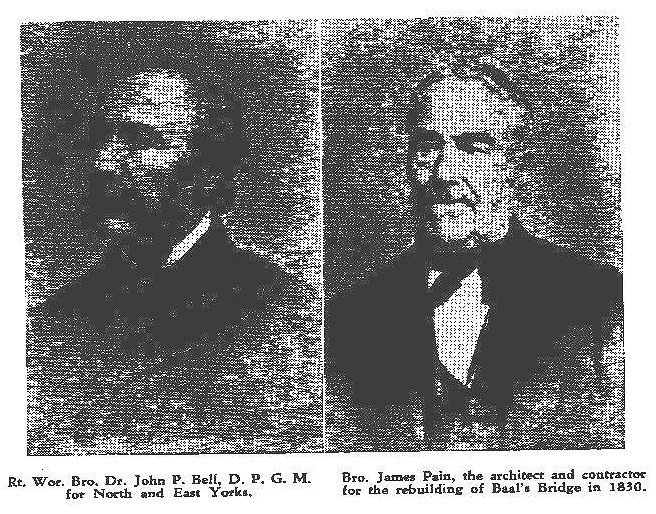
THE interesting story communicated by Bro. Crossle, of Dublin, Ireland, in the December, 1929, issue of THE BUILDER is one holding much fascination for the antiquarians of the Craft. It appealed especially to me because I have in my possession some interesting material relating thereto, this having come into my possession during the winter of 1923-24 when I purchased an old Masonic volume which had been advertised in England as a scrapbook containing letters from prominent Masons of the last century, among them several from William James Hughan, the eminent English Masonic historian. The book turned out to be the By-Laws of the Provincial Grand Lodge of the North & East Ridtngs of Yorkshire, printed at Kingstonupon-Hull, 1868, and formerly the property of Bro. John Pearson Bell, M. D., Deputy Provincial Grand Master. In fact, it was his working copy, for it also contains numerous annotations in his handwriting, and addenda to his Short History of the Provincial Grand Lodge which forms part of the work. I shall not dwell upon the other valuable letters I found in the volume; let it suffice to say that Bro. Bell was interested in the Old Brass Square of Limerick, and had in the book not only a photograph of Bro. James Pain, the discoverer of the Square in 1830, but also several letters from him, as well as a number from Bro. Fred W. Flurnell. A reproduction of the photographs accompany this article; and extracts from the letters as they illustrate the story.
The first item in the series of notes is a cutting from the Limerick Southern Chronicle, Clare and Tipperary Advertiser, issue of Saturday, September 25, 1869. On the margin is a memorandum in Bro. Bell's handwriting, "Sent a sketch of this Square and letter to Editor a few days before this article [appeared]. J.P.B."
MASONIC RELIC
We have received from a worthy Brother, a fac-simile sketch, of a very antique brass square, discovered under the foundation stone of the Old Baal's Bridge, in this city, with the words inscribed thereon:
"I will strive to live with love and care,
"Upon the level, by the square."
Brother James Pain, architect and engineer, of this city, contracted in the year 1830, to re-build Baal's Bridge on taking down the old one, the period of erection of which is unknown though noticed in the records in 1558 at the proclamation of Queen Elizabeth. Bro Pain discovered under the foundation stone at the Englishtown side, this old brass plate much eaten away. The shape, size, and formation of the engraving on both sides were easily traced. There are two holes in each square for the purpose of suspension to the collar, and a representation of a heart in both angles. The year 1317 is engraved on one of the squares, the most illegible character is the figure 3, which might be 5, but history proves it must have been before 1558.
[The worthy Brother who has favoured us with the above interesting sketch, has had it in his possession for the last 20 years.]
Further clues to the Square are given in other notes added to the cutting, thus:
Memo. Dec. 3rd, 1870. Up to this time no information of the above Square has been obtained. Wrote this day & enclosed sketch of Square to the W. Master, Limerick Lodge of Freemasons, Limerick.
Bro. Bell's letter to Limerick brought a reply dated December 10, 1870, from George W. Bassett, P. M., Worshipful Master of Lodge 73, Limerick, and P. K., Royal Arch Chapter, in which he conveys the information that Bro. James Pain was alive and "comparatively well, for he is an old & worthy Brother, now nearly 80 yrs of age." A letter of Bro. Pain's was enclosed, and the information was given that "I made it my business to see Mr. Furnell alluded to in Mr. Pain's letter and he promises to look through his late uncle's relics to find the Brass Square, but said he never saw it and I expect it will be difficult to search it up."
The letter from Bro. Pain forwarded by Bro. Bassett reads:
34 George Street,
Limerick, Dec. 6, 1870.
Dear Sir and Bro. Bassett:
In reply to your favor of yesterday's date with the sketch of the Old Brass Square enclosed, I beg to say I have a perfect recollection of the Square being found and given to me by the workmen - and I think I gave the Square to the late Brother Michael Furnell who I recollect thought much of it. It may possibly be found among his effects. I think it would be well if you inquired of the late Bro. Michael Furnell's nephew if the Square has been since met with. I regret the matter has never until now, been brought to my recollection and am sorry I cannot speak more about it.
Yours, Dr. Sir and Bro.,
G. W. Bassett. Esq
JAMES PAIN.
This was the beginning of a correspondence which lasted for several years. Bro. Bell wrote to Bro. Pain at once, and received this reply:
35 George Street,
Limerick, Dec. 17, 1870.
Dear Sir and Brot'r:
I beg to return you thanks for your kind letter of the 13th inst and its accomponents for which I am obliged. With respect to the brass square, it was found as observed on my removing old Baal's Bridge at Limerick previous to my erecting the present Bridge. I have no perfect recollection of the distich on it, but perfectly recollect talking with the late Br. M. Furnell (who was the Provincial Master for North Munster) on the difficulty of making out the date, he * * * much value for it, and 2nd, it was he thought the oldest document of the Craft he had ever seen. Mr. Bassett has not received any additional information from M. Furnell's nephew. When I next meet him I will have some talk with him on the subject and will let you know if I hear anything of it - since I gave it to his uncle. I am thank God in perfect health at 88, but a little weak in the frame from an illness I suffered three years ago when from weakness I lost my speech and could not even write my name. Please let this be an excuse for the improper formation of my note.
I beg to subscribe myself, Dear Sir and Brother,
Yours fraternally,
J. P. Bell, Esq.
A letter dated January 4, 1871, written by Bro. Pain speaks interestingly of his membership in Lodge No. 13, "to whom the late Bro. Furnell and myself were and are old companions. I have not seen his nephew since * * * but will do so and endeavor to get some additional intelligence of the Brass Square. We have belonging to 13 an Old Chest crammed with Papers and other stuff, I have * * * to be carefully searched to see if I can find aught related to it; as the late Brother Michael Furnell was for many years Grand Master of the Province of Munster."
The next letter brings good news. It was written January 15 or 18, 1871, and states that Bro. Pain had visited lodge the day before, and there met Bro. Michael Furnell, apparently a son of the late Provincial Grand Master to whom the Square had been given by Bro. Pain in 1830. While he remembered the article perfectly, he did not know what had become of it, but referred Bro. Pain to his cousin, Frederiek Furnell, of Castle Connell in the County of Limerick. The letter goes on to say:
But on yesterday evening, the two cousins, together, called on me. Mr. Frederick Furnell said he has the Square and he had it from his uncle, the late Michael Furnell. He also said that he would, in a day or so, write to you fully about it.
Some of the correspondence is apparently missing; but in a letter of February 8, 1871, Bro. Fred W. Furnell acknowledges one of January 19th from Bro. Bell, and says in part:
I enclose a rough uncorrected sketch of Ball's Bridge, compiled from Lenihan's History of Limerick. The date of the Square is undoubtedly 1517. How it got imbedded in the masonry of this old bridge no one can tell. I can only account for it by supposing that at some period after 1517 or about that time that that portion of the Bridge was being repaired or rebuilt and some worthy Mason put it in the place where it was found. I shall send you a copy of a sketch of Ball's Bridge taken just before Messrs. Paine commenced taking it down as soon as I can.
The same letter and subsequent correspondence indicate that Bro. Bell supplied Bro. Furnell with information about Freemasonry in earlier centuries. Reference is made to some tracing boards of Knight Templar interest, and also to a search for Mason's marks on the stones of a nearby cathedral founded in 1194; but none had been found up to that time. Apparently the copies of the tracing boards were made for Bro. William James Hughan, as they were sent for his acceptance.
The correspondence with Bro. Furnell ceased; at any rate, there are no more letters from him about the Square. However, there are some more from Bro. Pain, which become increasingly difficult to read, because of the good old brother's advancing years - ninety-one, far beyond the allotted three score and ten. One such letter gives us a hint why there are no more letters from the Furnells - there is a reference in 1873 to "the unfortunate death of Bro Doctor Furnell." Through it the Square came into possession of Captain Michael Furnell, also a member of Lodge No. 13. He brought it to the Lodge, "by whom it has been glazed and placed in the Lodge as an ancient memento of the Order, for which we have certainly to thank you," concluded Bro. Pain.
The last letter from Bro. Pain is dated August 1, 1875. Bro. Bell was still persistent in his search for information, having written again to Bro. George W. Bassett. He sent his son to see Bro. Pain, who apparently had the subject of the Old Square close to his heart. He gives further details:
I now write to you to account in the best way I can how the Furnells became acquainted with the Old Square. I was standing on the foundations of the Old Bridge, overseeing some labourers I had on the work. One of the labourers came to me: "See, Sir, what we have found among the stones of the Bridge we are taking up." I took it from him and kept it for some days I then showed it to the late M. Furnell. He was then P. Gr. Master of the Freemasons of North Munster. He was much pleased with it, and spoke of it as a very extraordinary thing He asked me for it and I gave it to him. At his death it was left to his nephew, Doctor Furnell, with whom you have a correspondence respecting it. The Doctor was shortly after unfortunately drowned. The Square then fell into the hands of his cousin, Capt. Furnell, a member of the Lodge. * * * His wife presented the Old Square to Lodge 13, of which the Rev. Anderson Ware was Wor. Master. I have this morning in company with the Lodge Tyler seen the Old Square, neatly framed and glazed with a compliment of Mr. Furnell. * * * The date of it is J5J7 or 5557. The third figure of it is so disfigured that we cannot tell what it is.
Readers of the article published last month will recall that there is question as to the date, being either 1507 or 1517. The newspaper cutting quoted has 1317, attributing the greatest illegibility to the figure " 3, " rather than to the third figure as has been done by others. No doubt the date is 1517, for both the first and third figures look alike, that is to say, like the letter "J." having a loop at the bottom. None of the brethren mentioned in this correspondence ever wrote of the third figure as "0" - all were agreed that it is a figure "1."
Bro. William James Hughan took more than a passing interest in the Old Square, as is witnessed by his action in sending a brief item about it to the "Freemason" of London, in which it appeared January 3, 1874. There is a memorandum to that effect in Bro. Bell's scrapbook, with the additional statement that "Not long before that date I had shown the sketch and correspondence to Bro. Hughan, when I saw him in London."
Reference is made in Bro. Crossle's article to the sketch of the Bridge. He is right in his surmise that it was made by some member of the Pain family, as Bro. James Pain, in his last letter, says: "This engraving [referring to the one in Limerick Lodge, accompanying the Square] is from a sketch of my Brother's, the late G. R. Pain, made by him a few days before I removed them [the stones] to build the present Bridge of a single arch. "
There is a confliet in the two statements by Brother Pain as to who presented the Square to the Lodge, but this is a detail of no great importance. The main thing is that the Square has been preserved. His statement in 1875 that he gave the Square to Bro. Michael Furnell at the time it was found is at variance with the latter's own letter to the "Freemason's Quarterly Magazine" in 1842, where he submits a sketch of "a very antique brass square presented to me this day by Brother Pain, Provincial Grand Architect."
A word about Brothers Furnell and Pain. The former is well known to collectors of Masonic bookplates because he had four variants of an attractive design, altered as the years went on through his advancement in Freemasonry. The whole story is told in Masonic Bookplates, page 130, a work produced by the collaboration of Bro. Winward Prescott and the present writer in 1928. Briefly, Bro. Furnell was born in 1794, and served as Deputy Lieutenant High Sheriff and Magistrate of the County of Clare. He was Provincial Grand Master of North Munster, 1842, and Sovereign Grand Inspector General, 33d, A. A. S. R.
Bro. Pain's history is told by Bro. Henry F. Berry in Ars Quatuor Coronatorum, 1905, page 19:
James Pain, a distinguished architect, was born at Isleworth in 1779. He and his brother, George R. Pain, entered into partnership, subsequently settling in Ireland, where James resided in Limerick and George in Cork. They designed and built a number of churches and glebe houses. Mitehelstown Castle, the magnificent seat of the Earls of Kingston, was the largest and best of their designs. They were also architects of Cork Courthouse and the County Gaol, both very striking erections, and of Dromoland Castle, the seat of Lord Inehiquin. James Pain died in Limerick 13th December, 1877, in his 98th year, and was buried in the cathedral church of St. Mary in that city.
To this can be added that Bro. Pain was evidently made a Mason September 7, 1813, according to a notation on the back of the photograph in my possession, which was sent to Bro. Bell during the exchange of correspondence quoted herein.
----o----
George W. Baird: Sailor, Man and Mason
By BRO. PAUL. B. ELCAN, Washington, D. C.
We reprint this article by permission of the New Age and the author, Bro. Elcan; and we asked this for a special reason. The subject of the article is a brother who for many years was a regular contributor to THE BUILDER; one whose articles were a valuable contribution to one aspect of the history of Masonry in America. It must not be supposed that such a faithful helper has gone entirely without acknowledgment, for Bro. H. L. Haywood, as long ago as 1922, wrote a biographical sketch and tribute to Bro Baird. But eight years is quite a while, and there is a new generation of BUILDER readers, hence this new article will not be out of place.
SAILOR, Man and Mason, these three titles are used in their fullest meaning when applied to George W. Baird, who has ever borne the attributes expected of one so called.
Washington, the capital of the United States, was little more than a village on April 22, 1843, when he was born, and education was a luxury that was not to be had by everyone. Young Baird soon exhausted the possibilities of the public and private institutions and at the age of thirteen was apprenticed to a printer. The life of a printer's "devil" was not appealing, and shortly afterward he turned from the pursuit of the art of Gutenberg to become a disciple of Fulton, and apprenticed himself to a machinist. Here the real ability and desires of the boy found full sway. He was soon an excellent draughtsman and a freehand sketcher of unusual skill. His fame was more than local, and his extraordinary faculty as a detailer of intricate designs made his work much sought after.
CIVlL WAR SERVICE
While still in his 'teens the call of the Civil War was heard, and he was appointed a third assistant engineer in the volunteer navy then being assembled to blockade the Southern Coasts. This was on September 19, 1862, and acting in this capacity he served on the Mississippi, the Calhoun, and Pensacola in the West Gulf Blockading Squadron and saw action on twenty-three occasions. As soon as age permitted, he entered the regular navy, where his knowledge of mechanics brought him promotions so rapidly that, in 1866, he was second assistant engineer of the U.S.S. Shamrock. The duties of this vessel took her to Europe, and it is worthy of note that this young man was on a vessel of typical Irish name and in a country where Masonry is almost outlawed when the degrees of the Craft were conferred upon him. This was in Tolerancia Lodge, No. 4, of Lisbon, Portugal. Brother Baird was initiated July 23, 1867; passed July 30, and raised July 30.
Half the distance round the world found him at Mare Island, Calif., in 1869, and he affiliated with Naval Lodge, No. 87, of Vallejo, Calif., in 1870. Naval service does not permit active participation in fraternal orders, and Brother Baird secured his Masonry at odd times, but the lessons inculcated in Portugal were not forgotten and the actions of this brother have exemplified the best traditions of the Order.
UNQUESTIONED CAPABlLITY
Few of us living today realize what a great change came over the entire Navy during the last half of the nineteenth century, when the wooden sailing war vessels were changed into floating fortresses of steel that now protect our interests. Brother Baird took a very prominent part in this transition, one of his feats being the installation of incandescent lighting in the U.S.S. Albatross, the first vessel in the world to be so equipped. The Albatross was built under the supervision of Brother Baird and was intended solely for use in deep-sea exploring, and many were the devices that he perfected to expedite and simplify these researches. With the advent of the breech-loading cannon it was necessary to revise the methods of manufacture in the Naval Gun Factory in Washington and, as a member of the board, Brother Baird assisted in making this the model of modern shops in every manner.
As an authority on scientific subjects he has attained first rank. The following are a few of his writings: Absorption of Gases by Water and the Organic Matter Contained Therein; An Improved Distilling Apparatus for Steamships; Pneumatic Steering Gear; The Flagship Trenton; Ventilation of Ships, and Flight of the Flying Fish, of which latter the French Academy, said: "It remained for an American naval officer to prove by mathematics the weight of this fish." Brother Baird is also a recognized authority on some of the earlier heroes of the American Navy and his book, The Father of the Arrlerican Navy, is especially enlightening and interesting.
Duty brought Brother Baird to Washington, and he transferred his Masonic affiliations to Hope Lodge No. 20, in 1875, where his attention and diligence in Masonic work were recognized and he was soon placed in line, being elected Worshipful Master in 1883. Washington Royal Arch Chapter, No. 2, received him as a Companion in 1882, and he once more showed ability and served as High Priest in 1890. A staunch Christian, the precepts of Templarism appealed to him and, in 1891, he was made a Knight Templar in Washington Commandery No. 1.
His unusually thorough knowledge of mechanical equipment caused him to be appointed superintendent of the State, War, and Navy Building, one of the largest structures in the country at that time. It was while holding this assignment that he was honored by a post which he graced in such a manner as to be an example to his successors, being elected Grand Master of the District of Columbia Grand Lodge in 1896.
He was promoted to the rank of Chief Engineer in 1892 and was transferred into the line of the Navy with the rank of Commander in 1899, where he served as Commander and later as Captain. In 1905 he was retired with the rank of Rear Admiral. In January of 1922 he was appointed a member of Perry's Victory Memorial Commission as a further mark of distinction.
Brother Baird's Masonic journey in the Scottish Rite started in Portugal in 1867, where he received the first fourteen degrees, and was continued via the Rose Croix in Evangelist Chapter; he became a Knight of Kadosh in Robert de Bruce Council, a member of Albert Pike Consistory, and reached his highest elevation in 1906, when the Ancient and Accepted Scottish Rite, Southern Jurisdiction of the United States, gave him the Thirty-third Degree.
As his rise in Masonry was the well-deserved reward of a faithful worker, so it was in the service of his country when, after more than forty years, the government said to him, "Well done, thou good and faithful servant," and retired him with the rank of Rear Admiral, although he continued on active duty until January, 1906. Not content to remain inactive when he still had the vigor of a sailor, he turned his efforts to civil betterment and was president of the Board of Education of the District of Columbia for several years.
Brother Baird is what may be called a "born Mason," as it was traditional in his family that the males be entitled to wear the lambskin. His father, grandfather, and three uncles on the paternal side and every man for eleven generations back on the maternal side were members of the Craft. Age has not caused him to relinquish any of the duties of Masonry, and his position as Chairman (since 1900) of the Committee on Correspondence of the Grand Lodge is held with pleasure to himself and genuine honor to the Fraternity. There is none to gainsay that he has earned a place in the first rank and his comments in Grand Lodge proceedings merit and receive general approval.
----o----
Historical Notes on Masonry in the Civil War
BY BRO. FRANK P. STRICKLAND, Kansas
This account of the differences of opinion among the Grand Lodges of the United States in regard to Army Lodges and military Masonry in general at the time of the Civil War will be very interesting as showing that very much the same problems appeared then and were met in much the same haphazard way as Bro. Irwin has depicted as occurring in the last war.
MASONRY is an Institution which, although it thrives in times of peace, yet has always held an appeal for military men; and many of those who have served it best have been warriors. Along with their battle-flags, soldiers have carried the Square and Compass into many distant lands and diffused the teachings of the Institution to the uttermost parts of the earth.
Many soldiers were members of the lodges which united to form the Grand Lodge of England at the organization of Speculative Masonry in 1717; and the names of soldiers have graced the rosters of countless lodges since that time. Shortly after this organization purely military lodges came into existence. The first of these, of which there is any definite record, was organized at Gibraltar in 1728, by the Duke of Wharton - the first foreign lodge chartered by the Grand Lodge of England. The formation of many other such lodges soon followed.
During the period of the later American colonial wars many of the regiments sent over from Great Britain contained these military lodges. Known variously as "military," "army," "movable, " or " traveling, " lodges, they were destined to play an important part in the development of American Masonry.
The Royal Art had been introduced into the American colonies sometime after the organization in 1717, but its growth had not been rapid. The population of the colonies was scanty and widely scattered, means of communication were difficult, and the distances to be overcome were great; as a result the Institution could do barely more than exist. Consequently, there was little intercourse among the brethren and their ideas of cohesion were vague. But in the campaigns in which the colonists were associated with the British regulars, the colonial brethren had an opportunity of improving their Masonic education through contact with the regimental lodges freshly arrived from the cradle land of Masonry. The knowledge which they thus received they passed on to their brethren and so generated a new spirit in them. Furthermore, there were many colonists who received their first lessons in the Craft, and learned to practice its mystic rites in these army lodges; and they also became torch bearers of Masonry. Thus the colonial Masons, quickly appreciating the value of the teachings of brotherhood and unity as exemplified by soldier Masons far from home, became connecting links in a chain of education and encouragement stretching from these army lodges to the outlying brethren, and even to places where the light of Masonry did not, as yet, shine. Through their activities their brethren were inspired to seek contacts with their neighbors, to draw together toward a common end.
These early Masonic apostles not only taught their brethren and fellows the necessity of pulling together, which was so signally exemplified later at Bunker Hill and Yorktown, but they also originated and organized that spirit of cohesion, that unity of purpose, which is so strong a characteristic of American Masonry today. The story of the extraordinary services rendered the American Institution by the military lodges of the Revolutionary War is too well known to be inserted here. Masonry in America owes a great debt to the obscure colonial Craftsmen, who, upon their knowledge gained in army lodges, laid well the foundation stones not only of the Republic, but of the Order as well.
As America advanced and expanded in the period of nationality, Masonry kept pace with it; at the beginning of the Civil War the Institution had become a mighty organization, with set forms of procedure and long established customs. One of its outstanding and long held beliefs was the doctrine that but one Grand Lodge could hold supreme authority in a state or territory; that it could not assume jurisdiction of lodges in another political unit. This doctrine, virtually unknown in Europe, had assumed almost the status of an American landmark, and was jealously guarded. Consequently, when Grand Bodies, upon the outbreak of the Civil War, became swamped with petitions for authority to form army lodges at the front, many Grand Lodges, fearing an infringement of the doctrine of Grand Lodge sovereignty, unhesitatingly refused such authority; others, influenced, no doubt, by patriotism and memories of the services rendered in the past by army lodges, as unhesitatingly issued authority for such bodies.
There was a similar conflict of ideas in the matter of removing the time limits between degrees in the ease of soldier applicants. As a result, there developed a division of policy which caused considerable confusion in the American Masonic Institution. The line of division between the two ideas was not always a fixed one, as may be seen from a study of conditions year by year, for, in several cases, Grand Lodges changed their belief and went over to the other side.
THE BEGINNING OF THE CIVIL WAR
The first year of the war found the Grand Bodies struggling with the problem which was suddenly thrust at them, and attempting to discover means of solving it. It was a time of confusion, uncertainty and tangling of cross currents of opinion; but among the first Grand Bodies to come to a decision was that of Indiana, which, at its Annual Communication, May 27, 1861, authorized the formation of army lodges in the Sixth, Seventh, Eighth and Twelfth Regiments of Indiana Volunteers.
The year 1862 began with the blunt announcement of Deputy Grand Master Francis Darrow, at the Annual Communication of the Grand Lodge of Michigan, January 8, that he had refused to grant dispensations for military lodges " for jurisdictional, constitutional and other reasons (1).'' Similar refusals came from Texas and New Jersey. Speaking upon the subject of petitioners who desired to take the degrees out of time, Grand Master Alvin B. Alden, of Wisconsin, said (2):
The fact that such applicants had neglected to make their application until they were about to be placed in positions of unusual danger did not furnish conclusive evidence to my mind that they were wholly uninfluenced by unworthy motives in offering themselves as candidates for masonry. The applicants, having neglected to take the proper steps to become Masons prior to their enlistment, are alone chargeable with such neglect, and have no right to complain because the necessary safeguards which we have deemed proper to throw around our Institution were not set aside for their benefit.
His further argument against these dispensations touched upon the fact that when a man applies for admission into Masonry he justly expects, if admitted, to receive all the rights, benefits and instruction appertaining thereto, and the lodge, in consideration of the fee, is bound to confer these privileges; but if there is not time enough granted, the lodge cannot properly confer such privileges and the candidate, though granted the degrees, cannot prove himself a Mason, and, consequently, cannot secure that which he sought.
During the year Grand Master Jacob Saqui, of Kansas, had refused to authorize army lodges or to grant dispensations for conferring the degrees out of time upon soldiers, as he did not believe a sufficient emergency existed. The Grand Lodge of Arkansas likewise refused authority for such lodges, although, during the recess following the Annual Communication, five military lodges were authorized.
Although Grand Master James R. Bagley, of Oregon, had granted several dispensations for conferring degrees out of time, he regretted his action, as he found that, in most eases, these favors were either for men who, after being initiated, had neglected to learn the work and desired such dispensations to save time and trouble, or were for men who had lived a long time in the jurisdiction of a lodge without caring enough about Masonry to apply for the degrees until they were about to be placed in positions of danger and thought that Masonry might help them.
As the conflict continued during its second year, Indiana added twenty more army lodges to its roster. Its example was followed by other Grand Bodies. The Grand Master of Virginia even went out of his lawful jurisdiction to authorize an army lodge in the Fifth Louisiana Volunteers, an act which aroused the ire of Grand Master J.Q.A. Fellows, at the Annual Communication of Louisiana, February 10, 1862 (3).
Grand Master Charles F. Stansbury, of the Grand Lodge of the District of Columbia, also, apparently, invaded another jurisdiction, for he reported, at a semi-annual Communication, May 6,1862, that he had authorized a military lodge in the Fifty-ninth New York Regiment. He had also granted authority to confer certain degrees out of time, a practice to which he we; opposed (4).
Some of the objections to army lodges may be summed up in the words of the Committee on Correspondence of the Grand Lodge of Kansas. Commenting upon the action of the Grand Lodge of New York in authorizing military lodges in three regiments from that state, the Committee stated:
We would regard the organization of the Masons of a regiment into a lodge for social or Masonic improvement as proper enough; this would be a pleasing relief from the tiresome duties of camp life; but we are opposed to granting them full powers to confer the degrees of Masonry.
Military lodges may have been very proper at the time of the Revolution. But in our humble opinion Masonry is too popular now; too many are seeking and obtaining admission through unworthy motives. If permanent lodges, who have ail the facilities for obtaining a correct knowledge of the applicant, fail many times in their endeavors to select none but the really good and worthy, what could we expect of a lodge in the midst of a community where each is a stranger to the other, except for the few weeks they may have been together as a regiment? We do not mean to infer that there are not plenty of persons in the various regiments now in the field who would make the very best of Masons, but we cannot see the propriety of sending lodges to hunt them out (5).
The closing hours of 1862 saw the senior Grand Lodge of America throwing the weight of its prestige into the scales on the side of the soldier Mason. In the Proceedings of the Grand Lodge of Massachusetts for the year ending December 30, 1862, Grand Master William D. Coolidge reported:
For this state of war there is no precedent, nor is there precedent for such an influx into the Institution from the army; of those, who from the circumstances of the case, must be made at sight, the prerogative alone of the Grand Master - as I am taught by a strict examination of the ancient landmarks, and the best counsel of the wise and prudent whom we all revere. I have met this pressure readily and earnestly, for it has been made by those whose patriotic impulses have led them forth to battle for their country; to stand for you and me and bare their breasts to the bullet aimed at the nation's heart, and I could not flnd it in my own, to refuse any aid, comfort or protection which I might be instrumental in throwing around them (6).
He had, accordingly, authorized a subordinate lodge to waive the time limit between degrees to the extent that, in five consecutive hours, the petitions of one hundred and thirteen soldier candidates were received, balloted upon, and all the degrees conferred. This wholesale dealing in the Mysteries aroused a storm of disapproval, not only in Massachusetts, but also in other Grand Jurisdictions. Grand Secretary O'Sullivan, of Missouri, expressed his objection in strong language:
And so, without more ado, the Grand Master issues his dispensation, setting aside all the requirements of the Constitution of his Grand Lodge, which he covenanted to support, by which one hundred and thirteen men were proposed, balloted for, initiated, passed and raised - "all within five consecutive hours", we deny, utterly deny, the existence of any landmark authorizing this wholesale manufacture of Masons. It does not exist. Not the most complaisant Grand Master England has produced, even when royalty was to be made, ever exercised such authority. It has remained for the oldest Grand Lodge in America, occupying a front rank for her Masonic talent and respectability, to set an example which others will not be slow to imitate; setting aside the Constitution, requirements, usage - everything which appeared like a barrier is swept away, and the mandate goes forth that one hundred and thirteen men may be entered, passed and raised within five consecutive hours, in spite of law, covenants, usage or common sense. We imagine the Grand Master quoting the words of the great cardinal, "The pen is mightier than the sword." But we are told with the utmost complacency that they were nearly all officers. We care not if they were all brigadiers. It does not alter the case a whit (7).
A curious illustration of the confusion into which Masonry was thrown by the eruption of the Civil War occurred on February 12, 1862, when the Grand Lodge of the District of Columbia authorized the formation of a lodge in the city of Alexandria, in the jurisdiction of the Grand Lodge of Virginia. It was set forth that there were no lodges working in that city at that time, that no charters or other property of lodges formerly working there could be found, that the Masons there had been cut off from all Masonic privileges, and that, finally, the Grand Lodge of Virginia had forbidden those working in its jurisdiction to recognize, or hold Masonic intercourse with Masons who adhered to the Union. The Masons of the District of Columbia felt that Virginia, in withdrawing recognition of loyal brethren, had waived its rights to them; that they were to be considered as living in Masonically vacant territory, the property of the first jurisdiction securing them. The District of Columbia therefore felt no compunction in taking them. To show that no attempt was being made to encroach upon the jurisdiction of Virginia, it was ruled that
. . . should these unhappy National differences be composed, and Virginia assume her former place in this great and glorious union, her Grand Lodge will be restored to her authority over all lodges within her geographical limits. The temporary warrant will be resigned to her, and her right of jurisdiction acknowledged by the fraternity here and everywhere (8).
Incidentally, there was some abuse of this dispensation, for Grand Master Ijovell Moore, of Michigan, complained, January 11, 1865, that this lodge was conferring degrees upon men from all parts of the country (9). Upon the return of Virginia to the Union, this lodge was returned to her Grand Lodge.
The year of Vicksburg and Gettysburg found many Grand Bodies still standing firmly opposed to the idea of military Masonry. Among the Grand Lodges which believed that there was no place in the Order for the army lodge, and that, in war, as in peace, petitions should take their regular course, were those of Vermont, Maine, California, Kentucky, Minnesota and Washington Territory. At the Annual Communication of the Grand Lodge of Ohio, October 20, 1863, there was some opposition, among the members, to the practice of the Grand Master in authorizing the conferring of the degrees out of time; doubt was even expressed as to his right to do so. Chairman Thrall, of the Committee on Correspondence, set forth the belief that
Laws and landmarks operate with equal force, as well upon the Grand Master himself, clothed in all the plentitude of authority, as upon the youngest Entered Apprentice of the lodge. It is the business of the Grand Master to look to the enforcement of the laws, and not to dispense with their observance, or grant indulgences for their infraction (10)
The report of Grand Master Jacob Saqui, at the Annual Communication, October 21, 1863, summed up the sentiments of Kansas:
I have had a number of applications from subordinate lodges for authority to elect a candidate and confer the degrees at the same meeting, and I have invariably refused to grant any dispensations for such a purpose, because I do not believe that the established usages of the fraternity ought to be set aside except on very particular occasions and I hold that a Grand Master is never justified in granting such a dispensation unless on satisfactory proof that the Order will be benefitted thereby, and not merely an applicant accommodated. The laws of Masonry should be suspended for the convenience of no human being. There are lodges in every town and village of every State in the Union, and no man can say that he had not an opportunity to seek admission into the Order. Whoever, then, neglected to avail himself of the privilege until he discovered that Masonry would be useful should not be guided to the sanctum sanctorum by a dispensation; besides, work performed in such a hurried manner as the application for a dispensation necessarily implies, is a discredit to the lodge and an injustice to the initiate (11).
On the other hand, Indiana and New York continued to increase their collections of army lodges; Illinois authorized the formation of six, and New Hampshire of three such lodges. In Iowa a large number of dispensations to confer degrees out of time upon soldiers had been granted, as was also the ease in Rhode Island; but Grand Master Ariel Ballou, of the latter Grand Lodge, did not approve of the matter as he thought that the motives of the applicants were mercenary.
The Grand Lodge of Michigan, which, in the previous year, had been flatly opposed to military Masonry, now executed an "about face," and authorized the removal of the time limit between degrees in the ease of soldier applicants about to leave for the front - an act which drew the fire of the Committee on Correspondence of Kansas:
Now this may seem all right and proper to some, but we must confess we can't see the propriety under the circumstances, now, more than at any previous time. We are quite willing at all times to confer all possible favors upon those who are fighting our country's battles; but to hurriedly confer the degrees of Masonry upon a person, because he is about to leave for "the seat of war," we consider an injury to the person as well as to the Institution. Many of the persons, too, receiving the degrees in this manner are persons who have lived for years within the sound of the gavel, and have never once thought of joining a lodge, until suddenly, as they are about to leave for the seat of war, they remember that they have long entertained a favorable opinion of the ancient and honorable Order, and almost demand an immediate admission. Ostensibly, they are actuated by a sincere desire to be serviceable to their fellow man, but we fear personal benefit is too often their real incentive to action; and fortunate will it be for us, if there are not many now receiving the degrees, whom we shall soon wish had not been admitted (12).
By the end of the year Massachusetts had eleven army lodges under charter, and was being flooded with petitions for admission. Grand Master William Parkman had continued the practice, established by his predecessors, of dispensing with the time limit between degrees, in the ease of soldiers, but he did so with misgiving, and thought the practice ought to be stopped.
So we can see that, even in those Grand Bodies which freely favored the military applicant, a doubt was beginning to develop as to the wisdom of the proceeding.
GRAND LODGES CHANGE THEIR ATTITUDE
As the war progressed and its fourth year opened and the evils of military Masonry began to appear, those Grand Lodges which had held aloof from the soldier Mason saw their course justified. Kansas, Missouri, Minnesota and other Grand Bodies, which had not been swayed by the importunities of the army applicants, pursued the even tenor of their way, unruffled as yet by the complications which were shortly to follow. On the other hand, however, among those Grand Bodies which had conferred favors upon the military Mason, that element of doubt concerning the wisdom of their course, which, in 1863, had crept into their deliberations, now assumed, in 1864, large proportions and influenced many of them to take steps to curtail the flow of favors.
Masonry in New York completely abandoned its place in the ranks of the "liberals," so to speak, and took its place in the column of the "conservatives." At its Annual Communication, in 1864, Grand Master Clinton F. Paige announced that he did not regard army lodges with favor, and, considering the manner in which those already authorized had functioned, he had decided that the objections far exceeded the advantages; as a result of which he had refused authority for any more such lodges, and had also declined to grant any dispensations for conferring degrees out of time. He believed, with regard to army lodges, that
Aside from the question of expediency, there is an unsurmountable objection in my mind, in the fact, that when the military organization to which such lodge is attached removes beyond the limits of our own State, an infringement of the jurisdictional rights of other Grand Lodges is inevitable and unavoidable (13).
Grand Master Alvin P. Hyde, of Connecticut, refused to grant any dispensations unless the act received the unanimous consent of the local lodge requesting the dispensation, and even then he thought it bad practice. The Grand Lodge of Maine sought to curtail the flow of privileges by setting a price of three dollars for each dispensation to hurry candidates through the degrees. Even in Kansas, where the privilege of the dispensation had never been abused, Grand Master Saqui thought a fee of twenty-five dollars ought to be charged for such authority; the Grand Lodge, however, feeling that the privilege had never been overworked, tabled the suggestion.
Grand Master Alvin B. Alden, attributing the rapid increase of the Order in Wisconsin to carelessness upon the part of the subordinate lodges, suggested, as a remedy for the "rushing through act," an increase in fees, and an edict prohibiting the conferring of degrees in less than the statutory time. He was opposed to army lodges, and still further opposed to their making Masons of men from jurisdictions other than the one granting them authority. He called attention to complaints of subordinate lodges regarding citizens of Wisconsin who had returned from the army claiming to have received the degrees in military lodges, some of these complaints referring to persons who had previously petitioned and been rejected before leaving home, and others to those whose moral and social standing were such that it would have been useless to have applied at home. His Grand Lodge ruled that a candidate could not be advanced within twenty days after receiving a preceding degree, and then only upon passing a creditable examination. It also demanded that Grand Lodges authorizing military lodges should limit the authority of the latter to persons outside the jurisdiction of Wisconsin.
Grand Master Parkman, of Massachusetts, still viewing with alarm the continued influx of new material, made an effort to slow up the flow of candidates by insisting that each petition be received at a stated communication of a lodge; but even with this restriction, he had granted one hundred and fifty-six dispensations during the year. He did not think the material thus gathered into the fold was of any considerable value, as few such persons became contributing members, while most of them took what little Masonry they had thus acquired into the army, where it was quickly forgotten.
Grand Master Leverett B. Englesby, of Vermont, thought that the practice of subordinate lodges in encouraging the speedy advancement of candidates ought to be stopped.
Grand Master Thomas Sparrow, of Ohio, now rose to inquire:
Has this rapid increase of members strengthened the tie of brotherhood, which is the foundation and cap stone, cement and glory of this ancient fraternity? Has it made us more industrious in furnishing the corn of nourishment to the hungry, the wine of refreshment to the sick, or the oil of joy to the afflicted? Has it sharpened the glorious strife of excelling each other in all the qualifications which should characterize our profession as Masons? Has this vast enlargement of the edifice added to its strength or symmetry? Has its interior been made to correspond in harmony and beauty with the magnitude and splendor of its external appearance?
It has been well said: "They mistake the nature of the Masonic Institution, who estimate its strength by its numbers, or measure its prosperity by the length of the roll of its initiates. These are not the standards by which either the one or the other is to be determined. Its strength is in its principle, and its prosperity in the character of its members (14).
He also went on to say:
It should be understood by the officers and members of subordinate lodges - once and for all - that lodges are created for the benefit of Masons, and not for the accommodation of candidates; that there are no eases of emergency in this jurisdiction, and that no lodge has the power to make them, that every petition must take its regular course (15).
He was strenuously opposed to military lodges because of their total disregard for the regulations prescribed for their government. His Grand Lodge supported him to the extent of repealing the regulations, adopted in 1861, authorizing military lodges among Ohio troops, and instructing subordinate lodges to repeal any sections of their by-laws authorizing eases of emergency.
Michigan continued to shower its favors upon army candidates, Grand Master J. Eastman Johnson having granted authority to waive the time limit in one hundred and thirty-three cases. At the Annual Communication, January 13, 1864, his Grand Lodge, however, was considerably wrought up by the action of Grand Master Thomas Saddler, of Kentucky, who had authorized the conferring of degrees out of time upon a number of soldiers of the Eleventh Michigan Regiment - properly the material of the Grand Lodge of Michigan. Brother Saddler, it appeared, had granted this authority upon the recommendation of Colonel S. B. Brown, regimental commander, who was also Deputy Grand Master of Michigan; in addition, the Master, both Wardens and eleven members of Evergreen Lodge, No. 9, of St. Clair, Michigan, had recommended the petition.
And so, as the evils of military Masonry became plainly manifest and evident, Grand Bodies began to look with dismay and chagrin upon the havoc that had been, and was being wrought, and to cast about for means of checking it and of repairing the damage that was resulting. The future looked black and foreboding. In the words of Grand Master Thomas Hayward, of Florida, to his subordinates:
When this war is ended, and the blessings of peace are again our happy lot, you will have much to do in your different lodges to correct the vices and improprieties which generally follow a year or more in camp (16).
THE AFTERMATH OF THE WAR
As the fires of the great Civil War burned out, the confusion of Masonry continued, but sentiment among Grand Bodies definitely turned against the army Mason. Instead of the warm brotherly greeting formerly extended him in many Grand Lodges he now met coldness, mistrust and suspicion. In Michigan, stronghold of army Masonry since 1862, there now developed outspoken opposition to the institution, and Grand Master Lovell Moore refused a large number of dispensations requested for soldiers. He even went so far as to regard as clandestine Masons a number of Michigan soldiers, home on furlough, who claimed to have been made in an army lodge in Mississippi working under the jurisdiction of Indiana, for the reason that Indiana could not authorize a lodge to work in the jurisdiction of another Grand Lodge, nor to make Masons of persons belonging to the jurisdiction of Michigan.
Even Indiana, a strong supporter of military Masonry from the beginning of the war, now began to doubt the expediency of the army lodge, especially as other Grand Bodies were making complaints similar to that of Michigan in regard to the activities of Indiana's military offspring; while in Maine, requests for dispensations favoring the soldier ceased, the subordinate lodges having no desire to pay the fee of three dollars, fixed the previous year, for such favors. Grand Master William S. Whitehead, of New Jersey, insisted that all petitions take their regular course, without favors to anyone. But although the pendulum was now swinging away from the army-made Masons, yet that fact did not dispose of them. They existed, and in large numbers. Something, apparently, had to be done with them. But what? Were they to be recognized as regular Masons and taken into the fold ? Or were they to be permanently classed as clandestines ?
NOTES
1 Review, Proc. Mich., 1862, in Proc. Kans., 1862, p. 319.
2 Review, Proc. Wis., 1862, in Proc. Kans., 1863, p. 406.
3 Review, Proc. La., 1862, in Proc. Kans., 1862, p. 317.
4 Review, Proc. D. of C., 1862, in Proc. Kans., 1863, p. 388.
5 Review, Proc. N. Y., 1862, in Proc. Kans., 1862, pp. 322-3.
6 Review, Proc. Mass., 1862, in Proc Kans., 1863, p. 398.
7 Review, Proc. Mass., 1862, in Proc. Kans., 1863, p. 399.
8 Review, Proc. D. of C., 1862, in Proc. Kans, 1863, p. 388.
9 Review, Proc. Mich., 1865, in Proc. Kans., 1865, p. 549.
10 Review, Proc. Ohio, 1863, in Proc. Kans., 1864, p. 477.
11 Address, G. M. Jacob Saqui, in Proc. Kans., 1863, p. 333.
12 Review, Proc. Mich., 1863, in Proc. Kans., 1863, p. 400.
13 Review, Proc. N. Y., 1864, in Proc. Kans., 1864, p. 475.
14 Review, Proc. Ohio, 1864, in Proc. Kans., 1865, p. 555.
15 Ibid .
16 Review, Proc. Fla., 1864, in Proc. Kans., 1866, p. 87.
----o----
Sir Christopher Wren: Architect and Mason
By BRO. G. C. KIRBY
This paper was read before the Toronto Society for Masonic Study and Research, and is now presented to the wider circle of members of the National Masonic Research Society through the good offices of Bro. N. W. J. Haydon, Associate Editor of THE BUILDER and also Secretary of the Toronto body.
In 1924 Bro. William B. Bragdon contributed a short article on the same subject, which will be found in the November number of THE BUILDER for that year. Bro. Bragdon, though inclined to believe that Wren was very probably connected with the Fraternity did not discuss the late R. F. Gould's arguments against this. These will be found in the twelfth chapter of his history. Gould's authority naturally carries very great weight, but while we may agree that he has quite demolished the supposition that Wren was a Grand Master of the Craft, he is not so convincing in denying that Wren could have been a speculative or honorary member. At least the possibility remains to intrigue us.
A STUDY of the lives of prominent men in the 17th century may afford clues to the unknown history of Freemasonry in a very interesting period. The subject of the present article is Sir Christopher Wren, the great English architect.
He was born at East Knoyle, near Tisbury in Wiltshire, on October 20, 1632. His father was also named Christopher. He was a clergyman of the Established Church, and at the time of his son's birth was the Incumbent of the parish of East Knoyle. A brother, Matthew Wren, was at the time Dean of Windsor. Later, when he was preferred to the see of Ely, Christopher Wren, senior, was made Dean of Windsor in his stead, and was also appointed as Chaplain to Charles I. His wife was Mary Cox of Fonthill Abbey. She died when her son was only two years old. The elder Christopher lived until his son was twenty-six years old. Both he and his brother, the Bishop of Ely, suffered much under the Parliamentary regime on account of their loyalty to the king.
When Wren was eleven years old he was instructed in mathematics by the famous mathematician, William Holder, who had married his father's sister, Susan Wren. At the age of nine he was sent to Westminster School, where he remained until he was fourteen. Here he was under the tuition of the famous Dr. Busby. Between leaving school and going to college he became assistant to Dr. Scarborough, and studied anatomy.
In 1649 he went to Oxford, entering Wadham College as a Gentleman- Commoner. Here he was under John Wilkins, afterwards Bishop of Chester, graduating as B.A. on March 18, 1650, and as M.A. on December 11, 1653. He was elected a Fellow of All Souls College and stayed there until 1657, when he was appointed to the Chair of Astronomy at Gresham College, London. On February 5, 1660, he was elected Professor of Astronomy at Oxford, and in 1661 he graduated D.C.L. at Oxford, and L.L.D. at Cambridge. From this it will be seen that he was an extremely clever young man. He seemed capable of everything; at one time he prepared drawings of insects, microscopically enlarged, for Charles II. He also invented a horse- drawn seeding machine to plant seeds after ploughing and harrowing. Another of his efforts was an illustration showing the graphical construction of solar and lunar eclipses, and most remarkable of all, he experimented with the transfusion of blood from one animal to another.
Wren took a prominent part in the formation of the Royal Society, and after the King gave his approval on December 5, 1660, the drafting of the preamble of the Charter was entrusted to him. He was a constant attendant at the Royal Society meetings for more than twenty years, and it was only the pressure of his architectural business that prevented him attending in later years.
In 1666 he invented an exceedingly simple form of Level, "for taking the horizon every way in a circle, " the main principle of which was a bowl having the lip accurately turned and provided with a ball and socket joint, so that when a drop of quicksilver was adjusted to the center, the lip should lie level in every direction. He had found the necessity of some such instrument in his surveying and building work. A report on the labors of the Royal Society in 1667 by Bishop Spratt specially commends Wren 's labors. It speaks of his work on the "doctrines of motion," caused by globous bodies meeting each other, such as billiard balls, etc. This report mentions also his having devised a clock to be annexed to a weather cock, so that the observer, by the traces of a pencil on paper might certainly conclude what winds had blown in his absence. Dr. Spratt further adds: "Wren has invented many ways to make astronomical observations more accurate and easy."
Although as a natural philosopher Wren was overshadowed by the genius of Newton, as an English architect he stands above his competitors. In some particulars, Inigo Jones may have surpassed him, but if a comprehensive view is taken, the first place must be adjudged to Wren. The relative merits of Sir Christopher Wren and Inigo Jones might well be the subject of further discussion our Research Society. The first definite information receive of his applying himself professionally to architecture is his accepting in his twenty-ninth year, the invitation from Charles II to act practically as Surveyor-General to His Majesty's works, though nominally as Assistant Sir John Denham. The two earliest original works we hear of are the chapel of Pembroke College, Cambridge, built at the expense of his uncle, Matthew Wren, and the Sheldonian Theatre at Oxford. The interior of Pembroke Chapel was very simple, but of good general proportions. It exhibits a lack of familiarity with architectural detail, not surprising for a young man's first attempt. When in 1665, ordinary business in London and other parts of England were interrupted by the Great Plague, Wren went to Paris for six months, and studied Sieur de Cambray's "Parallel, " and other French works of an architectural nature. Up to the time of the fire of London, his architectural work had not taken his entire time, and he was able to attend to his philosophical pursuits to a considerable extent.
The great fire of London raged from September 2nd to September 8th, 1666, and the best account of this fire can be found in Pepys' Diary. This account is given in an appendix at the end of this paper.
Before the embers of the great fire had cooled, Wren as virtual Surveyor-General, felt that it was his duty to prepare a scheme for the rebuilding of the City. On September 12th, he laid before the King a sketch plan of his design for the restoration of London. A copy of this plan, after he made some additions, can be seen today at All Souls College, Oxford. Unfortunately, the plan was too magnificent for the money available, and was never carried out. Doing the next best thing, he found employment enough in rebuilding a Cathedral, more than fifty Parish Churches, thirty-six of the Companies' Halls, the Customs House, and several private houses and provincial works. For his architectural work on St. Paul's Cathedral, and the Parish Churches, the stipend he asked for was 300 pounds per year. After Denham's death in November, 1669, he was appointed Surveyor-General of the Royal Works.
Regarding St. Paul's Cathedral, the old building damaged by the fire was in a very insecure condition, and Wren had previously made several reports on the same. After the fire, in July, 1668, some partial repair work on the Cathedral collapsed when Wren was at Oxford, and it was then decided to build a new Cathedral. In 1670, Parliament assigned a portion of the coal tax, namely, 4 1/2d. per chaldron annually for the rebuilding of the famous edifice.
Being satisfied that money would be forthcoming, Wren devoted himself to forming a design worthy of the occasion. In 1672 he was knighted, and in 1673 he submitted his first design to the King, who greatly approved it. However, it was not easy sailing and much clerical opposition was brought to bear against the plan, on account of its being different from the usual Cathedral shape. The Duke of York sided with the clergy, and insisted on many side chapels. The idea being to make the building specially suited for Roman Catholic services. Finally both parties were satisfied and a number of chapels were included, most of which are now in use.
Twenty-two years after the commencement of the work, it was so far advanced that the choir area could be opened for services. Nineteen years later Wren was dismissed from its superintendence, and the Cathedral was reported as finished, as no doubt it was in the main essentials. Meanwhile, about 1680, he had been much engaged in the restoration in and around Temple Bar which had also been damaged by the fire. Another of Wren's best works, the Ashmolean Museum at Oxford, was completed in 1683, and in 1684 he was appointed Comptroller of Works at Windsor Castle. He then went into polities and was returned as Member for Plympton on April 20, 1685, in James II's first Parliament. He was also chosen as Member for Windsor in March, 1689, in William and Mary's first Parliament, but the return was declared void and he never took his seat in the House.
Of the fifty-two churches in and around London that he designed, two of the best still remain, as far as I am aware, namely, Saint Mary- at-Hill and Saint Clement Danes. His church work showed very great skill in adapting buildings to irregular sites. In 1698 he was appointed Surveyor to Westminster Abbey and carried out very important repairs to that great fabric. He held this appointment until his death.
Having been appointed by the Stuarts to the office of Surveyor- General, Wren retained the Royal Favor unclouded through the reigns of William and Mary, and Queen Anne, but after the accession of the Hanoverian family in 1714, the jealousies which his high position had created were able to prevail against him. He was superseded as Surveyor-General in 1718, by William Benson. He possibly felt the blow coming, as he had gone into almost complete retirement since 1708, a date which I would like you to please remember. He had married twice, first in December, 1669, Faith, the daughter of Sir John Coghill, and secondly, Jane, the daughter of Lord FitzWilliam, in 1676.
In February, 1723, he contracted a severe chill, and he died on February 25, 1723, in his ninety-first year. He was buried on March 5th, in St. Paul's Cathedral, under the South Aisle of the Choir, near the East end.
Having thus dealt with the life of this illustrious man from a biographical standpoint, we will now consider whether or not he belonged to the ancient and honorable Fraternity of Freemasons.
The Book of Constitutions, published in 1738, says that Wren was a freemason and a Grand Master of the Fraternity. As the title of "Grand Master" is popularly supposed to have started with the Grand Lodge of 1717, and as we know that Wren was in almost complete retirement in 1717, grave doubts have been cast as to whether Wren was ever a freemason, much less a Grand Master.
The late R. F. Gould, in his history of Freemasonry, disputes the statement made in the Book of Constitutions of 1738, that Wren was a Freemason and a Grand Master. Nobody doubted the facts until 1887, when Gould devoted many pages to the subject.
It may seem bold to take issue with such an eminent authority as our late brother Gould, but great writers have been known to make mistakes before, and we hope to show that he was mistaken in this matter. The term "We" in the foregoing paragraph is somewhat extravagant, and like that famous Trans-Atlantic flier, Lindbergh and his aeroplane, by "We" I refer to myself and the authorities from whom I quote.
As Anderson was responsible for the Book of Constitutions of 1738, which credited Sir Christopher Wren as being a Freemason and a Grand Master, we should remember the following seven facts:
1. Anderson was the official writer for the Grand Lodge of 1717.
2. Whilst there are some obvious errors in Anderson's works, his eminent position entitles him to some respect.
3. Anderson was in close touch with the prominent brethren who brought the Grand Lodge into being.
4. He had before him, when he prepared his Book of Constitutions, nearly all the papers available dealing with Masonic history.
5. He had the assistance of Geo. Payne, Dr. Desaguliers, and other famous men familiar with history of the previous thirty years.
6. Notwithstanding the fact that some documents used by Anderson in compiling his history, have become lost, there remains auxiliary evidence for the main point at issue.
7. The editions of the Books of Constitutions of 1723 and 1738, were approved of and adopted by the Grand Lodge.
Gould's main argument against Sir Christopher Wren being a Freemason, is that the assertion only appears in the second Book of Constitutions, dated 1738, while the first edition of 1723 makes no mention of it. one answer to this is that the omission of facts which it is being assumed that everyone knows, is a common occurrence in histories of all kinds. But another, and weightier one, is that in the earlier work Anderson seems to be chiefly concerned with the progress of architecture, while nothing that he says of Wren is inconsistent with his having known that he was a Mason.
Perhaps the reason why Wren was not definitely said to be a Mason in the first Book of Constitutions of 1723, was that for many years prior to that he had suffered the criticism of many young and even middle-aged fellow architects, who were jealous of his long monopoly of the principal architectural commissions. As previously mentioned, at the age of eighty-six years he was dismissed from the Surveyor-General's position, not for inability, but simply because he was an appointee of the Stuarts and the Hanoverians were in power. One can readily imagine the stories that would circulate among the Operative Masons and the artisans who had labored with him so long in and about Old St. Paul's Churchyard, when it became known that he had lost the royal favor.
The rebuilding of St. Paul's Cathedral was completed in 1710, and a slump in the building trade followed, which gradually became worse and worse. Wren could do nothing to help his old workmen, as no money was forthcoming for building work. Even the money taken out of the tax on coal had ceased. The slackness in the building trade probably had a good deal to do with the demand for a supreme body, afterwards known as a Grand Lodge; for in my opinion, the thought lying back in the minds of the agitators for a supreme body, was work and food, rather than mere speculative Masonry. We know that what we are pleased to call Speculative Masonry, did exist at this time, as I shall hereafter prove, but it was not the main thing in the minds of the members of the lodges at the time. Thus arose the movement whereby four out of the then lodges existing took it upon themselves to organize the supreme body afterwards known as Grand Lodge. The first Book of Constitutions was already printed on January 17, 1723, and it was on sale when Sir Christopher Wren died thirty-eight days later.
Anderson described the organization of a Grand Lodge as a "revival of the drooping lodges of London," and elsewhere states that King Charles II was a "great-encourager of the craftsmen because he founded the present St. Paul's Cathedral conducted by that ingenious Architect, Sir Christopher Wren." There is a strong inference here that Wren was one of the Craft.
Regarding the statement that Wren was a Grand Master, we find that Anderson mentioned it in 1738. On February 24, 1738, the Grand Lodge chose a Committee to revise the Book of Constitutions of 1723, and on March 31st, 1738, Anderson was requested to "print the names of all the Grand Masters that could be collected."
Being somewhat of a diplomat, Anderson did not elaborate on the events which led up to the revolt of the four lodges and the formation of Grand Lodge, but he has this brief statement in his Book of Constitutions of 1738: "Sir Christopher Wren, continued as Grand Master until 1708, when his neglect of the office caused the Lodges to be more and more disused." Please remember that this statement appeared in the list of Grand Masters, and was approved of by Grand Lodge before being printed.
We will now give Anderson a rest, and examine evidence from other sources showing that Sir Christopher Wren was a freemason.
An old London newspaper, the Postboy, in its second issue after Wren's death, announced that he was to be interred on March 5th, and described him as "that worthy Freemason. " The Postboy was evidently a newspaper largely read by Freemasons because at that time it carried an advertisement that the newly published Book of Constitions was on sale. It is very improbable that a newspaper read in Masonic circles would make a mistake by calling Wren a freemason, if he were not one.
The next evidence of Wren being a Freemason is found in a note made by a well known author and antiquary, John Aubrey, in 1690, in his work on the Natural History of Wiltshire. The original MS. is now in the Bodleian Library at Oxford, and there is another copy, made by Aubrey himself, at Burlington House. This copy was made at the request of the Royal Society. The statement referred to is as follows:
1691
Mdm, this day [May the 18th being Monday] [after Rogation Sunday] is a great convention at St. Paul's Church of the Fraternity of the Free [Accepted] Masons: Where Sir Christopher Wren is to be adopted a Brother: and Sir Henry Goodrie of ye Tower, and divers others. There have been Kings, that were of this sodalitie.
Sr. William Dugdale told me many years since, that about Henry the third's time, the
Pope gave a Bull or diploma [Patents] to a Company of Italian Architects [Freemasons] to travels up and downe all over Europe to build Churches. From those are derived the Fraternity of Free- Masons [Adopted-Masons].
They are known to one another by certayn Signes & [Marks] and Watch-words, it continues to this day. They have severall Lodges in severall Counties for their reception: and when any of them fall into decay, the brotherhood is to relieve him &c.
The manner of their Adoption is very formall, and with an Oath of Secrecy.
In the earlier MS. this is an interpolated note on the backs of two of the sheets; in the later copy it has been incorporated into the text. In its earlier form the note had itself been revised. Mdm., is an abbreviation for Meridiem, "at mid-day." The words in italics placed between square brackets have been written in above those which preceded them. The word "Free" was crossed out, "Accepted" taking its place. The word Marks was also crossed out. The other emendations stand apparently as alternatives. All this correcting was done unmistakably in Aubrey's own hand.
Nothing is known of how Aubrey came to be told of the coming "Convention," but the Sir William Dugdale whom he mentions had a daughter who was the wife of Elias Ashmole, of whom we know for a certainty that he was a member of the Craft, from the well-known entries in his diary. Now if Wren was known to have taken part in the Masonic gathering of 1690, the notion of his being a Freemason could not have been imagined by the editor or reporters of the Postboy in 1723, nor by Anderson in 1738. The worth of Aubrey's memoranda surely lies in the fact that it was written without ulterior motives.
From 1690 to 1844, this information lay undisturbed in a forgotten manuscript describing the County of Wiltshire - we may recall that Wren had been born in Wiltshire - and it was by an accident that the late Mr. Halliwell made its discovery. It is evident that the Royal Society members were not enthused about the History of Wiltshire or the information would not have lain neglected so long.
The next source of information showing that Wren was a Freemason comes from Preston's Illustrations of Masonry. The chief objection brought against Preston was that in each edition of his History he generally gave some additional details. Whilst this, of course, looks like romancing, it was really due to his keenness to show in his history every scrap of information that he picked up as time went on.
In Preston's 1775 edition of the Illustrations of Masonry, he says: "Wren presided over the old lodge of St. Paul's during the building of the Cathedral." In his 1792 edition he says that the mallet used in laying the foundation stone of St. Paul 's was a gift of Sir Christopher Wren himself, and that "during his presidency he presented to the lodge three mahogany candlesticks."
The oldest of the lodges which joined together in organizing the Grand Lodge of 1717 was Lodge No. 1, the lodge of Antiquity, formerly called Old St. Paul's. The mallet preserved there was an interesting relic and very highly prized. The candlesticks given by Sir Christopher Wren were of great value as proving that there certainly was some speculative Masonry prior to 1717. Preston also says that "according to the records of the lodge of Antiquity" in 1663 and after, Wren "attended the meetings of the lodge," and also that Wren patronized the said lodge "for eighteen years," by which he may have meant that he was Worshipful Master, or some equivalent officer.
Let us consider for a moment what Aubrey meant when he said in 1690 that Wren was to be "Adopted a Brother." Preston and Anderson said, Wren was a principal officer of the Fraternity since 1663. These two authorities unite in making Wren Grand Master in 1685 when he was fifty-three years old. Therefore what could Aubrey have meant when he said Wren was to be "adopted" in 1690? This word "Adopted" could not have meant "Initiated." As Aubrey was not a Mason, he would scarcely know the difference between "initiating" and "installing." It is clear that some Masonic function took place in 1690 and Wren took a conspicuous part in it.
Gould himself points out that in 1690 the old St. Paul's Lodge became a Stated lodge instead of an Occasional lodge, and in my opinion the event mentioned by Aubrey was the big day when the change took effect.
Samuel Prichard, one of the Fraternity's greatest enemies, in his book Masonry Dissected, published in 1730, makes this remark: "No constituted Lodges or Quarterly Communications were heard of till 1690, when lords, dukes, lawyers and shopkeepers and other inferior tradesmen, porters not excepted, were admitted into this mystery or no mystery."
I have to apologize for quoting Samuel Prichard, but the date he mentions is confirmatory evidence that Aubrey's mention of the convention in 1690 is correct. It would seem, therefore, that the "adoption" of Wren at that convention was nothing more or less than his re-election as grand Master, whilst "Sir Henry Goodric of ye Tower, and divers others," were probably the officers appointed and invested on that occasion.
A precedent for the reselection of a Grand Master can be found in the ease of Inigo Jones, Worshipful Master, so to speak, of the Old St. Paul's Lodge, which met at the Goose and Gridiron Tavern in St. Paul 's Churchyard. According to the Nicholas Stone MS., Inigo Jones had once combined the two offices of Surveyor-General and President of the Masonic Fraternity, ceasing to hold the latter title in 1618, but subsequently being "re-elected."
In 1764, there was published The Compleat Freemason, or Multa Paucis for Lovers of Secrets. The following is an extract from that work:
In 1710, in the eighth year of the reign of Queen Anne, our Worthy Grand Master Wren, who had drawn the design of St. Paul's, had the honour to see it finished in a magnificent taste, and to celebrate, with the Fraternity, the Capestone of so noble and large a Temple.
Wren's son, Christopher Wren, in his book Parentalta, wrote as follows:
The highest or last stone on the top of the lantern, was laid by the hand of the Surveyor's son, Christopher Wren, deputed by his Father, in the presence of that excellent artificer, Mr. Strong, his Son, and other Free and Accepted Masons, chiefly employed in the execution of the work.
As Sir Christopher was then seventy-eight years of age, he was unable to ascend to the dizzy heights at the top of the lantern above the cupola of St. Paul's.
The Rev. F. deP. Castells, to whom I am indebted for much information, informs us that in 1917 or thereabouts he had seen, among the records of the Lodge of Antiquity, minutes of a meeting held on June 3, 1723, which read as follows:
The set of mahogany candlesticks presented to this Lodge by its Worthy Old Master, Sir Christopher Wren, ordered to be carefully deposited in a wooden case lin'd with cloth to be Immediately purchased for the purpose.
The reason for this particular minute was that Wren had died about three months previously, and they were anxious to carefully keep these symbolic gifts from so eminent a man.
This last piece of evidence is the crowning proof that Wren was a Freemason, and I understand that the Lodge Minutes which I have just read can be examined by anyone today. We are further assured that these Minutes were never examined by the late Brother Gould, and had he examined them his famous statement, made in 1887, that Sir Christopher Wren was not a Freemason, would probably have never been issued.
APPENDIX (Account of the Fire of London from Pepys' Diary)
Some of our maids sitting up last night, to get things ready against our feast today, Jane caned us up about three in the morning to tell us of a great fire that was in the city. So I rose and slipped on my night gown and went to her window and thought it to be on the back side of Market Lane, but being unused to such fires as followed, I thought it far enough, and so went to bed again and to sleep. About seven rose again to dress myself and there looked out at the window, and saw the fire not so much as it was, and further off. So to my closet to set things to rights, after yesterday's cleaning. By and by Jane comes and tells me that she hears that about 300 houses have been burned down tonight by the fire we saw, and that it is now burning down all Fish Street, by London Bridge.
So I made myself ready presently, and walked to the Tower; and there got up upon one of the high places, Sir J. Robinson's little son going up to me; and there I did see the houses at that end of the bridge all on fire, and an infinite great fire on this and the other side the end of the bridge; which, among other people, did trouble me for poor little Mitchell and our Sarah on the bridge. So down, with my heart full of trouble, to the Lieutenant of the Tower, who tells me that it begun this morning in the king's baker's house in Pudding-Lane, and that it hath burned down St. Magnus's Church and most part of Fish Street already.
So I went down to the water side and there got a boat, and through the bridge, and there saw a lamentable fire. Poor Mitchell's house, as far as the Old Swan, already burned that way, and the fire running further, that in a very little time, it got as far as the Steele-yard, while I was there. Everybody endeavoring to remove their goods, and flinging into the river, or bringing them into lighters that lay off, poor people staying in their houses as long as till the very fire touched them, and then running into boats, or clambering from one pair of stairs, by the waterside, to another. And then among other things, the poor pigeons, I perceive, were loth to leave their houses, but hovered about the windows and balconys, till they burnt their wings and fell down.
Having staid, and in an hour's time seen the fire rage every way; and nobody, to my sight, endeavoring to quench it, but to remove their goods, and leave all to the fire, and having seen it get as far as the Steele-yard, and the wind, mighty high, and driving it into the city; and everything, after so long a drought, proving combustible, even the very stones of the churches; and among other things, the poor steeple by which pretty Mrs. ____ lives, and whereof my old schoolfellow Elborough is parson, takes fire in the very top, and there burned till it fell down; I to Whitehall, with a gentleman with me, who desired to go off from the Tower, to see the fire, in my boat; and there up to the King's closet in the Chapel, where people came about me, and I did give them an account dismayed them all, and word was carried into the King.
So I was called for, and did ten the King and Duke of York what I saw; and that unless his Majesty did command houses to be pulled down, nothing could stop the fire. They seemed much troubled and the King commanded me to go to my Lord Mayor from him, and command him to spare no houses, but to pull down before the fire in every way.
The Duke of York bid me tell him, that if he would have any more soldiers, he shall; and so did my Lord Arlington afterwards, as a great Secret. Here meeting with Captain Cocke, I in his coach, which he lent me, and Creed with me to Paul's; and there walked along Watling Street, as well as I could, every creature coming away loaded with goods to save, and, here and there, Sick people carried away in beds.
Extraordinary good goods carried in carts and on backs. At last met my Lord Mayor in Canning Street, like a man spent, with a handkerchief about his neck. To the King's message, he cried, like a fainting woman, "Lord, What can I do? I am spent; people will not obey me. I have been pulling down houses; but the fire overtakes us faster than we can do it." That he needed no more soldiers; and that, for himself, he must go and refresh himself, having been up all night.
So he left me, and I him, and walked home; seeing people all almost distracted and no manner of means used to quench the fire.
In the year 1851, the Most Excellent Grand High Priest, George Giddings, in his address to the Grand Royal Arch Chapter of Connecticut, made the following pronouncement, which, if it were apposite eighty years ago, seems equally so now:
"But, Companions, in our prosperity, in our rejoicings, it may be well for us to remember that the hour of prosperity is frequently the hour of danger. The fairest flower frequently produces the deadliest poison. Elated by success, we too often become careless and neglectful of the means by which success was acquired, and by which alone its continuance can be secured. To this Source may be mainly attributed most of the adverse circumstances to which our institution has from time to time been subjected. The doors of our Lodges and Chapters have sometimes swung too easily upon their hinges. The Tyler has been too often found sleeping at his post. We are apt to forget, Companions, that the strength of every society, more especially this of ours, lies in the character and intelligence, not in the number of its members. Let this truth be inscribed in indelible characters over the High Priest's Sanctuary in every Chapter in our land, and all will be well.
----o----
EDITORIAL
R.J. MEEKREN, Editor in Charge
BOARD OF ASSOCIATE EDITORS
LOUIS BLOCK. Iowa
ROBERT I. CLEGG, Illinois
GILBERT W. DAYNES, England
RAY V. DENSLOW, Missouri
GEORGE H. DERN, Utah
N.W.J. HAYDON, Canada
R.V. HARRIS, Canada
C.C HUNT, Iowa
CHARLES F. IRWIN, Pennsylvania
A.L. KRESS, Pennsylvania
F.H. LlTTLEFIELD, Missouri
JOSEPH E. MORCOMBE, California
ARTHUR C. PARKER, New York
J. HUGO TATSCH, Iowa
JESSE M. WHTED, California
E. E. THIEMEYER, Missouri
DAVID E.W. WILLIAMSON, Nevada
THE NEW YEAR.
WlTH this number we begin a new Masonic year and a new volume. It is not easy to forecast the course of either. We wish our members all good fortune and happiness in the months to come, and we hope to be able to keep THE BUILDER up to its standard. It is, as may be said once again, the chief link between the members of the Society, as well as taking the place of the Proceedings published by other Masonic Research bodies. It has been a constant source of regret to the 'editor ever since he first had charge of the work, that some way of establishing more intimate relations between our members, or some of them, could not be found. The possibility of forming local branches has been suggested in a number of cases where it seemed that it might be practicable to do this. One or two tentative attempts have been made to organize such branches, but so far without definite results. We believe, however, that such a plan would establish our work in a way otherwise impossible. There is no doubt that the personal contact is of enormous value; indeed, without it that elusive but essential thing, esprit de corps, is practically unattainable. So far as we can see there is no reason why in every large centre of population there should not be a local branch of the Society. If any member feels stirred to try and form one we are prepared to help him with draft plans, constitutions, and so on, for the project has been so far worked out. Perhaps the realization of this hope may be one of the events of the coming year.
For THE Builder itself we can promise some interesting and useful articles. Bro Irwin will finish his work on Masonry in the War by a new series on the various Masonic Clubs; thus putting on record, before it is too late, a practically exhaustive account of all Masonic activities in the American Expeditionary Forces both at home and abroad.
Bro. R. V. Harris has promised another article on Masonic Heraldry, an interesting subject which has never been very fully treated hitherto. Bro. D. E. W. Williamson expects to have an article on the name or title Hiram Abiff, and the possible or probable channel by which it came into the legend of the third degree. There are few scholars better fitted than Bro. Williamson to elucidate this particular sub-problem, to which he has devoted much time and labor.
There has been under consideration for a number of years the republication of the Autobiography of Rob Morris, but it was one of those things that might be done at any time and so has always been crowded out. Perhaps this year it will be done as it will fit in with a new series of articles by Pros. Kress and Meekren on the History of the Masonic Ritual in America. Rob Morris wrote an apologia for the Conservators under the guise of an autobiography, and the Conservator movement is one of the least known yet most momentous influences on the American type of ritual as it exists today.
Among other articles that may be expected, though we hardly care to promise that they will appear, is one on the underground existence of Masonry in Russia after its abolition by the Government more than a hundred years ago.
There will also be some articles on the Scottish Rite. First there will be a historical sketch of the Albany Sovereign Consistory, Sublime Princess' of the Royal Secret, which contains much little known information about some of the outstanding Scottish Rite Masons of New York State a hundred years ago. This is the work of Bro Isaac H. Vrooman. In addition Bro. Kenderdine is preparing a series of articles on the early history of the Rite in this country, which will not be approached from any orthodox point of view. Bro. Kenderdine proposes to treat the subject objectively, and as impartially as may be possible to a trained and judicial mind.
We have other articles under consideration, but as yet insufficiently developed to make it worth while to say anything about them.
* * *
THE MASONIC EDUCATION MOVEMENT.
I we look back over the course of events in the American Masonic world for the last fifteen years, or even the last ten years, one of the most outstanding features will appear to be the emergence of Masonic Education as an object of official concern and policy. Scarcely a volume of Grand Lodge Proceedings now comes out but has something to report on the subject. The individual Mason as a rule does not know much of what is being done outside his own jurisdiction, if indeed he knows anything very much of what is being done within it. On the other hand those who are actively interested, whether officially or otherwise, are apt to miss the forest because they are so intent upon the trees in their own vicinity.
There has been a great variety in the methods adopted, and still greater differences in regard to estimate of results. It has been remarked, by several different observers, that there is a curious relation between the character of the reports and the nature of the machinery adopted. Where there are paid officials charged with educational work in the various lodges, there one is apt to find most glowing reports of the efficacy of the work and the value of the results. Where it is undertaken by unpaid voluntary workers the reports are often pessimistic in the extreme.
This is really not curious at all, it is most natural and human, aside from the fact that there may be objective reasons for the difference. The paid worker is able to travel, and to come in contact with the brethren he is working for. And because it is his avocation his methods receive some kind of standardization and the key is pitched fairly low. Besides, he sees the lodges at their best, as a rule - there is generally an extra large crowd to receive the official visitor - he is listened to with attention, sees only the enthusiasm he may have aroused, and goes on to repeat the process elsewhere.
The voluntary worker is in quite a different position and so sees things differently. As a rule, even if he has Grand Lodge recognition and official standing, he is unable to travel and has to do most of his work by correspondence. He has the far harder task of trying to get people to help themselves. The efforts generally flicker fitfully for awhile and then die suddenly like a burnt out candle. Then too, the voluntary worker is usually something of a student himself, and he must be an enthusiast or he would never undertake the task, and as a result he is inclined to forget how much elementary, kindergarten work has to be done before any advanced study can be initiated.
Taking everything into consideration there is a tendency now observable, here and there, to stop and take stock, to ask what it is really all about, and why and how? In short, the official Masonic Education Programmes have run up against human nature - or rather just plain nature. They have put in some kind of water supply, they have caught the horse and haltered him and have led him to the trough - and he won't drink. The danger is that in reaction the whole effort may be abandoned. After all, if your horse won't drink today you can fairly safely count on his drinking tomorrow, so that there is no sense in destroying the watering trough.
This is why an attempt to survey the whole subject and get it in some kind of perspective is necessary. The causes for the recent interest in "Education" are by no means clear. That Masonry was instructive has always been taken for granted, but it was also taken for granted that all that was necessary was embodied in the rituals, and that attendance at the regular work of the lodge was sufficient for a complete Masonic education. American Grand Lodges have, since 1850 or thereabouts, taken great interest in ritual minutiae, much of it of trifling importance, and have expended more ingenuity and effort in aiming at a rigid and somewhat monotonous uniformity than has been devoted to maintaining its spirit, and in seeing that it was either understandable or understood. And there are still many jurisdictions where "Education" merely means teaching the ritual so efficiently that the pupils may recite it with the faultless accuracy of a gramophone.
Now we do not wish to be understood as saying this care is misplaced, though those who know anything of the evolution of the ritual know that it has been materially changed in every jurisdiction from what it was seventy-five years ago, and that the rituals of two hundred years ago would be hardly recognizable to the average American Mason. And for every one who knows this there are a dozen who know that the rituals of different jurisdictions, and still more of different countries, vary almost as widely at the present day. And to all who are aware of these facts the pains taken to preserve the ipsissima verba of one particular recension must appear in a different light to that in which the matter is seen generally by Grand Lecturers and Ritual Committees. Nevertheless at the worst, this preoccupation with the preservation of the exact formula is only an exaggeration of a necessary requirement, a one-sided development, in which the letter has become everything and the spirit left in the background. For the word is nothing without its meaning, and though the ritual is the text, the starting point of true Masonic education, it is its significance that is the essential thing - the form is not an end in itself, a magical incantation working ex opere operato, but ultimately only a means to an end that is other than itself.
A friend who served in the old Russian army as a surgeon (and being a Pole he was keenly critical of everything Russian) once told the present writer how after the Russo-Japanese war the army authorities decided, among other things, that the Russian soldier needed education. Doubtless he did, but the method adopted was rather crude. Apparently something like this happened: Orders were sent to Commanding Officers to establish regimental schools. The (commanding Officers "passed the buck" to their company officers. These again told their non-commissioned officers to get the men together and teach them. The writer's informant attended one of the classes out of curiosity. The instructor had been assigned as his subject, "The Telegraph." The gist of his lecture was this. "I am to teach you all about the telegraph. Do you know what the telegraph is ? No ? Well I will tell you, the telegraph is the telegraph. This is what you have to learn." And he made them recite in unison, "The telegraph is - the telegraph." And that was that. It may sound incredible, but it is probably perfectly true, for the Russian soldier was armed and equipped and munitioned in very much the same way.
Now far be it from us to suggest that anything like this has ever occurred in official attempts to educate the American Mason, and yet, one has a sneaking idea that there has been a remote resemblance in the methods adopted, to this extent at least, that the idea that education was needed outran knowledge of what to teach and how to teach it. In other words, the thing went off at half cock, and no definite aim having been taken, nothing in particular was hit. Needless to say there are some shining exceptions, still the indictment holds good, we fear, in too many cases.
The primary necessity in an educational movement is the selection and training of teachers. In theory the Master is the instructor of his lodge; in practice he is, as a rule, utterly untrained in everything but the bare letter of the ritual; nor has he any chance to improve himself by experience, because by the time he has begun to learn something (if he has it in him) his term ends, and another untrained man is put in his place. After all, this is not so very different from the Russian method!
Now the lodge is the traditional organ by which Masonry functions, and Masons should be educated in the lodge. We have the machinery, but it has so long been disused, and is so rusty, that instead of putting it in operation again we have been trying all kinds of makeshift substitutes, which if they work would probably lead to embarrassing conflicts and overlappings of function and authority. Where to start is a most complex and difficult problem, far more so than has generally been realized.
As a contribution to its solution we will make a few suggestions. The first question is to decide quite definitely what is the proper scope of Masonic education, instruction, teaching. The second how to ensure trained teachers. That done, it is probable that the only difficulties left will prove to be really matters of detail only.
The first step is to distinguish clearly between teaching and research. This has not always been done, obvious as it may appear. Every Grand Lodge ought to foster research as much as possible, but it should not undertake it. Committees on Education should not be Research Committees, even if composed of Masonic students. The research worker is often a very poor teacher. His function is to provide the teacher with such information as he needs. Every Grand Lodge should have an adequate working library, with a trained librarian in charge. There are few Grand Lodges which could not afford this. There is no need for the librarian to be a man and a Mason. A trained woman could do the work quite competently; for the purpose of such a library is to make it possible for such brethren who are interested to get access to the books they need. But we doubt if the establishment of a library is the first step. There are much more elementary things to be done first.
Having set research aside as a thing by itself, a matter for the individual mainly, but in which the individual may be profitably assisted; let us turn to our first problem. What is it that should be taught, not to some, but to every Mason? What is it that corresponds to a common school training, that is elementary, well established, and that should be universally known. The ritual here gives us a plain answer. It is light, illumination. But perhaps this is only another case of "the telegraph is the telegraph," somewhat disguised. Yet there is a recognized metaphorical meaning assigned to light and illumination, even a common everyday one, quite aside from any special Masonic symbolism. And while it is true that many have looked for (and some have found) a mystical illumination in the initiation, yet it is obvious that this is only for a select few There is a plain meaning, within the reach of every initiate. It is simple and obvious and necessary, and like so many simple and obvious things is frequently overlooked, and like many necessary ones is often forgotten or not realized.
What happens is this: The candidate is introduced into a new circle, a fraternity, as an integral part of it, and to him is shown in form and symbol his social relationships and obligations in the light (it is difficult to avoid the term) of this fact. The elements of the new situation are not new, but the situation as a whole is new. His duties are merely new applications of moral precepts already known, but they are new applications to him. He may have imagined what they would be, but now he is to realize, to actualize them. To put it more generally, the first thing is to make him think - to think out his new relationships, and that is the fundamental purpose of the Masonic symbols presented and explained to him, trite and obvious as all this may seem. Whatever else they may mean they mean this first.
And the second thing is to put all this into practice - which is a matter of living and is outside the lodge. This is, or should be, Masonic work, spiritual building. In short, the Masonic primary education which should be universal is summed up in the familiar phrase, "good and wholesome instruction for their labor." But all this is in the ritual - Of course it is; only it is too often not extracted from the ritual. Suppose a teacher recited the alphabet to a child on its first day in school, and then said, "Now go and read what you like," it would seem somewhat more insane than even the education of the Russian soldier; yet this is the modern lodge practice in effect. The teachers have learned to say the alphabet and little more. Not being able to read themselves they cannot well teach others.
How then are the teachers to be taught? Inlet us keep close to the actual situation. Ideally many excellent plans would be possible, but any general movement towards improvement must be commenced, in the average lodge, with the average officers. There is the dead weight of insufficient knowledge, and there are a host of totally erroneous conceptions to be overcome. The difficulties are so great that any suggestion must be only tentative, but we are going to offer one that may seem rather radical, although it is quite in line with modern developments. The lodges have been in recent years more and more shorn of their original rights, liberties and responsibilities, by Grand Lodges, so that a new interference, one which might turn the American Craft back in the direction of the old ways, could not be objected to in principle. While there is already in many jurisdictions analogous legislation respecting the newly raised Master Masons. The suggestion is, that to qualify for office, a Mason should be obliged to pass an elementary examination in certain fundamental things.
To present the suggestion in more detail and to make it more tangible, let us suppose that no one could be appointed a Deacon in the lodge who did not have certificates from some competent authority. This would practically ensure that every Master would have this minimum qualification. And these are the subjects we would suggest. First, a written paper on a number of questions that would require knowledge of the Constitution and Code of the jurisdiction and, perhaps, the more recent decisions of Grand Masters. It is to be elementary, it is not to train Masonic lawyers. It is to make the potential Masters of lodges realize where to look for this information, and how to find it and apply it.
The second examination would be on the ritual. Not repeating it, the present machinery will serve for that, but understanding it. Again it must be elementary. Questions as to the meaning of unusual or obsolete words, of obscure phrases, with the suggestion that a good dictionary would clear up most of the difficulties. This is not memory work, but elementary research if one likes. The questions to be answered with the aid of any reference books needed, but honestly by the individual himself.
The third examination would be more advanced, and would necessitate some real practical thinking. The questions could be taken from almost any series of reports on grievances, or appeals. Present a number of hypothetical cases, of offenses against Masonic law, quarrels and disputes, and ask what the parties ought to have done had they acted as Masons should.
There seems nothing to prevent such requirements being made of those who have ambitions to "go through the chairs." It would be no hardship on the potential officers. It is in their power to instruct themselves, it needs no new machinery to do this. A man who cannot extract the information he needs from a code or a dictionary, or think out the practical application of Masonic obligations to daily life, is not fit to be Master of a lodge. All that would be needed is the establishment of the examining and certifying authority. The examining could all be done by correspondence, from the central board, or it might be a feature of district meetings. But this is hardly worth while to try and work out now. The main thing is to grasp the strategic points of the situation.
It is clear that were all Masters of lodges made to realize that there was much more to their office than merely repeating the formulas of the ritual, some advance would almost automatically follow. The questions asked by newly admitted brethren would be answered instead of being evaded; questioning indeed would be encouraged. It would not be "highbrow stuff," it would be as well within the powers of the farmer and mechanic as of the lawyer and clergyman. True, many of our members might be bored by it, and think much of it sermonizing. But probably they either need it themselves, or else they should not be in the lodge at all. If it led to the latter element getting out, the Craft would be benefitted thereby.
Here then, as we see it, is the proper scope of Masonic education. In this, Grand Lodges have a plain right and duty to act. It is nothing new, it is only trying to recover what we have to great extent lost. Beyond this it is probable that a Grand Lodge should not go, at least, not as now constituted. "Higher education," as we may call it, is for the individual and for unofficial organizations of individuals, quite free from special and local orthodoxies. The search for truth, for new facts, must be free if it is to be successful. Among such agencies stands the Research Society. But as we have said, Grand Lodges should help the individual worker by means of libraries, and wherever dual membership is permitted, Research Lodges might well be encouraged. All this, however, is relatively non-essential; it is the primary education, implied by Masonic ritual and symbolism, that should be made a reality; and once the problem is seen in its true bearings Masonic authorities will doubtless seek some way to recover the effectiveness of the lodge in its teaching and instructional functions.
* * *
A LOVING CUP ON PILGRIMAGE
WE have had "Traveling Bibles" and "Traveling Triangles," which aroused interest in the day of their wanderings, but the brethren of Evans Lodge, No. 624 of Evanston, Illinois, have initiated a project, that is perhaps more significant symbolically as it is more ambitious in conception. It was given by a Past Master of Evans Lodge, who modestly uses the lodge as a veil to screen his identity, upon the occasion of the raising of his son as a Master Mason. The cup is to be carried by traveling Masons from one lodge to another, toward the East. Thus it is expected to be carried around the world, and it is suggested (perhaps the symbolism is father to the estimate) that it will take seven years to complete its journey before it returns, from the West, to Evanston.
An attractively bound booklet was privately printed and distributed to the members of the lodge as a souvenir on the "Fathers and Sons" night, held on September 7, 1929. This too, is anonymous, and we suspect that it may have been compiled by the brother who gave the cup. It is entitled "The Glorious Mystery" and contains an account of the Legend of the Holy Grail, which aside from everything else is a very interesting resume of the subject.
After which comes the following description of the cup itself:
The "Cup of Brotherly Love" presented to Evans Lodge No. 524, Evanston, Illinois, on September 7th, 1929, A, L. 5929, is a marvelous example of artistic handiwork.
Fashioned of sterling silver, it is heavily over-laid with yellow gold. Interested members of the Craft carefully designed and executed the engravings, which are extremely elaborate and intricate, and which include many interesting features.
At the base of the goblet are found the lily-work, net-work and pomegranates so familiar to all Freemasons.
Around the outer lip are inscribed the twelve zodiacal signs, each within its own triple circle, and which together make up the great Celestial Circle.
An added circle of All-seeing Eyes above, and a ring of emblems, including the Square and Compass, below, complete a Grand Circle of three.
Underneath this Grand Ring are a trinity of rings, or circles, forming an upper border for the space above the lily-work, in which may be found many familiar Masonic symbols together with other figures of ancient use and meaning, handed down to us from time immemorial.
Within the lip of the cup and completely encircling it, is engraved in old Anglo-Saxon script, the command, "Drink you from this cup of brotherly love." With this inscription included as a "ring," the piece becomes a "7-ringed cup" such as those of the Legends were encircled.
Conceived in deepest appreciation of the spiritual values in Freemasonry, made of precious metals in which have been wrought the most beautiful designs by highly skilled craftsmen, presented to the brethren as an earthly symbol of lofty ideals impossible of expression in mere words, dedicated to the mothers of all men, and consecrated to the continuance forever of brotherly love and affection between all men, but more especially our brethren in Freemasonry, may this cup ever remind us of our duties to God, our country, our families, our neighbors and ourselves.
With the cup will be carried a book in which a record will be made in each lodge which receives it, the date and details of its coming, and of its being sent on, with any remarks or reflections that the members of the Lodge may wish to make. There is also a letter, addressed to the Craft, which has been translated into French, Spanish, Portuguese, German, Swedish, Dutch and Italian. The letter is as follows:
TO THE GL0RY OF THE GRAND ARCHITECT OF THE UNIVERSE:
To All and Every our Most Worshipful, Right Worshipful, Worshipful and Loving Brethren of the Most Ancient and Honorable Society of Free and Accepted Masons throughout the World to whom this message may come
GREETINGS:
Know you that upon the Raising of his son to The Sublime Degree, a Brother has given to the Lodge this marvelously wrought token of Gold and Silver;
Receive from us this Cup, befittingly Dedicated to the Mothers of all Men and Consecrated forever to Brotherly Love and Affection between all Mankind, but more especially our Brethren in Freemasonry;
Drink you, all our Brethren, from this Cup in acceptance of the Fraternal Wishes for your Health, Prosperity and Continuance, of all whose lips have touched its brim;
Inscribe upon its golden surface as you choose, your Name, Time and Place in the endless Circle of Travel, and write upon a Page in the Book such Message as you consider appropriate, Posting to us by mail directly, news of your actions;
Hand on to our Brethren toward the East, Where and Whom as you may Desire, this Symbol of the Glorious and Mystic Tie, giving it Safe Conduct by the Hand of a true and trusted Brother, that it may Completely Encircle the Whole World and Return to us within Seven years, bearing Witness to the Universality of our Beloved Fraternity;
Blessed be all you who shall Welcome this Cup of Brotherly Love and Expedite its Travels in Foreign Countries, and may your Names he forever Honored among Masons.
With our Brotherly Love and Affection,
The Brethren of Evans Lodge No. 524,
Ancient Free and Accepted Masons,
Evanston, Illinois, U. S. A.
IN THE YEAR OF LIGHT FIVE THOUSAND NINE HUNDRED AND TWENTY NINE.
----o----
Chronicle
A Review of Masonry the World Over
The Peace Movement in the Shrine
Whatever we may otherwise think of the "playground" of, Masonry, it has won credit and respect for American Masonry by its hospitals for crippled children - one of the most truly Masonic charities, in the proper sense of that abused word, that has ever been undertaken. Now it is giving Masonry in North America a new lead. The meeting of the Imperial Council to be held in Toronto in June of this year is to undertake a "drive for World Peace." The Shrine has its own methods, which evidently suit its votaries, and we sincerely hope they "put it over," and get the peace problem in the minds of the rank and file of American Masonry.
The State of Masonry
In the larger and wealthier jurisdictions everything appears prosperous, though even there post-war reaction is beginning to tell. In other places the situation is already serious, if we may judge from various indications. For example, R. W. Bro. John J. Phoenix of North Carolina does not mince matters at all. He describes lodges that have not met for twelve months, lodge rooms in disorder, books scattered or lost and dues unpaid. He lays this in part to negligence on the part of Grand Officers, but doubtless this is not the whole cause; and this negligence may itself be part of the disease.
In other quarters we hear of suggestions for mergers of lodges Which again indicates that all is not well. The advocates of consolidation say, that a country member can drive thirty or forty miles to a neighboring city more easily and quickly than his grandfather could five miles to the village. Which is true But is the standardizing of the large lodge the right line to take? It is undoubtedly along the line of least resistance, and wholly in conformity with the tendencies of' modern American Masonry; yet most thinking brethren are inclined to believe that the large lodge, materially successful as it may be, is a curse and a blight spiritually. What is a lodge for? If it is only a degree mill, plus a club, then the large lodge is obviously the answer. If it is, or should be, something else, then such mergers may merely make it still more difficult to return to a better way,
Curiously enough, a brother writing in the Master Mason under the pseudonym of "Zabud" very forcibly presents the evils of the average large city lodge, and concludes with a half serious description of a lodge he would like to found with a few like minded brethren. One that would reduce its expenses to a minimum, that would not work more than one degree at a time, nor permit its membership to increase above a certain limit. Lodges of less than a hundred members could flourish if the brethren only knew more of what Masonry really is.
Learning the Third Degree Lecture
The Masonic authorities of Oregon have also had before them that vexed question of how to get the average Master Mason to qualify himself "to travel and work as such." That this should be a problem is most likely a symptom only and not itself the disease. It is probable that if an instructor was appointed and everyone took it for granted that the newly raised brother was going to learn what he should know, that in ninety-nine cases out of a hundred he would. However in Oregon, as elsewhere, legislation has been proposed. The Committee on Jurisprudence had before it a proposed amendment to the Code, which required that the brother receiving the degree of Master Mason must pass an "examination on the lecture thereon" in open lodge within six months, and that on failure to do so “the brother shall become automatically suspended until such time as he shall have proved his proficiency.”
The Committee (in our opinion very wisely) refused to recommend this proposal, the principal objection lying in the automatic suspension. No one should be denied Masonic rights except by the regular and deliberate act of the lodge, on cause shown.
It is very probable that this general remissness in regard to instruction in the third degree has been due to the fact that there is no definite occasion (except where artificially created by law) for the Master Mason to prove his knowledge. The Entered Apprentice and the Fellowcraft are examined as preliminary to advancement. There is no such natural and obvious occasion for examination in the third degree. It is true that in theory a Master Mason must be examined when entering the Royal Arch Chapter, or the Scottish Rite, but in these bodies this has long since been the merest matter of form, and besides such examination is irrelevant to the lodge We make a suggestion for what it is worth. It would be a return in part to ancient usage, in conjunction with an American innovation. The latter is the rule that only a Master Mason can be a member of a chartered lodge, the former is the old rule that conferring the degrees did not ipso facto confer membership in the lodge. Let the newly raised Master remain an unattached Mason till he has passed his examination, and make that the occasion of his formal reception as a member of the lodge. But the best remedy, we expect, is more direct personal interest in the newly admitted brethren on the part of the officers and members of the lodge.
The Annual Meeting of the Masonic Service Association
In The Master Mason for December is a report of the annual meeting of the Association held in Chicago on November 19 and 20, 1929. Upon this the Masonic Chronicler makes the following comment:
"The Masonic Service Association has never sought publicity, and in fact it has been exceedingly difficult to get information from its officials as to what was being done. The account in the Master Mason is tantalizingly incomplete.
"Mississippi and Rhode Island answered the roll call a year ago, but apparently had no representatives present this year. To balance the number, Delaware and New Mexico, not mentioned in 1928, are listed this year. This indicates representation from thirteen Grand Lodges in each year, which may be the total membership of the Association, and may not. Nothing is said about resignations or the acquisition of new members.
"Reference is made to a resume of the year's activities, submitted by the executive commission, but this was apparently not deemed of sufficient importance to be included in the Master Mason's account. The fiscal or financial report is entirely missing. The committee on audit and finance found no fault with the reports which were examined, but not a word is mentioned auto the amount of money received or disbursed during the year, the source from which it was received or for what purpose it was expended.
"A reduction was made in the membership fees required of member Grand Lodges. They will hereafter all pay a flat assessment of $250 a year, plus two cents per capita, with the proviso that in no case shall a Grand Lodge be called upon to pay more than three cents per member.
"Andrew Foulds, Jr., Past Grand Master of New Jersey, who had served as chairman of the executive commission for the last five years, was unable to act longer and was succeeded by George R. Sturges, Grand Master of Connecticut. No successor to Andrew L. Randell, executive secretary during almost the entire life of the Association, was announced.
“We had understood last year that Bro. Frank L. Simpson was to have taken the position as Executive Secretary of the Association, but for some reason this does not seem to have become effective. Bro. Andrew L. Randell tendered his resignation at the meeting in 1928, which was accepted. All that the present report tells us that the matter "was discussed."
Oregon Considers Dual Membership
At the seventy-ninth Annual Communication of the Grand Lodge of Oregon held last June, the Grand Master, M. W. Bro. R. W. Davis, devoted a part of his address to this subject. Having observed that the Oregon code specifically forbade dual membership, he suggested that though the wisdom of this prohibition was a matter of opinion, yet it was his belief that it militated against the good of the Craft. It is estimated that there are living in Oregon five thousand Masons holding membership elsewhere who do not wish to sever their relationship with their mother lodge, and that to permit dual membership would enable them to actively participate in Masonic work. He added that "the matter of registration is a minor point and can be worked out." This is refreshing, for from what has been said about this one might think that it was an essentially insoluble problem to avoid confusion of records.
A special committee was appointed to consider this part of the address and considered it very fully. Bro. L W. Matthews, the Chairman, advancing an ingenious theory to account for the rise of this peculiarly American restriction on the freedom of The individual Mason. The committee reported itself as against plural membership but in favor of dual membership, and amendments to the Code were proposed to effect this. These do not make any specific distinction between dual membership in and out of the state, but presumably imply that an Oregon Mason can belong to two Oregon lodges. While if a Mason whose original membership is in another state, the Grand Secretary has to be informed, and pass on the question whether the. other state permits dual membership.
We are very glad to see Oregon joining the more liberal minded of American jurisdictions in the doing away with needless restrictions on Masonic liberty.
Fascist League in the U. S. Disbanded
From the daily press we learn that the Fascist League, which has sought to bind Italians in this country to the Fascist regime in Italy, regardless of their American citizenship, or even of their American birth, has been disbanded. Count Ignazio di Revel, in a statement prepared for the public, claims that the League existed only to enlighten the American public regarding the ideals of Fascism, which task having been accomplished the machinery was of no further use and could be scrapped. This is a little difficult to swallow, even by those who have no other information than has been afforded by the newspapers. The League undertook propaganda naturally, but its main object was to maintain a hold on Italians in this country in the interests of the Fascist Government. And it is most probable that it is rather the growing uneasiness at the existence of such an organization that has been manifested lately that is the real reason for abandoning the organization, which undoubtedly has been subsidized and directed from Italy. We may fully expect, though, that other and less obtrusive means will be sought to prosecute the end in view.
A Threat of Terrorism
Our readers will undoubtedly have seen the recent newspaper reports of the anonymous threats directed against Mr. Putnam of the well known publishing house. Putnams is producing the book Bro. Nitti has written, describing life "in exile" as a political prisoner under the Fascist regime. Of course these threats, whether seriously intended or not, can only be the work of ignorant and half baked adherents of the Fascist cause, but even so, they may perhaps be taken as illustrating its tendencies as affecting ignorant and violent men. All the same we hardly think the Fascist government would fell any regret if by any means the book were suppressed.
Royal Arch Masonry in Dora Scotia
From the proceedings of the Grand Chapter of Royal Arch Masons of Nova Scotia we learn that at the Sixtieth Annual Grand Convocation, held at Sydney, N. S., last June, M. E. Comp. R. V. Harris, who is Grand Historian of the Grand Lodge of Nova Scotia and an associate editor of THE BUILDER offered the following notable motion:
(a) In addition to the fees payable to Grand Chapter under Section 1 hereof each Subordinate Chapter shall pay to Grand Chapter the sum Or fifty cents per annum for every Companion registered as a member of said Chapter on the 31st day of March in each year, such sum to be applied annually by the Board of General Purposes for the purpose of assisting in the education of blind children, under such regulations as the Board may approve.
(b) Notwithstanding the provisions of subsection (a) hereof any Chapter may apply a sum from the amount assessed on such Chapter under the provisions of subsection (a) and not exceeding twenty-five cents per annum, for community or social, welfare, service or benefit, educational scholarships or bursaries, or other purpose as may be approved by the Board of General Purposes.
The motion, we judge, was sympathetically received, but naturally there would be fears and hesitations among some of the Companions, if not opposition, at the presentation of such a proposal. An amendment was moved as follows:
That any action in regard to motion be postponed for twelve months, and in meantime the Grand High Priest and Grand Superintendents be requested, during their visitations, to present matter fully to different Chapters.
The amendment carried, with the effect, we presume, that the motion will reappear on the agenda of the next Grand Convocation in 1930.
We sincerely hope that this noble and truly Masonic project will be endorsed by the Royal Arch Masons of Nova Scotia, and that the motion will be carried next year, and Nova Scotia may set an example to the whole continent. But in any case, whether passed or not, the proposal and its reception, is a cutting comment on the recently evolved theory that is rapidly spreading in the United States, that Masonic Funds are to be spent only for "Masonic Purposes," understood in the most limited sense, and that lodges must be restrained from aiding or assisting with contributions any charitable undertaking or social cause outside the narrow definition of what is Masonic.
Lodges Without Charters.
A brief article on Mother Kilwinning is going the rounds of the American Masonic press, the heading to which will undoubtedly give the impression to many readers that this ancient lodge is unique in the fact that it has no charter or warrant.
Neither in this respect, nor in that of having held the position of a "mother-lodge," nor in her immemorial antiquity, is she unique, though this epithet is due her as having all three of these distinctions in conjunction with being also the traditional originating center of various orders and "high grades" - an impeachment, by the way, that she has always most vigorously repudiated.
There are two existing lodges on the roll of the United Grand Lodge Or England, survivors of the four which formed the first Grand Lodge in London in 1717, or 1716, which have no warrants, but work by virtue of' time immemorial constitution. These are Antiquity No. 2, and Royal Somerset House and Inverness No. 4.
There were more than a hundred lodges in Scotland when the Grand Lodge of that country was organized in 1736, the great majority of which were either of "time immemorial" constitution, self constituted by "inherent right," or chartered by some "mother lodge" - most of such charters being granted by Kilwinning. Of all these thirty-three were represented at the assembly or convention at which the Grand Lodge was instituted, and William St. Clair (or Sinclair) of Rosslyn elected Grand Master.
Without definite information, but by inference from the works of Murray Lyon and Gould, one gathers that the lodges that were in existence before the Grand Lodge was formed were given "charters of confirmation," documents acknowledging their ancient rights and statutes. Whether Mary’s Chapel and Kilwinning did or did not receive, or accept such charters there is nothing in the standard works to show. It would be a fraternal act if some informed brother in Scotland would enlighten us upon the real state of affairs in regard to this.
"Recruitment" of Lodges In England.
As another example of the case with which misunderstandings can arise, we may cite a curious misapprehension that several of our European contemporaries have fallen into. Some time ago it was officially stated in England that an application for membership could not be acted upon at the communication at which it was received. Of course it was merely a restatement of the regulations regarding this matter, but our brethren on the continent seem to have understood it as a new rule, and have (under this impression) very naturally expressed themselves as surprised at the laxity of investigation, or lack of it, in English Masonry. We can assure our European readers that applicants are thoroughly investigated in England, and the official pronouncement from which the misunderstanding arose was undoubtedly in reality a reprimand and a warning which in the guise of a general admonition was directed to the action of some lodge which was showing a disposition towards laxity in regard to the law in this matter.
However, in practice, the severity and thoroughness with which the character of candidates in every respect is investigated in European countries makes American practice seem rather lax in comparison, even though our machinery and intentions are good.
----o----
THE LIBRARY
The books reviewed in these pages can be procured through the Book Department of the N.M.R.S. at the prices given, which include postage, except when otherwise stated. These prices are subject (as a matter of precaution) to change without notice; though occasion for this will very seldom arise. It may happen, where books are privately printed, that there is no supply available, but some indication of this will be given in the review. The Book Department is equipped to procure any books in print on any subject, and will make inquiries for second-hand works and books out of print.
HISTORY OF AMERICAN LIFE. Edited by Arthur M. Schlesinger and Dixon Ryan Fox. Published by the Macmillan Co.; Vol. I, THE COMING OF THE WHITE MAN: 1492-1848, By Herbert Ingram Priestly, xx and 411 pages, Vol. II, THE FIRST AMERICANS: 1607-1690; By Thomas Jefferson Wertenbaker; xx and 358 pages, Vol. III, PROVINCIAL SOCIETY: 1690-1763; By James Truslow Adams, Evil and 374 pages, Vol. VI, THE RISE OF THE COMMON MAN: 1830-1850; By Carl Russel Fish; xix and 391 pages; Vol. VIII, THE EMERGENCE OF MODERN AMERICA: 1865-1878; By Allan Nevins, xvi and 446 pages Cloth, price each volume, $4.00 net.
THESE are the parts so far issued of this ambitious joint attempt to cover the history of America. Each volume is the work of a specialist in the particular aspect of American History treated. Being done by scientific historians, the work may well be expected to supersede all previous American Histories, and is undoubtedly one that no American library worthy of the name, whether public or private, can afford to be without. A detailed review of the volumes that have thus appeared will be found on an earlier page.
* * *
FREEMASONRY IN THE THIRTEEN COLONIES. By J. Hugo Tatsch. Published by the Macoy Publishing Company. Red cloth. Introduction, illustrated index. 245 pages Price $3.15.
THE brethren who have been following the writings of Bro. Tatsch in the many Masonic journals to which he contributes, will greet this book, which has been published after much delay, with open arms. I consider it his best volume, because he has done much original research, as is indicated by the announcement of five new discoveries in the Introduction. Though he modestly disclaims any pioneer effort, those familiar with the scarcity of literature treating of American Masonic origins will gladly give him credit for what he designates a compilation only. He has been generous in the acknowledgment of assistance in getting facts; the roll of names listed in the Introduction is a formidable array of giants in the Masonic field. Not content with calling upon American writers, European authorities have been consulted too to bring out facts, which further testifies to his thoroughness. Prior to Bro. Tatsch's departure for army duty last March, I visited him at the Iowa Masonic Library in Cedar Rapids, and saw the voluminous files of correspondence, notes and material which he had gathered over a three-year period for the preparation of his book.
Among the valuable contributions is the record of a German lodge which worked in the British Army. Not only has he obtained the list of names of the Hessian officers who were lodge officers and members, but also a copy of the actual ritual used. Obviously, the ritual is not given in the book; but it has been located and a copy made available to those interested. Tantalizing rumors of a German lodge in America prompted Bro. Tatsch to institute inquiries in Germany, with the happy results as given in his work.
The book opens with a review of the unauthenticated accounts of Freemasonry in America which so confuse the novice. These improbabilities are grouped or classified by years so that easy reference can be made to the individual cases. He treats the Le Plongeon claims for Maya origins with more courtesy and consideration than they deserve. Though, in mentioning the books in which such claims can be found, he also cites scientific publications which are far more convincing leaving it to the student to form his own conclusions by consulting the original works. Still it is evident from his own treatment of the subject that he has little faith in the preposterous claims that have been made by the self-styled "archaeologists" of Freemasonry.
With the apocryphal accounts dismissed, the story of the Craft is set against a chapter in which the social and economic life of the Colonies is sketched. It prepares the reader for the strictly historical accounts which follow under the headings for each of the Thirteen Colonies - in which Vermont is given a place in the chapter on Massachusetts.
Bro. Tatsch objects to the thoughtless orators who would read Freemasonry into everything that was said and done in the Revolutionary period. It is such passages which lift his book above the commonplace treatment, for he does not hesitate to inject some original thought into his work:
Judging by what we used to read, it would seem that our colonial forefathers were conscious of the great future before the American nation, and never did anything which would cause us to think that they were anything less than supermen. This thought has been carried to a ridiculous extreme by Masonic orators, who would have one believe that every act was prefaced by the question, Is this in accordance with Masonic principles and precepts? They profess to see Masonry, as such, written into all state documents; they maintain that practically all of our colonial and revolutionary leaders were members of the Craft. Such of our patriots who were Masons may have been influenced unconsciously by Craft ideals; but to intimate that they were deliberately moved by the actual thought is to accuse them of an uncalled for provincialism. It is such intimations that have kept capable historians from considering the Masonic Fraternity at all when studying the movements which were a part and parcel of colonial life.
Yet the author does not deny that Freemasonry exerted a moral force, for he says:
The excellent reputation which Freemasons of all ages have enjoyed is proof of the worth of the institution, for the prestige of the Craft is only the sum total of that possessed by its individual members. Friendship, morality and brotherly love have always been fostered where Freemasons foregathered. The story of the Craft in America furnishes no exceptions.
Judgment is passed on books of history by those engaged in similar works. A reading of the chapters is at once convincing that the material has been ably selected. Though necessarily much condensed, in order to hold the volume down to a reasonable size, the essential facts are presented, so that anyone wishing to pursue the subject in minute detail can get the story from the books cited in the copious bibliographies at the end of each chapter. These notes are of particular value because they bring together, under one heading, the worthwhile books from which the larger story can be made. They form in themselves a bibliography of Colonial Masonic history.
To review each chapter in detail is impractical. The Pennsylvania and New Jersey chapters contain much information about Daniel Cone that has not hitherto appeared in book form, although published in magazine articles, fully credited in the bibliographies. Massachusetts had two Grand Lodges for a time; the story is carried down to the period when the two united and contributed to the literature of Freemasonry by the publication of the 1792 and 1798 CONSTITUTIONS, about the printing of which Bro. Tatsch had a separate article in the Iowa Grand Lodge Bulletin [March, 1929] under "Isaiah Thomas: Printer, Patriot and Freemason."
The story of Freemasonry in Vermont is especially interesting because of Canadian influences which prevailed at one time. Bro. Tatsch cites the History of Freemasonry in Quebec in which many of the details are found. Under New York is reported a hitherto unknown French Lodge, the charter of which Ossian Lang, Grand Historian of the Grand Lodge of New York, located in Nova Scotia. Freemasonry in the Carolinas involves points which fascinate the student and indicate that there is yet much to be ascertained about the early lodges. Roman Catholic persecution of Masons in Florida, working under English warrants, is also related.
Virginia has so much to present that the author gives two chapters to that Jurisdiction, one of which concerns itself entirely with the history of Norfolk Lodge No. 1. It is evident from the treatment given, and the supplemental matter included, that one Virginia brother, at least, did not agree with the conclusions of Bro. Tatsch; but the latter has left the door open for the inclusion of anything new which may be adduced, and which may serve to upset the concepts as based upon the facts so far ascertained. This critical but fair treatment is typical of Bro. Tatsch's work as a whole, as he takes nothing for granted and sifts the evidence carefully. If anything, he leans rather heavily to the writers of the Gould and Hughan school, and does not give too serious consideration to fables and fancies, but clearly labels them as such.
One is not surprised to find a long chapter devoted to military lodges of the Revolution. This chapter, as well as the others, indicates that restraint was necessary in order to keep them from becoming books in themselves. Considerable space is given to American Union Lodge, whose records, fortunately, are extant.
Some interesting separate facts are brought out in the book. For instance, General John Sullivan was elected Grand Master of New Hampshire without having served as Master of a Lodge; but he was not installed until he had in the meantime been elected and installed as Master of St. John's Lodge. It is shown that the Grand Lodge of New Jersey was formed by a group of individuals, and not by a group of lodges. The reviewer, as a New Jersey Mason, can attest the excellent presentation of the facts concerning his own Grand Jurisdiction, with which he is naturally very familiar. The Grand Lodge of Tennessee is mentioned as having come into existence by a warrant or charter from the Grand Lodge of North Carolina - a situation unique in the annals of American Freemasonry. The book presents accounts of Masters Lodges, which met in early days for the purpose of conferring the Master Mason degree only, for it was not until about the middle of the eighteenth century that the three degrees were universally worked.
Bro. Tatsch, in spite of the excellent work he has produced, is apparently not entirely satisfied with the volume, for in an Epilogue he speaks of his "meagre" treatment of the story as a whole. No matter what he thinks, it is evident that he has prepared a readable and instructive volume, and has succeeded in reaching the "average Mason," in spite of his reference in Chapter IV to Bro. Robert Freke Gould as "the Thucydides of Masonic history" which we feel sure is just a bit "beyond the pale" for the "average Mason," seeing Thucydides ceased to exist 401 B. C.! Bro. Tatsch thus describes his work:
"What I have brought together is prepared for the 'Average Mason,' whose number is legion, and whose support of the Craft, combined with that of three million and more of his brethren in the United States, enables the Craft to function as effectively as it does. He is not concerned with the technical details of origins, jurisprudence and practices which delight the specialist; what he seeks is a presentation which will give him a graphic picture of the Fraternity as a whole. This is what I have attempted to do with colonial Masonry in this volume, and it is with sincere regret that phases were omitted which really belong to the full treatment of the American Craft in colonial times."
And this is precisely what he has done.
H.V.B.V.
* * *
I BELIEVE IN MAN. By Judge Leon McCord. Published by Harper Brothers. Cloth, 137 pp. Price, $1.50 net.
NEW YORK CITY is a crossroads for good folk of all kinds – through its gates pass men and women from every corner of our country, and also from the lands across the seas. The fratres calami – brothers of the pen – are especially to be found, for sooner or later they come to this city of literary agents and publishers, and the better writers have no difficulty in making their way to the exclusive editorial sanctums. Some, in fact, are invited; among such is the author of I Believe in Man - Brother Leon McCord of Alabama. Through a happy courtesy on the part of Harper's, I was not only told of Brother McCord's visit but was also privileged to enjoy an hour's visit with him in my own office. Hence my brief comment on his book is not only based upon a perusal of it, but also upon a knowledge of his work as told in many an incident, tragic and comic, that he related during his never-to-be-forgotten visit.
Brother McCord is a judge of the Circuit Court at Montgomery, Alabama. For many years have passed before him in review the offenders against the laws of his state. Not content to merely pass judgment and to sentence, reprieve or dismiss those appearing at the bar of justice, he has delved into the lives of criminals in an effort to find underlying causes for crime. What he has learned is reflected in his book; the chapters are short but striking. They make one think. Each one is a jewel that needs no setting other than the sympathetic spirit which the reader inevitably brings to the book after reading but a single page.
Let it be said that the book is not a recital of morbid stories or tales of criminals. Rather, it holds the reflections which come upon a thoughtful man as he ponders upon the experiences of the long line of offenders who have passed in review through the years of public service. Brother McCord has transmuted the sordid details into gems of practical wisdom; he has presented them in the form of short talks which carry conviction, and inspire his listeners and readers to better effort.
Brother McCord believes not only in man, but also in the youth of our country. It is refreshing, after reading so much of a condemnatory nature in current publications, to have a man in a position of authority write thus:
The young generation of America is a challenge to you. They are yet sweet and clean, and have aspirations and hopes that soar as high as the morning star. They possess little road information; hot blood calls for speed, and they are soon on the road.
You know the road. The sharp curves, the pitfalls, and the unbridged streams are printed on your road map in red. You can make of that road a better and safer way for these children. If you hold in your heart the love of mankind; if the world sees in you an example of the Golden Rule; if the children have come to love and trust you; if they have come face to face with the Master because of you, then you are building bridges across the chasms of avarice, greed, and hate, and the children of the nation will find the roadway open to a nobler and better life.
It is this Masonic spirit of restoration and new construction that permeates the pages of I Believe in Man. I know of no better book of present times which one can read with enjoyment and profit; brethren who wish to find suggestions and inspiration for short talks before luncheon clubs, church gatherings and lodges, will do well to purchase this volume.
J.H.T.
* * *
THE DECLINE OF THE WEST. By Oswald Spengler. Authorized translation, with notes by C. F. Atkinson. Cloth, prefaces, table of contents xviii and 440 pages, price $4.50 net.
“SOME books are to be tasted," says Bacon, "others to be swallowed, and some few to be chewed and digested.
That is, some books are to be read only in parts; others to be read, but not curiously; and some few to be read wholly, and with diligence and attention." It is in the last category, as a book to be chewed and digested, that the great Lord Chancellor would without a doubt, have placed Oswald Spengler's Decline of the West. And to a competent mathematician-archaeologist-classicist-historian-aesthete-philosopher, endowed with a good knowledge of the German language to boot, for Spengler's ideas are formulated in German speech, and even in translation are redolent of the original tongue, the thorough mastication of the Decline of the West will be a most fascinating and profitable occupation. Few, however, are so encyclopaedically equipped, and for most the book will be one to be tasted; to be skimmed where the technical aspect of the argument requires a specialized knowledge, and read with attention when the general ideas are being enunciated or the particular technique is at the individual command. Such a skimming or tasting is, perhaps, the best line of as revealing most clearly the general ideas which the separate arguments are intended to establish, and which are well worth attention.
The time has come, according to Spengler, when the old historical philosophies and the old methods of historical study should be abandoned, and replaced by new. Our histories are written from a West-European point of view, and regard the past as something leading up to our present condition, thus falsifying the real character of Egyptian or Babylonian history by regarding it as a mere prelude to classical, omitting such histories as those of India and China which are not related to western development, and falling into the ancient, mediaeval, and modern division, which Spengler finds meaningless and barren:
In opposition to all these arbitrary and narrow schemes, derived from tradition or personal choice, into which history is forced, I put forward the natural, the "Copernican," form of the historical process which lies deep in the essence of that process and reveals itself only to an eye perfectly free from Repossessions. - In other aspects mankind is habitually, and rightly, reckoned as One of the organisms of the earth's surface - Only bring analogy to bear on this (the historical) aspect as on the rest, letting the world of human cultures intimately and unreservedly work upon the imagination instead of forcing it into-a ready-made scheme. Let the words youth, growth, maturity, decay - be taken at last as objective descriptions of organic states. Set forth the classical culture as a self-contained phenomenon embodying and expressing the classical soul, put it beside the Egyptian, the Indian, the Babylonian, the Chinese, and the Western, and determine for each of these higher individuals what is typical in their surgings and what is necessary in the riot of incidents. And then at last will unfold itself the picture of world-history that is natural to us, men of the West, and to us alone.
That picture Spengler proceeds to describe:
A boundless mass of human Being, flowing in a stream without banks, up-stream a dark past wherein our time-sense loses all powers of definition - ; down-stream, a future even so dark and timeless - such is the ground-work of the Faustian [Western] picture of human history. Over the expanse of the water passes the endless uniform wave-train of the generations, - But over this surface, too, the great Cultures accomplish their majestic wave-cycles. They appear suddenly, swell in splendid lines, flatten again and vanish, and the face of the waters is once more a sleeping waste.
The true historical method for the Western or Faustian soul is, therefore, to regard and examine the various cultures as separate organisms, to study them, as Goethe studied Nature physiognomically. Such a physiognomic view will reveal the fact that each culture is the product of a definite and special soul, of a special way of looking at life and the world. Classical culture, for example, was the product of the "Apollinian'" an a-historic, soul, living in the present, whose prime-symbol was the sensuously-present individual body, and whose vision was bounded by the visible horizon; Western culture the outward manifestation of the "Faustian" soul, whose prime-symbol is cure and limitless space. Every aspect of a culture, its mathematic, its architecture, its plastic and musical art, will be determined by the character of this underlying soul - or "possible." The spatially limited Apollinian will produce Euclidean geometry, the classic temple, and sculpture in the round; the unbounded Western will give birth to the modern form of mathematic, the Gothic cathedral with its striving upward to the infinite, and a particular type of oil-painting and music. The cultural manifestation of each underlying soul will, accordingly, have a limit. When the possible expression of that particular soul in science and art has been accomplished, the culture must inevitably harden, decline, and die.
Thus the idea of Destiny replaces that of Casuality as the great historical principle. By some deep inward compulsion the culture must rise along pre-determined general lines. Although particular events and movements [incidents] might have happened otherwise than actually occurred, the main course of development and the necessity of final decline are irrevocably decided. More, it appears from a comparative investigation that all cultures pass through similar phases, that the stages of their development are parallel and four in number. Spring, the period of "rural-initiative." Great creations of the newly-awakened dream-heavy soul. Super-personal unity and fullness. Summer, the time of "ripening consciousness. Earliest urban and critical stirrings." Autumn, the age of "Intelligence of the city. Zenith of strict intellectual creativeness." And Winter, the final phase, marked by the "Dawn of megalopolitan civilization. Extinction of spiritual creative force Life itself becomes problematical. Ethical-practical tendencies of an irreligious and unmetaphysical cosmopolitanism." These four phases would appear to be of approximately equal time-duration in the various cultures. We may therefore discard the old form of chronology which regarded a great figure or movement of classical culture as "earlier" than a corresponding personality or development of Western, and adopt a cultural scheme which would regard them as cultural contemporaries.
If these views are accepted, history need no longer restrict itself to the role of narrator and interpreter of the past, but may confidently assume that of prophet. Since it is the destiny Or each culture that rises from the world-waters of humanity to pass through these various phases of identical character, and of approximately equal duration, we may ascertain from the conditions of the day the place of our own age in the life-story of Western culture, and shall then be able to anticipate the course it has still to run before it reverts again into the proto-soul from which it sprang. It is Spengler's belief that the Faustian culture has entered the final phase in the cultural life-history, the winter-season of megalopolitan civilization; the period of the extinction of the spiritual creative force and of a hard, practical, efficient, material existence. Some two centuries of slackening energy remain to be spent before the decline of the West is finally accomplished and the culture of the Faustian soul joins those of the Egyptian, Apollinian, and Magian, as something that has been.
Such, to the layman, would appear to be the main ideas which Spengler develops philosophically and elucidates by exceedingly interesting analyses of Apollinian, Magian [Arabian] and Western mathematics, philosophy, and art. The view of world-history which he presents is that of a mass of humanity, a proto-soul, out of which form themselves a succession of cultural souls, each of a definite character, expressing itself ["actualizing its possible"] in an individual political, scientific, and artistic development; with the certainty that when the cultural soul has achieved the total expression of its innate possibilities, the culture must harden into "mere civilization" and die away.
To comment in any fair and adequate fashion on Spengler's ideas would require a treatise, or series of treatises - to which end a Spengler library seems in process of creation. A mere review must limit itself to one or two considerations. And first, as any student of the past would expect, in spite of the constant stressing of the novelty of his views, much of Spengler's philosophy is reminiscent of earlier thought, of the views of his cultural contemporaries. The remark of Bury in the "Idea of Progress" that the general view of the Greek philosophers was that they were living in an age Of inevitable degeneration and decay - inevitable because it was prescribed by the nature of the universe," has a familiar ring for one fresh from the perusal of the Decline of the West Jean Bodin's division of human history into three great periods, not ancient, mediaeval and modern, but those of the South-Eastern, the Mediterranean, and the Northern races, the note of the first being that of religion, of the second practical sagacity, of the third warfare and inventive skill, and each having a duration of approximately two thousand years, would seem to foreshadow in the 16th century, at least dimly, much of Spengler's 20th century conception Or world-history as the study of a series of specific cultures. And the lists might be indefinitely extended.
Perhaps the chief weakness of Spengler's method is that it is too rigid and absolute. While rightly condemning the attempts of former writers to crush history into a ready-made framework, he is himself liable to fall into the same error. As an example of this tendency his view of the Greek historians may be cited. Having determined that the prime-symbol of the Apollinian soul is the visibly-present, spatially-limited body, he decides that the Greek soul must have been a-historic, able to grasp the present and depict contemporary events in a masterly fashion, but falling into hopeless error in the attempt to deal with even the near past As a generalization this is true enough; but when Spengler makes his statement absolute, and reduces Thucydides from the rank of a great historian to that of a brilliant annalist of his own age; it is permissible to doubt, more especially when it is discovered that he has misrepresented his author to prove the point. On page 10, Spengler states that:
As for Thucydides, his lack of historical feeling - in our sense of the phrase - is conclusively demonstrated on the very first page of his book by the astounding statement that before his time (about 400 B. C.) no events of importance had occurred in the world.
What Thucydides actually says is:
The character of the events which preceded [the Peloponnesian War], whether immediately or in more remote antiquity, owing to the lapse of time cannot be made out with certainty. But judging from the evidence which I am able to trust after most careful enquiry, I should imagine that former ages were not greater either in their wars or in anything else.
He then proceeds to discuss earlier times in a manner which shows that he was very far from restricted in vision to his own day, and anything but "a-historic."
Behind every book, as Taine pointed out, there is something more than a single personality; there is the whole view of life land state of society from which it Proceeded. It may therefore not be amiss, in conclusion, to relate Spengler's ideas to conditions in Germany during the 19th and 20th centuries. In a lecture delivered at Cambridge some twenty-five years ago a prominent German historian pointed out that there were two Germanies, the dreamy, artistic, philosophical Germany of the South, and the hard, efficient, practical Germany represented. by the Prussian state. The union of the country was accomplished by the triumph of the latter, which then proceeded to effect a transformation of the German world after its own pattern, to restrict such former centres of culture as Weimar to the role of provincial towns, and develop the megalopolitan life of Berlin. It is impossible to read Spengler without feeling the close relation of this development with his thought. It is to Goethe that he looks for inspiration and illustration, as a glance at the number of references under that name in the index will show. The Decline of the West is a lament for the overshadowing of the philosophical, musical, literary, and artistic life by the practical, efficient, megalopolitan civilization, and may not inadequately be described as an "Elegy on Weimar."
E. E. B.
* * *
TASCHENBUCH DES VEREINS DEUTSCHER FREIMAURER MIT KALENDAR. Published by the Vereins Deutscher Freimaurer. Leather, 272 pages. Price, 2 marks.
THIS is the sixth edition of this pocket-book diary and calendar. It is on the same lines as the previous editions. A diary calendar, followed by complete information regarding German Grand Lodges and lodges, names and addresses of officers and so on; information about the V. D. F. itself and a list of lodges working in the German language throughout the world, and a list of Masonic periodicals published in German.
Each edition has in addition an interesting essay on some prominent German Mason, which is given the place of honor in the book. Last year the subject was Christoph Martin Wieland, in the present volume it is "Herder, as a Freemason," which subject is dealt with by Dr. Rudolph Mense of Bonn.
* * *
TWENTY-FIVE YEARS OF THE CARNEGIE HERO FUND. By W. J. Holland, President of the Commission. Paper, 15 pages.
A GENERATION has passed since Andrew Carnegie founded this fund. It was important news at the time, the papers everywhere were full of it, and all the men-in-the-street knew about it. Today it Is comparatively an ancient institution, and though most people have a vague feeling of familiarity with the name, few really know what it is.
Its genesis was the idea that those who performed actions of conspicuous bravery in the accidents of everyday life were fully as deserving of public honor as those who distinguish themselves on the field of battle. Mr. Holland relates the circumstances in which the idea took form, and gives a compressed account of what has been done since.
----o----
THE QUESTION BOX
and CORRESPONDENCE
THE ELIMINATION OF THE CHAPTER.
Referring to your "Chronicle and Comment" in the November, 1929, issue of your publication, page 343, "The Elimination of the Chapter," certainly deserves a few words of appreciation from all seriously minded Royal Arch Masons wherever dispersed.
One is really led to wonder what degree of "Masonic" intelligence is possessed by the reviewer of the proceedings of the Grand Commandery, K T. of Illinois. However, the biggest surprise is that he could find an entire "committee" to sign such a report. The reviewer's reference to the "Royal Arch Chapter being a mill stone about the neck of the Order of Knights Templar" and "if the Royal Arch Chapter cannot stand upon its own merits, then the sooner it goes out of business the better" are ample evidence of his ignorance of basic Masonic Law and Landmarks, particularly Landmark Second. Whatever may have been the good intentions of those who deemed it essential to inject the "bond" of denominational belief into the structure of "Free" Masonry, the fallacy of such idea is proven beyond doubt by the undisguised attitude of Illinois Templarism at the present
As to your own comment on this matter, I can find but one fault, and that is your suggestion that it might be better to make the "fuss and feather" degrees open to Entered Apprentices. Maybe playgrounds and parades are more suitable for the novices and Masonic "youths" before they ever enter the door of a symbolic lodge. But once a profane declares his desire to become "free," it is really an insult to his intelligence to expect him to return to the "bonds" of denominational organizations, from which he has just "escaped."
Just the same, I want to repeat that your comment upon, and frank exposure of the designs on the trestleboard of Knight Templarism deserves the thanks of organized Royal Arch Masonry. They are words of caution whispered into the ears of Royal Arch Masons exposed to grave danger. The wide circulation of THE BUII.DEB will do the rest.
WALTER H. BRAUN, Wisconsin.
* * *
I have been a subscriber of your magazine for some time, and enjoy it very much.
In your November issue, page 343, the article entitled "The Elimination of the Chapter," in reply would quote C. C. Hunt, a P.G.H.P.
Two thoughts inevitably suggest themselves. One is the germinating and self-developing power of Masonry. While its three Great Lights, its Ancient Landmarks remain the same from age to age, while it is not in the power of any man or any body of men to make innovations in the body of Masonry, yet in the application of its principle and diffusion of its light what a wonderful instance of organic development it presents Here indeed is genuine evolution. Not like the spurious development of the faith held by some religious teachers, which consists in the denial of truths which have been believed and revered from the first, but a development by actual growth and increment. Knowledge from previous knowledge, truth from truth, light from light, this is the law of Masonic evolution, and how impressive and striking an illustration of this is the whole system of Royal Arch Masonry. If, as has been asserted, there was a mutilation of the Third Degree when the Royal Arch was formed, who, looking at the wealth and beauty of teaching which has therefrom accrued to the Masonic Body as a whole can regret it? It is indeed a striking illustration of the law of sacrifice that the greatest good to the greatest number may be obtained; and the law of sacrifice is the law, not of death but of greater and fuller life, the supreme instance of which in all the world, and in all ages, is the sacrifice of Him who said: "I came that they might have life and have it more abundantly.” In an infinitely humbler but very real sense, this is true of the sacrifice by the Third Degree of its greatest treasure, and thereby, the Royal Arch might be formed. For we look on our time-honored Institution today, we see no stunted or unequal growth, no bare and blasted trunk on which the tempests and the lightning have wrought their will, but we behold, as it were, a magnificent and beautifully proportioned tree, full of vigorous life coursing from its downmost fibre to its topmost bud, whose branches reach the remotest confines of the civilized world, in whose grateful shade we may find rest from the burden and heat of the day, whose blossoms delight the eye, whose fruit gives food and sustenance to our moral and intellectual nature. And of the several branches which go to make up this imperial growth, none surely is fairer or more fruitful than the Royal Arch with its four collateral boughs. Oh, who could wish this branch lopped from the parent tree of Masonry, its history unwritten, its ultimate secret relegated back to the Third Degree. Surely not one of the Royal Craft, not one who has ever partaken of its fruit, who has ever beheld its beautiful ceremonies and absorbed its sublime lessons. The contribution of Royal Arch Masonry to the entire Masonic system is beyond all laudation, and of course beyond denial.
A.E. CANTELON, Minnesota.
Perhaps some of our readers may have misapprehended what was proposed by the Fraternal Correspondent of the Grand Commandery of Illinois. He did not propose the abolition of the Chapter (which indeed would be ultra vires, not to say absurd) but the elimination, not the best word perhaps, of the requirement that a Mason must have received the Royal Arch before entering the Templar Order, and this is presumably a private matter for the Knight Templars to decide for themselves. While we may hazard a guess that such action would probably reduce the number of applicants for exaltation, we are sure it would very greatly raise the average level of their quality, for the Chapter would at once cease to be regarded as a mere stepping stone to the Commandery and Shrine, which is all it is in the minds of hundreds of Companions - in name.
* * *
PLURAL MEMBERSHIP AND RESEARCH LODGES.
You have stated your opinion more than once that "dual" or "plural" membership would permit the formation of real "Research Lodges." But these lodges would not be concerned with initiating men into Masonry, their work not touching anyone who is not a Master Mason. N. W. J. H., Canada.
There have been several instances within the last ten years in which an attempt was made to found a Research Lodge in America. Those cases known to us have been in widely separated states, but the outcome in each was the same. There was apparently no adequate provision for financial obligations and there was no by law or general understanding among the members to prohibit, or even limit, initiations into the lodge. The result of these two causes in conjunction was that the lodge accepted applications in the usual way in order to obtain the initiation fees, which it needed to meet its expenses. This had two obvious consequences. Owing to the pressure of ritualistic work there was no time left for reading and discussing papers; and owing to the difficulty of divining beforehand whether a profane is going to be interested in Masonic research or not and the strong probability is that he will not be interested), the original founders of the lodge were soon swamped by "average" Masons, "good fellows," but bored stiff by anything "highbrow."
In order to meet this necessity for a carefully selected membership of those who have proved their interest in the intellectual side of Masonry, all successful Research Lodges (wherever they exist) either have by-laws against receiving applications for initiation, or a general understanding, rigidly lived up to, that none will be received. But this implies that unless a Mason can belong to more than one lodge, he must sacrifice the ordinary lodge life and interests, which very few zealous Masons are willing to do. Thus dual or plural membership does open up the possibility of founding a Research lodge in any jurisdiction permitting it. And we may say once more, to remove a persistent misapprehension, that there is no need for any special charter to start one; and in reality, no need for any special by-laws to maintain one. The warrant of Quatuor Coronati Lodge, for example, is in precisely the same form as that of any other English lodge. It is empowered to initiate, pass and raise candidates like any other lodge, even though it never does. Naturally those proposing to start such a lodge would explain their object to the Masonic authorities, and would have to receive their passive approbation at least. But considering the general interest in Masonic education now aroused in the United States, this should not be difficult. We rather wonder which of the Grand Lodges that have adopted the principle of plural membership, or are thinking of doing so, will have the honor of being the pioneer in such a development.
* * *
A VALEDICTORY
We have received the following communication from Dr. Joseph Fort Newton, which he has sent out generally to the Masonic Press. Bro. Newton is one of the most widely known, perhaps the most widely known Mason living today, and his decision to retire from his Masonic labors will be received with regret not only in this country but the world over. Bro. Newton was the first editor of THE Builder, although he only held the post for two years and a half, as he necessarily felt obliged to resign after he had gone to England However, length of time is not always a measure of service. It is quite possible that THE BUILDER might never have existed had Bro. Newton not been on hand to direct it in its earliest days.
For twenty years, or thereabouts - to be exact, since 1912 - I have had three great interests outside my home: the Church, the University, and the Lodge. To these fields of labor my energies have been given, in about equal measure; and in all three I have been trying to do one thing - that is, to interpret the spiritual worth and meaning of life.
In Masonry my aim has been twofold: to induce Masons to know more about Masonry, and to inspire them to do more with Masonry. In my little book The Builders - now to be read in many tongues, Dutch, Swedish, Spanish, Syrian - as editor of THE BUILDER, the journal of the National Masonic Research Society - and, later, of The Master Mason, the journal of the Masonic Service Association; in many books, and on a thousand Lodge platforms, I have tried to do somewhat in behalf of the gentle Craft of Freemasonry.
Others may have done better work, but no one ever worked harder, trying to do good work, true work, square work, in the effort to expound the principle and to promote the practice of Brotherly Love, Relief, and Truth; by which I mean the Truth that makes all other truth true. My work speaks for itself and is worth what it is worth; it is not for me to estimate its value, if it has any, still less to appraise its significance for the Craft. All a man can do is to do his work, as best he can, or well or ill, and pass on; leaving the results with the Master of all Good Work to forgive or approve.
Anyway, I have reached a time of life when I cannot go on doing so many things, and must conserve and concentrate my energies to do some things of which I have long dreamed, before the night falls and no one can work. To that end I am withdrawing as editor of The Master Mason - with which I have had only a nominal association since the first of last March - and from all active labors in Freemasonry; and I shall not again attempt such work as I have been trying to do in the years gone by. My decision has not been reached without reluctance and profound regret, and I shall be lonely for a time; but it must be so, and one must face facts.
If the Grand Master will grant me grace, I hope sometime to write a little book on the Symbolism of Masonry, and a Manual for Young Masons and Masters of Lodges, as well as the Masonic History of Texas, my native State; but these things are only dreams, and may not come true - if only because our fleeting life is of such stuff as dreams are made on, rounded with a Sleep. Yet, if all dreams came true, life would lose its lustre, and there would be nothing to look forward to Beyond - out yonder in the City on the hill.
To all my Brethren, all over America, in England, in Africa, Australia and the far ends of the earth, good men and true, brothers and builders, the very thought of whom has been an inspiration in the midst of the years, whose fellowship has added a whole dimension to my life - men to know whom is a kind of religion, and whose love on earth has made a God of Love real and radiant in the heavens - I send greetings, blessings, thanksgiving, and goodwill. To each one I would fain whisper a tiny word trust God, hope much, fear not at all, and love with all your heart.
JOSEPH FORT NEWTON
* * *
SOME APPRECIATIONS.
I read your articles with much pleasure and especially agree with the sentiments expressed in your question, What is the Matter with Masonry? They fit in precisely with the judgment of a good many Masons here in the West. Only not too much stress has been placed on the almighty dollar which very often opens the doors of our temples for men who don't care for obligations, misusing the name of Mason for gain only. Hope to see some more of this style.
B. J. BOUBIGIUS, Oregon.
Allow me to congratulate you on the excellence of the magazine both in contents and appearance.
I am chairman of our Library and Reading Room Committee and place it on file there when I have read it.
It may interest you to know that I have complete files of it from first number to present time.
Wishing you all manner of good things for the future.
T. R. STONER, South Dakota.
* * *
SYLVANUS COBB'S MASONIC NOVELS.
In THE BUILDER'S list of books, I notice the Caliph of Bagdad, by Sylvanus Cobb, Jr This novel pertains to the Council Degrees. The author wrote two other Masonic novels. One entitled Alaric or the Tyrant's Vault, which was based upon the Blue Lodge Degrees. The other was entitled The Keystone, and of course was founded upon the Royal Arch Degree. These three novels were first printed in the "New York Ledger," (Robert Bonner's famous story paper ), many years ago. A laric was printed about seventy years ago; (caliph about sixty years ago, and The Keystone later The first two mentioned were afterwards reprinted in book form, but naturally those editions are out of print. I don't know that The Keystone was ever printed in book form. If desired for reprinting, I presume copies of the first and third stories mentioned might be obtained.
Bro. Cobb lived and died at Hyde Park, Massachusetts, and was a member of the Blue Lodge at that place. He was also a Knight Templar, and was a thirty-second degree member of the Scottish Rite. Bro. Cobb was an extensive and versatile writer and his many novels and stories over different names were printed in a number of story papers and were very popular.
A.O. ROBINSON, Florida.
* * *
THE DEGREES OF MASONRY
We are engaged in revising the series of articles published in THE BUILDER in 1928 and 1929 with a view to republishing them. Our request for comment, corrections and criticism in the final article was quite serious. The articles were, many of them, written under circumstances not conducive to the complete accuracy that such a work demands, to be of any real value. We have discovered some errors, and in a few places the argument will have to be modified, but it is often very difficult to see mistakes from the inside. If such of our readers who are interested in the subject and have taken time to read the articles, would give us the benefit of any observations they have to make, we should be really very grateful.
A. J. Kress.
R. J. Meekren.
* * *
GENERAL GEORGE G. MEADE
Has any reader of THE Builder any information in regard to whether General George G. Meade was a Freemason or no? Or can suggest any place where the information might be found?
E.P.S., Maryland