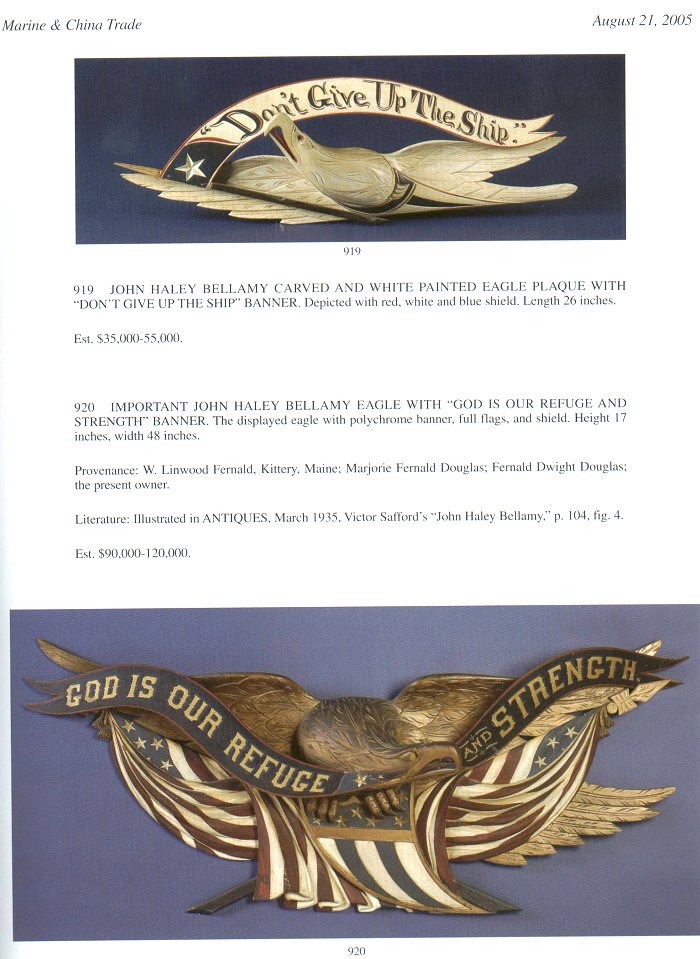
John Bellamy
Carved Masonic Clock
circa
1875
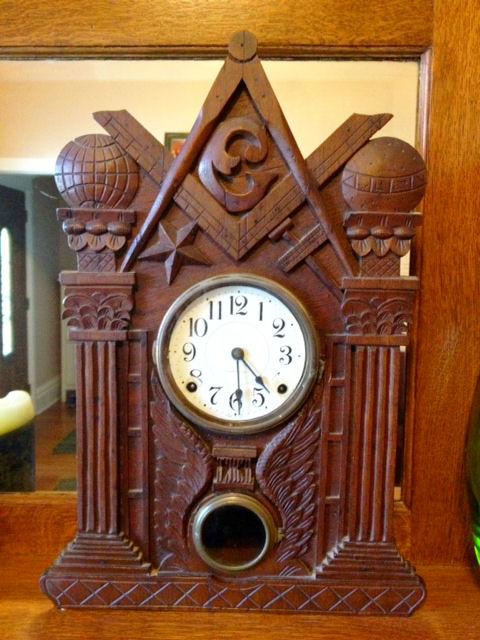
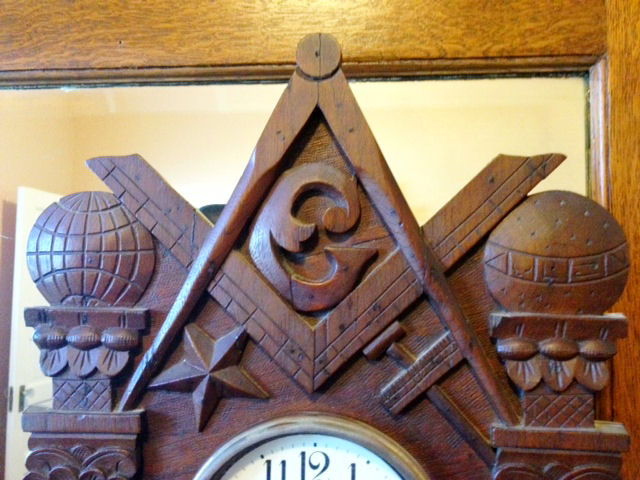
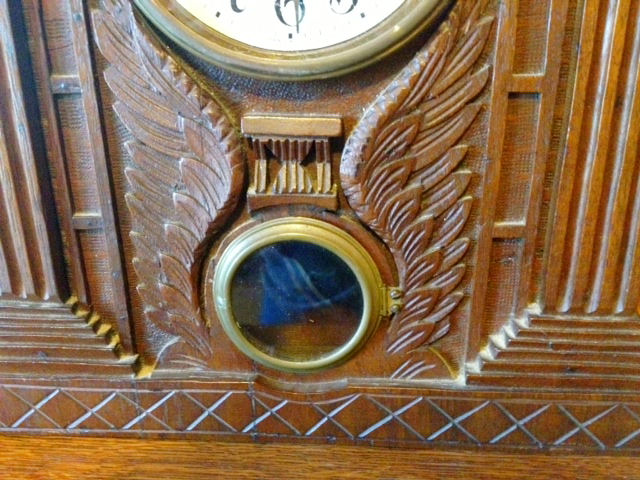
Here is a carved Clock case frame
with Masonic symbolism, circa 1875. The frame includes the name, "J.H.
Bellamy." The Masonic
symbols have been cleverly arranged to simulate armorial devices.
Fraternal organizations have
played a significant role in the history of America. The use of the
iconography of these organizations in the decorative arts has been a
significant aspect of the material culture of America through the centuries.
Free Masonry is one of those organizations. The use of Masonic imagery can be
found in virtually all of the decorative arts of America including clocks and
watches. To see an excellent website with examples of decorative and
utilitarian objects incorporating Masonic symbols, click
here .
John Haley Bellamy was a wood carver from Kittery, ME. He was active in the
latter 1/2 of the 19th century into the early 20th. He is best known for his
ship carving and his decorative eagles which in today's folk art market can
bring large sums of money. For more about him, please see Yvonne Brault
Smith's excellent book, John Haley Bellamy:Carver of Eagles, probably
the best reference about the oeuvre of this important American wood carver.
The objects he created are highly sought after by folk art collectors.
Bellamy is known to have carved objects, especially frames, replete with
Masonic symbols as the main decorative elements. See the above reference,
website and the picture below for examples of the frames. The one I posted is
in my own collection and a picture of it's twin, from the collection of The
Museum of Our National Heritage, is pictured in Smith on page 13.
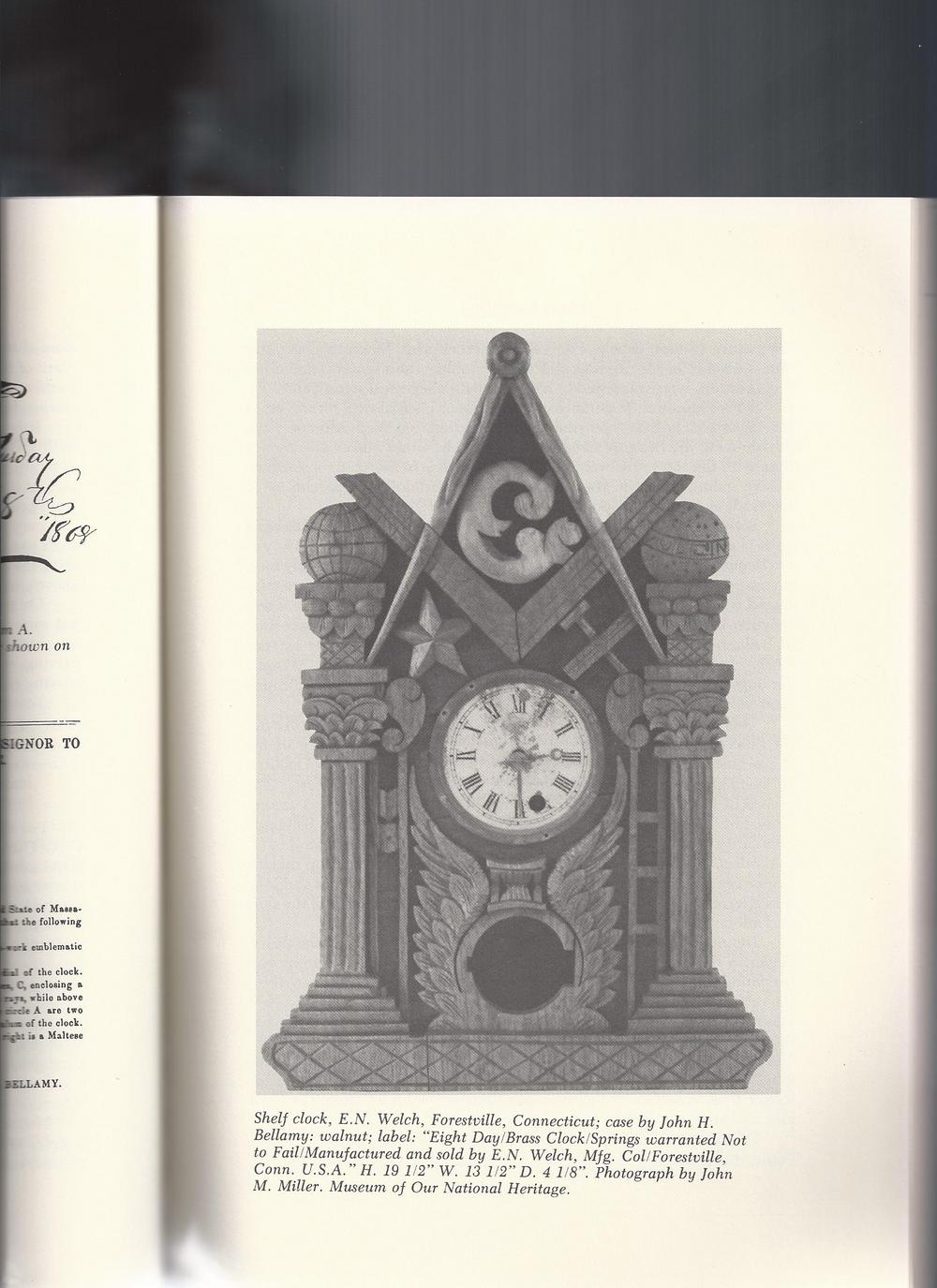
Bellamy was also known to have carved shelf clock cases. The designs for
which, according to Smith, he took out 6 patents. See Smith, pages 16 and 89
for a copies of two of his patents on these clock cases and pages 17 and 88
for examples of the clocks bearing the label of E.N. Welch. Scans of the
pictures of clocks in Smith are posted below. Also see the above website for
examples of these clock cases. I have posted pictures of the clocks from the
website as well. Note one says "Sessions" on the dial. This is an obvious
later replacement. I have only seen 2 of these clocks in person. They don't
come up very often.
Posted below are pictures of what I believe to be a Masonic clock by Bellamy.
I has a striking resemblance to other published examples as well as sharing
some of the attributes mentioned in the patents. What sets it apart and I
think may make it a bit more special is that it is a miniature at a mere 10
1/2 inches tall and it is a lever movement time piece (movement by Hubbell).
The case is walnut with walnut carving applied to a stipple punched background
all in old surface. Yes, there are some age splits and a few what look to me
to be old pieced repairs to the applied decoration. The movement sits in a
simple "box" attached to the front.

About the
Artist/Carver
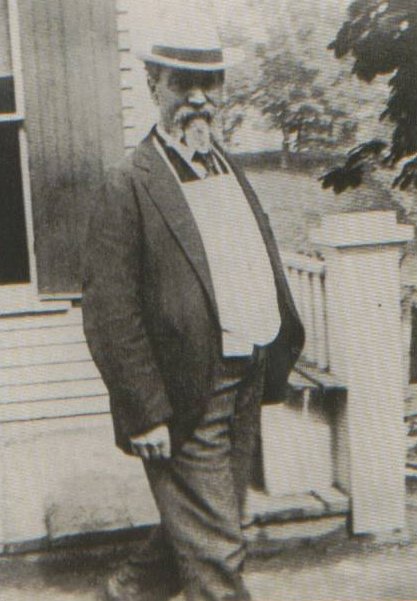
John Haley
Bellamy 1836 - 1914
John Haley Bellamy was a wood
carver in Maine, Portsmouth, New Hampshire and Boston. Although he is best
known for his ship figureheads and carved eagles, he also carved decorative
pieces and family coats of arms. Heraldry was a hobby of his and his
familiarity with the subject is obvious in the design of the above pictures
what-not-shelf. Although he is best known for his ship figureheads and
carved eagles, he also carved decorative pieces and family coats of arms.
Heraldry was a hobby of his and his familiarity with the subject is obvious in
the design of the above pictured clock case. Born in 1836 in Kittery
Point, Maine, John Haley Bellamy worked in Boston as a young man in the shop of
the ship carver Laban Beecher (1805-1876) and later attended the New Hampton
Literary institute. Sometime after 1857, Bellamy began his career as a
carver, working first at a shop on Washington street in Boston and later back
home in Maine. By the time he was thirty, his work was beginning to be
recognized for its creativity. Though he never considered himself an
artist, he was fiercely proud of his creations: "There is one thing I can say as
to this work of mine. It is original with me and never known or heard of
until I produced it." In addition to his well-known eagles, Bellamy's
output included clock cases, signs, frames, animal figures, and furniture.
Despite enjoying a reputation as a master carver, shipping his pieces throughout
the country, and patenting six types of clock cases and an oarlock by 1880,
Bellamy never achieved true financial security. Part of this is due to his
restless nature which never allowed him to stay in one position, no matter how
successful, for too long. Regardless, Bellamy never stopped carving, and,
by the time of his death, his work was well-known. When Bellamy died in
1914, The Portsmouth Herald wrote prophetically that "his name and his
carvings will probably be known longer to the outside world than that of any ...
man from (Portsmouth)."
Bellamy's most famous work is the
monumental Eagle figurehead carved in the late 1870s for the ship U.S.S.
Lancaster in Portsmouth, removed from the ship in the 1920s. Despite
weighing 3,200 pounds and displaying an eighteen foot wingspan, the Lancaster
Eagle is Bellamy's masterpiece, exemplifying his skill in using simple lines to
convey action. The only identifiable figurehead carved by Bellamy, the
Lancaster Eagle is in the collection of the Mariner's Museum in Newport News,
Virginia.
Twenty-one years after his death,
Victor Stafford, Bellamy's nephew, published "John Haley Bellamy, The
Woodcarver of Kittery Point" in The Magazine Antiques, which was the first
national article to explore his life and work. A later, more scholarly,
treatment of his life and work is Yvonne Brault Smith's John Haley Bellamy;
Carver of Eagles published in 1982.